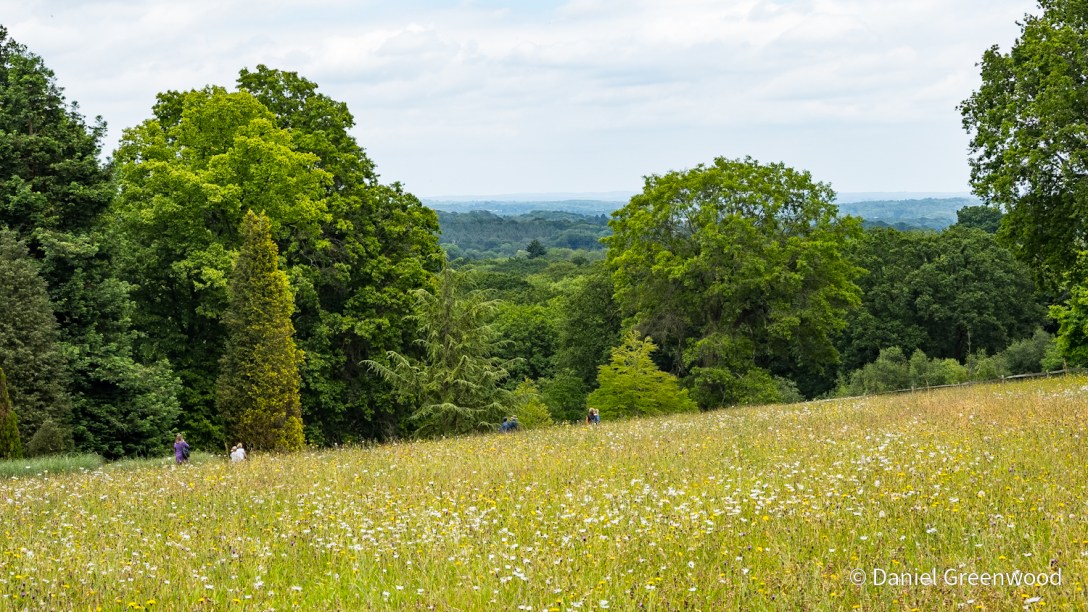
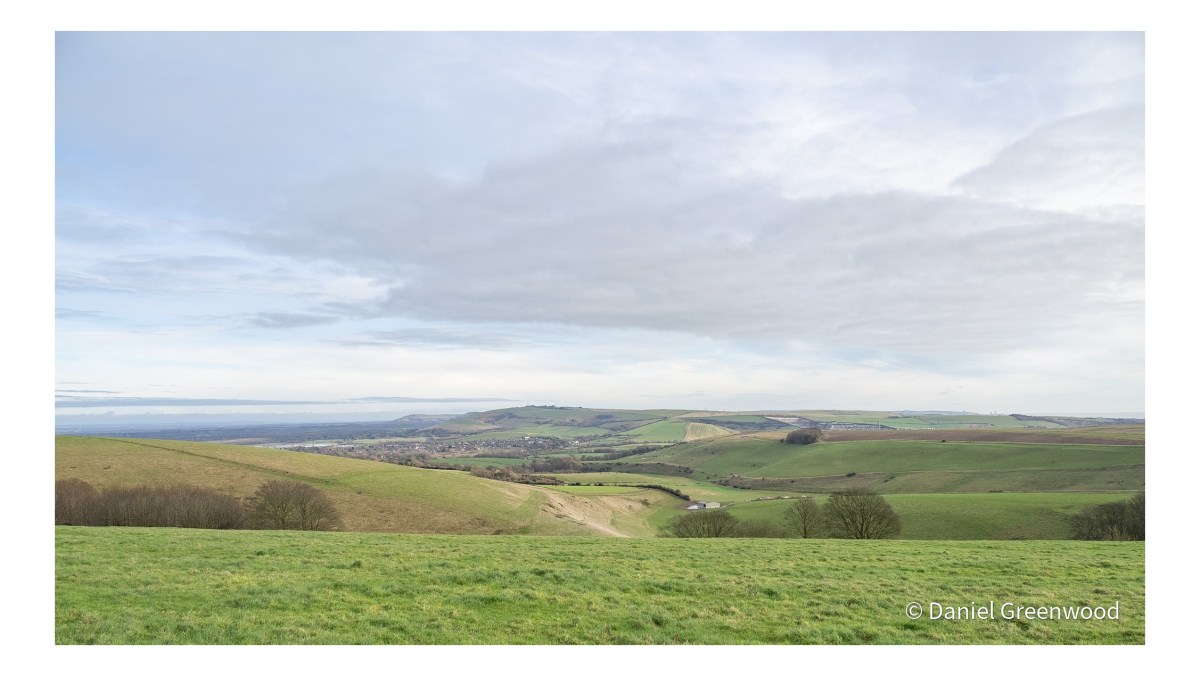
Nymans is a National Trust garden in the western edge of the High Weald. There are great views across Mid Sussex towards the South Downs. This visit was just for a general walk, but it quickly dawned on me that it could be a chance for some macro.
I had my Olympus 12-45mm lens with me which can work really well as a macro lens. Bingo!
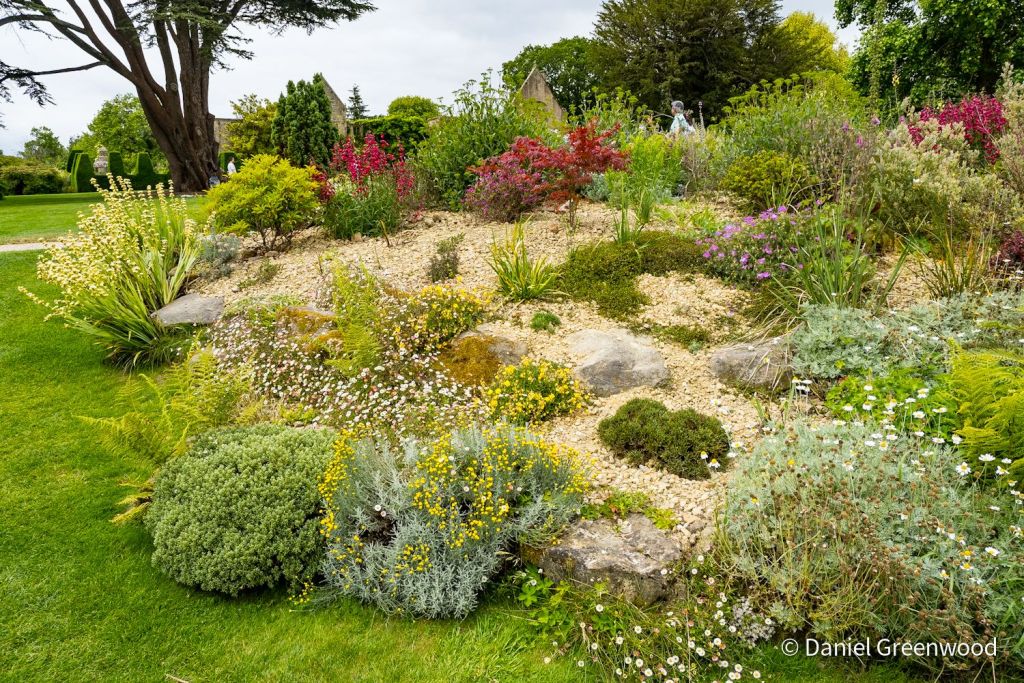
Nymans has a lovely array of rock gardens and extravagant flowering borders.
The common spotted orchids were peaking, as you can see, the flowers turning to seed.
I realised this visit could be interesting for macro when we spotted this caterpillar munching on a knapweed leaf. It’s the larva of a sawfly, rather than a moth or butterfly.
Elsewhere on the knapweed was this small robberfly. I love seeing this striking group of flies, they make great subjects. They also strike, in the predatory sense.
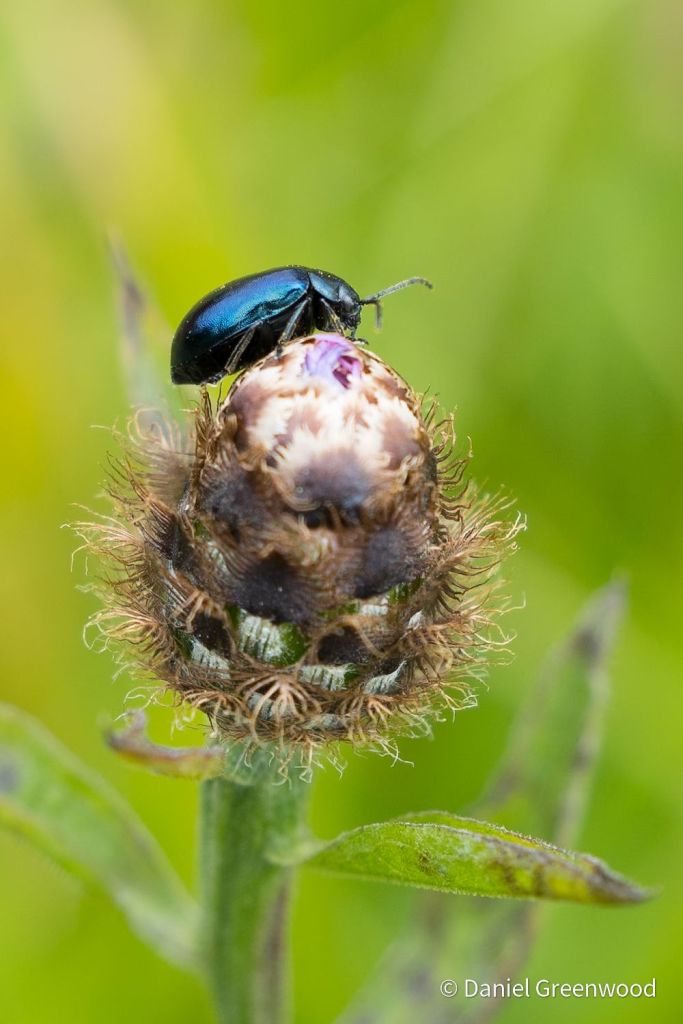
I’ve seen loads of alder leaf beetles since moving to Sussex but I usually see them in towns. It’s always nice to see one in a meadow.
There were a number of small bees around. I think this is one of the bronze furrow bees.
In the head of a meadow cranesbill was this rather dozy little solitary bee. I pulled the petal to the side, as you can see here, to see if it had been caught by a spider. It hadn’t, it was just still.
Nymans has rose gardens, where I found this solitary bee trying to make sense of the maze of petals. Life, eh?
No nationalism was expounded in the making of this blogpost.
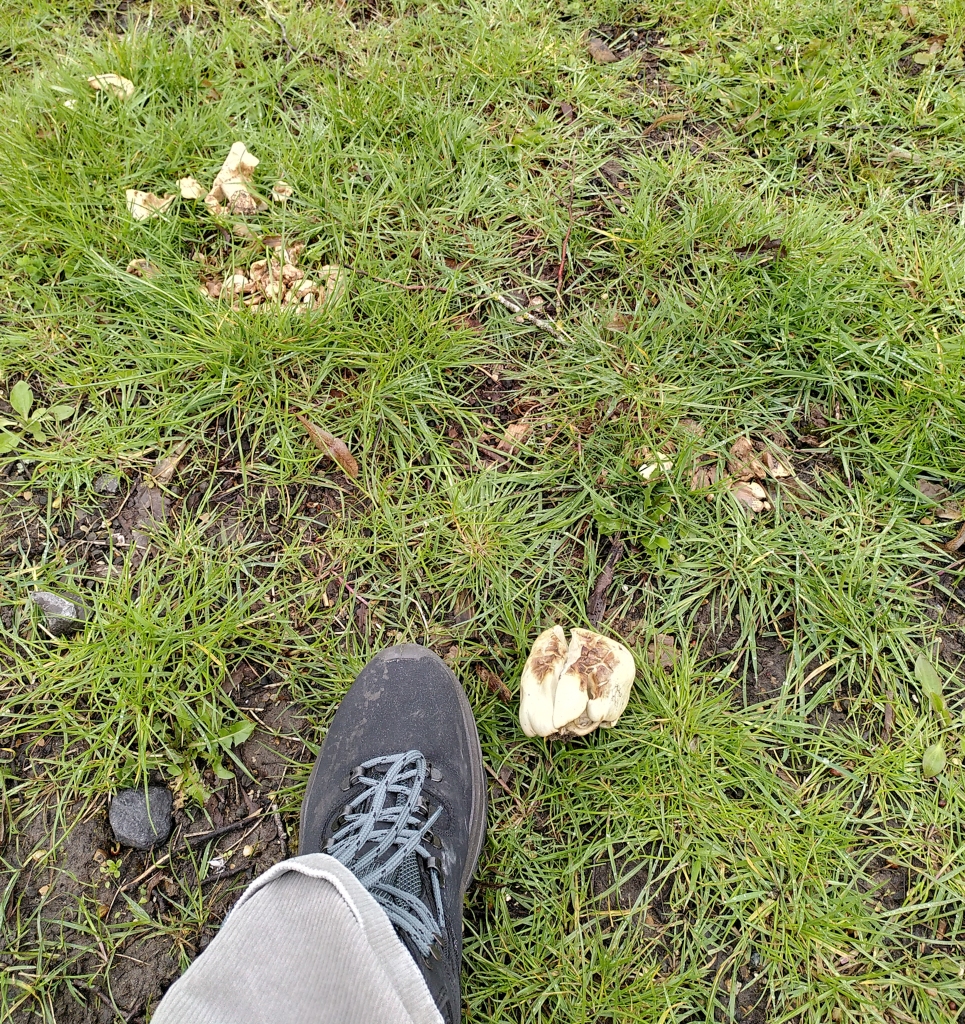
On a recent visit to the National Trust’s Nymans Gardens I spotted some big, cream-coloured things in the lawns near the car park. No, these were not scones or cream cakes, or even pasties discarded by visitors. It clicked almost immediately for me that these might be St. George’s mushroom – and guess what? I found them on 23rd April, St. George’s Day!
That is definitely the most enthusiasm I have offered for this national day. If it were to be made a holiday, then we can talk.
Spring can be a time of shrooms, as the frosts end and the temperatures rise. We’ve had quite a lot of rain this spring in SE England and so some mushrooms will fruit in response. St. George’s mushroom is one of those springshrooms.
Like many people in the UK my sense of personal identity is not straightforward, and I don’t celebrate St. George’s Day. I have strong Irish roots and as a Londoner of 50% Scouse parentage I feel an affinity with a more regional, culturally complex identity, rather than one of red and white, chest-thumping ‘Englishness’, whatever that is.
It makes me wonder though – is this England’s unofficial national mushroom?
A simple online search shows up no such award, which is probably a good thing. Surely that accolade should go to honey fungus!
You may not be surprised to find that its common name changes depending on its location. In Germany the mushroom fruits in May and is known as Maipilz. That means ‘May mushroom’. In fairness to Maipilz, that’s only 8 days later.
St. George’s mushroom is also edible. I didn’t pick or eat this one, and it’s not on my radar to do so anytime soon. The above seems to have been nibbled free in actual fact. Also, I wouldn’t encourage people to forage from National Trust properties generally because I don’t want to get banned.
The cap turns brown over time making it look like a barbecued chicken piece
St. George’s mushroom appears to enjoy garden lawns, so if you’re lucky you may have one popping up outside your front/garden door. As ever, you should be cautious about eating wild white mushrooms as there are several toxic species which can be confused for edible ones.
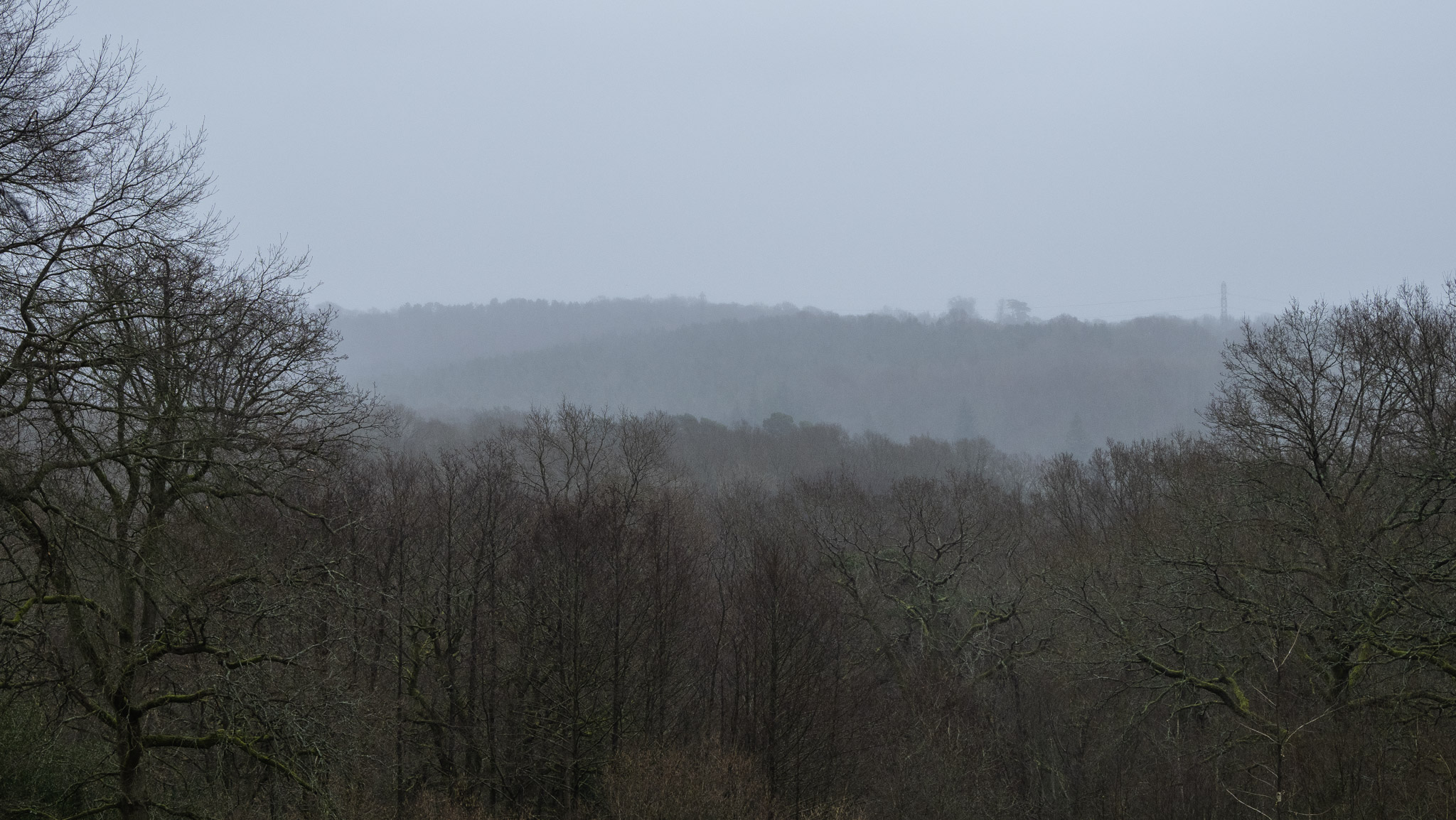
My partner and I made a couple of visits to Nyman’s in West Sussex recently to drown our sorrows after the death of our lovely rescue cat. We drowned those sorrows in flowers. Nymans is one of the jewels in the Sussex Weald, with amazing views across woodlands towards the South Downs.
I usually photograph less formal landscapes than National Trust gardens, but perhaps I am too particular sometimes. The stark colours against the grey backdrop of the day (literally) make for really pleasing images. All the pics here are ‘straight out the camera’ and I haven’t edited them. Olympus cameras produce beautiful jpeg files which my experience with Nikon equipment has never matched.
I’ve had a burst of American visitors in recent days (to my blog, not my house). So thanks for visiting, y’all, and sorry about the year you’ve had. You may have noticed I’ve slipped to monthly posts on here. Between April and October I posted blogs every Monday without pause, which is a tricky task…
Here’s my seasonal update of stuff you don’t need to know about, but then welcome to the Internet. What I’m writing Soon I will be self-publishing my third poetry collection, Fool’s Wood. It’s seven years since my last one and this collection has taken longer because of LIFE. There will be a booklet and also…
This was the week when fungi made a comeback in the form of windblown sticks.
I used to do post-storm checks in an oak woodland. It was a really enjoyable task, which may come as a surprise to hear. One benefit of all the damage to trees was seeing what previously was only seen by birds and squirrels in the canopy. By this I mean lichens and other fungi attached to windblown wood.
From my experience, one of the big ‘losers’ in stormy weather in SE England is the beech tree (Fagus sylvatica). Beech is a ‘poor compartmentaliser’, meaning it isn’t particularly good at preventing fungal decay or rot from spreading to other parts of its anatomy. Oak is better evolved to deal with this.
This was a thought I had on Friday (18th February) as the winds whipped up around outside. I thought of all the beech trees in the Sussex Weald and Downs, exposed on their respective ridges, and how vulnerable they can be.
On Sunday, a visit to the National Trust’s Nymans (so woke, bro) revealed a beech to have suffered. Nymans sits on an exposed ridge, with fantastic views across the Weald (to the Ouse viaduct) and the South Downs. One path was closed and in the distance a beech tree had fallen across it. Taking a detour round and looking at the damage, there was clear evidence that it wasn’t just the storm that was to blame – fungal decay had softened the tree up.
At some point earlier in the tree’s life, decay had entered the tree’s core, leaving it open to this kind of collapse. I’ve posted about something similar previously:
It’s a natural part of life on earth but causes problems for more controlled environments where people want to walk under trees and where they perform vital services as ‘green infrastructure’ among the grey. People who work in insurance will be very busy for the next few weeks assessing the damage that the storm, combined with fungal decay in trees, has caused.A windblown magnolia tree – spot the mushroom in the background
Also at Nymans, a magnolia tree (which I mistook for an ash until I checked the buds) had succumbed. The roots had snapped and the tree had fallen across a path.
As you can see from this photo, the fungal decay was dominant in the tree’s core. This is probably about 30-40% of the tree’s inner wood close to the roots. The decay had spread to the roots, which is probably what caused them to fail. Tension, which holds the tree up, is lost when the roots give way and thus the tree falls.
This is where the treasure is found. When the branches that were once high up meet the ground, interesting lichens and fungi can be seen for the first time.
At Nymans there were plenty of little sticks with beautiful lichens on show (you may be able to tell these are phone pics). You can look at #StickOfTheDay or #StickOfTheWeek on Twitter if you want to see more of these.
My best find of this kind was a piece of decaying oak wood that I spotted the night before. I saw in the dark this glowing thing under a hedge, underneath an oak tree I knew was in decline. I picked them up and stored them away to be photographed the following day.
This was a stunning collection of foliose (leafy) lichens and a species of Trametes fungus, likely to be turkey tail. It perfectly illustrates the importance of decaying wood in trees, whereby the ‘dying’ wood becomes a source of nutrition and, indeed, a home for the fungi and lichens. Deadwood (saproxylic) insects will be inside the wood helping to break the wood down further. It’s what woodlands across Europe are losing due to the ‘coniferisation’ of plantations and the lack of space to allow woodlands to do their thing. Storms included.
The photo above took off when I posted it on Twitter. So much so that it made its way into the strange world of Weed/Marijuana-Gaming Twitter. Sorry to disappoint those in that netherworld, but I hadn’t even considered that someone might “smoke it” until I saw those replies.
A couple of weeks ago I was inspecting a bird table in my garden and spotted a moss growing from its ‘roof’. This bird table has been, literally, around the houses and has probably gathered many organisms along the way. Looking more closely I found some jelly fungi.
The weather has been showing signs of spring, with queen bumblebees on the wing and what I am sure was a male hairy-footed flower bee travelling through the gardens. On Monday I was in the garden briefly and had a closer look at the bird table. On the edge I found a nice cluster of what I think are lemon disco (yes, great name!).
During a brief trip to The National Trust’s Nymans in the Sussex Weald this weird species was on the decaying heartwood of an old cherry tree. It’s a slime mould known as false puffball. If you press it with your finger it bursts, a bit like other Lycoperdon slime moulds such as wolf’s milk (search for it).
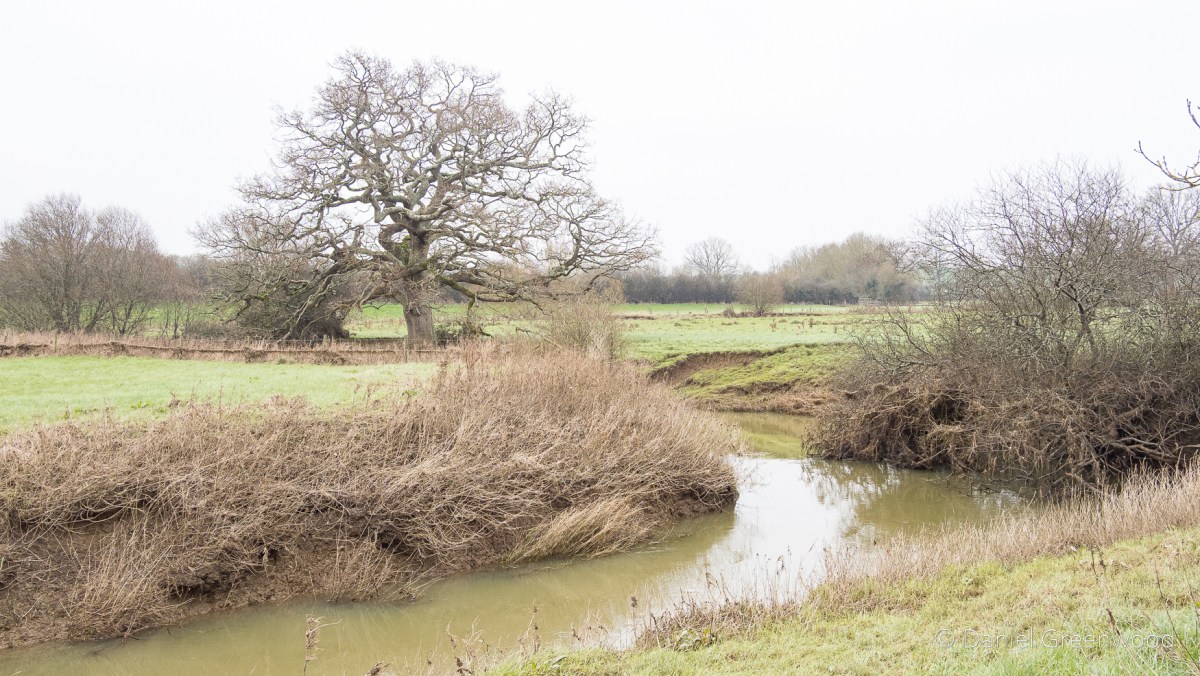
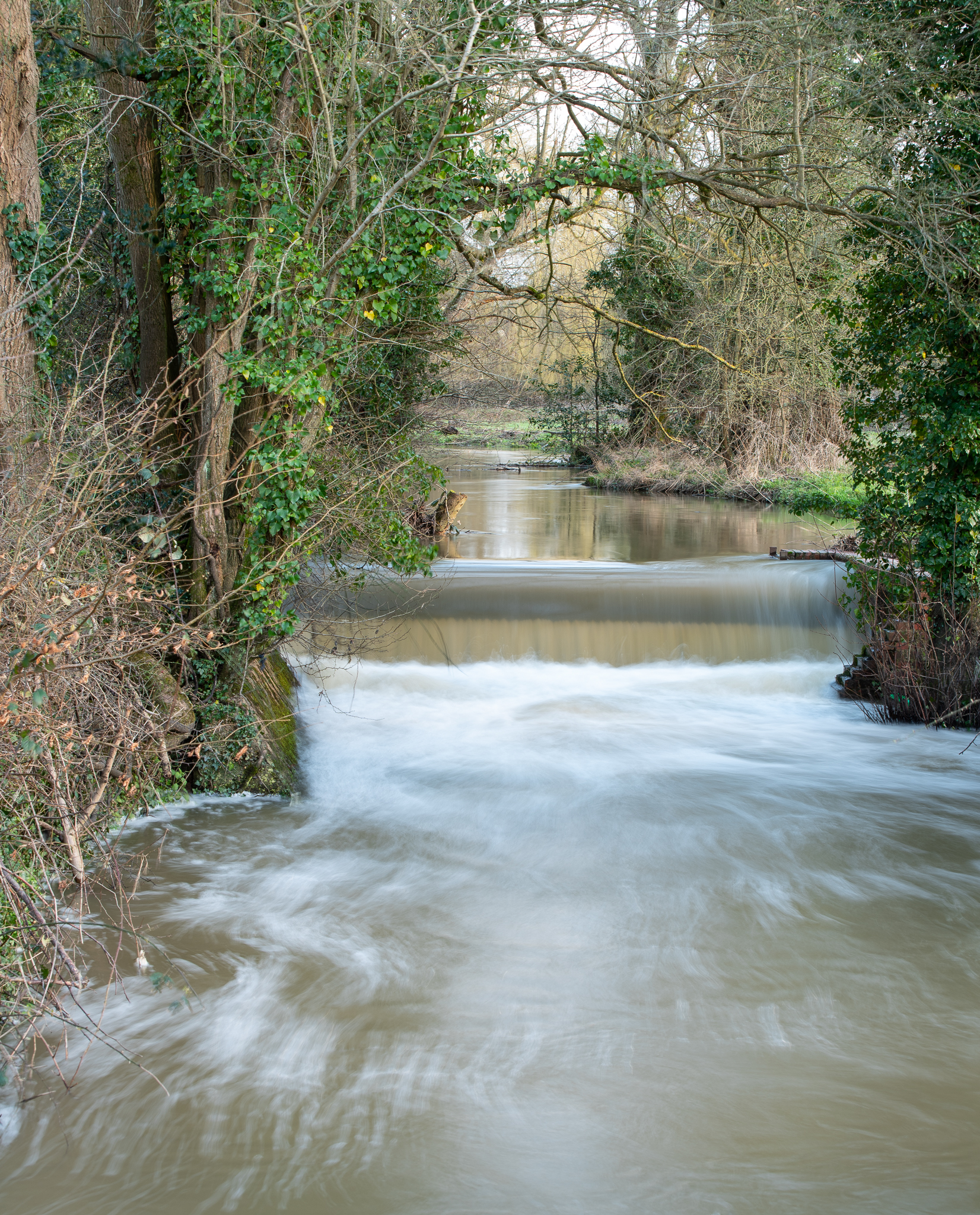
Elsewhere, the state of Sussex’s rivers shows how high the rainfall has been so far this year. But the lichenised-fungi are benefitting.
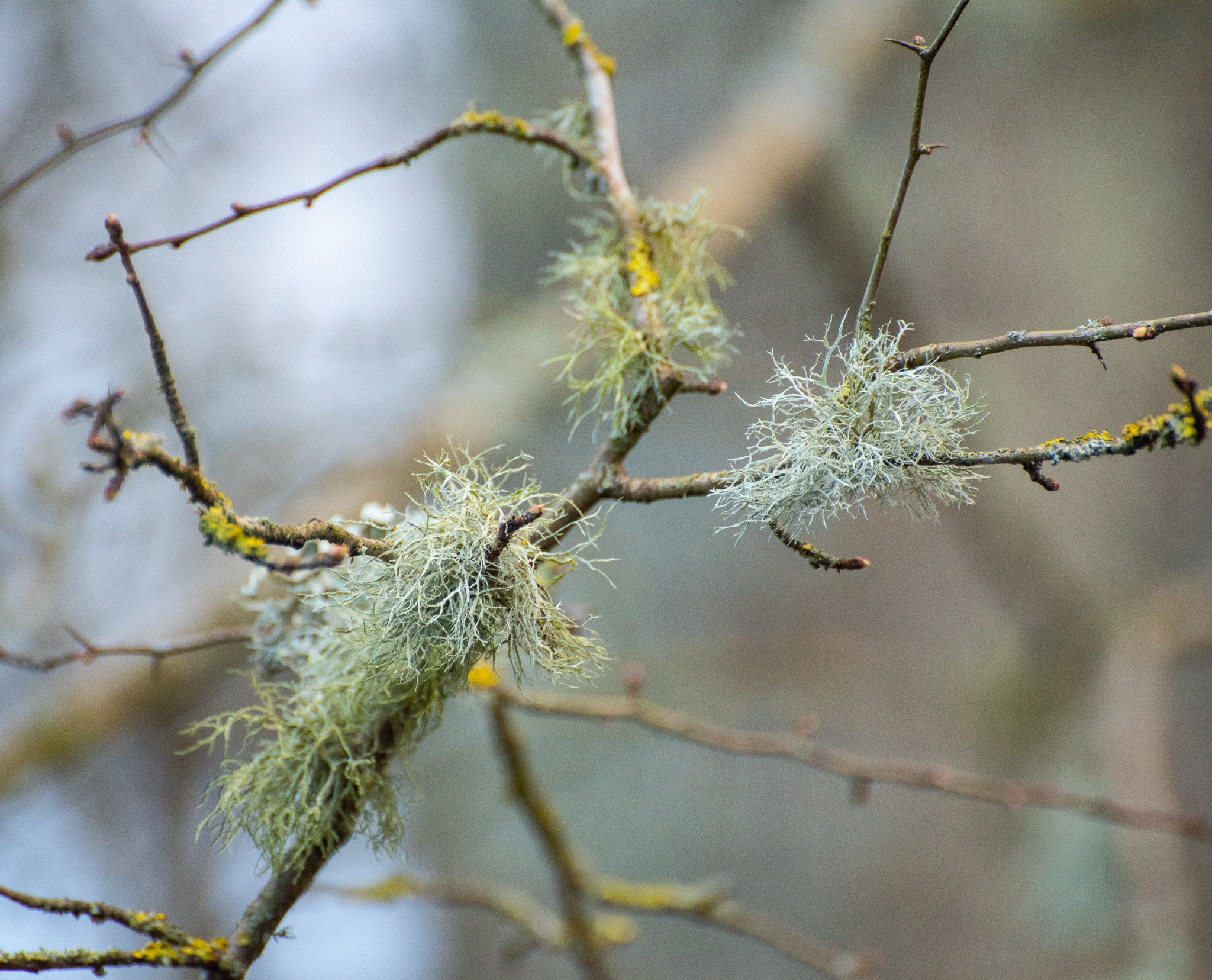
Along this stretch of the river Arun, these beard lichens were profuse. One hawthorn was so covered with them it seemed like there would be no room for leaves in a couple of weeks!
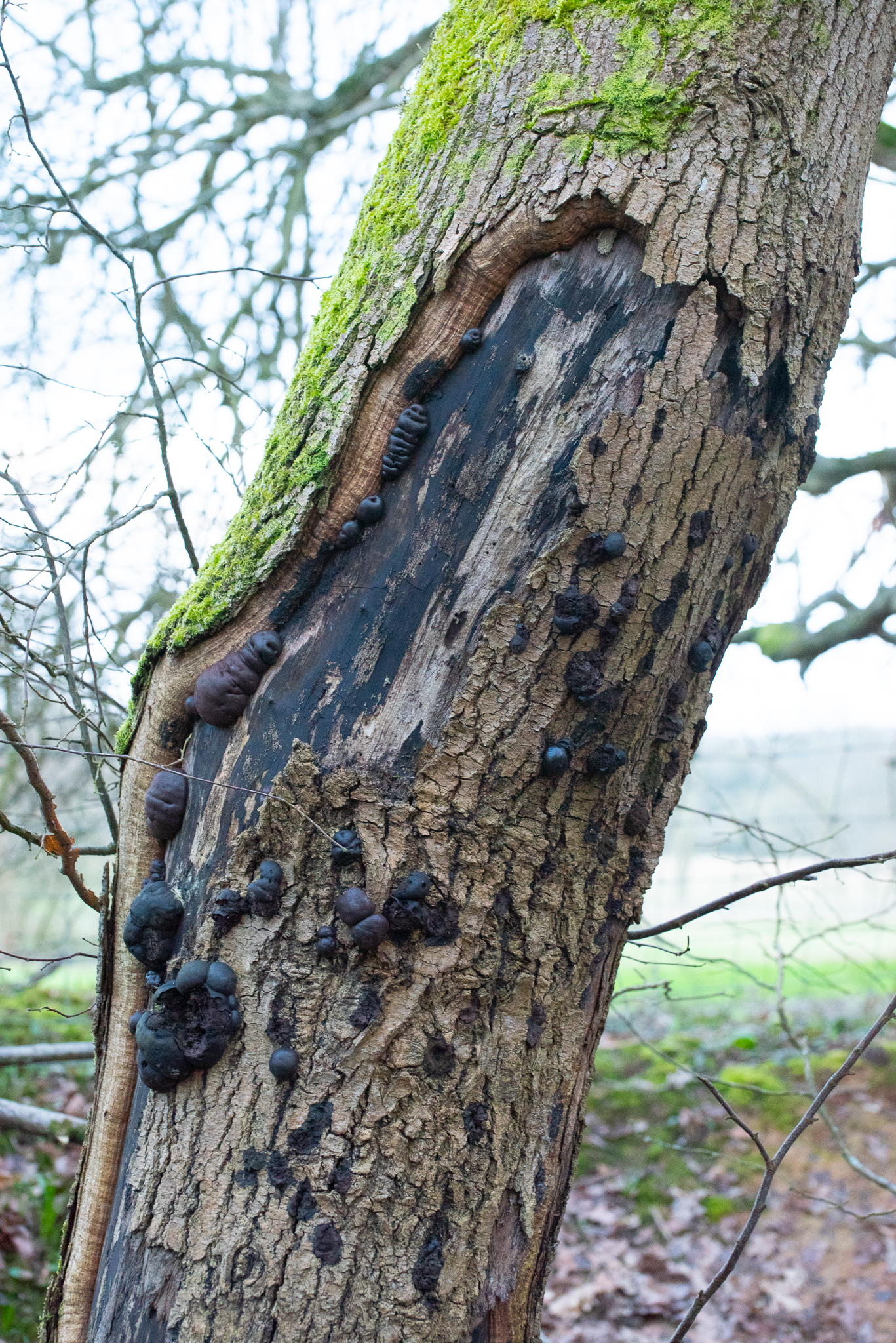
Not far away from the gushing Arun was a veteran ash tree with lots of King Alfred’s cakes growing from the damaged bark. In this image you can see the folds of the cambium where the tree is trying to protect itself from fungi and other invading organisms. This fungus will have a boom from the amount of dead ash trees caused by the evil fungus behind ash dieback disease.
To people outside the UK or without a grasp of English history, this name is quite meaningless. It is based on the tale of King Alfred who was exiled in the Somerset Levels during the Viking invasion of Winchester. Alfred failed to keep an eye on a woman’s loaves of bread that were on the fire and they burned. It is said that she had no idea he was the King, so far removed was his from his throne. Don’t worry, he eventually came back and pushed the Danes away a bit.
In the real world this fungus is said to be a host species for hundreds of invertebrates. It’s also used as a kindling and many people who know of it do so for that reason.
Let’s hope for milder temperatures and less rain and see if some more photogenic fungi pop up!




















 Unlocking Landscapes