
Ever felt you couldn’t sleep at night because elves were tickling your feet?
No? You obviously haven’t lived alone in the remote forested regions of eastern Russia. Then again, most of us in the ‘Western World’ never will. Judging from Owls of the Eastern Ice, that sounds like a good thing, it must be said.
So here we have the tonic to the ‘My Search for insert species‘ books that dominate the ever-growing nature writing bookshelf. It’s the story of years of scientific research trips conducted by American PhD student Jonathan C. Slaght seeking the endangered Blackiston’s fish owl of far eastern Russia, before their illegal war and genocide in Ukraine began (Russia, not the owls).
But it’s not necessarily the owls that draw the most interest here, it’s the people:
People arrive at the author’s shabby accommodation with bottles of ethanol (and sometimes cleaning fluid) as their ‘poison’ of an evening.
A local man shows up drunk, having been that way for days, perhaps weeks.
Bottles of vodka are sold without caps but instead foil tops, as it’s rude not to finish a bottle among strangers.
Anatoliy, a man who lives in a cabin in a remote part of the woodlands the author is surveying, says he can’t sleep at night sometimes because the elves tickle his toes. He is said to be hiding out after a business deal with dangerous Vladivostok people went awry.
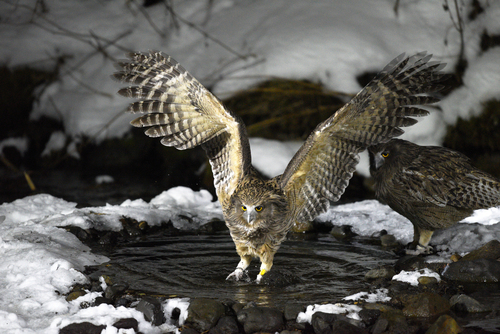
There are the hunters and the poachers (poaching being extremely frowned-upon), the young lad who admits to shooting a fish owl to provide meat for his trap. An endangered bird killed for scraps by someone who doesn’t know better. Though it has to be said it’s not the same for all the hunters who appear in the pages of the book. The author fumes at the news, but what can he do? Work harder, complete his project and get his conservation scheme approved.
One of Slaght’s recurring themes is the viscousness of poverty, which leads local people to brutalise starving deer wandering into the villages when a terrible snow storm strikes.
Then there are the loggers expanding their roads and business into the old growth forests likely never touched by forestry of this scale and intrusion. Thankfully (spoiler) the author does conclude that the logging companies work with his findings to help preserve the owls’ habitat and feeding areas.
Even the despot Putin gets a mention for his conservation interest in the Siberian tiger (there are no tigers in Siberia, and should really be called ‘Amur tigers’), more evidence that even the most vile public figures will use nature to embellish their popularity. That man has since visited ecocide on an epic scale in Ukraine.
Tigers stalk the pages of this book like mythological creatures, but still the focus of persecution from fearful and poorly-informed locals.
I loved this book (sent to me by my friend Eddie, thanks!). It’s probably not for everyone due to the talk of surveying and monitoring, the detail of the owl’s territory and behaviour. But the stories of the people who could either threaten or salvage the lives of these precious birds, are perhaps what really bring the book to life. An absolute classic of the bird writing genre, if there is one.
Thanks for reading.
 Unlocking Landscapes