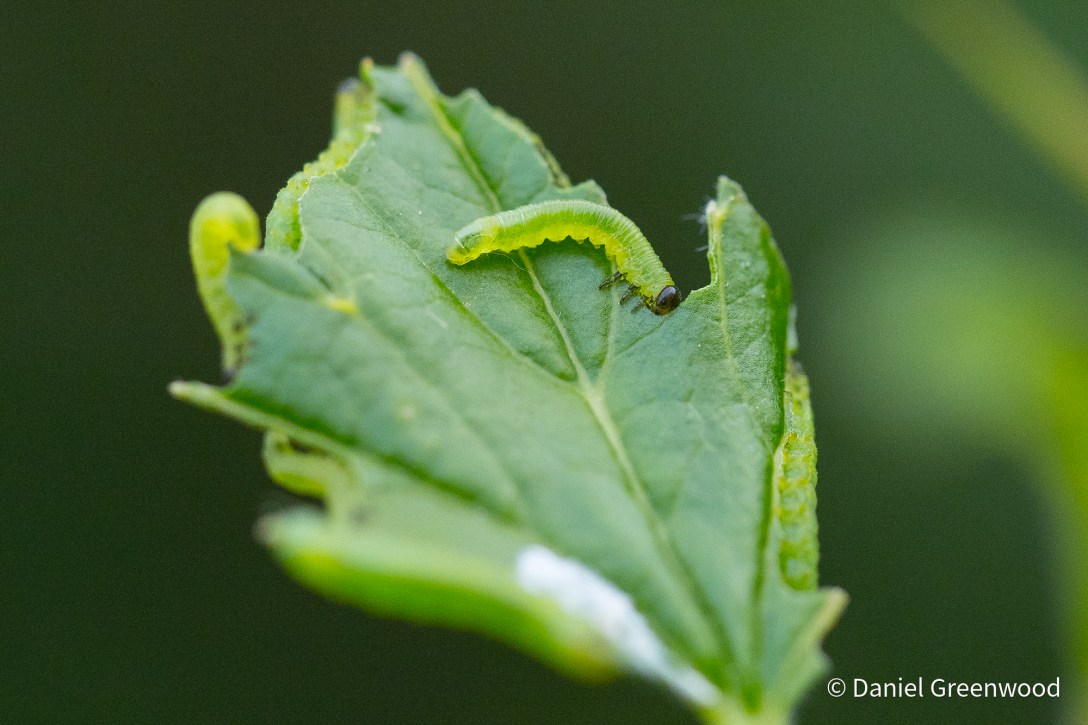
In June, my wife called me out to the garden because she’d found something in the gooseberry. Pretty standard.
She has an amazing ability to find things and is especially good at foraging. In this instance she’d found caterpillars munching through the gooseberry leaves.

There was a sense of both amazement at what we were witnessing and fear for the health of the shrub. We don’t survive on gooseberries and the birds almost always get to them first, but you don’t really want your shrub to die. Then again it hasn’t exactly been a raging success, to be honest.

Personally, I always think English gardening culture fails to accept death and decay into the mix, and the important role that plays. Gardens should feed local wildlife, not just be a killing zone for visitors deemed unwelcome.
One summer does not a garden make!
With the help of iNaturalist I understand these to be small gooseberry sawflies (Pristiphora appendiculata). Sawflies are relatives of bees and wasps that are common in gardens and elsewhere.

I do love this view of the sawfly caterpillar nibbling its way through the leaf. When we looked at them on the gooseberry new caterpillars would appear as your eyes adjusted.
In the days that followed I noticed house sparrows hanging from the surrounding raspberries and picking at the gooseberry. That’s a very good meal, especially for fledglings.

Some days later I spotted a new visitor to the gooseberry. I was confident this was a sawfly (not knowing anything about their lifecycle) but unsure if this was one of the caterpillars emerged as an adult insect. I’m not sure, but it’s likely to be an adult small gooseberry sawfly.
As for the gooseberry bush, it looks ‘touch and go’ as football physios say. It’s part of the game of life.
Thanks for reading.
 Unlocking Landscapes