Blog

Oaks of London: Sketch for Hounslow oak

6tag_111116-193625.jpg

Tree: Old common boundary of Hounslow Heath, Hounslow, west London, November 2016
Species: English oak, Quercus robur
Age: Between 200-300 years?
Status: Under attack

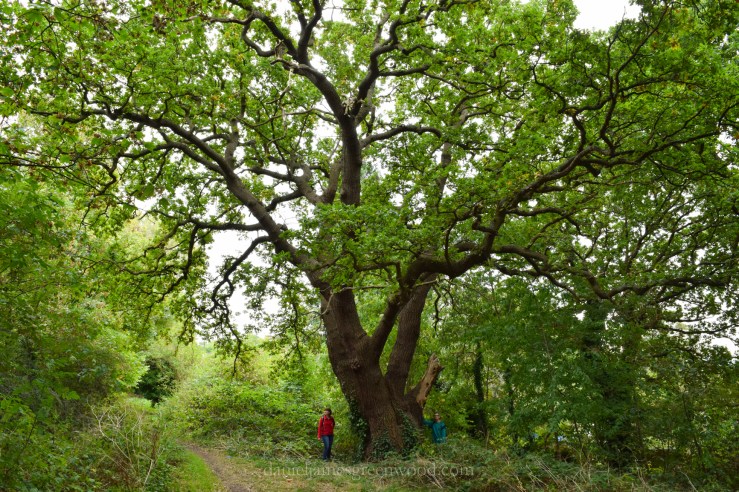
This phone photo was all I could take at the time of this sprawling specimen, so let’s consider it a sketch. It was on the western edge of Hounslow Heath in west London. I know less about west London’s natural history than the south, though I am familiar with the Crane valley. This oak is probably a coppice or a felled, accidental coppice, which has regrown. It is well-climbed but showed signs of charring from fire at the base. Gorse nearby had been burnt in what are considered arson attacks. In many ways the fact this tree is not older and more cavernous and has fewer points of entry for fire may protect it. Hopefully the arsonists – common in urban nature reserves – grow out of it or else are prosecuted.

Oaks of London archive

Photography: Halloween in the New Forest, October 2016

new-forest-october-2016-lo-res-17

This post is part of my Woodlands project

View my full gallery of New Forest photos on Flickr

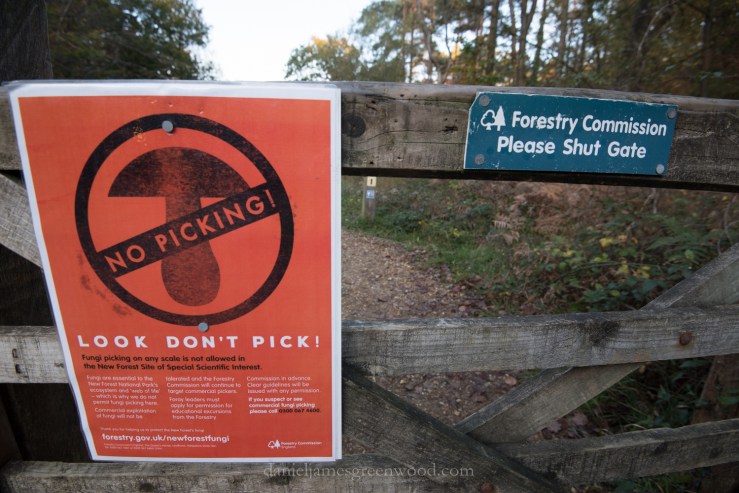
One of the great rewards of cultivating an interest in wildlife is the freshness and newness, the constant change. In spring it’s the woodland flowers breaking through the soil, in summer the bees, wasps and butterflies, and in autumn I seek out mushrooms on the woodland floor. This autumn, however, has not given the third kingdom of biological life, the fungi, what it needs. It has been very dry in the south of England. In October 2015 clouded and trooping funnels were romping across the woodland floor but this year there is very little soil-based fungi. Thanks to the astute minds of woodland conservationists who leave deadwood ‘in situ’ there are still mushrooms to be found and photographed for those of us who seek it. As I’ve said before, I’m not a forager for no good reason other than that I just enjoy photographing mushrooms. The New Forest has received publicity recently for its mushrooms and the Forestry Commission’s ban on all picking.
new-forest-october-2016-lo-res-162

Sure enough the signs were up when entering Forestry Commission land. I put similar signs up in my professional life and wish more people would respect the landowner’s wishes. But I sympathise with both sides in this case. Peter Marren argues that the Forestry Commission do more damage than a forager ever could with the use of heavy duty forestry machinery. Mushrooms are just the fruiting body of the fungus itself and the most important thing for any soil-based fungus is the mycelium in the soil. When heavy machinery is used in a forestry setting the soil is churned up and the mycelium destroyed. Even when the biggest band of foragers comes to raid the nest, they will only really be doing what the organism wants – spreading the spores released by the mushroom and leaving the mycelium intact. I sympathise with both arguments and feel that Marren may have the edge scientifically.
new-forest-october-2016-lo-res-30

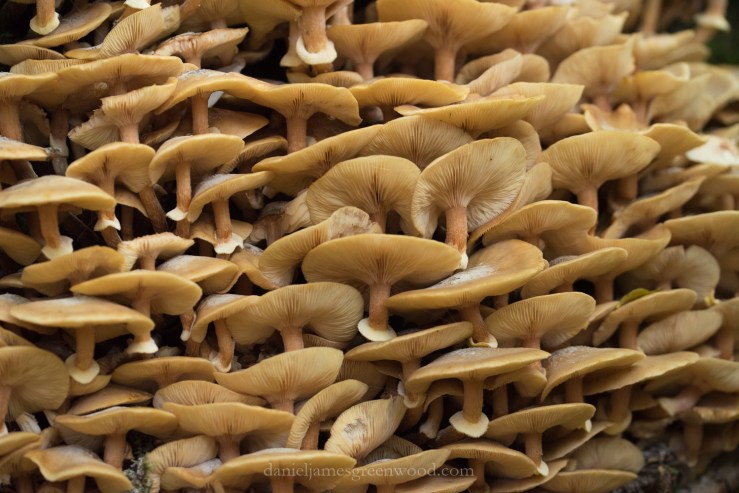
Conservation debates aside, there were lots of mushrooms to be seen. It has only been in the final weeks of October that honey fungus (Armillaria) has begun to appear and I came across large spreads of this most attractive and demonised mushroom. It is necrotrophic and often takes more from a tree than it gives in return in the symbiotic sense, meaning that the tree can often fail. It’s a native species often indicative of ancient woodland, so it’s been killing and breaking down trees for millions of years in Europe. But when it costs people money, people get angry.

new-forest-october-2016-lo-res-157

Honey fungus is the common name for a number of different types which are more difficult to identify straight away. I came across this charming clutch at the base of a beech tree. To think that fungi is in the fossil record as far back as 700 million years ago, while the Homo genus we have evolved from broke from other primates 3 million years ago. I feel we owe these unthinkably ancient organisms respect, which means not taking more than we should and protecting their habitats and allowing them to be, well, mushrooms. I think this species is Armillaria mellea owing to the ring and the colouring in the centre of the cap.

new-forest-october-2016-lo-res-78

Though I have complained about the lack of fungi this autumn on the soil sulphur tuft (Hypholoma fasciculare) has had a great year. It took it a while to come out last autumn but it has been first past the post this time. It is one of our most common species, found on the surface of logs and fallen trees.

new-forest-october-2016-lo-res-68

Looking back at this macro image of a bonnet mushroom (Mycena) I noticed the small shower of spores leaving the gills and flowing off towards the left. I’ve never seen a mushroom with a cap do this and certainly did not notice until I looked more closely later. To think one of those spores could end up producing a beautiful mushroom like this somewhere nearby.

new-forest-october-2016-lo-res-103

Spore dropping mushrooms are known as basidiomycetes, pointing to the basidium which, in mushrooms with gills, is where the spores are produced. Alternatively ascomycetes are spore shooters and myxomycetes are slime moulds, which aren’t fungus at all. Still there? On Halloween you could be forgiven for thinking these were the fangs of a vampire mushroom. But vampires don’t exist, and it’s a mushroom. This is a species from the genus Amanita.

new-forest-october-2016-lo-res-105

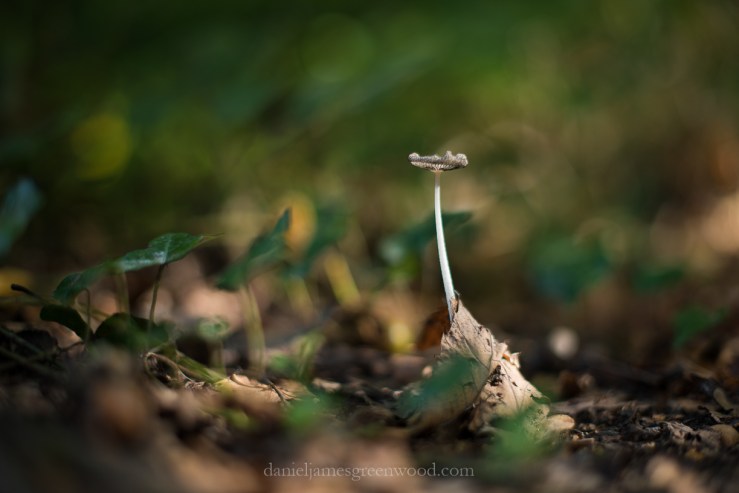
Though it can be disappointing if you’ve travelled a long way to see a big show of mushrooms in the woods and find nothing much, there is pleasure in finding  a little mushroom down in the leaf litter. This little bonnet was sticking its head above a parapet made of beech leaf litter, hence the brown and faintly orange blur throughout the image.

new-forest-october-2016-lo-res-86

Somewhat more incongruous and rock like was this earth ball in the genus Schleroderma.

new-forest-october-2016-lo-res-55

No, I am not saying this is a mushroom. It’s the reproductive parts of a moss seeking to spread its spores across the woodland.

new-forest-october-2016-lo-res-41

In the plant kingdom the bracken, such an important resource for people and their animals in the New Forest, was rainbow-like. The greens were so dark they almost appeared blue.

new-forest-october-2016-lo-res-122

The New Forest is an ancient landscape that supports species of conservation importance across Europe. In England the wild service tree (Sorbus torminalis) is far less common than it once was but Roydon Woods NNR is a good place to find the odd individual tree. I had never seen its autumn colour until this year.
new-forest-october-2016-lo-res-147

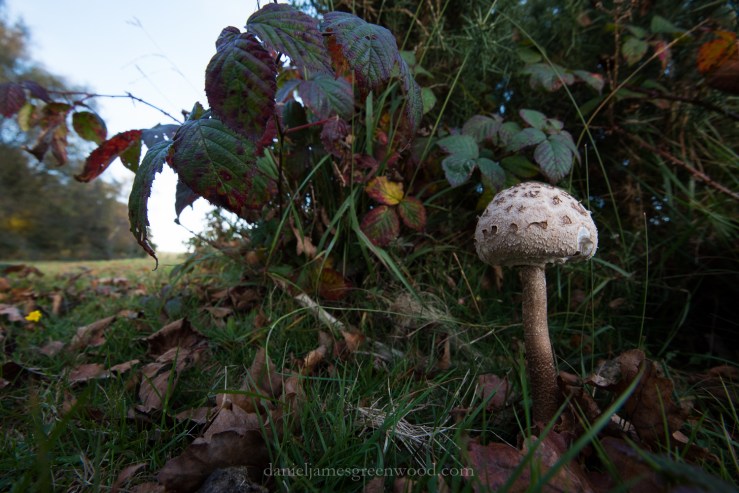
Out of the woods I found this parasol mushroom hiding in the shelter of bramble. If this was a tabloid article there would be a band of European foragers coming round the corner there with sacks full of mushrooms. There was only a lady walking her dog.

new-forest-october-2016-lo-res-168

One of the things to remember at this time of year is how quickly the light fades. On Halloween bats were hunting at 4 o’clock, ready for their upcoming hibernation. Is this why they are such a key part of Halloween’s iconography, because they hunt so close to dusk in autumn we come into contact with them, their shapes imprinted in our minds. I left with the shapes of New Forest ponies grazing the misty horizon of Balmers Lawn, imprinted upon my camera’s memory card.

See more in my New Forest archive


Oaks of London: Rural remnants of Dulwich Park

dulwich-park-oaks-22-8-16-lo-res-26

Trees: Old field boundaries of Dulwich Park, Southwark, London, September 2016
Species: English oak, Quercus robur
Age: Between 200-500 years?
Status: Fair

dulwich-park-oaks-22-8-16-lo-res-55

This sizeable boundary oak lost a limb in a recent storm but it should be able to recover. It’s important to remember that many ancient trees lose their heartwood through storm damage, lightning strikes or by other means. It is also very pleasing to see that the fallen limb has been left to decay next to the tree. Southwark Council are generally good at doing this where conservation policies make it to grounds maintenance.

dulwich-park-oaks-22-8-16-lo-res-43

One of the more intriguing trees is this heavily belted pollard oak. I like to call it the toilet oak. It has put on a lot of bulgewood over the centuries as it’s had to reach out to the light. My images are slightly distorted by the 10-24mm wide angle lens I use, seen in the lean of the toilet block. It seems in fair condition despite the erosion around its base, likely from the soles of children’s shoes as they climb it.

dulwich-park-oaks-22-8-16-lo-res-42

In the fenced nature reserve area is a neat line of former field boundary oaks from the time of farmland smallholdings, likely dating further back to when this was Dulwich Common. These oaks also show a great deal of bulgewood from the interal shifting of the tree’s woody fibres as it has reached out towards the light. They once grew in full sunlight, undeterred.

dulwich-park-oaks-22-8-16-lo-res-37

The one nearest the gate has all the signs of recovering from lost limbs, epicormic growth and the need to put on bulgewood. Immediate trouble for this tree is coming from the yew growing on the right hand side.

dulwich-park-oaks-22-8-16-lo-res-41

It’s an impressive pollard, probably about 300 years old. It is reaching for the light outside the nature reserve.

dulwich-park-oaks-22-8-16-lo-res-33

The furthest oak has lost one of its limbs and has a large wound in the heart of the tree. I can’t underline enough how important this is as a habitat feature for the fungi and invertebrates. It is a major wound but it should be able to recover over time now that the excess weight has been lost.

dulwich-park-oaks-22-8-16-lo-res-26

The largest of the oaks is this fine one next to the boating lake. I remember this well from childhood (decades not centuries). It has fairly complete leaf cover, so few signs of stress despite its closeness to the path and amenities.

dulwich-park-oaks-22-8-16-lo-res-19

The trunk shows the bulge of a former limb, the buttresses at the base holding the tree steady. When I photographed the oak it had been marked by the business card of a commercial dog walker.

Oaks of London archive
I’m leading a tree walk at Dulwich Park on Saturday 29th October 2016 
Dulwich Society
Dulwich Park Friends
My oaks of London gallery on Flickr

Oaks of London: The Beulah Spa oak

beulah-spa-oak-7-9-16-1

Tree: The Beulah Spa oak, Croydon, London, October 2016
Species: English oak, Quercus robur
Age: Between 300-600 years
Status: Good

Next up on my slow-motion journey through the oaks of London is another of the Great North Wood oaks. This was shown to me by Jo Wright and Sam Bentley-Toon.

This oak is a confusing one. At first sight it appears to be an ancient pollard, possibly 500-600 years of age. Closer examination shows that it may actually be a coppice or regrown fell, meaning it’s more like 300 years old at most. Oliver Rackham pointed out that coppiced oaks can look like pollards in the way other species would appear to be pollarded.

It’s situated in Spa Wood (or the Lawns) in South Norwood. It is certainly a remnant of the Beulah Spa, created in the 1840s before the opening of the Crystal Palace. Therefore it is another Great North Wood oak.

Links: History of the Beulah Spa – Norwood Society


North Downs diary: The roar grows ever louder

North Downs diary, Cuxton, September 2016

We arrive on Church Hill, the river Medway careering through Rochester under the fresh grey concrete of the bridge. The city looks a toy model from up here, high speed trains crisscrossing, back and forth to London and Dover. The carriages are coloured navy and pale blue, corporate and inoffensive. The howl of traffic comes from Cuxton at the bottom of the hill, possibly soon to be increased by a second major highway, the Lower Thames Crossing that has been proposed by Highways England. The plans have resulted in a campaign against the project, focusing on the impact it will have on the village of Shorne, nearby ancient woodland and Cuxton itself. I’m walking with my friend Pete Beckenham, he shows me on his old OS Map the Tilbury marshes where the Lower Thames Crossing will cut through, some of North Kent’s finest marshland. To our left and in the north suburban homes have crept into the downs, stopping short of the ancient coppice woods we have just escaped from. We have left behind a vast estate owned by Lafarge tarmac, polite signs succumbing to lichen asking walkers to stay on footpaths. In other places, fields and copses leased for grouse hunts, black and white signs warned us: KEEP OUT. Pheasants gathered in harems, their winter feeding stations deposited throughout the estate. The coppices of sweet chestnut appeared ready to fell, either for straining or simple fenceposts. Elsewhere old hornbeams coppiced and left for many decades reflect a trend across the North Downs:  hornbeam has little to no value economically anymore, its heritage value to us a reminder of the ancient charcoal industries now long extinct.

On telephone wires spanning the hillside a kestrel perches, looking out across the grasslands. He’s soon joined by a pair of linnets, waiting closely, pressuring him, a reminder that the element of surprise is lost. We make our way down to Cuxton, the roar of traffic growing ever louder. We pass through the grounds of St. Michael’s Church, a plastic monarch butterfly fluttering at the grave of a four-year-old child. Across the intersection, horses graze and groom one another, framed by the concrete bridge. In the White Hart pub we order two pints of Kentish ale – Pete is a true Kentish man – and sit on leather sofas. In the corner men play pool after work, while two regulars sit apart in colourful shirt and tie, one man in breeches, scribbling away at an A4 notebook. Another regular hobbles in from the car park, a plastic support boot on his right foot.

‘I went for a scan and then it turned out I had a fracture,’ he says. ‘I don’t believe ‘em though.’

The barman, youthful but confident in his experience, pulls the injured man a pint of lager and places it in front of him on the bar. ‘Twenty-quid please,’ he says.

We can’t see the man’s expression, but his silence suggests a wry smile. He’s leafing through a Cuxton gazette.

‘What’s happening in Cuxton, then?’ the barman asks.

‘Parking, parking and more parking,’ the regular replies. ‘Everyone’s got three cars nowadays.’

We drink up and head to the train station, a horse with hair like Little Richard, tangled by months-old burdock burrs, chews vegetation on the edge of the lane. Up ahead, in perfect entanglement, shrink-wrapped cheese sandwiches dangle from a twig.

Explore my North Downs diary

North Downs diary: The owl is calling autumn

North Downs diary, Coulsdon, September 2016

It’s dry and dull on the downs, wild carrot and ragwort desiccating, but house martins migrate overhead as they begin their return to Africa. In the damp and shady nooks of Devilsden Wood’s rotting logs the mushrooms sprout. The first I can find is a tiny bonnet rising out of beech leaves, one such leaf topped by an aphid. There is a spread of what I think are webcaps, orange-yellow in the wood dark. Now I remember the ache of kneeling for so long, gently turning the focus ring of the lens to catch the right part of the mushroom: the serrated gills, the skin of the cap. Overhead the soft calling of a tawny owl comes, at four o’clock in the afternoon. I’ve noticed this for the past month, with owls calling at two and three o’clock. The jays begin to rouse with their piercing shrieks, they are the principle mob leaders against the tawny. But no ruckus is forthcoming. I’ve read that tawny owls actually call more commonly in daylight rather than under darkness. Reading about them only this morning I learned that owls are better at hunting at dusk and some species are aided by an increase in moonlight. The jays are right to be worried, with birds taking up the largest chunk of a tawny’s diet. Under a decaying beech trunk dressed in moss the shape of a wood mouse trails into the cover of the leftover bark, another species fearful of the owl.

Away from the fungi I take a closer look at an old horse chestnut perhaps some 200-300 years in age, planted as a boundary marker on the edge of Happy Valley. It stands out beyond the still verdant hazel coppices with its floor of red crinkled leaves. It’s often the first to leaf and the first to leave. Out beyond the trees in Happy Valley the sun casts long shadows, the lines of hay the shadows of recent cutting, soon to be bailed, probably sold on to feed local grazing animals through the winter. I don’t quite know. Elsewhere on the North Downs these rows of hay are burnt, its value no longer universally high across the chalk. The sun sets over Devilsden Wood, the sheep grazing in the golden September light. All appears well in this remnant of downland past.

More from my North Downs diary

Poetry: Goshawk

goshawk-1


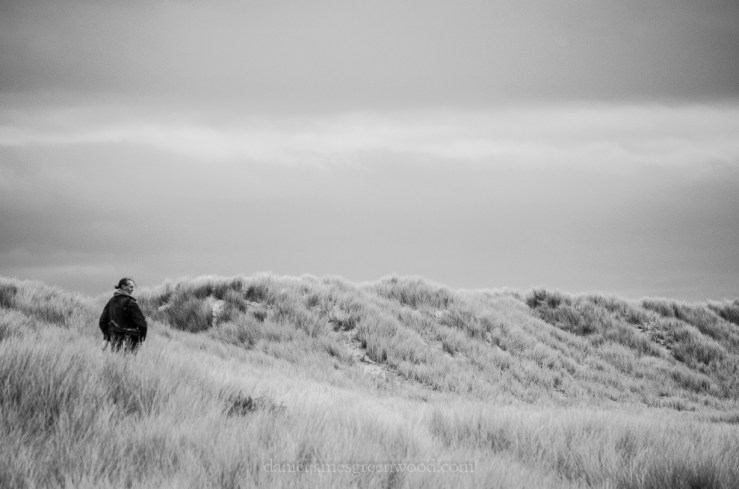
In the dunes we hear his hoarse
hollering, with reindeer lichens
and crumbling caverns of sand
arriving where our feet
meet the horizon.

We run under the clouds
the sea to our side
to see the wind tugging his
hair curling from his head

eyes glistening behind eggs
of steel-rimmed glasses:
he’s seen a goshawk below
hiding in a bramble bush.


© Daniel James Greenwood 2016

Photography: Blean Woods, September 2016

Having been continually wooded for hundreds, if not thousands of years the Blean is an area steeped in history which is unusually well documented. The continuity in woodland cover has also resulted in the creation an immensely rich habitat. Almost all of the 11 square miles of woodland comprising the Blean complex is classified as ancient woodland, which contains an enormous variety of biodiversity. Its value for wildlife is recognised at a national level with over half of the Blean being designated a Site of Special Scientific Interest; further to this, approximately one third is designated as a Special Area of Conservation, affording it protection at a European Level. – Blean Woods official website

blean-september-2016-lo-res-djg-16

Along a pathway, sessile oaks pale with algae, a sign of clean air

blean-september-2016-lo-res-djg-7

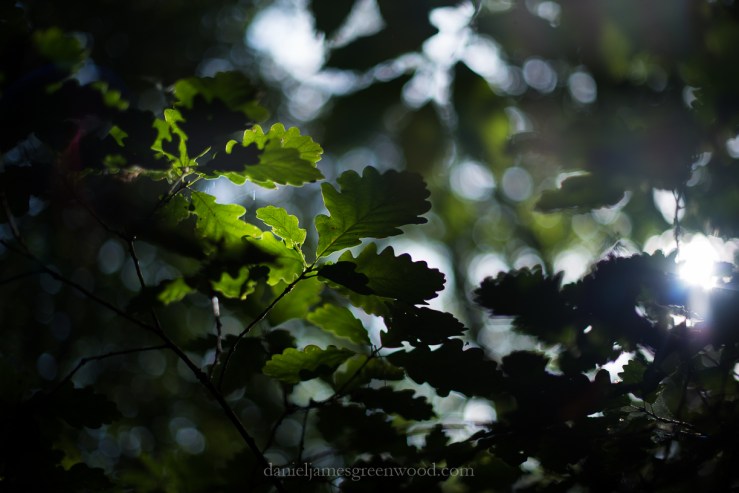
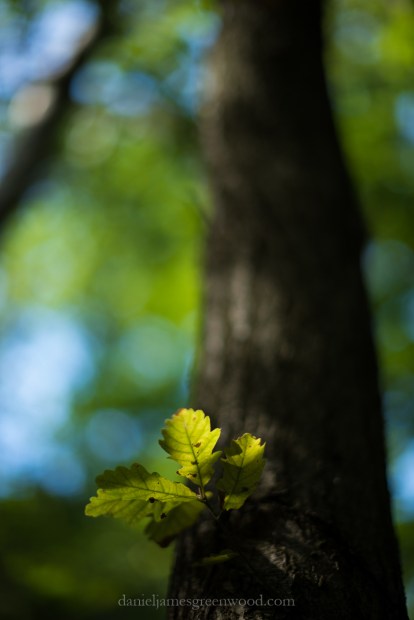
Sunlight through sessile oak leaves

blean-september-2016-lo-res-djg-13

One of very few mushrooms, a species of Coprinus inkcap

blean-september-2016-lo-res-djg-18

Coppice with standards: the piles of timber are sweetchestnut cut (I think) last year, the spring-summer growth can be seen

blean-september-2016-lo-res-djg-19

September is a beautiful month, the light has a spring-like quality about it. This gorse caught my eye where it grows in the areas of heathland in Blean Woods

blean-september-2016-lo-res-djg-2

Some epicormic growth on a sessile oak. I shot this at f1.4 with my 50mm lens to try and highlight the woodland ‘bokeh’

blean-september-2016-lo-res-djg-27

Blean has lots of birch, much of it coppiced. On the pathway between Canterbury and Blean the strongest signs of autumn were the seeds (of which I took many back home with me accidentally, and to me look like little flies in flight)…

blean-september-2016-lo-res-djg-28

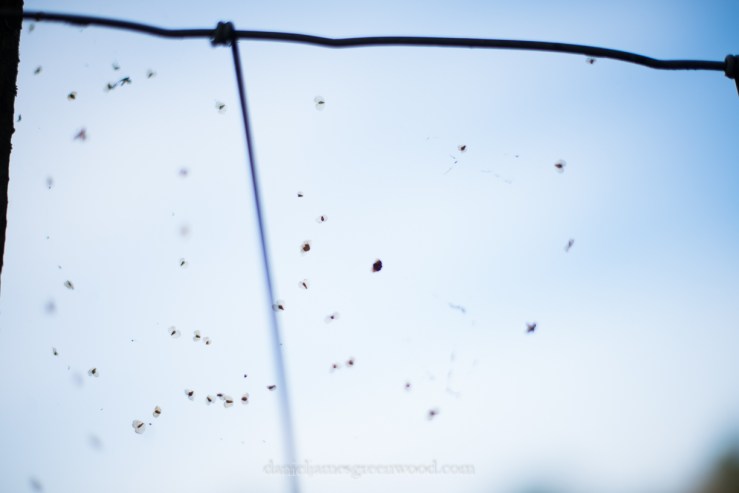
…and the leaves tangled in spiders webs

blean-september-2016-lo-res-djg-29

The orchards, of which there are a fair chunk running between Blean and Canterbury, were heavy with apples, the ground littered with hundreds of decaying fruits.

I’ve recorded a lo-fi folk song about Blean Woods, which you can listen to here:

Poetry: Chafers

chafers-1


Swilling in hawthorn
a restless summer evening on the downs
its yellow and white bedstraw
fit for our bodies, backs and snoring
our gritting teeth

I watch the chafers
as they become silhouettes
as their numbers slide
into the bristling night
drunk on dusk
the dip, swoop and dive

returning to an uncertain
place in the sky


© Daniel James Greenwood 2015

Music: Blackbird sing EP


I have just published a four song EP entitled Blackbird sing:

  1. Skylark
  2. Picking at the limes
  3. Blean
  4. Blackbird sing

You can download this EP for £4. Please do download it even if you don’t like birds or trees or folk music. To many of us, £4 is less than a pint, most people have too many pints.

All of the money received will be donated to the European Conservation Action Network to support with international conservation projects in places like Romania, Poland, the Czech Republic, Hungary and Estonia.

The songs are home recordings produced between 2012 and 2015, all written, recorded and ‘mastered’ by me at home. Photo, too.

– Daniel