Somewhere between a cuckoo and a high speed train

Mid-Colne valley

– Broadwater Lake, Harefield, May 2012

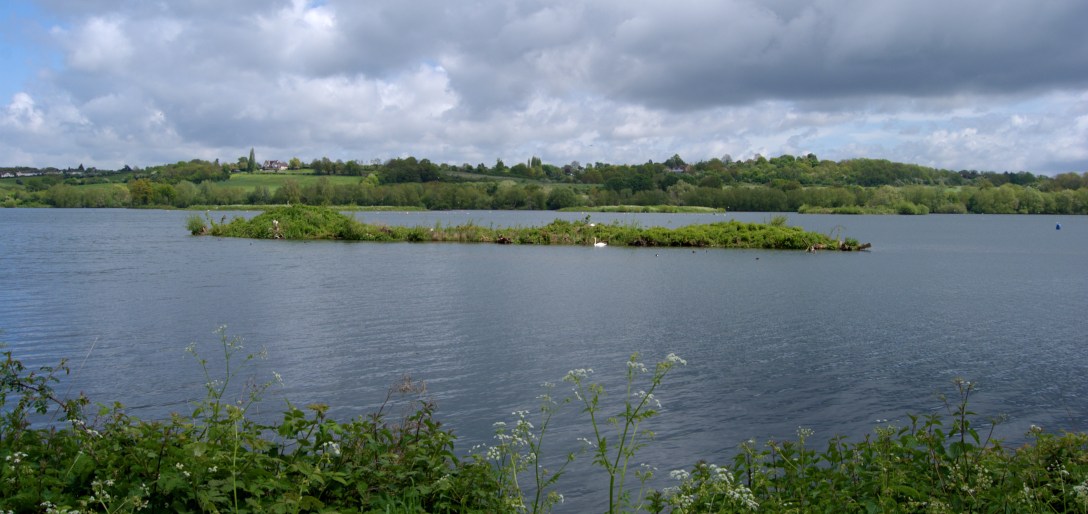
A chill wind moves across Broadwater Lake. Black-headed gulls are screaming from rafts built for the common terns which arrive here from their African wintering grounds. It is pleasing to be greeted by one of the newly emigrated. It swoops past, coming closer each time, raising aloft and diving into an arc that brings it back down to the surface of the water and away. The sky is alive with swifts feeding. When the suns does come out clouds of midges move like slow bands of rain after me and on the River Colne I see mayflies touching the water. There’s plenty of food if you’re feathered.

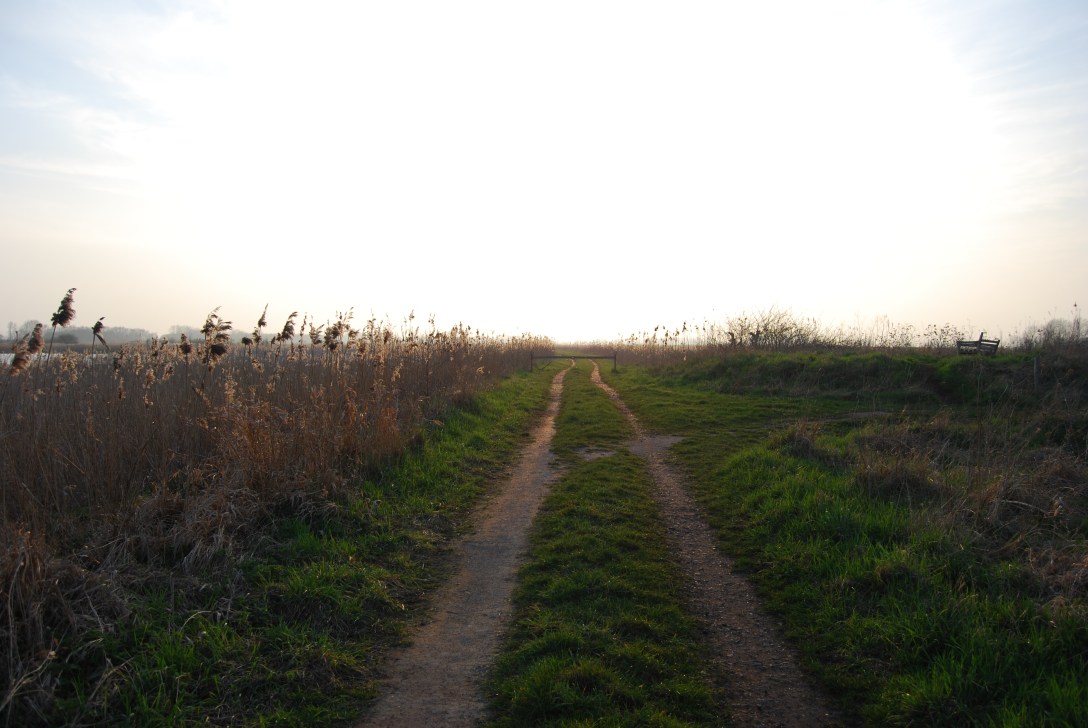
The track separates the Colne on the western side and the lake in the east. The river is separated again by a thick bank of nettles and cow parsley, that common umbellifer that signals spring. There are interjections from vibrant red campion flowers amongst the spread of green, probably indicators of the woodland that was here long before the lakes were dug for gravel and, when finished with, filled by rainwater to create today’s scene. The trees along the river are bursting with song, almost all with the fluid voice of the garden warbler, a bird so plain it’s unmistakable. It has a shy, modest look about it, as if too retiring to boast about its aural beauty. They’re in the bramble too, and it’s a song to silence the prick of the thorns.

On the other side of the river masses of dogwood cover the willow scrub. In the reedbeds struggling to establish along the bank of Broadwater Lake a sedge warbler is singing. It has a white eyestripe and differing palette of browns to mark it out from other plain-looking birds like the reed warbler. Its song is outstanding. I pick out the calls of a blue tit, great tit, goldfinch, greenfinch and the fink! of a chaffinch. This sedge warbler is a masterful mimic.

But there is one song which stands out most, and I hear it around the bend, further up from the lake. The cuckoo. It draws the breath.

A new bout of warm sunshine offers a male orange tip the chance to forage along the track, a pair of Canada geese are ushering twenty-four golden young away and into the Colne. It has the uncanny resemblance to teachers flocking fluorescent infants onto public transport. The geese wack in my direction as they go down river.

Cuck-oo, cuck-oo!

In the distant northern corner of the lake hundreds upon hundreds of house martins are skimming the surface, and from here it appears synchronised. I strafe the glasses from left to right and they are constant. Swifts are treating me like an obstacle, I’m sure I nearly took a hit from a dark and floppy hirundine.

The cuckoo is calling.

I pass back the way we came, again meeting the Canada geese, regarding me once more as a predator. A pair of reed bunting are busy between the scrub along the Colne, passing across to the edge of the lake, the black-headed male clinging to a willow stem, a stick in his bill like a dancer with a rose between his teeth. This bird is building a nest, the female appearing in the bush next door. They disappear into the thin stock of reeds at the edge of the lake.

As I head off in search along the track the cuckoo calls at its clearest, the sun free of cloud, piping. The bird calls from across the Colne, surely from a perch, we scan the trees and find the grey head and neck of the male but it’s bothered and takes to the air. It’s satisfying, so satisfying to see the bird my ancestors took for granted.

I continue along the track, buoyed with the sense that all is right with the world, that England is okay – if this bird has returned again then we must have something to be happy about. Of course, the calling cuckoo is only confirmation, whereas the sight of it is something else. This bird’s voice has become so much a part of our connection with birds, nature, wildlife, time, the world, whatever, that it’s become part of our language, even becoming a word to define mental ill health. It made it into a part of our mechanical world where other species haven’t, the sound of an hour passing and a new beginning. A world without the cuckoo is unthinkable to most. To see the bird calling is a privilege, and then you know it isn’t the gardener playing a trick, the old family clock, or a child portraying ‘madness’.

I’m in a daze. Two birds are squabbling overhead, I’m sure they’re sparrowhawks, but then I’m not. It’s two male cuckoos fighting over territory.

***

Outside the reserve and back on the main road my ears are ringing with the sound of birds – a blackbird somewhere along the way has recorded its fluid melodies into the fundament between my ears. A buzzard passes over the Colne in perfect silence, head twisting, two crows pursue it.

I climb to a pub on the hill over on the other side of the lake, to see the view of the mid-Colne valley and to get a sense of perspective. The weather is fluctuating, the wind is flung out and a few specks of rain touch the windscreens of parked cars, the sun breathes fire into the once dark globules of ornamental copper beech trees on the hill opposite and across the lake. The sunshine stays, the valley gleaming. Its beauty comes like a puncture. The swifts cover the expanse, wheezing and sailing across the vista. In the ragged hedge of hawthorn and field maple just in front of me a whitethroat appears, offering a few tentative renditions of its gravelly warble. A man walking a very slow and floppy-eared dog has spied me.

‘We see red kites very often, almost every day,’ he says. It’s his day off. He turns to take in the view of the valley, his thoughts turning to the proposal to build High Speed 2, a high speed trainline, through neighbouring Korda Lake and across the Colne. ‘It’s a nightmare,’ he says. ‘Hopefully they put it underground.’

The sky is an azure blue with discarded cloud, the sun intense. Broadwater Lake is a space of trembling, sparkling water. This was once a gravel quarry but now is a place which, in this moment, with swifts, warblers and the indefatigable cuckoo, retains a sense of the Arcadian paradise with which we paint our memories of the English countryside. With the threat of upheaval from HS2 it’s unclear how long that will remain.

The dead and the living are mingling on the Downs

Thistle

– Farthing Downs and New Hill, London, September 2012

The living and the dead mingle on the Downs this morning. Meadow brown butterflies kick up from the ruins of grassy tussocks and rusting bramble. They are as shed leaves moved by an autumnal breeze. Brown and orange, one white dot in their black eyespots, they sit in the tops of young, dwarfish oaks, or else are lost to the souring land. Workers have opened up more grassland with chainsaws and fire, stumps of ash are torn and splintered – a battle has taken place here. Jackdaws survey the new clearings, and the old ones, too, a strange officialdom about them, their calls back and forth, scathing blue-grey eye – are they coroners or corvids? This is their work, the image fits.

The yellow rattle has mostly turned, the wind pushing across the road and down the slope. But there isn’t the sound this parasitic plant is named for. There’s the drone of a biplane, probably from Kenley, there’s the teasing whir of a bicycle passing along the cutting, the sound of aging leaves stirring, sycamore yellowed by the changing season. Scabiouses and hawk’s-bits add punctuations of colour to the mushroom-drab Downs, the grey Sunday sky burnt by sun, puddles of blue appearing. In the long grass crickets click like a machine shutting down, the dead and the living mingling on the Downs.

A Farewell to Redwood

Farewell to Redwood

Dorset, April 2011

The passage of the old stable quarters ran to a doorway opening out onto the back of the house. The doorway itself appeared blocked at first viewing, blocked by the trunk of a tree so large that it filled the entire frame. The pianist staying at the house had spoken to me about the tree.

‘I like to bang my head against it,’ he’d said. He had a face like a fox.

The tree goes by different names: Wellingtonia, Big Tree, Giant Redwood and Giant Sequoia. During my time as neighbour to it I called it a jumble of names, sticking with ‘American Redwood’. The tree was twice as tall as the house, a 19th century mansion, and viewing it from the stable courtyard gave a sense of the tree’s grand but gentle scale. The bark is a deep red where worn and soft as a wafer to touch. It has none of the scratchiness of our mature natives like oak or ash. It runs in one towering trunk. Perhaps the white settlers who came upon the Americas harboured a secret adoration for these towering, ancient things (the oldest tree in the world is a Giant Sequoia) felled with such relish, an adoration which survived generations, resulting in an Empire State Building. The tree I had the pleasure of experiencing in Dorset is a prime example of the beauty and power that nature exerts when allowed to grow. This tree was near to 200 years old, probably planted with the house by the adventurous Victorians who’d lived here.

The Redwood had an apartment block feel to its design. Walking along the passage, face to face with the trunk and into the garden, a mouse-like bird scarpered out of view. After a few encounters with the white-bellied creature I witnessed it disappear into a small bore in the soft bark. The bird was a treecreeper, named after its tendency to climb the bark of a tree from its base, poking its bill between the cracks for insects. It climbs up the trunk pinching between the cracks for insects. It climbs and then flies to the bottom of another to begin its ascent all over again. It will only do this on trees of a certain age and size. The size and permeability of the Redwood make it a highly desirable habitat. In the middle of the tree a pair of goldcrests would sing thinly, spinning coins coming to an abrupt halt. The thin nature of the canopy made it a viable way to enjoy not merely the sound of the bird but also to see it. They would be there at lunchtime without fail.

A number of chimneys were built into the stables and across to the house itself. A pair of jackdaws would spend parts of the day bringing sticks and placing them in the vacant portals. Jackdaws are thought to mate for life and a pair here would ‘jack’ to one another as they constructed their nest. In the mid-afternoon, the lull after lunch, they strolled along the lawns either side of the house in an almost synchronous fashion, digging for worms. This was a group of about twenty birds, and in the gloaming they returned to the highest reaches of the Redwood to roost for the night, their chatter lessening before night and silence fell.

From the stable courtyard an expanse of woodland opens up in the near distance. There was another Redwood on that horizon, equally tall but dead. I was walking to the walled garden one morning with the head gardener when he told me the story:

‘Someone was taking their horses out into the wood that way one day and they got to chatting with someone they knew,’ he said. ‘They turned their backs for ten minutes and by the time they looked back the horse had eaten its way round the tree. The thing just went and died. Terrible shame.’

When I said goodbye to the house and the stables I wished the Redwood a farewell. Not just to the tree but the creatures living with it, the treecreeper disappearing into the bark, the singing goldcrests and sleeping jackdaws.

Descending, descending, falling apart

by Martin Damien

Photograph by Martin Brewer

— Nunhead Cemetery, London, April 2012

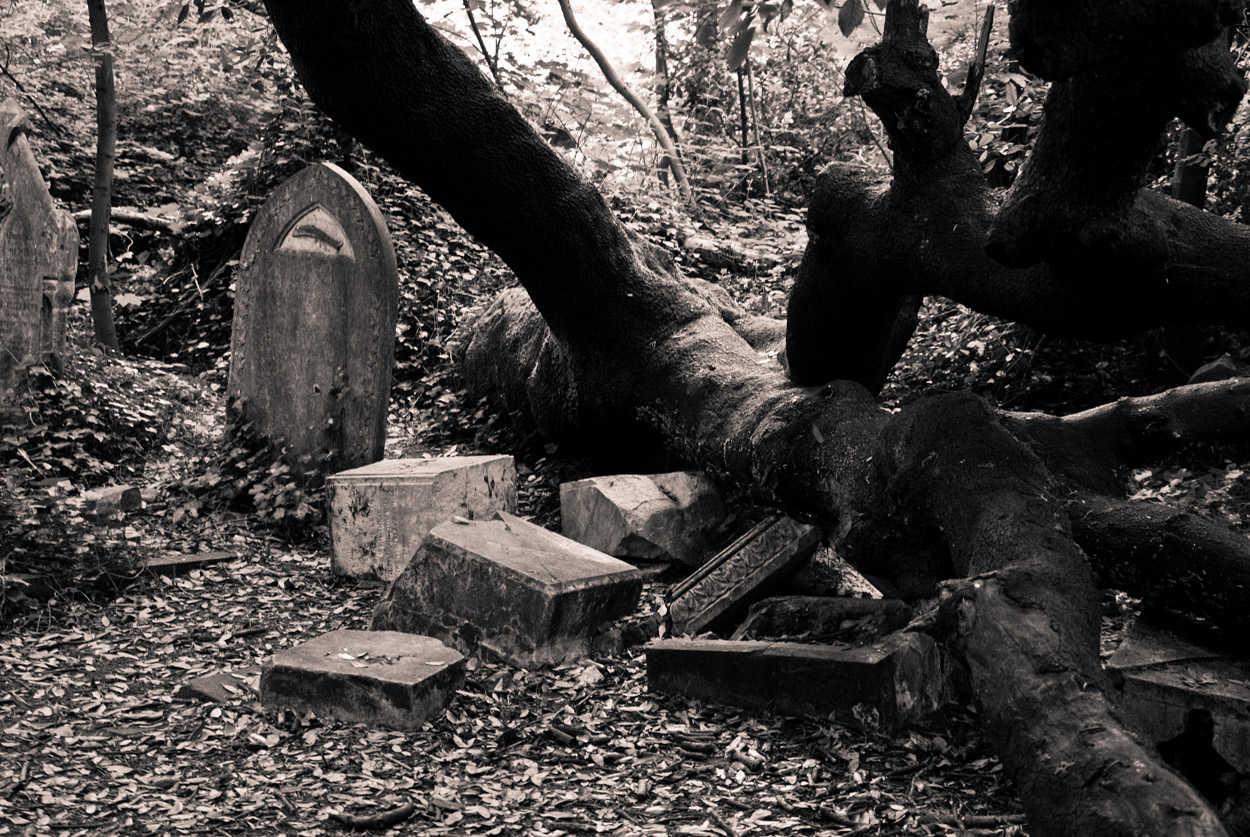
In the cemetery won by sycamore and rendered woodland, two male song thrush are duelling with one another, throwing out tunes, rewriting and rollicking the black cloud with their language.  This mysterious, handsome thrush is to me like a singing pudding endowed with flight. I leave them to it. My ears are working overtime, the scene dripping, the algae glows on the trunks of dark trees, the moss is vibrant on the gravestones appearing as shipwrecks at the bottom of an ocean. The denseness of the trees squeezes the sound: blue tit trill, the calling great tit and guttural canon of the crow marking the enclosure of forthcoming leaves and canopy. A family, their dog muddied, happy, intoxicated by the aroma of wet woodland, people relaxed, even pleased – woodland puts us back into our bodies. The sun inches out and makes crystals from the droplets of fallen rain, there is the feeling that the soil is sighing from the torrents. Deep refreshment has touched the natural world. My waterproof holds drops of water that leave strange dents in the material, my jeans are darker now. Wait – a song ending, a sweet, fluty refrain. Silence. Woodland dripping, I retrace my steps back down the path. The song comes from a leafless ash canopy – descending, descending, falling apart. Willow warbler. I see it, its long tail and constant hopping between branches. How far has it come? It sings again and moves on. The matt black storm clouds progress, the inkling of lightning, the thunderous thump.

Swifts screeching


Swifts spread across

the sky and stop,

part starfish

brought by a retreating

surf, pigeons bolting

from a setting,

behind cloud.


Always, always,

the world is a

painting.


I listen to the tits

pleading from the nest

box, one bird out

and the other bird

in, a single note

between them.


Hawthorn flowers

are a tree lit

by snow in the

middle of May,

but is spring or

winter late?

I worry that the

old tree is dying,

that a part

of my youth might

not outlive me.


Happiness is the sound

of swifts screeching,

the migrants testing

the evening,

spring’s ending


brought on

by the declining

surf of sky,

or sea?


A wheatear drops in

A wheatear drops in

– Farthing Downs, London, May 2012

The slope is exhausting. I push against my knees in order to reach the plateau without panting. Though it’s not as steep as it sounds, a flock of jackdaws glide in and bounce across the grass adding to my sense of human weakness. Turning back to look, it’s barely a slope, just an awkward drop down into the woodland below. In the distance, a world far, far away, the nearly-complete Shard and the Gherkin look like grey wreckage. The path ahead is bordered by two strips of scrub and small trees, in the open land across the road cutting through the downs a skylark is rolling out its splatter of trills and warbling. The bramble has come to life around me, a mouse or vole too quick for my eyes crosses to the other side. I swallow the air – it’s Croydon, but it tastes like the countryside. Beyond the dip into woodland Happy Valley opens out and up again, a vista of wildflower meadows and a fringe of trees. There is a hint of the hillsides of west Dorset within the boundary of The City of London. A pair of linnet alight in a small hawthorn, dull brown with specs of mud on their breasts, the red crown yet to come into full colour. They match the day – grey, brown, muddied. The aborted song of a bunting is coming from the branches above them, the striking colour of a yellowhammer sings from the still wintry scrub. It calls and calls, turning its head to look, not minding me at all, another arrives in a hurry.

The full view of Farthing Downs is open now as I continue to wander along the eastern flank. Two swifts newly arrived in the country dart about, twisting and turning, their black wings flapping a little like penguins under water. There are people over the surmount, people walking, people on horses, people with dogs. I approach a gate where a woman and her daughter are struggling with their dogs, one bounding around as if it’s been cooped-up for months. Right in front of me a wheatear drops in, landing on the small mound of an anthill. This robin-sized chat has travelled from Africa to be here in Croydon and will soon be moving to its northern breeding ground. The bird is nervous – the sprinting dog has been released upon the downs but it doesn’t notice the migrant wheatear, instead it runs at me full-pelt, swerving to my side, cracking its skull against my forearm. The lady who owns it has stepped in her other dog’s poo in trying to clean it up and is wiping her foot across the grass, grimacing. I’m muttering to myself – this is the first wheatear I’ve ever seen in the United Kingdom. The bird bursts into flight, landing on a fence post. I marvel at its feat of migration.

Set: Broadwater Lake

Broadwater Lake is situated in the Mid-Colne Valley a Sight of Special Scientific Interest (SSSI), the lake is managed by Herts & Middlesex Wildlife Trust. This is one of a number of nature reserves in England which is set to be developed for High Speed Rail 2. For more information please follow this link to the Wildlife Trusts’ website.

The cranes aren’t flying

March 2012 631

– Lakenheath Fen, Suffolk, March 2012

We’re standing on the raised bank overlooking Lakenheath’s reedbeds. It’s a warm, clear day but cooling gusts of wind disturb the peace, ushering us away from the viewpoint. On calmer days bearded tits move across the tops of the reeds, today they’ll be down in the cover. We pass a rigid poplar plantation famed for its golden orioles which breed here in spring, what is perhaps the only nesting site in the United Kingdom. The trees grow out of swamp and some of them have collapsed, the soil clinging to the upturned roots making the poplars look like toy soldiers left supine by a child’s swooping palm. The trees have sent suckers out along the horizontal trunk meaning a new layer of woodland is growing from the body of one of the fallen, a new understory naturally occurring from a man-made habitat.

The cover of the plantation lessens the wind somewhat, a green woodpecker yaffles from the cover of the trees. Along the bank are anthills home to yellow meadow ant. I’m with David Norfolk, a friend and expert ornithologist, and he tells me these are rare. The hills could be hundreds of years old. ‘They wouldn’t exist in today’s farmland,’ he says. ‘A tractor will destroy them’. He takes a small chunk of the mound and golden-coloured ants move busily across the grey soil held in his fingertips. On the other side of the bank a blue river runs away to where the sun is going, a flock of oystercatchers pass, chattering as they fly against the flow. On the riverbank near to us pristine white feathers are strewn like discarded quills around the skeleton of a mute swan. David has seen it before: ‘That’ll be a fox kill.’

We’re alerted to a faint, hoarse bird call wafting from beyond the poplars where a swathe of reeds stand for perhaps 200m all the way around. We stand to face the reeds and the wood beyond where trees have collapsed, fieldfares pass through on migration north on their return to Scandinavia. We hear it again, the muffled, bugling call of a crane. I have longed to see or hear these birds, Russian symbols of peace in the aftermath of Hitler and Stalin’s tyranny. The poet Anna Akhmatova described hearing cranes as she lay in her sickbed, the birds fleeing the dry autumnal fields after the harvest. Our cranes are not forthcoming but David is convinced they’re here. I’m prepared to wait until dark.

A group of men in their sixties arrive and we point out the vague sound of the crane, but they look in the opposite direction, instead to the sun setting over the lake. I suggest to another man that the cranes can be heard, he complains that he needs to sit down. ‘That’s a dog barking,’ he retorts. Bearded tits are pinging in the reeds, a water rail is squealing like a pig. We follow the path back to the start. The bugling goes on, it has to be cranes. But the beardies are closer and closer and even louder now. ‘Watch for their flight between the reeds,’ David says.And here they go, the pale brown flash and long tail, something I’ve never seen before. From behind us a crane calls clearly into the lilac sky.

F16s tear up the sunset with their apocalyptic thunder, a train careers along the bank next to us, the two carriages a little pathetic-looking and exposed in this vast open space. The lights shine inside, juxtaposed against the light dying down around us. The sun is stuck behind a strip of cloud and its colour cannot be revealed, jackdaws are roosting noisily in the poplar plantation, the green woodpecker continues its laughing fit, escaping its perch in an undulating flight overhead. The water rail is squealing still, a kingfisher bolts around a swoop of reeds. Two giant birds appear from the path we’ve just taken, grey and white. It has to be! Two cranes, flying together, approaching us on the bank, moving across. They are within a stone’s throw… but the joy evaporates. They’re swans and it’s a trick of the light.