The dead and the living are mingling on the Downs

Thistle

– Farthing Downs and New Hill, London, September 2012

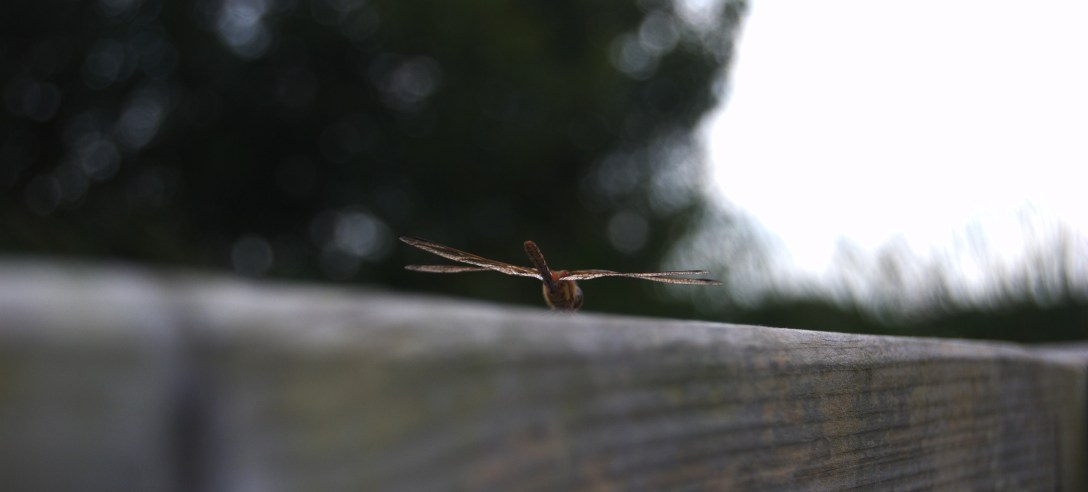
The living and the dead mingle on the Downs this morning. Meadow brown butterflies kick up from the ruins of grassy tussocks and rusting bramble. They are as shed leaves moved by an autumnal breeze. Brown and orange, one white dot in their black eyespots, they sit in the tops of young, dwarfish oaks, or else are lost to the souring land. Workers have opened up more grassland with chainsaws and fire, stumps of ash are torn and splintered – a battle has taken place here. Jackdaws survey the new clearings, and the old ones, too, a strange officialdom about them, their calls back and forth, scathing blue-grey eye – are they coroners or corvids? This is their work, the image fits.

The yellow rattle has mostly turned, the wind pushing across the road and down the slope. But there isn’t the sound this parasitic plant is named for. There’s the drone of a biplane, probably from Kenley, there’s the teasing whir of a bicycle passing along the cutting, the sound of aging leaves stirring, sycamore yellowed by the changing season. Scabiouses and hawk’s-bits add punctuations of colour to the mushroom-drab Downs, the grey Sunday sky burnt by sun, puddles of blue appearing. In the long grass crickets click like a machine shutting down, the dead and the living mingling on the Downs.

Descending, descending, falling apart

by Martin Damien

Photograph by Martin Brewer

— Nunhead Cemetery, London, April 2012

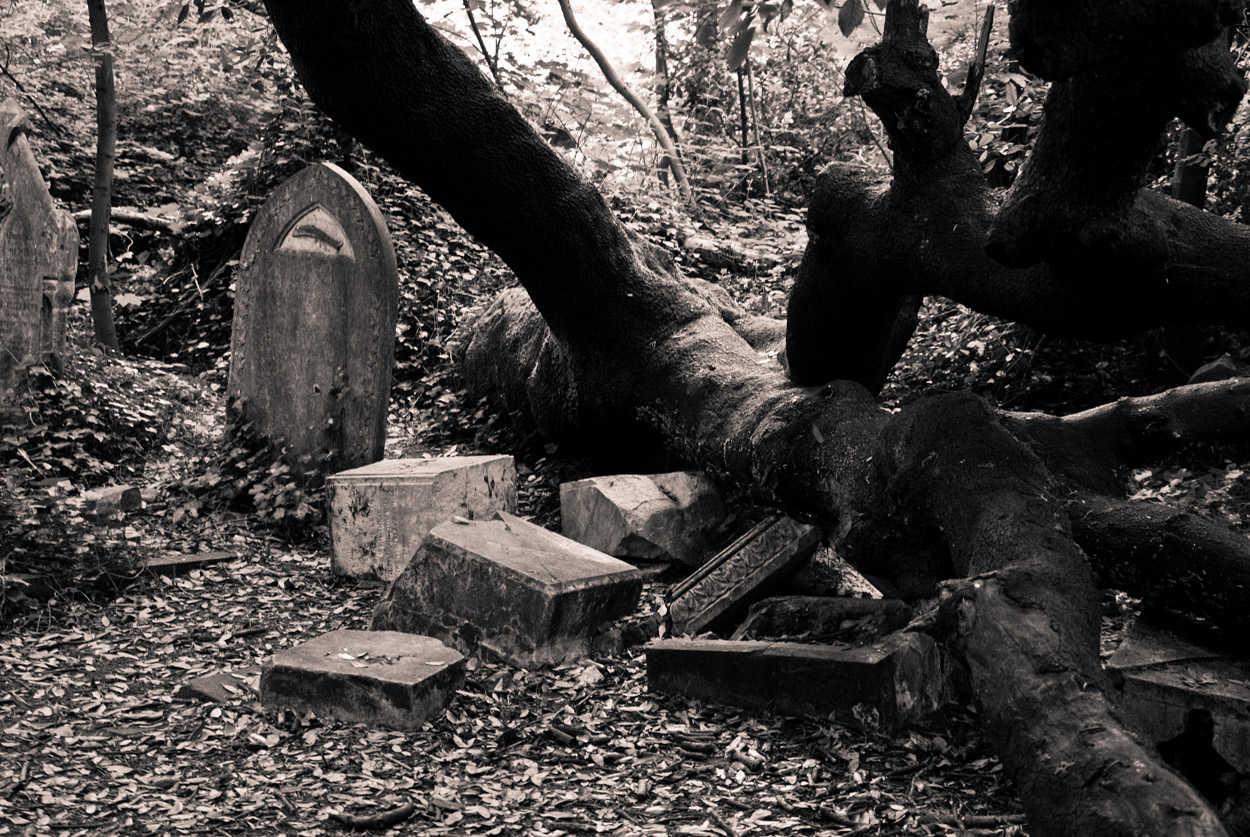
In the cemetery won by sycamore and rendered woodland, two male song thrush are duelling with one another, throwing out tunes, rewriting and rollicking the black cloud with their language.  This mysterious, handsome thrush is to me like a singing pudding endowed with flight. I leave them to it. My ears are working overtime, the scene dripping, the algae glows on the trunks of dark trees, the moss is vibrant on the gravestones appearing as shipwrecks at the bottom of an ocean. The denseness of the trees squeezes the sound: blue tit trill, the calling great tit and guttural canon of the crow marking the enclosure of forthcoming leaves and canopy. A family, their dog muddied, happy, intoxicated by the aroma of wet woodland, people relaxed, even pleased – woodland puts us back into our bodies. The sun inches out and makes crystals from the droplets of fallen rain, there is the feeling that the soil is sighing from the torrents. Deep refreshment has touched the natural world. My waterproof holds drops of water that leave strange dents in the material, my jeans are darker now. Wait – a song ending, a sweet, fluty refrain. Silence. Woodland dripping, I retrace my steps back down the path. The song comes from a leafless ash canopy – descending, descending, falling apart. Willow warbler. I see it, its long tail and constant hopping between branches. How far has it come? It sings again and moves on. The matt black storm clouds progress, the inkling of lightning, the thunderous thump.

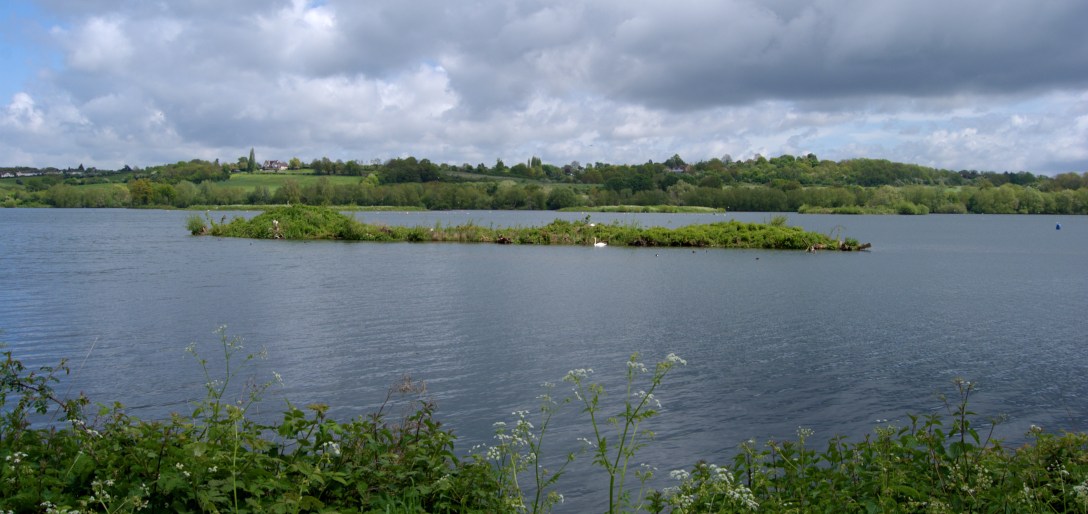
Set: Broadwater Lake

Broadwater Lake is situated in the Mid-Colne Valley a Sight of Special Scientific Interest (SSSI), the lake is managed by Herts & Middlesex Wildlife Trust. This is one of a number of nature reserves in England which is set to be developed for High Speed Rail 2. For more information please follow this link to the Wildlife Trusts’ website.

The cranes aren’t flying

March 2012 631

– Lakenheath Fen, Suffolk, March 2012

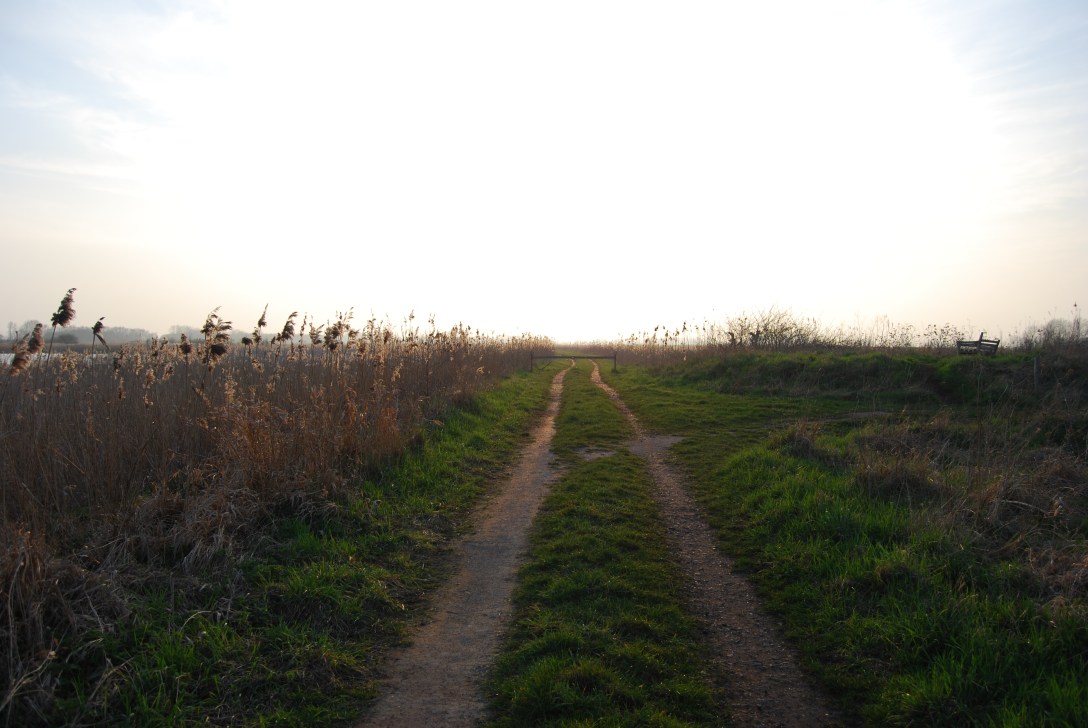
We’re standing on the raised bank overlooking Lakenheath’s reedbeds. It’s a warm, clear day but cooling gusts of wind disturb the peace, ushering us away from the viewpoint. On calmer days bearded tits move across the tops of the reeds, today they’ll be down in the cover. We pass a rigid poplar plantation famed for its golden orioles which breed here in spring, what is perhaps the only nesting site in the United Kingdom. The trees grow out of swamp and some of them have collapsed, the soil clinging to the upturned roots making the poplars look like toy soldiers left supine by a child’s swooping palm. The trees have sent suckers out along the horizontal trunk meaning a new layer of woodland is growing from the body of one of the fallen, a new understory naturally occurring from a man-made habitat.

The cover of the plantation lessens the wind somewhat, a green woodpecker yaffles from the cover of the trees. Along the bank are anthills home to yellow meadow ant. I’m with David Norfolk, a friend and expert ornithologist, and he tells me these are rare. The hills could be hundreds of years old. ‘They wouldn’t exist in today’s farmland,’ he says. ‘A tractor will destroy them’. He takes a small chunk of the mound and golden-coloured ants move busily across the grey soil held in his fingertips. On the other side of the bank a blue river runs away to where the sun is going, a flock of oystercatchers pass, chattering as they fly against the flow. On the riverbank near to us pristine white feathers are strewn like discarded quills around the skeleton of a mute swan. David has seen it before: ‘That’ll be a fox kill.’

We’re alerted to a faint, hoarse bird call wafting from beyond the poplars where a swathe of reeds stand for perhaps 200m all the way around. We stand to face the reeds and the wood beyond where trees have collapsed, fieldfares pass through on migration north on their return to Scandinavia. We hear it again, the muffled, bugling call of a crane. I have longed to see or hear these birds, Russian symbols of peace in the aftermath of Hitler and Stalin’s tyranny. The poet Anna Akhmatova described hearing cranes as she lay in her sickbed, the birds fleeing the dry autumnal fields after the harvest. Our cranes are not forthcoming but David is convinced they’re here. I’m prepared to wait until dark.

A group of men in their sixties arrive and we point out the vague sound of the crane, but they look in the opposite direction, instead to the sun setting over the lake. I suggest to another man that the cranes can be heard, he complains that he needs to sit down. ‘That’s a dog barking,’ he retorts. Bearded tits are pinging in the reeds, a water rail is squealing like a pig. We follow the path back to the start. The bugling goes on, it has to be cranes. But the beardies are closer and closer and even louder now. ‘Watch for their flight between the reeds,’ David says.And here they go, the pale brown flash and long tail, something I’ve never seen before. From behind us a crane calls clearly into the lilac sky.

F16s tear up the sunset with their apocalyptic thunder, a train careers along the bank next to us, the two carriages a little pathetic-looking and exposed in this vast open space. The lights shine inside, juxtaposed against the light dying down around us. The sun is stuck behind a strip of cloud and its colour cannot be revealed, jackdaws are roosting noisily in the poplar plantation, the green woodpecker continues its laughing fit, escaping its perch in an undulating flight overhead. The water rail is squealing still, a kingfisher bolts around a swoop of reeds. Two giant birds appear from the path we’ve just taken, grey and white. It has to be! Two cranes, flying together, approaching us on the bank, moving across. They are within a stone’s throw… but the joy evaporates. They’re swans and it’s a trick of the light.

The flavour of open landfill

– Beddington Farmlands, London, April 2012

We walk a clay-coloured path towards the landfill and stop to listen to the subsong of a whitethroat newly-arrived in the country. It sings from the obscurity of bramble and other scrub, evidently practicing before it’s ready to give its best rendition. We leave it and head for the hill. To the left is a gravel pit blocked by fencing, a hillside of green grass and garbage growing up and out of it on the bank. At times I fail to differentiate the flagging bin liners from the crows and jackdaws which gather in vast numbers, picking through the bits and pieces. On the track there’s a Nike basketball shoe and the Caucasian limb of a Barbie doll, a cassette tape of ‘90s Wimbledon and a plastic water bottle. This has been carried-over by the wind and evidently the landfill is not being contained. And then it touches my face, the sickening flavour of open landfill, like the whiff of pure alcohol. If I’d eaten I’m sure I’d be gagging, I hold my nose and breathe through my mouth.

At the surmount we can see everything – the Crystal Palace ridge, now recolonized by trees after the Great Exhibition’s twilight stay in the heights of south-east London, and Addington Hills in south Croydon, an undulating snapshot of landscape. Down below we can see the crows feeding on the recent landfill, clinging to the fence as a buffeting wind moves across, it’s too cold on the eyes to look through binoculars. The landfill slopes down towards a large pool with islands scattered throughout. It’s manmade, the aim to lure migrating birds like yellow wagtails, one of which passes overhead, and provide habitat for snipe, plovers and terns. The scene is teeming with life, herons at every corner, gulls, ducks, all living amongst one another. From the landfill perimeter garbage has escaped, a stream of multi-coloured items leading to the water where a white swan is preening its wings. I look across the water to the opposite side where a crude tin hut has been constructed by the Beddington Farmlands Bird Group, they’re gathered at the water’s edge, telescopes, cameras and binoculars to hand. Behind them is a feeding station supporting London’s only colony of tree sparrows but they can’t be picked out with the naked eye from up here. On one side of the water you have people who devote their lives to caring for wildlife, and on the other side the waste which so harms ecosystems. And somehow wildlife can live with the crap we don’t want, the plastic, the rotting food and even our stool. But the question remains: can we?