Austrian Alps: wildflowers on Zwölferhorn

Zwölferhorn (1522m), Salzkammergut, Austria, June 2025

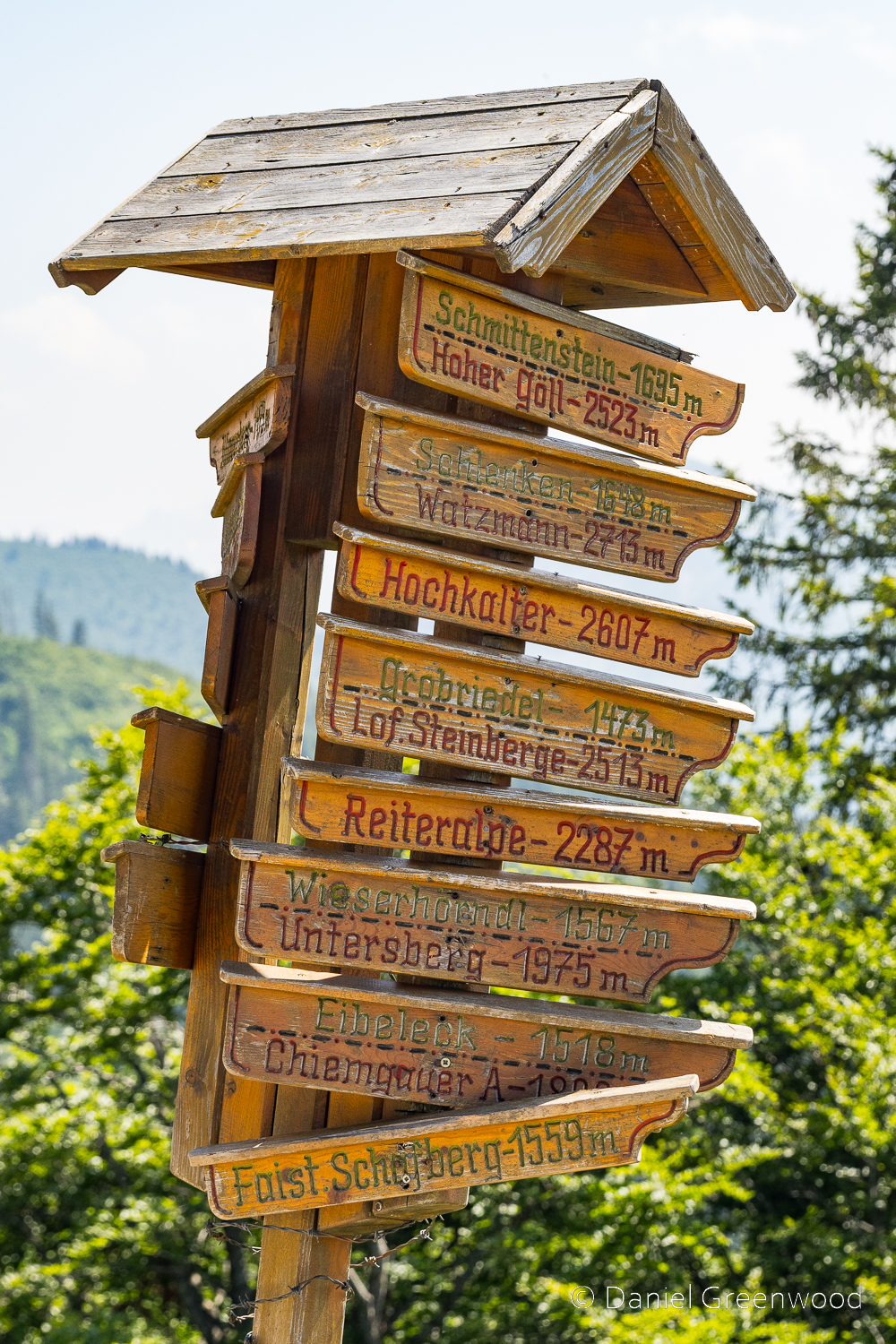
In mid-June my wife and I visited the Austrian Alps for the second year in a row. We took the cable car from the village of St. Gilgen (featured in the opening scenes of The Sound of Music) to the 1500m heights of Zwölferhorn, so named because according to shepherds down the years the sun sits atop the peak at 12noon (zwölf) everyday.
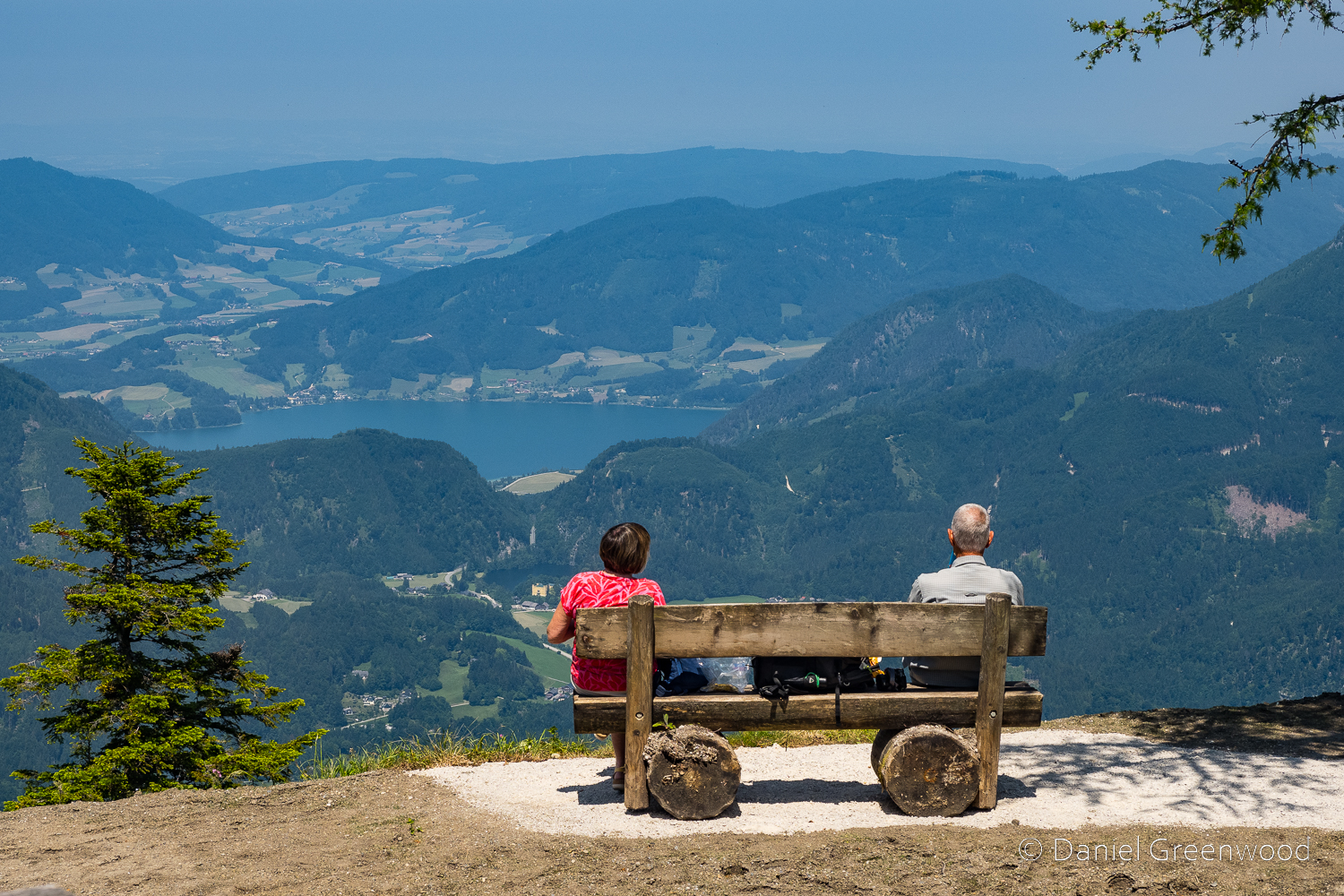
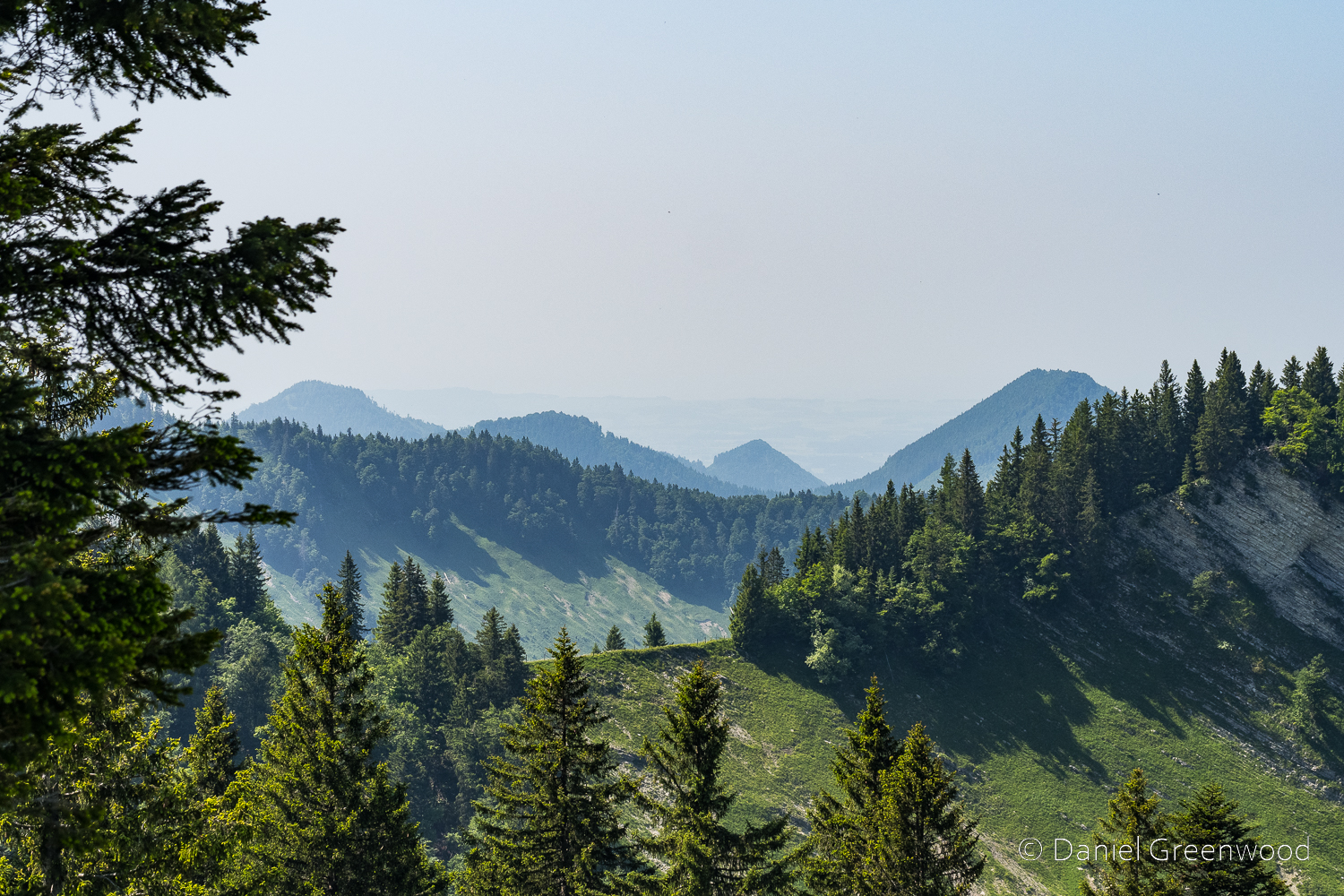
The views from the top are magnificent, as you would expect from the Austrian Alps, though a bit hazy on this hot day in the Salzkammergut.

Part of the allure of this place in spring-early summer is the wildflowers high in the mountains.
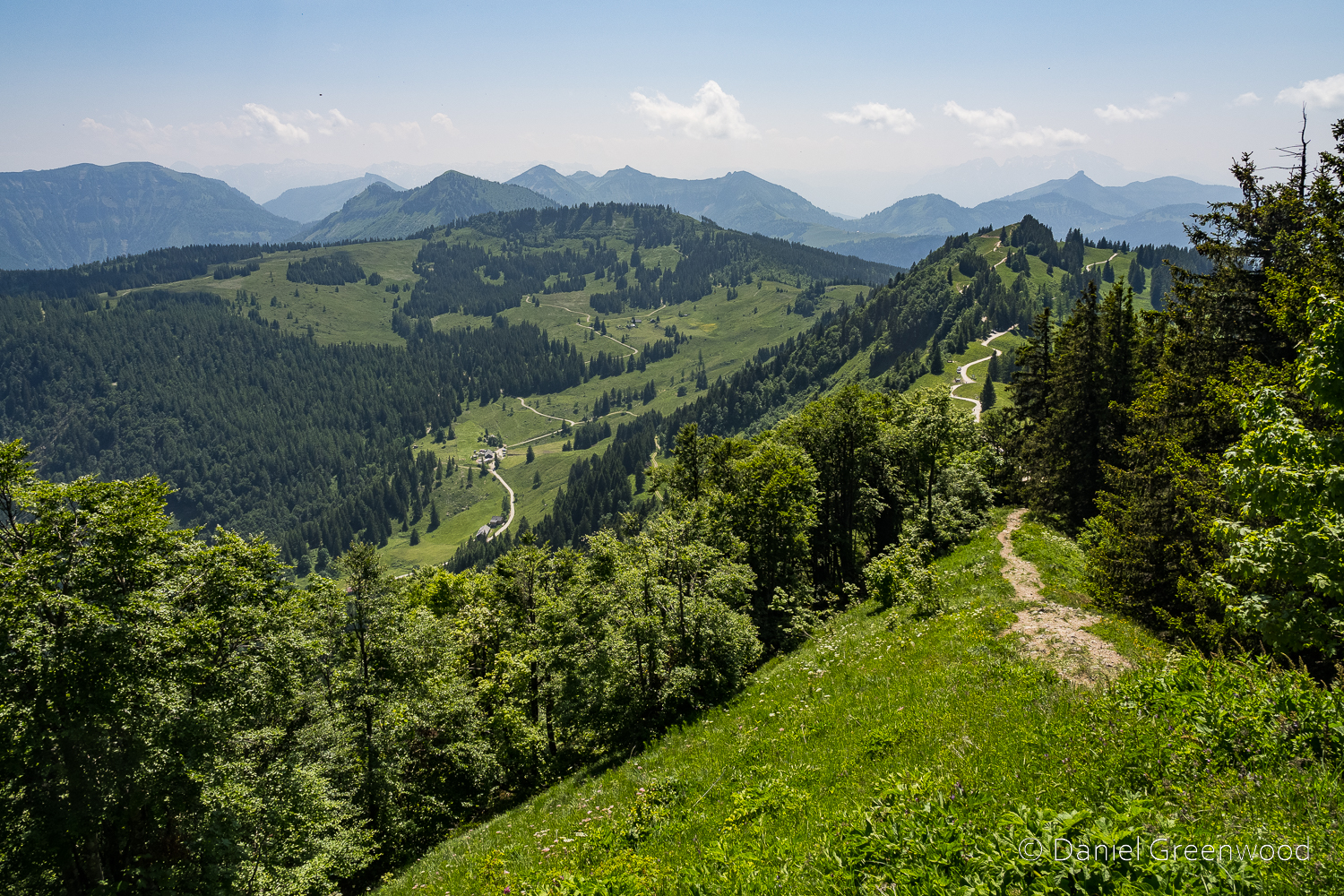
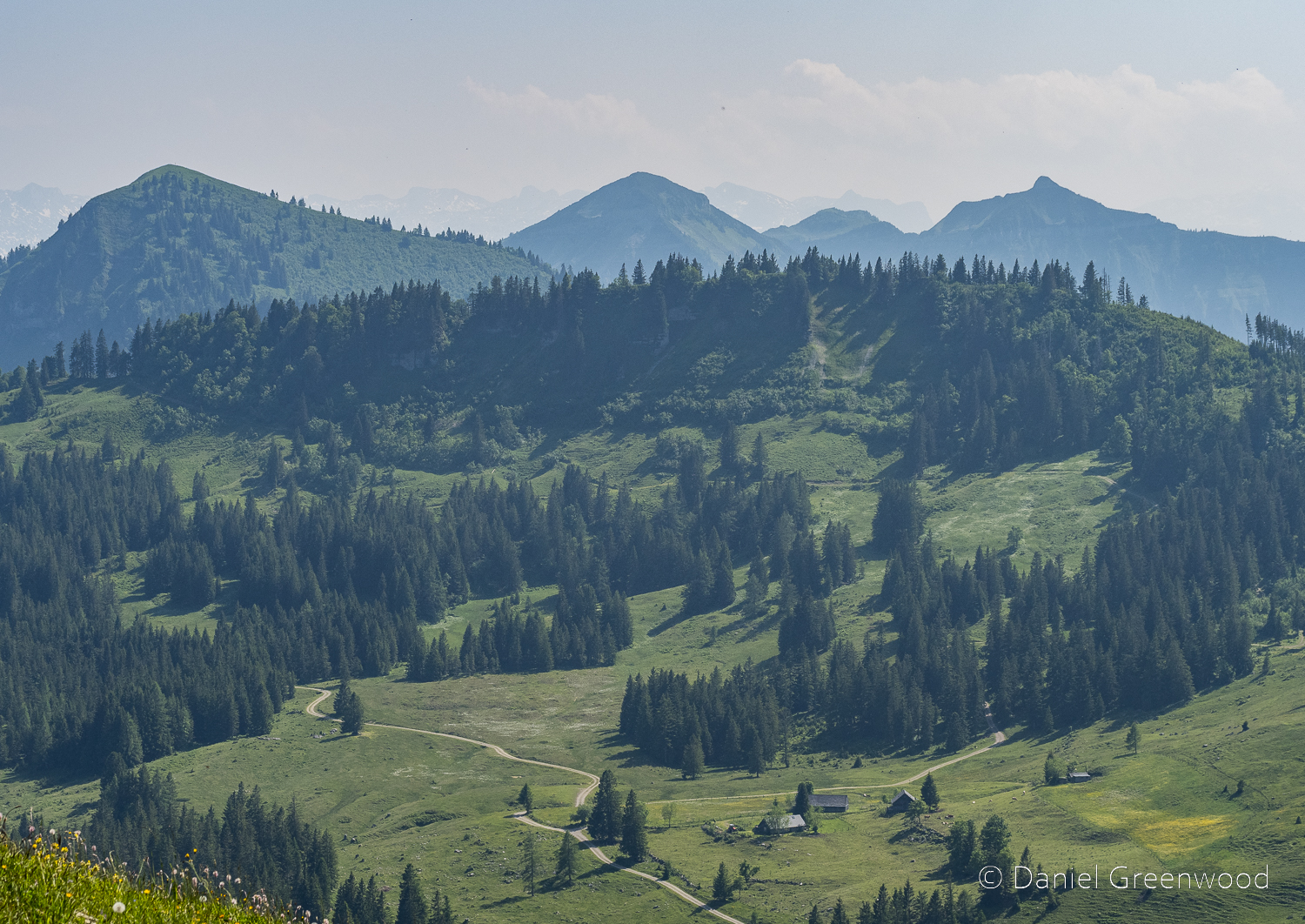
To the south and west the mountains seem to run forever. South-east of here is the famous Hallstatt and the Dachstein Massif, which I will include some long-range images of in an Austrian Alps post to follow.

A view into Salzkammergut

These mountains have been managed in the same way for many hundreds of years – though there were probably fewer trees in the past – which has led to a rich diversity of flowers and their dependent invertebrates. We saw an abundance of both when visiting this time.
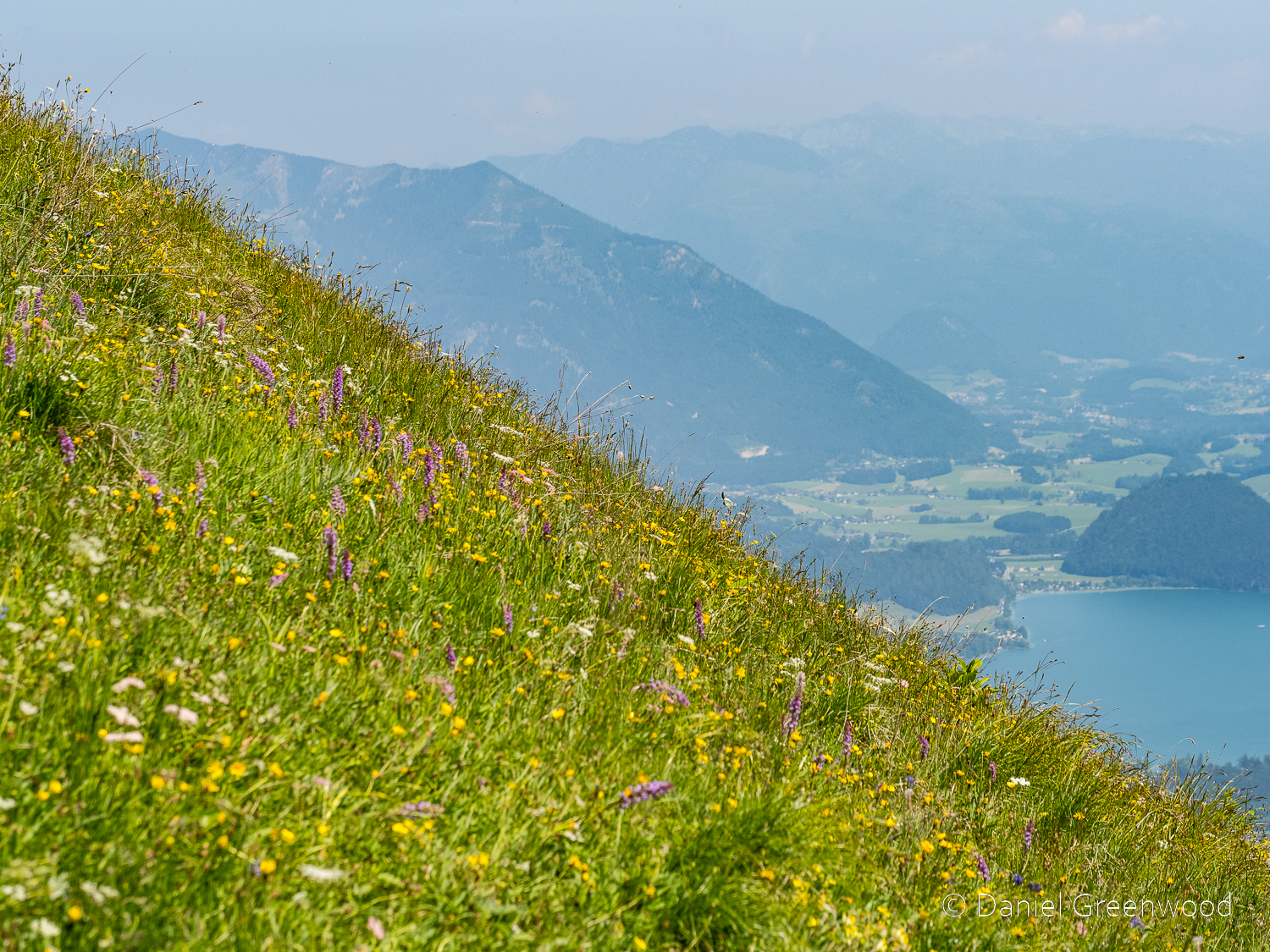
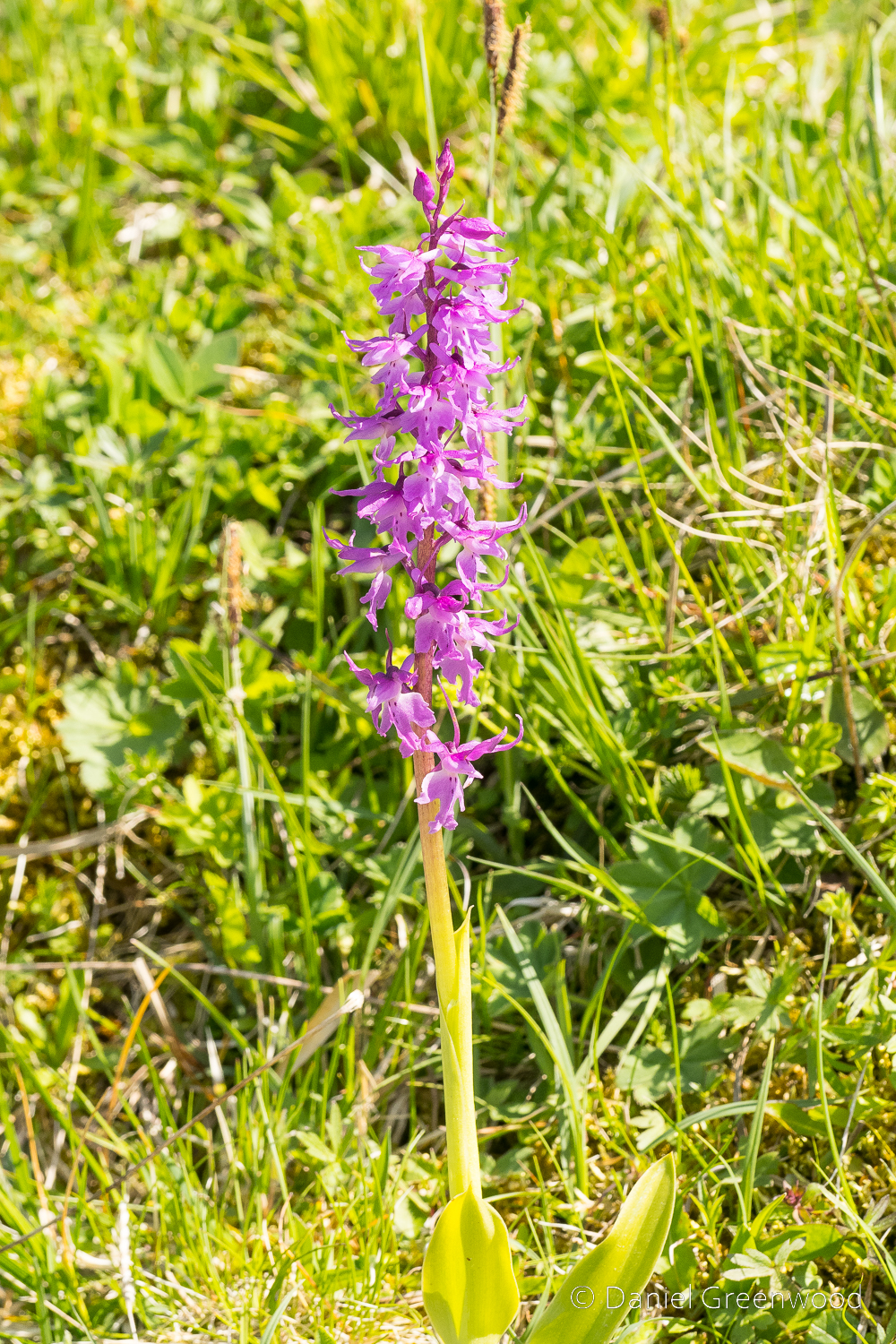
The sloping meadows were ‘littered’ with early purple orchids (Orchis mascula). We kept to the paths at all times for both safety as they were steep, and so as not to damage the grasslands. Having a camera in these places doesn’t give me a divine right to trample stuff!

Some of the orchids up close. Early-purple was the only species we saw.

This is hoary plantain (Plantago media) which gave a nice focal point to the alpine meadows.

I was intrigued by this daisy (Asters) as there were signs for arnica in the area. On iNaturalist it’s been identified as willow-leaved yellow oxeye.
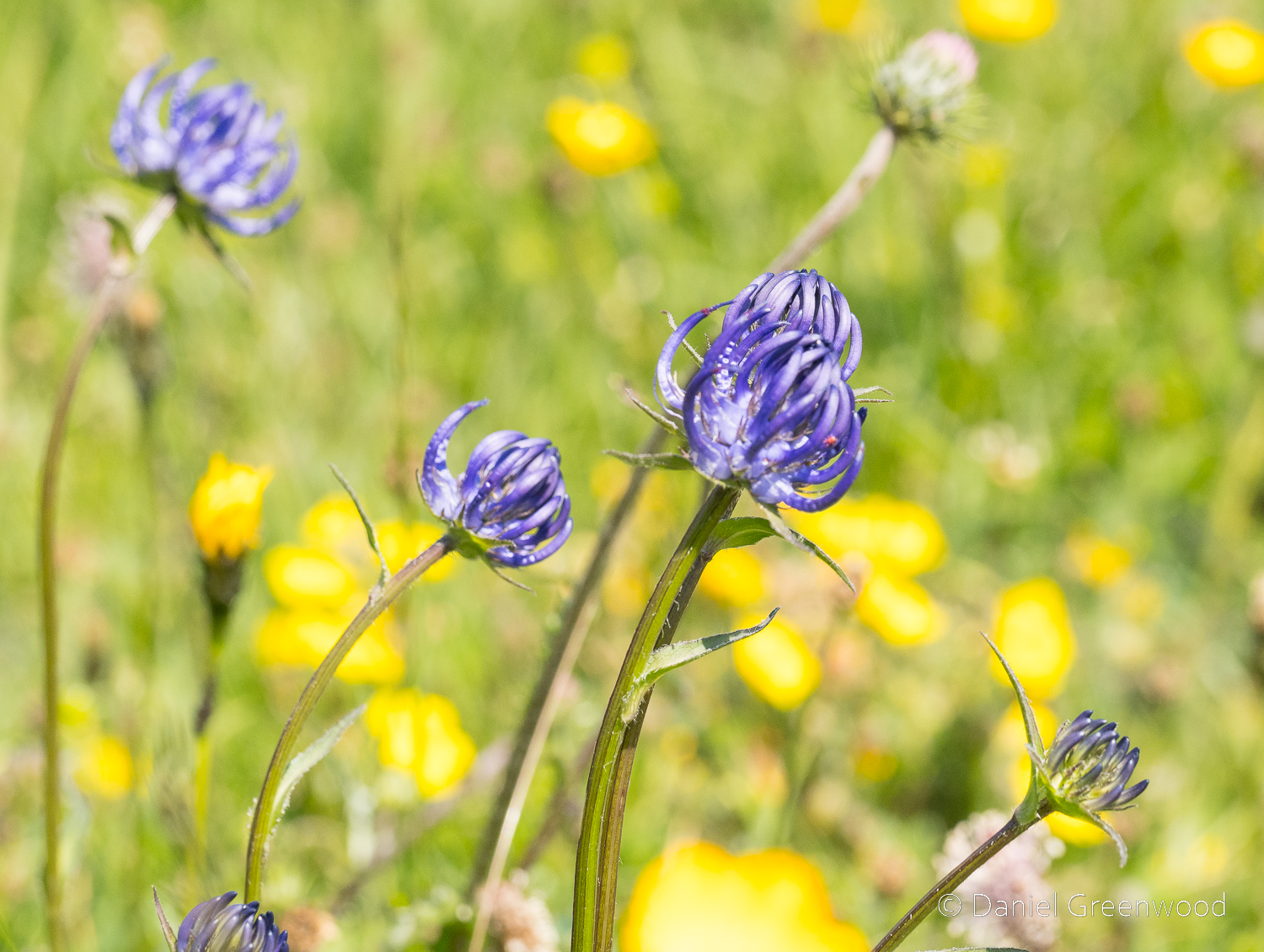
This came out a bit out of focus in the wind – it’s the ‘Sussex flower’ of the chalk Downs, round-headed rampion.

This is a new species for me, the slender Scotch burnet moth! Apparently they are native to Britain and much of Europe, and managing to nectar at the same time as mating, impressive.
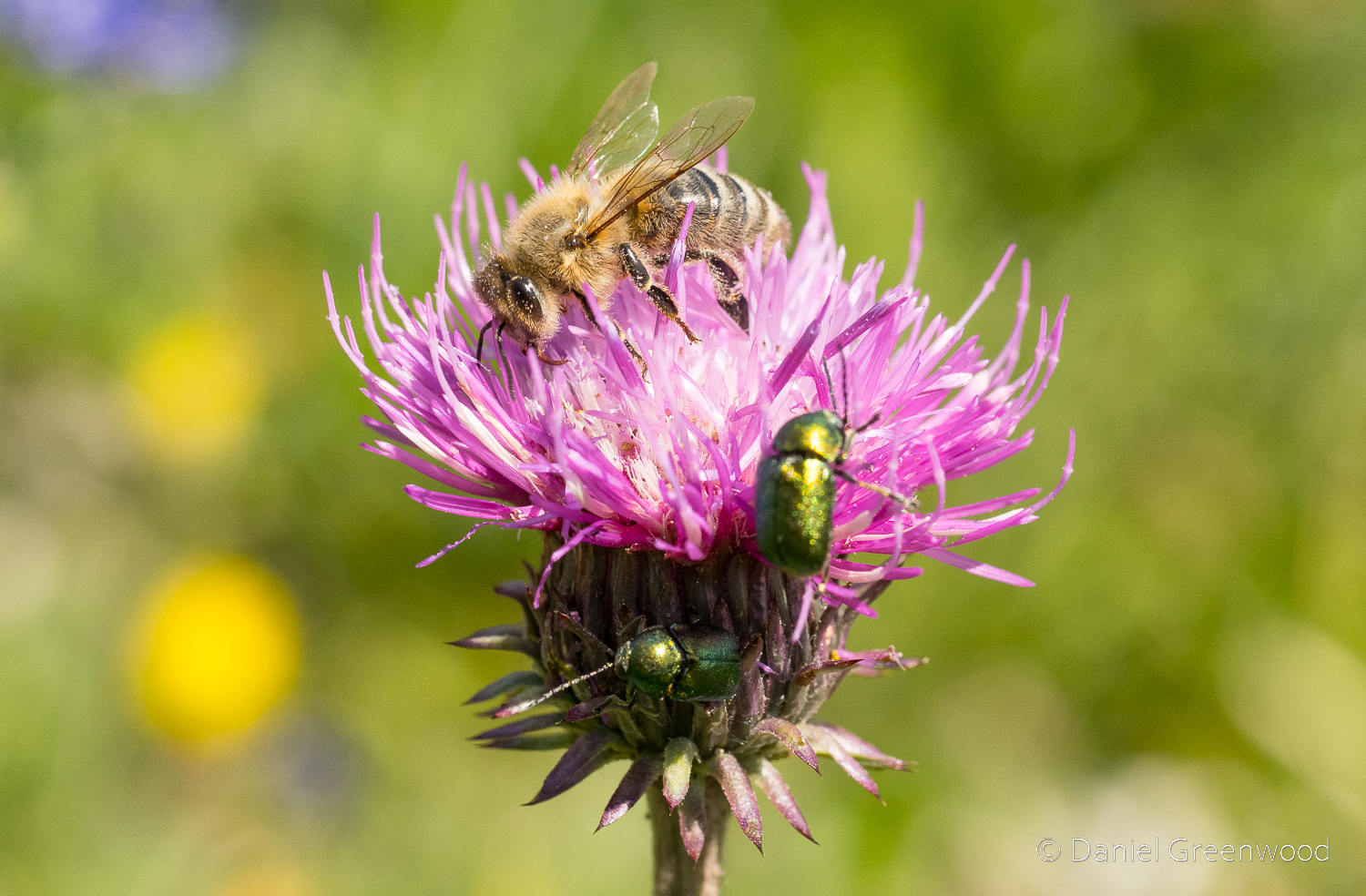
This photo made me laugh (I’ll explain). I was trying to get the honey bee and the green metallic beetle on the top in focus at the same time, so much so that I didn’t even see the second beetle lower down on the flower, which is actually in focus. This is knapweed, but I’m not sure if it’s a montane species or a variant to the common one.

While this is not a well-focused pic, it does enough to show you what is probably a duke of burgundy butterfly. In the UK it’s recovering but very rare.

The number of butterflies, day-flying moths, bees and hoverflies up here was a sight to behold. It was impossible to photograph anywhere near a reasonable percentage of all the things with wings. There were tens of fast-flying hummingbird hawkmoths on the wing, but getting photos of them would have resulted in falling down off the mountain. Also, we heard a cuckoo up here, which is quite late in the season for them.

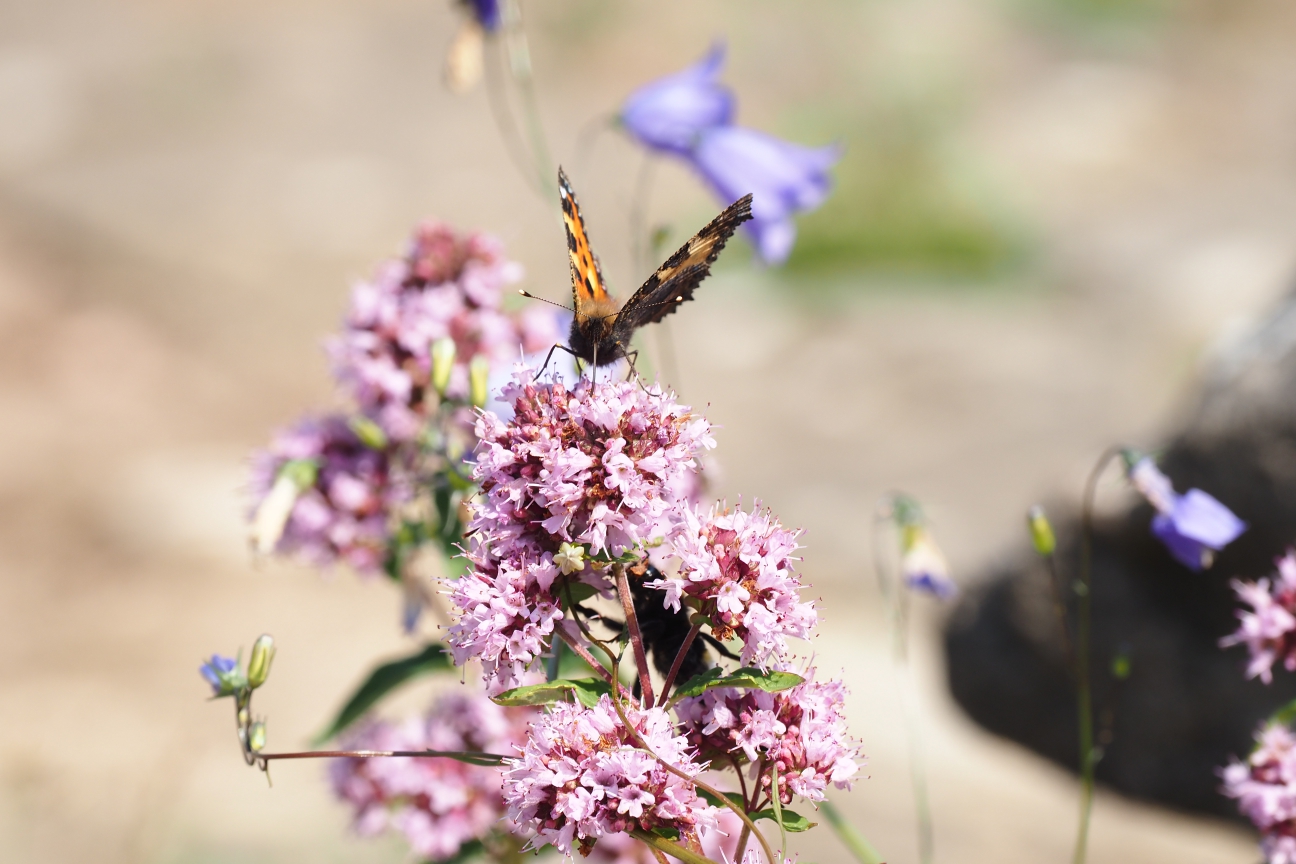
The most common butterfly was the small tortoiseshell, another one I know from home. Insert obligatory remark about how it’s not so common anymore! Isn’t it gorgeous?
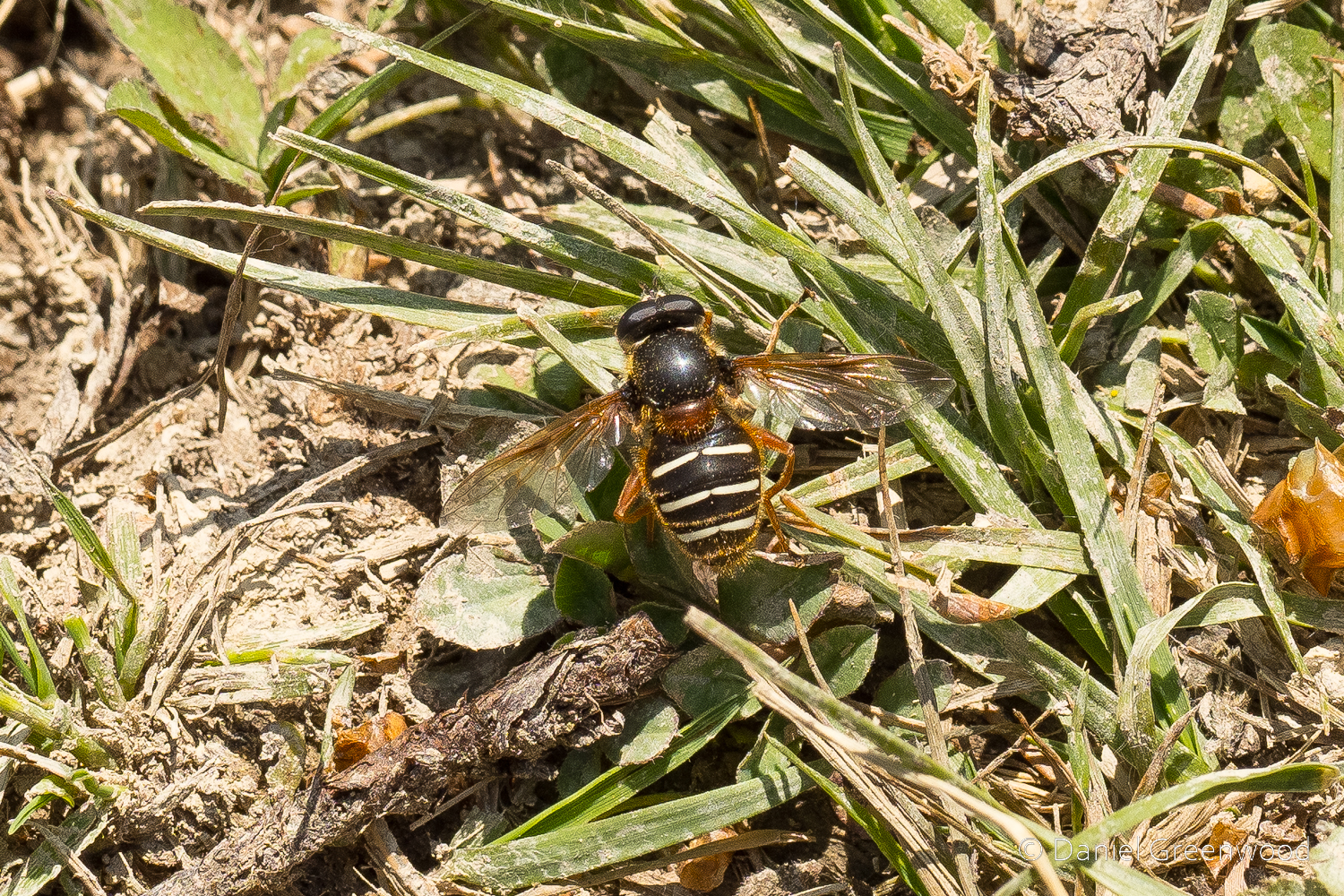
And to finish, there’s nothing more enjoyable in life than the sight of an unusual hoverfly. This was a new species for me, named on iNaturalist as the white-barred peat hoverfly. That would have been my second guess after Robocop hoverfly.

Here are some landscape images to see out this post of a wonderful walk and afternoon in the Austrian Alps. All taken with a macro lens!

Thanks for reading, Grüß Gott!

Macro | Support my work

Swiss Alps: mountain woodland flowers at Pfinstegg, Grindelwald🚡

Continuing my series of posts about the landscape of the Jungfrau mountains in Switzerland, here is a look at some of the woodland plants seen above Grindelwald.

Just to say: picking or trampling on wildflowers is not advised, and may be illegal in some locations. The meadows shown here form part of people’s livelihoods as well as being sensitive habitats. Woodlands are extremely sensitive to our footsteps so stick to designated paths where you can. Check the regulations around foraging before you go and show respect for people and wild plants, animals and fungi when you visit. There’s a lot of livestock around, usually behind fences, but they’re so noisy you can’t miss them.

The photos here are a mix of mirrorless camera and phone. The plants photos are mainly taken with my Pixel 7a, the landscape photos with my Olympus EM1 Mark III. All have been lightly processed.

The walk

The walk was a fairly short one in length, mainly due to the altitude and general tiredness from travelling. It would be a good one if you’re visiting from Interlaken on a day when it’s not worth going higher or it’s too early in the season.

The walk is about 2.5 miles and can be done more quickly if you’re not taking photos of plants!

All the high trails, including the Eiger Trail, were closed when we visited. Climate change may be making rockfall more common and therefore the higher trails are more dangerous.

It’s possible you can do this walk and see absolutely no one, but for a farmer or two, after you pass the toboggan run.

We took the Pfinstegg cable car up to the Berghaus restaurant, had some chips, and walked down to the village, past the toboggan run.

What you can’t hear is the sound of middle-class Americans talking about their Adriatic travel plans.

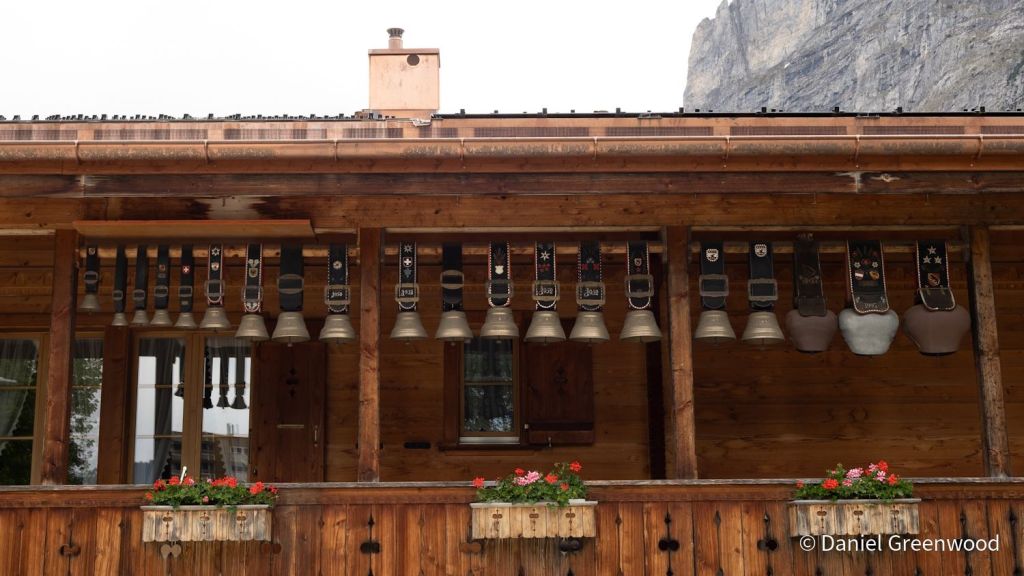
One image I wanted to share was this exhibition of alpine heritage. Here you can see the array of bells used in the Jungfrau for cattle management. The sound of the cowbells is one of the signifiers that you are in the Swiss Alps. Of course the same can be said for many mountain regions, but each one has its cultural differences. That’s a different blog entirely!

Alpine flowers (1300m)

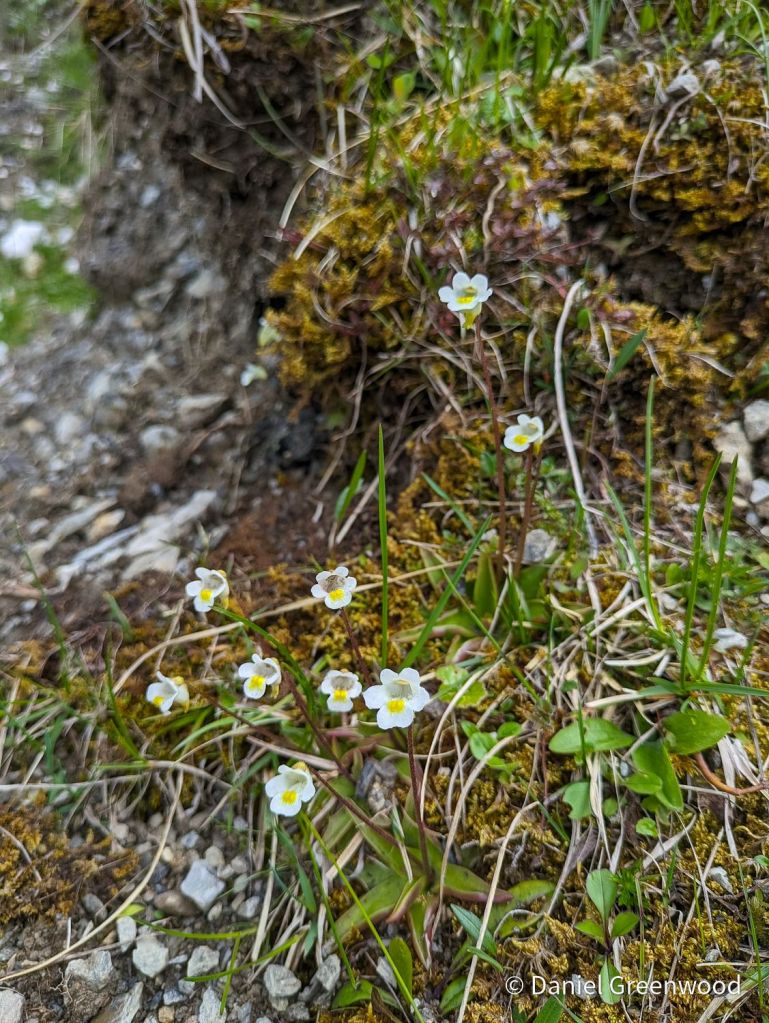
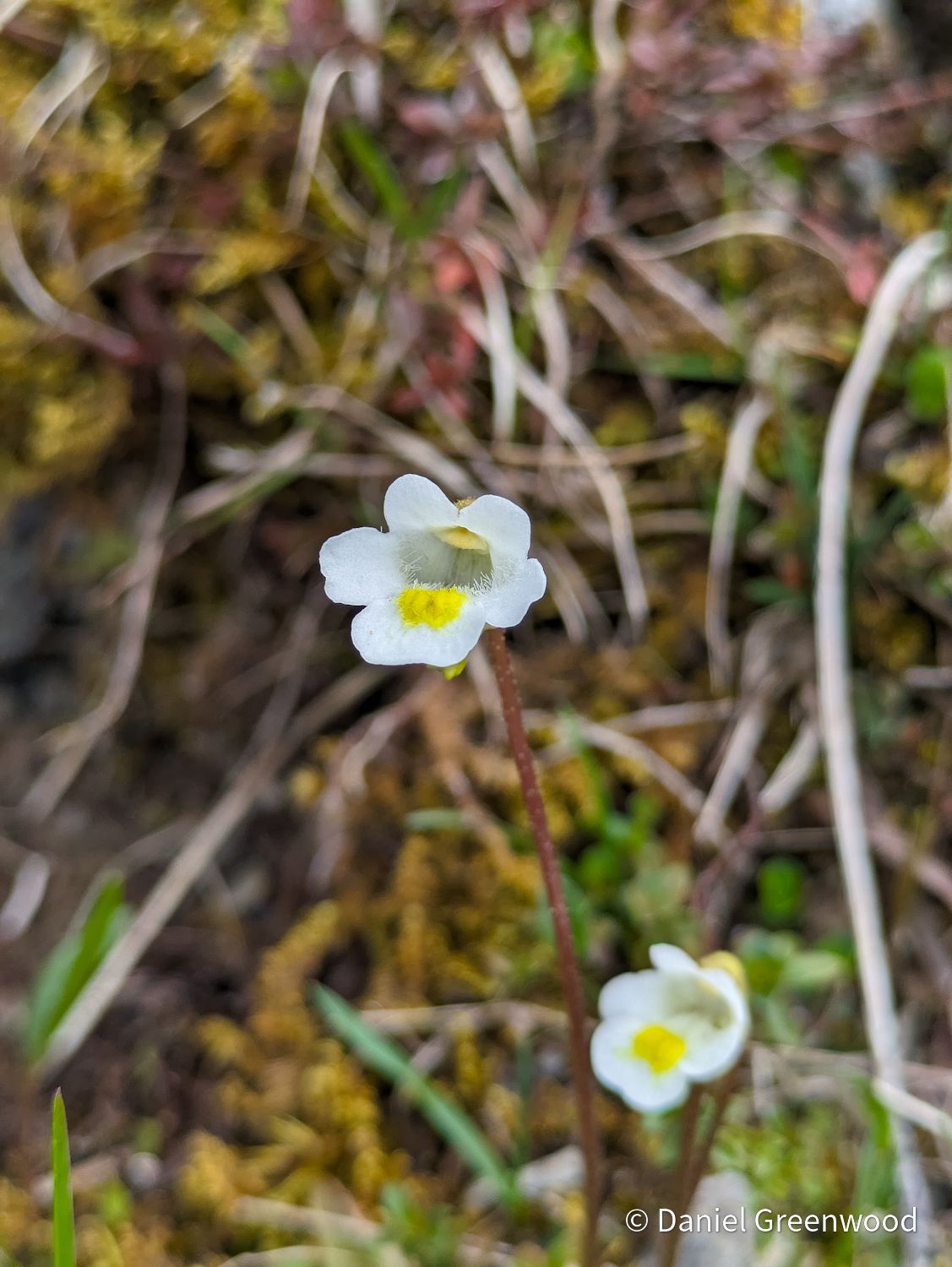
One of the more common sightings in the alpine zone was alpine butterwort, (Pinguicula alpina).

Another common one was shrubby milkwort (Polygaloides chamaebuxus).

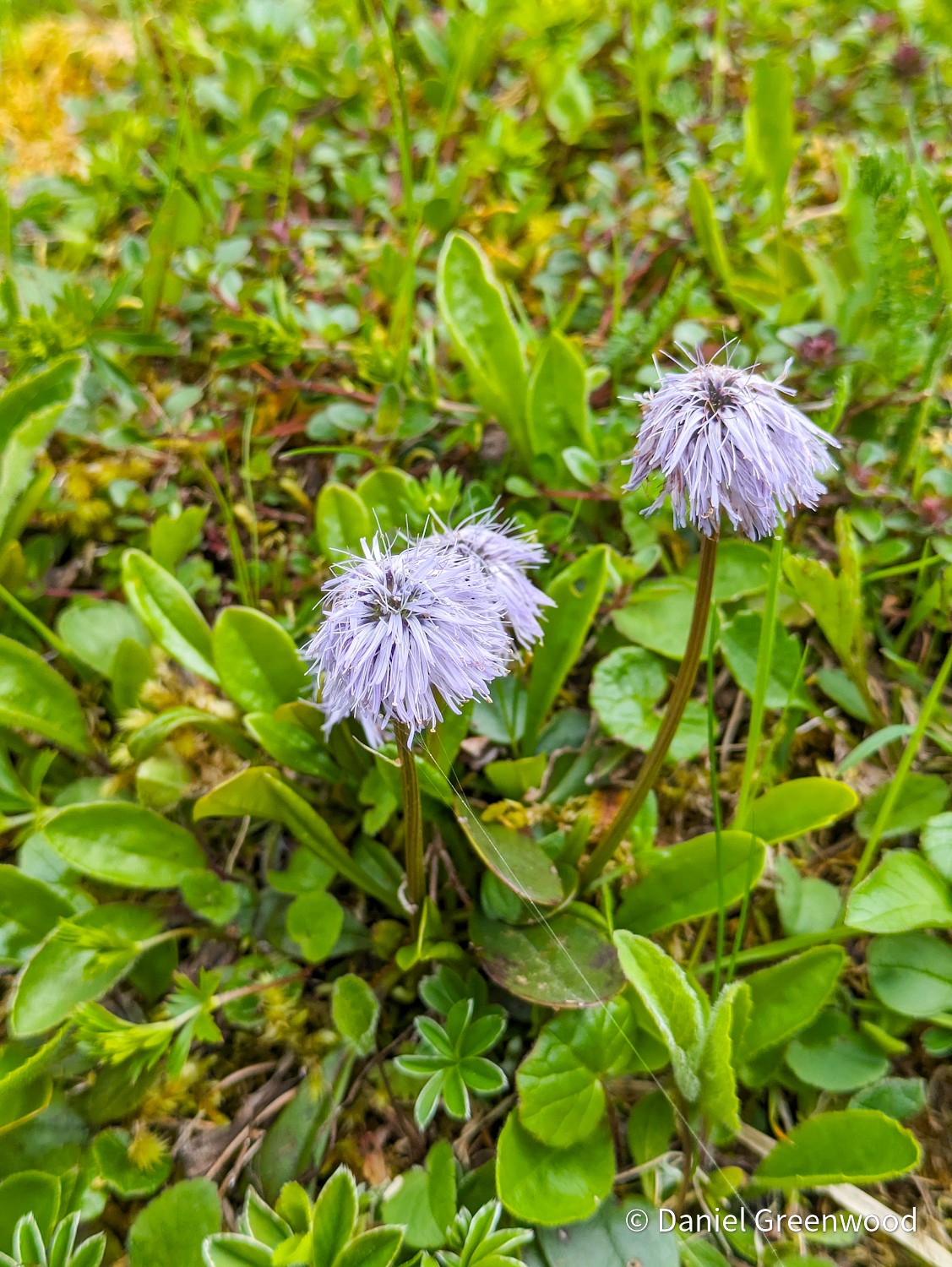
A regular of this habitat was leafless stemmed globularia (Globularia nudicaulis). They look like little lilac mops.

At this point the views of Grindelwald began to be swallowed by the spring woodlands.

In the woods

As you can imagine, the water was crashing down as the snow melted. A lot of work is going into observing the changes in the glaciers in the Swiss Alps, which is happening at an alarming rate here.

You can get views of the Lower Grindelwald Glacier from this walk (though this was taken lower down). This glacier shrunk by over a mile between 1973 and 2015.

I love a new violet species that’s easier to identify than ours at home. This is twoflower violet (Viola biflora) and was only seen in the woods at the edge of lanes.

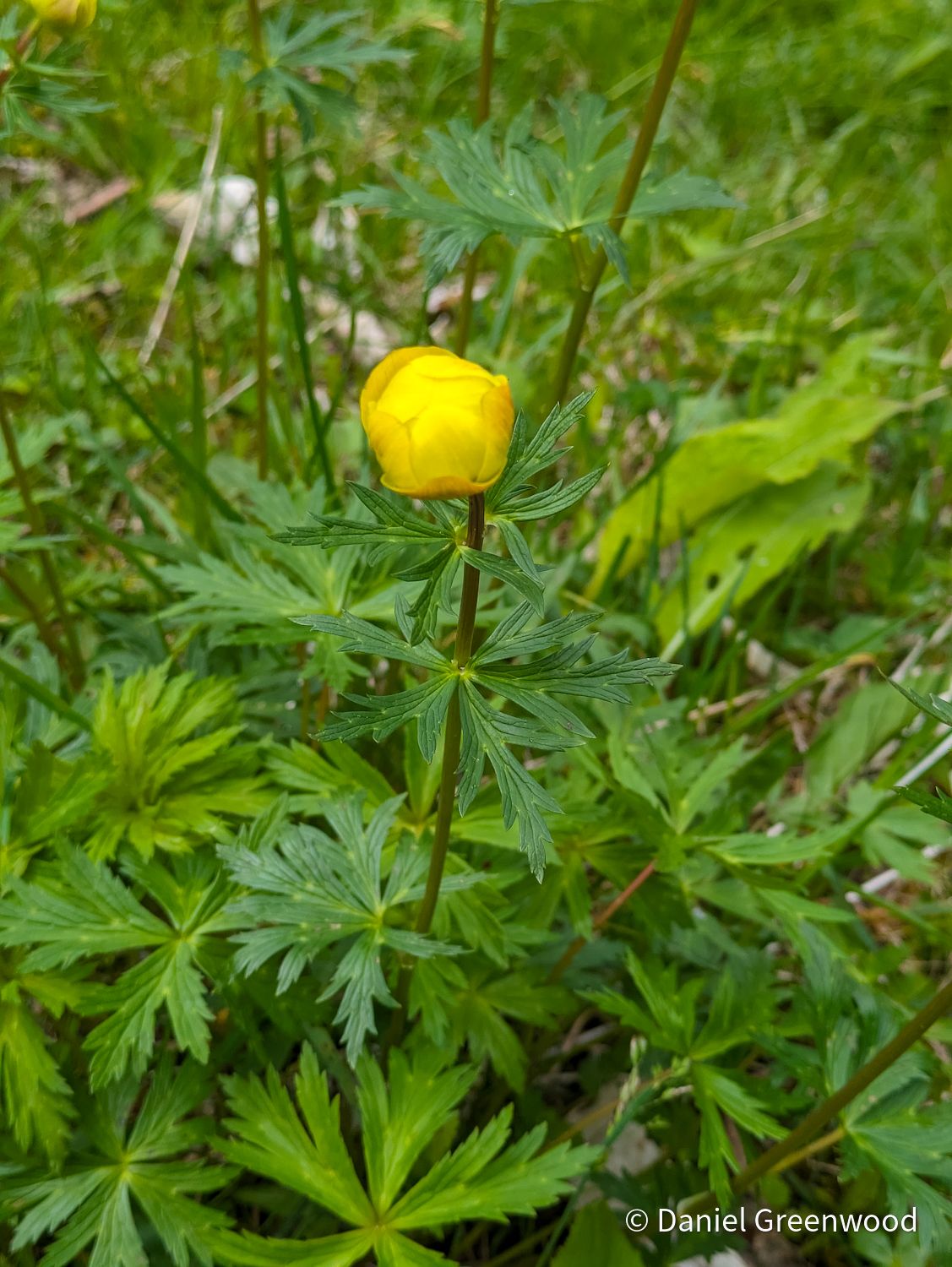
It’s always nice to find globeflower (Trollius europaeus), a species of buttercup.

This was a new species for me – may lily (Maianthemum bifolum). It looks more similar to something like black bryony or bindweed to the untrained eye (this one).

This cranefly was resting on the leaves of yellow archangel, a woodland plant we seem to be losing in the UK.

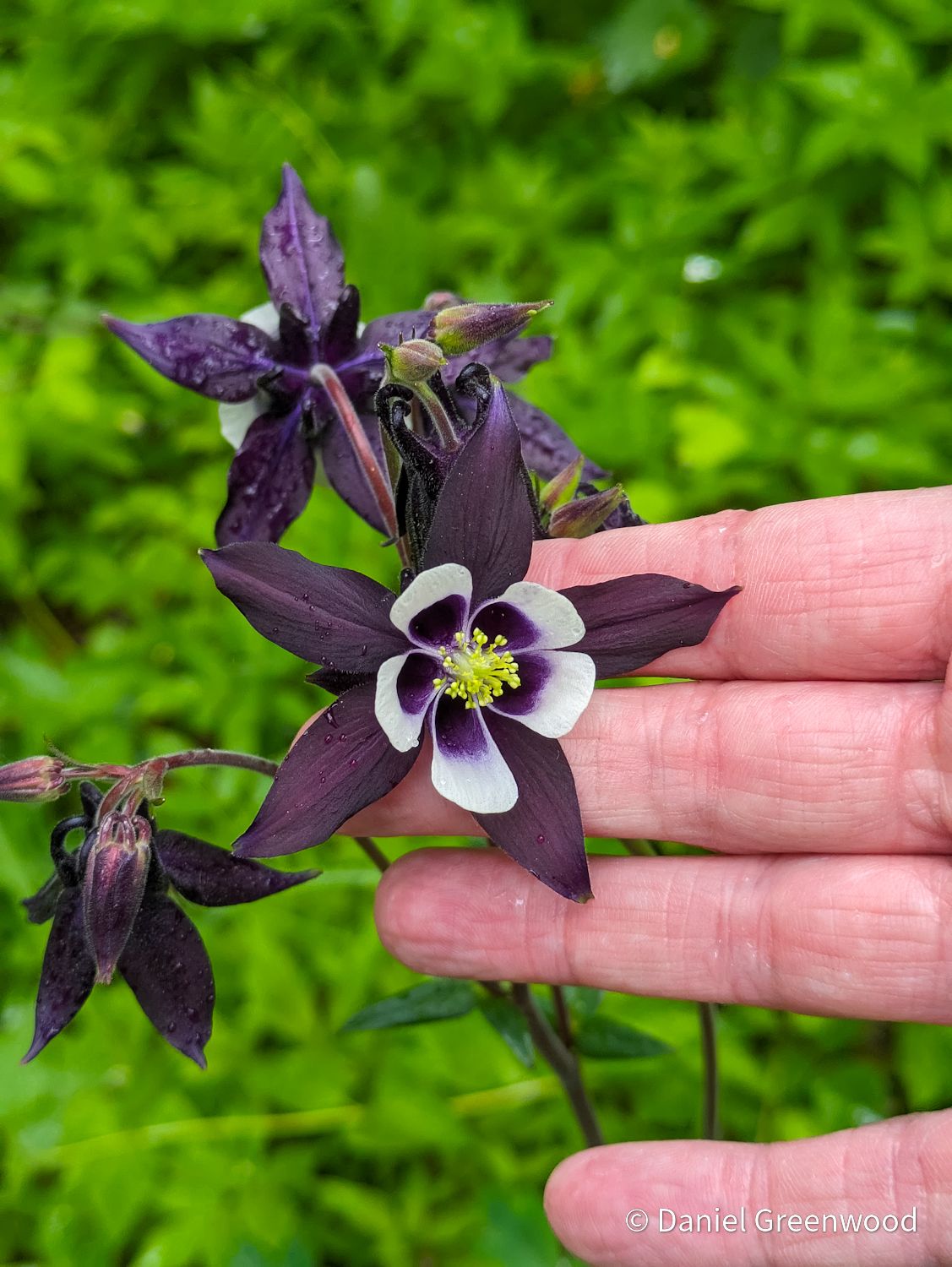
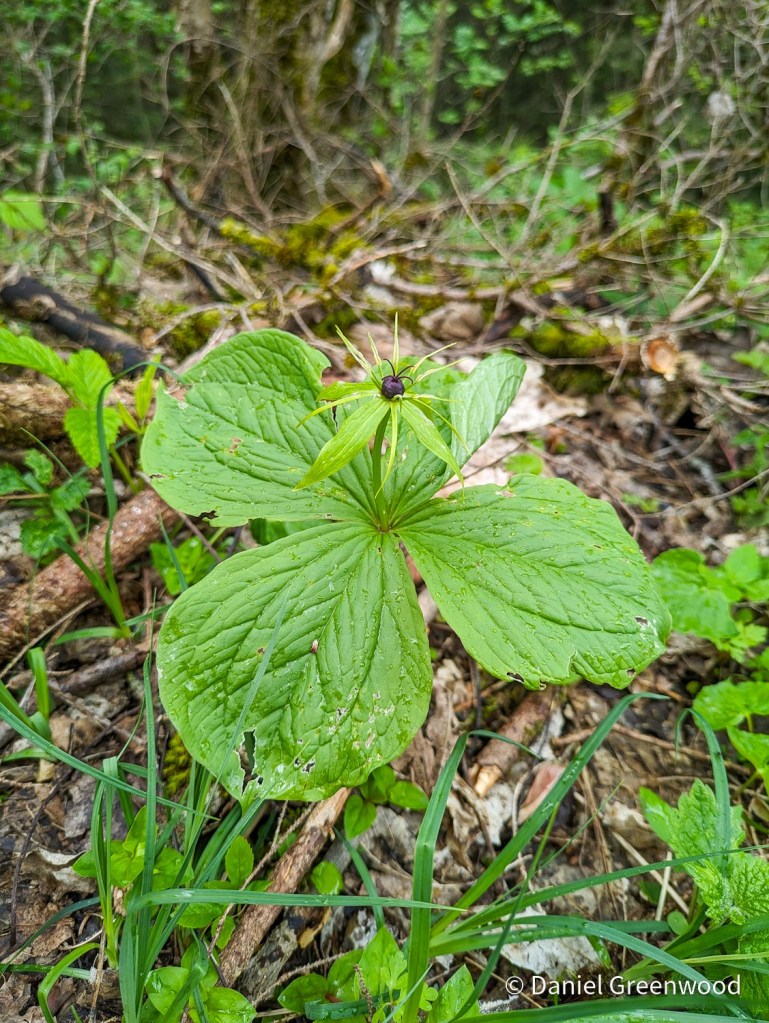
It’s always a joy to encounter herb paris (Paris quadrifolia). I think the columbine (Aquilegia vulgaris) seen here is probably a garden escape, though it is an ancient woodland plant as well, so I may be wrong. I hope it’s the wild one!

There was more herb paris, but only in the woods.

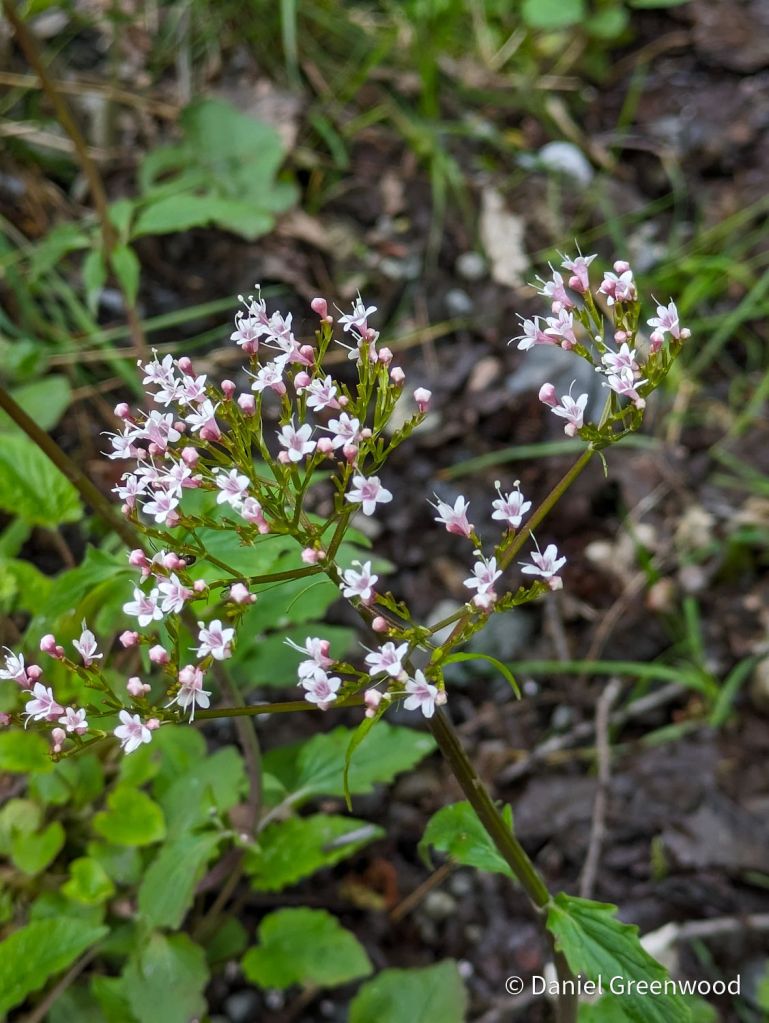
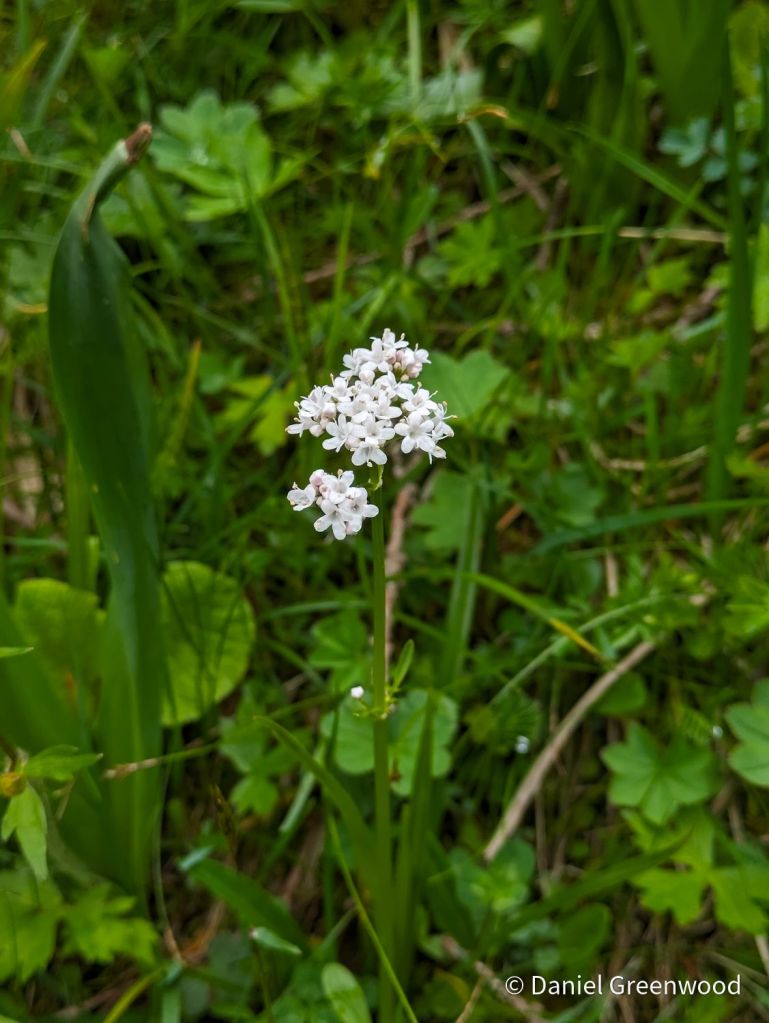
There were a couple of valerians. This one is three-leaved valerian (Valeriana tripteris). It was growing in wet areas.

I also saw marsh valerian (Valeriana dioica).

Now, there weren’t a lot of orchids out at the time as it was probably too early in the season. But this is bird-nest orchid (Neottia nidus-avis), which I’ve only really seen in the chalky woods of the North Downs in England.

This is fly honeysuckle (Lonicera xylosteum), a strangely shrubby honeysuckle compared with the climber we have in the UK. It’s been introduced to Britain but I’ve never bumped into it.

Hillside meadows

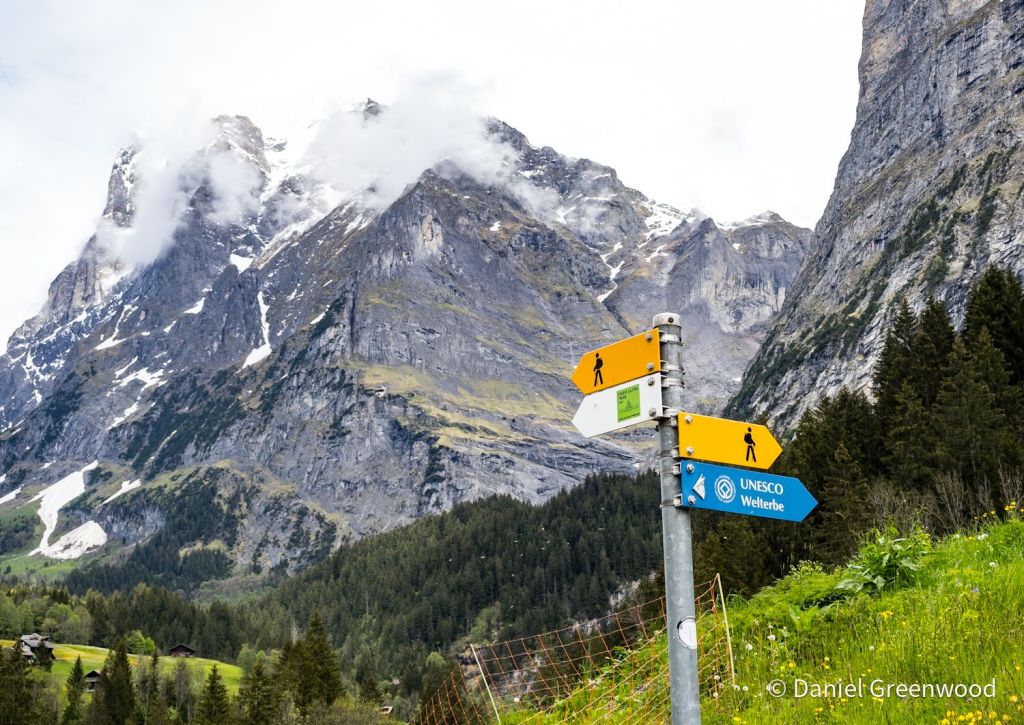
Let’s just take in the views of the Wetterhorn for a bit…

I’d like to be out walking in World Heritage landscapes every week, but alas, it will just have to be once or twice in life.

Looking south-west towards the Eiger.

Mountain sainfoin (Onobrychis montana) was one of the most eye-catching plants, growing at the edges of the lane if I remember rightly.

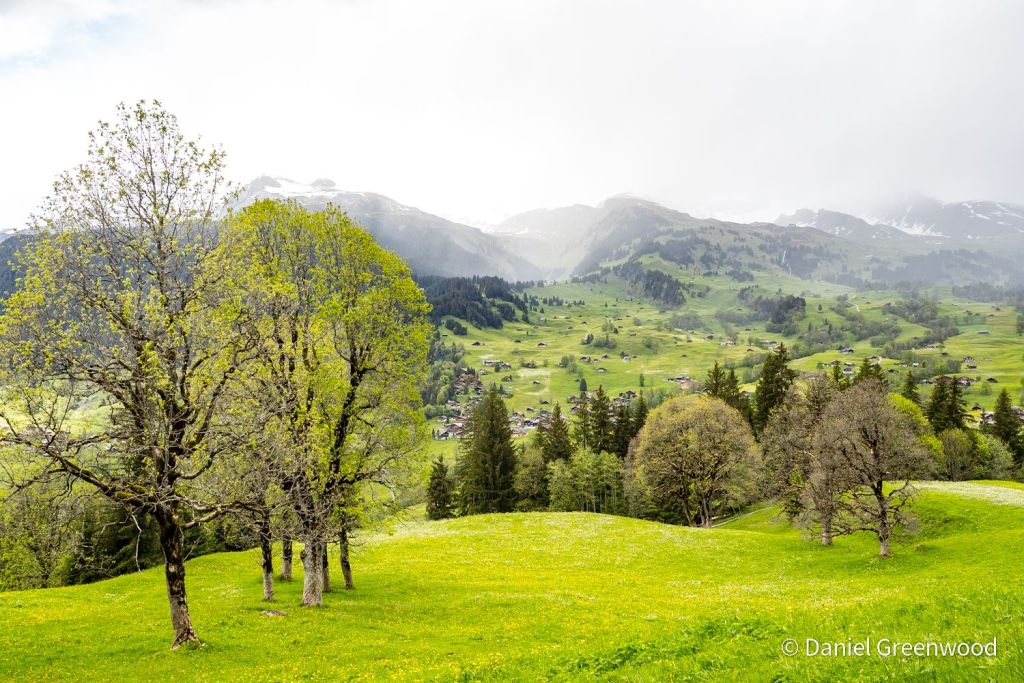
The spring really glows in this image, despite the misty conditions. The sycamores are coming into leaf.

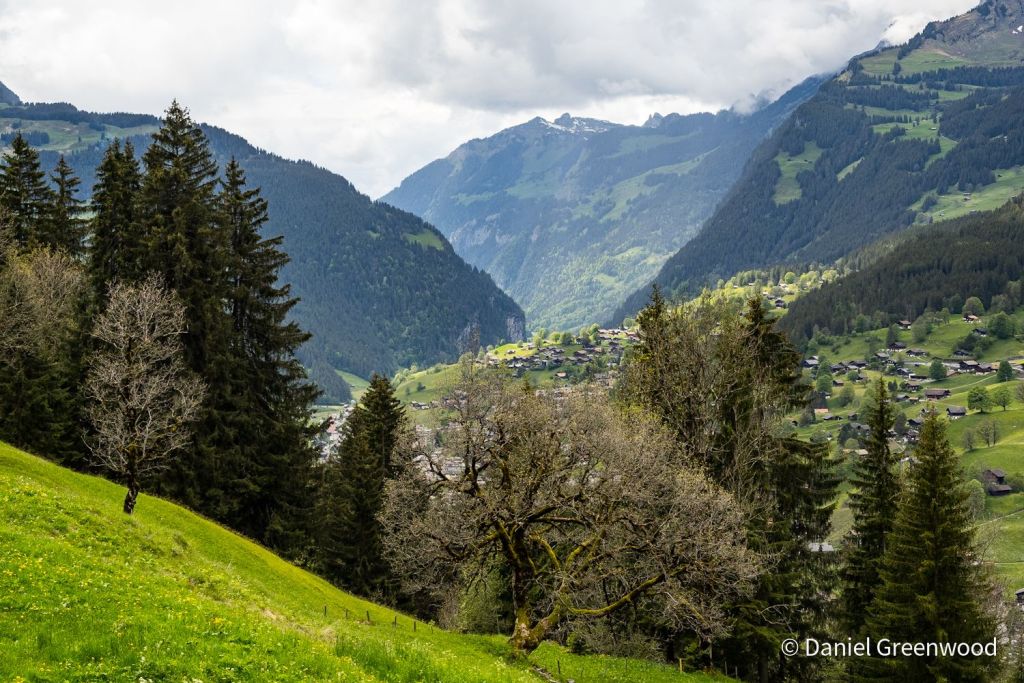
This is a view down the valley where the train returns to Interlaken.

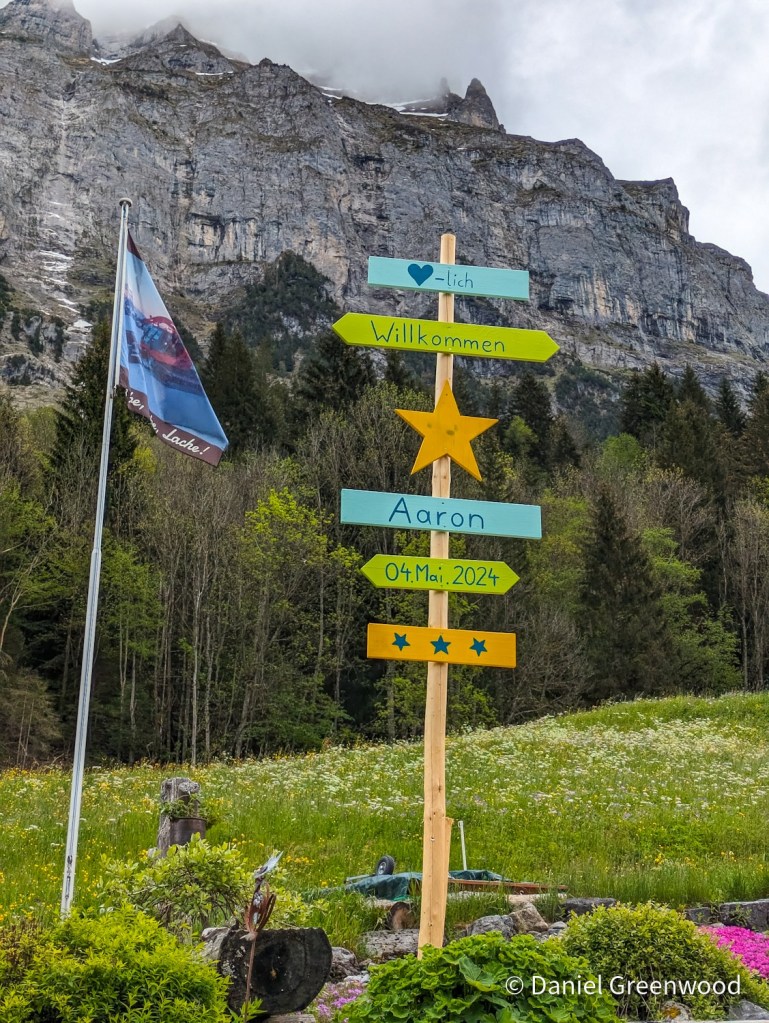
This is something I’d never seen before – a totemic welcome for Aaron who was born on 4th May 2024. Perhaps this is a tradition in this part of Switzerland?

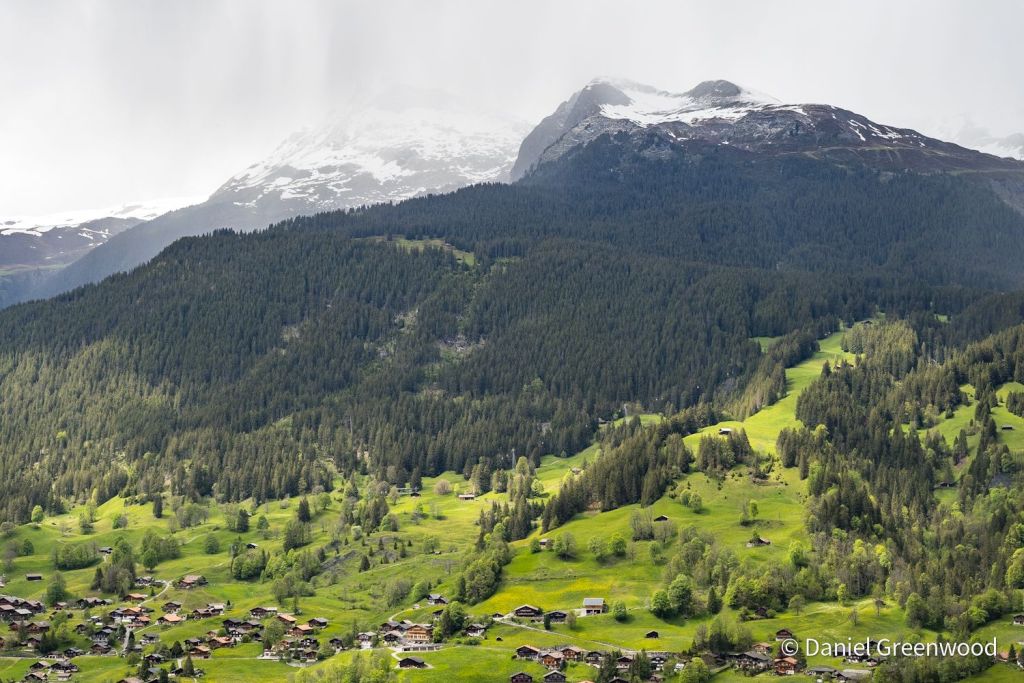
The views across towards Grindelwald First come into view as space opens up on the woods. You can see all of the chalets that dot the meadows.

I was intrigued by these rustic chalets that were more indicative of a rural way of life, compared with the guesthouses in the valley. It looked lived-in or at least used by people who made use of wood products. What a lovely place to be able to escape to in the summer. Of course communities would have developed from these single dwellings across the Alps.

This image looks north towards the other side of the valley. The yellow hue in the meadows is either kidney vetch or birds-foot trefoil.

The lovely spiralling shell of a snail roosting in a tree.

These umbellifer-rich meadows were a joy to behold.

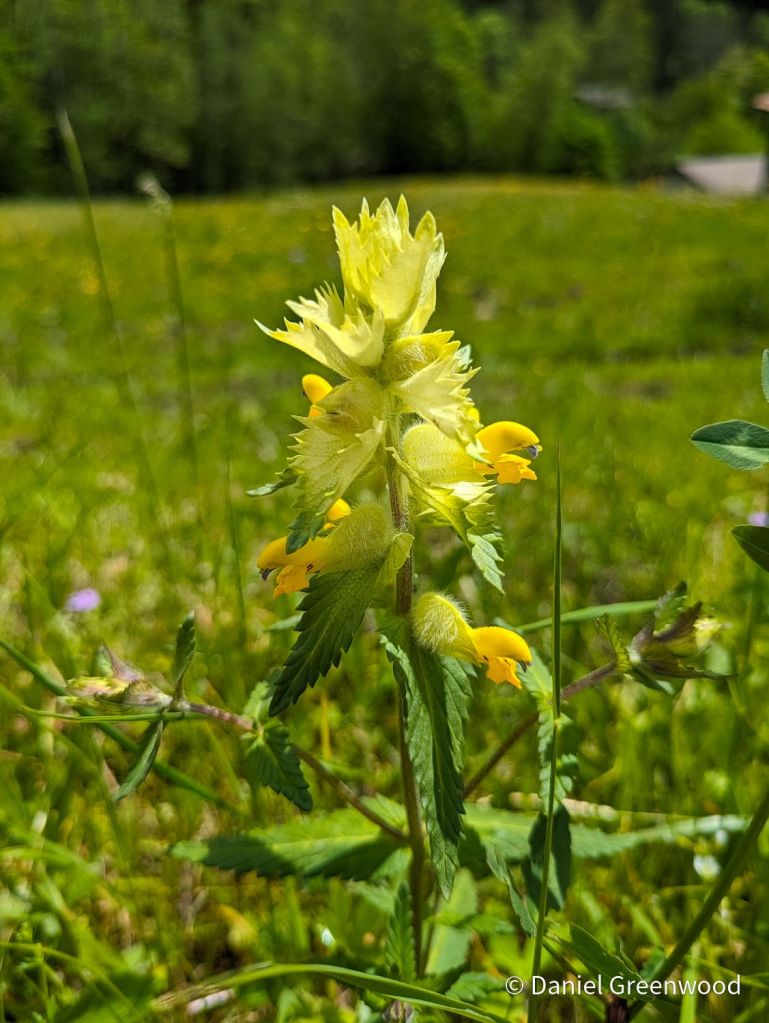
The lower we got (c.1000m) the more abundant yellow rattle become. This is probably Rhianthus serotinus.

This is the Black Lütschine, one of the rivers that flows into Lake Brienz. It was very powerful. Its source is the Lower Grindelward Glacier, pictured earlier in this post.

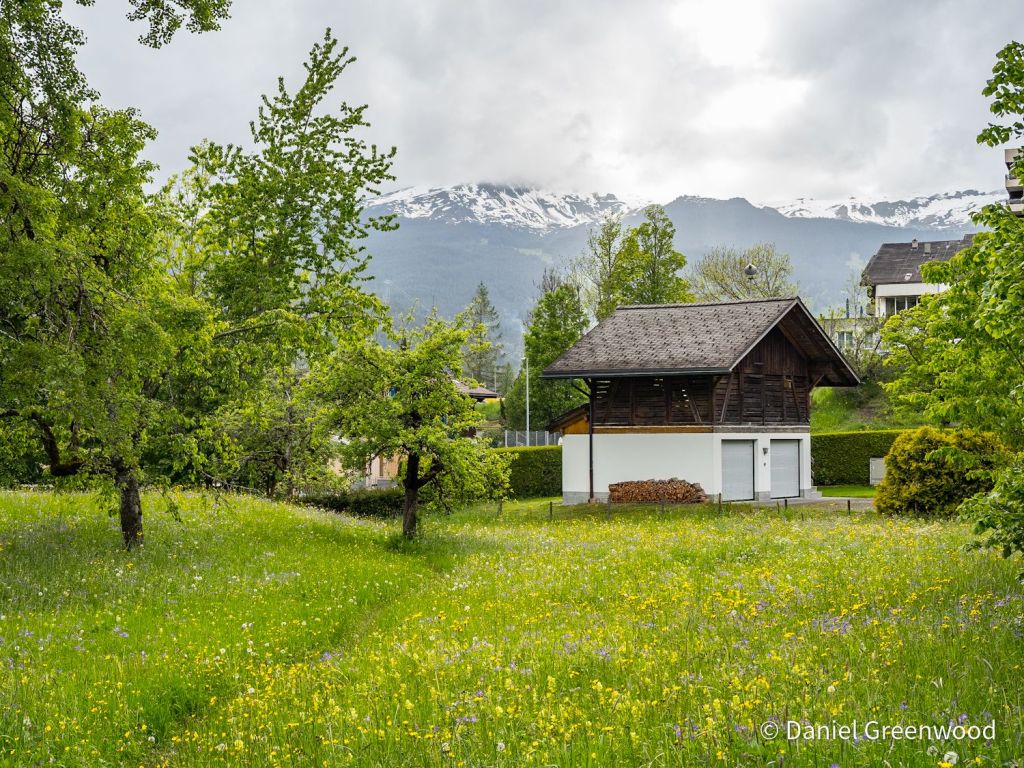
The meadows around people’s houses – this looks like an orchard – were in fine condition.

Thanks for reading.

I write these blogs in my spare time because I want to raise awareness about the beauty and diversity of our landscapes. If you enjoy reading them you can support my blog here.

At Fountains Abbey, wildflowers prevail with time

Fountains Abbey, North Yorkshire, July 2021

The ruins of Fountains Abbey sit on lawns that look as good as modern football pitches. It’s boiling hot and most people hide in the shade. This doesn’t feel like northern England.

The story of Fountain’s Abbey begins on the 27th December 1132 but abbeys have been in existence in northern England since the 600s. The abbey was founded under the Cistercian Order and monks had to serve as ‘a choir monk in prayer or as a laybrother in manual work’ (National Trust (NT), 2011).

The abbey and its residents lived through tough times: financial problems, livestock disease, climate change, raiding Scots and the onset of the plague. The plague hit around 1349-50 and killed a third of the abbey’s residents (NT, 2011).

On this hot day the ruins emit a welcome cool, tunnelling a gentle breeze that slips through the valley of the the River Skell. Skell is a non-English placename:

The name is from the Old Norse skjallr, meaning “resounding”, from its swift and noisy course. In the Middle Ages the river was known as “Heaven Water”, presumably from its association with Fountains Abbey.

Smith, A.H. (1962). The Place-names of the West Riding of Yorkshire. 7. Cambridge University Press. pp. 137–138.

Yorkshire can sometimes feel like another country to southerners, so strong are its cultural links to Scandinavia. It’s the same for the rest of England, with the Viking territory of ‘The Danelaw’ once reaching down to the River Lea, just north of London, and covering large swathes of England.

The ruins alongside the River Skell

Monasteries in England were dissolved after Henry VIII’s falling out with the Pope over his divorce from Catherine of Aragon. The abbey was surrendered in November 1539. After the monks moved on, the land and its materials were sold off. The stained glass windows and other valuable elements were crudely removed by the new owners. The abbey was ruined in a way to make it unfit for religious practices.

Some 450 years later, in 1983, the estate was purchased by the National Trust.

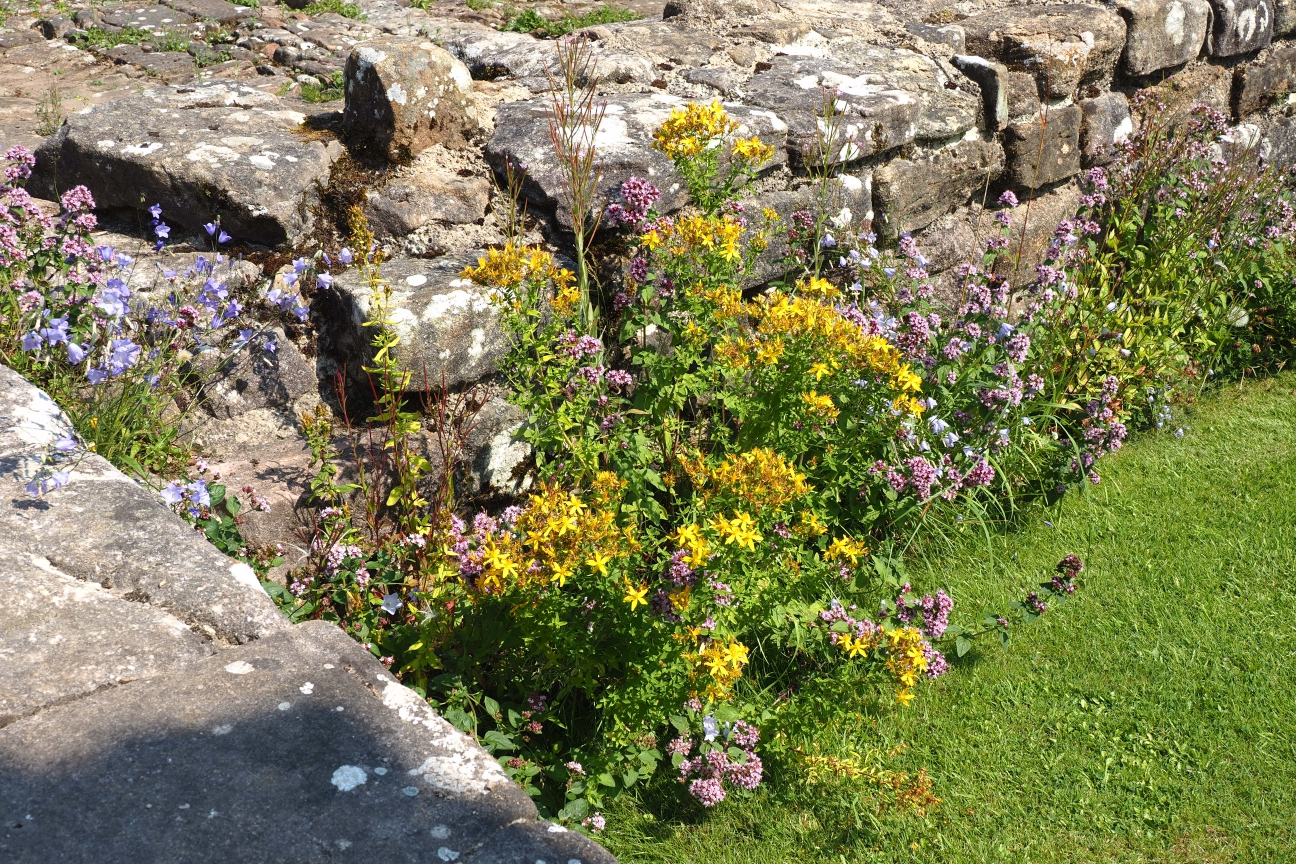
Inside the walls of the abbey, wildflowers burst from pockets of stonework: wild marjoram, black knapweed, St. John’s wort, field scabious and harebell. These flowers have taken root in substrates within the crevices of the masonry. They have prime positions to receive full sun, and are sheltered from some of the elements. It’s a great place to live.

Marjoram in its happy place

I wonder why these plants are here, perhaps their medicinal value. No doubt they were cultivated and used by the monks who spent their lives here. I like to think the prevalence of marjoram (known in a culinary sense as oregano), St. John’s wort and scabious are due to their prior importance in the day-to-day lives of the monks.

My uncle recently sent me a copy of The Treadwell’s Book of Plant Magic by Christina Oakley Harrington. It has a lot to say about these plants.

Small tortoiseshell butterfly nectaring on marjoram

I know that marjoram is a delicious herb. I grow it in a pot in my garden for pollinators and it’s something I nibble on when visiting the chalk grasslands of southern England, where it lives. According to Treadwell’s, it has high magical value, something which I can’t be sure was of interest to the monks at Fountain’s Abbey, who were obviously not pagan in the way previously settling Vikings were. It is thought that pagan beliefs of pre-Christian England did persist in people’s outlook. The connections people have with nature would have been safe spaces for those beliefs to persist.

Scabious gets its common name from the fact it was once used to treat skin ailments. The flowerheads eventually become scratchy after flowering and were once used on the skin.

St. John’s wort among marjoram and harebells

St. John’s wort is a famous medicinal herb, another species which can be found in chalk grasslands in southern England, and in other areas throughout Britain. There are a number of different species. According to Treadwell’s it’s one of the most important and protective plants in magic folklore.

In its medical use, Wikipedia says:

“The red, oily extract of Hypericum perforatum has been used in the treatment of wounds, including by the Knights Hospitaller, the Order of St John, after battles in the Crusades, which is most likely where the name derived.[19][21]

It is also used to treat depression.

Ragwort grows high from masonry

Ragwort does not have many supporters in England, which is a shame because it could be key to providing a fundamental nectar source for pollinators across the UK. This is particularly true of towns and cities away from grazing animals. It’s disliked because it has toxic properties which can go undetected in cut hay and then be consumed unknowingly by livestock, accumulating to cause organ failure. Its proponents (for ecological reasons) have created a website in its defence.

According to Treadwell’s, in Ireland it’s known as ‘fairies’ horse’. This is because:

it is believed that witches and fairies ride on it as if it were a horse, flying through the air at night

The Treadwell’s Book of Plant Magic, Christina Oakley Harrington (p.106)

The seeds definitely fly through the air because the plant grows in some of the highest parts of the masonry. Swifts screech in flight as they shoot past those higher outcrops, perhaps feeding on some of the many insects that nectar on the plant’s flowers.

One thing I learned here, and that I’ll never forget, is that urine was once used by the monks at the abbey. It was collected and used as a dye, for leather tanning and also for wool treatments. A urine pot was found near perfectly preserved.

I think I’ll stick to the herbs.

Thanks for reading.

Land of the lousewort: healing a broken landscape in the White Carpathians

Czechia 2017 lo-res djg-118

In September 2017 I visited the White Carpathians on the Czech side of the Czech-Slovak border. The White Carpathians hold wood pasture meadows with the highest plant diversity on Earth per square metre. This is a landscape heavily impacted by people but may be fairly close to the pre-human ‘wildernesses’ of Europe. Here conservation efforts have yielded great success in preserving part of a once international wildlife corridor.

The White Carpathians, Czechia (a.k.a Czech Rep.), September 2017

The sun beats down on the village of Vápenky and in the trees high winds blow off from over the White Carpathians. The sky is a deep, summer blue but in the orchards the colours of autumn are appearing. The meadows are dry and grain-coloured, red apples and green pears drop into the cropped grass.

We follow the forestry road through tall beech woods that stand like the framework of a cathedral incomplete. The wind lashes them but some stillness rests in the opening low between the silver-grey trunks. The limestone quarry track bends up and over into a clearing where the forestry machines have deeply rutted the road. They have also cleared the trees but for one long, thin beech that stands alone, its bark bleached by the sun.

The landscape of a recently deforested area is shocking, wreckage. But this industry is one of the most important in the whole of Czechia. Many lives are sustained by it. Still, I wish we could find a way for horses to still remain an integral part – something I’ve seen in Romania – and that its culture was not so macho, chauvinist and driven by putting profit above good ecological stewardship.

Czechia 2017 lo-res djg-64

The clearing of trees has opened up views of the valley, showing forested mountains and peach rooftops. For a country that is nowhere near as pious as neighbours Poland and Germany, each village or town has it church, climbing above all else.

We are looking for a nature reserve called Porážky but our map failed to show the road we were taking some time ago. We speak to a Czech woman heading down a track with freshly picked parasol mushrooms in her hand. She points us back up the trackway, fingernails cut and painted indigo, her hair dyed reddish-brown.

The end of forestry land is always marked by a boost in tree diversity. Here hornbeam, a tree of no forestry value, grows. So too hazel, oak and small-leaved lime – the Czech national tree. These are all species of the pre-industrial forestry age, wildwood species of great use to human hand and hearth, but not the modern machine.

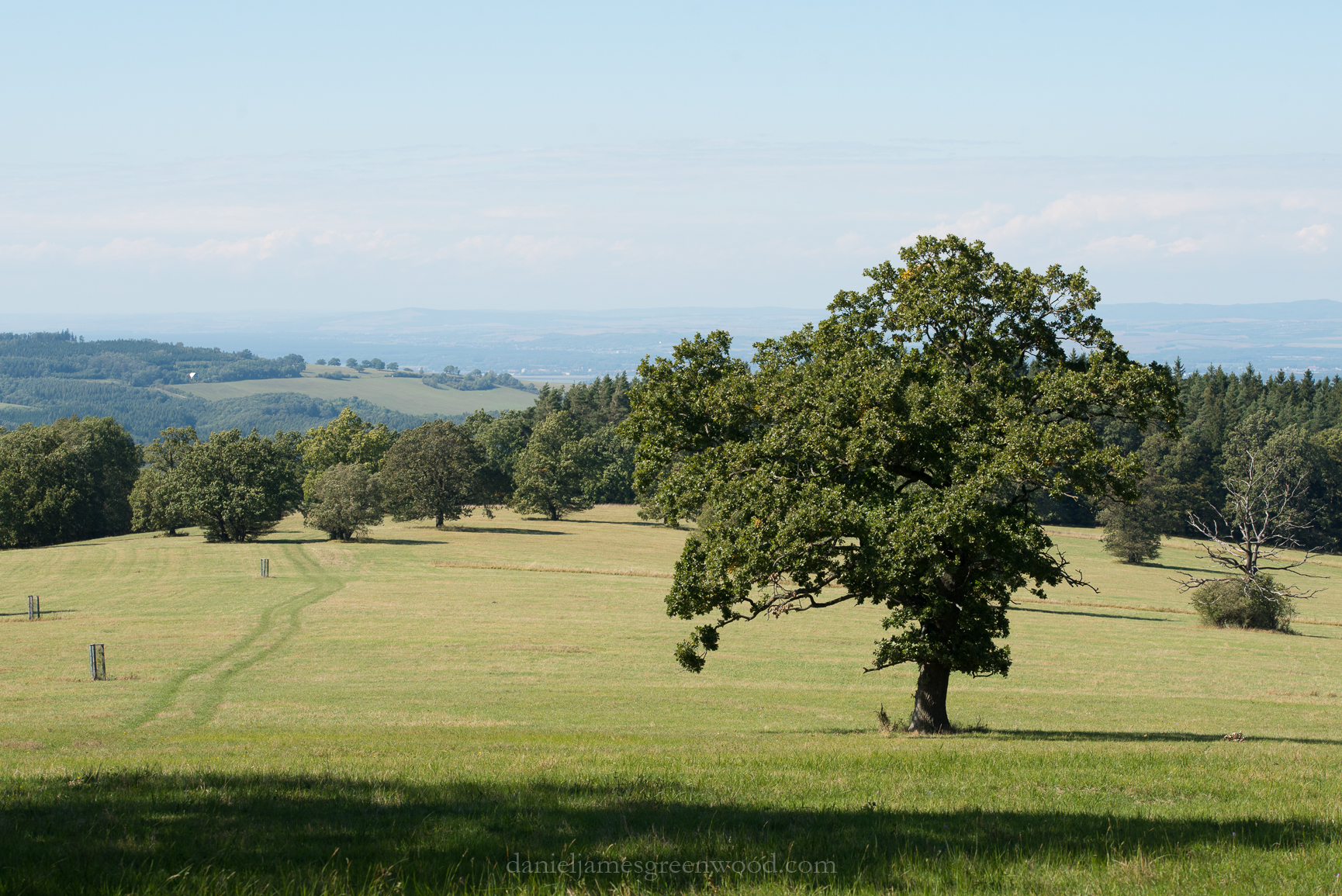
Light breaks through the edging of broadleaved wood to reveal grasslands and the sky atop the hill. Again the wind gusts. Reaching its top we enter Porážky, the protected area of wood pasture we had hoped to find. The landscape is cropped grass and single oaks. You would have not the slightest idea that these are the richest meadows on earth.

They are a man-made and exploited habitat, but they are the truest symbol of harmony between people and nature. In fact, they may even be closer to what the pre-human woodland landscape of Europe was like, due to the cropping of large, roaming groups of wild grazing animals we have now made extinct. ‘Rewilding’ in its purest or most puritanical form wants that world back.

Czechia 2017 lo-res djg-100

The White Carpathians are the lowest lying, most westerly extent of the Carpathians massif, stretching east to Romania where they reach their zenith. It is a landscape that holds great mystery, wildness and fascinating human cultures. What a life it could be to travel back and forth across the range, witnessing its wildlife and spending time with the people making a living from its soils, woods and meadows.

Eddie, my hiking companion, and I, have been to their furthest point, and there, too, are found meadows of great diversity. In Romania ancient traditions are dying out as people move to cities – what contrarily is thought to be the driving force behind the return of wolf, bear and other megafauna – the rewilder’s dream. In the White Carpathians conservation initiatives have led to the protection of the meadows and their continued management.

Two days ago we visited the headquarters of the Bílé Karpaty protected landscape area or CHKO in Veselí nad Moravou where we learned that one of the great successes for the organisation has been the return of orchards to the landscape. Vast tracts of this landscape have been returned from arable farming to species-rich grassland, righting wrongs of the post-war Soviet era. Fruit trees have returned because they offer something in return to local people – fruit.

Here in Moravia the Czechs have achieved great things. Grasslands are the most threatened habitat in the world, due to intensive agriculture, afforestation and development, and they have succeeded in both conserving what remains and bringing it back in other areas.

I have recently taken an interest in the Twitter account of Tibor Hartel, an ecologist in Romania whose work includes the mapping of ancient wood pasture. Unlike Czechia, Romanian wood pasture is poorly protected and local groups and individuals must act independently to save these amazing places often, it would seem, without government help. Imagine that this landscape once ran across the Carpathians, from Moravia, through the Ukraine, to Transylvania in the eastern corner of Europe. Even Prince Charles has taken an interest.

Czechia 2017 lo-res djg-94

Walking through Porážky it has the feel of an English parkland, the single oaks dotted amongst the green. I first visited here in 2014, hiking over the meadows with Libor Ambrozek, the former Czech Environment Minister and then head of the White Carpathians protected landscape area, or CHKO. I was blown away, the sheer abundance of orchids and the fact of its singular richness. In May 2014 a storm blew in and we were drenched in the open pasture. Today the wind overwhelms and the sun bears down, the glare intense.

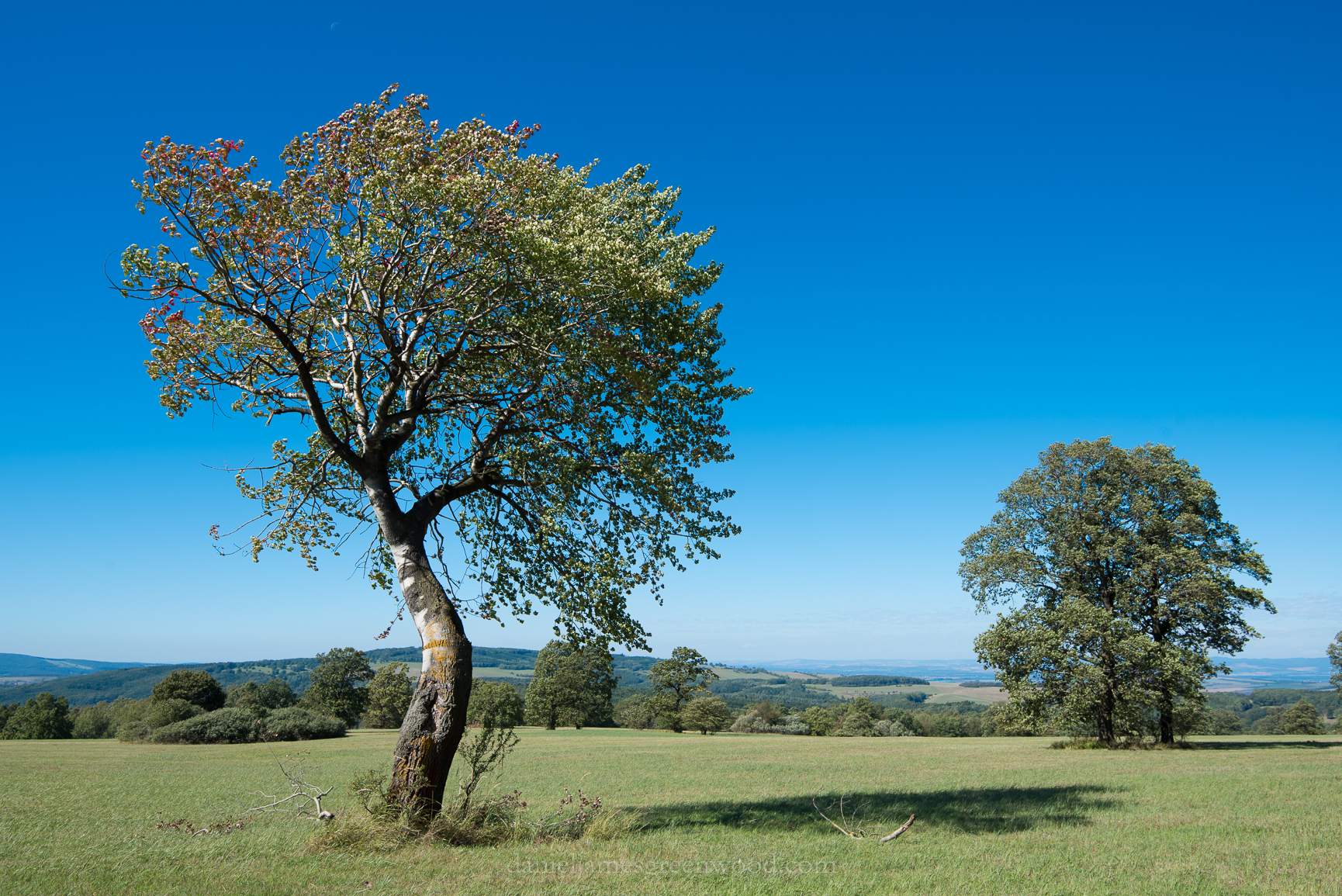
Jays pass almost every few seconds, back and forth to stash acorns. They are in the process of ‘scatter-hoarding’the act of burying acorns in places that may well one day grow into the new oak trees of this landscape. These are birds in an autumn-pique. Beyond them buzzards soar but the wind deters the smaller species. In the grasslands clouded yellow butterflies feed on knapweeds and dandelions, red admirals bolt from the dark plantations. We find a single aspen, its trunk crooked, whipped north by decades of strong winds. Half its canopy shows red in its leaves.

To many this kind of landscape is at odds with the contemporary ethic of rewilding, or ‘allowing land to return to its natural state’. If that were to happen here many species would become extinct. One plant clinging on, Pedicularis exaltata, a species of lousewort, is only found in this area away from other localities in Belarus, Ukraine and Romania. Its presence suggests a once-continuous wood pasture landscape across the Carpathians between the Czech-Slovak border and eastern Romania. It can’t be seen today as it flowers in spring and summer. Instead the ground is dotted with meadow saffron, a pink crocus.

Czechia 2017 lo-res djg-85

The wood pasture as it looks today was created and ‘refined’ thousands of years ago by people clearing woodland – likely of oak, ash, hornbeam and hazel – to allow their domesticated cattle and goats and Mesopotamian sheep to graze. At least that is the common understanding, for could the presence of large, roaming groups of wild horses, bison, elk and other herbivores have meant a landscape more open than the idea of coast-to-coast closed canopy woodland? Compared with today’s measure, the deforestation work of our species was sustainable deforestation due to the population sparsity, moving a possibly more dense wildwood to something more open in places.

The current management and conservation of wood pasture relates to the belief that habitats which are species-rich are the ones which are most important and valuable. But they need to be maintained. If their management involves local people, provides sustenance and perhaps employment, it will work, especially in a place like Czechia. This may lack the perceived poetry of rewilding, but its practicality brings results: the continued existence of the world’s most important wildflower meadows and all the other chains of life which depend on them.

With thanks to my travel companion Eddie Chapman, friend and guardian Zuzana Veverkova, Ivana Jongepierova and everyone at the CHKO office.


Something new

Fly orchid 4

Farthing Downs & New Hill, London, July 2013

On the Downs the butterflies are immediately evident, the week old broods of meadow brown ferry amongst the long grasses, rarely stopping to feed on flowers. Breeding season is ending but still the song of skylarks comes from over the slope, some ancient language remembered, its translation lost. Greater yellow rattle blooms now, the spring buttercups lost to a swathe of Yorkshire fog and other grasses I don’t know. The suntan lotion on my arms acts as an adhesive, my skin covered with seeds. The grasshoppers are conjuring up their rickety, wooden percussion. I am hopeless in finding them, except for one that hops between seed heads, a micro Tarzan in this meadow jungle. But where are the people? A man drives a BMW sports car along the lane, revving its engine. I know where I’d rather be. Men in England are bare chested at the slightest chance and here a couple stroll along the lane drinking from big bottles of water. The tattoo stamped on the man’s back stands out in this simple landscape of slopes and flowers.

Lovers

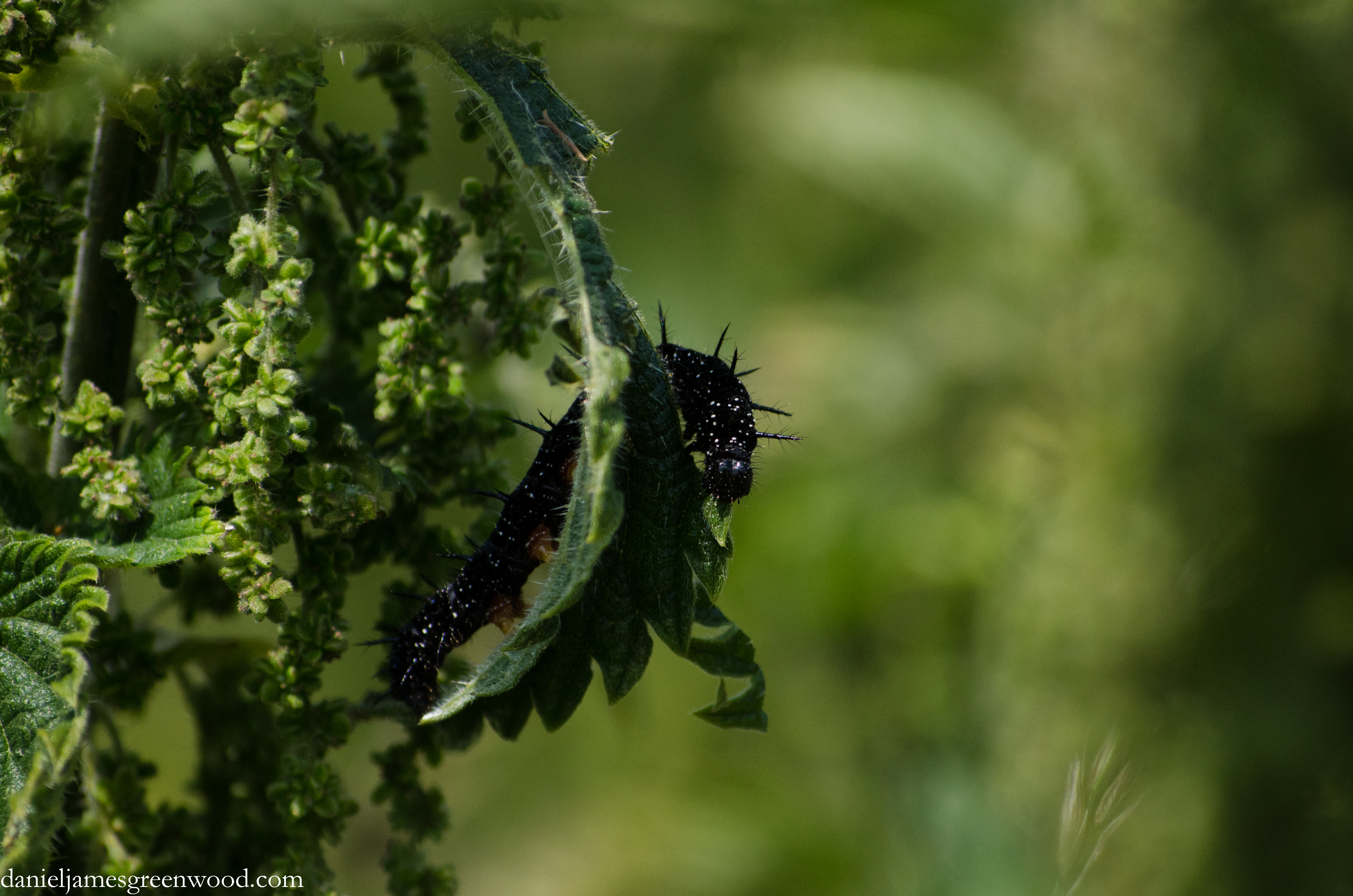
Ghostly day-flying moths spread at my every step through the long grass. Bumblebees forage on clovers, dropwort and yellow rattle, small heath butterflies appear again, two fly together, eager to fulfil their short lives with as much fornication as is possible. I cut back on to the path I know best. A chiffchaff sings in the hedgeline at the bottom of the hill, a single blackbird and a whitethroat, too. There’s no sign of spring’s willow warblers or their clutch of young. A crowd of peacock caterpillars munch through nettle leaves, leaving only the dreadlocks of flowers. A yellowhammer appears from across the lane, landing in a small hawthorn bush, its strong yellow plumage brighter than dandelions, a South American yellow, and at its brightest here. I take a few photos. Along with skylarks, this is a bird I have to travel to see, when once, before my time, you might have woken to it flocking in the hedges and fields.

Peackock caterpillar

Leaving the Downs I enter the chalky wooded hollows at the bottom of the slope, with tor grass growing along the track, an indicator of the calcareous soil. My sweat cools with the breeze that slips through here. In the dappled shade I scan the path edges for orchids, black bryony creeping out from the darkened hedges. And there it is: the fly orchid. I change lenses and struggle to get the image right, sweat dripping, bringing lotion down my face. But it’s beautiful to look at – a bit like a bumblebee pinned and proffered by the long spike, with its little eyes and short antennae. A family are passing behind the hedge, discussing how to control the dog.

‘She’s pulling me down into these weird places,’ says the mother.

‘Just let her off the lead, let her off the lead,’ the dad says.

They arrive on the path heading down hill. Their daughter warns the dog to stay with them. I only see the mother, she’s dressed in an apricot coloured dress and heeled shoes. She’s young and glamorous, so fitting with the array of flowers bursting from the hillside.

‘Who needs Box Hill when you can come here, eh?’ says the dad. They disappear down towards Happy Valley.

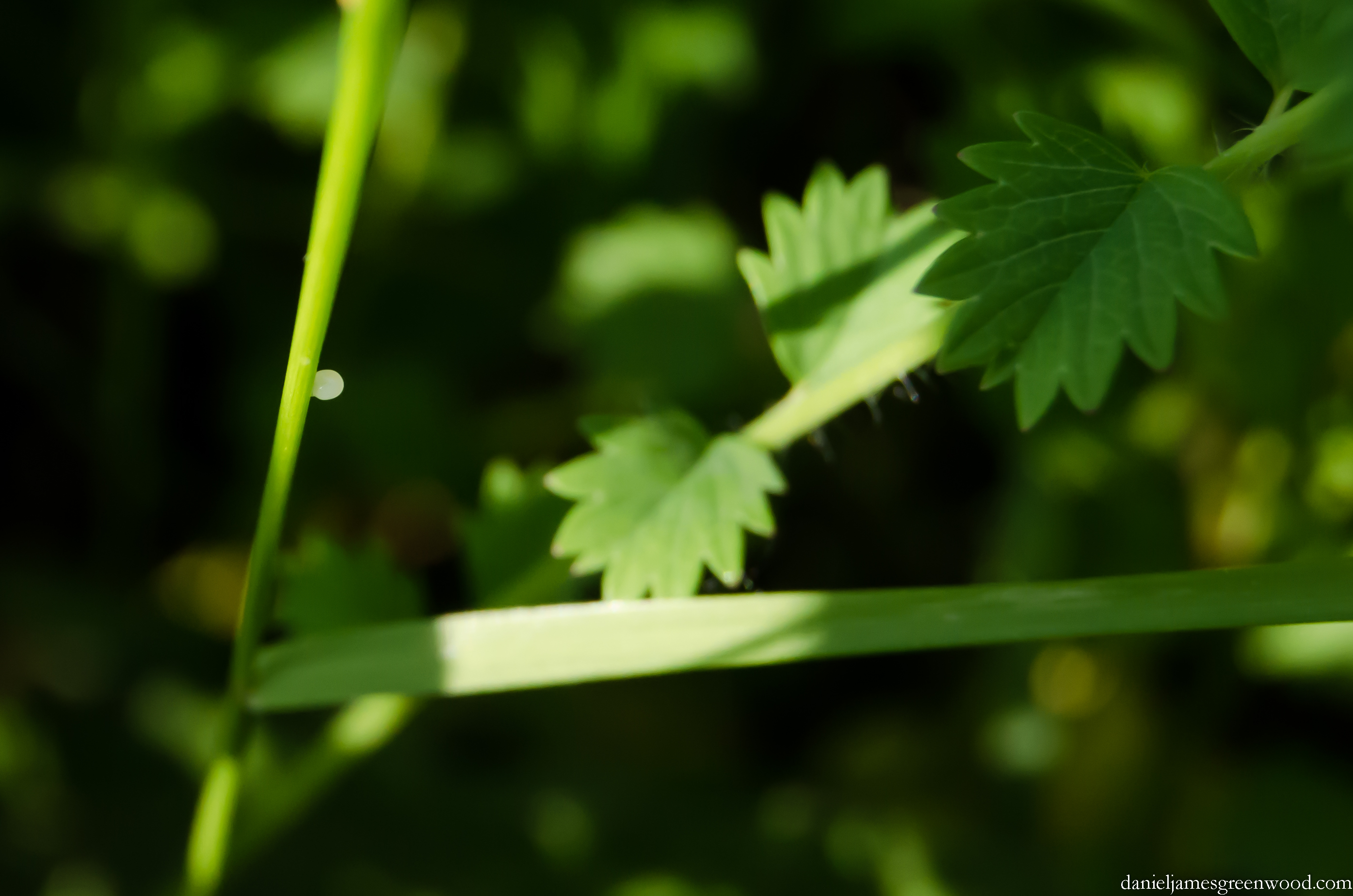
Speckled wood egg crop 1

I carry on along the ridge and settle on the desire line drawn down the hill and through the flowers. Ringlets move through the meadow, the first I’ve seen this year. They move at the same time and, stitched together, they are a tapestry of flickering wings. In my silence and stillness wildlife begins to move around me, perhaps more trusting. I see more plants now: twayblades, common spotted orchid, salad burnet, marjoram, ox eye daisy, rough hawkbit and bladder campion with its inflated, balloon like calyx-tubes. The wind blows through the trees. A speckled wood butterfly flaps about me, its wings audible as it hits my khaki shorts and leaf stalks. It clasps hold of a spear-like grass stem and curves its abdomen, laying a tiny pearl of an egg. This, for me, is something new.

Somewhere between a cuckoo and a high speed train

Mid-Colne valley

– Broadwater Lake, Harefield, May 2012

A chill wind moves across Broadwater Lake. Black-headed gulls are screaming from rafts built for the common terns which arrive here from their African wintering grounds. It is pleasing to be greeted by one of the newly emigrated. It swoops past, coming closer each time, raising aloft and diving into an arc that brings it back down to the surface of the water and away. The sky is alive with swifts feeding. When the suns does come out clouds of midges move like slow bands of rain after me and on the River Colne I see mayflies touching the water. There’s plenty of food if you’re feathered.

The track separates the Colne on the western side and the lake in the east. The river is separated again by a thick bank of nettles and cow parsley, that common umbellifer that signals spring. There are interjections from vibrant red campion flowers amongst the spread of green, probably indicators of the woodland that was here long before the lakes were dug for gravel and, when finished with, filled by rainwater to create today’s scene. The trees along the river are bursting with song, almost all with the fluid voice of the garden warbler, a bird so plain it’s unmistakable. It has a shy, modest look about it, as if too retiring to boast about its aural beauty. They’re in the bramble too, and it’s a song to silence the prick of the thorns.

On the other side of the river masses of dogwood cover the willow scrub. In the reedbeds struggling to establish along the bank of Broadwater Lake a sedge warbler is singing. It has a white eyestripe and differing palette of browns to mark it out from other plain-looking birds like the reed warbler. Its song is outstanding. I pick out the calls of a blue tit, great tit, goldfinch, greenfinch and the fink! of a chaffinch. This sedge warbler is a masterful mimic.

But there is one song which stands out most, and I hear it around the bend, further up from the lake. The cuckoo. It draws the breath.

A new bout of warm sunshine offers a male orange tip the chance to forage along the track, a pair of Canada geese are ushering twenty-four golden young away and into the Colne. It has the uncanny resemblance to teachers flocking fluorescent infants onto public transport. The geese wack in my direction as they go down river.

Cuck-oo, cuck-oo!

In the distant northern corner of the lake hundreds upon hundreds of house martins are skimming the surface, and from here it appears synchronised. I strafe the glasses from left to right and they are constant. Swifts are treating me like an obstacle, I’m sure I nearly took a hit from a dark and floppy hirundine.

The cuckoo is calling.

I pass back the way we came, again meeting the Canada geese, regarding me once more as a predator. A pair of reed bunting are busy between the scrub along the Colne, passing across to the edge of the lake, the black-headed male clinging to a willow stem, a stick in his bill like a dancer with a rose between his teeth. This bird is building a nest, the female appearing in the bush next door. They disappear into the thin stock of reeds at the edge of the lake.

As I head off in search along the track the cuckoo calls at its clearest, the sun free of cloud, piping. The bird calls from across the Colne, surely from a perch, we scan the trees and find the grey head and neck of the male but it’s bothered and takes to the air. It’s satisfying, so satisfying to see the bird my ancestors took for granted.

I continue along the track, buoyed with the sense that all is right with the world, that England is okay – if this bird has returned again then we must have something to be happy about. Of course, the calling cuckoo is only confirmation, whereas the sight of it is something else. This bird’s voice has become so much a part of our connection with birds, nature, wildlife, time, the world, whatever, that it’s become part of our language, even becoming a word to define mental ill health. It made it into a part of our mechanical world where other species haven’t, the sound of an hour passing and a new beginning. A world without the cuckoo is unthinkable to most. To see the bird calling is a privilege, and then you know it isn’t the gardener playing a trick, the old family clock, or a child portraying ‘madness’.

I’m in a daze. Two birds are squabbling overhead, I’m sure they’re sparrowhawks, but then I’m not. It’s two male cuckoos fighting over territory.

***

Outside the reserve and back on the main road my ears are ringing with the sound of birds – a blackbird somewhere along the way has recorded its fluid melodies into the fundament between my ears. A buzzard passes over the Colne in perfect silence, head twisting, two crows pursue it.

I climb to a pub on the hill over on the other side of the lake, to see the view of the mid-Colne valley and to get a sense of perspective. The weather is fluctuating, the wind is flung out and a few specks of rain touch the windscreens of parked cars, the sun breathes fire into the once dark globules of ornamental copper beech trees on the hill opposite and across the lake. The sunshine stays, the valley gleaming. Its beauty comes like a puncture. The swifts cover the expanse, wheezing and sailing across the vista. In the ragged hedge of hawthorn and field maple just in front of me a whitethroat appears, offering a few tentative renditions of its gravelly warble. A man walking a very slow and floppy-eared dog has spied me.

‘We see red kites very often, almost every day,’ he says. It’s his day off. He turns to take in the view of the valley, his thoughts turning to the proposal to build High Speed 2, a high speed trainline, through neighbouring Korda Lake and across the Colne. ‘It’s a nightmare,’ he says. ‘Hopefully they put it underground.’

The sky is an azure blue with discarded cloud, the sun intense. Broadwater Lake is a space of trembling, sparkling water. This was once a gravel quarry but now is a place which, in this moment, with swifts, warblers and the indefatigable cuckoo, retains a sense of the Arcadian paradise with which we paint our memories of the English countryside. With the threat of upheaval from HS2 it’s unclear how long that will remain.

The dead and the living are mingling on the Downs

Thistle

– Farthing Downs and New Hill, London, September 2012

The living and the dead mingle on the Downs this morning. Meadow brown butterflies kick up from the ruins of grassy tussocks and rusting bramble. They are as shed leaves moved by an autumnal breeze. Brown and orange, one white dot in their black eyespots, they sit in the tops of young, dwarfish oaks, or else are lost to the souring land. Workers have opened up more grassland with chainsaws and fire, stumps of ash are torn and splintered – a battle has taken place here. Jackdaws survey the new clearings, and the old ones, too, a strange officialdom about them, their calls back and forth, scathing blue-grey eye – are they coroners or corvids? This is their work, the image fits.

The yellow rattle has mostly turned, the wind pushing across the road and down the slope. But there isn’t the sound this parasitic plant is named for. There’s the drone of a biplane, probably from Kenley, there’s the teasing whir of a bicycle passing along the cutting, the sound of aging leaves stirring, sycamore yellowed by the changing season. Scabiouses and hawk’s-bits add punctuations of colour to the mushroom-drab Downs, the grey Sunday sky burnt by sun, puddles of blue appearing. In the long grass crickets click like a machine shutting down, the dead and the living mingling on the Downs.