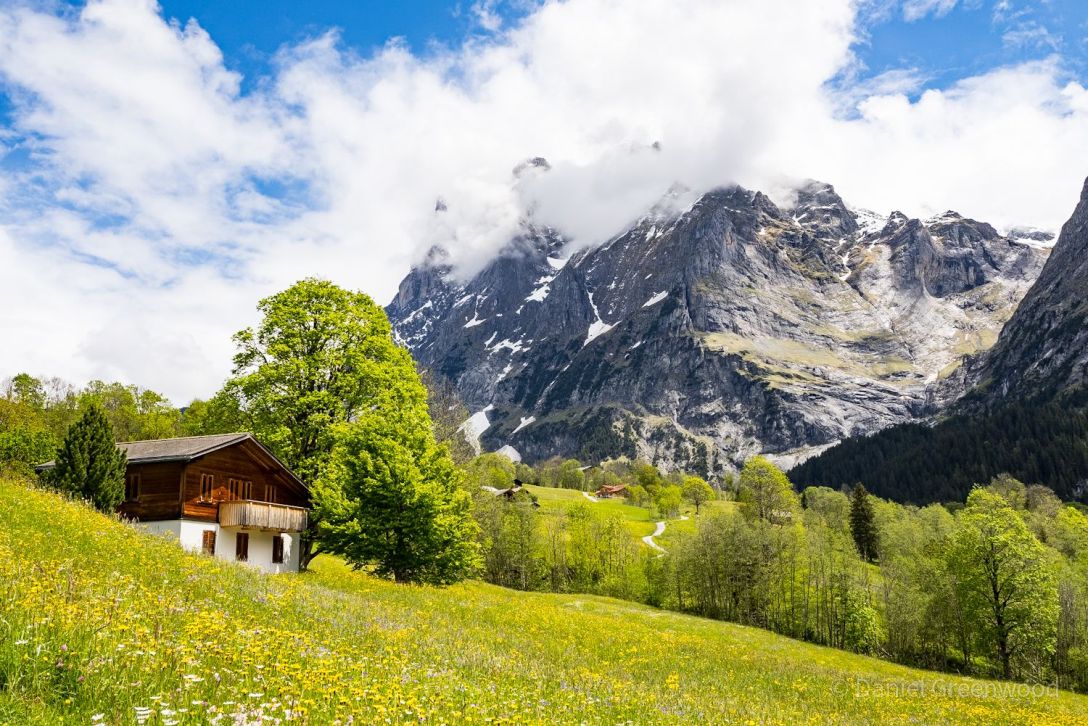
Swiss Alps: Grindelwald’s magnificent meadows ๐Ÿฆ—

In May 2024 my wife and I went on our interrail honeymoon to the Jungfrau region of the Swiss Alps. I am finally ready to post my photos from the trip, starting with some macro photos. I’ve popped in some short videos here to give a bit more texture and sound to bring things to life.

My cat whispering wife

It was an incredible trip, all done by rail there and back. The nostalgia is already with me.

In addition, I’m aiming to post about the spring alpine flowers and the amazing sycamore wood pasture. Hopefully one each week. I posted about the smattering of fungi back in May on Fungi Friday.

On the trip I took only one lens with me, one capable of pretty much any photography between 12-45mm (equivalent to 24-90mm in full frame cameras). That includes excellent close up capabilities. I also had a pocket compact camera and my phone.

The meadows were in full bloom, days from being cut for hay to feed the alpine cattle through the winter months.

Breathtaking alpine meadows

Oxeye daisies with the Wetterhorn (I think) in the background. This pic is taken with my Olympus TG-6 compact.

It was nice to see the variations in the grassland species in the different locations. At about 1200m up these meadows were packed with umbellifers. They make up the wash of white here. This meadow must have been impacted by the snowmelt as it nourishes the foothills in spring.

The typical mix around Grindelwald was one of red clover, scabious, oxeye daisy and hawkbits.

The Eiger looms over chalet homes and rich hay meadows. You can see the allure of Switzerland. High living standards and abundant nature.
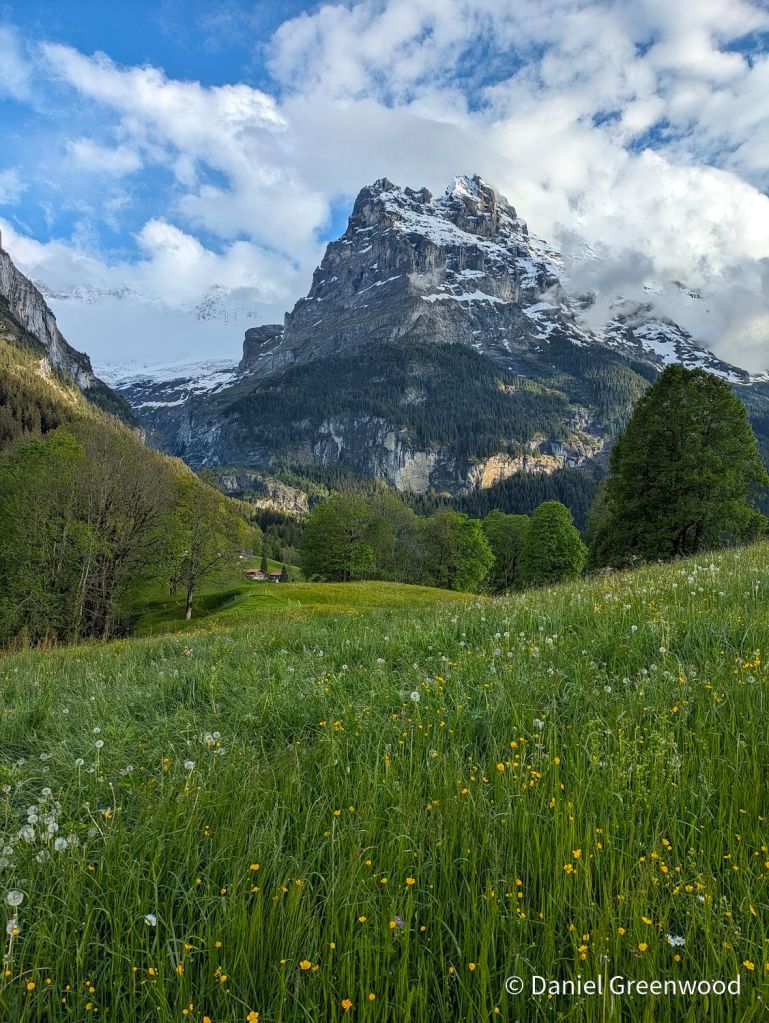
It is a breathtaking place, as this beautiful phone pic suggests (as in the phone’s capabilities!). This meadow was one that lacked the diversity of others, with the dandelions being evidence of nutrient enrichment, which encourages more vigorous plants at the expense of others. The most diverse meadows will have lower levels of nutrients in the soil.

The Grindelwald meadows were at a height of around 1000m. They were peaking and very loud at times. Just listen to this:

It was a chorus of crickets, not something that we get in England much anymore. The management of these meadows follows a largely medieval practice of haymaking, though it is now mechanised:

This is probably a family cutting and collecting the hay. This photo was taken from a cable car heading up to Mรคnnlichen.

Now onto the invertebrates that lived in the meadows.

Bush crickets
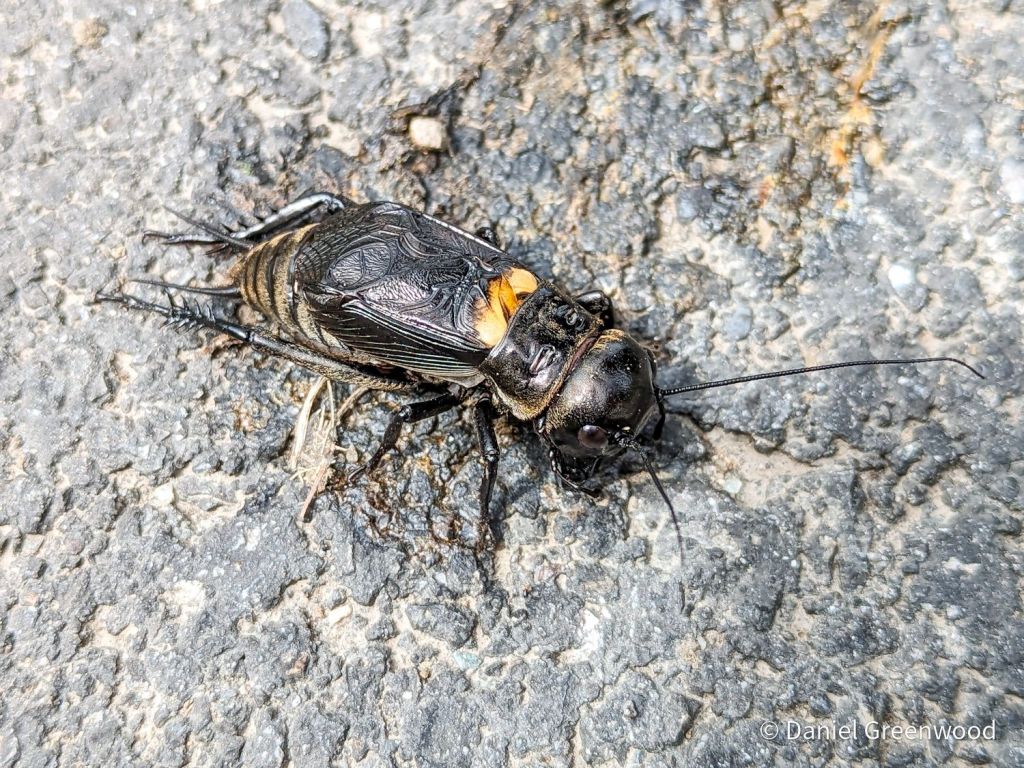
The sound in the meadows was made by the European field cricket, a species that has received support via conservation projects close to me in West Sussex. According to the iNaturalist page it’s flightless, so when it becomes locally extinct it struggles to repopulate lost ground. In the UK it has suffered from the decline in heathland, its favoured habitat. The cricket above was travelling across a lane to reach another meadow. There were a number of them squashed by vehicles. It’s unavoidable.

Moths and butterflies

During a walk in the valley woods at the foot of the mountain this green-veined white butterfly (I think) was on the wing. The main butterfly we saw was the swallowtail, but they were too fast, restless and far away for my lens to reach.
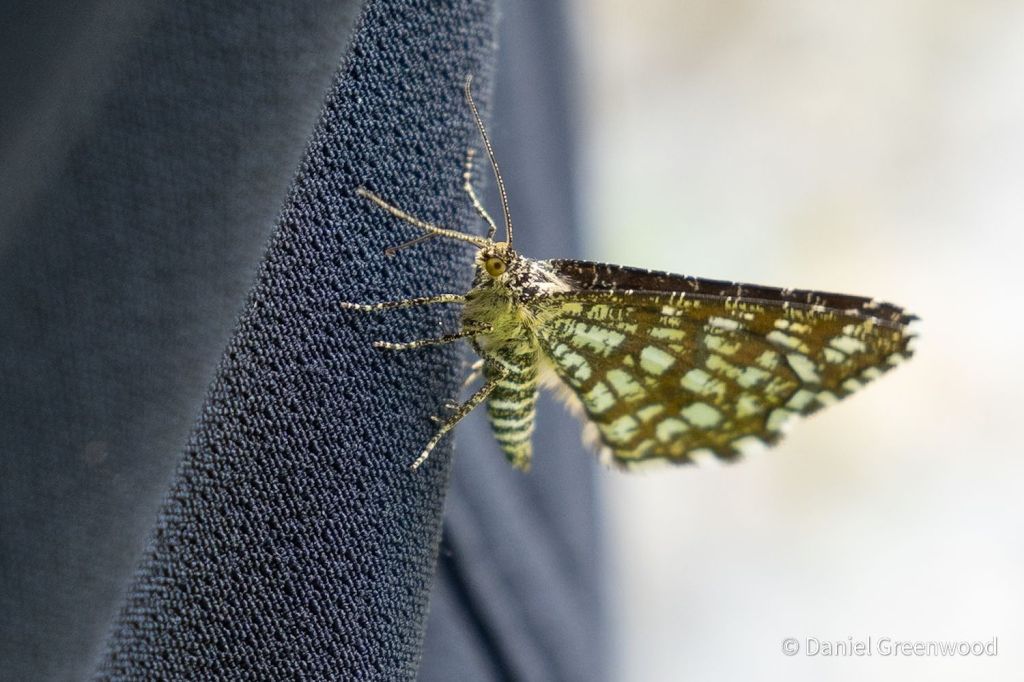
In stark contrast, this latticed heath moth alighted on my actual lens before being coaxed onto my trousers:

This is a species we also have in southern England.

Wasps and sawflies

One insect you don’t see in the UK, as far as I know, is the European paper wasp.
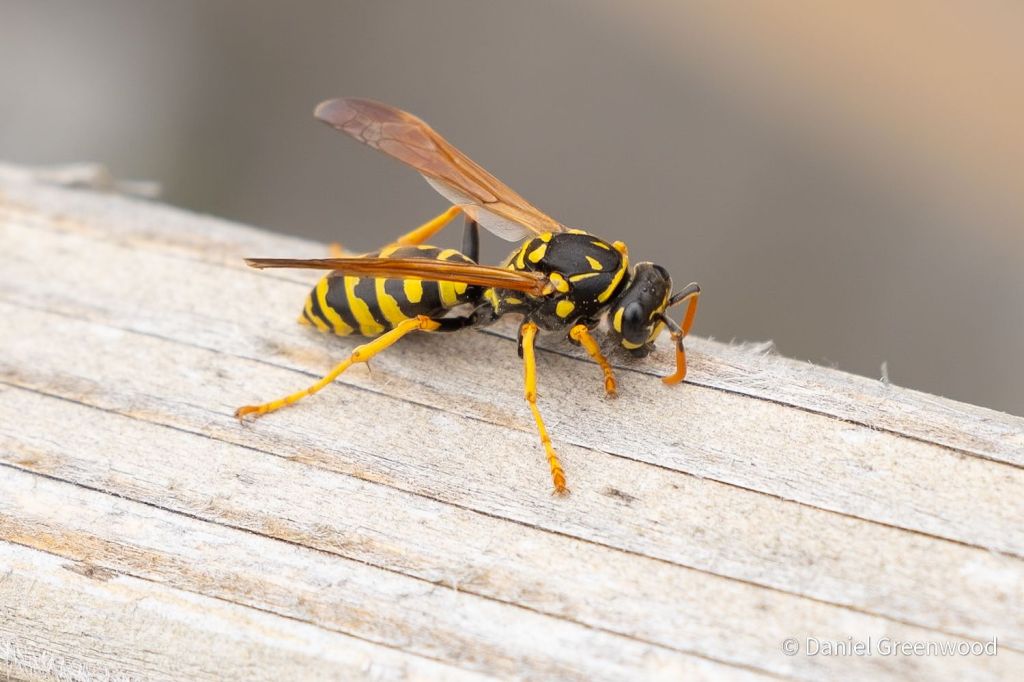
They have a lovely orange hue to their antennae, feet and wings. I’ve seen them before in Czechia making nests in residential post boxes. Here you can see one gathering wood shavings for nest building.

Meadow cranesbill was another common flower in the – you guessed it – meadows. I noticed that one area we passed when returning to our accommodation had a number of cranesbills that held sawflies in their flowerheads. The iNaturalist sawfly oracles have decided this is Tenthredo koehleri.

Beetles

Beetles are not my strong point, unless they are from Liverpool. This is a species of click beetle from what I know, visiting an oxeye daisy flower.

Spiders
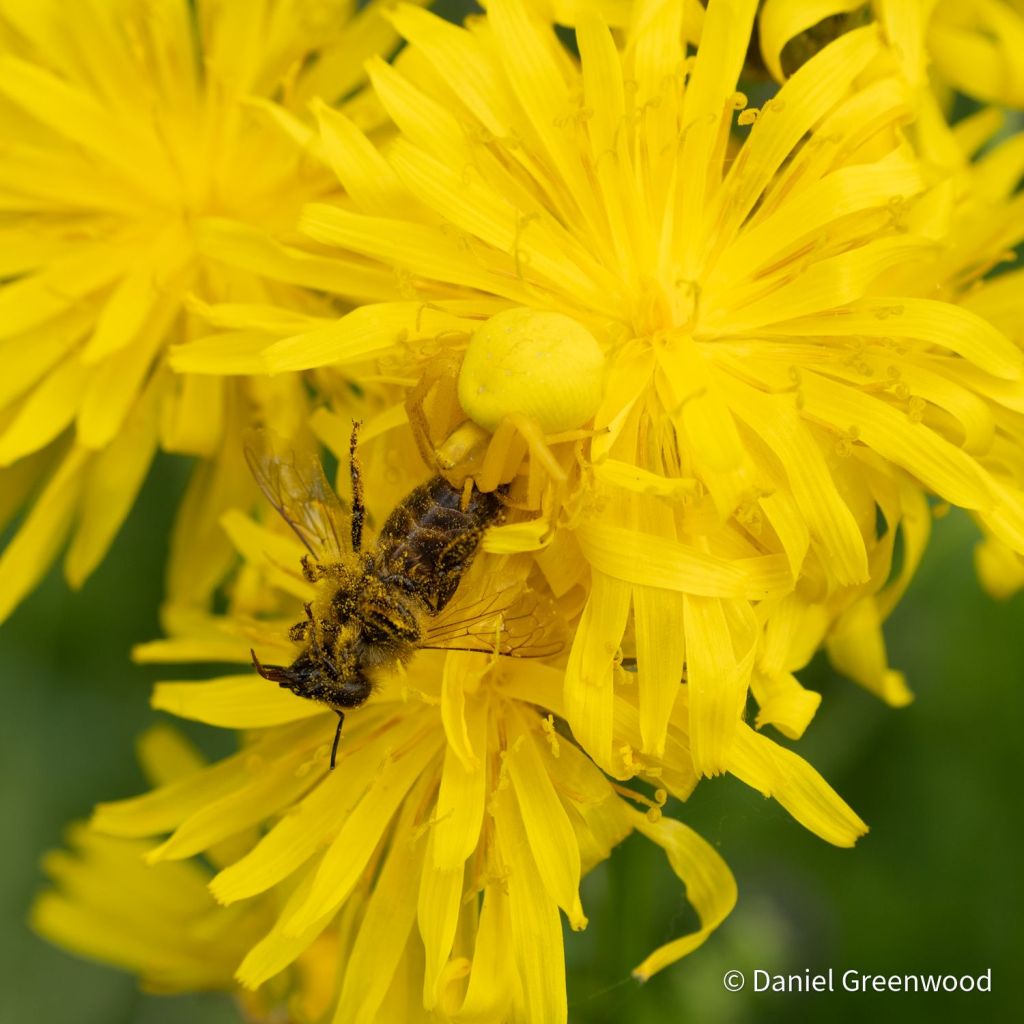
Now, I did mention those beardy daisies the hawkbits, earlier. I’m not up on my ID with these plants, but I did spot a crab spider which had joined in their colouring and caught a honeybee (I think) in one of the flowerheads. This was a statk example of how they can change their complexion to camouflage themselves in certain plants.

That’s all I really managed in the macro photos stakes. There’s much more to come from the Swiss Alps though.

Thanks for reading.

I write these blogs in my spare time because I want to raise awareness about the beauty and diversity of our landscapes. If you enjoy reading them you can support my blog here.

You can find my fungi blogs on Fungi Friday.
Macro Monday: it’s spider time!

GDN_16-8-2020_lo-res-18

Macro Monday 17th August 2020

*Warning*: as you may have guessed, this post contains spiders. Some people may find some of these photos unpleasant, but it may help you to learn to overcome your fear. I am not a spider-psychologist so this is not professional advice, as ever.

Here are frequently asked questions about spiders if you want to dispel any myths!

Well, what a week that was. Very high nightime temperatures and unbearable heat through the day. I barely spent any time outdoors, let alone in the garden. I really struggle in temperatures over 30 degrees. Most of the images this week come from the post-heatwave days towards the end of the week.

GDN_16-8-2020_lo-res-21

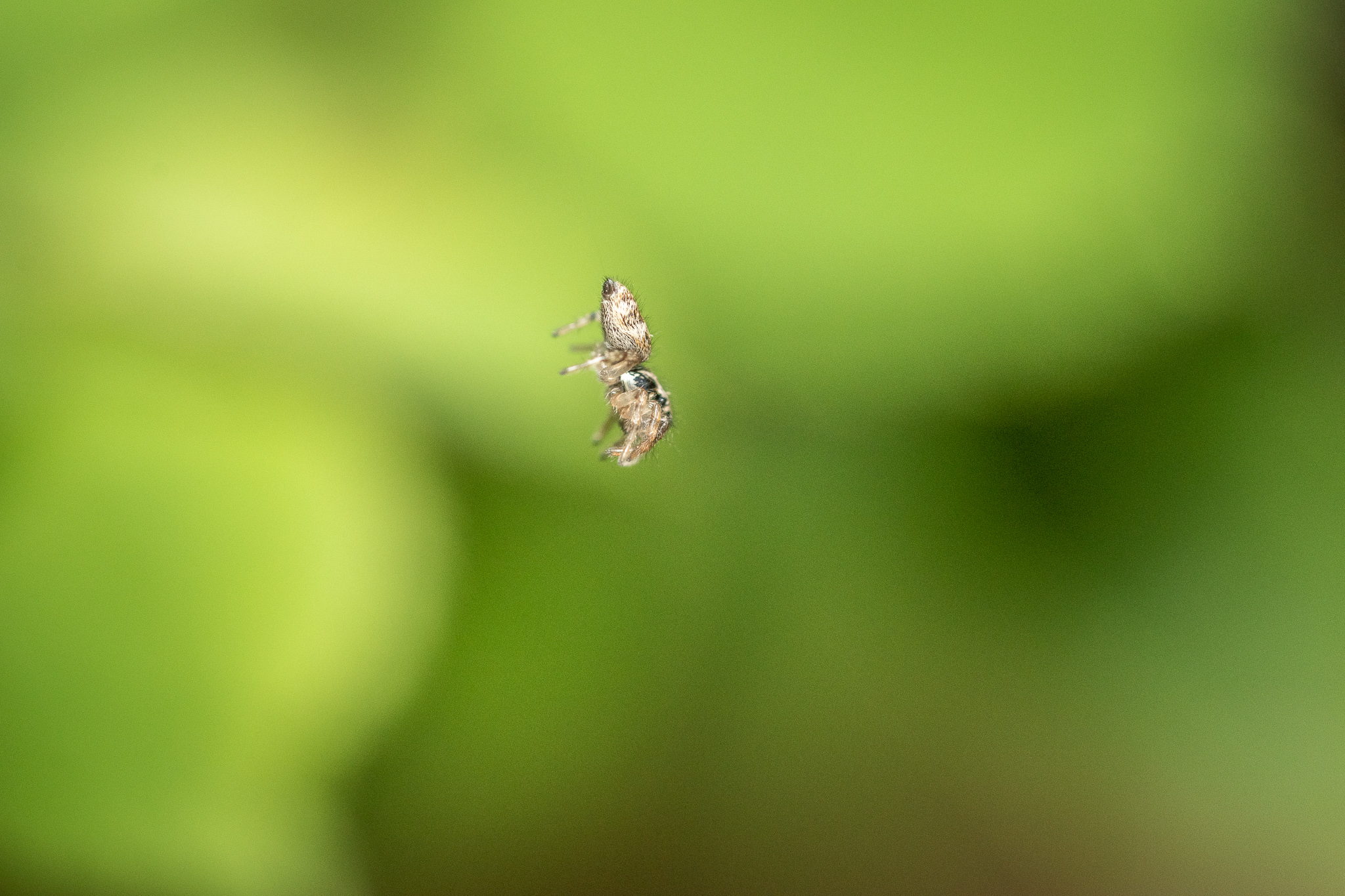
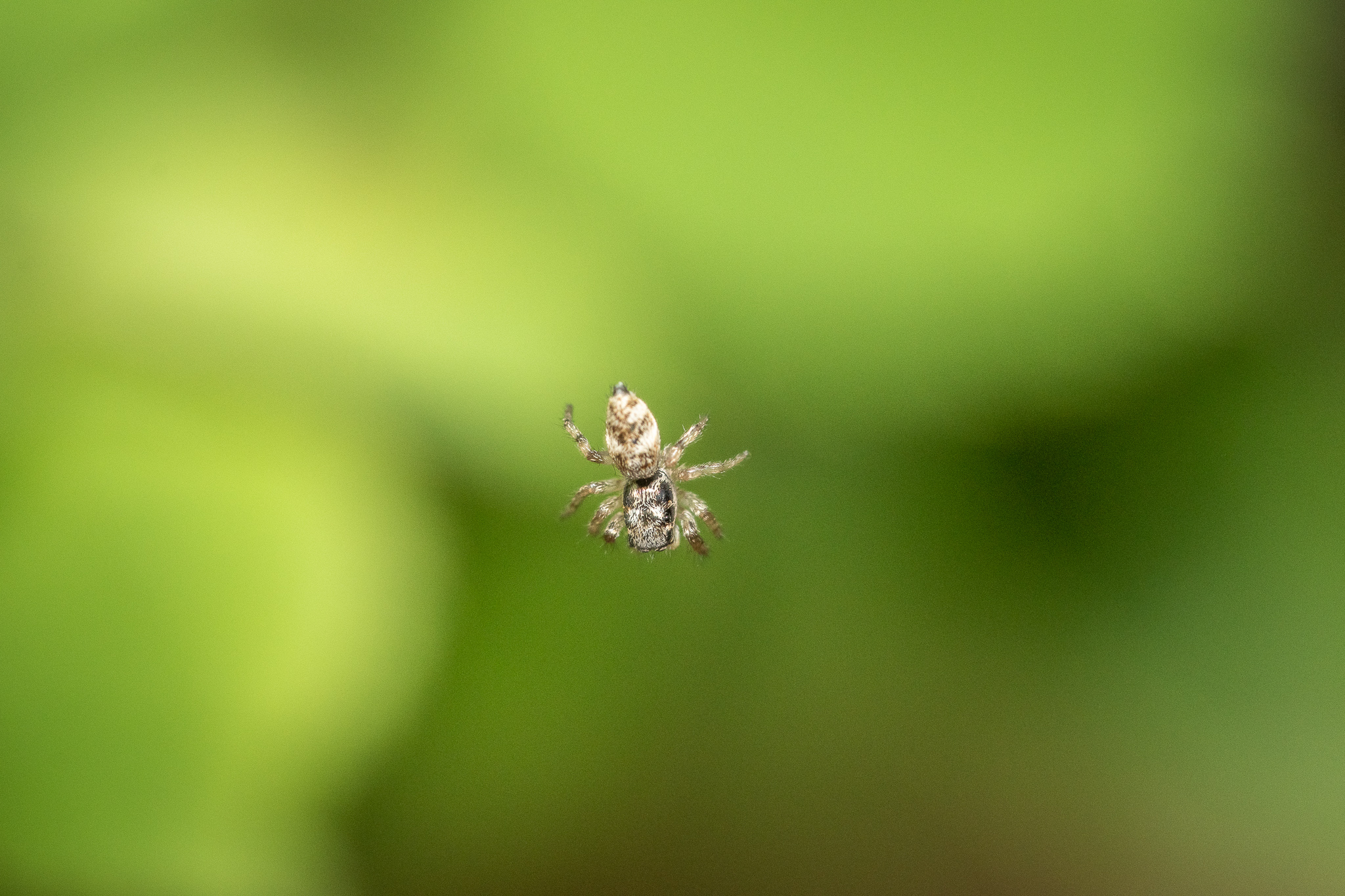
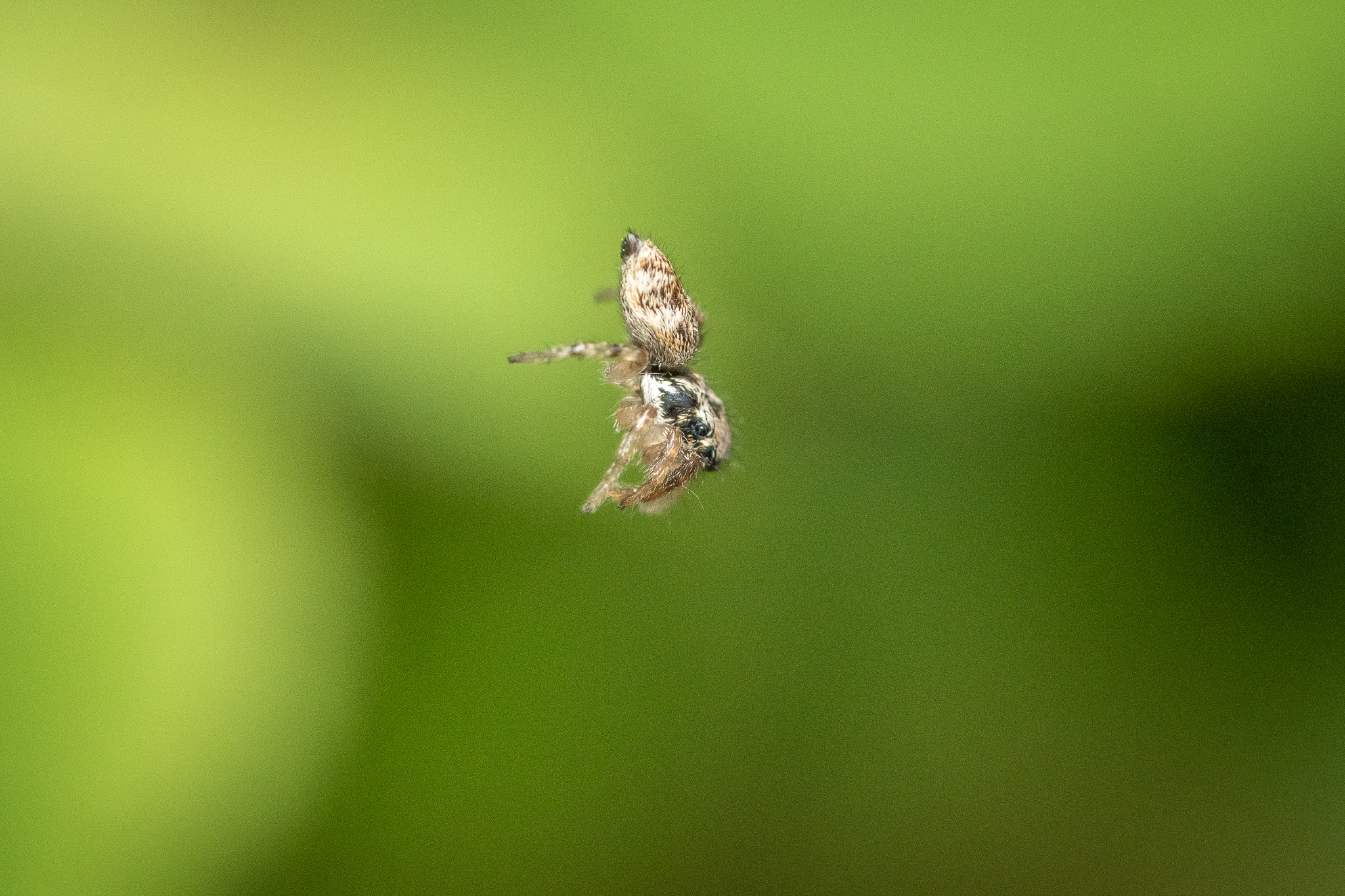
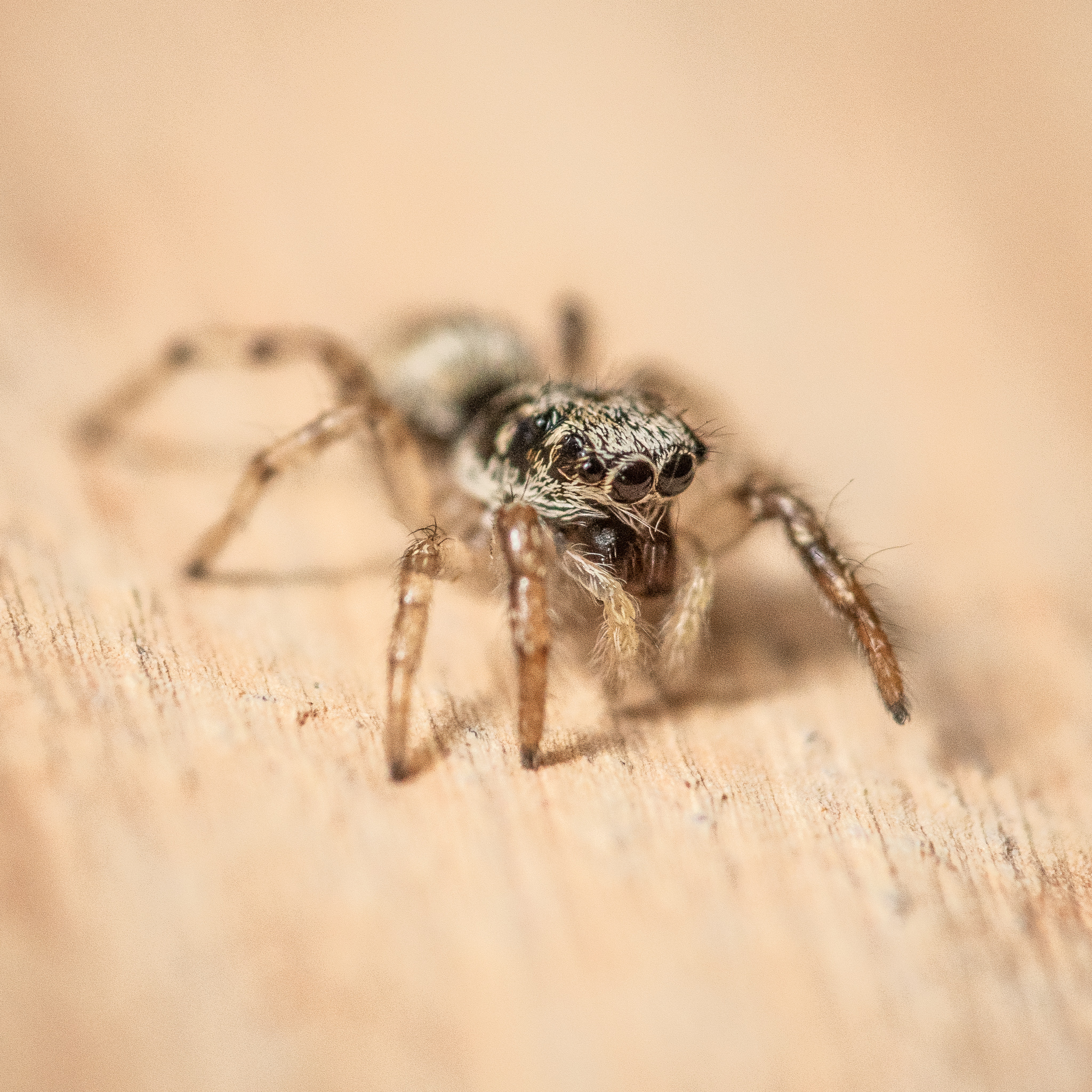
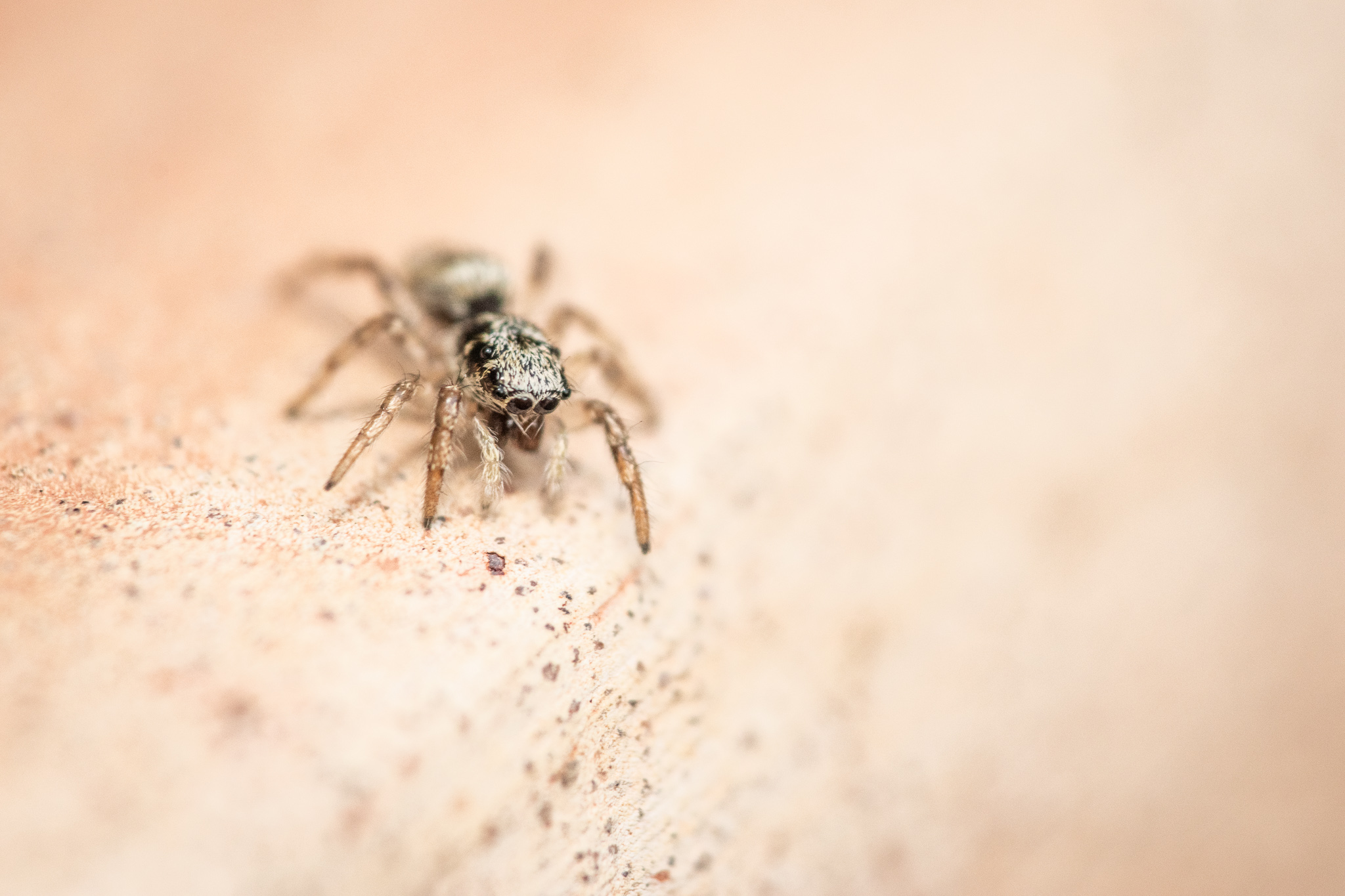
One evening, after the heat had largely dipped, I noticed some odd behaviour from a zebra jumping spider.

GDN_16-8-2020_lo-res-23

It was hanging from the leaf of a climbing rose we have growing from a terracotta pot on the front of our house.

GDN_16-8-2020_lo-res-22

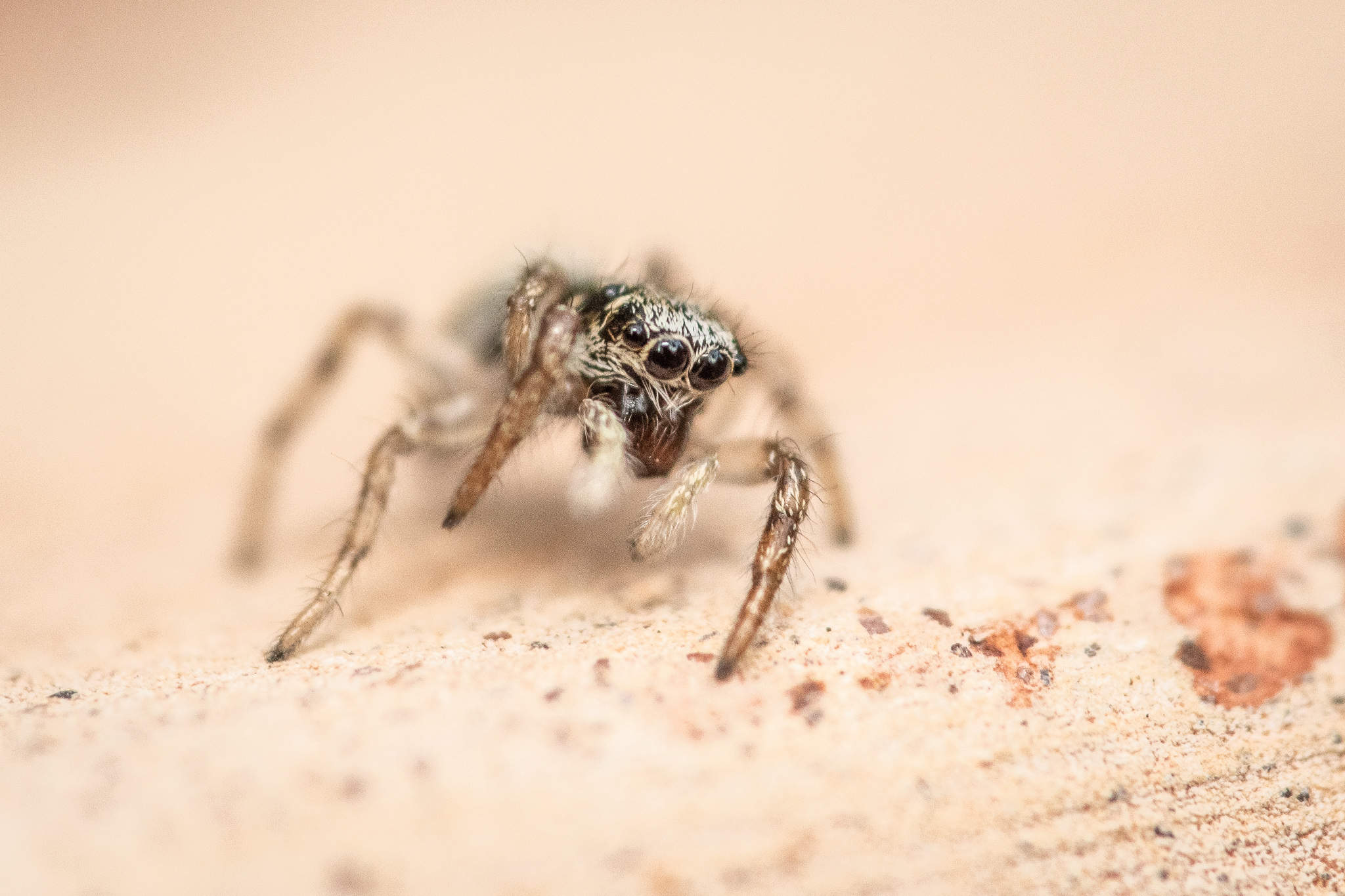
I noticed there was another, smaller, zebra jumping spider (ZJS) lower down on the pot. I think this was some kind of territorial or even courting behaviour. Eventually the ZJS made it down to the terracotta.

GDN_16-8-2020_lo-res-18

It was running around on the edge of the pot, looking for the smaller ZJS. It was a total nightmare to get in focus.

GDN_16-8-2020_lo-res-17

There was also some time to clean its legs while it tried to find out what the other ZJS was up to.

GDN_16-8-2020_lo-res-13

I’ve seen these lovely spiders all throughout the spring, but much less so in the summer. It was nice to see them again.

GDN_16-8-2020_lo-res-11

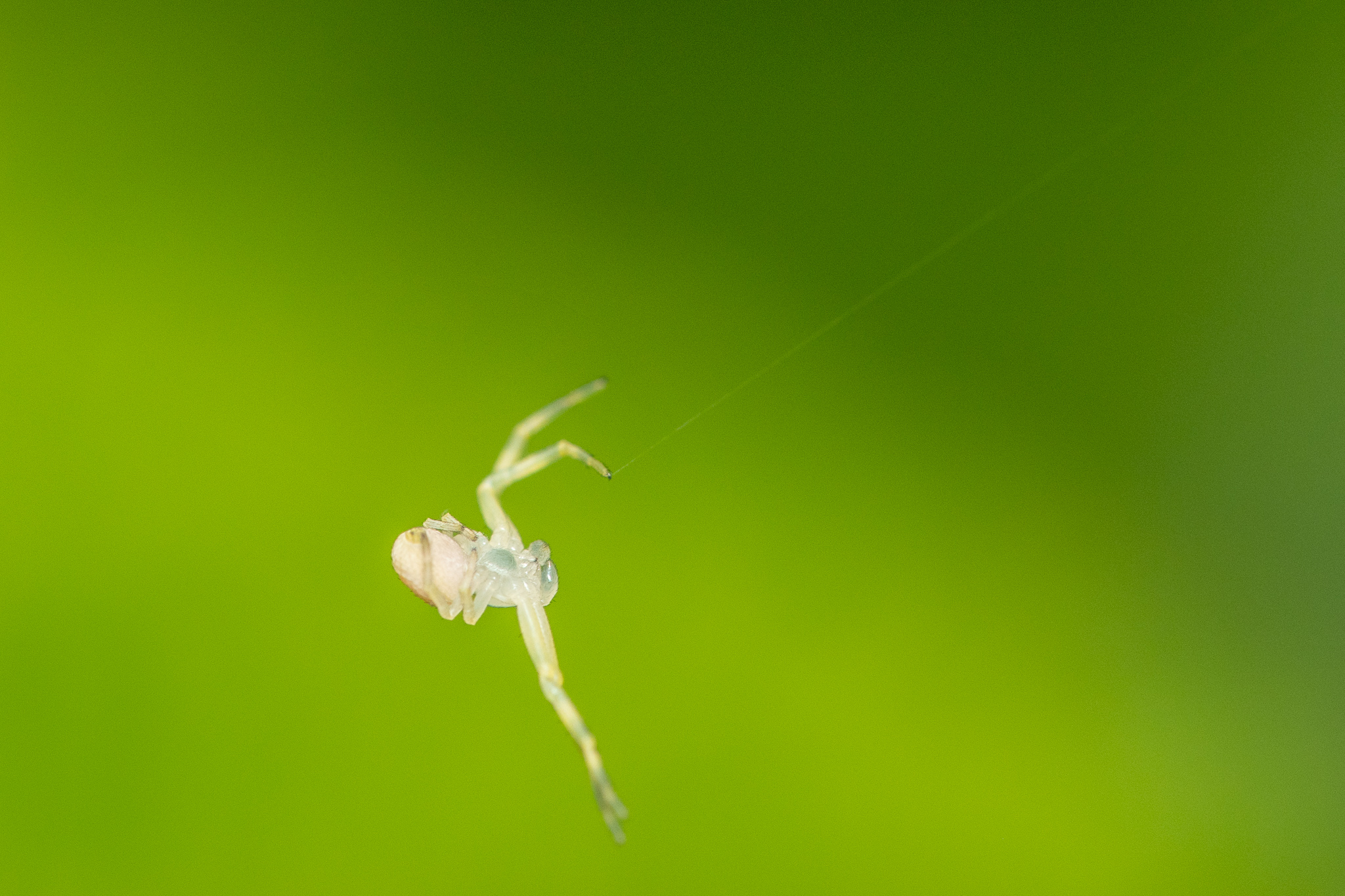
I also noticed this crab spider floating in midair on its silk. There is something quite weird about this image I think. The limbs look a bit like human or robot arms. This was a pure fluke of hoping it got into focus, even then you can’t really see the spider properly.

GDN_16-8-2020_lo-res-06

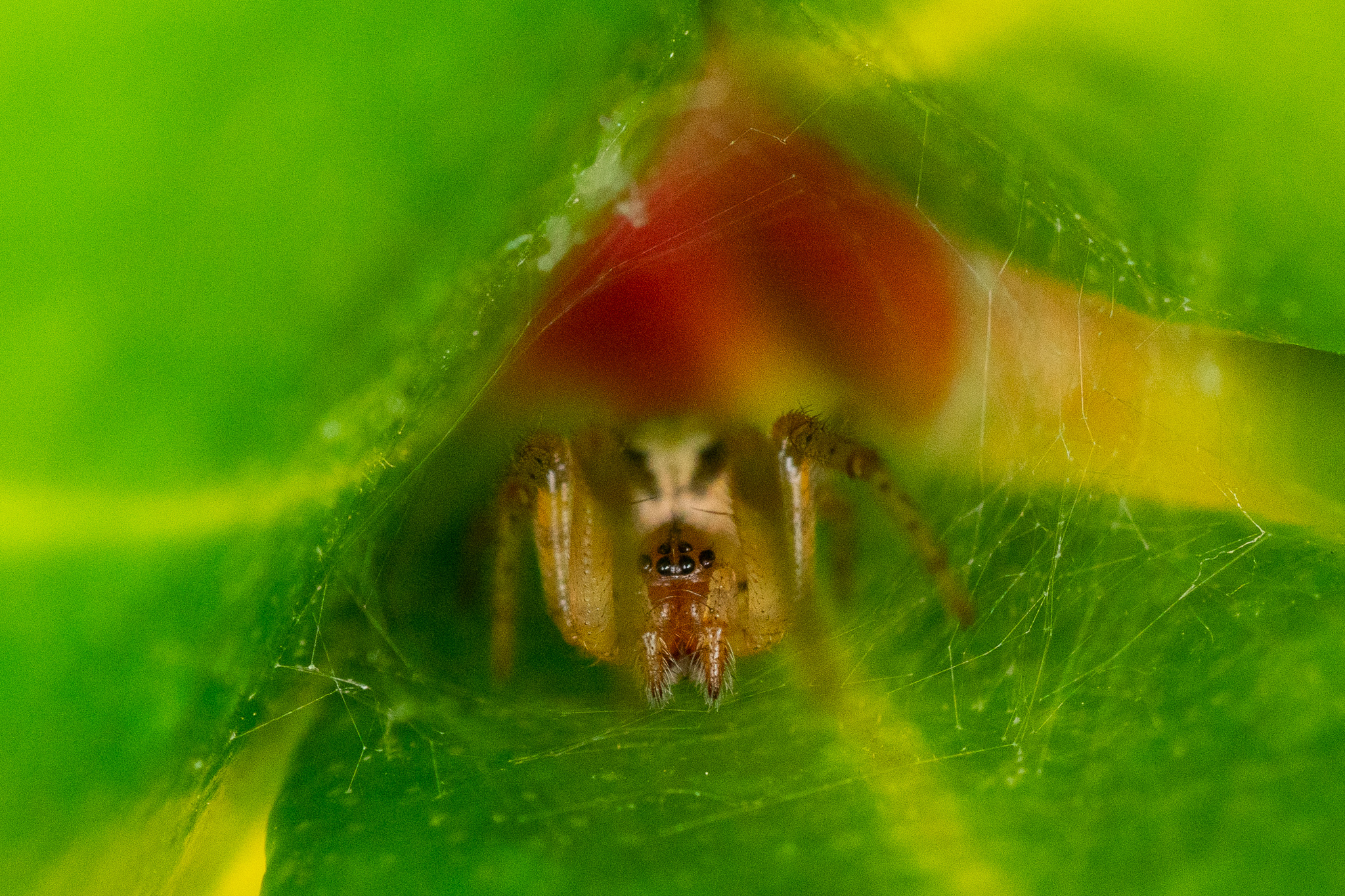
I’ve noticed far fewer insects in my garden, probably because the plants we have are largely over. I need to get some late-summer to autumn flowering species like stonecrop to keep things rocking and rolling. I had a look through the hedge while having an afternoon break after the storm took the heat away. I noticed this spider tucked away down in a bunch of leaves in the hedge. The silk is there to help catch prey but also it will react to movement, triggering the spider to attack.

OLYMPUS DIGITAL CAMERA

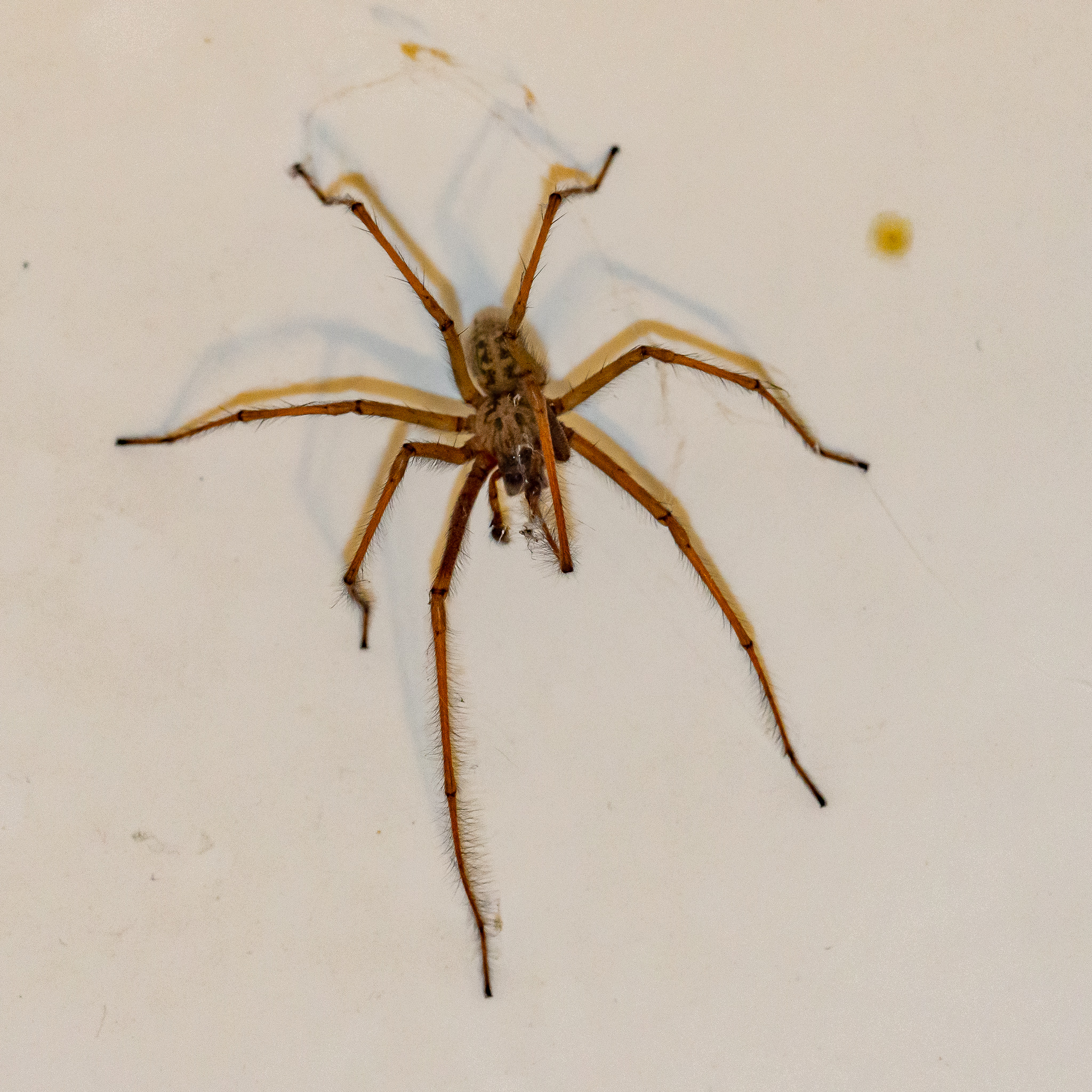
I visited my family home for the first time in 6 months last weekend, a really special experience after such a long time away. My parents are avid readers of this (perhaps that should say, the readers) blog and my mum pointed out to me that there was a big spider in the bath that I might want to include here! YES MUM!

OLYMPUS DIGITAL CAMERA

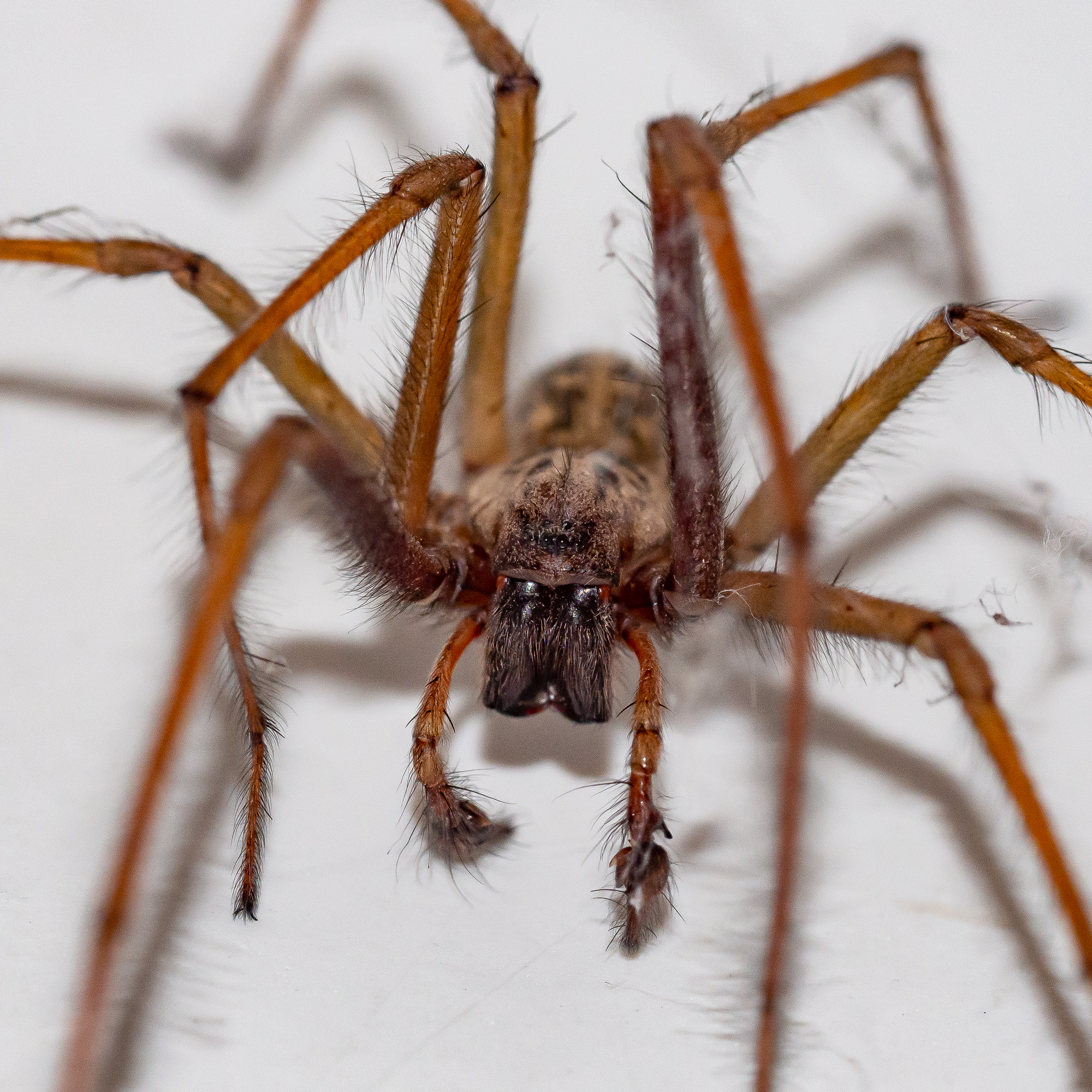
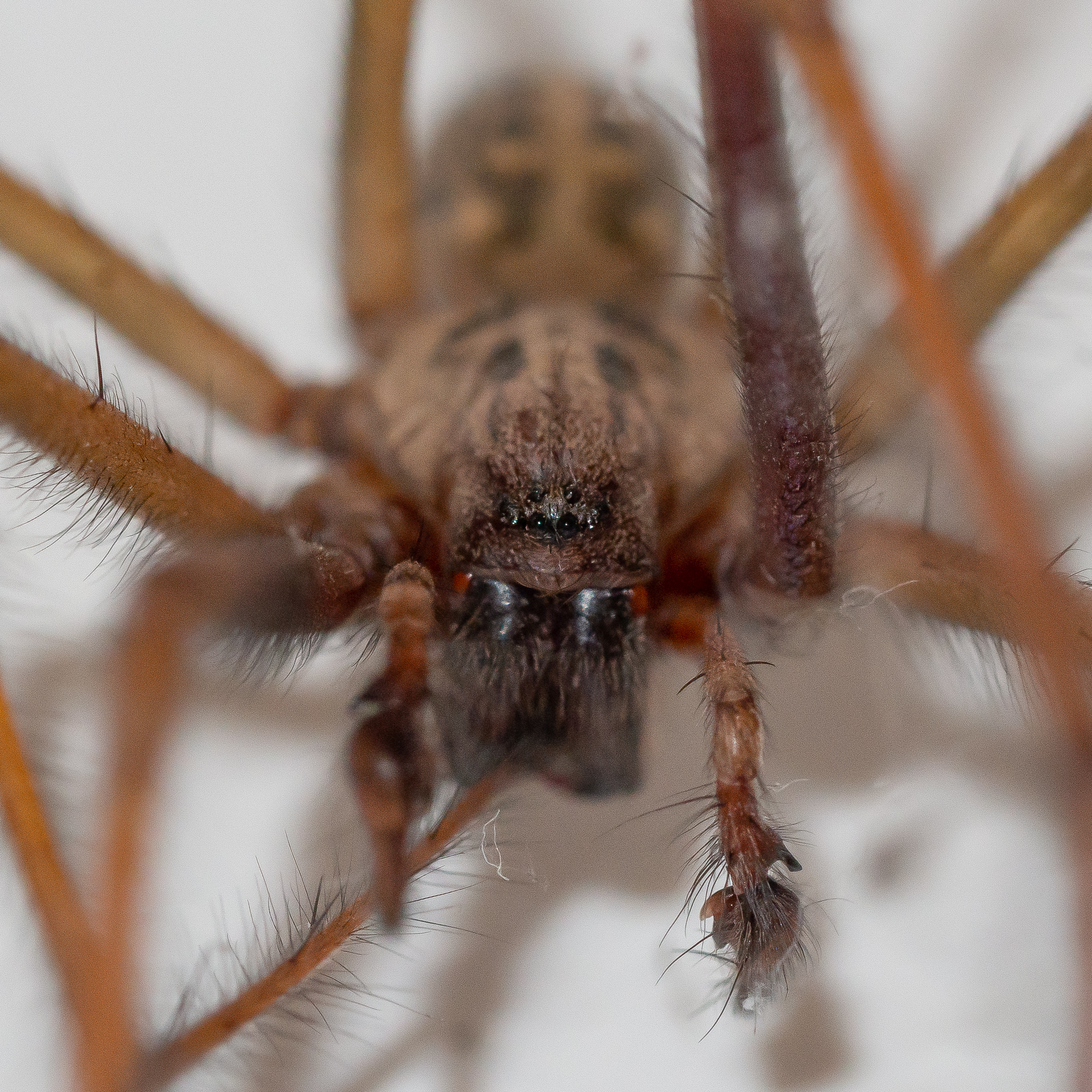
Now there have been several times this week when I’ve noticed out of the corner of my eye a shadow moving across the floor. This is something a lot of people are very unhappy about! But it’s the time of year when giant house spiders are becoming more evident. They are fiersome looking things yet they are harmless. They are more afraid of you than you are of it. They have every right to be afraid, because people will likely try and kill them when they see them, out of misplaced fear.

OLYMPUS DIGITAL CAMERA

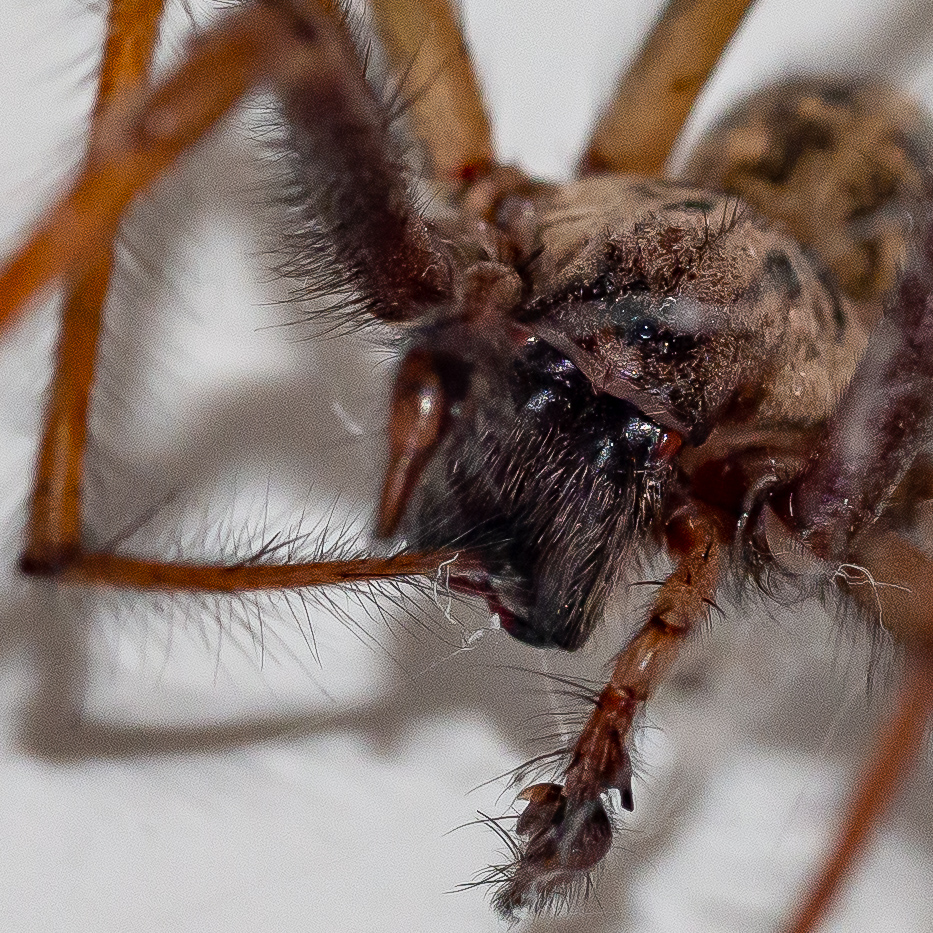
That said, they are a bit scary to look at and those mandibles are massive. I had my small mirrorless camera with me and a macro lens. The images are quite harsh and grainy because the light was so dank and the flash is a pop-up one without a diffuser.

OLYMPUS DIGITAL CAMERA

The spider didn’t actually mind me at all. It was trying to remove some spider silk from its legs by running them through its mandibles.

Far from wanting to harm this animal, I am pleased that we can have such close encounters with big insects like these. If you let them go about their business, there’s no problem. No spider in Britain is venomous. This is not Australia!

Thanks for reading.

Photos taken with Nikon D5600 with Sigma 105mm f2.8 macro lens and SB-700 flash. Giant house spider photos taken with Olympus EM-10 MIII with 60mm f2.8 macro lens.

More macro


Macro Monday: real bees and wannabees

GDN - 16-5-2020-lo-res-12

Macro Monday 25th May 2020

Happy Bank Holiday Monday to British readers. Recent weather has been hot, with strong winds coming in on Friday, blowing macro out of the equation. I’ve kept to my routine of garden and local walking.

Last week I said the bumblebee workers were beginning to appear, and this week I’m keeping up to my promise.

GDN - 16-5-2020-lo-res-05

I took lots of photos of bumblebees visiting flowers but they are very difficult to get in focus because of the shallow depth of field that macro lenses have. Therefore, the only decent photos I got were the header image and this here. These open spiked flowers are excellent for bumblebees, similar to foxgloves.

GDN - 16-5-2020-lo-res-13

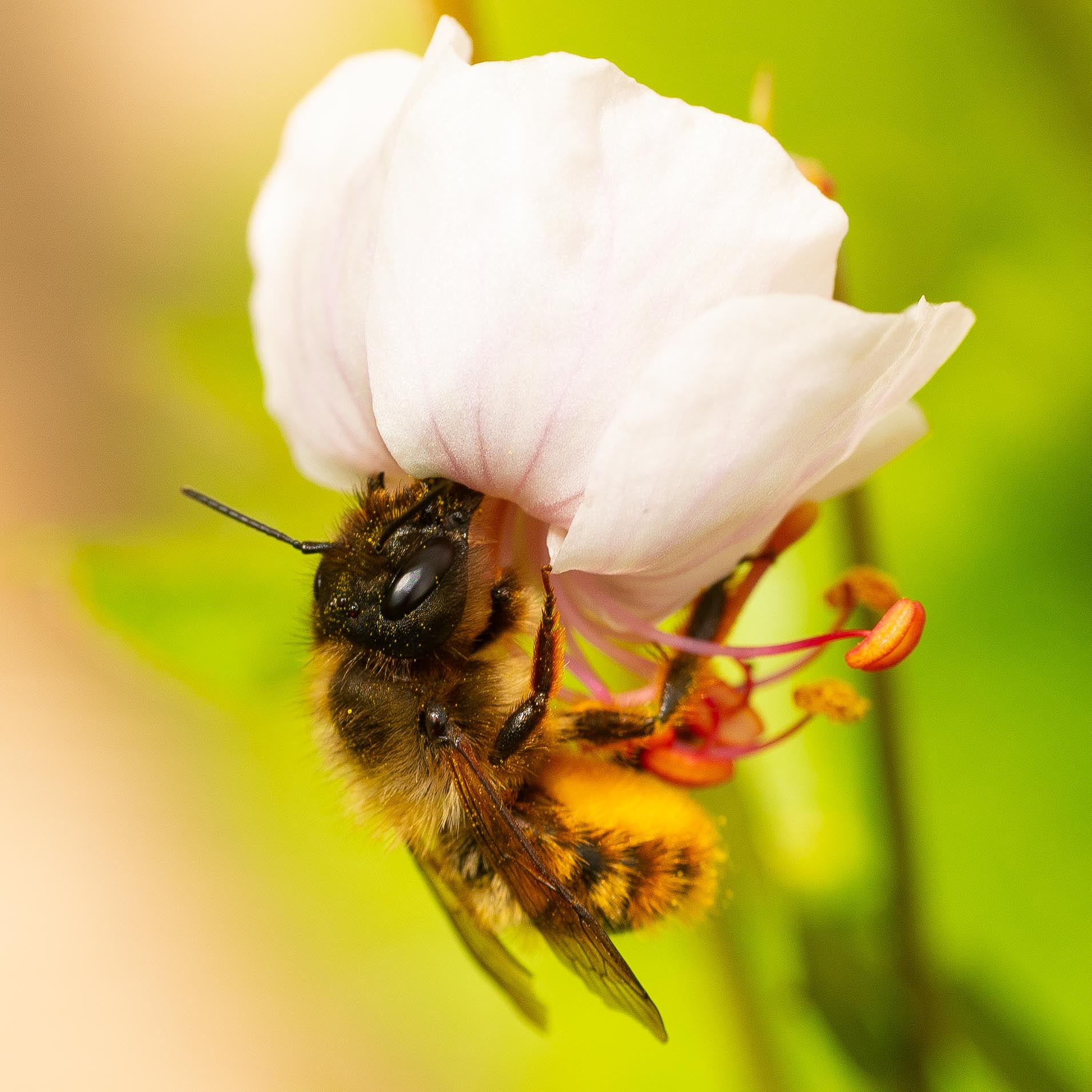
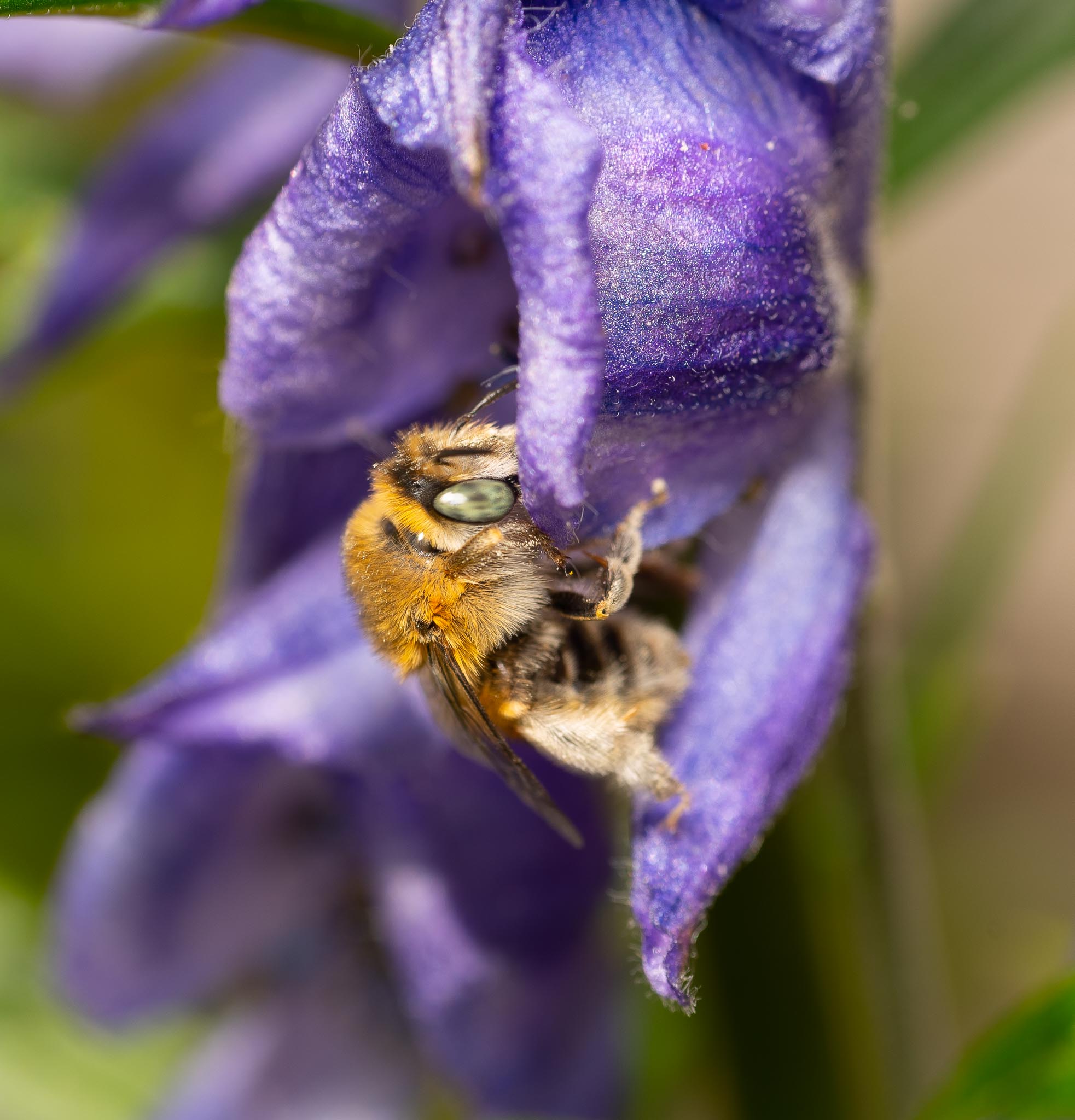
I had better luck with the solitary bees such as this mason bee visiting a cranesbill flower. I’ve noticed that our bee hotel is now quiet and the early spring activity has ended. But the mason bees are still active. I wonder where they’re spending their time?

OLYMPUS DIGITAL CAMERA

A few weeks ago I mentioned a mason bee that was giving me the right royal runaround. I think this is the same bee. I can see it from the window upstairs as it find the same place to bask on a sleeper that separates our garden from the brick patio.

OLYMPUS DIGITAL CAMERA

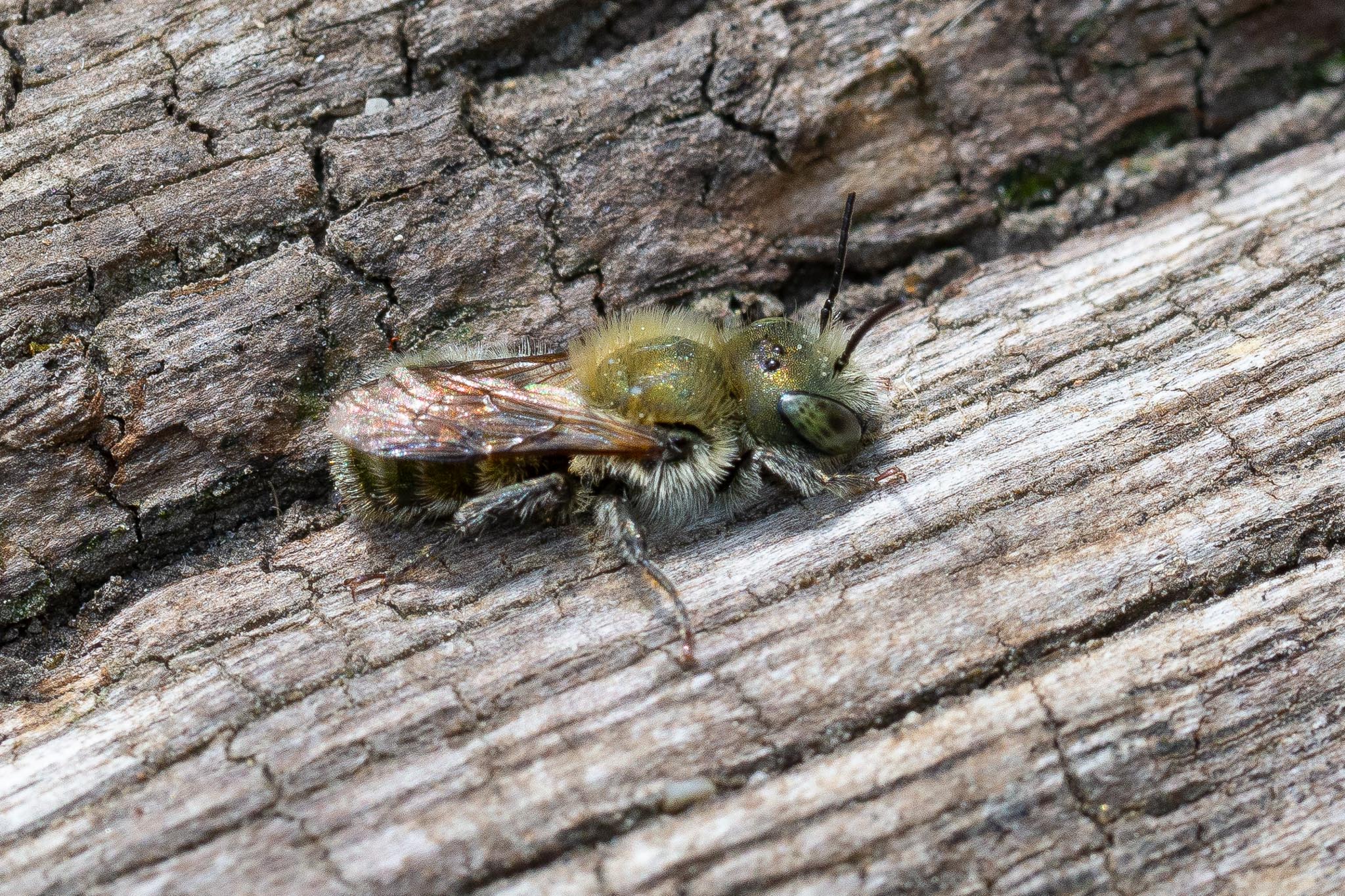
Here he or she is again up close. I love the golden sheen of its head, it’s almost like something from an episode of Ru Paul’s Drag Race.

GDN - 16-5-2020-lo-res-09

This is a new bee for my garden list and a species I haven’t seen before. It’s a relative of the hairy-footed flower bee which is a common early spring species. I think it’s a four-banded flower bee, Anthophora quadrimaculata. They nest in buildings. There’s plenty of dodgy mortar around where I live to provide them with a home.

OLYMPUS DIGITAL CAMERA

Moving on from the bees, despite what this hoverfly may have wanted, many species pretend to have the look of a wasp or bee. This is an area of evolutionary biology I’d like to learn more about (if you know a good book, please let me know). This is a bee-mimicking hoverfly. This one is mimicking a carder bumblebee with its ginger thorax (I’ve got one too).

OLYMPUS DIGITAL CAMERA

It’s not just hoverflies that mimic bees and wasps. One afternoon I noticed there was a wasp beetle sitting on my window ledge. In London I’ve seen these beetles on yellow and black things that help them to camouflage. I once saw one on the pedestrian road crossing box which is black and yellow. Urban insectlife at its best.

OLYMPUS DIGITAL CAMERA

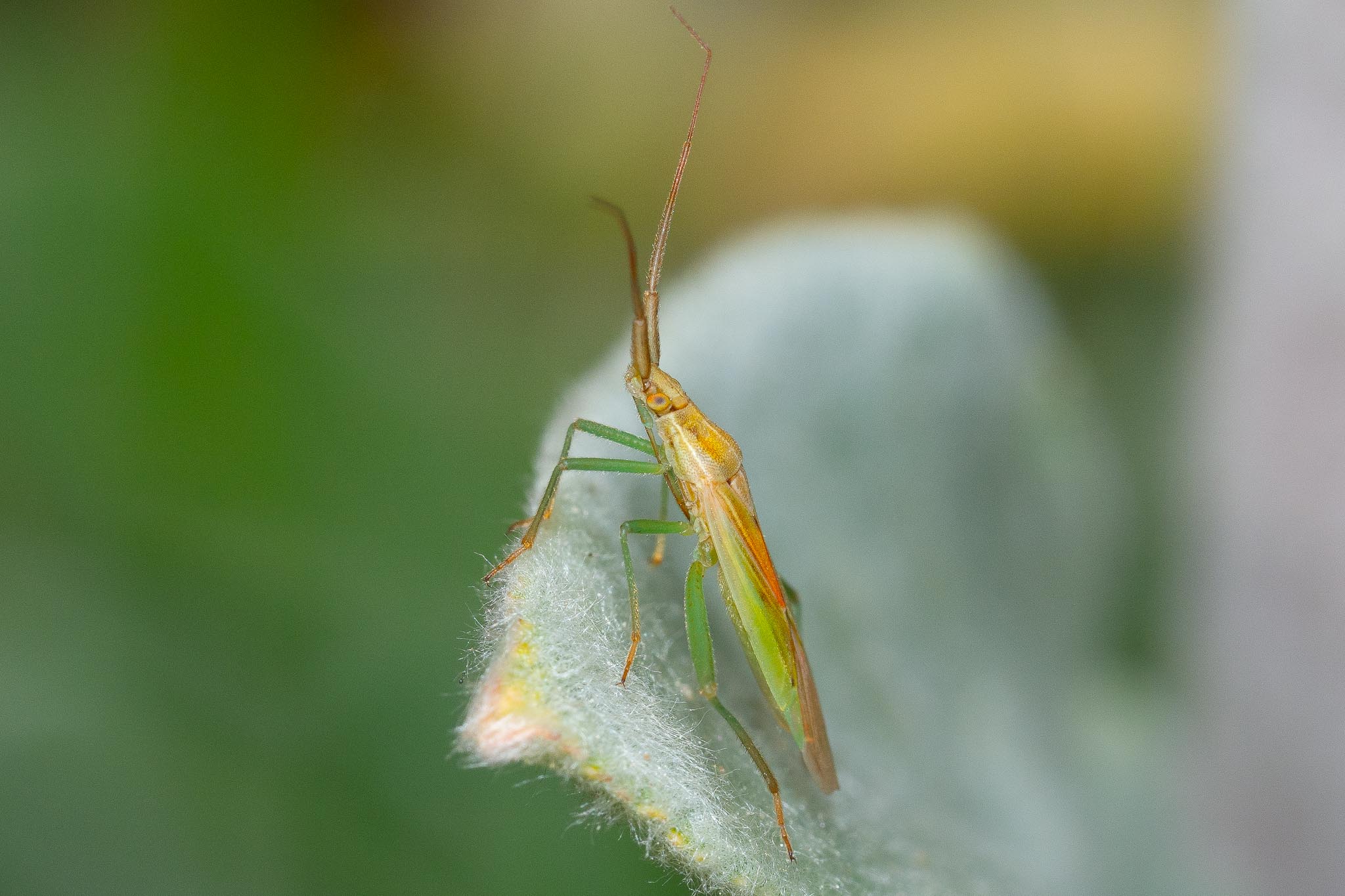
In the bug world I found this mirid bug posing on the lamb’s ear (which, by the way, is so close to flowering). It had a lovely orange glow to its body and eye, merging with the green.

OLYMPUS DIGITAL CAMERA

When I was a teenager I can recall insects crash landing behind the TV on summer nights when we had the window open. The culprit was almost always a hawthorn shieldbug smashing into the lamp. This week one tried to join me at my desk while I worked from home. Perhaps this was the same bug that I originally met on the garden fence.

OLYMPUS DIGITAL CAMERA

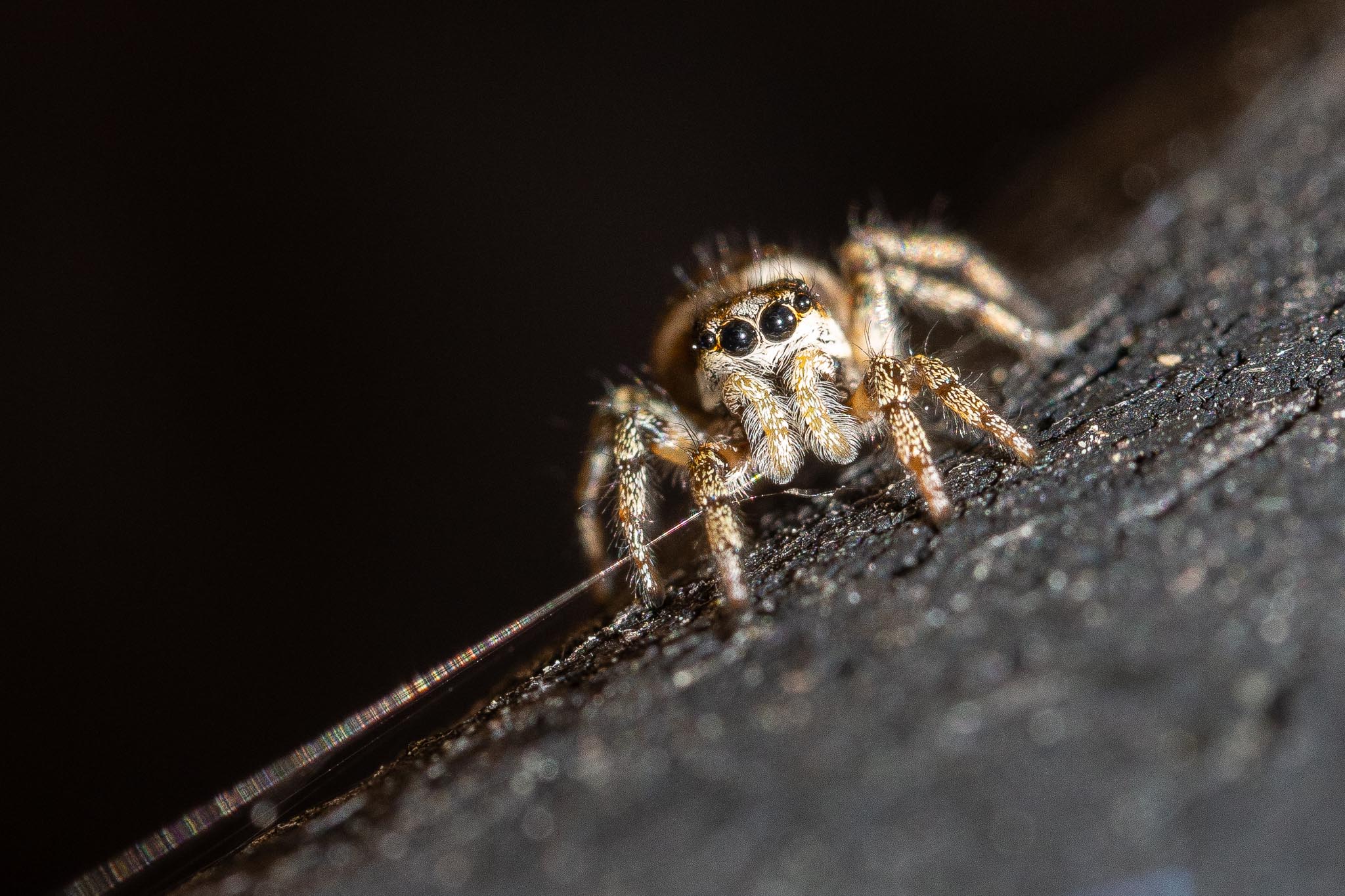
Having spent time trying to find jumping spiders, they are now coming to me. Eating lunch in the garden, I have found jumping spiders exploring my arms and legs. They’re really very sweet arachnids. I’m not sure if it’s producing this spider silk or just crossing it.

OLYMPUS DIGITAL CAMERA

This was another chance encounter in the lamb’s ear, where all the cool invertebrates hang out. I couldn’t resist keeping the background bokeh in the crop.

OLYMPUS DIGITAL CAMERA

I accept that some spiders are less cute and fluffy. But this yellow crab spider was incredible. It was hanging around the lamb’s ear seeking its prey. It didn’t really mind me getting close with my small mirrorless camera. I know many people are missing hugs right now, but this probably isn’t the hug you’re looking for.

Thanks for reading.

More macro