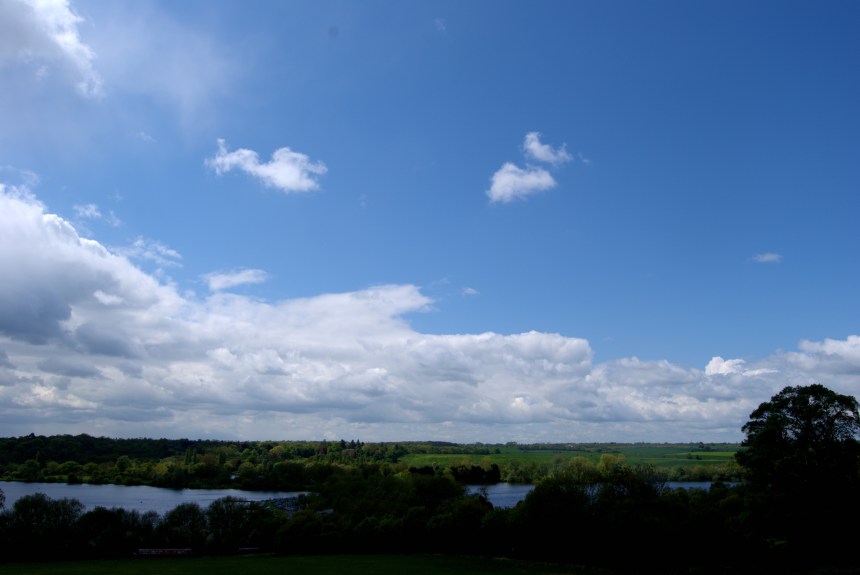
– Broadwater Lake, Harefield, May 2012
A chill wind moves across Broadwater Lake. Black-headed gulls are screaming from rafts built for the common terns which arrive here from their African wintering grounds. It is pleasing to be greeted by one of the newly emigrated. It swoops past, coming closer each time, raising aloft and diving into an arc that brings it back down to the surface of the water and away. The sky is alive with swifts feeding. When the suns does come out clouds of midges move like slow bands of rain after me and on the River Colne I see mayflies touching the water. There’s plenty of food if you’re feathered.
The track separates the Colne on the western side and the lake in the east. The river is separated again by a thick bank of nettles and cow parsley, that common umbellifer that signals spring. There are interjections from vibrant red campion flowers amongst the spread of green, probably indicators of the woodland that was here long before the lakes were dug for gravel and, when finished with, filled by rainwater to create today’s scene. The trees along the river are bursting with song, almost all with the fluid voice of the garden warbler, a bird so plain it’s unmistakable. It has a shy, modest look about it, as if too retiring to boast about its aural beauty. They’re in the bramble too, and it’s a song to silence the prick of the thorns.
On the other side of the river masses of dogwood cover the willow scrub. In the reedbeds struggling to establish along the bank of Broadwater Lake a sedge warbler is singing. It has a white eyestripe and differing palette of browns to mark it out from other plain-looking birds like the reed warbler. Its song is outstanding. I pick out the calls of a blue tit, great tit, goldfinch, greenfinch and the fink! of a chaffinch. This sedge warbler is a masterful mimic.
But there is one song which stands out most, and I hear it around the bend, further up from the lake. The cuckoo. It draws the breath.
A new bout of warm sunshine offers a male orange tip the chance to forage along the track, a pair of Canada geese are ushering twenty-four golden young away and into the Colne. It has the uncanny resemblance to teachers flocking fluorescent infants onto public transport. The geese wack in my direction as they go down river.
Cuck-oo, cuck-oo!
In the distant northern corner of the lake hundreds upon hundreds of house martins are skimming the surface, and from here it appears synchronised. I strafe the glasses from left to right and they are constant. Swifts are treating me like an obstacle, I’m sure I nearly took a hit from a dark and floppy hirundine.
The cuckoo is calling.
I pass back the way we came, again meeting the Canada geese, regarding me once more as a predator. A pair of reed bunting are busy between the scrub along the Colne, passing across to the edge of the lake, the black-headed male clinging to a willow stem, a stick in his bill like a dancer with a rose between his teeth. This bird is building a nest, the female appearing in the bush next door. They disappear into the thin stock of reeds at the edge of the lake.
As I head off in search along the track the cuckoo calls at its clearest, the sun free of cloud, piping. The bird calls from across the Colne, surely from a perch, we scan the trees and find the grey head and neck of the male but it’s bothered and takes to the air. It’s satisfying, so satisfying to see the bird my ancestors took for granted.
I continue along the track, buoyed with the sense that all is right with the world, that England is okay – if this bird has returned again then we must have something to be happy about. Of course, the calling cuckoo is only confirmation, whereas the sight of it is something else. This bird’s voice has become so much a part of our connection with birds, nature, wildlife, time, the world, whatever, that it’s become part of our language, even becoming a word to define mental ill health. It made it into a part of our mechanical world where other species haven’t, the sound of an hour passing and a new beginning. A world without the cuckoo is unthinkable to most. To see the bird calling is a privilege, and then you know it isn’t the gardener playing a trick, the old family clock, or a child portraying ‘madness’.
I’m in a daze. Two birds are squabbling overhead, I’m sure they’re sparrowhawks, but then I’m not. It’s two male cuckoos fighting over territory.
***
Outside the reserve and back on the main road my ears are ringing with the sound of birds – a blackbird somewhere along the way has recorded its fluid melodies into the fundament between my ears. A buzzard passes over the Colne in perfect silence, head twisting, two crows pursue it.
I climb to a pub on the hill over on the other side of the lake, to see the view of the mid-Colne valley and to get a sense of perspective. The weather is fluctuating, the wind is flung out and a few specks of rain touch the windscreens of parked cars, the sun breathes fire into the once dark globules of ornamental copper beech trees on the hill opposite and across the lake. The sunshine stays, the valley gleaming. Its beauty comes like a puncture. The swifts cover the expanse, wheezing and sailing across the vista. In the ragged hedge of hawthorn and field maple just in front of me a whitethroat appears, offering a few tentative renditions of its gravelly warble. A man walking a very slow and floppy-eared dog has spied me.
‘We see red kites very often, almost every day,’ he says. It’s his day off. He turns to take in the view of the valley, his thoughts turning to the proposal to build High Speed 2, a high speed trainline, through neighbouring Korda Lake and across the Colne. ‘It’s a nightmare,’ he says. ‘Hopefully they put it underground.’
The sky is an azure blue with discarded cloud, the sun intense. Broadwater Lake is a space of trembling, sparkling water. This was once a gravel quarry but now is a place which, in this moment, with swifts, warblers and the indefatigable cuckoo, retains a sense of the Arcadian paradise with which we paint our memories of the English countryside. With the threat of upheaval from HS2 it’s unclear how long that will remain.



 Unlocking Landscapes