Photography: Evening meadows

Evening meadows

Evening meadows, Farthing Downs, London, June 2015

It’s that time of year when the meadows are reaching their height. Here you can see the yellow rattle in flower, soon field scabious will appear to be fed on by burnet moths and bumblebees.

Please click through for more of my pictures of Farthing Downs on Flickr

London winter birds

Blog birds -1

Long-tailed tit, Aegithalos caudatus at One Tree Hill Local Nature Reserve

Blog birds -3

Ring-necked parakeet, Psittacula krameri at Camberwell Old Cemetery

Blog birds -2

Magpie, Pica pica perched at Camberwell Old Cemetery

The emptied mast

Dog stinkhorn Coulsdon, London, November 2014

In Devilsden Wood we tiptoe around fallen beech logs, slipping at times on beech leaves and clay, and the emptied mast. The nuts will have been eaten by hungry jays and squirrels. Over the past few weeks I’ve crouched down around these logs photographing their fungi: beech jellydisc with its almost caucasian flesh, purple jellydisc creeping out by the week from wisps of moss. Most startling for a layman like me was the glaring eye of dog stinkhorn, named after its canine stench. Lodged in a piece of black deadwood it had the appearance of a fox or wolf skull looking up at me. The long, finger-like stems that it had produced had collapsed, orange tips like finger nails. As Julian Hoffman has written recently, referring to the poet Rilke, we are surrounded by a world that beckons us to perceive it, to engage with it, to look and to touch. To me the fingers of the stinkhorn could be pointers to something worth seeing. Today only the jellydiscs remain, as well as a brown mushroom that reflects the white break of cloud between the trees above in its glossy cap. My friend Philip is searching for something behind me and as I look up the sharp dark shape of a sparrowhawk slices between us in silence. If we were little woodland birds we would not have seen a thing.

© Daniel James Greenwood 2014

This is it

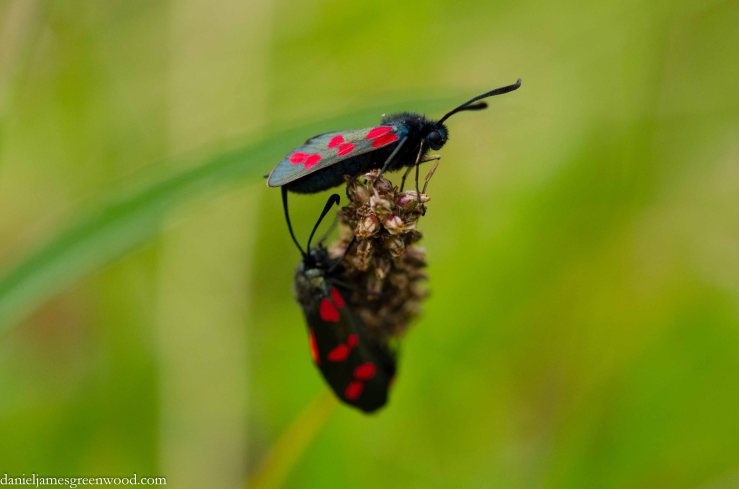
Six-spot burnet moth

Farthing Downs, London, July 2014

We leave the chalky, wooded hollow and appear in an ocean of field scabious. The sun setting in the west catches the pale, lilac petals of these daisies. In the other meadows across on New Hill and in Happy Valley greater knapweed has begun to flower, that deep purple gives me the sense of summer’s final movements, splayed florets that say: this is it. The meadows, too, abound with the motorised flight of burnet moths that were not here two weeks ago. Many of them are mating, one pursued by a pair of skippers unwilling to share a flowerhead. I wonder, what harm could a butterfly do a moth? Anthropomorphism excused, their quarrel does have the feel of a playground spat. That landscape is behind us now as we return along the crown of Farthing Downs. The sky is split in half to the west, smears of rain hurrying our return to the urban landscape. The liquid song of the skylark pours from the sky and we search for its shape. After giving in and then locating it I see it some forty-feet up in the sky. My companion can’t quite believe how clearly its song comes yet from so high. We stand, our exit delayed, the two forces of incoming weather and skylark display gluing us to the soft turf of Farthing Downs.

© Daniel James Greenwood 2014

The cascading orchid

Click through for full album

Farthing Downs and New Hill, London, June 2014

In the towns swallowed by London’s urban lurch, summer is flowering knotweed, rosebay willowherb and lupins, all non-native, all bold and blooming along Victorian railway sidings. At Farthing Downs summer strikes out in meadows of yellow rattle, dropwort, field scabious, hawkbit, ribwort plantain and sheeps sorrel. The first meadow browns, ringlets and small heaths take flight, the latter locked in a pair, mating, flying as one away from my lens. Stopping to take in these grassy Downs, the sheer number of butterflies is clear.

But the birds have not retired just yet. I hear a cry from the blue sky and see a buzzard tucking in its wings and bombing towards Coulsdon. This is the first I’ve seen here, and its arrowing for London is without doubt. This is now officially the most common bird of prey in the UK. I also hear the songs of linnet, song thrush and chiffchaff. Spring and summer have clashed in a frenzy of yellow, green and the common blue butterfly. On New Hill pyramidal orchids cascade across the slope, the leaves of spring cowslips now tucked in under the shade of orchids, rough hawkbit and yellow rattle. The bed of marjoram bounces, its fragrance only felt when touched with the fingers. On the other hillside jackdaws flock with two sheep grazing, their medieval world clattering along with their calls, like bullets ricocheting. The sheep go about their tasting, the meadows purpler still.

© Daniel James Greenwood 2014

A neon waltz

FD may blog-2

Farthing Downs, London, May 2014

I sit on a path new and slight, pressed into the grasses. Last year I sat in a spot close by under the shade of ash trees watching a willow warbler make return visits to a nest down in the brambles. Now the brink of a small copse of trees has gone, the bird, perhaps returning, may have decided this was no longer a place to raise young. In the absence of willow warblers, brimstone butterflies, perhaps reaching double figures, mark the new space of downland that has been reopened from the folds of trees. The piles of logs and branches stacked in the iron beds are still here, yet to be burned or hedged. I like that slowness, that I can come back some months later and no one has felt too pushed to tidy the place up.

A male and female brimstone fly together and then fall down amongst the twigs and low, woody brambles. I’m interested to see what they’re doing so I get up and have a look. They’re mating, bodies bent round, facing away from each other. They part. High in the sky, against the blue and its herring and lesser black-backed gulls circling on thermals, a huge flock. I wonder why, I wonder what for. Down here with me the female brimstone is again on the wing, met by a band of battling males. They pass her and are turned immediately onto her, each forgetting their quarrel and targeting the paler female. This is the perfect reflection of the adult butterfly’s life: the males seek as many females as they can; the female, having mated, defends herself from latecomers as she strives to find the right plant for egg-laying. The males attack her, but she breaks free, up into the sky. She is not free of them. The four males cloud her, their colours so close as they gain height that all sense of defence has disappeared into a neon waltz. They go up, up and over my head to the world of gulls and warm air rising.

© Daniel James Greenwood 2014