The dead and the living are mingling on the Downs

Thistle

– Farthing Downs and New Hill, London, September 2012

The living and the dead mingle on the Downs this morning. Meadow brown butterflies kick up from the ruins of grassy tussocks and rusting bramble. They are as shed leaves moved by an autumnal breeze. Brown and orange, one white dot in their black eyespots, they sit in the tops of young, dwarfish oaks, or else are lost to the souring land. Workers have opened up more grassland with chainsaws and fire, stumps of ash are torn and splintered – a battle has taken place here. Jackdaws survey the new clearings, and the old ones, too, a strange officialdom about them, their calls back and forth, scathing blue-grey eye – are they coroners or corvids? This is their work, the image fits.

The yellow rattle has mostly turned, the wind pushing across the road and down the slope. But there isn’t the sound this parasitic plant is named for. There’s the drone of a biplane, probably from Kenley, there’s the teasing whir of a bicycle passing along the cutting, the sound of aging leaves stirring, sycamore yellowed by the changing season. Scabiouses and hawk’s-bits add punctuations of colour to the mushroom-drab Downs, the grey Sunday sky burnt by sun, puddles of blue appearing. In the long grass crickets click like a machine shutting down, the dead and the living mingling on the Downs.

A Farewell to Redwood

Farewell to Redwood

Dorset, April 2011

The passage of the old stable quarters ran to a doorway opening out onto the back of the house. The doorway itself appeared blocked at first viewing, blocked by the trunk of a tree so large that it filled the entire frame. The pianist staying at the house had spoken to me about the tree.

‘I like to bang my head against it,’ he’d said. He had a face like a fox.

The tree goes by different names: Wellingtonia, Big Tree, Giant Redwood and Giant Sequoia. During my time as neighbour to it I called it a jumble of names, sticking with ‘American Redwood’. The tree was twice as tall as the house, a 19th century mansion, and viewing it from the stable courtyard gave a sense of the tree’s grand but gentle scale. The bark is a deep red where worn and soft as a wafer to touch. It has none of the scratchiness of our mature natives like oak or ash. It runs in one towering trunk. Perhaps the white settlers who came upon the Americas harboured a secret adoration for these towering, ancient things (the oldest tree in the world is a Giant Sequoia) felled with such relish, an adoration which survived generations, resulting in an Empire State Building. The tree I had the pleasure of experiencing in Dorset is a prime example of the beauty and power that nature exerts when allowed to grow. This tree was near to 200 years old, probably planted with the house by the adventurous Victorians who’d lived here.

The Redwood had an apartment block feel to its design. Walking along the passage, face to face with the trunk and into the garden, a mouse-like bird scarpered out of view. After a few encounters with the white-bellied creature I witnessed it disappear into a small bore in the soft bark. The bird was a treecreeper, named after its tendency to climb the bark of a tree from its base, poking its bill between the cracks for insects. It climbs up the trunk pinching between the cracks for insects. It climbs and then flies to the bottom of another to begin its ascent all over again. It will only do this on trees of a certain age and size. The size and permeability of the Redwood make it a highly desirable habitat. In the middle of the tree a pair of goldcrests would sing thinly, spinning coins coming to an abrupt halt. The thin nature of the canopy made it a viable way to enjoy not merely the sound of the bird but also to see it. They would be there at lunchtime without fail.

A number of chimneys were built into the stables and across to the house itself. A pair of jackdaws would spend parts of the day bringing sticks and placing them in the vacant portals. Jackdaws are thought to mate for life and a pair here would ‘jack’ to one another as they constructed their nest. In the mid-afternoon, the lull after lunch, they strolled along the lawns either side of the house in an almost synchronous fashion, digging for worms. This was a group of about twenty birds, and in the gloaming they returned to the highest reaches of the Redwood to roost for the night, their chatter lessening before night and silence fell.

From the stable courtyard an expanse of woodland opens up in the near distance. There was another Redwood on that horizon, equally tall but dead. I was walking to the walled garden one morning with the head gardener when he told me the story:

‘Someone was taking their horses out into the wood that way one day and they got to chatting with someone they knew,’ he said. ‘They turned their backs for ten minutes and by the time they looked back the horse had eaten its way round the tree. The thing just went and died. Terrible shame.’

When I said goodbye to the house and the stables I wished the Redwood a farewell. Not just to the tree but the creatures living with it, the treecreeper disappearing into the bark, the singing goldcrests and sleeping jackdaws.

The contents of the lady’s bucket

The contents of the woman's bucket

Cox’s Walk, London, July 2012

We’re coming toward the end of our bat transect, our detectors raised into a night lit by the orange glow of a line of streetlamps and closed by the canopy of oak. Nothing. Further up the slope there was a hint of a noctule bat’s chip-chop call coming through the static of the airwaves, but nothing else. Rain begins to fall and we make our final marks on the record sheet. There are very few bats around, the woodland all but shorn of them. At the bottom of the path are two figures, a third, dwarfish silhouette evidently that of a large dog. From here it’s unclear whether they are moving away or towards us. A fox appears between us and, turning to look back from where we’ve come there rests another. In this break of light and dark, the fox watches us with content, almost with sympathy. Nevertheless, we’re surrounded.

As time goes and our chatter dwindles, the people approach. It’s a man dressed in a cream suit and a woman. He is indeed rotund, stopping and strolling, she strafing either side of him, circling tree trunks, in and out of darkness. We’ve finished now – there’s no point dawdling – no one says anything about it, but there’s a sense of apprehension. We stop – I don’t know why. I call out: we’re doing a bat survey! I’m shaking the black box in the air. A voice travels back:

‘You can do what you like.’

The fox at the top continues in its restful manner. We are the scene.

The woman is clear now, she wears blue dungarees and a red bandana holding up dreadlocks. She disappears behind an oak trunk, flashing us a glance, like a child playing cowboys and Indians. She smiles, emptying a plastic bucket around the trunk. The man has stopped, I can see his large oval spectacles. He turns to the tall iron fence protecting a small copse of maturing silver birch. The woman comes from behind the tree again:

‘Don’t be scaring me foxes away,’ she says, gently, with a hint of the Caribbean in her voice.

We all stop and look to the copse. The streetlight cast onto the trees and fence shows movements of the amber fur of a trail of fox cubs. They slink through the fence and arc towards the tree surrounded by piles of pink sludge – the contents of the lady’s bucket.

‘Ain’t they beautiful,’ says the rotund man in his cream white suit and oval spectacles.

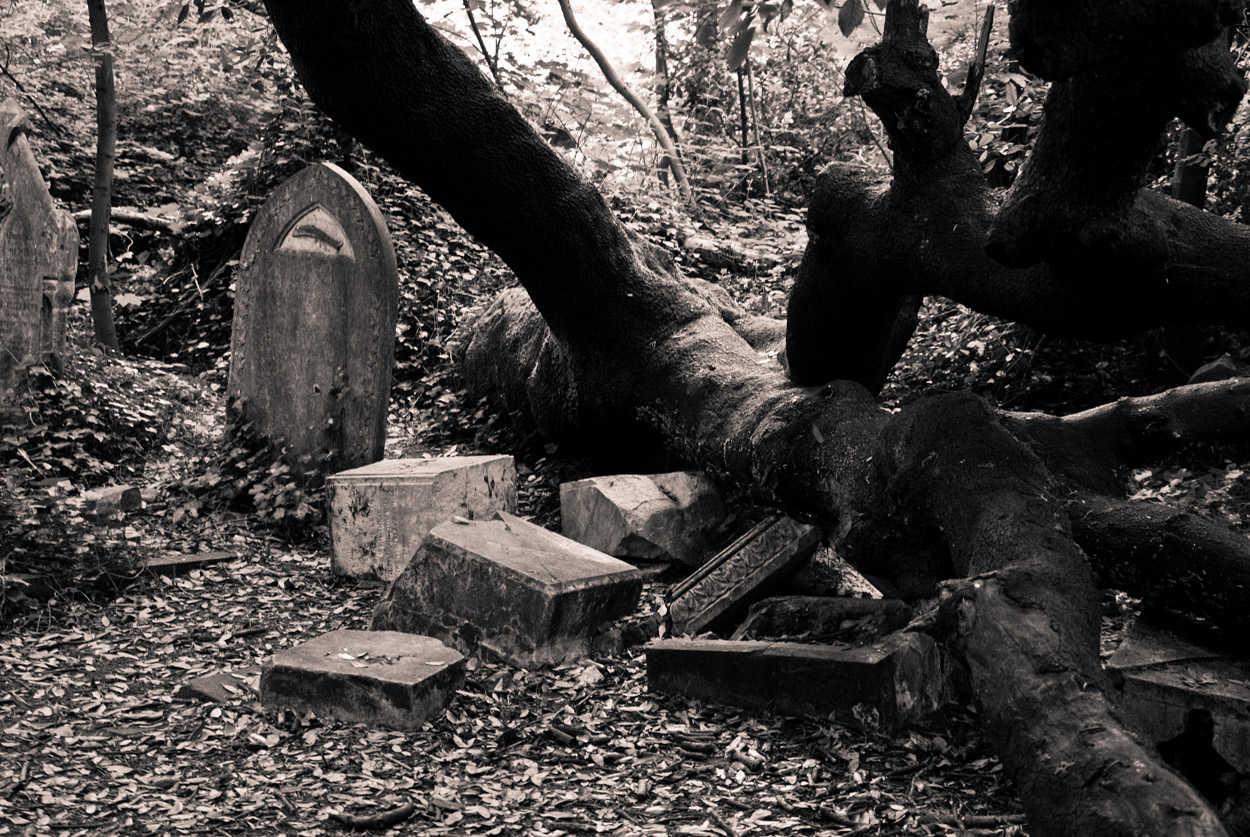
Descending, descending, falling apart

by Martin Damien

Photograph by Martin Brewer

— Nunhead Cemetery, London, April 2012

In the cemetery won by sycamore and rendered woodland, two male song thrush are duelling with one another, throwing out tunes, rewriting and rollicking the black cloud with their language.  This mysterious, handsome thrush is to me like a singing pudding endowed with flight. I leave them to it. My ears are working overtime, the scene dripping, the algae glows on the trunks of dark trees, the moss is vibrant on the gravestones appearing as shipwrecks at the bottom of an ocean. The denseness of the trees squeezes the sound: blue tit trill, the calling great tit and guttural canon of the crow marking the enclosure of forthcoming leaves and canopy. A family, their dog muddied, happy, intoxicated by the aroma of wet woodland, people relaxed, even pleased – woodland puts us back into our bodies. The sun inches out and makes crystals from the droplets of fallen rain, there is the feeling that the soil is sighing from the torrents. Deep refreshment has touched the natural world. My waterproof holds drops of water that leave strange dents in the material, my jeans are darker now. Wait – a song ending, a sweet, fluty refrain. Silence. Woodland dripping, I retrace my steps back down the path. The song comes from a leafless ash canopy – descending, descending, falling apart. Willow warbler. I see it, its long tail and constant hopping between branches. How far has it come? It sings again and moves on. The matt black storm clouds progress, the inkling of lightning, the thunderous thump.