Blue smoke plumes from the dreary Downs, the crack of piled ash trees cuts through the distant wash of the M25, and now the noise of chainsaws. This work is good fun. How many people panic at the sound of this machine, waking to find that their favourite tree is gone from the frame of their bedroom window. In the town I am always suspicious when their itch carries. But this is the restoration of the chalky meadows swallowed by the incoming of woods. We as a species have been trying to halt the loss of woods but at the same time deny new ones for thousands of years. This is a thousand-year-old view, the only change the exchange of machines for the pop of axes on heartwood.
Against a view of near leafless beech, a green woodpecker rises from the anthills, its flight reminiscent of a puppet tugged at intervals as it passes. Robins sing, gulls create the aura of the Sussex coast, and rain specks add a pinch of cool. In the now flattened meadows fungi can be found: a parrot waxcap plucked and left, yellow gills that ripple like flames around its stem. Puffballs are scattered across the path, little footballs deflated and unwanted. I press my toe into one, flattened and leathery grey, its brown spores puffing out like effluent. I definitely take them with me.
I’m standing in the street waiting for Moravian ornithologist Karel Šimeček. From here I can see a serin on a TV aerial across the road, and from over the houses I hear a golden oriole releasing a few phrases of its fluty, unmistakable music into the morning air. In the road is a dead animal, a common sight, and an indicator of just how much wildlife there is here. Another common image, especially on the roads leading out of town, is squashed hedgehogs. In England we barely have dead ones anymore. A car pulls up on the other side of the road and out steps Karel, binoculars round his neck, eye pieces covered by grey duct tape. He crosses the road, making sure not to be run down like a hedgehog. He shakes my hand and turns to the squashed animal in the road:
‘Turdus philomelos,’ he says.
A song thrush, my favourite bird. We get into Karel’s silver Peugeot estate with Radiohead’s Kid A on the stereo, a welcome reminder of home, and we set off. The roads are mostly empty but then it is 8:30am on a Sunday morning. I ask Karel about his interest in wildlife.
‘I became interested in birds as a boy when my mother bought me a book,’ he says. ‘I have been watching birds for more than thirty years. But there are not as many as there used to be, when I look at my notes I can see that there are less birds now.’
Why is that?
‘Different reasons. Agriculture is very important but it is probably the main reason,’ he says.
I was astonished to see how large the fields were in South Moravia. My host is conservationist Zuzana Veverkova, and she told me that the average field size is 500 hectares, meaning that small-scale, sustainable farming is impossible. Young people cannot find a way in other than through inheritance. And there are reasons why farms are so large: inspired by Stalin’s collectivisation of Russia’s agriculture, the Czech communists did the same, forcing farmers off their land and into prison if they refused. Today you have the corporate farming practice with monocultures of what Karel calls ‘the yellow evils’ of wheat, corn, sunflower and rapeseed. In some places, there are miles of these plants and nothing else.
But back to birds. I’ve never seen a goshawk and have read they are one of the most common raptors in the Czech Republic:
‘They are at 20% of what they were when I started,’ says Karel. ‘They are hunted and poisoned by people who think that anything with a curved bill and talons should be killed.’
‘Do you know the hunters?’ I ask.
‘Yes, I know them, and there is no reason for their killing of these birds.’
‘And are goshawks protected by law?’
‘Of course.’
We pass out through the fields, a pine wood on the horizon.
‘A few friends and I managed to get the pine forest protected as a nature reserve,’ says Karel.
That was not enough to save its most unique resident. 20 years ago it was home to more than twenty singing male ortolan buntings. Today there are none. Karel laments this fact as we take a swerve in the road, our passage halted by a pair of white storks treading through a field. Karel reverses and I photograph these graceful birds. They watch us, too, turning away and moving further into the pasture.
White stork
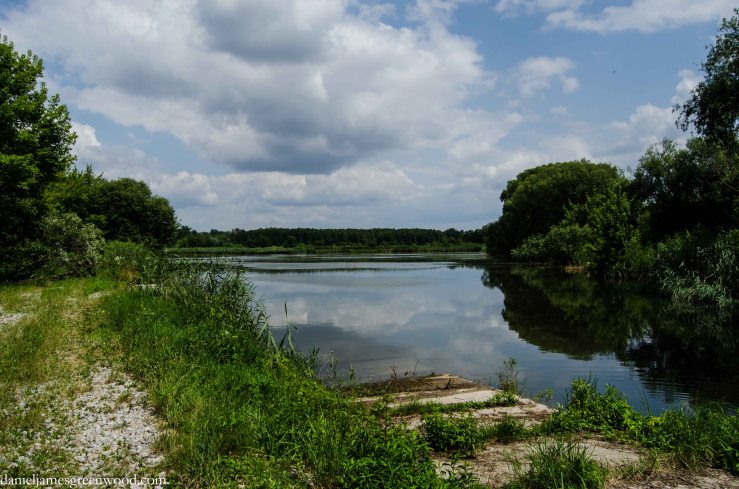
Arriving at Mutěnice fish ponds we stand on the rickety wooden footbridge where the River Kyjovka dams, the water splitting off into the ponds. Leaves cover the surface, a red admiral arriving to bask on the enforced stillness. Karel points to a stand of dead poplar trees on the other side of the river.
‘That’s the beaver’s work,’ he says.
They’ve been here for thirty years. About five years ago the manager of the ponds attempted to eradicate them, but he failed and so the beavers remain. They arrived here from Austria from the Morava, the river that gives this district its name, running the border with Austria and reaching the Danube in Slovakia. When they first appeared here one beaver was captured and interred in the local zoo. It escaped within 24 hours and returned to the fish ponds.
Turning to step off the footbridge, over a few missing slats, Karel glimpses a kingfisher as it lands on a rock in the Kyjovka. I lift the camera to it but can’t switch it on in time to get the shot. Off it goes, electric blue bolt into the willowy shadows of the river. And as we trample through the long grass alongside the river Karel picks out the calls of young kingfishers and a perch that bears the signs of the birds, no leaves, just bare and worn.
One abiding memory of these ponds will be the stench of the water. It’s nasty. More than once Karel has stopped and pointed at the water’s edge and said, ‘this is not water, this is coffee.’ It’s brown, frothy and pungent so not far off. We continue along the Kyjovka, the large pond on our left meeting the path which we’ve already passed down this morning. Karel has seen something up high in the hazy summer sky:
‘Yes,’ he says. ‘White tailed sea eagle.’
Marsh harrier attacking white-tailed eagle
Through the binoculars I see a huge animal beating its great wings, with primary feathers so long they look like fingers that could dictate some deep, magical changes to the world below. But no animal is safe or indeed at peace for long on Earth. Karel has seen alongside the eagle a marsh harrier attacking it, and moments later another appears. I set my camera and start clicking. The eagle looks overdressed in its Gogolian greatcoat of brown feathers, its white head and neck protruding out from under, yellow talons dangling out below like down-turned coat hangers. The marsh harrier strikes again and again, forcing the eagle away from the sky above the huge pond and towards the trees, until the battle is over and all three have left my field of vision.
‘We had no idea that the eagles were here,’ Karel says. ‘A Swedish hunter had a permit to hunt in the forest and when he was leaving he said, “I see that you have eagles nesting in the forest”. Our response was, “we didn’t know that!”.’
We tread the path already taken, a dead bat splayed on the ground, its deathly grin drawn wide and rotting. It’s our waymarker. A small van rolls along the track, a Czech man with short black hair and ski-glasses steps out, handing Karel a metal tag that reads ‘Budapest’. They discuss something and then say goodbye, the man getting back into the car and driving away. The ring is from a young cormorant that was shot the other day. It had been ringed by ornithologists in Hungary and died here at Mutěnice. This seems familiar to Karel:
‘The migration patterns of cormorants are well known,’ he says.
This is an extract from an upcoming collection, Travels in South Moravia
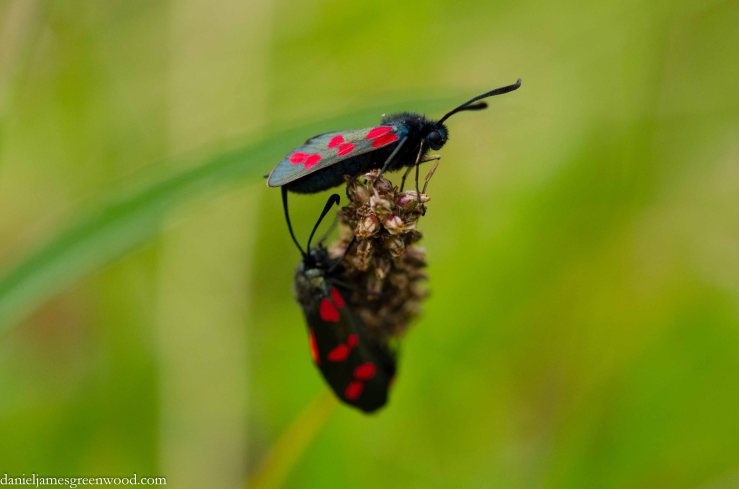
We leave the chalky, wooded hollow and appear in an ocean of field scabious. The sun setting in the west catches the pale, lilac petals of these daisies. In the other meadows across on New Hill and in Happy Valley greater knapweed has begun to flower, that deep purple gives me the sense of summer’s final movements, splayed florets that say: this is it. The meadows, too, abound with the motorised flight of burnet moths that were not here two weeks ago. Many of them are mating, one pursued by a pair of skippers unwilling to share a flowerhead. I wonder, what harm could a butterfly do a moth? Anthropomorphism excused, their quarrel does have the feel of a playground spat. That landscape is behind us now as we return along the crown of Farthing Downs. The sky is split in half to the west, smears of rain hurrying our return to the urban landscape. The liquid song of the skylark pours from the sky and we search for its shape. After giving in and then locating it I see it some forty-feet up in the sky. My companion can’t quite believe how clearly its song comes yet from so high. We stand, our exit delayed, the two forces of incoming weather and skylark display gluing us to the soft turf of Farthing Downs.
In the towns swallowed by London’s urban lurch, summer is flowering knotweed, rosebay willowherb and lupins, all non-native, all bold and blooming along Victorian railway sidings. At Farthing Downs summer strikes out in meadows of yellow rattle, dropwort, field scabious, hawkbit, ribwort plantain and sheeps sorrel. The first meadow browns, ringlets and small heaths take flight, the latter locked in a pair, mating, flying as one away from my lens. Stopping to take in these grassy Downs, the sheer number of butterflies is clear.
But the birds have not retired just yet. I hear a cry from the blue sky and see a buzzard tucking in its wings and bombing towards Coulsdon. This is the first I’ve seen here, and its arrowing for London is without doubt. This is now officially the most common bird of prey in the UK. I also hear the songs of linnet, song thrush and chiffchaff. Spring and summer have clashed in a frenzy of yellow, green and the common blue butterfly. On New Hill pyramidal orchids cascade across the slope, the leaves of spring cowslips now tucked in under the shade of orchids, rough hawkbit and yellow rattle. The bed of marjoram bounces, its fragrance only felt when touched with the fingers. On the other hillside jackdaws flock with two sheep grazing, their medieval world clattering along with their calls, like bullets ricocheting. The sheep go about their tasting, the meadows purpler still.
I sit on a path new and slight, pressed into the grasses. Last year I sat in a spot close by under the shade of ash trees watching a willow warbler make return visits to a nest down in the brambles. Now the brink of a small copse of trees has gone, the bird, perhaps returning, may have decided this was no longer a place to raise young. In the absence of willow warblers, brimstone butterflies, perhaps reaching double figures, mark the new space of downland that has been reopened from the folds of trees. The piles of logs and branches stacked in the iron beds are still here, yet to be burned or hedged. I like that slowness, that I can come back some months later and no one has felt too pushed to tidy the place up.
A male and female brimstone fly together and then fall down amongst the twigs and low, woody brambles. I’m interested to see what they’re doing so I get up and have a look. They’re mating, bodies bent round, facing away from each other. They part. High in the sky, against the blue and its herring and lesser black-backed gulls circling on thermals, a huge flock. I wonder why, I wonder what for. Down here with me the female brimstone is again on the wing, met by a band of battling males. They pass her and are turned immediately onto her, each forgetting their quarrel and targeting the paler female. This is the perfect reflection of the adult butterfly’s life: the males seek as many females as they can; the female, having mated, defends herself from latecomers as she strives to find the right plant for egg-laying. The males attack her, but she breaks free, up into the sky. She is not free of them. The four males cloud her, their colours so close as they gain height that all sense of defence has disappeared into a neon waltz. They go up, up and over my head to the world of gulls and warm air rising.
It dawned on me a few months ago, when a cull looked to be too stupid and ugly a prospect, that we can show no real mettle in the battle to stop the slaughter of wildlife overseas if we are seen to be slaying it without scientific basis.
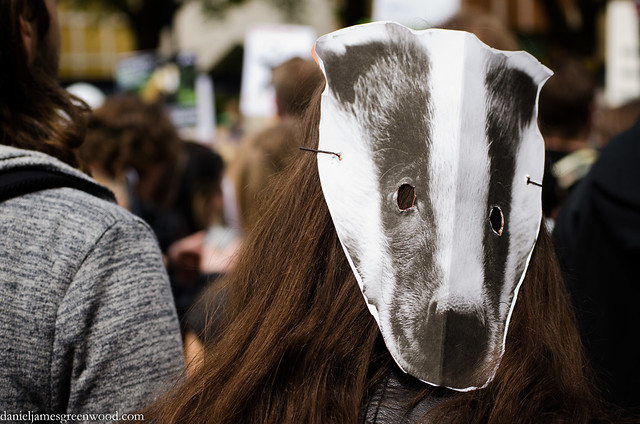
I have spent time recently with Andrew Lynch, an MSc student who is voraciously charting the former range of badgers in an area of London from which they disappeared in the 1990s. A few weeks ago we entered a wood of ancient origins that is closed to the public armed with a rusty key and the permission of the landowner. We crunched through leaf litter rarely trodden by humans, through spider webs, brambles and holly. There were no paths. We discovered two specimens of Solomon’s seal, an ancient woodland plant that was surviving here in the deep shade of an unmanaged but very old and undisturbed woodland. The next day Andrew discovered a crumbled badger sett, its former inhabitants long gone. Why did they go? It’s hard to say, but that’s the point of Andrew’s work. In my view it is probably because the human population rose and the local environment felt the eventual impact of the post-war development of open fields and other pockets of woodland. They were most likely cut off from badgers living on London’s periphery. This is an animal that likes to create new colonies and does not like inbreeding. The badgers were reintroduced but their roaming nature led them to their deaths on main roads a few miles away. Amazingly we have recently had a record of badgers returning to one of the woods that is open to the public and well used. It was a moment of immense satisfaction and gave us hope for this network of dysfunctional woodlands. To think that badgers could be returning to woodlands which suffered disturbance in the Victorian times but still makes a home for owls, bats and other woodland animals, feels like a crowning moment. They will not have a sett in this area of London for many, many years, but to think that they have been by is, in part, a conservation triumph for the local community.
I find it difficult to respond to the fact that the Department for Environment, Food and Rural Affairs (DEFRA) are contracting the slaughter of badgers in Somerset and Gloucestershire with anything other than anger. The cull is wrong, expensive, bloodthirsty, unscientific, barbaric and worst of all, it is happening. It angers me like nothing else that afflicts our environment. For British wildlife conservation today it’s worse than the Lydd Airport trump, the shameful Oaken Wood debacle, the threat to privatise the public woodland estate, the idea of 50 ancient woodlands lost to HS2, and far more sinister than the threat of ash dieback disease or oak processionary moth. I feel a deep seated sense of injustice. A cull has already been done and proved ineffective in reducing bovine TB (bTB) in any meaningful way. I believe the National Farmer’s Union and DEFRA should take greater responsibility for biosecurity and that badgers and cattle should be vaccinated, that the government should show a greater willingness to invest in this rather than focusing solely on political gains for 2015. They have, however, turned more than 300,000 people against them, perhaps for good. I am convinced, from what I’ve read and heard from all involved that it is based on political ideology – much like the government’s attempts to downgrade Lewisham A&E (deemed unlawful by the High Court) – and is purely to accrue political support from the farming lobby at the next election. I feel there is a bloodthirsty element to the cull, just like the killing of hen harriers to the point of extinction in England, the poisoning of buzzards and golden eagles in Scotland. With the badger cull we are in the throes of a witch hunt. It has the hint of Chairman Mao’s communist war on tree sparrows which backfired completely. This is the very thing we as leaders of the global conservation effort are attempting to halt overseas and now, it seems, at home.
Life and people have moved on from the days of the hunt, when the aristocracy took to the countryside to chase foxes on horseback. Wildlife is valued for more than its fur and flesh, many people in the UK have come to value the need for a connection with the natural world, and science has taught us the need for humans to maintain the environment and to repair degraded ecosystems. The repair takes on many different forms – the work of the Great Bustard Group, reintroducing this charismatic and iconic bird to Wiltshire after it was hunted to extinction in the UK; the resurgence of otters, another animal ‘clashing’ with humans where it forages from commercial fish ponds, but a welcome sign of healthier rivers in England; and then there’s the crane, a bird that was slaughtered in its thousands and now returning, like the spoonbill, to breed for the first time in over 400 years. It’s hard to say why the crane is back, but it could be because larger areas of land are being set aside for wildlife, larger reserves rather than pockets. These are great moments in the history of British wildlife conservation and are not all because of human action. Another great thing is the thriving badger population in England, of which there is no set figure. However, one thing that the badger cull reminds us is that whenever wildlife does well – foxes and cormorants being examples – it is treated with disdain and someone, often on the right wing of government, will call for a cull. Take Boris Johnson’s recent attack on London’s foxes. It is an instinctive, atavistic response, rooted in a love for slaughter that is abhorred by more modern attitudes towards animal welfare and the environment. Most pertinently it is a human failing, an inability to look at the impact we have on species and ecosystems we believe ourselves to be free from and above. When it comes to natural resources no species is more invasive and damaging than we and yet no other species has the ability to think and reflect over how we might improve our behaviour, to evolve, and improve the health of the environment not merely for ourselves.
Perhaps my lifestyle is implicated somewhere in the decline of the hedgehog but the badger is not to blame.
For me, the beauty of badgers is their very nocturnal nature, something which has inspired artists, scientists, conservationists and authors down the centuries. The image of a twilight woodland is one of the most magical, with badgers beginning their nightly forage for worms (and yes, even hedgehogs sometimes), moths taking to the wing with the moon as their guide, and tawny owls calling from the canopy, their prey of mice and voles scrabbling around in the leaf litter. If I were to talk like this to many people who are for a badger cull, I would be labelled as emotional and naïve or worse, only against a cull because I think badgers are sweet. I know that badgers predate hedgehogs but I don’t blame them for the decline in their prey. It’s an excuse used by individuals who have no scientific grounds to defend the cull. Perhaps my lifestyle is implicated somewhere in the decline of the hedgehog but the badger is not to blame. The blame for that can firmly remain with human impacts on the landscape, the lack of suitable habitat, a loss of food sources after the tidying up and poisoning of the English landscape through mass expansion of intensive agriculture after the Second World War (note that in modern times Owen Paterson went against the will of the people when voting to continue with neonicotinoid-laced systemic pesticides that kill wild pollinators and ruin the soil).
It dawned on me a few months ago, when a cull looked to be too stupid and ugly a prospect, that we can show no real mettle in the battle to stop the slaughter of wildlife overseas – migrating birds in Malta and Cyprus, lions in Africa, tigers in India – if we are seen to be slaying wildlife without any scientific basis. England is just as bad as everyone else. In the same way that we are looking to destroy our own version of the rainforests through development, we cannot truly argue with deforestation in the Amazon, the Congo and Eastern Europe when we are championing the very same thing at home. Overseas these people are barbarians, at home they are ‘doing the right thing’. And as we look for badgers in a landscape that has lost them, the loss feels peculiar with the government’s mindless slaughter of this beautiful and vital wild animal echoing in the background. I just hope that in twenty years people in Somerset and Gloucestershire will not be retracing old setts mindful of the senseless brutality that was inflicted in the past. Looking at the state of things it appears a distinct possibility.
I’m sitting out on the terrace of the pensione, complaining aloud in the full sun. Last night I’d peered over the ledge at the lemon and olive trees, the tiled terraces and bright white roofs. The faint voice of a thrush had caught my ear, and the familiar dark, scuttling figure of a blackbird darted across a building about twenty-five-feet below. But there was something unusual about the blackbird. The light was low and so darker tones fell to black. However, this was not a wholly black bird and I entertained the thought – could it be a blue rock thrush? I was unprepared for it, so unrefined is my knowledge of anything non-British and unfamiliar. From the viewpoint of our pensione, the houses, hotels, gardens and restaurants, immaculately packed together, are built like steps to the sky with the sweeping curve of the only road in the town cutting through them, linking Positano to Naples and Sorrento to the north and Amalfi in the south. Above all this stands dry, steep and rocky mountains with deep green woodlands below the peaks. Helicopters are taking turns to pour water from the ocean onto a forest fire that has erupted in the southern peaks. It has been going on all night, the choppers roaring, their sound unbearably loud in this mid-30 degree heat. On the terrace I watch the heat rise as the morning nears noon, the choppers ferrying water from ocean to mountain. From beneath me a butterfly emerges, and it’s the beast of European butterflies, the swallowtail, flitting between the railings like a twenty-pound note.
*
Having had the shadow of a swallowtail pass over me, down into the depths of the gardens where the mystery bird had scampered, I decide to investigate its flight path. I’m here for my uncle’s wedding. It’s a big family holiday and so I have relatives scattered around all corners of the town. Had they all been ornithologists or lepidopterists things might be easier for me. There’s the rumour of a path or set of stairs that runs for nearly half a mile from our pensione down to the beach. My uncle, the groom, tried it and nearly died, apparently. My sister, fresh from travels in India, walked it the other day and says there are ‘loads of butterflies’. She mentioned colours which don’t even appear in my rubbish field guide. The image in my mind is of clouds of blues dancing amid the nu-rave hue of Mediterranean wildflowers.
Wall lizard
The temperature touches 35 degrees by 2 or 3pm, and so it becomes a time of hibernation. It feels too hot even to think, to speak. The steps down to the beach, some 400 or so, begin by a chapel outside the pensione. A black priest enters through the old wooden doors, sending an SMS with his mobile as he walks, never looking up. The stairs aren’t uniform, they dip and swerve, the height of an individual slab varying and inducing vertiginous feelings. Streaming between old, old walls the path echoes with the slap of thin, rubbery footwear and suddenly a burst of pink lanterns, bougainvillea flowers which are so evident, climbing across the blistering walls of Positano. It’s September so some are turning to seed, they appear tea-stained. The stairs descend past the front doors of people’s houses and iron gates which offer tantalising visions of Italian ornamental gardens. On the rough surface of the waist high walls either side, lizards rest and escape. They give themselves away quite easily – the sound of brittle leaves dislodged in the cavity of a wall, by neither wind nor gravity. Ants channel the iron handrails. The sun is so hot and so high, my legs tremble when I look up.
The steps snake round and flatten into a slope, I sit down in the shade of an olive tree and waft my hat about my face. A woman and a young man, probably her son, are climbing up the steps. She is visibly sweating, I smile at her and attempt a universal gesture for overheating. She’s a typical Italian mama, portly with dark hair and a cloth dress. She’s out of breath and looks at me like the stranger that I am. A man is watering his garden behind the iron railings. I sit and wait for butterflies. The olive trees pool at their bases, as if they’ve been melted by the sun. The larger oliver groves have nets tied around their trunks, ready to be rolled out in season to catch the falling fruit. It’s not time yet. In the sun of the path’s slope, a lemon tree dangles over from a garden, plump with yellow fruits. Great umbrellas of fennel grow on the perilous bank beyond the wall and a white butterfly lands to feed on one plant. I photograph it and zoom in on the crop. Positano is home to white butterflies as London is to pigeons, mostly the small white, Europe’s most common butterfly. The one I’ve pictured isn’t a small white, however. It has dark markings on the wings, a little like a marbled white, but more like a bath white. In my head I swiftly establish this perilous walkway as Positano’s first wildlife conservation area. Peering over the wall at the olives and dry grasses, there is the usual sign of plastic bottles and bags discarded. This, however, doesn’t compare with the crap around Naples airport.
Positano’s first wildlife conservation corridor/stairwell
The heat is getting too much for me, I glance at the steep steps back up to the hotel. I let in the murmurings of hot panic. From the lemon tree garden the gigantic shape of a swallowtail soars down onto the path and over the wall, just like it passed over our terrace. I rush out to try and get a photo but it’s too quick and I’m too far from it. Against the rocky wall a brimstone glides, a flash of orange on its outer wing. This is no normal brimstone. I look at my field guide. It’s Cleopatra’s. The sun pulsates. I dive back into the shade. The Mediterranean glimmers blue in between the olive branches holding ripening fruits, Tunisia and Algeria beyond the horizon. People have been passing me, comfortable with the sun rays, on their way down to the beach. It’s 1:30pm, the hottest part of the day. I guzzle from my water bottle and make my way back up the steps to hide.
It’s 6:30 am. We’re strolling along the Crystal Palace ridge, a chunk of wild land made up of all kinds of plants, a few notorious for their invasive, disruptive nature. Bramble and nettle are frost-encrusted, brightened as the ice turns to dew in the occasional spillage of sunlight that greets us from the south. When it does appear we bathe in it like a gift from the gods, droning as maybe druids would. The willow catkins are clean through now, many dew-laden, droplets elongating as gravity weighs. Last spring we listened to the call of a lesser whitethroat as it dinked in and out of these willows, its common cousin, the whitethroat, performed mating rituals in a bower of buddleia, diving into the cover of bramble at the farthest tip of the palace’s former standing, now marked by a solitary white bracket. Buddleia grows on the ridge in large sprigs, still harbouring last year’s brown cones of flowers that will be purple in a few months. Elder leaves escape their buds a little early in this still wintry weather, green sleeves unfurled but perhaps thinking the better of it. The mutilated stalks of Japanese knotweed are the only signs of intervention but for discarded beer cans and a few muddy desire lines. The scene is punctuated by crows sat idly in birch and sycamore trees that have grown in the cracks of the palace’s old stairways, immortalised in stone. These walkways, presided over by headless statues and sphinxes, are now engulfed by green and yellow lichens. As for the living, we aren’t the only people visiting: dog walkers, joggers, cyclists, commuters all make their passes before us. A dog with a stick in its mouth accosts us out of curiosity as we regard a song thrush singing in an ash tree, the dog turning its head and smacking fellow birdwatcher Lisa on the back of her leg. It seemed to hurt.
The view below is of open parkland where crows and black headed gulls saunter, pulling worms from the always waterlogged ground. Every so often the crows leave their perches in the palace’s trees, returning a few minutes later with large morsels of white bread in their bills. It’s almost impossible to see if a bird returns to its perch, such is their uniform blackness. This is the highest point in south London, higher still is the television mast that reaches upwards into the sky. Last year we watched a peregrine falcon using the mast’s very top as a perch, a pair of sparrowhawks coasted from even higher. The memory brings vertiginous feelings. The view is south to the North Downs, the Dartford Crossing to the east, visible in the orange morning sky. Chimneys and flues are blowing white smoke up into the air, beyond the Crystal Palace athletics stadium, a site that without the development of the Olympic Stadium in east London would be England’s national athletics arena. Unbeknownst to most, a long distance marathon has taken place here for millennia. Migrant birds have historically chosen the Crystal Palace ridge as a spot to drop in on, with swallow, redstart, willow warbler, chiffchaff, blackcap, whitethroat and wheatear having been recorded in recent years.
The Crystal Palace’s relocation to Penge from its original siting at Hyde Park was completed in 1854and caused a global stir, attracting visitors from all over. The Crystal Palace High Level railway was built to serve the palace, a trainline which has now been reclaimed by nature in the form of Sydenham Hill Wood, Brenchley Gardens and the Horniman Nature Trail. The Crystal Palace burnt down in 1936 and the trainline was closed in 1954, leaving a footprint of paths interrupted by housing estates at the ghosts of Lordship Lane and Upper Sydenham stations. Train tunnels were built underneath roads and excavated through the ancient Dulwich and Penge woodlands, now home to bats like the brown long-eared. Go back a few hundred years and Crystal Palace would be entirely different, even further than its enclosure as Penge Place in the early 1800s, and its original incarnation as Penge Common. Penge translates from the Gaelic as ‘the end of the wood’, a wood that was known as The Great North Wood, a landscape of commons and coppices that stretched from Deptford to Selhurst. It was deemed ‘North’ because it was the great wood north of Croydon, a thriving market town. Locals from the surrounds would make trips here to Penge Common to listen to nightingales, a bird that has disappeared from the area, and is suffering similarly staggering declines nationally.
Perhaps there is some irony in the fact that Crystal Palace fills me with a sense of nostalgia, for the Arcadian past of Penge and the Great North Wood. It’s an emotion that the Victorians made their own as a visit to nearby Dulwich Upper Wood and Sydenham Hill Wood proves. The Victorian villas built along the Sydenham Hill ridge are now gone, their footprints straddled by regenerating hornbeam, oak and new woodlands of sycamore and ash sprouting from the basements, as well as the invasive laurel and rhododendron planted in their gardens. At Sydenham Hill Wood a small folly remains, a remnant of the Sydenham Hoo and a feature of its vast ornamental garden. There’s a picture on the Internet that shows this very garden, with a small shrubby evergreen which now stands as a mature cedar of Lebanon. I share Victorian nostalgia instead for a world that much of their development denuded. The Crystal Palace brought unprecedented change to the Great North Wood. But then there are records from the time of the Crystal Palace High Level railway suggesting that in the immediate aftermath of the development birdlife still thrived. Bullfinch, tree pipit, wryneck, spotted flycatcher and wood warbler were all known to nest in the area, and some locals will point to the fact that bullfinch and spotted flycatcher only stopped breeding in the area in the late twentieth century following a national trend. In the grounds of the palace tree pipit and hawfinch were breeding birds, the latter thought to have bred in Sydenham Hill and Dulwich Woods until the 1980s. What concerns me about the run off from the Crystal Palace’s legacy is how the ridge will be treated in the next 100 years.
There is a masterplan to redevelop Crystal Palace Park and bring the ridge into the same aesthetic bracket as the lake and waterfall features that remain from Joseph Paxton’s pleasure gardens down at the bottom end of the park. In previous decades there were proposals for a casino and other grandiose leisure complexes which have disappeared from the agenda due to public opposition and lack of funds. Some of the park, registered as Metropolitan Open Land, is being earmarked for the development of apartments, a decision upheld by the High Court in June 2012, to the grave disappointment of the Open Spaces Society, the Crystal Palace Community Association and London Wildlife Trust. What makes the Crystal Palace ridge unique is the lesson it can teach us about our design, about what truly lasts. The Crystal Palace was a grand and ambitious venture but like the villas painted across the Sydenham Hill ridge a mile away, it was too grand to last. Looking here at giant stone stairwells with pioneer woodland trees like birch and sycamore escaping from the cracks, headless statues reawakened by the figure of a perching crow, and the only remnant of the palace’s outer shell sitting alone on the wildflower-enveloped ridge, the feeling is not one of defeat. Over on the grass banks of Crystal Palace Parade where buses terminate and begin journeys to places like Elephant and Castle and Blackheath, a line of plane trees was planted to signify the footprint of the old palace. The masterplan includes proposals to plant a new tree palace along the ridge and to landscape it. If this is handled without due care and consideration, it could lead to the loss of good, wild habitat home to breeding song thrush, dunnock, blackcap, chiffchaff and whitethroat amongst all the other wild plants and creatures thriving in a space where wildlife has been allowed to thrive without much intervention. The palace has grown back in its own way, in the birch and sycamore palace escaping from the cracks in the steps, yet to reach the old palace’s heights. In truth, I wonder why we are so desperate to master the land, to make a statement of it. There is more pleasure in observing the movements of wild birds each spring, in listening to their songs, than in attempting to control them. I hope there comes a point where we can step back and allow the land to recover from our past mistakes. For us birdwatchers it will be a case of watching, listening and waiting.








 Unlocking Landscapes