
Author: Daniel Greenwood
Landscape photographer with a focus on woods and trees, fungi, and macro photography
Robin with nest material
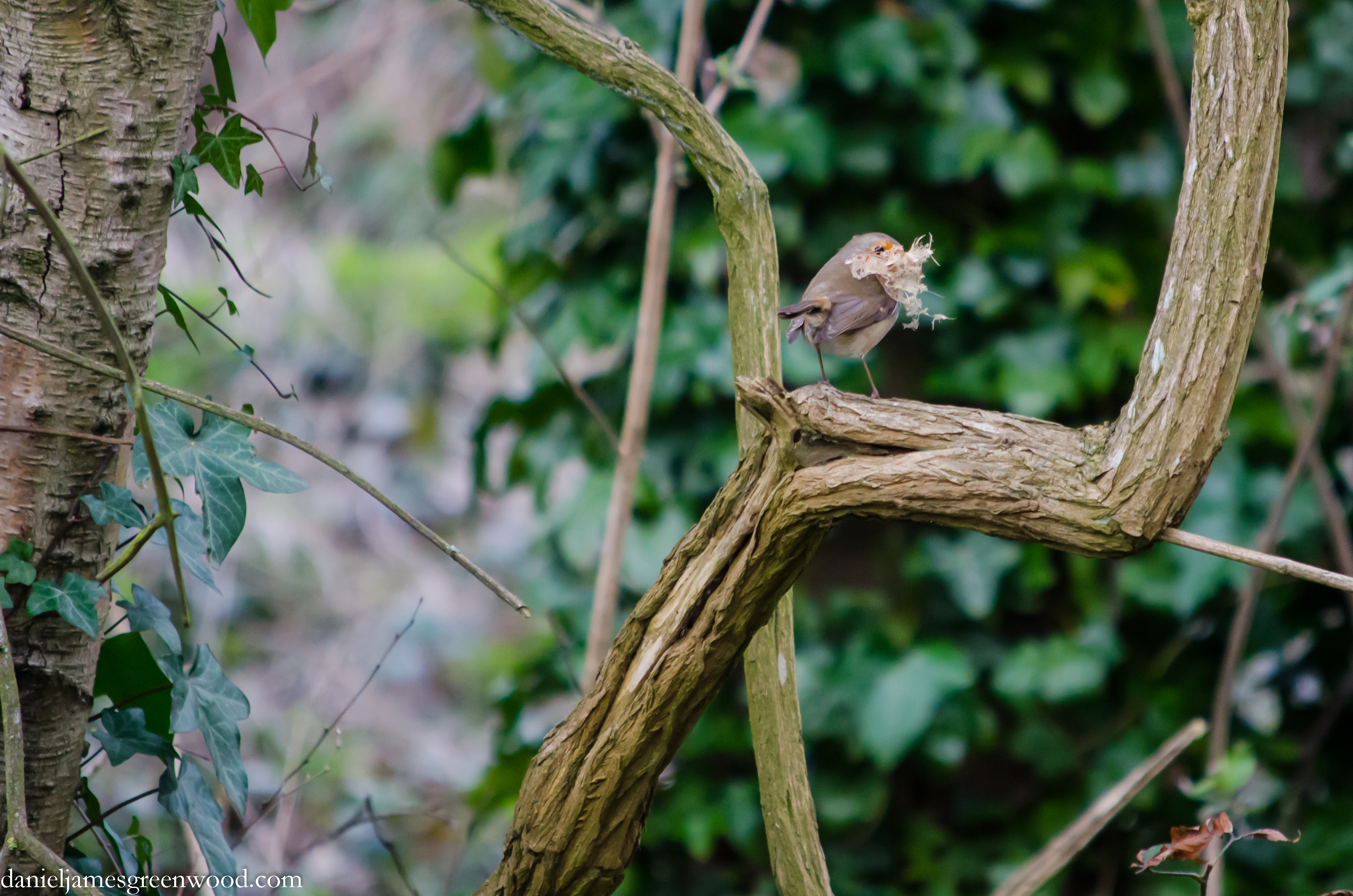 Crystal Palace Park, London
Herring gull

Dublin Port, Ireland
Essay: Why do people hate ivy?

I remember when I first became interested in woodland. Through my lack of knowledge and understanding I thought ivy was a tree-killing force that scaled a trunk like a cancer and had no other purpose. I looked at the fat stalks of ivy growing on a poplar in a nearby park and thought it might be an idea to cut them. In my local area there are people who go around doing just that.
The fact is that ivy is fantastic for wildlife. When ivy grows up the front of a house and sparrows are nearby they’ll use it. Blackcaps, one of my favourite songbirds, nest in it. Entire bat colonies can roost in it. Hoverflies, bees, butterflies, they all use it for different means, be it a leaf to perch on or flowers to drink nectar from. Walking in Crystal Palace Park recently I was passed by a man remarking to his friend about a line of trees with ivy growing up them:
‘Look at those trees,’ he said, his companion turning to look. ‘The ivy grows up them and just kills them off. I’m thinking of writing a letter.’
This is one of the biggest misunderstandings about ivy – it is not merely some dark demon from a tree-hating underworld, it flowers, too. In fact, the main reason it is even anywhere near a tree is because a songbird or woodpigeon has sat in the tree and evacuated its seed. It produces food eaten by a good number of birds and attracts insects that birds can feed to their babies. Beautiful and exciting birds like firecrests target it for food and shelter in winter when they pass through parts of the British Isles.
A tree brought down in a wood will give life to wildflowers and wake some that have lain dormant in the soil
Ivy does add extra weight to a tree and, in some cases, can weigh a tree down making it more liable to windblow during a storm. But the issue isn’t with the ivy it’s with us, Homo sapiens. In woodlands, it is completely natural for a tree to fall down, it’s good. The new light that will hit the woodland floor will improve the structural diversity, particularly in British woodlands that, since the Second World War, have gone largely unmanaged and have become overgrown as our economy has grown to rely more and more on imported materials.
A tree brought down in a wood will give life to wildflowers and wake some that have lain dormant in the soil, unable to flower because of the previous tree’s leaf shade. In the street, however, a fallen tree could mean death, damages and lawsuits. For all our love of woodlands and forests, perhaps the sight of new woodland is something that kindles a deep fear inside us, as if the open land is being overtaken, changing at a pace and in a manner that we’re uncomfortable with. Personally I find woodland reclaiming old developments and ‘wastelands’ as something to feel good about. It tells me the world can function without our intervention and can recover. Nature can make even the most barren place into a leafy oasis given time.
The chap I overheard in Crystal Palace later remarked on a c.200-year-old horse chestnut standing tall and true, though surrounded by ground dwelling ivy. If he had seen a horse chestnut wounded by blight, a disease spreading through global trade, might he have turned his ire on Environment Minister Owen Paterson for not tightening restrictions on imports? In the case of the healthy, happy horse chestnut, does it not suggest that what we love (or this man at least) is the splendour of individual trees, their maturity, their completeness. The common understanding of nature’s life cycle is a single sapling to a mature tree, without any notion of the stuff that might happen in between, the decay and lost limbs, all part of the picture. After a recent trip to the decidedly untidy West of Ireland, I read this quote from Oliver Cromwell on the state of the Irish landscape in Neil Hegarty’s The Story of Ireland:
‘For to what purpose was it to plow or sow, where there was little or no Prospect of reaping? – To improve where the Tenant had no Property? This universal Neglect of Husbandry covered the Face of the Kingdoms with thickets of Woods and Briars; and with those Vast extended Boggs, which are not natural but only the Excrescences and Scabs of the Body, occasioned by Uncleanliness and Sloth.’ (Page 136).
Cromwell couldn’t have been more wrong, though his rhetoric is plainly political. Those Irish ‘Boggs’ are one of the planet’s many ways of storing carbon dioxide emitted by the felling of woodlands (which thanks to the English has occurred in Scotland and Ireland through centuries of invasion and land grab) and is something we as a species are scrambling to mimic. Today we look at those bogs with a greater understanding, if not thanks. In County Mayo some are being turned into reserves, home to merlin, otter and grouse. But the main thing here has been capitalised by Cromwell’s old English: Neglect.
People get angry and feel they’re being forgotten when their grass isn’t cut by the council, when the neighbour hasn’t trimmed the hedge on their side, when the ivy suffocating those trees hasn’t been cut. Often these are measures to boost bee numbers and reinstate lost habitat for birds and bats. In England, if we are to help bees, birds and butterflies, we need to address our obsession with tidiness. In the natural world it does not equal good hygiene or ‘Cleanliness’, an untidy garden means more birds, more bees and more butterflies.
In Cromwell’s case it was the language of war, a debasing of another country and culture, rather than a comment on wildlife gardening. I don’t think it’s far off, mind you. If we are to overcome our uneasiness about ivy and trees we’ll need to loosen our grip, leave the mower in the shed one year and look at the benefits of the plant, the good it does for wildlife in these most ecologically trying of times. I like to think my original, misguided concern for trees came from a good place and has developed into something more reasonable having taken time to consider the bigger picture of the natural world.
Wild goats

Ox Mountains, Co. Mayo, Ireland
Horse on the moor
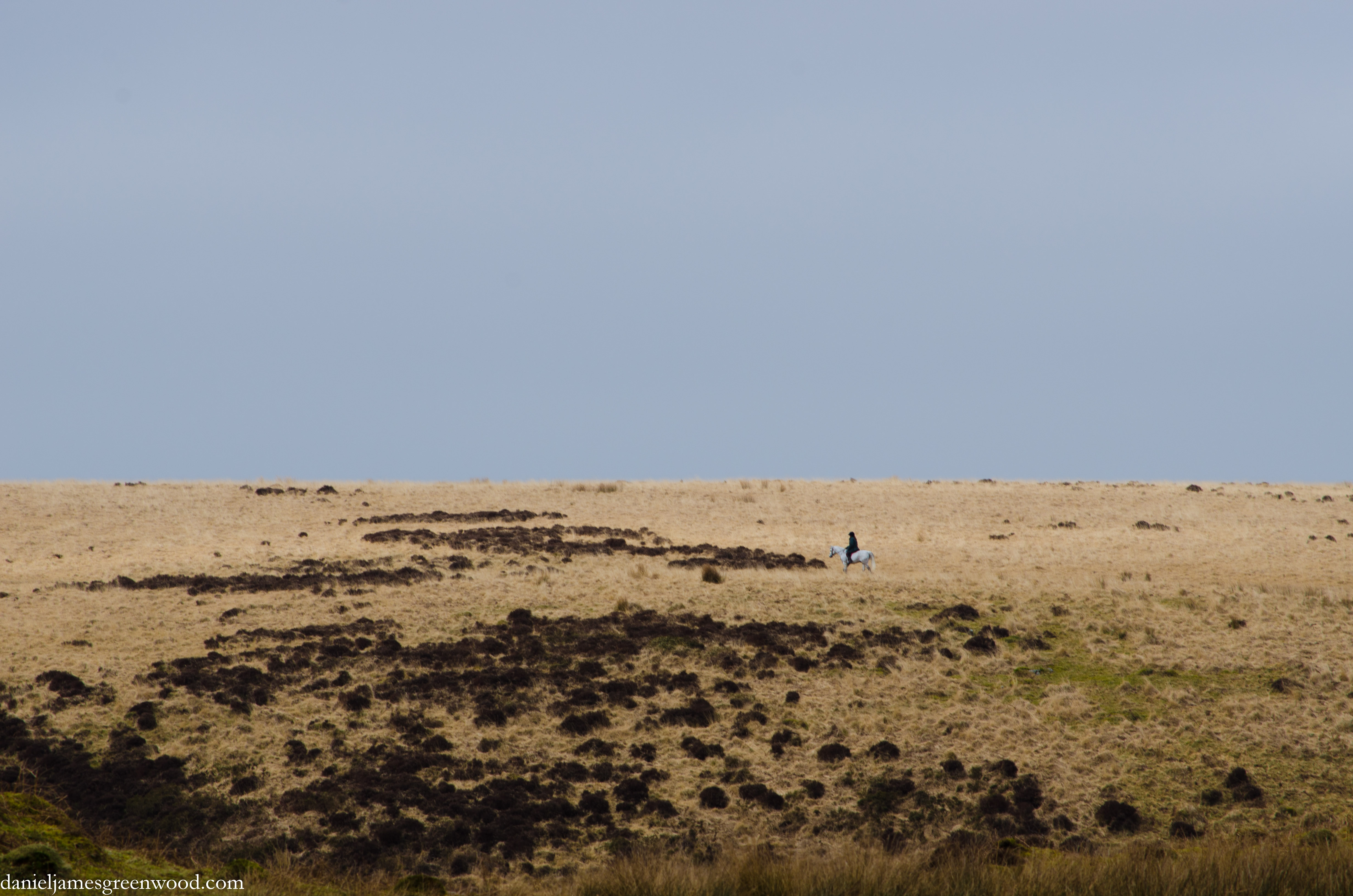
Exmoor National Park
© Daniel James Greenwood 2013
Crystal Palace lichens
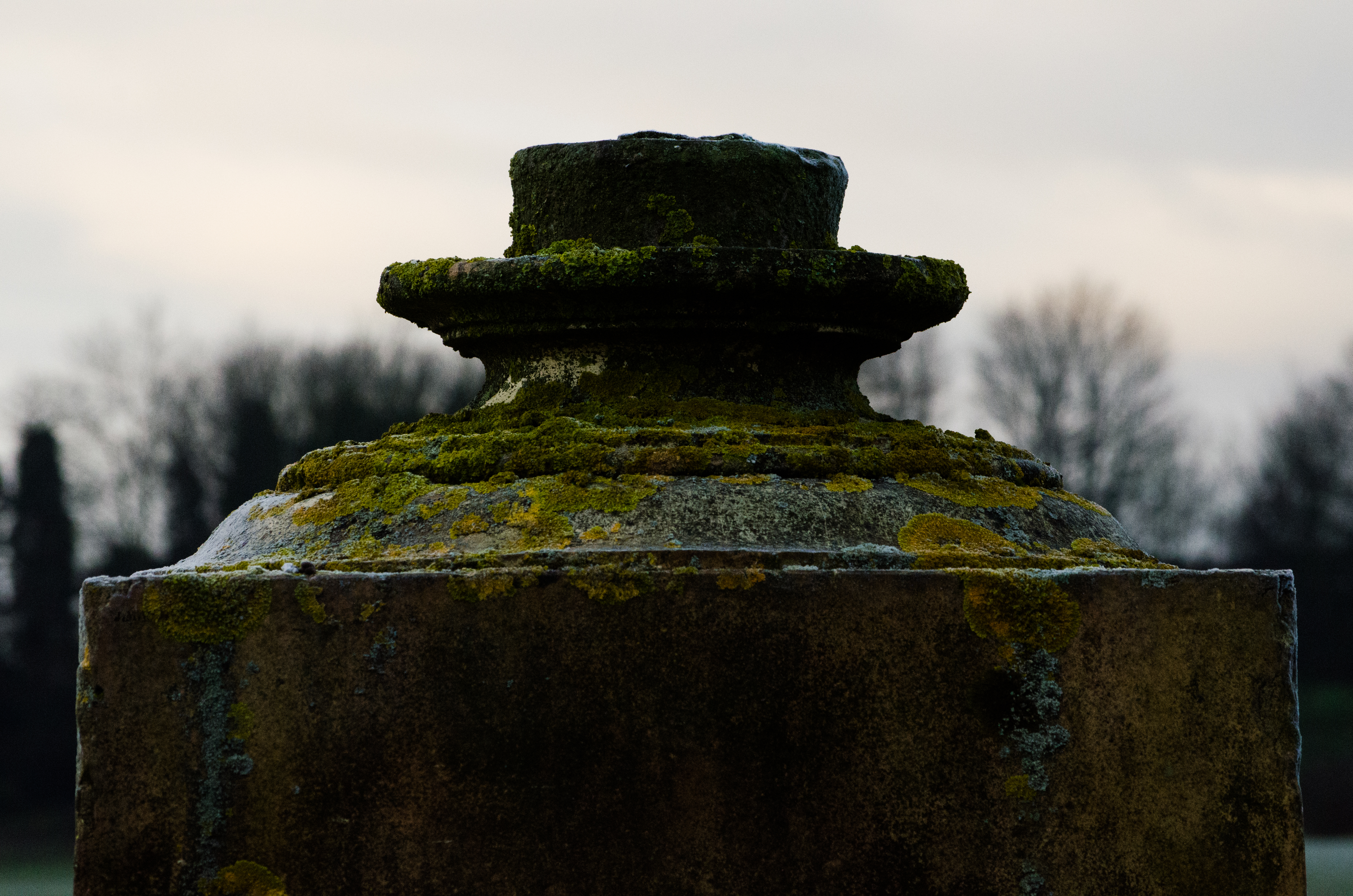
© Daniel James Greenwood 2013
The mysteries of the night wood remain

Last year I was commissioned to write this piece about the four seasons in Sydenham Hill Wood. Woodlands are beautiful, yes, but the lives of their inhabitants are not as gentle or pleasant as we might like to think. Here are my four dispatches.
Spring
Along the trackbed of the disused railway wild garlic grows. It’s a remnant of the wood’s ancient lineage, its deep green is welcome refreshment on a grey spring afternoon such as this. Every so often you find other indicators of the wood’s age. Wood anemone are growing in isolated clumps and English bluebells, too, some hybridising with the Spanish garden variety. The hornbeam standing along the track is another pointer to the old age of Sydenham Hill Wood.
Above our heads is another species sure to have been breeding here for some time. There are three tawny owl chicks sitting in the top of a large ash tree not yet in leaf, and through the bare branches we have a clear view of them. They snuggle into their plump, downy coat of feathers, calling to their parents, with rasping voices you might not expect them to make.
The wood’s bird community is watching, not least because the tawny owls are the top predator in the wood and one of the chicks’ parents is nearby trying to make a kill. Last week we found a crow’s head by the pond and it now appears likely that the adult tawny that spawned the trio above is the culprit. The birds know it too: there is an anxious din of woodland birds – woodpecker, crow, robin, great tit, blue tit, ring-necked parakeet, nuthatch – as the rufous adult tawny emerges from its hiding place.
The chicks are further along than expected, they move one at a time over our heads and closer to mum or dad, their spread of primary wing feathers giving them a tactile appearance, each like a finger. The parakeets are the most successful in bothering the young owls as they shriek and dive around them, the vibrancy of these exotically coloured birds muted by the task, on a dour afternoon in the spring wood.
Summer
The leaves of trees under torchlight are sticky with honeydew, a little like our faces, damp with sweat and bothered by mosquitoes. I swat them away. The wood is perspiring, wet with aphids. The air is thick with the funk of wild garlic that has flowered and gone. Stars are appearing in the ocean of night sky. A dot of light moves across the expanse. Is it a satellite?
A male tawny owl calls from acres away. We blow through a hazel whistle carved in a fashion to mimic the owl, and the bird itself responds in kind, edging closer and closer to us after each play of the whistle, its voice becoming clearer: What’s the time Mr. Owl? Now there is no foliage between us and anxiety stirs. We decide it’s better to stop in case the tawny thinks we’re another male. They are renowned for their aggression in protecting territory.
With the wood under the spell of darkness, the industrial world is reduced to a dreamy wash. Beyond the lining of trees could be an endless wildwood or an open pasture – the imagination runs free in the absence of engines and electric light. Some centuries ago the old woodland was felled and turned into farmland that skylarks, corn bunting, lapwing, turtle dove and cuckoo would have colonised. These birds are now absent from land that is used for cricket, golf and rugby.
From the glade’s sleeping bed of rosebay willowherb the great ghost of a hawkmoth ascends. I swoop the child’s pond-dipping net I am holding towards the monstrous insect, bringing the net and my knees to the ground. I carefully peel it away from the grass, revealing only shadows. The mysteries of the night wood remain.
Autumn
We’re sitting around the moth trap again tonight. A large flock of crows are returning to a roost in the direction of Dulwich Park. There’s something about vast movements of crows, it gives the sense of an ending. In old times this would have been the signal to down tools at the close of a day labouring, ‘when the crow flies’, as they used to say.
The insect numbers have visibly dropped since summer but the pipistrelle bat hunting just above our heads shows there must be enough for them to eat. The twilight is metallic blue, stars are lanterns in the sky untouched by trees.
We’re surrounded by oak woodland, with smatterings of birch, ash, willow and hornbeam. We can only hope the darkening wood conjures something beautiful for us to behold. The leaves around us are soon to fall and even in this fading light you can sense the change, nature exhausted after the sex of spring and summer’s heat. A hobby flies the same path as the bat, catching a moth in midair.
Night falls. Nocturnal mammals begin their movement through the leaf litter, their sound much bigger than they actually are. A moth has been drawn to the bulb of our moth trap and we retrieve it in a clear plastic pot. It’s medium-sized, purple and mustard in colour. It’s the barred-sallow. This moth has evolved to match the leaves of autumn, but it’s early, many of the trees are still verdant green. We release the insect and it disappears into the dark.
Winter
A slender pathway cuts through the ground layer of ivy, most likely to have been forged by a train of foxes. A large ash has been pulled down by the wind, the underside of the ivy leaves wrapped around it are a fresh colour, like the flesh of a lime fruit. To the side a den has been made with string tied to the rotting logs that rest against a tree in a tepee form. Sometimes people spend a night in the wood and so the sign of a tent or den surrounded by food packaging and drinks bottles is not unusual. There isn’t much litter to be found tonight, other than things the ivy has subsumed, bottles or cans taken in by the soil or blown over from the road. Spiders make a home for themselves in empty bottles and the woodlouse is a common inhabitant of an old shoe. Now the leaves of premature bluebells peek through the earth and we take care not to trample.
We come upon a clearing around a large yew tree, the soil cleared of ivy and plant life by the acidity and shading of the tree’s needles. The trunk is rippled and worn like an old doll’s limb. It’s one of a line of yews that would have been a hedge in the grand Victorian garden that was once here. The villas were built in the 1800s, but too grandiose to last, they were abandoned during the Second World War and, deemed unsafe, were eventually bulldozed into the earth. The ground dips to reveal the whitish bricks of a wall and a trail of broken glass. Behind us is a group of silver birch trees, quarantined amidst layers of ivy and the yew. These birch look like they’re waiting for something.
The other side of the wall shows a support structure for the terrace of the old Victorian villa, where the slow life of the woodland has been allowed to resume. A blackbird calls in the canopy and a great tit sings its winter song down in the woodland glade. The sun is setting low through the slope of trees. It’s time to go home.
Crystal Palace Park

© Daniel James Greenwood 2013
Blue tit


