
for Alice in Peckham
Writing, photography and more by Daniel Greenwood
for Alice in Peckham



It’s late afternoon and the sun begins its descent toward Dartford. In the east the bridge is reflected in the shimmering Thames. Rainham Marshes is behind us, beyond the large concrete seawall and iron fencing, protecting the reserve from dogs, people and vehicles, protecting skylarks and lapwings, birds that breed on the ground. Gulls pass over from the marshes and across the Thames to the south. A deceit of lapwings exits, too, their flappy black wings belie their compact shape when grounded. They return to Rainham a few minutes later. Evidently this is not an exodus. Teal are swimming on the Thames, their colours draining as the sun retires behind them. We inspect the shoreline, its thin marshland and garbage. The ducks want to feed here, but what’s to be eaten? The tide bubbles audibly against concrete, an armchair rests at a tilt in the marsh, half against the slanting ground and half in the slurry. The chair is stained where it’s become soaked by liquids other than water over the years. If you were to sit in it, you’d fall backwards, skull first. The dry land is tropical with all kinds of plastic: caps freed from their bottles, thin tubes like the insides of biros, thousands of bits of broken plastic, and a syringe. There are pieces of driftwood lying around, one chunk has been bleached by sun, sea and salt. It breaks under the slightest pressure, the yellow shape of woodworm hibernating in a crevice created inside. I wonder how far this piece has travelled.
The sun is setting further, the river taking on the image of a lagoon, still the teal are drifting. We walk back along the path in the direction of Purfleet, a small flock of pied wagtails circling us back and forth to Rainham. They are wary and so they come and go, at last settling on a patch of rushes and straggly vegetation covered by yet more rubbish. Small islands of sand and mosses remain amidst plastic, industrial sponge, a road crossing bollard and bottles galore, the pooling water has the metallic sheen of petrol. The eye’s obsession with trash distracts from the living, in this instance the stone-washed water pipit holding onto a stalk amidst the rushes. The wagtails patrol the sand in their cheerful manner, taking pops at one another on occasion. The water pipit is still, in contrast to its cousins. A woman in red approaches and the passerines are flushed from the islands and back over the seawall, the pipit going with them. She has a green lager tin in her hand and white earphones. She sits to watch the sun from the wall, kicking her legs. The birds return to their patch. The pipit lands at the water’s edge, joined by what looks like a second pipit. The much duskier bird lacks a white eye stripe, or supercilium, and is itself a different bird, a rock pipit. Like its cousin, the rock pipit wags its tail as it looks for something to eat.
The trains back to London arrive on the hour so we sit by the water and watch the final movements of the evening. On the path a woman pushes her grandchild in a buggy, remarking to us that Thurrock once had a population of forty-four. This, of course, was centuries ago. The pipits would have been in a similar spot then, likely feeding in water free of oil and sponge, but no doubt touched by different sort of human waste. Up ahead, a man rides a mini motorbike with his daughter in his lap, his look is sincere. They disappear between a gap in a dumpy little bush. On the grass dwarf mallow leaves await flowers and a pair of mistle thrush regard us with caution as they disappear into near darkness. The sun is a ball, inflating and draining into the south, v-formations of gulls sweep to the east, down a river now black and gold. Ducks and debris float freely towards Greenhithe and Grays, a slurry of pollution passing by, highlighted in the twilight.
A fashion shoot is taking place against the railings, a young woman with cropped hair and a purple dress stretches herself against the bars in a mocking vogue. As if from the river itself, as its inhabitants flee eastward, a curlew calls over and over again.


– Dorset, April 2011
The track was churned up by tractor wheels, giving the appearance of an industrial thoroughfare. The trees were mostly beech, with the odd oak or ash in places. They were not yet in leaf, but on the cusp. On the verges wild primrose had bloomed and swathes of wood anemone grew where light fed the woodland floor. Beyond the ride, greyish flowers were appearing from the thin green sleeves of bluebell leaves. In patches common dog-violets showed their petals and heart-shaped leaves. The wood anemones, bluebells, wild primrose and violets all indicated that the woodland had been here, in part, for over 400 years. In Dorset, only wood anemone is indicative of ancient woodland. Though wild primrose, common dog-violet and bluebells would qualify the wood as ancient in the South-East of England, here in the South-West it was not necessarily proof. But wood anemone signifies ancientness. Beech is the final stage of woodland, and so the wood appeared to me to be especially old. Wood anemone is a slow grower, it increases its range by no more than six-feet a century. The tractor’s movement through the wood may have benefitted the primroses, its wheels carrying their seeds to hedgerows in distant fields.
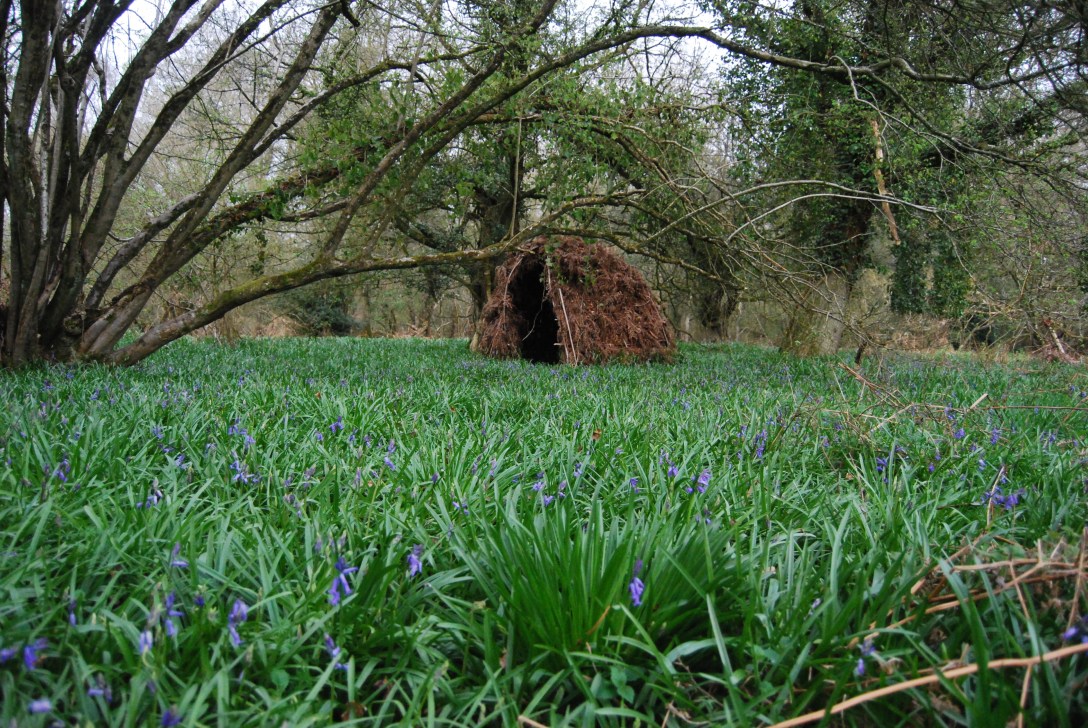
The track reached a plateau, swooping down and around a dense plantation of larch and other coniferous trees. No light reached the woodland floor, nothing could be seen beyond or between the trunks, merely needles and intense shade. No anemones, no violets. But this was a blip in the wood, the musty conifers likely planted for timber in a clearing came to an end. The spread of bluebells and beech returned. It was here that a big, moving, breathing blotch entered my peripheral vision. It was an animal, too tall to be a dog but that was my instinctive response. This flickering feeling is known as ‘fight-of-flight’, an adrenaline surge caused by the brain sensing that you are in danger. The brain then sends a command for adrenaline to be released into the bloodstream. Your senses are tunnelled. Leap the nearest fence or suffer the consequences. This natural pinch of adrenaline didn’t last. The fluffy white ‘tush’ of the animal engaged my senses. It was a roe deer. This doe got one whiff of a fragrant human and darted out of sight. The encounter was over within seconds. She had looked at me as she would once have witnessed her original predator, the wolf, a species long absent from Britain. In one of the trees a badger-viewing platform had been constructed. I climbed up and looked out across the dulled wood. The bluebells remained in their nearly state, spindly lichens hung from the bare branches of oaks like small, bluish wigs caught as their minor bearers escaped. In the gap of the sky untouched by twigs, the broad wingspan of a buzzard passed across. I clambered down and happened upon a neat den made from hazel poles and covered with brown ferns. To the side was an overgrown hazel coppice in need of cutting, with arms stretching out from the wide base. The ground underneath was coated with bluebells gradually lifting their heads to flower. Inside the den the leaves of the plant were flattened and brown hairs were scattered. A resting deer had stopped here.
There was a left-turning out of the wood marked by a rusted oil drum. The trees came to a sudden end and a field of grass exploded into a vista of deep, silent green. The roe deer stood in the tramlines leading over and down to an undulating expanse of the same. It watched me and continued sniffing around without much concern for a time, before galloping away as I took a few steps in its direction. I turned from the green field and gazed upon the woodland’s sudden end: a border of trees, a ditch and then the dirt of the farmland. A rabbit flinched in the low scrub by the ditch. The monoculture of the crop covered the scene for perhaps a mile over the hill and far away. In the wood, wildflowers of great variety grew, badgers slept through the day in their sett, birds of prey surveyed the glades and clearings while deer ambled along, sometimes stopping to rest in a man-made den. I turned my back to the farmland and sky and entered the wood once more.
 Unlocking Landscapes