A jay swoops through the trees in silence, landing on an oak branch, an acorn held in its bill. A friend and I have a running gag. Wherever we see a jay we send a text or voice recording to eachother:
โJay.โ
It originates from a trip to the White Carpathians mountains in Czechia one September. The bird we saw again and again was the jay. Always travelling around with or for acorns. As is now commonly known now, jays scatter-hoard thousands of acorns every year. They have helped pioneer Europeโs great oak woodlands along with squirrels and other smaller caching mammals.
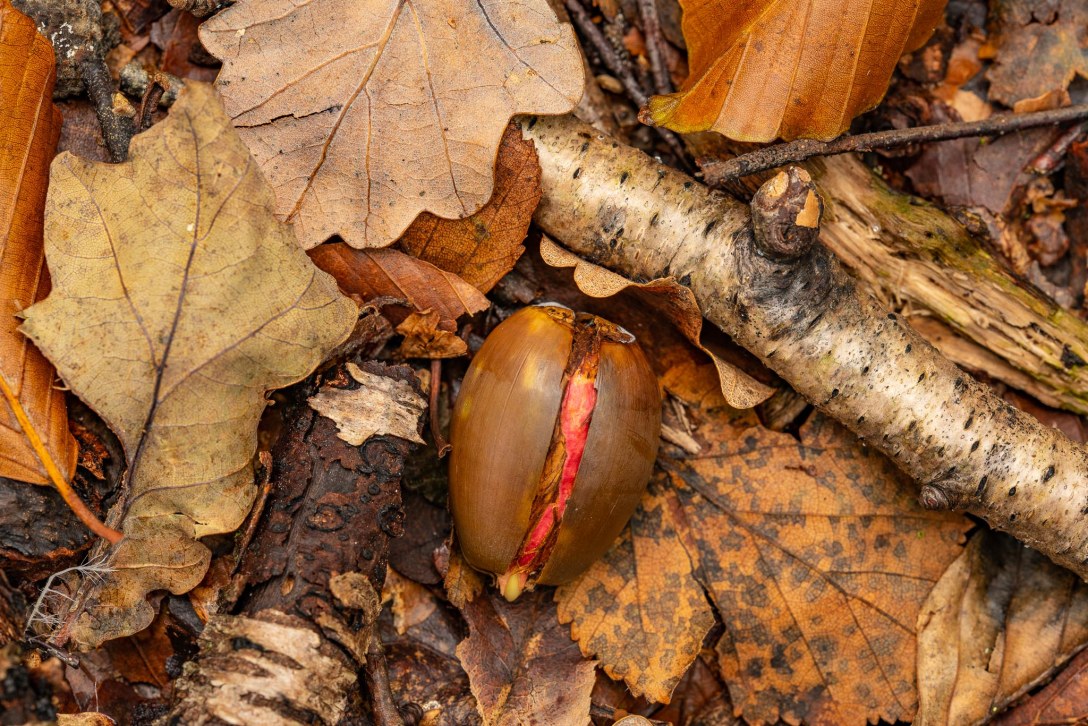
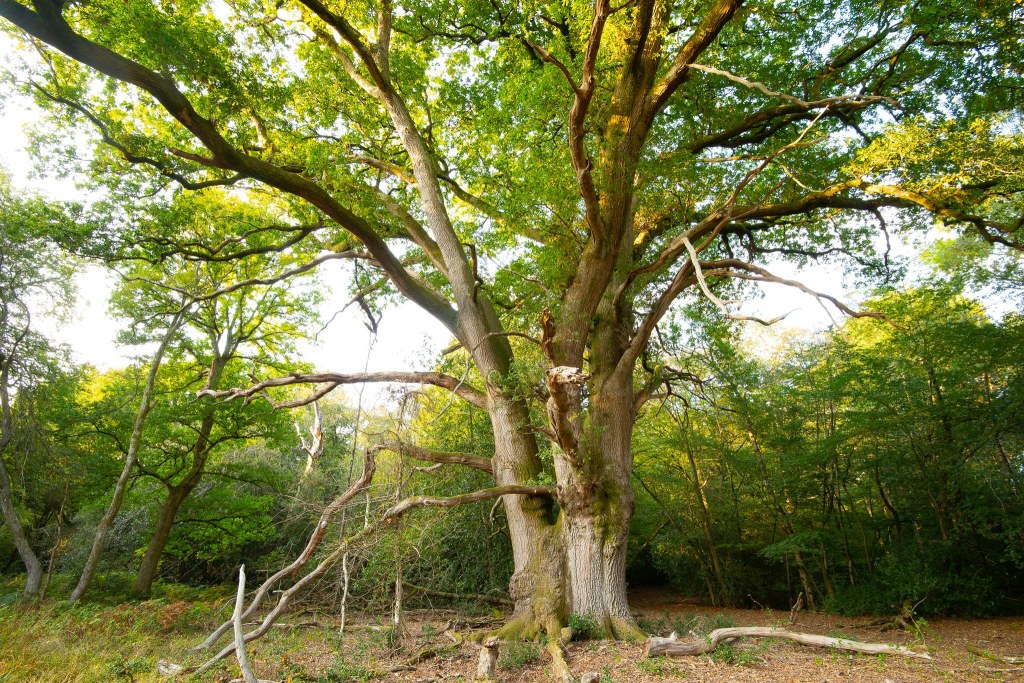
Here in the Sussex Weald I find a fallen acorn split down its centre. The tannin red catches my eye. The shell is cracked because the acorn is shooting, seeking soil to establish itself in.
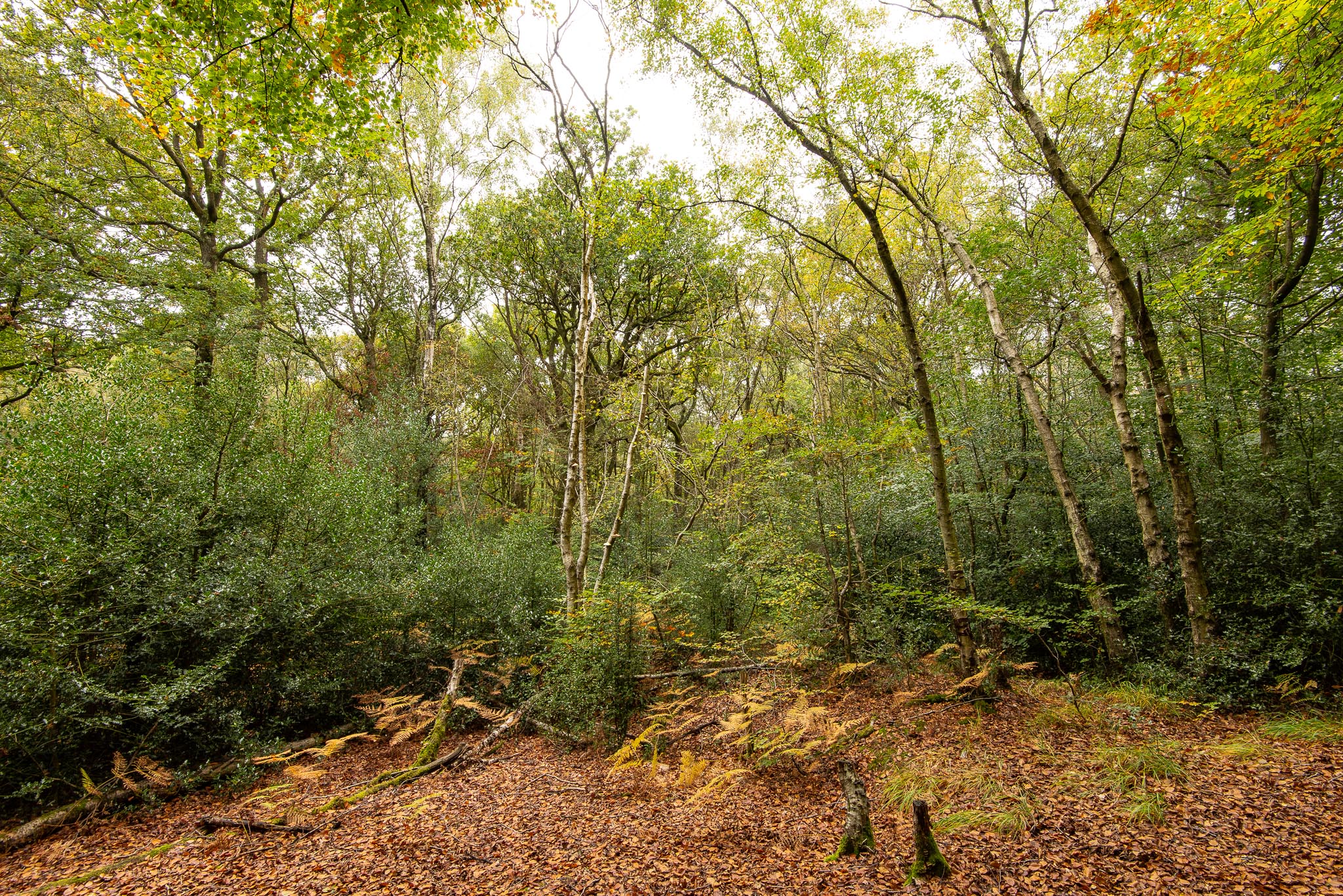
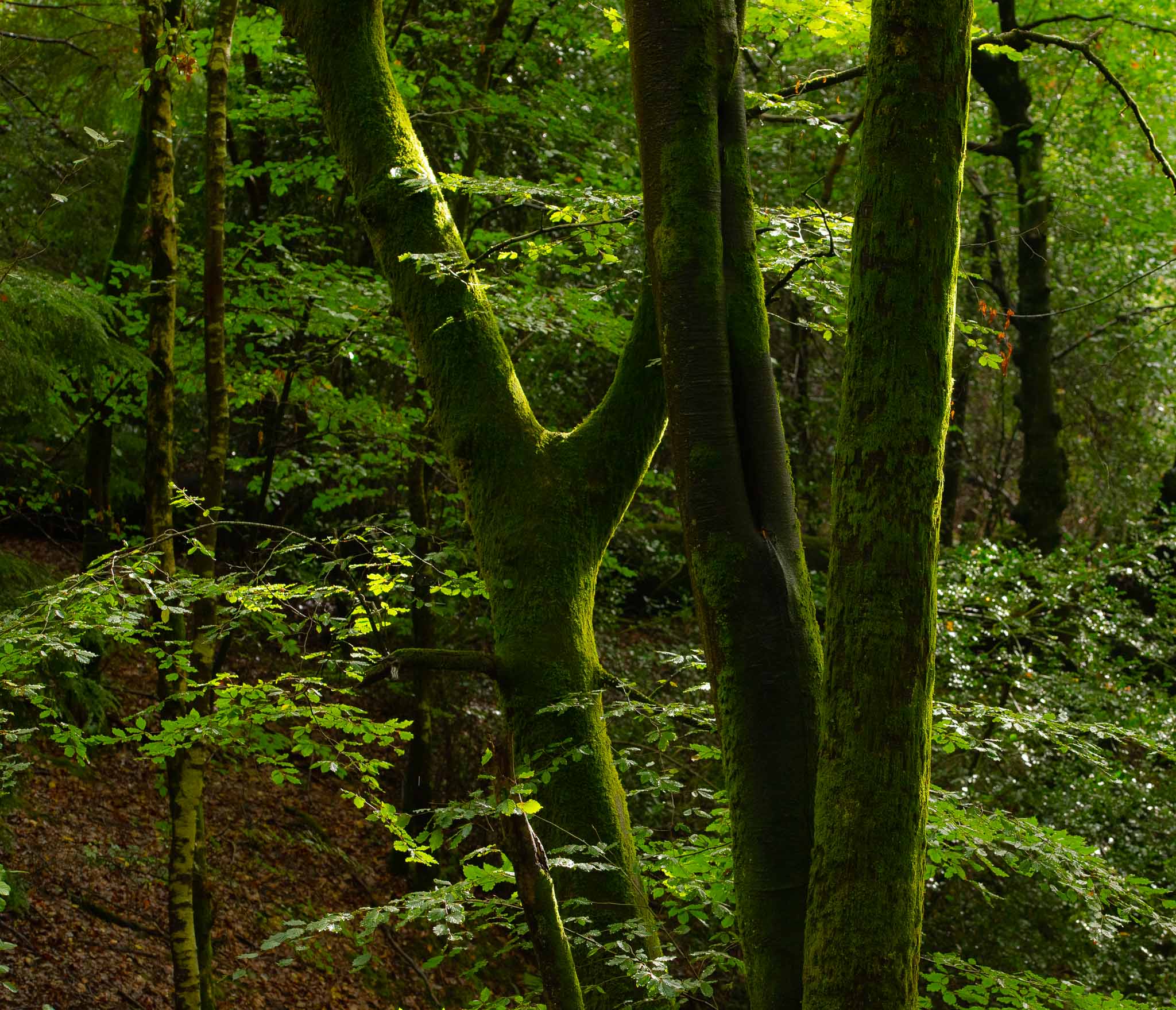
Iโm tracing an old ditch or woodbank looking for fungi to photograph. There is an almost comical halt to the woodland where the heathland and its diminishing ranks of pine begin and the broadleaf oaks end. Marking that edge is an astonishing beech tree. Let me explain.
Part of the treeโs root plate has lifted. The lignified roots have become hardened like a drystone wall. They have developed into a lattice-work of branches, their function forever entangled by their appearance above ground.
The tree must have fallen about fifty years ago. But it has not died. Where the old trunk hit the other bank of the ditch it has made a sharp turn towards the sky to grow anew. Trees can teach us that to fall is rarely to fail.
I want to start by saying thank you to everyone who stopped by last week to read my click-bait post about honey fungus. The post had nearly 200 views in one day, which is a huge amount for this blog and broke the single day record. My blog could have nearly twice the number of visitors as in 2019, probably due to the fact I have had more time to walk locally taking photos and to spend time writing these posts. Otherwise I would be stuck in a car driving to and from an office I probably didn’t even need to visit so often.
I think the fact more people are working from home could be key to protecting local green spaces going forward. In the UK ‘lockdown’, as the period of late-March and most of April and May 2020 are known, millions of people discovered their local green spaces. If people value something close to home, they will learn about it and in their stewardship, nurture and defend it. I discovered fungi close to home, and I’ve sought it closer and closer ever since.
This is black bulgar, a rather odd species that seems to explode in October on large fallen branches. The first time I saw this, it had appeared on the fallen limb of a massive oak tree which had come down that summer.
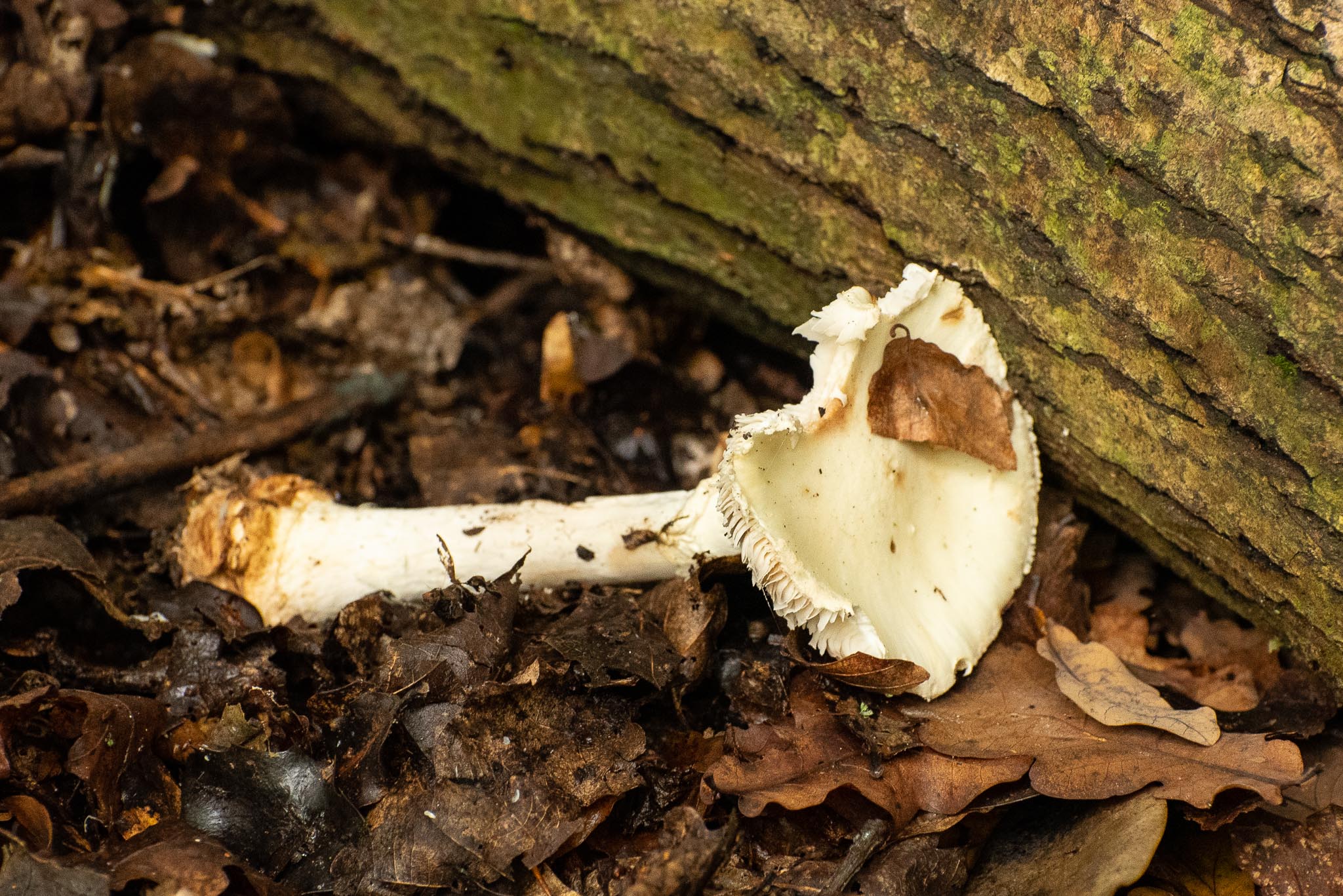
This rather unsightly mushroom did get my heart racing at first. I thought it was perhaps my first local deathcap, but really I think it’s the false deathcap. It has the classic Amanita bulb at the base. I think the colouring of the cap is wrong for deathcap and it has some of the brownish scales of the false deathcap, on the cap.
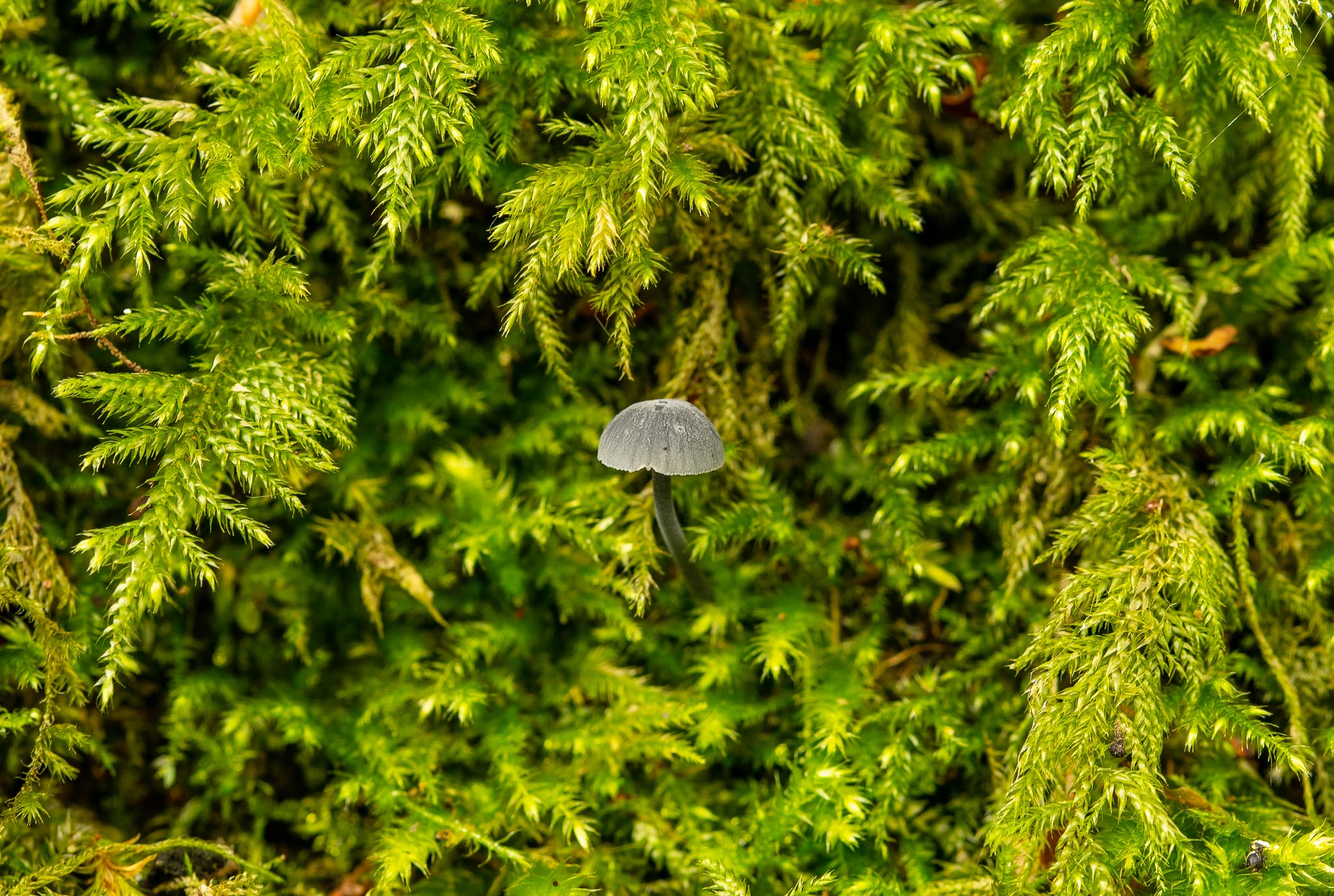
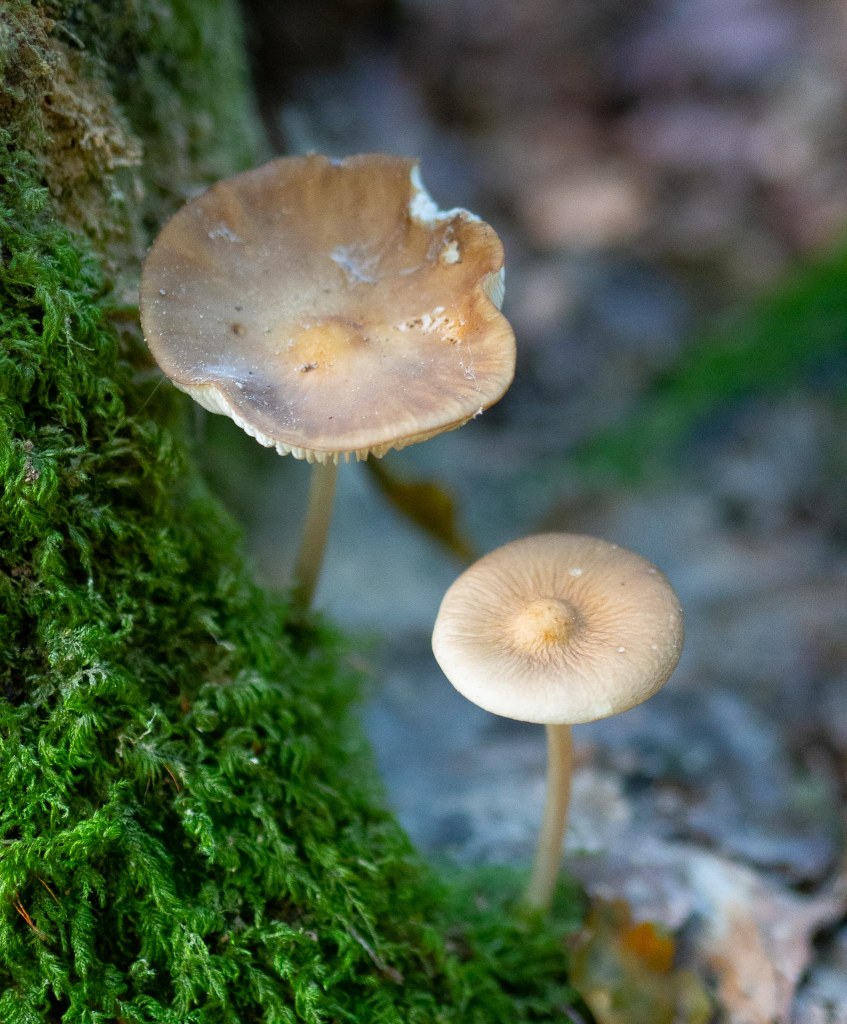
When the ground isn’t producing the shrooms needed at this time of year, I look to the moss growing on tree trunks. You can often find very small mushrooms there, perhaps bonnets (mycena) or galerinas. The moss holds on to the rainfall for longer, meaning fungi, some of which are parasitic on moss, can prosper. Let’s call them… mosshrooms!
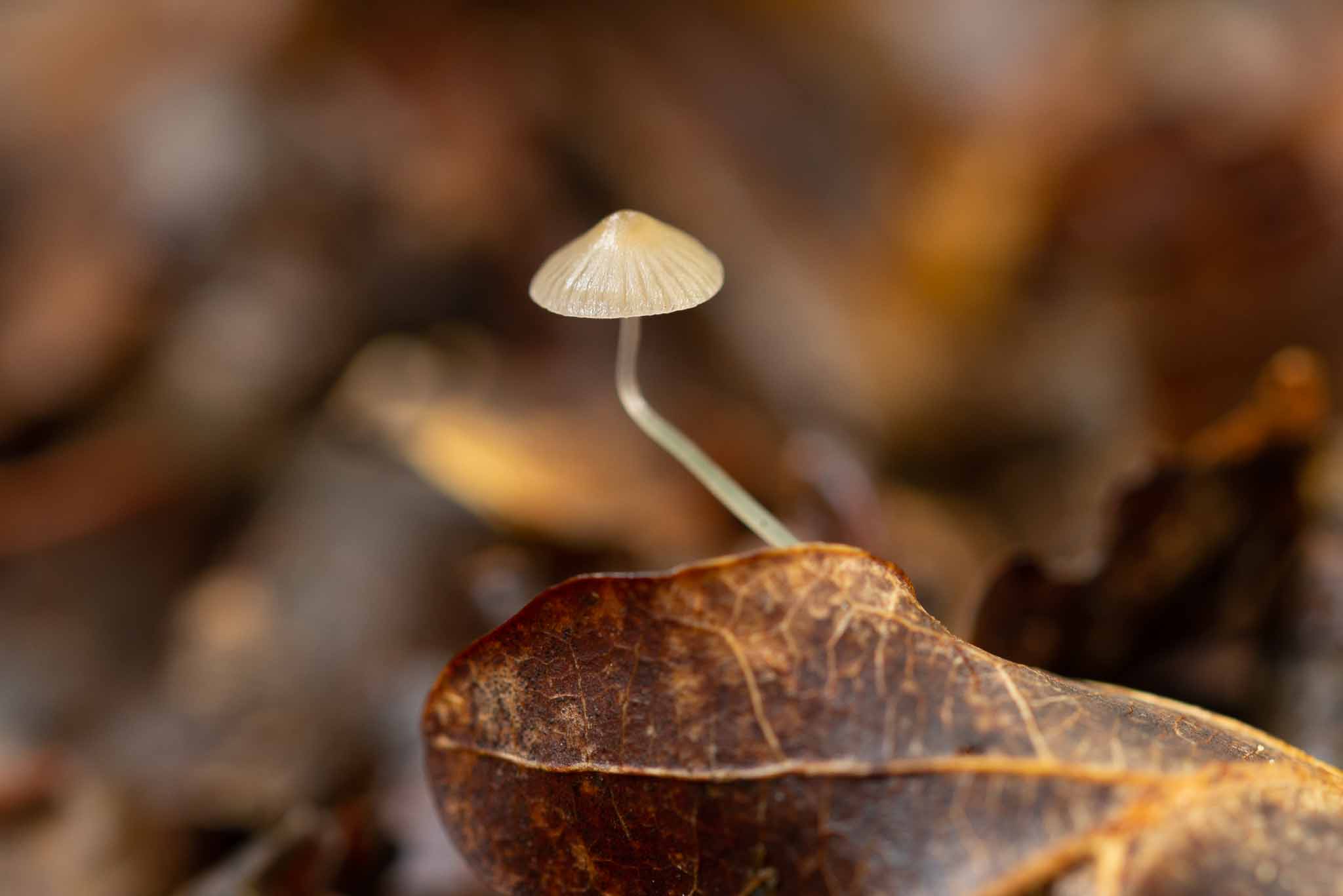
This lovely little mosshroom had actually snapped but I rotated the image for effect.
This beautiful little grey-blue mushroom epitomises the mossy shroomlet. As you can see from the moss fronds, it was very small indeed.
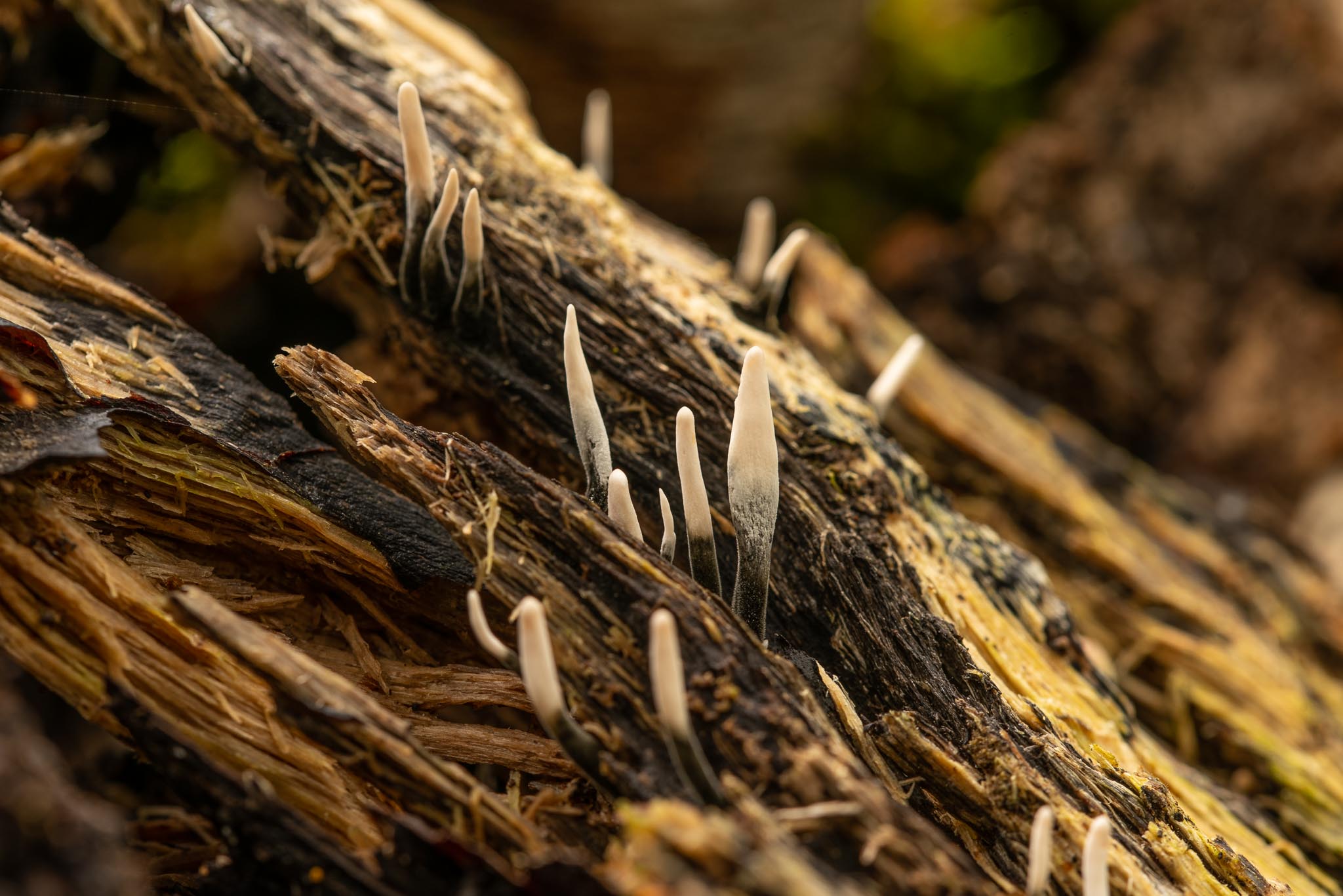
One of my first #FungiFriday blogs was about candlesnuff fungus. It looks quite neat at the stage seen above, when it is first beginning to fruit. In dry conditions you can flick the white ‘wick’ and the spores appear as smoke from a snuffed candle.
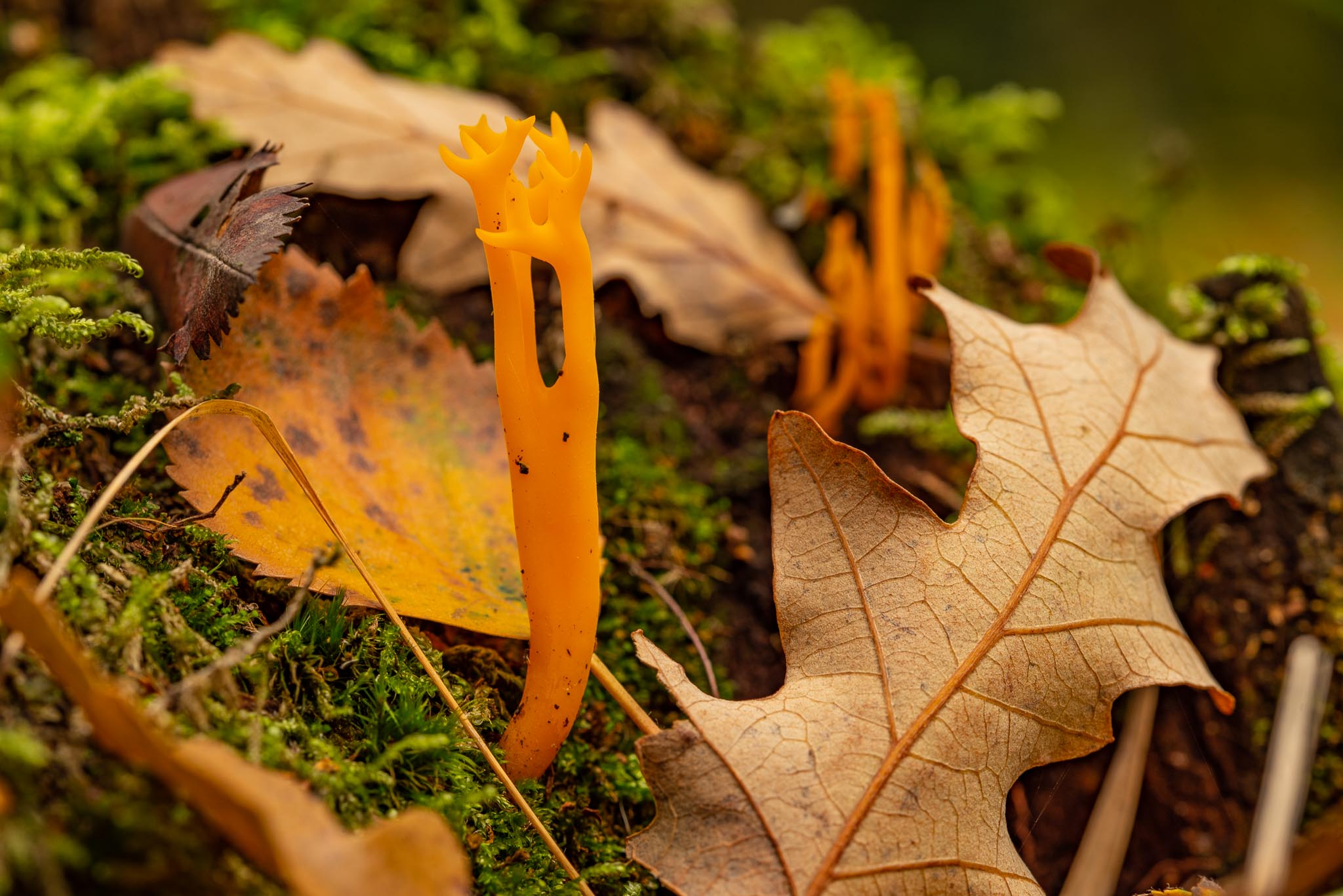
A similar type of fungus was this yellow staghorn, a common species. It was growing down on a mossed-over stump on the woodland floor. That oak leaf on the right (I think Turkey oak, Quercus cerris) is so beautiful.
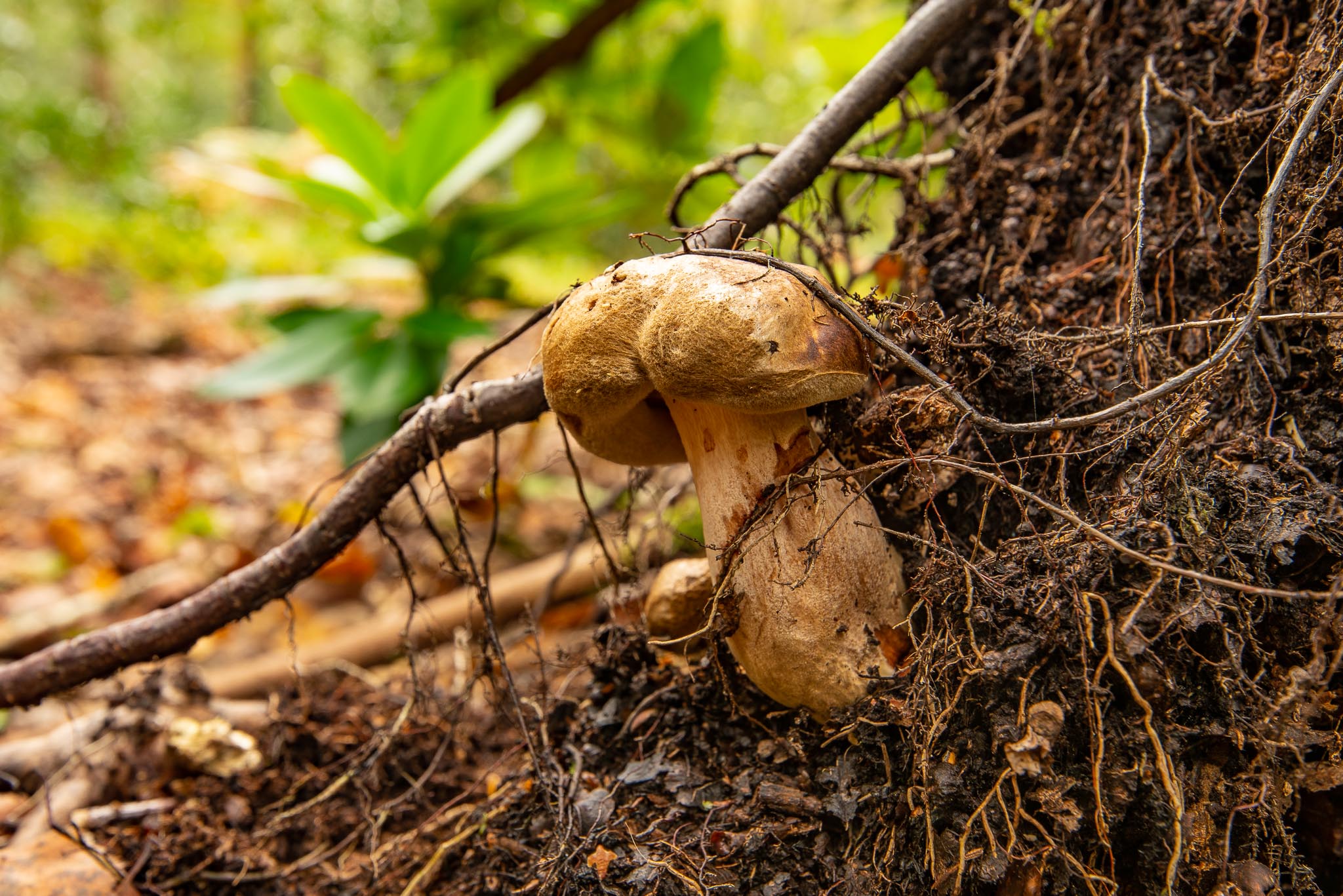
The most unusual find was in the raised rootplate of a rhododendron. From above they looked like potatoes. I am fairly confident this is a cep, Boletus edulis. It is, of course, also known as porcini and is one of the most sought after edible mushrooms. Foraging is not something I do commonly, so I left it there to grow on its merry way.
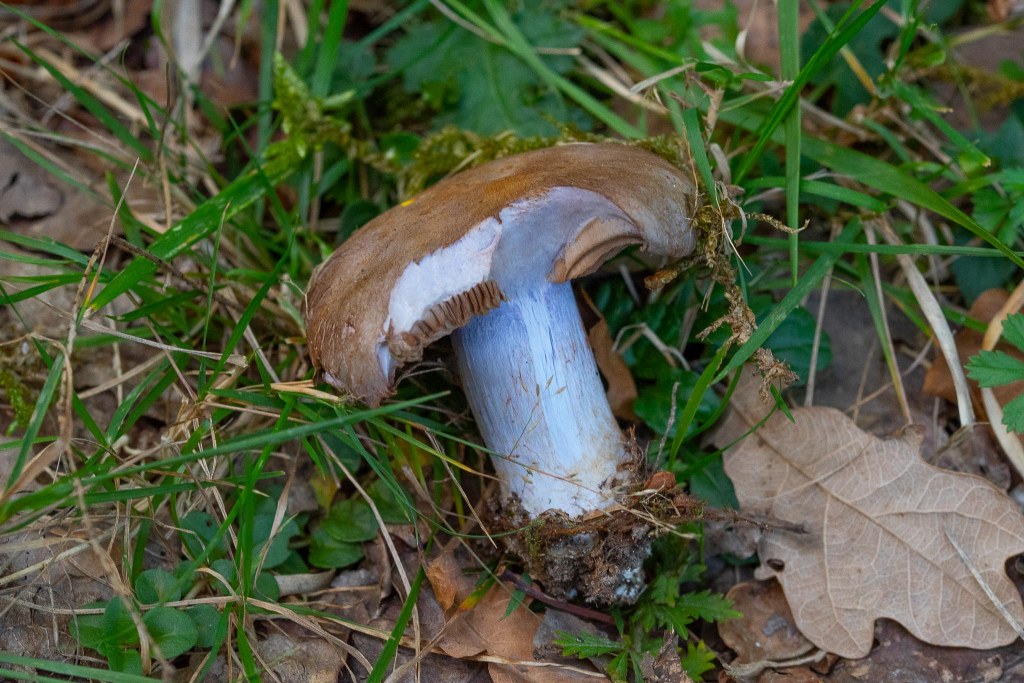
This scraggly crew are a common but no less beautiful mushroom – amethyst deceiver. They are easy to identify due to their colour and size and are a very common species in the UK. I do find that they are happier in older, more stable woodland. Aren’t we all?
I visited the Surrey Hills in the North Downs last week. Autumn was pushing through lots of tree species, but the oak and birch still held green. I was expecting to find more mushrooms, judging by the glut of shrooms splurged across social media in the past week.
This is the moody view from Box Hill, one of southern England’s best known beauty spots. Box Hill is part of the North Downs, a ridge of chalk that runs between Farnham in Surrey to the white (green) cliffs of Dover. The North Downs, like its southern sister, is covered by chalk grassland and woodland habitats, overlooking the clay soils of the Weald which are interlaced with sandy heathland.
I was expecting to see more mushrooms because of the recent rain and the time of year (autumn, FYI). There were a few fly agarics (check out this great thread on Twitter) but not much else. Perhaps London’s famous gangs of illegal foragers had got the train down and taken EVERYTHING.
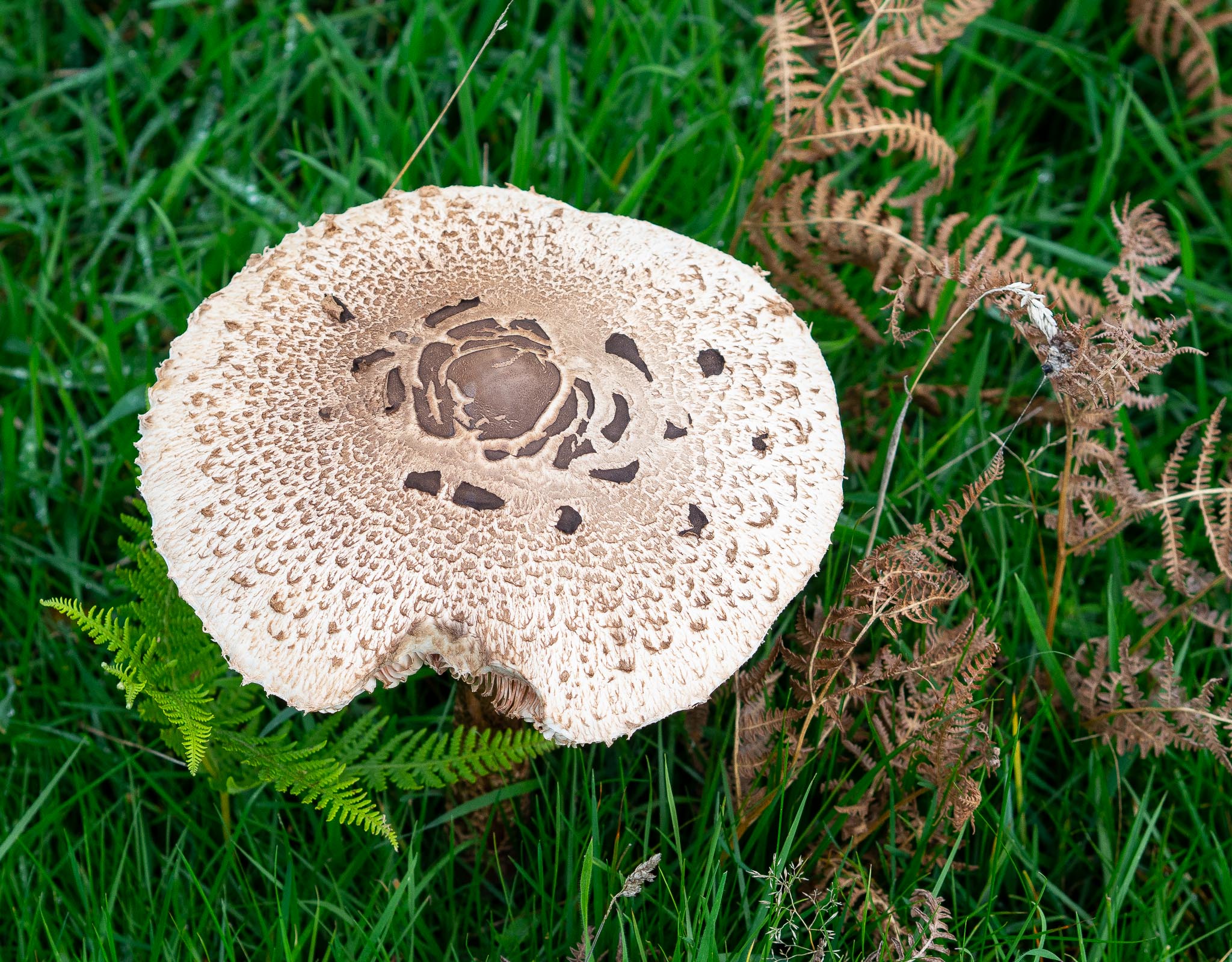
I don’t think the foraging fyrd had been by, because these parasols were getting ready in the grasslands. Also I don’t know if they even exist to be honest. How it started (above).
How it’s going.
The amanita family were present in the form of what is probably a false-deathcap. The biggest hoard was to be found in an area of woodland, as you might have guessed.
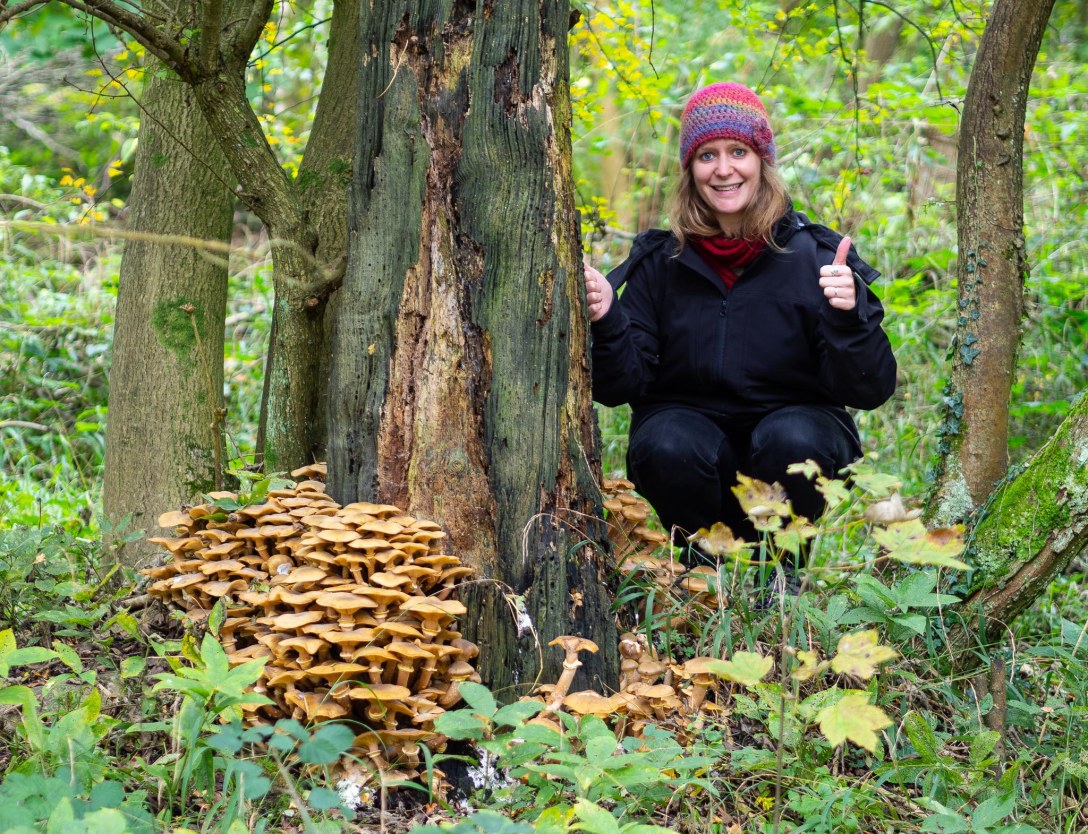
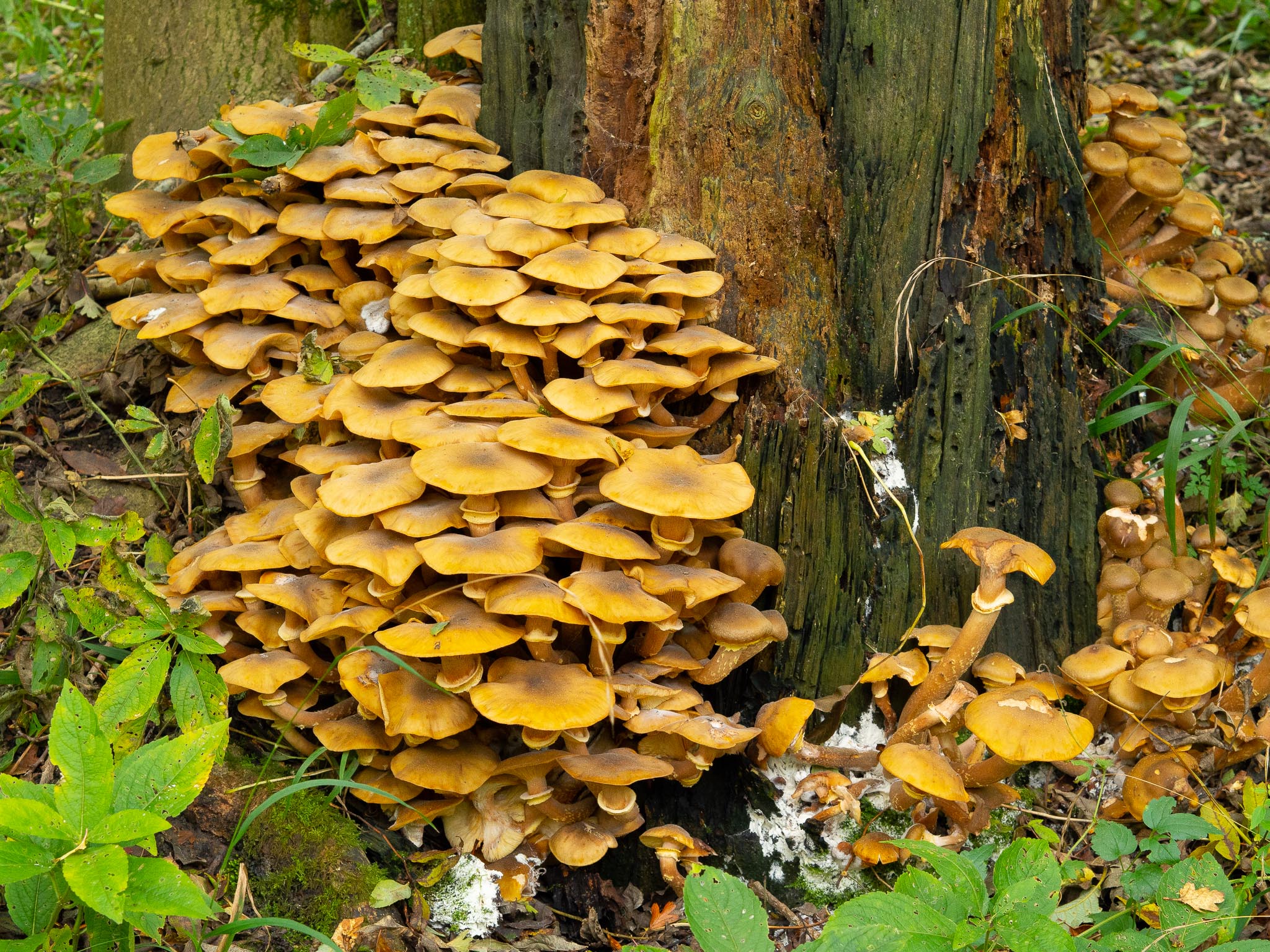
In June I wrote a post about honey fungus and how disliked it is. It’s not really bothered though because it’s grown to be the biggest living organism on/in Earth (I think). This batch of honey fungus is the biggest spread of fungi I, have, ever, seen. The mushrooms are popping up from a widely spread mycelium in the soil.
Looking at the individual mushrooms I think this is ringless honey fungus because it lacks a collar or ring on the stipe.
Then again, looking at another spread growing around an old stump, there do appear to be turtlenecks going on.
I am currently reading The Overstory by Richard Powers. I was given it as a birthday present (and funnily enough also passed a copy by Jess) mainly because it’s a novel about trees. It’s a complex, multi-protagonist story that comes together around the clearance of ancient old-growth woodlands in North America. One of the characters is a woodland ecologist who gives evidence in court as to why old-growth woodland should be protected from logging. It’s a brilliant scene, and it has a quote in it which really hit home with me:
“I sometimes wonder whether a tree’s real task on Earth isn’t to bulk itself up in preparation to lying dead on the forest floor for a long time.”
The amount of life found in the decaying tissue of a fallen tree that no longer grows outnumbers that found in living trees. Yet deadwood has been cleared from European temperate woodlands to such an extent (hi Forestry, I know, you’re changing) that many species dependent on this habitat are at risk of extinction.
Honey fungus is just one species that creates deadwood habitat for insects, spiders and other species which depend on it. These deadwood invertebrates are the most threatened species group in Europe. If you can do anything in the space you have, be it a private or a public space, please add some dead wood. It will make more difference than perhaps you realise.
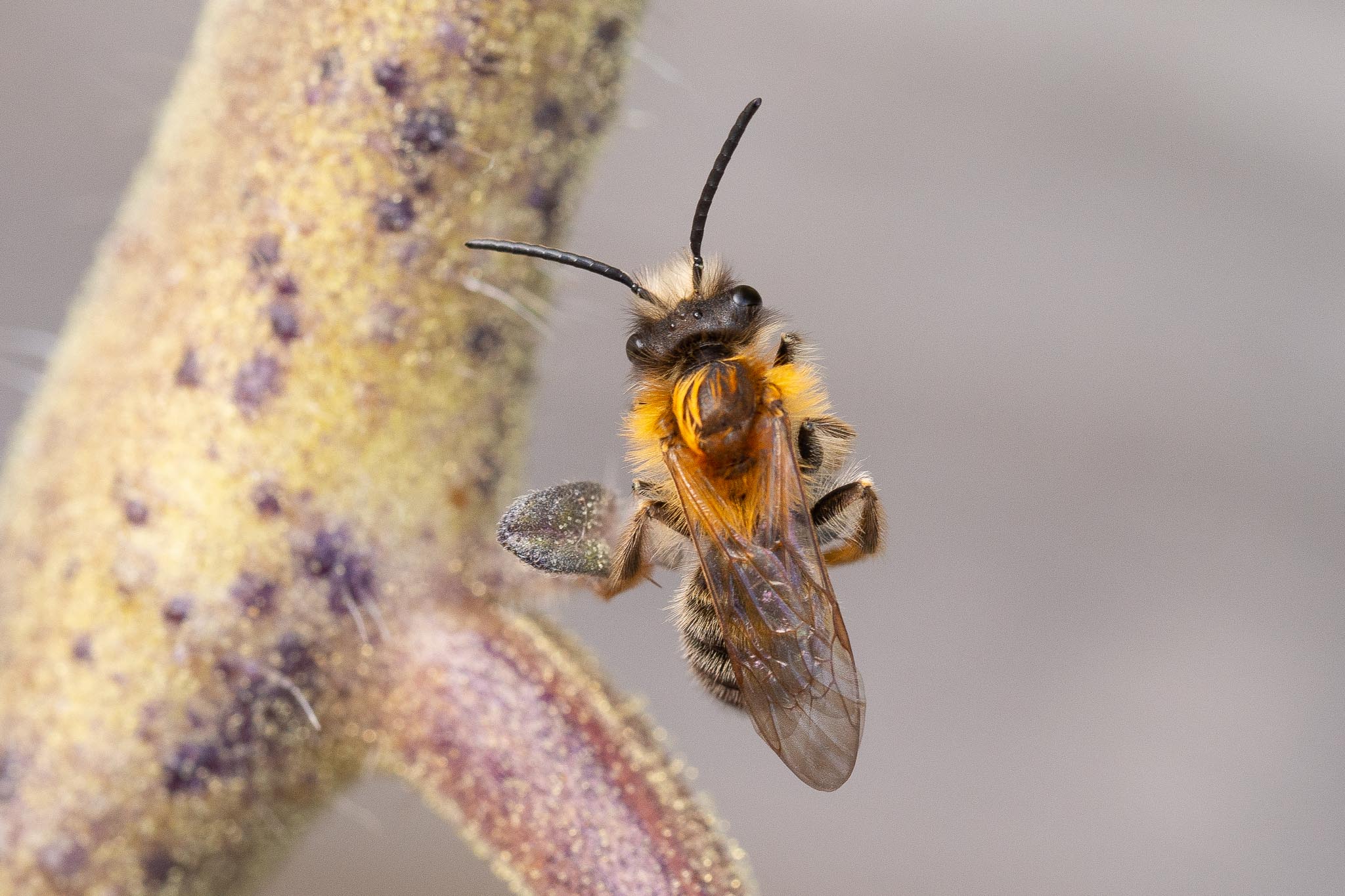
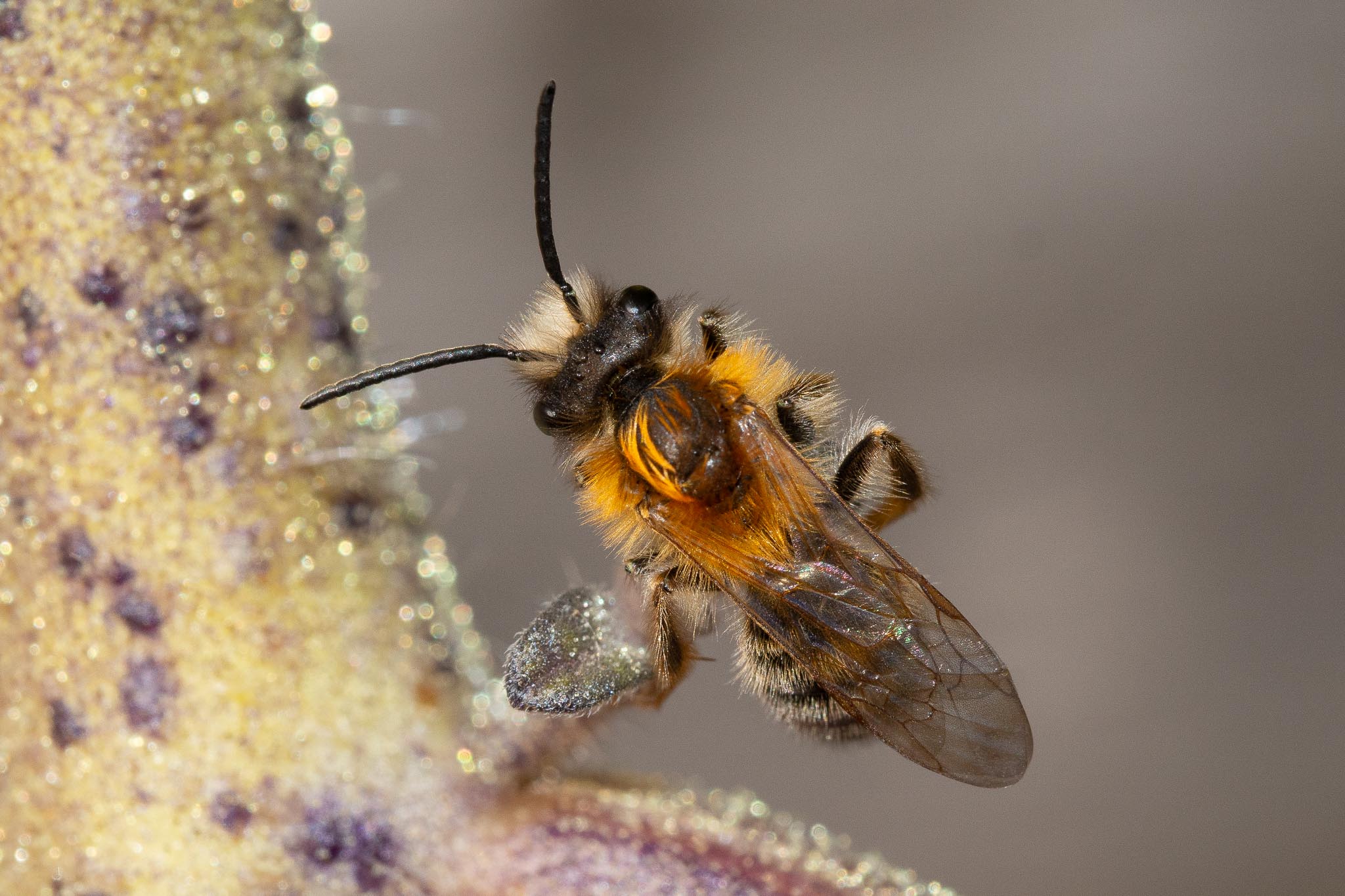
Naturally, last week I summed up this spring and summer of invertebrate life in my garden, thinking it was all over. I was sitting outside one lunchtime, enjoying the kind of sun that doesn’t burn my very pale skin for once. I had seen something flying around that didn’t quite look like a fly and was too small for a bumblebee.
I didn’t pay too much attention to it and went to check on my tomatoes. It was there that I noticed a small bee holding on to a short leaflet of one of the tomato plants. I was really surprised, it looked like a solitary bee. Almost all of their flight seasons have come to an end.
I have a couple of insect books but in October I can’t bring myself to leaf through them. But in this case I had to. I couldn’t work out what the species was. It didn’t really match most of the species, except for one group: the colletes. They have a common name of ‘plasterer bees’ and their most famous species is the ivy bee, which I haven’t ever encountered. The bee above was in Peckham in south-east London at a special wildlife garden managed by London Wildlife Trust. It’s feeding on tansy.
It was lovely to see this bee and for it to pose so obligingly. If you know what it is please let me know!
A couple of weeks ago I visited the New Forest and saw hedgehog mushrooms for the first time. There are several species of hedgehog mushroom in the UK, all being edible. Since then I’ve been doing my research to try and learn more about them. This video has been helpful:
In short, hedgehog mushrooms are difficult to confuse with anything else because they have spikes where gills or pores are usually found, under the mushroom’s cap. If you want to eat any wild mushroom you should be sure you have used several different forms of identification and are completely sure of what it is.
I was out for a short photography expedition (walk) at the weekend and I discovered some more hedgehog mushrooms. Their numbers were so healthy and the shrooms themselves were in such good condition, I couldn’t help pick a few for myself.
I used my penknife to cut the mushrooms at ground level. I then used the knife (as in the video) to remove the spikes.
This may help with spore dispersal and allow more hedgehog mushrooms to spread.
This is what they look like in the wild. The caps of these mushrooms were a bit mouldy.
I got the mushrooms home as quickly as possible. I didn’t have an air-proof container to put them in so time was of the essence. I cleared the rest of the spikes from them and washed them, scraping off any excess soil.
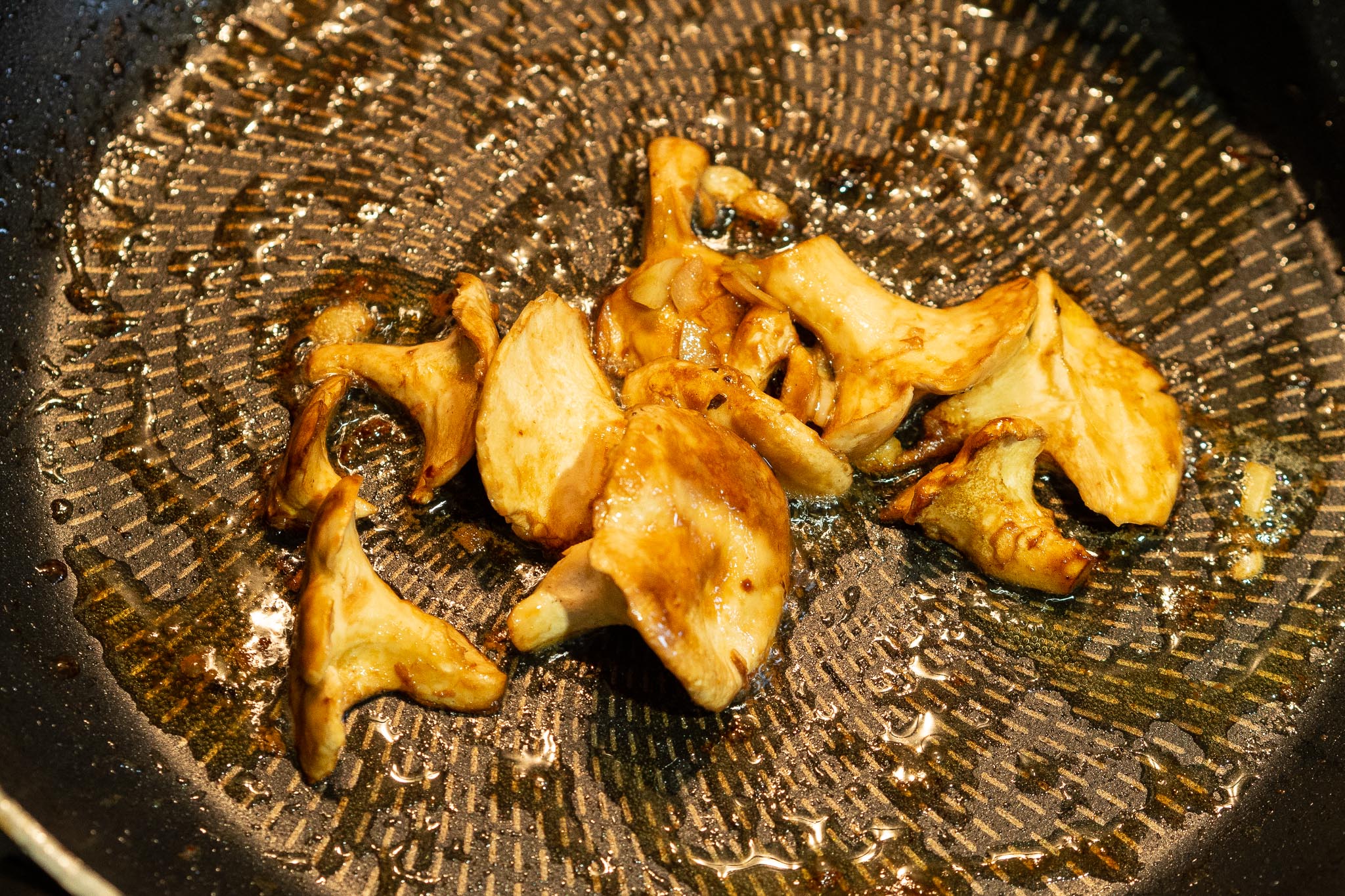
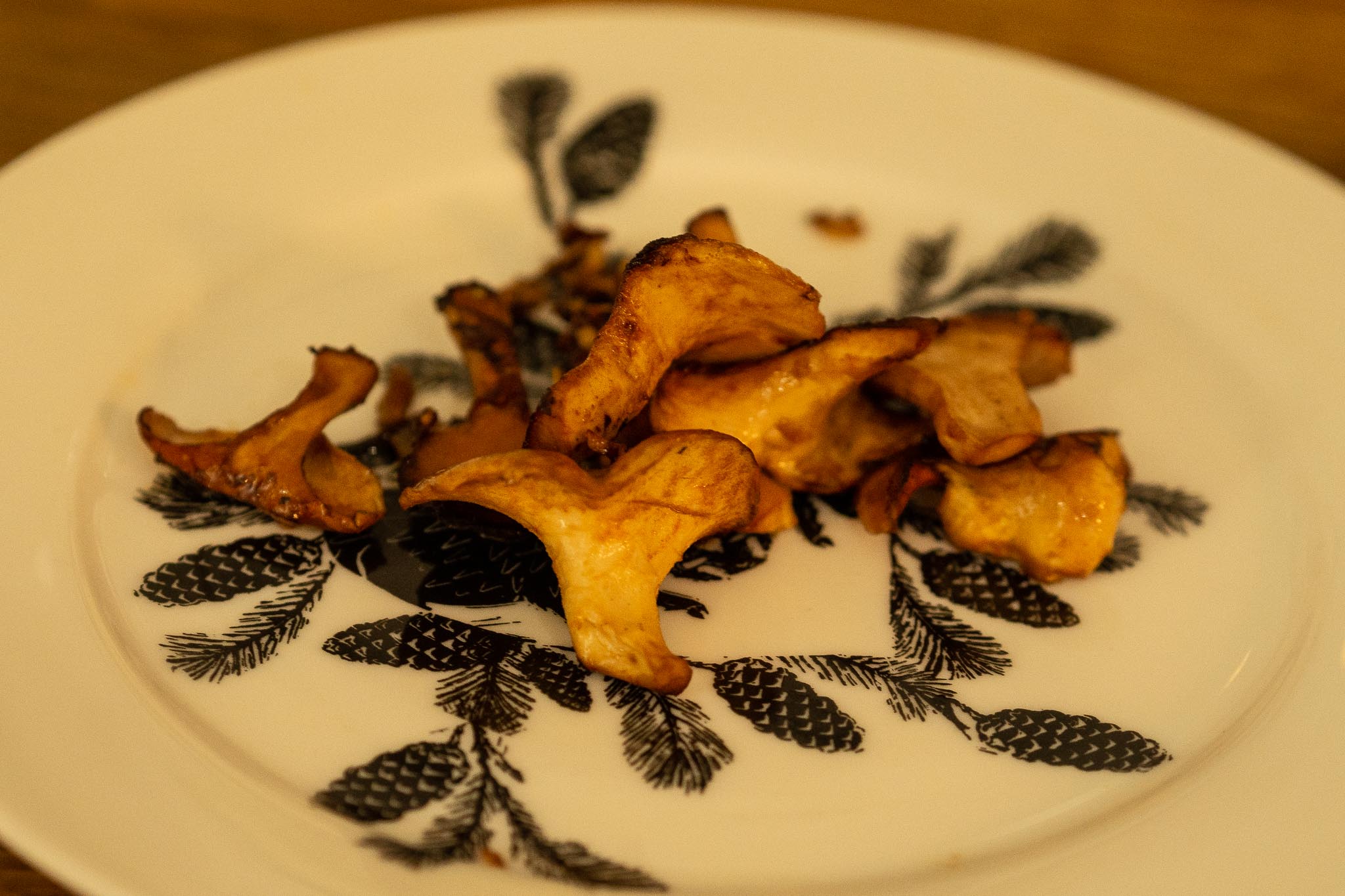
I had no idea of a recipe for the mushrooms, I hadn’t even planned to eat them. I fried them in some butter and garlic until they were lightly browned.
In short, they were delicious. I think they would work well with something like chorizo.
Back to the woods where the mushrooms I had no intention of eating were doing really rather well.
The edge of the town I live in has a lot of conifer plantation, once heathland, a sandy, acidic habitat. There is plenty of silver birch which means fly agaric.
This was the best specimen I could find, a veritable pondshroom.
The leaf litter is becoming so damp from recent heavy rain that smaller species are coming up. Woodland soils are incredibly rich in life and our footfall can be very damaging if not managed in sensitive places. This small mushroom (mycena, I think) is one that can be easily found at this time of year. The time before leaves fall is an easier time to find fungi. This is also because after the leaves fall the cold weather comes and mushrooms are held back.
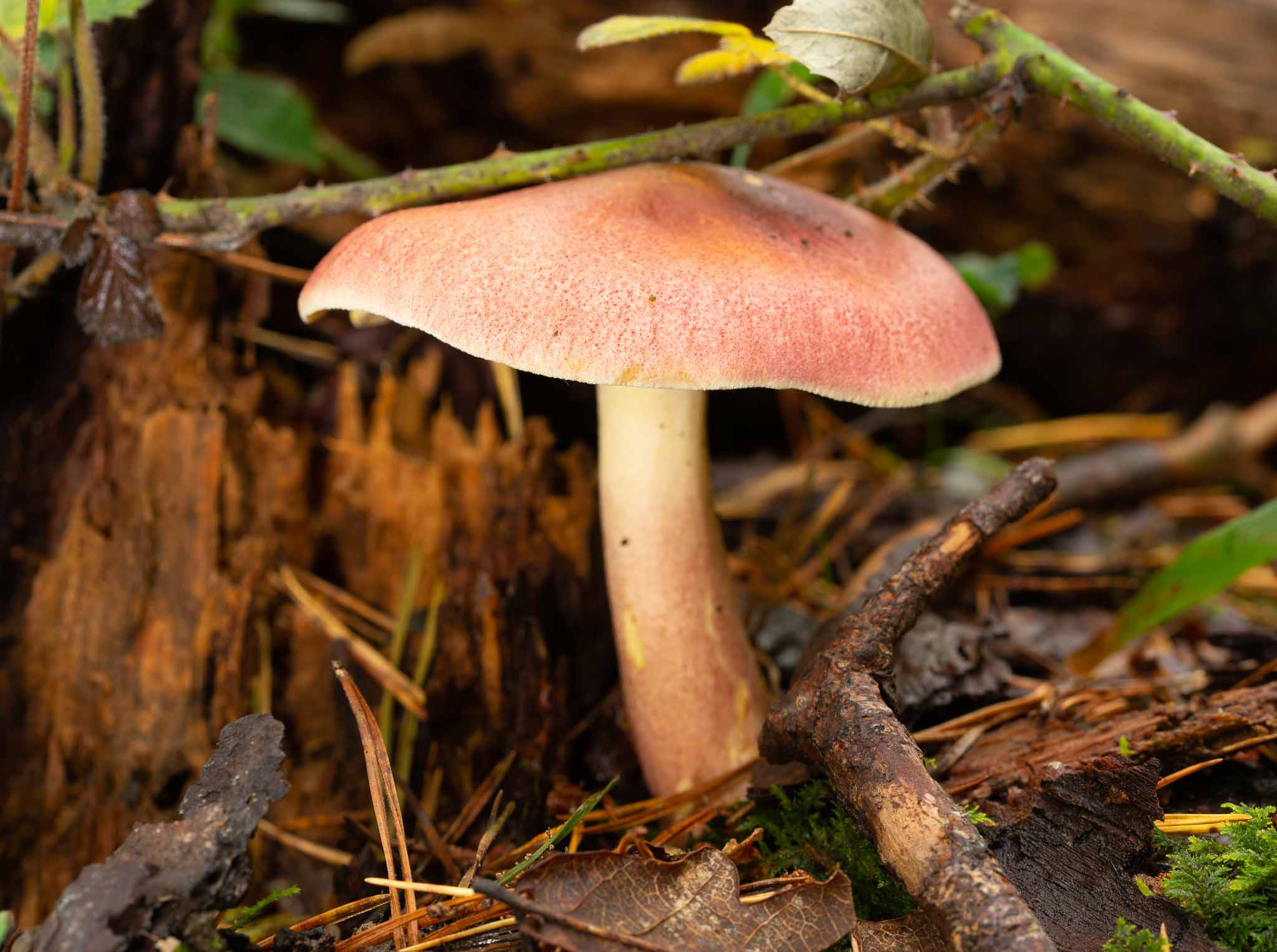
My favourite find of the week, despite the delicious hedgehogs, was this pink fungus growing at the base of a pine tree stump. It took me a while to work out what this species is. Bizarrely, it took the accidental viewing of a YouTube video to learn that it’s called plums and custard! It is a stunning shroom.
Autumn is here and the invertebrate season is coming to an end. Temperatures are dipping below 14 degrees and heavy rain is coming. It’s goodbye to our minibeast friends, those tiny ecosystem engineers, for another six months.
It was six months ago that I began this blog, just as the UK was locking down into the Covid-19 pandemic, which has sadly claimed so many lives. Ironically, we are now waiting on the Government to limit our movements once more, as the virus comes back at pace, and cold and flu season arrives.
To our wild neighbours, Covid-19 is not a thing, though it is thought to have originated from the exploitation of wild animals, amid patterns of increasing harm to wildlife habitats. I think writing this weekly blog has helped me greatly to focus on the fact that human life is not the only thing and our troubles do not define everything.
Nature is a powerful thing that even in the smallest lifeform expresses something wild and free. Nature is not an emotional force but it gives hope.
My small urban garden in West Sussex has been the focus of this blog. I am privileged to have a garden and value greatly how it enriches my life. Many people do not share this same privilege, not even hav I’ve recorded at least 62 species of invertebrate: 16 species of bee, 8 wasps, 1 ant, 9 butterflies, 3 moths, 7 flies, 3 bugs, 5 beetles, 4 spiders, 3 damsel/dragonflies and 3 other types of insect. Of course, there are so many more that I’ve missed and those I am unable to identify.
I thought I would wrap up this insect, spider and other invertebrate season by listing some of the highlights below. I’ll be spending the autumn and winter using what I’ve learned to make the garden even more accommodating for wildlife in 2021.
Thanks to everyone for your time in reading these blogs, and for your contributions in comments or elsewhere. Though I will try and post some Macro Mondays through the autumn and winter period it won’t be every week. I wish you well through the months ahead!
“Like 25% of all humans, I am now confined to a new way of living. Work from home if you can and exercise in your garden if you have one. Itโs not military arrest, yet. So like many others who are promoting our #NaturalHealthService online Iโm starting a weekly Macro Monday blog series.”
“This may be news to some people, but we owe our way of life to solitary wasps. Bees, which are crucial to food production, evolved from them about 130million years ago and their heritage is far more ancient. Everyone hates on the common social wasp Vespula vulgaris, but the are many thousands of species that you slander when you say โI hate waspsโ. As Chris Packham once put it, when asked what is the point of wasps, โwhat is the point of youโ!”
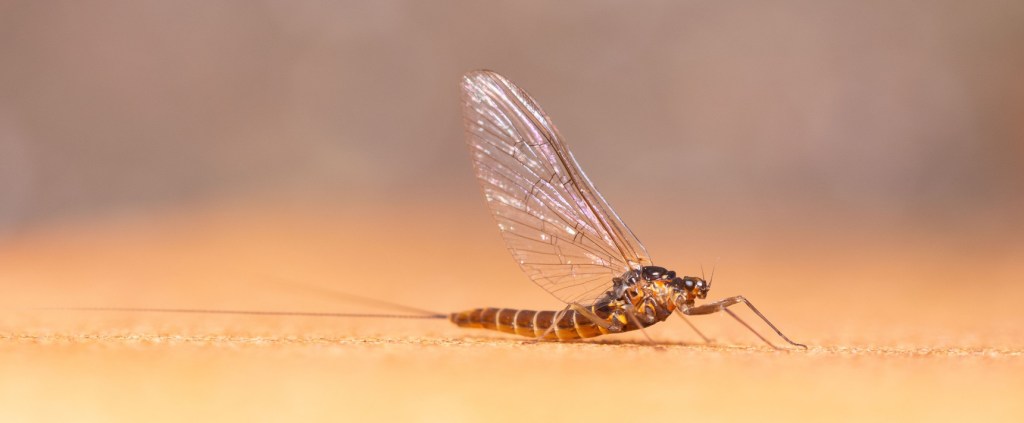
“The biggest surprise in the garden this week was spotted early one morning before I started work. On the side of a hexagonal flower pot I noticed some unusual wing shapes. I realised it was an insect and nipped inside to get my camera. It was in the shade and temperatures were only just rising. It was a mayfly, one of 51 species in the UK. I know very little about this group of insects other than that they appear en-masse over rivers and that they only live for one day. How did it get to my garden? The River Arun is ten minutes walk away but it was a real joy to think it had used my garden to shelter for half its short life.”
“With the physical distancing measures still in place, itโs not possible to do any meaningful macro work away from home. I have been on my official walk from home with a macro lens but itโs not the time. Despite this, the one thing I am reminded of again and again is, with macro I get my best results in my garden. Itโs a small patch in a network of open gardens in an urban location, but it gives me the chance to focus on small areas.”
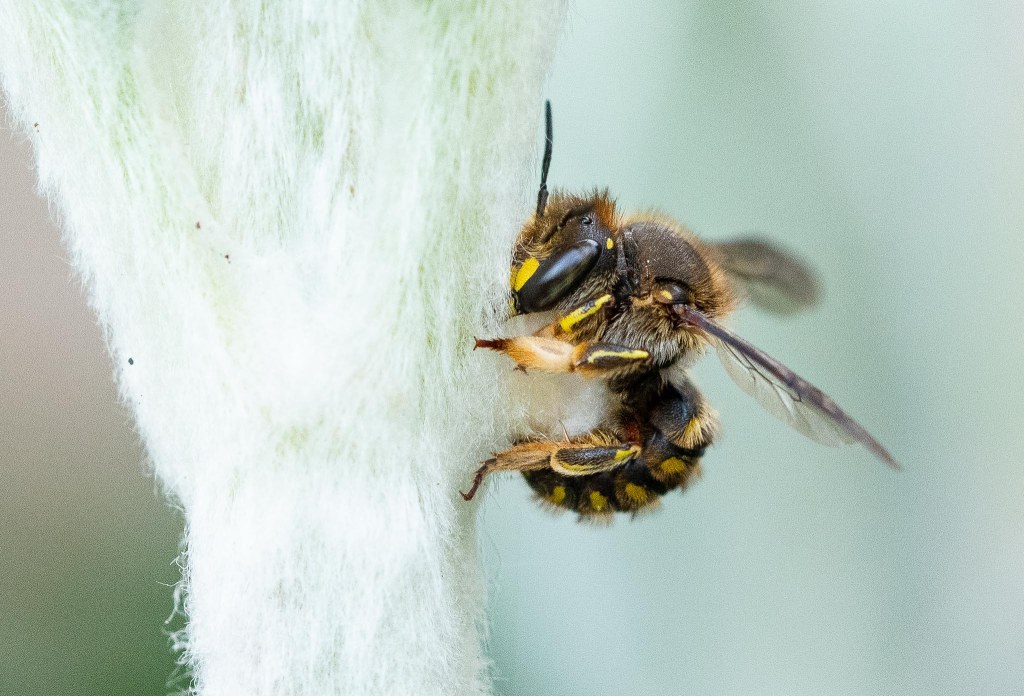
‘A couple of weeks ago I noticed a new species visiting the lambsโ ears in my garden. After work I had gone into the garden to morph into a normal human again. The sun had moved to the point where shade was covering the flowerbeds but still an insect was busy and behaving in an unusual way.’
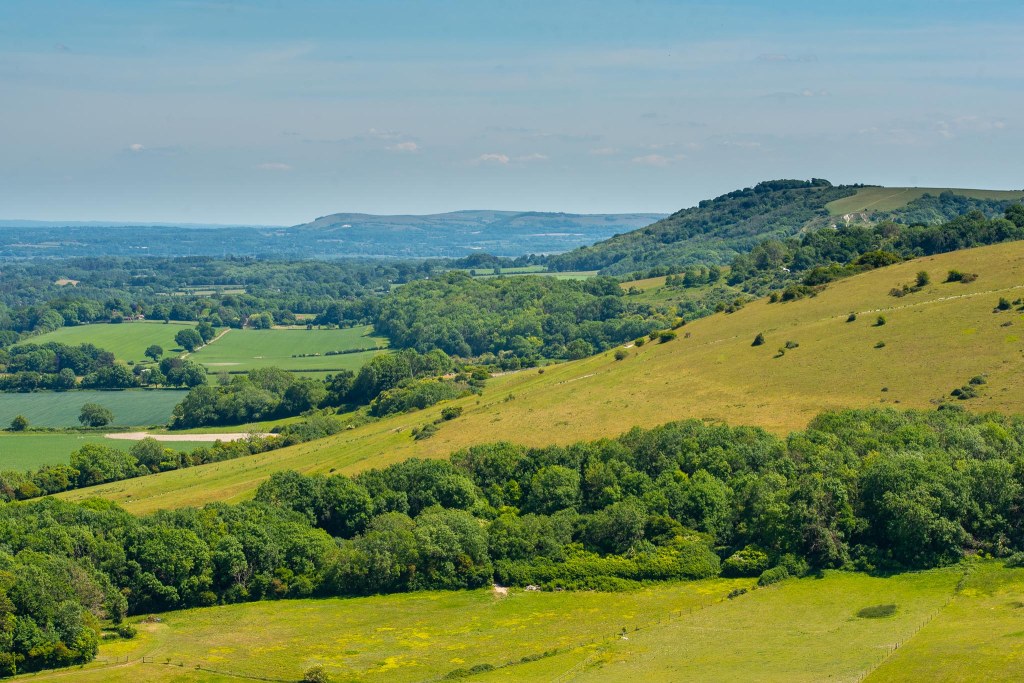
‘Ok, I know what you’re thinking: you have a nice garden. You’re too kind, but it’s not mine. This is the South Downs National Park. I visited the South Downs for the first time in three months with one aim in mind: macro.’
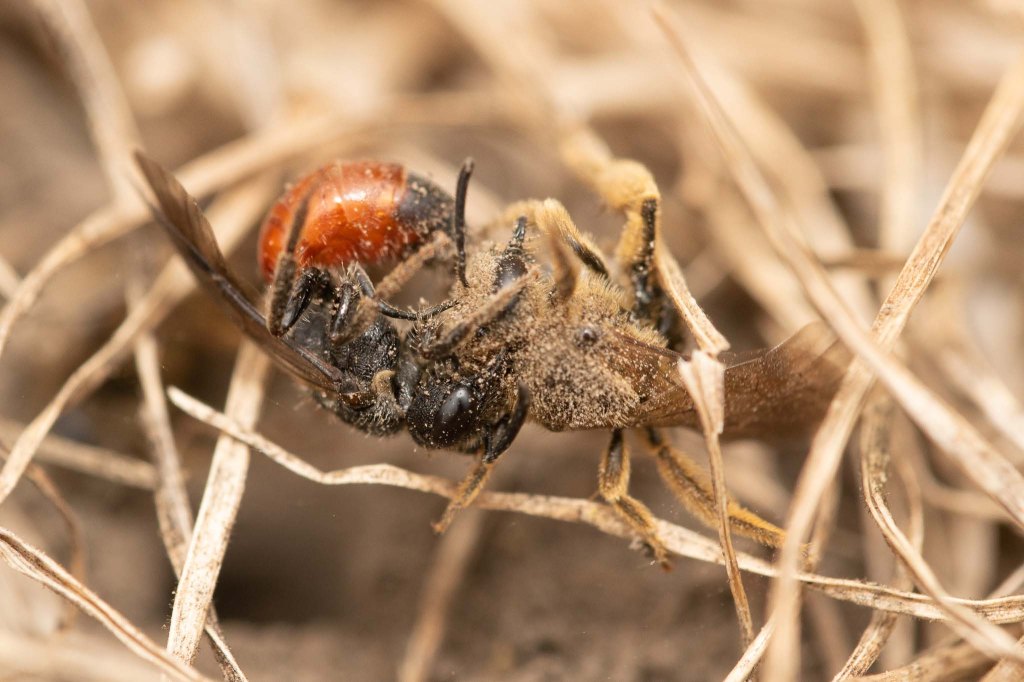
‘I had gone back to work somewhat shocked by the smash and grab episode. I did feel sadness for the mining bees and the killing field which had appeared in my garden. But thatโs a human response to an issue that doesnโt exist. We should feel much greater sadness or anger for a wider loss of habitat than we should say a magpie or jay raiding a nest. You have to remember the bigger picture.’
‘I had noticed a bit of activity and glanced over to see a slender insect flying around the flowers. It was the equivalent of a video buffering over a poor quality internet connection. When it landed on one of the flowers I recognised it instantly as an ichneumon wasp. I ran inside to get my camera and managed to get some good photos: in focus, well lit and sharp enough.’
Thanks for reading, for your comments, likes and support. I hope these posts have helped someone else to become interested in bees, wasps, spiders and other local wildlife. They need us!
I found so much for this week’s post that it’s a mushroom-packed blog!
The wait is over, the mushrooms are arriving. I had the pleasure of a 10-mile walk in the New Forest in September. It was a warm and sunny day. It was a special walk because it revealed two species I have never seen before. One renowned for its edibility, the other for its deadliness.
The New Forest is a National Park and Special Area of Conservation. It’s of European importance with places left like it in the continent. Its mosaic of woodland and heath is maintained by free-roaming animals owned by commoners. This in ancient land management practice which, around Europe, is often responsible for the conservation of rare habitats and species. The New Forest was established by William the Conqueror at some point after 1086 when the Domesday Book was created. Its old name ‘Nova Foresta’ translates directly to its current name. It certainly ain’t new anymore.
It’s also more heathland than woodland, an open habitat. ‘Forest’ does not actually mean woodland. It means ‘outside of common law’ or a place where Forest Law was enacted. Forest Law was implemented by the Normans to ensure recreational hunting for the aristocracy was protected from the foraging and ‘poaching’ of local people. Its enactments were often violent. The Vederer’s court still exists in Lyndhurst, where hearings took place regarding acts committed within the Forest.
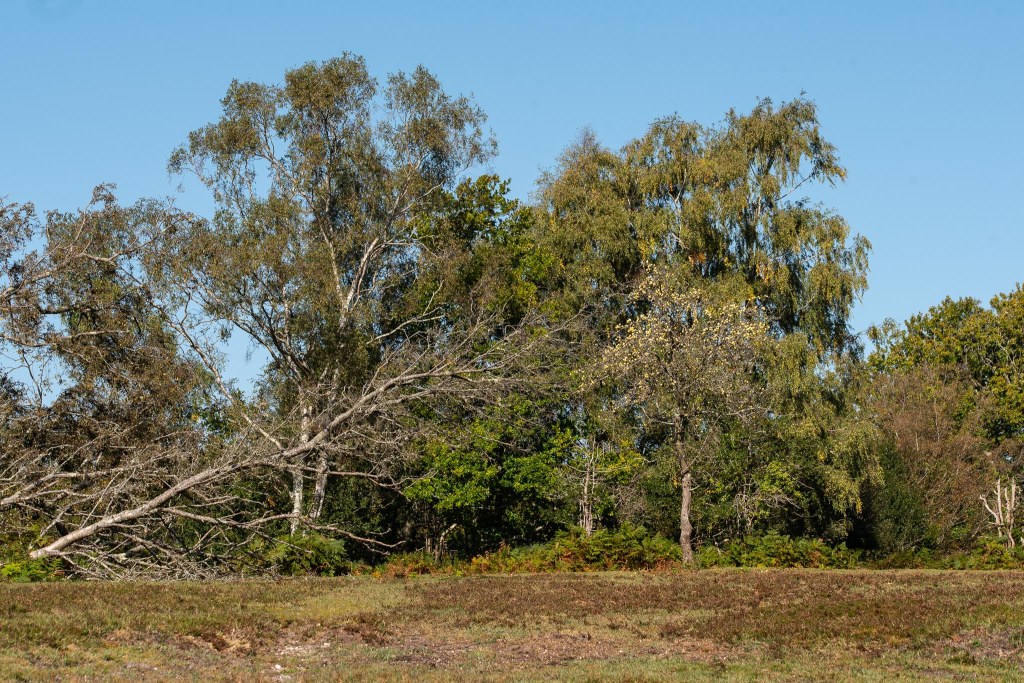
The New Forest is home to lots of spectacular ancient and veteran trees like the hollowed out beech tree above. It has a feel to it that is unlike other places. It is spectacularly rich in fungi, or at least, compared to other areas of the UK.
Much of the land is owned by Forestry England and they discourage foraging.
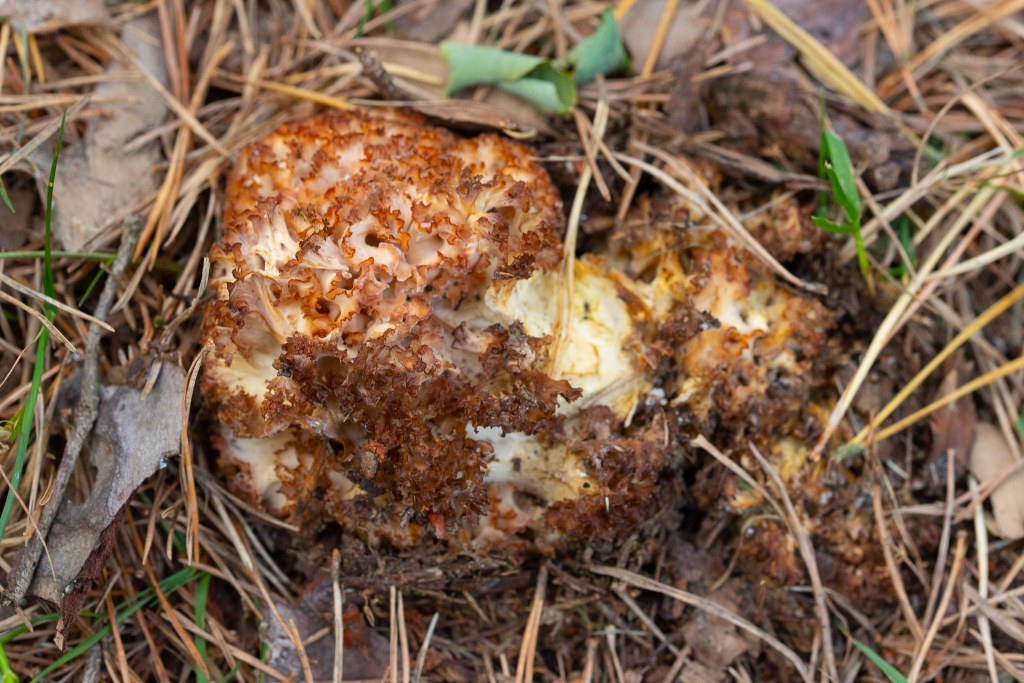
The first fungus I found was in a car park, on a bank under pine trees. It’s cauliflower fungus, looking a little bit dry in the sudden burst of warm weather. This is an edible species.
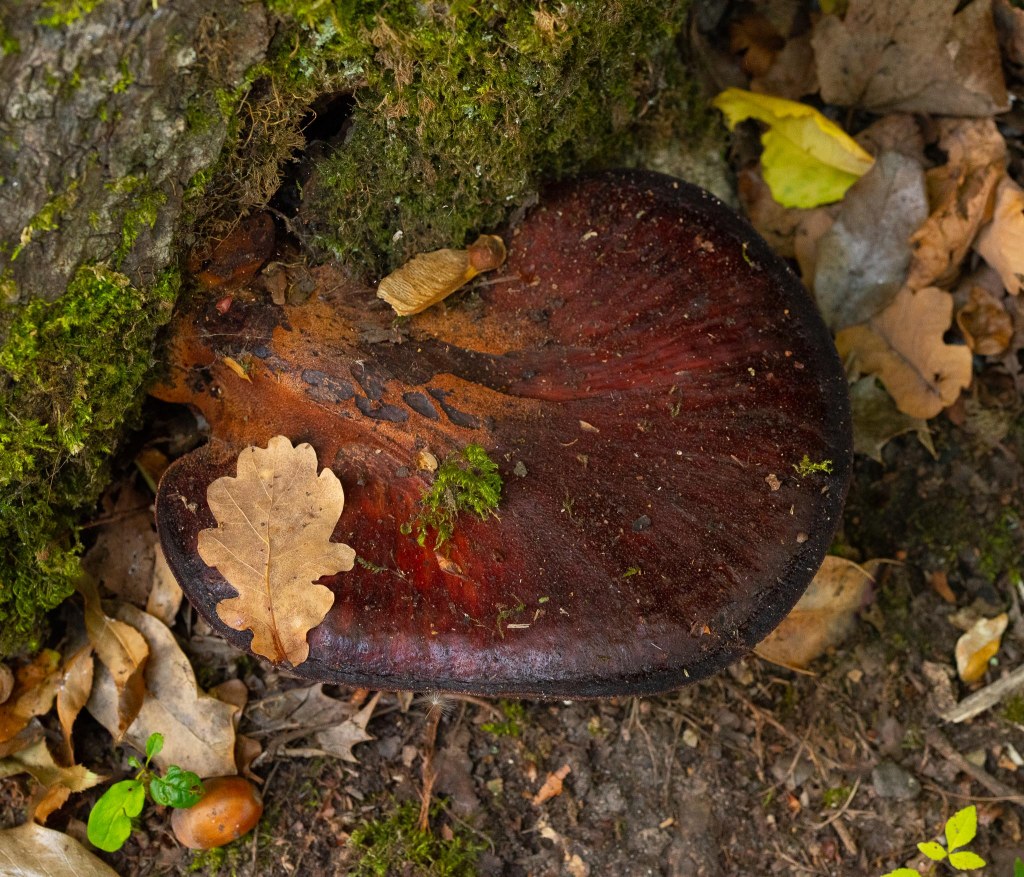
In the buttress of an old oak was this beefsteak fungus, a bracket that looks like human organs. It’s an edible species that has also led people to call the police, thinking that a crime had occurred in the woods!
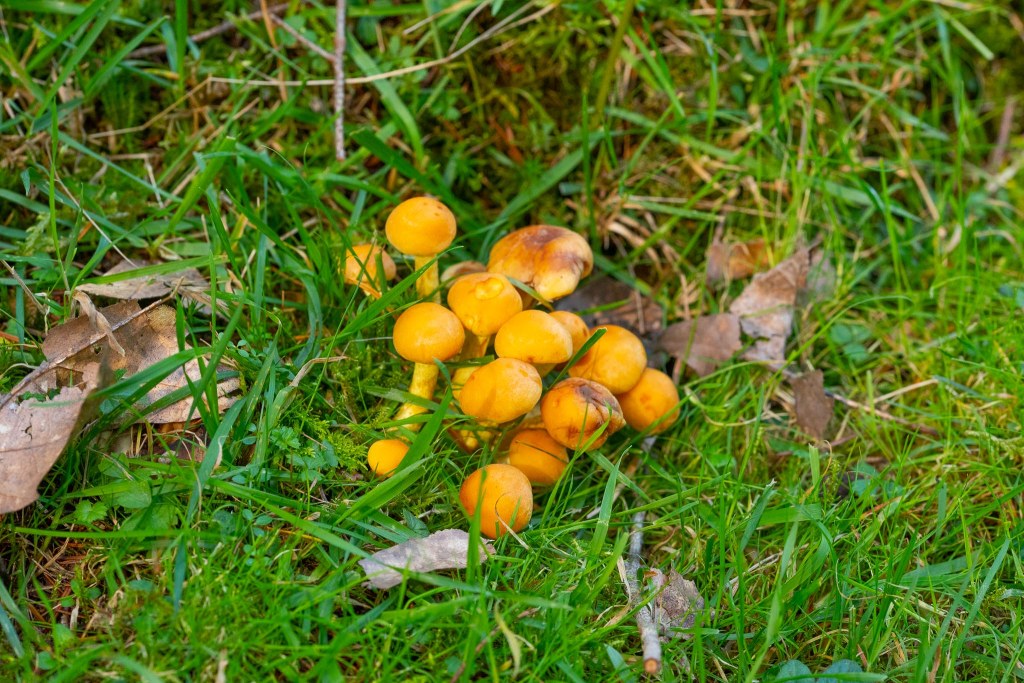
The most common species of the 10 miles was sulphur tuft. It responds quickly to rain and was popping up in lots of places. This is one of the most common species in the UK and is also toxic.
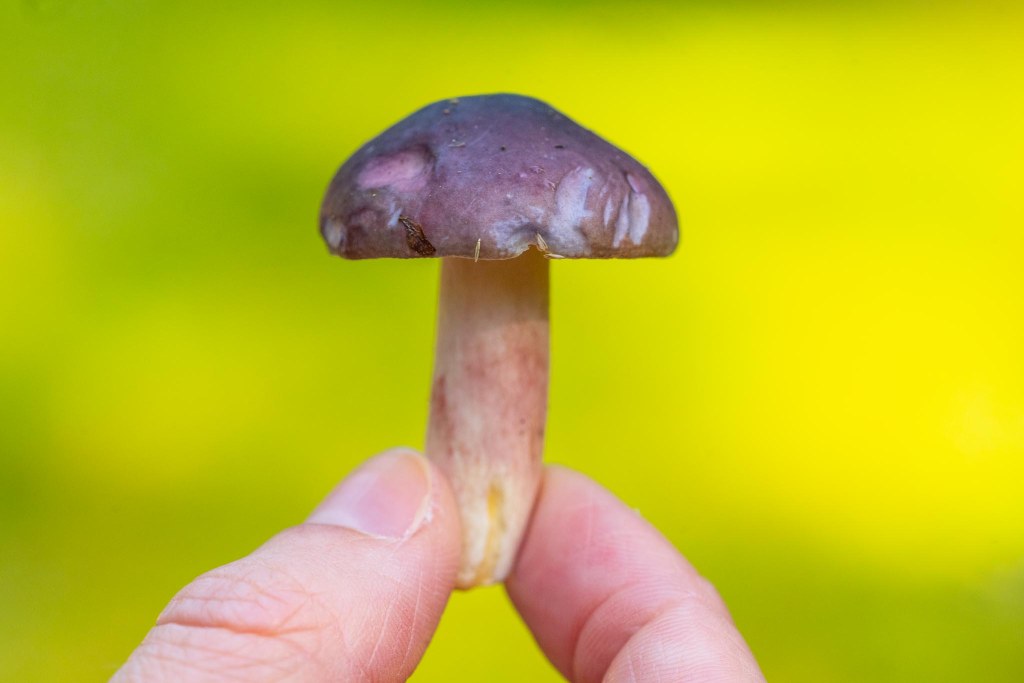
There was a good showing from the russula family (AKA brittlegills). This one had already been picked.
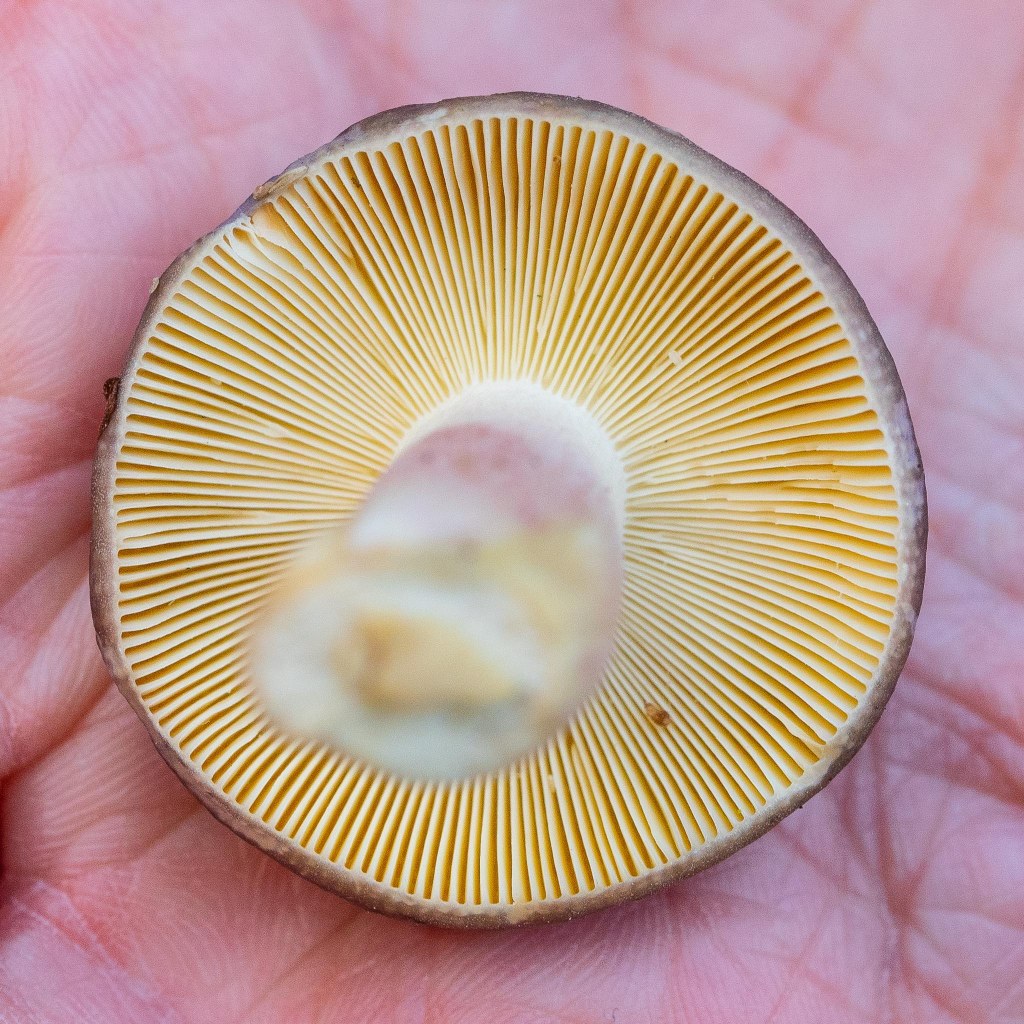
The crowded gills of russulas are a sight to behold. They are, of course, brittle and so break easily. The gills and stipe are always white or cream.
Unless it’s blackening brittlegill!
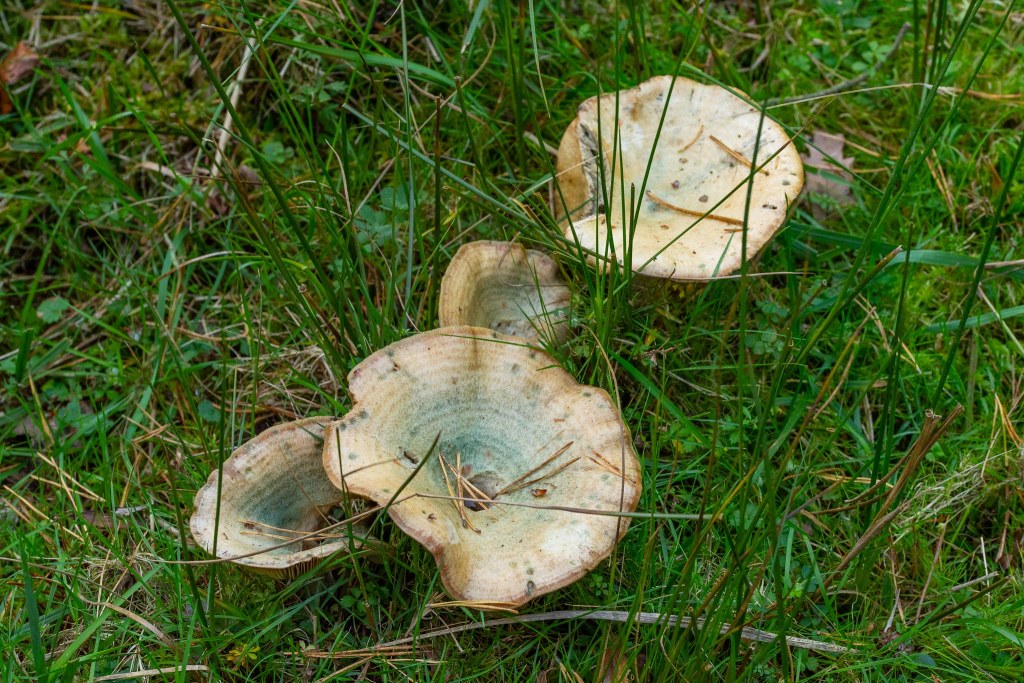
Deeper into the woods, this greenish species of milkcap was abundant in certain areas alongside the track. They were under either spruce or pine, shown by the needles here. I’m not sure of the species but they may be either Lactarius deterrimus or Lactarius quieticolor.
I think this is the same species, overcome with a blue-green colouring.
This is a wood or field blewit, which are usually found in grassy areas.
This is my first deceiver of the season, so named because it can be confused for others. I have rarely found that to be the case, though! This is a mega-common species and is also edible. It’s said only to be worthwhile in large numbers.
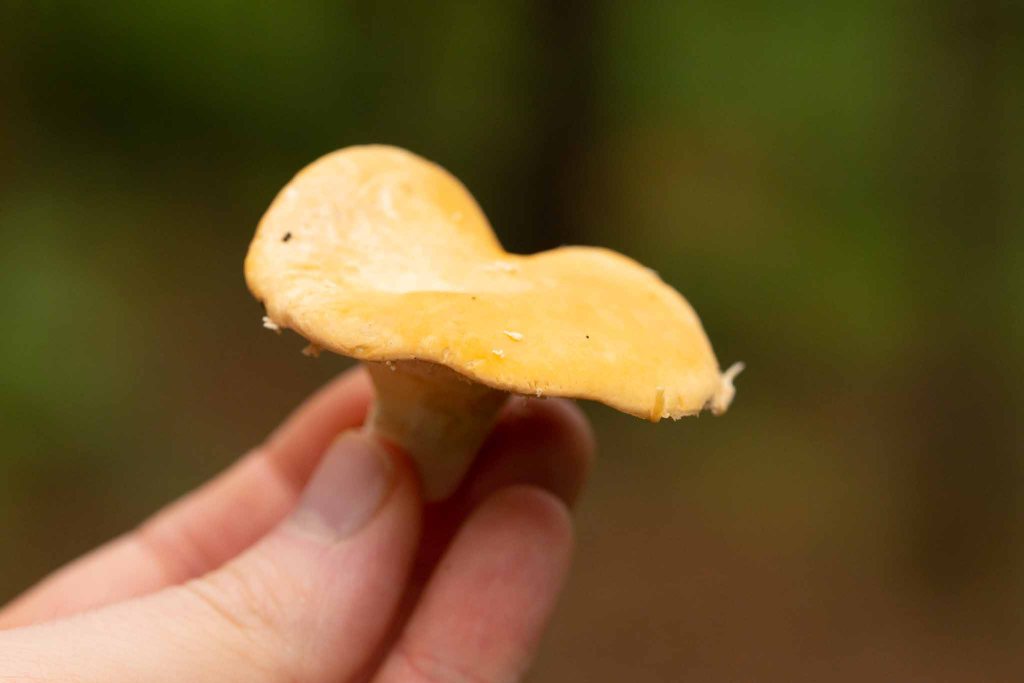
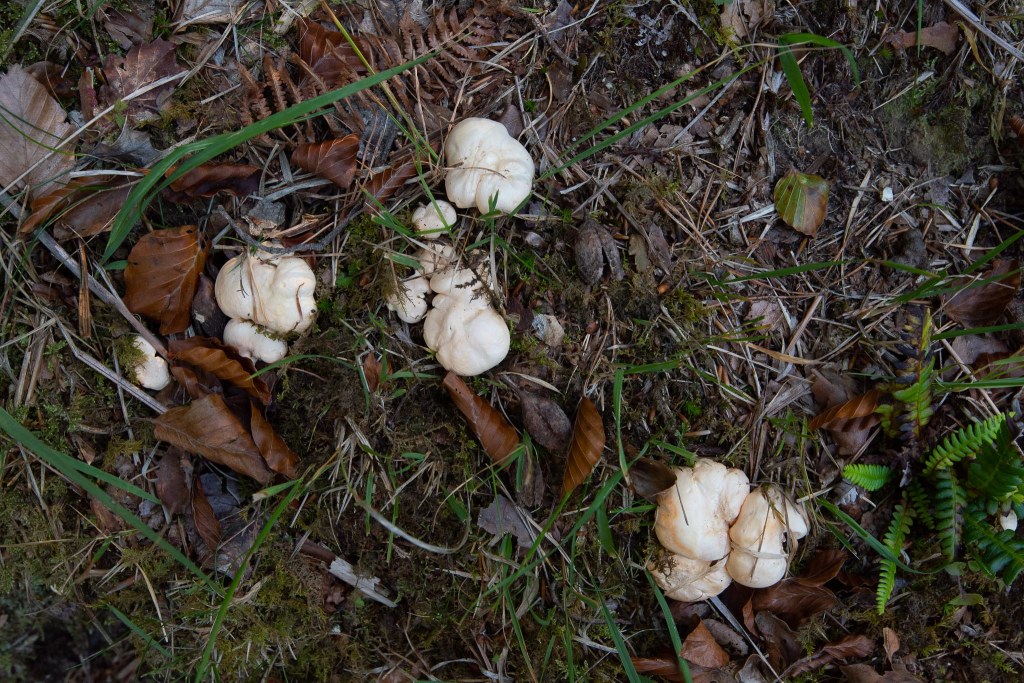
This doesn’t look great but apparently it tastes it! I knew when I saw these apricot coloured fungi that they were hedgehogs. This is a first for me. I looked for the spikes underneath the caps. They are described by professional foragers as one of the safest species to eat. That’s because they’re impossible to confuse with others due to the spikes and that all the hedgehogs are edible.
This is how they look from afar, note the beech leaves for scale. They don’t look like much.
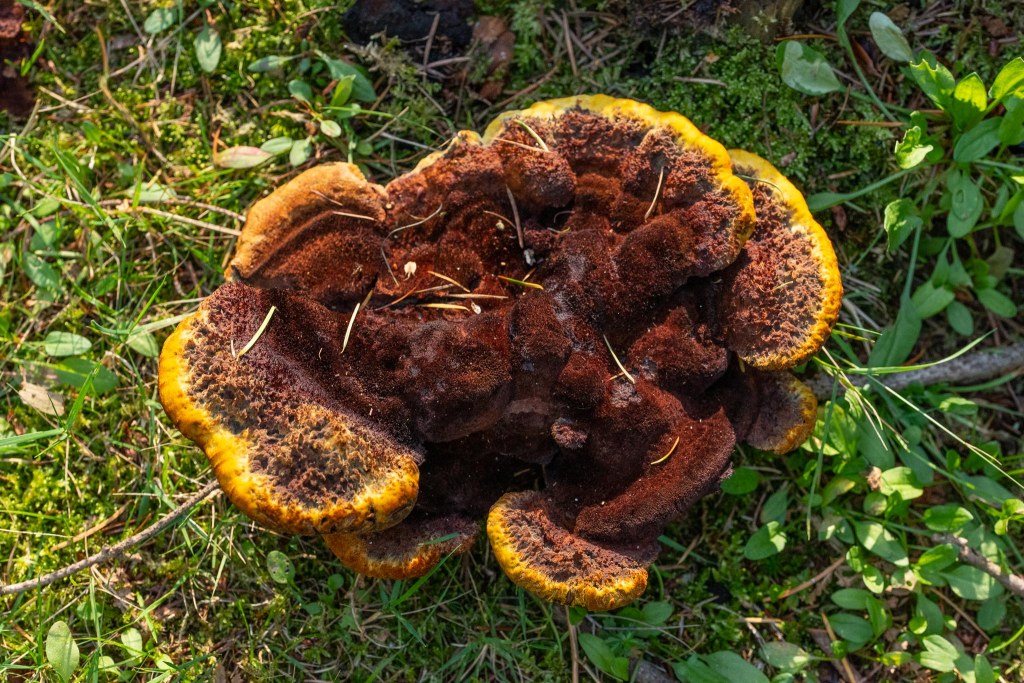
Conifer mazegill is one of my favourite species of polypore or bracket. I love the velvet-like yellow edge to the bracket. It is a beautiful fungus. I think it’s one I’ve only ever really seen in New Forest plantations or heaths.
Fungi is an acquired taste. This is probably egghead mottlegill, on horse or cattle dung! Stay classy. It was alongside a road at the edge of beech woodland.
I wrote about the amanita family a couple of weeks ago. They were out in force in the New Forest. This is the first fly agaric I’ve seen this year. September is a great month for this iconic species. It has such a depth of cultural significance it deserves its own post.
The blusher is a common amanita which is so named for its pinkish colouring. I’ve read that it’s edible, which is weird considering the consistently poisonous nature of the family.
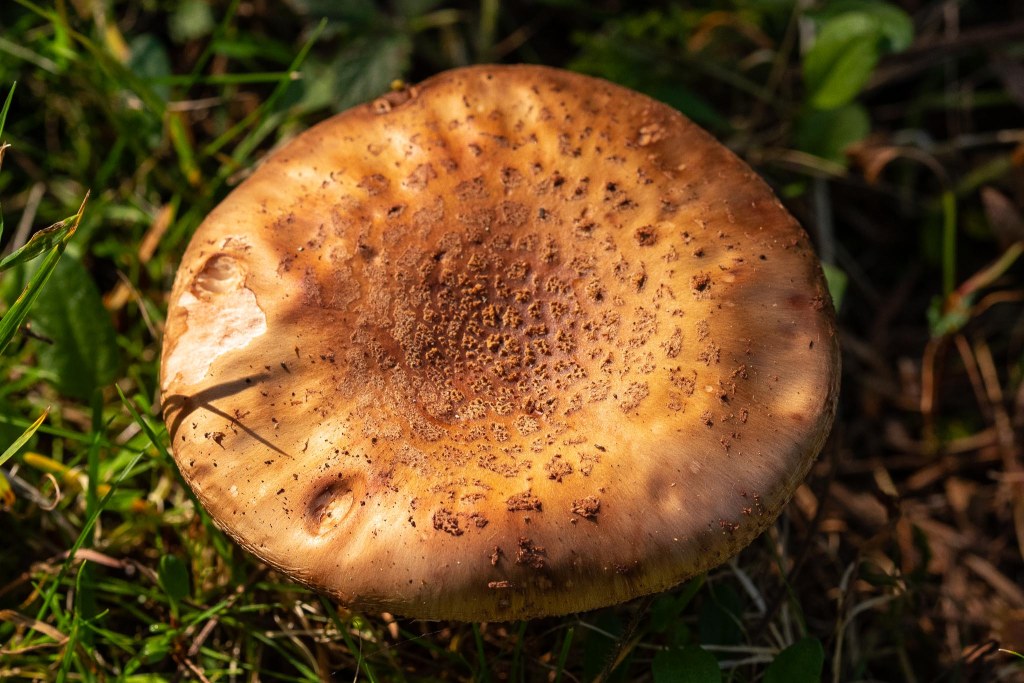
These are probably panther caps, a leathery-looking shroom. I’m not 100% sure because they seem too big.
False deathcaps were common in Mark Ash Wood, the target for the walk itself. It’s a beautiful ancient woodland with an old stream and wet alder carr running throught its heart. It was in the damp area, on a mossy tree root, that I found a special mushroom:
I had to put this out to Twitter to be sure. I think this is a deathcap, one of the most poisonous mushrooms in the Northern Hemisphere. Another first for me! That is a mushroom that definitely needs a post of its own.
The summer’s September siege has broken and autumn has washed in with cut-price temperatures and heavy rain. The fruits of this sudden shift will not be felt fully for a few weeks yet, so here is what I have found in the last of the warm September days.
Last week I visited a favourite nature reserve in West Sussex, managed by Sussex Wildlife Trust. It was the first time I’d manage to get there in perhaps a year, due to the pandemic and the remoteness of the site. It is one of the only places I know locally where you find such an abundance of moss and lichen on trees, suggesting excellent air quality. This is the kind of thing you see in the New Forest, as well as more highland landscapes.
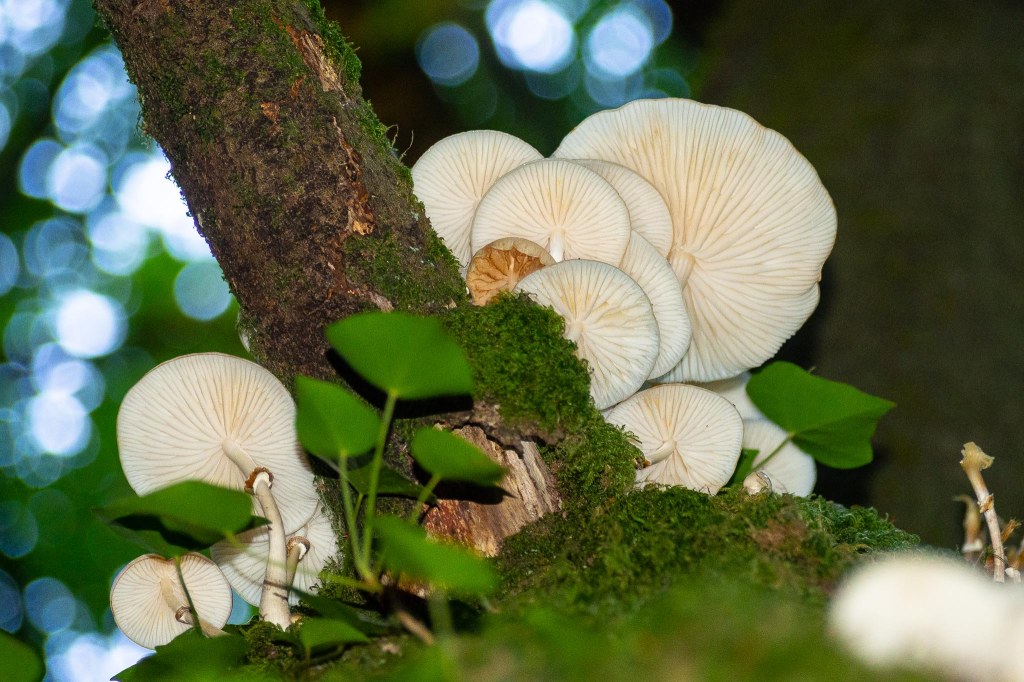
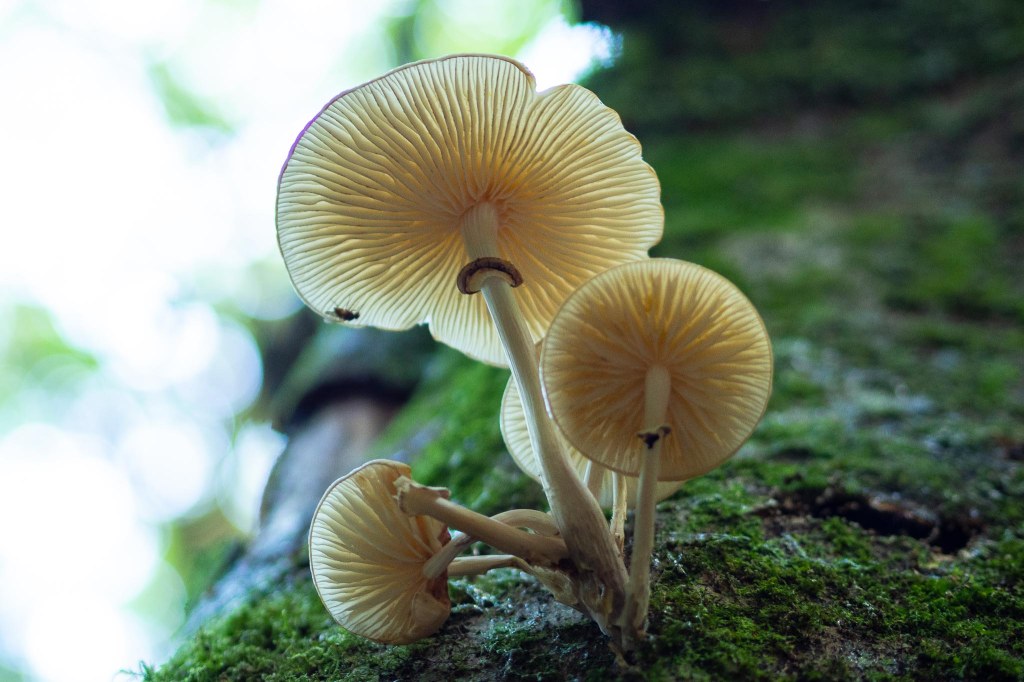
I found porcelain fungus, this time hiding high up in a tree.
It is a reminder to me that if you see signs of smaller mushrooms, it can mean there are much more in other places that you may not have checked.
Rooting shank is a common summer mushroom which grows on wood submerged in soil. It gets its name from the root-like growth which attaches it deep into the soil. I almost always find it at the base of a tree.
Above is a species that is one of the earliest mushrooms to fruit, spindleshank. I find them most often along the lines of roots near the butresses of oaks. It is symptomatic of root trouble, usually with oak trees. In this blog, there is no trouble, as fungi get a free ride here and no anthropomorphic view of their world. That said, I won’t be focusing on fungal pathogens anytime soon. Awkward.
Later in the week I made a visit to another Sussex Wildlife Trust gem, Ebernoe Common. It was a hot day and the fungi were few.
This lovely scene is one of Ebernoe’s more open habitats, where trees like willow and crab apple are more dominant. It harks back to how wooded landscapes in Britain and Europe once appeared. These areas would have been grazed and kept open by livestock, allowing more light-loving tree species like crab apple and hawthorn to come to the fore. Here I found some blushing brackets hovering like UFOs on a fallen tree.
Fallen trees were the only place I found any fungi at all. This lovely turkeytail was growing on some birch trunks at the side of a path. This may be a varience on the more common turkeytail found. I love the progression in colours towards the tip.
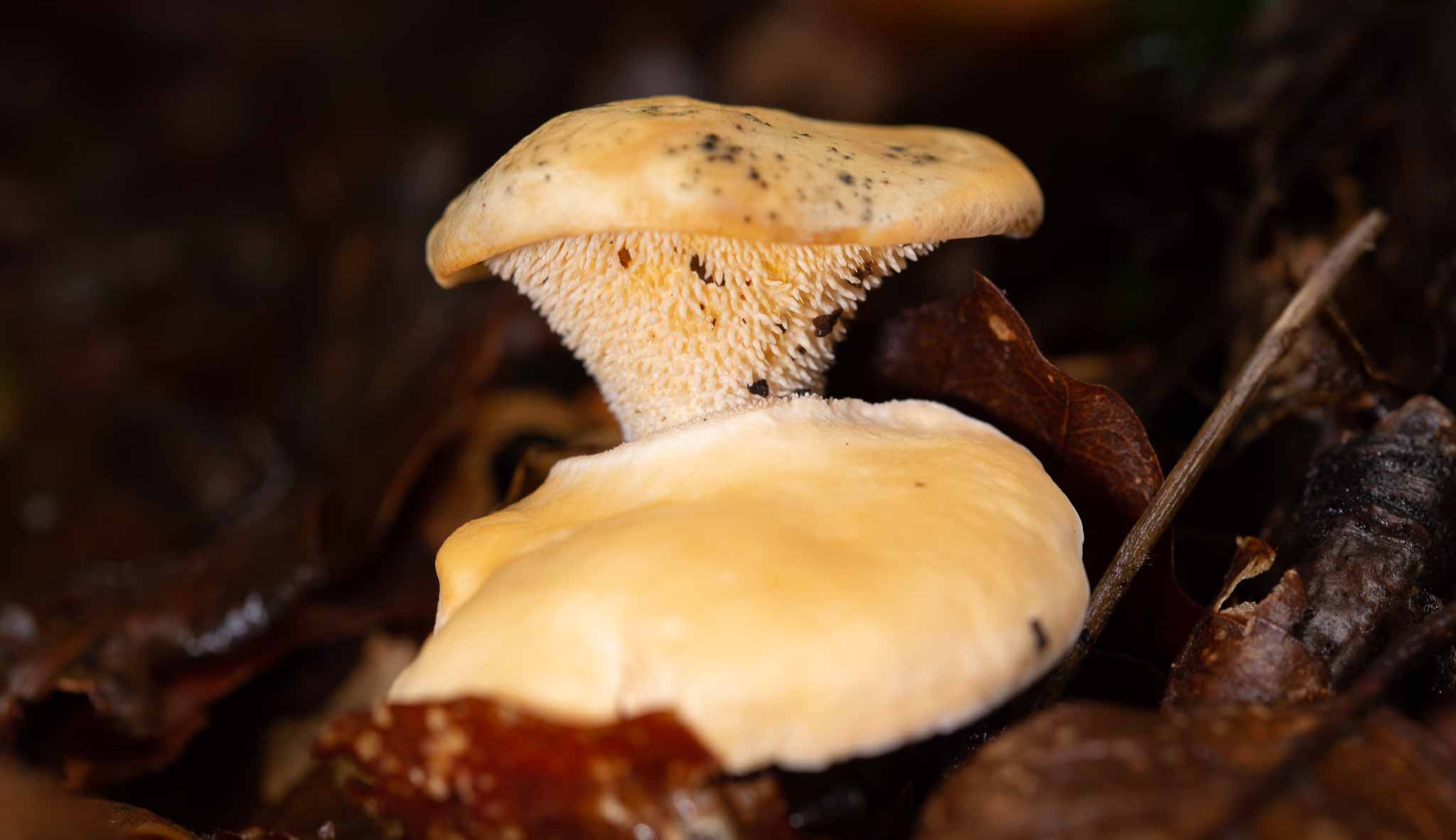
This is a pretty rad example of a variant species, again growing at the side of a path on some fallen wood. Stunning.
There were signs of what is to come over the next two months. This is probably shaggy scalycap (Pholiota), pushing its way through the bark of a fallen tree like Wotsits, a cheesey wheat snack. With the rain that’s washing in at the time of writing, we should all be getting ready for mushroom season!
I walk my bike along the field edge, woodpigeons grazing the dry stubble of the field. It’s another hot day in Sussex and the land is thirsty and dry. In the distance, a hedge line with a number of small beech trees in it seems to have died. Ahead of me a small dustcloud rises and dissolves into some oak scrub. The shadows of dragonflies cross my own, a hawker coming close to my face, perhaps lured by the neon hi-vis helmet I’m wearing.
I’m heading for the High Weald knowing that some late summer and early autumn mushrooms are appearing. I just want to see what’s there, to maybe see something new. From the sloping footpath down into the woods, three mountain bikers appear, breathless.
‘Great sesh boys,’ one of them says. ‘I feel violated.’
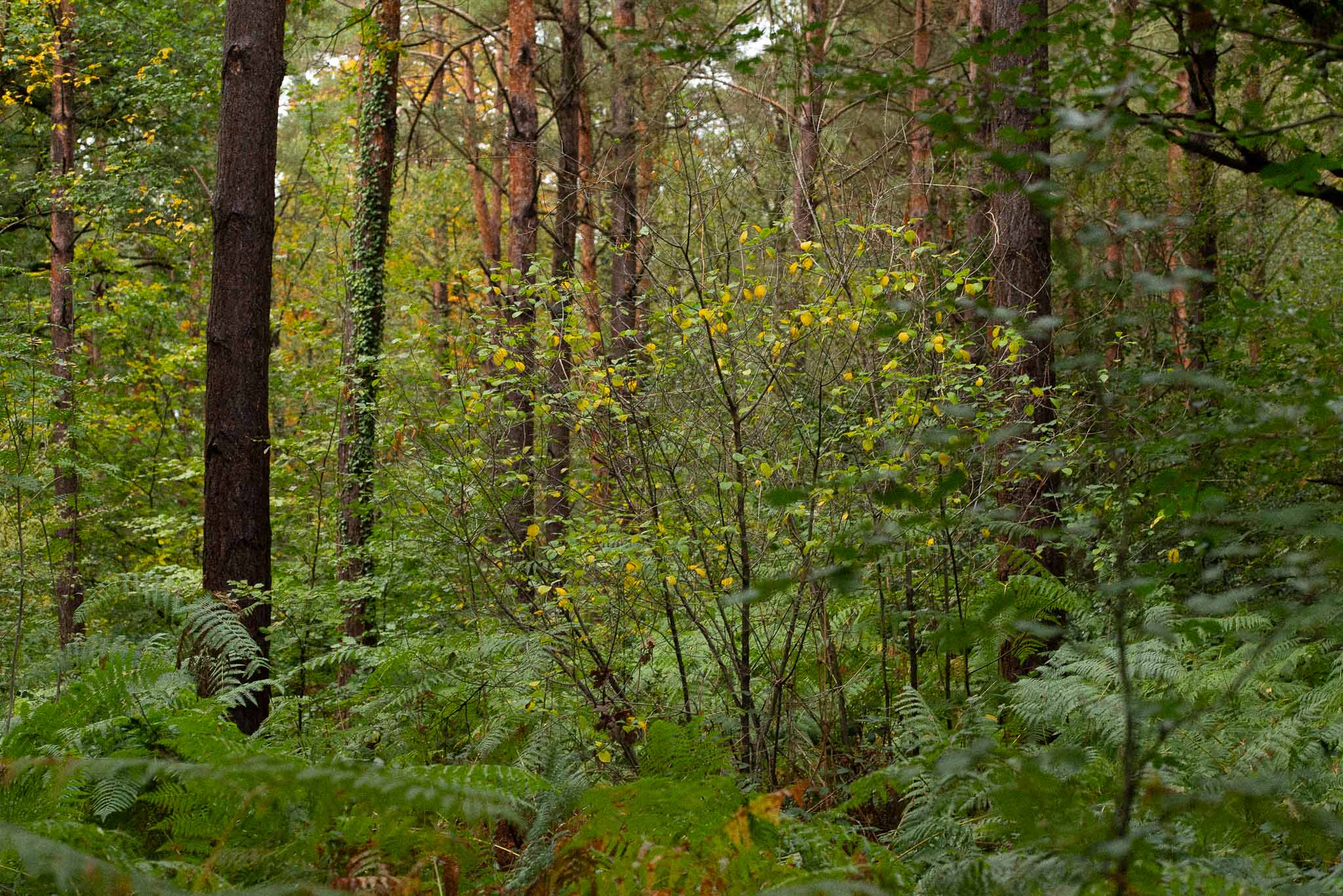
Entering into this old heathy landscape, the whispering pines give a sense of endlessness. They remind me of the mountains of the Scottish Highlands and the Romanian Carpathians. Though this is southern England it feels so much like somewhere remote, wild and unchartered. I think that’s what makes these places so important.
The heather blooms still at the path edge, and up on the banks of crumbling soil where pine roots are exposed. I find small suede-capped bolete mushrooms in the shade and take pictures.
I get back on my bike and follow the old track where a couple of weeks ago deer roamed freely. Not today. I cycle slowly along the old ride that bisects the Forest. In the ditches mushrooms appear: red russulas, blushers and some larger boletes. The sun shines in high contrast in the dark birch woods, where bracken still holds green. A hornet flies among fleabane flowers.
I follow a track down past bare-chested mountain bikers. Like deer, a group of people are crossing the track from one area of woodland to another. They have plastic bags full of things, reminding me of Czechia at this time of year. I slow down and hear a Slavic language being spoken. In a friendly way I ask them if they’re foraging mushrooms.
‘No,’ a younger man with glasses responds. He, too, is holding a plastic bag heavy with something.
I tell them I was just interested to know. I think they probably thought I was a warden or maybe some xenophobe. Really I just wanted to know where all the mushrooms were!
Further ahead the track thins and the woodland pinches: pine, birch and spruce. I get the feeling of a good place to find fungi. Out of the corner of my eye I catch the shape of large discs on a fallen tree. Bingo!
I dismount and take my bike off the path. There are two large bolete mushrooms growing from a log, another of the suede-capped variety half-chewed before them. I find more. Nearby, two small mammals, perhaps voles or shrews, follow each other underground in a way so direct they seem magnetised or attached like train carriages.
I take back to the track and grey-spotted amanitas appear at the track edge in their hundreds. They stand at the side like a crowd cheering me on towards the finish line.
The moment is truly upon us: autumn is progressing and the mushroom world is waking up once more. One of the true symbols of autumn is, in my opinion, the arrival of a dangerous family of mushrooms: the amanitas.
It’s been a hot week of it in southern England, with temperatures coming close to 30 degrees (c). Of course this pales in comparison to what is being experienced in America, which I am very sorry to read about. If you are affected I wish you all the best and that you can find safety. I know of a few fungi people on social media who have seen their favourite woods burned by the fires. I hope Americans vote out the Climate Denier in Chief in November and we can get on with the global efforts required to tackle the climate emergency. It’s happening now.
I visited a local woodland patch with low expectations. I’m not sure if I’ve mentioned it(!) but there has been so little rain this spring and summer in Sussex. But woods are key resources of moisture, soil needs it to thrive and provide habitat for all the organisms which make it a living thing. Fungi are a key part of healthy soils. Though I wasn’t holding out hope for much, I was surprised to find that grey-spotted amanitas were out in force!
Now most amanitas are identifiable to me by their spotted caps, what are fragments of the veil the mushroom appears from, though you don’t find this as on toxic species such as deathcap or destroying angel. The most famous spotted amanita is the fly agaric, with its archetypal red and white cap, so significant to our species that it made it into Super Mario.
The grey-spotted amanita can be most easily confused with the blusher, seen above in the same woodland last year. This species has a pink ‘blush’ to its cap. It’s easier to tell the difference when they’re mature. Again it has the same white patches of the amanita family and a collar.
Away from the amanita family, I was searching around a fallen beech tree when I noticed a small cluster of mushrooms growing from the tree.
I pushed deeper into the undergrowth where the tree had fallen, down into the ditch of an ancient woodbank. There I found one of my favourite mushrooms to photograph, porcelain fungus!
This is porcelain fungus when it’s just appearing, pushing from behind a dislodged piece of bark. It is an edible species, which needs the slimy coating removed before it can be eaten. I haven’t ever eaten them. I have only ever seen them on beech.
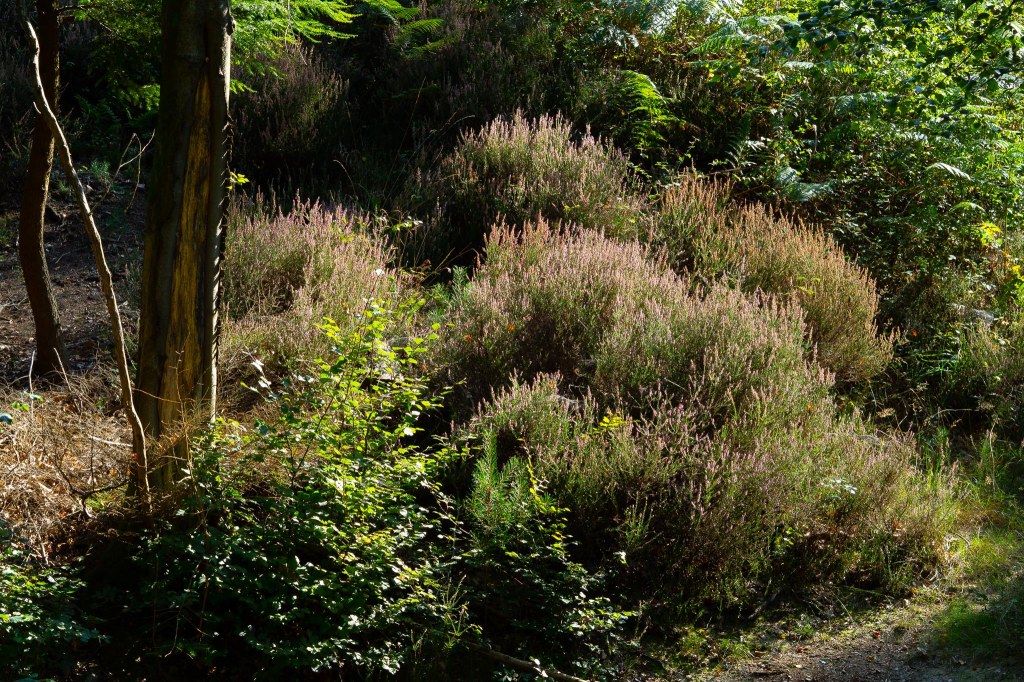
Other finds included blushing bracket, which is growing from a fallen log across one of the paths in the prime mushroom spot. It has continued to grow and grow over the past few months.
This is a time of russulas (or brittlegills as they’re ‘commonly’ known) but I think the lack of rainfall is hindering them. I am guessing these two might be charcoal burners. A pleasant surprise in adverse conditions for our mushroom friends.