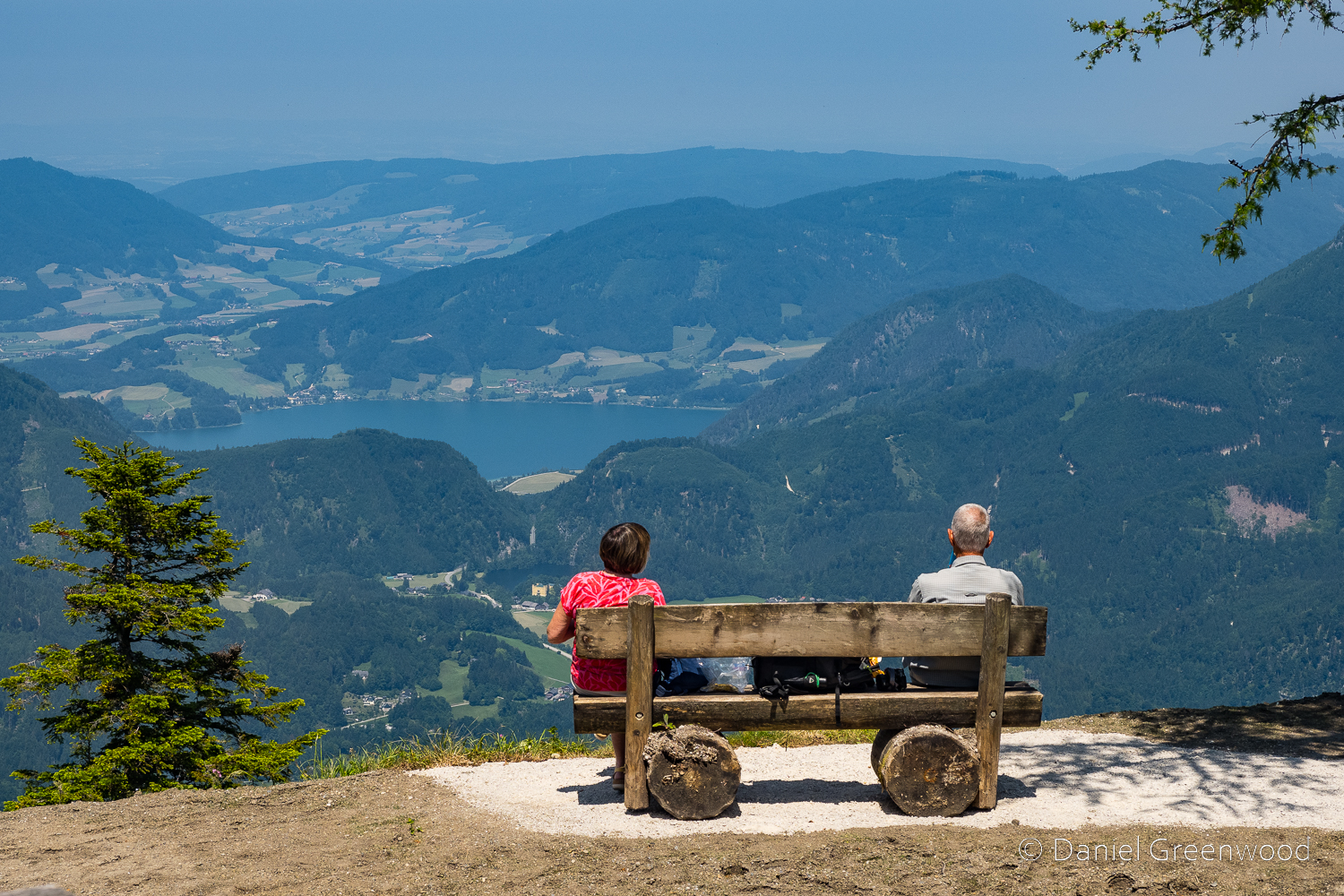
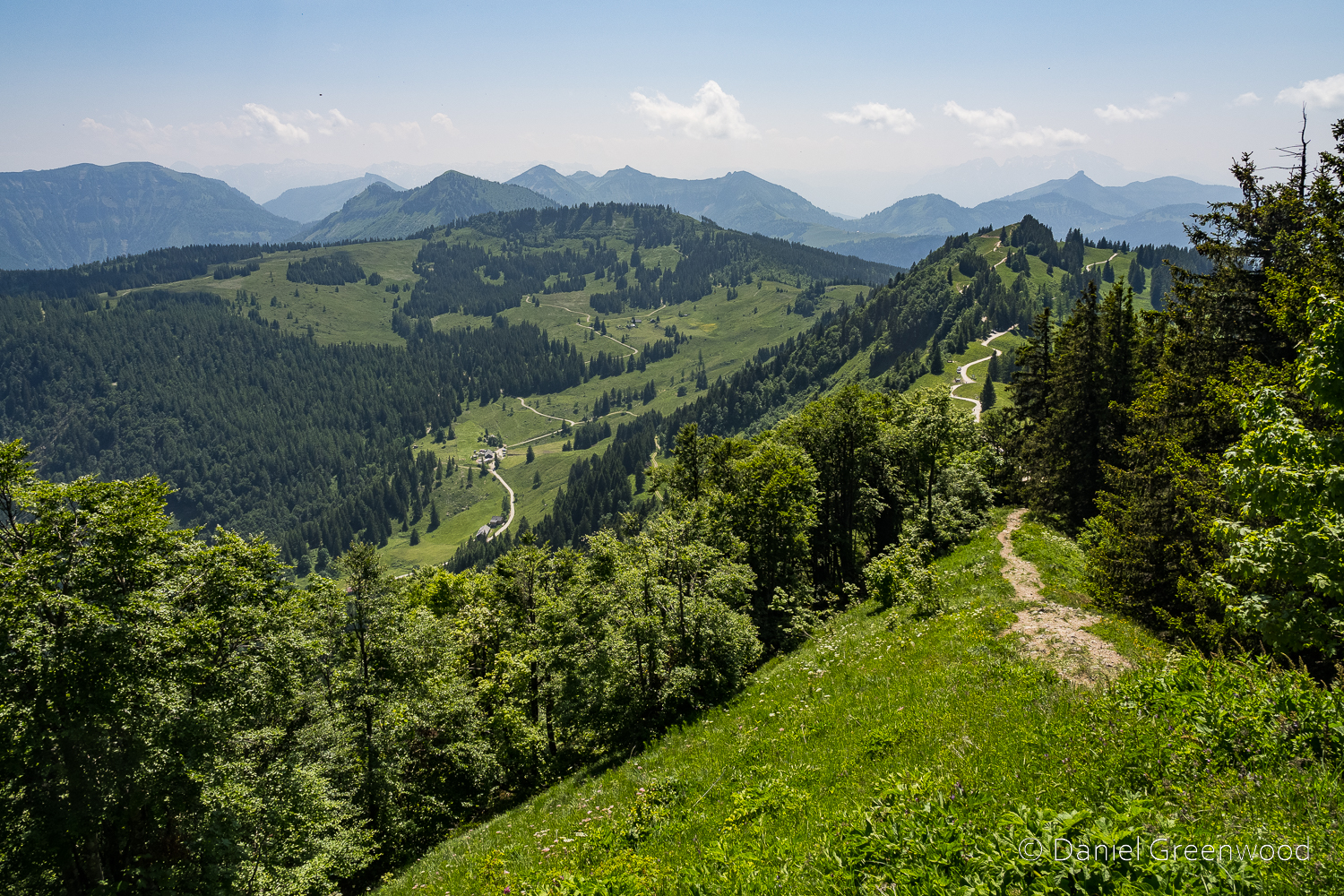
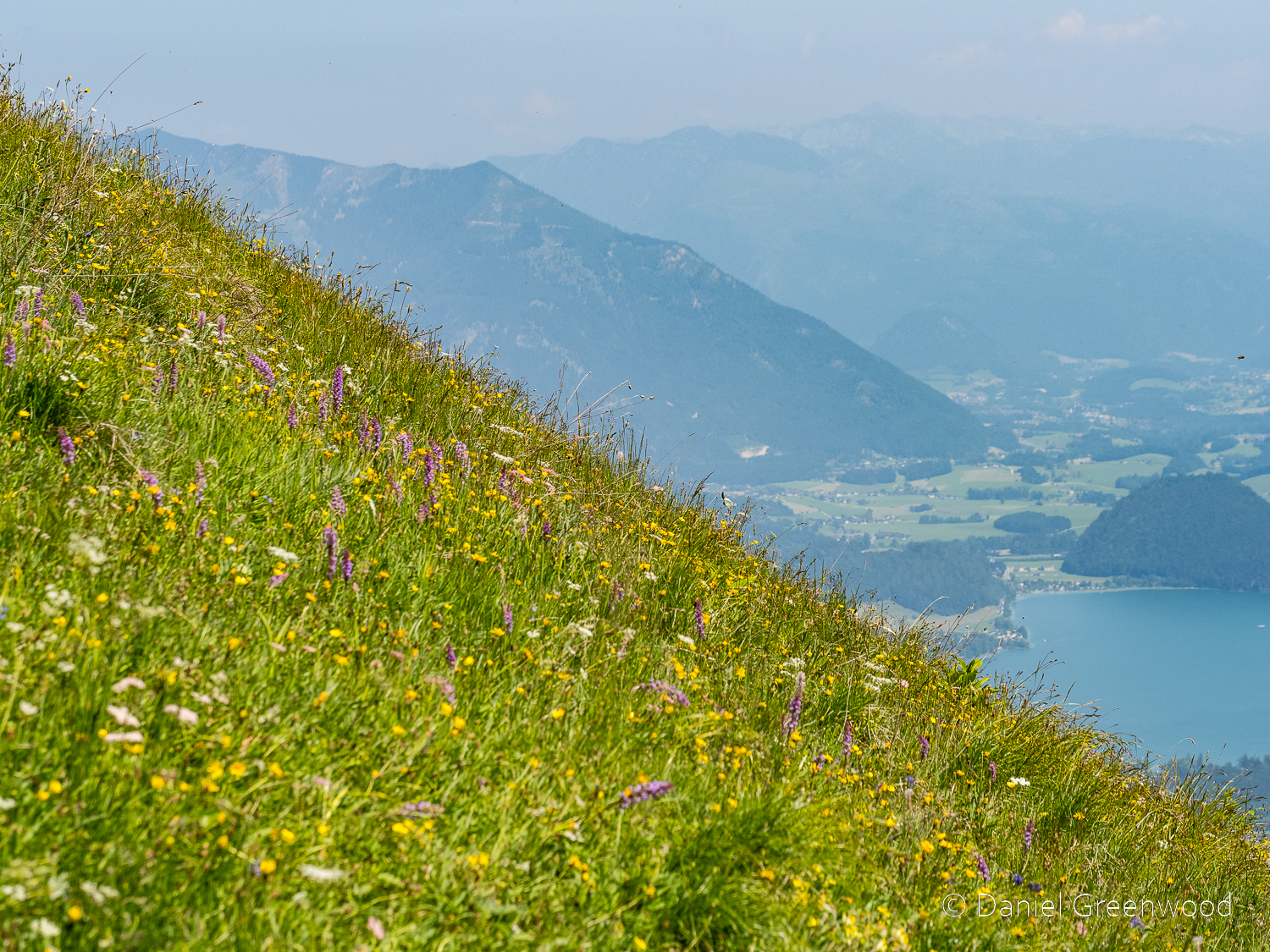
Welcome to a big blog of sunny alpine images, from my walking highlight of the year so far. Down we go!
My wife and I travelled by train to the Austrian Alps this summer, and we took one more train to reach the top of Schafberg (1782m) – the Schafbergbahn.
The images here are in chronological order as we descended, trying not to be too distracted as we picked our way down through the rocky tracks. I would recommend using at least one walking pole while doing this walk because it is so steep. The walk was nearly 8 miles and took us about 5 hours (because I stop a lot to take photos).
To the south-west you can see the high peaks of the Dachstein range (3600m), an area we haven’t explored yet.
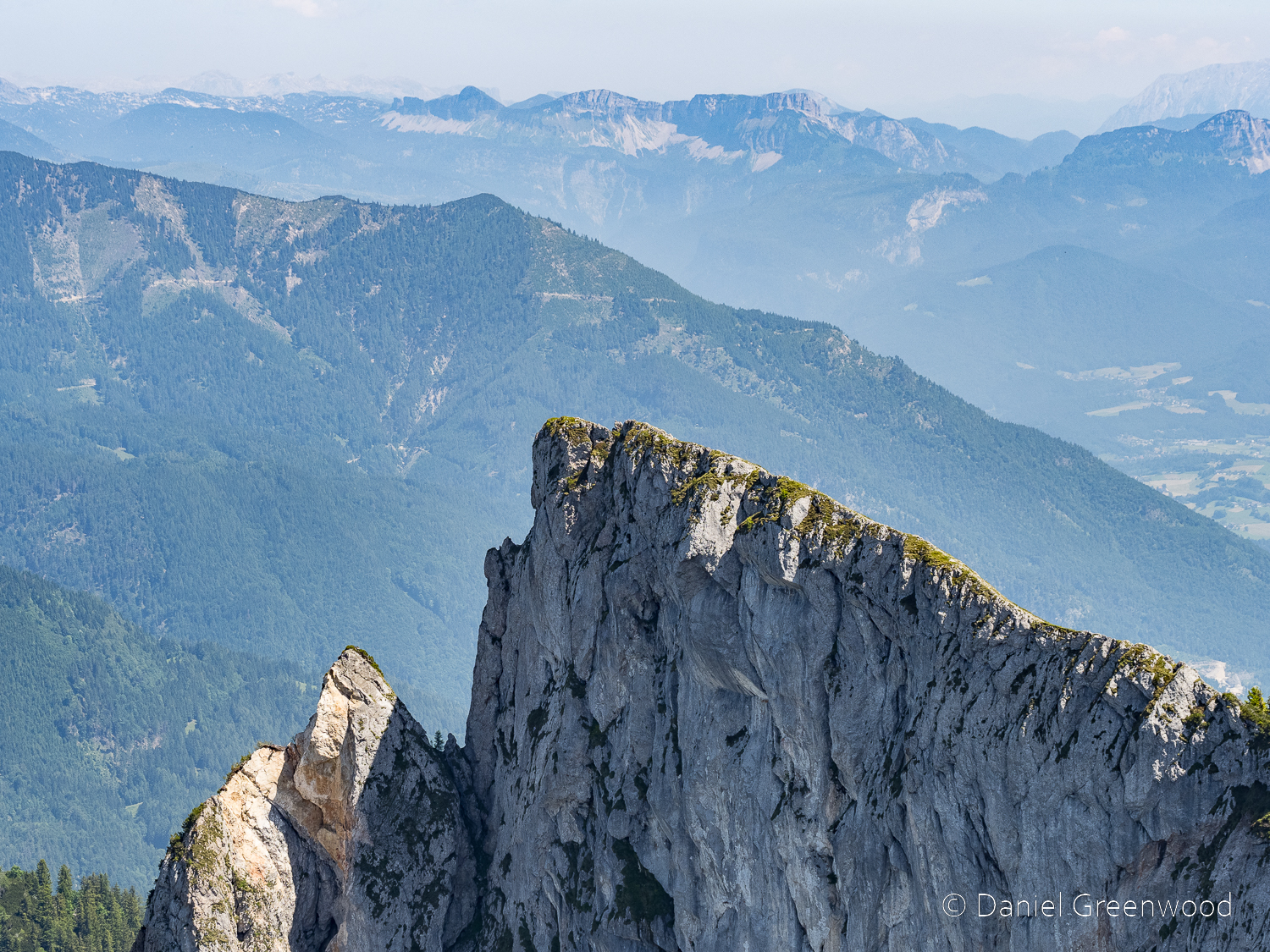
The dramatic peak of Spinnerin seen from the top of Schafberg
This walk is simply heading down the main (uneven and steep) paths to Wolfgangsee, ending up at St. Gilgen. You can do this as a daytrip from Salzburg, but you need to get the boat to the train station.
You can stay on Schafberg for the night in the hotel, or you can just have lunch and enjoy the views.
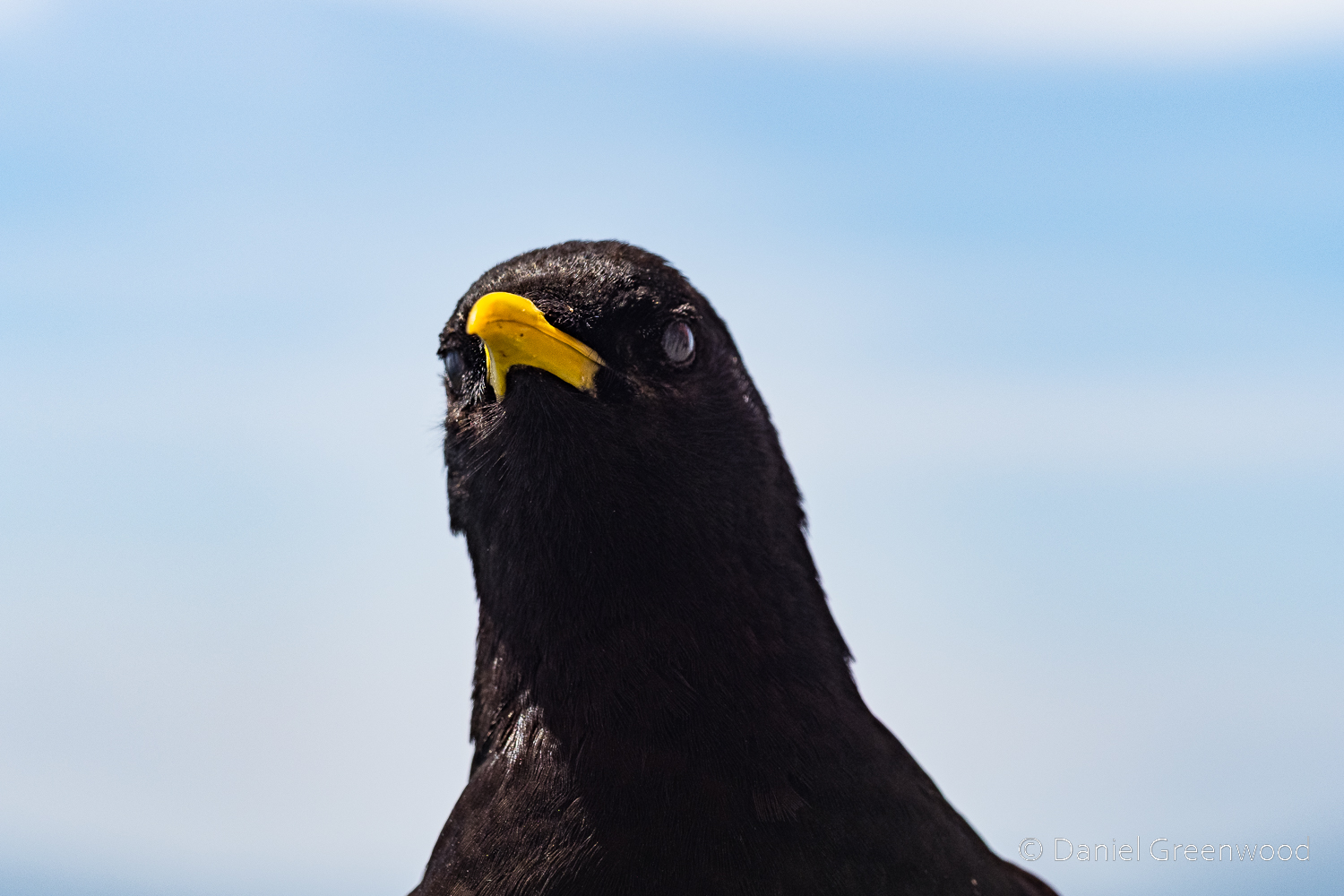
You’ll have to get approval from the alpine choughs though, they rule the roost up there.
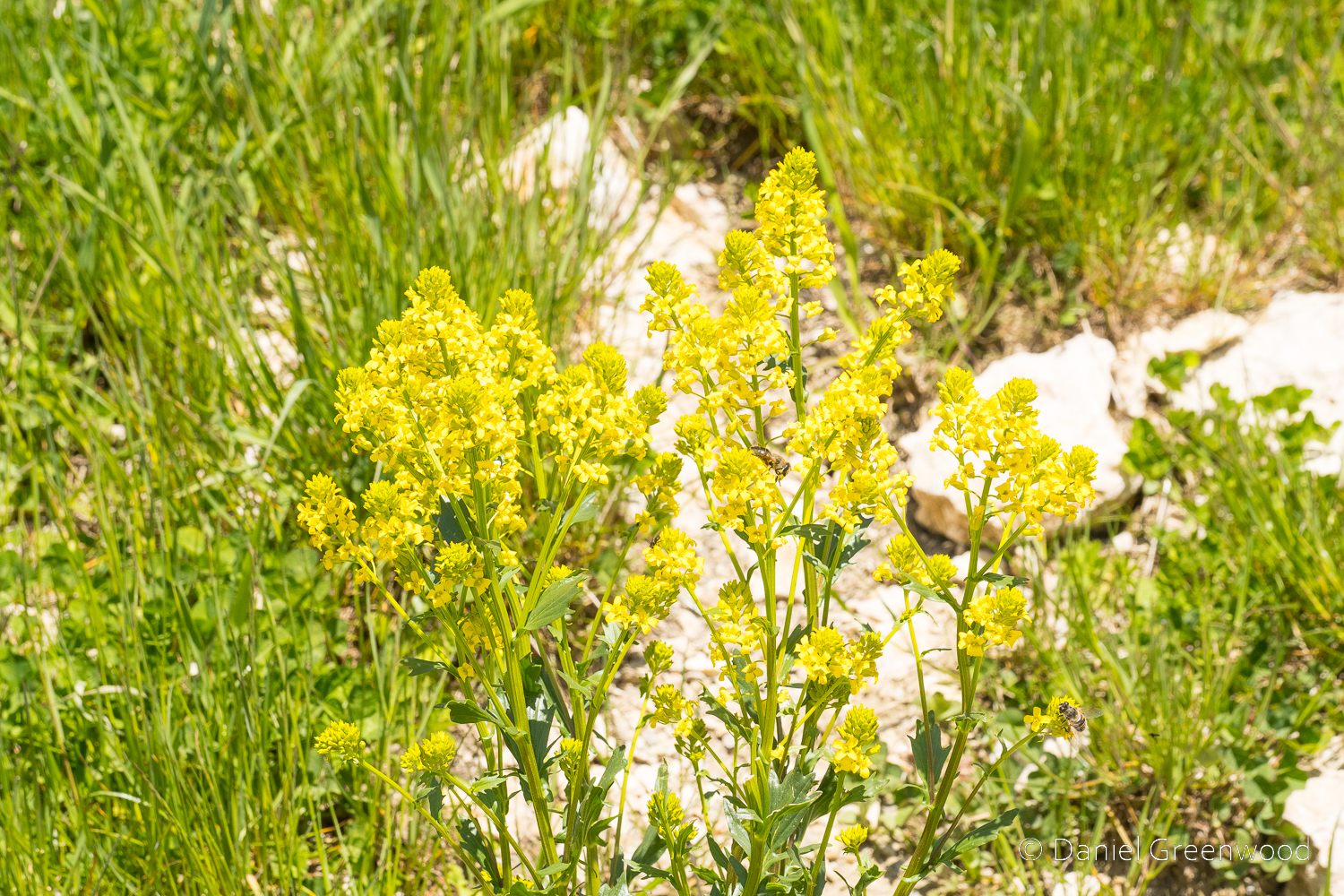
The first inverts I noticed were these hoverflies (probably droneflies) feeding on this brassica.
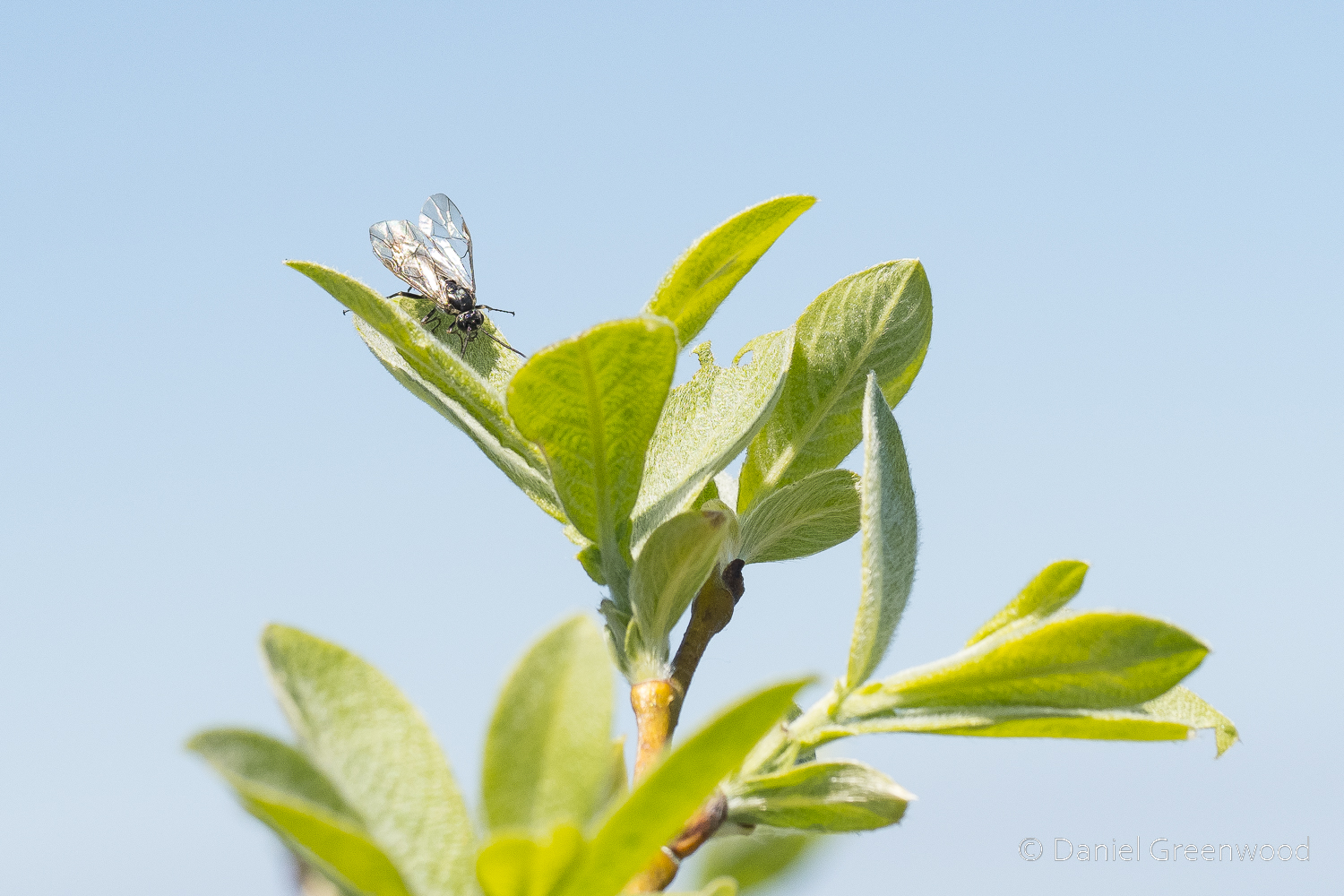
This willow shrub was growing out of one of the viewpoints (see below), and had lots of insects waiting for their close up. This is a saw-fly.
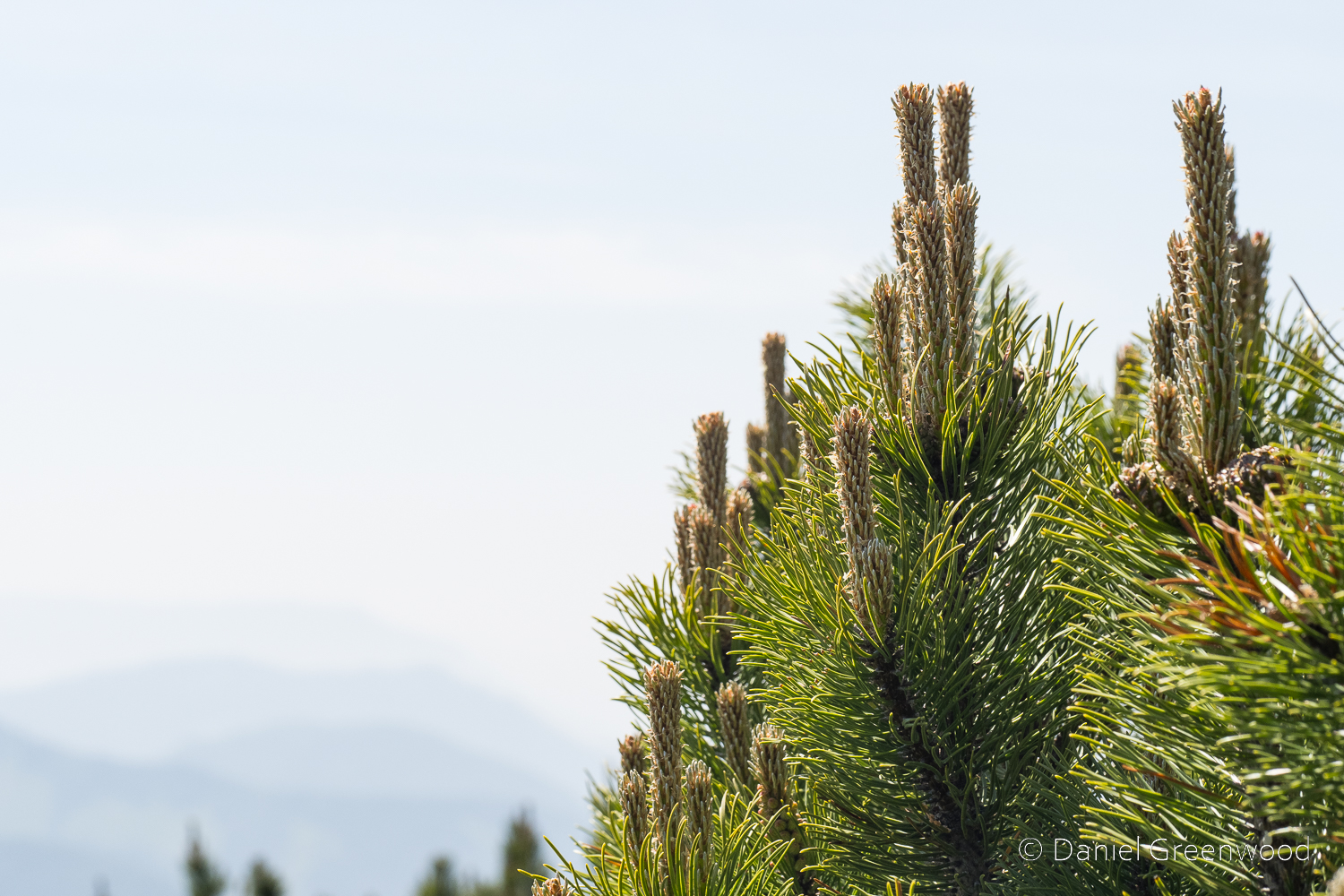
Mountain pine is like a shrub dotted around the alpine grasslands.
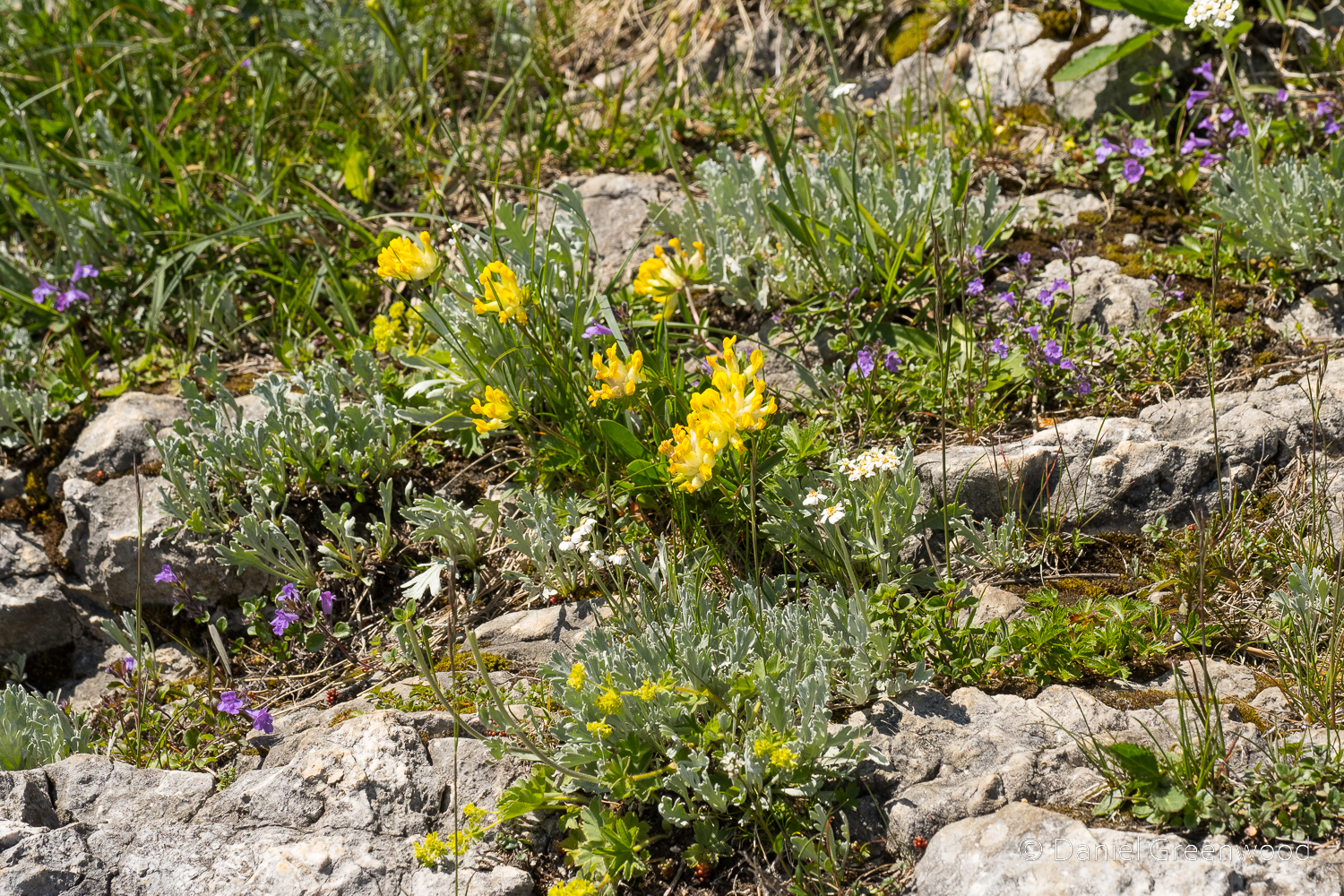
The limestone can be seen where the grasslands can’t grow. Thankfully the decline wasn’t as steep as this on the main path, but it wasn’t that far off.
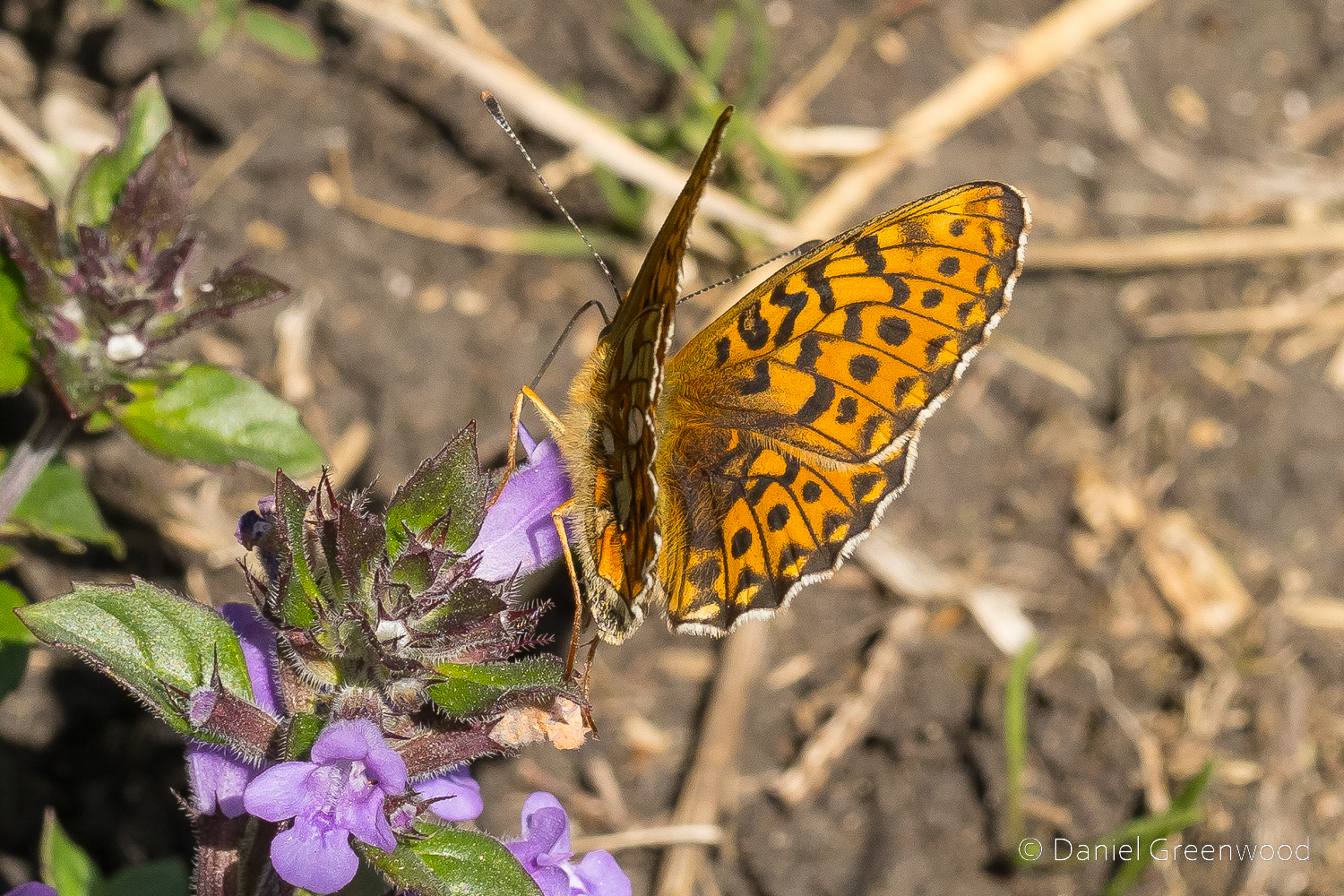
The butterflies were not as numerous as they were lower down on Zwölferhorn, but there were a good number of fritillaries. iNaturalist is suggesting this is pearl-bordered frit.
On the rocky outcrops of the path the flowers were a-bloomin’. This is kidney-vetch, unless I’m mistaken.
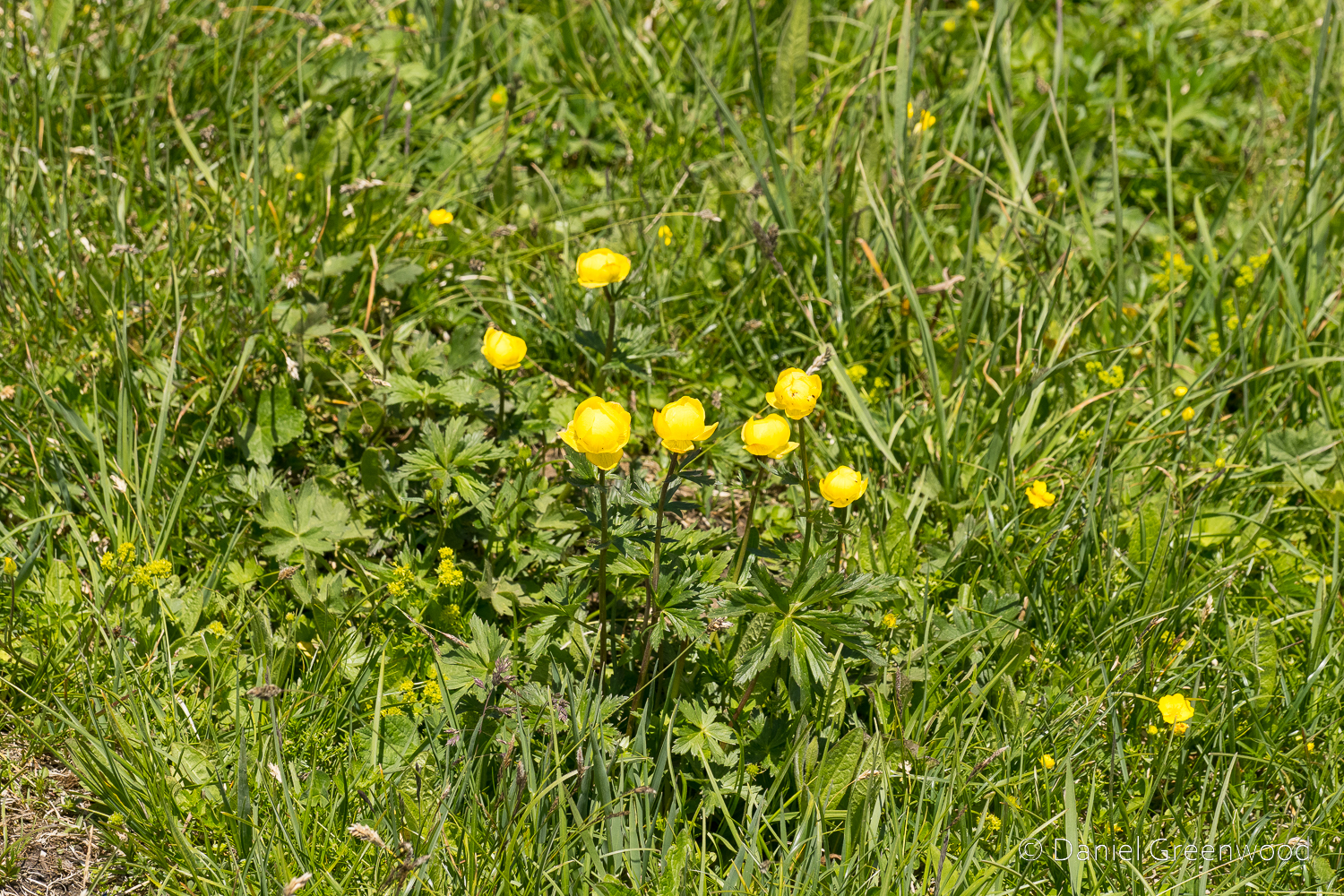
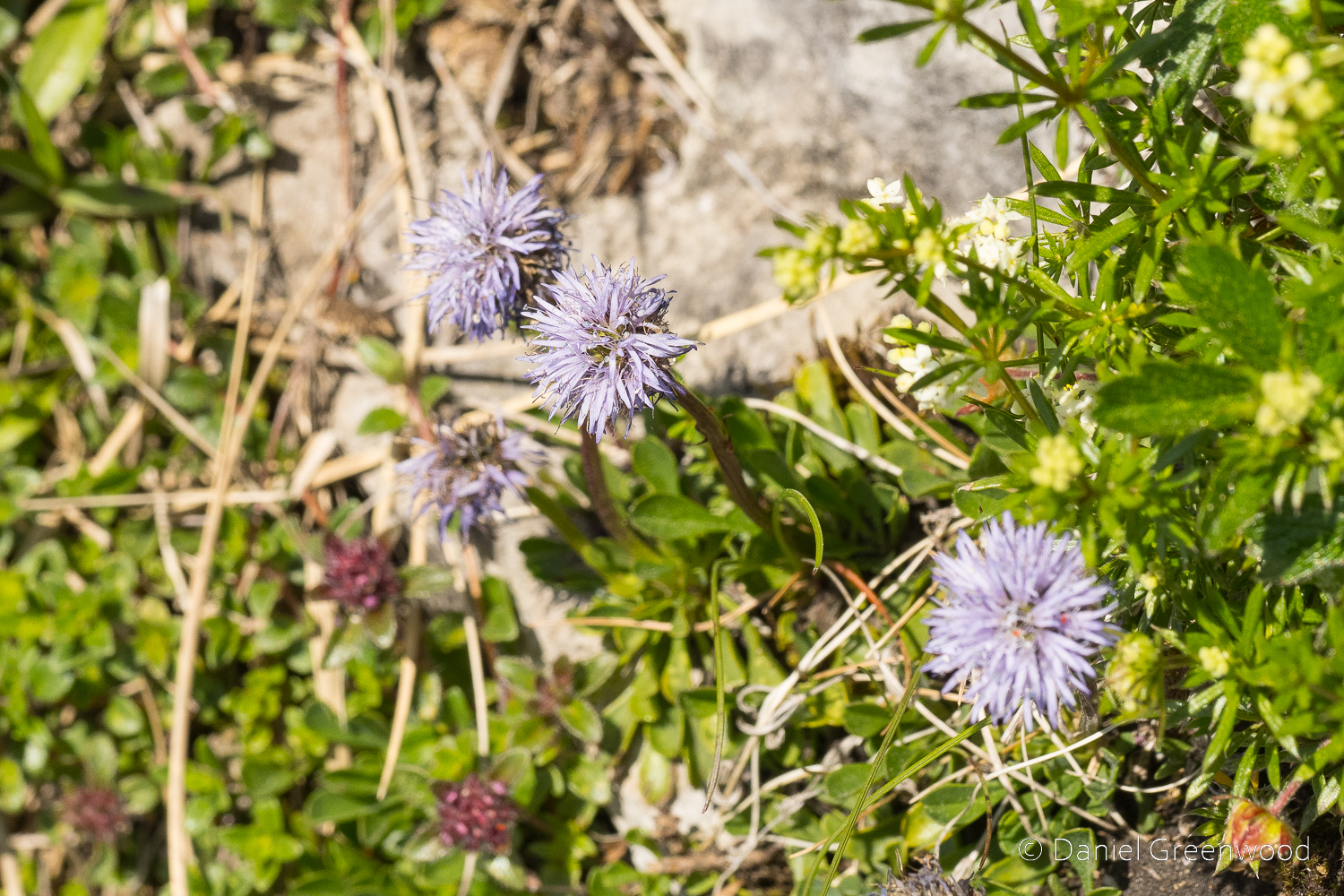
Globe flowers are a group I remember well from the Swiss Alps, they are probably more of a spring species than in mid-June. Not to be confused with the buttercup globeflower seen above.
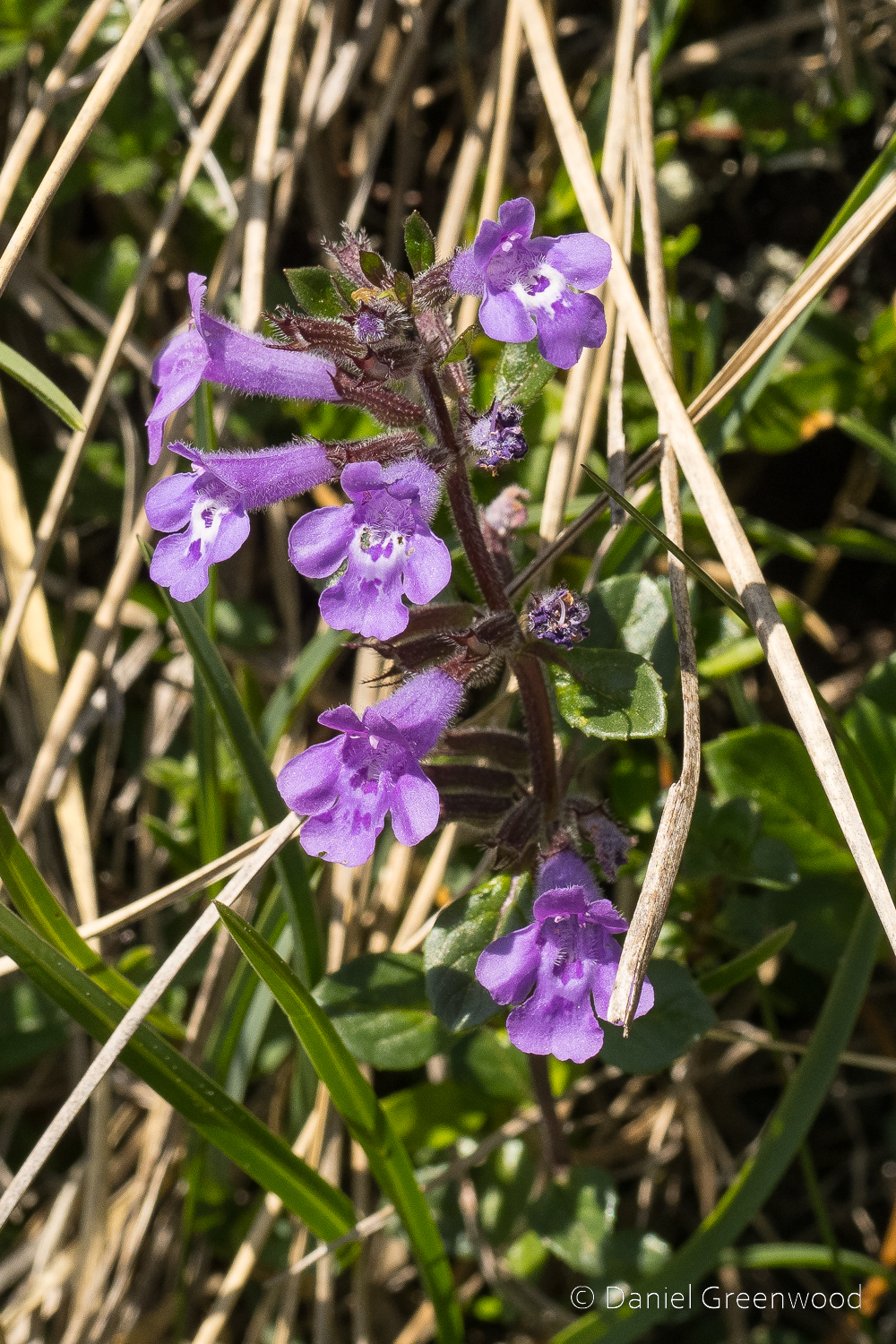
I think this is rock thyme, which looks a lot like ground-ivy.
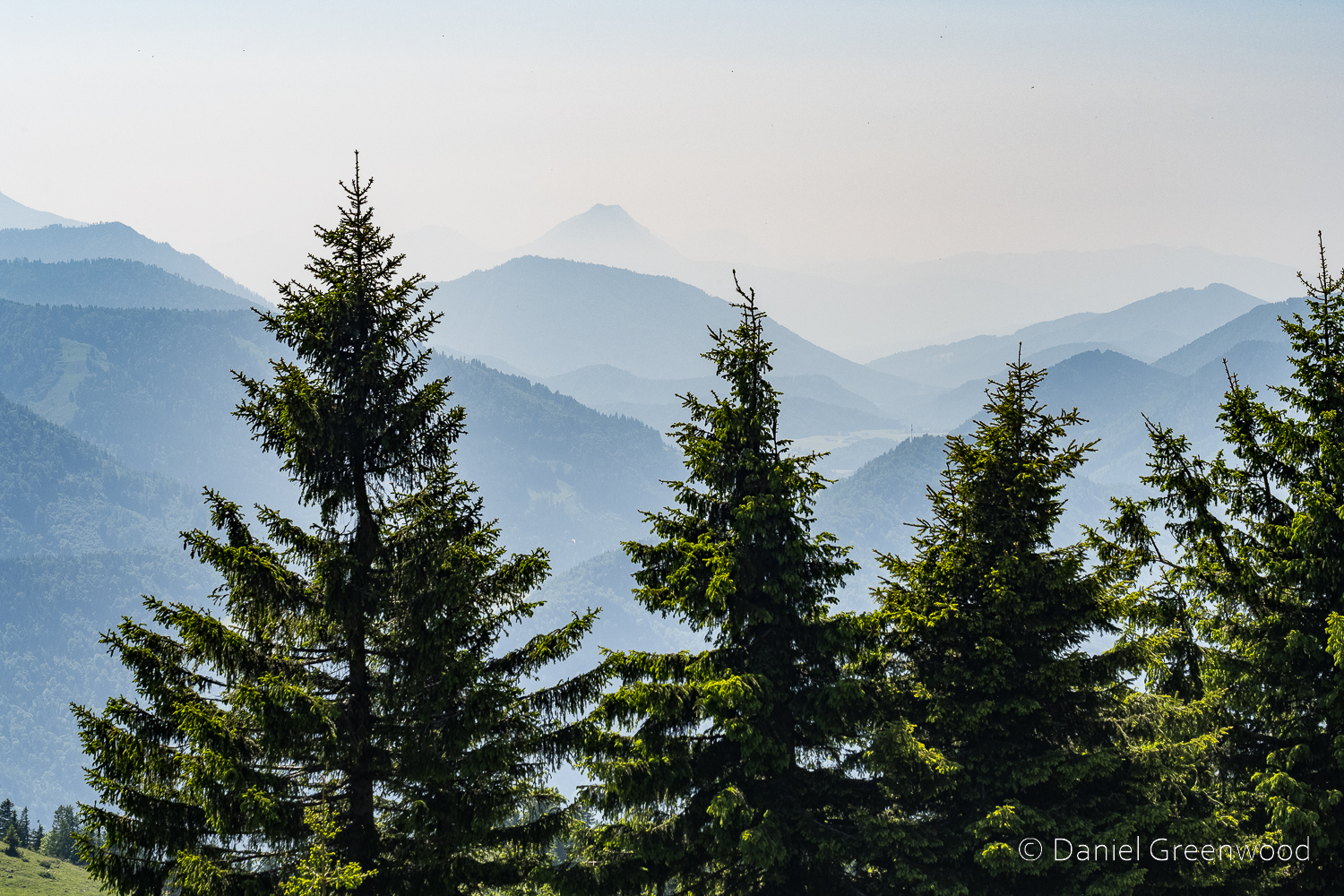
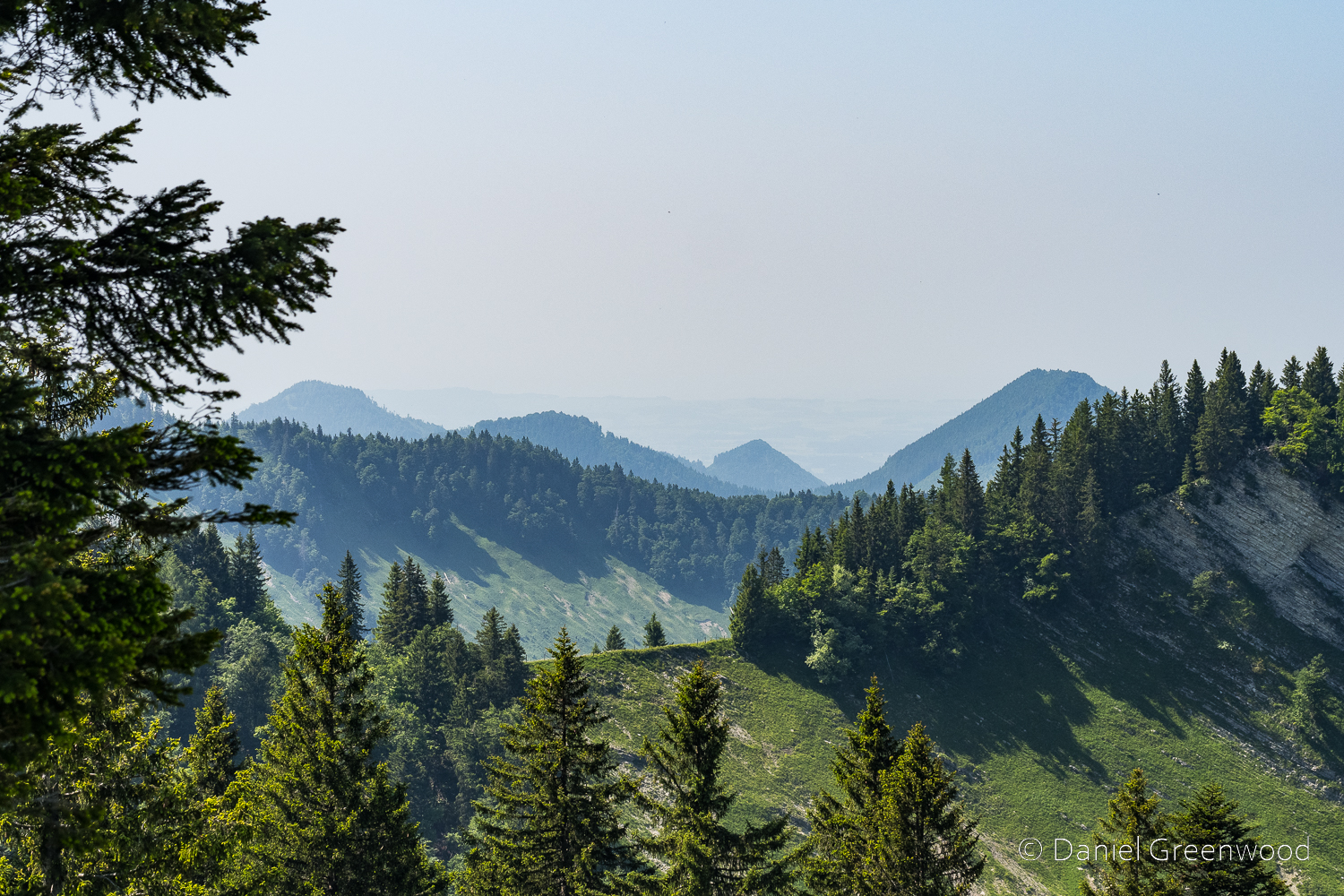
The views are spectacular along this part of the walk, so it’s a matter of looking at the plants and butterflies around your feet, and the vistas beyond, without tripping up!
The train meets you as the steepest stretch of the walk comes to an end. The gradient is nicely illustrated here.
You pass the Gasthof Schafberg-Alpe which is not in use at the moment. It’s the site of the station before the top of Schafberg. You can jump out here and walk up, or get the train back down. We continued on to St. Gilgen, down through the woods.
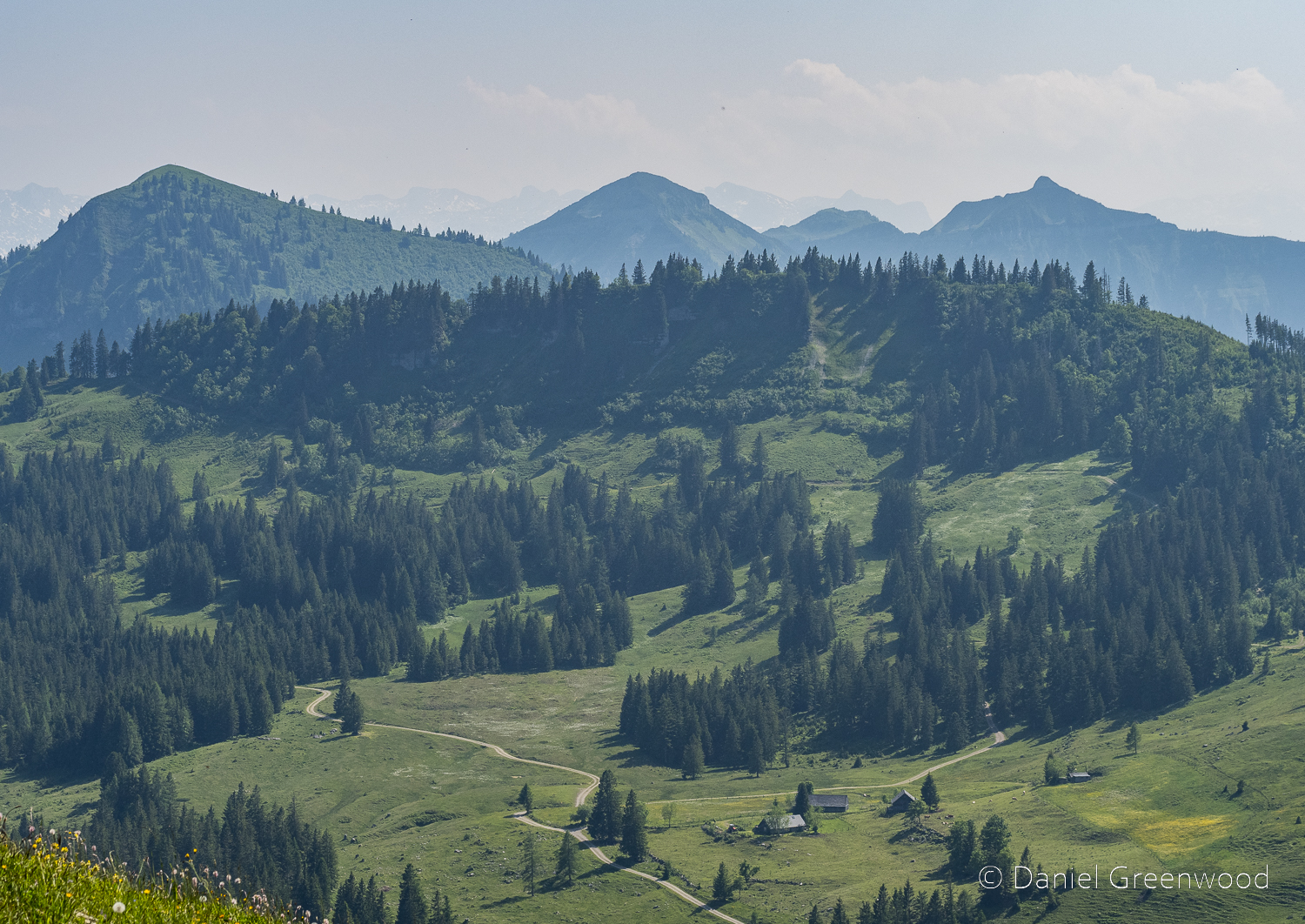
The ground levels out here and the walking is gentler for a time. The views are some of the most awe-inspiring I’ve encountered.
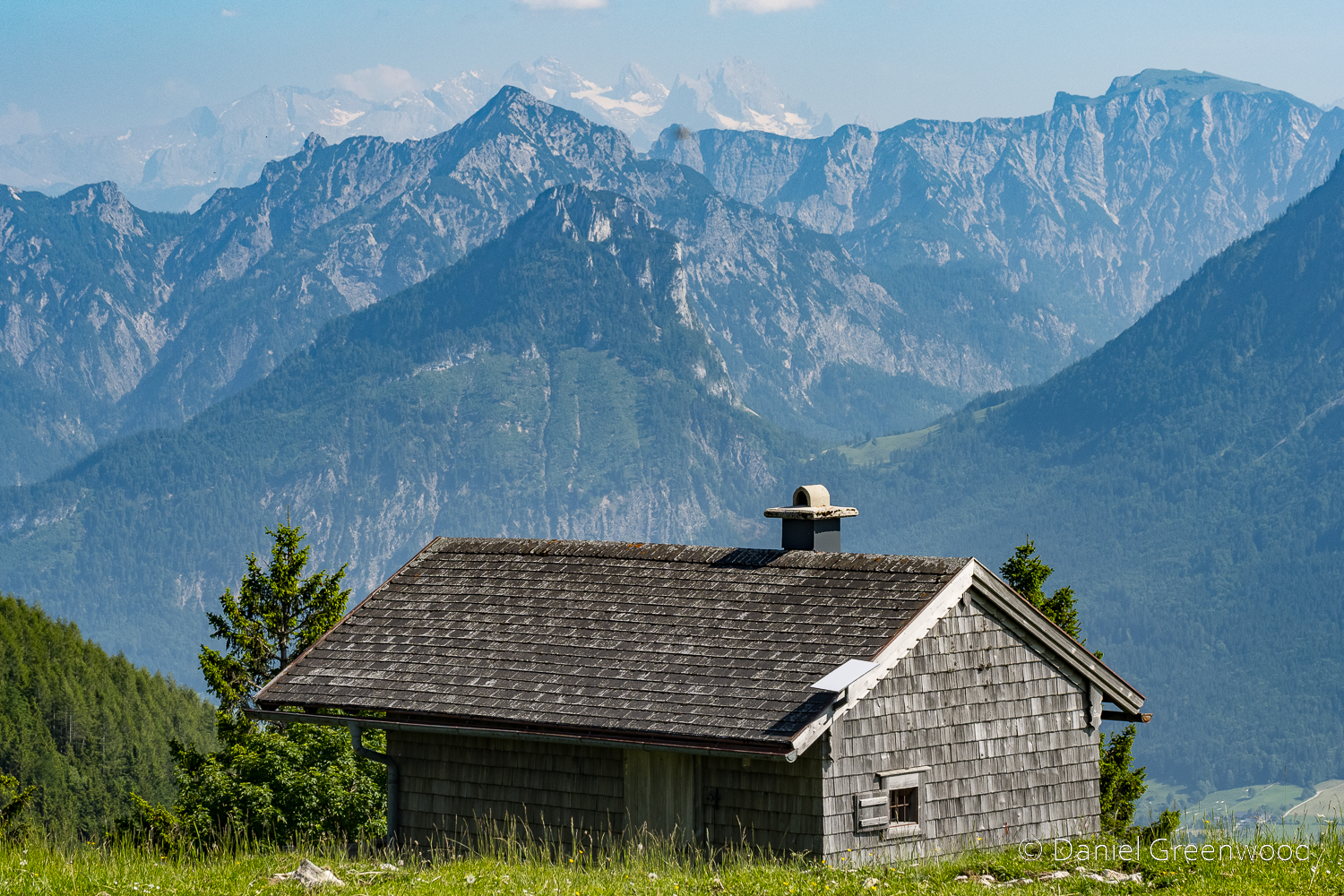
There are a number of wooden huts in this part of the walk, which make for helpful foreground subjects, with Dachstein in the distance.
It’s at this point that you can see how far you’ve come (literally) as the path then moves into woodland.
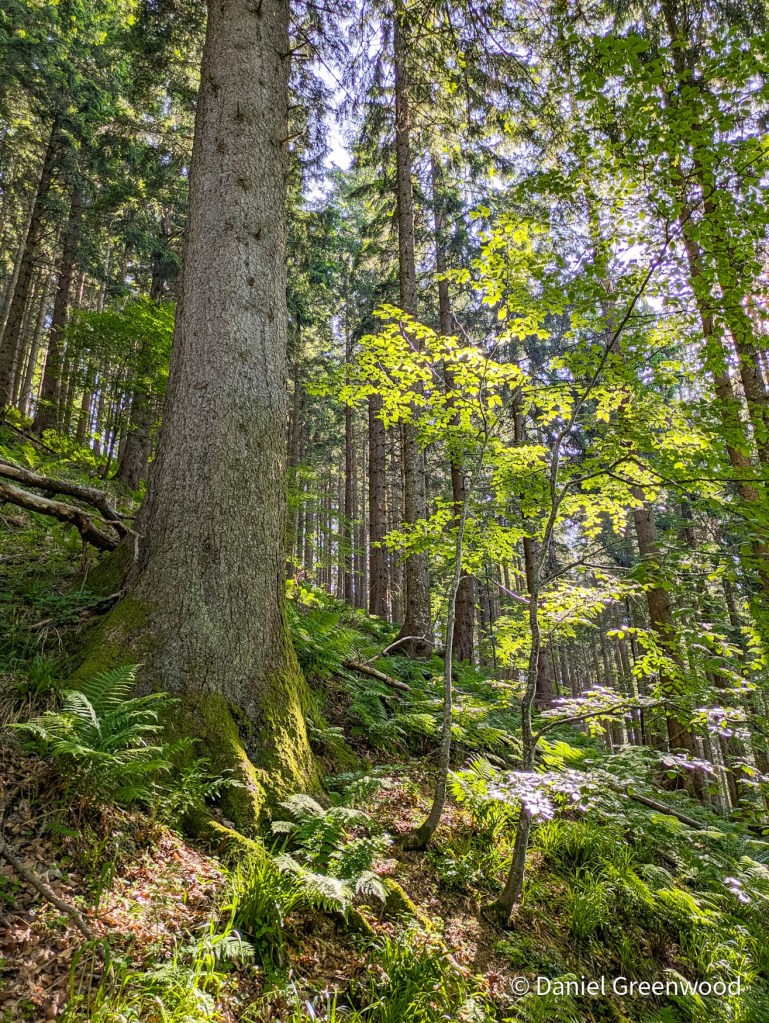
The shade was welcome, but it was very steep and winding.
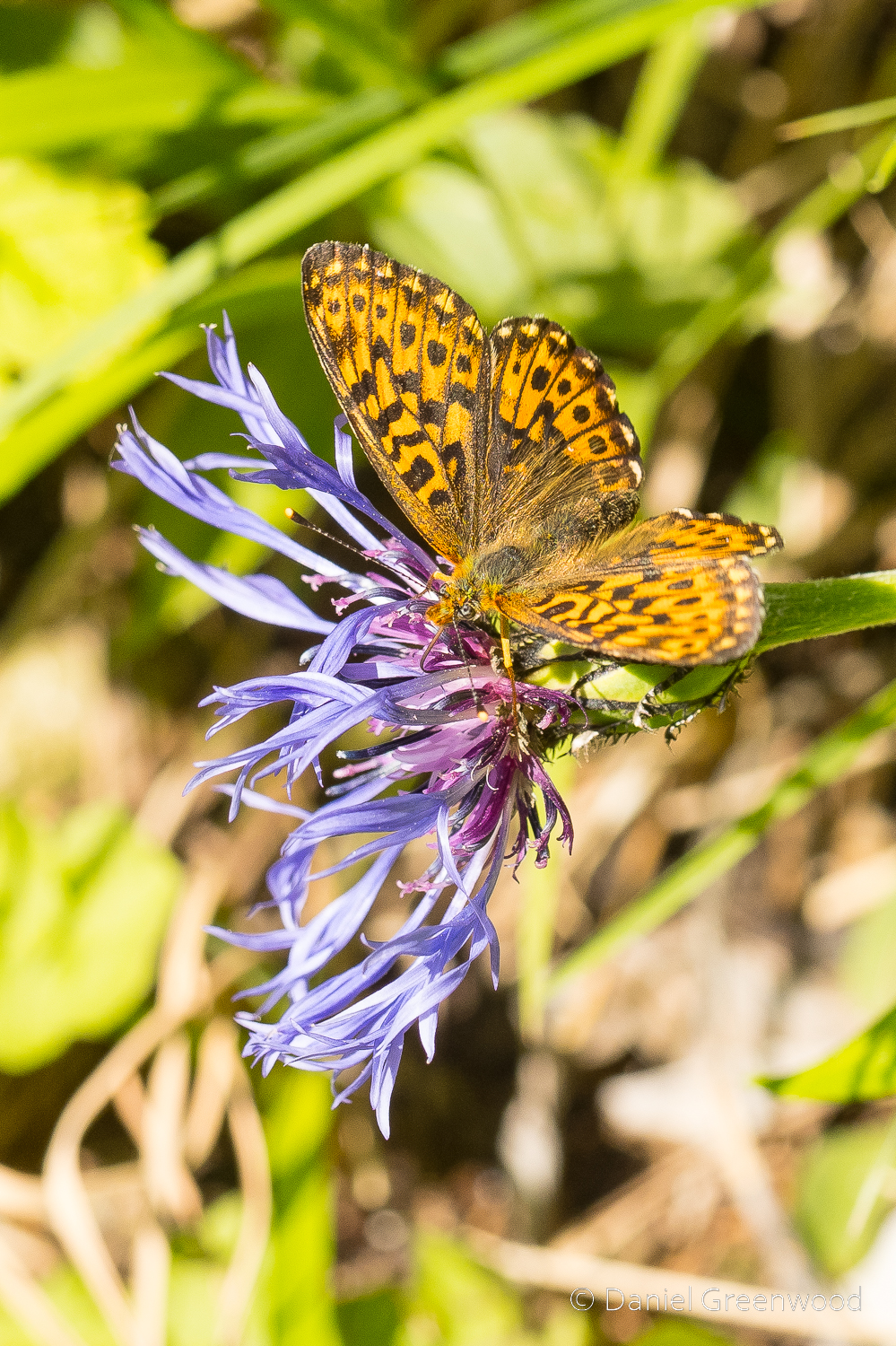
This is probably another pearl-bordered frit, feeding on a plant I actually have in my garden here but that grows wild in the mountains – perennial cornflower.
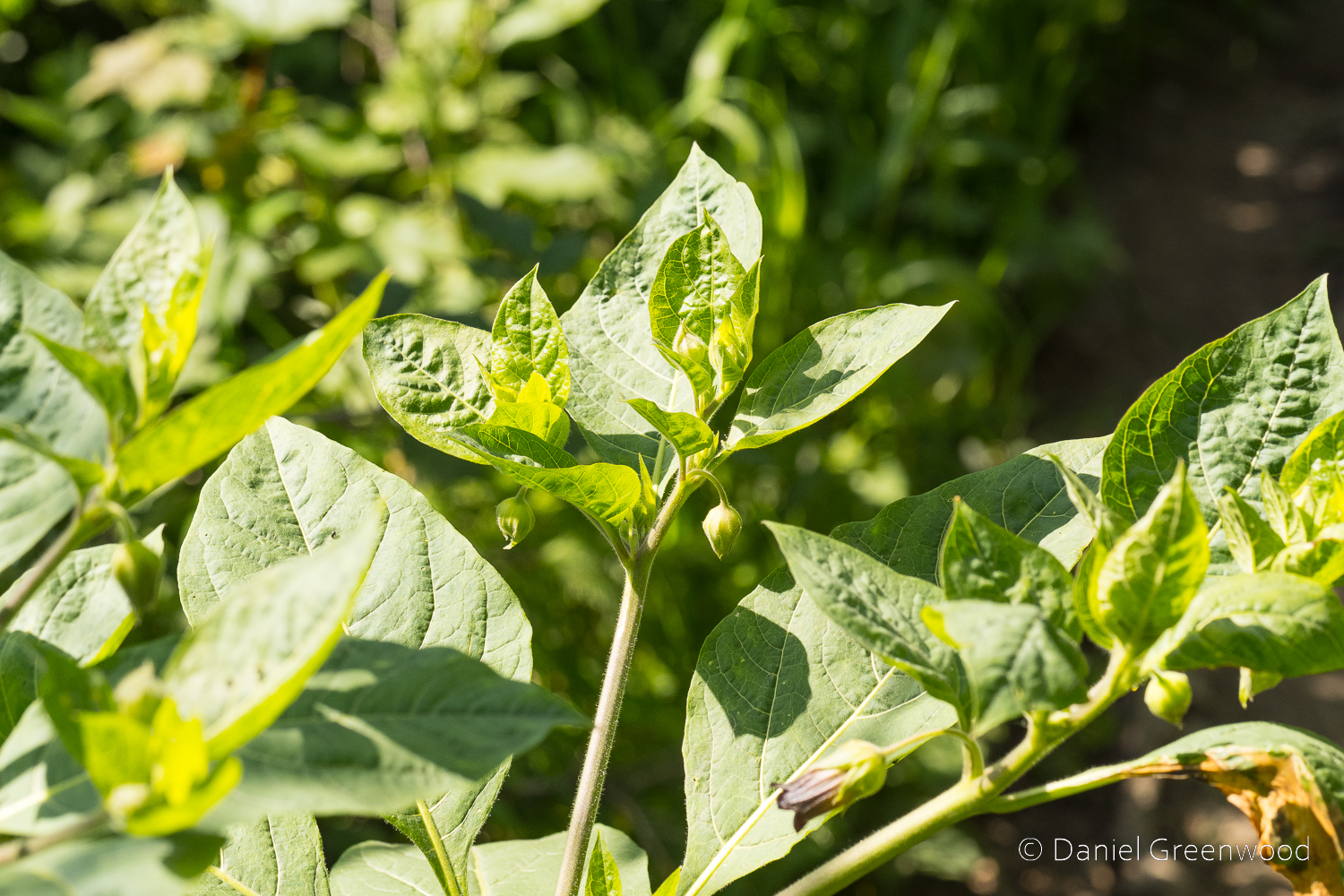
Don’t worry you can’t get poisoned through your screen. This is deadly nightshade, also known as henbane, growing in the woods below Schafberg.
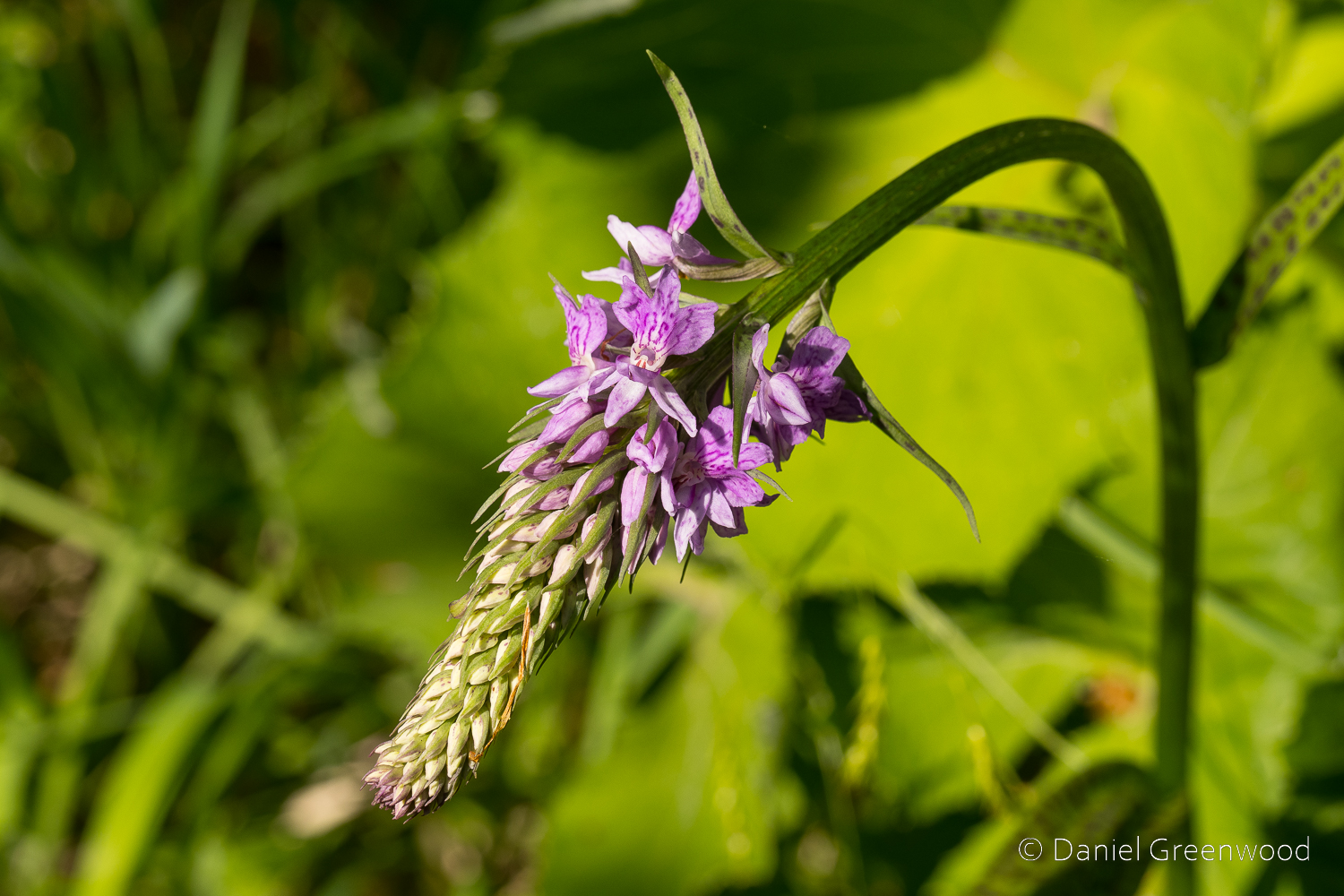
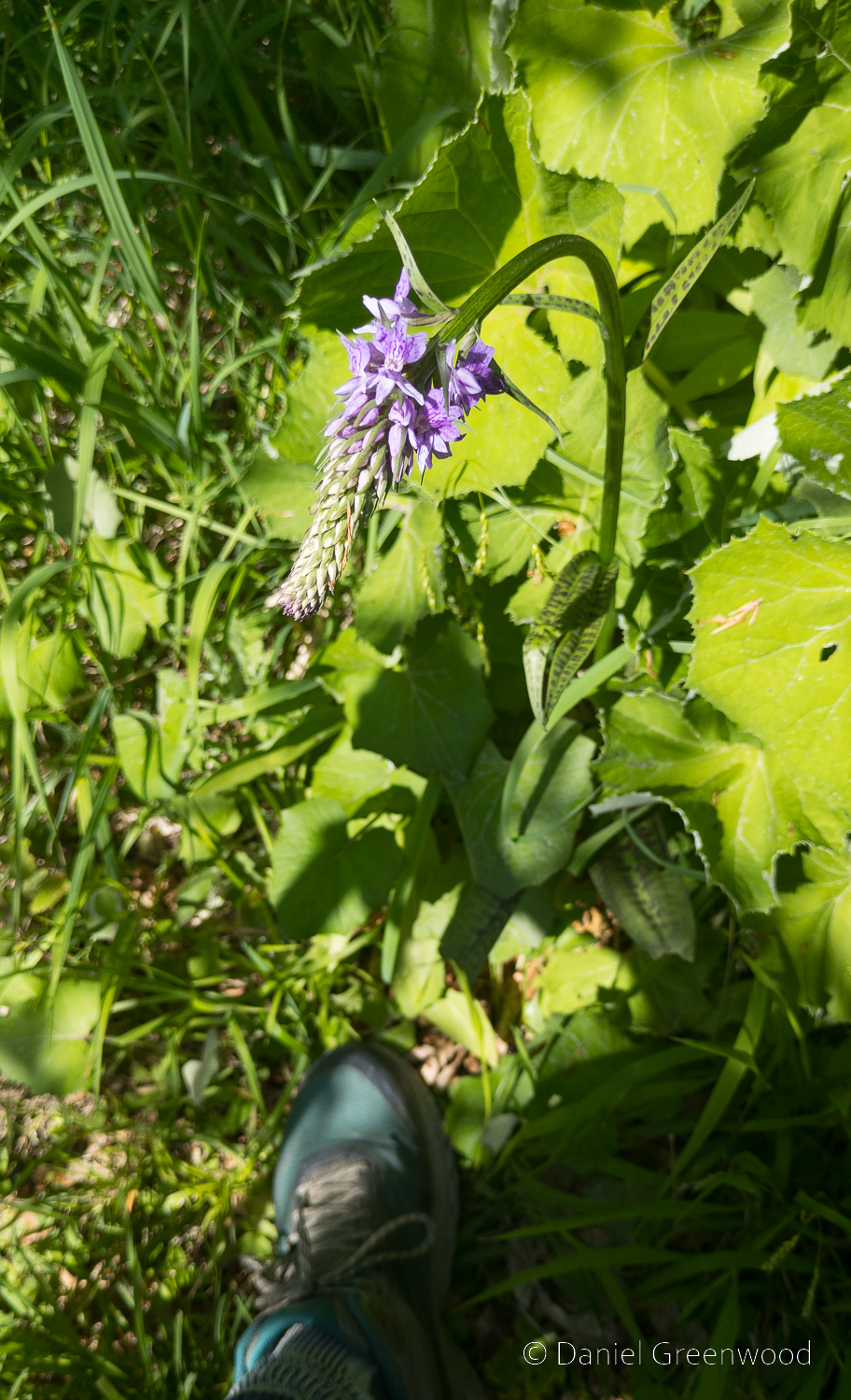
Now, this is the biggest orchid I’ve ever seen. My foot in the image on the right should show just how tall this is – knee-height. Does anyone know what on earth is happening here – is it some kind of hybrid?
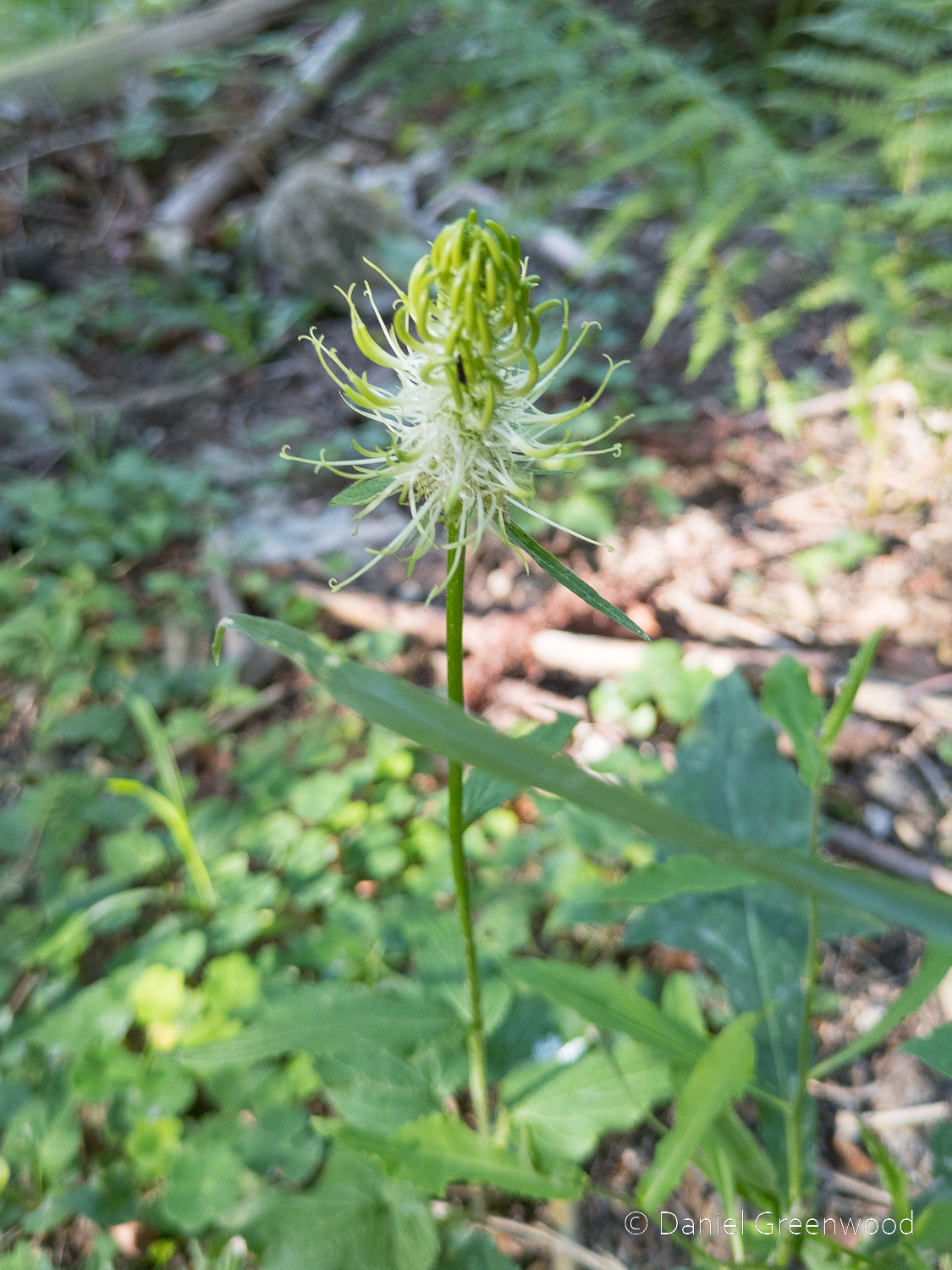
This is an out-of-focus phone pic but it’s a species I don’t see often – spiked rampion.
On a fallen tree across the track I found a nice collection of wolf’s milk slime mould. I was too tired to pop them.
We arrived in the village of Winkl and soon we were among hay meadows.
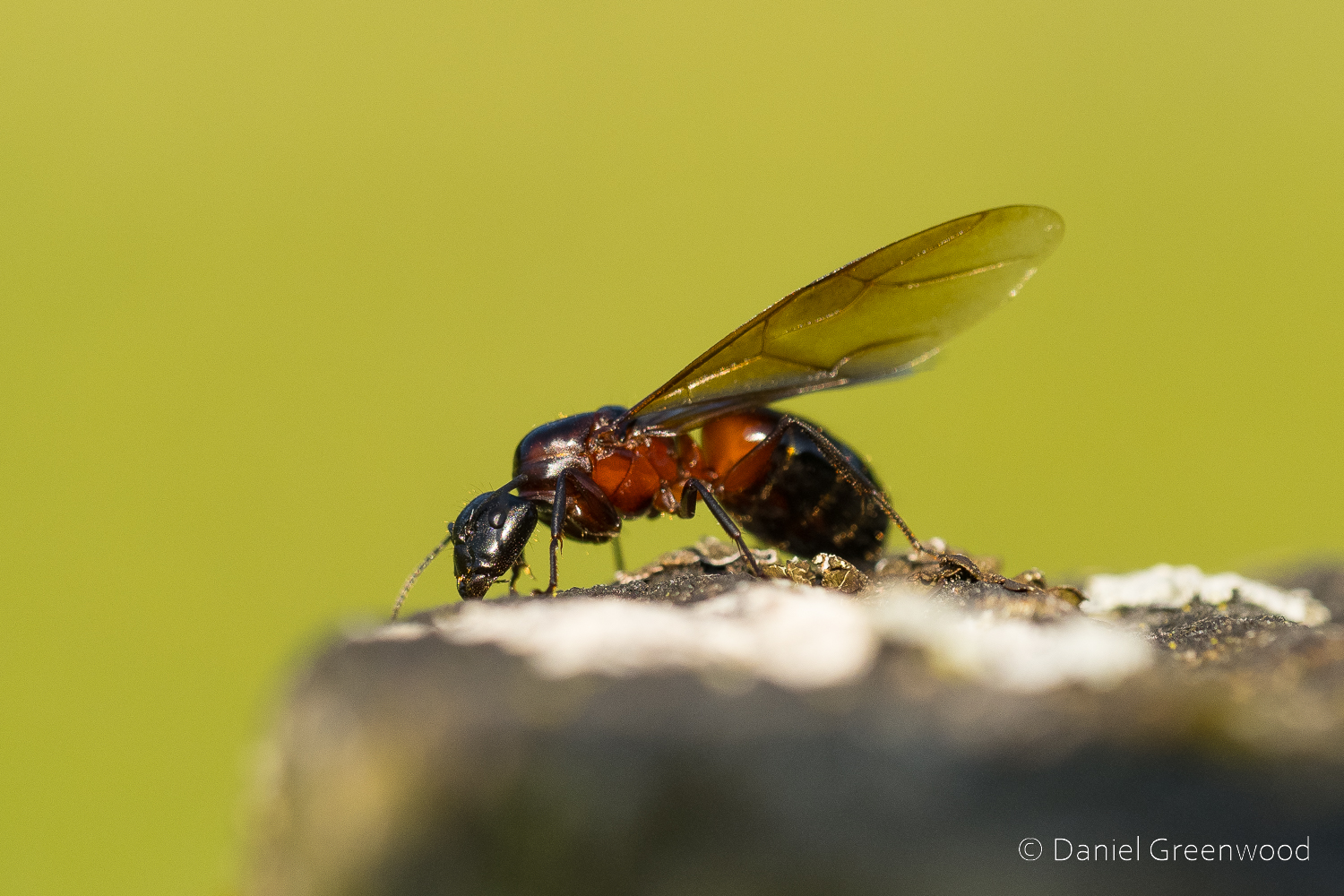
This brown-black carpenter ant was poised on a fencepost, perfect for a pic. There were a couple higher up on Schafberg, so it must have been one of their ‘flying-ant days’ as we say in England.
Another species that I only see when in Europe is this buck’s-beard, growing at the roadside.
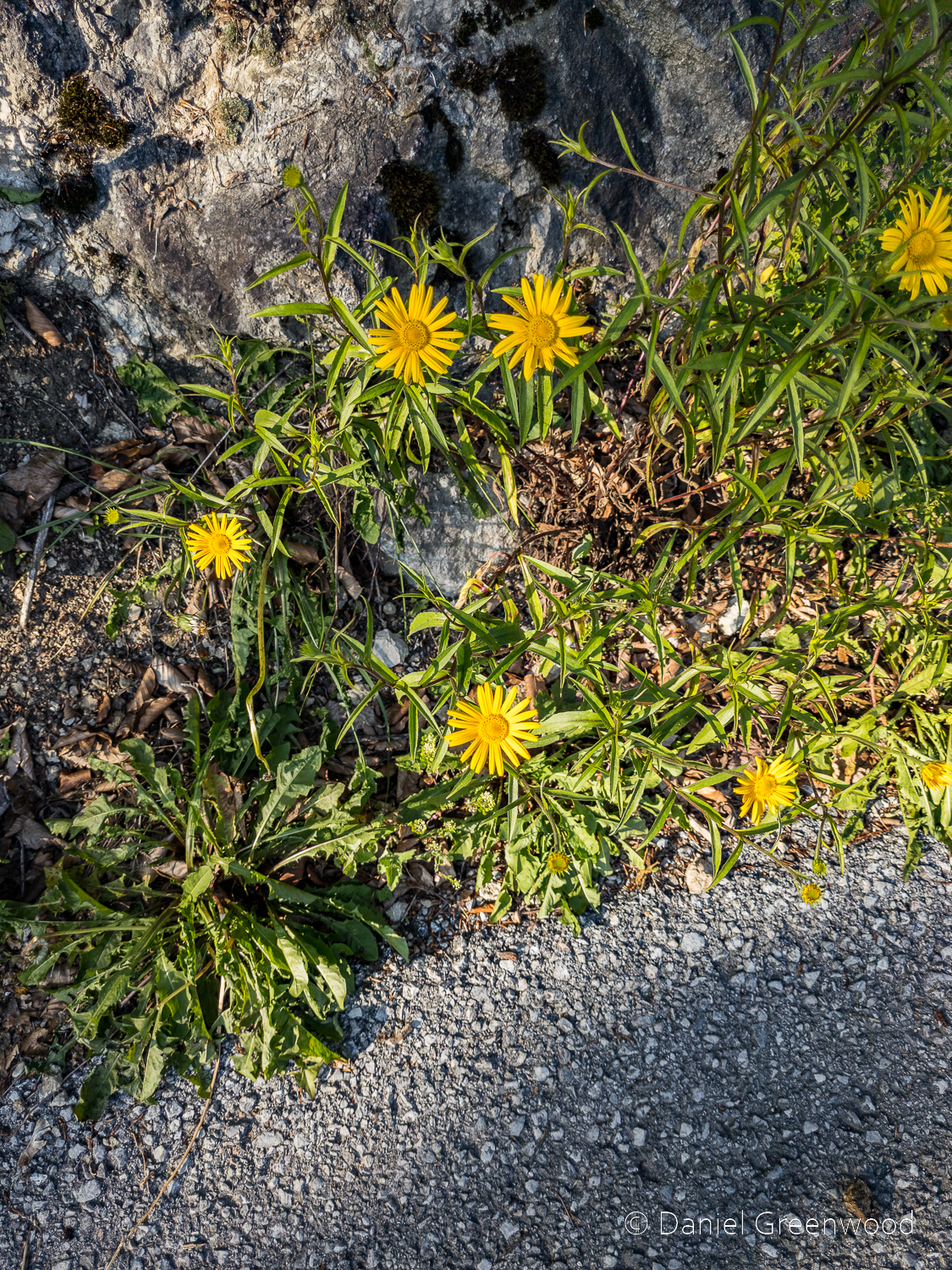
Having descended to the shore of Wolfgangsee, there were these lovely willow-leaved yellow oxeyes growing at the edge of the path.
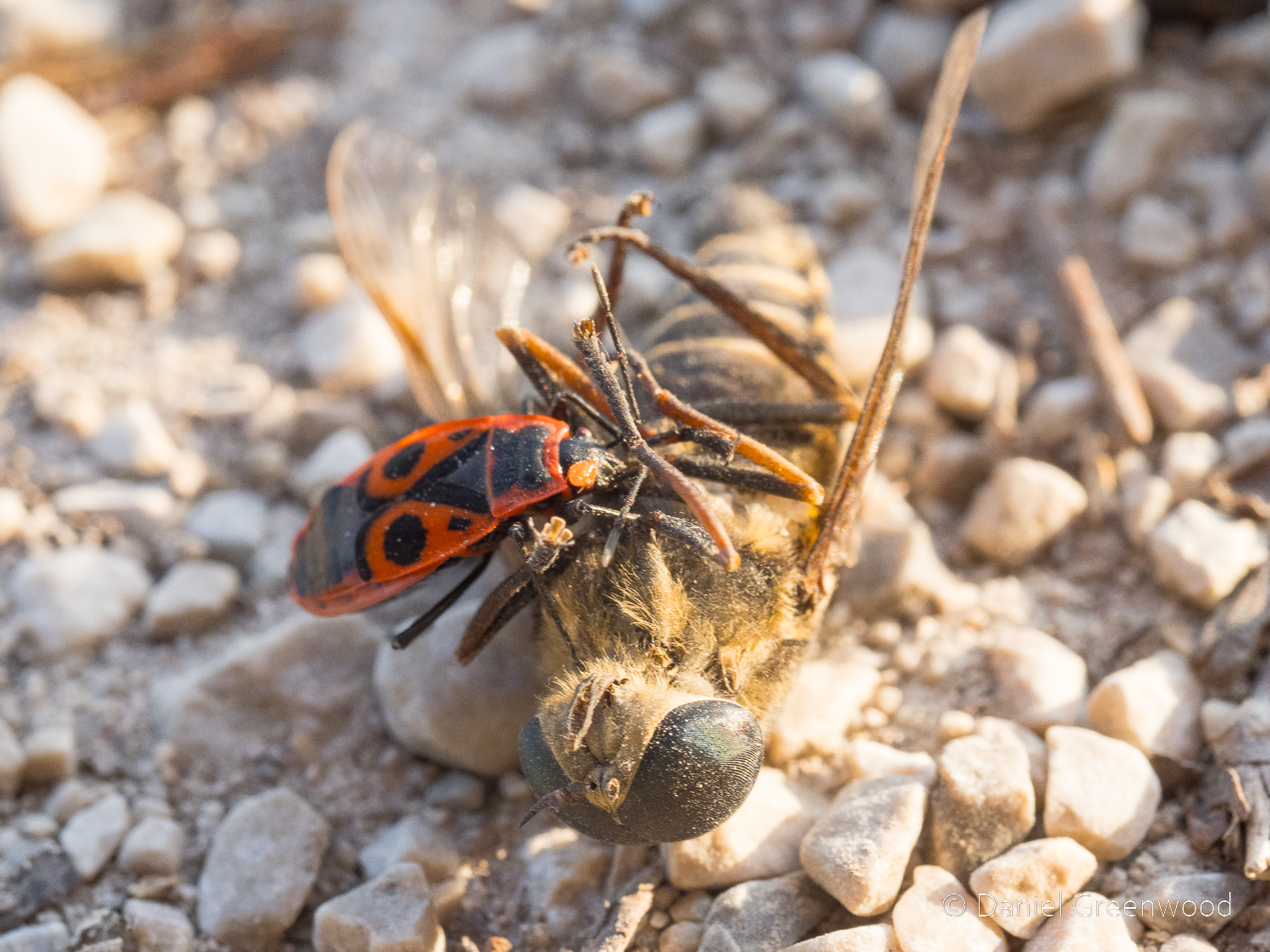
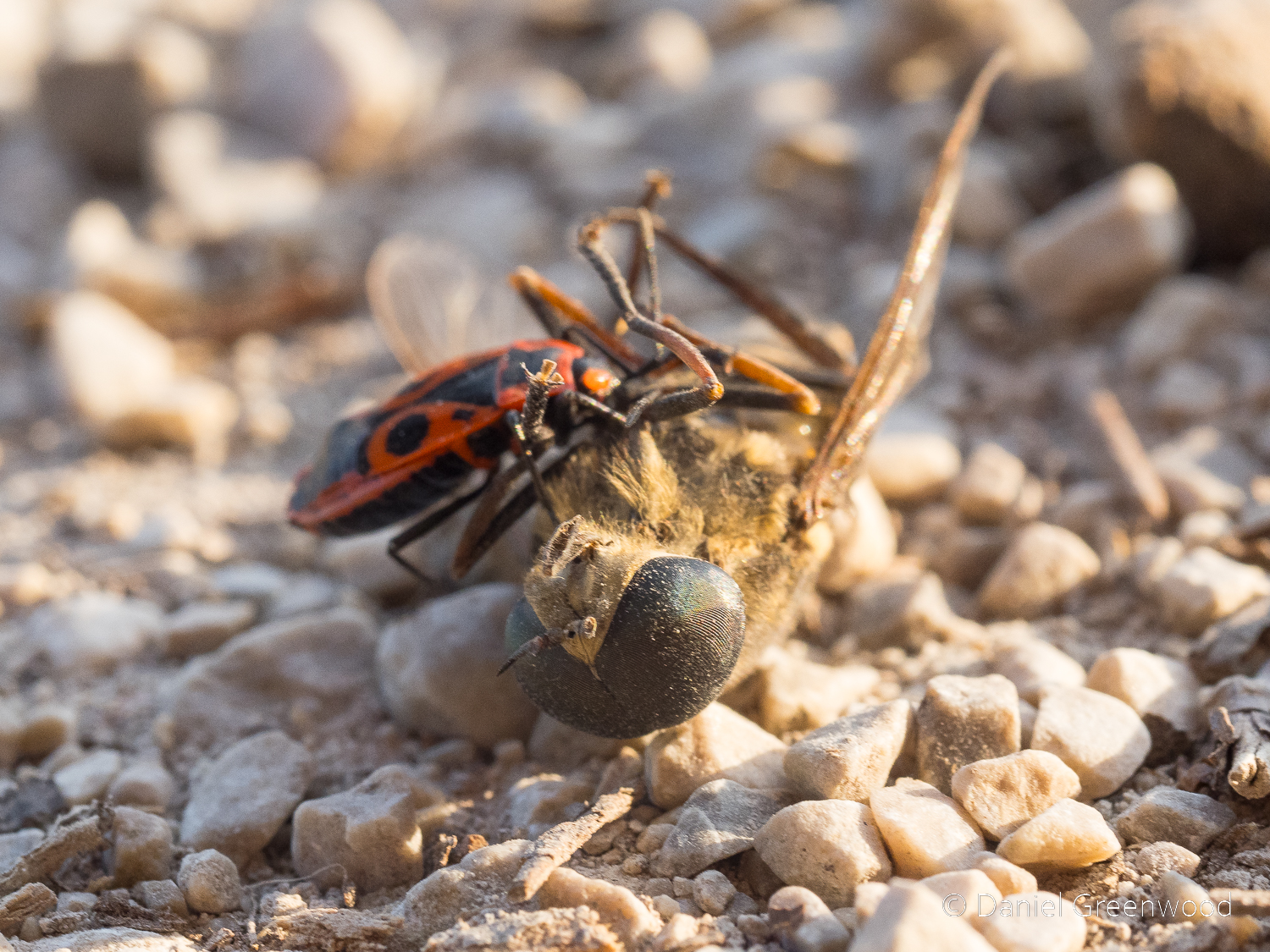
To end, I was quite tired by this point and wondered what on earth was happening. This is a mix of phone pics and mirrorless camera pics, of the scene of a dead horsefly being eaten by a cinnamon bug. If you look more closely you can see a red mite on the head of the bug, so the mite is the winner!
Not that kind of battle, but instead to the village in East Sussex. Battle the village is the site of one of the major battles of the Norman Conquest of England of 1066, when the Normans invaded Britain and defeated the Anglo-Saxons.
It’s a period in history that absolutely fascinates me. The land ownership brought about by the Normans has shaped much of the rural landscape today, bar the impact of the enclosures in the 18th-19th centuries.
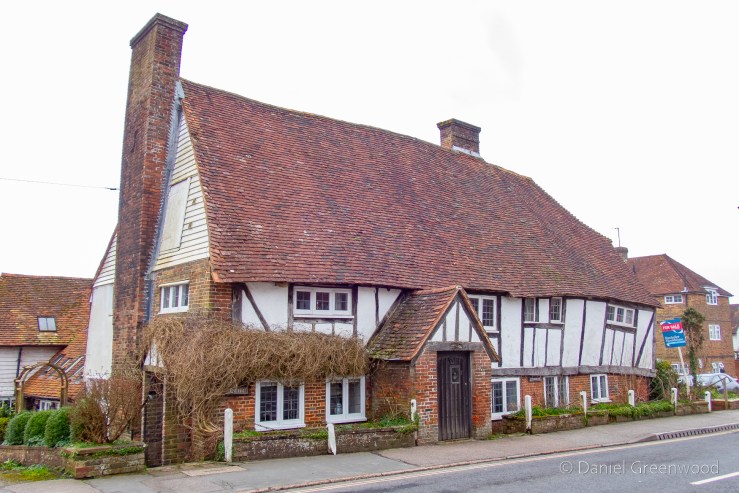
I was passing through from Rye in February 2025 and wanted to experience Battle (the village), so we stopped off for some food and a walk around. The main photographic interest was in the timber-framed buildings. It’s always worth checking out old Sussex villages because they are so rich in history and much of it is well preserved.
The timber-framers are concentrated along the rather loud high street, noisy because it’s the main road and has a fair amount of agricultural traffic.
Now squeezed in by the George Hotel, it’s home to a charity shop raising money to support homeless people.
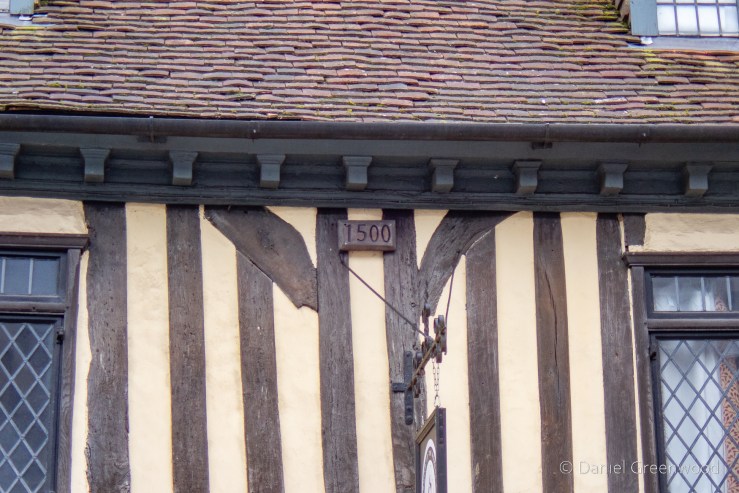
I know it says 1500, but it goes deeper than that.
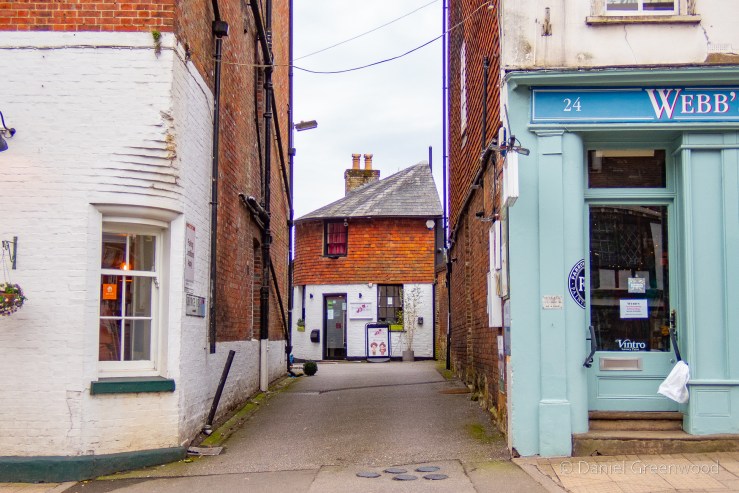
I enjoyed this little alley view, but I’m not sure if it’s too wide to be a twitten.
If you came here looking for food, tough luck – the kitchen was demolished in 1685. I’m confused by the date as the Historic England listing only dates it to 1688. What happened to the kitchen!?
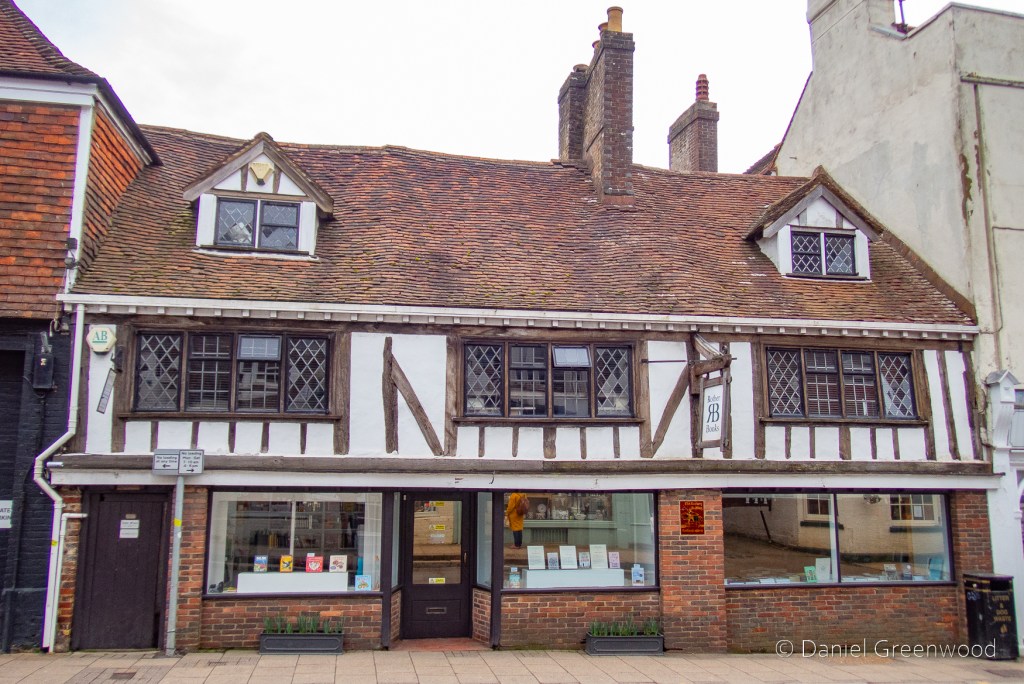
This is the imaginatively named 59 & 60 High Street. It’s been restored but dated to the 1400s. Just goes to show how old Battle High Street is.
Before turning off the main road onto Mount Street, I enjoyed the ‘clap-boarding’ on this little shop. This is a technique used to protect the front of a house from rain and wind, hence its other name of ‘weather-boarding’.
This is a decorative hanging-tile style that you often see in Kent and Sussex. The tiles are ‘hung’ on two pegs from holes in the top corners of the tile and laid one by one over each other. It was introduced to protect timbers from rot and weathering, I think. This one doesn’t have a listing but is probably 1700s.
Now we’re talking. This large house, Lewins Croft, is the wonkiest of the wonkies.
It’s a joy, but a shame it’s so close to the road.
It’s also very old, dating to the 1500s.
Here’s another nice clap-boarded cottage along Mount Street, off the main road.
It’s been more than 20 years since I studied First World War fiction in sixth form college. It remains some of my favourite reading and has dominated my book consumption of late, so here’s a run-through of my adventures in this very challenging area of literature and history.
My family and the First World War
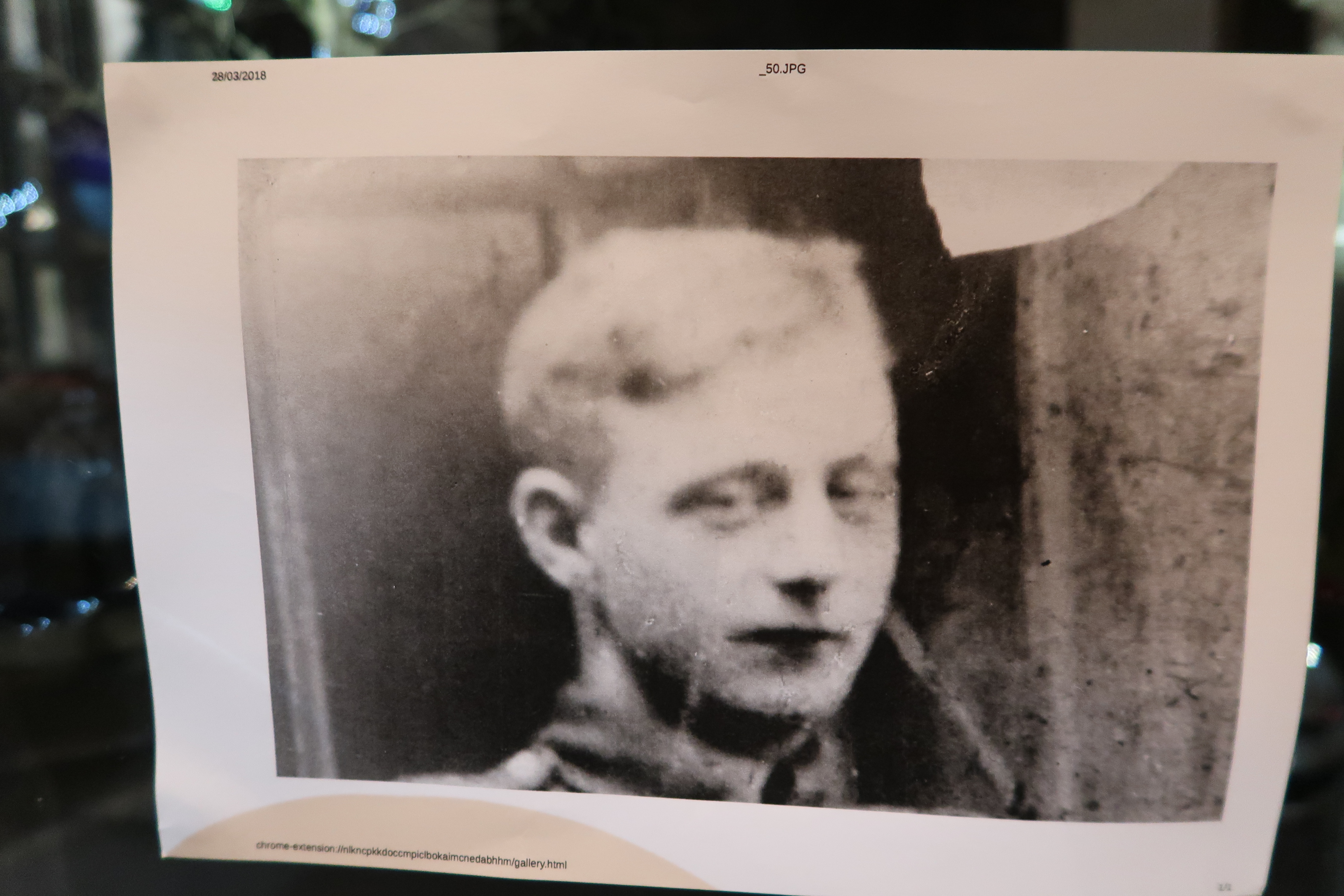
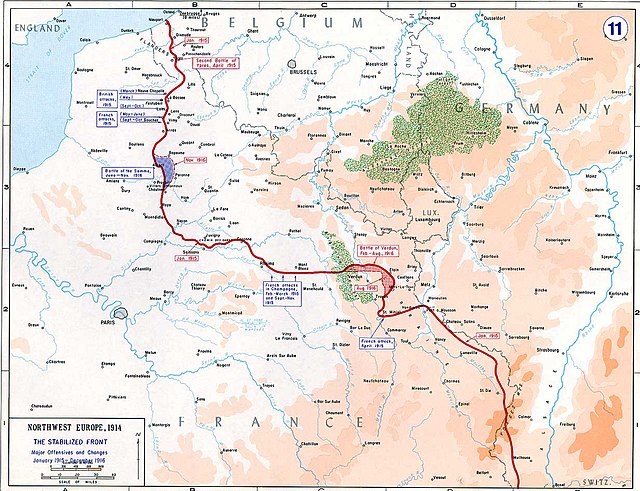
The face above is that of my great-grandfather Wilfred Hill (1896-1961). Here he is posing in his British army uniform some time around 1914 as he prepared to go to join the First World War (WWI). Both my paternal great-grandfathers served in WWI and both of them survived. One was at Ypres, the other at the Somme, both battles renowned for the conditions experienced by soldiers and the extreme loss of life.
I don’t know much about my great-grandfather Wilfred’s stint, but I do know he was a runner and may have been rescued by Canadian soldiers after being buried alive in a shell-blast.
First World War literature
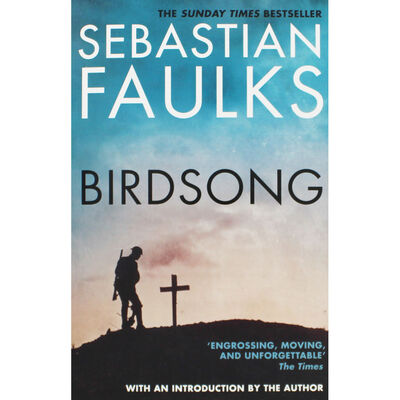
At A-level (aged 16-19) I studied the war poets Wilfried Owen and Rupert Brooke, and the more contemporary novels Birdsong (1993) by Sebastian Faulks and Regeneration (1991) by Pat Barker.
I found Birdsong ‘unputdownable’, but Regeneration a bit more difficult to love at the time.
The poetry has not really stayed with me, possibly because it is so tragic, Wilfred Owen being killed so late in the war. Part three of Barker’s Regeneration trilogy – The Ghost Road (1995) – dramatises Owen’s death, what I felt to be the best of the three novels. It also won the Booker Prize in 1995.
Another WWI novel that really captured my late-teenage mind was the Ice Cream War (1982) by William Boyd, telling the story of life in Africa while the British and German empires battled one another for territory. It began to reveal to me the complexity of empire, war and the relationships between the people mixing in those places.
“They didn’t talk about it”
My great-grandfather Wilfred was 22 when the war ended, but he had probably lived many lives over in that four years.
When I spoke to my dad about his grandfathers’ roles in that war, he said they didn’t talk about it. His maternal grandfather, Charles (born 1895), didn’t say much at all by the sounds of it! The issue of WWI veterans not talking about the war or the difficulty integrating into society during and after the war is a major theme of WWI literature, such was the brutality of it all. I’ve read about it in Regeneration, Birdsong, and the German novel The Way Back (1931) by Erich Maria Remarque.
J.L. Carr’s A Month in the Country (1980) tells the story of a WWI veteran who moves to a Yorkshire village to restore a church mural, post-war. The story expresses some of the social issues found in rural village life, between those who had served and those who had remained at home, not least the difficulty of finding love again.
Returning to the WWI novel
In 2024 I enjoyed a rich seam of fiction, mainly WWI literature, including the Pat Barker trilogy Life Class (2007), Toby’s Room (2012), and Noonday (2015). Looking at my reading list from last year, it didn’t include a single ‘nature writing’ book, which may surprise some readers of this blog. Instead my list is comprised almost completely of novels about WWI.
I wonder why that is. I remain staunchly anti-war (but aware of the need for self-defence) in my personal outlook on world events. Perhaps the wars in Ukraine, Gaza, and Sudan have me trying to understand why these things happen and the impact they have on people swept up by them. Perhaps I am preparing myself for what Trump’s election means for Europe, and the potential selling-out of Ukraine, and thus Europe, by his inexplicable cosying up to Putin, a war criminal.
Non-British perspectives
During my university years my dad handed me his copy of The Good Soldier Svejk (1923), a satirical account of a Czech soldier serving the Austro-Hungarian Empire in WWI, against the French and British forces. It is one of the few books that has made me laugh out loud, not something you will really find in British WWI lit. The illustration above should offer you a sense of it.
Offering an Irish perspective, Sebastian Barry has two exceptional novels which cover this terrible period in history.
The brilliant A Long Long Way (2005) by Barry includes elements of the Irish ‘Easter Rising’, which helped me to understand how the two conflicts were interlaced, and how much WWI was a war of collapsing European empires. Though not focused solely on the war, The Whereabouts of Eneas McNulty (1998) tells the story of a man’s life through both WWI and the Second World War (WWII). It’s one of the most enthralling novels I’ve read in a long time and has the feel of a classic to me.
Prince Leopold of Bavaria inspecting German soldiers on the Western Front on 14 November 1914.
At school we didn’t study All Quiet on the Western Front (Remarque, 1928) but in the autumn of 2024 I finally read it, having already seen the Netflix adaptation. As many will already know, it is an incredible novel. It is possibly the first WWI novel I’ve read from a German perspective, but the anti-war sentiments are universal. There is so much more that could be said about this novel. The Way Back is the follow-up, but I didn’t finish it because I was reaching my temporary limit for WWI reading.
Empires at War
Speaking of collapsing empires, Sathnam Sanghera’s non-fiction Empireland (2021) really is worth reading. I enjoyed it so much I then read Empireworld (2024), which is also excellent but heavy. It covers slavery in some detail, and it’s harrowing reading.
There is so much about our lives over here in Britain that can be better understood within the colonial context of the British Empire. I know that some can apparently feel quite unhappy about this being raised (not that I have actually met anyone who is), but Sanghera is not looking to goad or whip up division on the topic. I feel that he makes that point very well throughout, but you wonder how fair it is that he keeps having to say it.
In the south of England soldiers from the Indian regiments stayed in temporary hospitals at the Royal Pavillion in Brighton, and out on the heaths in what is now the New Forest National Park. This post on the University of Sussex blog goes into excellent visual and historical detail about the Indian contingent in Brighton.
Moving into 2025, I began the year reading David Olusoga’s The World’s War (2014). Olusoga is a WWI enthusiast, and this is one of the best books I’ve read on the subject. You may know David Olusoga from A House Through Time and his writing about the Bristol statue riots in 2020. He now is a Goalhanger podcaster with Sarah Churchwell on Journey Through Time. The World’s War helped me to understand just how vast WWI was at continuous landscape-scale.
WWI was the first time men of colour came to fight in European wars on European soil. This exposed the varying degrees of racism and white supremacy in each army, but perhaps went furthest in highlighting the seedlings of fascist ideology growing in pre-Nazi Germany. Olusoga ranks the fledgling American military as one of the worst – perhaps unsurprisingly – whereas the French military allowed men of colour to rise up the ranks and be treated with a greater degree of respect. That said, the violence experienced by black American military personnel in St. Nazaire left many questions, and the treatment of colonised Senegalese regiments in the French army echoes the worst of white supremacist imperialism.
Black and white 35mm film image of Auschwitz I took in June 2009
Germany waged racist propaganda against the Allies and their black regiments during and after WWI. Olusoga makes the case for how this virulent strain of white supremacy provided the foundation for Hitler, with children born of relationships between white German women and black Allied soldiers being forcibly sterilised to ‘protect the white race’. We should all know by now that Hitler and his acolytes focused the national shame of losing WWI on a lack of racial purity, and we all know that it ended up at Auschwitz where 6million Jews were murdered, as well as many Roma, black, LGBT and disabled people.
One of the most shocking and appalling outcomes of the post-war (or inter-war) period was the wave of murders carried out against black American servicemen on their return from WWI. The worst excesses of white American, anti-black hate reared its head, leading to the brutal killing of decorated soldiers and their families on the streets of the United States. I didn’t know about this, and I felt sickened reading about it.
Schomburg Center for Research in Black Culture, Photographs and Prints Division, The New York Public Library. “The 369th Infantry Regiment, also known as the Harlem Hellfighters, a well-known New York based black regiment during World War I, returning home” The New York Public Library Digital Collections. 1919.
The summer of 1919 was known as the ‘Red Summer’. White American racists, including well known outfits like the Ku Klux Klan, felt that black Americans needed to be ‘put in their place’ after their achievements on the Western Front. What expresses the feral nature of this violence is how women and children seemed to be involved in these attacks and crimes, not merely men. Black men were lynched in their military uniforms.
Indeed, many of the issues I have witnessed in my lifetime arguably have echoes in the 1910s. Not least the rise of the far-right in Europe and white supremacy in America are obviously not new issues.
They’re just issues I thought society had learned from, having seen where these issues end up.
What can we learn from reading the First World War?
What I take from reading this wide array of fiction and non-fiction is that war is stupid, cruel and driven by greed. The suffering experienced by people during WWI is not something I feel I can comprehend, but the voices of the people who lived through it can teach us important lessons. Those lessons are that war is misery and wars of aggression, like Putin’s in Ukraine and now Netanyahu’s on the civilians of Gaza, should never happen. War destroys not just people and culture but landscapes and ecosystems humanity depends upon for a stable existence.
Do you have any recommendations? Please let me know in the comments.
Zwölferhorn(1522m), Salzkammergut, Austria, June 2025
In mid-June my wife and I visited the Austrian Alps for the second year in a row. We took the cable car from the village of St. Gilgen (featured in the opening scenes of The Sound of Music) to the 1500m heights of Zwölferhorn, so named because according to shepherds down the years the sun sits atop the peak at 12noon (zwölf) everyday.
The views from the top are magnificent, as you would expect from the Austrian Alps, though a bit hazy on this hot day in the Salzkammergut.
Part of the allure of this place in spring-early summer is the wildflowers high in the mountains.
To the south and west the mountains seem to run forever. South-east of here is the famous Hallstatt and the Dachstein Massif, which I will include some long-range images of in an Austrian Alps post to follow.
A view into Salzkammergut
These mountains have been managed in the same way for many hundreds of years – though there were probably fewer trees in the past – which has led to a rich diversity of flowers and their dependent invertebrates. We saw an abundance of both when visiting this time.
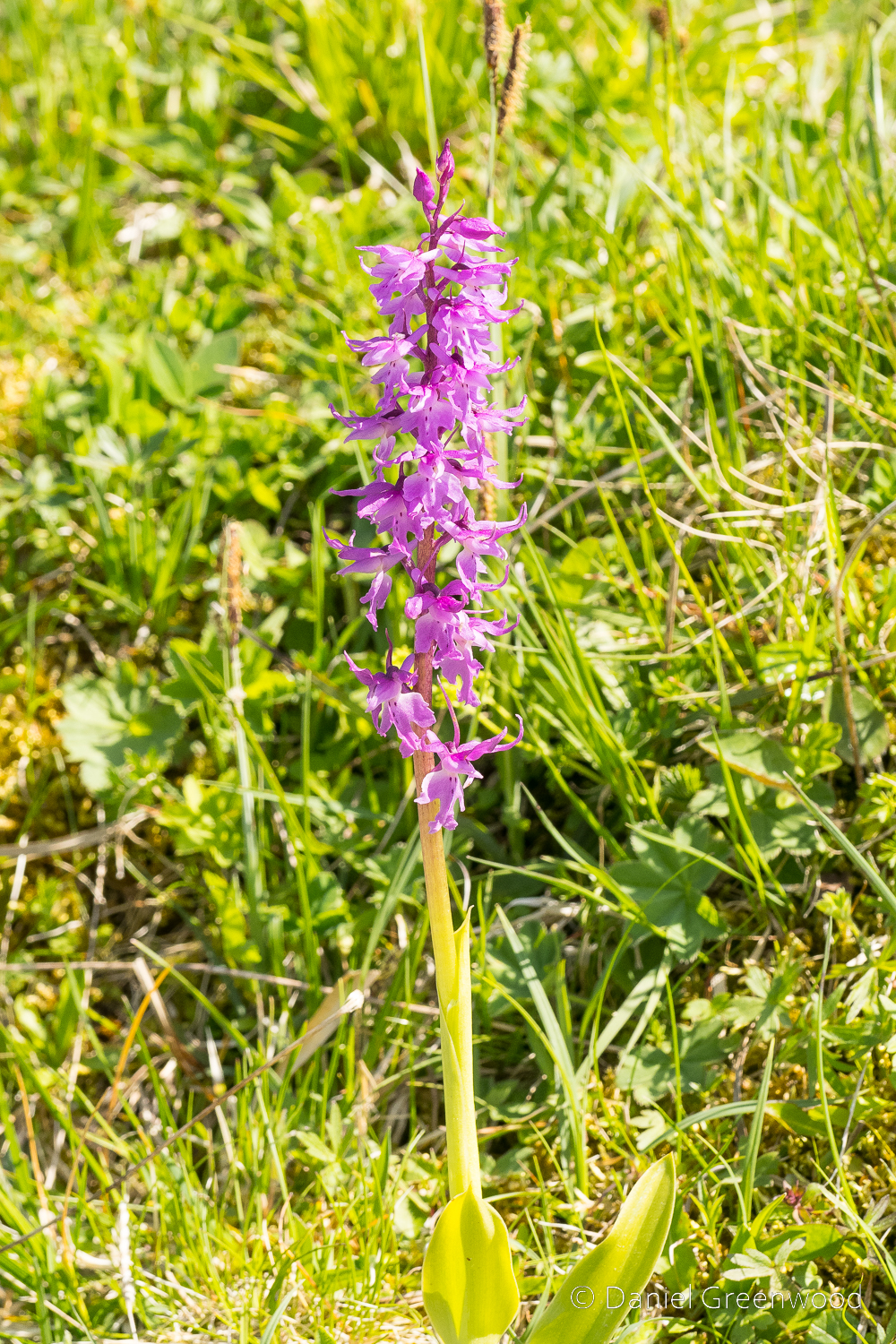
The sloping meadows were ‘littered’ with early purple orchids (Orchis mascula). We kept to the paths at all times for both safety as they were steep, and so as not to damage the grasslands. Having a camera in these places doesn’t give me a divine right to trample stuff!
Some of the orchids up close. Early-purple was the only species we saw.
This is hoary plantain (Plantago media) which gave a nice focal point to the alpine meadows.
I was intrigued by this daisy (Asters) as there were signs for arnica in the area. On iNaturalist it’s been identified as willow-leaved yellow oxeye.
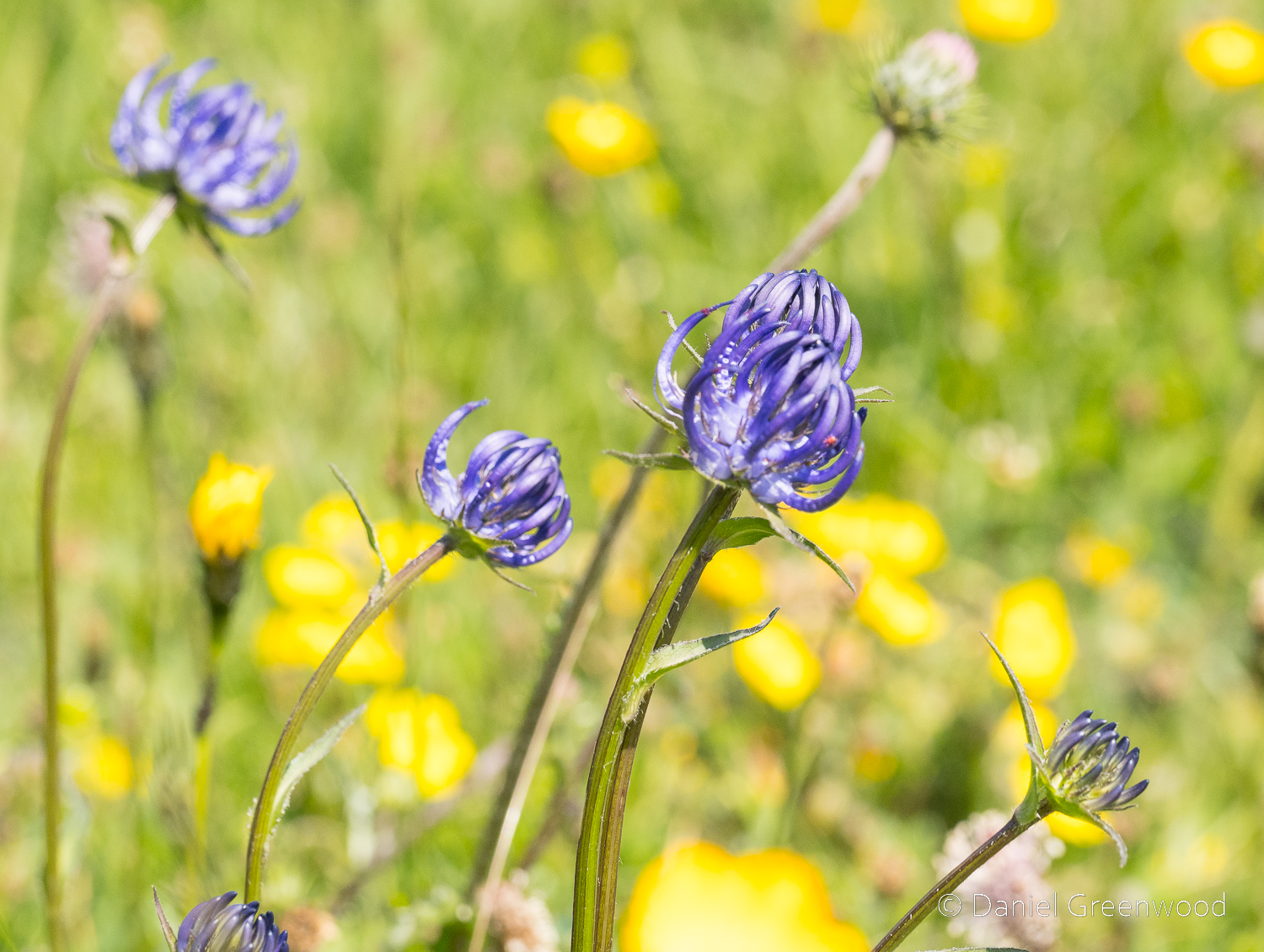
This came out a bit out of focus in the wind – it’s the ‘Sussex flower’ of the chalk Downs, round-headed rampion.
This is a new species for me, the slender Scotch burnet moth! Apparently they are native to Britain and much of Europe, and managing to nectar at the same time as mating, impressive.
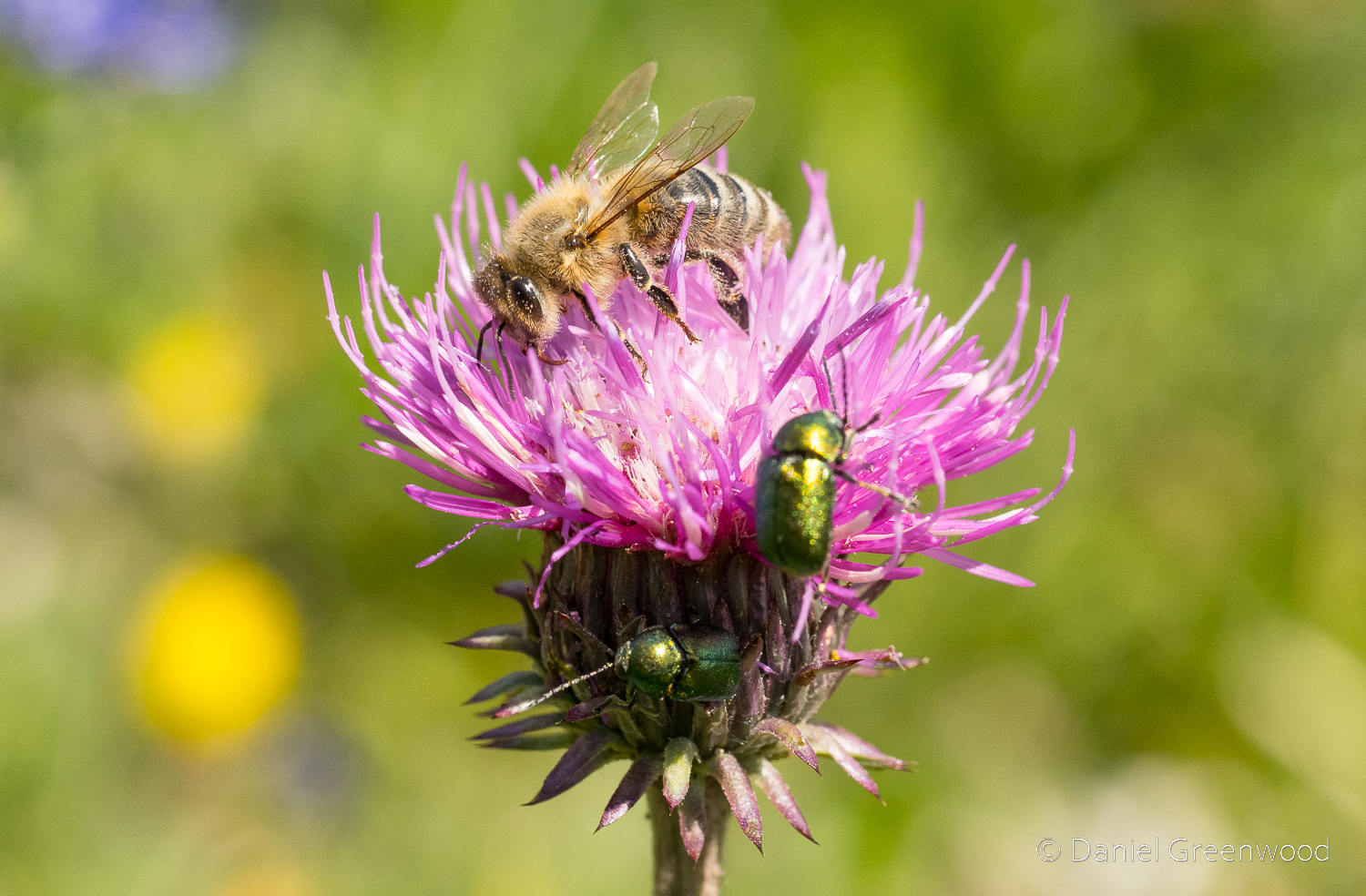
This photo made me laugh (I’ll explain). I was trying to get the honey bee and the green metallic beetle on the top in focus at the same time, so much so that I didn’t even see the second beetle lower down on the flower, which is actually in focus. This is knapweed, but I’m not sure if it’s a montane species or a variant to the common one.
While this is not a well-focused pic, it does enough to show you what is probably a duke of burgundy butterfly. In the UK it’s recovering but very rare.
The number of butterflies, day-flying moths, bees and hoverflies up here was a sight to behold. It was impossible to photograph anywhere near a reasonable percentage of all the things with wings. There were tens of fast-flying hummingbird hawkmoths on the wing, but getting photos of them would have resulted in falling down off the mountain. Also, we heard a cuckoo up here, which is quite late in the season for them.
The most common butterfly was the small tortoiseshell, another one I know from home. Insert obligatory remark about how it’s not so common anymore! Isn’t it gorgeous?
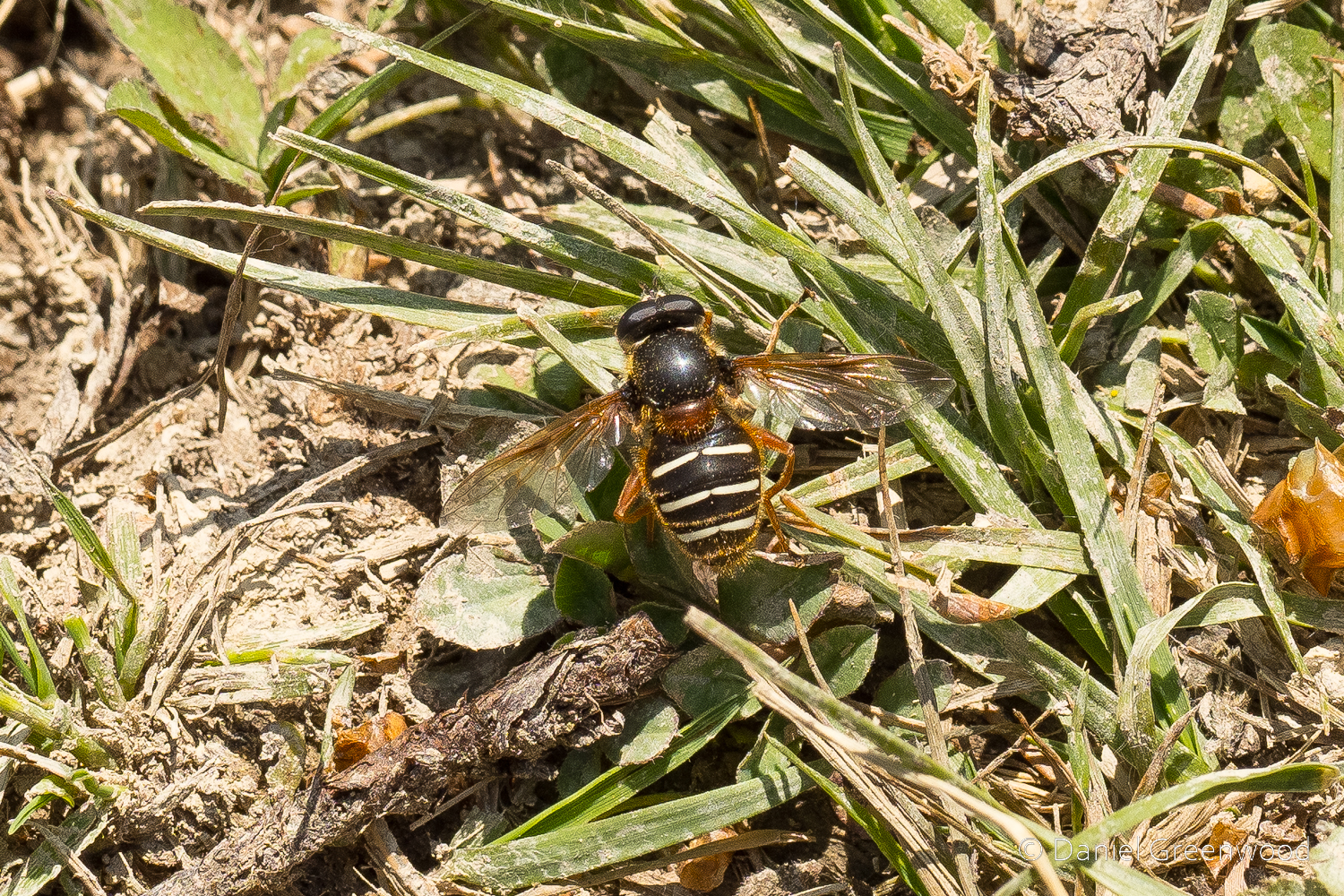
And to finish, there’s nothing more enjoyable in life than the sight of an unusual hoverfly. This was a new species for me, named on iNaturalist as the white-barred peat hoverfly. That would have been my second guess after Robocop hoverfly.
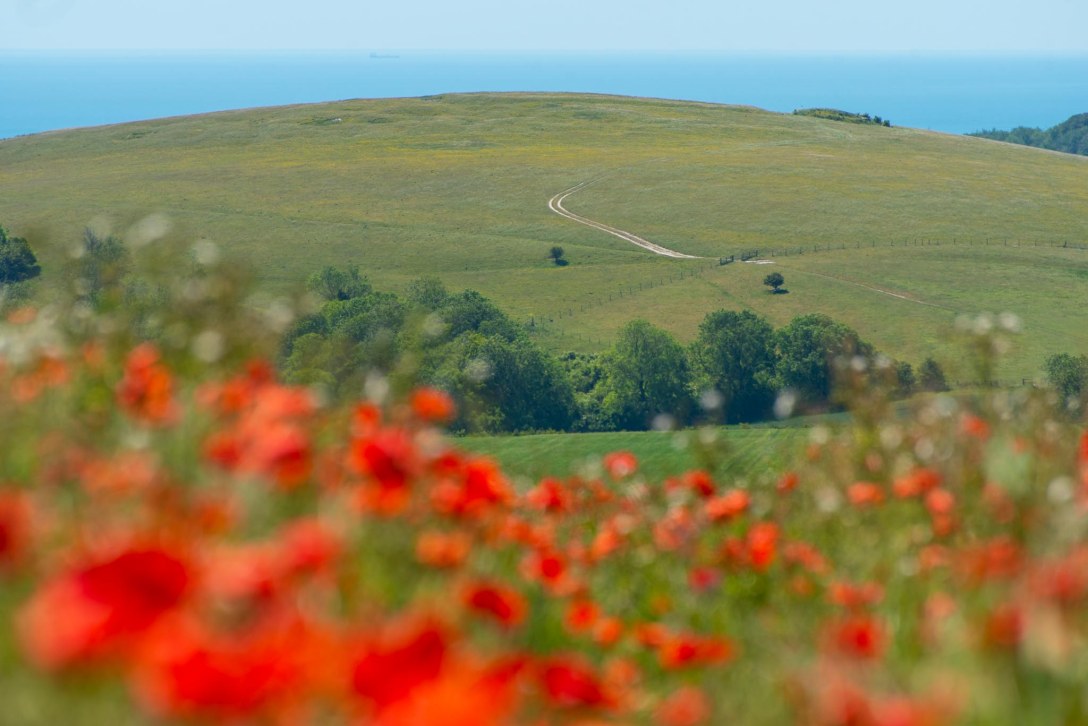
Here are some landscape images to see out this post of a wonderful walk and afternoon in the Austrian Alps. All taken with a macro lens!
I noticed some good news about ash trees recently and wanted to share my experience of a difficult decade for the European ash (Fraxinus excelsior, referred to here as ‘ash’), as well as some of the photos I’ve taken of this iconic tree. Working through this post, I’ve realised just how many images I’ve compiled down the years. I’ve also realised just how much I care about this tree as a species, and how painful it is to see it effectively being erased from the landscape by disease.
Ash is one of the first tree species that I really began to notice and tried to understand ecologically and culturally. When I started to take notice of wild trees, I saw that ash was everywhere in south London, seeding in railway sidings, parks, gardens, and woods. I’ve cut them down (not particularly big ones), planted them, pollarded them, photographed them and breathed their oxygen (obviously most people in the UK have!).
What do ash trees mean to people?
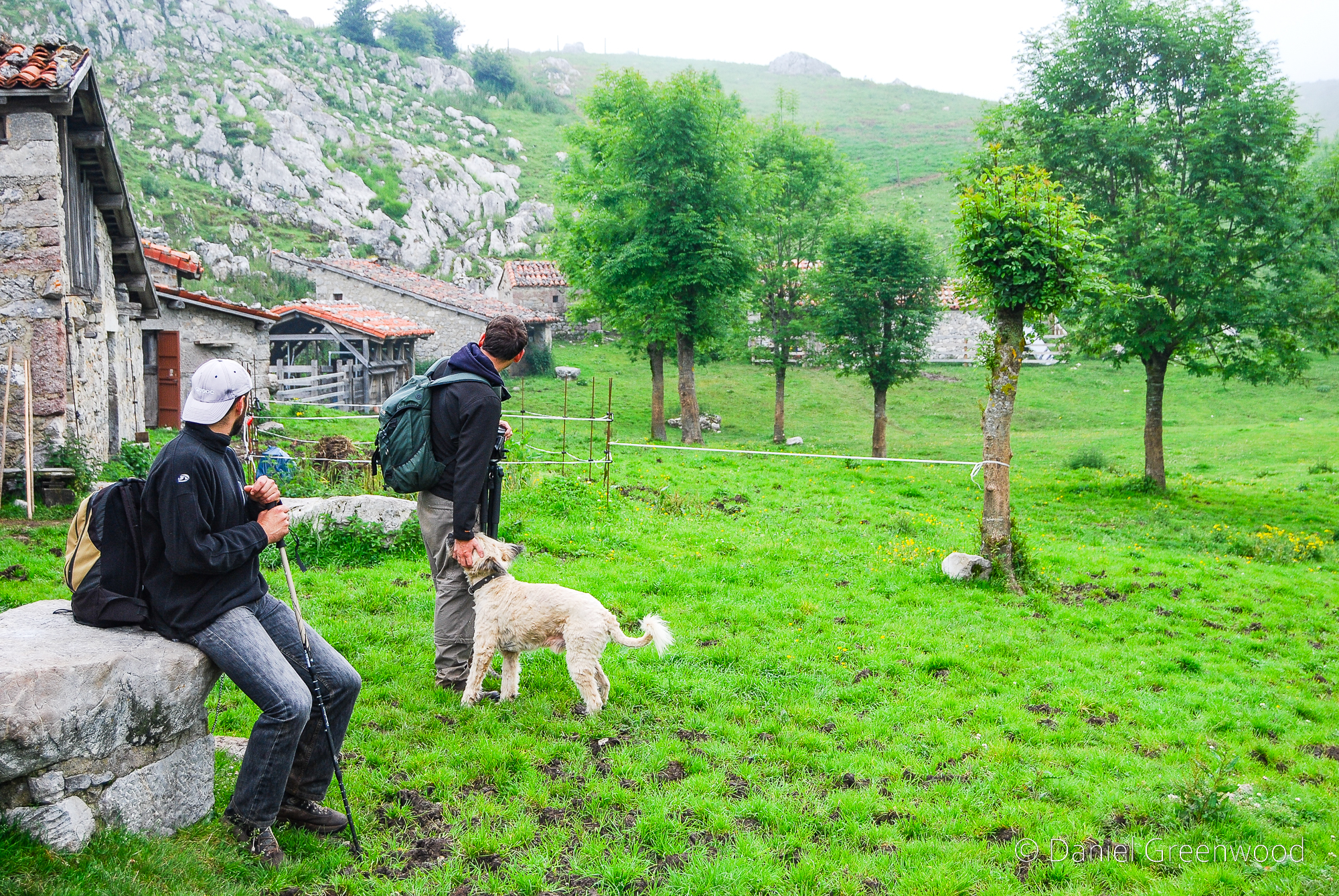
Pollarded (or shredded?) ash trees outside shepherd’s huts in Asturias, Spain in June 2011
I’d like to start overseas, as ash dieback is Europe-wide problem.
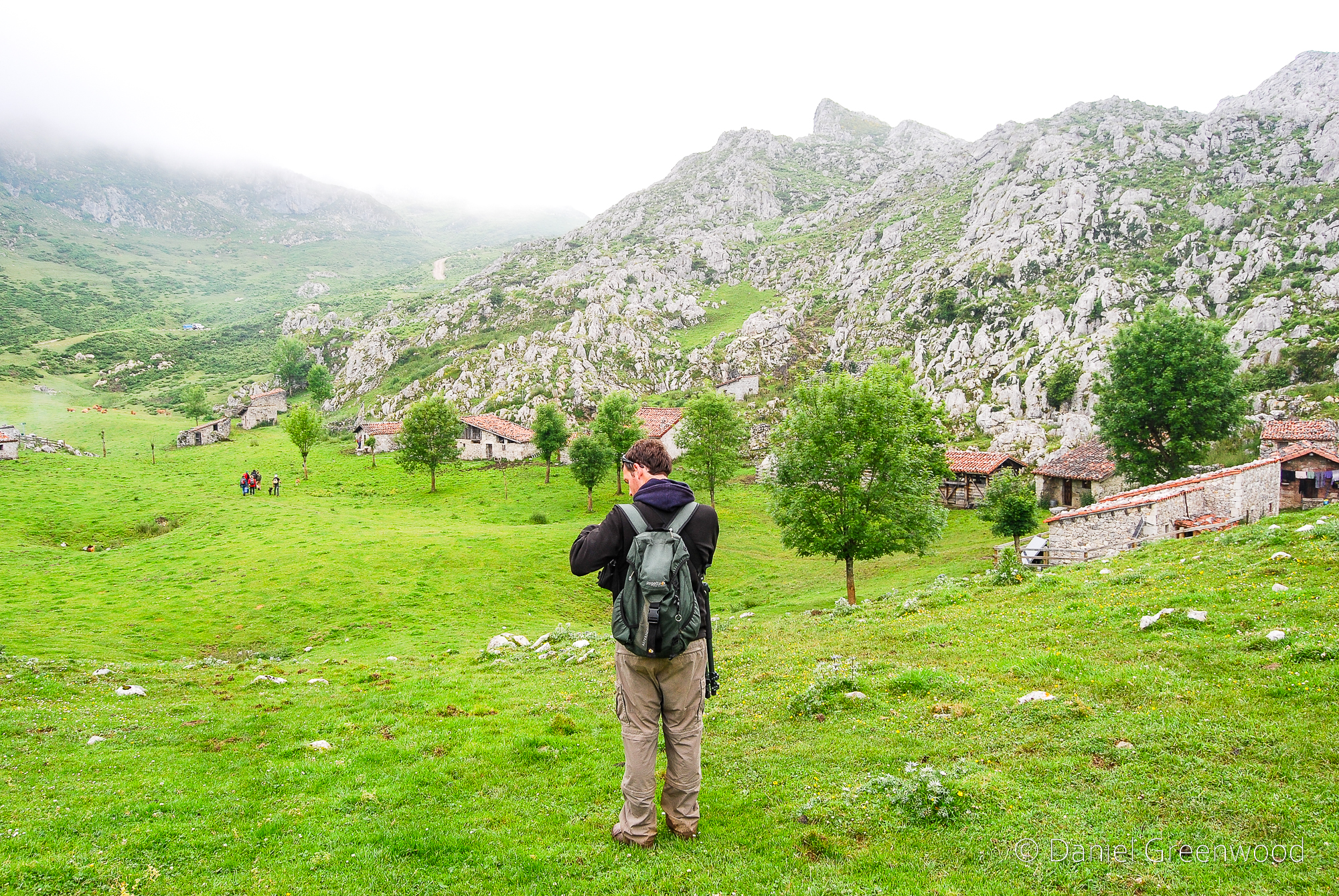
This week it was 14 years since I visited Los Picos de Europe (The Peaks of Europe National Park) in Asturias, Northern Spain as a volunteer.
The photo above came up in my ‘memories’ and it was only then that I remembered the ash trees. This was a remote village high in the mountains where people were making cheese (they didn’t want the name of the village to be shared online). The ash trees here are pollards, with the branches cut back to make a single stick of a trunk. It’s probably severe enough to be considered ‘shredding’, which Oliver Rackham wrote about.
Lollipop ash trees growing close to the old shepherd’s huts in a remote part of the Picos de Europa, June 2011
The reason this is done is to provide food for sheep – the fresh green growth of new ash leaves, which they love.
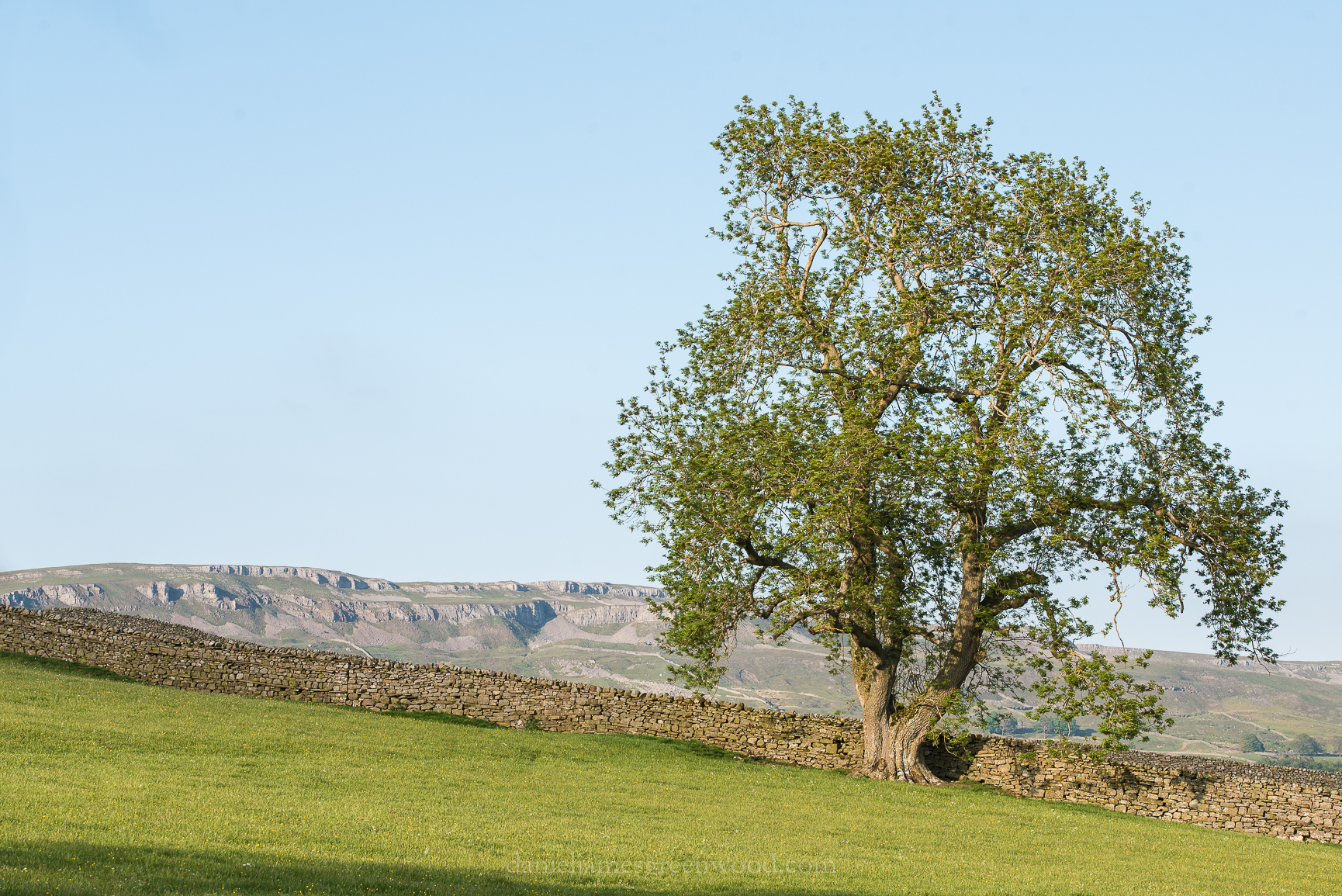
A massive pollarded ash tree next to a restored hay barn in Wensleydale, Yorkshire in 2018
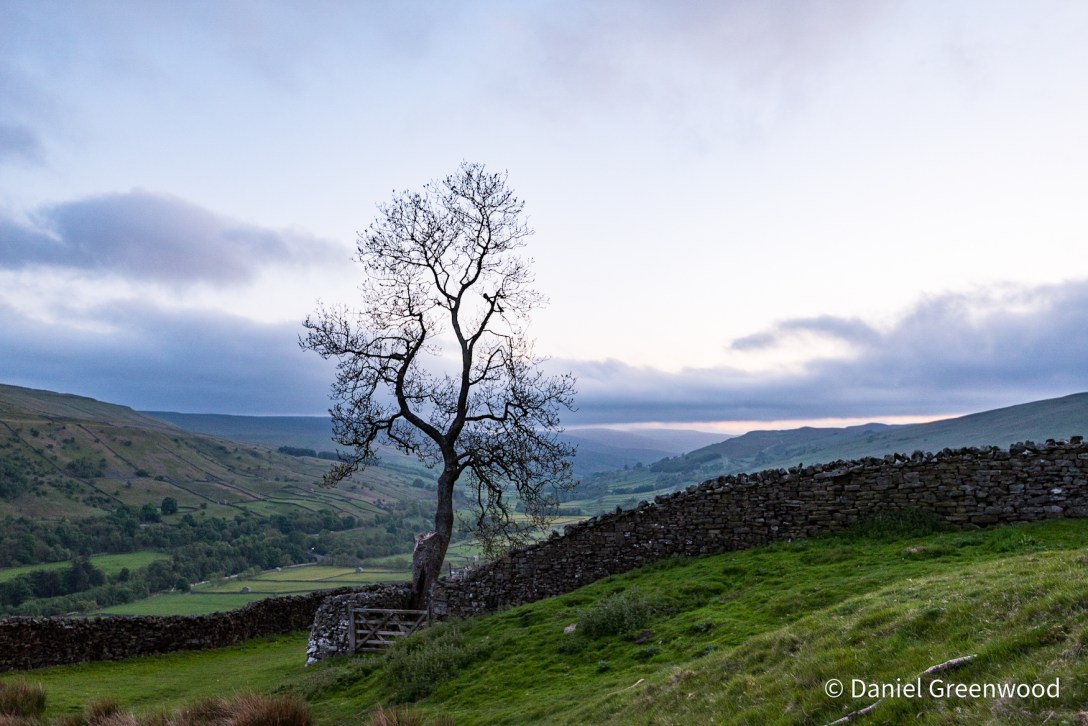
Interestingly, it’s similar in the Yorkshire Dales, where ash trees are abundant (see above and header image) and so are sheep. During one holiday in the Dales, I remember seeing a sheep climbing up a wall in order to nibble the leaves of an ash. What is also interesting to me, is that this is the same model of livestock grazing which spread from the Middle East, across Europe and into Britain thousands of years ago. It doesn’t sound dissimilar to the spread of ash dieback.
A typically large ash stool in a former hedgeline or boundary, coppiced or laid for many years (near Reeth in the Yorkshire Dales, 2019)
It’s not uncommon to see very large ash stools (old trees that have been regularly felled for timber) in boundary lines in places like Yorkshire, Sussex and Kent. I’m sure their coppicing was probably to provide ample feed to sheep, as in Northern Spain, above.
Dartmoor, Devon in 2023
This mammoth ash in Dartmoor National Park in Devon is possibly the biggest I’ve ever seen.
What do ash trees mean to wildlife?
A diseased ash tree with a large number of King Alfred’s Cakes fungi growing on the main trunk in Sussex in 2023
The fungus King Alfred’s Cakes has benefited in the short-term from an explosion in dead ash wood to colonise. The longer-term picture for fungi and lichen is not so good. Ash has a number of lichens that depend on it in places like the Lake District (my knowledge doesn’t extend very far here) which needs living trees.
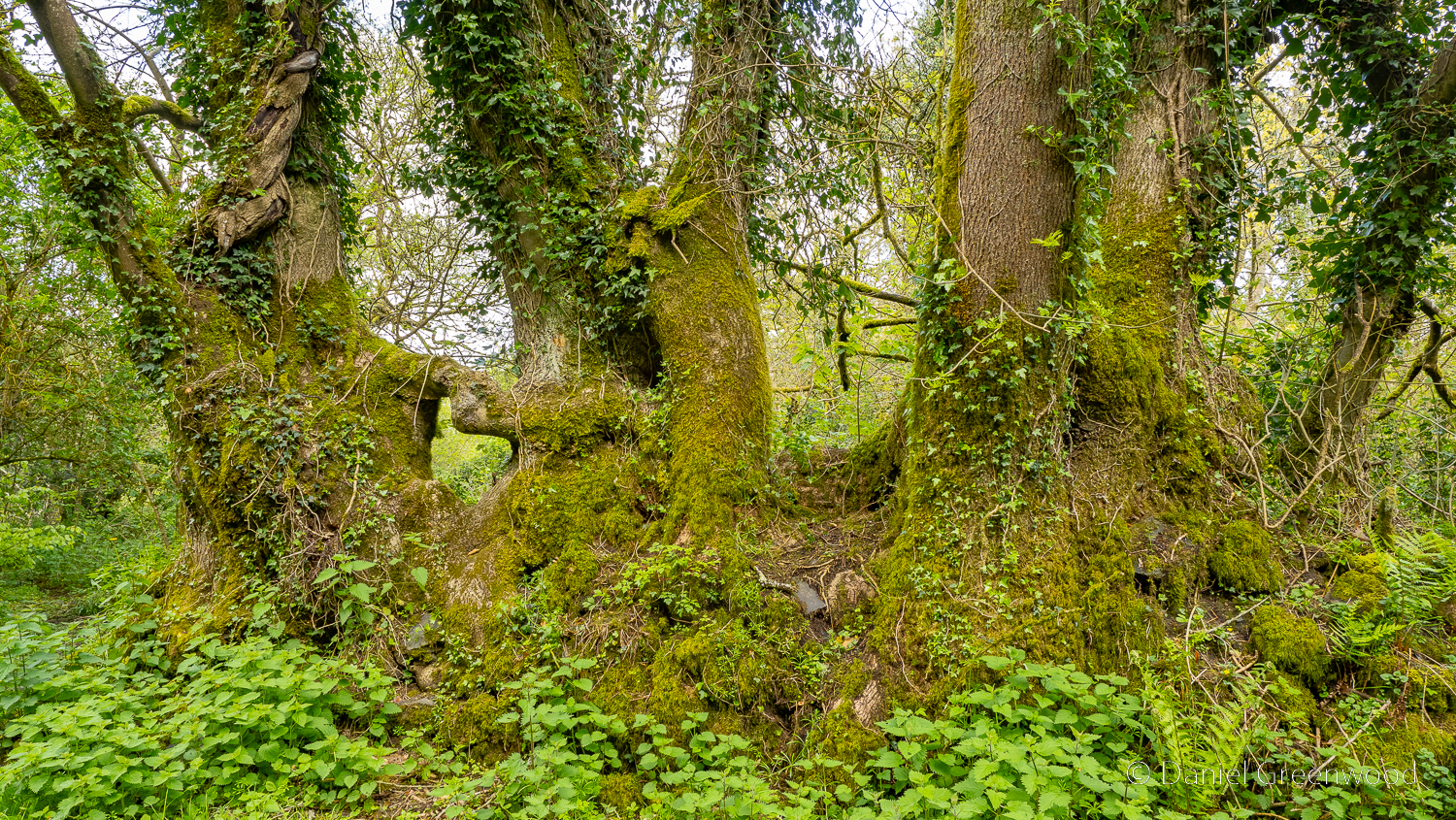
A mossy ash surrounded by wild garlic in Wensleydale, Yorkshire in May 2018
Ash benefits ancient woodland flowers that arrive early in spring because the leaves are compound (they have leaflets, not broad leaves) and allow light into the woodland floor. Species like wood anemone and wild garlic do particularly well in their dappled early spring light.
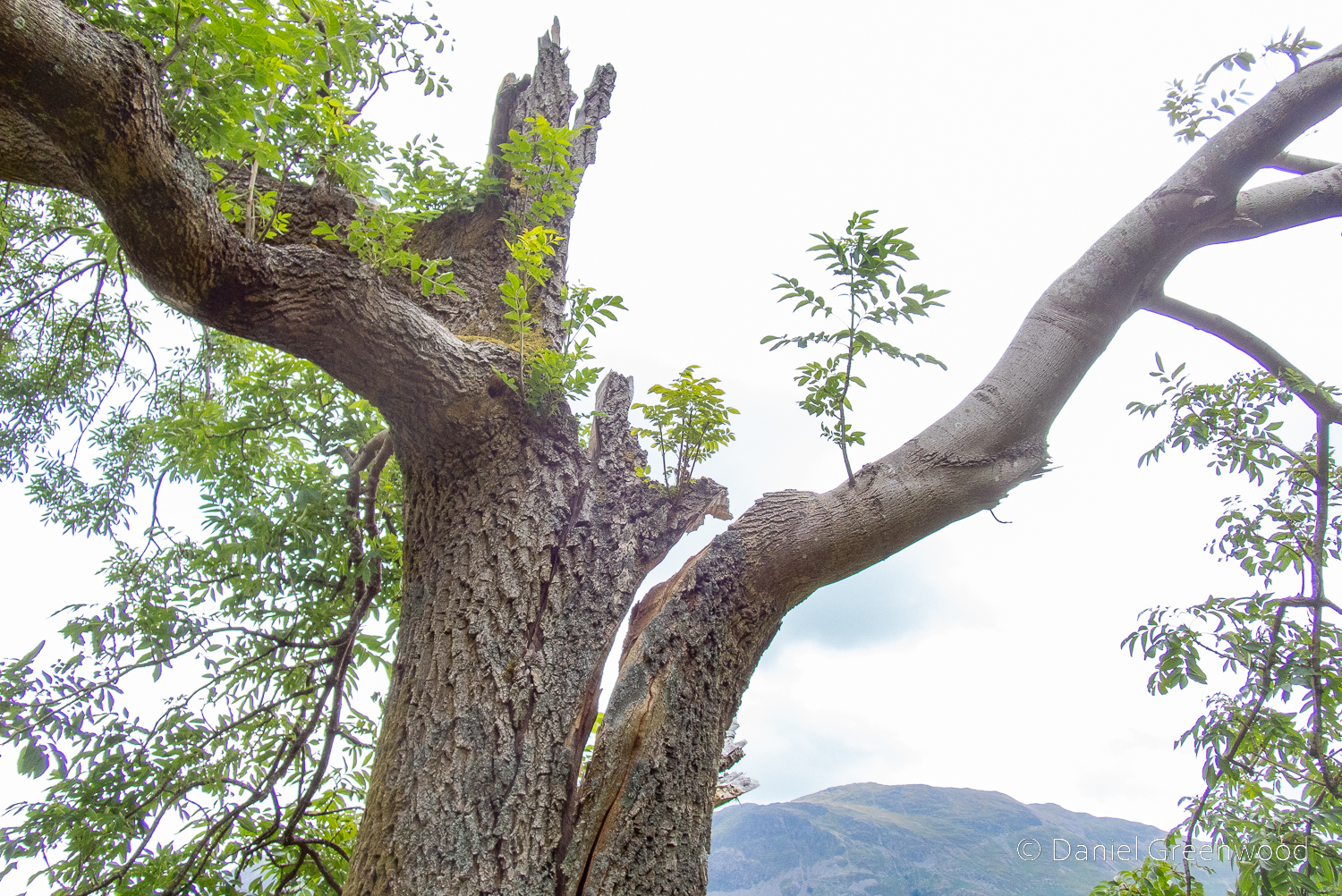
Magnificent veteran ash tree with Ullswater behind it in the Lake District. The top trunk of the tree has collapsed on some farm equipment in the background (2023)
I’ve encountered several ash down the years that have been for the chop on reasonable safety grounds in London, but then have been saved by the fact bats are living in them.
Bats can live under loose bark, in woodpecker holes (which are often found in older ash) and in large crevices. This magnificent ash was near Ullswater in the Lake District and had suffered what the tree officers would deem a catastrophic failure, but the woodland ecologists would be licking their lips at!
The Timeline
2012: when ash dieback arrived in Britain
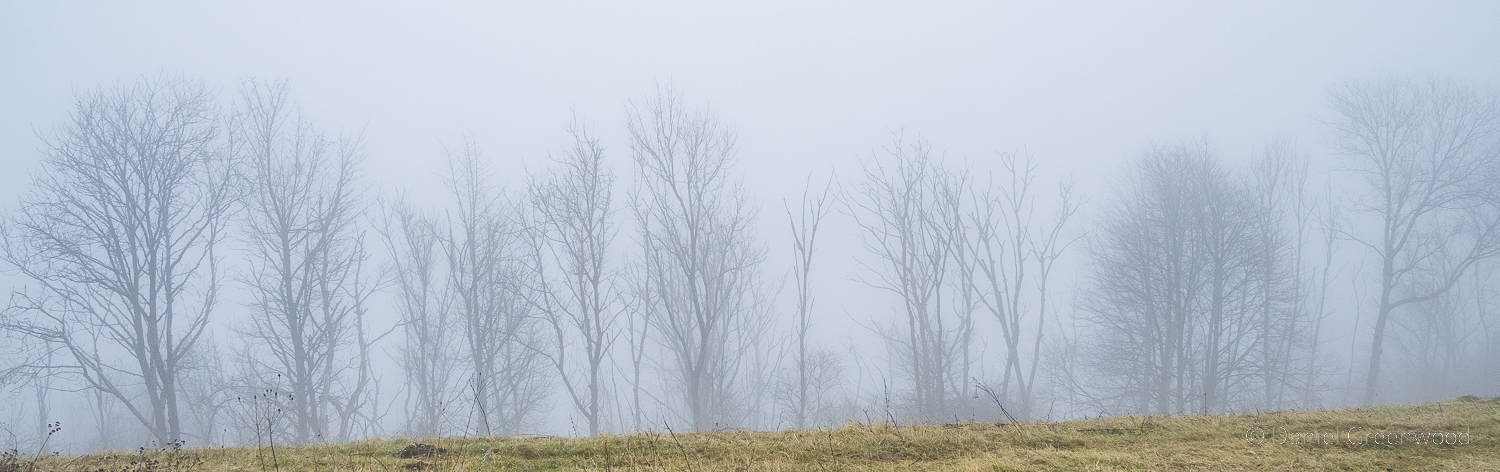
A range of leafless ash trees alongside the South Downs Way near Ditchling in November 2024
One afternoon in the autumn of 2012 I was finishing my working day in the woods when I noticed the dying-back of an ash sapling. The stem had lesions and the leaves were drooping. It was my first year as a community woodland officer and ash tree seedlings were so numerous we actually had to pull them up in certain places. They were the epitome of a sometimes invasive British plant.
The first time I saw and photographed ash dieback disease in Sydenham Hill Wood,autumn 2012
At the time we needed to report every new sighting to the Forestry Commission (as it was then), to help map the spread of this devastating disease. It spread so quickly that reporting became redundant, as were widespread protection measures. I remember someone remarking that asking people to clean their boots would be about as effective as asking the birds to clean their feet.
2017: ash dieback decimates the South Downs
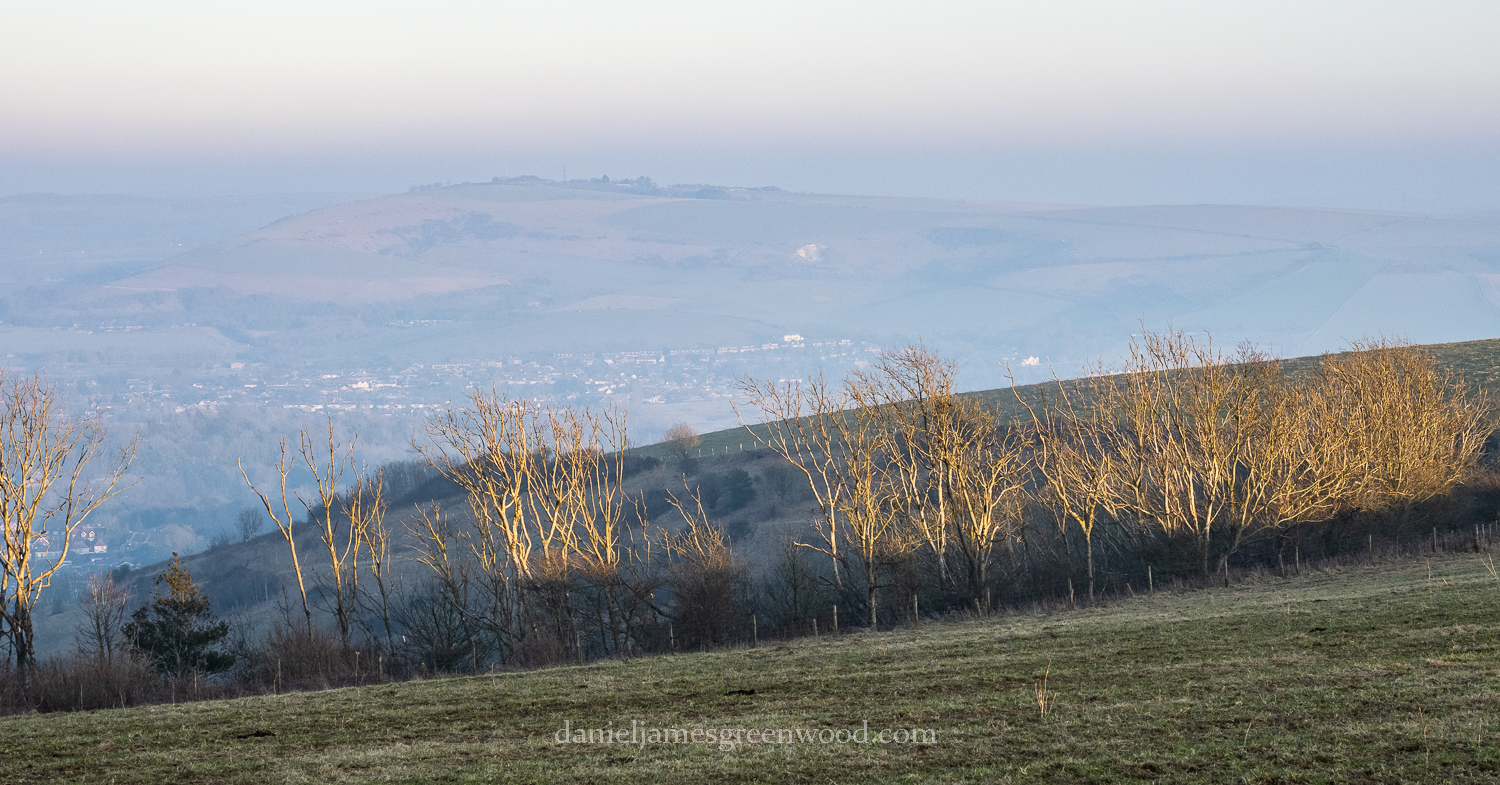
Leafless diseased ash trees above Steyning, seen from the South Downs Way in February 2023
It was only really when I moved to Sussex to work in the South Downs National Park that the real impact dawned on me.
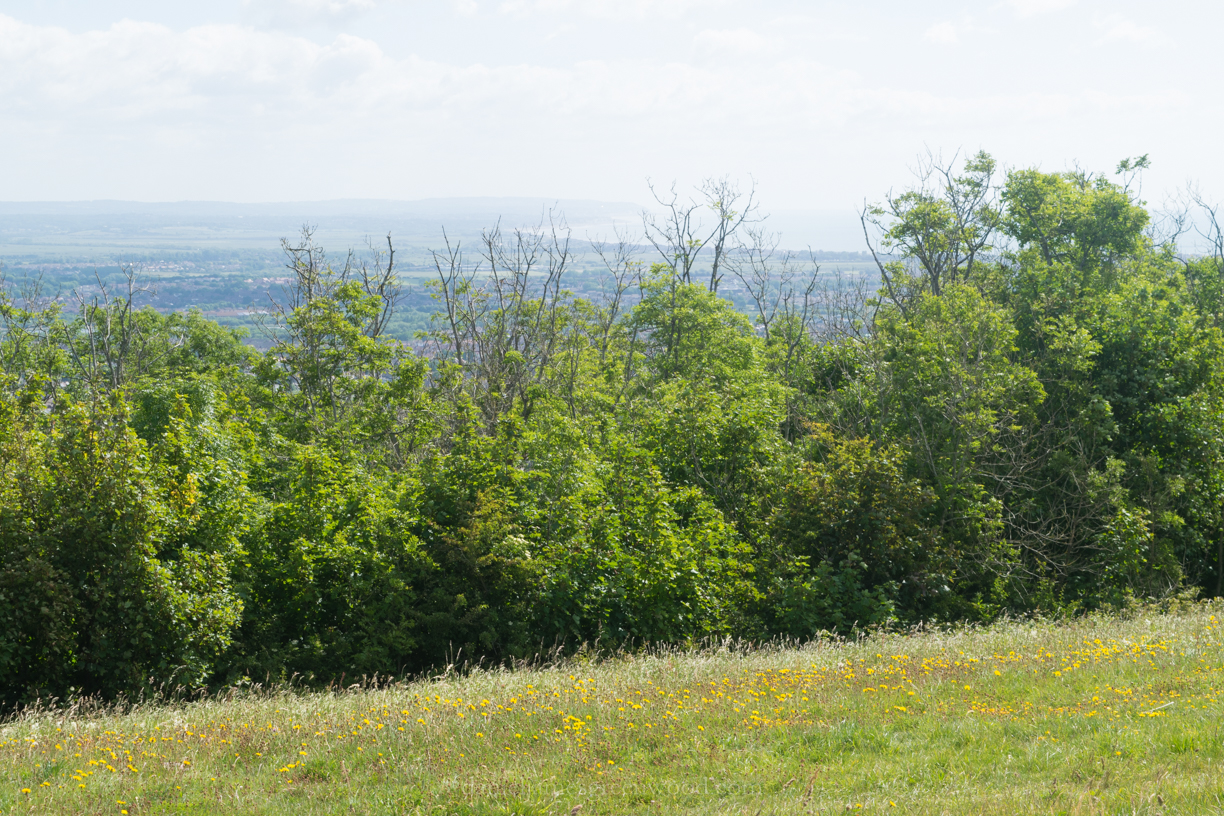
Eastbourne appearing beyond infected ash trees in June 2017
During a walk with the South Downs Eastern Area Ranger team, I was taken aback by the way declining ash trees were opening up views of the coastal town of Eastbourne. It has continued to progress since then.
A young ash tree experiencing ash dieback from the top-down on the South Downs, May 2019
Groves of once green ash woodlands and verdant hedgerow trees were dying en masse. In the past few years trees along highways have been felled due to the threat to public safety from these brittle, dead trees overhanging roads, paths and properties.
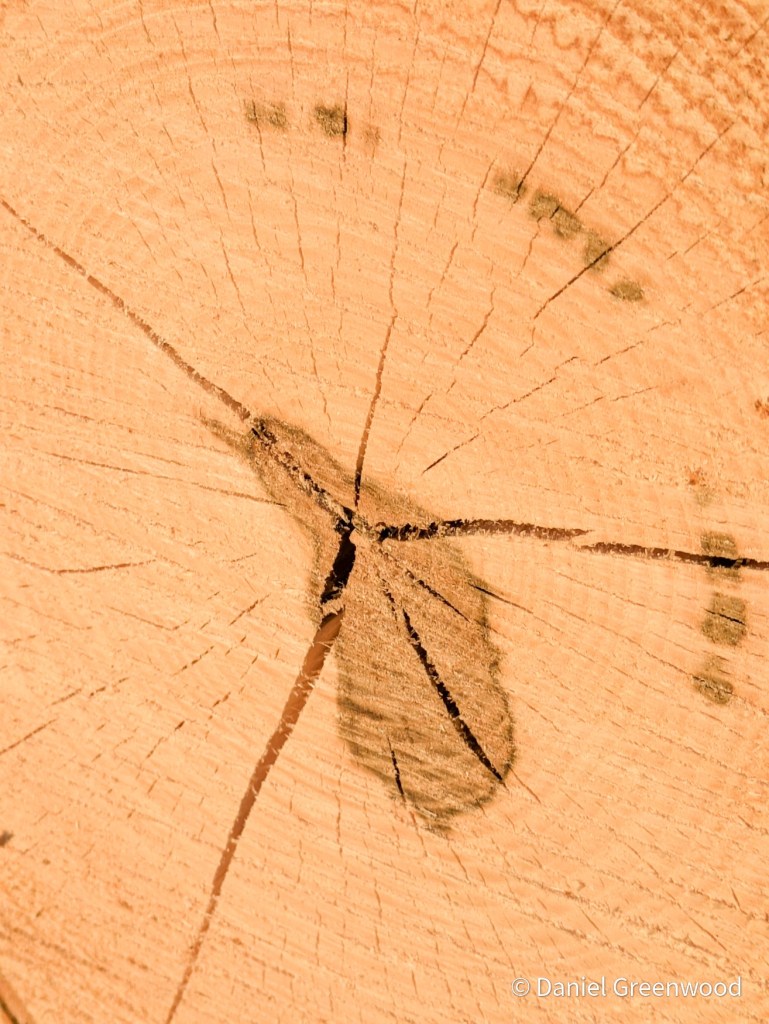
Heartwood decay visible in piled ash logs shortly after being felled, July 2025
The main concern is how the decay enters the heartwood (as above) and causes structural failure even within living trees, meaning the ash are more likely to fall unexpectedly. I spoke to a council tree officer who said that there have been a number of fatalities of tree workers due to ash trees. It’s tragic.
A diseased ash tree that had fallen across a footpath in the South Downs, logged and cleared in February 2023
But how did ash dieback get to Britain? Fungi spread through spores, tiny particles that ‘seed’ in appropriate places and then grow into a living fungus that produces fruiting bodies. The fruiting bodies (mushrooms, to most people) then produce the spores. The ash dieback fungus is native to Asia, but there’s no way it could get to Europe alone. People helped it, accidentally, to arrive in Europe over 30 years ago. In Britain, it may have been helped by the process of growing UK saplings in Dutch hot houses, alongside infected ash saplings, and bringing them back to the UK.
2024: signs of resistance
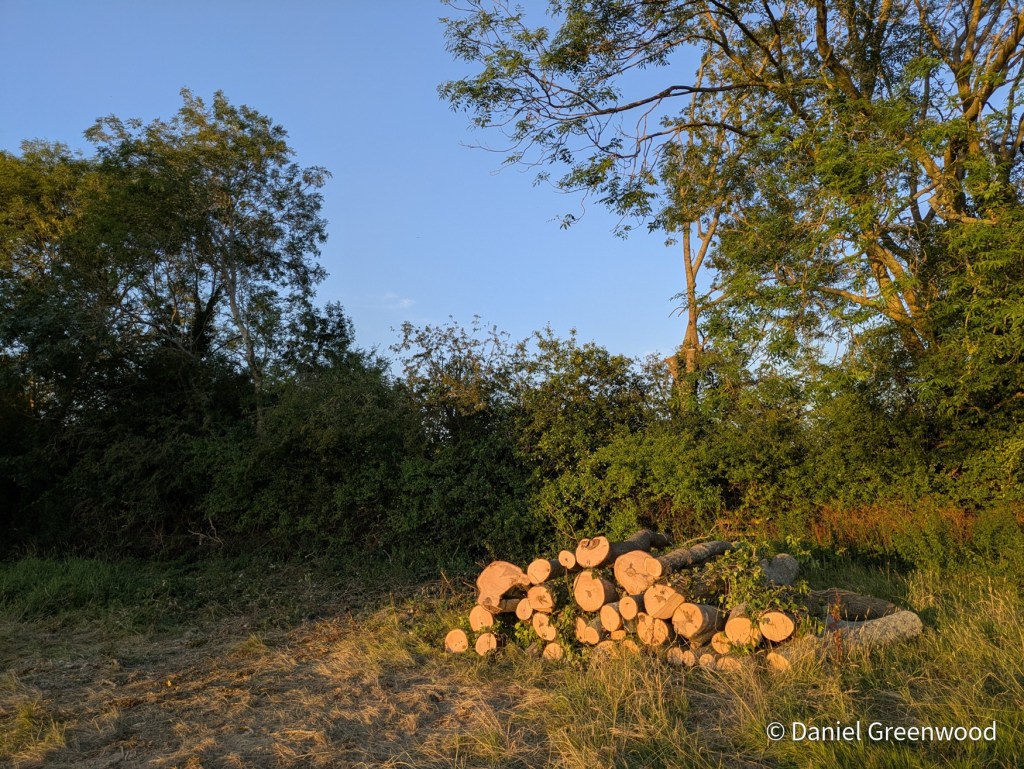
This phone pic was taken in July 2025 when my local green space had been subject to ash removal. The logs show the scars of the disease (see previous) but the scene is not one of disaster. There are healthy ash trees on either side that are surviving and, indeed, thriving considering what they are up against.
That is something The Living Ash Project have been logging(!) – trees showing mild symptoms and overcoming the dieback.
This rather optimistic article highlights more of the positive steps, and advanced scientific interventions being made to save ash trees.
Ash trees in isolated areas, away from ash woodlands, may be in a much better position (literally) to survive the disease epidemic because they are not overwhelmed by spores from ash leaf litter found in thick leaf litter.
A turning point for ash trees?
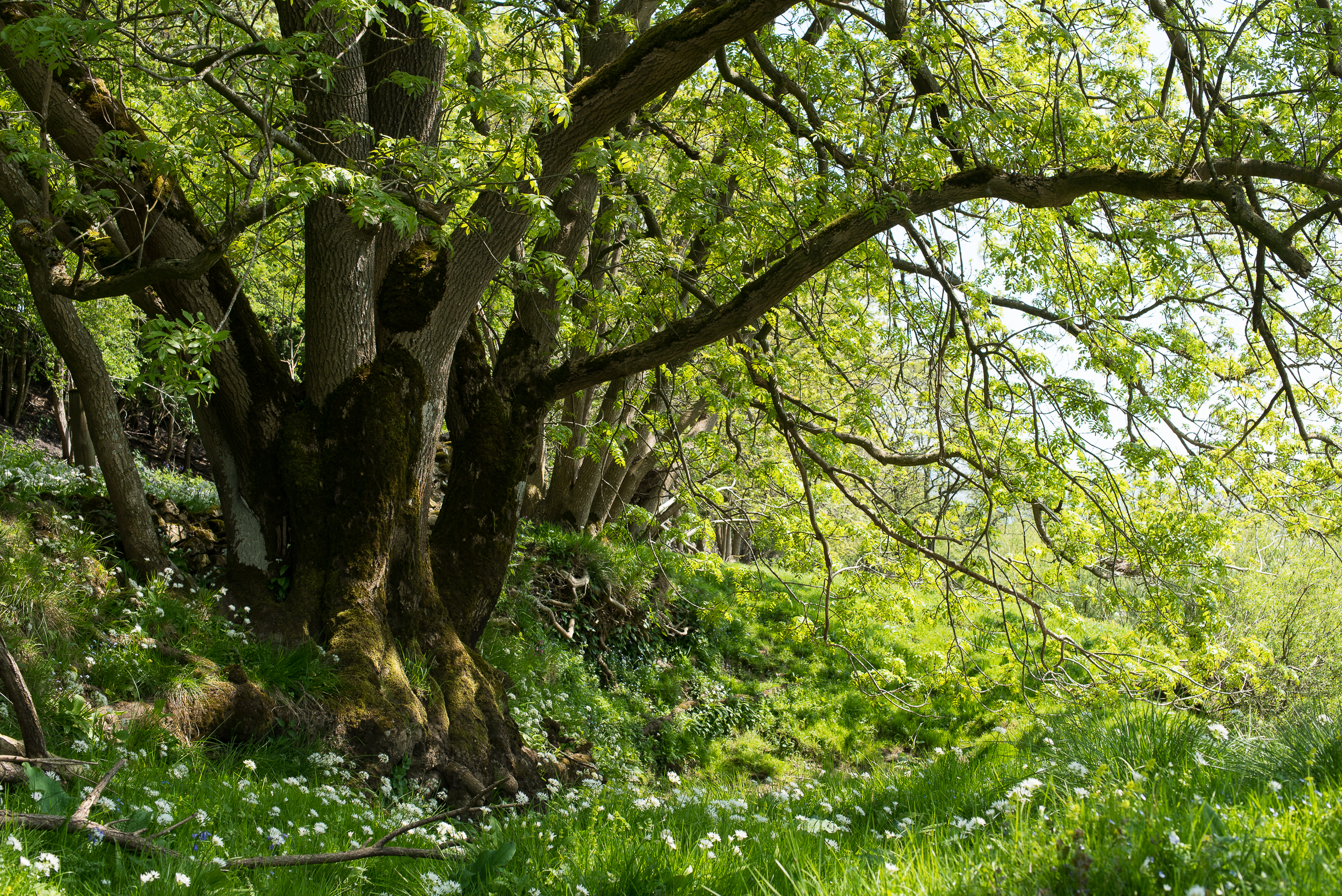
A mature ash tree in Wensleydale, Yorkshire in May 2018
The news for ash trees in 2025 is much more promising.
An article in The Guardian reports that ash trees in Britain are showing signs of evolving genetic strains of ash that will not succumb to the fungus. This means ash trees could return to the landscape in due course, though not in the same way.
Other research has shown that some isolated ash trees are surviving. I can vouch for this – there’s an ash tree in my mum’s garden (c.15 years old) in London that I’ve trimmed back once before. It is flourishing, so much so that the neighbours are asking for it to be cut down again. Welcome to London.
Large ash in the Dentdale, Yorkshire Dales (close to Cumbria) in 2019
There is also a plea on the back of the latest research for woodlands to be allowed to regenerate on their own. Many people will be keen to point out the role of ‘rewilding’ in helping this process. In many cases it’s just a matter of leaving woodlands in certain places to do their thing, probably behind some fencing.
Here’s hoping that ash trees can be saved across Europe and wild trees are given the space to do their thing. In the end they may outlive us.
Earlier this week I went for a short walk around part of the Sussex Weald to see if any mushrooms had popped up. We’ve experienced one of the driest springs on record and the warmest June for England, as well as three heatwaves already! Me and mushrooms don’t need three heatwaves, thanks.
Mushrooms need rain, warmth and moisture to thrive, and after a downpour earlier in the day I thought it might be worth having a look. Here’s what happened:
At the beginning you can hear my water bottle in my bag and a great spotted woodpecker ‘kicking’
I began in the presence of Bambi, or a fallow deer
Saturday 31st May felt like a passing of the seasons, with spring departing and summer arriving. That could be seen in the invertebrate world, with more summer species out there in my garden.
This post is generally wasps and spiders, with some lovely little bees to calm you down afterwards.
As ever, some of these things are so ridiculously small that without magnification (in my case a macro lens) you (I) wouldn’t necessarily see them.
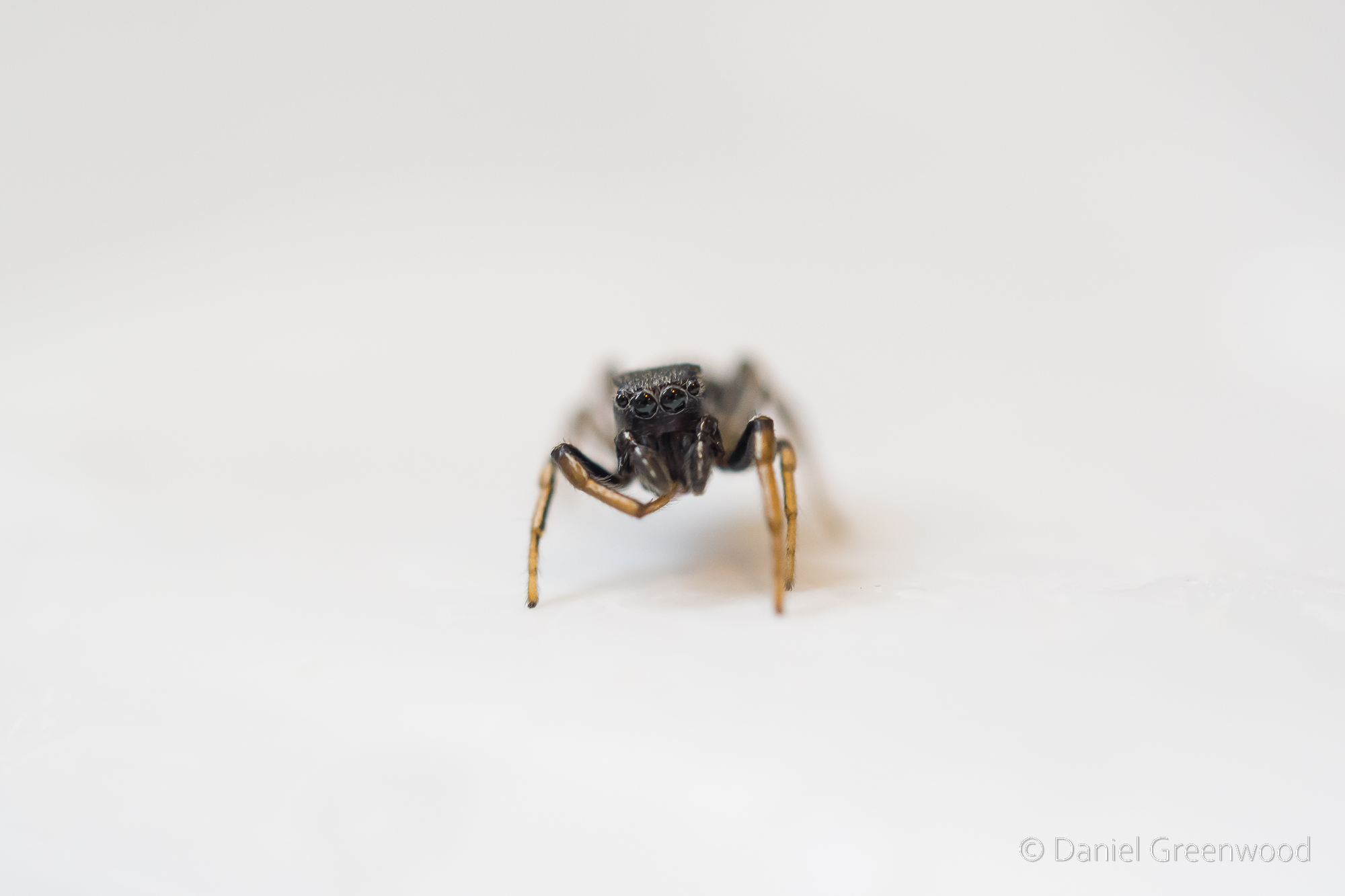
I should have known it was going to be a good photography day when this little jumping spider appeared in my kitchen sink! The light was rubbish so I’ve had to draw out the shadows and ‘de-noise’ these photos a bit. I’m unsure of the exact species, but I do get an apparently uncommon oak jumping spider in my garden/near the house sometimes, and this may be one.
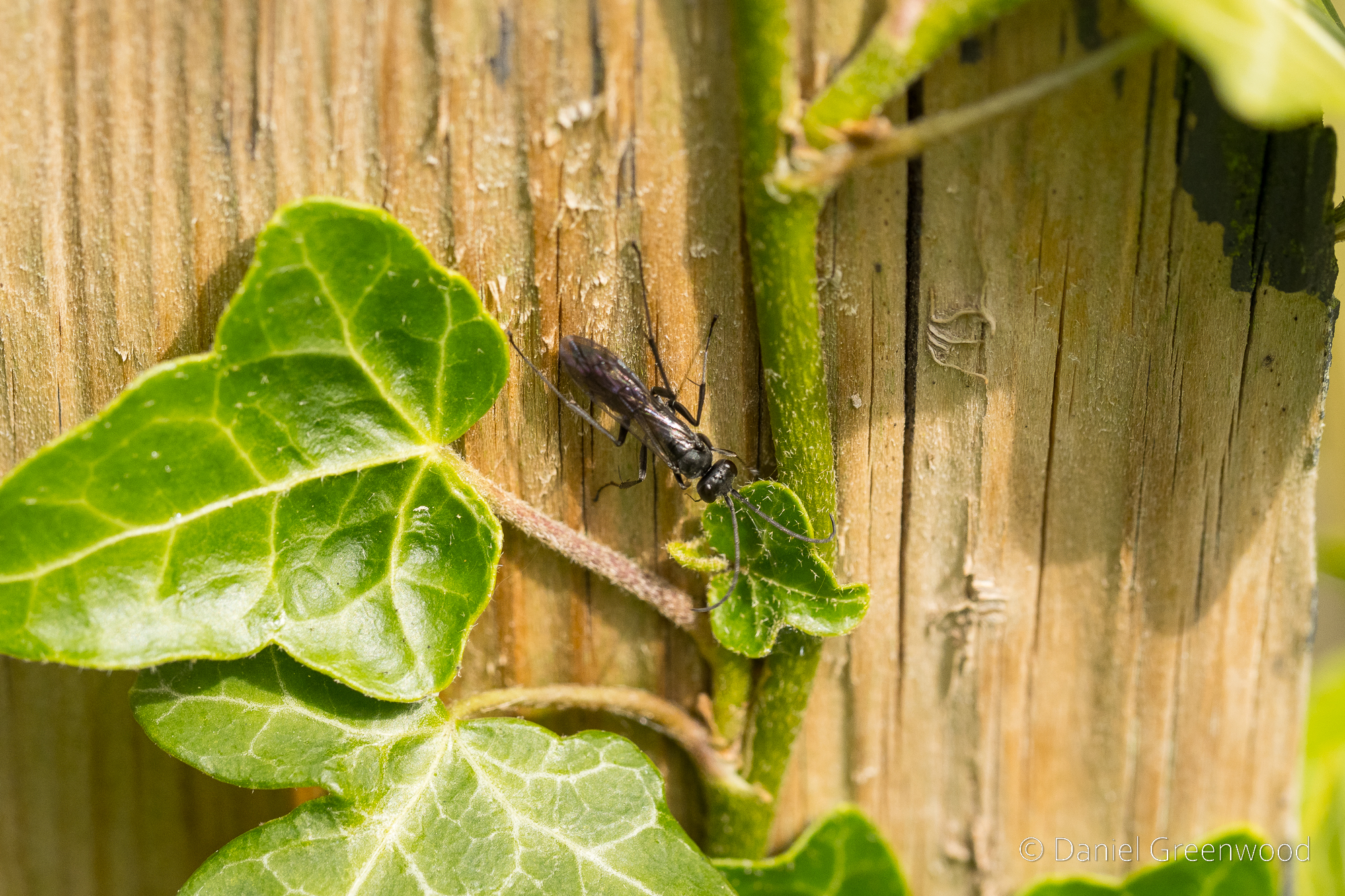
While we’re on spiders, here’s a wasp – a spider-hunting wasp! I’ve learned that sitting down on the grass by a shrub for 15 minutes isn’t just a forest-bathing exercise, it’s also a good way to allow the life to move around you. One fence post was being explored by this very busy spider-hunter. And then, something amazing happened.
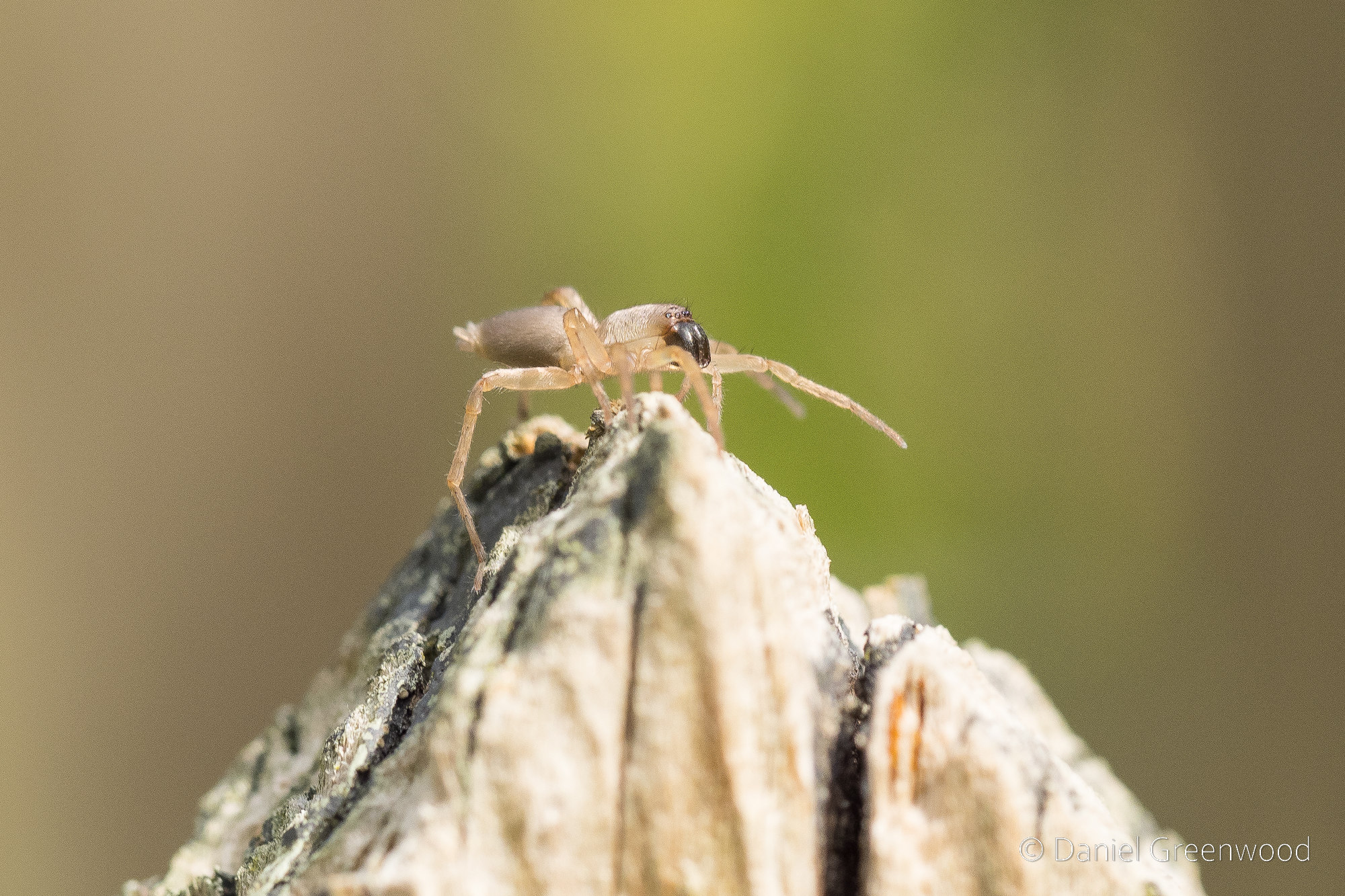
On a vacant fencepost (that’s just how I consider them now) a spider appeared at the top. The spider-hunting wasp saw their moment and burst onto the post, but missed the spider by milliseconds!
The spider-hunting wasps paralyse their prey and then carry them away to a cache. It’s pretty grizzly, but if you think that wasps have been in existence for over 100million years, and spiders, gosh, they’ve been around for over 300million (humans 200k and unlikely to make 1million at this rate), it’s something that’s been going on for a long time. If you’re annoyed about one species of wasp bothering you, imagine how spiders felt when 100million years later a spider-hunting wasp evolves from nowhere!
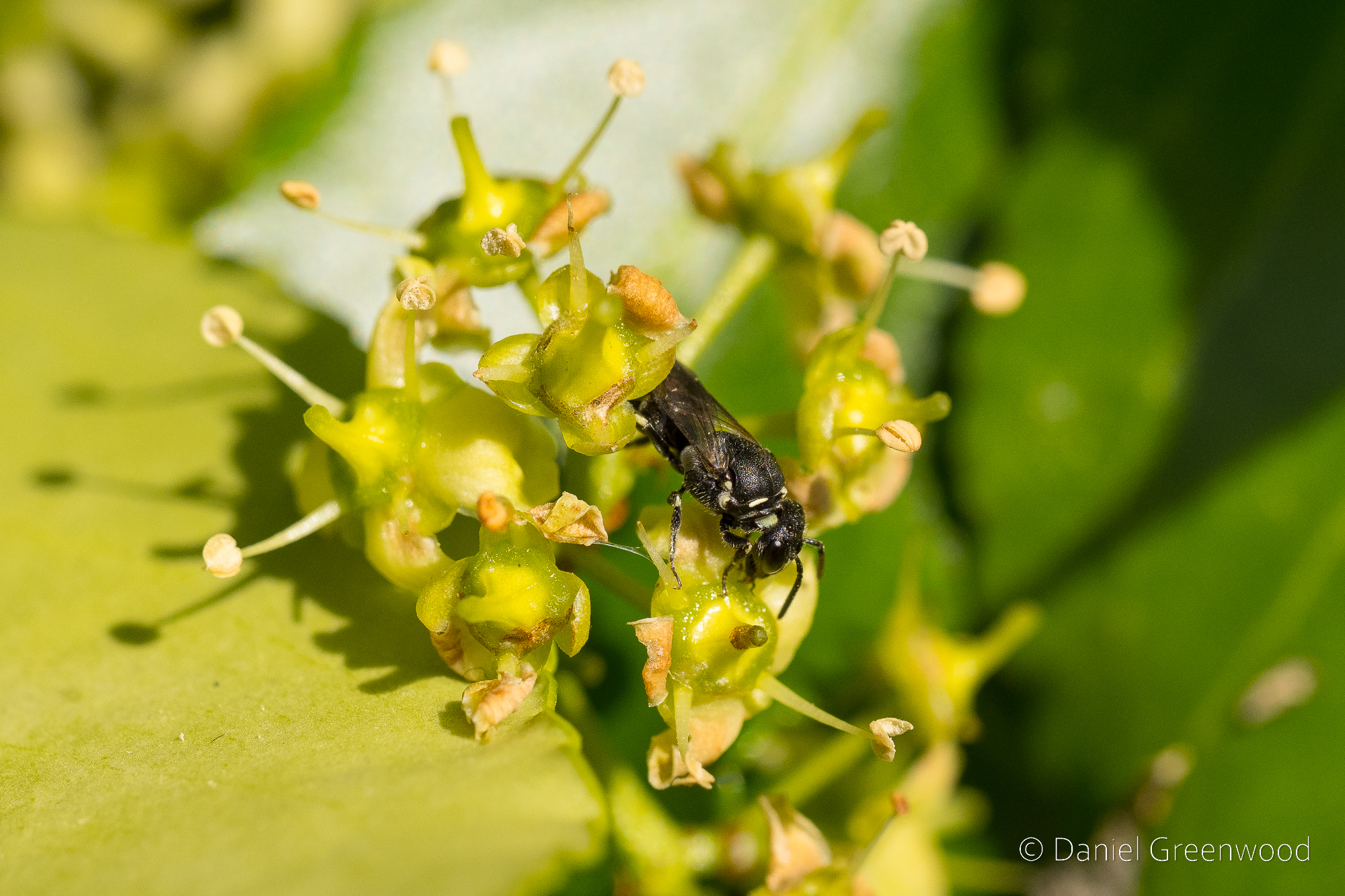
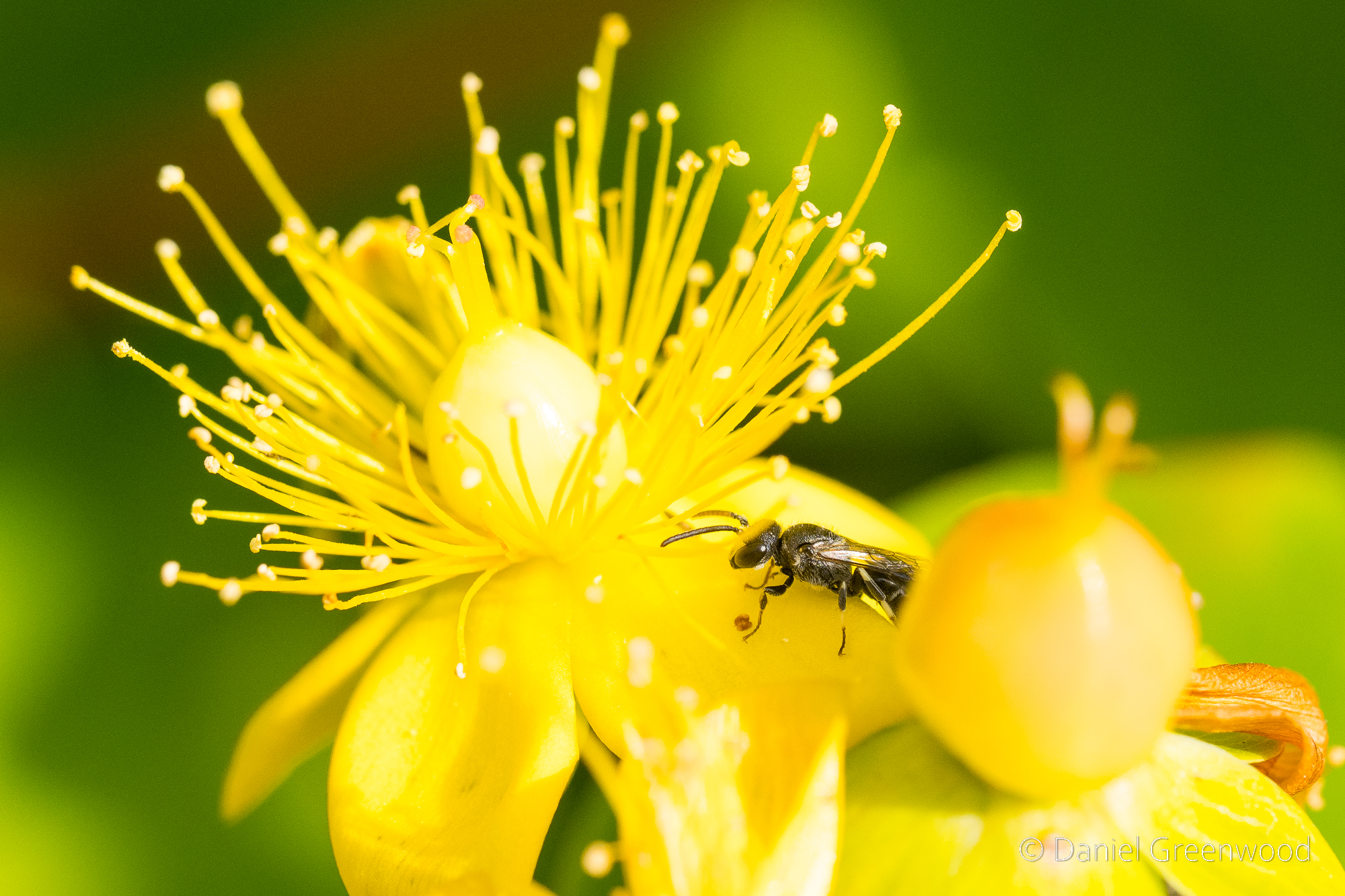
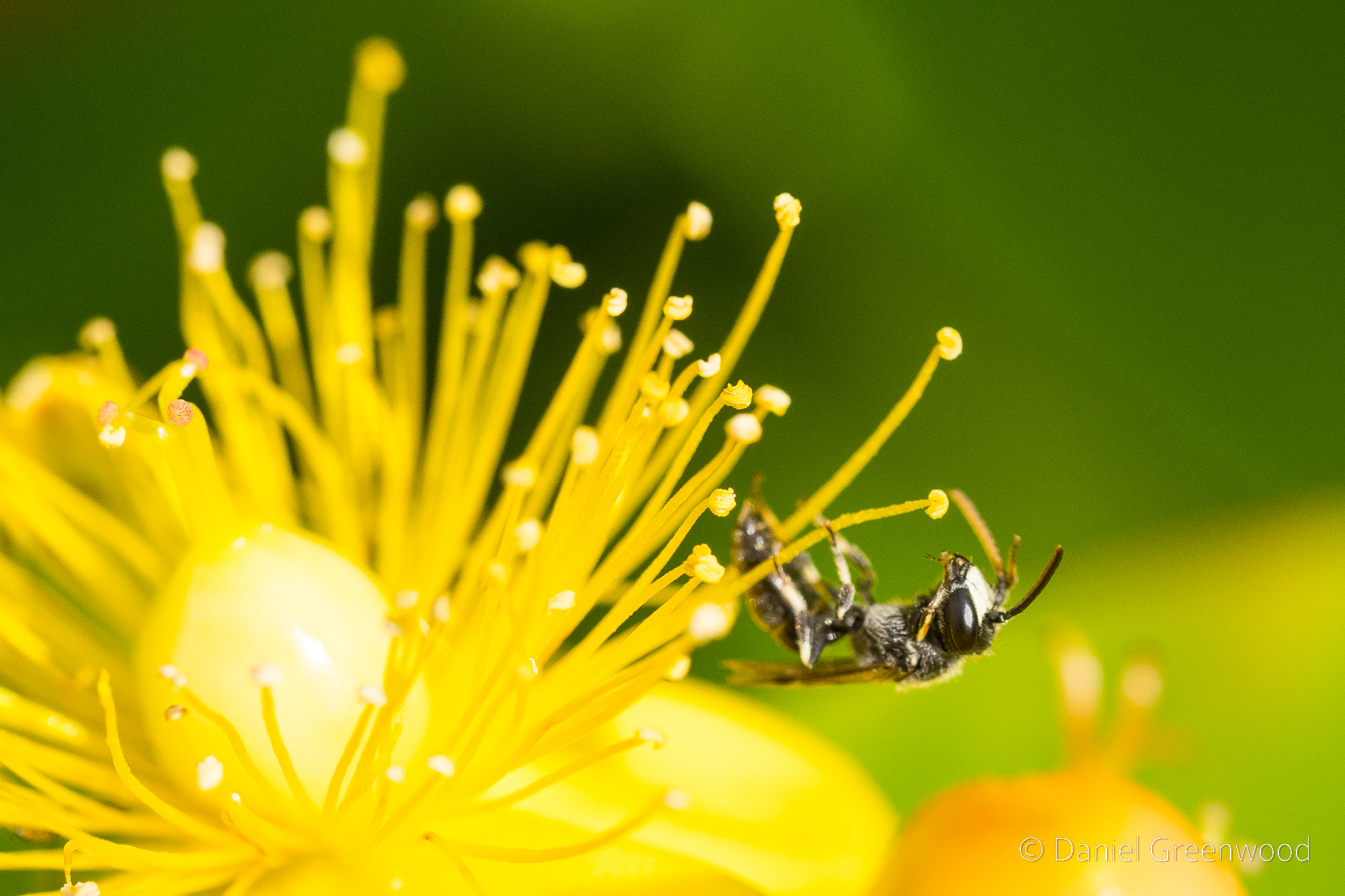
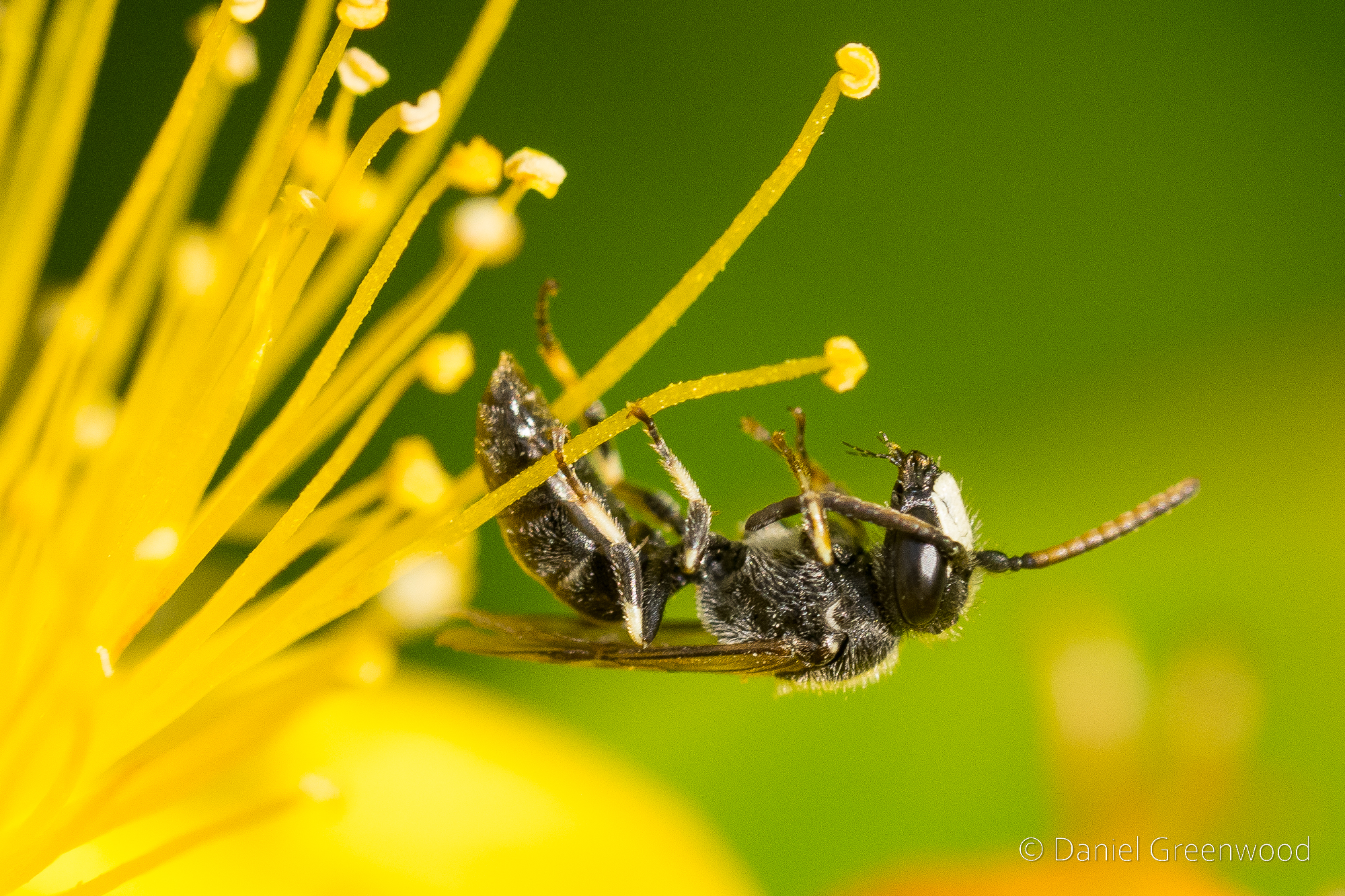
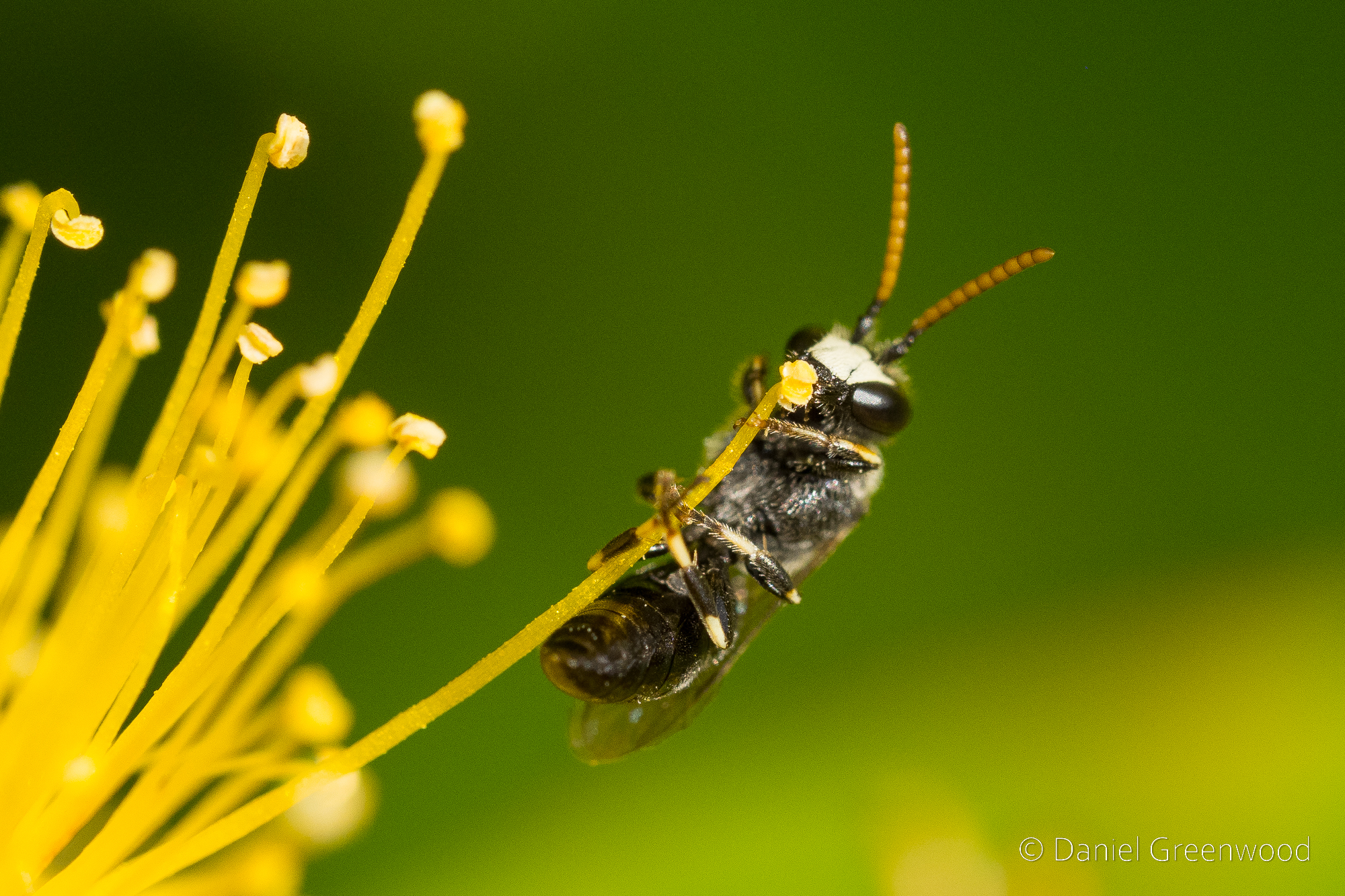
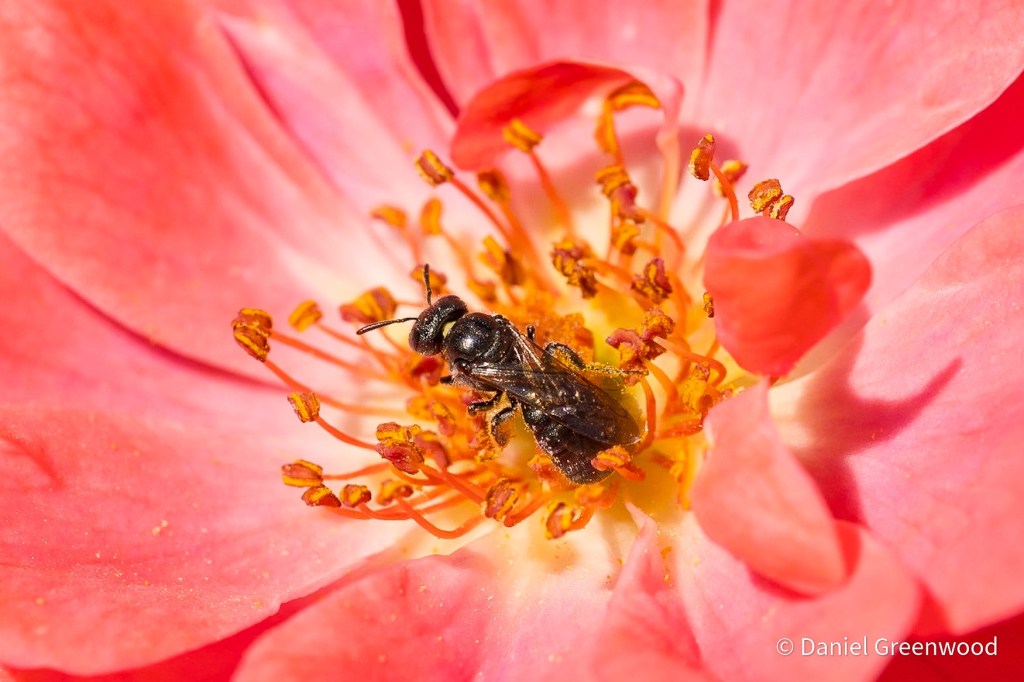
This is around the time when I begin to notice the very tiny yellow-faced bees (Hylaeus). I’m happy to identify them to that level, and don’t really take it any further.
And here we have some of the ‘best’ images I’ve taken this year. This yellow-faced bee is probably less than 4mm in length. Here it’s nectaring on the stamens of a cultivated garden hypericum. This was grown from a cutting taken from my grandmother-in-law’s garden and is a very good plant for pollinators, though it does need maintaining. I love the way the bee uses the stamen a bit like an Elvis impersonator on a standing microphone. Ah-huh-huh.
Here’s a bumblebee for scale!
I don’t think I’ve seen as many honey bees as in recent years, but there was a glut of them around May. There are reports of problems in the U.S. this year (bit of an understatement, considering who’s running things there).
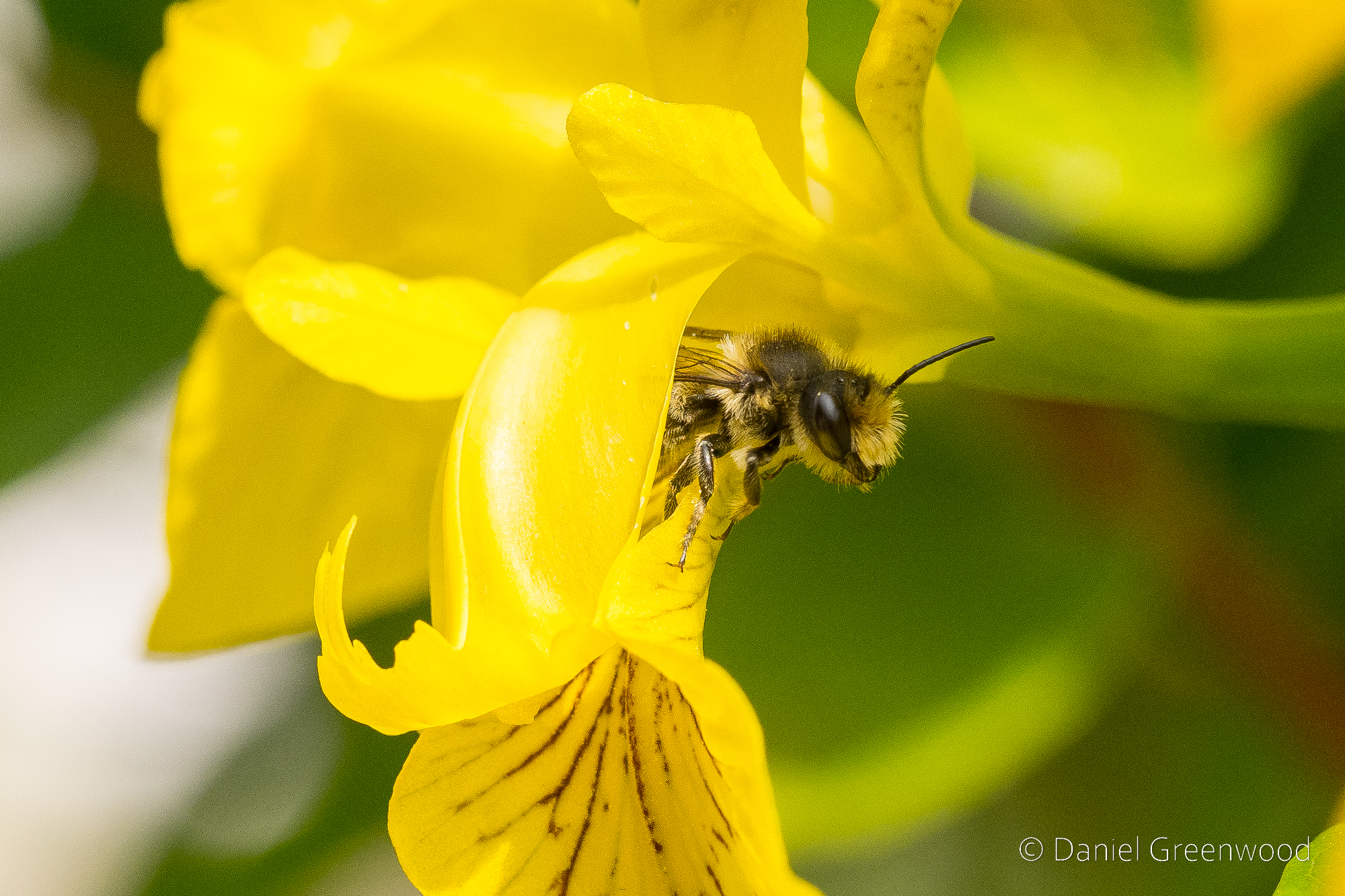
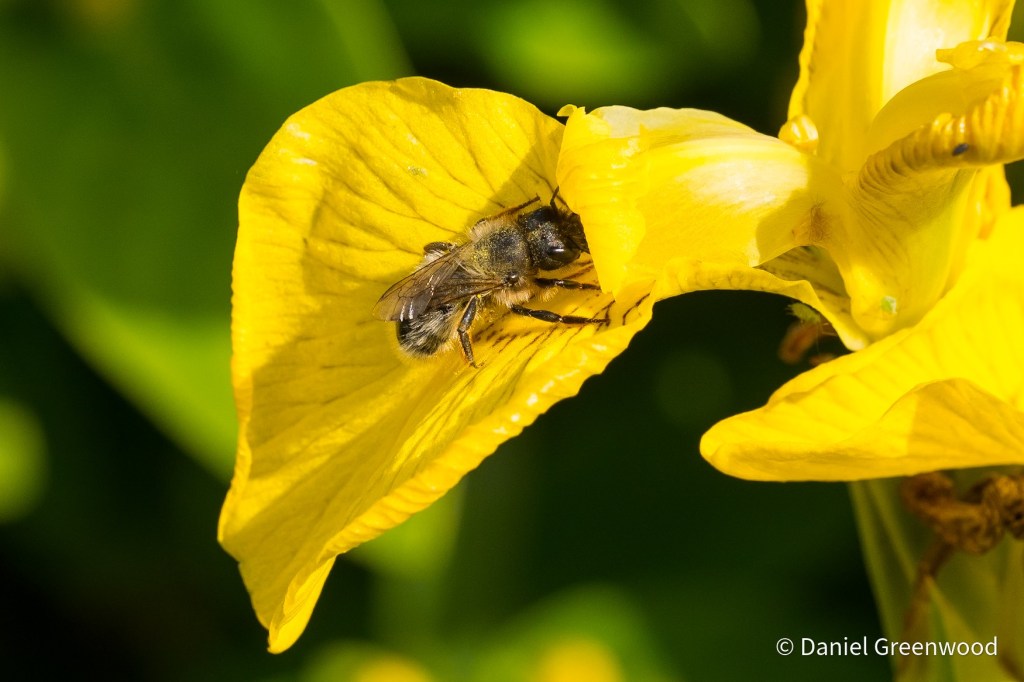
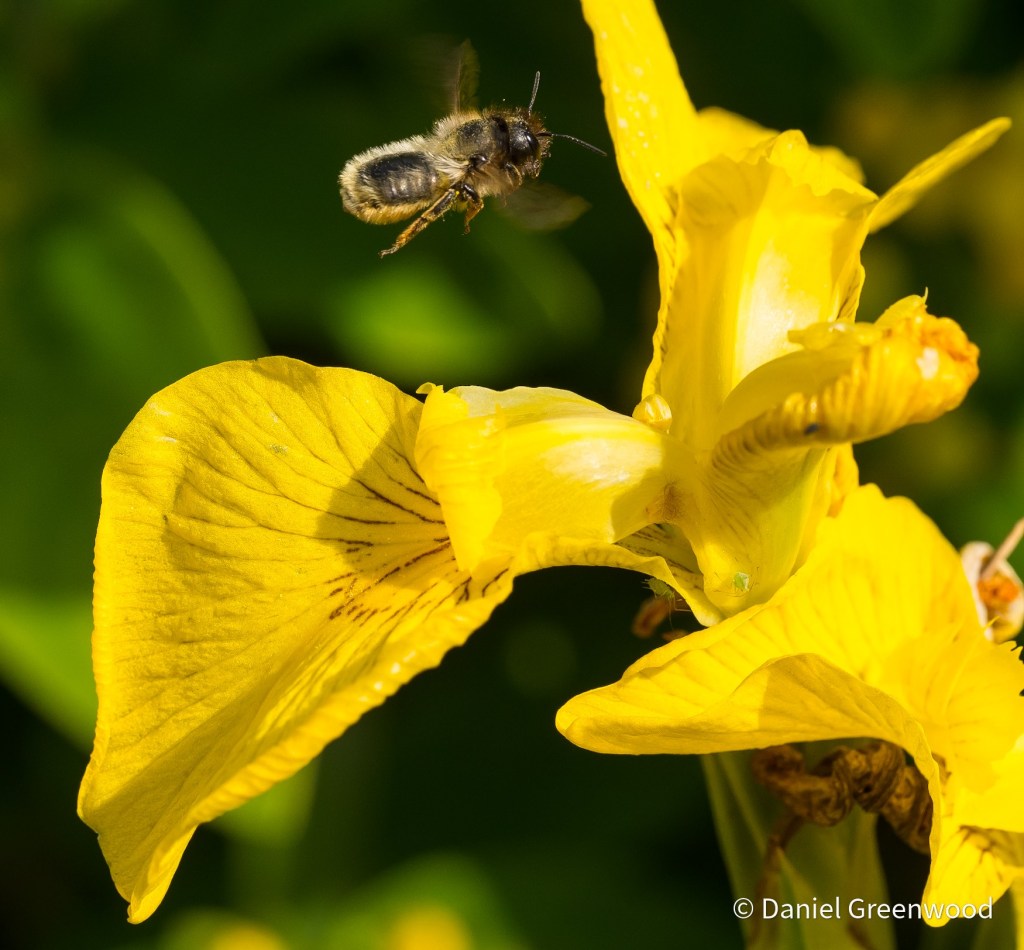
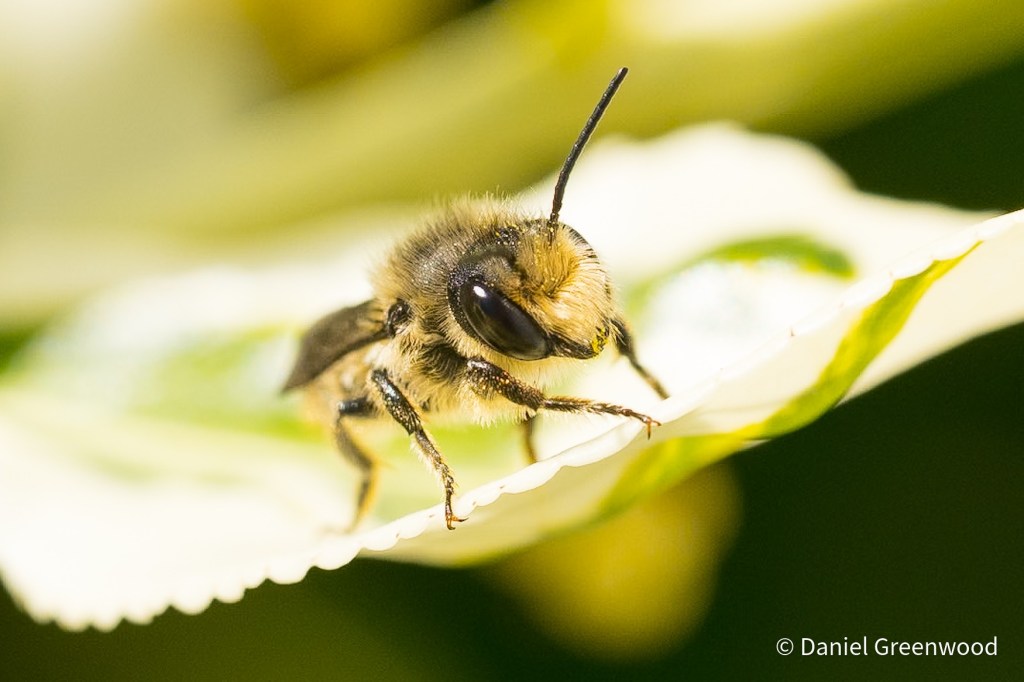
This solitary bee was visiting the flag iris in our little pond. I do enjoy the bee’s sideways escape. Not sure of the species, might be one of the Andrena mining bees.
I will now make like this bee and leave it there. Thanks for reading.
I’m posting garden macro photos from the 17th and 30th May. I have some really interesting photos from the 31st but that is probably more than one post in itself.
There are a couple of intriguing species I encountered in my garden between mid-late May, one of the very best times to look for our tiny invertebrate friends in this part of the world.
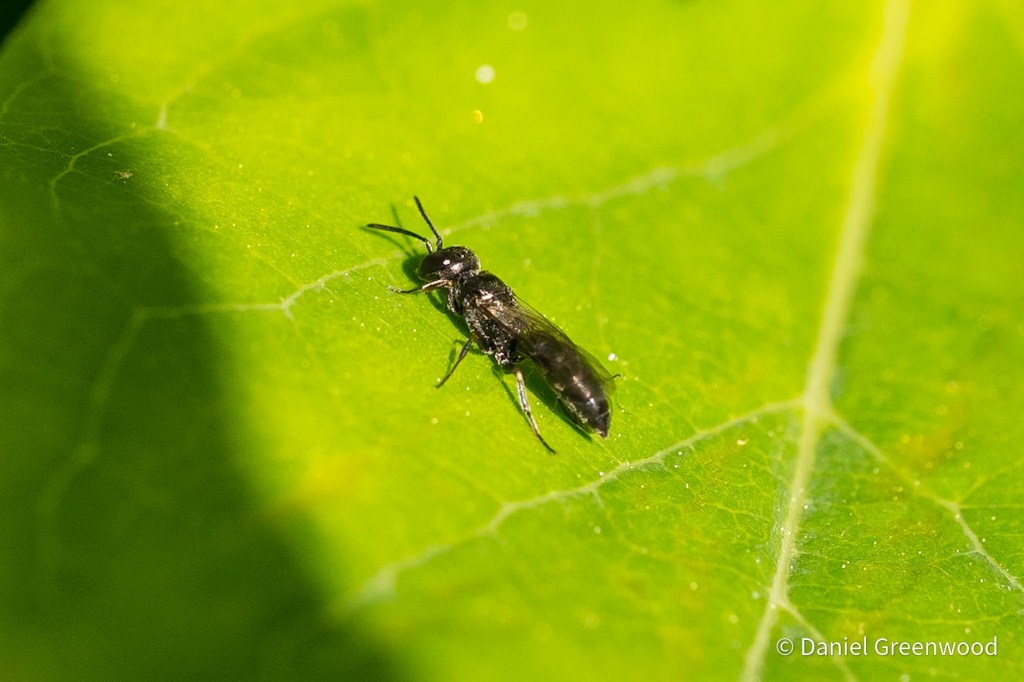
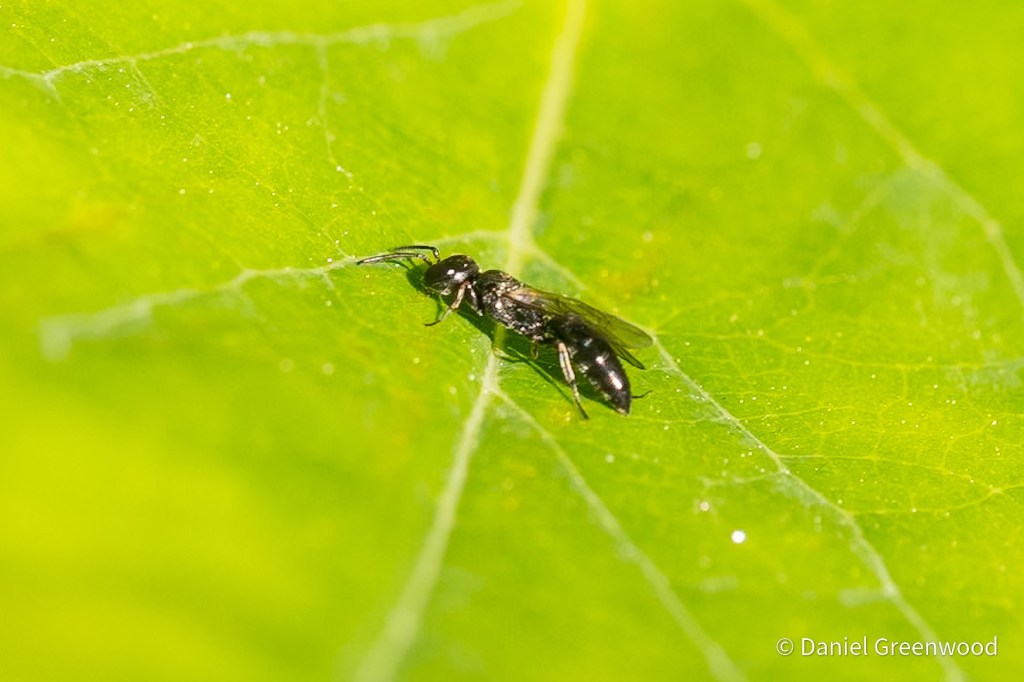
These are by no means great images (I would need extension tubes to increase the magnification) but the species may be an interesting type of wasp. It might be an aphid wasp, which is a group of wasps I haven’t heard of or seen before (there are thousands, even in the nature-depleted UK).
I’ve posted about aphids this year, and have noticed just how good a year they’re having. I listened to this episode of the Food Programme last week on the subject of potatoes, and didn’t realise aphids could trouble potato farmers. Perhaps they need to start gardening for aphid wasps!
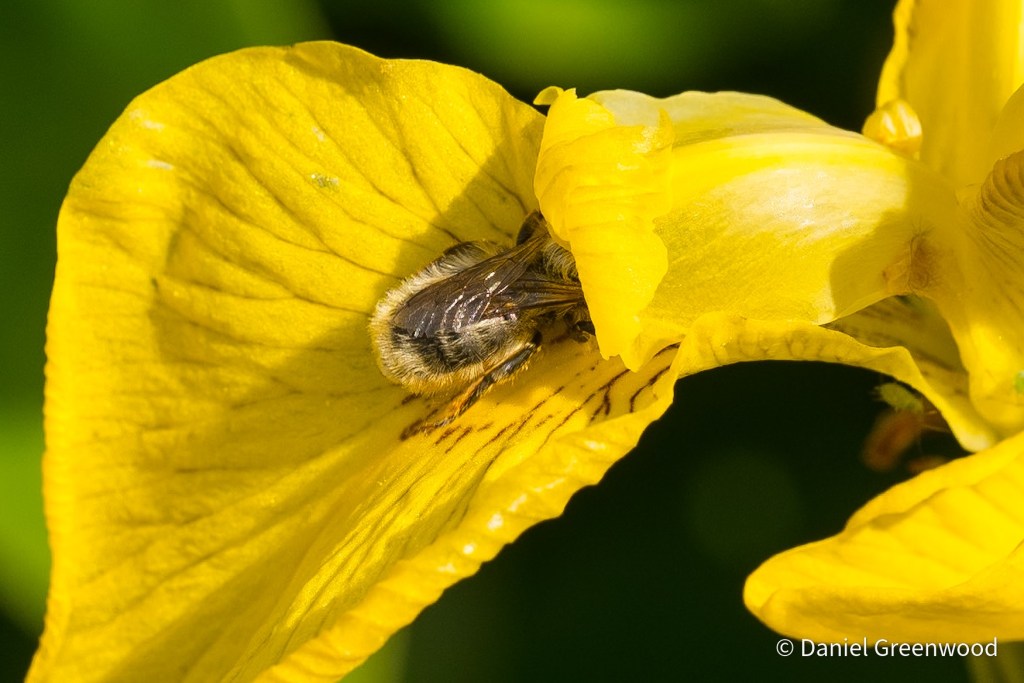
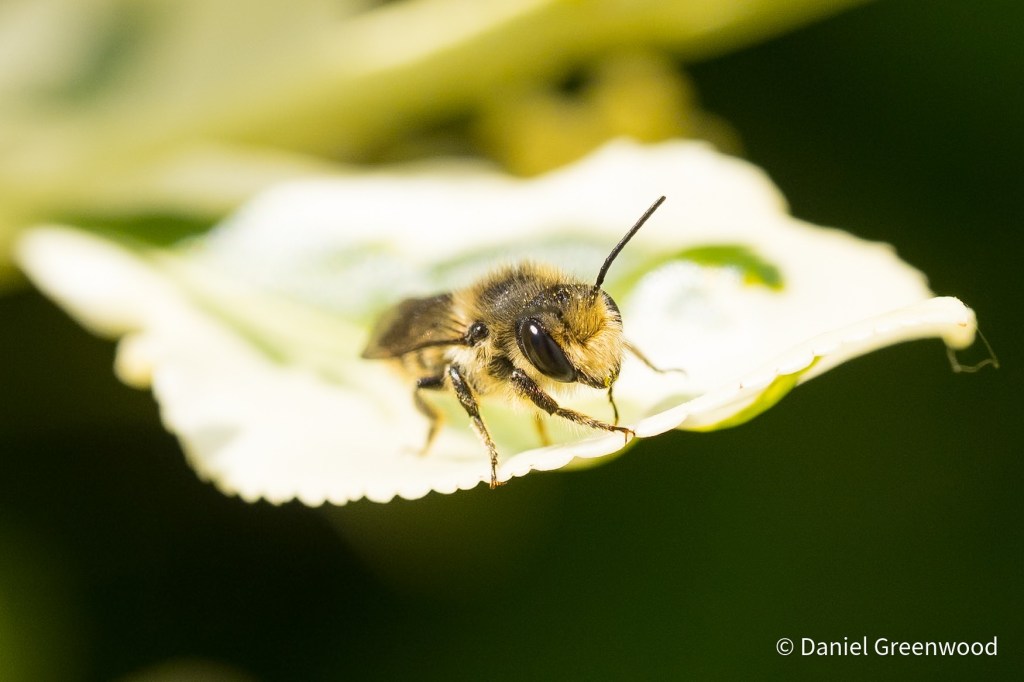
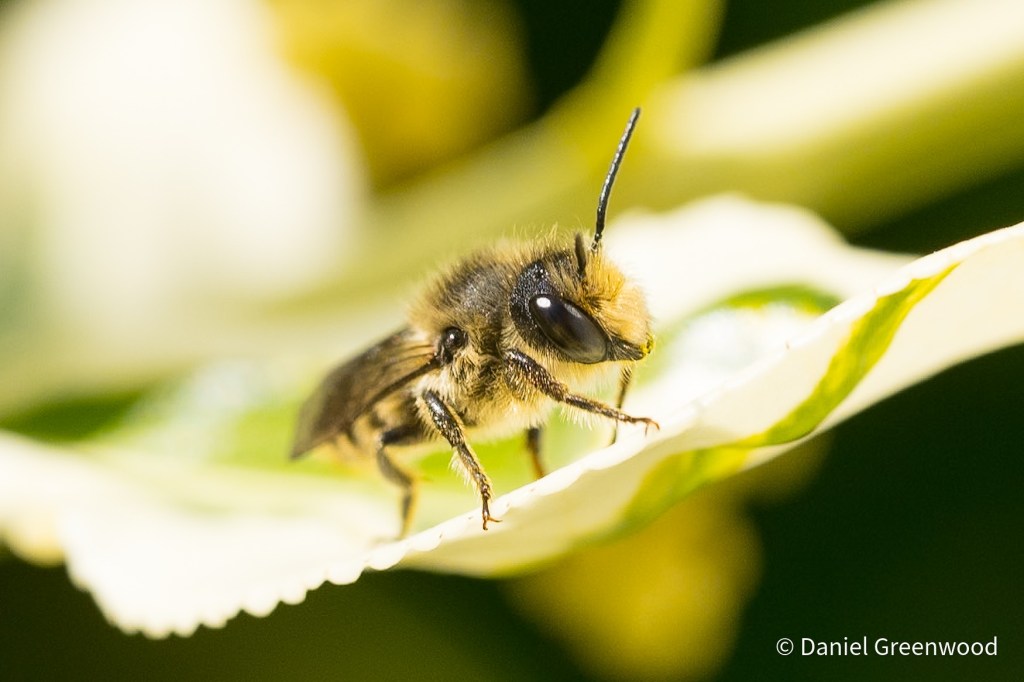
We have a tiny pond which supports frogs and is planted with native aquatic plants. One of those plants is flag iris, which the bigger bees love. I enjoy seeing the bees climb through the yellow petals to nectar on the stamens. This bee is probably in the megachile group, perhaps one of the leafcutter species. Someone on iNaturalist suggests it’s a mason bee, so I’m not sure.
I like how leafcutters are in their own world. They often appear after the red mason bees and hairy-footed flower bees have gone, but they seem like they’ve always been there, so focused are they on their leafcutting tasks.
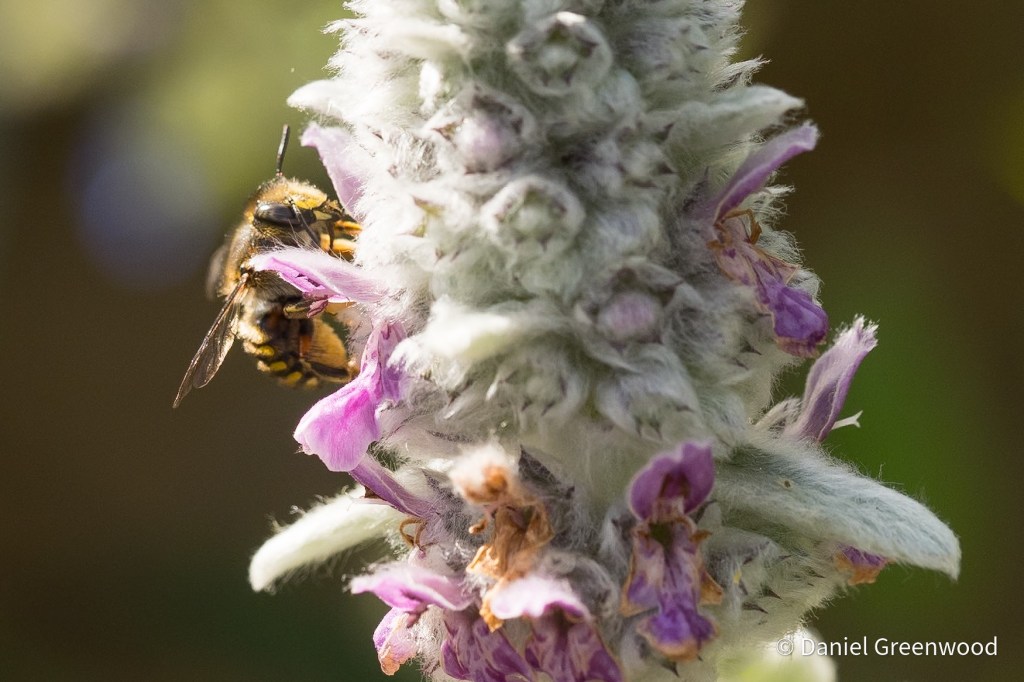
Another welcome sight in the bee world (it’s so much more than honeybees!) are the wool carder bees. I planted this stachys (or lambs ears) for the WCBs in 2020, and they immediately arrived.
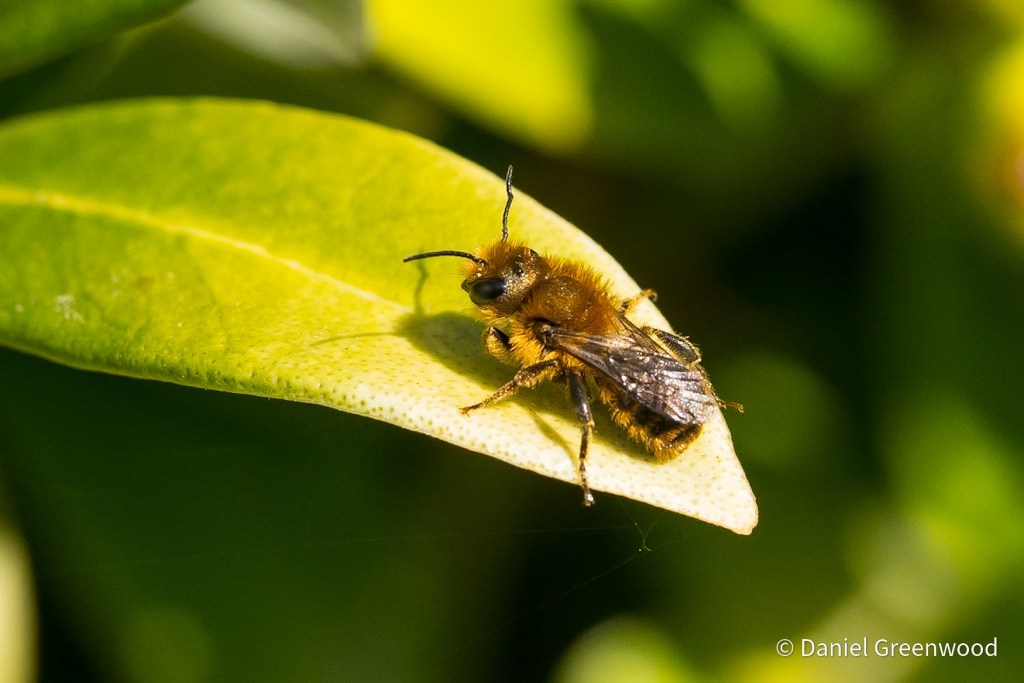
Regular readers of this blog may recognise this species from previous posts, who just couldn’t keep out of this week’s post. I used to look like this. These may be an orange-vented mason bee.
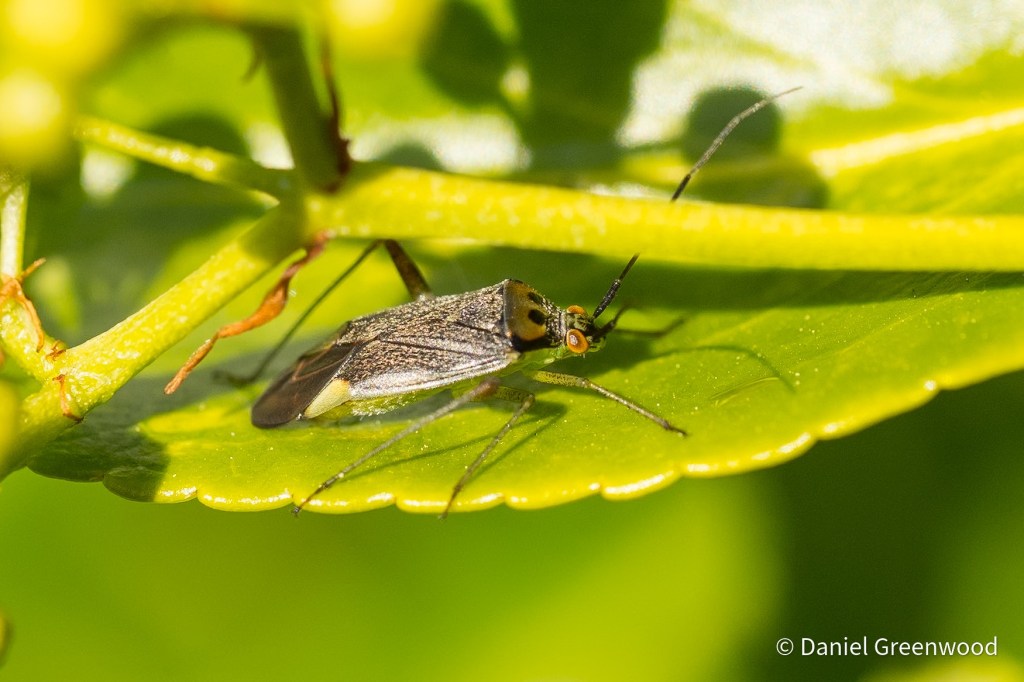
This capsid or mirid bug was chilling in the hedge, as they often do.
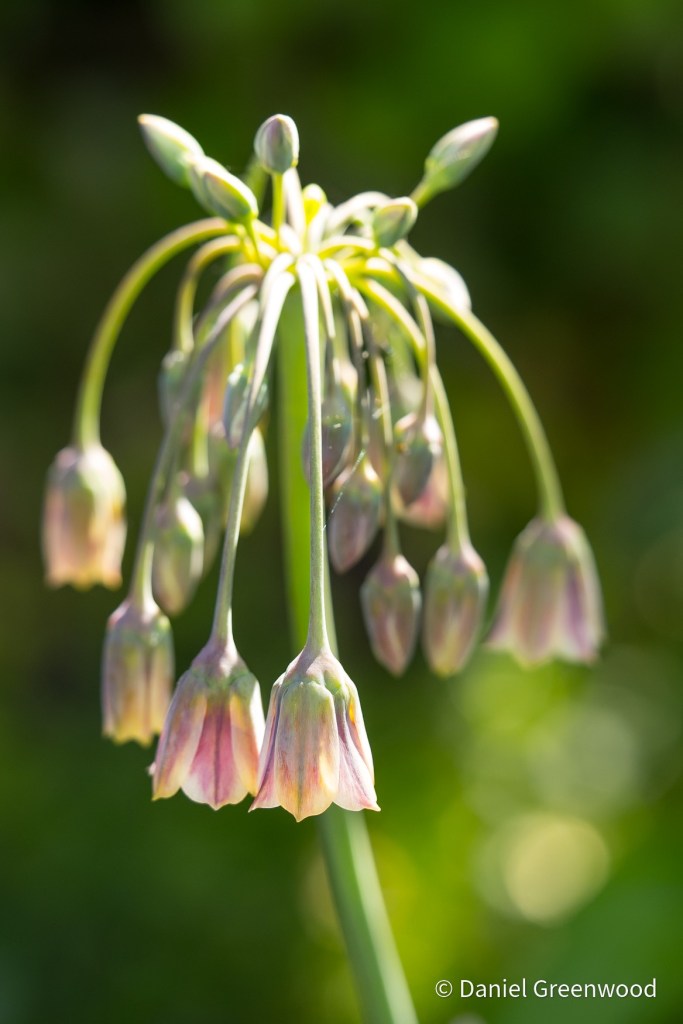
And finally, those trusty honey lilies were looking their best in the evening light, as their flowering period drew to a close.
Next week we’ll see out May with some pretty epic wasp vs. spider scenes and miniscule bees.
Taking macro photos in gardens introduced me to the capsid bugs. This is one. I’ve seen lots of one species in the hedge this year, they are quite ‘alien’-looking in the sci-fi sense.
Now to the bees. I spotted what I thought was a blue mason bee on the fence, but instead it may be a different mason bee. Compared with the red mason bees, this species, whatever it is, appears later in the spring and lasts longer until the summer.
I love the light in these pics, and it’s all au naturale. Someone on iNaturalist has suggested this is one of the leafcutter bees.
This bee is potentially a little blue carpenter bee. I enjoy the background colours of the rose above…
…and the yellow and cream of the honeysuckle. Backgrounds in macro can make a very big impact on the photo. This is a species of sweat bee.
Finally, I didn’t get this little wasp in focus, but I like these brief encounters with random wasps. It reminds me that there is still huge biological diversity in the UK and the world does not revolve around us.
Onto the 15th May 2025, when the bumblebees were beginning to increase as the workers emerged. But we won’t begin there.
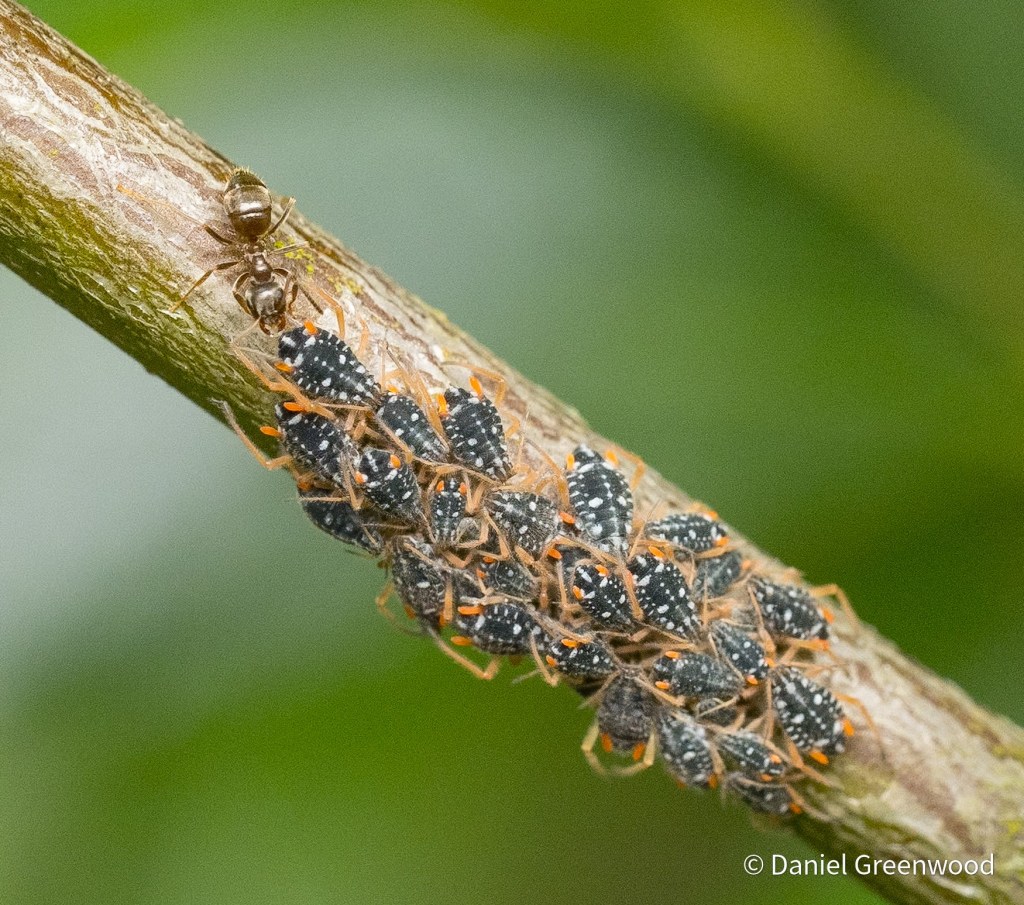
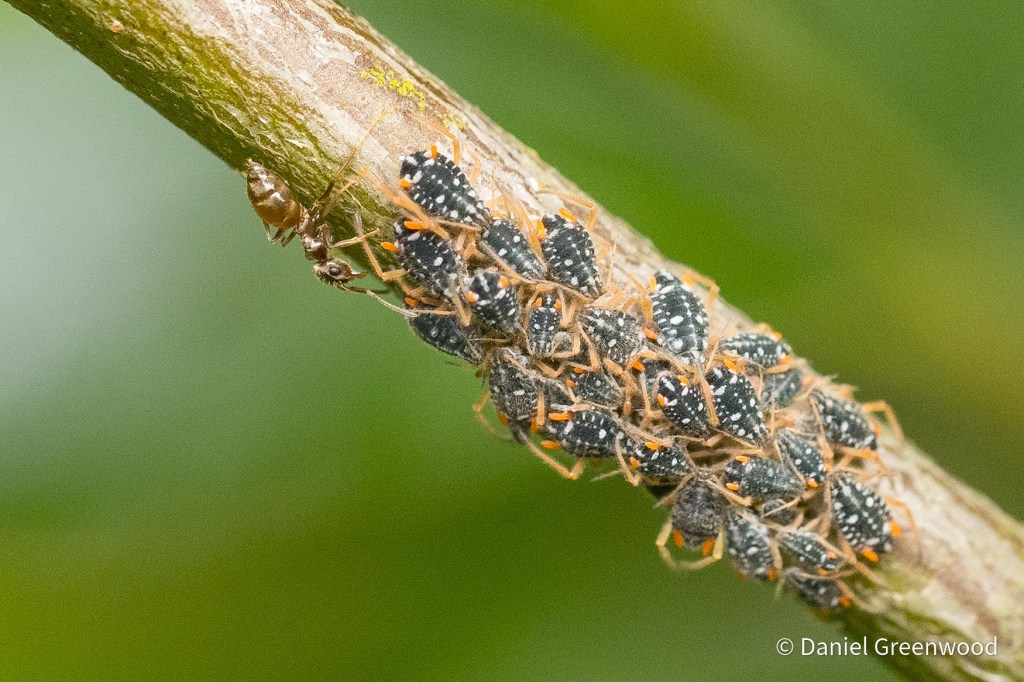
The path to my house is overhung by a self-seeded willow sapling (probably to the annoyance of the postman). One morning I noticed the twigs held a cluster of aphids, tended to by ants.
The ants are probably farming the aphids by providing them with a degree of protection and harvesting the honeydew they excrete. These are probably willow bark aphids but my insect book says there are over 600 species in the UK and many are very hard to identify!
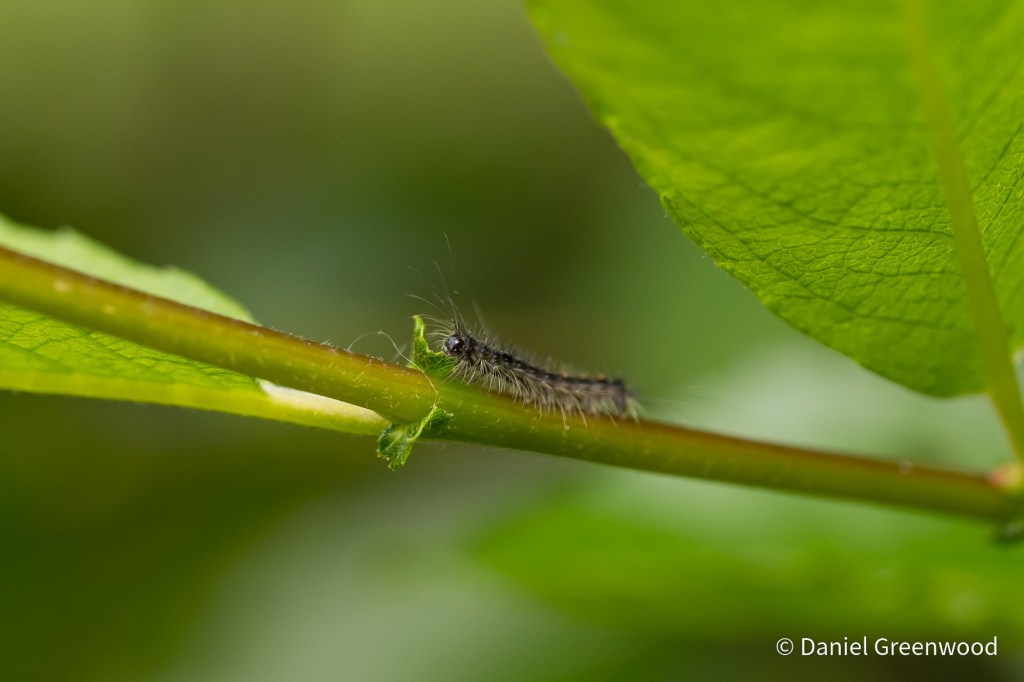
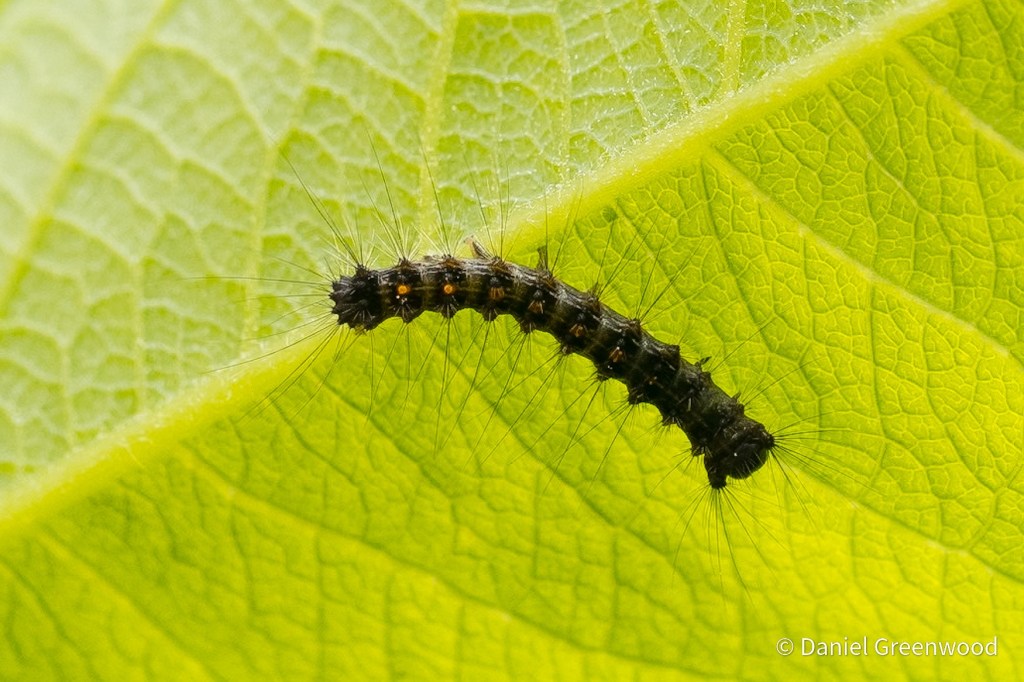
Elsewhere on the willow this little caterpillar was chomping away.
I think this is the same species but I’m not sure what it is. Caterpillars are not a strong area for me.
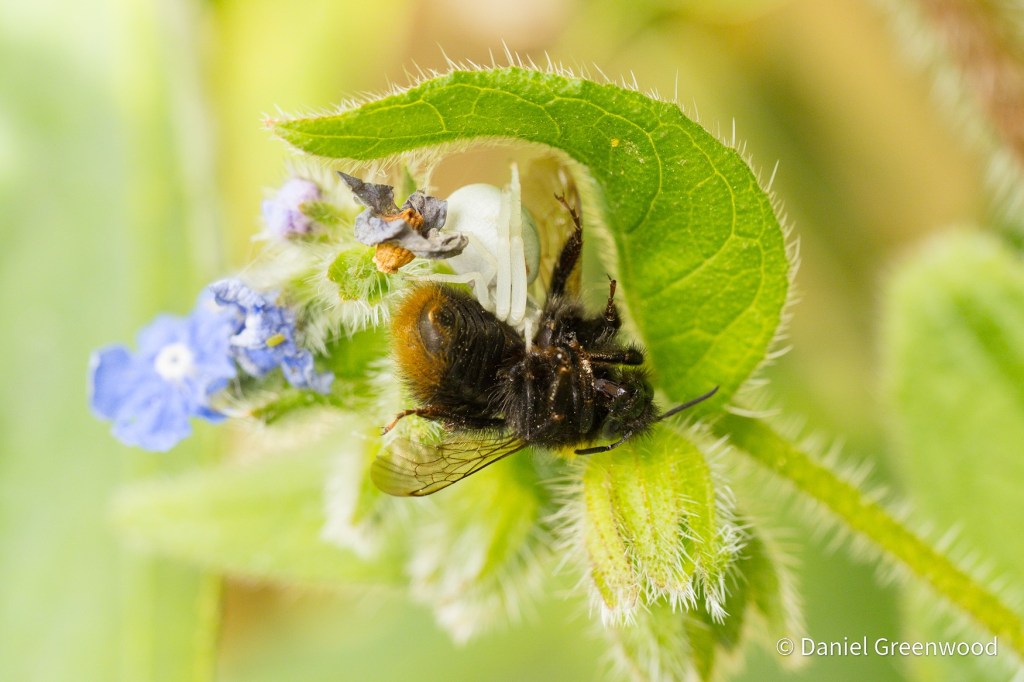
Moving onto bees, I spotted this bee that had been predated by a crab spider (probably Misumena vatia). I am wondering if this might be a cuckoo bumblebee, a kind of mimic that is in fact solitary and raids bumblebee nests, rather than being part of the community. The second photo is from some time later when the spider had moved their prey around.
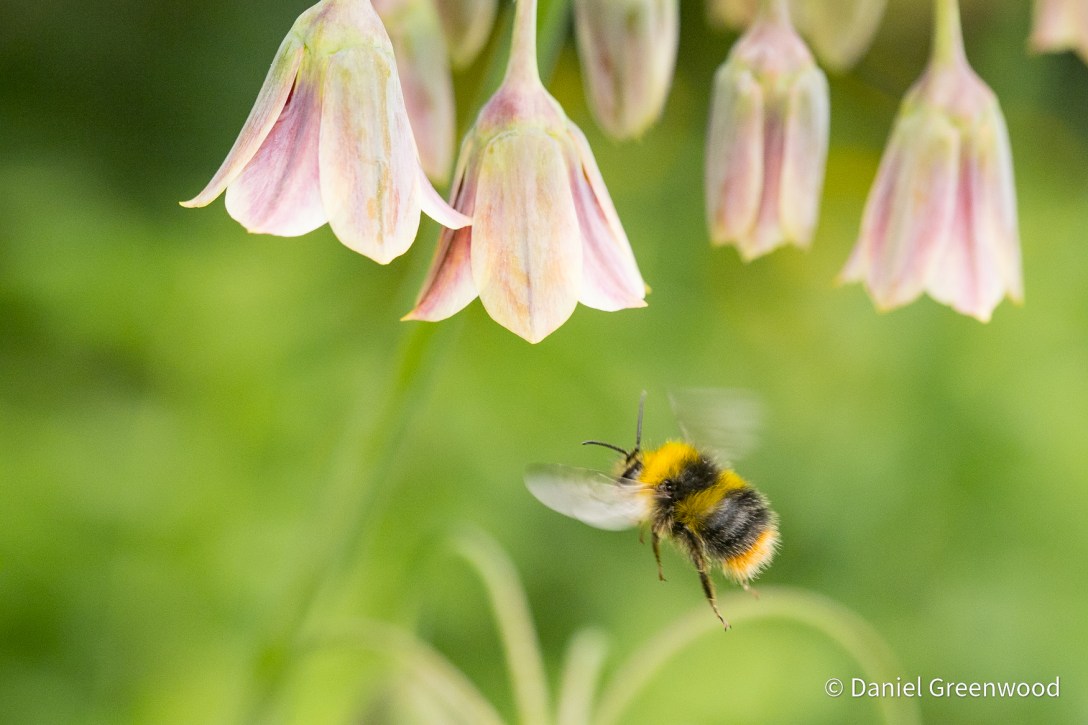
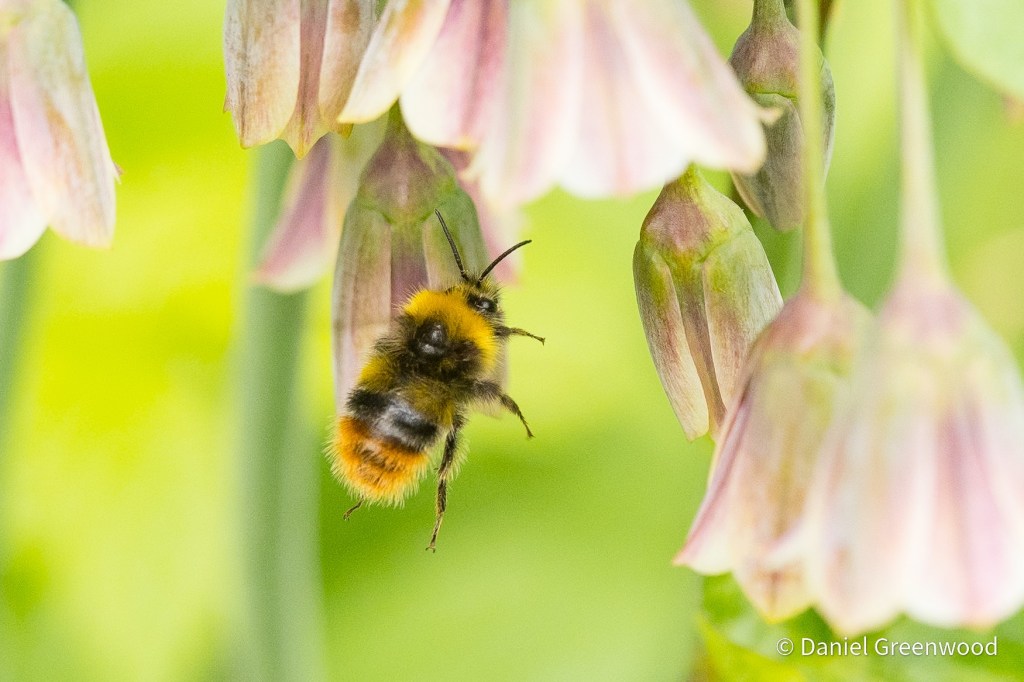
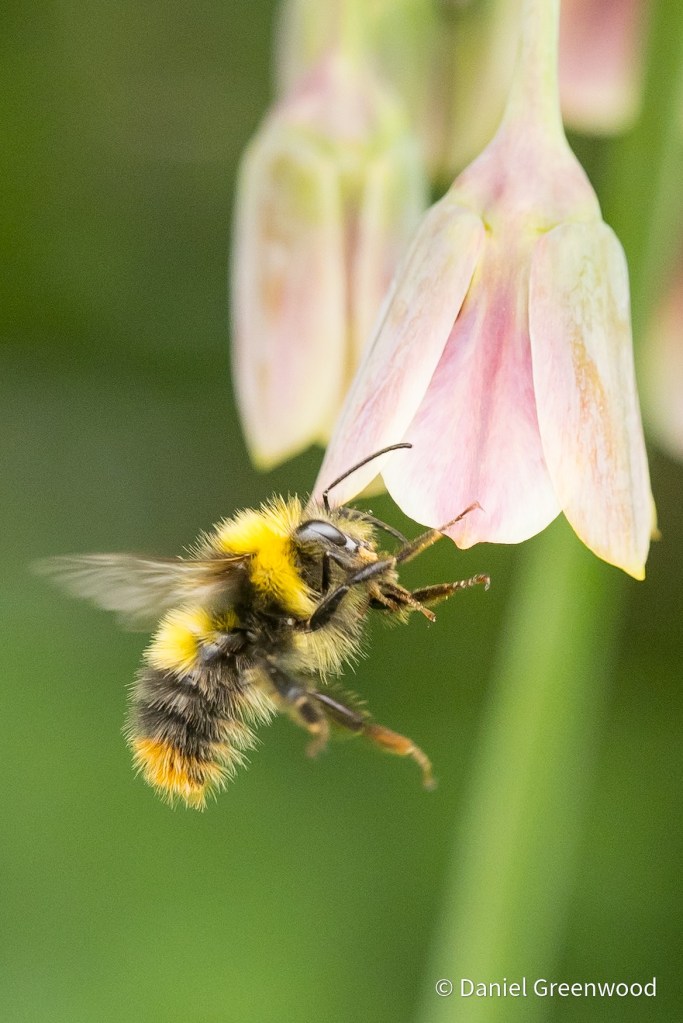
A couple of weeks ago I wrote about the Sicilian honey lilies that have been flowering in my garden. The bumblebees were out in force among these flowers. They seemed to find it a bit difficult to access the flowers from below, but they were foraging en masse. This is one of the first times I’ve used the high speed shutter option on my camera, and it has provided excellent results. I’m not sure of the species, another area I need to brush up on, along with the aphids.
This spider is pregnant, you can see the egg sack. I think it’s a fox spider.