Something new

Fly orchid 4

Farthing Downs & New Hill, London, July 2013

On the Downs the butterflies are immediately evident, the week old broods of meadow brown ferry amongst the long grasses, rarely stopping to feed on flowers. Breeding season is ending but still the song of skylarks comes from over the slope, some ancient language remembered, its translation lost. Greater yellow rattle blooms now, the spring buttercups lost to a swathe of Yorkshire fog and other grasses I don’t know. The suntan lotion on my arms acts as an adhesive, my skin covered with seeds. The grasshoppers are conjuring up their rickety, wooden percussion. I am hopeless in finding them, except for one that hops between seed heads, a micro Tarzan in this meadow jungle. But where are the people? A man drives a BMW sports car along the lane, revving its engine. I know where I’d rather be. Men in England are bare chested at the slightest chance and here a couple stroll along the lane drinking from big bottles of water. The tattoo stamped on the man’s back stands out in this simple landscape of slopes and flowers.

Lovers

Ghostly day-flying moths spread at my every step through the long grass. Bumblebees forage on clovers, dropwort and yellow rattle, small heath butterflies appear again, two fly together, eager to fulfil their short lives with as much fornication as is possible. I cut back on to the path I know best. A chiffchaff sings in the hedgeline at the bottom of the hill, a single blackbird and a whitethroat, too. There’s no sign of spring’s willow warblers or their clutch of young. A crowd of peacock caterpillars munch through nettle leaves, leaving only the dreadlocks of flowers. A yellowhammer appears from across the lane, landing in a small hawthorn bush, its strong yellow plumage brighter than dandelions, a South American yellow, and at its brightest here. I take a few photos. Along with skylarks, this is a bird I have to travel to see, when once, before my time, you might have woken to it flocking in the hedges and fields.
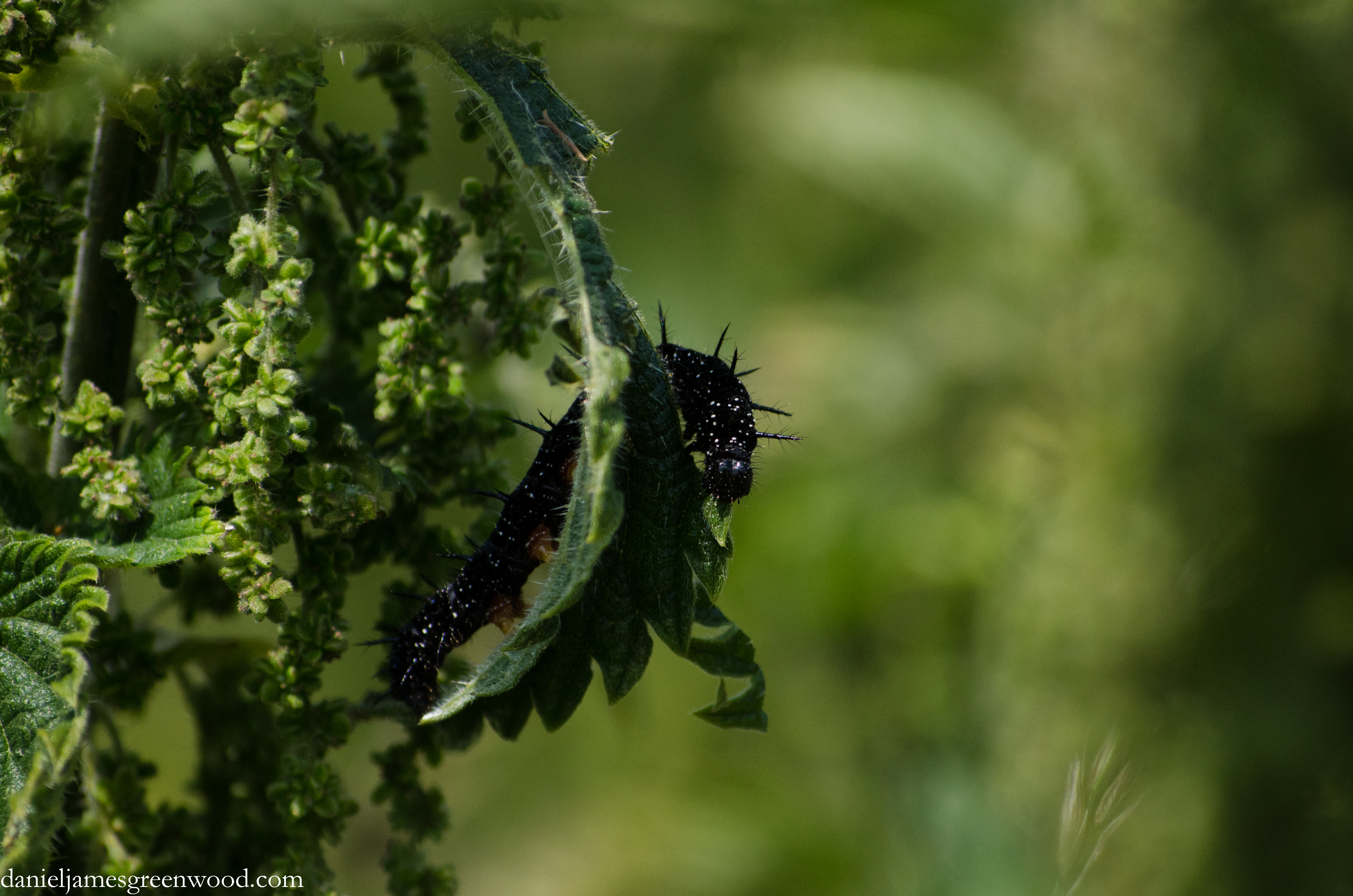
Peackock caterpillar

Leaving the Downs I enter the chalky wooded hollows at the bottom of the slope, with tor grass growing along the track, an indicator of the calcareous soil. My sweat cools with the breeze that slips through here. In the dappled shade I scan the path edges for orchids, black bryony creeping out from the darkened hedges. And there it is: the fly orchid. I change lenses and struggle to get the image right, sweat dripping, bringing lotion down my face. But it’s beautiful to look at – a bit like a bumblebee pinned and proffered by the long spike, with its little eyes and short antennae. A family are passing behind the hedge, discussing how to control the dog.

‘She’s pulling me down into these weird places,’ says the mother.

‘Just let her off the lead, let her off the lead,’ the dad says.

They arrive on the path heading down hill. Their daughter warns the dog to stay with them. I only see the mother, she’s dressed in an apricot coloured dress and heeled shoes. She’s young and glamorous, so fitting with the array of flowers bursting from the hillside.

‘Who needs Box Hill when you can come here, eh?’ says the dad. They disappear down towards Happy Valley.
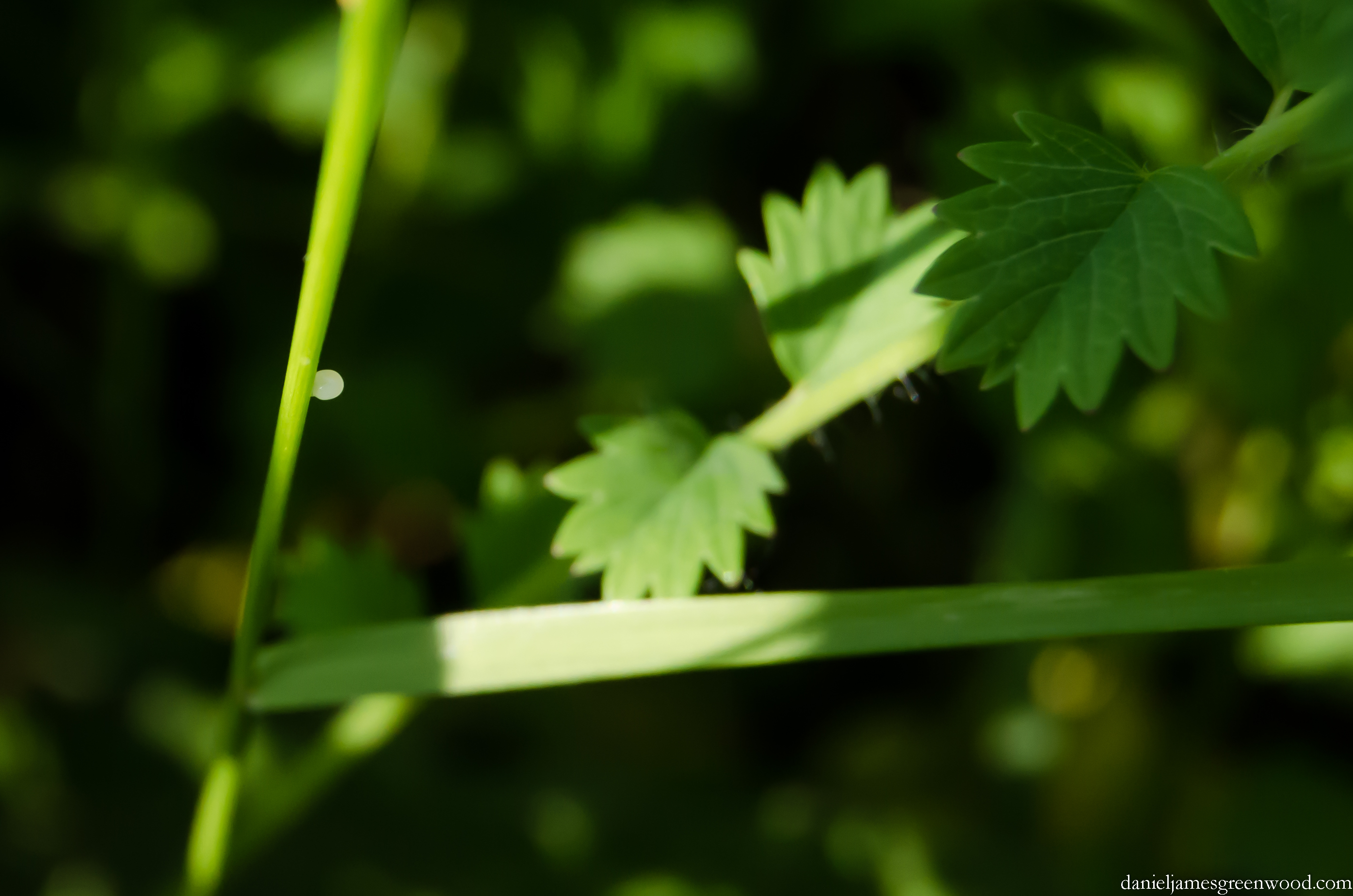
Speckled wood egg crop 1

I carry on along the ridge and settle on the desire line drawn down the hill and through the flowers. Ringlets move through the meadow, the first I’ve seen this year. They move at the same time and, stitched together, they are a tapestry of flickering wings. In my silence and stillness wildlife begins to move around me, perhaps more trusting. I see more plants now: twayblades, common spotted orchid, salad burnet, marjoram, ox eye daisy, rough hawkbit and bladder campion with its inflated, balloon like calyx-tubes. The wind blows through the trees. A speckled wood butterfly flaps about me, its wings audible as it hits my khaki shorts and leaf stalks. It clasps hold of a spear-like grass stem and curves its abdomen, laying a tiny pearl of an egg. This, for me, is something new.

The contents of the lady’s bucket

The contents of the woman's bucket

Cox’s Walk, London, July 2012

We’re coming toward the end of our bat transect, our detectors raised into a night lit by the orange glow of a line of streetlamps and closed by the canopy of oak. Nothing. Further up the slope there was a hint of a noctule bat’s chip-chop call coming through the static of the airwaves, but nothing else. Rain begins to fall and we make our final marks on the record sheet. There are very few bats around, the woodland all but shorn of them. At the bottom of the path are two figures, a third, dwarfish silhouette evidently that of a large dog. From here it’s unclear whether they are moving away or towards us. A fox appears between us and, turning to look back from where we’ve come there rests another. In this break of light and dark, the fox watches us with content, almost with sympathy. Nevertheless, we’re surrounded.

As time goes and our chatter dwindles, the people approach. It’s a man dressed in a cream suit and a woman. He is indeed rotund, stopping and strolling, she strafing either side of him, circling tree trunks, in and out of darkness. We’ve finished now – there’s no point dawdling – no one says anything about it, but there’s a sense of apprehension. We stop – I don’t know why. I call out: we’re doing a bat survey! I’m shaking the black box in the air. A voice travels back:

‘You can do what you like.’

The fox at the top continues in its restful manner. We are the scene.

The woman is clear now, she wears blue dungarees and a red bandana holding up dreadlocks. She disappears behind an oak trunk, flashing us a glance, like a child playing cowboys and Indians. She smiles, emptying a plastic bucket around the trunk. The man has stopped, I can see his large oval spectacles. He turns to the tall iron fence protecting a small copse of maturing silver birch. The woman comes from behind the tree again:

‘Don’t be scaring me foxes away,’ she says, gently, with a hint of the Caribbean in her voice.

We all stop and look to the copse. The streetlight cast onto the trees and fence shows movements of the amber fur of a trail of fox cubs. They slink through the fence and arc towards the tree surrounded by piles of pink sludge – the contents of the lady’s bucket.

‘Ain’t they beautiful,’ says the rotund man in his cream white suit and oval spectacles.

Descending, descending, falling apart

by Martin Damien

Photograph by Martin Brewer

— Nunhead Cemetery, London, April 2012

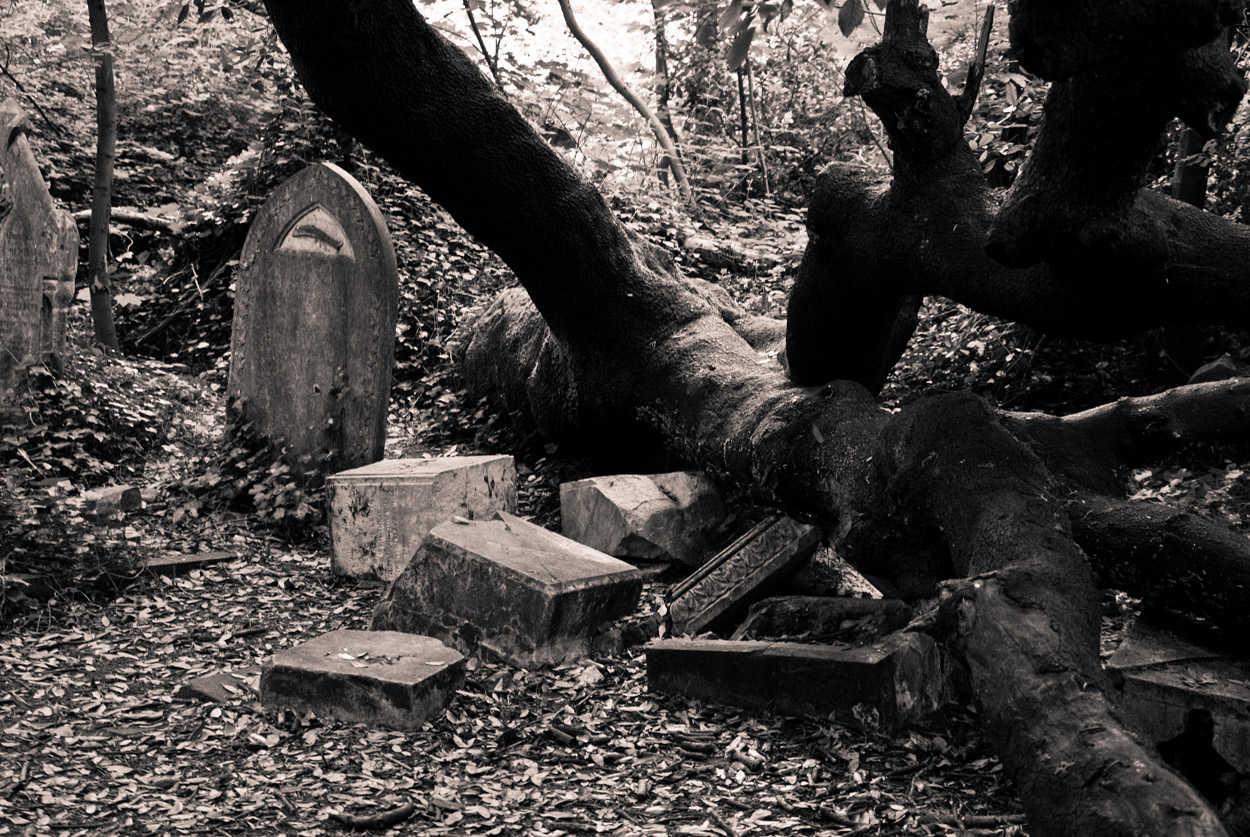
In the cemetery won by sycamore and rendered woodland, two male song thrush are duelling with one another, throwing out tunes, rewriting and rollicking the black cloud with their language.  This mysterious, handsome thrush is to me like a singing pudding endowed with flight. I leave them to it. My ears are working overtime, the scene dripping, the algae glows on the trunks of dark trees, the moss is vibrant on the gravestones appearing as shipwrecks at the bottom of an ocean. The denseness of the trees squeezes the sound: blue tit trill, the calling great tit and guttural canon of the crow marking the enclosure of forthcoming leaves and canopy. A family, their dog muddied, happy, intoxicated by the aroma of wet woodland, people relaxed, even pleased – woodland puts us back into our bodies. The sun inches out and makes crystals from the droplets of fallen rain, there is the feeling that the soil is sighing from the torrents. Deep refreshment has touched the natural world. My waterproof holds drops of water that leave strange dents in the material, my jeans are darker now. Wait – a song ending, a sweet, fluty refrain. Silence. Woodland dripping, I retrace my steps back down the path. The song comes from a leafless ash canopy – descending, descending, falling apart. Willow warbler. I see it, its long tail and constant hopping between branches. How far has it come? It sings again and moves on. The matt black storm clouds progress, the inkling of lightning, the thunderous thump.