In Devilsden Wood we tiptoe around fallen beech logs, slipping at times on beech leaves and clay, and the emptied mast. The nuts will have been eaten by hungry jays and squirrels. Over the past few weeks I’ve crouched down around these logs photographing their fungi: beech jellydisc with its almost caucasian flesh, purple jellydisc creeping out by the week from wisps of moss. Most startling for a layman like me was the glaring eye of dog stinkhorn, named after its canine stench. Lodged in a piece of black deadwood it had the appearance of a fox or wolf skull looking up at me. The long, finger-like stems that it had produced had collapsed, orange tips like finger nails. As Julian Hoffman has written recently, referring to the poet Rilke, we are surrounded by a world that beckons us to perceive it, to engage with it, to look and to touch. To me the fingers of the stinkhorn could be pointers to something worth seeing. Today only the jellydiscs remain, as well as a brown mushroom that reflects the white break of cloud between the trees above in its glossy cap. My friend Philip is searching for something behind me and as I look up the sharp dark shape of a sparrowhawk slices between us in silence. If we were little woodland birds we would not have seen a thing.
Blue smoke plumes from the dreary Downs, the crack of piled ash trees cuts through the distant wash of the M25, and now the noise of chainsaws. This work is good fun. How many people panic at the sound of this machine, waking to find that their favourite tree is gone from the frame of their bedroom window. In the town I am always suspicious when their itch carries. But this is the restoration of the chalky meadows swallowed by the incoming of woods. We as a species have been trying to halt the loss of woods but at the same time deny new ones for thousands of years. This is a thousand-year-old view, the only change the exchange of machines for the pop of axes on heartwood.
Against a view of near leafless beech, a green woodpecker rises from the anthills, its flight reminiscent of a puppet tugged at intervals as it passes. Robins sing, gulls create the aura of the Sussex coast, and rain specks add a pinch of cool. In the now flattened meadows fungi can be found: a parrot waxcap plucked and left, yellow gills that ripple like flames around its stem. Puffballs are scattered across the path, little footballs deflated and unwanted. I press my toe into one, flattened and leathery grey, its brown spores puffing out like effluent. I definitely take them with me.
I’m standing in the street waiting for Moravian ornithologist Karel Šimeček. From here I can see a serin on a TV aerial across the road, and from over the houses I hear a golden oriole releasing a few phrases of its fluty, unmistakable music into the morning air. In the road is a dead animal, a common sight, and an indicator of just how much wildlife there is here. Another common image, especially on the roads leading out of town, is squashed hedgehogs. In England we barely have dead ones anymore. A car pulls up on the other side of the road and out steps Karel, binoculars round his neck, eye pieces covered by grey duct tape. He crosses the road, making sure not to be run down like a hedgehog. He shakes my hand and turns to the squashed animal in the road:
‘Turdus philomelos,’ he says.
A song thrush, my favourite bird. We get into Karel’s silver Peugeot estate with Radiohead’s Kid A on the stereo, a welcome reminder of home, and we set off. The roads are mostly empty but then it is 8:30am on a Sunday morning. I ask Karel about his interest in wildlife.
‘I became interested in birds as a boy when my mother bought me a book,’ he says. ‘I have been watching birds for more than thirty years. But there are not as many as there used to be, when I look at my notes I can see that there are less birds now.’
Why is that?
‘Different reasons. Agriculture is very important but it is probably the main reason,’ he says.
I was astonished to see how large the fields were in South Moravia. My host is conservationist Zuzana Veverkova, and she told me that the average field size is 500 hectares, meaning that small-scale, sustainable farming is impossible. Young people cannot find a way in other than through inheritance. And there are reasons why farms are so large: inspired by Stalin’s collectivisation of Russia’s agriculture, the Czech communists did the same, forcing farmers off their land and into prison if they refused. Today you have the corporate farming practice with monocultures of what Karel calls ‘the yellow evils’ of wheat, corn, sunflower and rapeseed. In some places, there are miles of these plants and nothing else.
But back to birds. I’ve never seen a goshawk and have read they are one of the most common raptors in the Czech Republic:
‘They are at 20% of what they were when I started,’ says Karel. ‘They are hunted and poisoned by people who think that anything with a curved bill and talons should be killed.’
‘Do you know the hunters?’ I ask.
‘Yes, I know them, and there is no reason for their killing of these birds.’
‘And are goshawks protected by law?’
‘Of course.’
We pass out through the fields, a pine wood on the horizon.
‘A few friends and I managed to get the pine forest protected as a nature reserve,’ says Karel.
That was not enough to save its most unique resident. 20 years ago it was home to more than twenty singing male ortolan buntings. Today there are none. Karel laments this fact as we take a swerve in the road, our passage halted by a pair of white storks treading through a field. Karel reverses and I photograph these graceful birds. They watch us, too, turning away and moving further into the pasture.
White stork
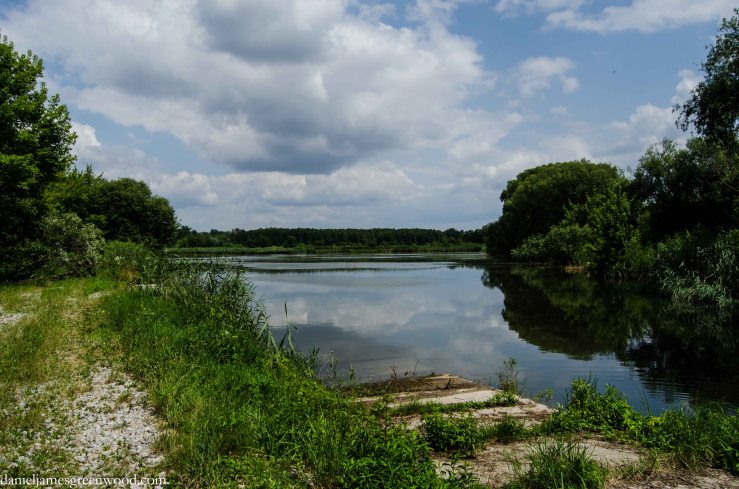
Arriving at Mutěnice fish ponds we stand on the rickety wooden footbridge where the River Kyjovka dams, the water splitting off into the ponds. Leaves cover the surface, a red admiral arriving to bask on the enforced stillness. Karel points to a stand of dead poplar trees on the other side of the river.
‘That’s the beaver’s work,’ he says.
They’ve been here for thirty years. About five years ago the manager of the ponds attempted to eradicate them, but he failed and so the beavers remain. They arrived here from Austria from the Morava, the river that gives this district its name, running the border with Austria and reaching the Danube in Slovakia. When they first appeared here one beaver was captured and interred in the local zoo. It escaped within 24 hours and returned to the fish ponds.
Turning to step off the footbridge, over a few missing slats, Karel glimpses a kingfisher as it lands on a rock in the Kyjovka. I lift the camera to it but can’t switch it on in time to get the shot. Off it goes, electric blue bolt into the willowy shadows of the river. And as we trample through the long grass alongside the river Karel picks out the calls of young kingfishers and a perch that bears the signs of the birds, no leaves, just bare and worn.
One abiding memory of these ponds will be the stench of the water. It’s nasty. More than once Karel has stopped and pointed at the water’s edge and said, ‘this is not water, this is coffee.’ It’s brown, frothy and pungent so not far off. We continue along the Kyjovka, the large pond on our left meeting the path which we’ve already passed down this morning. Karel has seen something up high in the hazy summer sky:
‘Yes,’ he says. ‘White tailed sea eagle.’
Marsh harrier attacking white-tailed eagle
Through the binoculars I see a huge animal beating its great wings, with primary feathers so long they look like fingers that could dictate some deep, magical changes to the world below. But no animal is safe or indeed at peace for long on Earth. Karel has seen alongside the eagle a marsh harrier attacking it, and moments later another appears. I set my camera and start clicking. The eagle looks overdressed in its Gogolian greatcoat of brown feathers, its white head and neck protruding out from under, yellow talons dangling out below like down-turned coat hangers. The marsh harrier strikes again and again, forcing the eagle away from the sky above the huge pond and towards the trees, until the battle is over and all three have left my field of vision.
‘We had no idea that the eagles were here,’ Karel says. ‘A Swedish hunter had a permit to hunt in the forest and when he was leaving he said, “I see that you have eagles nesting in the forest”. Our response was, “we didn’t know that!”.’
We tread the path already taken, a dead bat splayed on the ground, its deathly grin drawn wide and rotting. It’s our waymarker. A small van rolls along the track, a Czech man with short black hair and ski-glasses steps out, handing Karel a metal tag that reads ‘Budapest’. They discuss something and then say goodbye, the man getting back into the car and driving away. The ring is from a young cormorant that was shot the other day. It had been ringed by ornithologists in Hungary and died here at Mutěnice. This seems familiar to Karel:
‘The migration patterns of cormorants are well known,’ he says.
This is an extract from an upcoming collection, Travels in South Moravia
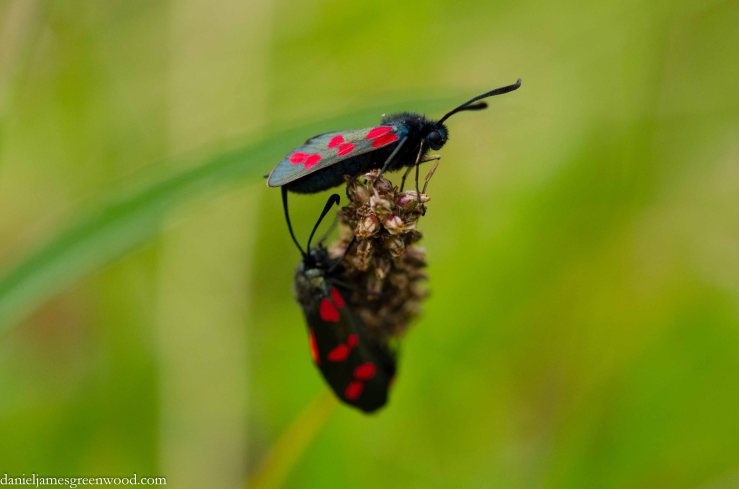
We leave the chalky, wooded hollow and appear in an ocean of field scabious. The sun setting in the west catches the pale, lilac petals of these daisies. In the other meadows across on New Hill and in Happy Valley greater knapweed has begun to flower, that deep purple gives me the sense of summer’s final movements, splayed florets that say: this is it. The meadows, too, abound with the motorised flight of burnet moths that were not here two weeks ago. Many of them are mating, one pursued by a pair of skippers unwilling to share a flowerhead. I wonder, what harm could a butterfly do a moth? Anthropomorphism excused, their quarrel does have the feel of a playground spat. That landscape is behind us now as we return along the crown of Farthing Downs. The sky is split in half to the west, smears of rain hurrying our return to the urban landscape. The liquid song of the skylark pours from the sky and we search for its shape. After giving in and then locating it I see it some forty-feet up in the sky. My companion can’t quite believe how clearly its song comes yet from so high. We stand, our exit delayed, the two forces of incoming weather and skylark display gluing us to the soft turf of Farthing Downs.
I sit on a path new and slight, pressed into the grasses. Last year I sat in a spot close by under the shade of ash trees watching a willow warbler make return visits to a nest down in the brambles. Now the brink of a small copse of trees has gone, the bird, perhaps returning, may have decided this was no longer a place to raise young. In the absence of willow warblers, brimstone butterflies, perhaps reaching double figures, mark the new space of downland that has been reopened from the folds of trees. The piles of logs and branches stacked in the iron beds are still here, yet to be burned or hedged. I like that slowness, that I can come back some months later and no one has felt too pushed to tidy the place up.
A male and female brimstone fly together and then fall down amongst the twigs and low, woody brambles. I’m interested to see what they’re doing so I get up and have a look. They’re mating, bodies bent round, facing away from each other. They part. High in the sky, against the blue and its herring and lesser black-backed gulls circling on thermals, a huge flock. I wonder why, I wonder what for. Down here with me the female brimstone is again on the wing, met by a band of battling males. They pass her and are turned immediately onto her, each forgetting their quarrel and targeting the paler female. This is the perfect reflection of the adult butterfly’s life: the males seek as many females as they can; the female, having mated, defends herself from latecomers as she strives to find the right plant for egg-laying. The males attack her, but she breaks free, up into the sky. She is not free of them. The four males cloud her, their colours so close as they gain height that all sense of defence has disappeared into a neon waltz. They go up, up and over my head to the world of gulls and warm air rising.
A lady with a crutch and white hair slipping from a woollen hat stops me in the road. She saw me photographing the upturned soil and root plate of a gigantic spruce. Her accent suggests she has moved here from England:
‘I’ve seen about half a dozen deer in the woods just up there,’ she says. ‘If you’re quiet you might see them.’
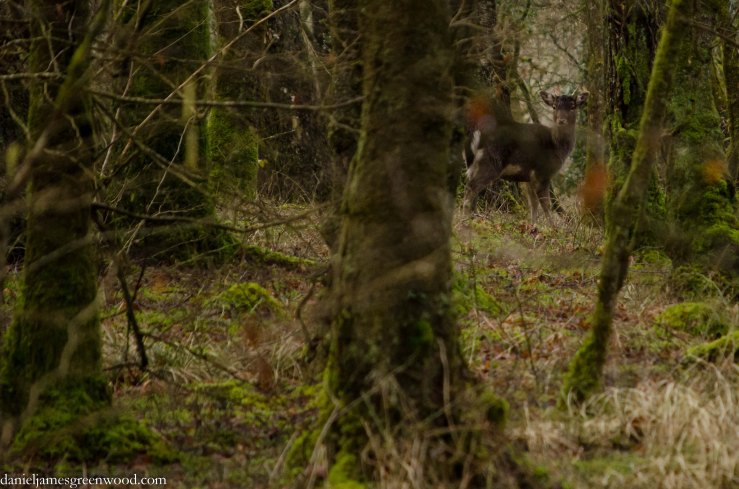
I thank her and take my camera from the bag, pulling my hood up to shade out my face. The day is bright, sunny and warm. Beyond the dry stone wall the woodland begins, a line of evergreens creating a dense bank of shade along the wall, before the characteristically decrepit and mossy trees of an old Scotch wood. I look into shadows and see that a deer is watching me. It’s a sika deer, the first one I’ve ever seen. It doesn’t seem frightened. It turns to me, then away again, grazing behind the line of dark trees. I follow it along, it doesn’t gallop or run. Its path leads me to two more animals, one of them a stag, new antlers primitive but still impressive. It stares at me behind the wall – there’s a good twenty-metres between us. I’ve been photographing them the entire time. I think back to the venison sausages I had at the Galloway Arms, the conversation I had with the bar man:
‘Everyone thinks they’re all cute and cuddly, like Bambi,’ he’d said. ‘No one wants to kill them.’
‘But not everyone knows what they do to woodlands,’ I’d said, thinking aloud.
‘Well, exactly!’ he’d affirmed in his thick Scotch accent.
I know their numbers are at their highest in the United Kingdom since the last Ice Age 10,000 years ago (so are ours, by the way). I know the link between the nightingale’s sudden decline in England and deer overgrazing woods, not that the nightingale makes it up here to Scotland. But I could not kill one of these animals. I’d rather leave that to the lynx, or even the wolf. I put my camera away and make my way along the empty road.
 Coulsdon, London, November 2014






 Unlocking Landscapes