Deer and shadows

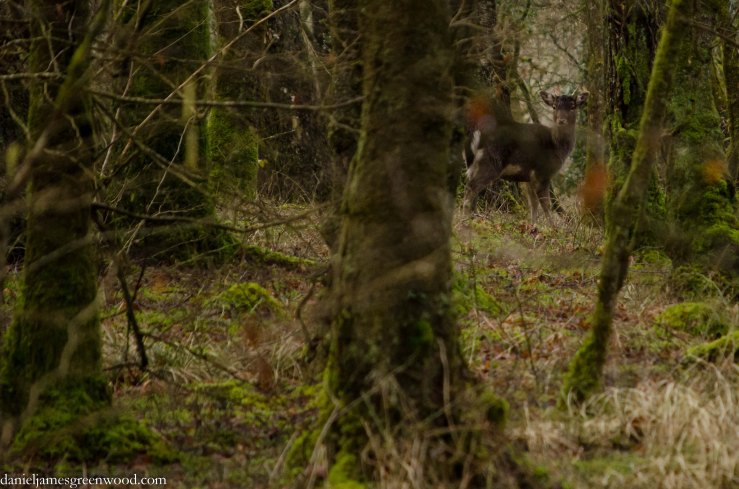
Sika deer

Newton Stewart, Galloway, Scotland, February 2014

A lady with a crutch and white hair slipping from a woollen hat stops me in the road. She saw me photographing the upturned soil and root plate of a gigantic spruce. Her accent suggests she has moved here from England:

‘I’ve seen about half a dozen deer in the woods just up there,’ she says. ‘If you’re quiet you might see them.’

I thank her and take my camera from the bag, pulling my hood up to shade out my face. The day is bright, sunny and warm. Beyond the dry stone wall the woodland begins, a line of evergreens creating a dense bank of shade along the wall, before the characteristically decrepit and mossy trees of an old Scotch wood. I look into shadows and see that a deer is watching me. It’s a sika deer, the first one I’ve ever seen. It doesn’t seem frightened. It turns to me, then away again, grazing behind the line of dark trees. I follow it along, it doesn’t gallop or run. Its path leads me to two more animals, one of them a stag, new antlers primitive but still impressive. It stares at me behind the wall – there’s a good twenty-metres between us. I’ve been photographing them the entire time. I think back to the venison sausages I had at the Galloway Arms, the conversation I had with the bar man:

‘Everyone thinks they’re all cute and cuddly, like Bambi,’ he’d said. ‘No one wants to kill them.’

‘But not everyone knows what they do to woodlands,’ I’d said, thinking aloud.

‘Well, exactly!’ he’d affirmed in his thick Scotch accent.

I know their numbers are at their highest in the United Kingdom since the last Ice Age 10,000 years ago (so are ours, by the way). I know the link between the nightingale’s sudden decline in England and deer overgrazing woods, not that the nightingale makes it up here to Scotland. But I could not kill one of these animals. I’d rather leave that to the lynx, or even the wolf. I put my camera away and make my way along the empty road.

© Daniel James Greenwood 2014

The flickering of panic

Cairnsmore of Fleet

Cairnsmore of Fleet, Galloway, Scotland, February 2014

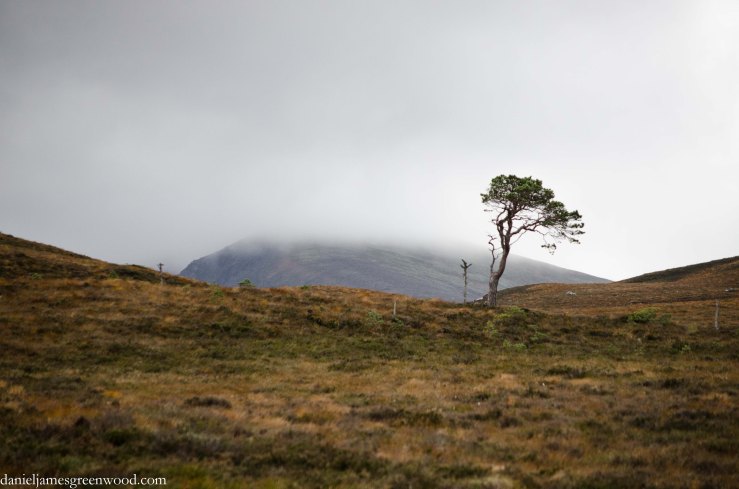
A wading bird bursts from the bog. I watch its sharp wings cut into the wall of mist and descending treeline. I put my binoculars to my eyes and the bird is lost. The world has been reduced. All terrestrial life but for water, a few lichens, heather and wintry moor grasses has escaped. I have left behind oak woods overcome by rhododendron and cherry laurel, and Cairnsmore Burn choked by the former, its water crashing from the shadows. It was not right. Snowdrops still managed to create small rugs of white flowers and winter green leaves. Bluebells peeked through the leaf litter amongst them. Behold the denizens of Galloway’s oldest woods. Up here those are images in the mind. The life in the lap of the Cree estuary – the buses, postman, trees and gentle flowering plants are mere memory. The cover of Glenure Forest’s regimental spruce is the last notion of protection. It’s now up to willpower, my body and clothing. The path leads clear from 20 metres, visibility coming and going with cloud.

Snowdrops

I climb over a wooden ladder and the landscape ascends suddenly from 400m towards the 711 that marks Cairnsmore of Fleet’s summit. I have not seen a single person since snowdrops. Why would anyone want to be here? I come for the brutal solitude, even if I wanted to see another person I couldn’t. I come because I know that people once had no choice but to walk this path, a path that zigzags and climbs, an uncomfortable choice of jutting rock or slippery grasses. I attempt to find a rhythm on stone. The path curves east and the winds propel me on. I see boulders and mistake them for cairns – this is not the summit. My thighs are soaked, woollen gloves, too. I took my jumper off some miles back and now need it. It’s sodden and looped around the strap of my bag. The winds are harder, colder and the rain splatters against me. What the guidebook called a nice introduction to Galloway’s hiker’s paradise has the makings of a minor ordeal. Water streams down the rocky path as I step up and through it. The music of the running water cuts through the wind, it’s almost all I hear, but for my own mutterings. I can say what I want now, no one can hear me. There will be no repercussions. I cherish that.

Cree estuary

The false sense of the summit has given me energy. I’m so hungry. I begin to see my breakfast as vital, I value it differently, as something I was fortunate to have. I see the first cairn of the summit approach and slump down behind it onto wet stone, moss and crustose lichens, barely protected from the gelid gusts. I push some cheese into a crusty bread roll and swallow it. I feel the onset, the flickering of panic. The wind and rain has thrashed me, and I didn’t realise it had or that it might. Visibility is now down to 10m, I put my gloves back on, the cold hammering without, almost burning. I think of real mountains and feel stupid. Hills aren’t to be taken for granted, either. My glasses are blotted by rain on both sides, I recall my friend’s maxim that the descent is worse than the climb. There is no notion of friendship here. The supposedly fine views of the estuary are not on my mind just now. I tread blindly back the way I came, finally removing my glasses. The path of rock, the fog, the bog, it’s all clear. There is no need for detail. I tread in hope and long to see the cloud drift and for the undetectable sound of the wind dropping. The spruce trees appear again, black and warming, even a glimpse of the Cree. From the bog two grouse explode into the air and I leap in surprise. It’s the start of a world I can live with.

A careless act

Gull

Farthing Downs, London, January 2014

From the hawthorn trees comes the sparkling sound of thrush and finch chatter. All around the landscape is weighed down by weeks of rain, the sodden grey and blackness, but this conversation lightens the scene. A flock of goldfinch burst into the sky, skipping through the air in their piecemeal flock. Their yellow wingbars flash against black feathers like miniature human warning signs. I train my binoculars on the thorns and see a redwing sat in the branches, contributing to the bird discussion. As I step towards them it ends instantly and so I turn and take a path to leave them.

The stumps of ash trees glow resinous on the hillside, the felled trunks lie supine beside them, the bark darkened by rain, the green and blue lichens thrive without a care for the tree’s demise. The brash has been piled and burned in elevated corrugated iron beds, and to many people this would seem like a careless act of deforestation. But it’s not. Farthing Downs sits on a bed of chalk and is home to a vast array of wildlflowers which are disappearing from the English countryside. The City of London Corporation are here engaging in a battle of restoration. Further along the path a black-headed gull skates low over the lane – I’ve not seen them so close to the grasslands here – propelling itself up and into the wind. Its relationship to winds so cold and blustery seem uneasy, and against this vista of meadows and woods, all the more unique.

A layer of snow

A layer of snow

Carrbridge, The Cairngorms, Scotland, October 2013

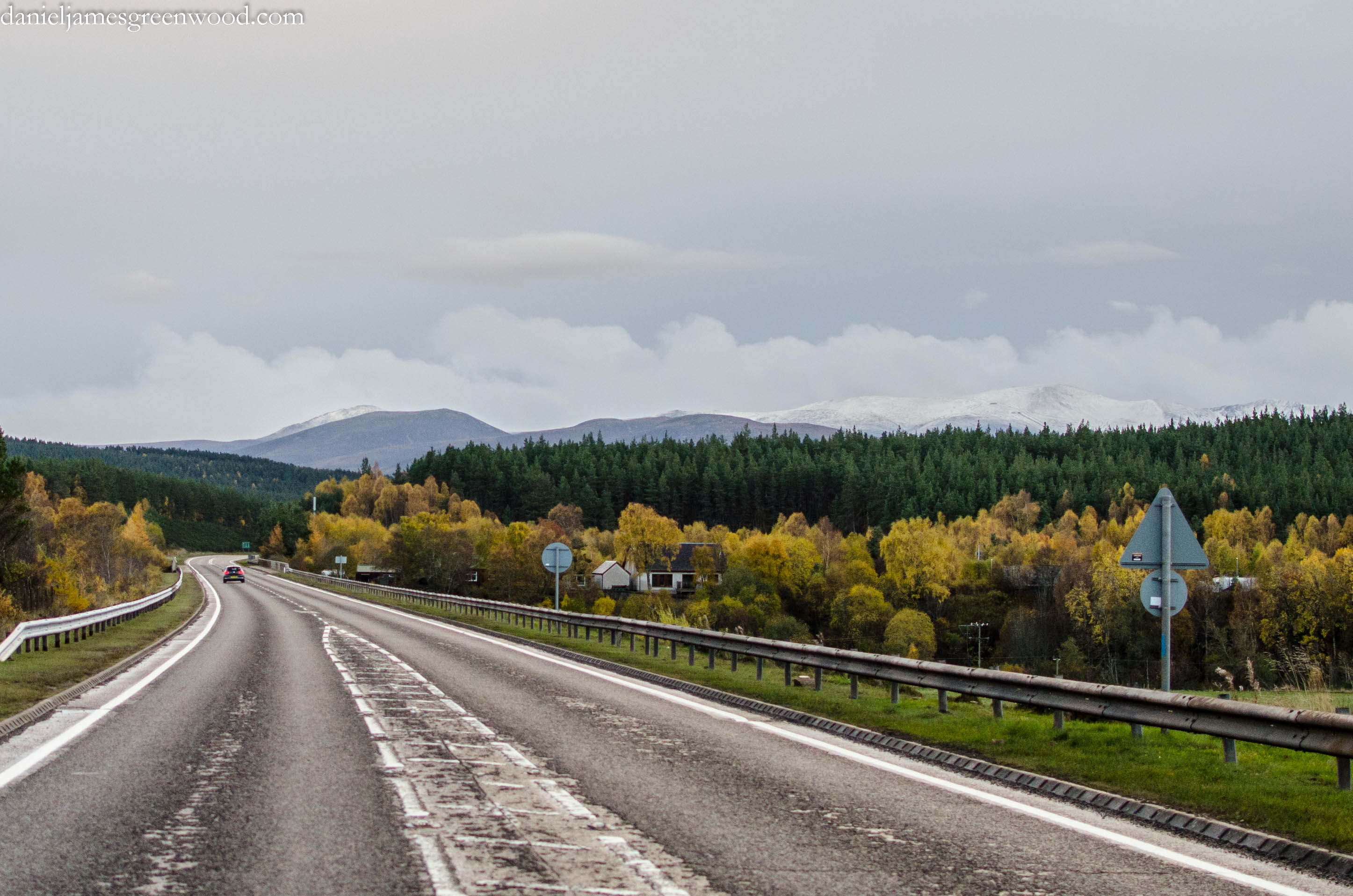
Arriving in the fields, the lichen frosted pinewood in our wake, I admire an old alder tree coppiced and growing by a brook. The landscape unfolds, the Cairngorms rising in the east, fringed in all corners by the yellow of birch leaves. We look to the hill where we had observed this scene only two hours ago, from a spot where a sheep skull hung from a piece of standing wood. We follow the River Dulnain as it runs east, the sound of traffic returning along the A-road. A buzzard floats over a line of trees, calling out, the sound severing the reminder of motor vehicles. We egg it on – ‘go on, my son!’ – and approaching a small farmstead we find a rabbit freshly mutilated, its neck bone protruding, eyes gone. Was this the buzzard’s work, or perhaps a mustelid. We cross a tributary of the Dulnain and a goosander bursts from underneath the footbridge. This saw-billed creature is one I had never seen before now. It steers itself upstream into the dusky light reflected by the water. We continue past a dilapidated cottage and fiery beech tree, watching as sheep leap and bounce away from a row of cabbages they had been eating in a neighbouring field. We meet the main road and wait patiently for our chance. Having crossed, we train our binoculars on the summit of Cairn Gorm, the restaurant and funicular railway car scratched into its slopes. All is dressed in a layer of snow.

© Daniel James Greenwood 2014

It’s the eagle

Glen Einach

Glen Einach, Cairngorms National Park, Scotland, October 2013

Lying on the grass where the road forks up and into the wind I watch the redwing and fieldfare slip across the grey sky. Down below us the River Am Beanaidh flows with great force. My friend has finished in his attempts to separate map from wind and joins me on the gravelly soil, rolling himself a cigarette. A few minutes ago we watched redwing appearing from the heather like particles drawn, magnetised to the scots pine. Some remained in the heather for a time, before using the air and their wings to join with the trees. My smug little siesta is embellished further by a reward received a few minutes earlier: the sight of a crested tit mixing with its coal tit cousins and picking at the sticks and lichens. I have felt the tiredness and tenseness that comes from a lack of proper rest since summer’s end but this landscape reinvigorates me like no other that I have set foot upon. Listening to the quickening wind dashing through the medium of pine needles, my friend calls an end to our pause.

We head up over the top path, the wind bursting through. It’s much cooler, a hint of ice. I automatically reach into my coat pockets seeking woollen gloves. It’s reported to feel like -11 on the peaks today and here blows the clue as we climb to 450m. Trudging along, a shape appears in the distance, passing over the pinewoods, across the river and the slopes of Cairn Eilrig:

‘Big, big bird,’ I shout, into the strength of the wind. My friend stops.

It passes across our view, a cloak caught by a gale. The thought process begins: buzzard… raven… its dark, primary wing feathers like digits. Its wings catch a slither of sun, a golden sheen. It’s the eagle. It disappears behind the trees, appearing again, coasting and now lost to the pines. My friend and I have both leapt up onto a lichen and heather-covered bank of soil. We jump back down, carried back by the wind by an inch or two. We hit a gloved high five, hard and true.

The shock of the heartwood

Farthing Downs

Full set of photographs here on Flickr

Farthing Downs, London, January 2014

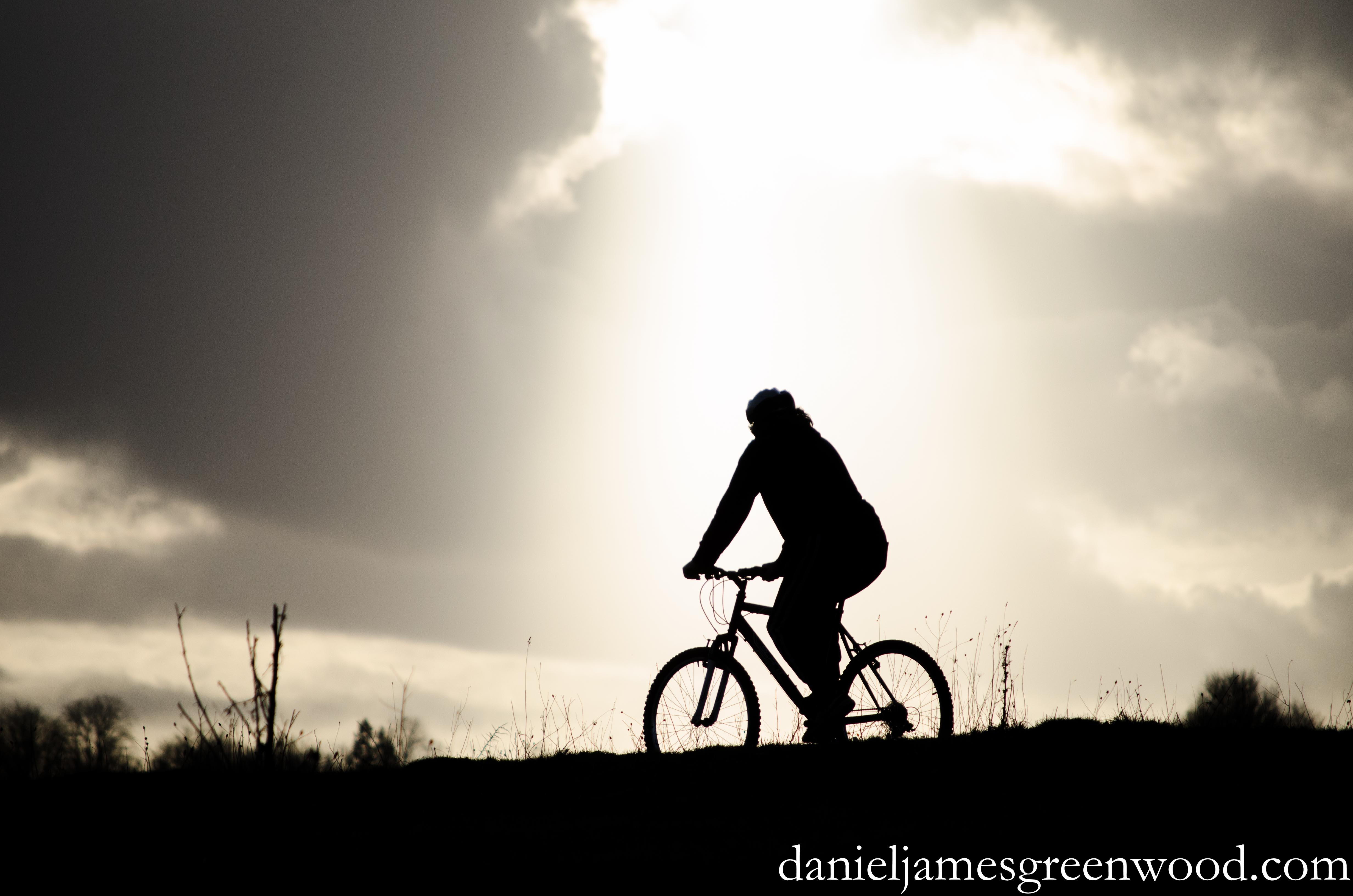
The long shadow of a jogger crosses me and at first I think it’s someone approaching. A peek over my shoulder shows the silhouette of a toiling woman, but is it new resolution or good habit? She is followed over time by a trail of cars, parents clutching the hands of young children, and finally the huffing shape of a cyclist rolling past. The world of the Downs reminds me again that the earth is something of a cauldron, everything is always changing. Groups of people walk along the lane, shadows breaking and reforming, pausing to watch something, perhaps a bird, perhaps the view of houses creeping up the hill, or views of a distant, spiralling city.

Jackdaws dot the horizon in the east, their indentations against the sky encourage the play of human language. They are a slow swarm of insects, embers from a smokeless blaze, or simply jackdaws doing their winter dance. Woodpigeons pass them in the foreground, redwing, too. I sit and watch. On New Hill, the land beneath the jackdaws, the small ash trees are indeed like matchsticks, or else the stiff hairs of a broad and worn broom. More have been felled, chopped and piled, and against the brown wash of wood and winter grasses the shock of the heartwood is telling.

The sun slips down to me, the ant hills like boulders at the edge of a lake, dropping chunky shadows from the daylight. Squirrels cavort, their music one of scratched syllables, like little huffing corvids. We regard them with equal disdain, forgetting their own intelligence and desires. They feel a dislike for their kind, too, sometimes. A helicopter careers overhead, a primitive design still, but how long until tiny drones trail through these skies, how long before they snag in the branches of oaks or the tangle of hawthorn? Who will collect them and what will be done with them. The helicopter is navy blue and white, it heads south-west towards the North Downs as vulnerable as flesh and feathers.

North Downs diary: the endless scene

Sweet chestnut coppice

King’s Wood, Kent, December 2012

The piles of birch trunks tell us that this chalky fringe of King’s Wood has recently been coppiced. The heartwood glows golden against the black, brown and grey of a winter’s afternoon. The paths are boggy, holding the tracks of boots and the tyre marks of cyclists and scramblers. Large ditches appear at intervals, home to trees and dead wood. A Soakham Downs poster a little way back identified these as chalk pits dug in old times to extract the chalk from the soil. The chalk was then spread in the fields – what once would have been woodland – to fertilise the soil, left to weather under sun and rain.

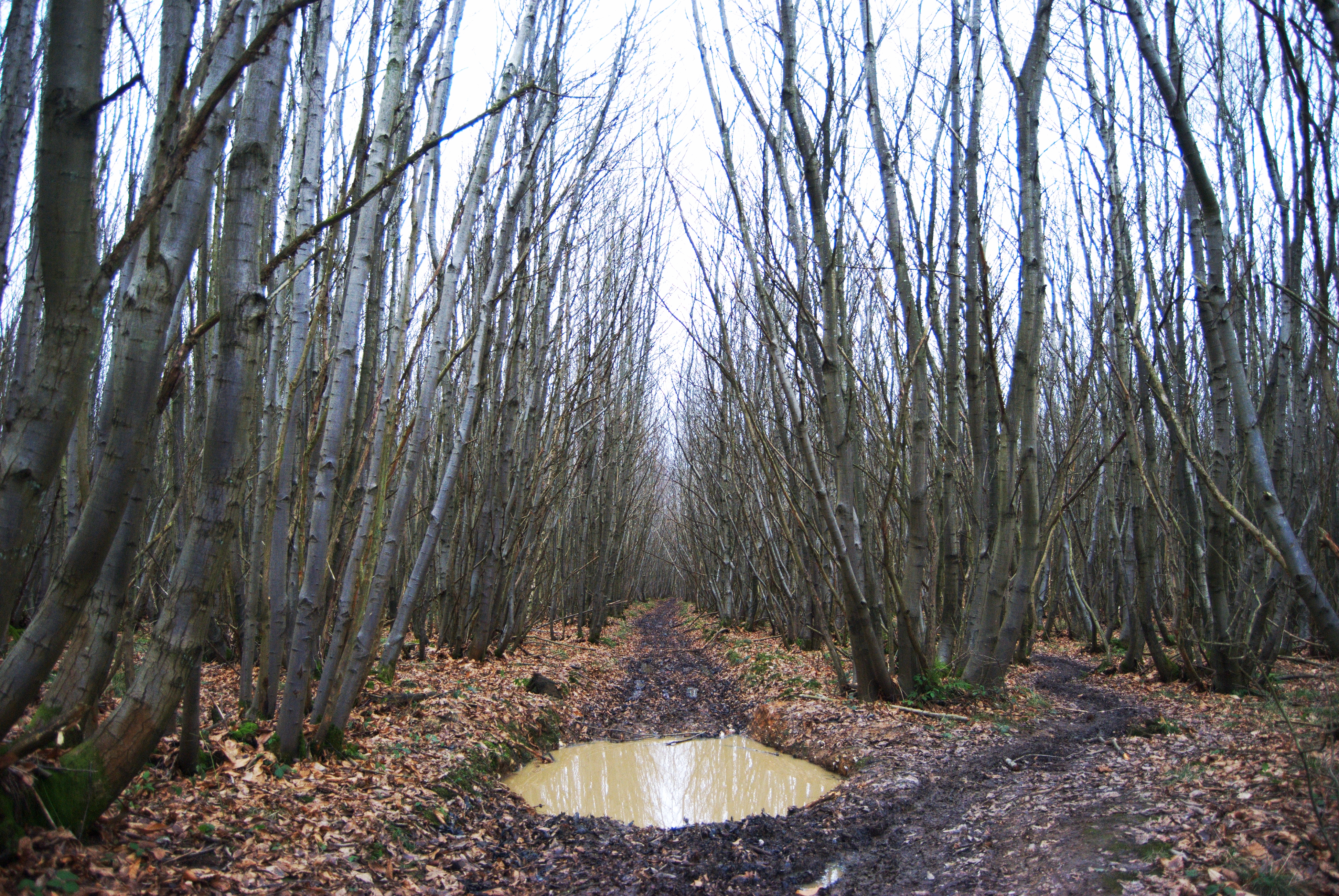
Further ahead the woodland opens in earnest, endless tracts of sweet chestnut coppice climbing into the sky. A brown puddle reflects the bare branches. Sweet chestnut provides the nuts we like to roast at Christmas, as well as forming the most economically viable form of coppicing in today’s market. The poles are cut after about five or six years and split down the middle to make chestnut paling, a type of fencing used in parks and nature reserves up and down the country. It’s another aspect of the Roman’s botanical legacy – they brought it along with them. The vertical slant of the branches is interrupted by a movement of four legged animals crossing our path in the distance. Our talking pauses as we watch an endless trail of deer move from right to left, disappearing into the trees. One of them was all white and it sticks in my mind like a puncture. We make our way towards Chilham, stopping briefly to search amongst these overgrown trees for walking sticks. We listen to the multiple stems tapping together as the wind steals through, some trees creaking. This a sound that in the endless scene of coppiced trees we mistake for shrill and distant calls of people.