Restoring the Magnificent Meadows of the Cotswolds

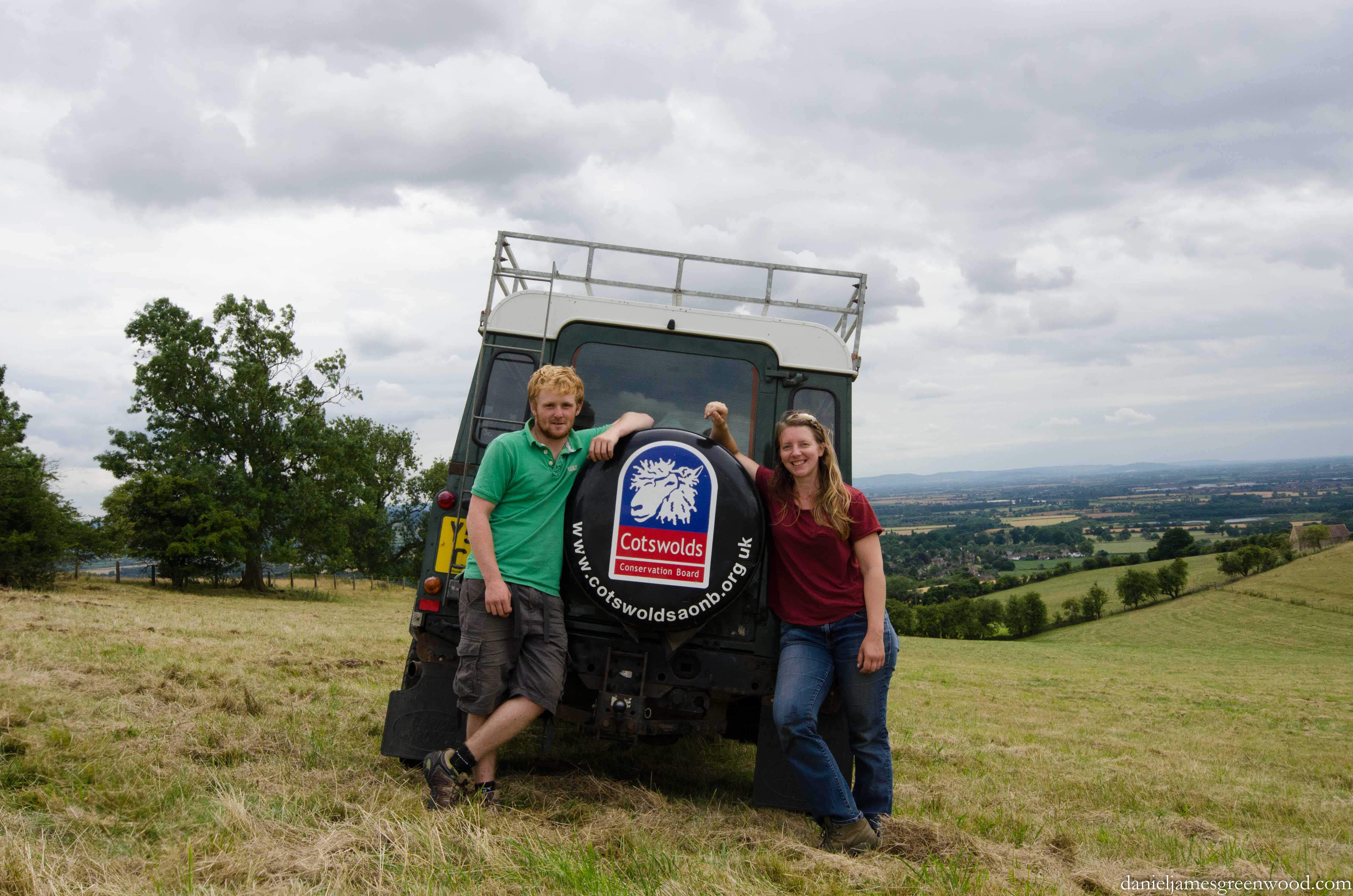
In July 2015 I volunteered with the Cotswolds Area of Outstanding Natural Beauty (AONB) to help with the harvesting of wildflower seeds from hay meadows and other species-rich grasslands. The Magnificent Meadows project is partnered nationally between the AONB, the Wildlife Trusts, Plantlife and the RSPB. I was helping Conservation Officer Eleanor Reast and volunteer Will Bowers. Since 1945, 97% of British wildflower meadows (hay meadows, water meadows, chalk and limestone grassland) have been lost. There are many reasons for this and there are a number of projects to raise awareness and physically restore this near-obliterated habitat. The loss has been catastrophic for invertebrate populations, namely the bees which are popular whilst their misunderstood habitat continues to decline. I don’t mean honeybees specifically, they play an important role in pollination but the biggest and most concerning losses are to bumblebees, with some of the rare species now confined to coastal meadows and grasslands. The Bumblebee Conservation Trust estimates that bees provide £560million to the UK economy through pollinating high value crops. But bumblebees are only a fraction of British species: there are around 250 species, 32% of which are threatened with extinction. Solitary bees make up much of the numbers here, with an amazing array of species having taken to different niches and areas of our landscape, giving us mining, mason and leaf cutter bees. Wildflower-rich meadows, along with woods, should be the fulcrum of support for our rural wildlife, instead the former has been near-destroyed and millions of pounds are now rightly being invested in their regeneration. At the same time government continues to build on remaining rich grasslands and open up more areas for fracking.

The AONB is vast and the job of Eleanor and her colleagues is not a simple one. The project aims to work with local landowners both to collect seed from their meadows but also to re-seed new grasslands where the soil conditions are suitable. Flower-rich grasslands are generally nutrient poor, this means that they haven’t been fertilised with chemicals or dung (also human excrement as I learned in the Cotswolds). This is vital because if the soil is too nutrient-rich, dominant species like nettle, bramble and hogweed will begin to overtake. Species-rich grasslands are often also rich in waxcap fungi. However, according to George Peterken, the nitrogen emitted into the atmosphere by car engines and through aviation is leading to rainfall that is actually fertilising grasslands and reducing the range of fungi as well as wildflowers. Orchids are impacted here as some species have intricate, symbiotic relationships with fungi, and the loss of fungi can therefore impact the meadow ecosystem in subtle ways.

Harvesting the meadows required a Land Rover to drag the seed harvester around the landscape and a trailer to get the thing out there. I spent most of my time trying to sift the collected seed of knapweed, yellow rattle, orchids and scabious, or else trying to photograph insects.

We were visited by BBC Countryfile’s Ellie Harrison, who is also the President of the Gloucestershire Wildlife Trust. Ellie is helping with the Magnificent Meadows project and was keen to see, first hand, how the work was going. Seeing Ellie driving the vehicle, though only briefly, through the field made me think of how meadows challenge our notion of the ‘natural’. They are man-made habitats which have been around in their current form for at least 6000 years, when the Neolithic farming revolution reached its nadir or height, depending on your viewpoint. Much of the meadows and farmland we have today will once have been covered by wildwood, a habitat of nature’s own making that is lost to us in Britain thanks to thousands of years of deforestation by humans. Peterken suggests that meadows originated from woodland glades that once would have been kept open by aurochs (wild cows), deer and other large grazing animals. Something close to these old wildwood meadows are wood meadows still found in Estonia and Sweden.

The seed had to be emptied onto the blue tarpaulin which was then sifted out using the homemade wooden frames and wire sieves. There was a lot of insect by-catch, most commonly grasshoppers and crickets, unfortunately losing one leg most of the time, and a few dead meadow brown and marbled white butterflies, and silver-y moths. Don’t be upset though as these are common species in the Cotswolds which will, in the long term, be able to increase in number when the meadows diversify over a wider area of the AONB.
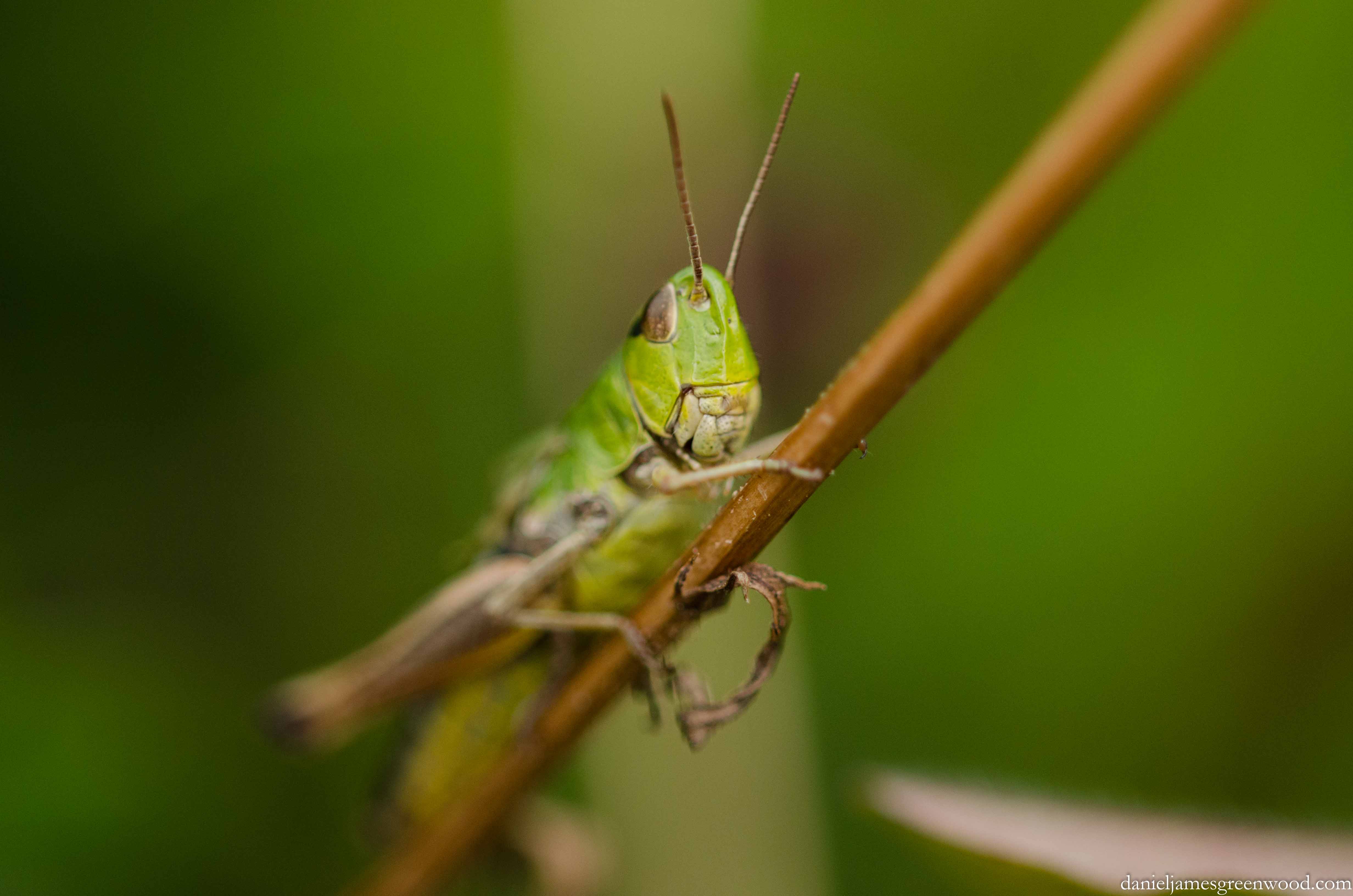
The meadows were generally ‘over’ but there was still a lot of insect life. I think this is a stripe-winged grasshopper.
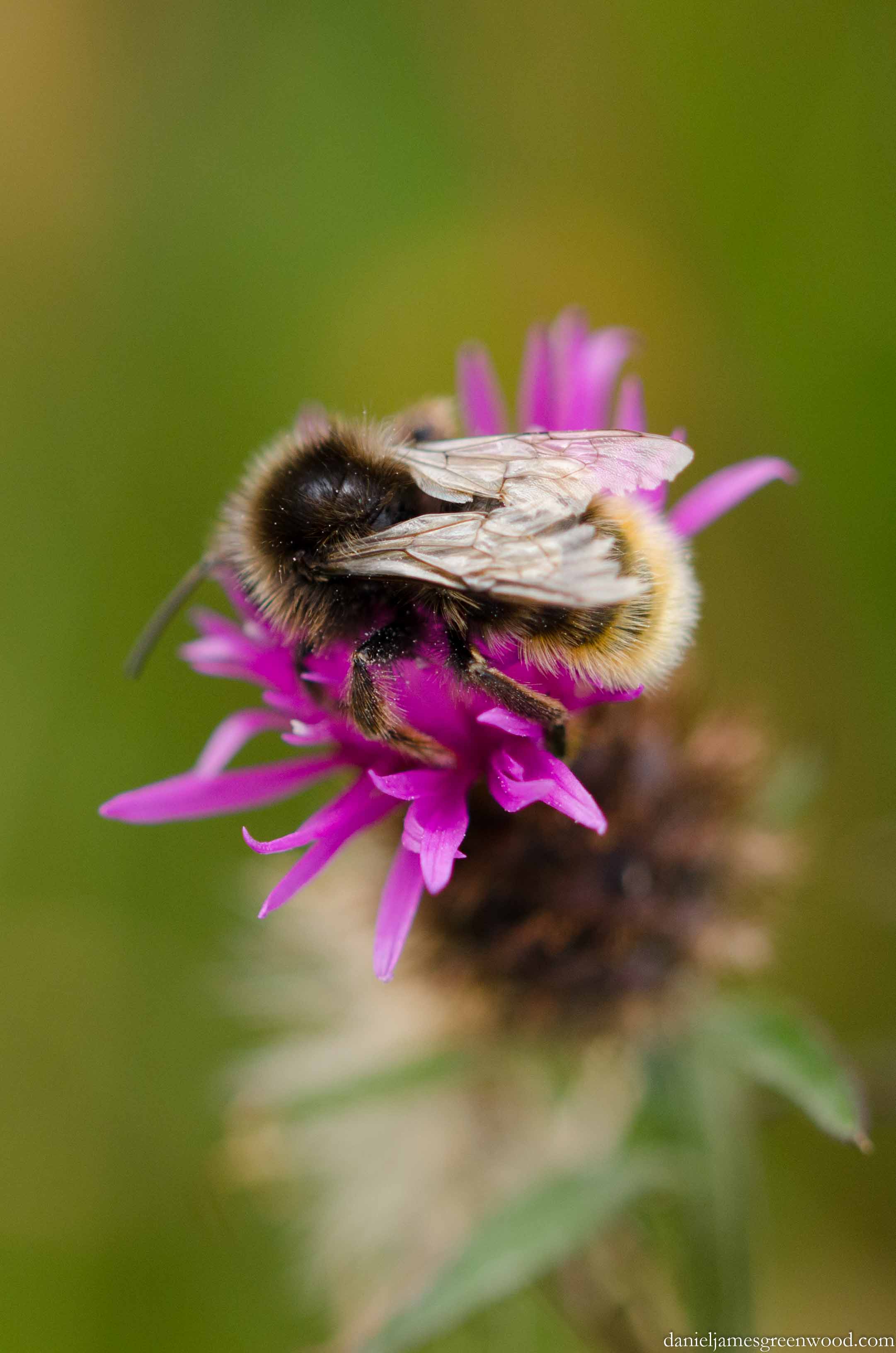
Bumblebees were busy and looking worn from their summer work. This ‘rather faded’ common carder bee was on common knapweed.

Cotswolds blog pics-6

There were a number of wildflowers still in bloom, like this white variation of greater knapweed.
Cotswolds blog pics-30

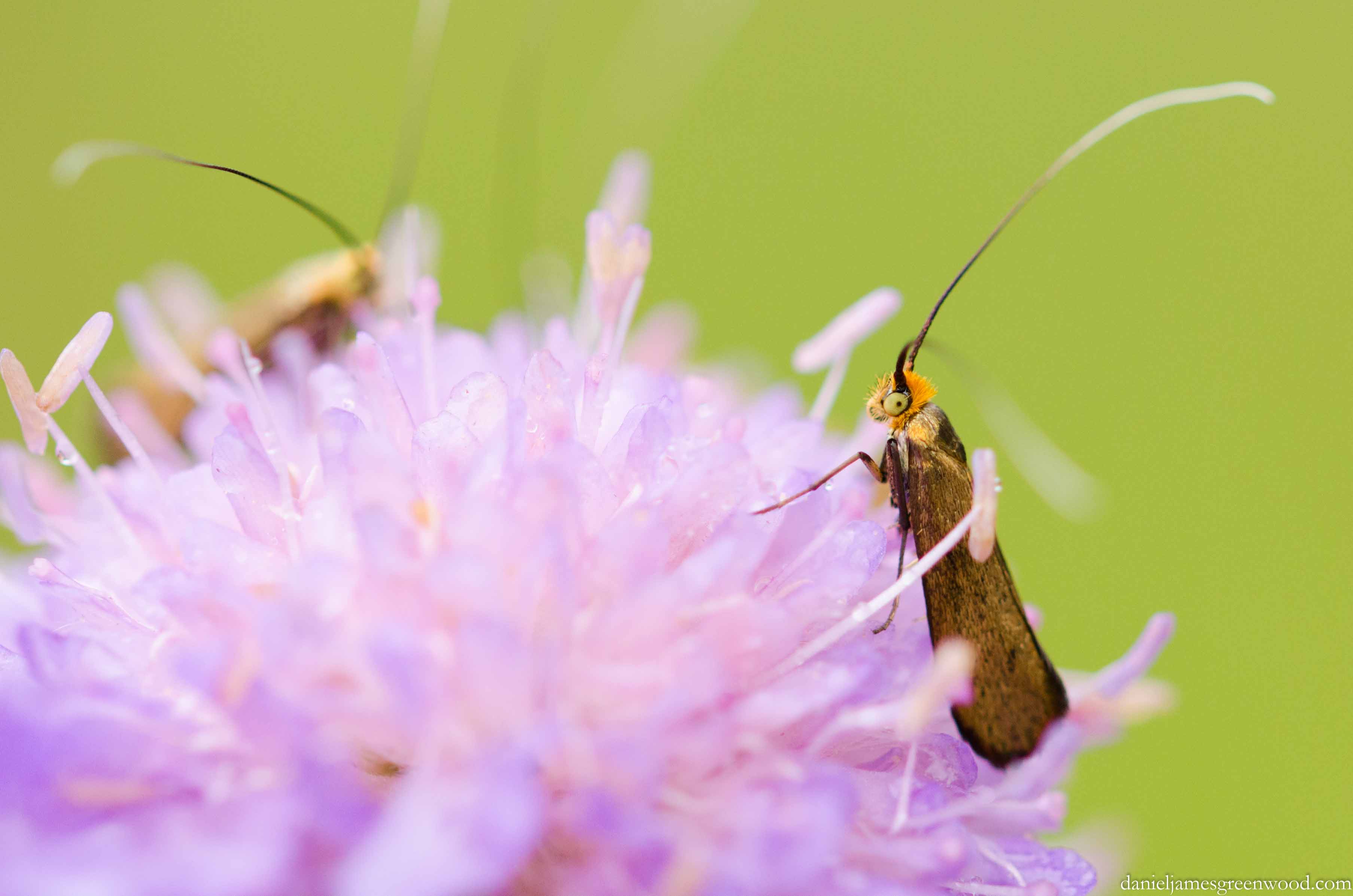
It was not entirely possible to gather seed every day. We tried to harvest at Leckhampton Hill, a site with very rich and beautiful limestone grassland. Only minutes after arriving and bringing the mower on site, a torrential downpour hit and the grassland become impossible to harvest. We had to return, seedless. I took the chance to look for insects and found a gathering of longhorn moths, Nemophora metallica. I like this little punk of a micro-moth, it looks quite tiger-like to me. I’ve had to invest in the Field Guide to the Micro-moths of Great Britain and Ireland to acquaint myself with them.

Cotswolds blog pics-11

The seed had to be spread out in the barn after harvesting. Will and I (mostly Will, whose practical skills were, for a 21-year-old, amazing and embarrassing) raked out the seed onto tarpaulins. Will diligently turned the seed so that it would stay cool. If it got too warm and mound-like it would effectively begin to compost and decompose.

Here you can see the most sought-after seed, that of yellow rattle, a wildflower which is parasitic on the roots of grasses and so can help other less dominant, nectar-rich species to move in. Eleanor said that you only need a single yellow rattle seedling to establish for the plant to take hold in a meadow. Of course the conditions have to be right, this is a plant that likes calcium-rich limestone grassland like meadows being protected and enhanced in the AONB.

Cotswolds blog pics-24

When the seed was ready it was the job of Eleanor and volunteer Will (and me) to hand-sow the seeds, carrying them from point to point in dumpy-sacks. It was a real challenge to get it right and it will take years for the plants to establish. It’s a project that needs patience as much as it needs meadows to harvest.
Cotswolds blog pics-22

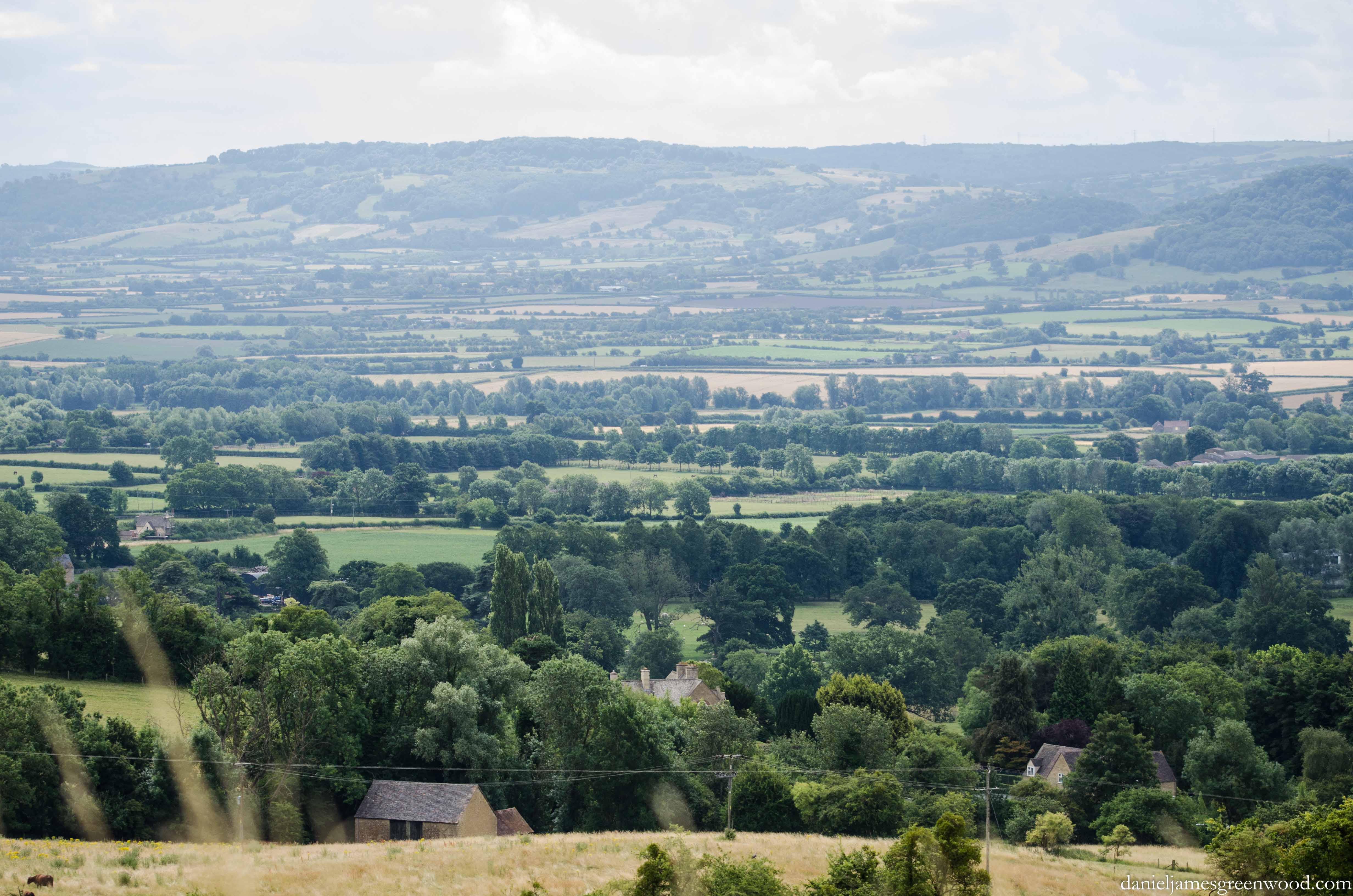
My final day of harvesting took place in Tewkesbury, an area of rolling hills with hay meadows and arable land lined by trees and hedges in the valley. The weather was warm and dry and therefore perfect for harvesting. We harvested from a slither of the hillside which was designated as a SSSI (Site of Special Scientific Interest) but was in fact somewhat ‘rank’, meaning it was not so floristically diverse and instead was clogged with grasses. I did, however, find some wonderful (for spider-lovers) and a little horrifying (for bee-lovers) insect-life.

Capsid bugs are a large family of insects with 229 species, known as the Miridae, but they’re quite easy to encounter if you have a macro lens for your camera or some other form of magnification. This capsid bug was traversing the stamens of knapweed.
Cotswolds blog pics-19

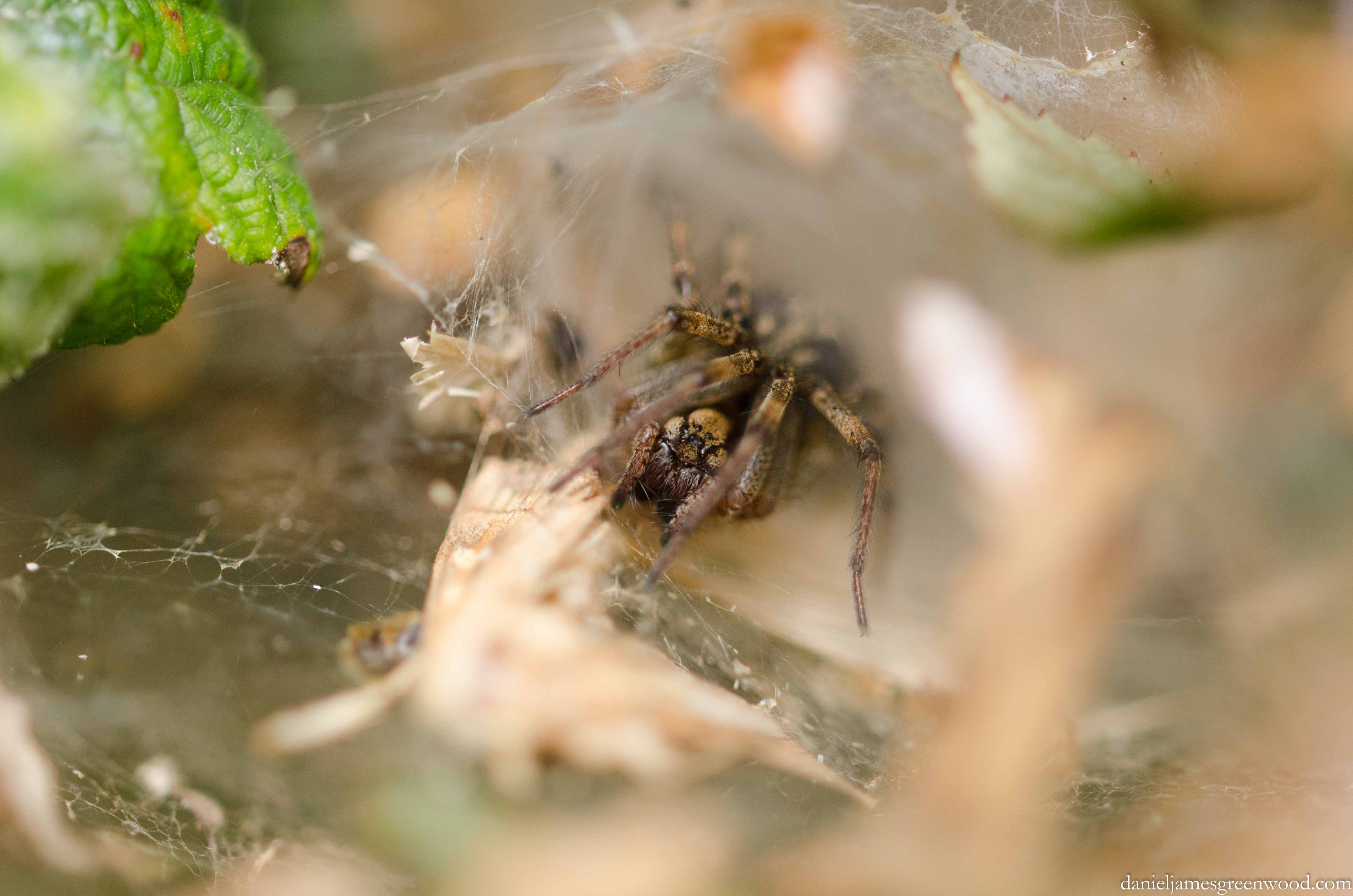
The SSSI was edged by a line of trees and dense bramble. Hidden away in the bramble was this funnel-web spider that Will found. It had created a tunnel (or funnel) from which it could prey on insects. There were plenty of potential meals to be had.

A lot has been said about the importance of meadows for bees and butterflies. Bees are also important for the other creatures that prey on them. I watched this spider wrapping a solitary bee in its silk. The bee fought to try and free itself, but the strength of the webbing is not something that can be broken by a solitary bee. It was unpleasant to watch but also fascinating. You can be sure this is a scene that has been occurring for centuries in the meadows of the Cotswolds, with balances maintained within the ecological network by predators like these grassland-dwelling spiders. Nature’s beauty is indeed subjective. Don’t confuse this, though, its full-scale importance to us cannot be put in material or capitalist terms.
Cotswolds blog pics-14

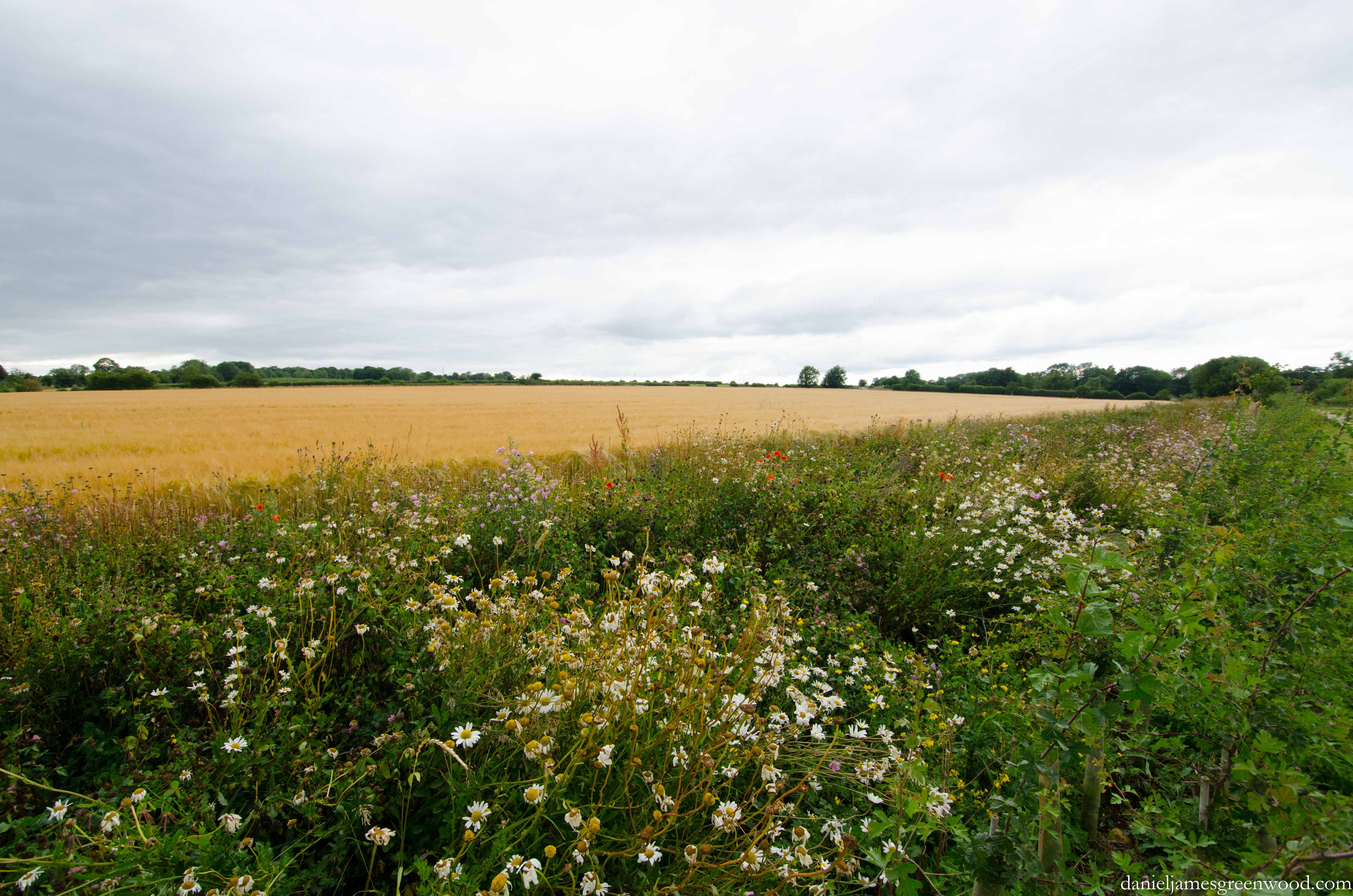
Away from the harvesting there were a few signs of good government policy in action. Higher Level Stewardship (HLS) is a boring-sounding scheme which is being undertaken in different forms across the EU where farmers and other landowners receive funding from government to seed wildflower-rich margins, plant woodland, reintroduce grazing to ailing grasslands and replace lost hedgerow. This field had sidings of oxeye daisy, poppy, cornflower and a range of other native wildflowers which have been lost from British farmland in the past 60 years. Sadly, at the same time the Tories caved in to unrelenting corporate and National Farmer’s Union pressure to allow bee-killing pesticides once more, flouting an EU ban.

Cotswolds blog pics-31

Another national meadow project is Prince Charles’s Coronation Meadows scheme in partnership with the Wildlife Trusts and Plantlife. The heir to the throne loves the place so much he hung out with Eleanor in July. As for me, I got the chance to visit one near Morton-in-marsh. It was mostly covered by greater burnet, a member of the rose family that likes wet meadows and margins. The flowers were not at their full pomp in July, though the gentle spots of burnet and devil’s-bit scabious pointed to the richness of the meadow, the orchids having flowered and gone.
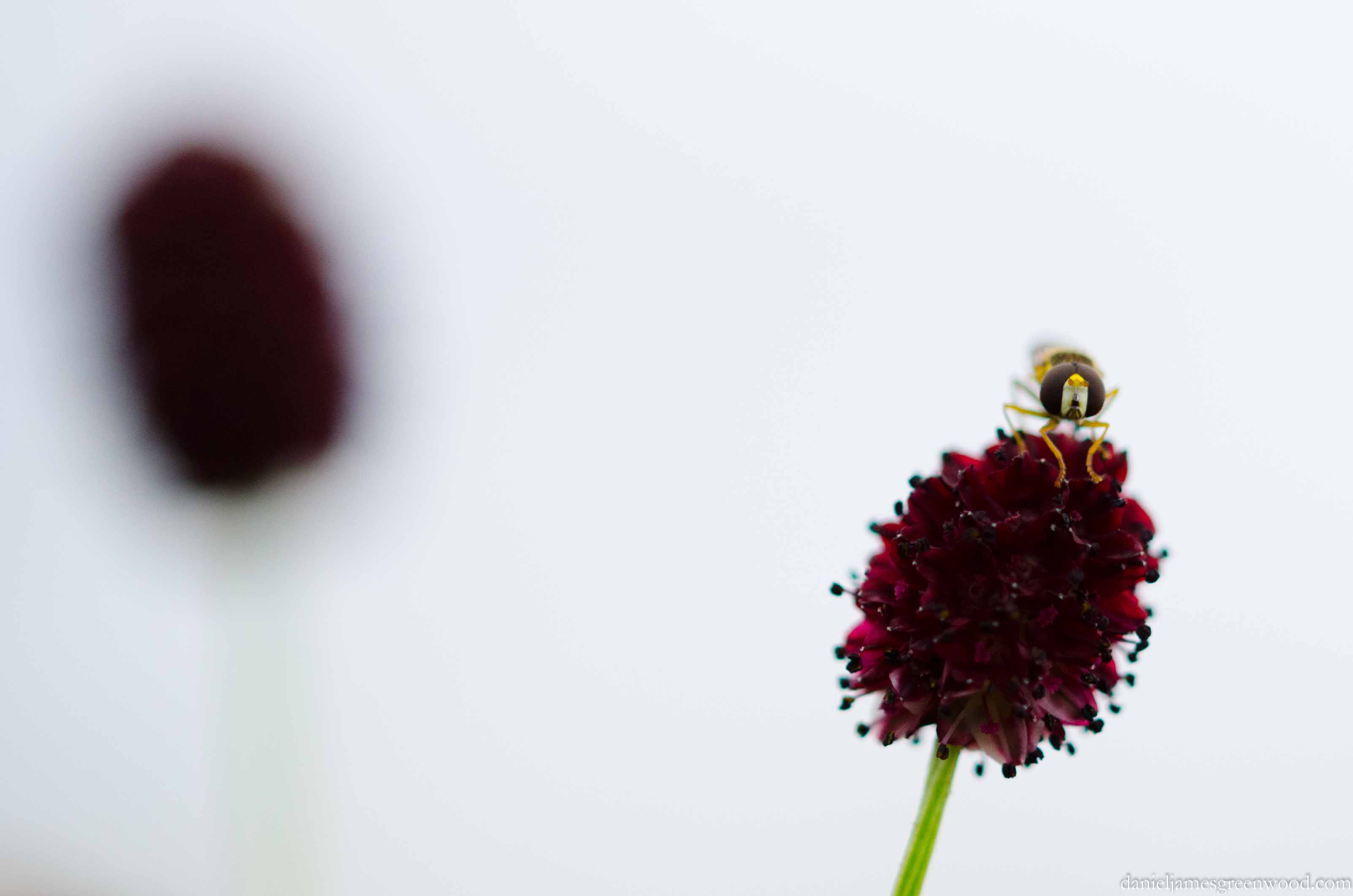
There were lots of insects feeding on the still flowering burnet, like this hoverfly, a member of the Sphaerophoria family.

Cotswolds blog pics-16

And this male red-tailed bumblebee was working hard on this greater burnet flower. He had a fine yellow-beard.
Cotswolds blog pics-25

I’d like to thank Eleanor and Will for all they taught me about meadow restoration and the laws of the Cotswolds. Eleanor and her colleagues obviously work incredibly hard out there trying to improve the landscape for future generations of people and wildlife. It is no simple task but hopefully it will make a big difference in decades to come meaning more bees, butterflies and beautiful, vital wildflowers.
Photography: The Great Hungarian Plain

Beardie blog pic-1
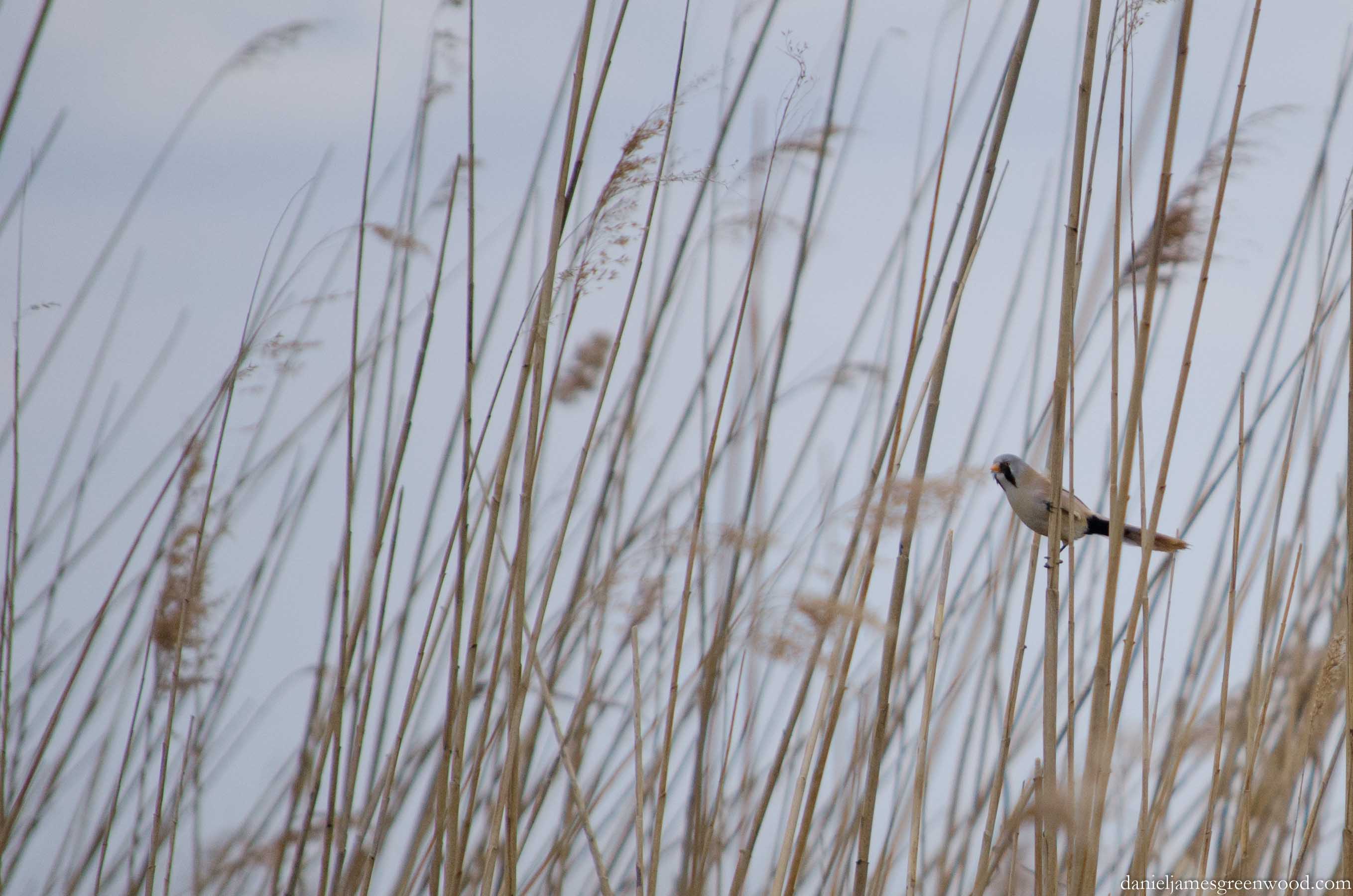
Bearded tit at Hortobágy-Halasató

In April 2015 my good friend Eddie Chapman and I visited the Hortobágy in the Great Hungarian Plain, a Unesco World Heritage Site designated as ‘an exceptional surviving example of a cultural landscape constituted by a pastoral society’. Hortobágy is a small town in the heart of the Hortobágy National Park, three hours east of Budapest by train and a little bit to the west of Debrecen. The area is a magnet for wildlife enthusiasts and we were visiting on our way to Romania by train. The main focus of our visit, being without a car and dependent on public transport, was the fishpond complex known as Hortobágy-Halastó (Halastó meaning ‘fishponds’ in Hungarian). Halastó was ‘dripping’ with birdlife. This vast area of water was cut through with a single gauge railway (which we never used) and a mile-long, single file footpath. We saw a long-eared owl sleeping in a bird box, six eagles in the sky at once, marsh harrier at every turn and many other wonderful species. In the town, storks cavorted in front gardens and battled for prominence on streetlamp platforms placed there to support the storks. I had wanted to visit the region for several years after reading Patrick Leigh Fermor’s 1934 account in Between the Woods and the Water, as the teenage Fermor travelled from Rotterdam to Instanbul on foot. To see this area of land over ground hid none of Europe’s failings: people living in rubbish, vast areas of land devastated by extractive industries, huge infrastructure projects half built and deserted, rivers channelled, concreted and their banks denuded, and more rubbish, so much rubbish. But we met wonderful people who invited us into their homes and villages and guided us around the lands they call their own. The wildlife we encountered, for an early spring visit, was incredible. I recommend the excellent Crossbill Guide for anyone visiting.

Hortobagy blog pics-2

The Great Hungarian Plain or ‘Puszta’ is known for its flatness. The phrase Puszta was created after the Magyar (Hungarian) population was decimated in the 1200s by Mongol invasion and then the black death. It refers to the emptiness of the landscape after those devastating events. The Magyars settled in the Great Plain at the end of the 800s and they are seen as the founders of the land we now know as Hungary.

Hortobagy blog pics-4

230-140 million years ago the Plain was covered by the Tethys Sea, which is described as ‘the mother’ of the Mediterranean. Later, the Pannonian Sea was created with the formation of the Alps and Carpathian mountains surrounding it. The eventual draining of water from the landscape led to a unique mixture of soils, namely loess and clay, the former created when glaciers grind down underlying bedrock. As a student I read Anton Chekhov’s The Steppe and other stories and fell for these endless landscapes and the people (in Chekhov’s case Russian) who had to live from them. Chekhov didn’t miss their wildlife though, his short story The Steppe reveals its hidden life, death and beguiling beauty. As in Chekhov, first impressions of the Great Plain give the sense of a deserted landscape. In reality it was alive with wildlife: white stork, buzzard, roe deer, corn bunting, butterflies, wildflowers, boxing hare, red fox. These were only the things we could see. We missed the steppe tarantula and ground squirrels.

Hortobagy blog pics-1

In the town of Hortobágy white storks were a common sight. They arrive in spring from their wintering grounds in Africa, building their famously large nests on platforms erected to support them. We saw tens of white stork in the town itself, some seen at dusk walking around in front gardens, sometimes in very small spaces. From a distance they looked like people, blurred either by heatlines or crepuscular light. We noticed that house sparrows were building nests of their own underneath the mass of twigs put together by the stork. There was tension between the storks with a number attempting to intrude upon the scene pictured above. The birds are silent but for a bill ‘clacking’ gesture, evidently territorial.

Hortobagy blog pics-7

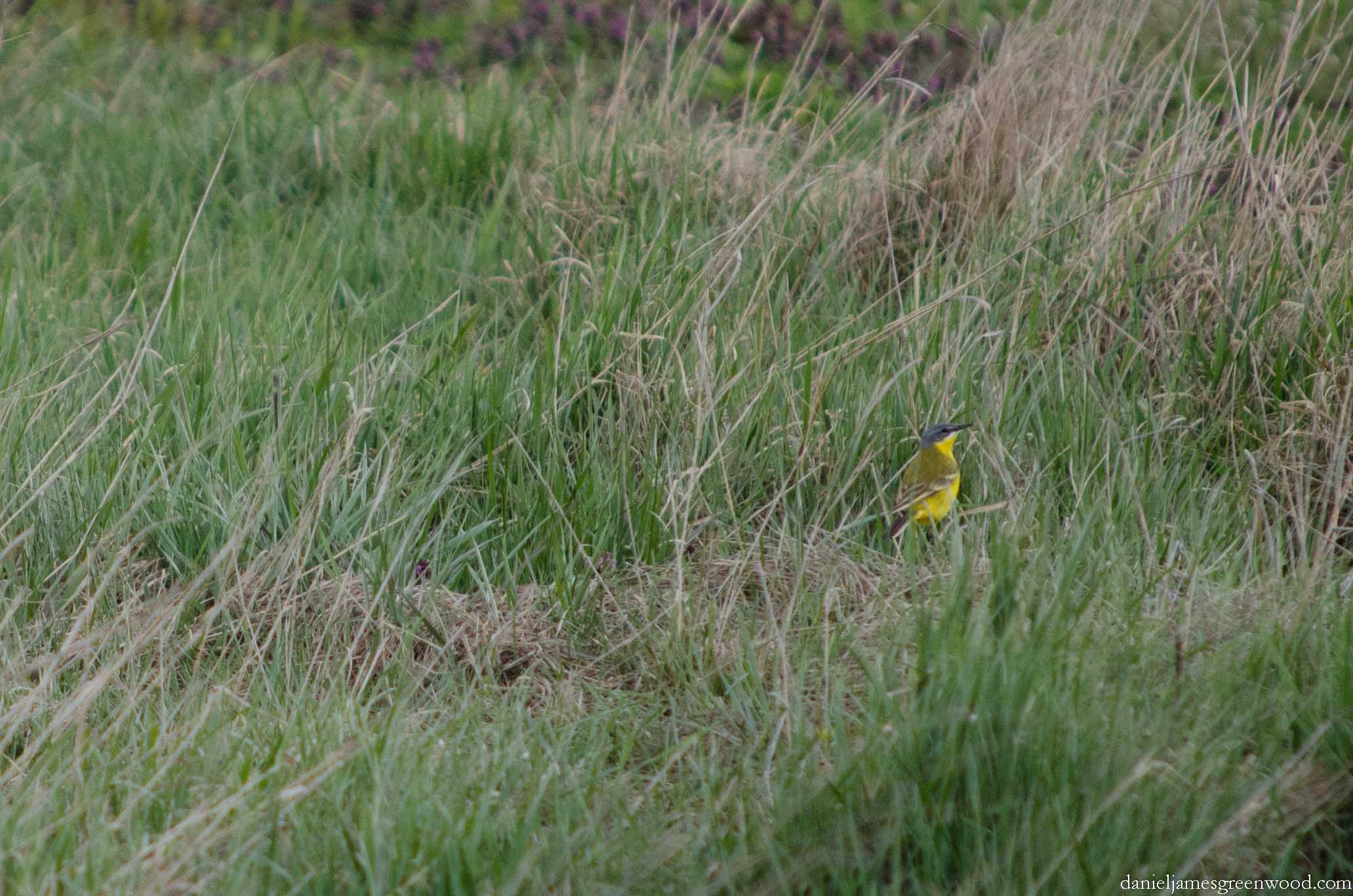
Yellow wagtail is a spring migrant to Europe which is in severe decline in Britain. There were a good number of them on the Plain. Being bright yellow with a grey head, it’s easy to mistake the more urban and common grey wagtail for this bird.

Hortobagy blog pics-27

The only way for us to get around was to travel by train, the only time that we were really able to mix with local people. For the untrained, Hungarian is a pretty inaccessible language, with no relation to Latin or Western languages, it descends (or ascends) from Finnish. We tried our best but could only really master egészségedre (‘to your health’ or ‘cheers’) after a week in Hungary. The railways were typically post-war Communist, pumping out black fumes and chuntering along. But they were always on time and provided a lifeline for people who had no other means of transport. No one gets around on horseback like they did when Patrick Leigh Fermor visited in the early 20th century, when ‘carts drawn by horses and oxen easily outnumbered the motor cars’ (p.44).

Hortobagy blog pics-24

Both Eddie and I were struck by the struggles of people in the places we visited. It was at times impossible to see the trip as a holiday, particularly because of what we saw from the windows of our train as it passed from Debrecen over the border into Romania. I like old buildings crumbling around and lament their loss from London (I know there is a housing crisis) and took a few photographs of some that were around the Halastó station.

Hortobagy blog pics-23

Having travelled in the Czech Republic and Poland, I’m not a big fan of what communism has done to the landscape. The former Soviet Union has also contributed greatly to global warming with its industrialisation of much of rural Europe. Its architectural merits are also lost on me. I’m not a fan of what modern capitalism is doing either, via agricultural intensification, oil and fracking. But agricultural intensification is something that communism welcomed with open arms, rounding up the smaller farms and destroying millions of hectares of natural grasslands, woods and rivers in the process. Today agricultural intensification is the biggest threat to the steppe grasslands of Europe and Asia, making them some of the most threatened habitats on earth.

Hortobagy blog pics-26

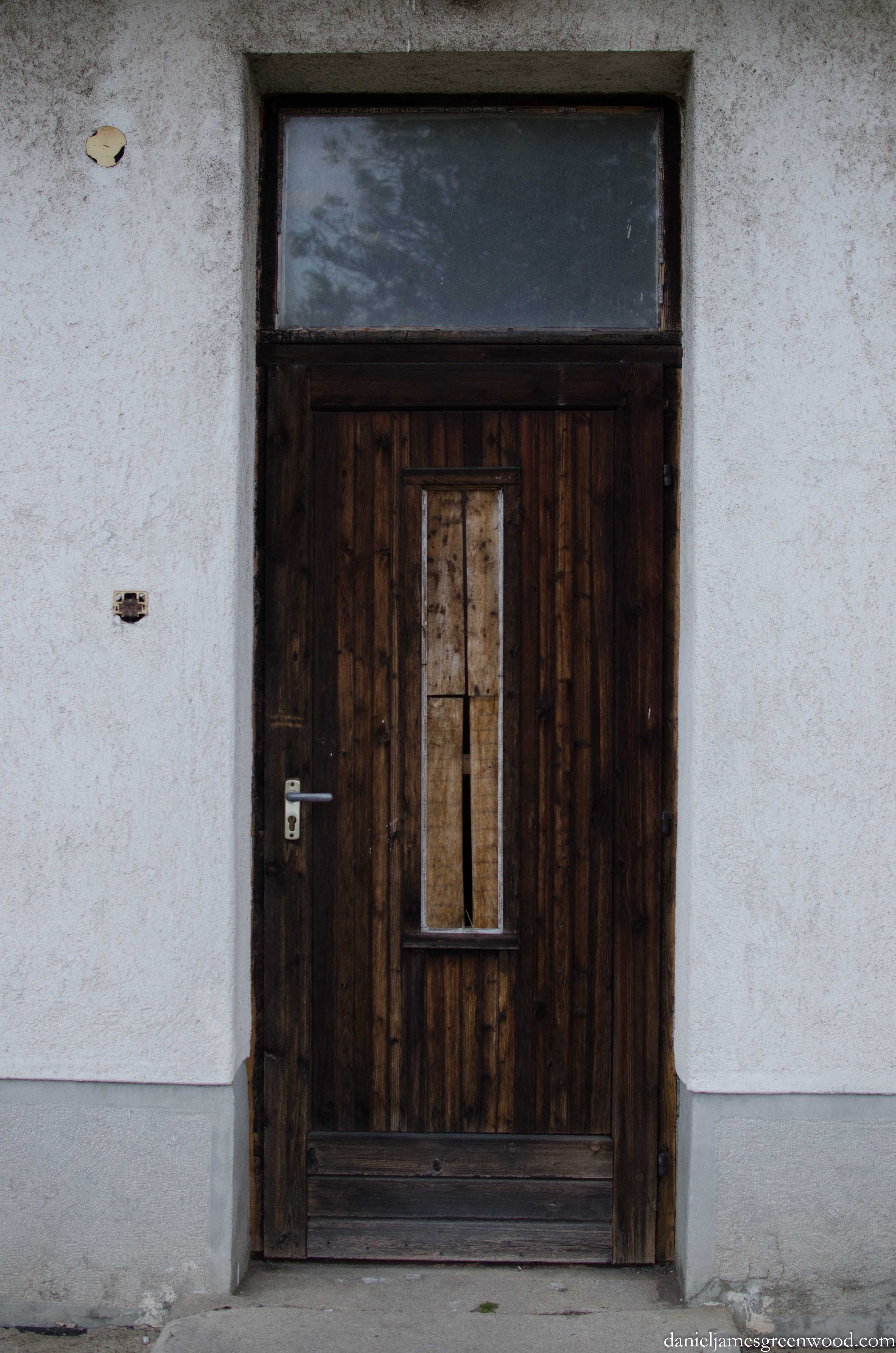
This was the door to the station building, now housing sparrows. I should say that dilapidated housing and other buildings do not mean people in the area are suffering or unhappy. Here people seemed perfectly content with life on the surface. No one was homeless and the National Park appeared to be offering good support to the local community through ecotourism.

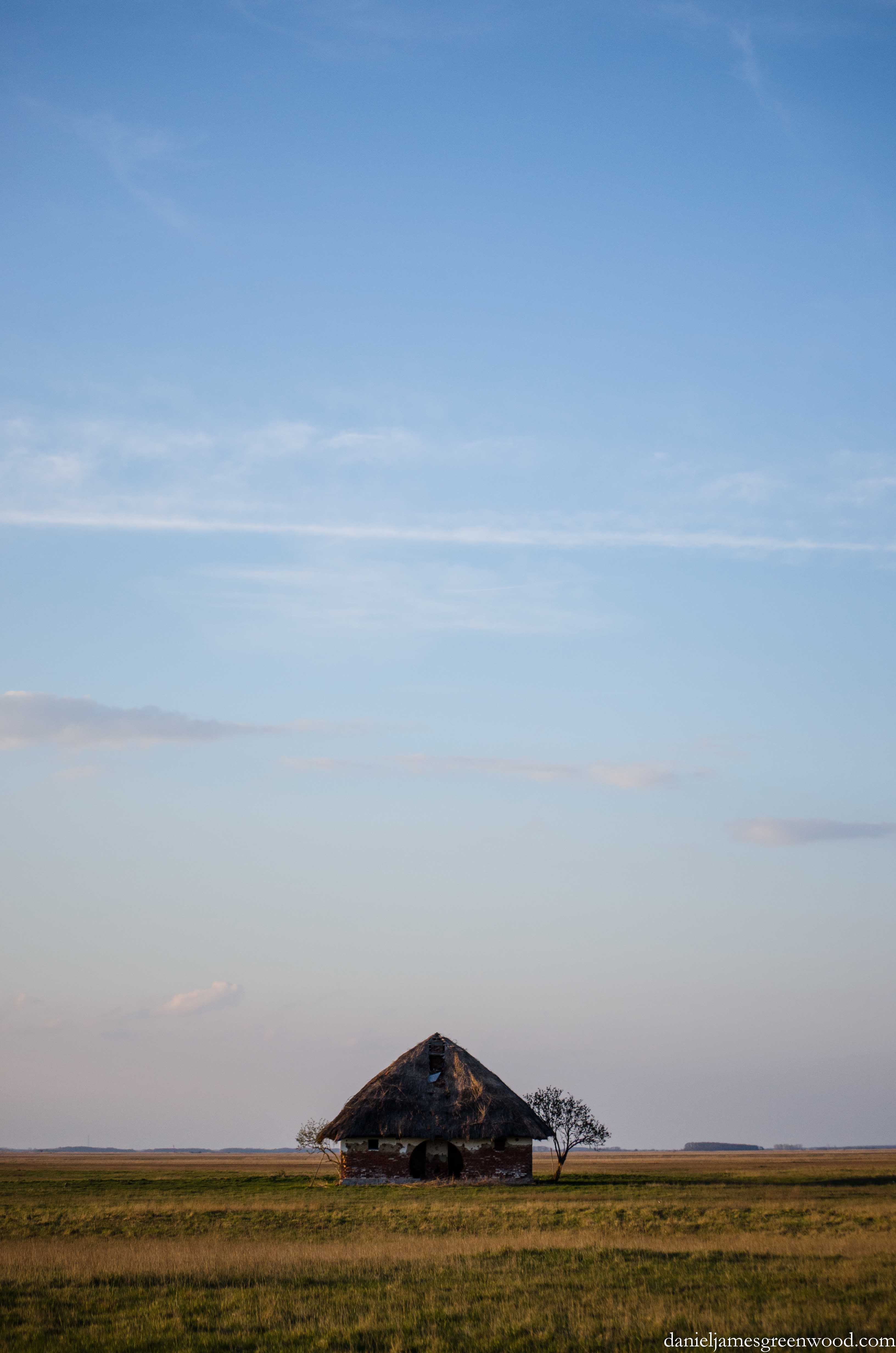
Hortobagy blog pics-13 More charming for the outsider were the individual thatched cottages dotted across the landscape. The evidence of how inhospitable this landscape is for trees can be seen by the two here sheltering next to the cottage. Whether this was used to shelter livestock or dry hay is unclear to me.

Hortobagy blog pics-20

We arrived at the Halastó fishponds on foot. The reeds from 2014 were being cut and piled into these pyramids, neatly put in rows. The thatch from the cottage in the previous image will likely have come from the vast reedbeds of Halastó. The reedbeds supported an amazing array of birds, this even before the spring migrants had arrived.

Hortobagy blog pics-18

Marsh harriers could be seen at every corner of the landscape, flying low over the reedbeds in search of food. Upon leaving, we were shaking our heads at the sheer number of these birds of prey. We missed them when we’d left.

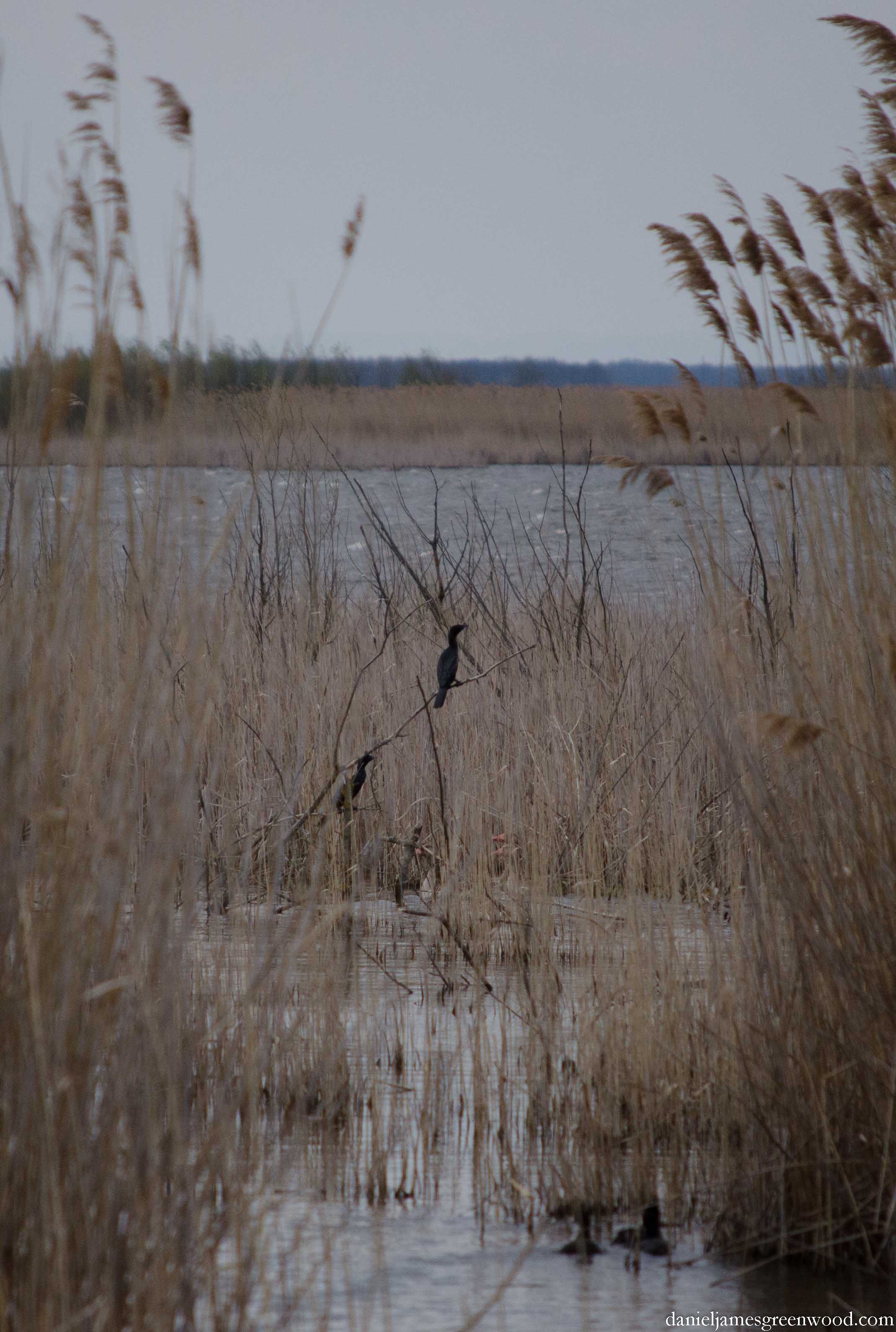
Hortobagy blog pics-19 Another bird of interest for us was the pygmy cormorant, relative of the great cormorant which I know from the River Thames in London, and most waterbodies, really. Seeing these birds perched on branches low in the reeds was like looking back into the prehistoric swamps of Europe.

Hortobagy kes-1

A line of dying trees at the edge of the fishponds were fitted with open bird boxes. The boxes were a form of social housing for kestrels, what I later found to be lesser kestrel (thanks to Nigel Spring for pointing this out to me), a separate species to the common kestrel we have in Britain. There were several more kestrels out of sight but my lens couldn’t quite capture the scene.

Hortobagy owl-1

Perhaps the biggest source of amusement for us was from this long-eared owl which was roosting in the same box three days running.

Hortobagy blog pics-11

Ever since reading the poems of Anna Akhmatova and the film The Cranes are Flying (Mikhail Kalatozov, 1957), I had wanted to see cranes. They are returning to England as a breeding bird for the first time in 400 years, once being a common species of marsh and fenland before their habitat was drained for agriculture. These birds were often eaten by royalty in England. The Latin name Grus grus points directly to the noise they make. These birds flew over our heads as we watched the kestrels and sleeping owl.

Hortobagy blog pics-17

For wildlife to be protected successfully in the long term there has to be some benefit for humans as well. Fishponds have been present in Eastern Europe since medieval times and were created for royalty. Today they have a much more wide ranging commercial value and there is conflict to be found between those who like to pull fish from the water and those who like to watch birds pull fish from the water. Here we happened upon workmen extracting fish from one pond into the back of a lorry.

Hortobagy blog pics-9

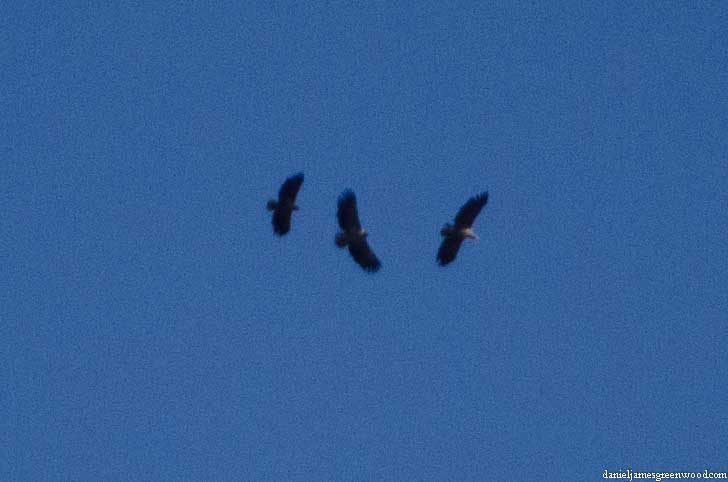
Climbing up one of the lookout posts, Eddie happened across six eagles flying on thermals over the fishponds. I managed to get this photo of what we think are mainly white tailed eagles with a possible lesser spotted eagle, though that may have been out of the picture. Later we saw a white tailed eagle sitting in the mudflats of a drained fishpond, taking to the air with deep wafts of wingbeats.

Hortobagy blog pics-14

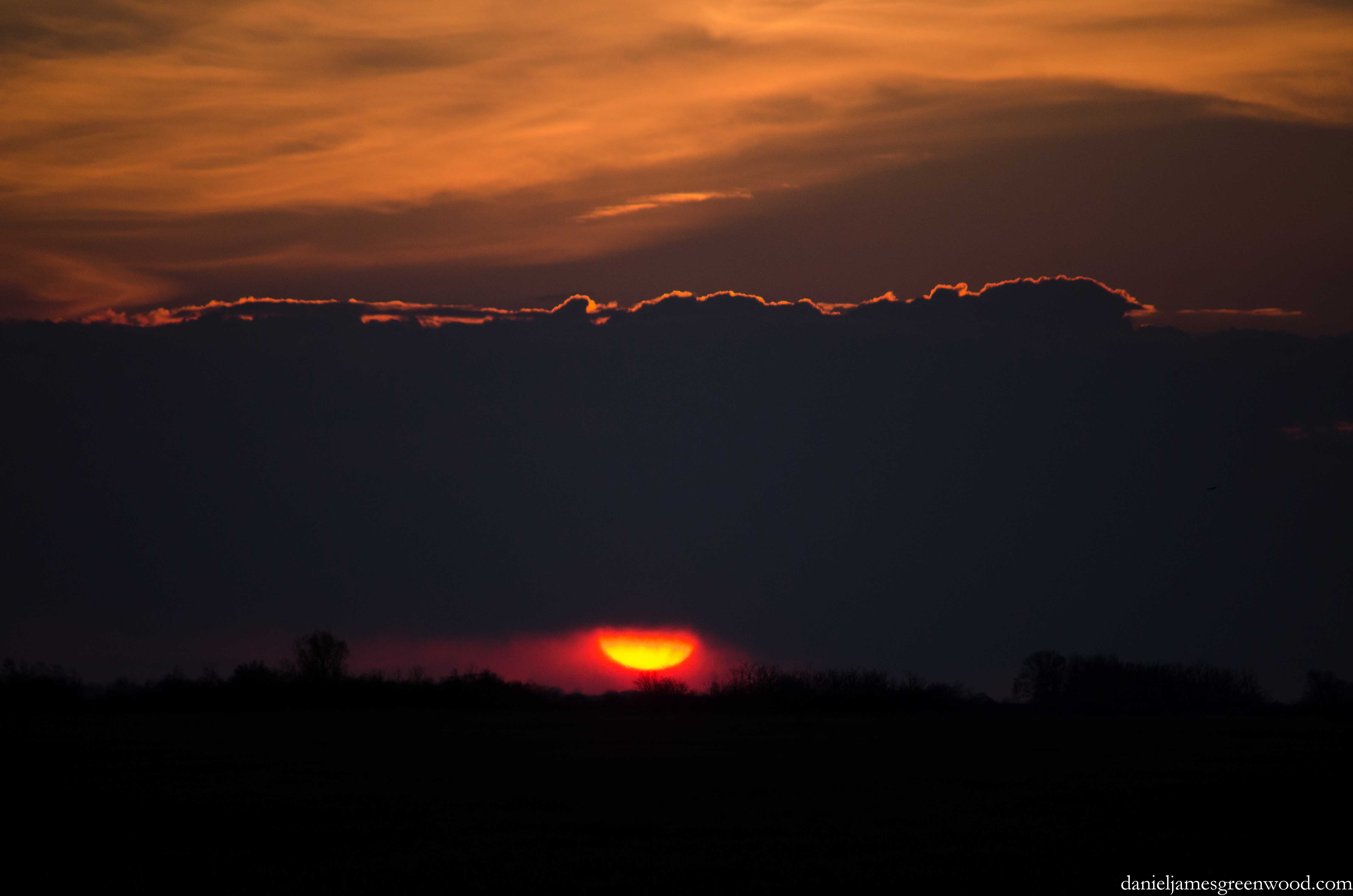
The sunsets of the Puszta are famous. We encountered this scene on our first day walking back from the fishponds. At this point we were turning back and forth between the setting sun and a pristine red fox trotting along the edge of the path. Corn buntings flocked and roe deer attempted to escape our view with nothing but the blur of the horizon to disappear into.

From here to Canterbury

Wildflowers

The North Downs, Coulsdon, May 2015

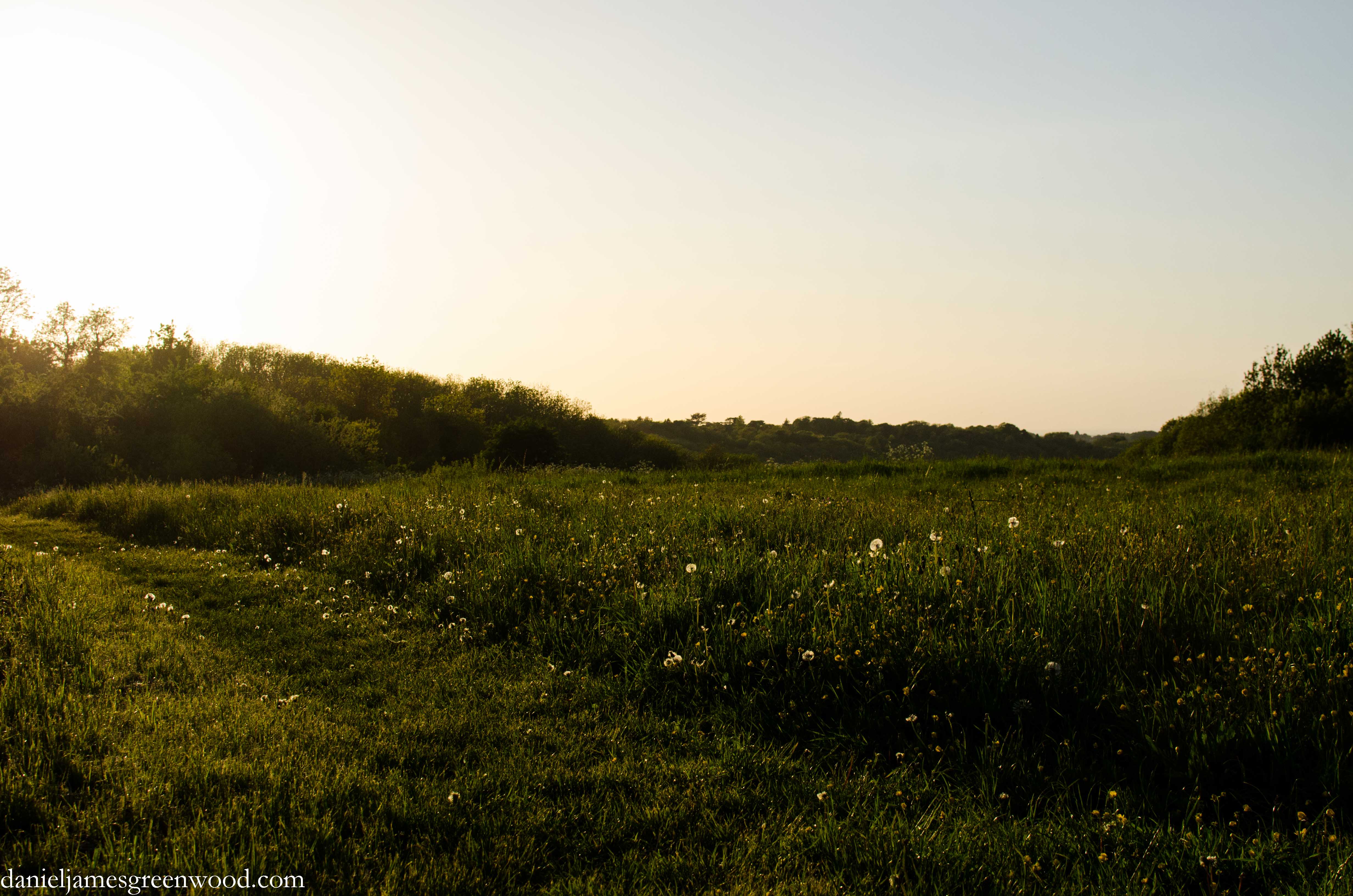
Entering onto the Downs, a group of teenagers are fixing their upturned bikes in the buttercups and silverweed. They spill out onto the lane, calling across to each other when a car comes past. It’s evening and the sun hits the mounds of anthills overgrown by birds-foot trefoil and speedwell. The glowing yellow and blue petals are a precursor to the summer yet to hit these chalky meadows, their flowers like a stash of forgotten jewels. From the strip of trees and bushes that separates Farthing Downs from New Hill, a flow of blackbird music runs, moving here and there as the wind tugs and carries their songs to different places. A red fox slips into the hedgerow. Song thrushes evade the wind with their daggers and trills. Up ahead, a pair of young women pose on the path, and only until a few paces ahead do I see the selfie-stick with their phone on the end. Disappearing off, knowing they aren’t alone, they throw a few more statuettes to their camera, before slinging hand bags back into the crooks of their arms. Skylarks call from up on high, one with its wings and bill working as if it all depended on that verse. In the hawthorns the linnets ping and pang, a green woodpecker lifts up from the turf and submerges itself in some oak scrub. The magpies tread through short tufts of meadowland coloured by buttercups and the hot red stems of salad burnet, still yet to leaf. Before me is Happy Valley, its wayfaring trees flowering in white spots on the hillside. Slipping off into the chalk hollow that will lead to Devilsden Wood, the defiant song thrush sings into the tunnel of hazel and yew, a master of this underworld. On the track before me is a light brown toad, sitting in the middle of the path. Like a baby it crawls towards me and nuzzles in against the side of my boot. I remove my foot and let it continue its journey into the undergrowth.

In Devilsden Wood I feel the first hints of the evening cooling, the sun having reddened my skin in the open land. The new, hardening green leaves of beech explode in the canopy where the light hits them, the few slithers of sky that can be seen between their branches leaves nicks of light along the trackway. A couple with their two sons walk with sticks, picking their way through the undergrowth to find new paths and treasure. The bluebells hum purple in the dark hazel coppices, brightened in part by the helmets of yellow archangel and splashes of stitchwort. The wood ends and the buttercup meadows of Happy Valley simmer at the break of trees. A man and a woman stroll the way I have come with butterfly nets in their hands, a happy day spent on the Downs, I am sure.

Blog pics-2

The route leads back into sun dappled bluebell woods swamped by bramble. Two dogs shoot past from behind a small mound and I’m taken by surprise. Meeting company in the dark wood I waste no time breaking out again into the valley. On the hill that will take me to Coulsdon Common, two lads are rolling down, swearing as their tumble takes a surprising turn. At the bottom of the hill waits a girl with hands on hips, as if deciding between them who she will choose when their race climaxes. The lad with long black hair and grunge hoodie lies on his back, raising himself up on his elbows. The girl jockeys him and lies back. They rest in the sun-draining valley like a pair of Siamese twins. I pass them and head towards Coulsdon Common, overtaking a man in his seventies:

‘Evening,’ I say.

‘Good evening, sir!’ he fires back, as if still in the military. He stops, casting his eyes across the flowering meadow to the scene of a white gazeebo in a garden where a PA system amplifies a ceremony of some sort. He is a lone figure on that track, wearing a cap and winter coat. On Coulsdon Common the goal posts gape in shade as the sun breaks through the branches, illuminating the grasses: cocks foot and meadow foxtail. It’s approaching eight o’clock and so I chunter on, passing Saturday evening strollers fresh from an afternoon in the Fox pub. A man drives a mower along the verges, a clutch of bluebells given a stay of execution around a fencepost. I drop down into Rydons Lane past houses with vast lawns dotted with wildflowers left over from their previous incarnation as meadowland or wood. The absurdity of suburbia strikes its note – carp ponds, seven cars, gates with intercoms. I leave on an incline swallowed by yew trees and bursting with chalk, a Labrador storming past me. A voice blurs with the tree dark.

‘He’s over here,’ I shout.

‘Oh, thanks mate,’ is the reply of a man in a white t-shirt, stranded amidst dogs mercury.

I walk through a familiar farm where women ride horses, a Jaguar parked close by. In winter these fields are boggied by the deep clefts of horse hooves, now they are sealed by the heat of a hot day’s sun. Crossing a stile I arrive in a field where a man smokes a cigarette at a pathway in from his house, evidently in need of some silence and peace, he does not see me. I follow the mowed path alongside a hedge of poplar suckers, beyond a dead oak and its dead ivy which has only collapsed in the past year. In need of a snack I sit on the grass and notice paths which I had not seen before. A young, fresh red fox bounds into view, skipping as if from something invisible to the human eye. It sees me and stops, staring, unsure of what I might do. But I’m only here to sit and chew a Tunnock’s Caramel. I watch it through my binoculars, its image framed by buttercups and hedges, a house at the field’s edge. Insects move in small clouds along the edge of the mower’s reach.

Blog pics-3

On Hayes Lane I dodge speeding cars and see that patches of wild garlic are being harvested with scissors, hollow stalks standing leafless on the verge. Their thoughtful foraging will make no dent in this robust lily, a plant flowering in profusion along the trackways from here to Canterbury in spring. At the entrance to Kenley Common a song thrush rises to a protruding branch, smashing a snail against the wood. It drops it and flies away. Taking a closer look I see the snail still curled up in its brittle, fractured home. The Common is not empty, the same spreads of buttercup full with human life. A man lies on his stomach in the flowers calling for his dog to run towards him, the remaining sunlight channelling straight down his lens. I look at the English oaks, swelling woods and distant wounds of chalk quarry and wonder what draws us so readily to gather professional images of our pets. With time on my mind I snatch a glimpse of the Caterham valley and head towards Whyteleafe, the remainder of the Common swamped in the shady wood pasture by cow parsley. The wood of mature ash and wayfaring trees are bright white, naked limbs in the twilight. At the end of my walk a poorly, urban fox cub nips into the road, pausing to watch me, like its healthier meadow counterpart, to see what I might do. I watch it disappear into the avenue of parked cars and take the pavement down to catch the next train home.

Essay: John Keats and how nature makes us feel so small

Galloway
Galloway, Scotland

John Keats (1795-1821) died aged 25 thinking himself a failed poet. Today he is revered as a great. I mine his poems for evocations of nature, the nightingales, the bees ‘bustling down in the bluebells’, and his recurring musk rose. For these moments, from a wet and gloomy winter, I find great pleasure in peering back 200 years to Keats’s descriptions of a London that had not yet swallowed Hampstead entirely, or my borough, the 800-year-old parish of Lewisham. In Keats’ Ode to a Nightingale, he describes much of what makes birdsong a cure for human pains, the continuity of wildlife and nature gives us a place in the world, for we are not the first to hear a blackbird, song thrush or nightingale sing, nor will we be the last:

Thou was not born for death, immortal Bird!

No hungry generations tread thee down;

The voice I hear this passing night was heard

In ancient days by emperor and clown (p. 220[i])

Birds do not discriminate against any audience, their songs can be heard by any person who happens to be passing, be it the song of a robin singing at midnight in central London or a nightingale firing in the morning from a blackthorn hedge in a Dorset field. And perhaps real nature conservation has this at its heart, though often unsaid from a fear of sounding eccentric or elitist. Nature is vital to humanity in many ways, humanity is inseparable from nature, but in dealing with dissonance and social discord brought about by contemporary austerity and financial inequality, its inclusiveness is what makes it most relevant to us living in the 21st century. The song of the blackbird can be heard by anyone who might happen to hear it, more so if conservation is supported by communities and authorities.

Loch Trool
Loch Trool, Galloway Forest Park, Scotland

On a recent visit to Dumfries and Galloway in south-western Scotland I brought Andrew Motion’s hefty biography of Keats with me. It appears more and more that it is not so much Keats’ poems I like the most, but the many aspects of his story, which poetry seems such a big part of. He lived a very short and full life, his published poems barracked by what we might today equate with critics or journalists of the propagandist right’s ilk. And many people thought that he had died from the heavy blows of his critics. Motion points to his wildly ambitious walking tour of Scotland and Ireland, arguing that it was the conditions a weary and exhausted Keats experienced on the Isle of Mull that began his descent into critical illness. Keats had embarked on a mission to collect experiences to influence his writing, and he was astounded by Scotland’s sublime mountains and wild landscapes. He ‘forgot himself’ and found that nature took away all resentment he might have for other people, or his critics, at that time:

The space, the magnitude of mountains and waterfalls are well imagined before one sees them; but this countenance or intellectual tone must surpass every imagination and defy any remembrance. I shall learn poetry here and shall henceforth write more than ever, for the abstract endeavour of being able to add a mite to that mass of beauty which is harvested from these grand materials, by the finest spirits, and put into ethereal existence for the relish of one’s own fellows. […] these scenes make man appear little. I never forgot my stature so completely – I live in the eye, and my imagination, surpassed, is at rest. (p. 269)

Keats has been knocked down by nature’s visual power and, eventually, by its impacts on his body. He cracks open the heart of the genre of nature writing. Surely the whole point of casting nature as the central theme in anything is so that ‘these scenes make man appear little.’ In the face of the sublime image of Scottish mountains, human problems are made to feel minute. It’s the same feeling people experience today in British woods, on those same Scottish mountains and by the sea. Surely if Keats were alive today his thoughts might have turned to conservation of larger landscape areas – in the same way that his biographer, Andrew Motion, once Poet Laureate, now works for the Campaign to Protect Rural England, defending National Parks from a development lobby which seems to hold sway with government. National Parks are an idea created by John Muir, the Scottish adventurer who helped to found Yosemite National Park with his grand and flawed ideas of wilderness. In Scotland, protected landscape areas such as the Trossachs National Park, Cairngorms National Park and Galloway Forest Park are key to preserving the impact of those places on the human mind, at the same time protecting their prehistoric ecosystems and wildlife. A National Park or protected landscape area is an admission or celebration of the fact that nature can show us how small we really are. For John Keats and visitors to mountains today, if underestimated or not treated with respect these landscapes and their conditions can kill.

[i] The Complete Poems of John Keats, Wordsworth Poetry Library, 2001

© Daniel James Greenwood 2014

The emptied mast

Dog stinkhorn Coulsdon, London, November 2014

In Devilsden Wood we tiptoe around fallen beech logs, slipping at times on beech leaves and clay, and the emptied mast. The nuts will have been eaten by hungry jays and squirrels. Over the past few weeks I’ve crouched down around these logs photographing their fungi: beech jellydisc with its almost caucasian flesh, purple jellydisc creeping out by the week from wisps of moss. Most startling for a layman like me was the glaring eye of dog stinkhorn, named after its canine stench. Lodged in a piece of black deadwood it had the appearance of a fox or wolf skull looking up at me. The long, finger-like stems that it had produced had collapsed, orange tips like finger nails. As Julian Hoffman has written recently, referring to the poet Rilke, we are surrounded by a world that beckons us to perceive it, to engage with it, to look and to touch. To me the fingers of the stinkhorn could be pointers to something worth seeing. Today only the jellydiscs remain, as well as a brown mushroom that reflects the white break of cloud between the trees above in its glossy cap. My friend Philip is searching for something behind me and as I look up the sharp dark shape of a sparrowhawk slices between us in silence. If we were little woodland birds we would not have seen a thing.

© Daniel James Greenwood 2014

The beaver’s work: men versus nature in South Moravia’s fishponds

Mutěnice fish ponds

South Moravia, Czech Republic, July

I’m standing in the street waiting for Moravian ornithologist Karel Šimeček. From here I can see a serin on a TV aerial across the road, and from over the houses I hear a golden oriole releasing a few phrases of its fluty, unmistakable music into the morning air. In the road is a dead animal, a common sight, and an indicator of just how much wildlife there is here. Another common image, especially on the roads leading out of town, is squashed hedgehogs. In England we barely have dead ones anymore. A car pulls up on the other side of the road and out steps Karel, binoculars round his neck, eye pieces covered by grey duct tape. He crosses the road, making sure not to be run down like a hedgehog. He shakes my hand and turns to the squashed animal in the road:

‘Turdus philomelos,’ he says.

A song thrush, my favourite bird. We get into Karel’s silver Peugeot estate with Radiohead’s Kid A on the stereo, a welcome reminder of home, and we set off. The roads are mostly empty but then it is 8:30am on a Sunday morning. I ask Karel about his interest in wildlife.

‘I became interested in birds as a boy when my mother bought me a book,’ he says. ‘I have been watching birds for more than thirty years. But there are not as many as there used to be, when I look at my notes I can see that there are less birds now.’

Why is that?

‘Different reasons. Agriculture is very important but it is probably the main reason,’ he says.

I was astonished to see how large the fields were in South Moravia. My host is conservationist Zuzana Veverkova, and she told me that the average field size is 500 hectares, meaning that small-scale, sustainable farming is impossible. Young people cannot find a way in other than through inheritance. And there are reasons why farms are so large: inspired by Stalin’s collectivisation of Russia’s agriculture, the Czech communists did the same, forcing farmers off their land and into prison if they refused. Today you have the corporate farming practice with monocultures of what Karel calls ‘the yellow evils’ of wheat, corn, sunflower and rapeseed. In some places, there are miles of these plants and nothing else.

But back to birds. I’ve never seen a goshawk and have read they are one of the most common raptors in the Czech Republic:

‘They are at 20% of what they were when I started,’ says Karel. ‘They are hunted and poisoned by people who think that anything with a curved bill and talons should be killed.’

‘Do you know the hunters?’ I ask.

‘Yes, I know them, and there is no reason for their killing of these birds.’

‘And are goshawks protected by law?’

‘Of course.’

We pass out through the fields, a pine wood on the horizon.

‘A few friends and I managed to get the pine forest protected as a nature reserve,’ says Karel.

That was not enough to save its most unique resident. 20 years ago it was home to more than twenty singing male ortolan buntings. Today there are none. Karel laments this fact as we take a swerve in the road, our passage halted by a pair of white storks treading through a field. Karel reverses and I photograph these graceful birds. They watch us, too, turning away and moving further into the pasture.

White stork

Arriving at Mutěnice fish ponds we stand on the rickety wooden footbridge where the River Kyjovka dams, the water splitting off into the ponds. Leaves cover the surface, a red admiral arriving to bask on the enforced stillness. Karel points to a stand of dead poplar trees on the other side of the river.

‘That’s the beaver’s work,’ he says.

They’ve been here for thirty years. About five years ago the manager of the ponds attempted to eradicate them, but he failed and so the beavers remain. They arrived here from Austria from the Morava, the river that gives this district its name, running the border with Austria and reaching the Danube in Slovakia. When they first appeared here one beaver was captured and interred in the local zoo. It escaped within 24 hours and returned to the fish ponds.

Turning to step off the footbridge, over a few missing slats, Karel glimpses a kingfisher as it lands on a rock in the Kyjovka. I lift the camera to it but can’t switch it on in time to get the shot. Off it goes, electric blue bolt into the willowy shadows of the river. And as we trample through the long grass alongside the river Karel picks out the calls of young kingfishers and a perch that bears the signs of the birds, no leaves, just bare and worn.

One abiding memory of these ponds will be the stench of the water. It’s nasty. More than once Karel has stopped and pointed at the water’s edge and said, ‘this is not water, this is coffee.’ It’s brown, frothy and pungent so not far off. We continue along the Kyjovka, the large pond on our left meeting the path which we’ve already passed down this morning. Karel has seen something up high in the hazy summer sky:

‘Yes,’ he says. ‘White tailed sea eagle.’

Marsh harrier attacking white-tailed eagle

Through the binoculars I see a huge animal beating its great wings, with primary feathers so long they look like fingers that could dictate some deep, magical changes to the world below. But no animal is safe or indeed at peace for long on Earth. Karel has seen alongside the eagle a marsh harrier attacking it, and moments later another appears. I set my camera and start clicking. The eagle looks overdressed in its Gogolian greatcoat of brown feathers, its white head and neck protruding out from under, yellow talons dangling out below like down-turned coat hangers. The marsh harrier strikes again and again, forcing the eagle away from the sky above the huge pond and towards the trees, until the battle is over and all three have left my field of vision.

‘We had no idea that the eagles were here,’ Karel says. ‘A Swedish hunter had a permit to hunt in the forest and when he was leaving he said, “I see that you have eagles nesting in the forest”. Our response was, “we didn’t know that!”.’

We tread the path already taken, a dead bat splayed on the ground, its deathly grin drawn wide and rotting. It’s our waymarker. A small van rolls along the track, a Czech man with short black hair and ski-glasses steps out, handing Karel a metal tag that reads ‘Budapest’. They discuss something and then say goodbye, the man getting back into the car and driving away. The ring is from a young cormorant that was shot the other day. It had been ringed by ornithologists in Hungary and died here at Mutěnice. This seems familiar to Karel:

‘The migration patterns of cormorants are well known,’ he says.

This is an extract from an upcoming collection, Travels in South Moravia

Links:

Karel’s website

Conservation in South Moravia

© Daniel James Greenwood 2014

This is it

Six-spot burnet moth

Farthing Downs, London, July 2014

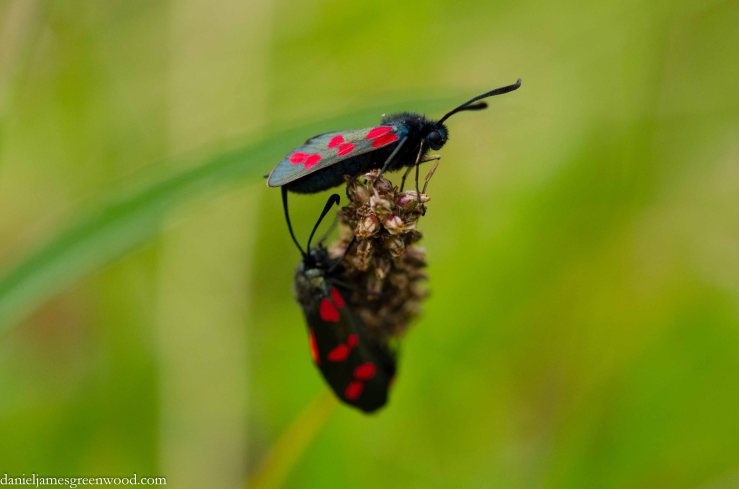
We leave the chalky, wooded hollow and appear in an ocean of field scabious. The sun setting in the west catches the pale, lilac petals of these daisies. In the other meadows across on New Hill and in Happy Valley greater knapweed has begun to flower, that deep purple gives me the sense of summer’s final movements, splayed florets that say: this is it. The meadows, too, abound with the motorised flight of burnet moths that were not here two weeks ago. Many of them are mating, one pursued by a pair of skippers unwilling to share a flowerhead. I wonder, what harm could a butterfly do a moth? Anthropomorphism excused, their quarrel does have the feel of a playground spat. That landscape is behind us now as we return along the crown of Farthing Downs. The sky is split in half to the west, smears of rain hurrying our return to the urban landscape. The liquid song of the skylark pours from the sky and we search for its shape. After giving in and then locating it I see it some forty-feet up in the sky. My companion can’t quite believe how clearly its song comes yet from so high. We stand, our exit delayed, the two forces of incoming weather and skylark display gluing us to the soft turf of Farthing Downs.

© Daniel James Greenwood 2014

Where the wild thyme grows

Daneway Banks

Daneway Banks, Gloucestershire Wildlife Trust, Cotswolds, July 2014

Figures stalk this tumbling chunk of meadowland. Severe expressions are worn: eyes drawn to-and-fro, either side of the gently worn path. But all they see are the scattered clouds of marbled whites. This is where the wild thyme grows, creeping along the turf, appearing in small spreads on the miniature hillocks of ants. And here you have the reason for all the skulking souls, though some boast of their sightings as they lay flat on their bellies in wildflowers, with camera lenses mounted by donut-shaped flashes large enough to save a life at sea. The wild thyme is the food plant of the large blue butterfly, once extinct but now successfully reintroduced from Swedish stock, this insect depends on the work of red ants taking its pupa into their nests as one of their own. The large blue pupa will then eat the other ant grubs it’s lodging with, eventually destroying the entire colony. To find something that was once extinct is, to many, to contend with the immortal. We haven’t seen it, instead we hear stories of large blues sunning themselves beside gate posts ‘just fifteen minutes ago’. We also hear of the creature’s phased movement, down the hill with the sun’s heat. We meet a softly spoken man making his fifth visit in search of the ghost. He identifies the yellow spike of flowers that is agrimony. He suggests we look it up in my friend’s wildflower guide (one which I tossed, jokingly, into the air out of faux-botanical disgust some minutes ago). There’s much more to see: clustered bellflower, common centaury, yellow wort, pyramidal orchid, lady’s bedstraw (which we shamefully contended ourselves with as golden rod), the simple colours of bird’s-foot-trefoil, and edibles like marjoram and salad burnet.

Marbled white

Rain comes and we leave these meadows of lost souls, leading up into Dorvel Wood. There is that change, the sudden loss of colour, all has become green and brown – leaf and leaf litter. The wood flowers appease the loss of butterflies – the underlying stench of wild garlic, the sight of violets, wood spurge, wood melick and no desire for the unusual. No man can be found here lying in mud and puddle to capture a photograph he can later sell on. But the ash leaves, crinkled, brown – is this ash dieback disease, the greatest threat to British wildlife since Owen Paterson? This was a moment I had expected but had somehow felt to be too far away. The canopy leaves are curling and dying, too. Is this the end for the common ash? We ponder it and tread out of Dorvel Wood, into the beating and blazing meadows of Sapperton.

© Daniel James Greenwood 2014

The cascading orchid

Click through for full album

Farthing Downs and New Hill, London, June 2014

In the towns swallowed by London’s urban lurch, summer is flowering knotweed, rosebay willowherb and lupins, all non-native, all bold and blooming along Victorian railway sidings. At Farthing Downs summer strikes out in meadows of yellow rattle, dropwort, field scabious, hawkbit, ribwort plantain and sheeps sorrel. The first meadow browns, ringlets and small heaths take flight, the latter locked in a pair, mating, flying as one away from my lens. Stopping to take in these grassy Downs, the sheer number of butterflies is clear.

But the birds have not retired just yet. I hear a cry from the blue sky and see a buzzard tucking in its wings and bombing towards Coulsdon. This is the first I’ve seen here, and its arrowing for London is without doubt. This is now officially the most common bird of prey in the UK. I also hear the songs of linnet, song thrush and chiffchaff. Spring and summer have clashed in a frenzy of yellow, green and the common blue butterfly. On New Hill pyramidal orchids cascade across the slope, the leaves of spring cowslips now tucked in under the shade of orchids, rough hawkbit and yellow rattle. The bed of marjoram bounces, its fragrance only felt when touched with the fingers. On the other hillside jackdaws flock with two sheep grazing, their medieval world clattering along with their calls, like bullets ricocheting. The sheep go about their tasting, the meadows purpler still.

© Daniel James Greenwood 2014

A neon waltz

FD may blog-2

Farthing Downs, London, May 2014

I sit on a path new and slight, pressed into the grasses. Last year I sat in a spot close by under the shade of ash trees watching a willow warbler make return visits to a nest down in the brambles. Now the brink of a small copse of trees has gone, the bird, perhaps returning, may have decided this was no longer a place to raise young. In the absence of willow warblers, brimstone butterflies, perhaps reaching double figures, mark the new space of downland that has been reopened from the folds of trees. The piles of logs and branches stacked in the iron beds are still here, yet to be burned or hedged. I like that slowness, that I can come back some months later and no one has felt too pushed to tidy the place up.

A male and female brimstone fly together and then fall down amongst the twigs and low, woody brambles. I’m interested to see what they’re doing so I get up and have a look. They’re mating, bodies bent round, facing away from each other. They part. High in the sky, against the blue and its herring and lesser black-backed gulls circling on thermals, a huge flock. I wonder why, I wonder what for. Down here with me the female brimstone is again on the wing, met by a band of battling males. They pass her and are turned immediately onto her, each forgetting their quarrel and targeting the paler female. This is the perfect reflection of the adult butterfly’s life: the males seek as many females as they can; the female, having mated, defends herself from latecomers as she strives to find the right plant for egg-laying. The males attack her, but she breaks free, up into the sky. She is not free of them. The four males cloud her, their colours so close as they gain height that all sense of defence has disappeared into a neon waltz. They go up, up and over my head to the world of gulls and warm air rising.

© Daniel James Greenwood 2014