In search of Mayo’s native woodlands

First published on the Earthlines Review

Co. Mayo, Eire, April 2013

Saturday

Last night we arrived to watch the mountain burn. The flames licked up from behind the plantation at the end of the field, capturing the tinder of last year’s heather. I thought of how dry that wood was, how it would go up in an instant. The farmer ghosted down the lane, no knowledge of who could have set fire to the mountain, or why. He always strikes me as part wild, so accustomed to the lay of this land that he has partly-merged with its bogginess, its giant boulders and streams, in the way I am accustomed to the wildness of streetlamps and new woodlands, how they impact me. Seeing an Xbox and satellite TV in his house a few years back diluted that idea. This isn’t the first time the mountain’s been set on fire, five years ago it happened. Waking up this morning it’s as if last night was a dream brought on by the exhaustion of a long and early journey from London, across the Irish Sea from Holyhead and then from Dublin. At the foot of the Ox Mountains this morning I see no sign of fire, no people, no animals. It must have been much further away than we thought it was. The bracken lies dead and dry, concealing crevices between rocks. How quickly this could burst into flame. The ground is dry at the foot of the mountain, the sphagnum mosses and reindeer lichens spreading as I climb with the wind. A herd of feral goats watch me from the top, filing away, perhaps in disappointment that I’ve blocked their path. Turning to look to the west I see Nephin in silhouette where the valley of farms and gorse-covered bog ends. I head south-east and up into the Ox Mountains.

Trees are sparse, only a hawthorn or a mountain ash in 100 metres, bedraggled and gnawed by the animals that graze between the rocks. The heather is growing again, and where there is some dampness a cladonia cup-lichen pouts its miniature red lips on pale blue stems. I search along the south-facing banks for wildflowers and find dog violet and wood sorrel. Being a woodlander at heart, it draws me back home and to the question of origins – did woodlands once grow on the Ox Mountains? They must have. Looking around me, I am not convinced. But early or common dog violets do grow in ancient woodland in south London, and wood sorrel, too. One of my holiday reads is Oliver Rackham’s Woodlands. I will be tearing into it on my return back to the cottage.

A small bird is calling, barely audible above a wind that’s gained momentum as I’ve gained height. Two giant boulders sit like mountain fauna and all I see above and between them is sky. The ground is boggy, covered by the papery yellow grasses and red mosses. A goat path is indented through it all. I take it, stepping up into the goat hoof clefts and up between the two boulder gods. Though unseeing, they will have presided over a valley wrought by famine in the 1840s, worn only by the deep breaths of time. Last night they will have been coloured by fire, unmoved. To be rock is to be asleep.

The rocks are beneath me now, a plane of damp dead grasses and moss pervades. The wind is stronger, still. How strange that even on a tree-less moor of a mountain the movement between rock and mound can feel like entering somewhere new. I sit on the rocky deity’s scalp.  Down below, the plantation is crossed by bare larch trees, and in the distance the blue promise of Sligo Bay. Further west, in the realm of the imagination: America. But I’m hungry, and the basic desire for food always wins out over beauty.

I wander across and down, away from the sheer drop. At least the fall would be into a mattress of bog. A raven calls out, kronk, kronk, kronk, but so bare is the mountain the call could be a thing of the distant past, or my imagination. I grab onto heather forgetting that the soft ground will give and I nearly tumble bearing yet-blooming flowers, but a goat print saves me and I land on my backside. Gradually the song of a robin replaces the mountain wind, the images of sheep return to life and the mountain looms again, forgetful, triumphant.

ireland-april-2013-lo-res-109

Easter Sunday

It’s evening, the weather is warmer here than in England but when the wind blows it cuts through you. I have been reading Rackham’s Woodlands. In the period between 1350 and 1500 woodland cover expanded in the United Kingdom in the wake of the Black Death. England’s population declined by 1/3 and so too did global warming[1].  Why? Less trees were being felled and burned. The woodland came back and captured the carbon. I wonder when that will happen again. Today we visited my grandfather at his nursing home in Kiltimagh, it’s an old estate with pollarded horse chestnut and beech trees. On the hillside wind turbines have been built. They do not look a scar or a slight on the land. But granddad never leaves the house to see these things, most of the people there drift in and out of sleep and eating, the radio playing in the background. It was Aerosmith when we arrived. He used to live in Ballindine, crossing the motorway to the shop, forgetting how many times he’d been. He always asks me when I’m going to get a haircut. I feel a little apprehensive about visiting the home but when I get there I enjoy it, the people are friendly even if some aren’t in their right mind and there’s a welcome warmth about the long faces, slow gestures and blazing radiators.

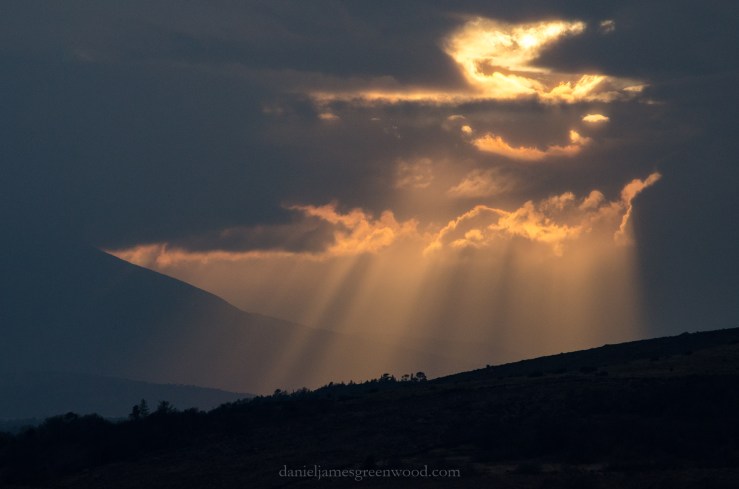
After a day spent in the car I decide to visit the mountain again. I’ve never been to the top. Me and my dad nearly got up there a few years ago but we didn’t feel the desire to. I take to the path again, passing the sheep in the field, the caravan shot to pieces, a lace curtain blowing through the hole where the window once was. I climb up the track again and feel no desire to reach the summit. I turn into a small cove where a stream runs down and the path becomes sphagnum moss, soft, white and red. I sit on a boulder and look up at the sky and the mountain. But for the stream there is no sound at all. All my thoughts come in and out again. Having had my fill of silence I return back down. On the way I see Nephin traversed by the sun setting behind clouds, the trees silhouetted on a hill before it. I can’t help but think of those who used to live on this mountain and in this valley who were shackled and degraded by famine. How did they view this overbearing rock and heathland, the sight of Nephin and sunsets like these? Surely they couldn’t have had the energy or mind to even think about it. It would not have mattered. I was reading a book called The Great Famine last night. When one ship carrying food and aid from England arrived in Ireland during the famine, three went the other way. At times I feel torn between my heritage, between my anger for the cruelty wrought by the British and the suffering inflicted upon the Irish. I do not feel completely one or the other.

On the way back down I have a sudden desire to remain, to sit against a rock and enjoy the fresh Atlantic air. I remember hearing a cuckoo a decade ago, but it hasn’t returned yet. After my breather I continue into the valley and meet the farmer on the track. I ask him if cuckoos still come here. He doesn’t understand me. I sometimes forget that my accent isn’t clear to everyone. He eventually realises what I mean and points to the plantations growing on either side, comfortable with the knowledge that they come often.

‘But it’ll be too cold for them here now,’ he says.

Ireland 2013 blog 2020-2
Mountain ash, Ox Mountains

Easter Monday

From Woodlands, page 206: ‘Ancient woods are not the place to look for ancient trees. Indeed, the presence of ancient trees, unless they are boundary pollards, indicates that the wood is not ancient, but has grown up around freestanding trees (in-filled savannah).’  There are no ancient trees at the foot of the Ox Mountains, there are barely even trees. I still have hope of finding something.

Tuesday

We aren’t visiting granddad today. We drive to Westport to see what they have in the bookshop there. On the river a grey heron is mobbed by black headed and common gulls. They stand on the wall having their pictures taken by everyone, including me and my family. We drive to Achill Island for the day, the sun beating down but the cold wind still lingers. It’s snowing in London. The views from Achill are astounding, rock pipits merge with the winter grasses and silver boulders as they feed at the cliff’s edge. Spring is still not with us, the leaves are not on the trees, no swallows nest in the barn and no cuckoo calls from the wood. The bogs on Achill are strewn with rhododendrons, thriving on the acid soils, clearly admired by the locals for their unusual pinks and purples when in flower. I bought The Story of Ireland by Neil Hegarty. This quote from Oliver Cromwell stuck with me:

‘For to what purpose was it to plow or sow, where there was little or no Prospect of reaping? – To improve where the Tenant had no Property? This universal Neglect of Husbandry covered the Face of the Kingdoms with thickets of Woods and Briars; and with those Vast extended Boggs, which are not natural but only the Excrescences and Scabs of the Body, occasioned by Uncleanliness and Sloth.’ (page 136).

It’s what I love about Ireland, the bogs, the boulders, the ‘Excrescences’, the 1970s Opel car rusting in the ditch. In Mayo the Irish are not erasing their visual history, the ghost towns of the 1990s are still standing and the eerie cottages of the times gone by are still decaying at the roadside. In England we are obsessed with tidiness.

Today has again been spent in the car, imprisoned. I haven’t been able to contend with the landscape other than through the camera. It’s evening and the sky is broad and blue. The children are playing in the fields, traversing the margins and fence lines. Now I feel the need to see the mountain’s top, I want to know what’s on the other side. I make it to where I stopped the other day, no need of silence or thought, I continue up through the goat clefts, driving shin-first through midge clouds. A wren is singing up above me as I dip in to the path as it bends around an alcove home to boulders that have become dislodged and crashed down over time to sit in the vegetation, cool. I pass back out and the track becomes more steep, the heather creeping across. Now I can see another fire in the south, the smoke blowing to the west across the glassy Roosky lake. The field lines are clear from up here, the margins deep and defined. I turn and clamber to the top. The zenith opens out with a gust of a cold, cold wind. I put my hood up and watch as a meadow pipit raises aloft, calling, a single peep, escaping on deep undulations. So that was the little bird I’d heard the other day. The top of this mountain is peat bog, the feral goats see me and disappear over a peat bank. There are lines where the peat has been removed in the past, a practice which is now criticised by environmentalists because so much carbon has been stored in the bogs. To the Irish who cut out this peat it was just a local and available fuel, it was not an evil act. A trough in the heather is full with water reflecting the sky. The wind ripples the surface. Frogspawn sits in large clumps in one corner. It’s only the second lot I’ve seen this year, here and on Exmoor. I decide to head back down the mountain

A meadow pipit appears and clings to a sprig of heather. I watch it through my binoculars as it looks from side to side, its speckled breast twisting. I pass the winding path again and overshoot, taking the wrong goat path this time. I spot an unusually verdant green peeking from behind a boulder. And here we have it, lesser celandine, wild strawberry. Woodland indicator species hiding behind a rock. So, could it be, did the Ox Mountains once have ragged woods rather than heather? How long ago? I think of how I came to find these plants, by following a goat path. There will be no woodland as long as the goats roam these moors. A man is standing on rock down below covering his eyes, looking around in a fashion not far from the meadow pipit’s.

‘Have you seen a sheep and a lamb passing up these ways?’ he asks.

I haven’t. I see the smoke plumes again. ‘Who is setting fire to the mountain?’ I ask.

‘Just cats,’ he says.
Ireland 2013 blog 2020-3

Wednesday

I walk up to the top of the mountain again but with my family this time. I want them to see this view. I see how much good the walk does them, out of the car, not worrying about granddad, if he has enough clothes, if he remembers us, if he’s happy.

Thursday

Stepping off the main road we tread carefully over the rocky steps to Lough Conn, the water lapping against the rocks as it flows under Pontoon Bridge. On the opposite bank the gorse is flowering at every opportunity. North of Foxford it’s bright orange, the dry weather and warm sun has lit fires across the Ox Mountains, this morning the sun shone through the smoke and lit everything brown. It’s not arson this time. In the nursing home they mentioned it on the radio. This place feels like the whole world, the only place. In Pontoon the cars passing at 50mph on the road are not regular enough to dominate the soundscape. I listen – no birds. To the left is a pile of rocks and boulders, leading to a shoreline of reeds, grasses and willow. Beyond the water’s edge is woodland, rising into a lip that looks out over the lough. To me, from here, that is an ancient wood. I look through my binoculars and I’m sure I can see oak buds against the blue sky, growing amidst the straggly birch trees.

How can I get there without drowning? It’s a family holiday and my parents are with me, so dad suggests climbing across the boulders to the left. When we were on holiday in West Cork in the 1990s he would go fishing off rocks our mum deemed dangerous. My sister and I would sit at the window waiting for him to appear on the lane, unsure if the ocean, a shark, a giant squid might have captured him from us. He risked it, and so I’ll do it. The water isn’t deep immediately below the boulders but a cold soaking isn’t on the cards when I’ve got my camera with me. I clamber up onto a big boulder, leading with my feet, stepping onto smaller, and sometimes shifting rocks. I bring my right arm round and the sleeve of my coat unclips my lens cap – and off it goes, somersaulting into the brown water. I can’t help but think of Leonardo di Caprio disappearing into the sea at the end of Titanic. This feels like one of those times when things go a bit wrong. I slip down onto my backside and try to drag the cap towards me with my boot. The lens cap begins to sink. I fish again and drag deeper, I pull my boot away and it’s there, I snatch at it and zip it away.

I climb across the final few rocks until the water has receded and a sandy shore is under foot. This route is rarely taken, it’s blocked by crouched willows and twigs that are so dry they snap as I move. Further along the shore is a stone hut with an iron roof. It looks old, really old, but renovated. The ground is sandy, boggy, midges and mozzies frolic in their respective mobs. Cutting across the marshy path towards the trees I get my first view of it – the green of an Irish rainforest. Everything is vibrant with moss, the tongues of ferns and decrepit trunks of birch and oak trees. At last, I’ve discovered one of Mayo’s ancient woodlands. A chiffchaff is singing from over the bank of collapsed oak and rock, the first of spring. There’s a slender path through the moss, leading to the lip I’d seen from the other side of the water. I wave to my family and call across. It’s ancient! It’s like entering into a new kingdom, a homecoming, a piece of land that hasn’t been twisted and torn by the plough. But there are signs: the stone hut on the shore has a back window (open casement) with a bar running through it, inside it’s dark and wet like a medieval prison.

A swing has been tied to an oak and some clothes are hanging up like the sails of a ship moored in this wood. I feel as if I’m trespassing, like in Frances Horovitz’s poem ‘Winter Woods’: ‘we have encroached – /this is not yet our land.’ There are signs of people yet I’m alone. A flock of long-tailed tits pass overhead, one holds the body of an insect and its sprawled limbs in its mouth – spring is beginning to move now – I wonder if that’s for a baby bird. I take one last glance at the mosses, a script lichen etched into hazel bark, the wood sorrel and ferns and head towards the water. A path through some heather leads up and out to the main road. I needn’t have scrambled after all.

More from Ireland

Something new

Fly orchid 4

Farthing Downs & New Hill, London, July 2013

On the Downs the butterflies are immediately evident, the week old broods of meadow brown ferry amongst the long grasses, rarely stopping to feed on flowers. Breeding season is ending but still the song of skylarks comes from over the slope, some ancient language remembered, its translation lost. Greater yellow rattle blooms now, the spring buttercups lost to a swathe of Yorkshire fog and other grasses I don’t know. The suntan lotion on my arms acts as an adhesive, my skin covered with seeds. The grasshoppers are conjuring up their rickety, wooden percussion. I am hopeless in finding them, except for one that hops between seed heads, a micro Tarzan in this meadow jungle. But where are the people? A man drives a BMW sports car along the lane, revving its engine. I know where I’d rather be. Men in England are bare chested at the slightest chance and here a couple stroll along the lane drinking from big bottles of water. The tattoo stamped on the man’s back stands out in this simple landscape of slopes and flowers.

Lovers

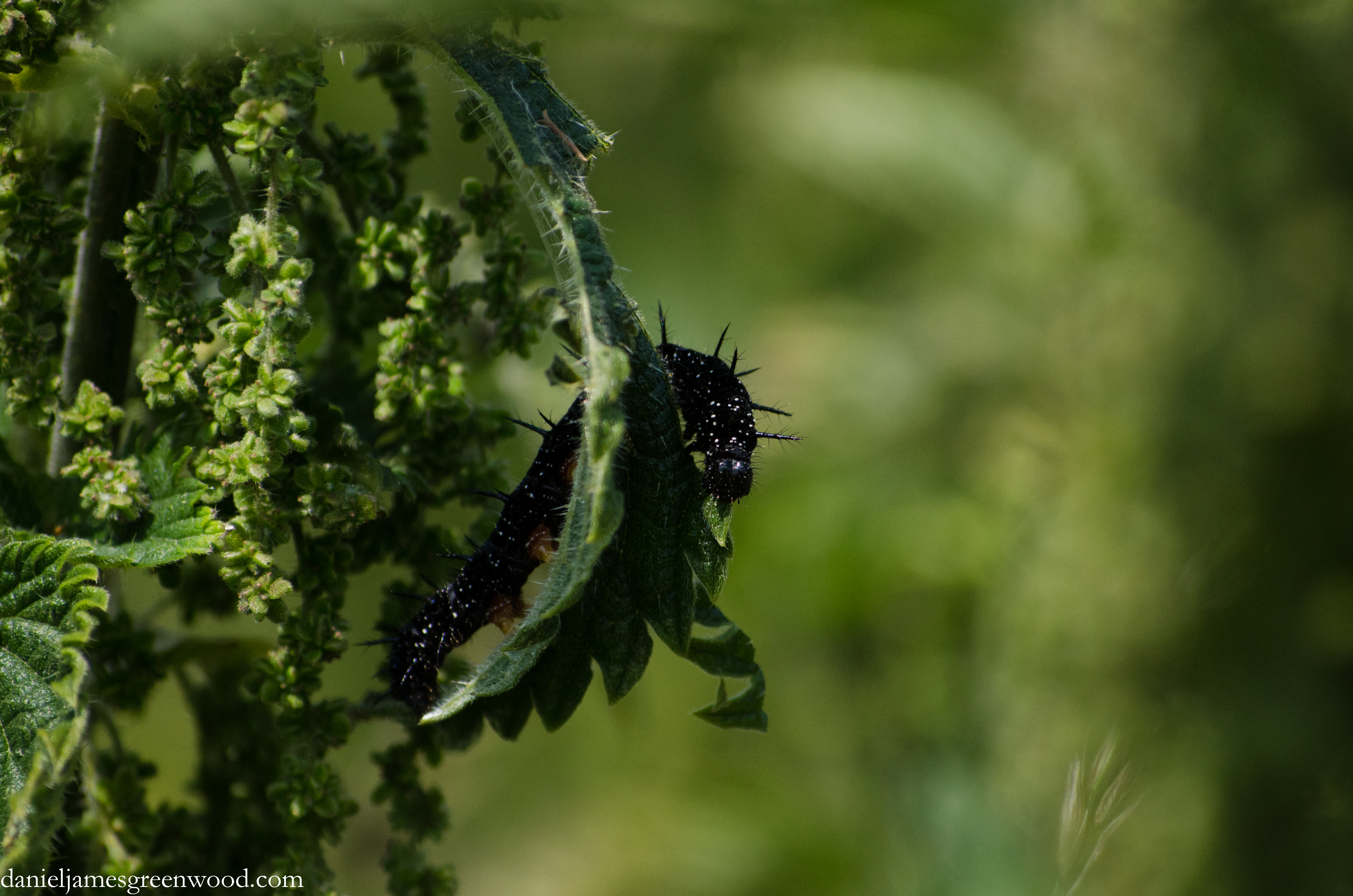
Ghostly day-flying moths spread at my every step through the long grass. Bumblebees forage on clovers, dropwort and yellow rattle, small heath butterflies appear again, two fly together, eager to fulfil their short lives with as much fornication as is possible. I cut back on to the path I know best. A chiffchaff sings in the hedgeline at the bottom of the hill, a single blackbird and a whitethroat, too. There’s no sign of spring’s willow warblers or their clutch of young. A crowd of peacock caterpillars munch through nettle leaves, leaving only the dreadlocks of flowers. A yellowhammer appears from across the lane, landing in a small hawthorn bush, its strong yellow plumage brighter than dandelions, a South American yellow, and at its brightest here. I take a few photos. Along with skylarks, this is a bird I have to travel to see, when once, before my time, you might have woken to it flocking in the hedges and fields.

Peackock caterpillar

Leaving the Downs I enter the chalky wooded hollows at the bottom of the slope, with tor grass growing along the track, an indicator of the calcareous soil. My sweat cools with the breeze that slips through here. In the dappled shade I scan the path edges for orchids, black bryony creeping out from the darkened hedges. And there it is: the fly orchid. I change lenses and struggle to get the image right, sweat dripping, bringing lotion down my face. But it’s beautiful to look at – a bit like a bumblebee pinned and proffered by the long spike, with its little eyes and short antennae. A family are passing behind the hedge, discussing how to control the dog.

‘She’s pulling me down into these weird places,’ says the mother.

‘Just let her off the lead, let her off the lead,’ the dad says.

They arrive on the path heading down hill. Their daughter warns the dog to stay with them. I only see the mother, she’s dressed in an apricot coloured dress and heeled shoes. She’s young and glamorous, so fitting with the array of flowers bursting from the hillside.

‘Who needs Box Hill when you can come here, eh?’ says the dad. They disappear down towards Happy Valley.

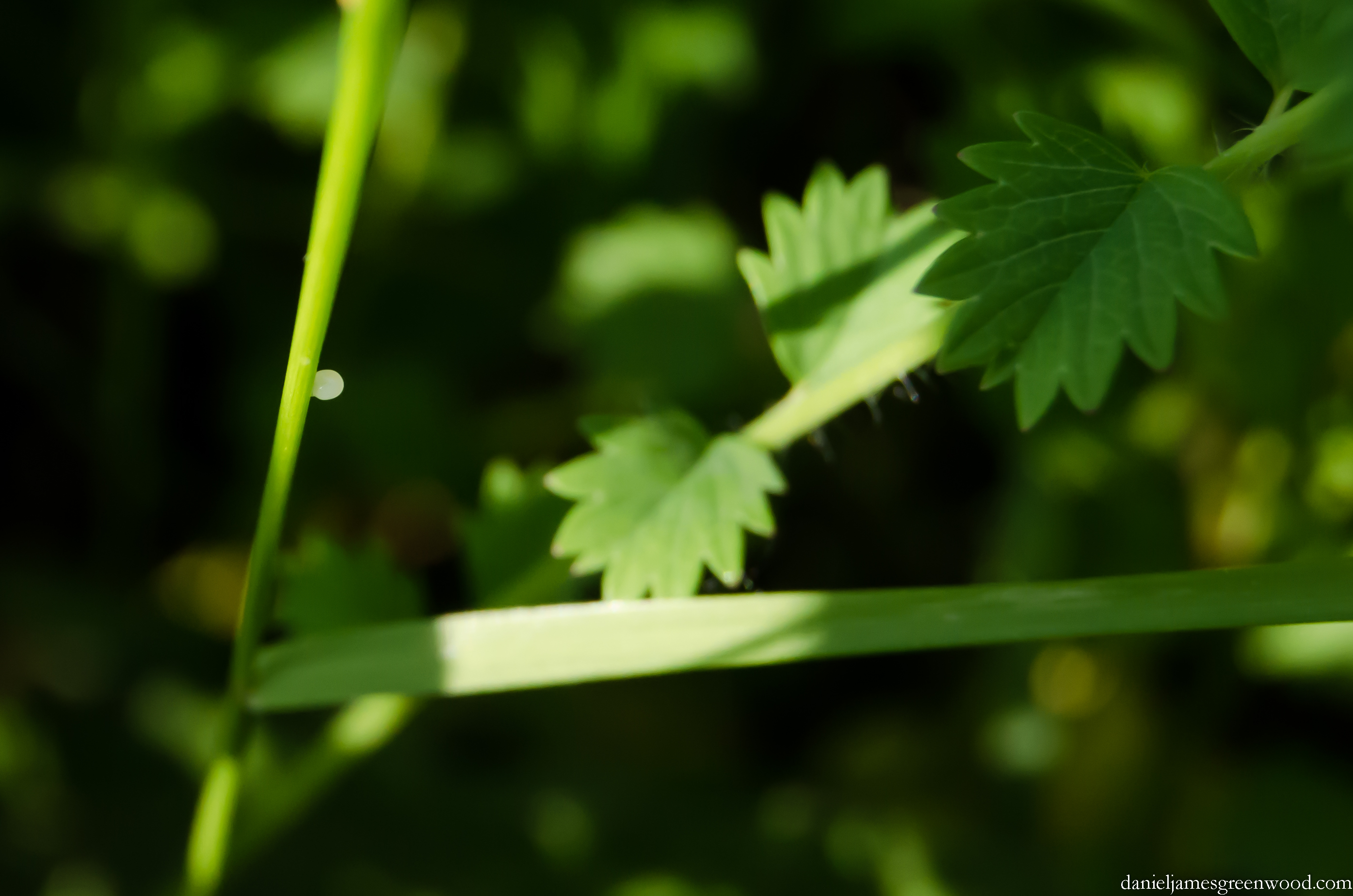
Speckled wood egg crop 1

I carry on along the ridge and settle on the desire line drawn down the hill and through the flowers. Ringlets move through the meadow, the first I’ve seen this year. They move at the same time and, stitched together, they are a tapestry of flickering wings. In my silence and stillness wildlife begins to move around me, perhaps more trusting. I see more plants now: twayblades, common spotted orchid, salad burnet, marjoram, ox eye daisy, rough hawkbit and bladder campion with its inflated, balloon like calyx-tubes. The wind blows through the trees. A speckled wood butterfly flaps about me, its wings audible as it hits my khaki shorts and leaf stalks. It clasps hold of a spear-like grass stem and curves its abdomen, laying a tiny pearl of an egg. This, for me, is something new.

Somewhere between the woods and the water

Image 2

First published on Caught by the River

The River Avon, Bristol, June 2013

I walk along the floating harbour in search of the woodlands I know are further downstream of the Avon, high above the city of Bristol. The harbour is a story of new developments in a variety of different colours and states. One sign by a small park warns of its private nature – no sunbathing, no dogs. Another building is skeletal, multi-storey car park-esque. It always makes me laugh how the images of what a development will look like become less a promise and more a threat when they’re in this half state – it will be finished. Together, these buildings are gently grotesque. The death of England’s once great ports is a boon to the property development industry. Just like in Liverpool and Manchester, old buildings which once provided lifelong employment and were a focus of global trade have become bars, shops, restaurants, apartments and offices, transient spots for the aspirational middle classes and upward to work, frolic and recover. But that’s not the whole story. There’s a revolt against the tidying, the ornamental planting, the exclusivity and boredom. At the water’s edge is red valerian, a Mediterranean flower that has escaped into walls and pavements across England and grows here in the cracks between the stone where daisies also blush pink. Together these plants are the punks of the gentrified waterside, the Pussy Riot of the floating harbour. I clench my fist and salute these wildflowers.

Image

The Avon bends north and in the distance I see the mighty Clifton suspension bridge bursting from the wooded limestone cliffs. But I’m getting lost on my map in trying to locate the path to Leigh Woods, confused by the A370’s spaghetti junction. I cross a footbridge and then a few roads and find the river itself, a prehistoric mud swamp that’s brown in its entirety. Gulls are making prints, lesser black backs, herring and common gulls, they rule this city totally. When I opened the door to the room where we’re staying I looked out of the window and met the fierce eye of a gull. I cross a bridge plastered with posters protesting against plans for buses to pass through. Gulls below see me and act a little tentative – I wonder if they get any trouble from people up here, in this well hidden spot, maybe kids with air rifles. Parkland opens up, the suspension bridge now clear, I aim for the trees. The Avon and I both flow in the same direction. The wheel of a trolley reaches from beneath the mud, as does a traffic cone and a road sign, fragments of a world of transport now mired. I pass underneath the bridge and its black strip across the sky catches in my vision through the leaves of the trees. Up ahead comes a left turning and the entrance into Leigh Woods.

Clifton suspension bridge CBTR

The path appears carved from the gorge. The banks are denuded of trees, covered in hartstongue fern, panting as they soak up the light. The path is steep and wild, riddled with chunks of the limestone that defines this landscape. The slopes become more wooded as I climb, hazels grow amidst single ash trees, with a good number of wych elm and some oak. A chiffchaff sings somewhere, as does a blackbird, a song thrush pipes its beginnings. A month ago there would have been much more, but the breeding season is beginning to take its toll on the songbirds, they are growing quiet. That said, a moment of rest and silence brings more songs: the aborted music of a coal tit, a robin squeezing its thin medley out through the thicketed scrub of young trees. A trio of East European students pass me where I sit, a young woman speaking pointedly. They don’t notice me, so involved in their conversation. The Poles I know all speak in their native tongue with such passion, you’d think their world was at stake.

Image 3

I happen upon a settlement that the interpretation board renders some 2300 years old. The banks were perfect for the defence of the river. I walk along the ridge lit by red campion and struggle to imagine the scene. Farther over on the other side I find the first common spotted orchids of my summer, taking them by the throats with the tips of my thumb and finger.

Back amongst trees, the wind blows through and I notice the rumble of the city, the searing sound of cars around the River Avon. I wonder how the hunter gatherers would have lived in dense woods like these. People today are enlivened and stressed by the proximity of others, as well as their distance. The woodland peoples, before they began exploiting the clearings at the edges will undoubtedly have been driven by a fear of wolves and bears, creatures that were made extinct in England. I ask two ladies and their dog in passing if they know how to get back onto the riverside and they shrug, they don’t know: ‘I think you just have to find a slope and go for it.’

I head on down a side track and the limestone rocks return, cutting out a steep, rugged path into the wooded hillside. At the end there’s some light, colours move across the gap. I’ve found the edge. The view opens out and the murmurings of vertigo appear with the river, the road and the gorge. It is a bizarre and beautiful sight. An oak is dead and beheaded above me on the precipice, how frightening for the woodlander who had to cut that off. Slick ferns grown from its mossy trunk like attempts at wings and feathers. The track isn’t at an end here and so I sense an exit. On the way down it crumbles under foot and so I’m thankful for the fistfuls of hawthorn wood that I can hold as I descend. And as I do I think of the settlers rushing to defend their land from an invasion on the Avon, flying down to the river with spears, arrows and other weaponry to hand. You see, I only have a camera and binoculars. I live in the age of observation.

© Daniel James Greenwood 2013

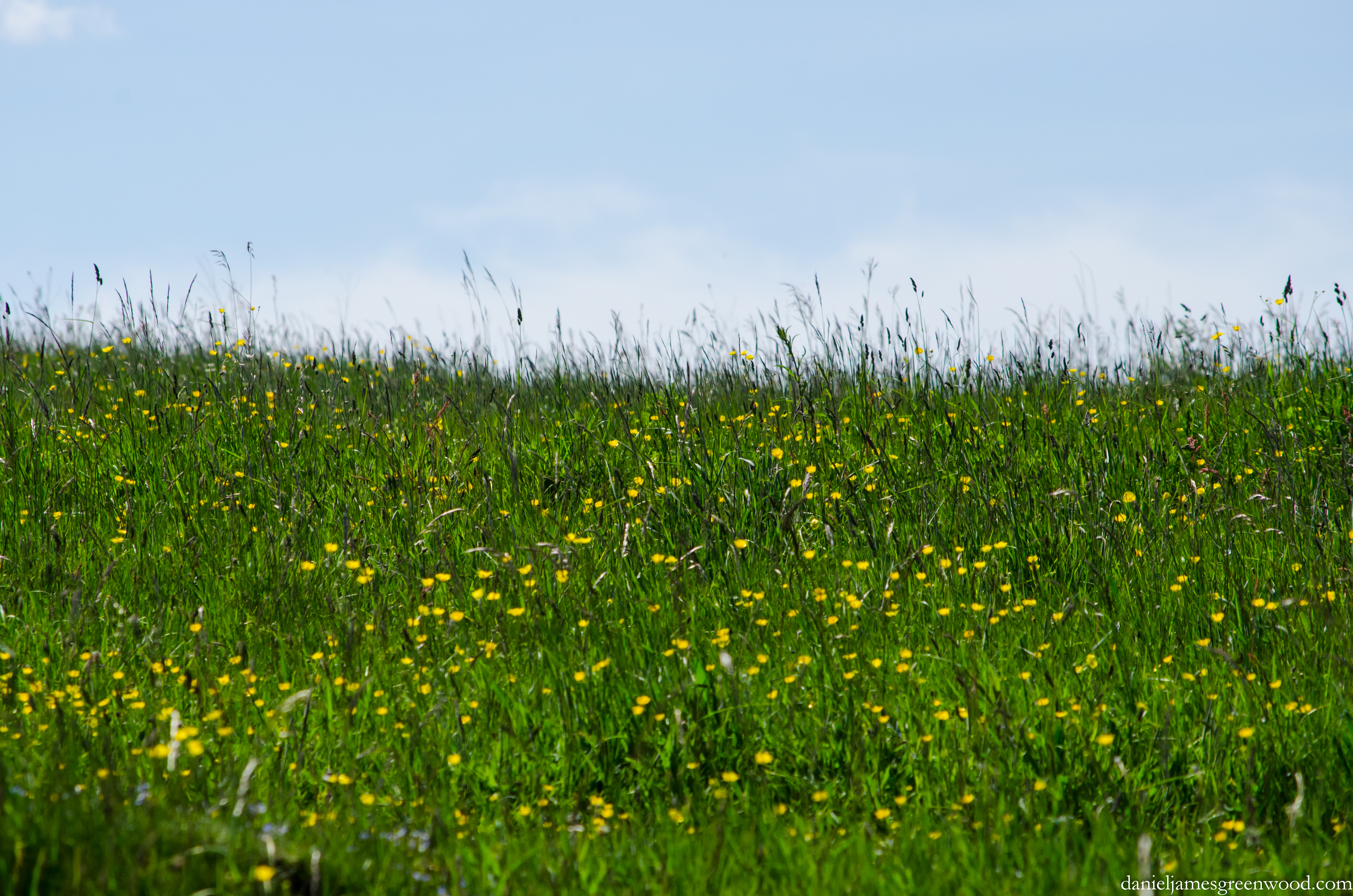
A profusion of buttercups

Meadow buttercups
Meadow buttercup

Farthing Downs, London, June 2013

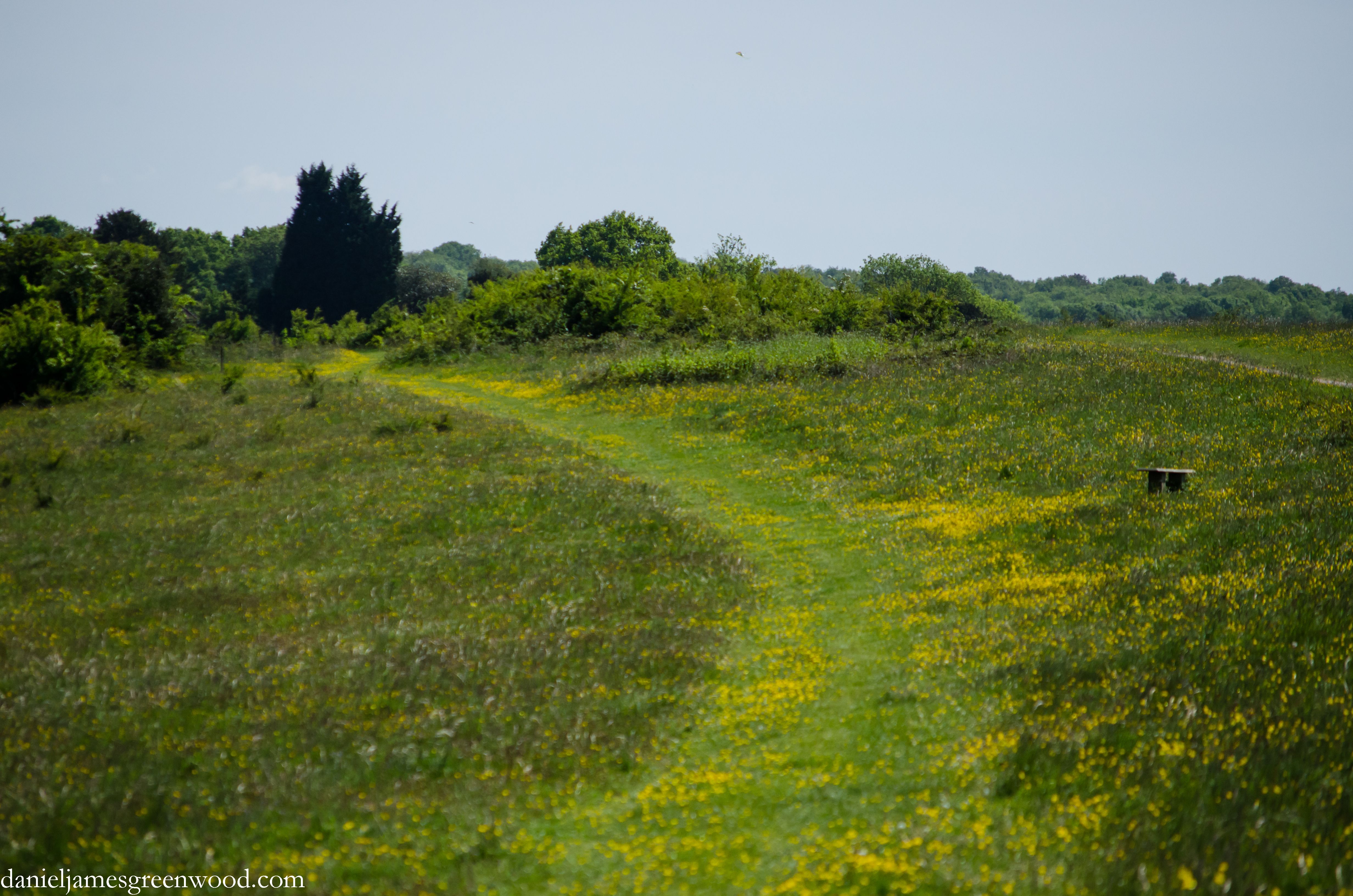
Stepping on to the Downs, a marked change has taken place in the two weeks since I’ve been here. The grass has lost its wintry edge and there grows a profusion of meadow buttercups. On the woody margins white butterflies steer themselves through the day, the slight of a cool breeze will no doubt register with them. A man is sitting on a bench taking pronounced drags from a spliff. I imagine ushering him to the gate as does someone wanting to be in a room alone. What is that link with landscape and human solitude.

A holly blue flutters about in a restless fashion, unwilling to perch, itself ushering me away, perhaps. I take the hint. The jackdaws are still here, so faithful to this place, much more so than me. This is why wildlife is so deserving of the land, perhaps more so than we. It doesn’t have a choice. Last time I watched them in a snowy sky but now they move through the ankle high wildflowers like shadows. They call out and burst free into the air when I enter into their field of vision.

Willow warbler crop 1
Willow warbler

I walk into the scrubby chunk of woodland that the path cuts through. I am struck by the change, the green, the lividness of the living. A woody, leafless hawthorn reminds me that both states remain all year round. Chiffchaffs are calling to each other up ahead, followed by the only slightly different voice of a willow warbler, a bird almost identical to the others. I sit in the shade on the edge of the path and listen. A willow warbler appears from the bush and lands on the branch of a young hazel tree. It has some insects in its bill and it whistles incessantly, huuu-eet. I take a picture and sit still. After a short wait a green woodpecker yaffles and the willow warbler dives into the long grass and bramble. Two weeks ago this bird did the same but without food in its bill. Now it’s feeding silent young down there in the thorns and tussocks. A couple pass me where I sit.

‘Are you looking for a lesser spotted whatever-it-is?’ the lady asks.

I explain the situation, pleased they don’t think I’m up to no good. Her partner turns to me: ‘I know you.’

‘And I know you.’

We remind ourselves of when and where from. We both agree things have improved since then. They leave happily, I get up and carry on through Farthing Downs.

Farthing Downs in June 1
Farthing Downs

The year’s first brood of small heath butterflies have hatched on the Downs. A pair rest on separate patches of bare soil created by livestock, conducting the heat of the sun. They live as adults for as little as seven days and I admire their freedom, their lolling and landing, they circle me, perhaps jittery when I move but not much bothered. They are orange smudges against the green downland. I sit with them. A soldier beetle clambers up a blade of grass and wrestles with its own weight, a clumsy, dim creature, it straddles the seed head, whirs its antennae and unleashes its wings from its black backpack, struggling into the air.

Soldier beetle
Soldier beetle

Chasing butterflies down stairs in Italy

Positano
Forest fire above Positano

Positano, Italy, September 2011

I’m sitting out on the terrace of the pensione, complaining aloud in the full sun. Last night I’d peered over the ledge at the lemon and olive trees, the tiled terraces and bright white roofs. The faint voice of a thrush had caught my ear, and the familiar dark, scuttling figure of a blackbird darted across a building about twenty-five-feet below. But there was something unusual about the blackbird. The light was low and so darker tones fell to black. However, this was not a wholly black bird and I entertained the thought – could it be a blue rock thrush? I was unprepared for it, so unrefined is my knowledge of anything non-British and unfamiliar. From the viewpoint of our pensione, the houses, hotels, gardens and restaurants, immaculately packed together, are built like steps to the sky with the sweeping curve of the only road in the town cutting through them, linking Positano to Naples and Sorrento to the north and Amalfi in the south. Above all this stands dry, steep and rocky mountains with deep green woodlands below the peaks. Helicopters are taking turns to pour water from the ocean onto a forest fire that has erupted in the southern peaks. It has been going on all night, the choppers roaring, their sound unbearably loud in this mid-30 degree heat. On the terrace I watch the heat rise as the morning nears noon, the choppers ferrying water from ocean to mountain. From beneath me a butterfly emerges, and it’s the beast of European butterflies, the swallowtail, flitting between the railings like a twenty-pound note.

*

Having had the shadow of a swallowtail pass over me, down into the depths of the gardens where the mystery bird had scampered, I decide to investigate its flight path. I’m here for my uncle’s wedding. It’s a big family holiday and so I have relatives scattered around all corners of the town. Had they all been ornithologists or lepidopterists things might be easier for me. There’s the rumour of a path or set of stairs that runs for nearly half a mile from our pensione down to the beach. My uncle, the groom, tried it and nearly died, apparently. My sister, fresh from travels in India, walked it the other day and says there are ‘loads of butterflies’. She mentioned colours which don’t even appear in my rubbish field guide. The image in my mind is of clouds of blues dancing amid the nu-rave hue of Mediterranean wildflowers.

Wall lizard

The temperature touches 35 degrees by 2 or 3pm, and so it becomes a time of hibernation. It feels too hot even to think, to speak. The steps down to the beach, some 400 or so, begin by a chapel outside the pensione. A black priest enters through the old wooden doors, sending an SMS with his mobile as he walks, never looking up. The stairs aren’t uniform, they dip and swerve, the height of an individual slab varying and inducing vertiginous feelings. Streaming between old, old walls the path echoes with the slap of thin, rubbery footwear and suddenly a burst of pink lanterns, bougainvillea flowers which are so evident, climbing across the blistering walls of Positano. It’s September so some are turning to seed, they appear tea-stained. The stairs descend past the front doors of people’s houses and iron gates which offer tantalising visions of Italian ornamental gardens. On the rough surface of the waist high walls either side, lizards rest and escape. They give themselves away quite easily – the sound of brittle leaves dislodged in the cavity of a wall, by neither wind nor gravity. Ants channel the iron handrails. The sun is so hot and so high, my legs tremble when I look up.

The steps snake round and flatten into a slope, I sit down in the shade of an olive tree and waft my hat about my face. A woman and a young man, probably her son, are climbing up the steps. She is visibly sweating, I smile at her and attempt a universal gesture for overheating. She’s a typical Italian mama, portly with dark hair and a cloth dress. She’s out of breath and looks at me like the stranger that I am. A man is watering his garden behind the iron railings. I sit and wait for butterflies. The olive trees pool at their bases, as if they’ve been melted by the sun. The larger oliver groves have nets tied around their trunks, ready to be rolled out in season to catch the falling fruit. It’s not time yet. In the sun of the path’s slope, a lemon tree dangles over from a garden, plump with yellow fruits. Great umbrellas of fennel grow on the perilous bank beyond the wall and a white butterfly lands to feed on one plant. I photograph it and zoom in on the crop. Positano is home to white butterflies as London is to pigeons, mostly the small white, Europe’s most common butterfly. The one I’ve pictured isn’t a small white, however. It has dark markings on the wings, a little like a marbled white, but more like a bath white. In my head I swiftly establish this perilous walkway as Positano’s first wildlife conservation area. Peering over the wall at the olives and dry grasses, there is the usual sign of plastic bottles and bags discarded. This, however, doesn’t compare with the crap around Naples airport.

Positano's first wildlife conservation corridor/stairwell
Positano’s first wildlife conservation corridor/stairwell

The heat is getting too much for me, I glance at the steep steps back up to the hotel. I let in the murmurings of hot panic. From the lemon tree garden the gigantic shape of a swallowtail soars down onto the path and over the wall, just like it passed over our terrace. I rush out to try and get a photo but it’s too quick and I’m too far from it. Against the rocky wall a brimstone glides, a flash of orange on its outer wing. This is no normal brimstone. I look at my field guide. It’s Cleopatra’s. The sun pulsates. I dive back into the shade. The Mediterranean glimmers blue in between the olive branches holding ripening fruits, Tunisia and Algeria beyond the horizon. People have been passing me, comfortable with the sun rays, on their way down to the beach. It’s 1:30pm, the hottest part of the day. I guzzle from my water bottle and make my way back up the steps to hide.

© Daniel James Greenwood 2013

Essay: In south London, a place reclaimed by weeds

Dartford Crossing

As featured in The Earthlines Review:

Crystal Palace, London, March 2013

It’s 6:30 am. We’re strolling along the Crystal Palace ridge, a chunk of wild land made up of all kinds of plants, a few notorious for their invasive, disruptive nature. Bramble and nettle are frost-encrusted, brightened as the ice turns to dew in the occasional spillage of sunlight that greets us from the south. When it does appear we bathe in it like a gift from the gods, droning as maybe druids would. The willow catkins are clean through now, many dew-laden, droplets elongating as gravity weighs. Last spring we listened to the call of a lesser whitethroat as it dinked in and out of these willows, its common cousin, the whitethroat, performed mating rituals in a bower of buddleia, diving into the cover of bramble at the farthest tip of the palace’s former standing, now marked by a solitary white bracket. Buddleia grows on the ridge in large sprigs, still harbouring last year’s brown cones of flowers that will be purple in a few months. Elder leaves escape their buds a little early in this still wintry weather, green sleeves unfurled but perhaps thinking the better of it. The mutilated stalks of Japanese knotweed are the only signs of intervention but for discarded beer cans and a few muddy desire lines. The scene is punctuated by crows sat idly in birch and sycamore trees that have grown in the cracks of the palace’s old stairways, immortalised in stone. These walkways, presided over by headless statues and sphinxes, are now engulfed by green and yellow lichens. As for the living, we aren’t the only people visiting: dog walkers, joggers, cyclists, commuters all make their passes before us. A dog with a stick in its mouth accosts us out of curiosity as we regard a song thrush singing in an ash tree, the dog turning its head and smacking fellow birdwatcher Lisa on the back of her leg. It seemed to hurt.

The view below is of open parkland where crows and black headed gulls saunter, pulling worms from the always waterlogged ground. Every so often the crows leave their perches in the palace’s trees, returning a few minutes later with large morsels of white bread in their bills. It’s almost impossible to see if a bird returns to its perch, such is their uniform blackness. This is the highest point in south London, higher still is the television mast that reaches upwards into the sky. Last year we watched a peregrine falcon using the mast’s very top as a perch, a pair of sparrowhawks coasted from even higher. The memory brings vertiginous feelings. The view is south to the North Downs, the Dartford Crossing to the east, visible in the orange morning sky. Chimneys and flues are blowing white smoke up into the air, beyond the Crystal Palace athletics stadium, a site that without the development of the Olympic Stadium in east London would be England’s national athletics arena. Unbeknownst to most, a long distance marathon has taken place here for millennia. Migrant birds have historically chosen the Crystal Palace ridge as a spot to drop in on, with swallow, redstart, willow warbler, chiffchaff, blackcap, whitethroat and wheatear having been recorded in recent years.

Long tailed tit

The Crystal Palace’s relocation to Penge from its original siting at Hyde Park was completed in 1854 and caused a global stir, attracting visitors from all over. The Crystal Palace High Level railway was built to serve the palace, a trainline which has now been reclaimed by nature in the form of Sydenham Hill Wood, Brenchley Gardens and the Horniman Nature Trail. The Crystal Palace burnt down in 1936 and the trainline was closed in 1954, leaving a footprint of paths interrupted by housing estates at the ghosts of Lordship Lane and Upper Sydenham stations. Train tunnels were built underneath roads and excavated through the ancient Dulwich and Penge woodlands, now home to bats like the brown long-eared. Go back a few hundred years and Crystal Palace would be entirely different, even further than its enclosure as Penge Place in the early 1800s, and its original incarnation as Penge Common. Penge translates from the Gaelic as ‘the end of the wood’, a wood that was known as The Great North Wood, a landscape of commons and coppices that stretched from Deptford to Selhurst. It was deemed ‘North’ because it was the great wood north of Croydon, a thriving market town. Locals from the surrounds would make trips here to Penge Common to listen to nightingales, a bird that has disappeared from the area, and is suffering similarly staggering declines nationally.

Perhaps there is some irony in the fact that Crystal Palace fills me with a sense of nostalgia, for the Arcadian past of Penge and the Great North Wood. It’s an emotion that the Victorians made their own as a visit to nearby Dulwich Upper Wood and Sydenham Hill Wood proves. The Victorian villas built along the Sydenham Hill ridge are now gone, their footprints straddled by regenerating hornbeam, oak and new woodlands of sycamore and ash sprouting from the basements, as well as the invasive laurel and rhododendron planted in their gardens. At Sydenham Hill Wood a small folly remains, a remnant of the Sydenham Hoo and a feature of its vast ornamental garden. There’s a picture on the Internet that shows this very garden, with a small shrubby evergreen which now stands as a mature cedar of Lebanon. I share Victorian nostalgia instead for a world that much of their development denuded. The Crystal Palace brought unprecedented change to the Great North Wood. But then there are records from the time of the Crystal Palace High Level railway suggesting that in the immediate aftermath of the development birdlife still thrived. Bullfinch, tree pipit, wryneck, spotted flycatcher and wood warbler were all known to nest in the area, and some locals will point to the fact that bullfinch and spotted flycatcher only stopped breeding in the area in the late twentieth century following a national trend. In the grounds of the palace tree pipit and hawfinch were breeding birds, the latter thought to have bred in Sydenham Hill and Dulwich Woods until the 1980s. What concerns me about the run off from the Crystal Palace’s legacy is how the ridge will be treated in the next 100 years.

Stadium and tree (2)

There is a masterplan to redevelop Crystal Palace Park and bring the ridge into the same aesthetic bracket as the lake and waterfall features that remain from Joseph Paxton’s pleasure gardens down at the bottom end of the park. In previous decades there were proposals for a casino and other grandiose leisure complexes which have disappeared from the agenda due to public opposition and lack of funds. Some of the park, registered as Metropolitan Open Land, is being earmarked for the development of apartments, a decision upheld by the High Court in June 2012, to the grave disappointment of the Open Spaces Society, the Crystal Palace Community Association and London Wildlife Trust. What makes the Crystal Palace ridge unique is the lesson it can teach us about our design, about what truly lasts. The Crystal Palace was a grand and ambitious venture but like the villas painted across the Sydenham Hill ridge a mile away, it was too grand to last. Looking here at giant stone stairwells with pioneer woodland trees like birch and sycamore escaping from the cracks, headless statues reawakened by the figure of a perching crow, and the only remnant of the palace’s outer shell sitting alone on the wildflower-enveloped ridge, the feeling is not one of defeat. Over on the grass banks of Crystal Palace Parade where buses terminate and begin journeys to places like Elephant and Castle and Blackheath, a line of plane trees was planted to signify the footprint of the old palace. The masterplan includes proposals to plant a new tree palace along the ridge and to landscape it. If this is handled without due care and consideration, it could lead to the loss of good, wild habitat home to breeding song thrush, dunnock, blackcap, chiffchaff and whitethroat amongst all the other wild plants and creatures thriving in a space where wildlife has been allowed to thrive without much intervention. The palace has grown back in its own way, in the birch and sycamore palace escaping from the cracks in the steps, yet to reach the old palace’s heights. In truth, I wonder why we are so desperate to master the land, to make a statement of it. There is more pleasure in observing the movements of wild birds each spring, in listening to their songs, than in attempting to control them. I hope there comes a point where we can step back and allow the land to recover from our past mistakes. For us birdwatchers it will be a case of watching, listening and waiting.

Essay: Why do people hate ivy?

Ivy leaf

I remember when I first became interested in woodland. Through my lack of knowledge and understanding I thought ivy was a tree-killing force that scaled a trunk like a cancer and had no other purpose. I looked at the fat stalks of ivy growing on a poplar in a nearby park and thought it might be an idea to cut them. In my local area there are people who go around doing just that.

The fact is that ivy is fantastic for wildlife. When ivy grows up the front of a house and sparrows are nearby they’ll use it. Blackcaps, one of my favourite songbirds, nest in it. Entire bat colonies can roost in it. Hoverflies, bees, butterflies, they all use it for different means, be it a leaf to perch on or flowers to drink nectar from. Walking in Crystal Palace Park recently I was passed by a man remarking to his friend about a line of trees with ivy growing up them:

‘Look at those trees,’ he said, his companion turning to look. ‘The ivy grows up them and just kills them off. I’m thinking of writing a letter.’

This is one of the biggest misunderstandings about ivy – it is not merely some dark demon from a tree-hating underworld, it flowers, too. In fact, the main reason it is even anywhere near a tree is because a songbird or woodpigeon has sat in the tree and evacuated its seed. It produces food eaten by a good number of birds and attracts insects that birds can feed to their babies. Beautiful and exciting birds like firecrests target it for food and shelter in winter when they pass through parts of the British Isles.

A tree brought down in a wood will give life to wildflowers and wake some that have lain dormant in the soil

Ivy does add extra weight to a tree and, in some cases, can weigh a tree down making it more liable to windblow during a storm. But the issue isn’t with the ivy it’s with us, Homo sapiens. In woodlands, it is completely natural for a tree to fall down, it’s good. The new light that will hit the woodland floor will improve the structural diversity, particularly in British woodlands that, since the Second World War, have gone largely unmanaged and have become overgrown as our economy has grown to rely more and more on imported materials.

A tree brought down in a wood will give life to wildflowers and wake some that have lain dormant in the soil, unable to flower because of the previous tree’s leaf shade. In the street, however, a fallen tree could mean death, damages and lawsuits. For all our love of woodlands and forests, perhaps the sight of new woodland is something that kindles a deep fear inside us, as if the open land is being overtaken, changing at a pace and in a manner that we’re uncomfortable with. Personally I find woodland reclaiming old developments and ‘wastelands’ as something to feel good about. It tells me the world can function without our intervention and can recover. Nature can make even the most barren place into a leafy oasis given time.

The chap I overheard in Crystal Palace later remarked on a c.200-year-old horse chestnut standing tall and true, though surrounded by ground dwelling ivy. If he had seen a horse chestnut wounded by blight, a disease spreading through global trade, might he have turned his ire on Environment Minister Owen Paterson for not tightening restrictions on imports? In the case of the healthy, happy horse chestnut, does it not suggest that what we love (or this man at least) is the splendour of individual trees, their maturity, their completeness. The common understanding of nature’s life cycle is a single sapling to a mature tree, without any notion of the stuff that might happen in between, the decay and lost limbs, all part of the picture. After a recent trip to the decidedly untidy West of Ireland, I read this quote from Oliver Cromwell on the state of the Irish landscape in Neil Hegarty’s The Story of Ireland:

‘For to what purpose was it to plow or sow, where there was little or no Prospect of reaping? – To improve where the Tenant had no Property? This universal Neglect of Husbandry covered the Face of the Kingdoms with thickets of Woods and Briars; and with those Vast extended Boggs, which are not natural but only the Excrescences and Scabs of the Body, occasioned by Uncleanliness and Sloth.’ (Page 136).

Cromwell couldn’t have been more wrong, though his rhetoric is plainly political. Those Irish ‘Boggs’ are one of the planet’s many ways of storing carbon dioxide emitted by the felling of woodlands (which thanks to the English has occurred in Scotland and Ireland through centuries of invasion and land grab) and is something we as a species are scrambling to mimic. Today we look at those bogs with a greater understanding, if not thanks. In County Mayo some are being turned into reserves, home to merlin, otter and grouse. But the main thing here has been capitalised by Cromwell’s old English: Neglect.

People get angry and feel they’re being forgotten when their grass isn’t cut by the council, when the neighbour hasn’t trimmed the hedge on their side, when the ivy suffocating those trees hasn’t been cut. Often these are measures to boost bee numbers and reinstate lost habitat for birds and bats. In England, if we are to help bees, birds and butterflies, we need to address our obsession with tidiness. In the natural world it does not equal good hygiene or ‘Cleanliness’, an untidy garden means more birds, more bees and more butterflies.

In Cromwell’s case it was the language of war, a debasing of another country and culture, rather than a comment on wildlife gardening. I don’t think it’s far off, mind you. If we are to overcome our uneasiness about ivy and trees we’ll need to loosen our grip, leave the mower in the shed one year and look at the benefits of the plant, the good it does for wildlife in these most ecologically trying of times. I like to think my original, misguided concern for trees came from a good place and has developed into something more reasonable having taken time to consider the bigger picture of the natural world.

The mysteries of the night wood remain

Wood anemone

Last year I was commissioned to write this piece about the four seasons in Sydenham Hill Wood. Woodlands are beautiful, yes, but the lives of their inhabitants are not as gentle or pleasant as we might like to think. Here are my four dispatches.

Spring

Along the trackbed of the disused railway wild garlic grows. It’s a remnant of the wood’s ancient lineage, its deep green is welcome refreshment on a grey spring afternoon such as this. Every so often you find other indicators of the wood’s age. Wood anemone are growing in isolated clumps and English bluebells, too, some hybridising with the Spanish garden variety. The hornbeam standing along the track is another pointer to the old age of Sydenham Hill Wood.

Above our heads is another species sure to have been breeding here for some time. There are three tawny owl chicks sitting in the top of a large ash tree not yet in leaf, and through the bare branches we have a clear view of them. They snuggle into their plump, downy coat of feathers, calling to their parents, with rasping voices you might not expect them to make.

The wood’s bird community is watching, not least because the tawny owls are the top predator in the wood and one of the chicks’ parents is nearby trying to make a kill. Last week we found a crow’s head by the pond and it now appears likely that the adult tawny that spawned the trio above is the culprit. The birds know it too: there is an anxious din of woodland birds – woodpecker, crow, robin, great tit, blue tit, ring-necked parakeet, nuthatch – as the rufous adult tawny emerges from its hiding place.

The chicks are further along than expected, they move one at a time over our heads and closer to mum or dad, their spread of primary wing feathers giving them a tactile appearance, each like a finger. The parakeets are the most successful in bothering the young owls as they shriek and dive around them, the vibrancy of these exotically coloured birds muted by the task, on a dour afternoon in the spring wood.

Summer

The leaves of trees under torchlight are sticky with honeydew, a little like our faces, damp with sweat and bothered by mosquitoes. I swat them away.  The wood is perspiring, wet with aphids. The air is thick with the funk of wild garlic that has flowered and gone. Stars are appearing in the ocean of night sky. A dot of light moves across the expanse. Is it a satellite?

A male tawny owl calls from acres away. We blow through a hazel whistle carved in a fashion to mimic the owl, and the bird itself responds in kind, edging closer and closer to us after each play of the whistle, its voice becoming clearer: What’s the time Mr. Owl? Now there is no foliage between us and anxiety stirs. We decide it’s better to stop in case the tawny thinks we’re another male. They are renowned for their aggression in protecting territory.

With the wood under the spell of darkness, the industrial world is reduced to a dreamy wash. Beyond the lining of trees could be an endless wildwood or an open pasture – the imagination runs free in the absence of engines and electric light. Some centuries ago the old woodland was felled and turned into farmland that skylarks, corn bunting, lapwing, turtle dove and cuckoo would have colonised. These birds are now absent from land that is used for cricket, golf and rugby.

From the glade’s sleeping bed of rosebay willowherb the great ghost of a hawkmoth ascends. I swoop the child’s pond-dipping net I am holding towards the monstrous insect, bringing the net and my knees to the ground. I carefully peel it away from the grass, revealing only shadows. The mysteries of the night wood remain.

Autumn

We’re sitting around the moth trap again tonight. A large flock of crows are returning to a roost in the direction of Dulwich Park. There’s something about vast movements of crows, it gives the sense of an ending. In old times this would have been the signal to down tools at the close of a day labouring, ‘when the crow flies’, as they used to say.

The insect numbers have visibly dropped since summer but the pipistrelle bat hunting just above our heads shows there must be enough for them to eat. The twilight is metallic blue, stars are lanterns in the sky untouched by trees.

We’re surrounded by oak woodland, with smatterings of birch, ash, willow and hornbeam. We can only hope the darkening wood conjures something beautiful for us to behold. The leaves around us are soon to fall and even in this fading light you can sense the change, nature exhausted after the sex of spring and summer’s heat. A hobby flies the same path as the bat, catching a moth in midair.

Night falls. Nocturnal mammals begin their movement through the leaf litter, their sound much bigger than they actually are. A moth has been drawn to the bulb of our moth trap and we retrieve it in a clear plastic pot. It’s medium-sized, purple and mustard in colour. It’s the barred-sallow. This moth has evolved to match the leaves of autumn, but it’s early, many of the trees are still verdant green. We release the insect and it disappears into the dark.

Winter

A slender pathway cuts through the ground layer of ivy, most likely to have been forged by a train of foxes. A large ash has been pulled down by the wind, the underside of the ivy leaves wrapped around it are a fresh colour, like the flesh of a lime fruit. To the side a den has been made with string tied to the rotting logs that rest against a tree in a tepee form. Sometimes people spend a night in the wood and so the sign of a tent or den surrounded by food packaging and drinks bottles is not unusual. There isn’t much litter to be found tonight, other than things the ivy has subsumed, bottles or cans taken in by the soil or blown over from the road. Spiders make a home for themselves in empty bottles and the woodlouse is a common inhabitant of an old shoe. Now the leaves of premature bluebells peek through the earth and we take care not to trample.

We come upon a clearing around a large yew tree, the soil cleared of ivy and plant life by the acidity and shading of the tree’s needles. The trunk is rippled and worn like an old doll’s limb. It’s one of a line of yews that would have been a hedge in the grand Victorian garden that was once here. The villas were built in the 1800s, but too grandiose to last, they were abandoned during the Second World War and, deemed unsafe, were eventually bulldozed into the earth. The ground dips to reveal the whitish bricks of a wall and a trail of broken glass. Behind us is a group of silver birch trees, quarantined amidst layers of ivy and the yew. These birch look like they’re waiting for something.

The other side of the wall shows a support structure for the terrace of the old Victorian villa, where the slow life of the woodland has been allowed to resume. A blackbird calls in the canopy and a great tit sings its winter song down in the woodland glade. The sun is setting low through the slope of trees. It’s time to go home.

The silence overcomes us

Loch Garten

– Loch Garten, Scotland, November 2012

Bar a few cars passing us on the approach road there is no one here. And but for the track itself, the birch, heather and lichen covered Scot’s pine exude a sense of ancient wilderness. There are no human trails through the heather and soggy mounds of moss, only a few signs of other mammals escaping into the wilder regions. Some odourless spraint we discover at our feet intrigues us: pine marten, otter? I don’t know. A bit further back, we watched a red squirrel hug the trunk of a pine, climbing a branch higher as we took steps closer. The images we’re fed in England of confiding creatures doesn’t match the shy nature of these Scottish animals.

The sound of chainsaws is moaning, unending. It may be work that will help these famously mistreated woodlands, cleared with such fervour by the English, but the noise is irritating. We turn into Loch Garten and our minds to the capercaillie, a member of the grouse family which is renowned for the defence of its territory to all comers. Our host in Aviemore showed us a photograph in the guesthouse lobby of a celebrity capercaillie that entertained the masses in the 1990s. Anyone who passed the field bordering the bird’s pinewood territory would be met with a fanfare of its black tail feathers, not unlike a peacock. The framed photograph in the lobby showed that the bird lacked a tail feather. This led to uproar locally – someone’s dog had attached the bird and it had lost its feather. That, however, proved to be untrue. A local farmer had put out feed for his horse in the field next to the capercaillie’s dwelling, and the bird had begun to join the horse for dinner. Eventually, the horse grew tired of the charismatic grouse eating its food and bit it on the arse. Mystery solved. There is no chance of us witnessing such scenes today at Loch Garten.

But what’s to be enjoyed in the absence of the Cairngorms’ other celebrity birds, the ospreys that travel here from Africa to breed? The Loch itself. The roots of mature pines spread freely from the soil as the opening of the Loch appears before us: the gentle movement of its surface, the image of Craiggowrie in the distance, the silence overcomes us. How peculiar that silence can feel louder than chainsaws. Nan Shepherd wrote about it up in the mountains but here it is lapping on the water at just a few hundred feet. The movement of the water’s edge does not end there, it moves across the sandy soil, into the pine forest, rippling through me. From the bordering pine forest comes the cheerful trill of a crested tit, it sounds like the only thing on earth. The pines on the waterfront have beard lichens snagged in in their branches, so much like the facial hair of miniature woodland elders, dark green and bright blue. The gnarled dead wood of the pine holds their ghastly expressions. We turn on our heels and head for the depths of Abernethy Forest.

Even under snow

Even under snow

Featured on The New Nature

– Farthing Downs & New Hill, London, February 2013

Snow covers the Downs. From the town comes the agitated clamour of traffic and, somewhere, the eagerness of a chainsaw. The layer of snow is fresh, renewed by flakes heavier out here on London’s periphery. Beneath my feet the seeds of field scabious, knapweed, yellow rattle and marjoram wait for the thaw, warm in the soil. Just as winter’s onslaught can’t be held off, nor can spring and summer wildflowers be maligned for long. The small pockets of woodland lack the crunch of the open Downs. The snow has melted quickly there, the ivy bright in the tree-dark, a young oak drips loudly, the sound heard out in the snowscape. Winter’s renaissance will be short lived.

A flock of some forty jackdaws whip around in the white sky. They have seen Farthing Downs at its brightest, remaining here to make something of it, even under snow. Their image is otherworldly, as if the past is being ripped out and unleashed, helpless, across the sky. A car passes in the lane blaring tunes, stopping, the driver steps out – at first I think to accost me and perhaps the camera – kneeling down he photographs his car with his phone, front and behind. Two magpies are flushed into the air. He steps in and rolls away. The snow melts and flows in a stream down the chalky hollow of the woodland descending to Happy Valley, heavy droplets falling from gleaming hazel coppices and blackened hawthorn. The world is working.

© Daniel James Greenwood 2013