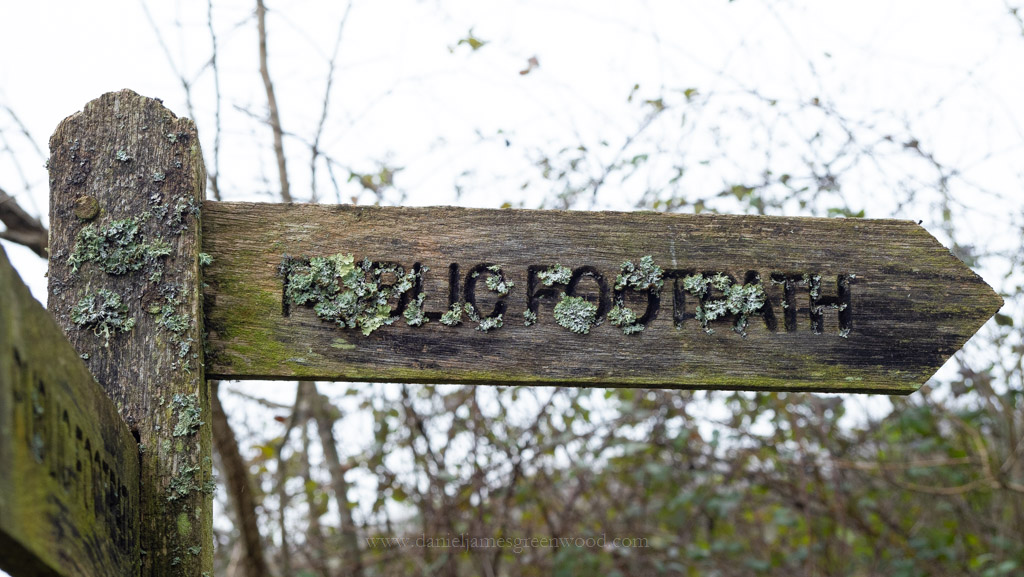
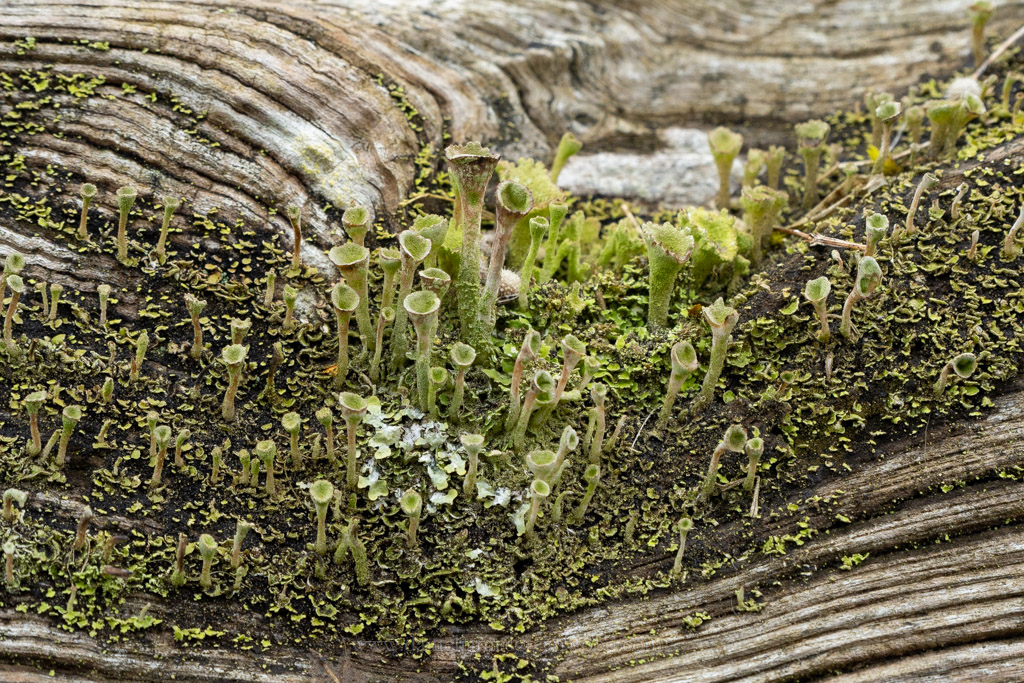
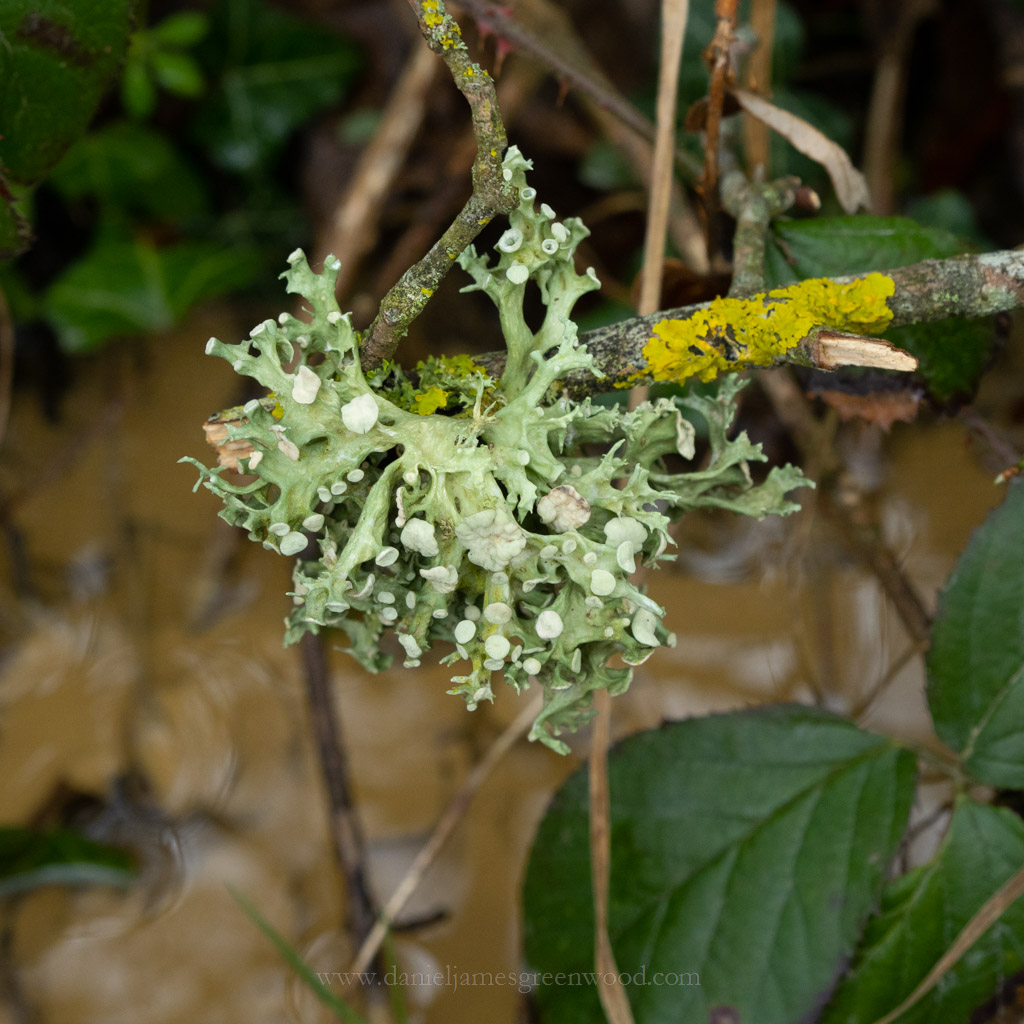
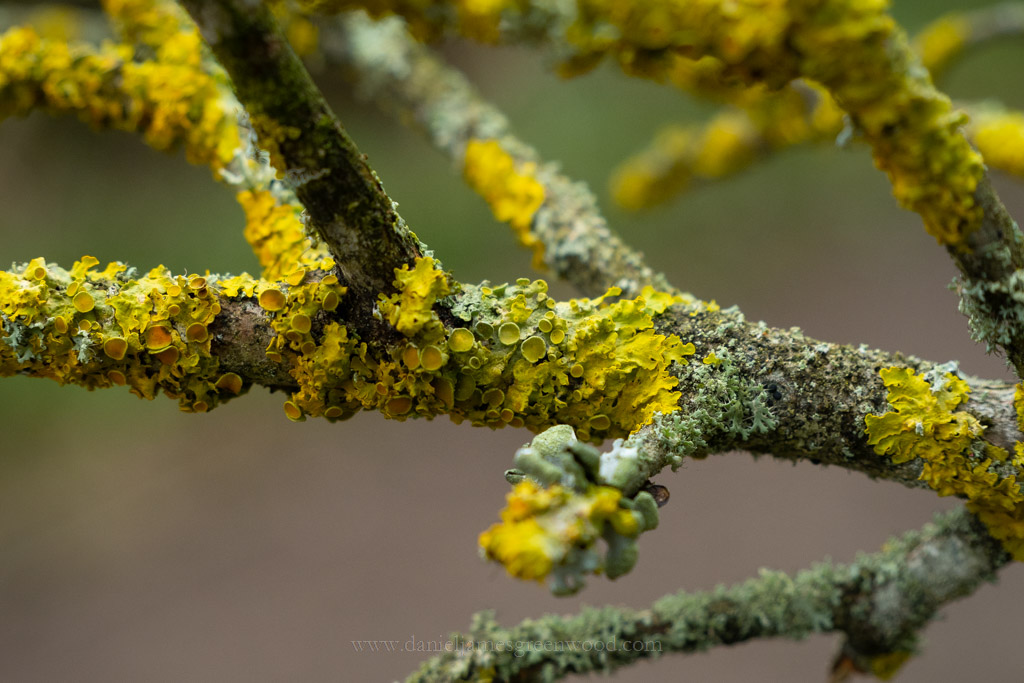
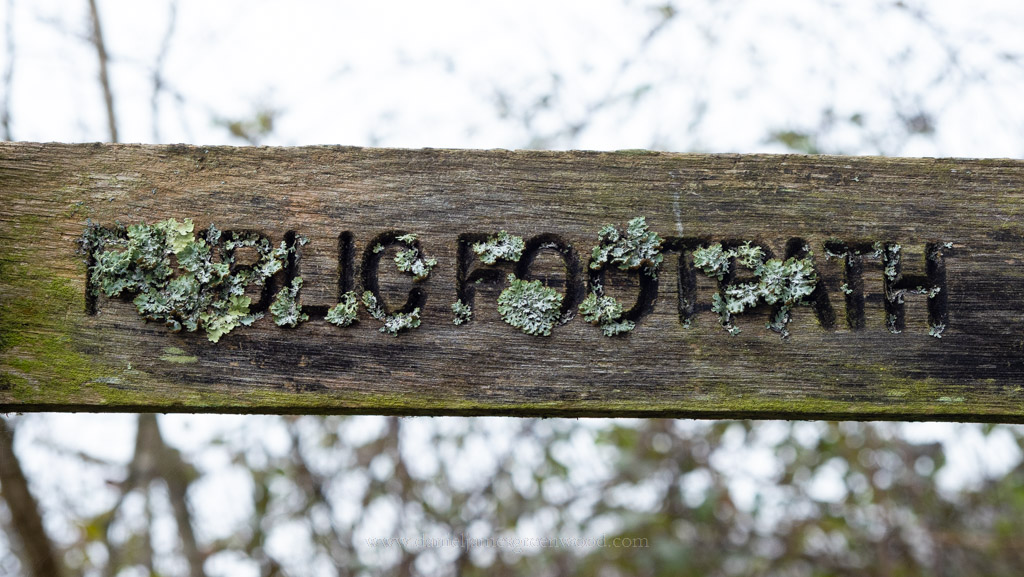
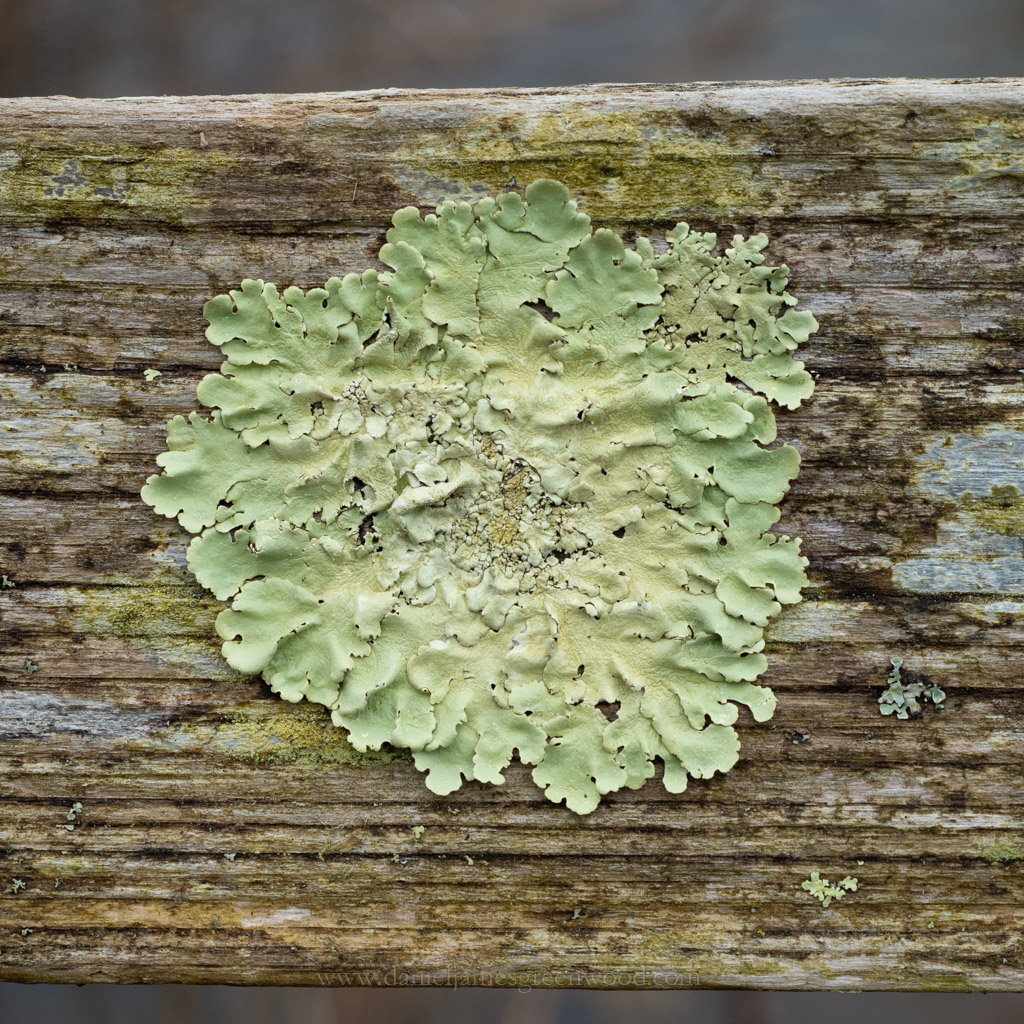
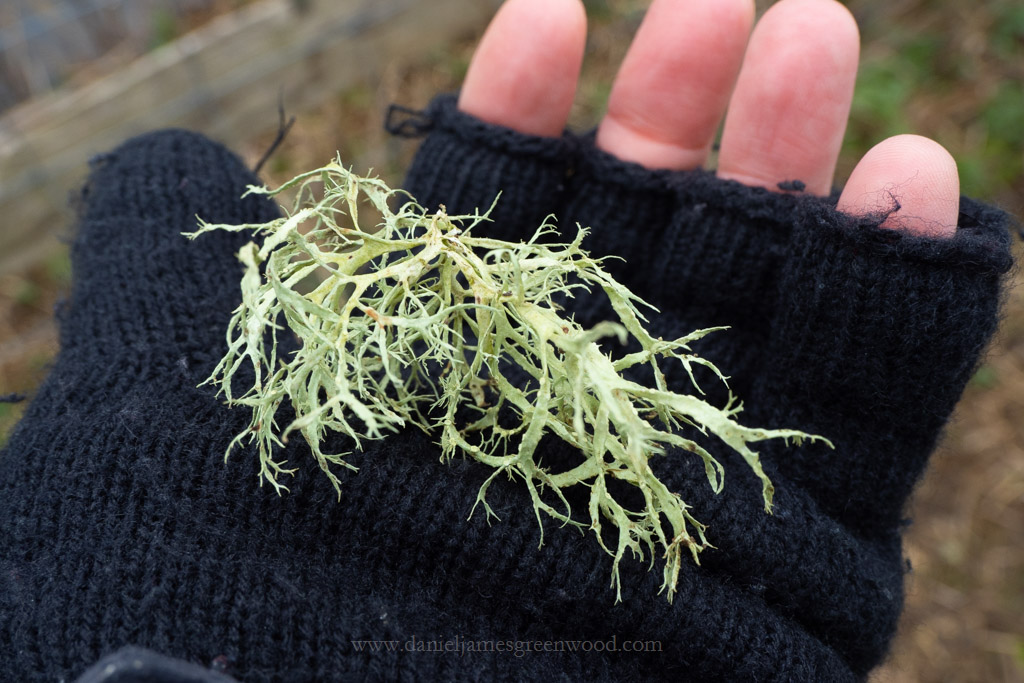
Not much to say this week, just some happy lichens after a rainy week in West Sussex.


Thanks for reading.
Writing, photography and more by Daniel Greenwood
Not much to say this week, just some happy lichens after a rainy week in West Sussex.
Thanks for reading.

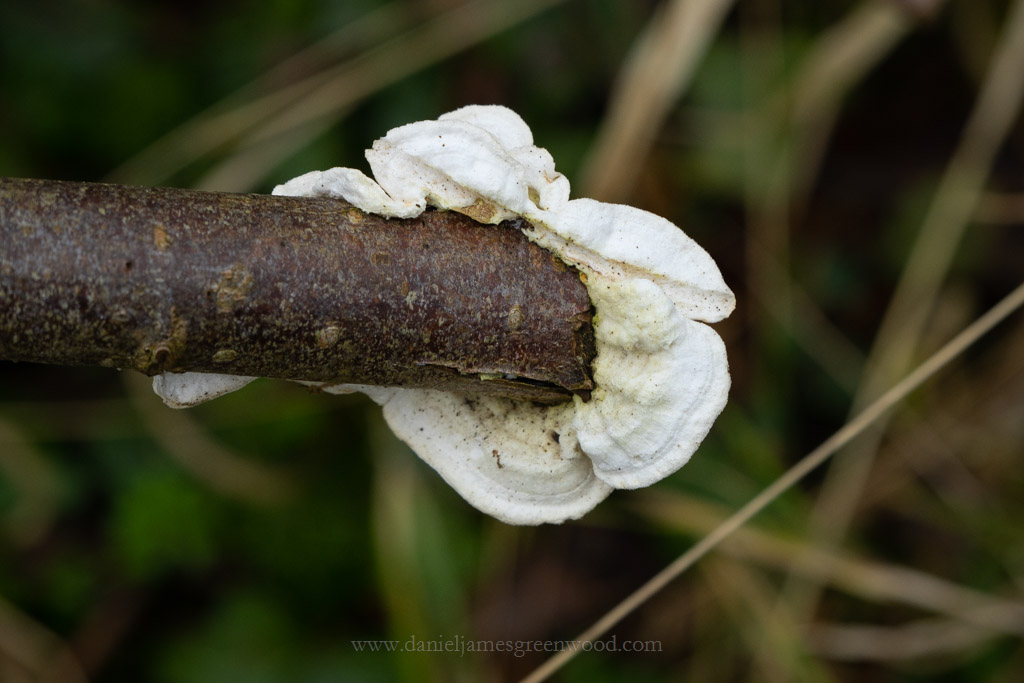
This was the week when fungi made a comeback in the form of windblown sticks.
I used to do post-storm checks in an oak woodland. It was a really enjoyable task, which may come as a surprise to hear. One benefit of all the damage to trees was seeing what previously was only seen by birds and squirrels in the canopy. By this I mean lichens and other fungi attached to windblown wood.
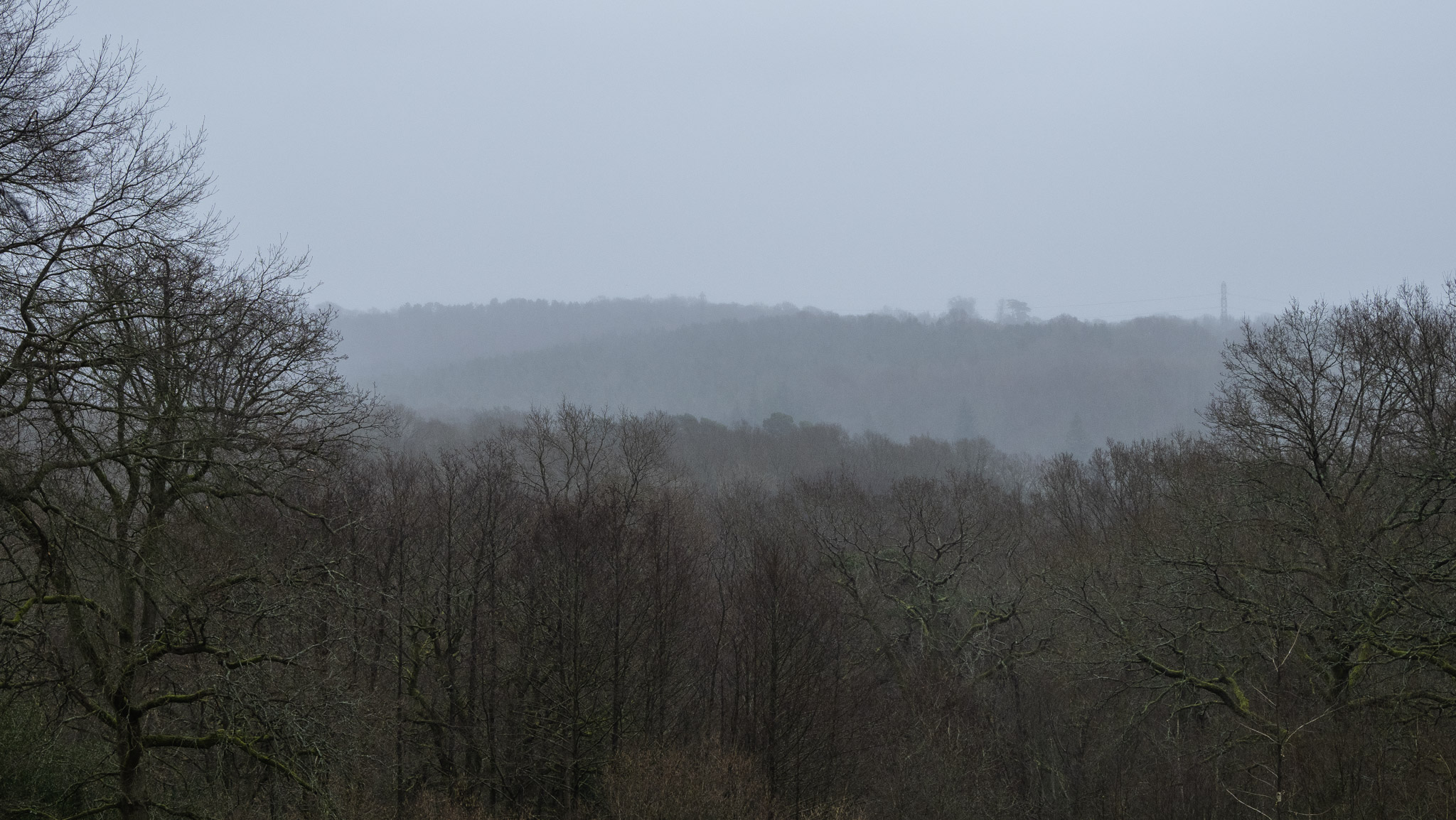
We’ve just had one of the worst storms in thirty years hit the UK, with the first-ever red warning for parts of SE England and the strongest gust on record at the Isle of Wight – 122mph. It has long been predicted that climate change would create more intense weather and the scientists are being proven right. This is at the same time that some of the more reactionary British MPs are seeking to use Brexit tactics to attack plans to protect people from the climate crisis.

From my experience, one of the big ‘losers’ in stormy weather in SE England is the beech tree (Fagus sylvatica). Beech is a ‘poor compartmentaliser’, meaning it isn’t particularly good at preventing fungal decay or rot from spreading to other parts of its anatomy. Oak is better evolved to deal with this.
This was a thought I had on Friday (18th February) as the winds whipped up around outside. I thought of all the beech trees in the Sussex Weald and Downs, exposed on their respective ridges, and how vulnerable they can be.

On Sunday, a visit to the National Trust’s Nymans (so woke, bro) revealed a beech to have suffered. Nymans sits on an exposed ridge, with fantastic views across the Weald (to the Ouse viaduct) and the South Downs. One path was closed and in the distance a beech tree had fallen across it. Taking a detour round and looking at the damage, there was clear evidence that it wasn’t just the storm that was to blame – fungal decay had softened the tree up.

At some point earlier in the tree’s life, decay had entered the tree’s core, leaving it open to this kind of collapse. I’ve posted about something similar previously:

Also at Nymans, a magnolia tree (which I mistook for an ash until I checked the buds) had succumbed. The roots had snapped and the tree had fallen across a path.
As you can see from this photo, the fungal decay was dominant in the tree’s core. This is probably about 30-40% of the tree’s inner wood close to the roots. The decay had spread to the roots, which is probably what caused them to fail. Tension, which holds the tree up, is lost when the roots give way and thus the tree falls.

This is where the treasure is found. When the branches that were once high up meet the ground, interesting lichens and fungi can be seen for the first time.


At Nymans there were plenty of little sticks with beautiful lichens on show (you may be able to tell these are phone pics). You can look at #StickOfTheDay or #StickOfTheWeek on Twitter if you want to see more of these.

My best find of this kind was a piece of decaying oak wood that I spotted the night before. I saw in the dark this glowing thing under a hedge, underneath an oak tree I knew was in decline. I picked them up and stored them away to be photographed the following day.

This was a stunning collection of foliose (leafy) lichens and a species of Trametes fungus, likely to be turkey tail. It perfectly illustrates the importance of decaying wood in trees, whereby the ‘dying’ wood becomes a source of nutrition and, indeed, a home for the fungi and lichens. Deadwood (saproxylic) insects will be inside the wood helping to break the wood down further. It’s what woodlands across Europe are losing due to the ‘coniferisation’ of plantations and the lack of space to allow woodlands to do their thing. Storms included.
The photo above took off when I posted it on Twitter. So much so that it made its way into the strange world of Weed/Marijuana-Gaming Twitter. Sorry to disappoint those in that netherworld, but I hadn’t even considered that someone might “smoke it” until I saw those replies.
Thanks for reading.

On YouTube I follow Simon Baxter, a photographer who has recently begun to do something most YT photographers don’t do – he has focused on ecology and wildlife in the landscape he photographs. I enjoy watching some YT photographers but my unofficial inner-ecologist tells me that many spend too little time learning to understand the landscapes they photograph professionally, with little interest in the biological life that depends on those landscapes.
Simon has posted recent videos celebrating the role of fungi in woodland ecosystems, an oak one in Yorkshire from what I can work out. He has spoken about his passion for the book by Peter Wohlleben about the connectivity of trees, which is underpinned by fungi.
Peter Wohlleben seems to have taken a lot of the credit for this scientific discovery purely because he wrote a book about it (one which I really enjoyed as well), when that credit really belongs to Suzanne Simard. The phrase was used for the first time in the publication of Simard’s pioneering research in Nature.

Simard has recently published Finding the Mother Tree an arboreal-memoir about how she worked to research the relationships and dependencies between fungi and plants in old growth woodlands that were being logged in epic fashion by the regional forestry services. It is a helpful real-world account of some of the things illuminated by Richard Powers in The Understory. There is some suggestion one of the main characters in The Understory is in fact based on Simard.
Finding the Mother Tree is an absolutely stonking read which describes the battles, bordering on persecution, that she faced for challenging the patriarchal systems that dominated woodland management and theory of the time. She is up against men in positions of power who did not want her to do her research and did everything they could to undermine her. It should not be that men now receive all the air-time or credit for the work that Simard did herself.
Simard doesn’t claim to be the first person to learn of these vital interconnections, however. She quotes Indigenous people in America who had stated this to be a fact long ago. It’s what makes her book so enjoyable – it is an exercise in truth-telling:
Bruce ‘Subiyay’ Miller of the Skokomish Nation, whose people live on the eastern Olympic Peninsula of Washington State, had told a story about the symbiotic nature and diversity of the forest, mentioning that under its floor ‘there is an intricate and vast system of roots and fungi that keeps the forest strong.’
Suzanne Simard, Finding the Mother Tree: p.283
It reminds me of a story from an ecologist I met in Romania. In spring, frogs were found by scientists to be travelling down to networks of ponds via melt-water streams in Bulgarian mountain areas. This was hailed scientifically as new research. However, local people had known about this and disclosed it as fact for decades before this research had been completed. Local knowledge is often an untapped resource in conservation.
I read Finding the Mother Tree while sitting in the waiting room of a hospital, reading chapters about Simard’s breast cancer diagnosis and treatment. Her messages cut through more deeply and, dare I say, gave some comfort in knowing that sometimes people go through these awful ordeals and survive them. People sometimes even prosper in their wake.
Simard’s book is something special, for its ecological deep truth and knowledge, and for her willingness to share her own vulnerability as a woman, a mother, a partner and a scientist. The ecological/environmental/conservation movements are still undermined by the same patriarchal forces of Simard’s early years as a scientist.
The logging industries in Canada, to name but one nation, still log ancient, irreplaceable forests in times of climate and biodiversity crisis. Simard’s book must be read by more people to understand both the ecosystems we need to celebrate and conserve but also to understand what holds back the good work that needs to be done.
Thanks for reading.

In England we suffer with a condition that affects many people: mycophobia, a fear of fungi.
If you ask anyone about wild mushrooms, you’re likely to receive a response highlighting the fear of being poisoned. Cultivated mushrooms are a staple of the ‘British diet’ but people have very little knowledge about ones you can eat from the wild, perhaps because it doesn’t seem worth the risk.
Another thing most of us lack is an understanding of where we can forage if we are allowed to. It’s no surprise, the situation is complicated and in general foraging wild mushrooms is frowned upon, regardless of arguments for or against.
It’s important to debunk some myths around the edibility of fungi:
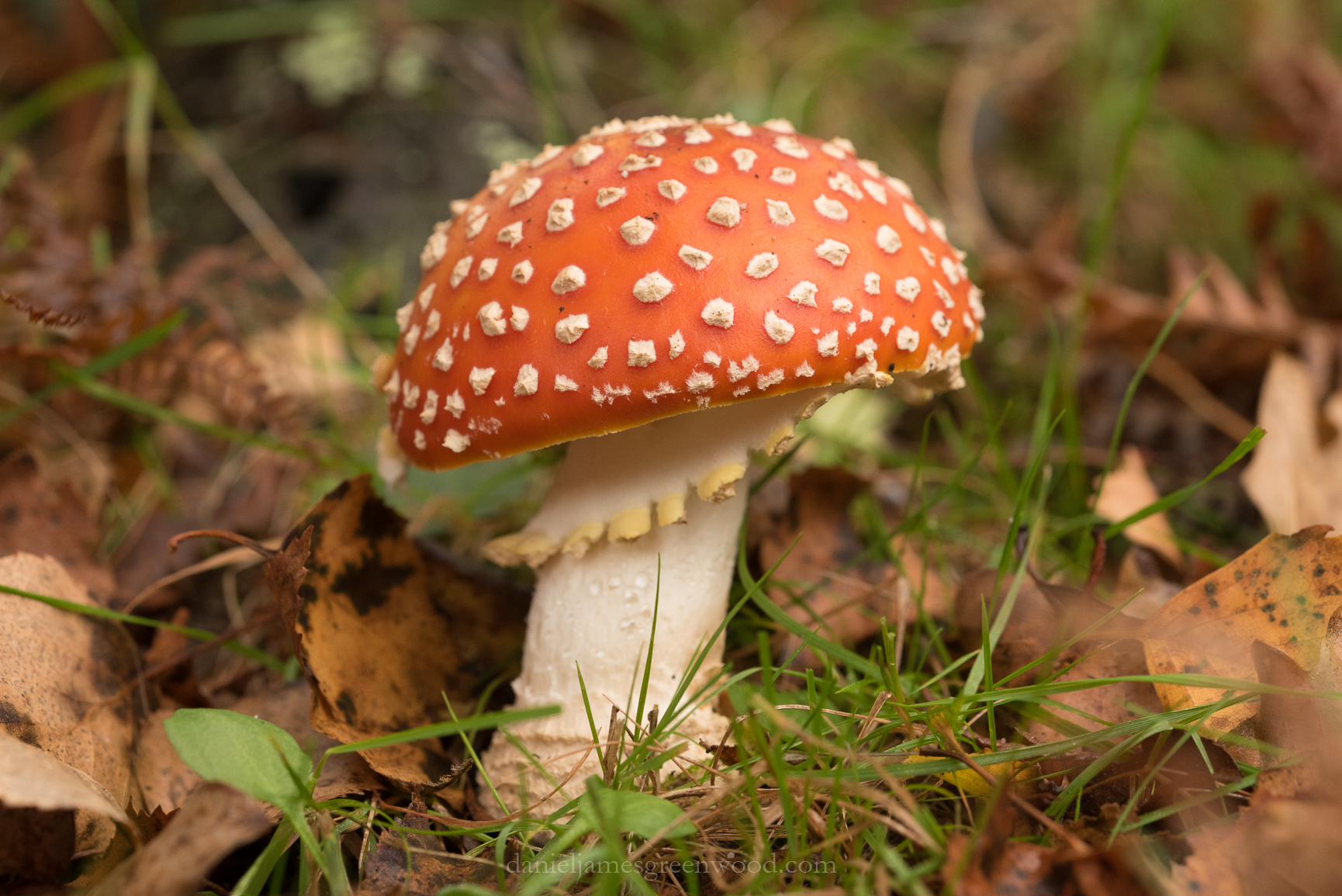
The most toxic mushrooms in the UK are found in the Amanita family, home to famous species such as the red and white fly agaric. They have some extremely sinister names: deathcap and destroying angel, for example. The deathcap is common in the UK, especially under beech trees. There are other similar species like the false deathcap, however, but the similarity is not so close.
The destroying angel gets its name from the fact it’s pure white but deadly poisonous. This is where a lot of problems lie. People confuse the destroying angel for white edible species like horse or field mushrooms.
One of the more common cases of confusion appears to be people from countries in Asia who are new to places like Europe or North America, foraging mushrooms that look identical to destroying angel but accidentally ingesting the toxic variety. Tragically, this has happened in recent months after Afghan refugees ate deathcap mushrooms in Poland after being evacuated from Afghanistan. There is no reason why they would have thought the mushrooms would not be the same as the ones they ate at home. Knowledge is privilege.
Other toxic Amanitas are the panthercap and, to a lesser degree, fly agaric. Confusingly there are some in the family which are edibles, including the blusher and Caeser’s mushroom (the latter named for its favour among Roman leaders). Remember: no one without relevant expertise should ever consider trying to eat an Amanita mushroom.

The fear whipped up around these species is, unsurprisingly, exploited in the British tabloid press, with the following being printed in one major English newspaper:
“Foragers are being warned about an alarming abundance of Britain’s most poisonous variety of mushroom this autumn.”
There’s mycophobia rearing its head once again, you could argue. Anyone who knows what the deathcap’s features are is unlikely to ever mistake it for something edible. It’s about taking care and time and having the right knowledge.
That said, the impacts of the deathcap on the human body are very unpleasant. Though someone can eat the mushroom and not feel any effects for 12 hours or more, it will slowly be degrading the liver on the quiet and other vital organs, resulting in eventual death if not treated.
This podcast covers quite a lot around the attitudes people have to fungi in the UK.

One toxic mushroom that is very common is sulphur tuft. Sulphur tuft grows in woods, parks, gardens and even the street. It’s known to cause mild to severe illness in people.
There are other deadly species which are very common, including such as funeral bell(!) and brown roll-rim. Brown roll-rim can even be found in urban areas, with the first ones I ever saw were in urban south-east London in an old tree-pit next to a main road.
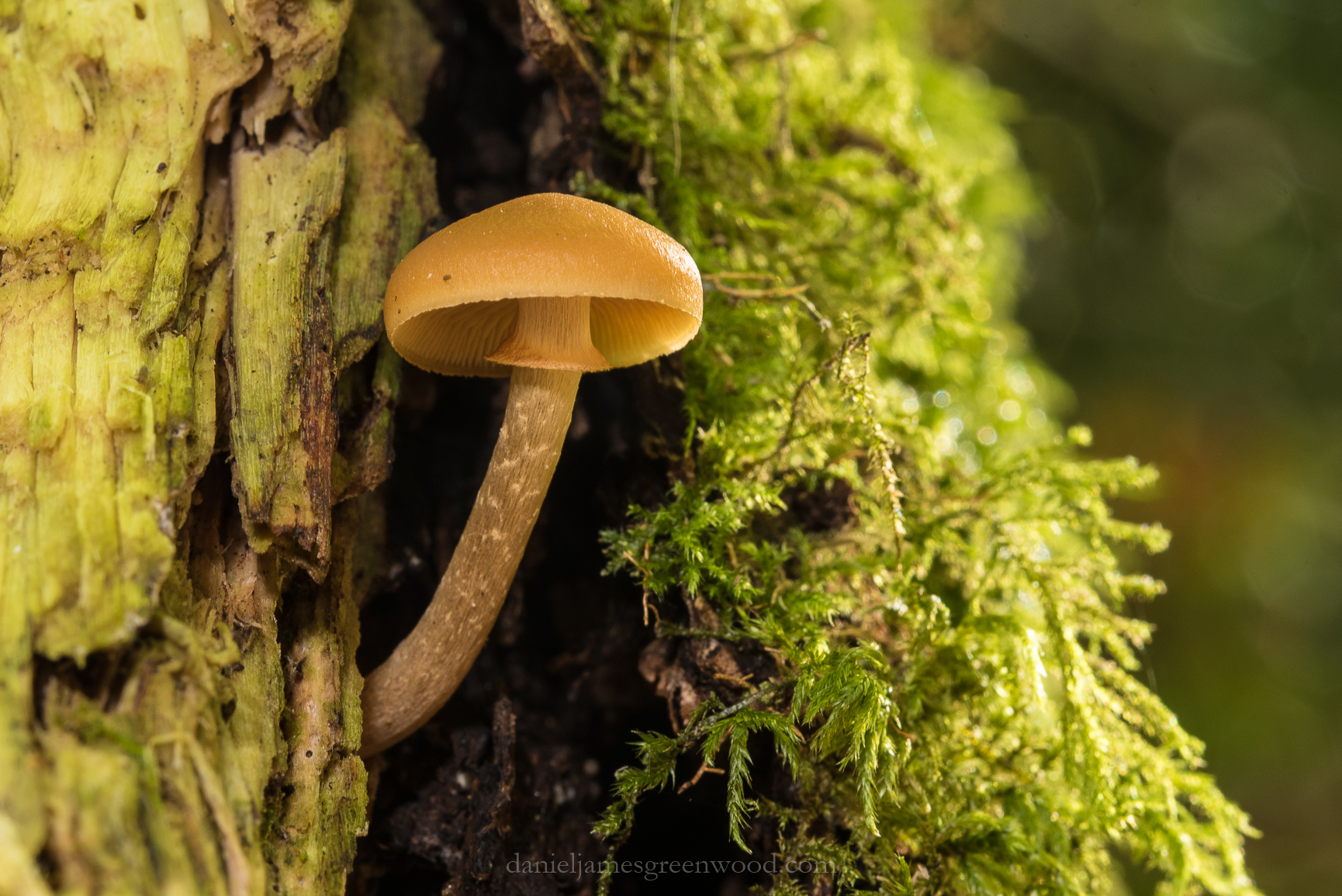
It’s also important to know that species which are edible to some like chicken of the woods may cause mild sickness in other people.
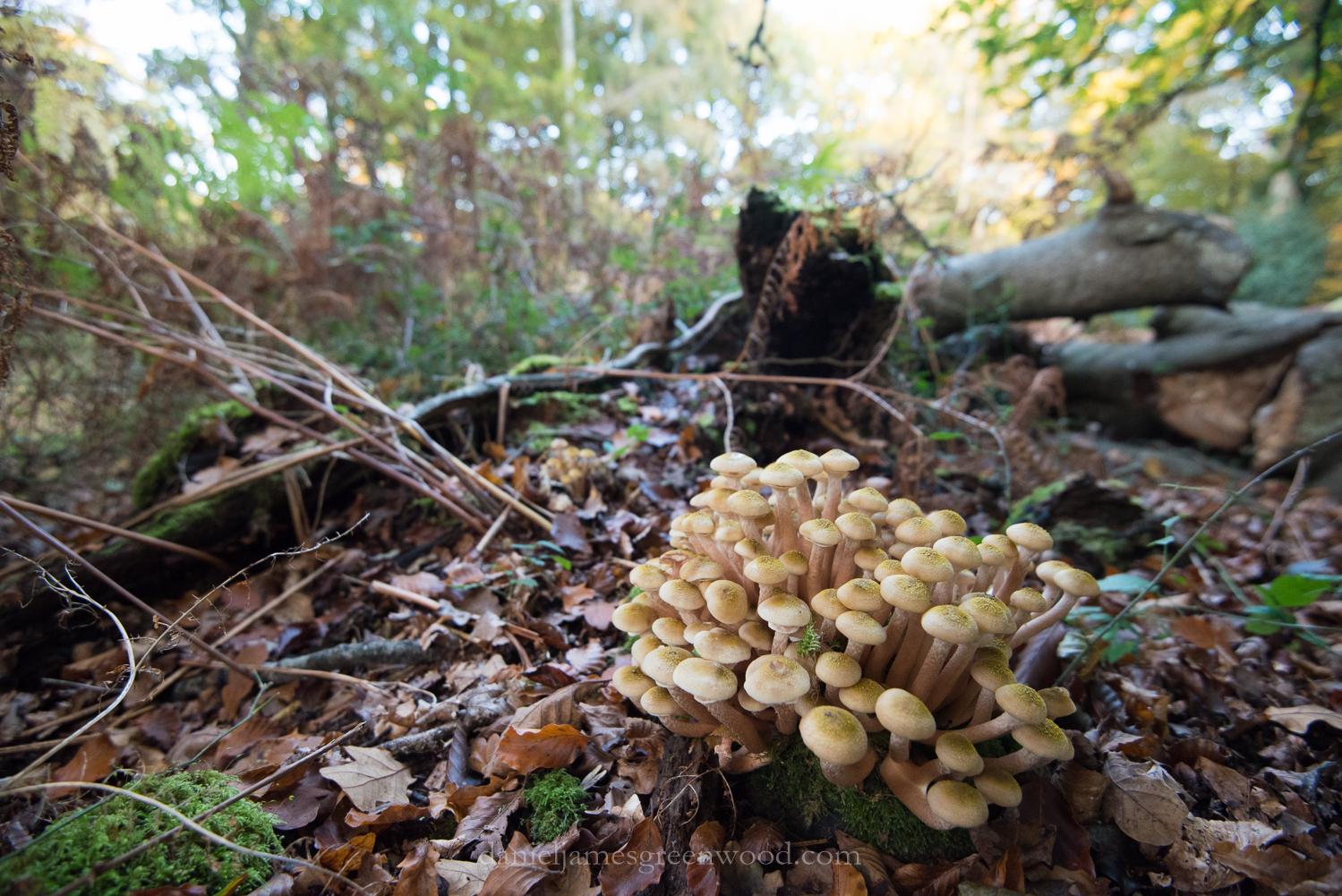
The same goes for honey fungus, which is edible but can make people sick, especially after eating a certain amount of it.
This shouldn’t be seen as a guide to avoiding poisonous mushrooms so please don’t treat it that way, nor is it support for a mycophobic view of the outdoors. Always do your research and understand that you need to develop your knowledge over time. My interest here is the role fungi play in our lives, especially the debilitating fear factor – the mycophobia.
Thanks for reading.

Happy New Year! Another pandemic year in the bag (yay) and a chance to look at some of my fungal highlights of the year that was.
I do appreciate that this post title does sound like I’m updating people on how my infection is going. That’s not the case.
My first fungi post was during England’s winter lockdown when we had to all stay at home again. Options for fungi photography were not great so I delved into my own wood-wide web. The post was about a favourite subject of mine, lichens on Dartmoor in SW England:
January 2021 also turned out to have a little mushroom boom:
Dark times continued through February 2021, but some brightly coloured jelly fungus provided a light in the dark:
Being privileged enough to work from home during the winter lockdown, I spent a lot of time at a computer. Behind me was a yukka plant that had spent the summer months outside. I was amazed (and a bit disturbed) to see that mushrooms were fruiting over my shoulder!
As winter drew to a close one fungus stood out in the woods:
A dry spring until April came with heavy rain. I finally worked out what common inkcaps were:
I gave two lockdown Zoom talks about fungi in 2021, one for London Wildlife Trust (video didn’t materialise) and one for Bell House, a learning charity based in SE London:
In July I found some very nice mushrooms and tried a bit of camera focus-stacking:
One of the few trips I managed to Sussex’s more remote ancient woodlands was in July:
A quick whip round an area of Ashdown Forest in August revealed some early signs of autumn:
I notice perhaps more deathcaps than I’d seen before when out and about in September:
A slow start to the autumn fungi season was dominated by these purple mushrooms in October:
One of my highlights of the year was encountering the stunning violet webcap:
At the crossing of October and November I was lucky enough to spend a couple of nights in Dartmoor National Park. It was dripping with mushrooms, a really special experience:
Thanks for reading and for your support in a challenging year for all.
Daniel
Previous ‘my fungal years’:

The day after last week’s post, I headed back out to another local woodland to check up on the fungal situation. Building on the violet webcap theme, I was this time lured down an amethyst deceiver rabbit-hole. Thankfully, I was able to return from it.
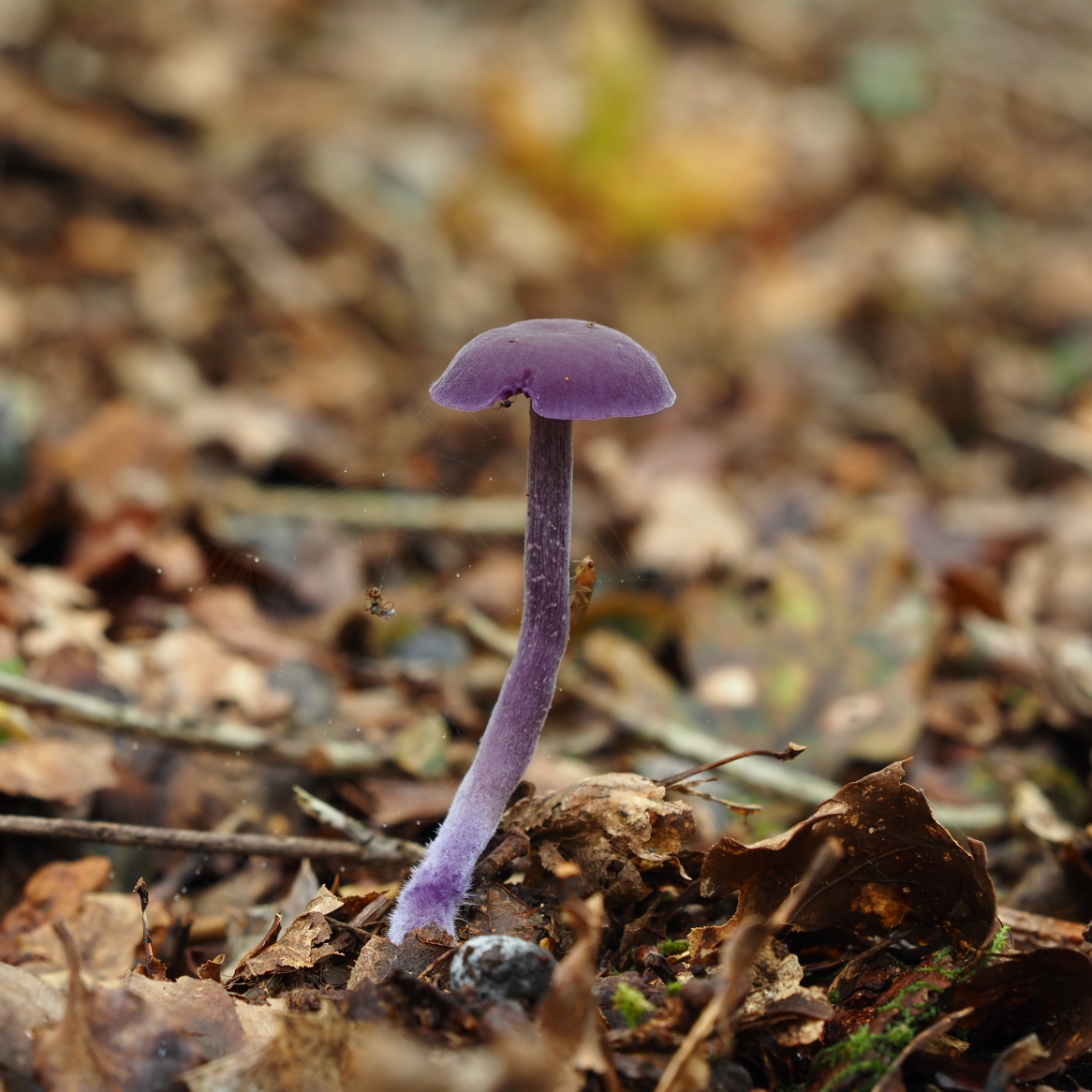
I saw a tweet recently from the editor of the Inkcap Journal about how she could never find these mushrooms. The question was whether they are as bright as people say, or if that was deceptive. They are, of course, deceptive by name but also in their appearance.

I was scanning the path edges along a usual mushroom route I take through this woodland when I spotted a very small, dark mushroom under the birch and holly. It was almost black in the shade but on closer inspection it was one of perhaps 100 amethyst deceivers in the local leaf litter.
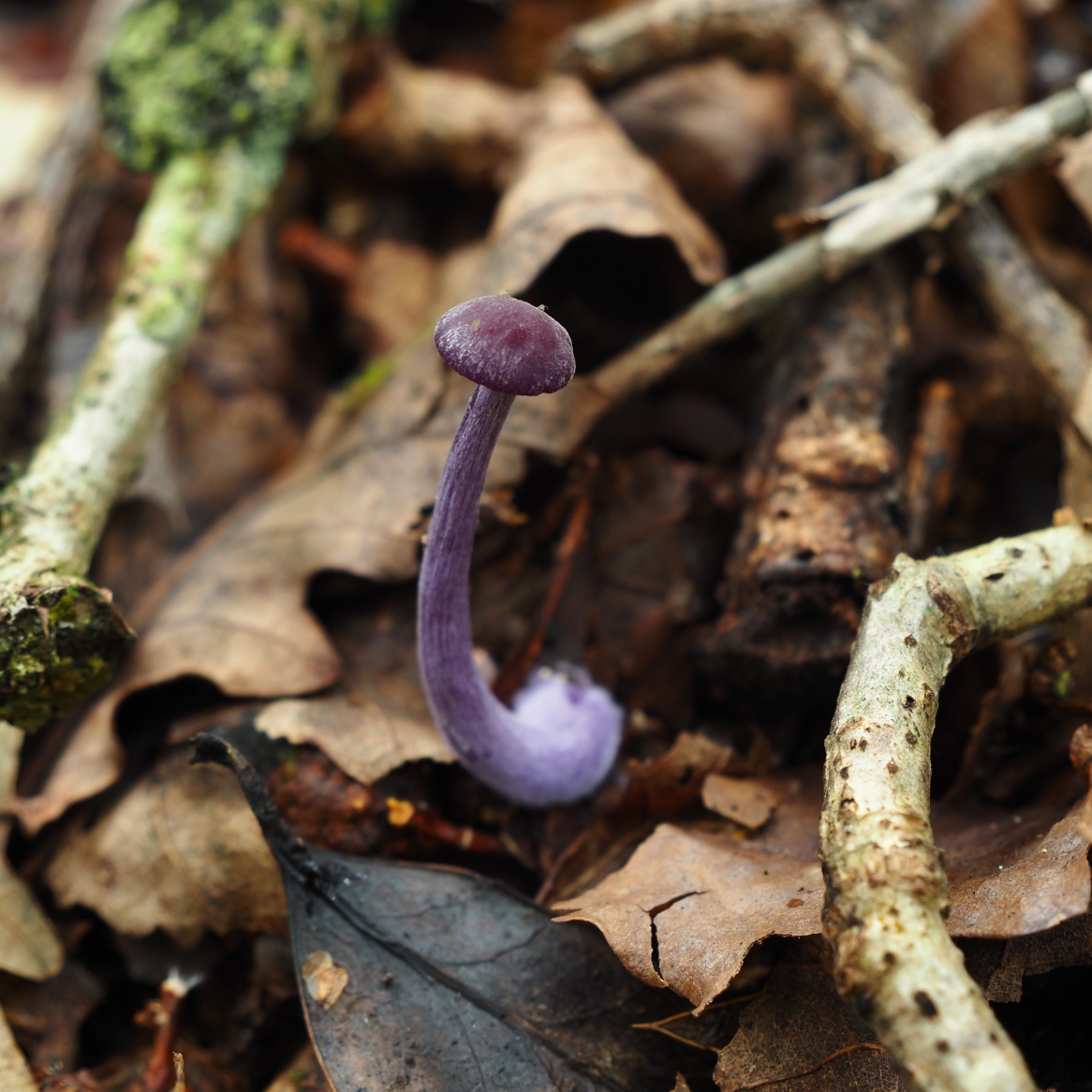
As I slowed down upon finding the mushroom, I began to see more and more. They were everywhere. I was careful not to step or kneel on them. I took some photos of them in varying states.

Herein lies this family’s deception – they are often confusing because they can look so different in anything but colour. Perhaps their name also derives from the fact they are hard to see.
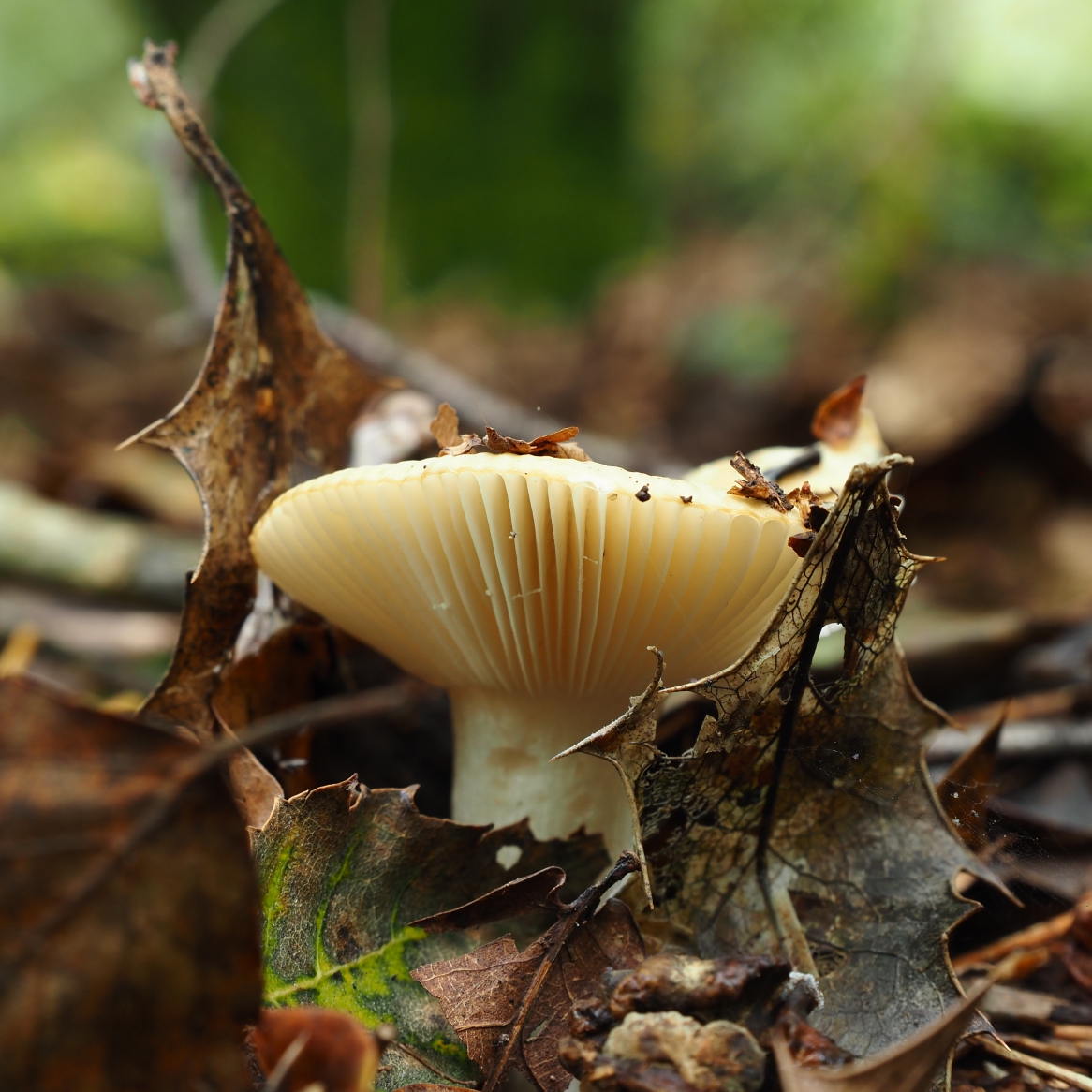
These blogposts can also be deceptive. Though I have found things to photograph, we are nowhere near a mushroom peak. Things are not in full flow. The Sussex Weald’s woods look dry still, with heavy rain not yet enough to provide the water for full-on fruiting across the board. In other words, the mushrooms remain small and sparse, but there if you look. This brittlegill was exploding onto the scene like the shark from Jaws.
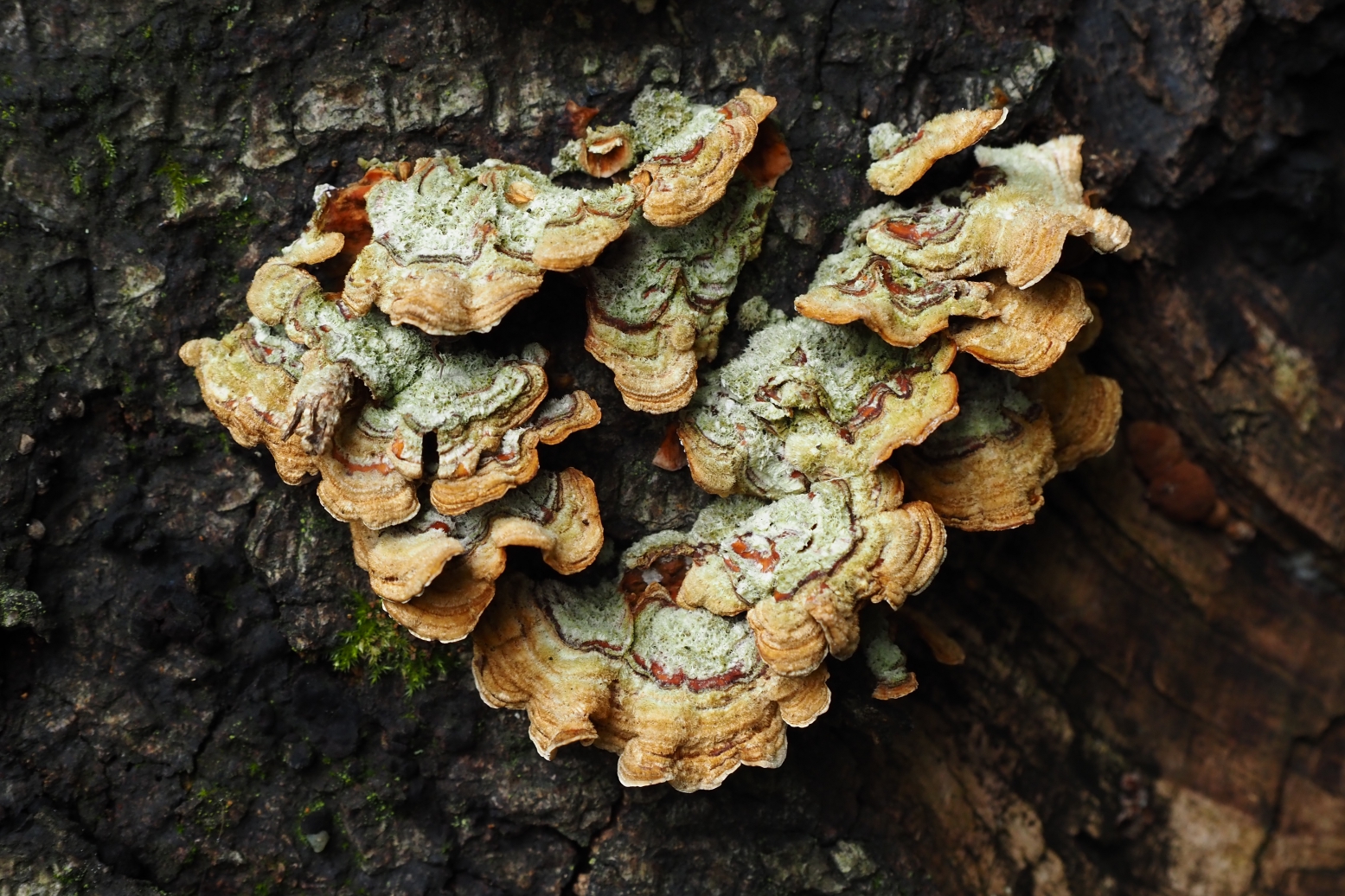
Something that can always be relied upon is a hard-wearing polypore. This fan of small brackets is the sort of thing you can find all year round.

This yellow stagshorn was climbing every mountain.

There were more of the typical mushrooms, but mostly in the shaded areas under holly or lower vegetation. This crew of bonnets were growing in their hundreds.
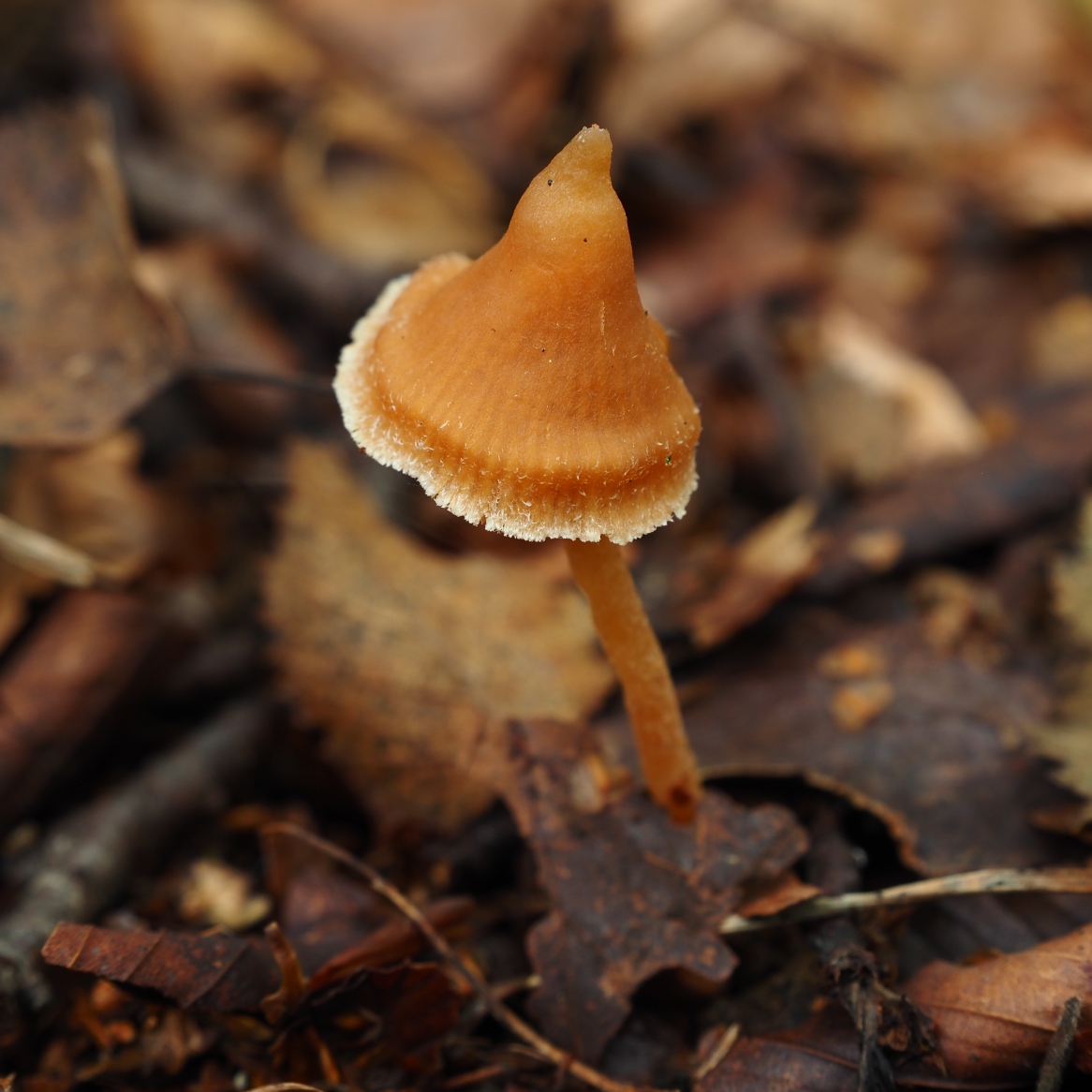
On the woodland floor I spotted some very small mushrooms with conical hats. These tips look a bit like the famous magic Psilocybe mushrooms. After a bit of research I decided that they are in fact peaked webcap.
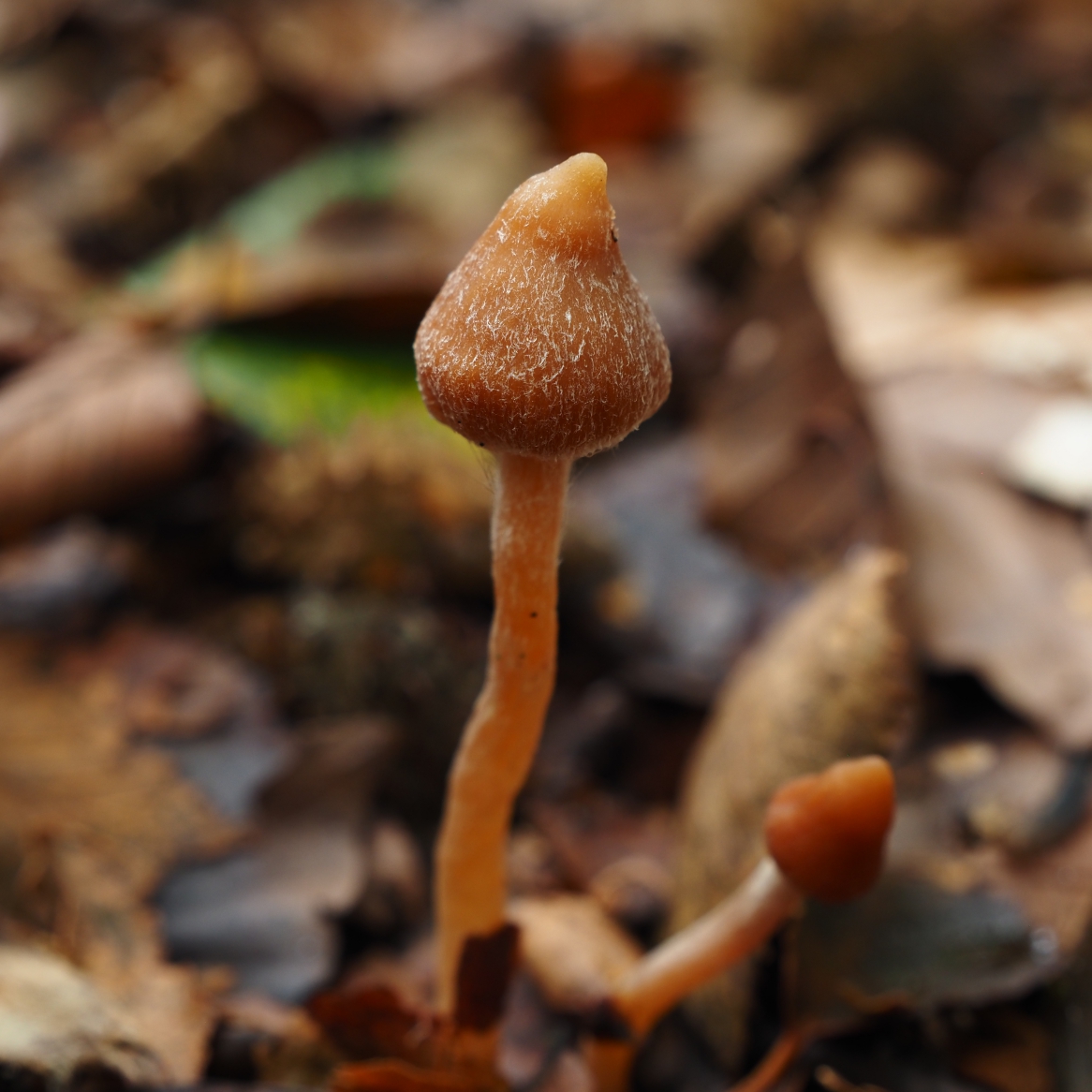
You can forgive me for seeing their similarity for liberty cap, the magic mushroom. In this photo you can see a small amount of the webbing which gives this huge family of mushrooms its general name.
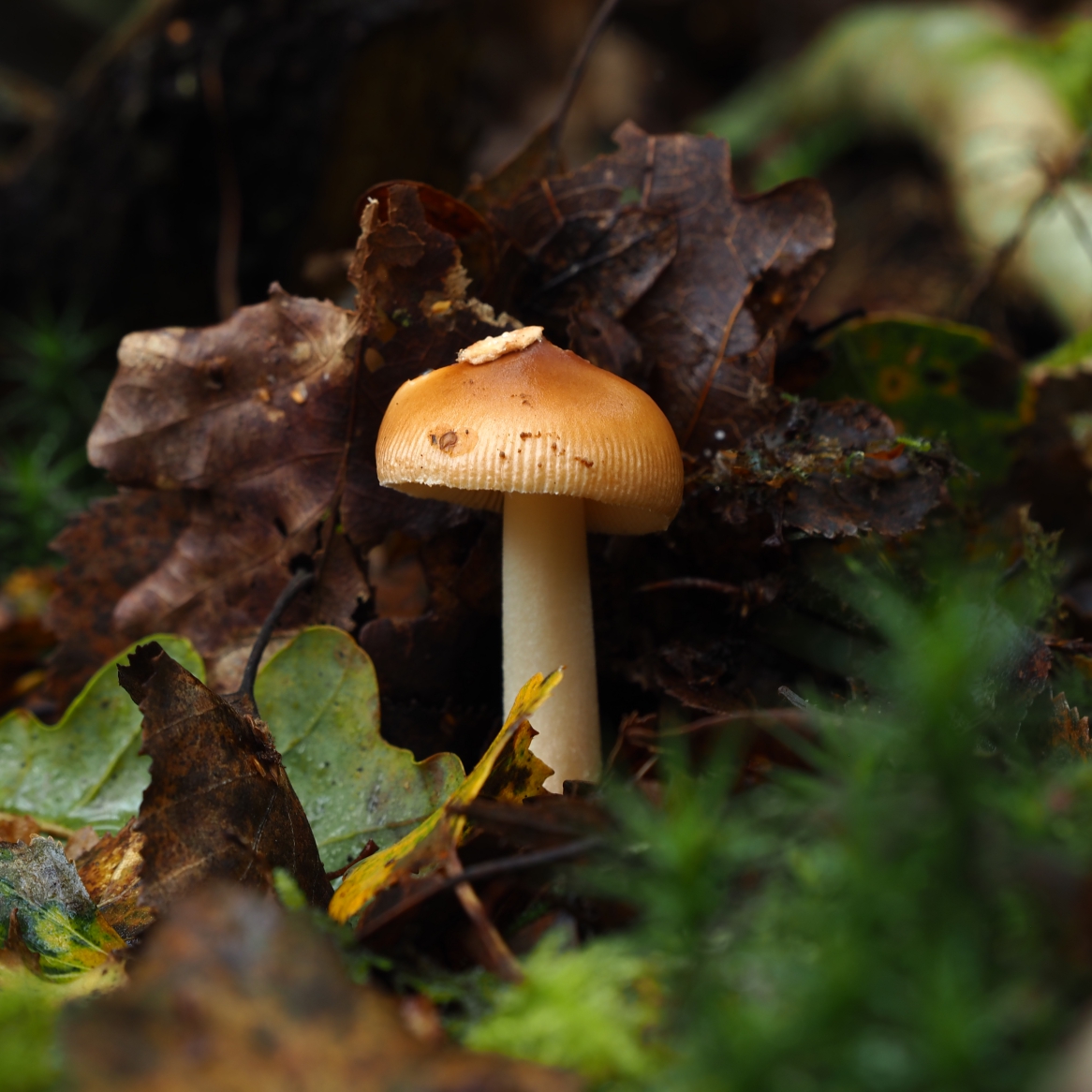
Some of the more summery mushrooms were there to be found. This included the undisputed king of looking-like-they-just-burst-through-the-door, tawny grisette.

Another amanita to be found was this blusher, I think. It is quite difficult sometimes to tell the difference between a couple of relatives in this group, including the panther cap and grey-spotted amanitas.
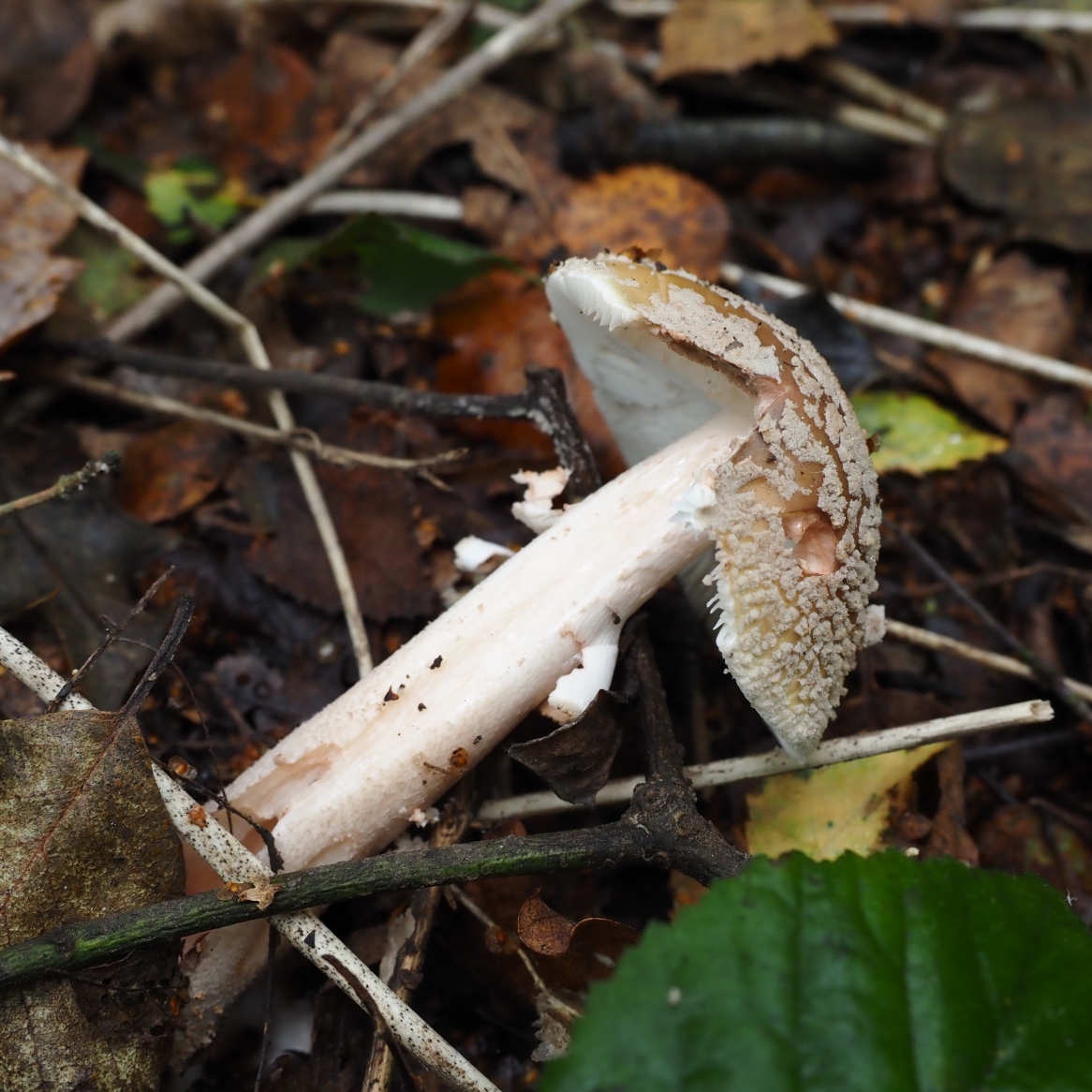
The pinkish-hue and appearance of the stipe was enough to suggest to me that it’s a blusher, rather than a grey-spotted amanita.
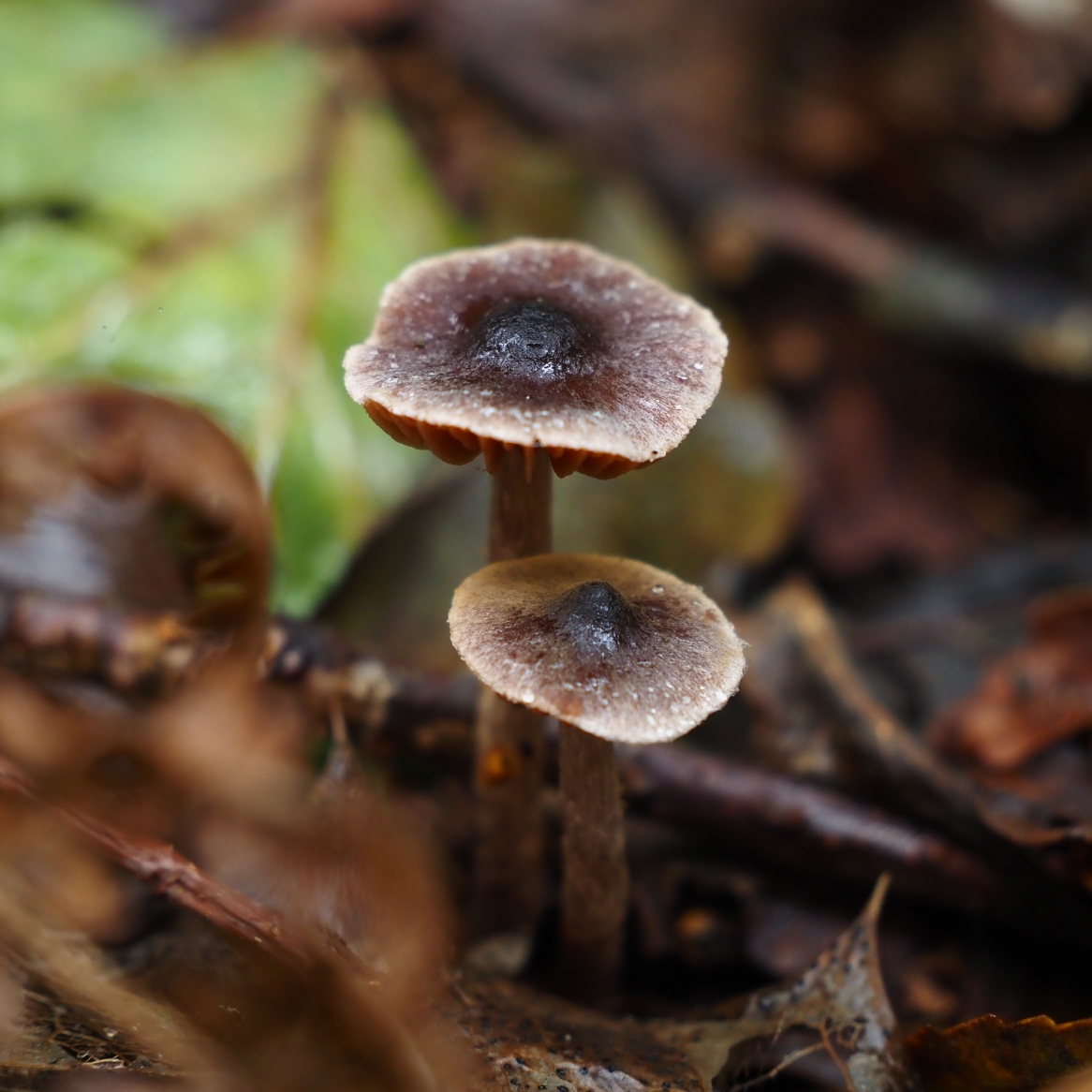
I like the felty-caps of these two friends down among the old holly leaves and sticks.

Before making my way back home I happened upon another gathering of bonnets, again under holly in very shady woodland. It’s where the moisture is and therefore where the magic happens.
If you can, make some time to get out there and find yourself some mushrooms. You won’t regret it.
Thanks for reading.

At long last some time in the woods! Get ready for a mammoth mushroom post to celebrate the start of the season. I am so annoyed to have missed UK Fungus Day due to work commitments (no time or energy to do writing, visit woods or take photos) and also I have at least one other mushroom post that hasn’t made it to the surface yet.
In south-eastern England we have finally had some rain after a very dry summer. iNaturalist and social media have shown lots of autumn mushrooms popping up, including the first fly agarics. This week I had the chance to check things out for myself, and was not disappointed.

I am fortunate enough to live near a large expanse of ancient woodland/wooded heathland which is part of the High Weald Area of Outstanding Natural Beauty. This landscape is fungal heaven in places that have been wooded for more than 400 years. It’s dominated by birch, oak, beech and pine, trees that have strong associations with fungi.
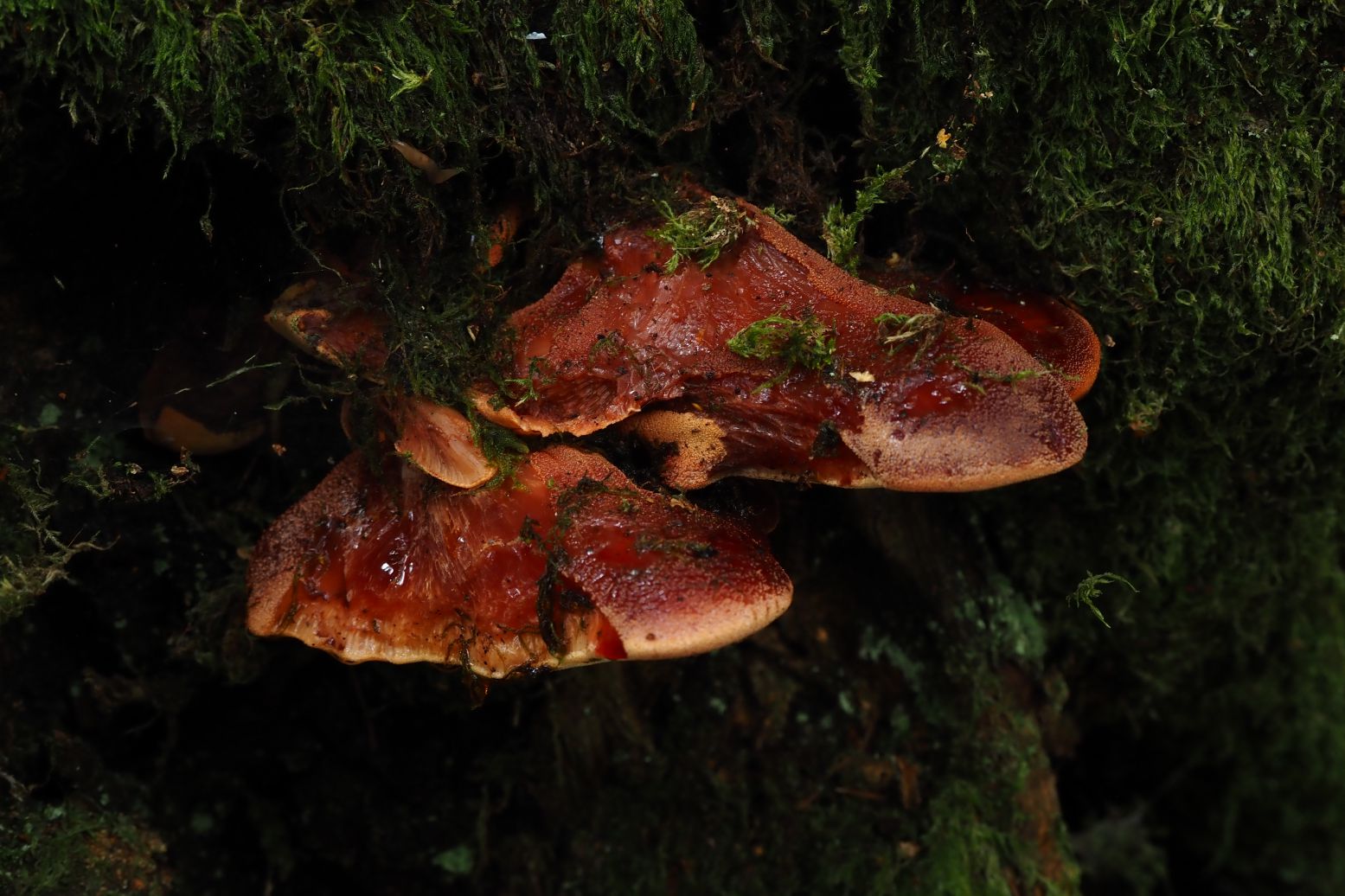
The early signs were good as I discovered a beefsteak fungus growing at the base of an oak tree. This is a species which can be mistaken for body parts, and though it’s parasitic, its impact is said to work more slowly than a tree’s ability to heal itself.
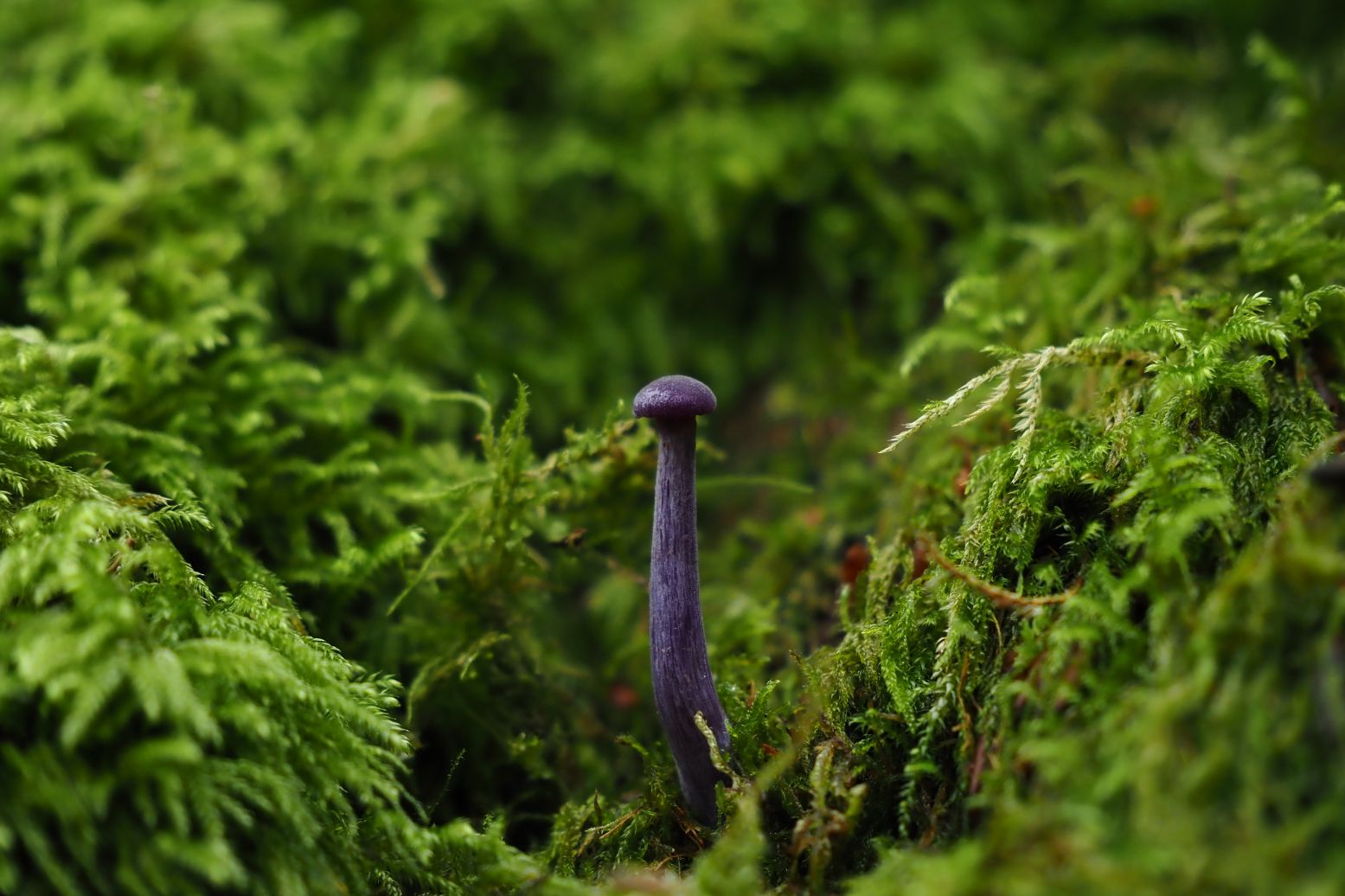
Amethyst deceivers are a common species at this time of year, often found growing in profusion. I spotted this tiny one growing in moss at the base of a tree.
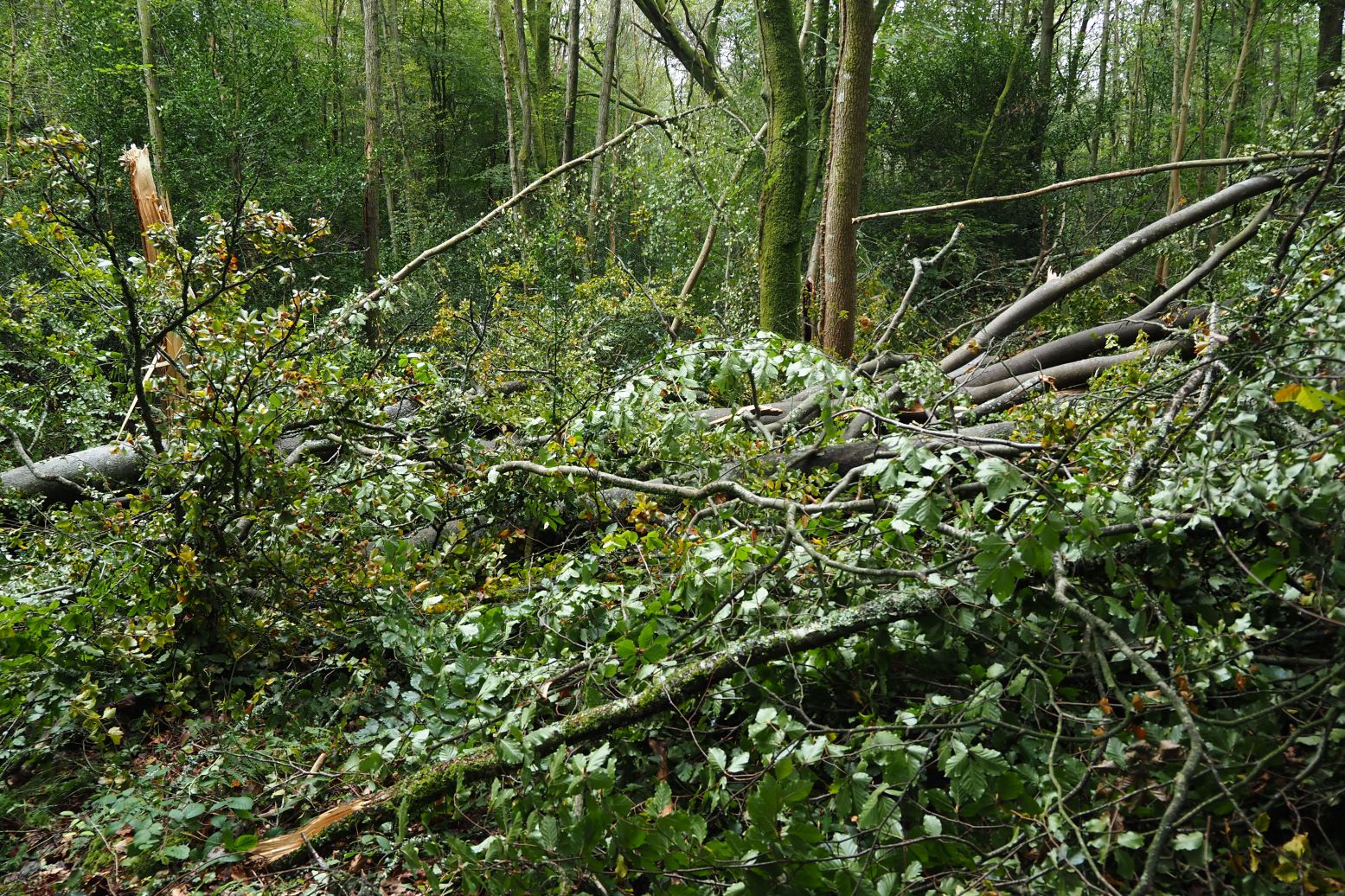
Recent storms had created a realignment of the woodland canopy. A beech tree had broken off in high winds, opening up the woodland to light. The concentrations of deer are high here, so it will be interesting to see how well the woodland manages to renew in this sudden clearing.

No, this is not an amphibian! I spotted this holly leaf covered in a species of wart-like fungus which I think might be in this family. Please add a comment if you know what it is.

Lurking behind a fallen log was what I think is a deer shield mushroom. I saw far more in the proximity of fallen wood, rather than in the open woodland floor. Perhaps the heavy rain recently has washed things away.

This mazegill-like crust fungus caught my eye.

This small polypore, which I have not looked to ID yet, was in fine fettle on a little birch stump. Not unlike a thought-cloud.

A reminder that it’s not just humans that enjoy fungi. Not that anyone is in any rush to chow down on this one.

This crust fungus interested me as it looked like a map of Scandinavian islands.

It’s always nice to find a bolete. This is probably a birch bolete as it was growing underneath birch trees. I moved the beech leaf but it fell into this position purely by accident. Lots of autumn happening here.

There were two moments during this two-hour walk that I let out some expression of joy upon finding mushrooms to photograph. I don’t know what family this, well, family of fungi, are in, but they are beautiful. I love to find fungi in this state, at this time of year, before the leaves have fallen.

Autumn appearing in beech, birch and bracken.
As a lone male visiting woodland, I am very aware of the impact my presence could have on women who are walking alone. I saw a woman walking and turned away to walk a different path to ensure she didn’t have to experience the fear of having some weird dude approach in a secluded area or pinchpoint of woodland. I also have my camera clearly on show. Sometimes I have considered getting a hi-vis vest with a mushroom emoji on the back. I would implore other men to consider how you are perceived in similar situations.
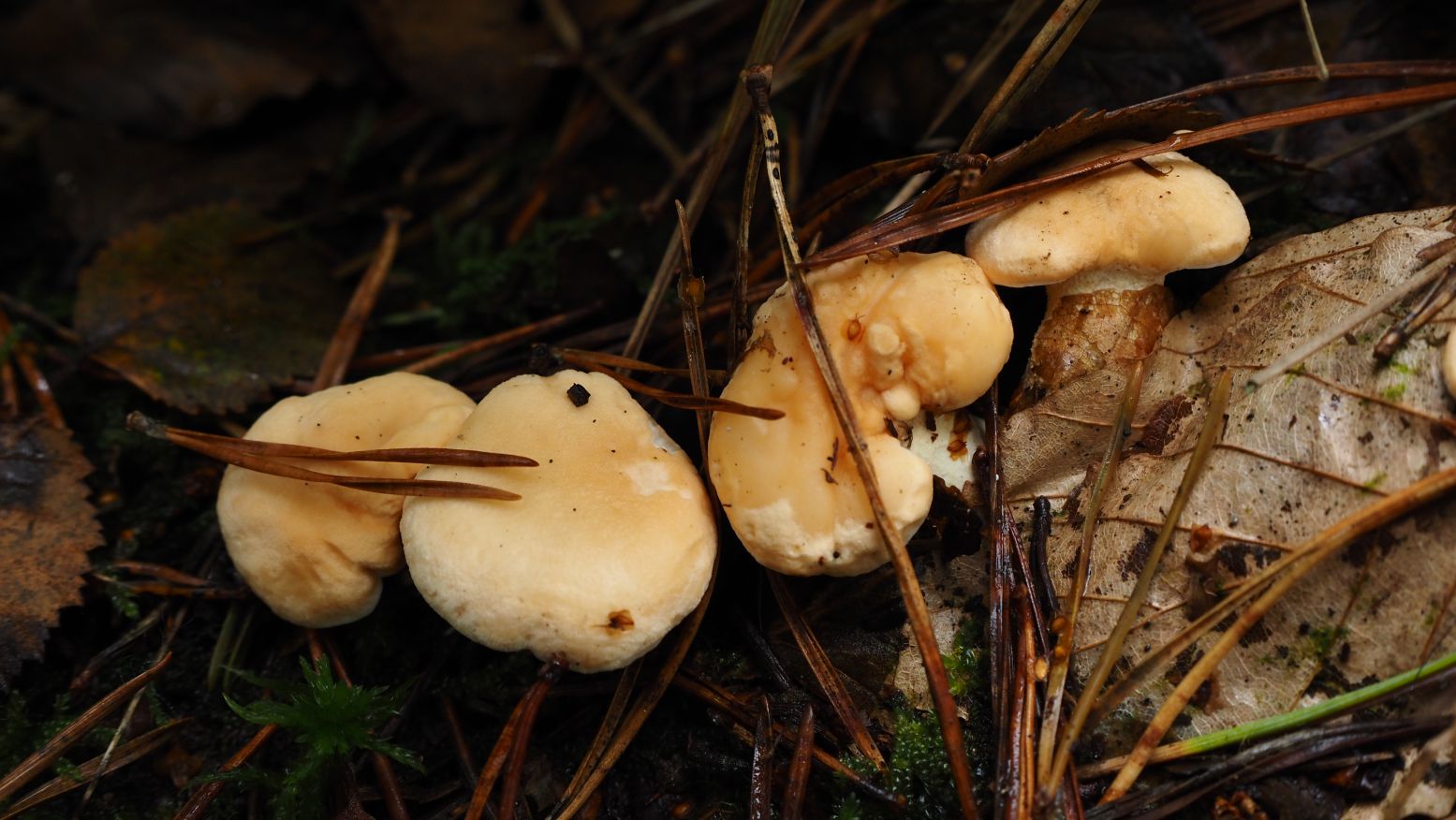
The point here is that if I hadn’t turned off into the birch and heather, I wouldn’t have found these hedgehog mushrooms! I wrote about this species almost exactly a year ago, though I was not foraging for the pot here.

A pine tree had come unstuck and much of its bark had been pulled away. Looking more closely I could see some kind of root network. Now I’m not sure if these are aerial roots put on by the tree as it tried to consume its own decaying matter. Then again there was a lot of hyphae-like structure in among the roots, but the whole structure couldn’t have been all fungi. Here we have the foundation for much of life on earth, the partnership of fungi and plants.
It made me think of how Britain is faring at the moment. We cut our ties with our European neighbours in January 2021 (i.e. the wood-wide web), thinking we could grow taller and stronger alone. The truth is that everything is connected and we are diminishing in isolation because we need our nearest neighbours to thrive.
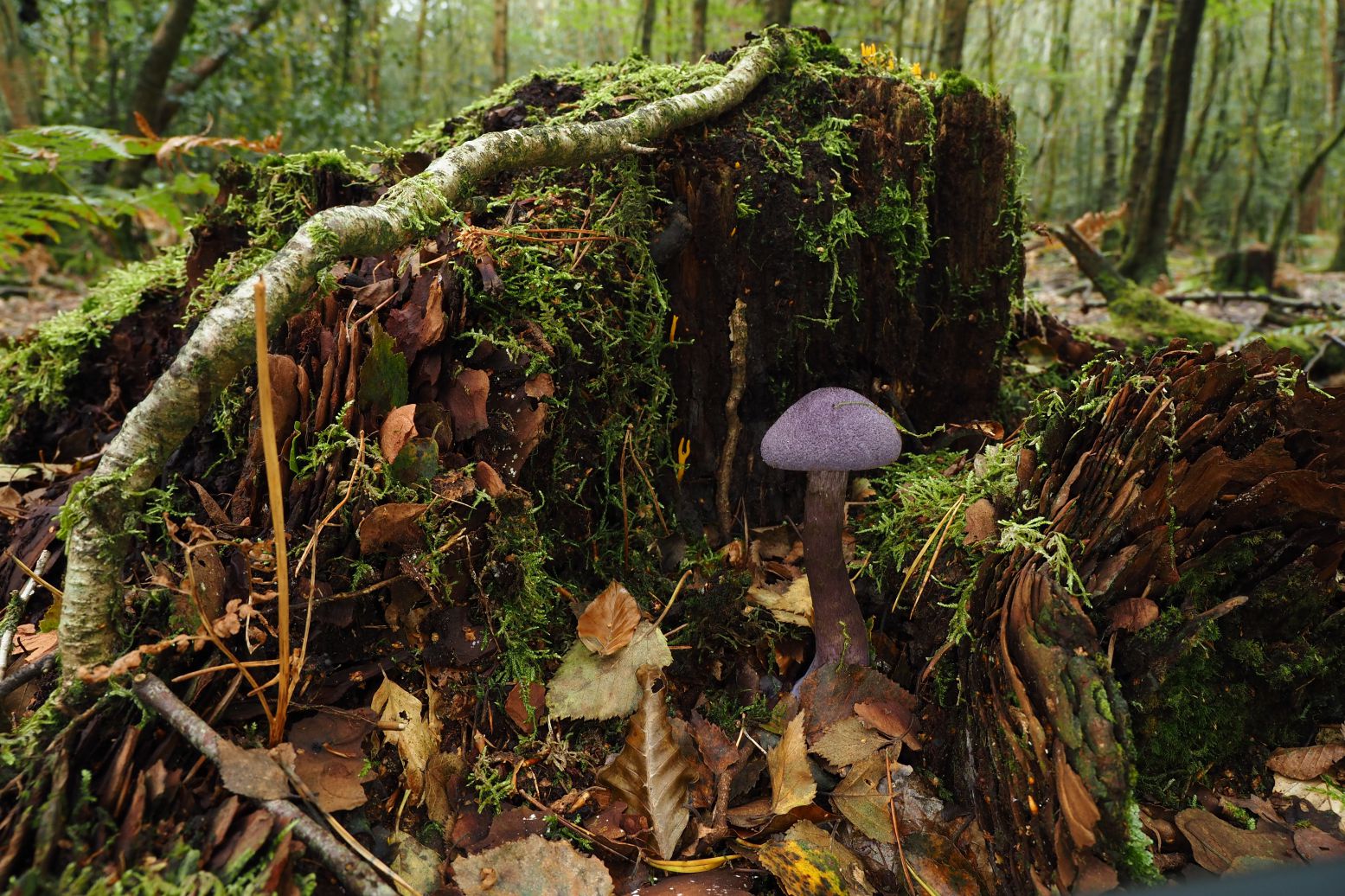
And then I found a mushroom I had never seen before – a webcap, probably violet webcap!

Seeing this mushroom sitting there took my breath away. It is a stunning fungus. The photographs just don’t do it justice.
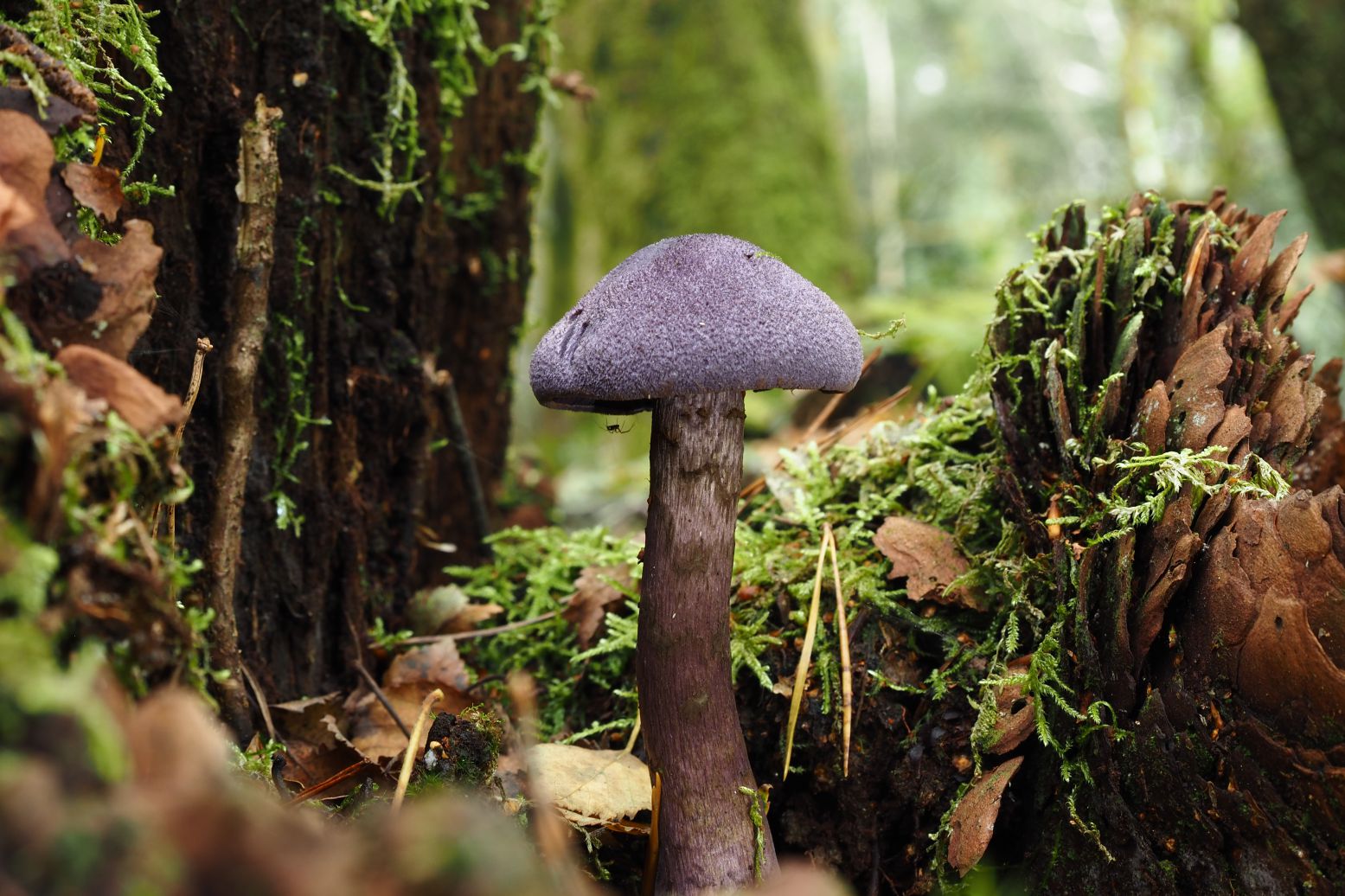
Looking back at the photos I could see a spider using the underside of the cap as a place to find prey. It’s a smart move as many small insects and other arthropods are attracted to mushroom gills and caps.

One of the highlights of this walk, literally, were the spreads of yellow staghorn in the moss.

Their likeness to flames is really pleasing. I also love how they grow out of a tiny alcove in fallen wood as if from a little firepit.

Here is an example of how far and wide the little fires were burning.

This ominous pumpkin of a fungus is probably a russula of some kind. I saw something similar in the same spot in September.
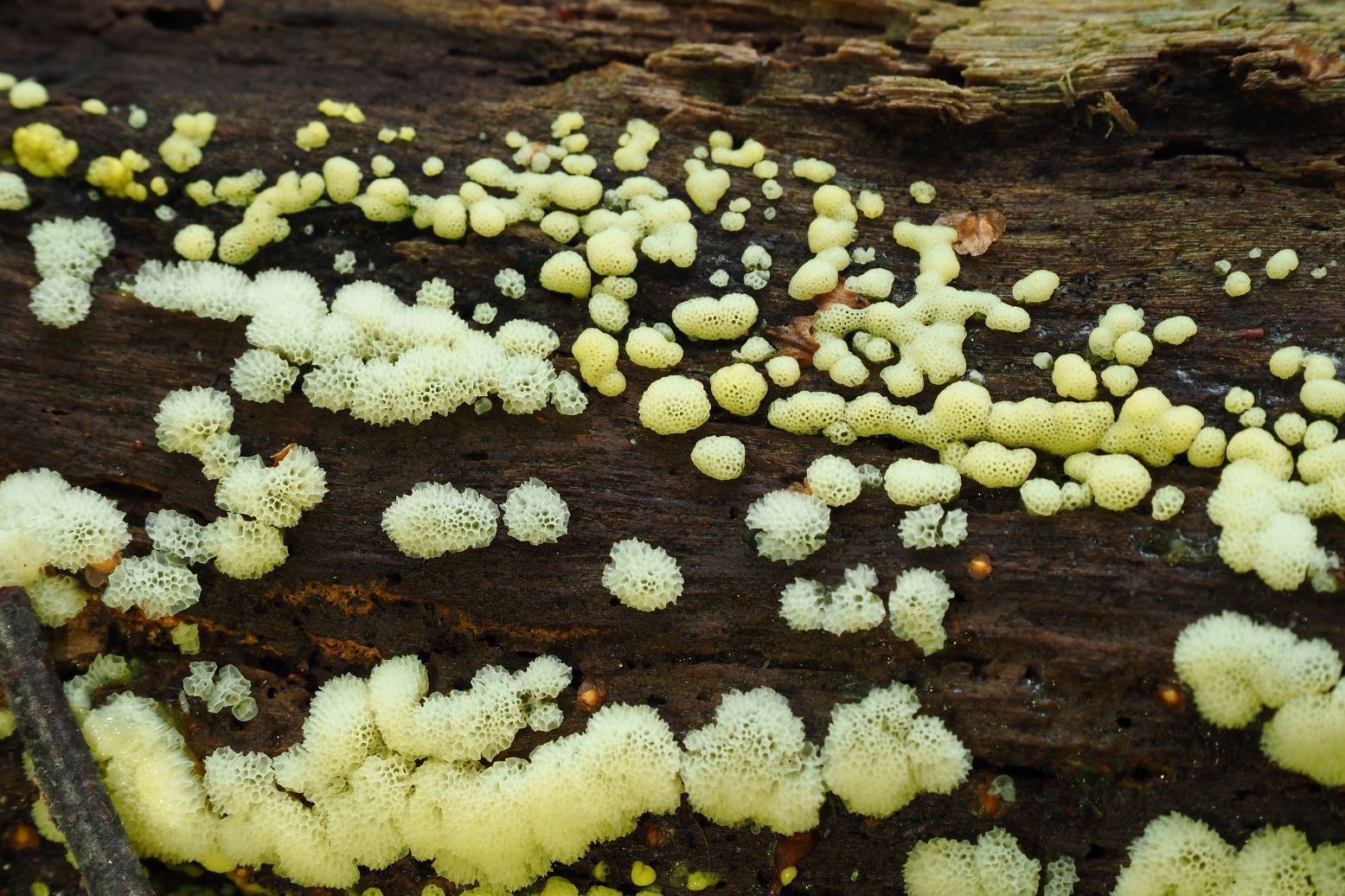
Here’s a short video showing the full extent of the slime I encountered!
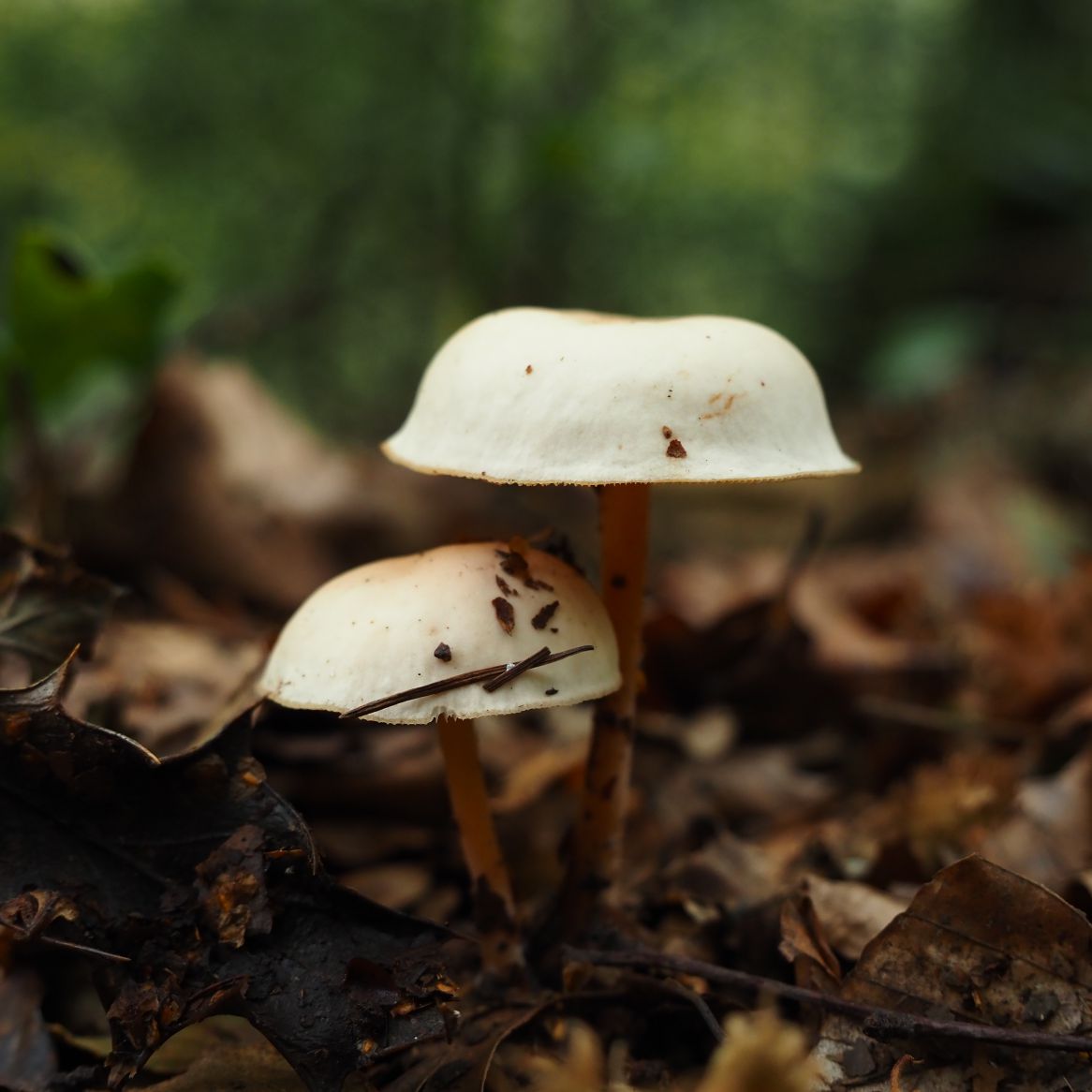
The light was growing dim as I made my way out, but these mushrooms were so bright I could see them from several metres away.
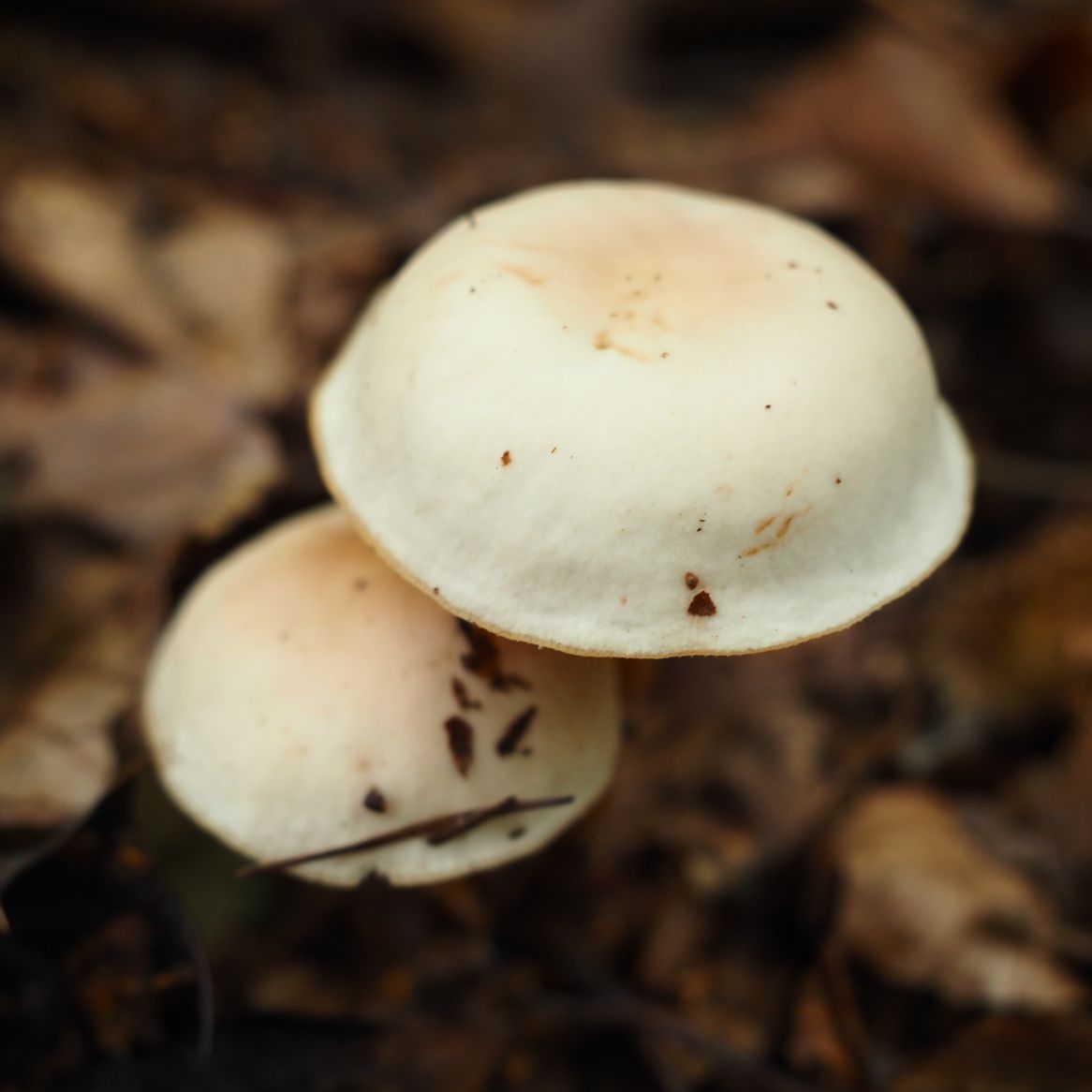
It was dark under the trees so I had to use a wide aperture setting (f4) to allow more light in, making the image quite dreamy. I think this is a species of dapperling.
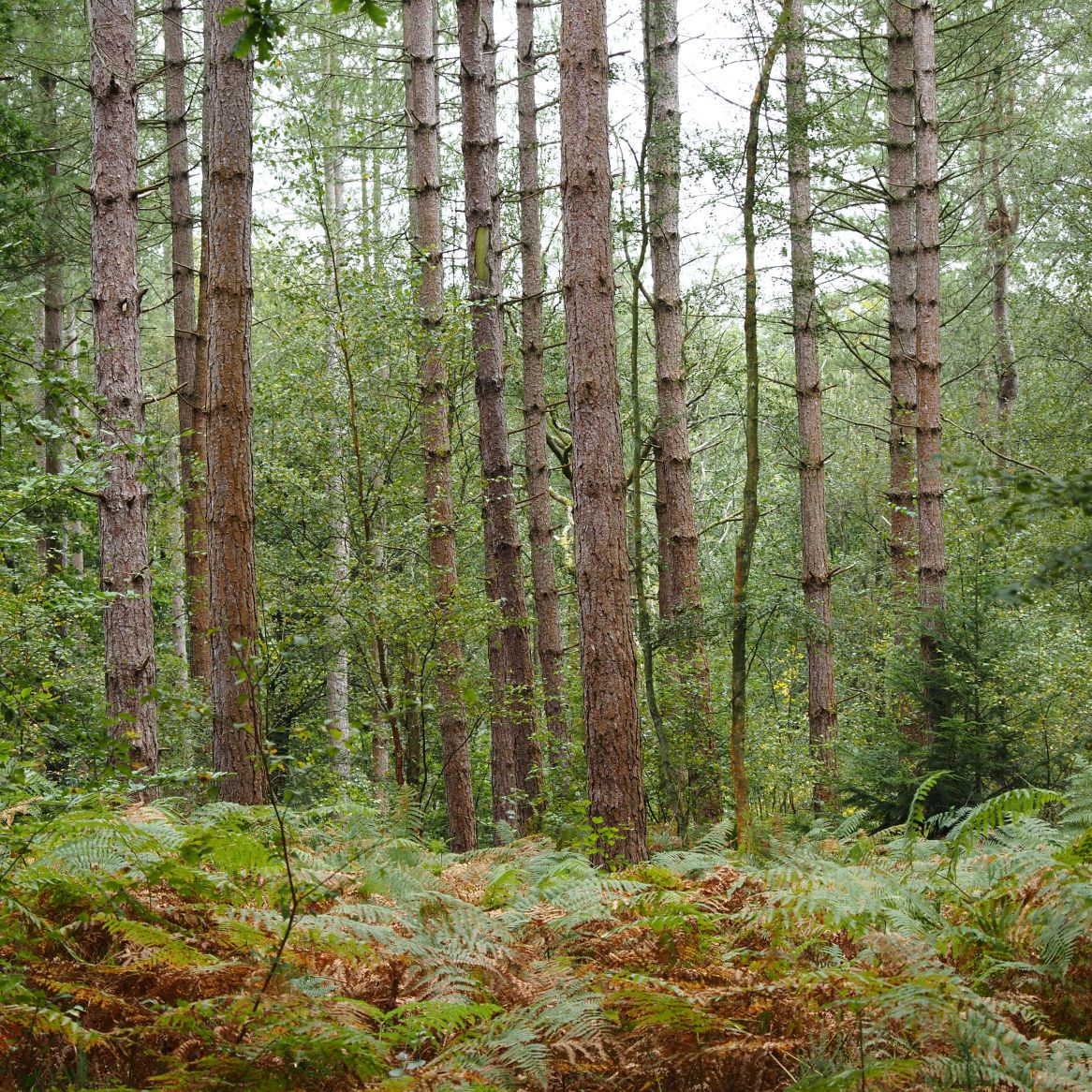
Thanks for reading and make sure to get out there if you can. The mushroom days are coming!
Photos taken with Olympus E-M5 MIII camera and 12-45mm f4 lens. Photos are straight out of the camera, no edits or crops made.
A walk from Forest Row to the Brambletye ruins in Ashdown Forest, with some ancient woodland and rocky outcrops scattered along the way.
What I am experiencing culturally in this rather wet winter of 2025-26
A long ramble (in both senses) around the oaken landscapes of Billingshurst, including the Wey & Arun Canal
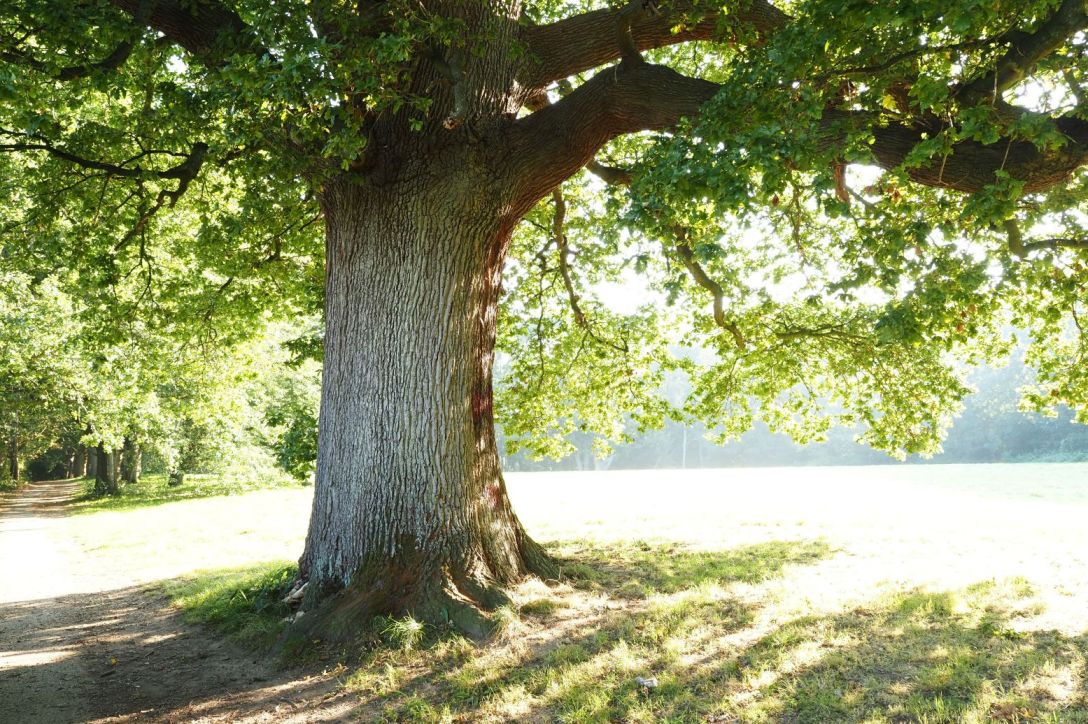
This week I stumbled across two of the more charismatic polypores you can find at this time of year. Polypores are bracket fungi that grow like shelves, usually from a tree trunk but sometimes also at the base or from a branch.
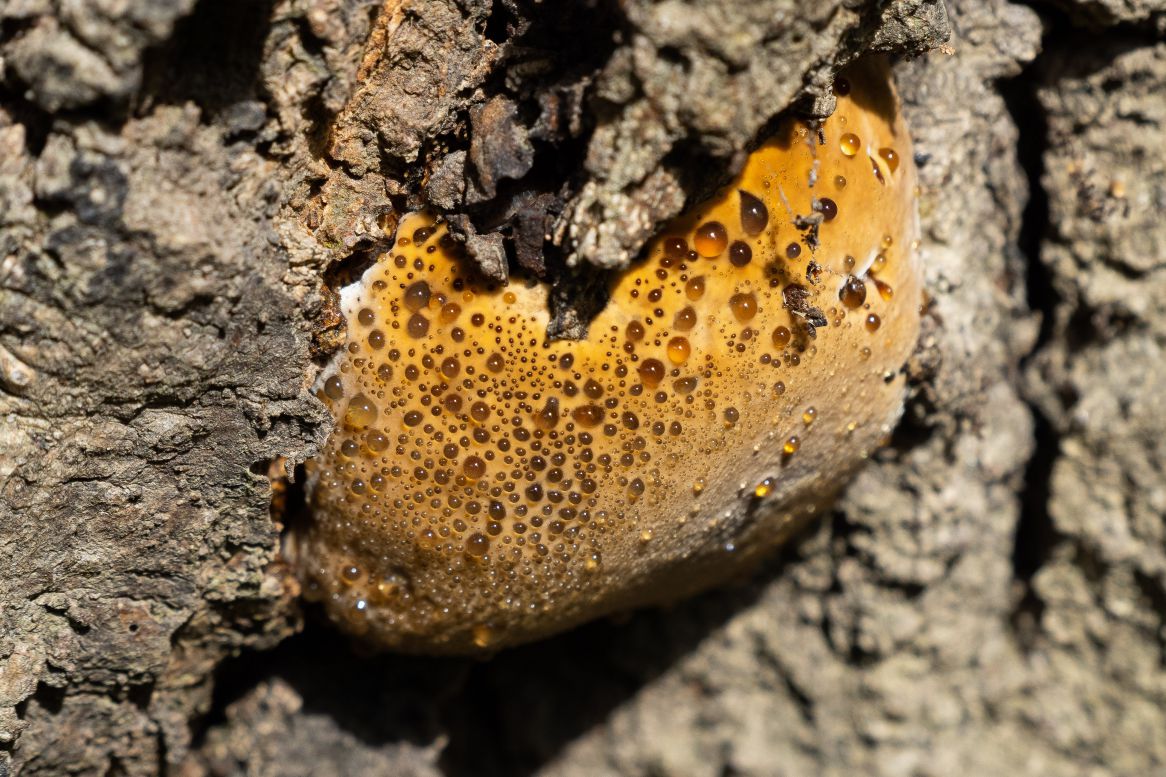
On a morning walk I went to check on the progress of a polypore I’d spotted several months ago (pictured above in late June 2021!), growing at the base of a large oak tree.
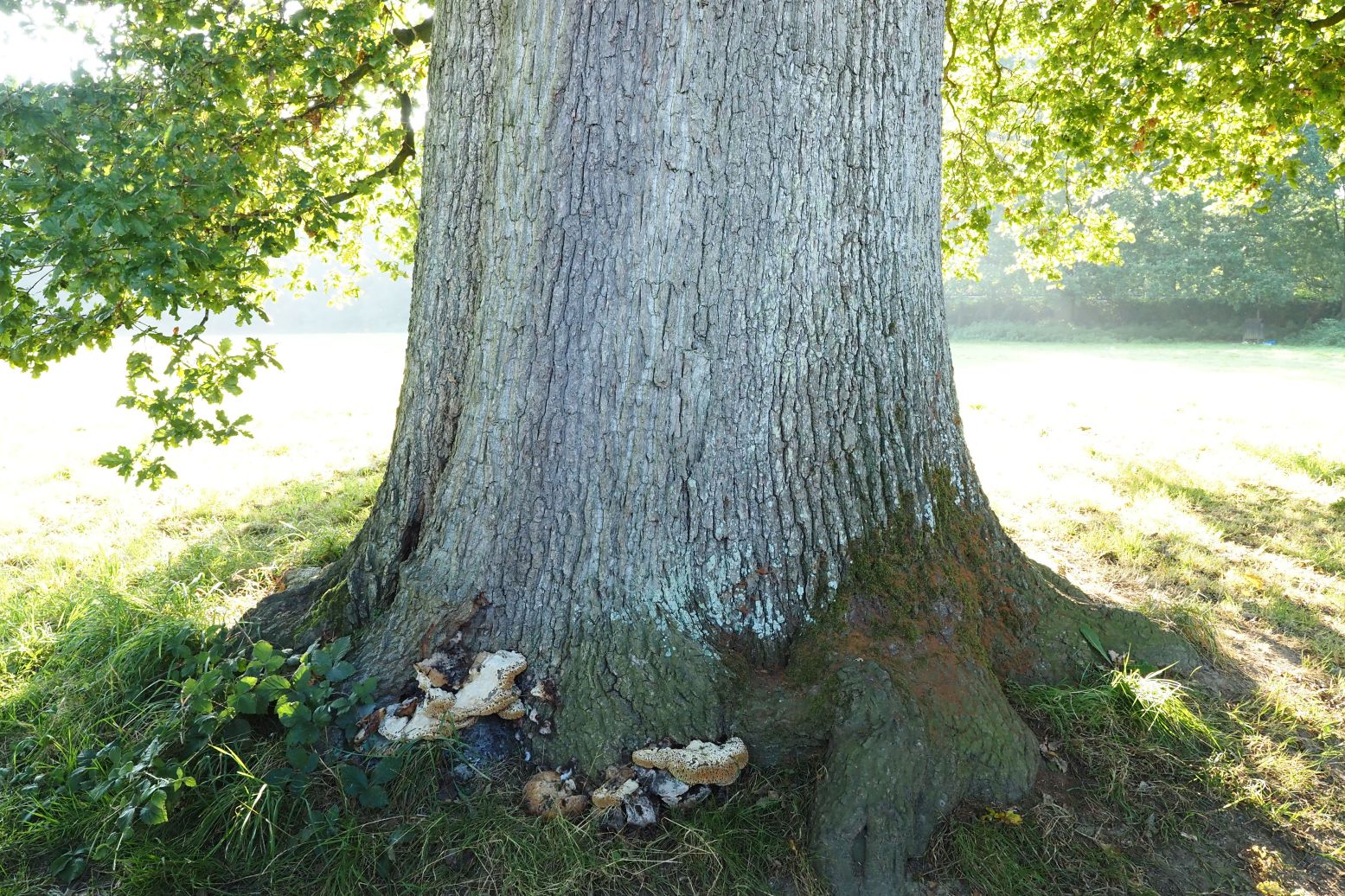
Oak bracket is one I posted about almost exactly a year ago during a visit to Suffolk. It also goes by the name of weeping conk, with a scientific name of Pseudoinonotus dryadeus. It’s a parasitic species, which means that this tree may be suffering some internal, ‘mechanical’ trouble. I hope not because it’s one of the largest in the area and is right next to a path. This makes it much higher up the chopping order if public health might be deemed to be at risk. I will never forget being taught that trees weren’t a hazard until we showed up.

This is a very attractive fungus, if you like a dough that drips caramel. It grows at a fairly critical part of the tree, where it meets the ground. It’s crucial because the tension of the roots holding the trunk upright.

Look into those hundreds of caramel eyes and tell me this is not one of the most beautiful fungi out there.

Later that evening I cycled out to the countryside on what was the end of a September heatwave. The landscape was very dry and smelly. I could smell the manure from my house two miles away in the daytime. That evening I became acquainted with the stench up close – muck spreading in the fields. It was absolutely rank, undoubtedly made far worse by the heat and lack of rain.

My route took me past the 800-year-old Sun Oak. Like the large oak I saw earlier that morning, this tree was also home to a charismatic polypore fungus.

This red button is a beefsteak fungus, Fistulina hepatica. It may also have been a red button – do not press the red button. Unless you want to continue watching this programme (BBC joke).
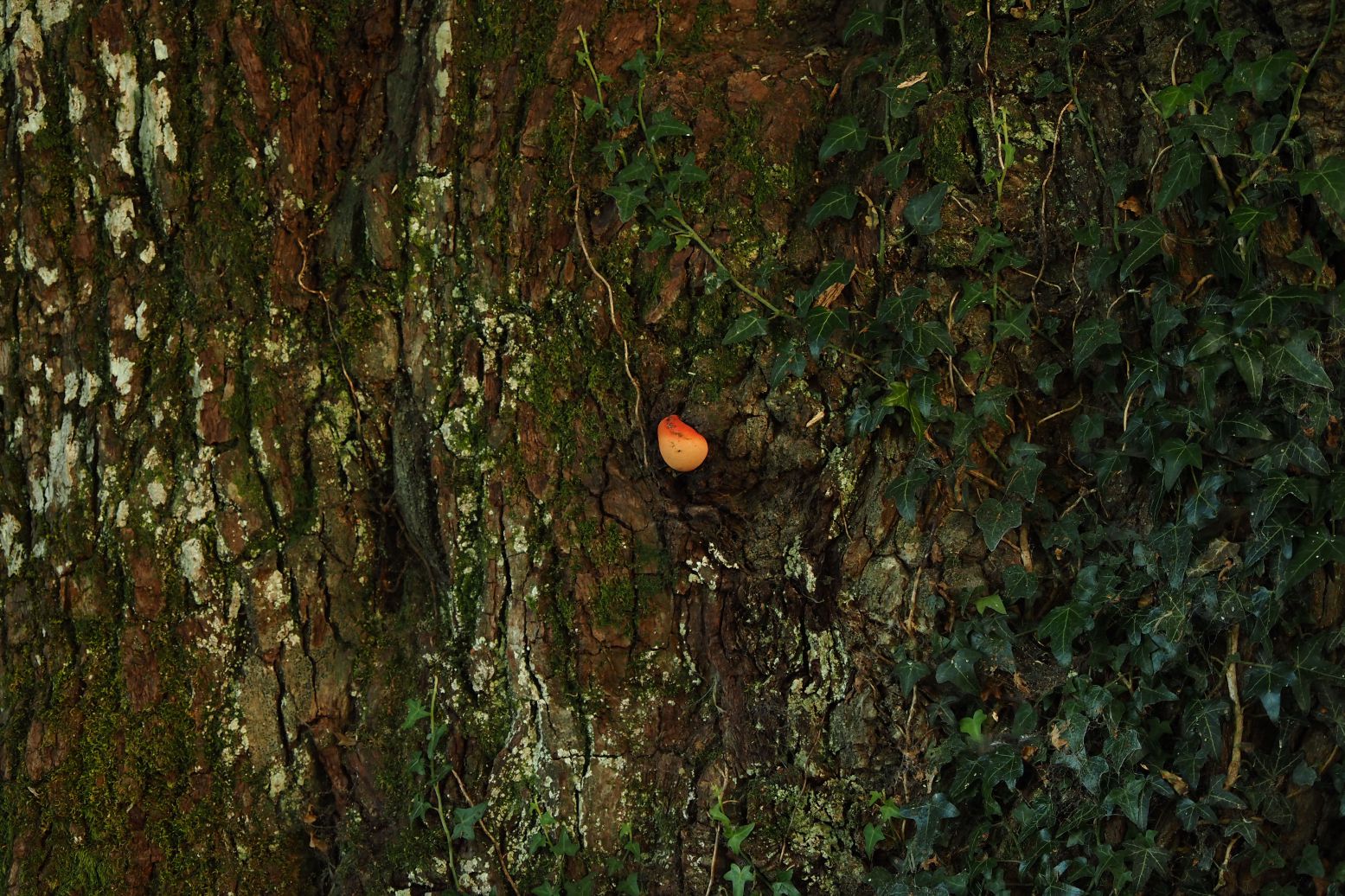
Oh go on then.
In reality this fungus will grow out to form something that looks like a human bodily organ (hepatica). It’s often on oak or sweet chestnut, especially more mature trees. It’s another parasitic species but it’s said to grow too slowly to ever cause the tree structural problems. We should remember that these fungi have been growing with their hosts for potentially millions of years. It’s the impact we have had on their habitats that have made the trouble. Check yourself before you wreck everything else.
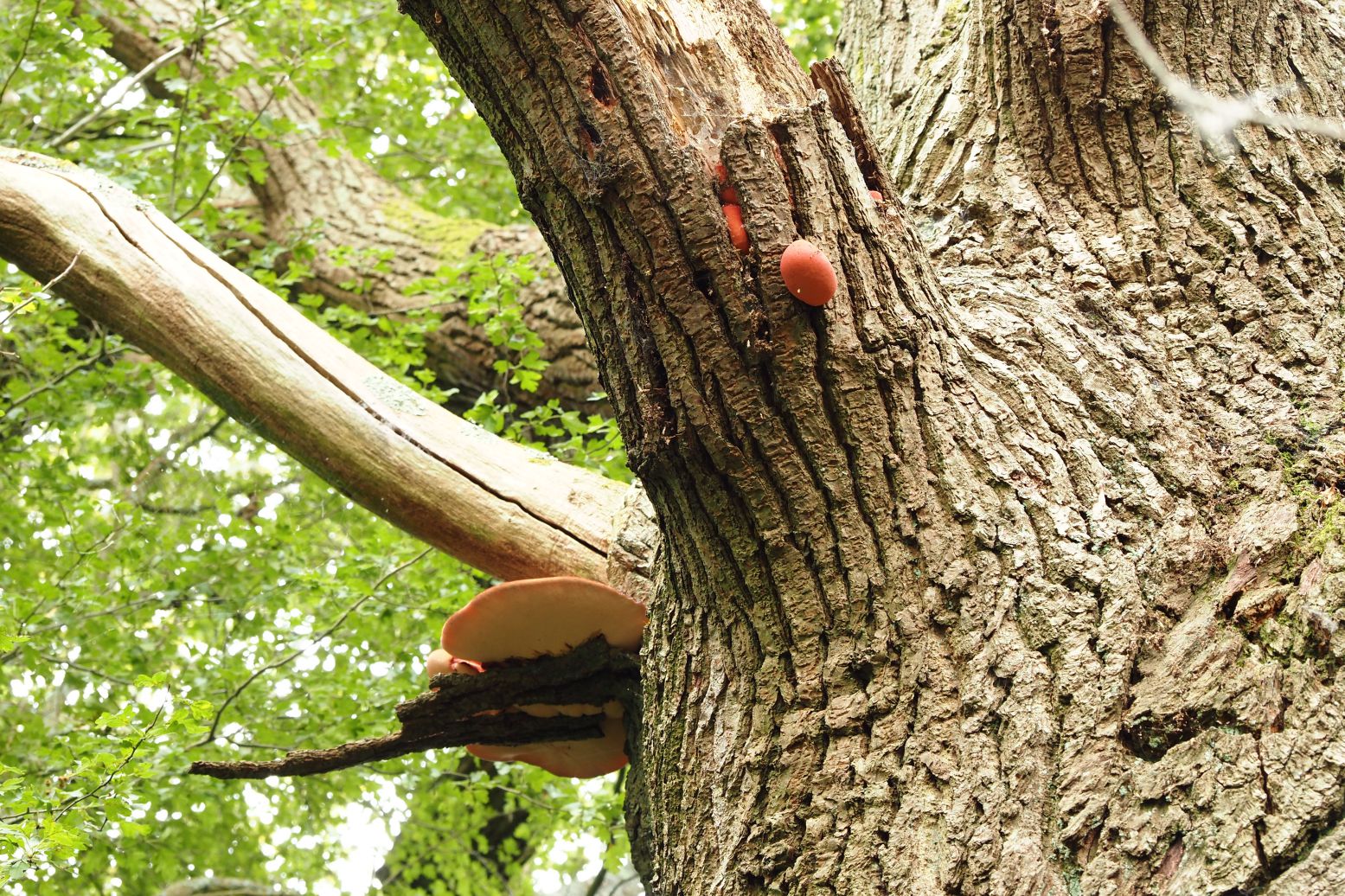
Here’s a recent example that cost me several milligrams in blood as the mosquitos were hanging out under this tree waiting for me to arrive. Beefsteak indeed.
Thanks for reading.

This week I’ve been researching an article about deadly mushrooms. That post will appear here at some point but I felt like I needed to fit in some quality time with fungi in real life, especially as we have technically entered autumn. I visited somewhere in the Sussex Low Weald which is one of the most reliable fungi reserves I know.
In reality I found almost nothing, but for one of the most deadly mushrooms in the business: the deathcap (Amanita phalloides).

I found these two deathcaps growing close together underneath a beech tree. There was something so very strange about this, seeing as I’d spent the previous day reading about them, and only the second time I’ve encountered the species. Both sightings were in September. The bite taken out of one of the mushrooms is a good pointer to the fact that other animals can eat this fungus and not die. Unlike many people who have sadly passed away after mistaking this fungus for something edible.
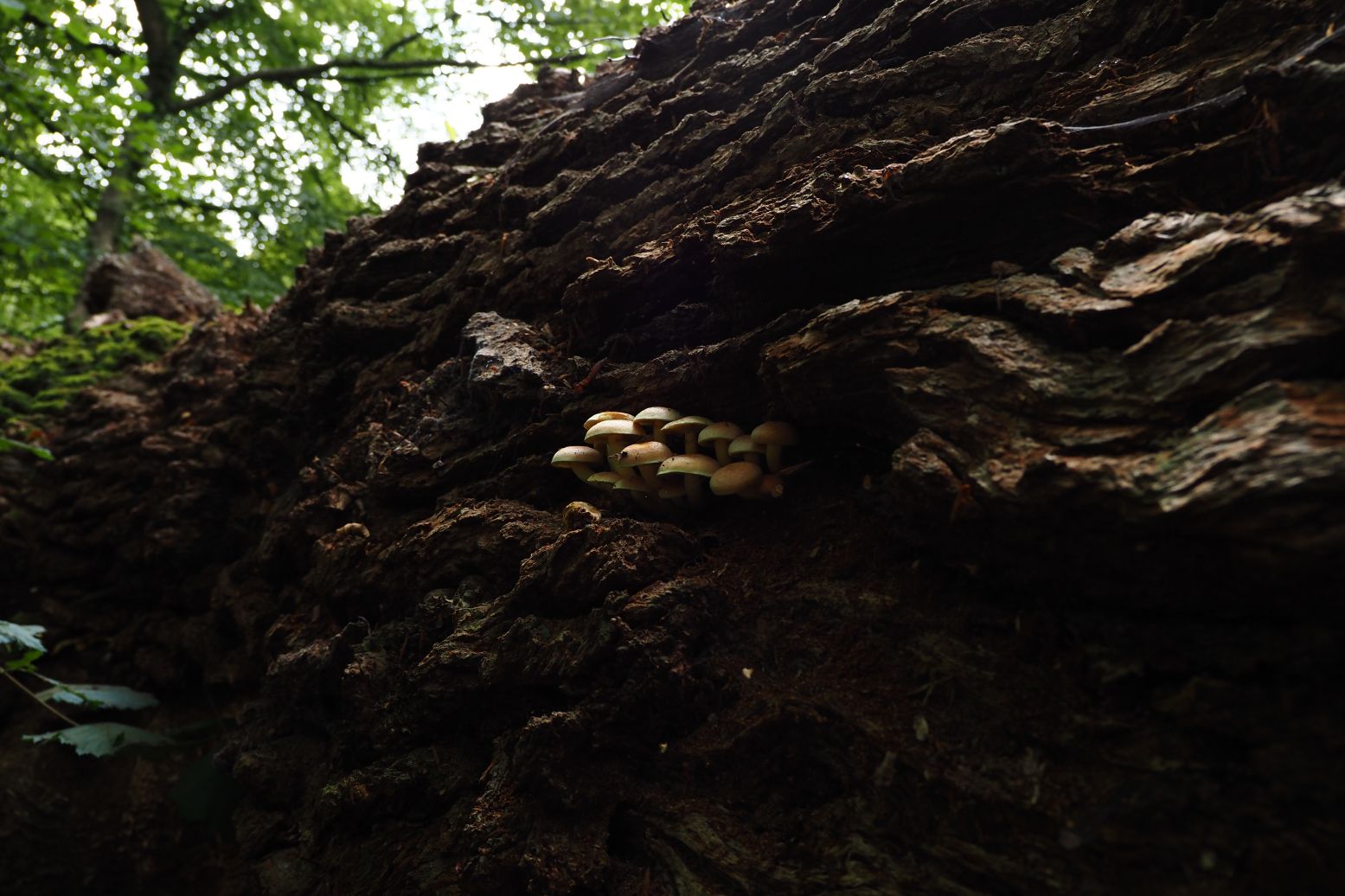
To find mushrooms to photograph in these dry periods, one of the best bets is to seek out large deadwood, particularly wood in shade. Sulphur tuft was the other mushroom I found, another toxic species. Seriously, what is that all about! Back off, nature.

In truth, sulphur tuft is one of the most photogenic species you can find. At this time of year when there is less rain it looks fantastic. It’s also supposed to be bioluminescent, glow-in-the-dark:

If you’re interested in that, this excellent podcast episode of The Mushroom Hour is a must listen. I learned that it could be the case that many more species of fungi were once bioluminescent. Over time, they have lost it.

Lichens are, fundamentally, ascomycote fungi. This means that they are much happier in wet weather. I was looking around an old oak stump when I found this beautiful heart-shaped Usnea lichen.
It’s nice to end on a fungus that won’t kill you.
Thanks for reading. Don’t eat poisonous mushrooms.
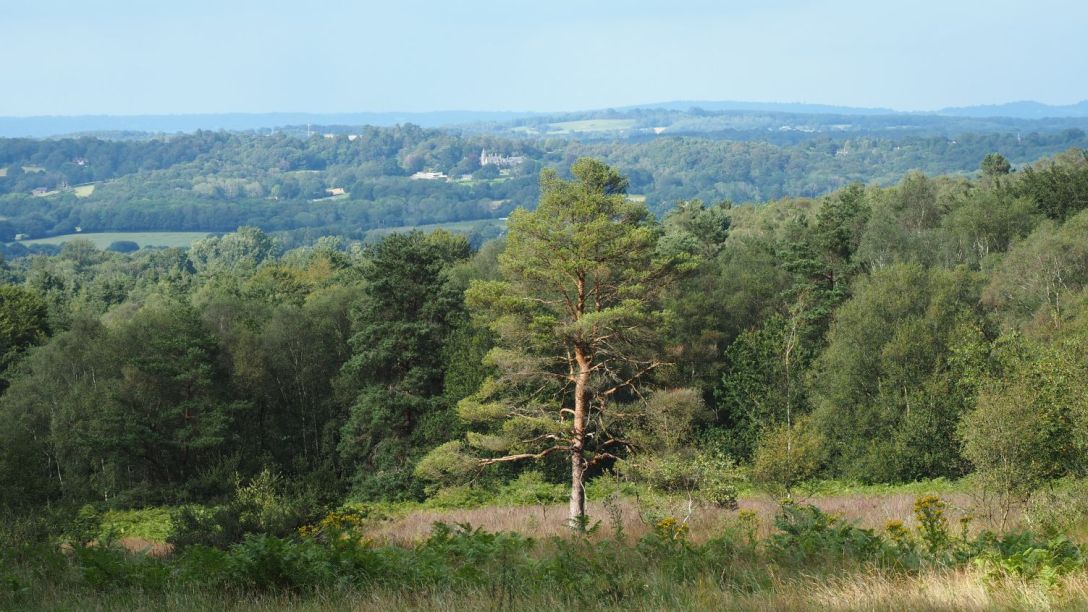
I was lucky enough to have a couple of hours to spend in Ashdown Forest last week. The light was beautiful and the views expansive across this famous part of the Sussex Weald. For those who don’t know, Ashdown Forest was the inspiration for A.A. Milne’s Winnie the Pooh. I very nearly titled this blog ‘Winnie the shroom bear’.
The mushroom situation at the moment in Sussex is one of a twilight late summer boom, with not really enough rain recently to feed the fungi and maintain the fruiting window. However, where there is shade there is moisture and therefore there is hope.
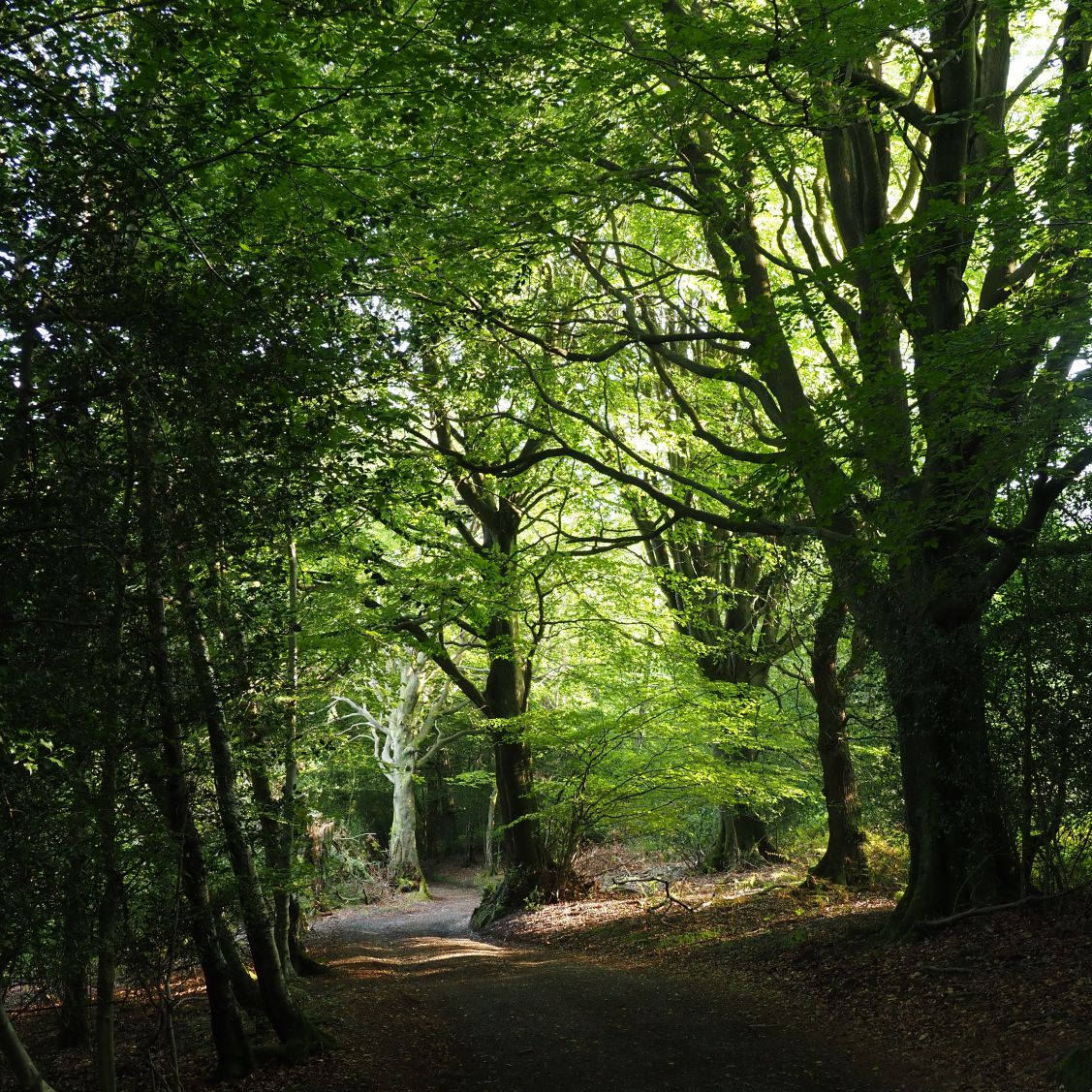
I followed a path into the woodland, away from Ashdown Forest’s famous heathlands. The ground did look quite dry, so I wasn’t expecting to find too much growing from the soil.
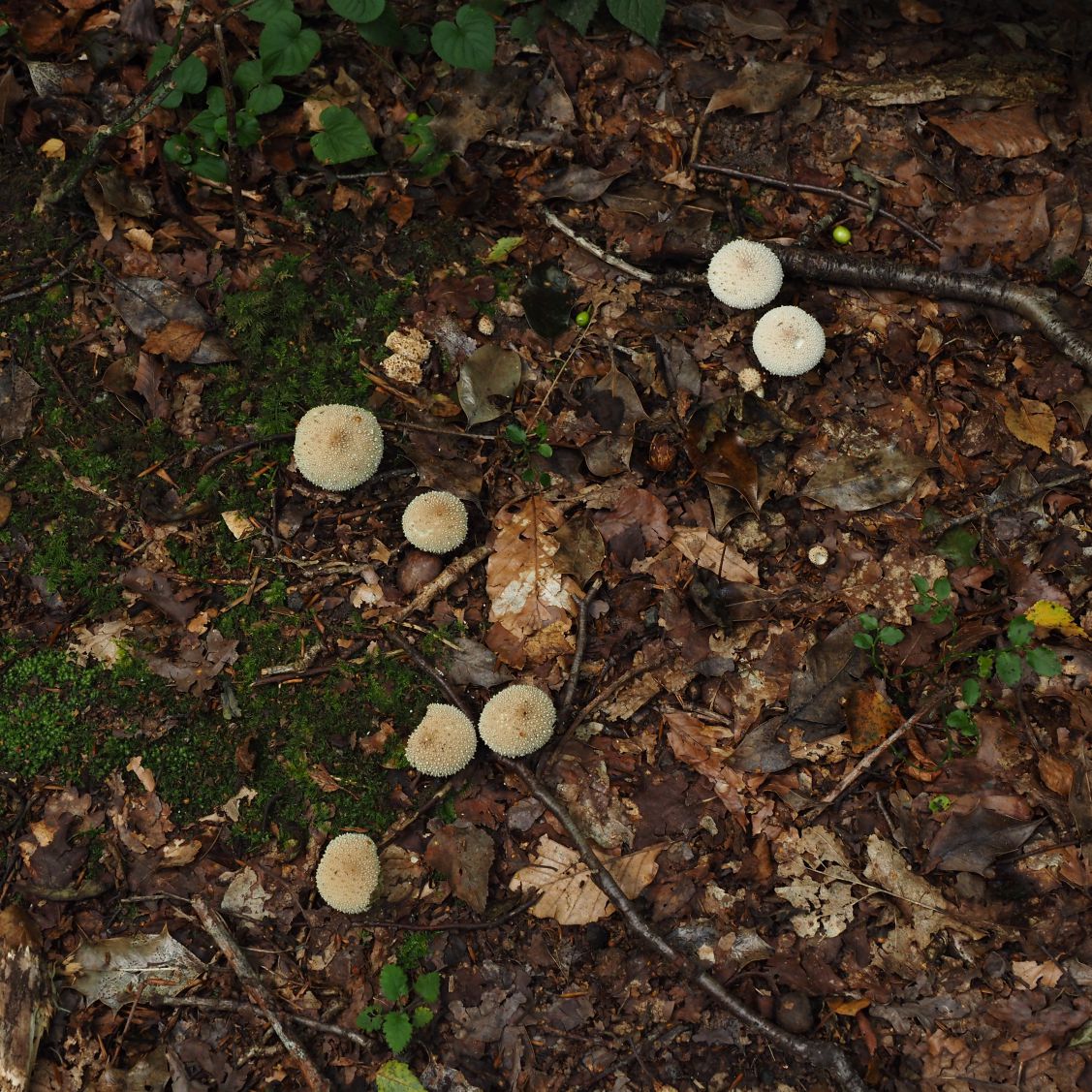
My first sighting was, in fact, in the soil. In the shade at the edge of the path I found a group of common puffballs.
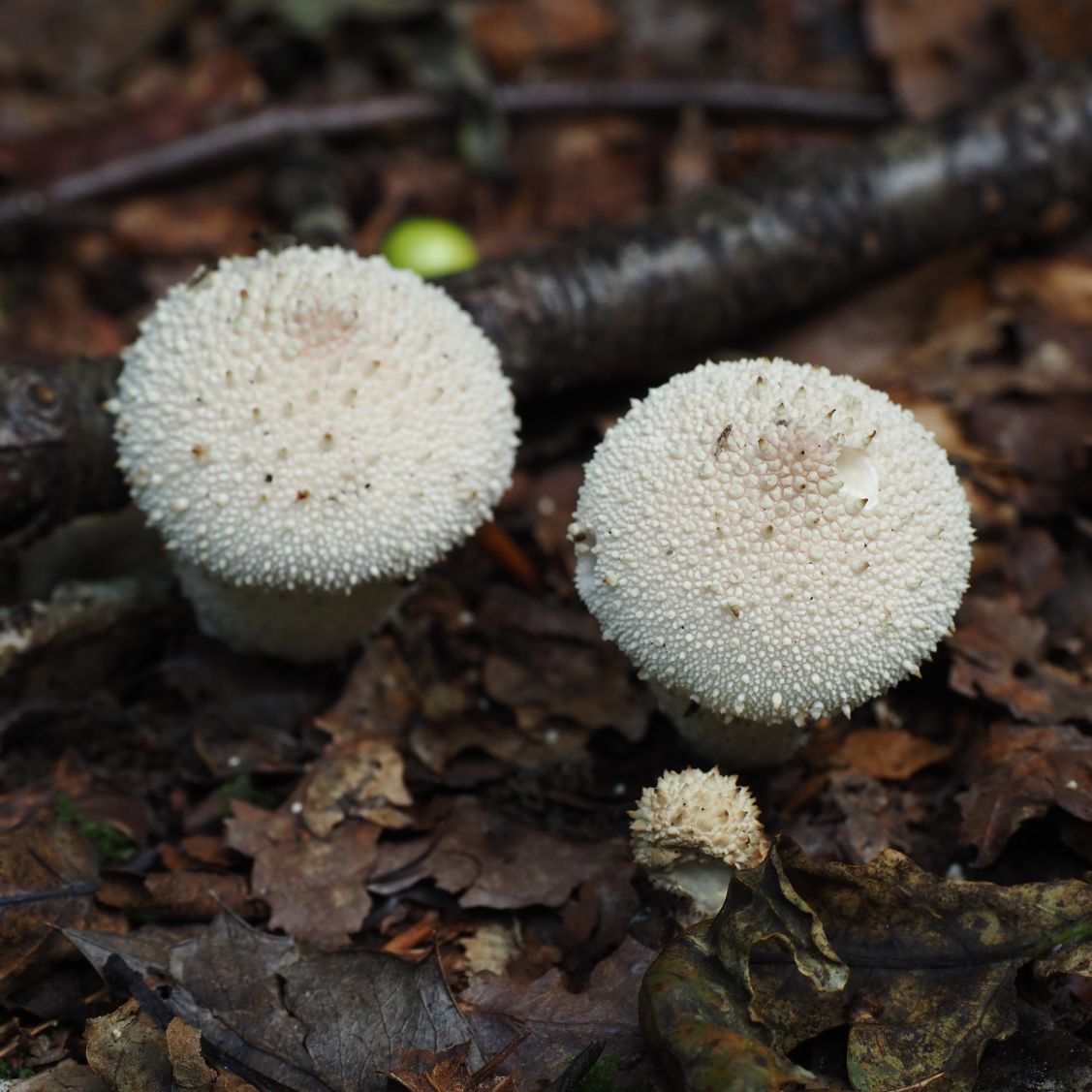
This is an edible species, and though two looked in fairly good condition, I wasn’t looking to forage for food.
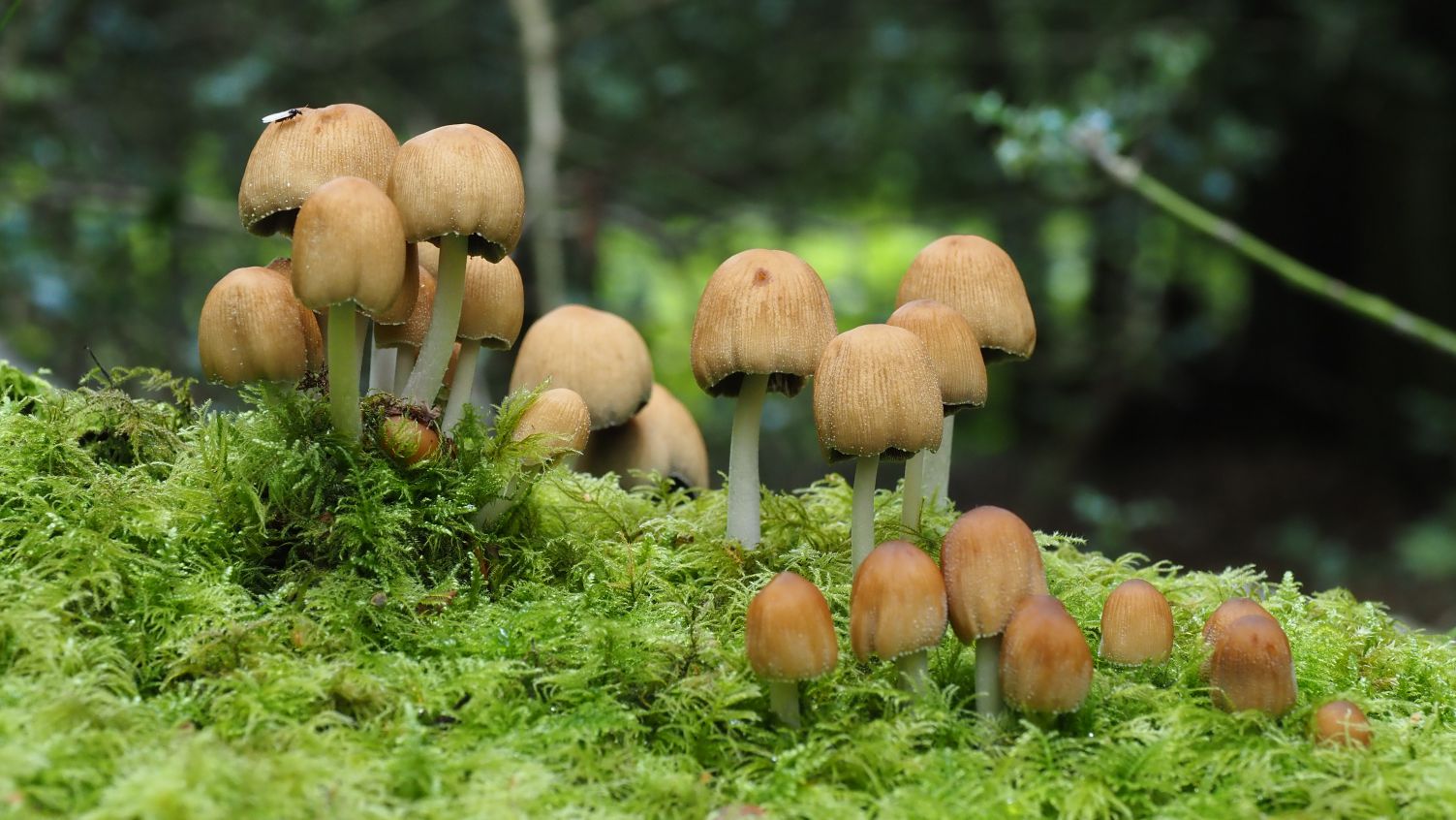
On the opposite side of the path a piece of wood was covered in feather moss. The moss was home to a gathering of glistening inkcap mushrooms. They were in wonderful condition, with varying stages of growth in the bright green bed of bryophytes.

Under a beech tree I noticed some large fallen wood sitting in heavy shade. This is always a good place to find fungi because there will be high levels of moisture and damp throughout the year. Especially under beech which casts heavy shade through its leafing phase.

My guess for this species would be stump puffball which grows in large numbers on decaying wood. From a distance they looked like fairy inkcap, but were of course much larger when looking properly. As I knelt down to take these photos, the sunlight broke through on occasion and then faded away. It was a fateful fungi photo.
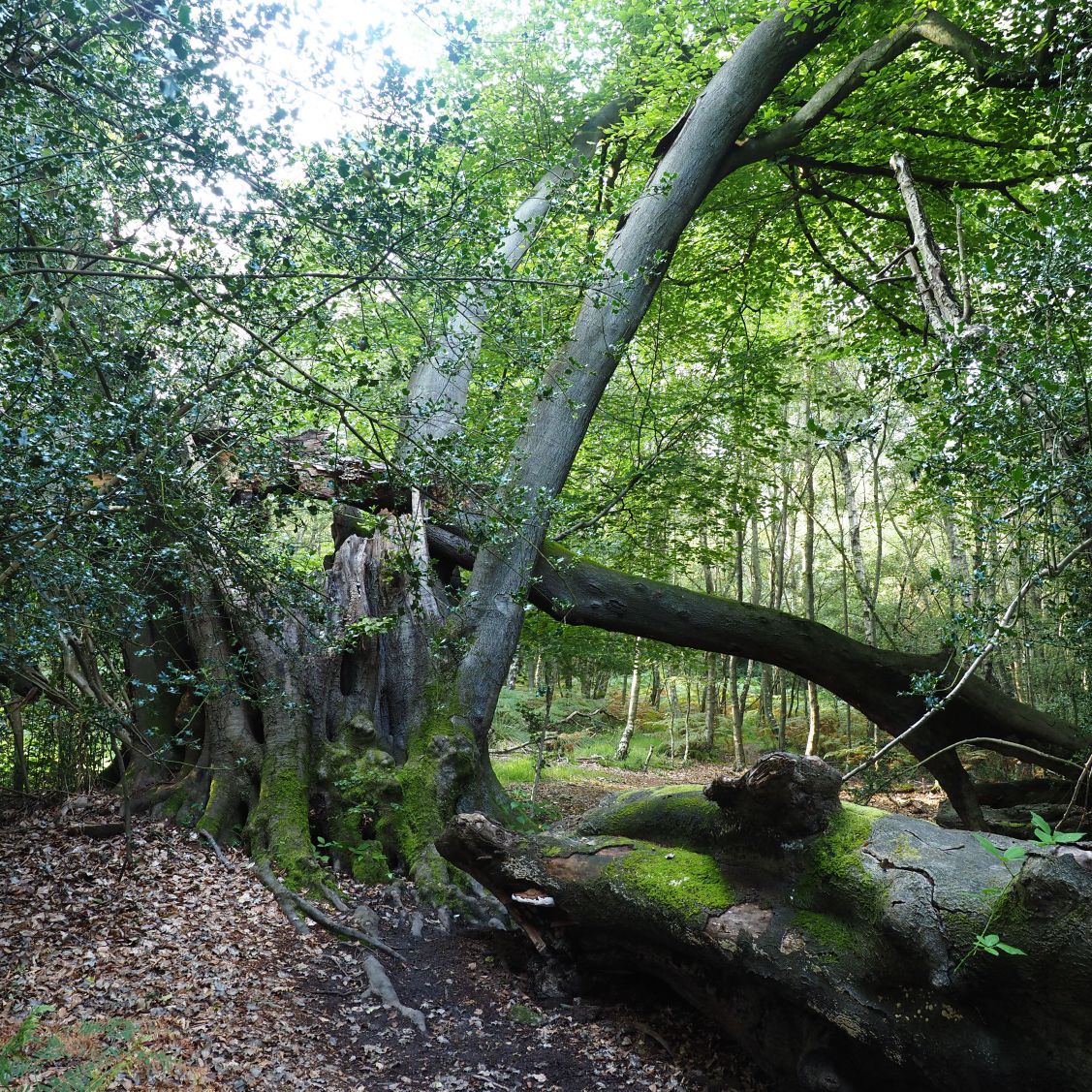
Off of the path, as I considered whether there was enough time to take things a bit deeper into the woodland, I found an incredible beech tree. This looked like an old beech pollard (regularly cut high) or perhaps a coppice (regularly cut to the stump for regrowth). It had lost a huge limb which lay in front of it, providing a home for a Ganoderma bracket fungus, as so many beech trees both standing and fallen do.

I don’t know Ashdown Forest at all well. It feels to me quite an elusive place. This short walk allowed me to experience more of its quiet allure. I hadn’t expected to see so many unusual beech trees, which would probably qualify as veteran with the discerning experts out there.

This is another wonderful beech tree which has experienced damage to its trunk. The image above shows the tree’s own ‘aerial’ roots feeding of its own decaying wood. No doubt fungi has its role here in helping the tree roots to feed on itself by softening up the wood with its own decay processes.
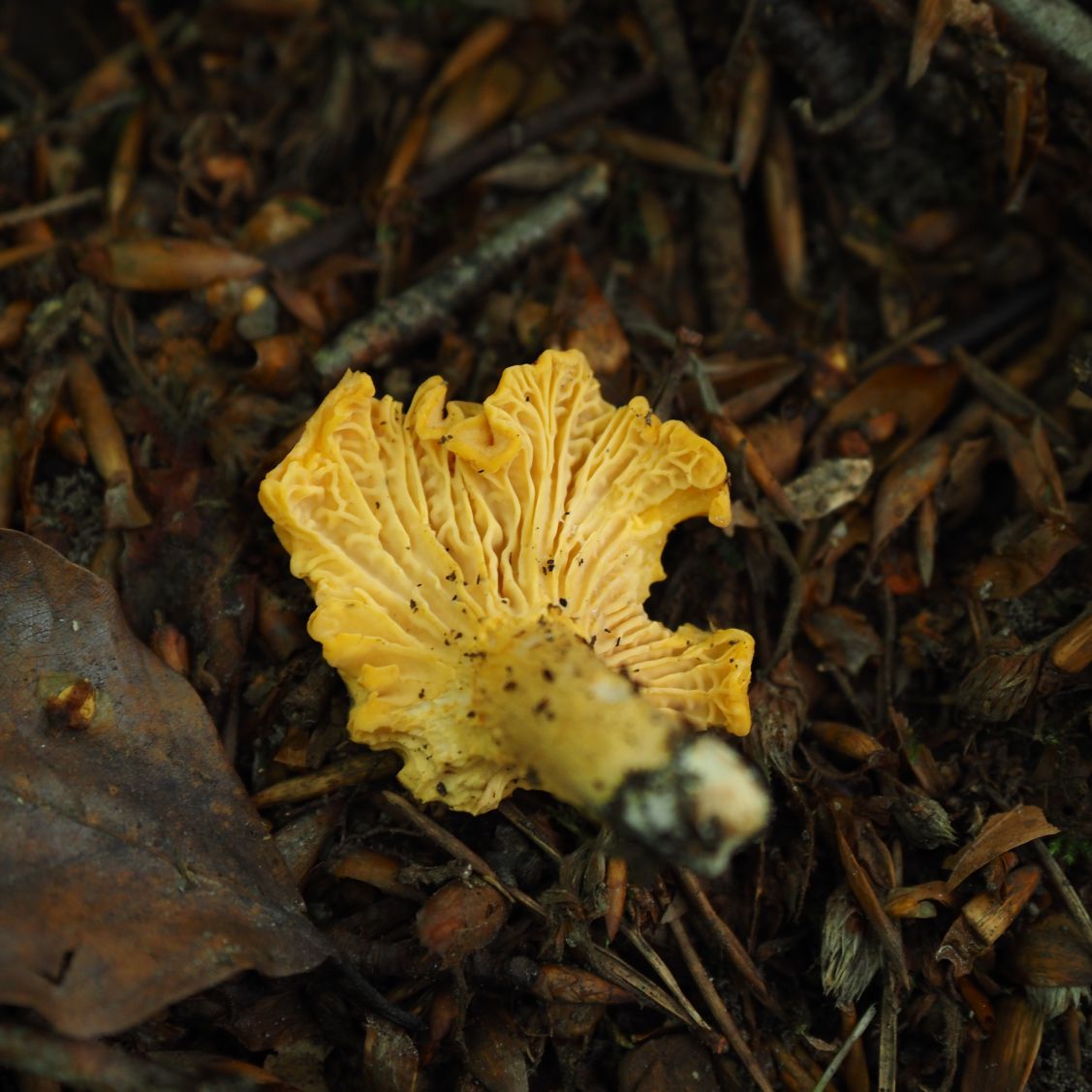
My hour was up and I had to head back to the car park. On the return leg I noticed some very small yellow mushrooms on the bank built up along the footpath. It clicked that they were probably chantarelles. I looked at the gills of one that had fallen loose and could confirm they were. There is a beech leaf in the left of the image above which provides scale – they really were tiny.
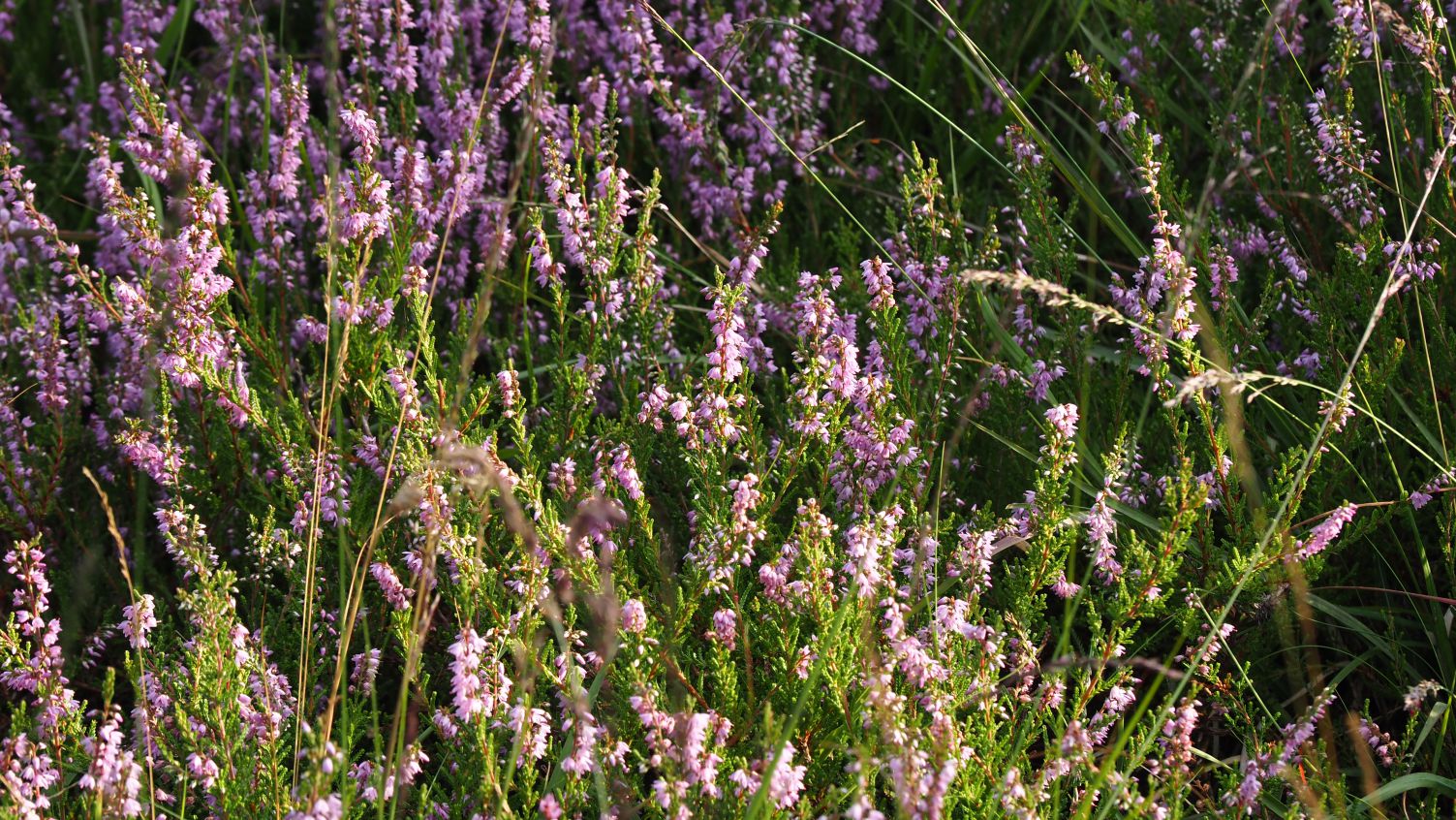
On the way out I noticed the heather was flowering, one of the final acts of summer. It’s always good when there are shrooms on show to support this darkening shift in seasons. The days are getting shorter, the leaves will soon be on the turn and the mushrooms will be arriving.
Thanks for reading.
.jpg)
 Unlocking Landscapes