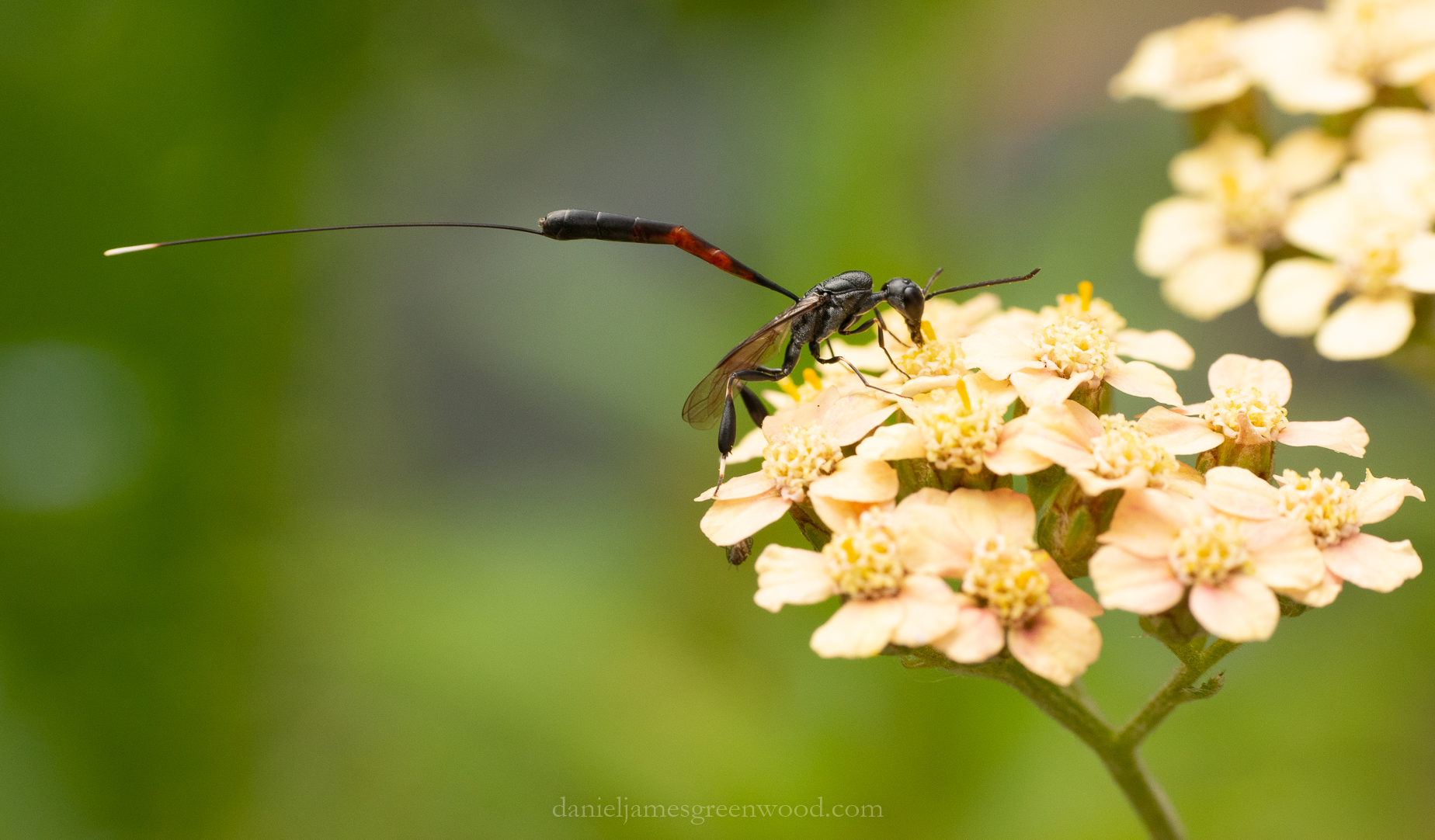
Macro Monday 10th August 2020
Welcome to the weekly wasp.
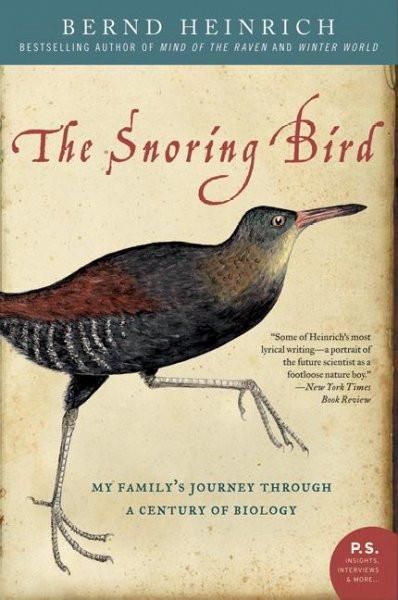
A couple of years ago my friend recommended a book called The Snoring Bird by Bernd Heinrich. The book is a memoir about Heinrich’s relationship with his father, Gerd, an entomologist who collected ichneumon wasps but who was never fully accepted by the scientific or academic community. Bernd tells the story of his father’s escape from the Red Army in 1945 and how he buries his collection of ichenumonids so they aren’t destroyed. Gerd travelled around the world collecting specimens.
In Britain we have poorer biodiversity than even our closest continental neighbours because of physical separation from the European landmass, intensifying land management practices, the impact of successive ice ages and, furthermore, the fact our climate is not tropical. But even then, we still have over 2000 species, which you can’t say for other fauna like birds or butterflies.
Reading The Snoring Bird consolidated a personal fascination with wasps, one which has not really travelled beyond blogposts, photos and seeking them out where I can. I’m not a collector of anything other than images.
Ichneumons have what we perceive as an unpleasant ecology. Females use their needle-like ovipositor to ‘inject’ their eggs into the burrows of insects, into crevices in wood or, most appallingly to our species, caterpillars or the larvae of bees. The eggs hatch inside the live caterpillar and eat it. It’s probably where the inspiration for the Alien films came from. To balance things out, insects inspired the creation of Pokemon.
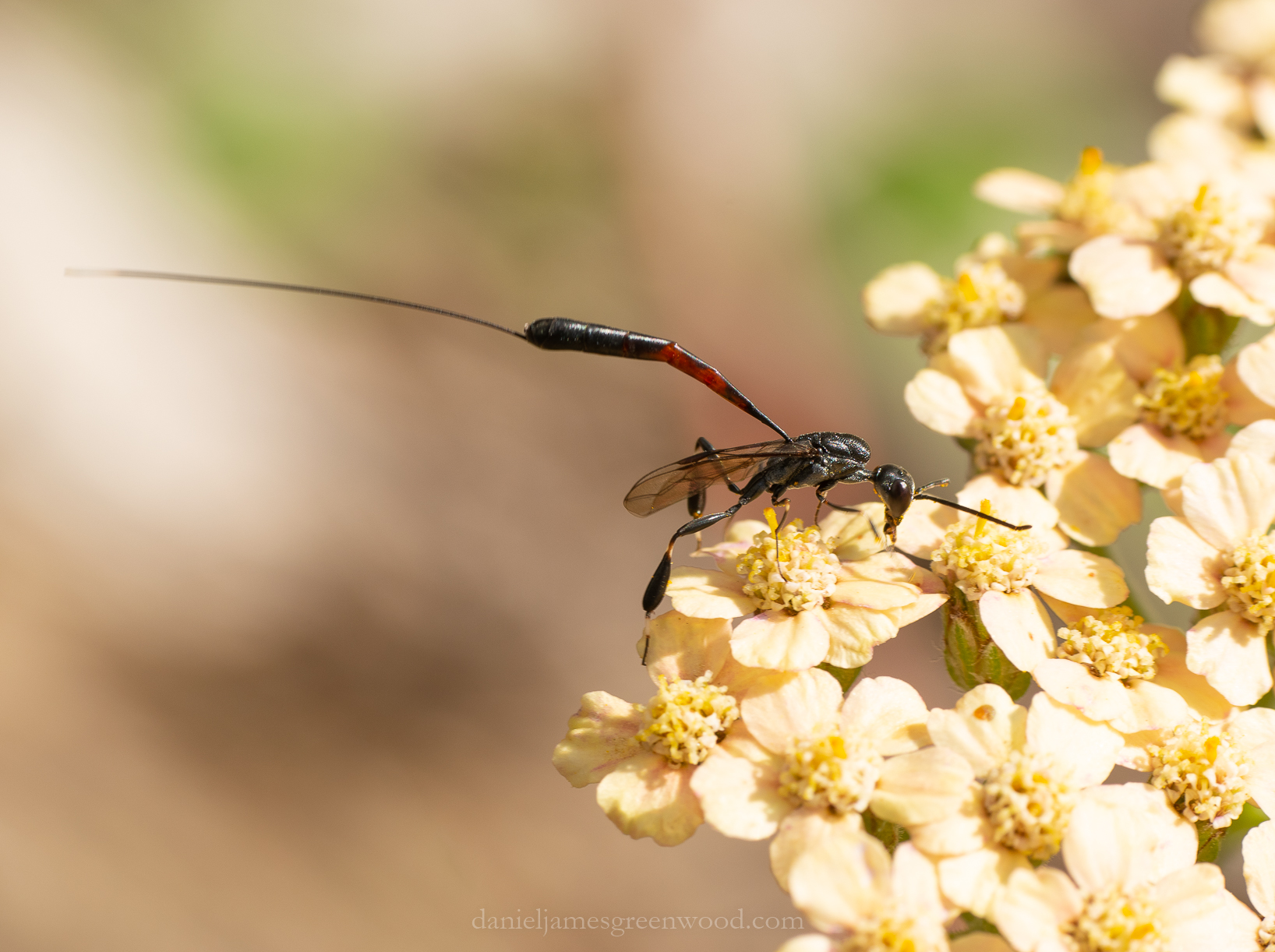
Last week I was sitting in my garden catching up with visiting family. I looked to my right at a pot of ornamental yarrow flowers (Achillea). I had noticed a bit of activity and glanced over to see a slender insect flying around the flowers. It was the equivalent of a video buffering over a poor quality internet connection. When it landed on one of the flowers I recognised it instantly as an ichneumon wasp. I ran inside to get my camera and managed to get some good photos: in focus, well lit and sharp enough.
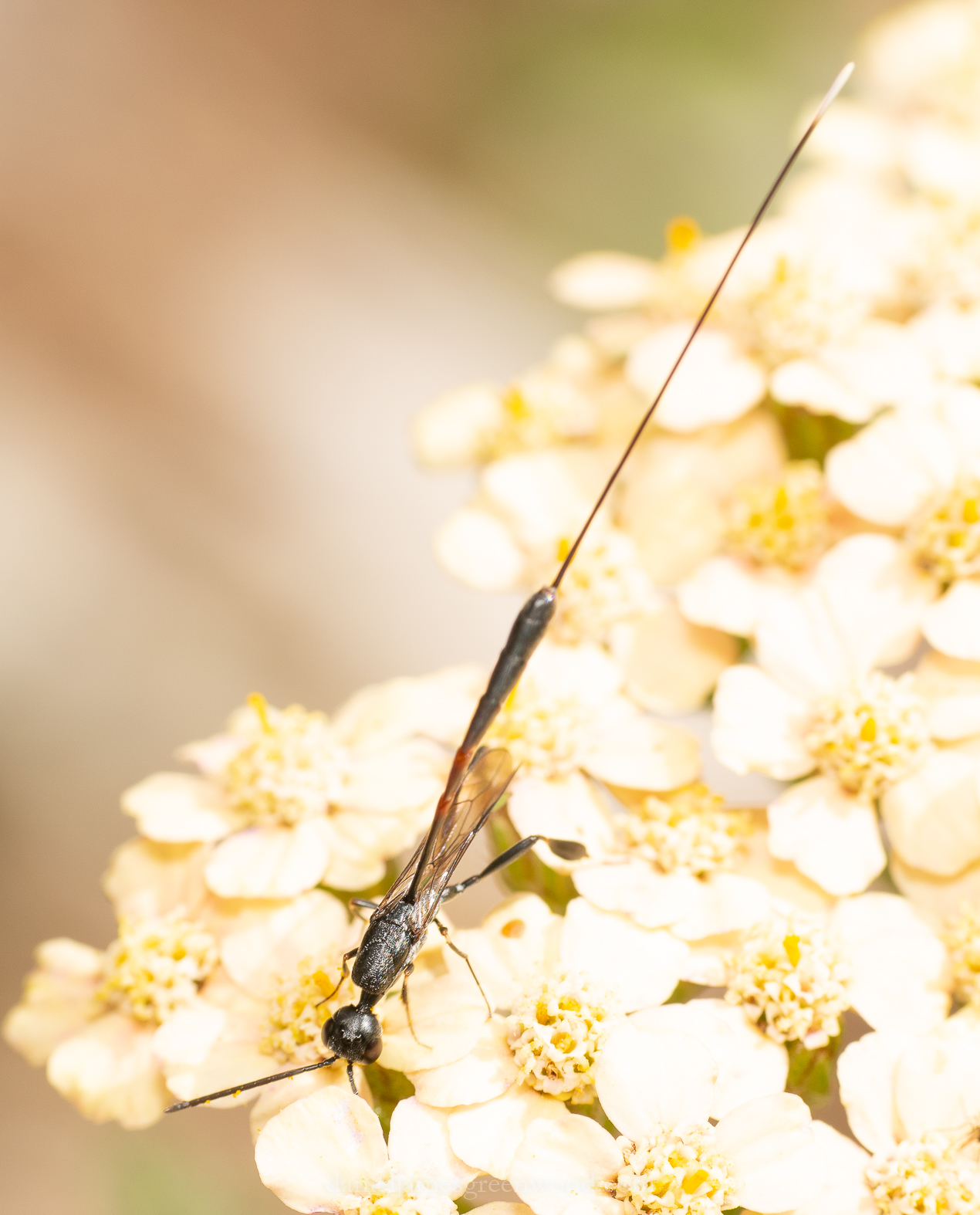
I have always wanted to see this species. Its scientific name is Gasteruption jaculator. To find it in my garden was a real surprise and one of the highlights of my time seeking wildlife.
Why might it have visited? We actively garden for wildlife, insects particularly, and there is a log store that this kind of species will seek out. A couple of months ago I saw a similar species hovering around the logs, but I couldn’t get my camera quick enough and it moved on.
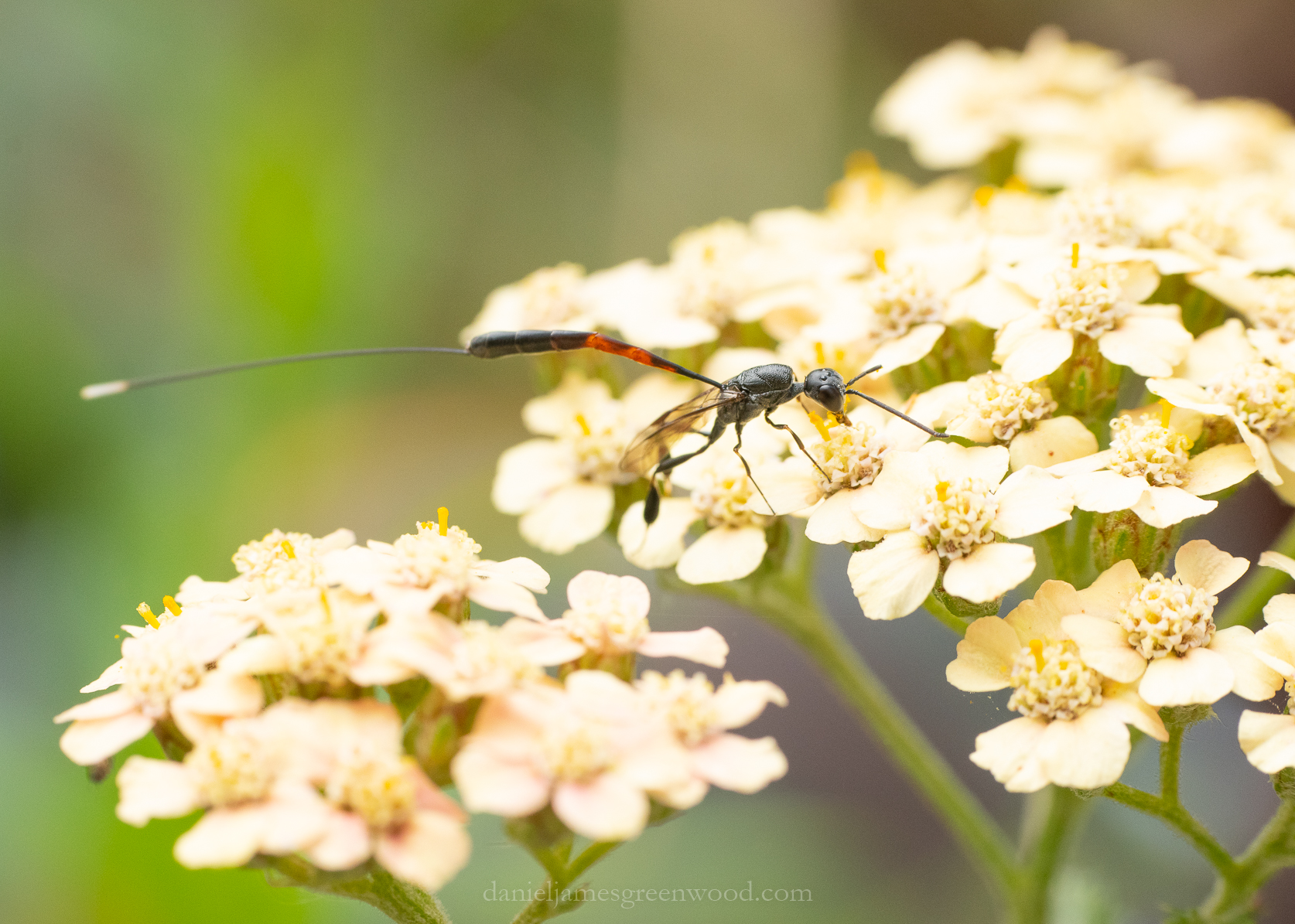
There are people whose first reaction to seeing this insect may be to kill it because of its ecology. That, to me, says everything about our misunderstanding of nature. A natural history lesson will tell us that without solitary wasps such as these we would have no social bees, a community of insects which prop up our dependencies on pollination of both crops and other flowering plants (including trees). Social bees evolved from solitaries wasps. The ichneumon’s ecological relationship with bees is one millions of years old, one small part of a web of life that has given human societies licence to develop through an abundance of food.

However, this is an insect which has affected the way some of the science’s key thinkers have framed their own mortality. Darwin doubted that any benevolent God could have created animals which behaved in this way. Not sure about you, but I often think that about Donald Trump or Boris Johnson.
A few years ago I encountered a cousin of the ichneumon that visited me in my garden. It has a far shorter ovipositor and its scientific name is Gasteruption assectator. I was walking on the North Downs when I found the insect nectaring on hogweed flowers. A woman passed me and asked what I had found. I said I’d found the insect that made Darwin doubt God. She looked away with a knowing smile:
‘I remember reading about them,’ she said.
Thanks for reading.
More macro
Recent photos taken with Nikon D5600, Sigma 105mm F2.8 macro lens, Nikon SB700 flash and Raynox 250 adaptor.


 Unlocking Landscapes