The ruins of Brambletye

Ashdown Forest in the Sussex Weald, East Sussex, June 2024

It’s time to unearth another Sussex gem from 2024 with a walk to the mysterious Brambletye Ruins. It was an after-work jaunt, starting in the village of Forest Row in East Sussex.

We didn’t stop, clocking up 6.5 miles in 2 hours which is unusually fast for me. There are a couple of B-roads to engage with so take care on those as people can be quite careless with their speed on rural roads. There are no streetlights so you may want to bring a hi-vis and a torch to make yourself visible in lower light.
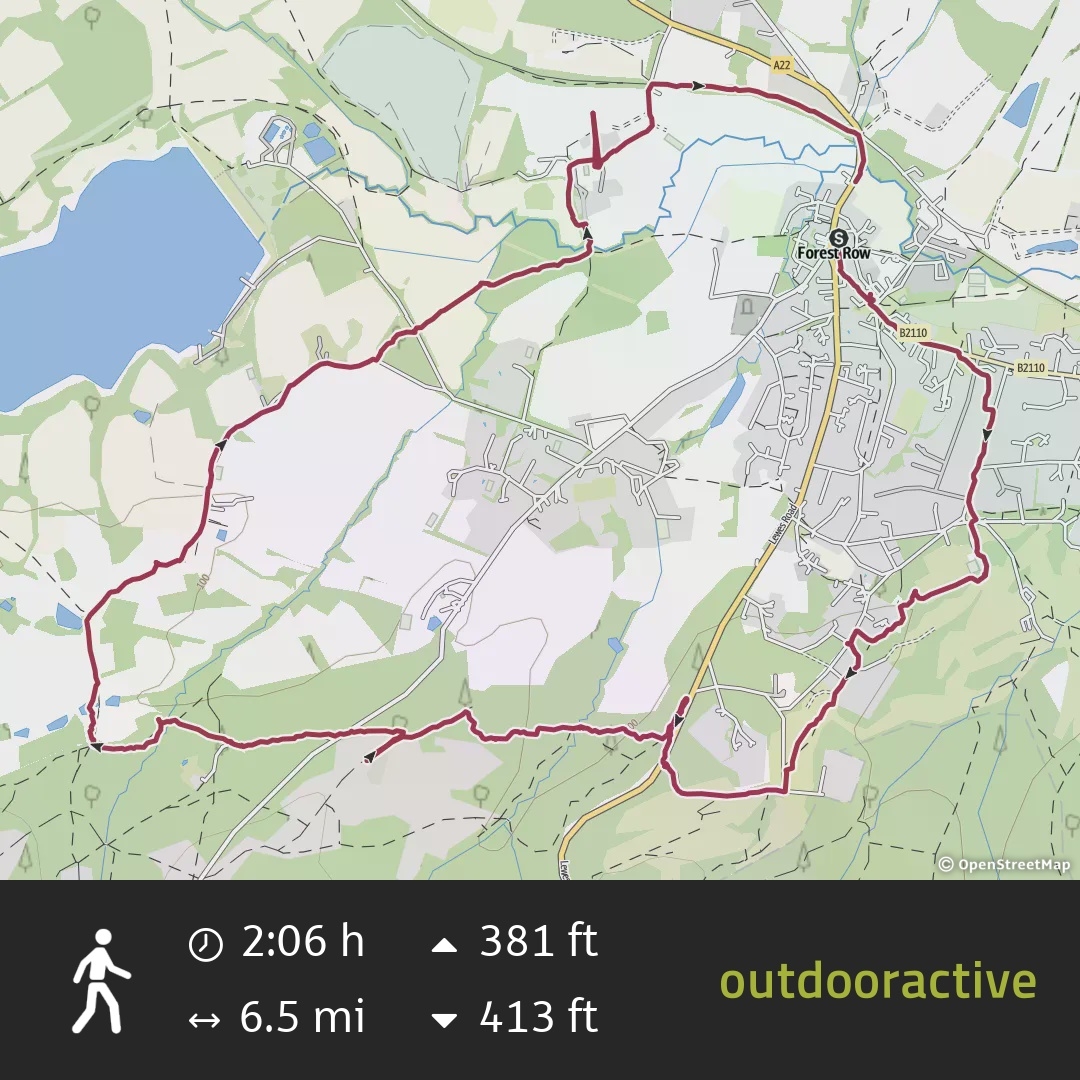
East Sussex County Council is promoting a shorter version of our walk (3 miles compared with out 6.5) along the Forest Way which you can view here. The Forest Way is the route of the old railway line that used to run between East Grinstead and Forest Row. This line was closed by the infamous Dr. Beeching, and there’s some interesting information about that:

The Forest Row railway station opened in 1866. Although a busy commuter line, it was axed with the Beeching cuts in 1966. Ironically, Dr Beeching lived near Forest Row and regularly travelled up to London on the line when he was Chairman of British Rail.

https://forestrow.co/forest-way/

Kill your darlings, as the creative writing teachers say.

This blog is a comprehensive account of the history of Brambletye (which doesn’t have a Wikipedia page!) from a local. If you want to see Brambletye in this blog you’ll have to get to the end as we left the highlight to the final stretch of the walk.

Woodcut showing a depcition of Brambletye Manor before its destruction ( From โ€˜Brambletye Houseโ€™, The Mirror of Literature, Amusement, and Instruction, Vol. 10, No. 279, (1827; Project Gutenberg, 2005), pp. 265-267. https://www.gutenberg.org/files/1594)

BBC Sussex recently published an article about Brambletye and a Secret Sussex podcast episode. This is an interview with Garen Ewing, a local illustrator who seems to be ‘the Brambletye Guy’. His website has a trove of information about the history of the house with a lot of interesting old images, which I wish were larger. The whole reason we did this walk was after a suggestion from my friend Edwin, who had learned about Brambletye from Garen’s crowdfunder for The Brambletye Box:

You can read more about Garen’s fundraiser on his Patreon page.

The photos in my post are a blend of mirrorless camera and phone, with the odd illustration and historical photograph where I could find some.
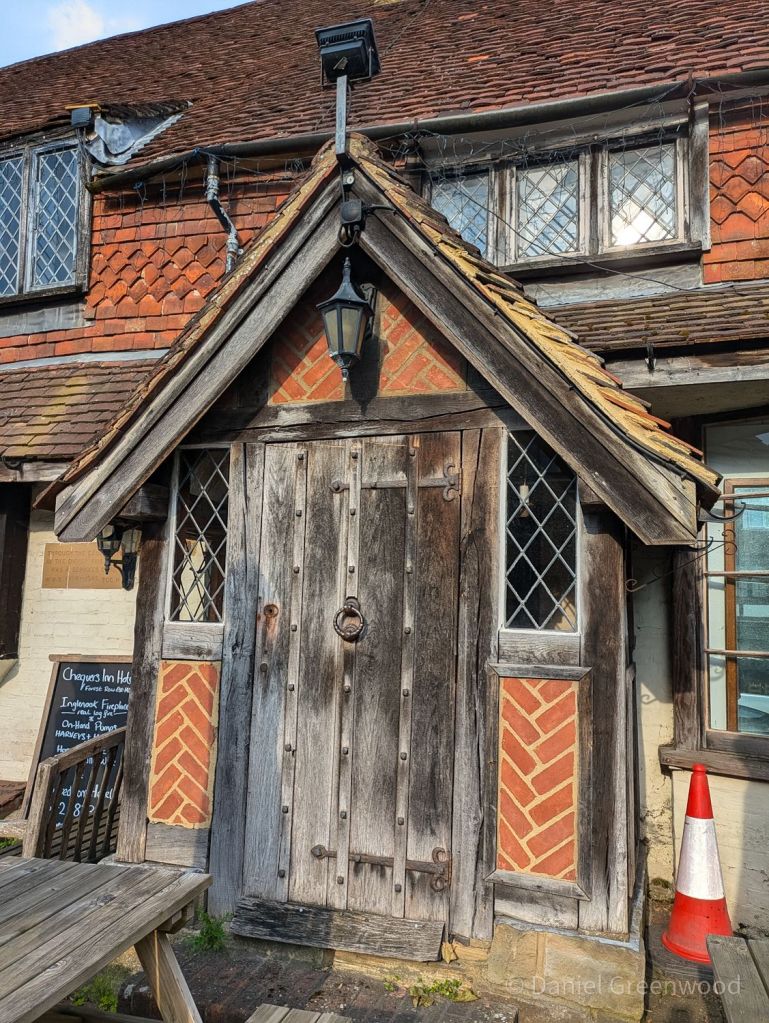
I parked in Forest Row in the village centre, where there are some typically oaky timber construction to be admired. This is an old entrance to the Chequers Inn Hotel. This is not the only reference to oak doors in this post.
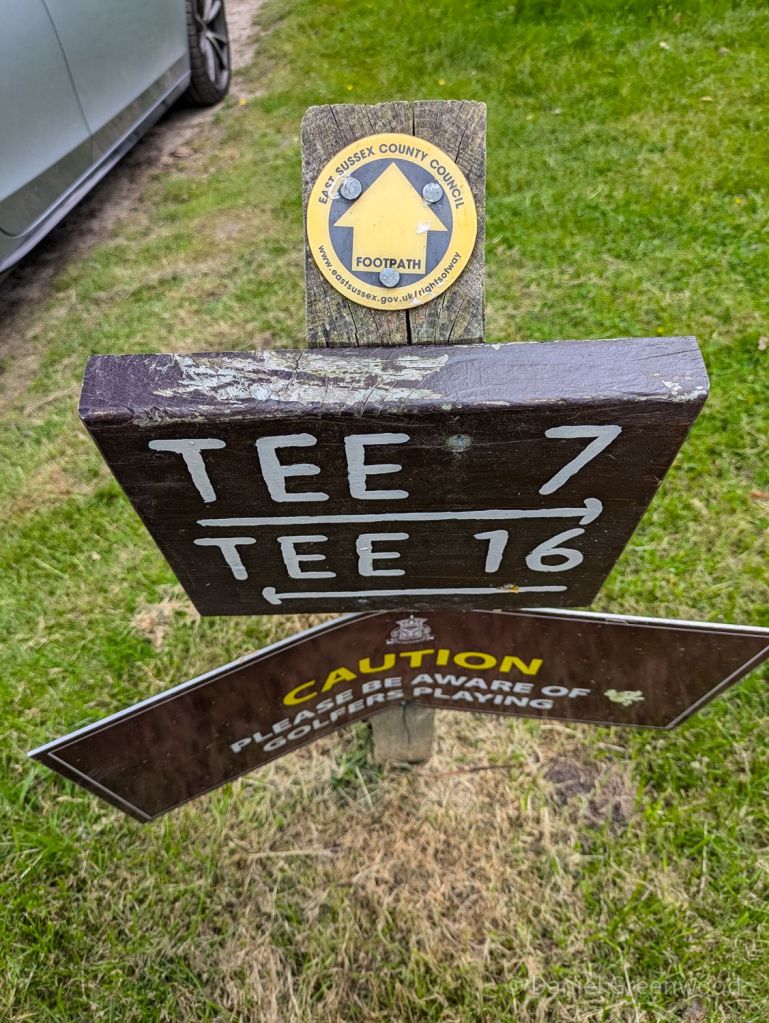
The walk leaves Forest Row by crossing a golf course, which I still find quite weird because of the tiny white eggs flying around trying to kill you. Follow the ESCC footpath signs through here.
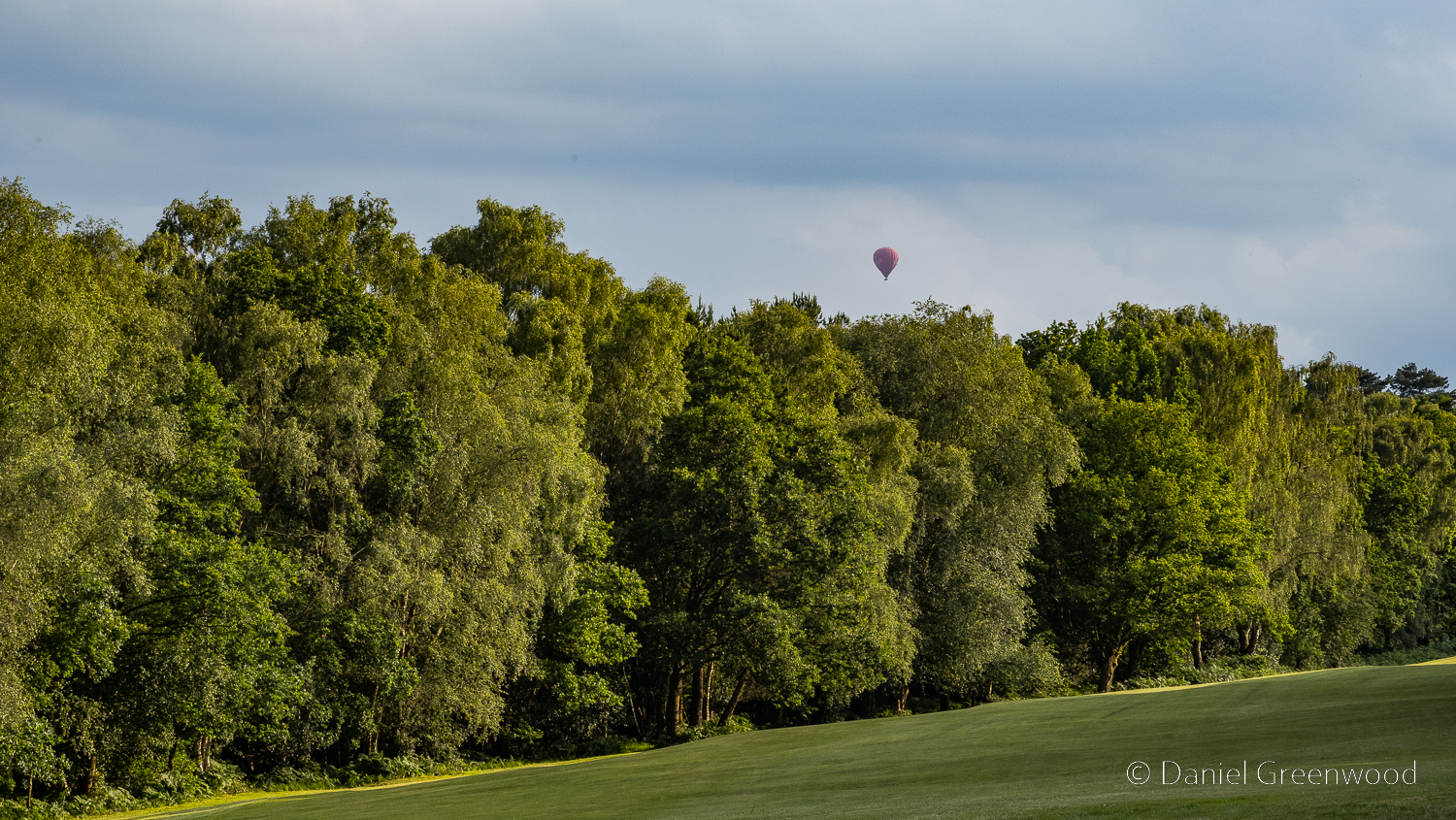
The view across the greens into the Weald was splendid. It was such a still evening, we could see a hot-air balloon beyond the birch trees in the distance.
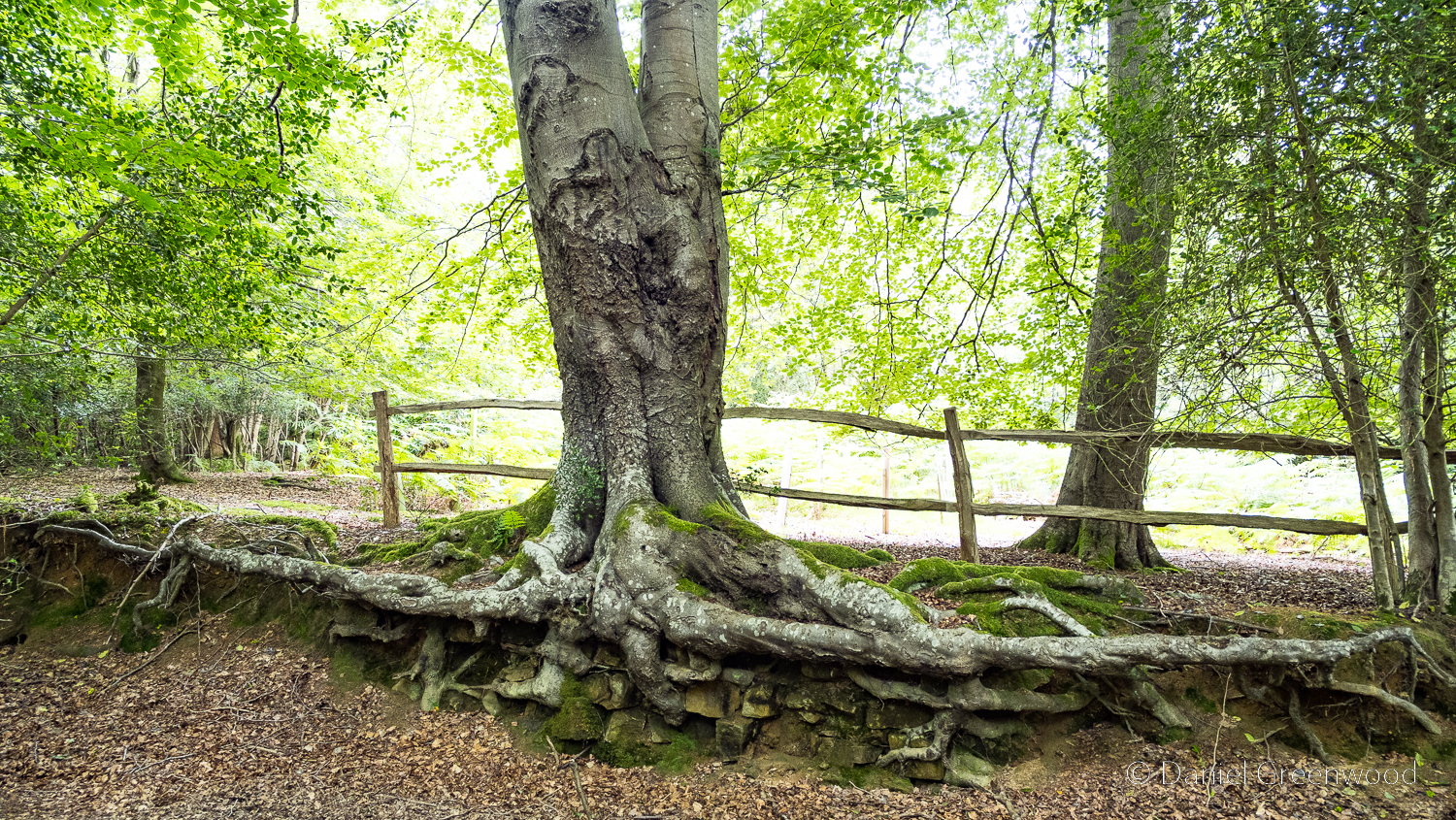
Surviving the golf course, you enter into the heathy woodlands so typical of the Ashdown Forest area. This is something you can see along old footways, a mature beech tree with its roots exposed. It’s a nice indicator of how close to the surface tree roots can be. The root has adapted to life above ground and become more like a branch. It looks like there are some bricks or stones under the roots, so perhaps the tree grew on top of a wall.
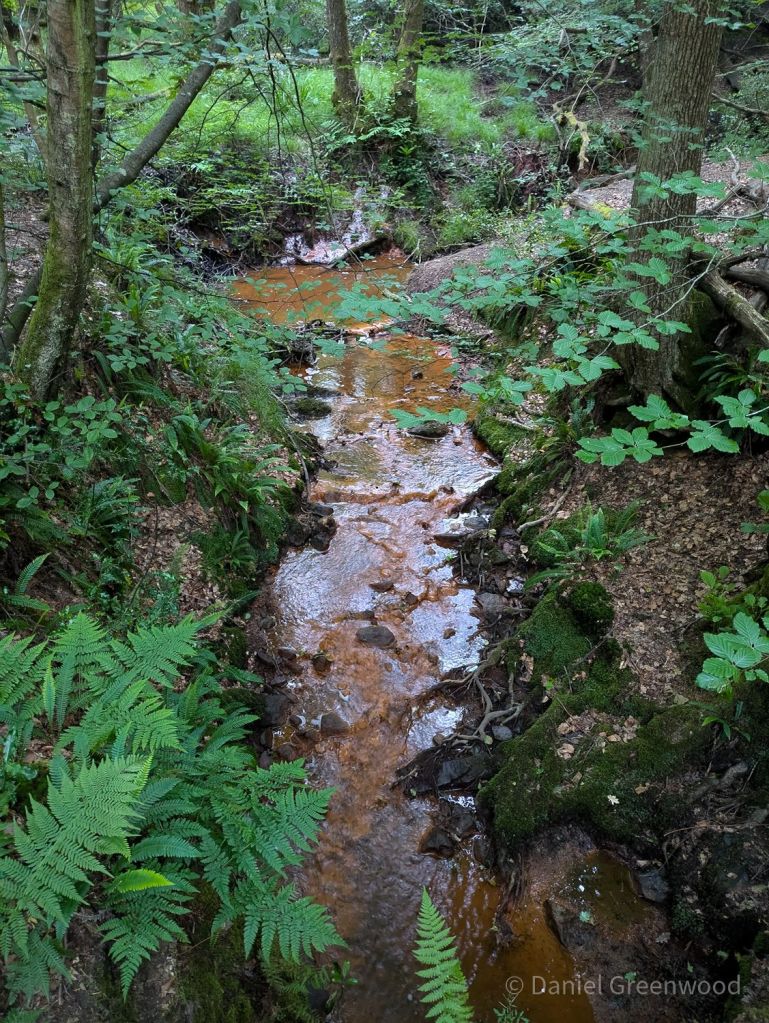
We passed one stream which is typical of those in the Ashdown Forest. This stream had the brown-orange hue of a Wealden ghyll, caused by the iron ore discolouration that made the area so attractive for the famous iron works of centuries past.
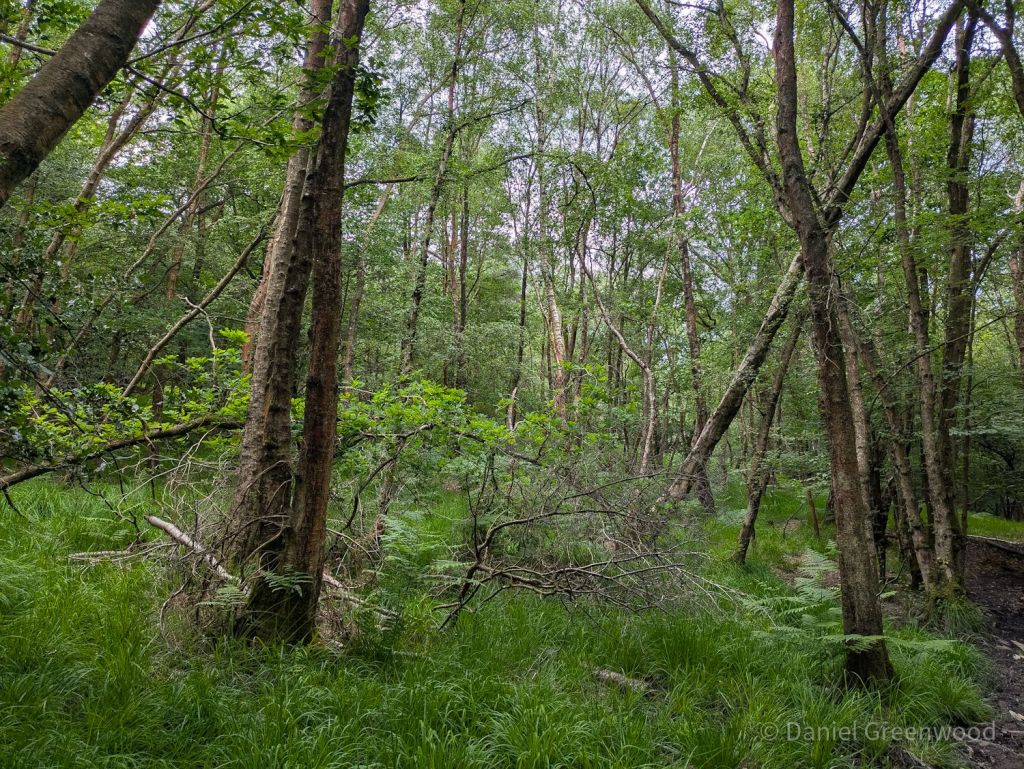
The woods were a tangle of birch and honeysuckle. I’m never sure if these are truly ancient woodlands or recently wooded heathland, but the sighting of the plant below is helpful.
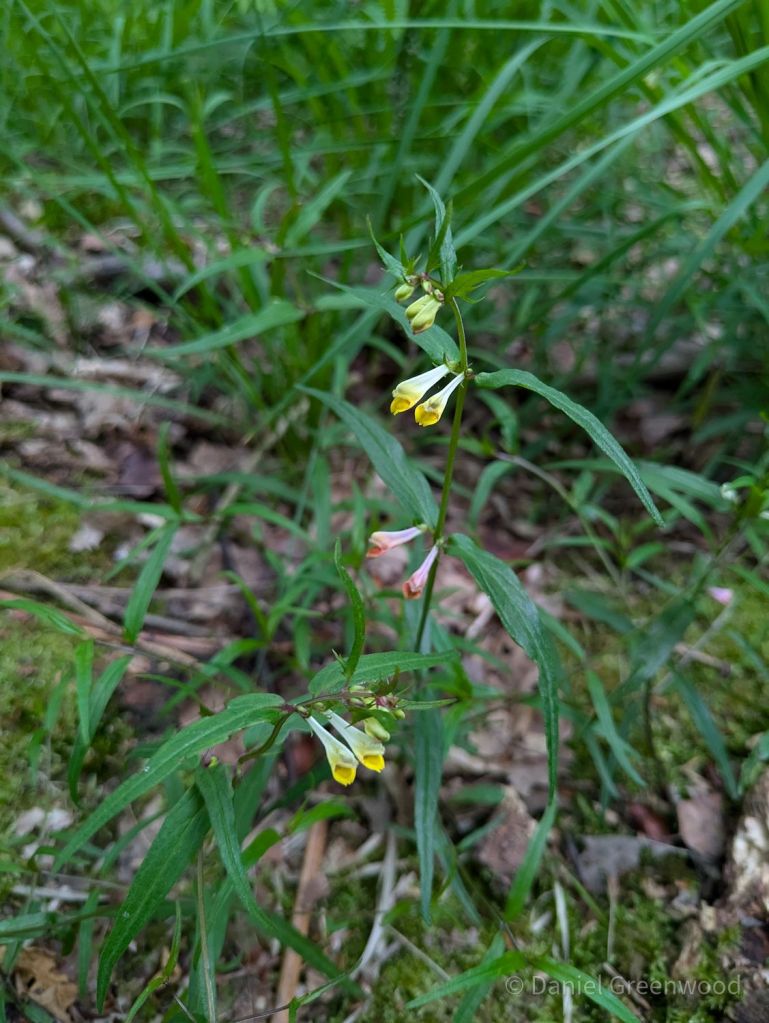
Common cow wheat is an ancient woodland indicator and is far from common. I’ve found it in ancient woodlands around the western side of the High Weald. It used to be found in south London’s oak woodlands but has been lost since the 1980s. Plant diversity declining before our very eyes. It’s in the figwort family, along with yellow rattle and foxglove, of which more later.
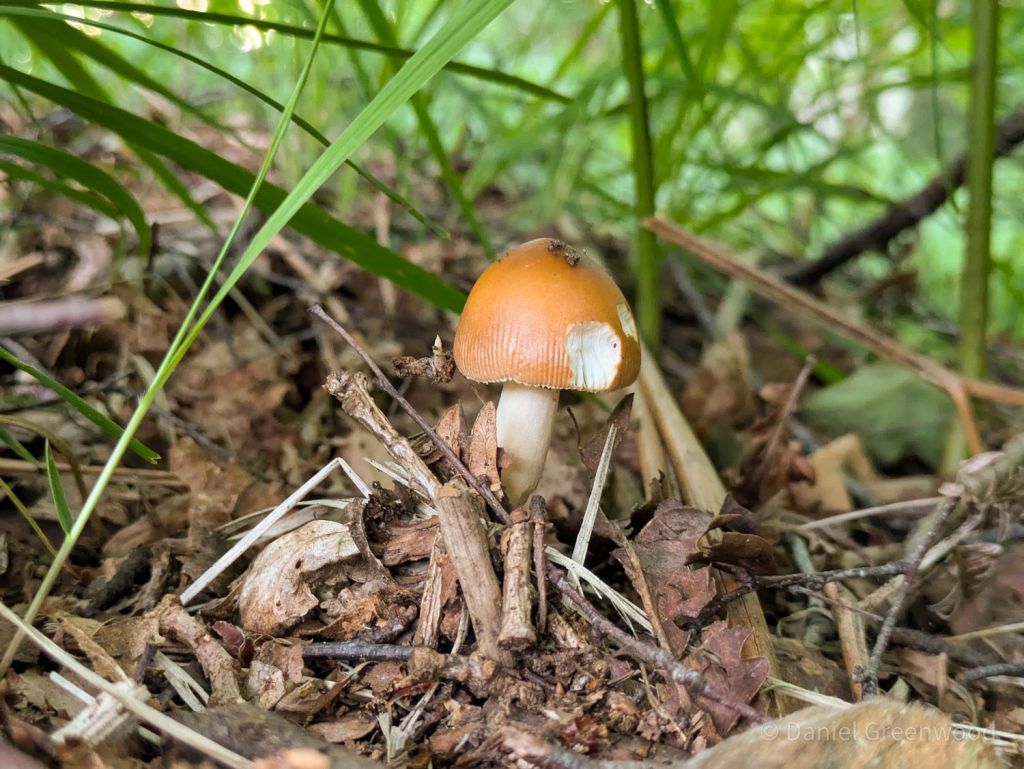
June can be a month of mushrooms, so I wasn’t hugely surprised to find this tawny grisette. For more mushrooms have a look at my Fungi Friday blog. After this we left the woodlands.
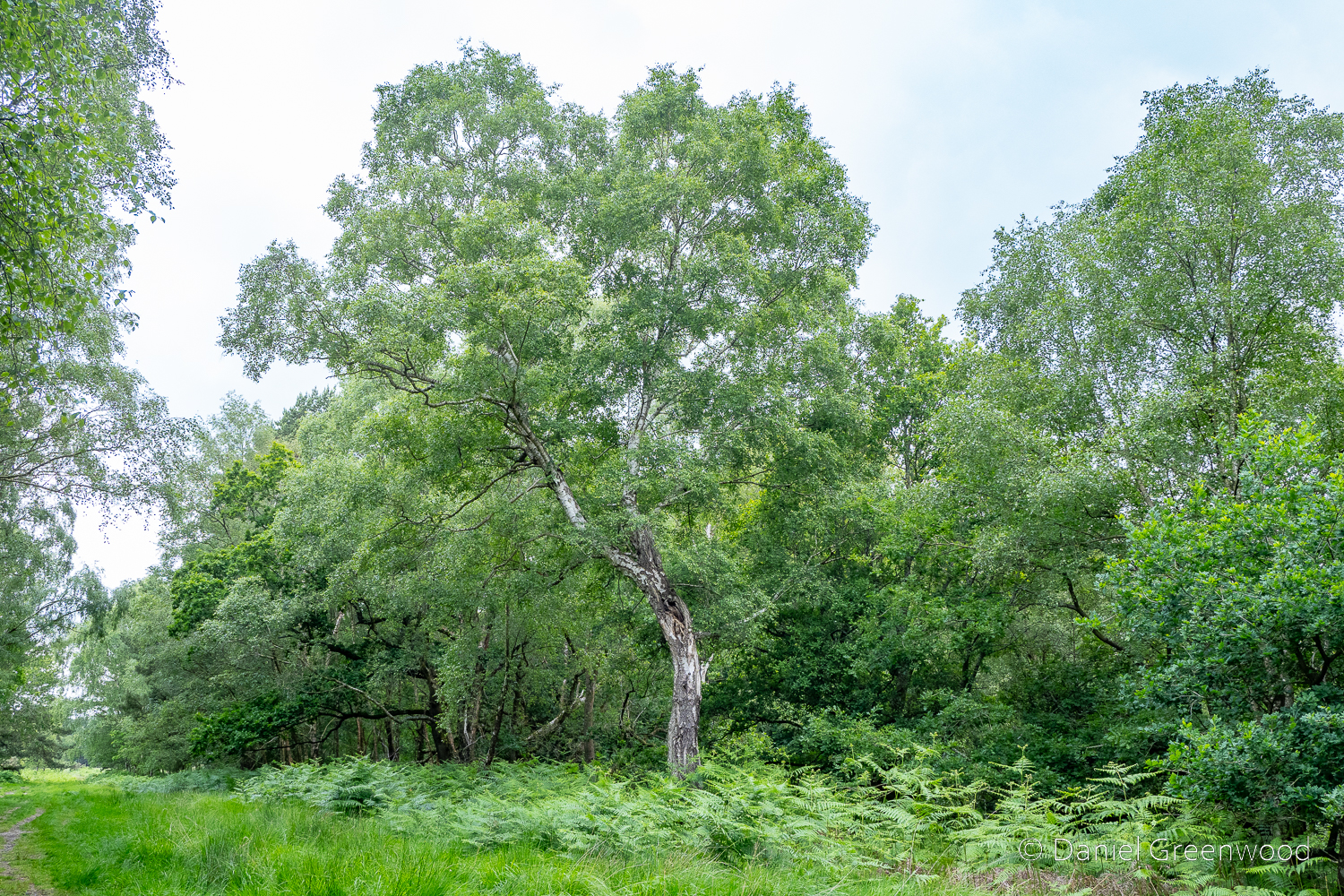
These heathlands are very birchy, brackeny, oaky and rushy, much like the New Forest.
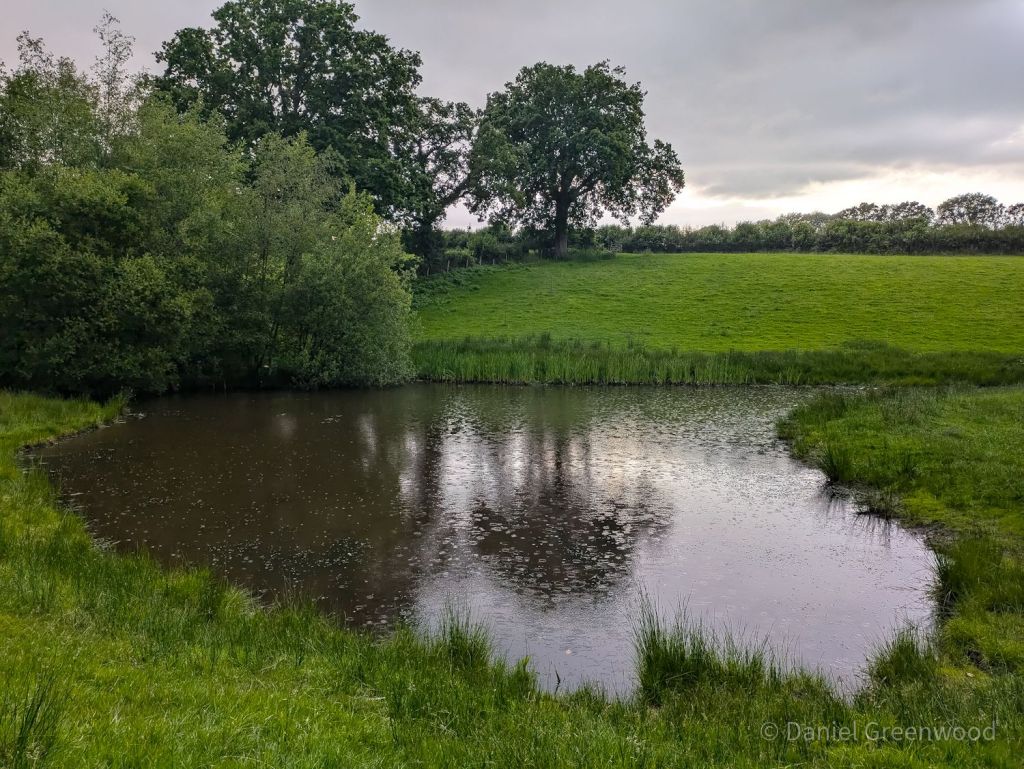
I was intrigued by this wonderful pond, one of a network of three running east-west. It’s so large and, looking at the map, is clearly part of an historically wet landscape. The placenames nearby include Alder Moors (alder is a tree of wetlands), Hollow Shaw (hollow probably a place where water pools), Mudbrooks House, and Spring Hill Farm.
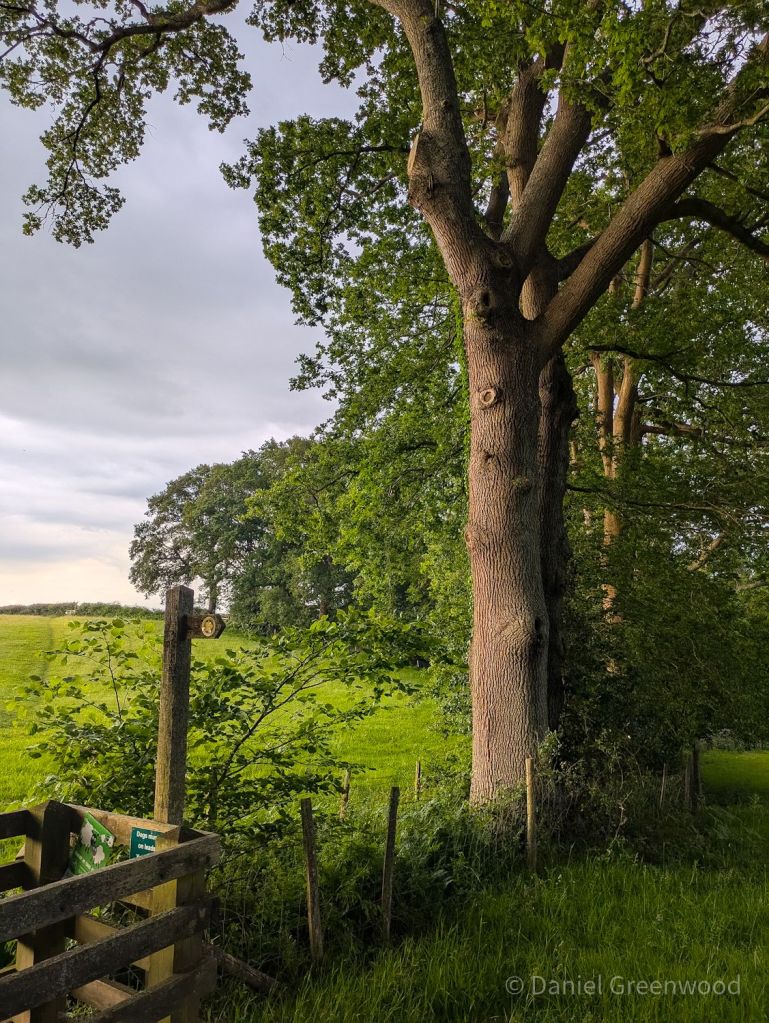
When the walk turns north out of the woods you pick up the Greenwich Meridian Trail. My parents used to take me and my sister to Greenwich Park most Sundays when we were kids, when it felt more like a south London park than a mass-tourist attraction. It’s nice to feel that connection. The Meridian Line runs through nearby East Court at East Grinstead, which this walk will take you to.
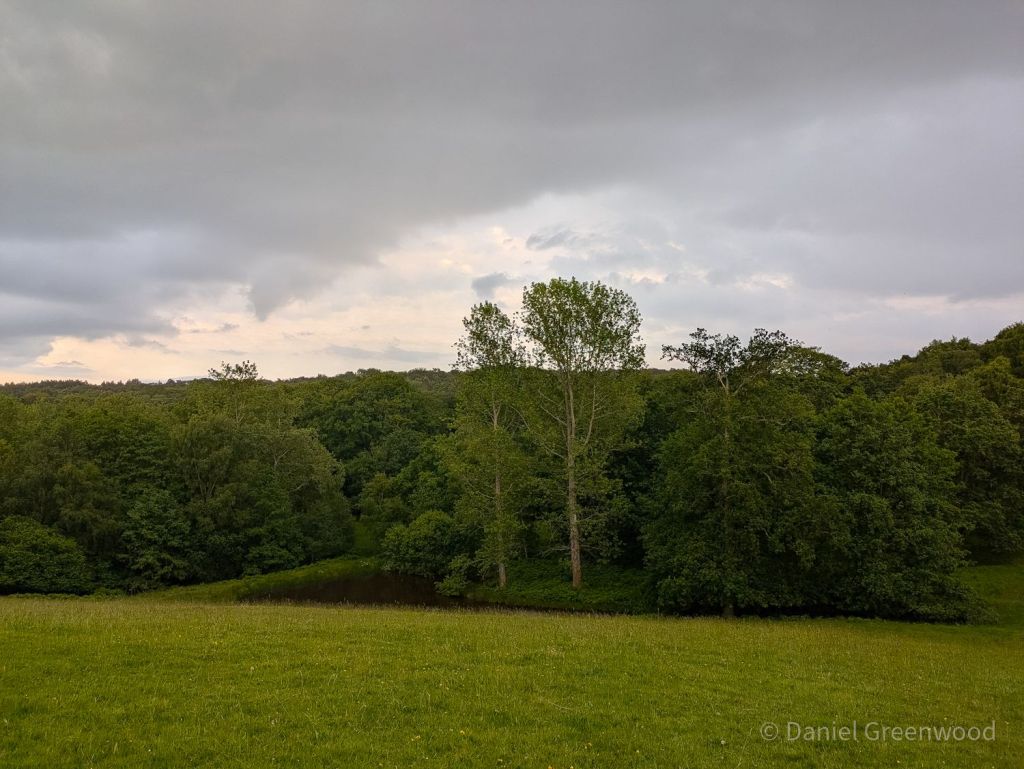
This is a phone pic looking back at the woodland we passed through, a large pond at the bottom of the slope.
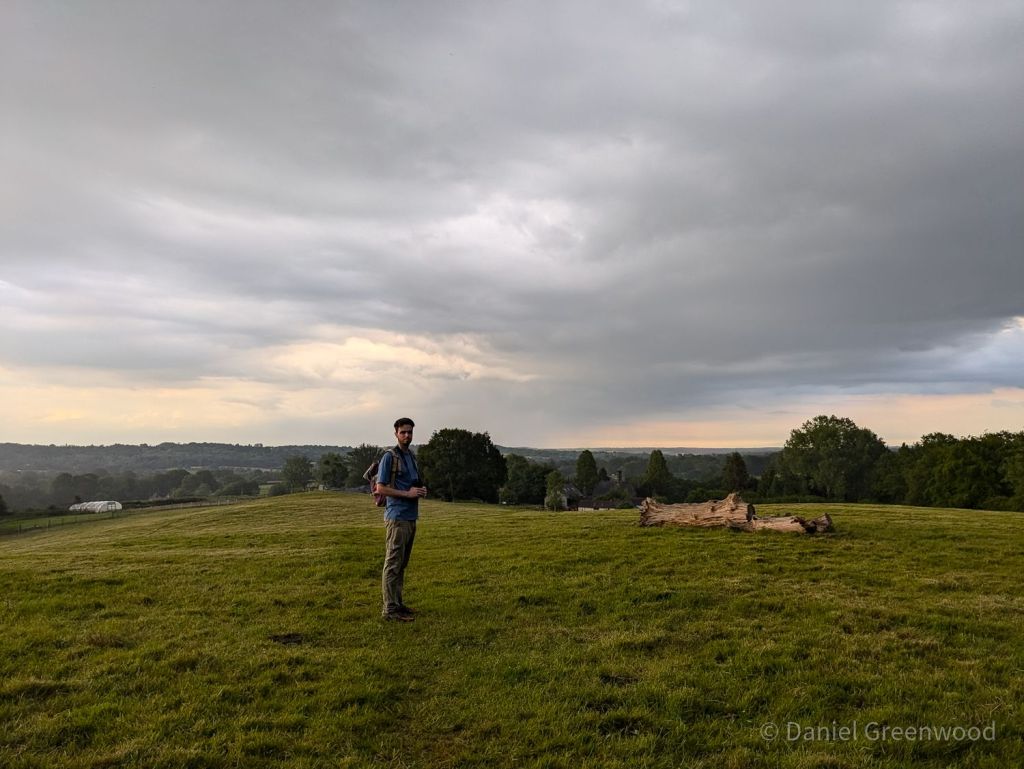
On higher ground you have view towards Mid Sussex. For some reason the trunk of a dead oak rested up there on the snooker table grassland, presumably where it fell.
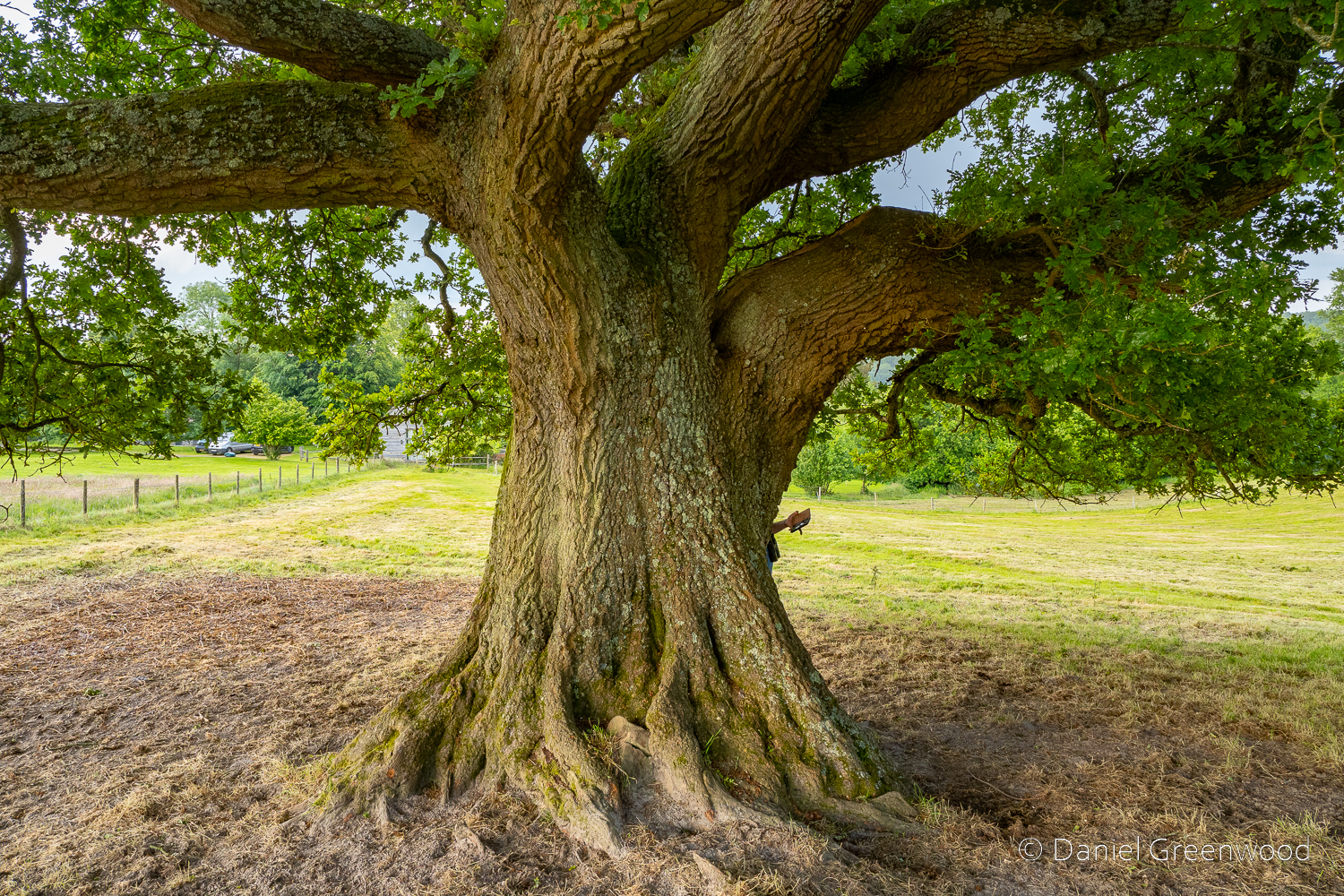
This fine living oak is passed along the way, with signs of cattle gathering underneath its branches for shelter. That’s what causes erosion to the roots, but I don’t know if this is harmful to the tree, or if it’s something they have evolved to cope with over millions of years shared with wild cattle and the like. I have read that the pocking caused by hooves may allow air to reach the roots move effectively than the flat compaction caused by modern human footwear and tyres, etc..
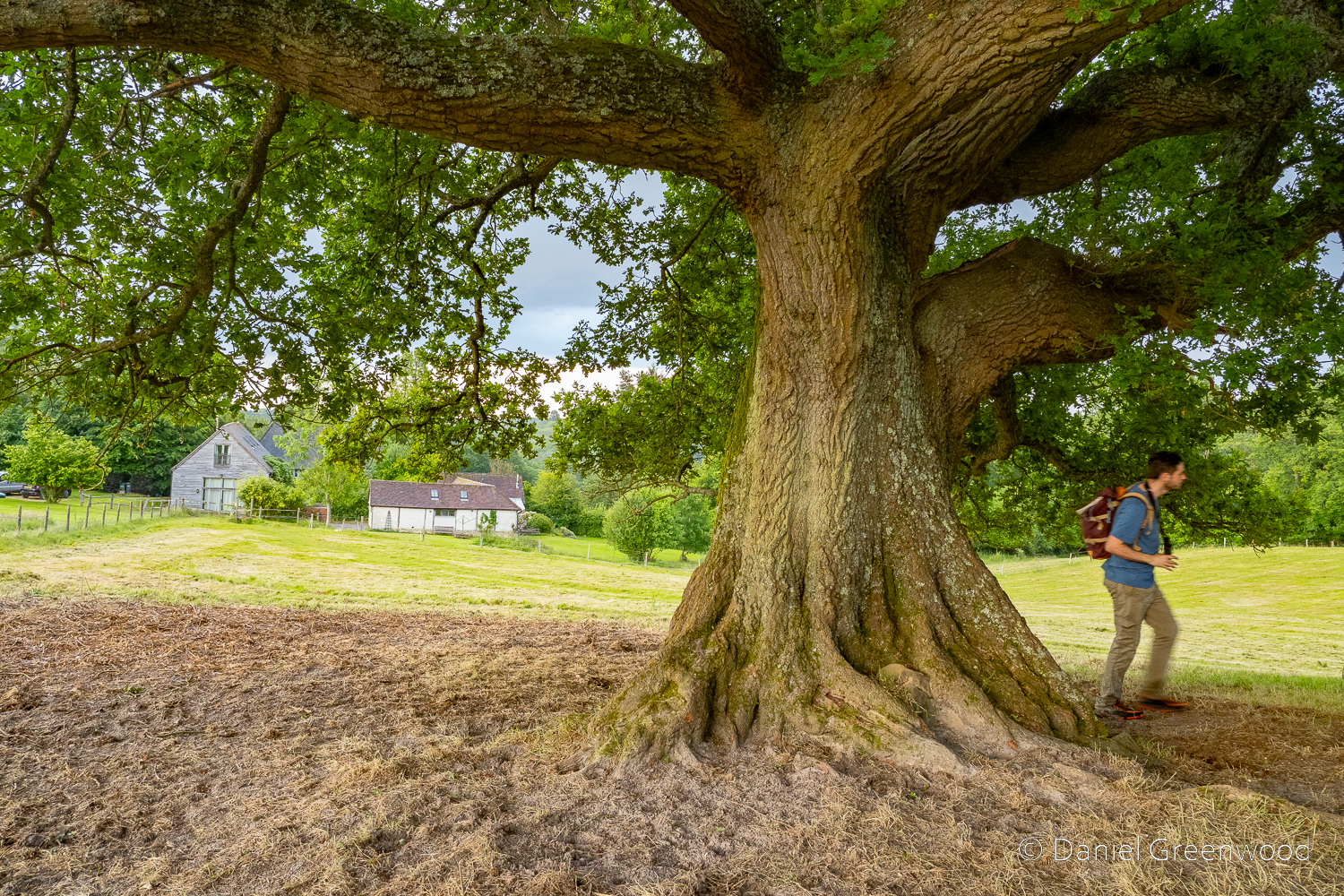
The shelter of the oak is too great to turn down. One oak’s ancient pagan names was ‘dur’, which ‘door’ derives from. This is probably because some oaks had cavities so large you could enter inside them. Also interesting that doors (as per the first image on the post) were once more commonly made from oak.
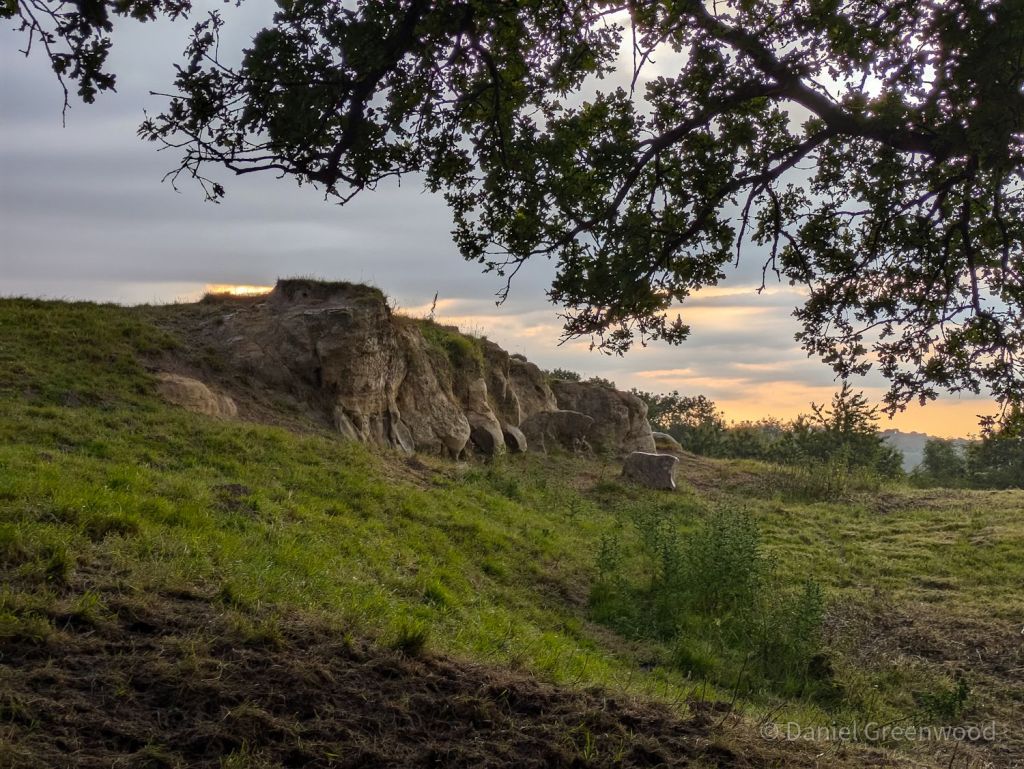
Nearby was an outcrop of rock! That’s exciting here because we don’t really have much in the way of rocky outcrops in the south-east, compared with the Dales, Dartmoor or the Lakes. This is probably the stone used to build Brambletye House, what I presume is a type of sandstone but I’m no geologist. You wonder if this little section has been quarried over the years.
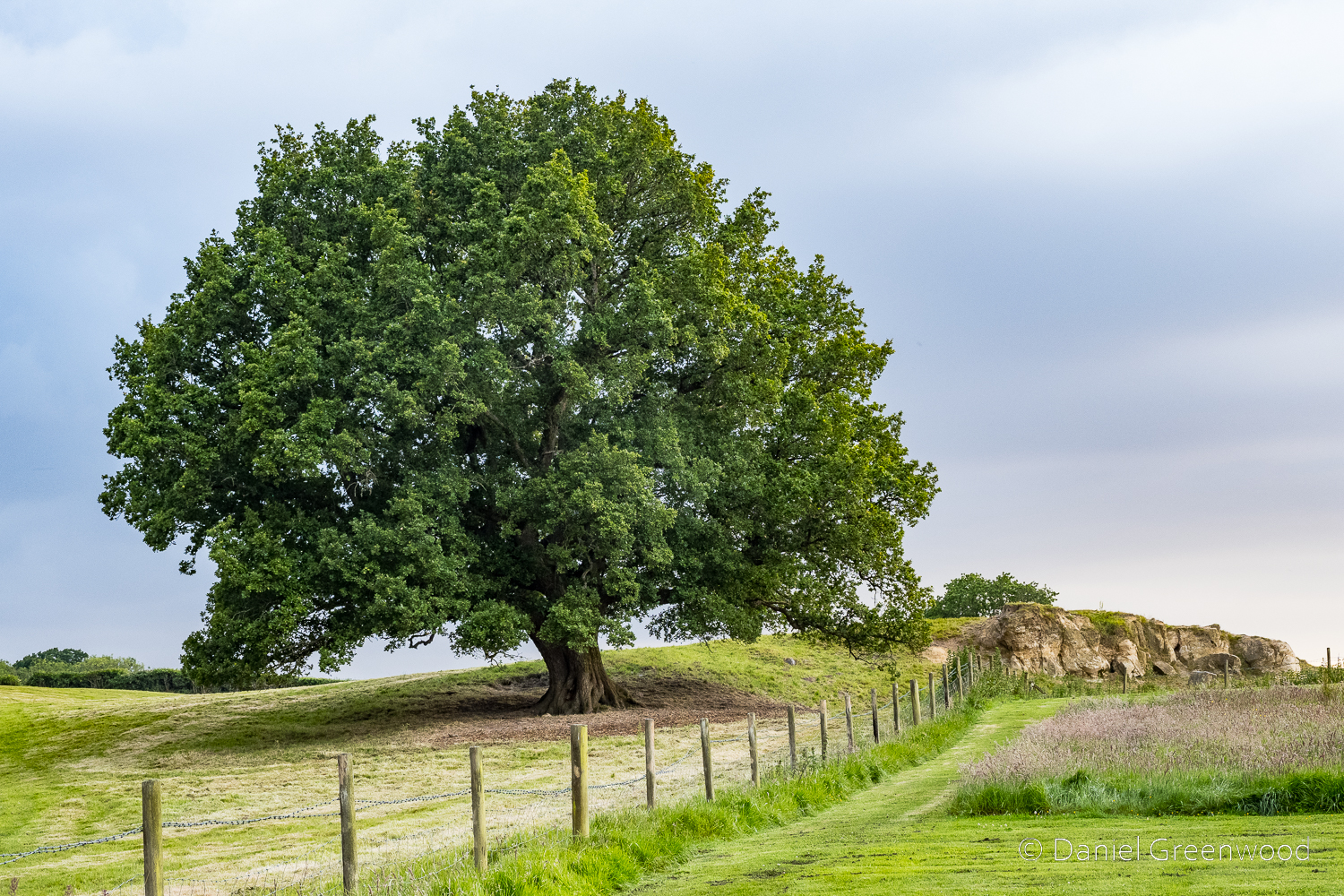
This is our fine oak with the rocky outcrop seen to the other side.
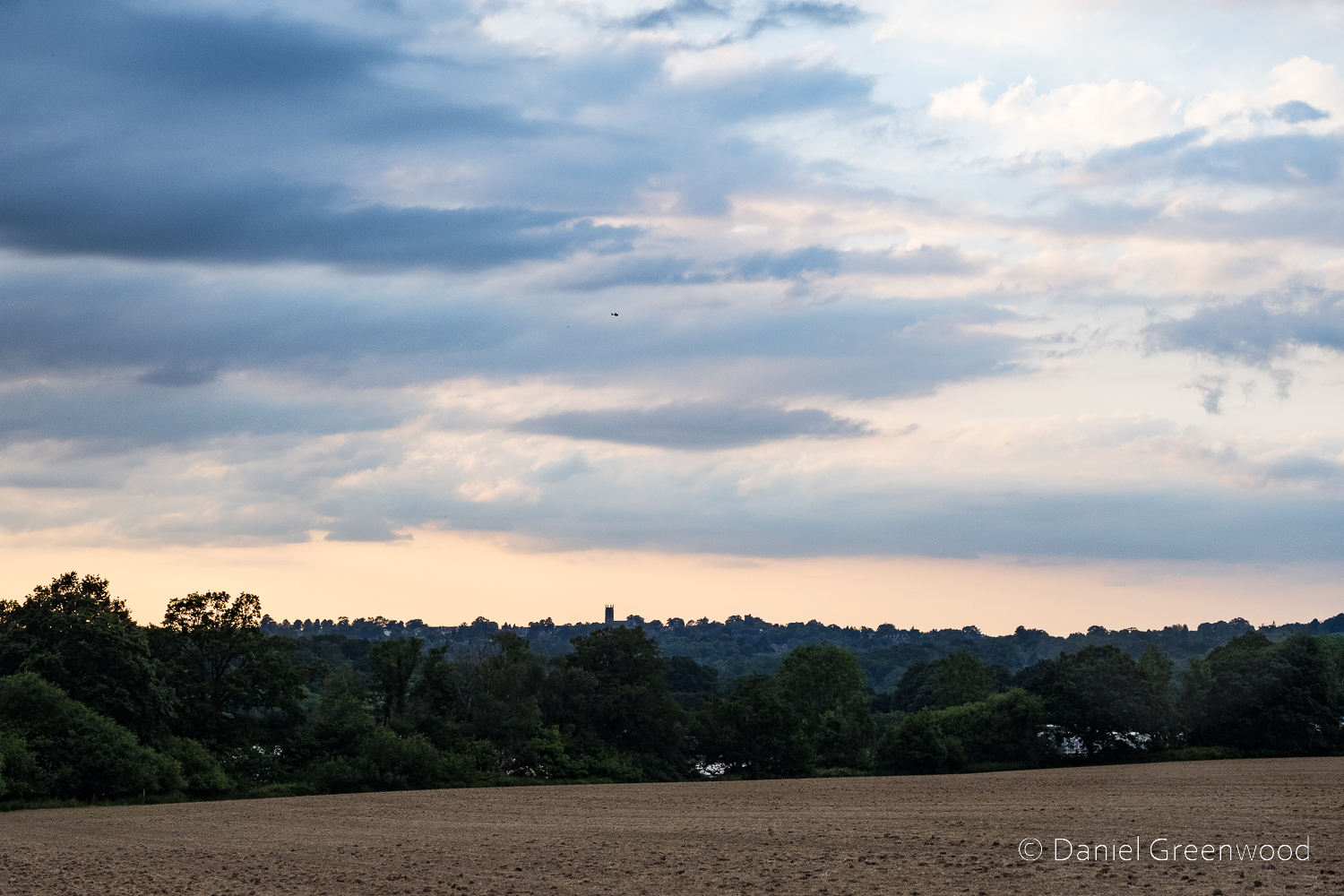
This is a view north towards Weir Wood Reservoir. There’s a church on the horizon and a helicopter high in the sky. Dramatic clouds were developing but we escaped a downpour.
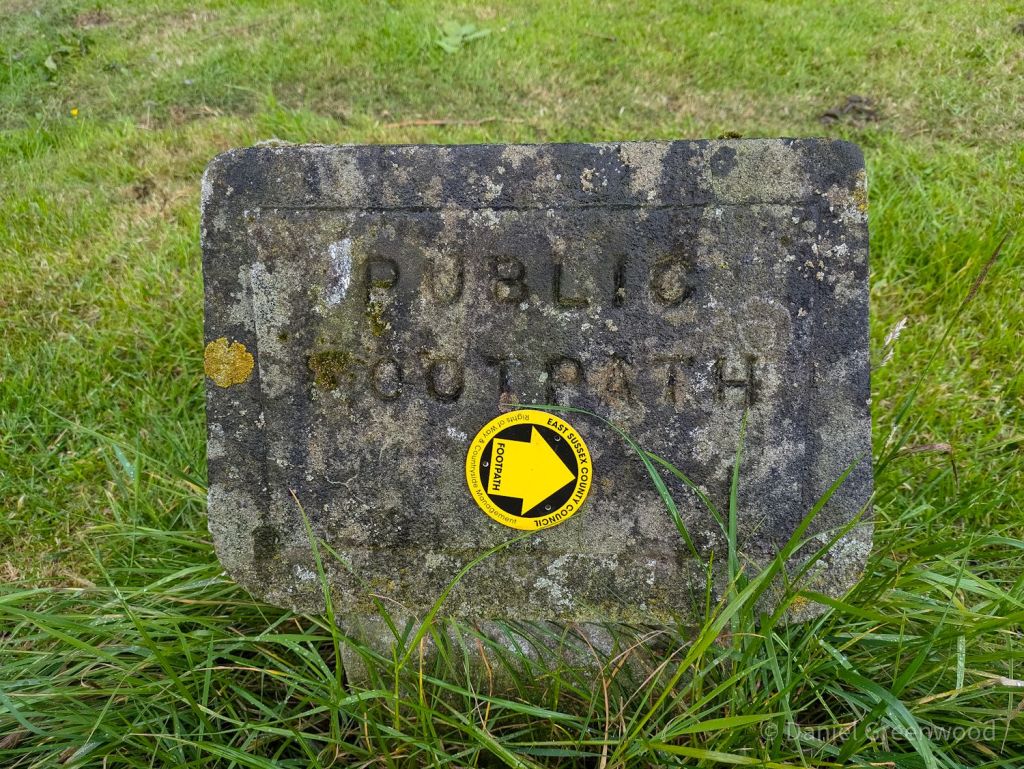
Let’s appreciate this lichen-touched public footpath stone, with its helpful update pointing us in the right direction.
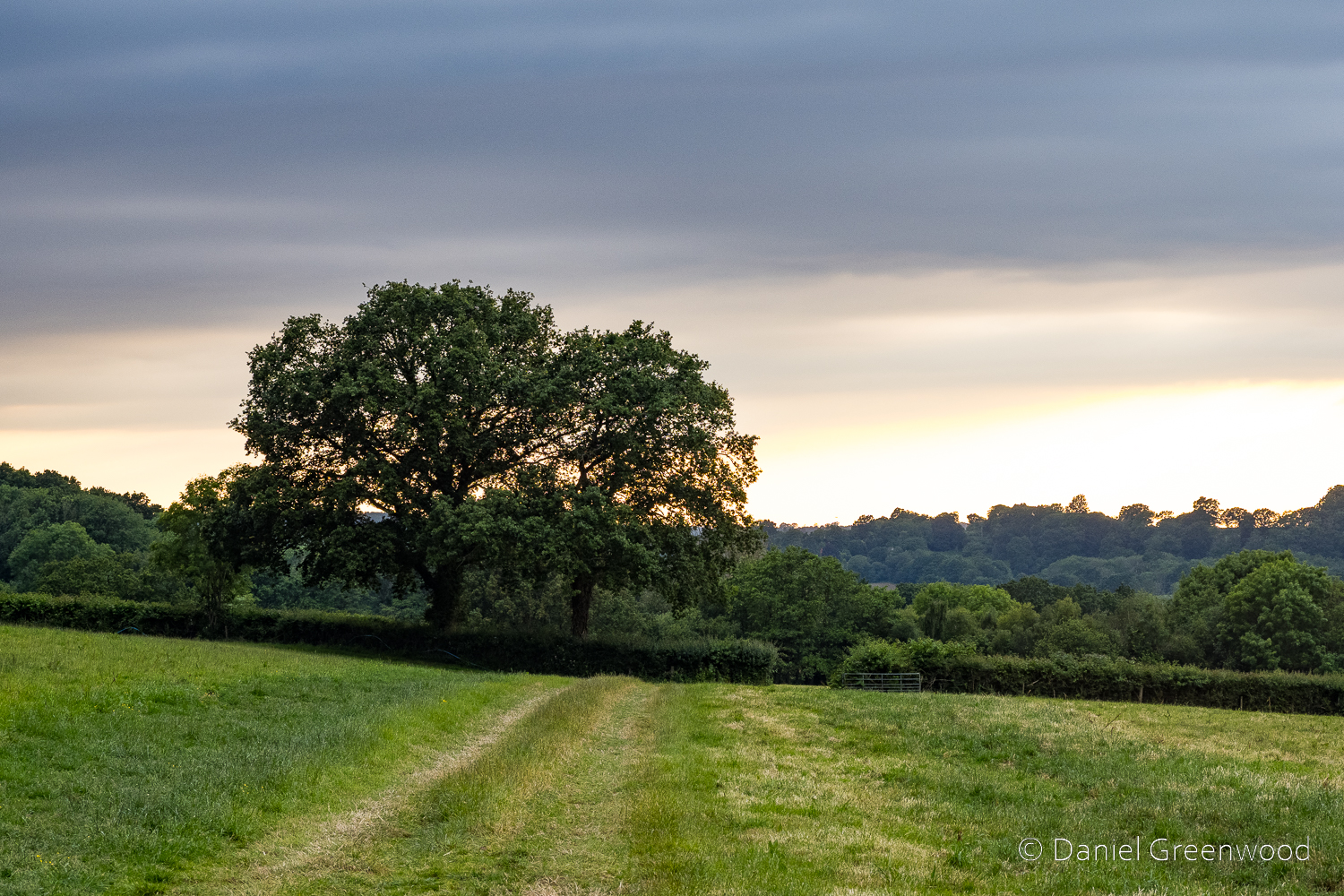
A snapshot of the hedge and oak boundary we passed through on our way to Brambletye.
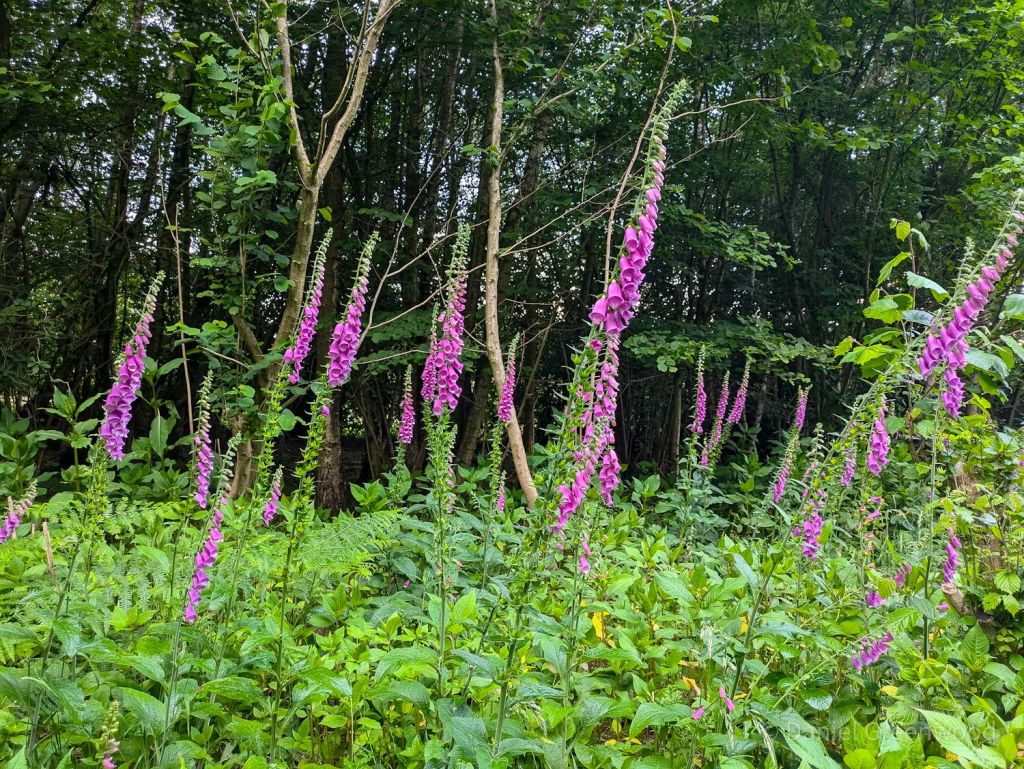
I was taken aback by this magnificent display of foxgloves. June is the peak for this wonderful flower, also a member of the figwort family along with common cow wheat as mentioned earlier!
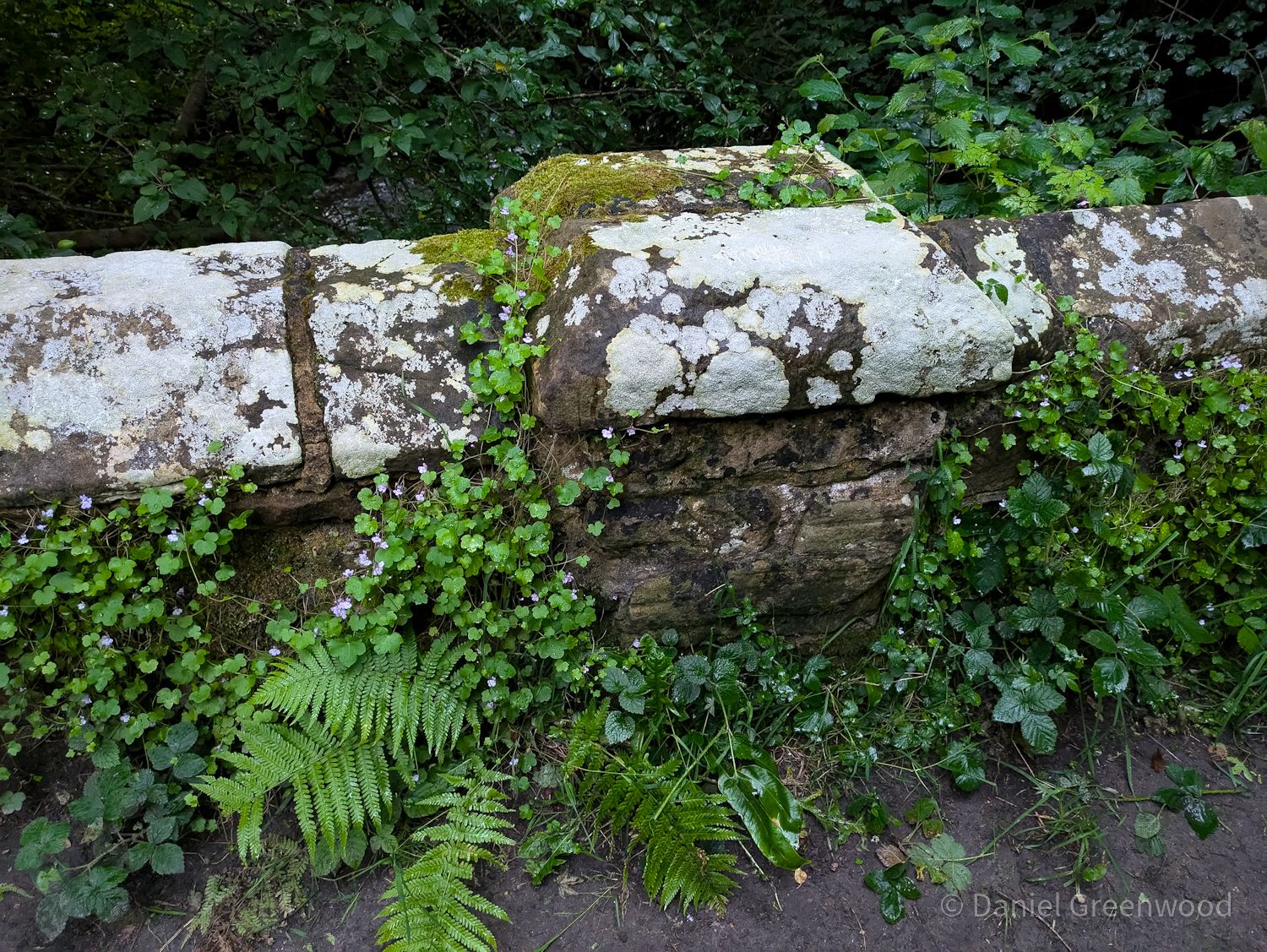
As we neared the famous ruins, we passed over a little stone bridge, what is probably quarried from the same stone seen earlier. It amazes me that this is in fact a bridge over the River Medway, that mighty Kentish river of Dickens and my mate Pete. In fact, by writing this blog I’ve learned that the Medway rises nearby in Turners Hill.

The Medway and its tributaries are known as โ€˜Wealden Riversโ€™ โ€“ rising from springs across the High Weald where the sand meets impermeable clay.

https://www.southeastriverstrust.org/medway/
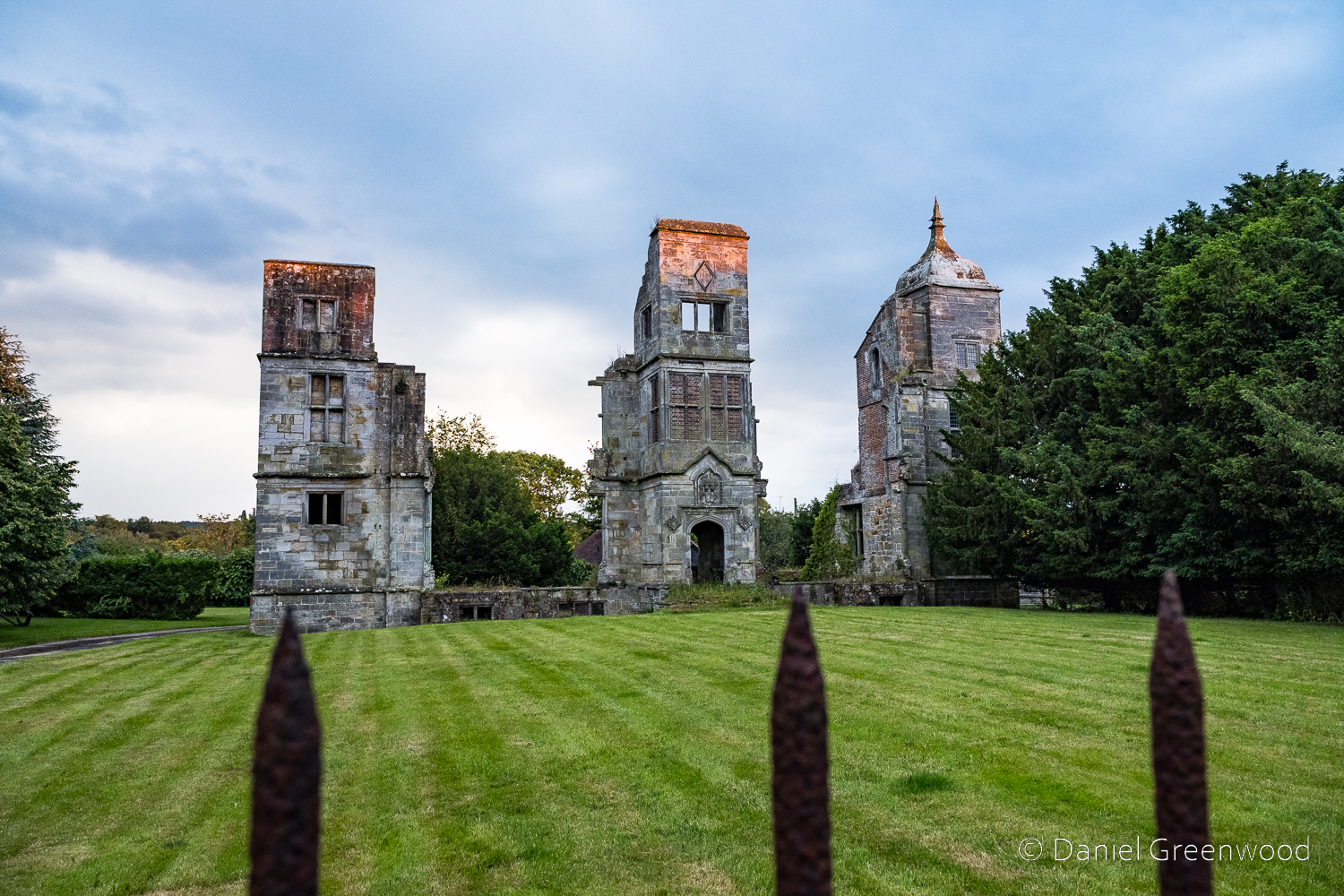
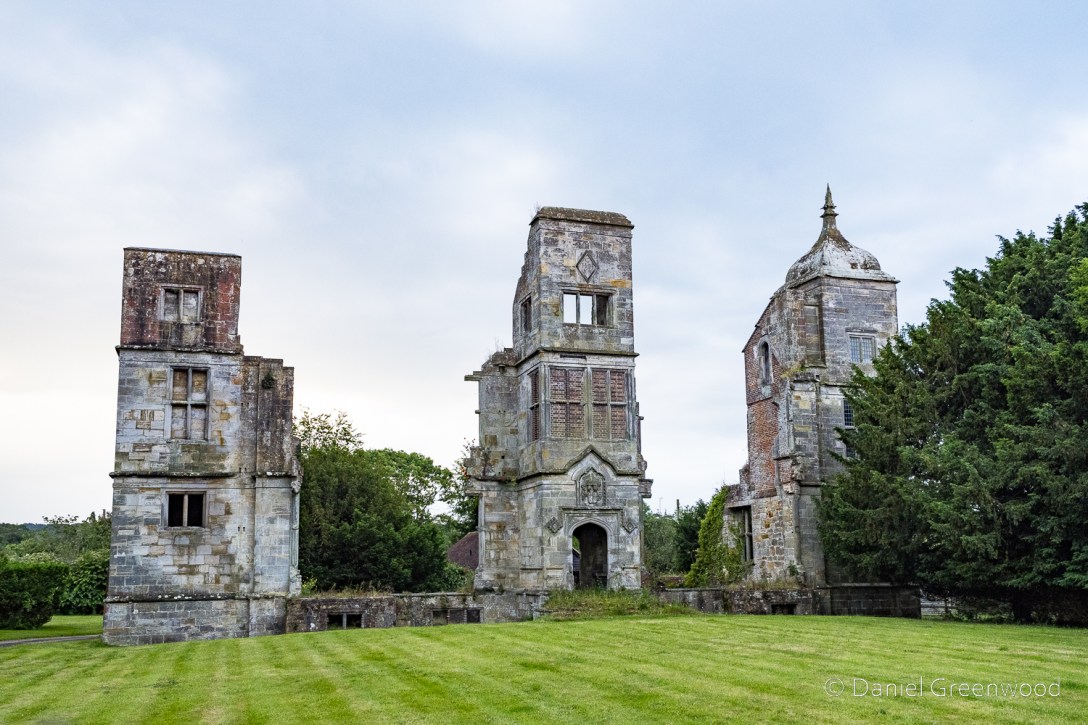
We arrived behind the fence at Brambletye just as the sun began to set, the orange light clipping the tops of each remaining tower. According to Garen Ewing, each tower would have had a minaret similar to that of the western tower. This image is looking south with the towers running east-west.

1892 – 1933, C G Harper Collection via Historic England

This old illustration shows two of the towers ivy-clad, and a far more open landscape surrounding them. Now the clump of trees on the western side hides a tennis court, such is the wealth of the current landowner.

It was commissioned by Sir Henry Compton, a prominent landowner and political figure, and would have been one of the most impressive residences in Sussex at the time. However, the Compton family’s time at the manor was short-lived as by the late 17th Century they had left the property – for reasons unknown.

BBC
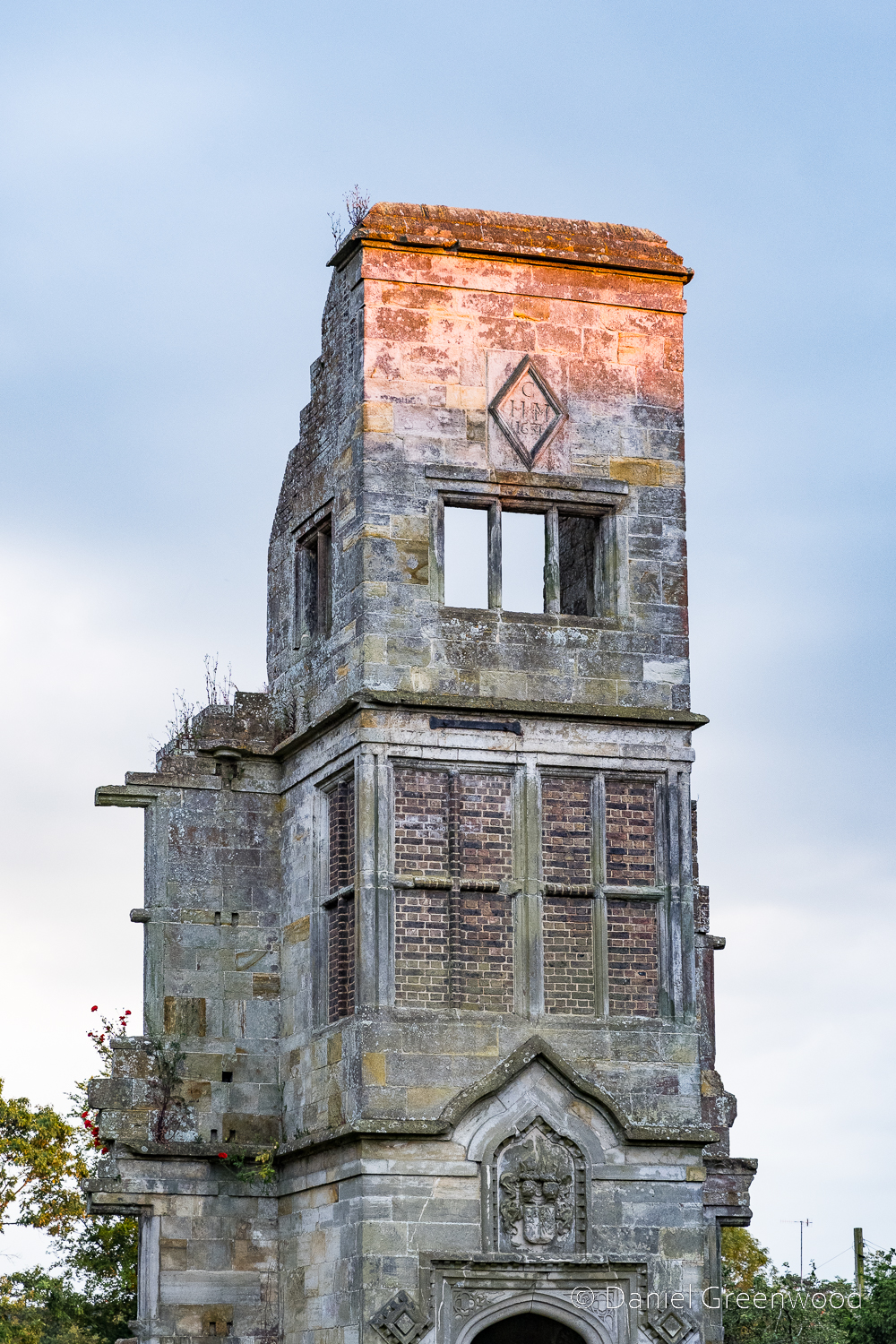
On the central tower you can see the date of Brambletye’s construction, 1681. Also note the bricked-up windows and what I am guessing is the family crest below. I was using my 24-200mm lens so could zoom in for some nice detail.
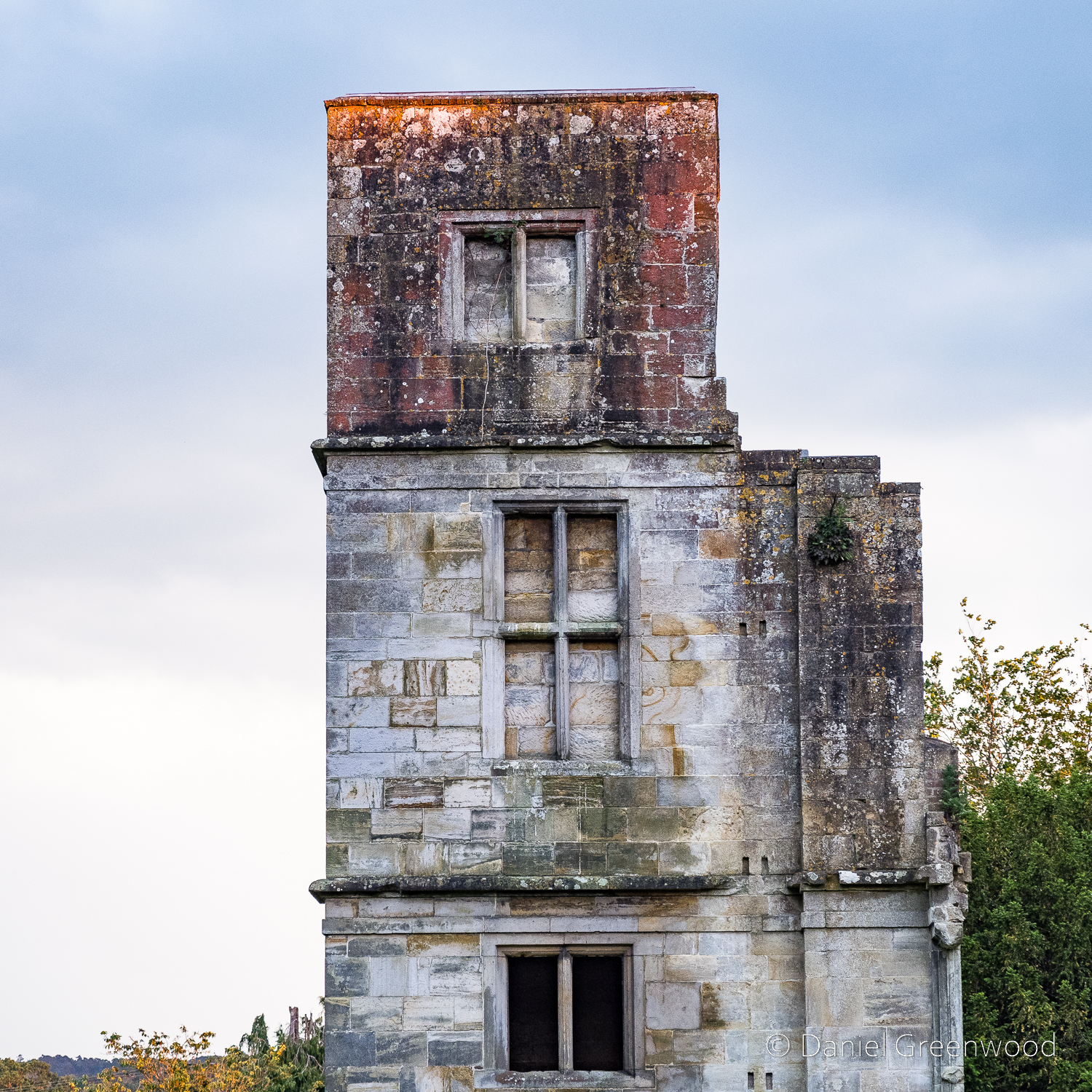
The eastern tower had yet more bricked-up windows – perhaps to avoid the window tax, introduced in 1696 in England, 16 years after Brambletye was built.
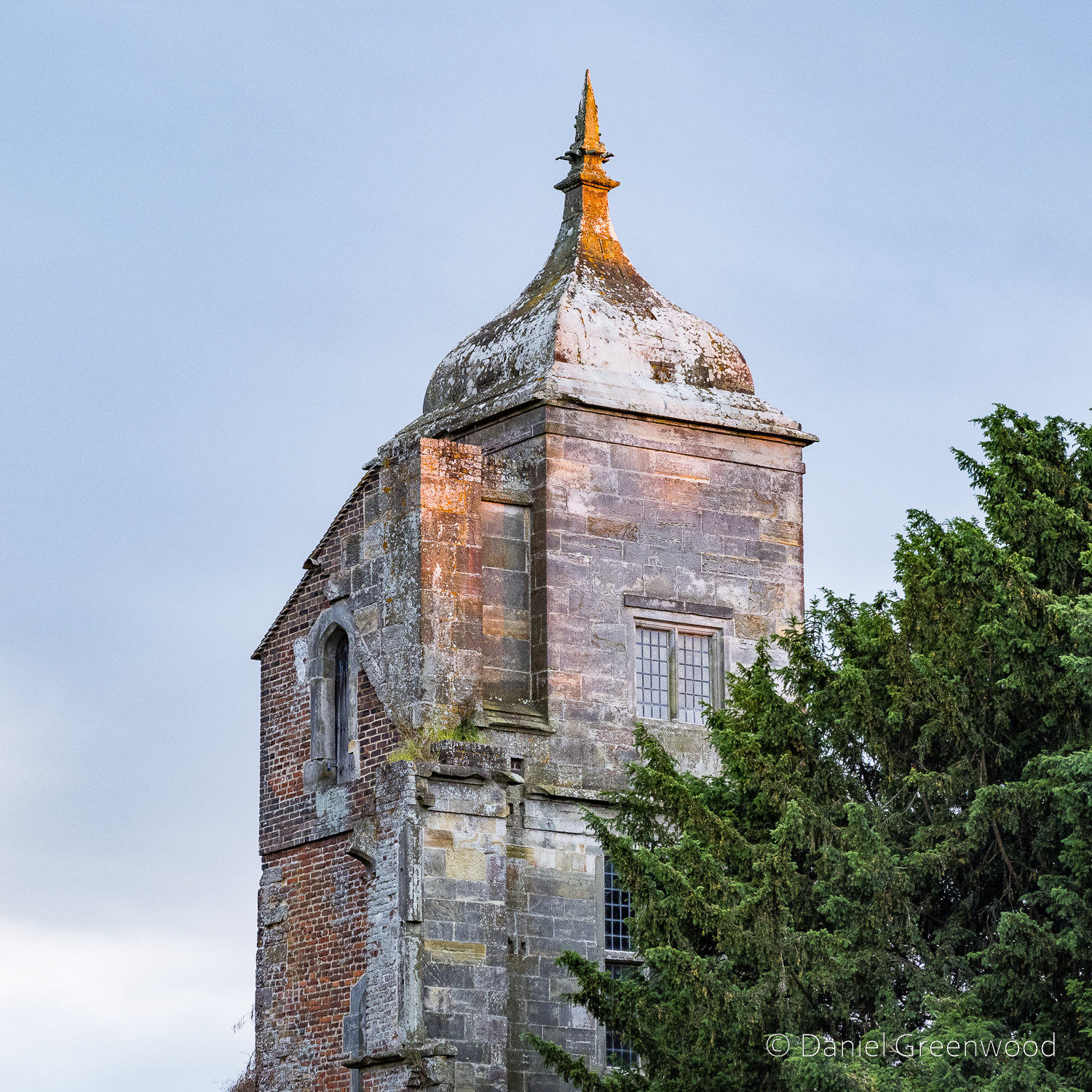
Western tower aglow in the setting sun, an architectural melange.
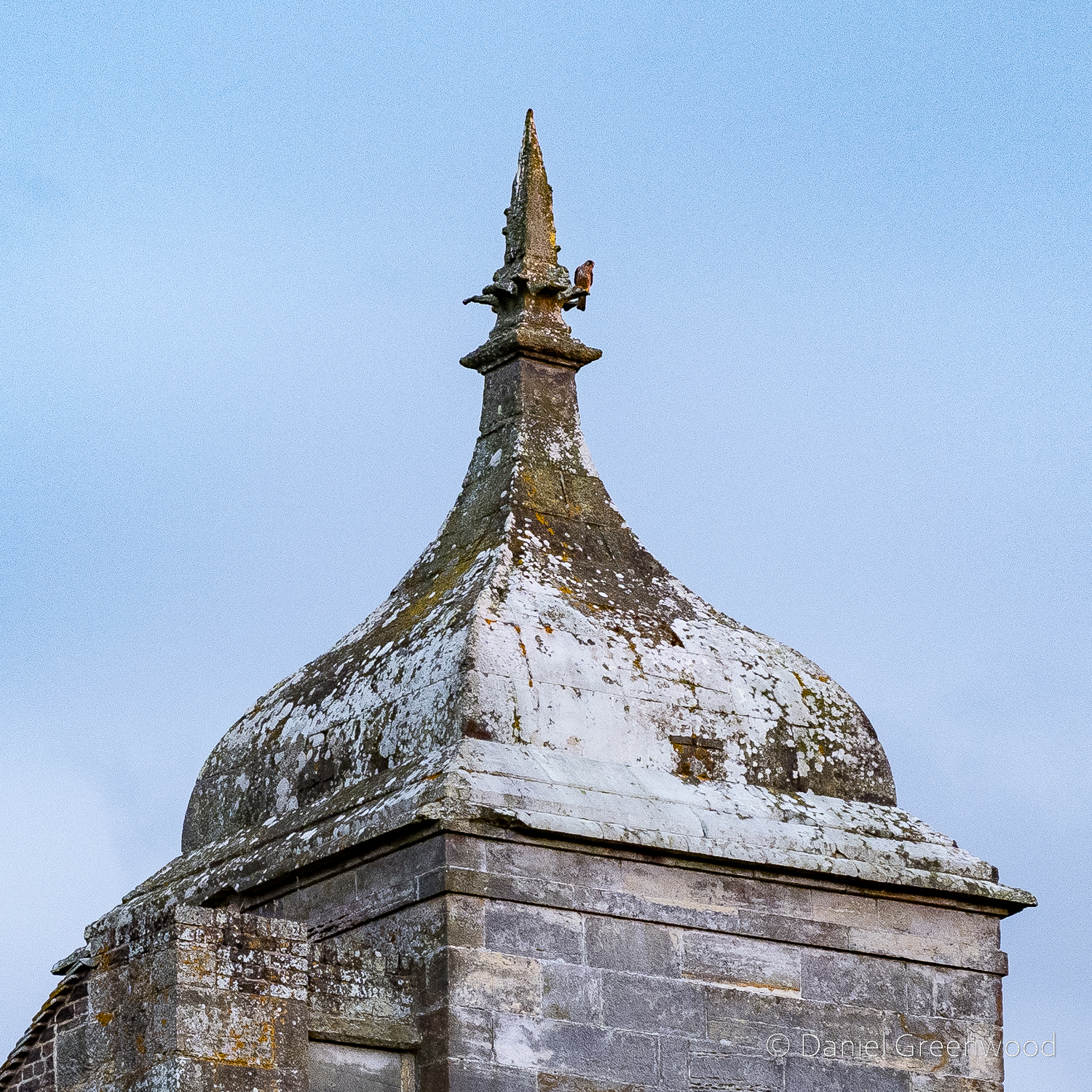
Me and Edwin are both bird nerds, and we were pleased to see a kestrel perched on the only complete tower. Kestrels love habitat like this, and the lack of suitable buildings to nest in has probably contributed to their decline in the UK.

Thanks for reading.

The Sussex Weald

A basketful of boletes ๐Ÿงบ

As seen on Friday 14th October 2022

In mid-October I met up with the Heathlands Reunited team at a Hampshire heathland in the Surrey borders. The meeting was to scope out a fungi walk I will be leading with them next month, and I thought it would be worth sharing some of the sightings. They will no doubt differ next month when autumn is well and truly progressing towards winter.

Very early on we found a perfect scarletina bolete (Neoboletus luridiformis)! This is one of my favourite species, having only seen one once before, on chalk on the South Downs Way in 2019.

Elsewhere in the bolete family, there were loads of brown birch boletes (Leccinum scabrum), most of which were in very good condition. Bramshott is a heathland so there’s a lot of birch there.

There were also plenty of Boletus edulis but they seemed to be mostly covered in mould after recent rain. This part of the Weald and Downs is quite misty and damp at times, so the mushrooms were probably quickly affected by the conditions.

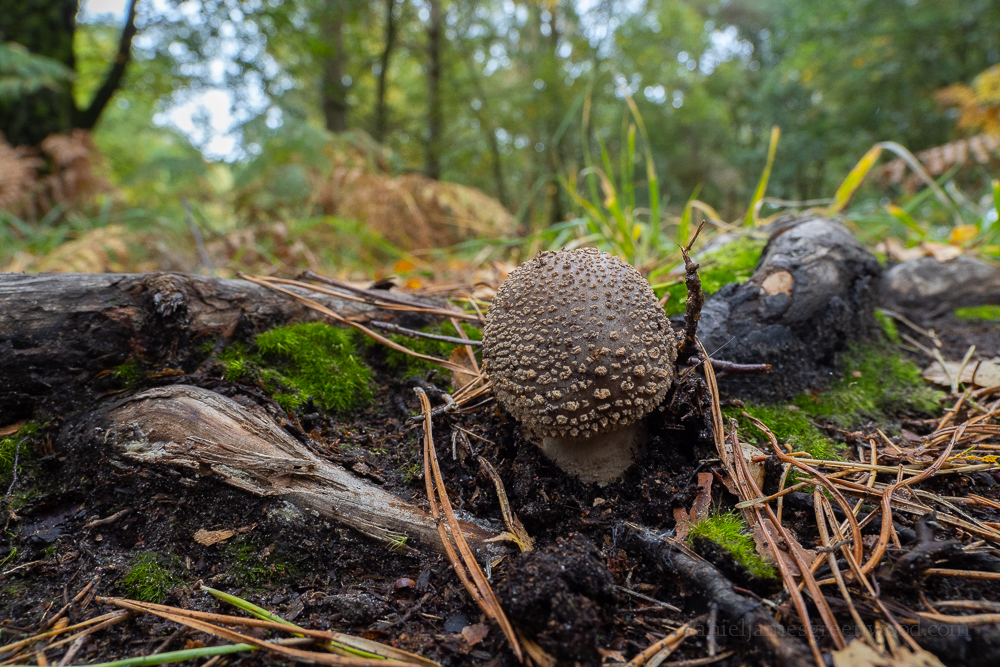
There were lots of these red mushrooms that you may have heard of before. They’re enjoying a good year.

Other amanitas found that afternoon include what is either panther cap or grey-spotted amanita.

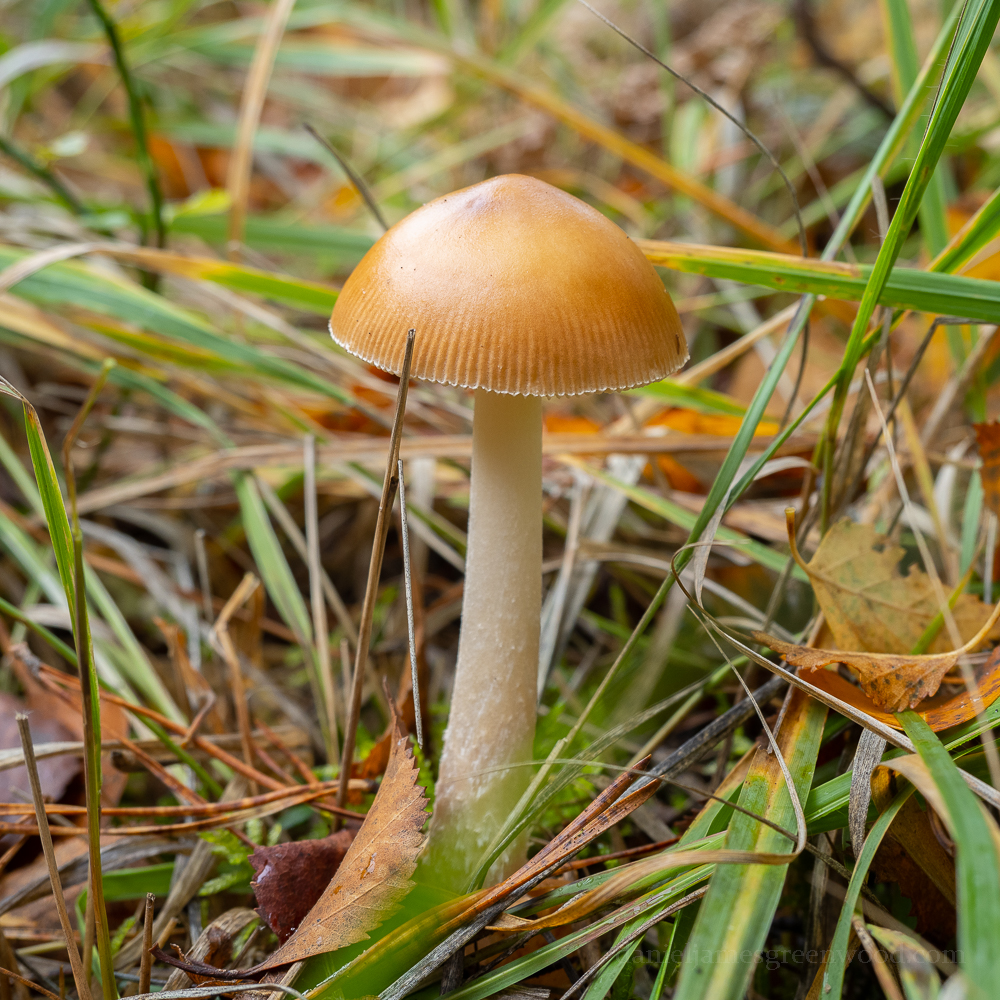
Less spotty amanitas included the highest numbers of tawny grisette mushrooms (Amanita fulva) I’ve ever encountered.

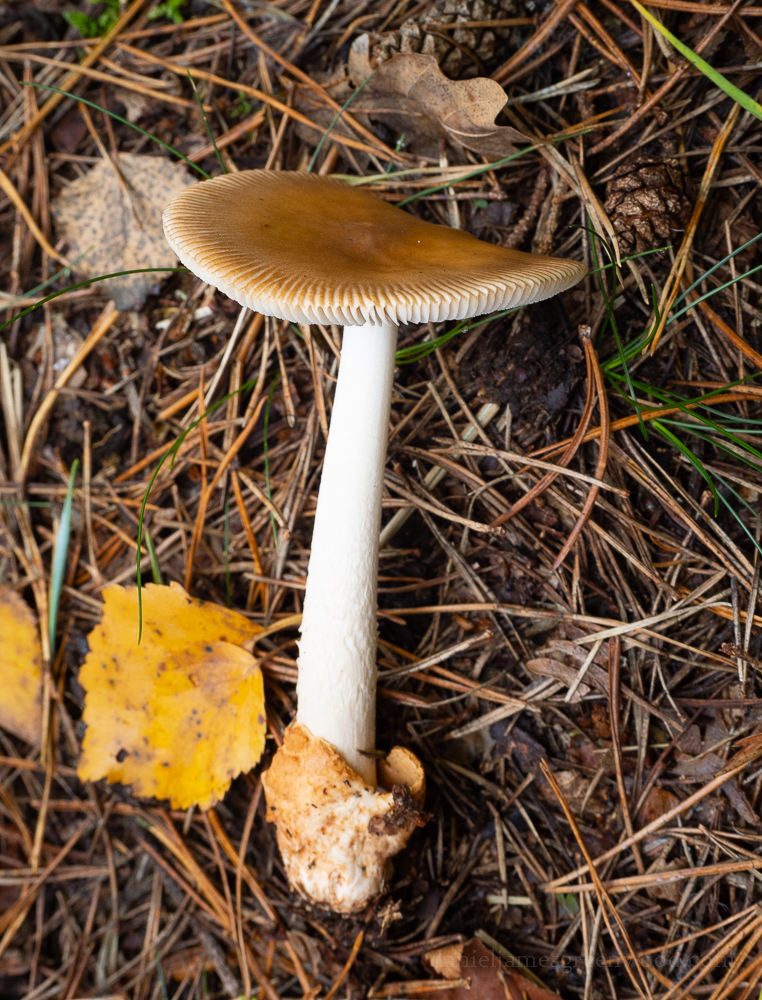
This grisette had fallen over. At the base you can see the ‘egg’ the fruiting body emerges from.

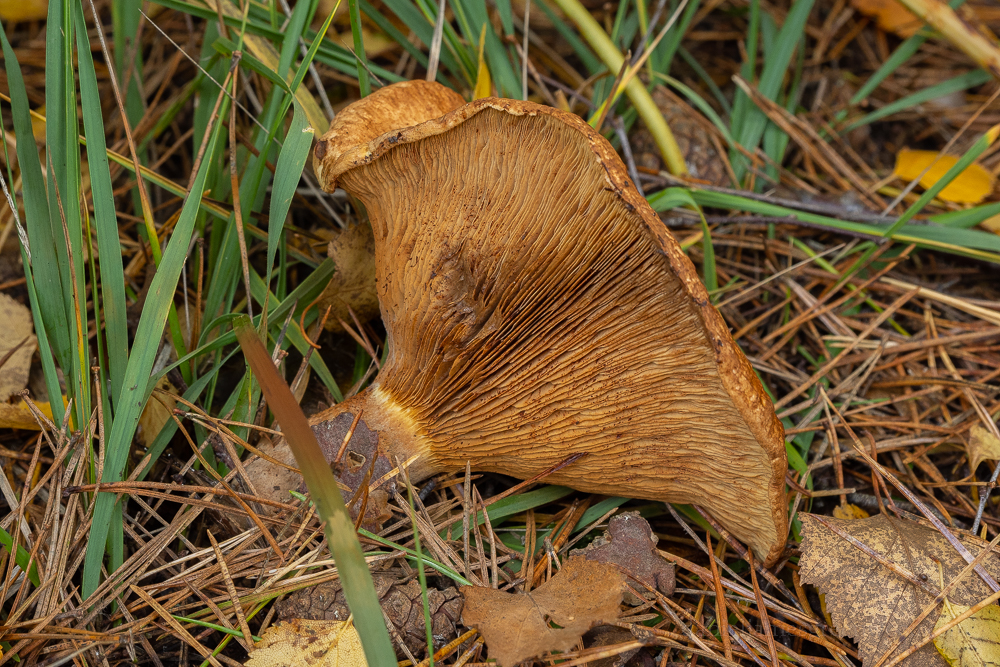
Along with those amanitas, the most common mushroom by a long, long way was the brown rollrim (Paxillus involutus). This is a poisonous mushroom which seems to be having a very good year.

Here’s a closer look at one of those grizzly bears. I first saw this mushroom when attending a walk from someone who taught me a lot – David Warwick – in Nunhead in SE London. He pulled what looked like a piece of rubbish from an old tree pit, what turned out to be the brown roll rim. I’ll never forget it!

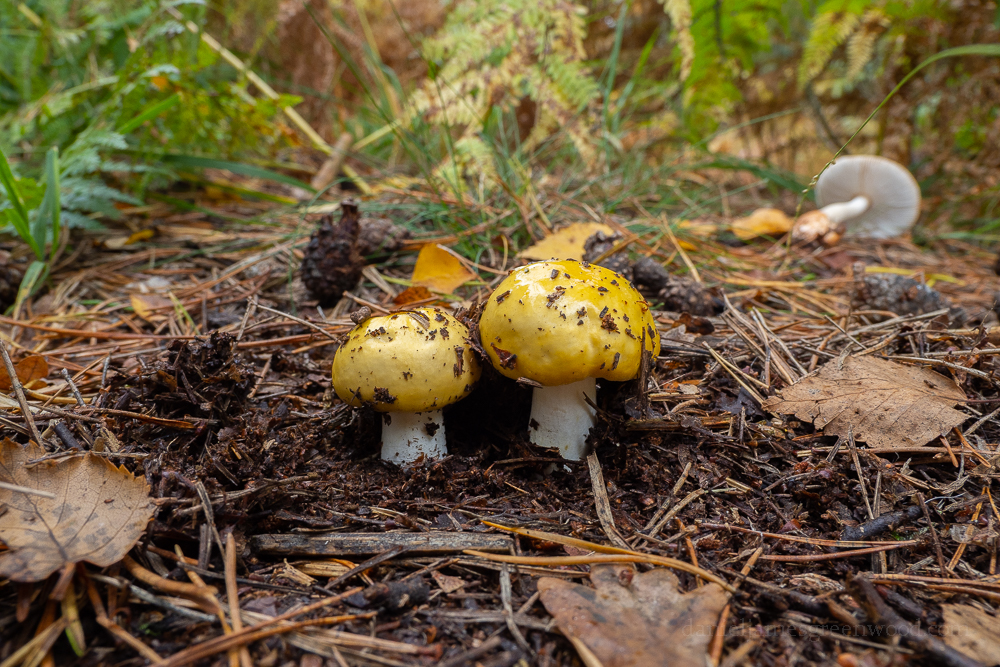
As mentioned previously this season, the russulas are having a strong year. These lovely yellow ones, were appearing afresh from under the pines and birch. You can see a collapsed amanita in the background.

I have considered whether to try and spend more time learning to identify russulas. My focus is on learning families rather than getting obscure fungi down to species level. I am not completely a scientist in this and my aim is to produce photographs and write these blogs. It becomes all about how much time is available to you and what the best use of that time is.

As we finished scouting the route for the walk, we bumped into a group of women who were picking mushrooms. They had a woven basket full to the brim. From what I could make out they had picked a lot of honey fungus, ceps, a scarletina bolete and one of the leccinum boletes. We got talking to them and discovered they were Polish – I can speak a little bit, which I deployed here, always received very warmly! – and the woman in charge really knew her stuff. She said she was going to pickle them in olive oil and was happy with the slug-bitten state of that cep you can see on the lefthand-side.

I’ve written before about the place mushrooms have in historically ‘Slavic’ countries such as Poland. This is not something you would often see in England, nor to encounter someone with the level of confidence in their knowledge. Of course no nation of people can be generalised or defined in any one way but the English culture has become one of mycophobia.

If anything is to be said in riposte to that, it’s that the level of interest and intrigue in fungi in England is growing. We were here to plan a route for a public fungi walk, after all!

Thanks for reading.

Further reading: Fungi

Enjoyed what you saw here? If so, please support my work: https://ko-fi.com/djgwild

Dragonfly heaven at a special Surrey heathland

Thursley - 29-6-2018 djg-30

Thursley Common, Surrey, June 2018

I’ve recently moved somewhere new and with that comes an interaction with new landscapes. In the United Kingdom, a distance of 25 miles can open up entirely new experiences in the outdoors through the sudden change in soils, topography and local culture. I have moved further south into Sussex, in touching distance of a tangled web of counties (West Sussex, East Sussex, Surrey and Hampshire), communities and habitats. One landscape that feels closer than it ever did is lowland heathland, a landscape I’ve come to learn more about in recent months.

I now know that dry lowland heath has been drastically lost over the past 150 years and it is rarer than rainforest. It is a human-made habitat with intrinsic ties to a pre-industrial way of life where local people grazed their animals, cut and burned heather, extracted sand, cut trees, but were unable to grow crops due to the poor fertility of the soils. It is subject to epic conservation projects in some places, like the Heathlands Reunited project working across the South Downs, tipping into Hampshire and Surrey in places outside the South Downs National Park.

My family have roots in Ireland and I have spent time there learning about the way of life of people who lived in the wild and very wet western areas. To my ancestors heather was an incredibly diverse resource. It could be cut at the right age to produce all manner of items, most fascinating to my mind were lobster pots weaved from woody heather growth.ย The subsequent cutting of heather allowed new growth and light to reach the heathland, benefiting many different species – denser growth for ground nesting birds, increased flower abundance – and a mosaic of vegetation lengths which further the species diversity through the creation of micro-habitats.

This slideshow requires JavaScript.

With the popularity of the rewilding movement in the UK, heathlands are a point of contention because an argument for landscapes to be left to ‘adopt their natural state’. This is at odds with the desire to see heathlands humanised again, what is shown to produce the richest conditions for their wildlife. Heathlands which are ‘left’ or ‘rewilded’ become simply poor quality woodland in the sense of the lack of species diversity.

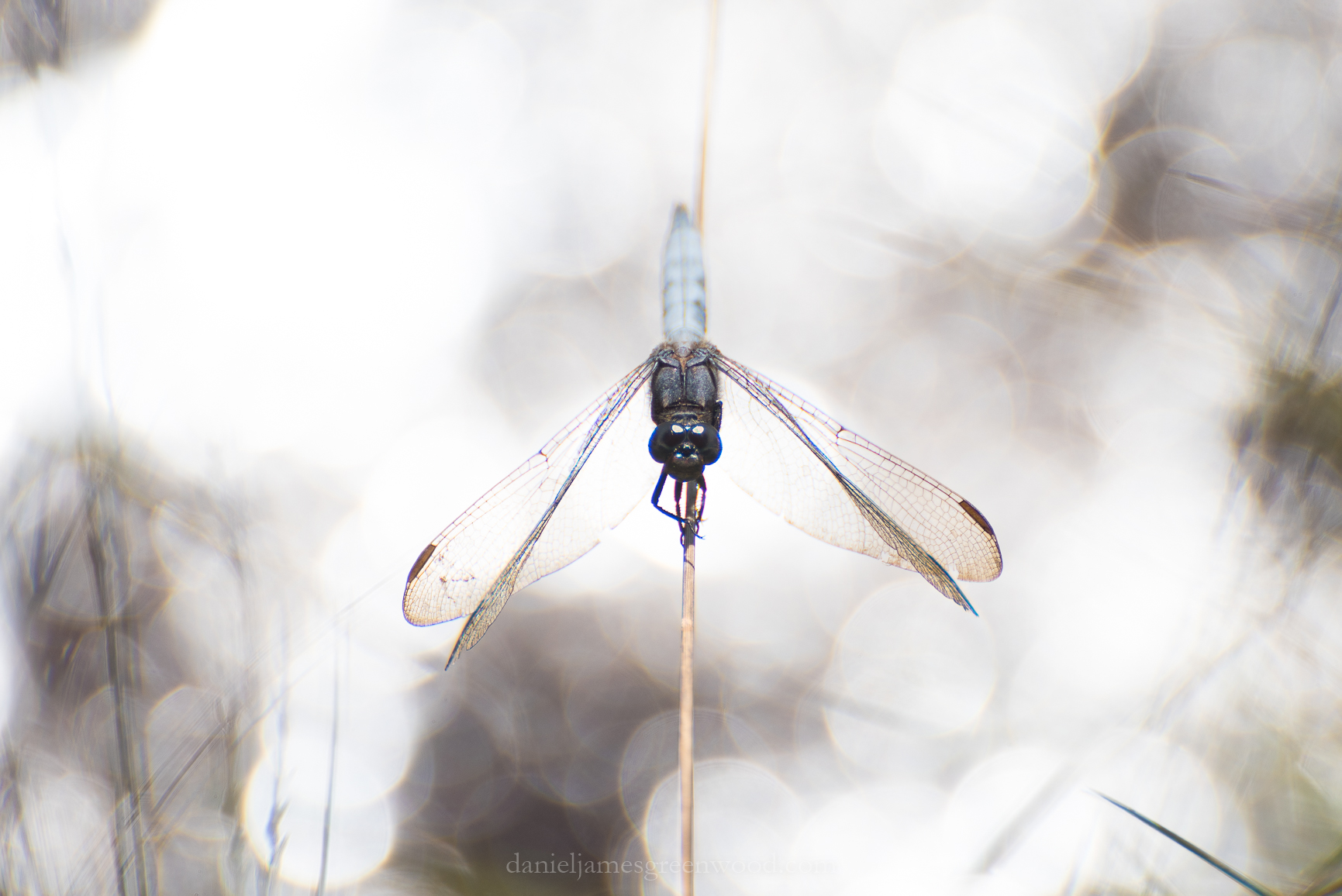
One site stuck in that tangled-web of counties is Thursley Common, a National Nature Reserve managed by Natural England in Surrey. I visited Thursley for the second time in June on a hot but mercifully breezy day. There were many thousands of dragonflies on the wing – so many I declined to ‘tick off’ the vagrant red-backed shrike which people were heading over to see but completely ignoring the riot of Odonataย  – and the sandy paths were brimming with rare insect life.

Having visited Thursley a year before with a tour from the site manager, I had an idea of where the good stuff was and some background on their ecology. Over the winter I had looked forward to returning to try and photograph the heath sand wasp and mottled bee-fly. Thankfully the weather was perfect for this.

This slideshow requires JavaScript.

Kneeling down on a sandy track it was possible to see the heath sand wasp, found only on lowland heath, mainly in the south of England. It was caching moth larvae that it had been hunting out in the heather. It’s hilarious how they use a small roll of sandy soil to close their doorway before heading off again to hunt on the heath.

They have every right to be cautious. Lying in wait on tiny scatterings of twigs were mottled bee-flies, a rare insect that parasitises the nest of the sand wasp. It wasn’t clear whether the sand wasp was wary of me or suspicious of the presence of the fly (do insects experience suspicion?) but at times the bee-fly deigned not to move, creating a kind of stand off between the two insects as the sand wasp waited to fly off to hunt and the bee-fly waited to hover and throw its eggs into the hole.

Sure enough, after the wasp had moved away, the bee-fly was hovering over the nest hole, chucking its eggs in like a footballer volleying the ball into an open goal.

These are two species which, without managed heathlands (interestingly much of the management they benefit from is the result of footfall exposing sand along the paths) would be lost. Woodland’s return would mean a loss of light, warmth and resultant heather growth where the sand wasp’s prey is found, meaning that the structure that binds these species would collapse.

Thursley - 29-6-2018 djg-71

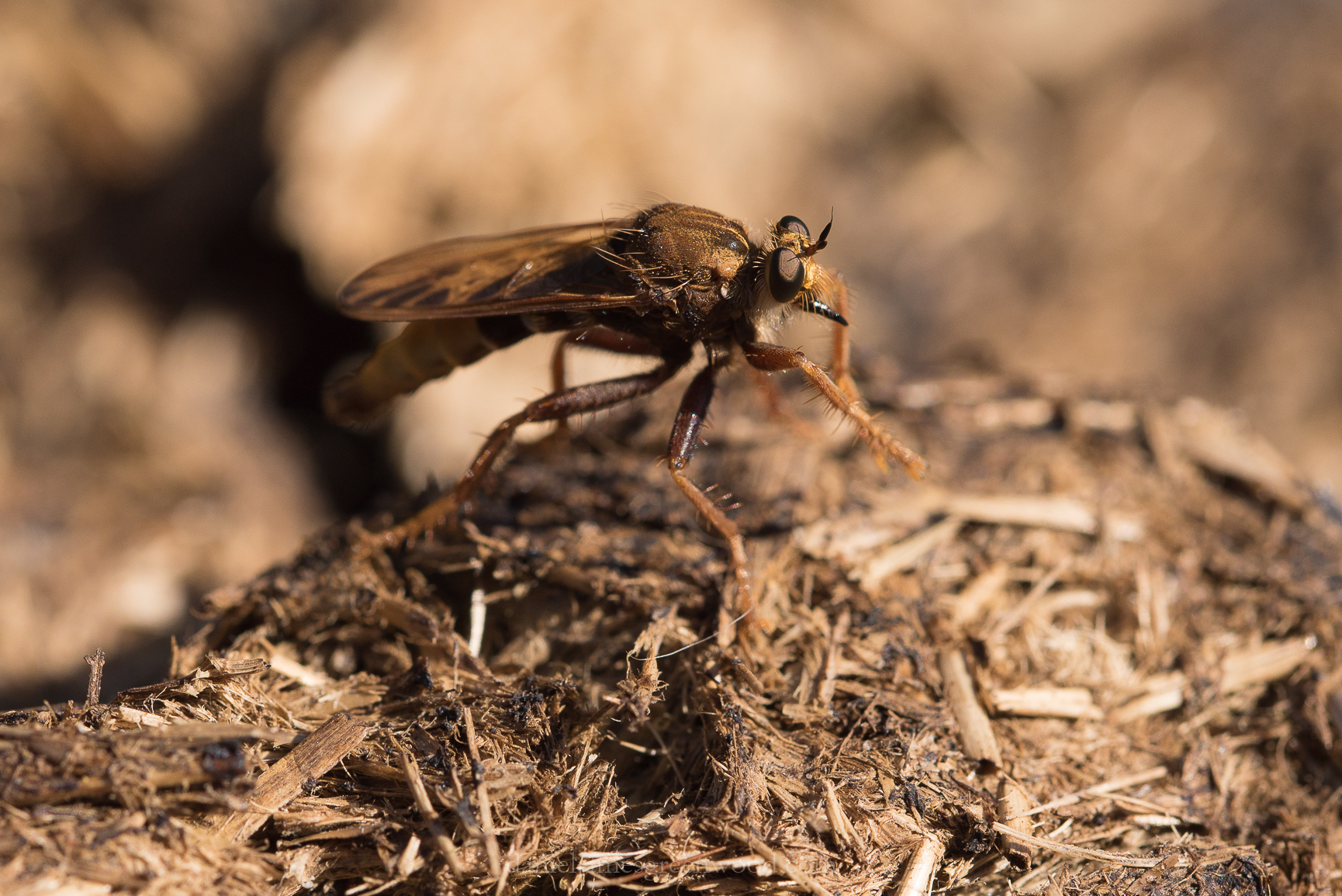
Another unusual insect along the paths was the hornet robberfly. This is another type of fly that can be found in heathland and is classified as rare. It is possibly the largest fly in the UK but it looks like a hornet. Like many of our flies (bet you don’t consider them your own) it mimics the appearance of a predatory wasp to give a greater sense of protection. In terms of natural selection, it has survived probably because it looks like a species that has a world-shattering sting at the tip of its abdomen.

Robberflies do exactly what their name suggests, they steal insects and eat them, sucking them dry in about thirty minutes in the case of the hornet robberyfly. The best way to see them is through a macro lens and to hang out somewhere that you know has lots of other insects present. Some stunning photos are out there with robberflies holding on to their fly prey.

I spotted the hornet robberfly because it was sitting on a pile of manure, exactly where it likes to spend its time in life. It was using the manure as a perch to hunt where it can blend in with the hay stems that a horse or cow can’t quite digest. They also lay their eggs in the crevices of the dung.

It was a privilege to see these rare species, unseen to almost everyone (obviously), only present because of good management and an appreciation that human impacts can be positive for living things other than ourselves.