Macro: As autumn beckons, ivy brings the bees 🐝

East Dulwich, London, September 2023

On the corner of the street, a mass of ivy was spilling over a wall. It was an explosion of leaves and flowers, sound and smell. The flowers were alive with insects: hoverflies, honeybees, bumblebees, and that ivy specialist, the ivy bee. 

I hadn’t seen many ivy bees before, and wasn’t aware they were now so far into the centre of London. They nectared in a frantic fashion, with at least two having been captured by a massive garden spider that scarpered when it realised how close I was to its web.

At this time of year very few plants are flowering, and none like the ivy can. Even so, ivy in London has an awful reputation. People hate it, calling it a parasite and tree killer.

Some years ago a man gave me his opinion by leaning in and whispering that he had seen it sucking the sap from a tree, like it was some dark truth kept hidden from the world.

In reality it’s not a tree killer and it’s not a parasite. But like so many things in society now, people will believe what they want, regardless of the facts.

In a wood near to this jungle of ivy, mature growths of it have been found hacked and severed by visitors acting on their instincts without reason (or permission).

I remember a local tree surgeon unloading on me one morning when I was in the woods about to start a working day, telling me how terrible ivy was at that location. I was taken aback by the man’s strength of feeling and let him say his piece. When he had finished I asked if I could go and start my day’s work.

“You didn’t like that, did you?” he said.

Is it any wonder tree surgeons don’t like ivy? I’m sure many appreciate its place in the ecosystem, a habitat for bats, birds, insects and autumnal nectar for pollinators. But to a tree surgeon it makes your work so much harder, what is already one of the most dangerous and brutal jobs available in the UK. I suppose I had just expected someone who works with trees all day to have a little more imagination and ecological flexibility.

I’ve made the faux-pas while leading guided walks of talking about the value of ivy nectar to honeybees and been informed that it’s not so good for them. One very polite beekeeper corrected me and said that the nectar can crystallise too quickly in the hive and leave the bees to starve. For wild pollinators there is no such problem, of course. The beekeeper said the issue was mostly where the only nectar source was ivy.

Should ivy be cut off trees in some cases? Of course. But is it often framed for crimes it didn’t commit? Yes, all the time.

I remember driving with my parents through Ireland back in 2008, when I knew very little about trees. Ivy was everywhere and I worried it was going to harm the trees. I later learned that the story is different.

Ivy often grows on trees that are in decline, meaning more light comes through the canopy, encouraging the growth upwards. Then when the tree does die, there stands the ivy, ‘throttling’, ‘suffocating’, ‘killing’, as some hyperbolise. In high winds ivy can act like a sail, and trees do come down.

In my experience it is often life-giving.

People come to nature looking for absolutes, but just end up finding more questions and often being humbled. The trick is to embrace the ambiguity, your own lack of knowledge and mastery of any given subject.

Personally, I was thankful for that final flush of insect buzz on an unseasonably warm September morning. Who do I thank for that? That’ll be the ivy.

Thanks for reading.
Why do people hate ivy?

Tooth of the lion 🦁

Back in London and a chance to see what my Mum and Dad’s garden had to show for itself on the first day of May. This is when we really start to get into the pollinator season, which peaks in July. The weather was perfect for macro with no harsh light.

The forget-me-nots were still on fine form.

I noticed how the dandelions in their pre-flowering phase also look like lions. Their name actually means tooth of the lion from the French “dent-de-lion”, which is one of the great common plant names in my view. Also a reminder of how the English language takes from so many others (did you know English also contains ‘Viking’ words like sky, eggs, and happy?!) The leaves look like teeth but the flowers look like lion’s manes. I’d love to learn more about the history of the name in England.

The ladybirds were quite active. We may be looking at the invasive harlequin here.

I saw this micro-moth on a few occasions, if they are the same species. Their behaviour was similar and their patterning is also.

It’s always nice to see a bee-fly, unless you’re their prey. They can’t have much longer left of their season.

This cucumber spider was hiding away in a buddleia leaf.

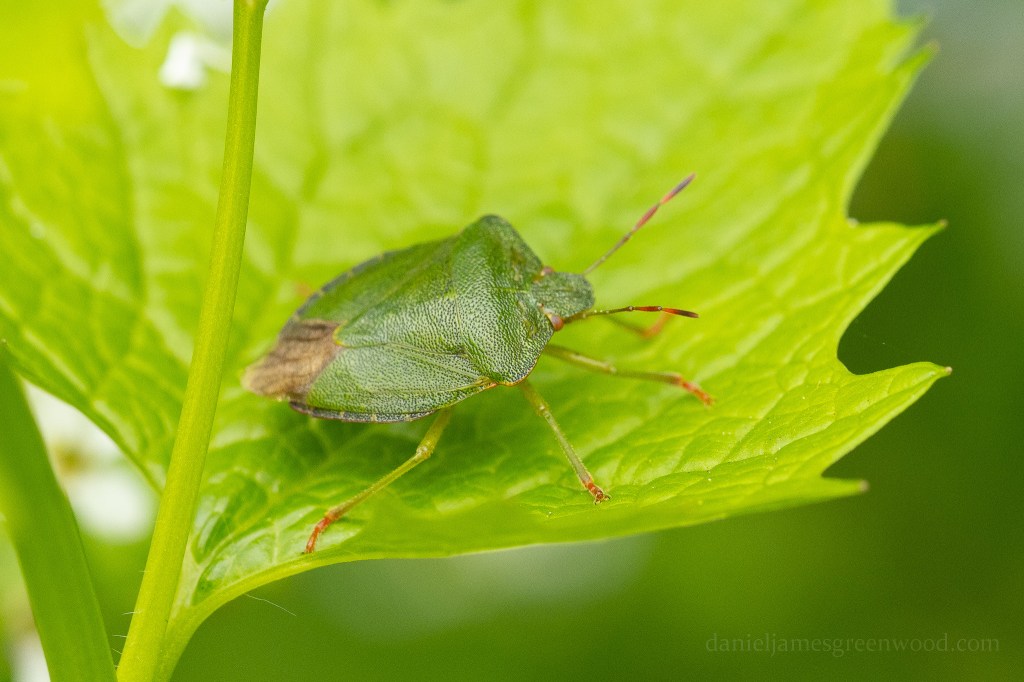
This is one of the first green shieldbugs I’ve seen this year. They are a really common garden bug in England.

Mirid bugs are a quite big group, but this is definitely one species I’ve encountered often in suburban gardens.

My Dad spent ages trying to control the Spanish bluebells that were running rampant. They are a difficult species to remove. That said they are attractive both for photos and some pollinators like mason bees.

My final image was of a hoverfly I see quite a lot that holds its wings in to its body, making it difficult to observe its markings. I think this one looks like a metallic robot from a 1980s sci-fi movie.

Thanks for reading.

More macro

London’s woodpeckers: the rattling call of the great spotted wood-striker

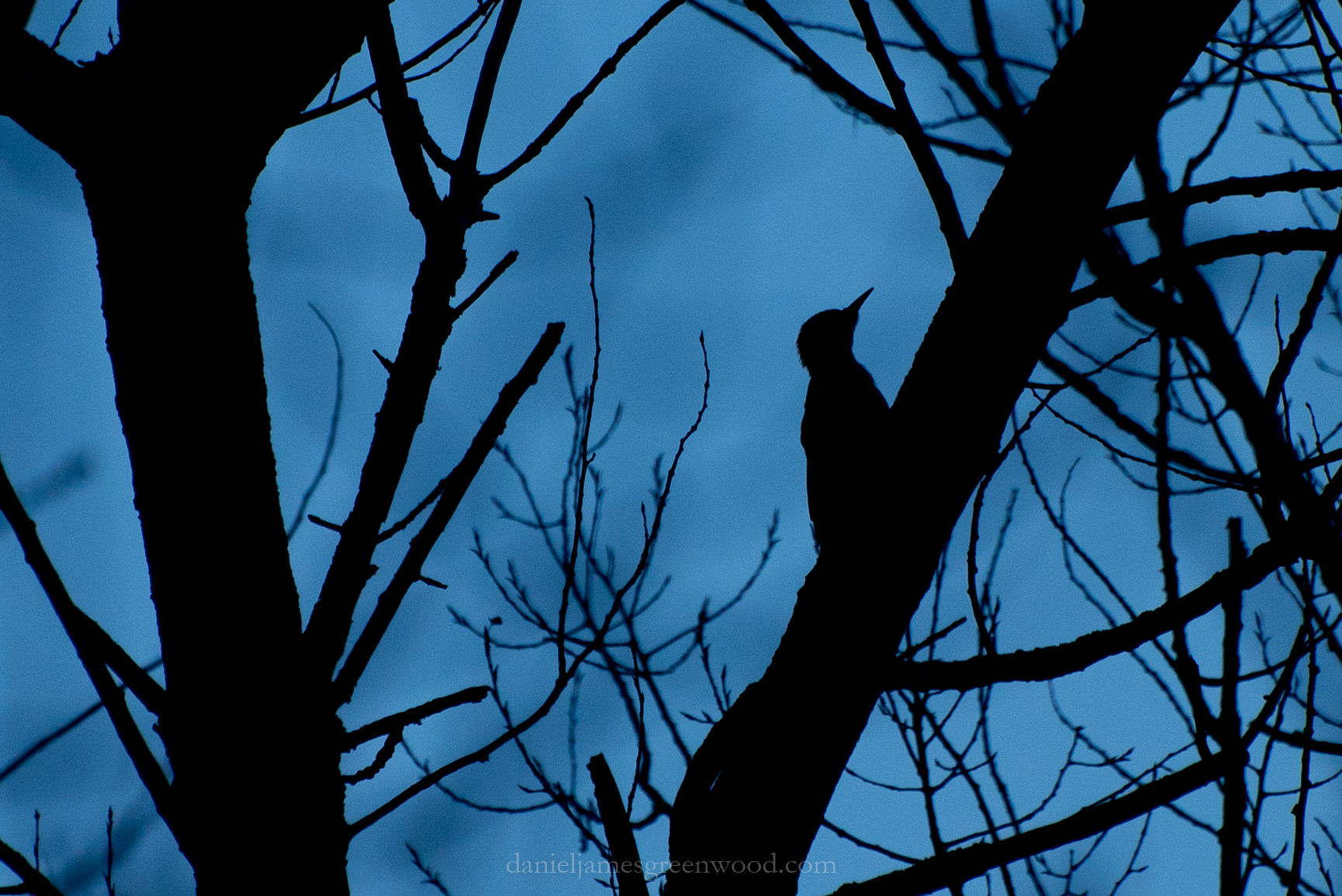
Woodpecker silhouette djg-1

This is an expanded version of an article that was first published in London Wildlife Trust’s Wild London magazine

It’s a sound that stops many in their tracks, the rattling in the canopy of woods, parks and gardens. It’s a sound that brings in the new year, signs of spring breaking through as our own seasonal celebrations draw to an end. While we are still deep in recognising our need to rest in the midwinter, our wildlife is busy setting out its quest for new life. Britain has three species of woodpecker and in January we begin to hear the hammering, or drumming, of the great spotted, the sound of male birds marking new territories. It’s a bird that is becoming more and more familiar to us in London as its numbers increase.

Its favoured habitat is oak woodland with plenty of rotting branches, trunks and limbs in which to create a new hole each year, ample habitat for the biggest of our two Dendrocopos woodpeckers, the great spotted. Dendrocopos translates from Greek as ‘wood-striker’.

One thing I have noticed in suburban locations is the woodpecker drumming on TV aerials and receivers. One great spot I’ve seen has found the plastic box now employed to improve TV signals makes decent percussion. It’s a wonder that this hammering on hard surfaces doesn’t cause the birds injury, but evolution has equipped them with shock absorbers in the back of their skulls that cushion the blow. It’s not the same as banging your head against the wall.

There are four members of the woodpecker family deemed native to Britain, with one now classified as extinct as a breeding bird. That is the wryneck (Jynx torquilla), a bird that migrates from Africa each spring in small numbers still. In 1904 a wryneck nested on south-east London, what was thought by the observer to be one of the last nests in his time, in south-east London historically.

Another of our four species has declined at a rate that has baffled ornithologists. The lesser spotted woodpecker (Dendrocopos minor) was noted in south London’s woods up until 2008. The odd autumnal record does crop up as the lesser spots are migratory, with one seen in 2015 in Brockwell Park in Lambeth.

Bialowieza-1-15
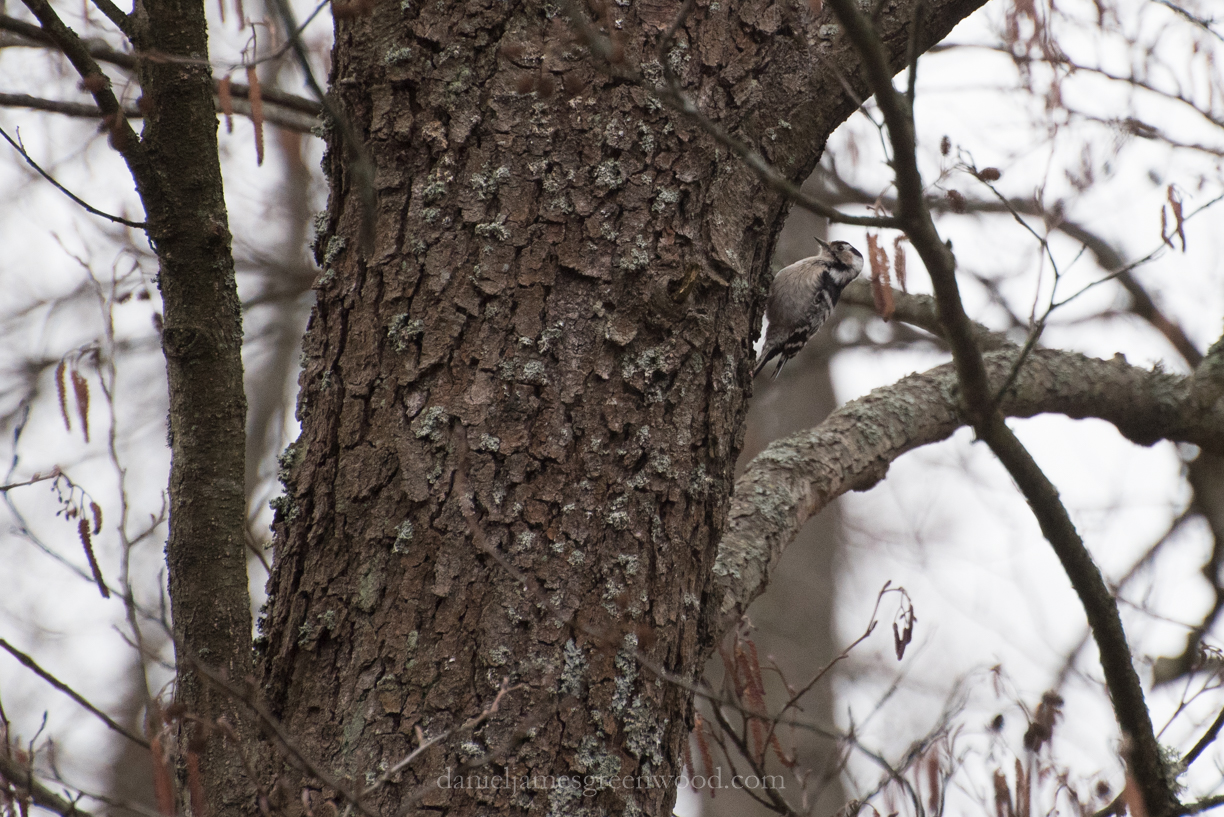
Lesser spotted woodpecker

One possible theory for the decline of lesser spotted woodpeckers (above) relates to the rise of the great spot and the disappearance of starlings from London’s woods as a breeding bird. When starling numbers were higher in woods they provided more competition for great spots.

This gave more space for the lesser spots, being much smaller, about the size of a sparrow or starling. As starlings and their ruckus have left the woods, the great spots have increased in number as they have experienced less competition and adapted to the boom in garden bird food. Lesser spots require a smaller hole in a tree to nest and if a great spot chooses the nest they can make the hole bigger and the lesser spots are pushed out.

Lesser spotted woodpeckers, however, are not extinct like the wryneck as a breeding bird and they still have strongholds in the UK. The most important place for them is the New Forest, one of the mythical heartlands of ancient English woods. There the management of the woods has remained the same for centuries, pointing to another reason for the species’ decline elsewhere. British wildlife is under increasing pressure from development and the loss of available food due to wider intensified management of the countryside.

So the two factors which are most harming lesser spots, and starlings, too, are a lack of habitat and food. The loss of food is a loss of invertebrate life being driven by agricultural intensification and a tidying up of green spaces, loss of gardens and general overuse of harmful, residual pesticides. Another key change is the loss of old orchards, another traditional habitat disappearing in Britain, one of the lesser spot’s favoured habitats.

The other member of the British quintet, if including wryneck, is the green woodpecker (Picus viridis). Green woodpeckers are different to the spotted woodpeckers because they don’t hammer to mark their territories but instead call, what was known for centuries as ‘yaffling’. An old name for a green woodpecker is ‘yaffler’. It’s a call that can be heard most clearly in woods and parks with mature trees, where green woodpeckers also nest.

Blean September 2016 lo-res djg-15
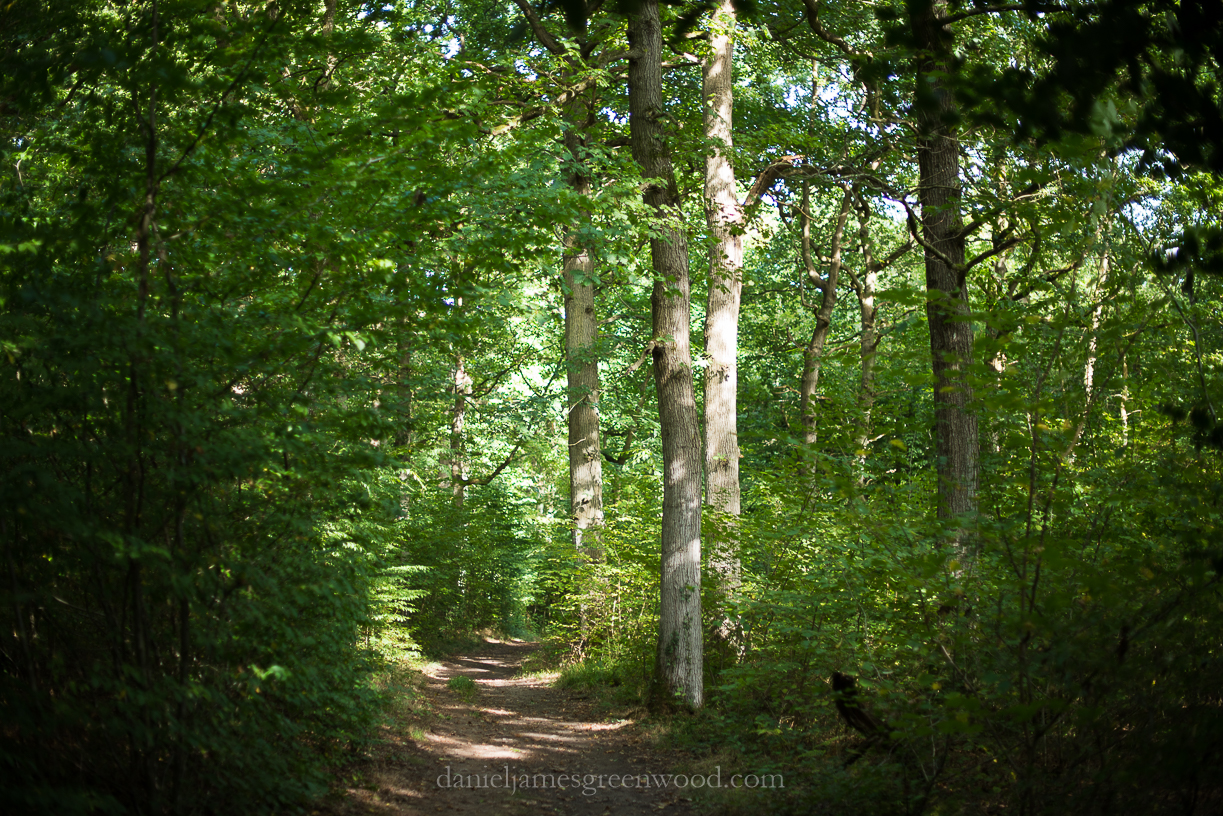
Oak woodland is a key habitat for woodpeckers

The call has a prehistoric feel about it, echoing deep into woodland, as the reverberation recedes. Greens differ again from the spotted woodpeckers because of their feeding habits, spending their time searching for ant colonies in woods and lawns. Naturally grassy sports pitches with a surrounding area of mature trees are a good place to find the birds. They lie low, shooting their long tongues down into nests to find food. It’s something you are very unlikely ever to see a great spotted woodpecker do.

For those curious and unsatisfied by the array of woodpeckers in London, remember that you will have to travel to continental Europe to find a greater diversity. Arriving in France you could meet with the biggest of all the European woodpeckers, the black woodpecker and heading as far as the great ancient woods of the Czech Republic, Poland or Romania, you can find as many as seven species. In British terms, the health of London’s woodpeckers reflect the state of the nation’s.