The flavour of open landfill

– Beddington Farmlands, London, April 2012

We walk a clay-coloured path towards the landfill and stop to listen to the subsong of a whitethroat newly-arrived in the country. It sings from the obscurity of bramble and other scrub, evidently practicing before it’s ready to give its best rendition. We leave it and head for the hill. To the left is a gravel pit blocked by fencing, a hillside of green grass and garbage growing up and out of it on the bank. At times I fail to differentiate the flagging bin liners from the crows and jackdaws which gather in vast numbers, picking through the bits and pieces. On the track there’s a Nike basketball shoe and the Caucasian limb of a Barbie doll, a cassette tape of ‘90s Wimbledon and a plastic water bottle. This has been carried-over by the wind and evidently the landfill is not being contained. And then it touches my face, the sickening flavour of open landfill, like the whiff of pure alcohol. If I’d eaten I’m sure I’d be gagging, I hold my nose and breathe through my mouth.

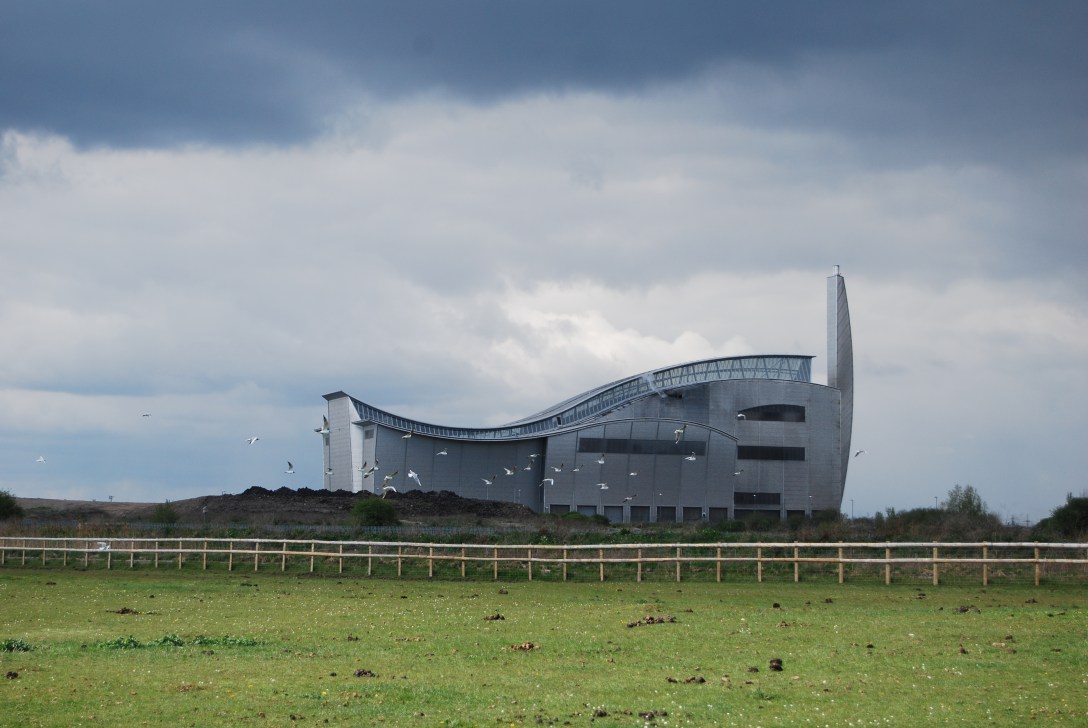
At the surmount we can see everything – the Crystal Palace ridge, now recolonized by trees after the Great Exhibition’s twilight stay in the heights of south-east London, and Addington Hills in south Croydon, an undulating snapshot of landscape. Down below we can see the crows feeding on the recent landfill, clinging to the fence as a buffeting wind moves across, it’s too cold on the eyes to look through binoculars. The landfill slopes down towards a large pool with islands scattered throughout. It’s manmade, the aim to lure migrating birds like yellow wagtails, one of which passes overhead, and provide habitat for snipe, plovers and terns. The scene is teeming with life, herons at every corner, gulls, ducks, all living amongst one another. From the landfill perimeter garbage has escaped, a stream of multi-coloured items leading to the water where a white swan is preening its wings. I look across the water to the opposite side where a crude tin hut has been constructed by the Beddington Farmlands Bird Group, they’re gathered at the water’s edge, telescopes, cameras and binoculars to hand. Behind them is a feeding station supporting London’s only colony of tree sparrows but they can’t be picked out with the naked eye from up here. On one side of the water you have people who devote their lives to caring for wildlife, and on the other side the waste which so harms ecosystems. And somehow wildlife can live with the crap we don’t want, the plastic, the rotting food and even our stool. But the question remains: can we?
The sun sets over Dartford

It’s late afternoon and the sun begins its descent toward Dartford. In the east the bridge is reflected in the shimmering Thames. Rainham Marshes is behind us, beyond the large concrete seawall and iron fencing, protecting the reserve from dogs, people and vehicles, protecting skylarks and lapwings, birds that breed on the ground. Gulls pass over from the marshes and across the Thames to the south. A deceit of lapwings exits, too, their flappy black wings belie their compact shape when grounded. They return to Rainham a few minutes later. Evidently this is not an exodus. Teal are swimming on the Thames, their colours draining as the sun retires behind them. We inspect the shoreline, its thin marshland and garbage. The ducks want to feed here, but what’s to be eaten? The tide bubbles audibly against concrete, an armchair rests at a tilt in the marsh, half against the slanting ground and half in the slurry. The chair is stained where it’s become soaked by liquids other than water over the years. If you were to sit in it, you’d fall backwards, skull first. The dry land is tropical with all kinds of plastic: caps freed from their bottles, thin tubes like the insides of biros, thousands of bits of broken plastic, and a syringe. There are pieces of driftwood lying around, one chunk has been bleached by sun, sea and salt. It breaks under the slightest pressure, the yellow shape of woodworm hibernating in a crevice created inside. I wonder how far this piece has travelled.

The sun is setting further, the river taking on the image of a lagoon, still the teal are drifting. We walk back along the path in the direction of Purfleet, a small flock of pied wagtails circling us back and forth to Rainham. They are wary and so they come and go, at last settling on a patch of rushes and straggly vegetation covered by yet more rubbish. Small islands of sand and mosses remain amidst plastic, industrial sponge, a road crossing bollard and bottles galore, the pooling water has the metallic sheen of petrol. The eye’s obsession with trash distracts from the living, in this instance the stone-washed water pipit holding onto a stalk amidst the rushes. The wagtails patrol the sand in their cheerful manner, taking pops at one another on occasion. The water pipit is still, in contrast to its cousins. A woman in red approaches and the passerines are flushed from the islands and back over the seawall, the pipit going with them. She has a green lager tin in her hand and white earphones. She sits to watch the sun from the wall, kicking her legs. The birds return to their patch. The pipit lands at the water’s edge, joined by what looks like a second pipit. The much duskier bird lacks a white eye stripe, or supercilium, and is itself a different bird, a rock pipit. Like its cousin, the rock pipit wags its tail as it looks for something to eat.

The trains back to London arrive on the hour so we sit by the water and watch the final movements of the evening. On the path a woman pushes her grandchild in a buggy, remarking to us that Thurrock once had a population of forty-four. This, of course, was centuries ago. The pipits would have been in a similar spot then, likely feeding in water free of oil and sponge, but no doubt touched by different sort of human waste. Up ahead, a man rides a mini motorbike with his daughter in his lap, his look is sincere. They disappear between a gap in a dumpy little bush. On the grass dwarf mallow leaves await flowers and a pair of mistle thrush regard us with caution as they disappear into near darkness. The sun is a ball, inflating and draining into the south, v-formations of gulls sweep to the east, down a river now black and gold. Ducks and debris float freely towards Greenhithe and Grays, a slurry of pollution passing by, highlighted in the twilight.

A fashion shoot is taking place against the railings, a young woman with cropped hair and a purple dress stretches herself against the bars in a mocking vogue. As if from the river itself, as its inhabitants flee eastward, a curlew calls over and over again.