Essay: Why do people hate ivy?

Ivy leaf

I remember when I first became interested in woodland. Through my lack of knowledge and understanding I thought ivy was a tree-killing force that scaled a trunk like a cancer and had no other purpose. I looked at the fat stalks of ivy growing on a poplar in a nearby park and thought it might be an idea to cut them. In my local area there are people who go around doing just that.

The fact is that ivy is fantastic for wildlife. When ivy grows up the front of a house and sparrows are nearby they’ll use it. Blackcaps, one of my favourite songbirds, nest in it. Entire bat colonies can roost in it. Hoverflies, bees, butterflies, they all use it for different means, be it a leaf to perch on or flowers to drink nectar from. Walking in Crystal Palace Park recently I was passed by a man remarking to his friend about a line of trees with ivy growing up them:

‘Look at those trees,’ he said, his companion turning to look. ‘The ivy grows up them and just kills them off. I’m thinking of writing a letter.’

This is one of the biggest misunderstandings about ivy – it is not merely some dark demon from a tree-hating underworld, it flowers, too. In fact, the main reason it is even anywhere near a tree is because a songbird or woodpigeon has sat in the tree and evacuated its seed. It produces food eaten by a good number of birds and attracts insects that birds can feed to their babies. Beautiful and exciting birds like firecrests target it for food and shelter in winter when they pass through parts of the British Isles.

A tree brought down in a wood will give life to wildflowers and wake some that have lain dormant in the soil

Ivy does add extra weight to a tree and, in some cases, can weigh a tree down making it more liable to windblow during a storm. But the issue isn’t with the ivy it’s with us, Homo sapiens. In woodlands, it is completely natural for a tree to fall down, it’s good. The new light that will hit the woodland floor will improve the structural diversity, particularly in British woodlands that, since the Second World War, have gone largely unmanaged and have become overgrown as our economy has grown to rely more and more on imported materials.

A tree brought down in a wood will give life to wildflowers and wake some that have lain dormant in the soil, unable to flower because of the previous tree’s leaf shade. In the street, however, a fallen tree could mean death, damages and lawsuits. For all our love of woodlands and forests, perhaps the sight of new woodland is something that kindles a deep fear inside us, as if the open land is being overtaken, changing at a pace and in a manner that we’re uncomfortable with. Personally I find woodland reclaiming old developments and ‘wastelands’ as something to feel good about. It tells me the world can function without our intervention and can recover. Nature can make even the most barren place into a leafy oasis given time.

The chap I overheard in Crystal Palace later remarked on a c.200-year-old horse chestnut standing tall and true, though surrounded by ground dwelling ivy. If he had seen a horse chestnut wounded by blight, a disease spreading through global trade, might he have turned his ire on Environment Minister Owen Paterson for not tightening restrictions on imports? In the case of the healthy, happy horse chestnut, does it not suggest that what we love (or this man at least) is the splendour of individual trees, their maturity, their completeness. The common understanding of nature’s life cycle is a single sapling to a mature tree, without any notion of the stuff that might happen in between, the decay and lost limbs, all part of the picture. After a recent trip to the decidedly untidy West of Ireland, I read this quote from Oliver Cromwell on the state of the Irish landscape in Neil Hegarty’s The Story of Ireland:

‘For to what purpose was it to plow or sow, where there was little or no Prospect of reaping? – To improve where the Tenant had no Property? This universal Neglect of Husbandry covered the Face of the Kingdoms with thickets of Woods and Briars; and with those Vast extended Boggs, which are not natural but only the Excrescences and Scabs of the Body, occasioned by Uncleanliness and Sloth.’ (Page 136).

Cromwell couldn’t have been more wrong, though his rhetoric is plainly political. Those Irish ‘Boggs’ are one of the planet’s many ways of storing carbon dioxide emitted by the felling of woodlands (which thanks to the English has occurred in Scotland and Ireland through centuries of invasion and land grab) and is something we as a species are scrambling to mimic. Today we look at those bogs with a greater understanding, if not thanks. In County Mayo some are being turned into reserves, home to merlin, otter and grouse. But the main thing here has been capitalised by Cromwell’s old English: Neglect.

People get angry and feel they’re being forgotten when their grass isn’t cut by the council, when the neighbour hasn’t trimmed the hedge on their side, when the ivy suffocating those trees hasn’t been cut. Often these are measures to boost bee numbers and reinstate lost habitat for birds and bats. In England, if we are to help bees, birds and butterflies, we need to address our obsession with tidiness. In the natural world it does not equal good hygiene or ‘Cleanliness’, an untidy garden means more birds, more bees and more butterflies.

In Cromwell’s case it was the language of war, a debasing of another country and culture, rather than a comment on wildlife gardening. I don’t think it’s far off, mind you. If we are to overcome our uneasiness about ivy and trees we’ll need to loosen our grip, leave the mower in the shed one year and look at the benefits of the plant, the good it does for wildlife in these most ecologically trying of times. I like to think my original, misguided concern for trees came from a good place and has developed into something more reasonable having taken time to consider the bigger picture of the natural world.
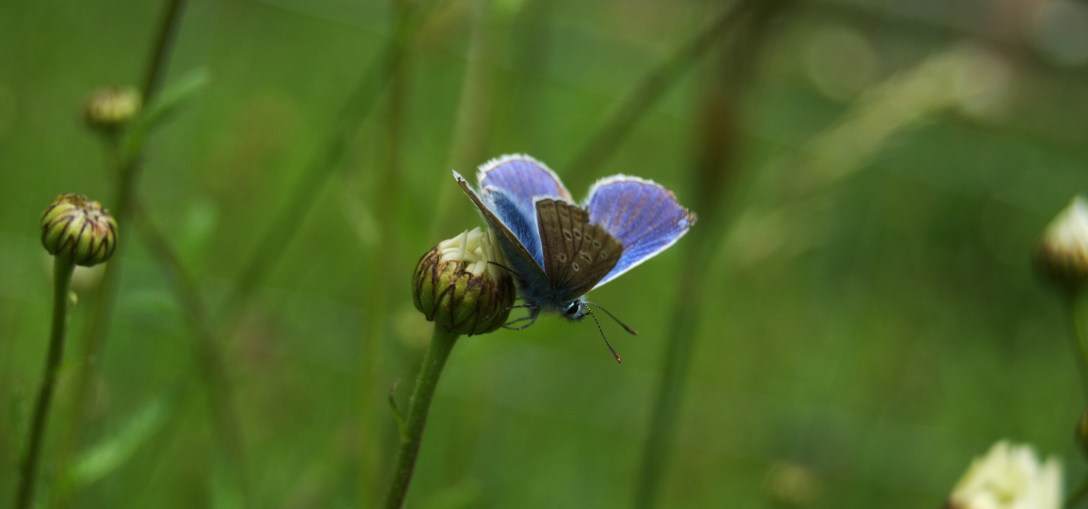
Hutchinson’s Bank butterflies

On Saturday (9th June 2012) London Wildlife Trust and the Old Surrey Downs Project held the annual Hutchinson’s Bank open day. With the Heritage Lottery Funded From Thorn to Orchid Project, Hutchinson’s Bank has been managed instensively by both local and travelling volunteers over the past 12 months to remove the encroaching scrub of young trees which, if left unchecked, will shade-out the foodplants of a diverse array of butterflies. Here are some of the butterflies encountered on the day, many of which will thrive thanks to the ongoing management of the 35 acre reserve. The small blue and dingy skipper are two butterflies suffering severe declines nationally.

Small blue (Cupido minimus)

Brimstone (Gonepteryx rhamni)

Green hairstreak (Callophrys rubi)

Dingy skipper (Erynnis tages)

Small heath (Coenonympha pamphilus)

Common blue (Polyommatus icarus)

A wheatear drops in

A wheatear drops in

– Farthing Downs, London, May 2012

The slope is exhausting. I push against my knees in order to reach the plateau without panting. Though it’s not as steep as it sounds, a flock of jackdaws glide in and bounce across the grass adding to my sense of human weakness. Turning back to look, it’s barely a slope, just an awkward drop down into the woodland below. In the distance, a world far, far away, the nearly-complete Shard and the Gherkin look like grey wreckage. The path ahead is bordered by two strips of scrub and small trees, in the open land across the road cutting through the downs a skylark is rolling out its splatter of trills and warbling. The bramble has come to life around me, a mouse or vole too quick for my eyes crosses to the other side. I swallow the air – it’s Croydon, but it tastes like the countryside. Beyond the dip into woodland Happy Valley opens out and up again, a vista of wildflower meadows and a fringe of trees. There is a hint of the hillsides of west Dorset within the boundary of The City of London. A pair of linnet alight in a small hawthorn, dull brown with specs of mud on their breasts, the red crown yet to come into full colour. They match the day – grey, brown, muddied. The aborted song of a bunting is coming from the branches above them, the striking colour of a yellowhammer sings from the still wintry scrub. It calls and calls, turning its head to look, not minding me at all, another arrives in a hurry.

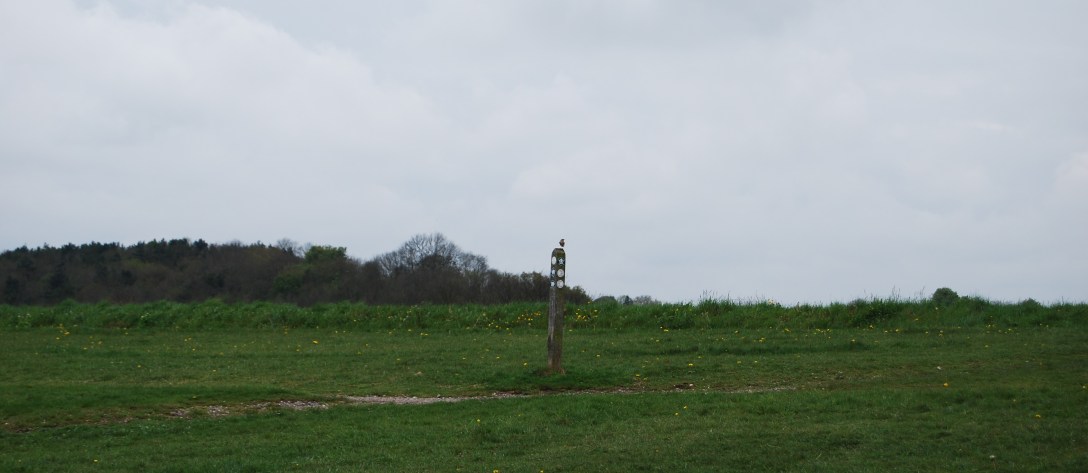
The full view of Farthing Downs is open now as I continue to wander along the eastern flank. Two swifts newly arrived in the country dart about, twisting and turning, their black wings flapping a little like penguins under water. There are people over the surmount, people walking, people on horses, people with dogs. I approach a gate where a woman and her daughter are struggling with their dogs, one bounding around as if it’s been cooped-up for months. Right in front of me a wheatear drops in, landing on the small mound of an anthill. This robin-sized chat has travelled from Africa to be here in Croydon and will soon be moving to its northern breeding ground. The bird is nervous – the sprinting dog has been released upon the downs but it doesn’t notice the migrant wheatear, instead it runs at me full-pelt, swerving to my side, cracking its skull against my forearm. The lady who owns it has stepped in her other dog’s poo in trying to clean it up and is wiping her foot across the grass, grimacing. I’m muttering to myself – this is the first wheatear I’ve ever seen in the United Kingdom. The bird bursts into flight, landing on a fence post. I marvel at its feat of migration.

Set: Broadwater Lake

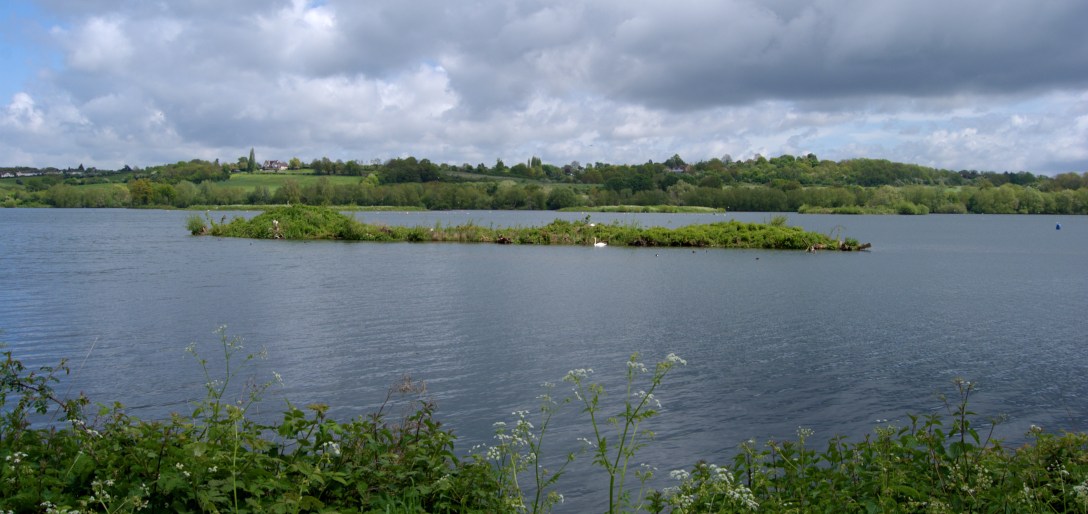
Broadwater Lake is situated in the Mid-Colne Valley a Sight of Special Scientific Interest (SSSI), the lake is managed by Herts & Middlesex Wildlife Trust. This is one of a number of nature reserves in England which is set to be developed for High Speed Rail 2. For more information please follow this link to the Wildlife Trusts’ website.

The cranes aren’t flying

March 2012 631

– Lakenheath Fen, Suffolk, March 2012

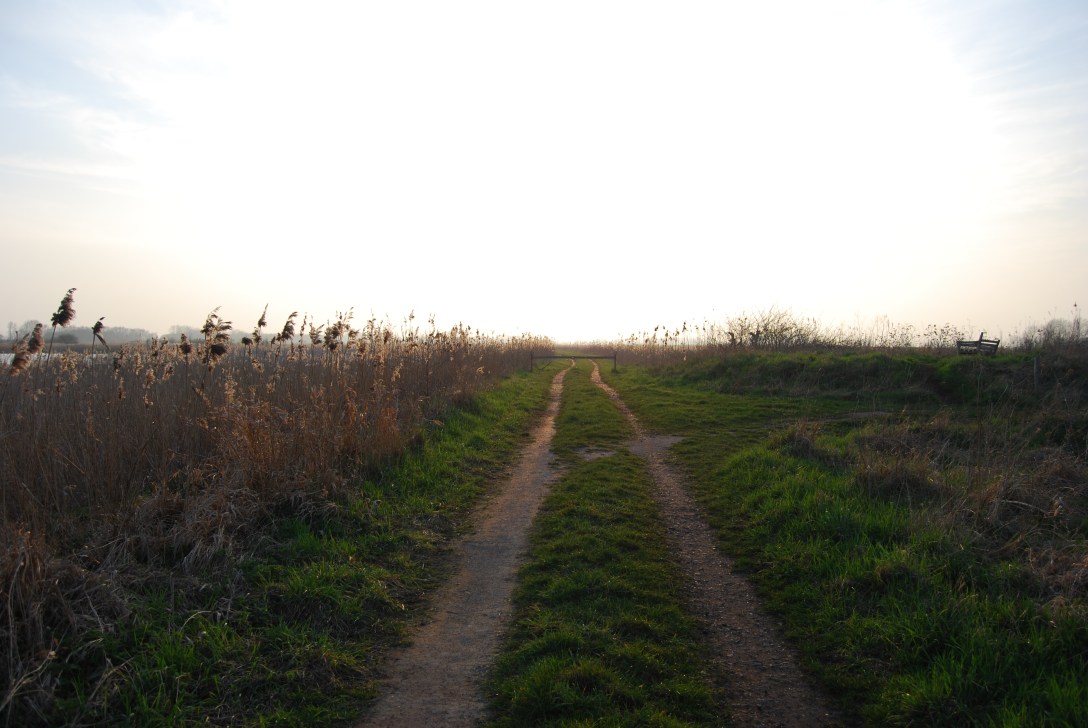
We’re standing on the raised bank overlooking Lakenheath’s reedbeds. It’s a warm, clear day but cooling gusts of wind disturb the peace, ushering us away from the viewpoint. On calmer days bearded tits move across the tops of the reeds, today they’ll be down in the cover. We pass a rigid poplar plantation famed for its golden orioles which breed here in spring, what is perhaps the only nesting site in the United Kingdom. The trees grow out of swamp and some of them have collapsed, the soil clinging to the upturned roots making the poplars look like toy soldiers left supine by a child’s swooping palm. The trees have sent suckers out along the horizontal trunk meaning a new layer of woodland is growing from the body of one of the fallen, a new understory naturally occurring from a man-made habitat.

The cover of the plantation lessens the wind somewhat, a green woodpecker yaffles from the cover of the trees. Along the bank are anthills home to yellow meadow ant. I’m with David Norfolk, a friend and expert ornithologist, and he tells me these are rare. The hills could be hundreds of years old. ‘They wouldn’t exist in today’s farmland,’ he says. ‘A tractor will destroy them’. He takes a small chunk of the mound and golden-coloured ants move busily across the grey soil held in his fingertips. On the other side of the bank a blue river runs away to where the sun is going, a flock of oystercatchers pass, chattering as they fly against the flow. On the riverbank near to us pristine white feathers are strewn like discarded quills around the skeleton of a mute swan. David has seen it before: ‘That’ll be a fox kill.’

We’re alerted to a faint, hoarse bird call wafting from beyond the poplars where a swathe of reeds stand for perhaps 200m all the way around. We stand to face the reeds and the wood beyond where trees have collapsed, fieldfares pass through on migration north on their return to Scandinavia. We hear it again, the muffled, bugling call of a crane. I have longed to see or hear these birds, Russian symbols of peace in the aftermath of Hitler and Stalin’s tyranny. The poet Anna Akhmatova described hearing cranes as she lay in her sickbed, the birds fleeing the dry autumnal fields after the harvest. Our cranes are not forthcoming but David is convinced they’re here. I’m prepared to wait until dark.

A group of men in their sixties arrive and we point out the vague sound of the crane, but they look in the opposite direction, instead to the sun setting over the lake. I suggest to another man that the cranes can be heard, he complains that he needs to sit down. ‘That’s a dog barking,’ he retorts. Bearded tits are pinging in the reeds, a water rail is squealing like a pig. We follow the path back to the start. The bugling goes on, it has to be cranes. But the beardies are closer and closer and even louder now. ‘Watch for their flight between the reeds,’ David says.And here they go, the pale brown flash and long tail, something I’ve never seen before. From behind us a crane calls clearly into the lilac sky.

F16s tear up the sunset with their apocalyptic thunder, a train careers along the bank next to us, the two carriages a little pathetic-looking and exposed in this vast open space. The lights shine inside, juxtaposed against the light dying down around us. The sun is stuck behind a strip of cloud and its colour cannot be revealed, jackdaws are roosting noisily in the poplar plantation, the green woodpecker continues its laughing fit, escaping its perch in an undulating flight overhead. The water rail is squealing still, a kingfisher bolts around a swoop of reeds. Two giant birds appear from the path we’ve just taken, grey and white. It has to be! Two cranes, flying together, approaching us on the bank, moving across. They are within a stone’s throw… but the joy evaporates. They’re swans and it’s a trick of the light.