
First published on the Earthlines Review
Co. Mayo, Eire, April 2013
Saturday
Last night we arrived to watch the mountain burn. The flames licked up from behind the plantation at the end of the field, capturing the tinder of last year’s heather. I thought of how dry that wood was, how it would go up in an instant. The farmer ghosted down the lane, no knowledge of who could have set fire to the mountain, or why. He always strikes me as part wild, so accustomed to the lay of this land that he has partly-merged with its bogginess, its giant boulders and streams, in the way I am accustomed to the wildness of streetlamps and new woodlands, how they impact me. Seeing an Xbox and satellite TV in his house a few years back diluted that idea. This isn’t the first time the mountain’s been set on fire, five years ago it happened. Waking up this morning it’s as if last night was a dream brought on by the exhaustion of a long and early journey from London, across the Irish Sea from Holyhead and then from Dublin. At the foot of the Ox Mountains this morning I see no sign of fire, no people, no animals. It must have been much further away than we thought it was. The bracken lies dead and dry, concealing crevices between rocks. How quickly this could burst into flame. The ground is dry at the foot of the mountain, the sphagnum mosses and reindeer lichens spreading as I climb with the wind. A herd of feral goats watch me from the top, filing away, perhaps in disappointment that I’ve blocked their path. Turning to look to the west I see Nephin in silhouette where the valley of farms and gorse-covered bog ends. I head south-east and up into the Ox Mountains.
Trees are sparse, only a hawthorn or a mountain ash in 100 metres, bedraggled and gnawed by the animals that graze between the rocks. The heather is growing again, and where there is some dampness a cladonia cup-lichen pouts its miniature red lips on pale blue stems. I search along the south-facing banks for wildflowers and find dog violet and wood sorrel. Being a woodlander at heart, it draws me back home and to the question of origins – did woodlands once grow on the Ox Mountains? They must have. Looking around me, I am not convinced. But early or common dog violets do grow in ancient woodland in south London, and wood sorrel, too. One of my holiday reads is Oliver Rackham’s Woodlands. I will be tearing into it on my return back to the cottage.
A small bird is calling, barely audible above a wind that’s gained momentum as I’ve gained height. Two giant boulders sit like mountain fauna and all I see above and between them is sky. The ground is boggy, covered by the papery yellow grasses and red mosses. A goat path is indented through it all. I take it, stepping up into the goat hoof clefts and up between the two boulder gods. Though unseeing, they will have presided over a valley wrought by famine in the 1840s, worn only by the deep breaths of time. Last night they will have been coloured by fire, unmoved. To be rock is to be asleep.
The rocks are beneath me now, a plane of damp dead grasses and moss pervades. The wind is stronger, still. How strange that even on a tree-less moor of a mountain the movement between rock and mound can feel like entering somewhere new. I sit on the rocky deity’s scalp. Down below, the plantation is crossed by bare larch trees, and in the distance the blue promise of Sligo Bay. Further west, in the realm of the imagination: America. But I’m hungry, and the basic desire for food always wins out over beauty.
I wander across and down, away from the sheer drop. At least the fall would be into a mattress of bog. A raven calls out, kronk, kronk, kronk, but so bare is the mountain the call could be a thing of the distant past, or my imagination. I grab onto heather forgetting that the soft ground will give and I nearly tumble bearing yet-blooming flowers, but a goat print saves me and I land on my backside. Gradually the song of a robin replaces the mountain wind, the images of sheep return to life and the mountain looms again, forgetful, triumphant.

Easter Sunday
It’s evening, the weather is warmer here than in England but when the wind blows it cuts through you. I have been reading Rackham’s Woodlands. In the period between 1350 and 1500 woodland cover expanded in the United Kingdom in the wake of the Black Death. England’s population declined by 1/3 and so too did global warming[1]. Why? Less trees were being felled and burned. The woodland came back and captured the carbon. I wonder when that will happen again. Today we visited my grandfather at his nursing home in Kiltimagh, it’s an old estate with pollarded horse chestnut and beech trees. On the hillside wind turbines have been built. They do not look a scar or a slight on the land. But granddad never leaves the house to see these things, most of the people there drift in and out of sleep and eating, the radio playing in the background. It was Aerosmith when we arrived. He used to live in Ballindine, crossing the motorway to the shop, forgetting how many times he’d been. He always asks me when I’m going to get a haircut. I feel a little apprehensive about visiting the home but when I get there I enjoy it, the people are friendly even if some aren’t in their right mind and there’s a welcome warmth about the long faces, slow gestures and blazing radiators.
After a day spent in the car I decide to visit the mountain again. I’ve never been to the top. Me and my dad nearly got up there a few years ago but we didn’t feel the desire to. I take to the path again, passing the sheep in the field, the caravan shot to pieces, a lace curtain blowing through the hole where the window once was. I climb up the track again and feel no desire to reach the summit. I turn into a small cove where a stream runs down and the path becomes sphagnum moss, soft, white and red. I sit on a boulder and look up at the sky and the mountain. But for the stream there is no sound at all. All my thoughts come in and out again. Having had my fill of silence I return back down. On the way I see Nephin traversed by the sun setting behind clouds, the trees silhouetted on a hill before it. I can’t help but think of those who used to live on this mountain and in this valley who were shackled and degraded by famine. How did they view this overbearing rock and heathland, the sight of Nephin and sunsets like these? Surely they couldn’t have had the energy or mind to even think about it. It would not have mattered. I was reading a book called The Great Famine last night. When one ship carrying food and aid from England arrived in Ireland during the famine, three went the other way. At times I feel torn between my heritage, between my anger for the cruelty wrought by the British and the suffering inflicted upon the Irish. I do not feel completely one or the other.
On the way back down I have a sudden desire to remain, to sit against a rock and enjoy the fresh Atlantic air. I remember hearing a cuckoo a decade ago, but it hasn’t returned yet. After my breather I continue into the valley and meet the farmer on the track. I ask him if cuckoos still come here. He doesn’t understand me. I sometimes forget that my accent isn’t clear to everyone. He eventually realises what I mean and points to the plantations growing on either side, comfortable with the knowledge that they come often.
‘But it’ll be too cold for them here now,’ he says.

Easter Monday
From Woodlands, page 206: ‘Ancient woods are not the place to look for ancient trees. Indeed, the presence of ancient trees, unless they are boundary pollards, indicates that the wood is not ancient, but has grown up around freestanding trees (in-filled savannah).’ There are no ancient trees at the foot of the Ox Mountains, there are barely even trees. I still have hope of finding something.
Tuesday
We aren’t visiting granddad today. We drive to Westport to see what they have in the bookshop there. On the river a grey heron is mobbed by black headed and common gulls. They stand on the wall having their pictures taken by everyone, including me and my family. We drive to Achill Island for the day, the sun beating down but the cold wind still lingers. It’s snowing in London. The views from Achill are astounding, rock pipits merge with the winter grasses and silver boulders as they feed at the cliff’s edge. Spring is still not with us, the leaves are not on the trees, no swallows nest in the barn and no cuckoo calls from the wood. The bogs on Achill are strewn with rhododendrons, thriving on the acid soils, clearly admired by the locals for their unusual pinks and purples when in flower. I bought The Story of Ireland by Neil Hegarty. This quote from Oliver Cromwell stuck with me:
‘For to what purpose was it to plow or sow, where there was little or no Prospect of reaping? – To improve where the Tenant had no Property? This universal Neglect of Husbandry covered the Face of the Kingdoms with thickets of Woods and Briars; and with those Vast extended Boggs, which are not natural but only the Excrescences and Scabs of the Body, occasioned by Uncleanliness and Sloth.’ (page 136).
It’s what I love about Ireland, the bogs, the boulders, the ‘Excrescences’, the 1970s Opel car rusting in the ditch. In Mayo the Irish are not erasing their visual history, the ghost towns of the 1990s are still standing and the eerie cottages of the times gone by are still decaying at the roadside. In England we are obsessed with tidiness.
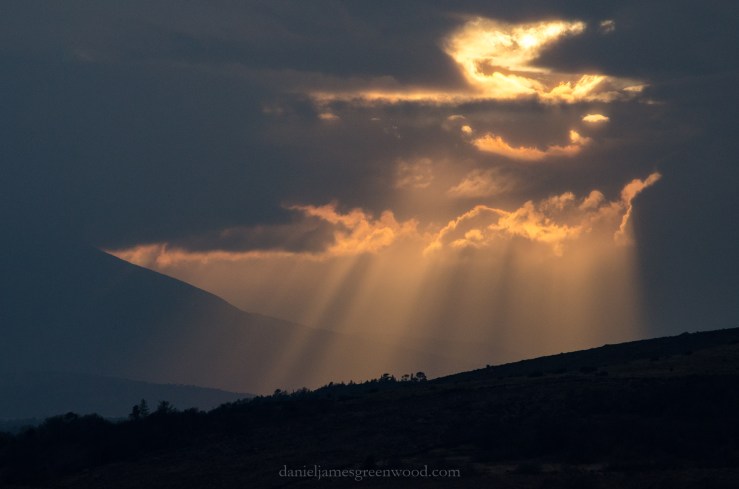
Today has again been spent in the car, imprisoned. I haven’t been able to contend with the landscape other than through the camera. It’s evening and the sky is broad and blue. The children are playing in the fields, traversing the margins and fence lines. Now I feel the need to see the mountain’s top, I want to know what’s on the other side. I make it to where I stopped the other day, no need of silence or thought, I continue up through the goat clefts, driving shin-first through midge clouds. A wren is singing up above me as I dip in to the path as it bends around an alcove home to boulders that have become dislodged and crashed down over time to sit in the vegetation, cool. I pass back out and the track becomes more steep, the heather creeping across. Now I can see another fire in the south, the smoke blowing to the west across the glassy Roosky lake. The field lines are clear from up here, the margins deep and defined. I turn and clamber to the top. The zenith opens out with a gust of a cold, cold wind. I put my hood up and watch as a meadow pipit raises aloft, calling, a single peep, escaping on deep undulations. So that was the little bird I’d heard the other day. The top of this mountain is peat bog, the feral goats see me and disappear over a peat bank. There are lines where the peat has been removed in the past, a practice which is now criticised by environmentalists because so much carbon has been stored in the bogs. To the Irish who cut out this peat it was just a local and available fuel, it was not an evil act. A trough in the heather is full with water reflecting the sky. The wind ripples the surface. Frogspawn sits in large clumps in one corner. It’s only the second lot I’ve seen this year, here and on Exmoor. I decide to head back down the mountain
A meadow pipit appears and clings to a sprig of heather. I watch it through my binoculars as it looks from side to side, its speckled breast twisting. I pass the winding path again and overshoot, taking the wrong goat path this time. I spot an unusually verdant green peeking from behind a boulder. And here we have it, lesser celandine, wild strawberry. Woodland indicator species hiding behind a rock. So, could it be, did the Ox Mountains once have ragged woods rather than heather? How long ago? I think of how I came to find these plants, by following a goat path. There will be no woodland as long as the goats roam these moors. A man is standing on rock down below covering his eyes, looking around in a fashion not far from the meadow pipit’s.
‘Have you seen a sheep and a lamb passing up these ways?’ he asks.
I haven’t. I see the smoke plumes again. ‘Who is setting fire to the mountain?’ I ask.
‘Just cats,’ he says.
Wednesday
I walk up to the top of the mountain again but with my family this time. I want them to see this view. I see how much good the walk does them, out of the car, not worrying about granddad, if he has enough clothes, if he remembers us, if he’s happy.
Thursday
Stepping off the main road we tread carefully over the rocky steps to Lough Conn, the water lapping against the rocks as it flows under Pontoon Bridge. On the opposite bank the gorse is flowering at every opportunity. North of Foxford it’s bright orange, the dry weather and warm sun has lit fires across the Ox Mountains, this morning the sun shone through the smoke and lit everything brown. It’s not arson this time. In the nursing home they mentioned it on the radio. This place feels like the whole world, the only place. In Pontoon the cars passing at 50mph on the road are not regular enough to dominate the soundscape. I listen – no birds. To the left is a pile of rocks and boulders, leading to a shoreline of reeds, grasses and willow. Beyond the water’s edge is woodland, rising into a lip that looks out over the lough. To me, from here, that is an ancient wood. I look through my binoculars and I’m sure I can see oak buds against the blue sky, growing amidst the straggly birch trees.
How can I get there without drowning? It’s a family holiday and my parents are with me, so dad suggests climbing across the boulders to the left. When we were on holiday in West Cork in the 1990s he would go fishing off rocks our mum deemed dangerous. My sister and I would sit at the window waiting for him to appear on the lane, unsure if the ocean, a shark, a giant squid might have captured him from us. He risked it, and so I’ll do it. The water isn’t deep immediately below the boulders but a cold soaking isn’t on the cards when I’ve got my camera with me. I clamber up onto a big boulder, leading with my feet, stepping onto smaller, and sometimes shifting rocks. I bring my right arm round and the sleeve of my coat unclips my lens cap – and off it goes, somersaulting into the brown water. I can’t help but think of Leonardo di Caprio disappearing into the sea at the end of Titanic. This feels like one of those times when things go a bit wrong. I slip down onto my backside and try to drag the cap towards me with my boot. The lens cap begins to sink. I fish again and drag deeper, I pull my boot away and it’s there, I snatch at it and zip it away.
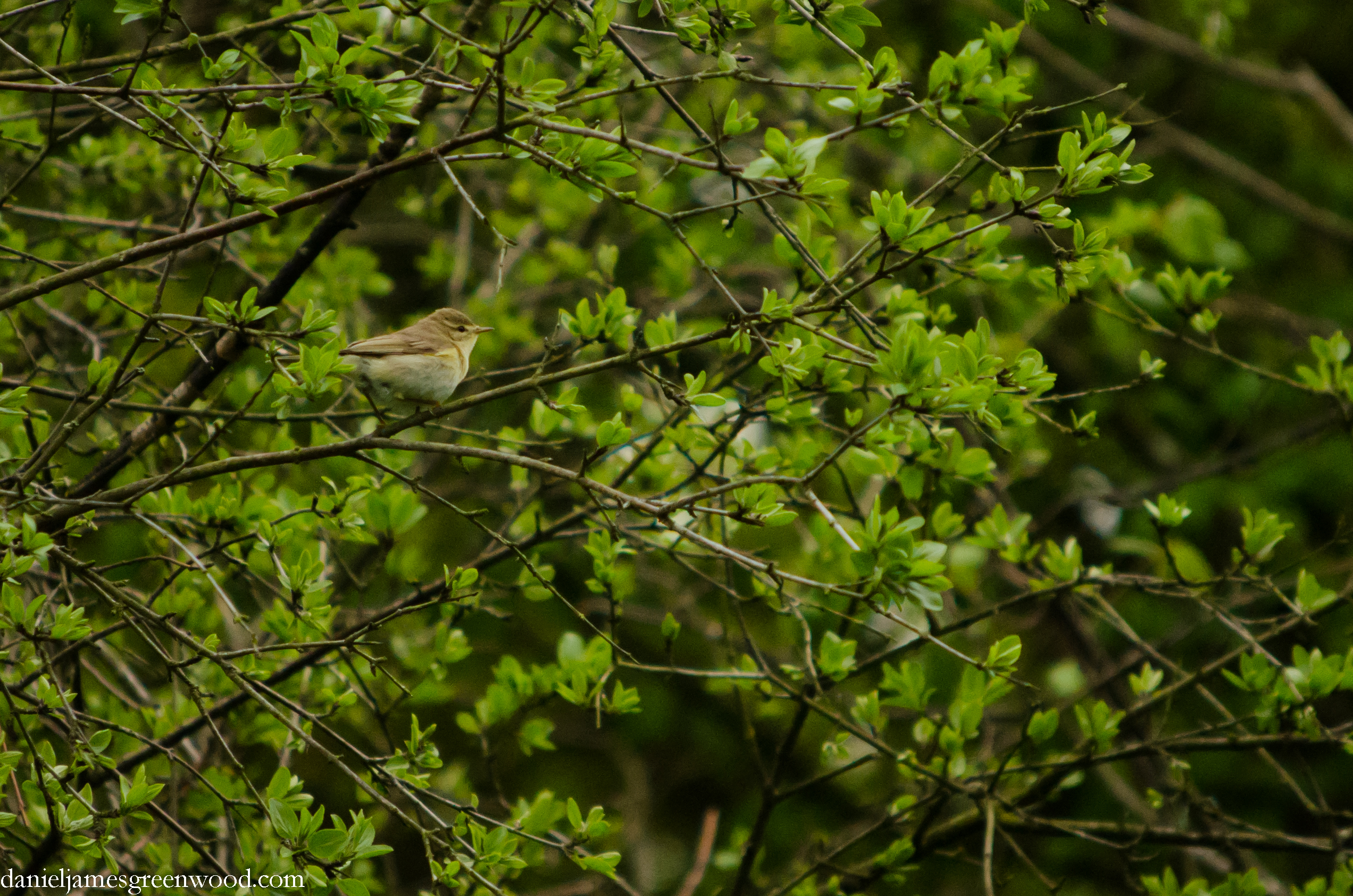
I climb across the final few rocks until the water has receded and a sandy shore is under foot. This route is rarely taken, it’s blocked by crouched willows and twigs that are so dry they snap as I move. Further along the shore is a stone hut with an iron roof. It looks old, really old, but renovated. The ground is sandy, boggy, midges and mozzies frolic in their respective mobs. Cutting across the marshy path towards the trees I get my first view of it – the green of an Irish rainforest. Everything is vibrant with moss, the tongues of ferns and decrepit trunks of birch and oak trees. At last, I’ve discovered one of Mayo’s ancient woodlands. A chiffchaff is singing from over the bank of collapsed oak and rock, the first of spring. There’s a slender path through the moss, leading to the lip I’d seen from the other side of the water. I wave to my family and call across. It’s ancient! It’s like entering into a new kingdom, a homecoming, a piece of land that hasn’t been twisted and torn by the plough. But there are signs: the stone hut on the shore has a back window (open casement) with a bar running through it, inside it’s dark and wet like a medieval prison.
A swing has been tied to an oak and some clothes are hanging up like the sails of a ship moored in this wood. I feel as if I’m trespassing, like in Frances Horovitz’s poem ‘Winter Woods’: ‘we have encroached – /this is not yet our land.’ There are signs of people yet I’m alone. A flock of long-tailed tits pass overhead, one holds the body of an insect and its sprawled limbs in its mouth – spring is beginning to move now – I wonder if that’s for a baby bird. I take one last glance at the mosses, a script lichen etched into hazel bark, the wood sorrel and ferns and head towards the water. A path through some heather leads up and out to the main road. I needn’t have scrambled after all.








 Unlocking Landscapes