Tag: Photography
London winter birds

Long-tailed tit, Aegithalos caudatus at One Tree Hill Local Nature Reserve

Ring-necked parakeet, Psittacula krameri at Camberwell Old Cemetery

Magpie, Pica pica perched at Camberwell Old Cemetery
Essay: John Keats and how nature makes us feel so small
John Keats (1795-1821) died aged 25 thinking himself a failed poet. Today he is revered as a great. I mine his poems for evocations of nature, the nightingales, the bees ‘bustling down in the bluebells’, and his recurring musk rose. For these moments, from a wet and gloomy winter, I find great pleasure in peering back 200 years to Keats’s descriptions of a London that had not yet swallowed Hampstead entirely, or my borough, the 800-year-old parish of Lewisham. In Keats’ Ode to a Nightingale, he describes much of what makes birdsong a cure for human pains, the continuity of wildlife and nature gives us a place in the world, for we are not the first to hear a blackbird, song thrush or nightingale sing, nor will we be the last:
Thou was not born for death, immortal Bird!
No hungry generations tread thee down;
The voice I hear this passing night was heard
In ancient days by emperor and clown (p. 220[i])
Birds do not discriminate against any audience, their songs can be heard by any person who happens to be passing, be it the song of a robin singing at midnight in central London or a nightingale firing in the morning from a blackthorn hedge in a Dorset field. And perhaps real nature conservation has this at its heart, though often unsaid from a fear of sounding eccentric or elitist. Nature is vital to humanity in many ways, humanity is inseparable from nature, but in dealing with dissonance and social discord brought about by contemporary austerity and financial inequality, its inclusiveness is what makes it most relevant to us living in the 21st century. The song of the blackbird can be heard by anyone who might happen to hear it, more so if conservation is supported by communities and authorities.

On a recent visit to Dumfries and Galloway in south-western Scotland I brought Andrew Motion’s hefty biography of Keats with me. It appears more and more that it is not so much Keats’ poems I like the most, but the many aspects of his story, which poetry seems such a big part of. He lived a very short and full life, his published poems barracked by what we might today equate with critics or journalists of the propagandist right’s ilk. And many people thought that he had died from the heavy blows of his critics. Motion points to his wildly ambitious walking tour of Scotland and Ireland, arguing that it was the conditions a weary and exhausted Keats experienced on the Isle of Mull that began his descent into critical illness. Keats had embarked on a mission to collect experiences to influence his writing, and he was astounded by Scotland’s sublime mountains and wild landscapes. He ‘forgot himself’ and found that nature took away all resentment he might have for other people, or his critics, at that time:
The space, the magnitude of mountains and waterfalls are well imagined before one sees them; but this countenance or intellectual tone must surpass every imagination and defy any remembrance. I shall learn poetry here and shall henceforth write more than ever, for the abstract endeavour of being able to add a mite to that mass of beauty which is harvested from these grand materials, by the finest spirits, and put into ethereal existence for the relish of one’s own fellows. […] these scenes make man appear little. I never forgot my stature so completely – I live in the eye, and my imagination, surpassed, is at rest. (p. 269)
Keats has been knocked down by nature’s visual power and, eventually, by its impacts on his body. He cracks open the heart of the genre of nature writing. Surely the whole point of casting nature as the central theme in anything is so that ‘these scenes make man appear little.’ In the face of the sublime image of Scottish mountains, human problems are made to feel minute. It’s the same feeling people experience today in British woods, on those same Scottish mountains and by the sea. Surely if Keats were alive today his thoughts might have turned to conservation of larger landscape areas – in the same way that his biographer, Andrew Motion, once Poet Laureate, now works for the Campaign to Protect Rural England, defending National Parks from a development lobby which seems to hold sway with government. National Parks are an idea created by John Muir, the Scottish adventurer who helped to found Yosemite National Park with his grand and flawed ideas of wilderness. In Scotland, protected landscape areas such as the Trossachs National Park, Cairngorms National Park and Galloway Forest Park are key to preserving the impact of those places on the human mind, at the same time protecting their prehistoric ecosystems and wildlife. A National Park or protected landscape area is an admission or celebration of the fact that nature can show us how small we really are. For John Keats and visitors to mountains today, if underestimated or not treated with respect these landscapes and their conditions can kill.
[i] The Complete Poems of John Keats, Wordsworth Poetry Library, 2001
© Daniel James Greenwood 2014
The emptied mast
 Coulsdon, London, November 2014
In Devilsden Wood we tiptoe around fallen beech logs, slipping at times on beech leaves and clay, and the emptied mast. The nuts will have been eaten by hungry jays and squirrels. Over the past few weeks I’ve crouched down around these logs photographing their fungi: beech jellydisc with its almost caucasian flesh, purple jellydisc creeping out by the week from wisps of moss. Most startling for a layman like me was the glaring eye of dog stinkhorn, named after its canine stench. Lodged in a piece of black deadwood it had the appearance of a fox or wolf skull looking up at me. The long, finger-like stems that it had produced had collapsed, orange tips like finger nails. As Julian Hoffman has written recently, referring to the poet Rilke, we are surrounded by a world that beckons us to perceive it, to engage with it, to look and to touch. To me the fingers of the stinkhorn could be pointers to something worth seeing. Today only the jellydiscs remain, as well as a brown mushroom that reflects the white break of cloud between the trees above in its glossy cap. My friend Philip is searching for something behind me and as I look up the sharp dark shape of a sparrowhawk slices between us in silence. If we were little woodland birds we would not have seen a thing.
© Daniel James Greenwood 2014
A thousand years

Farthing Downs, London, November 2014
Blue smoke plumes from the dreary Downs, the crack of piled ash trees cuts through the distant wash of the M25, and now the noise of chainsaws. This work is good fun. How many people panic at the sound of this machine, waking to find that their favourite tree is gone from the frame of their bedroom window. In the town I am always suspicious when their itch carries. But this is the restoration of the chalky meadows swallowed by the incoming of woods. We as a species have been trying to halt the loss of woods but at the same time deny new ones for thousands of years. This is a thousand-year-old view, the only change the exchange of machines for the pop of axes on heartwood.
Against a view of near leafless beech, a green woodpecker rises from the anthills, its flight reminiscent of a puppet tugged at intervals as it passes. Robins sing, gulls create the aura of the Sussex coast, and rain specks add a pinch of cool. In the now flattened meadows fungi can be found: a parrot waxcap plucked and left, yellow gills that ripple like flames around its stem. Puffballs are scattered across the path, little footballs deflated and unwanted. I press my toe into one, flattened and leathery grey, its brown spores puffing out like effluent. I definitely take them with me.
© Daniel James Greenwood 2014
The beaver’s work: men versus nature in South Moravia’s fishponds
South Moravia, Czech Republic, July
I’m standing in the street waiting for Moravian ornithologist Karel Šimeček. From here I can see a serin on a TV aerial across the road, and from over the houses I hear a golden oriole releasing a few phrases of its fluty, unmistakable music into the morning air. In the road is a dead animal, a common sight, and an indicator of just how much wildlife there is here. Another common image, especially on the roads leading out of town, is squashed hedgehogs. In England we barely have dead ones anymore. A car pulls up on the other side of the road and out steps Karel, binoculars round his neck, eye pieces covered by grey duct tape. He crosses the road, making sure not to be run down like a hedgehog. He shakes my hand and turns to the squashed animal in the road:
‘Turdus philomelos,’ he says.
A song thrush, my favourite bird. We get into Karel’s silver Peugeot estate with Radiohead’s Kid A on the stereo, a welcome reminder of home, and we set off. The roads are mostly empty but then it is 8:30am on a Sunday morning. I ask Karel about his interest in wildlife.
‘I became interested in birds as a boy when my mother bought me a book,’ he says. ‘I have been watching birds for more than thirty years. But there are not as many as there used to be, when I look at my notes I can see that there are less birds now.’
Why is that?
‘Different reasons. Agriculture is very important but it is probably the main reason,’ he says.
I was astonished to see how large the fields were in South Moravia. My host is conservationist Zuzana Veverkova, and she told me that the average field size is 500 hectares, meaning that small-scale, sustainable farming is impossible. Young people cannot find a way in other than through inheritance. And there are reasons why farms are so large: inspired by Stalin’s collectivisation of Russia’s agriculture, the Czech communists did the same, forcing farmers off their land and into prison if they refused. Today you have the corporate farming practice with monocultures of what Karel calls ‘the yellow evils’ of wheat, corn, sunflower and rapeseed. In some places, there are miles of these plants and nothing else.
But back to birds. I’ve never seen a goshawk and have read they are one of the most common raptors in the Czech Republic:
‘They are at 20% of what they were when I started,’ says Karel. ‘They are hunted and poisoned by people who think that anything with a curved bill and talons should be killed.’
‘Do you know the hunters?’ I ask.
‘Yes, I know them, and there is no reason for their killing of these birds.’
‘And are goshawks protected by law?’
‘Of course.’
We pass out through the fields, a pine wood on the horizon.
‘A few friends and I managed to get the pine forest protected as a nature reserve,’ says Karel.
That was not enough to save its most unique resident. 20 years ago it was home to more than twenty singing male ortolan buntings. Today there are none. Karel laments this fact as we take a swerve in the road, our passage halted by a pair of white storks treading through a field. Karel reverses and I photograph these graceful birds. They watch us, too, turning away and moving further into the pasture.

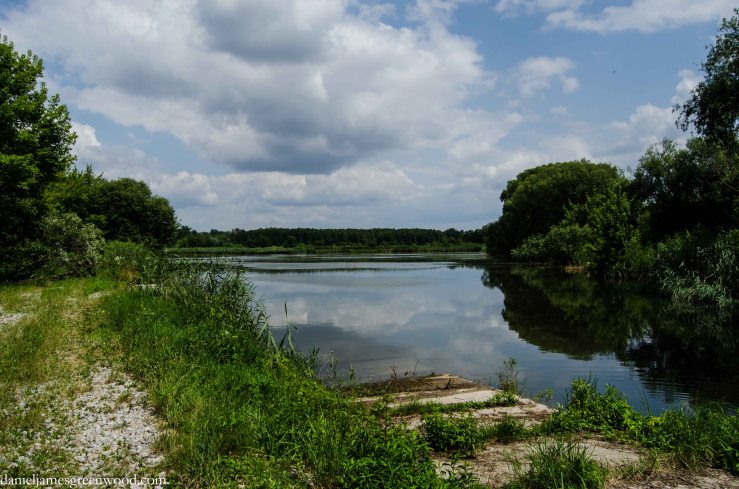
Arriving at Mutěnice fish ponds we stand on the rickety wooden footbridge where the River Kyjovka dams, the water splitting off into the ponds. Leaves cover the surface, a red admiral arriving to bask on the enforced stillness. Karel points to a stand of dead poplar trees on the other side of the river.
‘That’s the beaver’s work,’ he says.
They’ve been here for thirty years. About five years ago the manager of the ponds attempted to eradicate them, but he failed and so the beavers remain. They arrived here from Austria from the Morava, the river that gives this district its name, running the border with Austria and reaching the Danube in Slovakia. When they first appeared here one beaver was captured and interred in the local zoo. It escaped within 24 hours and returned to the fish ponds.
Turning to step off the footbridge, over a few missing slats, Karel glimpses a kingfisher as it lands on a rock in the Kyjovka. I lift the camera to it but can’t switch it on in time to get the shot. Off it goes, electric blue bolt into the willowy shadows of the river. And as we trample through the long grass alongside the river Karel picks out the calls of young kingfishers and a perch that bears the signs of the birds, no leaves, just bare and worn.
One abiding memory of these ponds will be the stench of the water. It’s nasty. More than once Karel has stopped and pointed at the water’s edge and said, ‘this is not water, this is coffee.’ It’s brown, frothy and pungent so not far off. We continue along the Kyjovka, the large pond on our left meeting the path which we’ve already passed down this morning. Karel has seen something up high in the hazy summer sky:
‘Yes,’ he says. ‘White tailed sea eagle.’

Through the binoculars I see a huge animal beating its great wings, with primary feathers so long they look like fingers that could dictate some deep, magical changes to the world below. But no animal is safe or indeed at peace for long on Earth. Karel has seen alongside the eagle a marsh harrier attacking it, and moments later another appears. I set my camera and start clicking. The eagle looks overdressed in its Gogolian greatcoat of brown feathers, its white head and neck protruding out from under, yellow talons dangling out below like down-turned coat hangers. The marsh harrier strikes again and again, forcing the eagle away from the sky above the huge pond and towards the trees, until the battle is over and all three have left my field of vision.
‘We had no idea that the eagles were here,’ Karel says. ‘A Swedish hunter had a permit to hunt in the forest and when he was leaving he said, “I see that you have eagles nesting in the forest”. Our response was, “we didn’t know that!”.’
We tread the path already taken, a dead bat splayed on the ground, its deathly grin drawn wide and rotting. It’s our waymarker. A small van rolls along the track, a Czech man with short black hair and ski-glasses steps out, handing Karel a metal tag that reads ‘Budapest’. They discuss something and then say goodbye, the man getting back into the car and driving away. The ring is from a young cormorant that was shot the other day. It had been ringed by ornithologists in Hungary and died here at Mutěnice. This seems familiar to Karel:
‘The migration patterns of cormorants are well known,’ he says.
This is an extract from an upcoming collection, Travels in South Moravia
Links:
Karel’s website
© Daniel James Greenwood 2014
Where the wild thyme grows

Daneway Banks, Gloucestershire Wildlife Trust, Cotswolds, July 2014
Figures stalk this tumbling chunk of meadowland. Severe expressions are worn: eyes drawn to-and-fro, either side of the gently worn path. But all they see are the scattered clouds of marbled whites. This is where the wild thyme grows, creeping along the turf, appearing in small spreads on the miniature hillocks of ants. And here you have the reason for all the skulking souls, though some boast of their sightings as they lay flat on their bellies in wildflowers, with camera lenses mounted by donut-shaped flashes large enough to save a life at sea. The wild thyme is the food plant of the large blue butterfly, once extinct but now successfully reintroduced from Swedish stock, this insect depends on the work of red ants taking its pupa into their nests as one of their own. The large blue pupa will then eat the other ant grubs it’s lodging with, eventually destroying the entire colony. To find something that was once extinct is, to many, to contend with the immortal. We haven’t seen it, instead we hear stories of large blues sunning themselves beside gate posts ‘just fifteen minutes ago’. We also hear of the creature’s phased movement, down the hill with the sun’s heat. We meet a softly spoken man making his fifth visit in search of the ghost. He identifies the yellow spike of flowers that is agrimony. He suggests we look it up in my friend’s wildflower guide (one which I tossed, jokingly, into the air out of faux-botanical disgust some minutes ago). There’s much more to see: clustered bellflower, common centaury, yellow wort, pyramidal orchid, lady’s bedstraw (which we shamefully contended ourselves with as golden rod), the simple colours of bird’s-foot-trefoil, and edibles like marjoram and salad burnet.

Rain comes and we leave these meadows of lost souls, leading up into Dorvel Wood. There is that change, the sudden loss of colour, all has become green and brown – leaf and leaf litter. The wood flowers appease the loss of butterflies – the underlying stench of wild garlic, the sight of violets, wood spurge, wood melick and no desire for the unusual. No man can be found here lying in mud and puddle to capture a photograph he can later sell on. But the ash leaves, crinkled, brown – is this ash dieback disease, the greatest threat to British wildlife since Owen Paterson? This was a moment I had expected but had somehow felt to be too far away. The canopy leaves are curling and dying, too. Is this the end for the common ash? We ponder it and tread out of Dorvel Wood, into the beating and blazing meadows of Sapperton.
© Daniel James Greenwood 2014
The cascading orchid

Farthing Downs and New Hill, London, June 2014
In the towns swallowed by London’s urban lurch, summer is flowering knotweed, rosebay willowherb and lupins, all non-native, all bold and blooming along Victorian railway sidings. At Farthing Downs summer strikes out in meadows of yellow rattle, dropwort, field scabious, hawkbit, ribwort plantain and sheeps sorrel. The first meadow browns, ringlets and small heaths take flight, the latter locked in a pair, mating, flying as one away from my lens. Stopping to take in these grassy Downs, the sheer number of butterflies is clear.
But the birds have not retired just yet. I hear a cry from the blue sky and see a buzzard tucking in its wings and bombing towards Coulsdon. This is the first I’ve seen here, and its arrowing for London is without doubt. This is now officially the most common bird of prey in the UK. I also hear the songs of linnet, song thrush and chiffchaff. Spring and summer have clashed in a frenzy of yellow, green and the common blue butterfly. On New Hill pyramidal orchids cascade across the slope, the leaves of spring cowslips now tucked in under the shade of orchids, rough hawkbit and yellow rattle. The bed of marjoram bounces, its fragrance only felt when touched with the fingers. On the other hillside jackdaws flock with two sheep grazing, their medieval world clattering along with their calls, like bullets ricocheting. The sheep go about their tasting, the meadows purpler still.
© Daniel James Greenwood 2014
A neon waltz

Farthing Downs, London, May 2014
I sit on a path new and slight, pressed into the grasses. Last year I sat in a spot close by under the shade of ash trees watching a willow warbler make return visits to a nest down in the brambles. Now the brink of a small copse of trees has gone, the bird, perhaps returning, may have decided this was no longer a place to raise young. In the absence of willow warblers, brimstone butterflies, perhaps reaching double figures, mark the new space of downland that has been reopened from the folds of trees. The piles of logs and branches stacked in the iron beds are still here, yet to be burned or hedged. I like that slowness, that I can come back some months later and no one has felt too pushed to tidy the place up.
A male and female brimstone fly together and then fall down amongst the twigs and low, woody brambles. I’m interested to see what they’re doing so I get up and have a look. They’re mating, bodies bent round, facing away from each other. They part. High in the sky, against the blue and its herring and lesser black-backed gulls circling on thermals, a huge flock. I wonder why, I wonder what for. Down here with me the female brimstone is again on the wing, met by a band of battling males. They pass her and are turned immediately onto her, each forgetting their quarrel and targeting the paler female. This is the perfect reflection of the adult butterfly’s life: the males seek as many females as they can; the female, having mated, defends herself from latecomers as she strives to find the right plant for egg-laying. The males attack her, but she breaks free, up into the sky. She is not free of them. The four males cloud her, their colours so close as they gain height that all sense of defence has disappeared into a neon waltz. They go up, up and over my head to the world of gulls and warm air rising.
© Daniel James Greenwood 2014
Photography: The Kingdom of Moravia, Czech Republic


