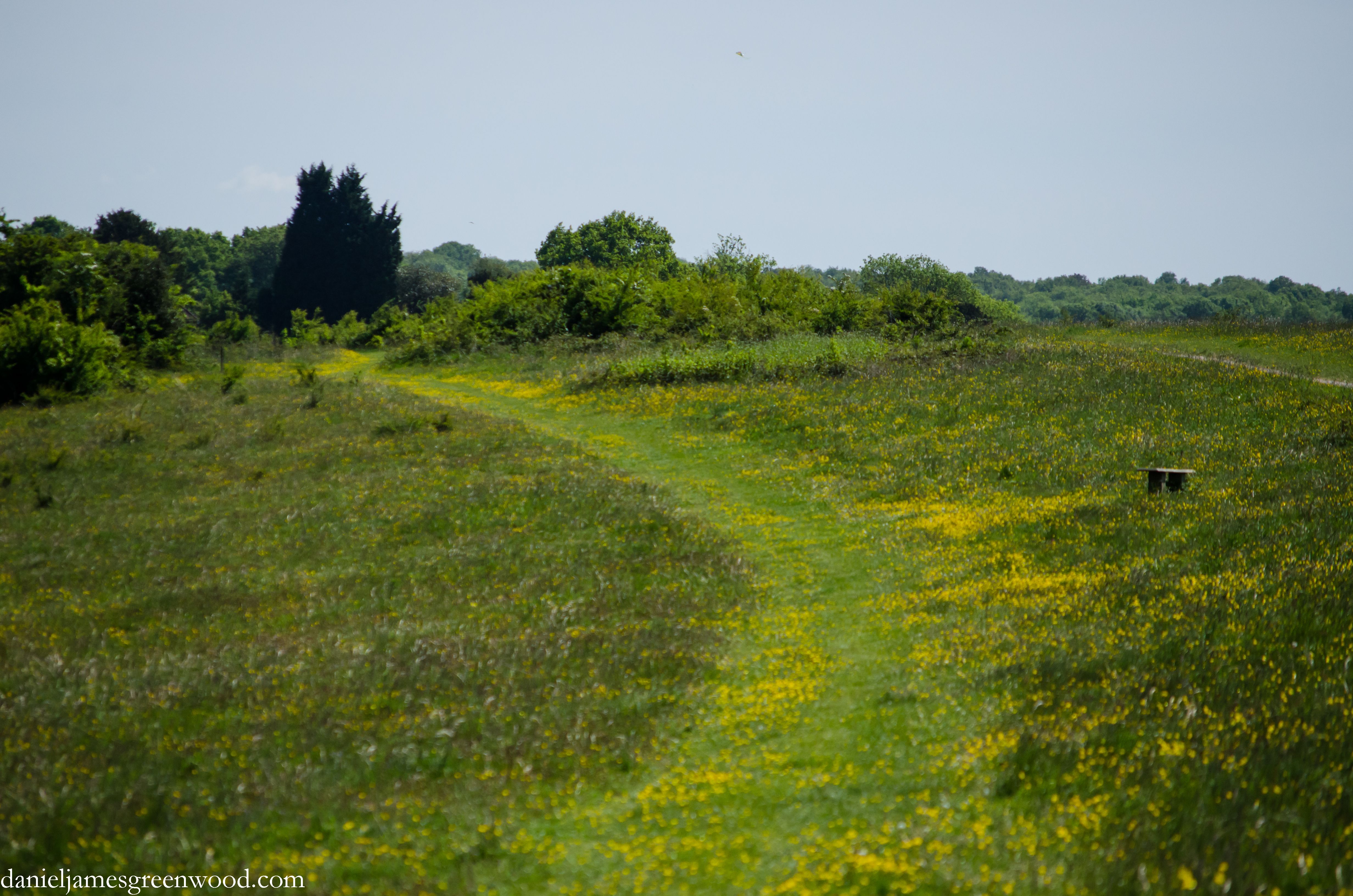
This is it

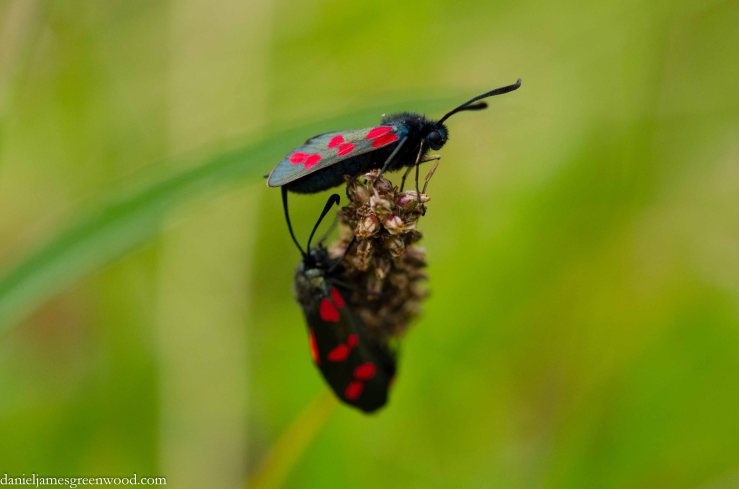
Six-spot burnet moth

Farthing Downs, London, July 2014

We leave the chalky, wooded hollow and appear in an ocean of field scabious. The sun setting in the west catches the pale, lilac petals of these daisies. In the other meadows across on New Hill and in Happy Valley greater knapweed has begun to flower, that deep purple gives me the sense of summer’s final movements, splayed florets that say: this is it. The meadows, too, abound with the motorised flight of burnet moths that were not here two weeks ago. Many of them are mating, one pursued by a pair of skippers unwilling to share a flowerhead. I wonder, what harm could a butterfly do a moth? Anthropomorphism excused, their quarrel does have the feel of a playground spat. That landscape is behind us now as we return along the crown of Farthing Downs. The sky is split in half to the west, smears of rain hurrying our return to the urban landscape. The liquid song of the skylark pours from the sky and we search for its shape. After giving in and then locating it I see it some forty-feet up in the sky. My companion can’t quite believe how clearly its song comes yet from so high. We stand, our exit delayed, the two forces of incoming weather and skylark display gluing us to the soft turf of Farthing Downs.

© Daniel James Greenwood 2014

The cascading orchid

Click through for full album

Farthing Downs and New Hill, London, June 2014

In the towns swallowed by London’s urban lurch, summer is flowering knotweed, rosebay willowherb and lupins, all non-native, all bold and blooming along Victorian railway sidings. At Farthing Downs summer strikes out in meadows of yellow rattle, dropwort, field scabious, hawkbit, ribwort plantain and sheeps sorrel. The first meadow browns, ringlets and small heaths take flight, the latter locked in a pair, mating, flying as one away from my lens. Stopping to take in these grassy Downs, the sheer number of butterflies is clear.

But the birds have not retired just yet. I hear a cry from the blue sky and see a buzzard tucking in its wings and bombing towards Coulsdon. This is the first I’ve seen here, and its arrowing for London is without doubt. This is now officially the most common bird of prey in the UK. I also hear the songs of linnet, song thrush and chiffchaff. Spring and summer have clashed in a frenzy of yellow, green and the common blue butterfly. On New Hill pyramidal orchids cascade across the slope, the leaves of spring cowslips now tucked in under the shade of orchids, rough hawkbit and yellow rattle. The bed of marjoram bounces, its fragrance only felt when touched with the fingers. On the other hillside jackdaws flock with two sheep grazing, their medieval world clattering along with their calls, like bullets ricocheting. The sheep go about their tasting, the meadows purpler still.

© Daniel James Greenwood 2014

Deer and shadows

Sika deer

Newton Stewart, Galloway, Scotland, February 2014

A lady with a crutch and white hair slipping from a woollen hat stops me in the road. She saw me photographing the upturned soil and root plate of a gigantic spruce. Her accent suggests she has moved here from England:

‘I’ve seen about half a dozen deer in the woods just up there,’ she says. ‘If you’re quiet you might see them.’

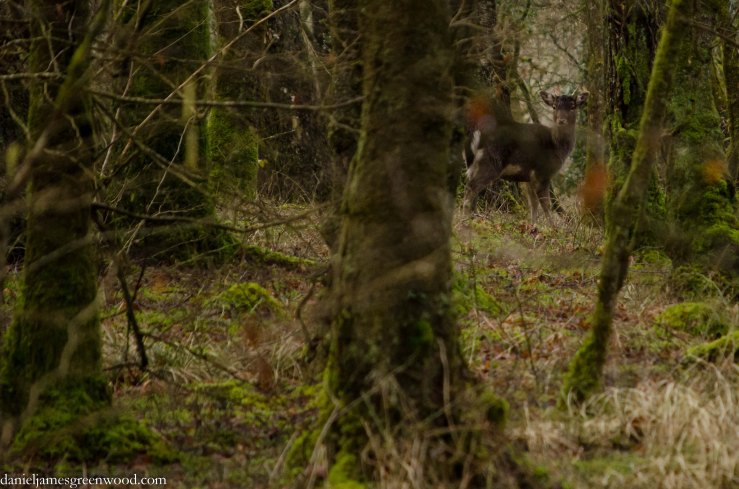
I thank her and take my camera from the bag, pulling my hood up to shade out my face. The day is bright, sunny and warm. Beyond the dry stone wall the woodland begins, a line of evergreens creating a dense bank of shade along the wall, before the characteristically decrepit and mossy trees of an old Scotch wood. I look into shadows and see that a deer is watching me. It’s a sika deer, the first one I’ve ever seen. It doesn’t seem frightened. It turns to me, then away again, grazing behind the line of dark trees. I follow it along, it doesn’t gallop or run. Its path leads me to two more animals, one of them a stag, new antlers primitive but still impressive. It stares at me behind the wall – there’s a good twenty-metres between us. I’ve been photographing them the entire time. I think back to the venison sausages I had at the Galloway Arms, the conversation I had with the bar man:

‘Everyone thinks they’re all cute and cuddly, like Bambi,’ he’d said. ‘No one wants to kill them.’

‘But not everyone knows what they do to woodlands,’ I’d said, thinking aloud.

‘Well, exactly!’ he’d affirmed in his thick Scotch accent.

I know their numbers are at their highest in the United Kingdom since the last Ice Age 10,000 years ago (so are ours, by the way). I know the link between the nightingale’s sudden decline in England and deer overgrazing woods, not that the nightingale makes it up here to Scotland. But I could not kill one of these animals. I’d rather leave that to the lynx, or even the wolf. I put my camera away and make my way along the empty road.

© Daniel James Greenwood 2014

The flickering of panic

Cairnsmore of Fleet

Cairnsmore of Fleet, Galloway, Scotland, February 2014

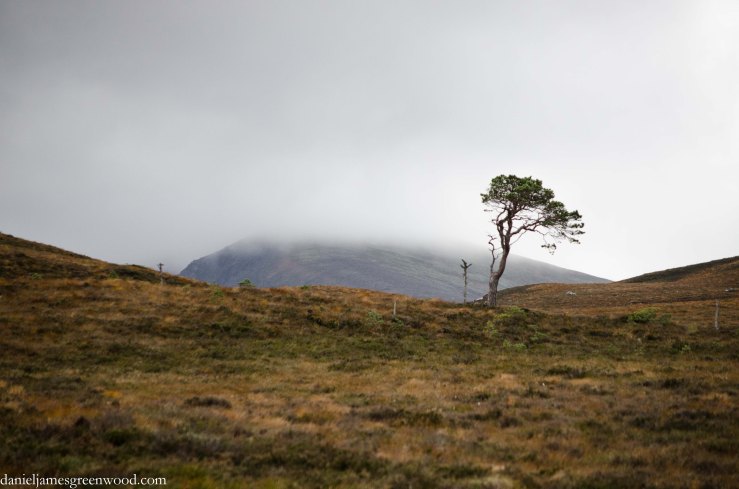
A wading bird bursts from the bog. I watch its sharp wings cut into the wall of mist and descending treeline. I put my binoculars to my eyes and the bird is lost. The world has been reduced. All terrestrial life but for water, a few lichens, heather and wintry moor grasses has escaped. I have left behind oak woods overcome by rhododendron and cherry laurel, and Cairnsmore Burn choked by the former, its water crashing from the shadows. It was not right. Snowdrops still managed to create small rugs of white flowers and winter green leaves. Bluebells peeked through the leaf litter amongst them. Behold the denizens of Galloway’s oldest woods. Up here those are images in the mind. The life in the lap of the Cree estuary – the buses, postman, trees and gentle flowering plants are mere memory. The cover of Glenure Forest’s regimental spruce is the last notion of protection. It’s now up to willpower, my body and clothing. The path leads clear from 20 metres, visibility coming and going with cloud.

Snowdrops

I climb over a wooden ladder and the landscape ascends suddenly from 400m towards the 711 that marks Cairnsmore of Fleet’s summit. I have not seen a single person since snowdrops. Why would anyone want to be here? I come for the brutal solitude, even if I wanted to see another person I couldn’t. I come because I know that people once had no choice but to walk this path, a path that zigzags and climbs, an uncomfortable choice of jutting rock or slippery grasses. I attempt to find a rhythm on stone. The path curves east and the winds propel me on. I see boulders and mistake them for cairns – this is not the summit. My thighs are soaked, woollen gloves, too. I took my jumper off some miles back and now need it. It’s sodden and looped around the strap of my bag. The winds are harder, colder and the rain splatters against me. What the guidebook called a nice introduction to Galloway’s hiker’s paradise has the makings of a minor ordeal. Water streams down the rocky path as I step up and through it. The music of the running water cuts through the wind, it’s almost all I hear, but for my own mutterings. I can say what I want now, no one can hear me. There will be no repercussions. I cherish that.

Cree estuary

The false sense of the summit has given me energy. I’m so hungry. I begin to see my breakfast as vital, I value it differently, as something I was fortunate to have. I see the first cairn of the summit approach and slump down behind it onto wet stone, moss and crustose lichens, barely protected from the gelid gusts. I push some cheese into a crusty bread roll and swallow it. I feel the onset, the flickering of panic. The wind and rain has thrashed me, and I didn’t realise it had or that it might. Visibility is now down to 10m, I put my gloves back on, the cold hammering without, almost burning. I think of real mountains and feel stupid. Hills aren’t to be taken for granted, either. My glasses are blotted by rain on both sides, I recall my friend’s maxim that the descent is worse than the climb. There is no notion of friendship here. The supposedly fine views of the estuary are not on my mind just now. I tread blindly back the way I came, finally removing my glasses. The path of rock, the fog, the bog, it’s all clear. There is no need for detail. I tread in hope and long to see the cloud drift and for the undetectable sound of the wind dropping. The spruce trees appear again, black and warming, even a glimpse of the Cree. From the bog two grouse explode into the air and I leap in surprise. It’s the start of a world I can live with.

It’s the eagle

Glen Einach

Glen Einach, Cairngorms National Park, Scotland, October 2013

Lying on the grass where the road forks up and into the wind I watch the redwing and fieldfare slip across the grey sky. Down below us the River Am Beanaidh flows with great force. My friend has finished in his attempts to separate map from wind and joins me on the gravelly soil, rolling himself a cigarette. A few minutes ago we watched redwing appearing from the heather like particles drawn, magnetised to the scots pine. Some remained in the heather for a time, before using the air and their wings to join with the trees. My smug little siesta is embellished further by a reward received a few minutes earlier: the sight of a crested tit mixing with its coal tit cousins and picking at the sticks and lichens. I have felt the tiredness and tenseness that comes from a lack of proper rest since summer’s end but this landscape reinvigorates me like no other that I have set foot upon. Listening to the quickening wind dashing through the medium of pine needles, my friend calls an end to our pause.

We head up over the top path, the wind bursting through. It’s much cooler, a hint of ice. I automatically reach into my coat pockets seeking woollen gloves. It’s reported to feel like -11 on the peaks today and here blows the clue as we climb to 450m. Trudging along, a shape appears in the distance, passing over the pinewoods, across the river and the slopes of Cairn Eilrig:

‘Big, big bird,’ I shout, into the strength of the wind. My friend stops.

It passes across our view, a cloak caught by a gale. The thought process begins: buzzard… raven… its dark, primary wing feathers like digits. Its wings catch a slither of sun, a golden sheen. It’s the eagle. It disappears behind the trees, appearing again, coasting and now lost to the pines. My friend and I have both leapt up onto a lichen and heather-covered bank of soil. We jump back down, carried back by the wind by an inch or two. We hit a gloved high five, hard and true.

Somewhere between the woods and the water

Image 2

First published on Caught by the River

The River Avon, Bristol, June 2013

I walk along the floating harbour in search of the woodlands I know are further downstream of the Avon, high above the city of Bristol. The harbour is a story of new developments in a variety of different colours and states. One sign by a small park warns of its private nature – no sunbathing, no dogs. Another building is skeletal, multi-storey car park-esque. It always makes me laugh how the images of what a development will look like become less a promise and more a threat when they’re in this half state – it will be finished. Together, these buildings are gently grotesque. The death of England’s once great ports is a boon to the property development industry. Just like in Liverpool and Manchester, old buildings which once provided lifelong employment and were a focus of global trade have become bars, shops, restaurants, apartments and offices, transient spots for the aspirational middle classes and upward to work, frolic and recover. But that’s not the whole story. There’s a revolt against the tidying, the ornamental planting, the exclusivity and boredom. At the water’s edge is red valerian, a Mediterranean flower that has escaped into walls and pavements across England and grows here in the cracks between the stone where daisies also blush pink. Together these plants are the punks of the gentrified waterside, the Pussy Riot of the floating harbour. I clench my fist and salute these wildflowers.

Image

The Avon bends north and in the distance I see the mighty Clifton suspension bridge bursting from the wooded limestone cliffs. But I’m getting lost on my map in trying to locate the path to Leigh Woods, confused by the A370’s spaghetti junction. I cross a footbridge and then a few roads and find the river itself, a prehistoric mud swamp that’s brown in its entirety. Gulls are making prints, lesser black backs, herring and common gulls, they rule this city totally. When I opened the door to the room where we’re staying I looked out of the window and met the fierce eye of a gull. I cross a bridge plastered with posters protesting against plans for buses to pass through. Gulls below see me and act a little tentative – I wonder if they get any trouble from people up here, in this well hidden spot, maybe kids with air rifles. Parkland opens up, the suspension bridge now clear, I aim for the trees. The Avon and I both flow in the same direction. The wheel of a trolley reaches from beneath the mud, as does a traffic cone and a road sign, fragments of a world of transport now mired. I pass underneath the bridge and its black strip across the sky catches in my vision through the leaves of the trees. Up ahead comes a left turning and the entrance into Leigh Woods.

Clifton suspension bridge CBTR

The path appears carved from the gorge. The banks are denuded of trees, covered in hartstongue fern, panting as they soak up the light. The path is steep and wild, riddled with chunks of the limestone that defines this landscape. The slopes become more wooded as I climb, hazels grow amidst single ash trees, with a good number of wych elm and some oak. A chiffchaff sings somewhere, as does a blackbird, a song thrush pipes its beginnings. A month ago there would have been much more, but the breeding season is beginning to take its toll on the songbirds, they are growing quiet. That said, a moment of rest and silence brings more songs: the aborted music of a coal tit, a robin squeezing its thin medley out through the thicketed scrub of young trees. A trio of East European students pass me where I sit, a young woman speaking pointedly. They don’t notice me, so involved in their conversation. The Poles I know all speak in their native tongue with such passion, you’d think their world was at stake.

Image 3

I happen upon a settlement that the interpretation board renders some 2300 years old. The banks were perfect for the defence of the river. I walk along the ridge lit by red campion and struggle to imagine the scene. Farther over on the other side I find the first common spotted orchids of my summer, taking them by the throats with the tips of my thumb and finger.

Back amongst trees, the wind blows through and I notice the rumble of the city, the searing sound of cars around the River Avon. I wonder how the hunter gatherers would have lived in dense woods like these. People today are enlivened and stressed by the proximity of others, as well as their distance. The woodland peoples, before they began exploiting the clearings at the edges will undoubtedly have been driven by a fear of wolves and bears, creatures that were made extinct in England. I ask two ladies and their dog in passing if they know how to get back onto the riverside and they shrug, they don’t know: ‘I think you just have to find a slope and go for it.’

I head on down a side track and the limestone rocks return, cutting out a steep, rugged path into the wooded hillside. At the end there’s some light, colours move across the gap. I’ve found the edge. The view opens out and the murmurings of vertigo appear with the river, the road and the gorge. It is a bizarre and beautiful sight. An oak is dead and beheaded above me on the precipice, how frightening for the woodlander who had to cut that off. Slick ferns grown from its mossy trunk like attempts at wings and feathers. The track isn’t at an end here and so I sense an exit. On the way down it crumbles under foot and so I’m thankful for the fistfuls of hawthorn wood that I can hold as I descend. And as I do I think of the settlers rushing to defend their land from an invasion on the Avon, flying down to the river with spears, arrows and other weaponry to hand. You see, I only have a camera and binoculars. I live in the age of observation.

© Daniel James Greenwood 2013
A profusion of buttercups

Meadow buttercups
Meadow buttercup

Farthing Downs, London, June 2013

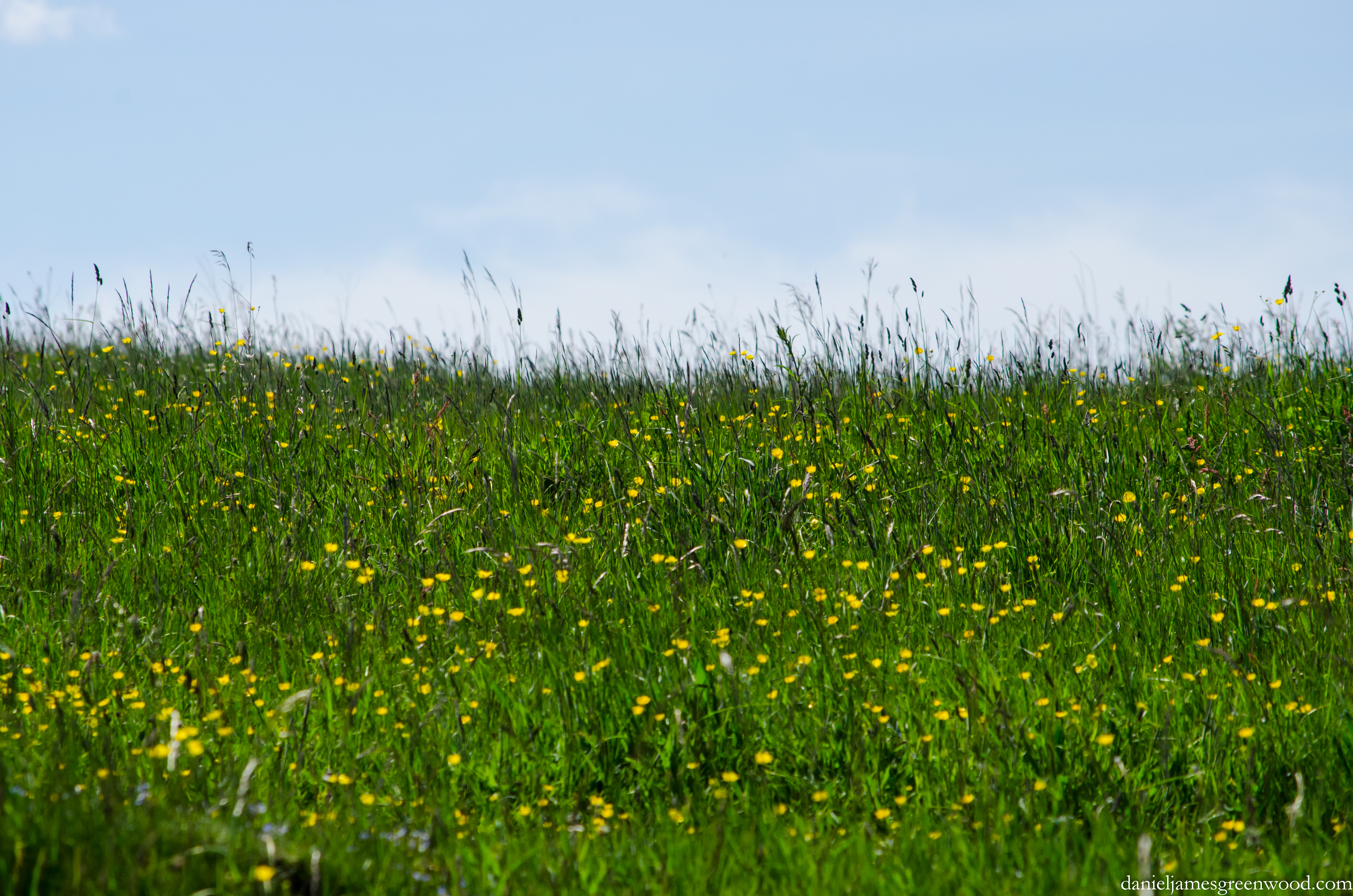
Stepping on to the Downs, a marked change has taken place in the two weeks since I’ve been here. The grass has lost its wintry edge and there grows a profusion of meadow buttercups. On the woody margins white butterflies steer themselves through the day, the slight of a cool breeze will no doubt register with them. A man is sitting on a bench taking pronounced drags from a spliff. I imagine ushering him to the gate as does someone wanting to be in a room alone. What is that link with landscape and human solitude.

A holly blue flutters about in a restless fashion, unwilling to perch, itself ushering me away, perhaps. I take the hint. The jackdaws are still here, so faithful to this place, much more so than me. This is why wildlife is so deserving of the land, perhaps more so than we. It doesn’t have a choice. Last time I watched them in a snowy sky but now they move through the ankle high wildflowers like shadows. They call out and burst free into the air when I enter into their field of vision.

Willow warbler crop 1
Willow warbler

I walk into the scrubby chunk of woodland that the path cuts through. I am struck by the change, the green, the lividness of the living. A woody, leafless hawthorn reminds me that both states remain all year round. Chiffchaffs are calling to each other up ahead, followed by the only slightly different voice of a willow warbler, a bird almost identical to the others. I sit in the shade on the edge of the path and listen. A willow warbler appears from the bush and lands on the branch of a young hazel tree. It has some insects in its bill and it whistles incessantly, huuu-eet. I take a picture and sit still. After a short wait a green woodpecker yaffles and the willow warbler dives into the long grass and bramble. Two weeks ago this bird did the same but without food in its bill. Now it’s feeding silent young down there in the thorns and tussocks. A couple pass me where I sit.

‘Are you looking for a lesser spotted whatever-it-is?’ the lady asks.

I explain the situation, pleased they don’t think I’m up to no good. Her partner turns to me: ‘I know you.’

‘And I know you.’

We remind ourselves of when and where from. We both agree things have improved since then. They leave happily, I get up and carry on through Farthing Downs.

Farthing Downs in June 1
Farthing Downs

The year’s first brood of small heath butterflies have hatched on the Downs. A pair rest on separate patches of bare soil created by livestock, conducting the heat of the sun. They live as adults for as little as seven days and I admire their freedom, their lolling and landing, they circle me, perhaps jittery when I move but not much bothered. They are orange smudges against the green downland. I sit with them. A soldier beetle clambers up a blade of grass and wrestles with its own weight, a clumsy, dim creature, it straddles the seed head, whirs its antennae and unleashes its wings from its black backpack, struggling into the air.

Soldier beetle
Soldier beetle