
Amberley, West Sussex, May 2023
I am aware that most of the people who read my posts are likely to have a natural aversion to football. But really I’m not sure this blog would be here without the football side of my life. I’m someone who is able to say I’ve had words printed in national newspapers having written (unpaid, of course!) short articles about Everton Football Club as a student for the Observer newspaper. As a child I learned to love the outdoors from playing football with my dad and then my friends in the park, and chasing the irregular bounce of a ball over uneven grazing land in Ireland on summer holidays.
As a masters student I dreampt up articles and essays about the psychological landscape of football pitches and the sheer absurdity of the rules of the game. I wanted to deconstruct football, to make it make sense. The ball crosses a line and people’s lives are changed, while billions of pounds change hands. It has become something so unpleasant in many ways nowadays, but its heritage is old and significant. My family have probably supported Everton since the late 1800s when the club was invented.

On Sunday 28th May I forced myself, though tired, to go for a walk in the Arun valley in the South Downs. The aim was to try and distract myself from Everton’s final day game against Bournemouth, where my team could be relegated from the top division of English football for the first time in 69 years.
Formed in 1878, Everton were relegated in 1951 but came back in 1954 and promptly won the league. My dad passed away just short of his 72nd birthday. As an Evertonian from the age of 5, he had never known his team to be anything other than in the top flight. I can say they have won the league in my lifetime, in 1987, in the year of my birth, 1985, as well as picking up the FA Cup against the odds in 1995. It’s not something Newcastle and Spurs fans my age or younger can say!

The stress of these final day relegation cliffhangers is extreme, but I couldn’t tell you why. In 1994 Everton were on the brink, 0-2 down to Wimbledon (RIP) on the final day, but managed to win 3-2 and stay up. In 1998 I put my face in the grass and pleaded with a god I didn’t really know, to save Everton from relegation again. They survived yet again.

Back on my present day distraction walk I passed through Amberley village and popped into the churchyard. It was a beautiful sight, with intelligent mowing having taken place to allow the chalk downland of the churchyard to grow into a rich and healthy sward. #NoMowMay indeed. One unlikely advocate of this excellent initiative is the former footballer and now pundit, Chris Sutton. Sutton regularly makes the case for bee conservation while barracking his co-host Robbie Savage on BBC Radio 5Live’s football phone-in. Well in, lad.

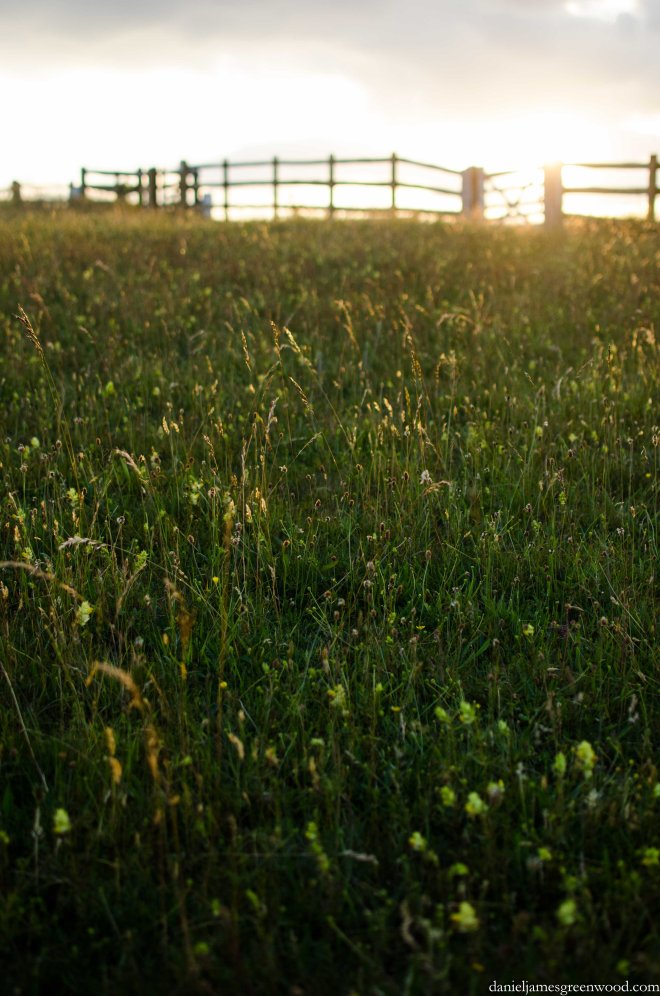
Back in the churchyard, the grasslands were full with oxeye daisies and that downland favourite, yellow rattle.
I entered into the church and took a break from the sun. I love the cool air and quiet of churches, of which the South Downs is spoilt in terms of the sheer number of them. Now, I am not a practicing religious person of any recognised faith, my cathedrals are usually either tree or hill-shaped, but I did ask for my pathetic football team to be spared while sitting on the pew (I also donated to support the church’s eye-watering running costs).
Some hours later, having hammered out 6 miles on the Downs and rushed back to catch the train to listen to the second half at home, Everton survived.
1994, 1998, 2023. Please, just not next year.
Thanks for reading.

 Unlocking Landscapes