
On social media in recent weeks one of the dominant fungi photographed has been a bright red cup fungus. This species is one of the most visually stunning, standing out like an elf’s sore thumb in a winter wood. I’m talking about scarlet elf cup.
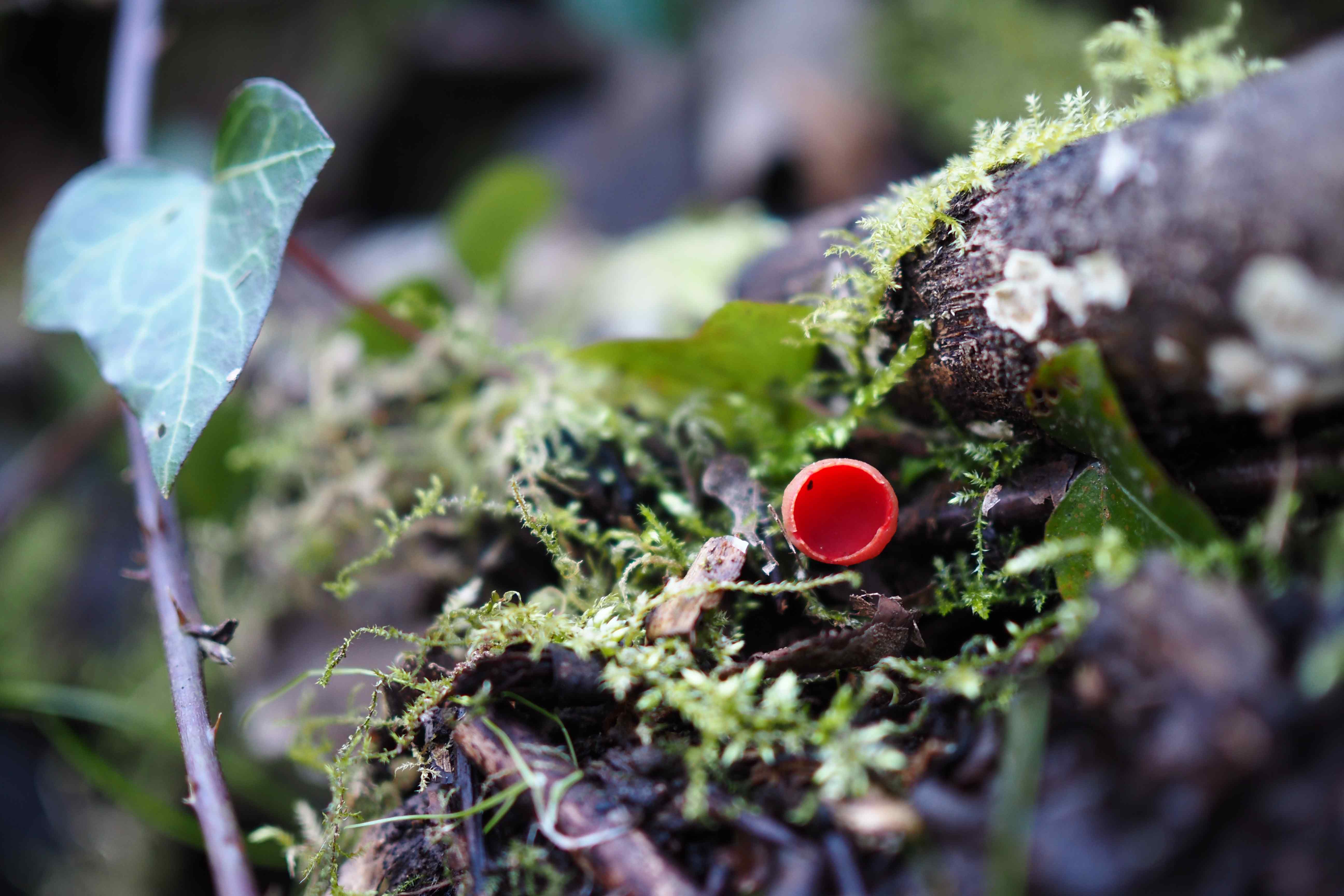
I visited an area of woodland I have featured many times here, but a place I haven’t been to this year. I don’t know why, it’s close to home but usually requires a car journey because it’s awkwardly difficult to walk to. It’s a mixed ancient woodland with a stream running through it and heathland on its upper slopes.

In the UK heathland is a sandy habitat dominated by heather and pine. In terms, dry lowland heath is rarer than rainforest.

This woodland is managed with the support of volunteers. I don’t know the people who do the good work there but they clearly spend a good amount of time building what I know as dead hedges. These are barriers or piles of cuttings, branches, twigs and sometimes logs. They are there mainly to protect sensitive areas of soil where ancient woodland plants grow. It’s to keep people on the paths, which is best for the health of a woodland overall. These dead hedges also happen to be excellent habitat for wildlife like fungi.

From my experience in the woods and by looking at other people’s photos, I would say scarlet elf cups are happiest in damp, shaded areas. I would even say they are so keen on dampness that alongside streams and rivers is usually a good place to find them. This was a bit of a way from a stream but it ticked all the other boxes. You can see here that it’s growing from a small stick.

This is a nice example of this gorgeous fungus (not something you hear often enough). They grow on something similar to a stem but are a different set of fungi to the usual stipe-based mushrooms. Cup fungi are ‘ascomycetes’ (ask-oh-my-seets) and are spore shooters. ‘Basidiomycetes’ are spore droppers, most of them being the gilled mushroom types.

This area probably had hundreds of scarlet elf cups growing in this long stretch of dead hedge. It will be good habitat for lots of other species as well, including invertebrates and sometimes they’re big enough for small birds like wrens to nest in. The specimen above was snug as a shroom in a trug.
From what I know it’s an edible species, but I wasn’t about to clean out all these fungi from their wild habitat. I had mushrooms in my fridge that were a couple of days close to their best!
Thanks for reading.
The ruins of Brambletye
A walk from Forest Row to the Brambletye ruins in Ashdown Forest, with some ancient woodland and rocky outcrops scattered along the way.
Winter-spring 2026: the loud lie
What I am experiencing culturally in this rather wet winter of 2025-26
Arun valley oaks around Billingshurst
A long ramble (in both senses) around the oaken landscapes of Billingshurst, including the Wey & Arun Canal

 Unlocking Landscapes
I also love hiking… And, you are a great photographer
Thank you Lokesh
Lokesh Umak is right – you are a great photographer Daniel.
And this post is so interesting – I was so delighted to find three stunning Scarlet elf cups about a month ago and found out about them, so it’s great to now know more – thank you!
Wow, thank you Emma. That is such a nice thing to say. I really appreciate it. These photos are not far from where you are actually so it’s likely the stuff I post here will be popping up near you at the same time! 😁 This is Leechpool Woods.
Wonderful – crazy to say, but I only found out about Leechpool last year – such a wonderful place, and joined, corridor style to many other woods / natural places that make the wonderful Horsham Riverside walk – and many other adaptions of walks! So glad you’re looking at fungi local to me; this year, I really hope to somehow be able to learn how to identify edible fungi confidently. 🙂
That’s what I love about it, it connectivity. Must say I wish it was better connected with St. Leonard’s Forest but oh well, feels like you can get lost there which is a good feeling if you know how to get home again! I would recommend going on a course for that specifically if you want to learn edibles. Always best to learn from someone who knows.
Thanks Daniel – yes, I found a very affordable, comprehensive sounding one last year –
I think at the Warnham Nature reserve, but I may have remembered incorrectly –
but of course it had to be cancelled…
You’re right, best to learn about edibles from an expert!