The Sussex Weald: the owl in the rafters

Blackdown-14-3-2020_lo-res-28

Blackdown, West Sussex, March 2020

We climb the hill on a winding, muddy path through woodland. The trees are sprawling yew, rotten beech and broken holly. On the thick, black soil holly leaves have fallen. We listen to the spinning coins of a goldcrest’s song as it moves close over our heads in the twigs of a yew. These tiny birds weigh little more than a 20p piece and must eat 90% of their body weight each day to survive in winter.

The light at the top of the hill comes through the branches. Woodland becomes heath of gorse, bilberry and birch. The voices of a walking group echo down as we step up through sandier soils now. A screen of crooked birches are splayed across the view, desperate to keep its secret. Their birchen secret is out.

Blackdown-14-3-2020_lo-res-27

From up here, the highest point in the South Downs National Park, the Sussex Weald opens out. Soft brush woods are broken by fields where individual oaks express themselves as they once would have, in landscapes kept open by now extinct herbivores like aurochs and wild horses.

Then there are the folding Downs catching in a spill of light from the west. The beechen clump of Chanctonbury Ring, with the heavy metal orchids of Truleigh Hill further east.

Blackdown-14-3-2020_lo-res-16

A woman is here with her son and his girlfriend, walking the dog. She tells them in a faintly Irish accent that you can see the Isle of Wight on a good day. This is not one of those days.

The families and walkers are dissipating and the view is now ours for a moment. Just as the last person leaves, a call rings out from the woodland we crept up through.

One call, and then the truncated follow-up. A tawny owl, calling from the rafters of the Weald at 3pm on a Saturday afternoon.

The Sussex Weald

#FungiFriday: the gifts of spring

Warnham_19-3-2020_lo-res-04

Fungi Friday 20th March 2020

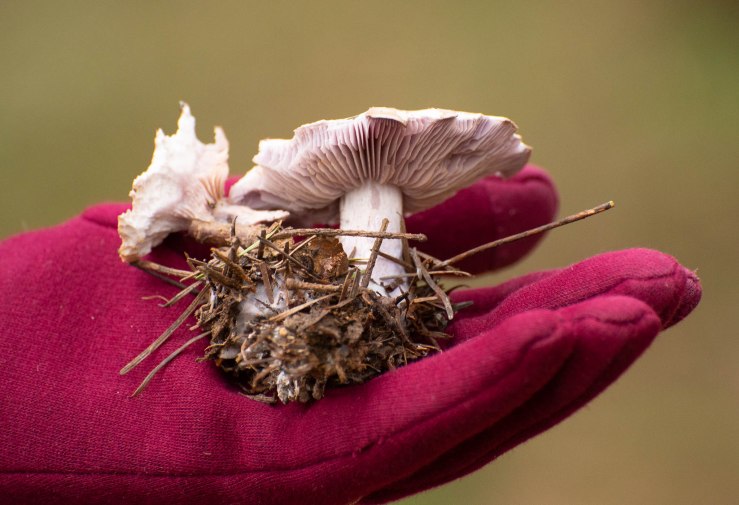
Happy Spring Equinox! Yesterday was a special day, the first proper mushrooms of 2020 made an appearance in Sussex, to me at least. Problem was I completely missed this mushroom, blewit! Wood blewit, that is (sorry). Thankfully it was pointed out to me and I had a glove model on hand (lol) to show it off.

Warnham_19-3-2020_lo-res-08

This has been an incredibly difficult week for people and it’s hard not to talk about it here. Heading out to see which birds are now singing or which mushrooms might be fruiting is a massive tonic to the social frenzy which is hitting pretty much everywhere at the moment. This week I heard my first singing chiffchaff of the year, a rubberstamp of ecological spring. This female great tit may soon become a mum.

Chesworth_17-3-2020_lo-res-6

We have to look to nature now as spring arrives. It puts you back in your place and gives a picture of the longer term. The wild life will go on. But we should also consider that the problems we are now facing are linked to our awful devastation of the natural world, the abuse of its wildlife and ecosystems. Seriously people, we have to consider what we are doing to wildlife and their habitats first hand and also by our consumption of unsustainable products like beef from Brazil or chocolate from companies with poor ethical standards. I really hope that people can find a love of nature now that makes us slow down, consume less and see that our impact has to change forever before nature changes us more abruptly. After this, there can be no going back.

Warnham_19-3-2020_lo-res-03

As I say quite often on this website, I’m not a forager of edible plants and mushrooms, though I know a fair number that I could eat. By that I mean plants and mushrooms, not actual foragers. I have never lived in a place where the foraging of anything beyond blackberries is sustainable. Some foragers must have been banking on this moment of temporarily empty supermarket shelves. Though our numbers are too great and nature’s larder probably too diminished to sustain our diets now. Shame that the toilet roll you find in the woods ain’t ripe yet.

Warnham_19-3-2020_lo-res-01

Most of the fungi I saw yesterday was not edible, either because of its species or just generally because something else had already eaten it. The Coronavirus situation should remind us that there are millions of other species with lifestyles that are far more sustainable than ours, and we are vulnerable to pandemics, especially as we force our way ever deeper into untouched ecosystems that have been intact for millions of years or disturb people who have lived in harmony with those landscapes for a long time. The fungus above is probably shaggy bracket or Inonotus hispidus, one you usually find in bits on the floor having dropped off from higher up. I learned this species conducting tree health surveys with tree inspectors.

Warnham_19-3-2020_lo-res-09

A common mushroom popping up now is glistening inkcap. The ‘record shot’ above is enough to show you how few mushrooms I’ve seen recently. The standards should get better as winter diminishes in the rearview mirror.

Warnham_19-3-2020_lo-res-10

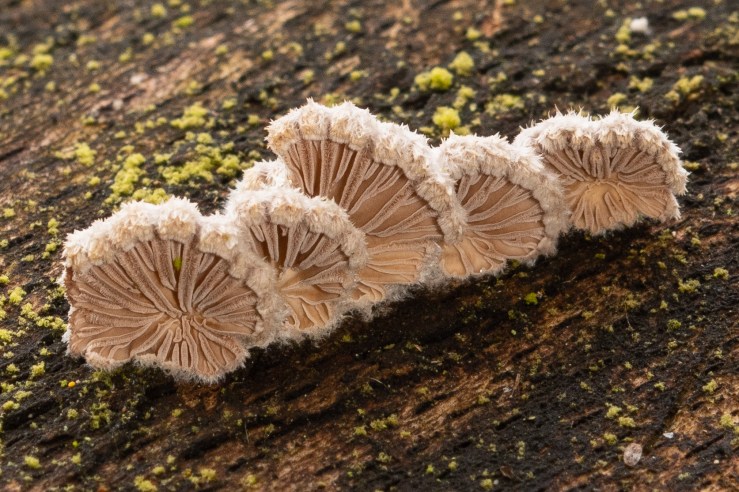
Some fungi need a bit more before they’re ready to go on stage. Here we have a splitgill fungus, which I covered a few weeks ago. Still this snowy white shroomster was a pleasant sight against the blackened rings of this log.

Garden_18-3-2020_lo-res-4

I am getting mentally ready to spend a lot of time in my garden this spring. I am very privileged to have a garden and, having eventually got to this point, I will never take it for granted. During one of this week’s WFH lunch breaks, I found this miniscule fungus frowing on the remains of a magnolia leaf. I wasn’t even looking for it, I saw it later when editing the RAW file on the computer.

Garden_18-3-2020_lo-res-1

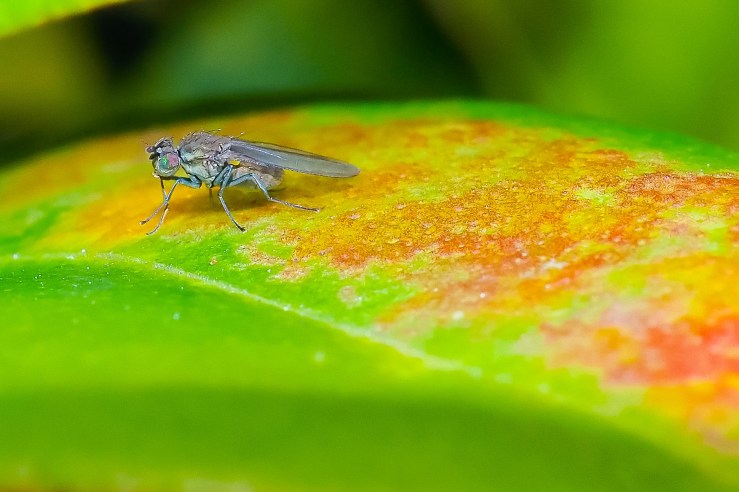
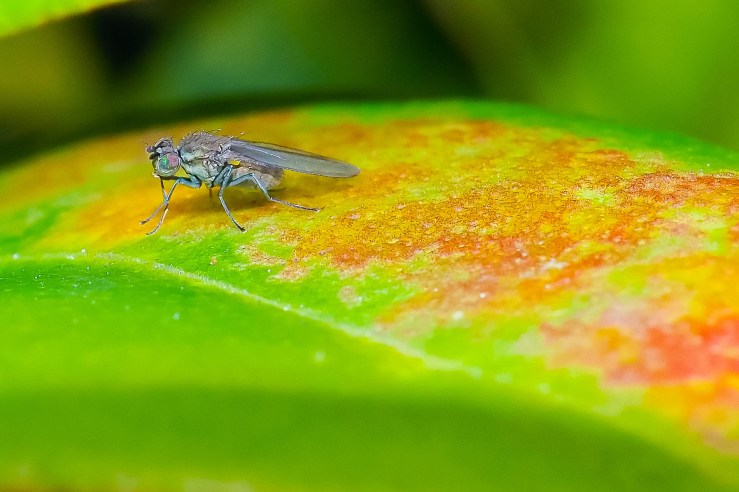
This very tiny fly was resting on a patch of fungus in the pigment of this leaf. I’d like to learn more about these types of fungi but one of the more recognisable ones is that which grows on bilberry (blaeberry, blueberry) leaves.

Warnham_19-3-2020_lo-res-11

I owe lichens for getting this #FungiFriday blog close to completing its third month. Let’s hope that Fungi Friday can help us adapt to the life changes we are all experiencing just now. I plan to do a virtual Fungi Friday guided walk if we’re still allowed out, in a couple of weeks. Stay tuned for that, but most of all stay tuned to the season rather than your news app on your smartphone. It will help you when you need it.

More mushrooms

The South Downs: the Sullington yew

Sullington_yew_9-3-2020-7

The Sullington Yew, Sullington, West Sussex

The South Downs is renowned for its ancient churches. Its chalk soils have also proven hospitable to yew trees. Some of the most extensive yew woodlands in the UK (if not Europe) are on the chalk of the North and South Downs in southern England.

Sullington_yew_9-3-2020-2

I had a couple of minutes in the village of Sullington at the foot of the South Downs close to Storrington in West Sussex. The village is made up largely of an ancient farmstead and the Church of St. Mary.

Sullington_yew_9-3-2020-6

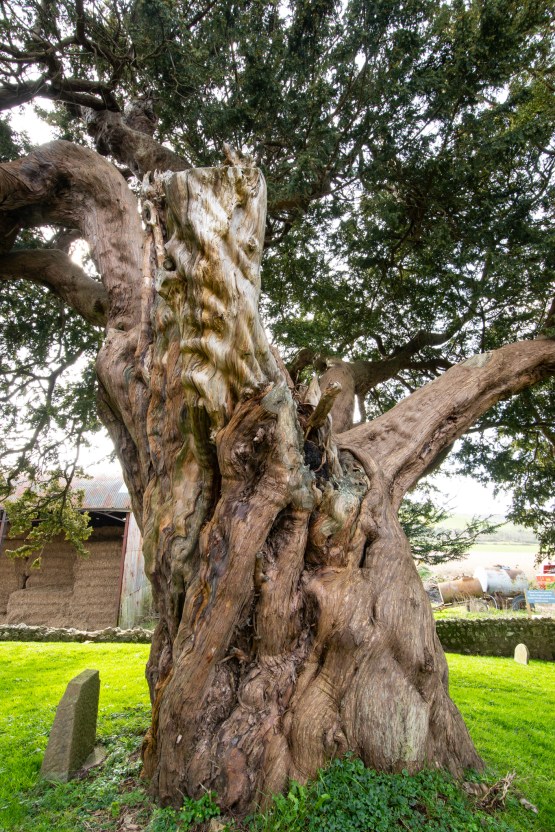
The Sullington yew sits in the churchyard, supposedly 1200 years old. To me it looks like it could be younger due to its lack of hollowing in the heart of the tree. If it’s that old it would pre-date the church by several hundred years. It is true that many yew trees pre-date the churches they share a plot with. Yew trees hold strong spiritual significance to pre-Roman/Saxon Brits who were Pagan. Therefore churches came later, being Christian, on sacred Pagan sites.

Sullington_yew_9-3-2020-5

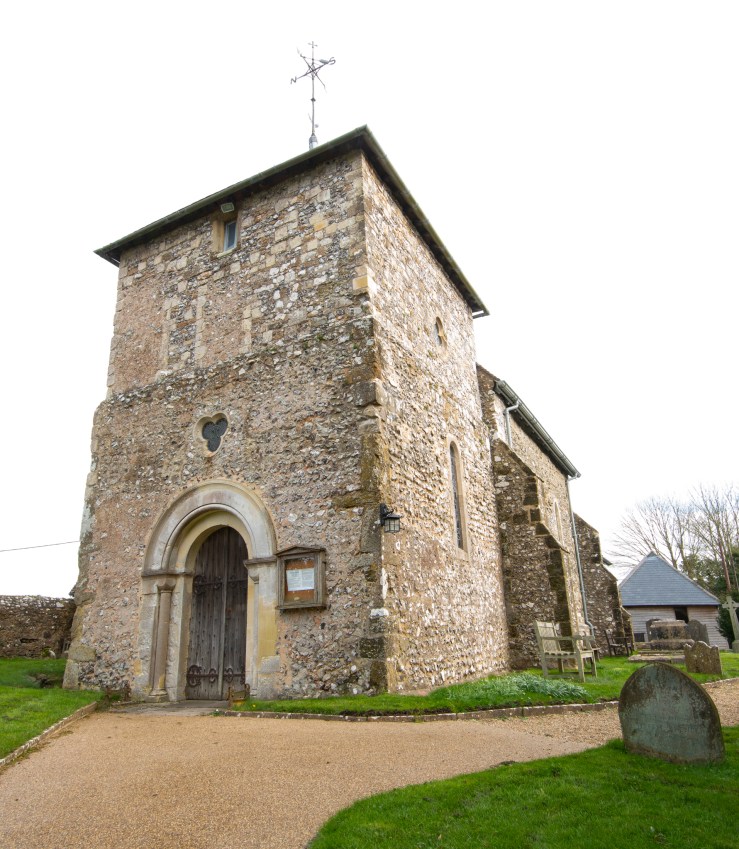
The church itself is built of flint, sandstone and other materials. Part of it is Saxon, meaning it survived the Norman Conquest of 1066. It is thought to originate from 1050.

Sullington_yew_9-3-2020-8

Here’s the tree on the Ancient Tree Inventory.


#FungiFriday: a weird week for mushrooms

Warnhqm_8-3-2020_LRCC-01

Fungi Friday 13th March 2020

No self-respecting person goes out looking for mushrooms in March. The mushrooms come to you. Or in this case (above), the bracket mushrooms will hover over your head and attempt to abduct you ala UFOs visiting nocturnal fields in the southern states of the USA. I’m unsure of what this bracket fungus is but it is probably the funniest. I actually ‘laughed out loud’. It’s growing from a poplar in a wetland reserve in the Sussex Weald. If you look closely enough it also looks like a grumpy frog.

Warnhqm_8-3-2020_LRCC-16

This great spotted woodpecker was looking for his lunch nearby. Thankfully his attempt to fool me into thinking he was a bracket fungus didn’t work. It got more weird:

Fungi_Friday_13-3-2020_lo-res-1

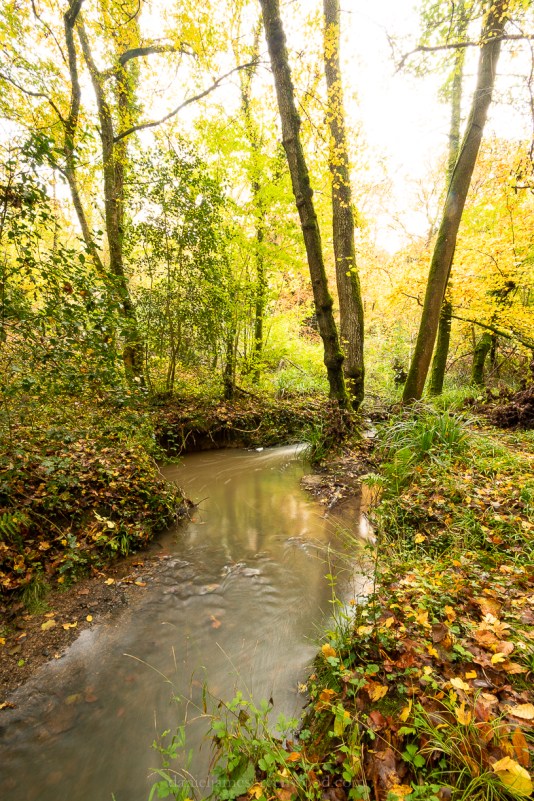
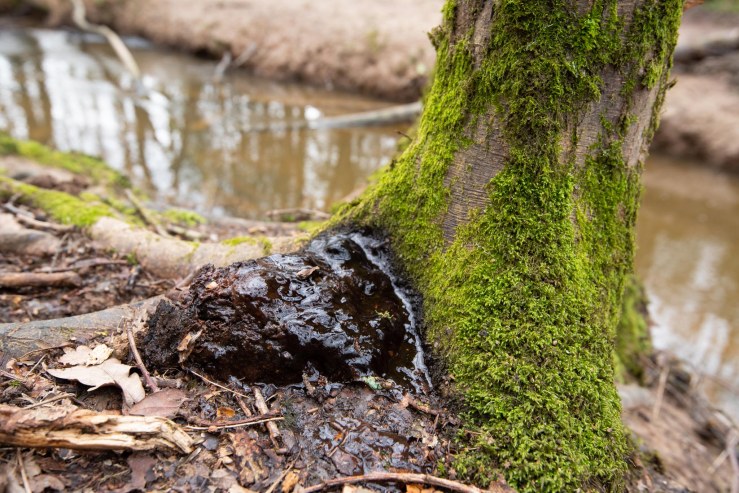
Alongside what is known in Sussex as a ‘gill’, a stream rushing through woodland, I found this horror. Now I’m unsure whether this is the jellied remains of an old bracket fungus or simply the remains of a jelly fungus. It could also be something far worse. I prodded it with a twig and it jiggled, so I would go with it being a jelly fungus. It was delicious. Kidding, it wasn’t. As in, I didn’t eat it.

Fungi_Friday_13-3-2020_lo-res-3

The only fungal wow moment of the past week has been this encounter with splitgill fungus growing from a pine tree. This was a plantation of thousands of pine trees with very little variety in structure, tree species or ground flora. Keep an eye out for my next Sussex Weald post on that. These mushrooms stood out like many sore thumbs.

Warnhqm_8-3-2020_LRCC-13

The lichenised fungi also provided a rather artistic sight. I think this is a species of poplar. It has crustose lichens growing around the trunk. In a tweet the British Lichen Society pointed out that this is evidence that trees grow outward rather than upward. Why is this? It’s because trees are constantly putting on new layers of wood internally, behind the bark. These layers of tissue form the static mass of the tree. It is in effect a kind of waste product but it gives the tree some structure.

Warnhqm_8-3-2020_LRCC-02

Take this stunning dead oak which was also seen on the same day as the lichens. The bark is falling away from the tree as it decays (thanks to fungi in part) and the layers of wood internally are exposed.

Warnhqm_8-3-2020_LRCC-12

All that, from the fact that lichens look a bit like bird poos delivered at high velocity from the leftfield.

Thanks for reading!

More fungi

#FungiFriday: a week of cake and jelly

OLYMPUS DIGITAL CAMERA

Fungi Friday 5th March 2020

A couple of weeks ago I was inspecting a bird table in my garden and spotted a moss growing from its ‘roof’. This bird table has been, literally, around the houses and has probably gathered many organisms along the way. Looking more closely I found some jelly fungi.

OLYMPUS DIGITAL CAMERA

The weather has been showing signs of spring, with queen bumblebees on the wing and what I am sure was a male hairy-footed flower bee travelling through the gardens. On Monday I was in the garden briefly and had a closer look at the bird table. On the edge I found a nice cluster of what I think are lemon disco (yes, great name!).

OLYMPUS DIGITAL CAMERA

During a brief trip to The National Trust’s Nymans in the Sussex Weald this weird species was on the decaying heartwood of an old cherry tree. It’s a slime mould known as false puffball. If you press it with your finger it bursts, a bit like other Lycoperdon slime moulds such as wolf’s milk (search for it).

Chesworth_29-2-2020_LR_lo-res-11

Elsewhere, the state of Sussex’s rivers shows how high the rainfall has been so far this year. But the lichenised-fungi are benefitting.

Chesworth_29-2-2020_LR_lo-res-08

Along this stretch of the river Arun, these beard lichens were profuse. One hawthorn was so covered with them it seemed like there would be no room for leaves in a couple of weeks!

Chesworth_29-2-2020_LR_lo-res-17

Lichens were doing well in other places too. This knotty old fencing rail was making a home for these cup lichens (Cladonia). Lots of countryside fence posts are home to these lichens.

Chesworth_29-2-2020_LR_lo-res-06

Not far away from the gushing Arun was a veteran ash tree with lots of King Alfred’s cakes growing from the damaged bark. In this image you can see the folds of the cambium where the tree is trying to protect itself from fungi and other invading organisms. This fungus will have a boom from the amount of dead ash trees caused by the evil fungus behind ash dieback disease.

hqdefault

To people outside the UK or without a grasp of English history, this name is quite meaningless. It is based on the tale of King Alfred who was exiled in the Somerset Levels during the Viking invasion of Winchester. Alfred failed to keep an eye on a woman’s loaves of bread that were on the fire and they burned. It is said that she had no idea he was the King, so far removed was his from his throne. Don’t worry, he eventually came back and pushed the Danes away a bit.

In the real world this fungus is said to be a host species for hundreds of invertebrates. It’s also used as a kindling and many people who know of it do so for that reason.

Let’s hope for milder temperatures and less rain and see if some more photogenic fungi pop up!

Thanks for reading.

More fungi

#FungiFriday: it’s raining, it’s sporing

OLYMPUS DIGITAL CAMERA
The South Downs

Fungi Friday 28th February 2020

A fungal perspective on February would probably say that it was ok if you live on a fence post. The poor people who have had their lives ruined by flooding in Britain probably wish they too live on stilts. And so February saw itself out with yet more heavy rain and flooding. But it also carried the early signs of spring.

OLYMPUS DIGITAL CAMERA

The closest thing I got to a true fungus (whatevs that is) was this turkeytail fanning out from a fence post. It’s a reminder that to a fungus, a fence post is just a dead tree that we have put somewhere away from the woodland it was once growing in. There are also a smattering of crustose lichens in the background.

OLYMPUS DIGITAL CAMERA

The best chance of finding something fungal to photograph was on some raised timber somewhere. I found this very marshmallow-like polypore bulging from a crevice in a fencing rail. You know times are hard when it comes to this. Behold the pores developing underneath as the specimen expands.

OLYMPUS DIGITAL CAMERA

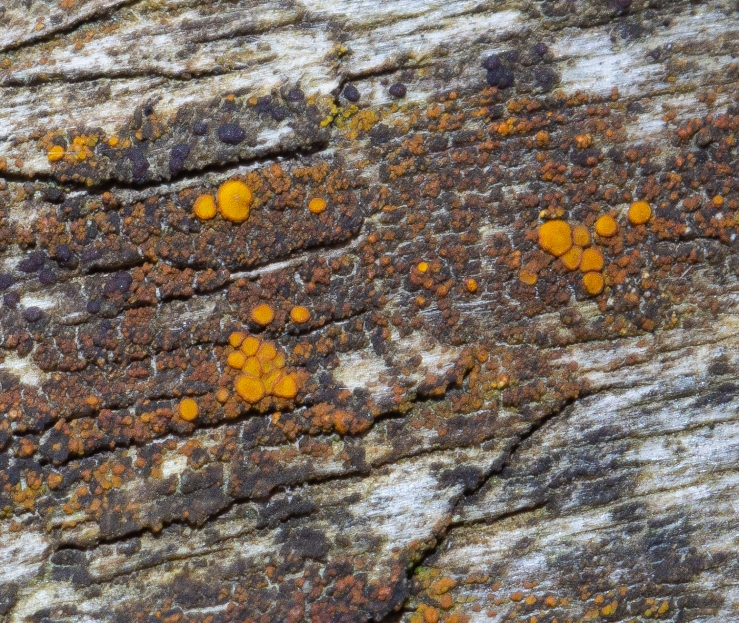
As you can imagine, the 100%-fungi fungi ran out quickly. This lichen stood out to me a bit like the archetypal graffiti you see alongside railway lines. I went to a secondary school with a rich mix of graffiti artists (I know that this is not a universally held description) and this reminded me of that.

OLYMPUS DIGITAL CAMERA

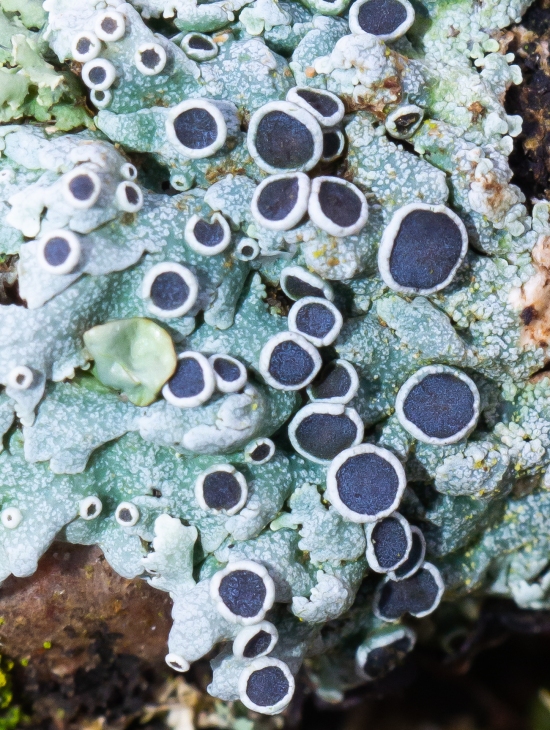
This is a heavy crop so the photo isn’t winning any awards, but the lichen’s orange fruiting cups are really cool. I read this week that these cups are ascomycetes in fungal terms, better known as ‘cup fungi’. Their biological name as a structure on the lichen is ‘apothecia’. The ascomycetes are the largest group of fungi in the world and are also known as ‘spore-shooters’ (but don’t confuse them with puffballs like I once did). Normal mushrooms are basidiomycetes and produce their spores in the basidia which are usually present inside the gills we all know and eat.

OLYMPUS DIGITAL CAMERA

This is a pic from last week (is that allowed?) where you can see the apothecia of the lichen. The spores are released from these navy-blue discs and shot out into the air.

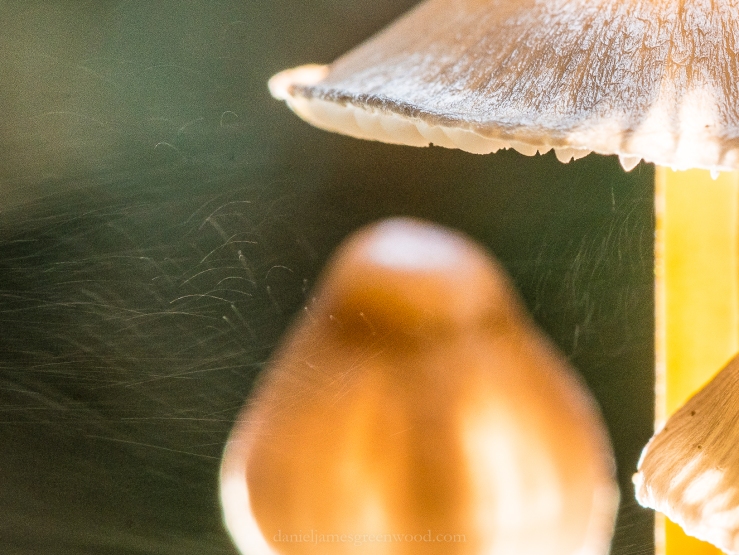
Bonnet spores - Octoberr-2018 djg-1

Just to illustrate, above you can see spores being released from a bonnet mushroom. This was taken with a high-resolution camera and lens, with some additional lighting. I didn’t know this had been captured until I looked at the photo later on my computer.

OLYMPUS DIGITAL CAMERA

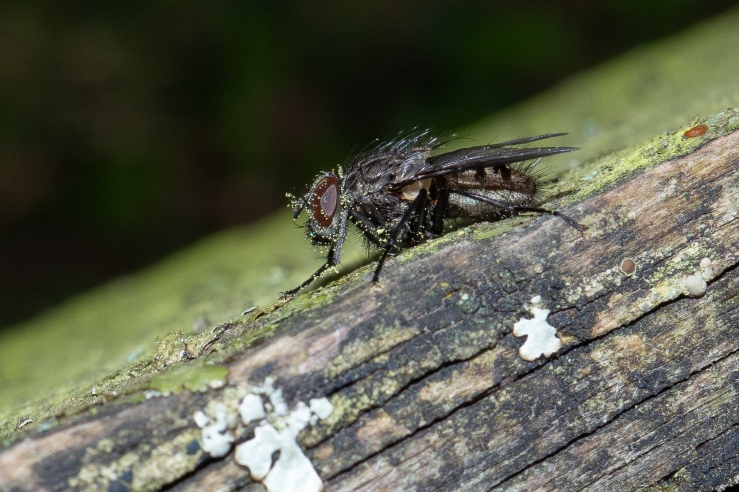
Back to this week and there are signs of winter coming to an end and the return of some mushrooms. This fly has what I guess might be goat willow pollen on it, meaning that they’re flowering and spring, it cometh.

OLYMPUS DIGITAL CAMERA

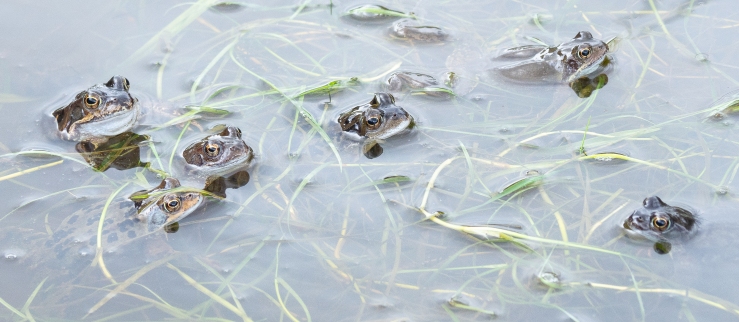
The truest sign of winter going back to where it came from is these froggy peeps, about a week later than 2019. More from them in a bit, if I find the time. Rebbit. Soon enough they’ll be sheltering under toadstools in the woods, where they belong.

Thanks for reading.

More fungi

#FungiFriday: fungi giveth and they taketh away

SLF_LRCC_14-2-2020-1

Fungi Friday 21st February 2020

The Weald holds so many future Fungi Fridays. It’s an ancient wooded landscape that stretches across Sussex, parts of Surrey and into Kent. It covers the most wooded part of the UK in East Sussex. Once it will have connected with the New Forest, forming much of England’s post-glacial ‘wildwood’. I am very privileged to live within rambling distance of the Weald. I write about walks in it once a month, check that out if you will.

I managed to sneak ninety minutes in locally last week and found plenty of interesting things. As well as the ‘dark side’ of fungi, a reminder that a fungus giveth, and it taketh away.

SLF_LRCC_14-2-2020-11

We have had two storms in two weeks in Sussex and the winter streams are tickling through the woodland understory. Above, a tree was resting in a winterborne. This means a stream that only flows in winter when rainfall is higher. In Ireland, lakes (or loughs) that appear in winter are known as ‘turloughs’. Got plenty of those right now in Brexit-land.

SLF_LRCC_14-2-2020-09

The log was covered in some nice looking turkeytail, a very common polypore that is said have anti-carcinogenic properties. It was a nice way to start.

SLF_LRCC_14-2-2020-06

Then I happened upon these absolute corkers growing on a dead birch tree. These are blushing bracket in their mature stage. This area of the woodland is very wet, with mosses like sphagnum attempting to recolonise more places. It is set in amongst mature beech trees at the edge of heath-ier habitats, largely consumed by pines that were planted, rank and file, by the Forestry Commission in the 20th Century. It’s very wet and many birches are succumbing there. This is natural.

SLF_LRCC_14-2-2020-07

This is a standalone dead birch tree with birch polypore, also known as razorstrop fungus. It’s a tough bracket fungus that people probably once used to sharpen their razors. It naturally controls birch trees and breaks them down for other organisms to devour, and therefore new soils to be created.

SLF_LRCC_14-2-2020-6

Here’s a quick macro of one of the mosses from the work of the razorstrop, looking much like a cedar or a fern.

SLF_LRCC_14-2-2020-1

I found some split gills looking rather shaggy, in a good way. If you look at the yellow smatterings around, I think that’s a slime mould making its way across the surface of the bark.

St. Leonards Forest - 12-5-2019 djg-6

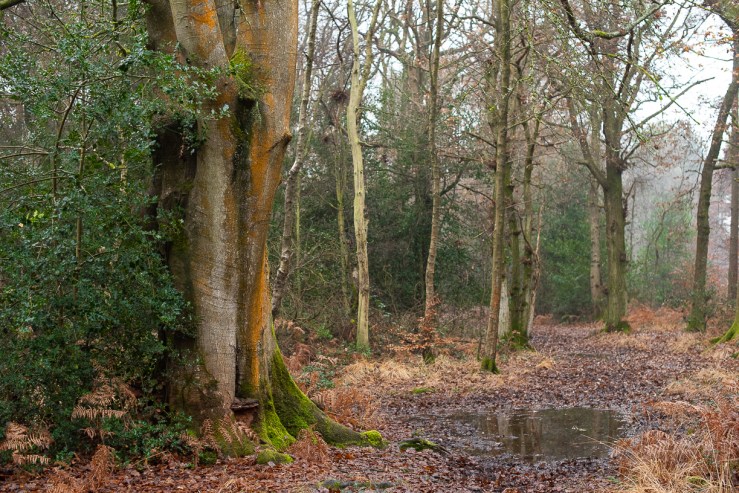
Rewind to May in this area, when the first leaves were appearing on the trees and the ground was far drier. This is one of my favourite trees to photograph in this woodland because of the orange algae and the beautiful buttresses at the tree’s base.

SLF - 5-12-2019 blog-18

Here it is in December, the ground much more wet, the leaves all gone. Can you see the bracket fungus at its base? It has been damaged, probably by a visitor testing its strength.

SLF_LRCC_14-2-2020-04

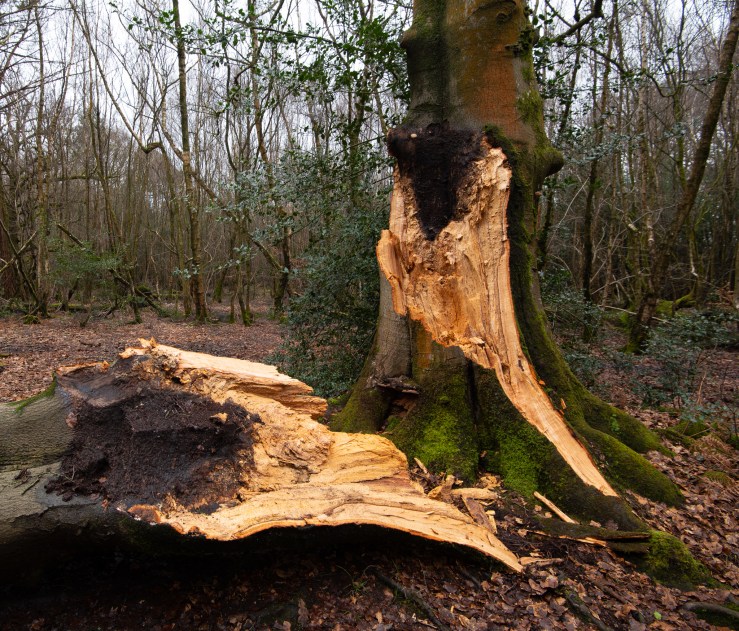
And here it was last week. Evidently the tree has been destabilised by the decay which has been accelerated by the fungus. This has softened the heartwood which leaves the tree vulnerable to storm damage.

SLF_LRCC_14-2-2020-03

But this veteran beech tree still lives, it has only lost one of its three trunks. I hope it can remain where it is and continue down its veteran path into the realm of the ancients.

It’s just another reminder that fungi has its own way in the world and there is no sentimentality involved. It’s there to break down organic matter. Trees were not a safety concern until we started walking underneath them everyday.

Some species share what they can find, others take, take, take. It’s in their nature. But in the end fungi are contributing to vital processes of organic recycling and renewal. Without the ecological role of fungi our species would not exist writing blogs, taking photos, hurling abuse at passers by, or walking under veteran trees in the woods.

More fungi

#FungiFriday: still loving lichen

OLYMPUS DIGITAL CAMERA

Fungi Friday, 14th February 2020

Storm Ciara blew in on Sunday and probably washed any winter shrooms away. But I’m still spending my time with the symbiotic fungal folk found in lichens. The lichens have had a good week, heavy rain has been interspersed with some lovely winter sun.

Near where I work there are lengths of low post-and-rail fences that are covered in lichens. They’re likely to be sweet chestnut and not to be treated with any chemicals. This patch above is a joy, a mass of cladonia cup lichens with mosses and some crustose lichens smattered in between.

This is probably Xanthoria parietina which is a very common yellow lichen. I think it looks like scrambled eggs! The colours have only been very mildly edited here, it really was vibrant.

These are the fruiting bodies of the cladonia cup lichens in the previous image, far more alien-like.

These fences are close to the river Rother which was flooding the surrounding landscape in an epic manner. It’s done it twice now this year.

As you can imagine, for the mushrooms of the fungal world, this is too much water!

This is a dead alder tree that sits in the centre of the river. You can see the blue-green hue from the riverbank, the presence of lichens enjoying a sunny and moist spot to prosper in.

Next week I will actually have some 100% fungi to share!

More fungi

How mushrooms are helping to fight poverty in China – Time

The Sussex Weald: all that’s left of the shadows

SLF - 6-2-2020 blog-37

St. Leonard’s Forest, February 2020

The sun hasn’t yet reached St. Leonard’s Forest. Frost covers the depressed spreads of bracken at the edge of trees. A dawn chorus still rattles on, dominated by song thrush posted across this wooded landscape. In the distance there comes the clopping of horse hoofs, a throwback to the days when highwaymen roamed the Weald and when people travelled almost anywhere far away enough, on horseback.

The horse riders appear on the hard track ahead of me. They’re galloping until they see me, surrounded by a cloud of perspiration. Their upper bodies are coloured yellow, green and orange by hi-visibility vests. The man leading the troop glares at me from under his helmet as I pass with birch trees between us. Perhaps he thinks I’m a warden.

‘Good morning!’ I shout across to them, which is met with a murmur.

Off they trot.

SLF - 6-2-2020 blog-1

Beyond the stands of spruce and pine planted on old areas of heath, the sun is climbing. I can hear the wash of the M23 as vehicles roar through its wound in the Weald. It’s one I use a couple of times a month, too, when heading further south and then east.
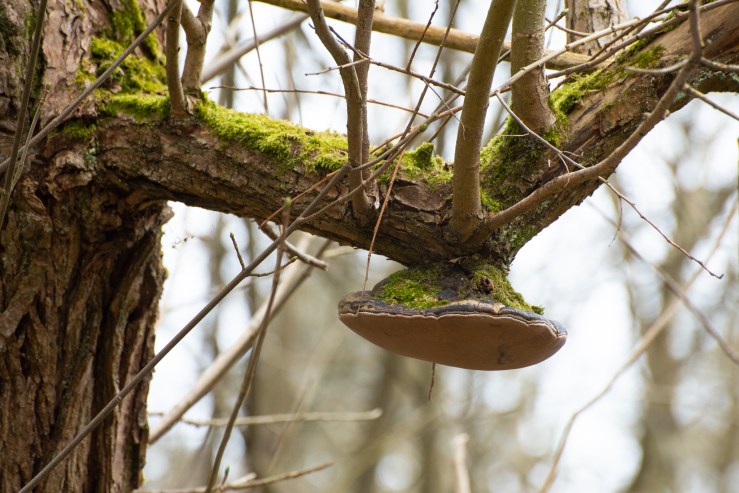
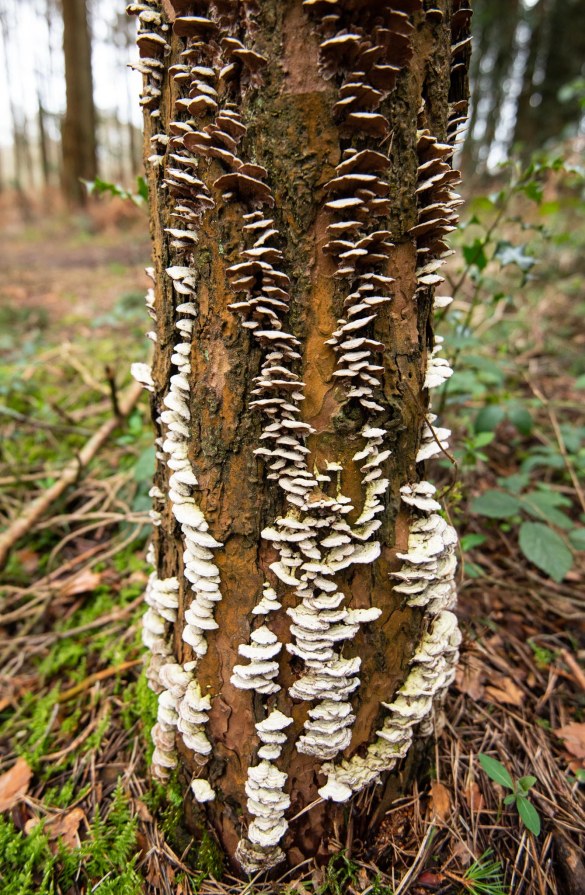
The first breaks of sun glow golden in birches and the spreading branches of pines. The remnant flowers of heather persist like leftover decorations.

When the sun breaks the tops of the pines, things begin to change. Rays of light cut through the plantations and light small fires in the beds of bracken. They burn amber at the base of pines.

SLF - 6-2-2020 blog-21

The birds remain elusive: crests, tits, siskins, woodpeckers. They’re all here but they’ve found all that’s left of the shadows. I can only see silhouettes.

More people are arriving now with the sun, all with dogs. One couple have more than ten between them, one pug-like thing snarls and froths at the mouth, following me for a good minute. Of course, the apologies come. It’s such a common thing, you get bored of saying ‘don’t worry about it.’

SLF - 6-2-2020 blog-29

I notice a spread of oak trees, the sun crashing down through their boughs. One curved oak with a trunk lit entirely with green moss opens its door to yet more of its fellow species. These oaks are walking out of a cold and frost-bitten night, the icy coating on the vegetation around them steaming as it melts away in the day’s eyes.

The Sussex Weald

#FungiFriday: a shedload of shrooms

IMG_20200202_153118125

Fungi Friday: 7th February 2020

Welcome to my weekly #FungiFriday post! Every Friday I aim to post my latest photos and learning from the Kingdom of Fungi (where I live). You can see my Fungi Friday archive here.

Last Sunday I was taking apart an old shed. Plenty of wildlife had made a home in the shed, including lots of large spiders, woodlice and springtails. Pulling the panels away, I was amazed to find this very small mushroom sitting there on a wooden panel.

shedshroom - 2-2-2020 blog-2

This is a species that I’ve posted about on a previous Fungi Friday but instead when it appears in the fissures of tree bark. This shroom shows the ability for fungi to get into any appropriate micro-habitat if the spores can reach them. This shed was very damp and moulds were already building in places. I was simply speeding up a process that fungi and other recyclers had started.

IMG_20200202_153123730

If you look at the image above you can see the scale of the mushroom. It’s miniscule! To photograph it I used a macro lens and a macro adaptor to get even closer.

Rother lichens - 5-2-2020 blog-2

Meanwhile at the river Rother in West Sussex, my poplar branch patch was drying out due to lack of rain and some unseasonably warm sun. It gave the cyanobacteria and algae the chance they need to turn some of that light into sugar and feed the fungus that puts a roof over (under?) their heads.

Rother lichens - 5-2-2020 blog-5

The common yellow lichen Xanthoria parietina continued undimmed. Life goes on. There’s a storm coming…

More fungi

Extreme Macro Photos Unveil the Hidden World of Fungi in the Forest

The History of European Forest Exploitation