This blog often complains about the poor understanding in England regarding wasps. I began drafting this post in the midst of what’s known as ‘the silly season’, when Britain’s tabloid newspapers turn their guns on gulls, wasps and spiders, with a seasonal vacuum in news. However, in a global pandemic there is no real vacuum in news, and there is no way I’m going to go looking through those rags for stories I know are rubbish. Perhaps it’s my Scouse heritage.
What I didn’t expect was for YouGov to run a poll on the most hated invertebrates in the UK. I don’t understand how this helps in a time when invert populations – which we depend on for survival – are crashing. You know what they say, don’t trust the polls. Unless it’s the most recent ones in which case please God let it be true.
Moving on.
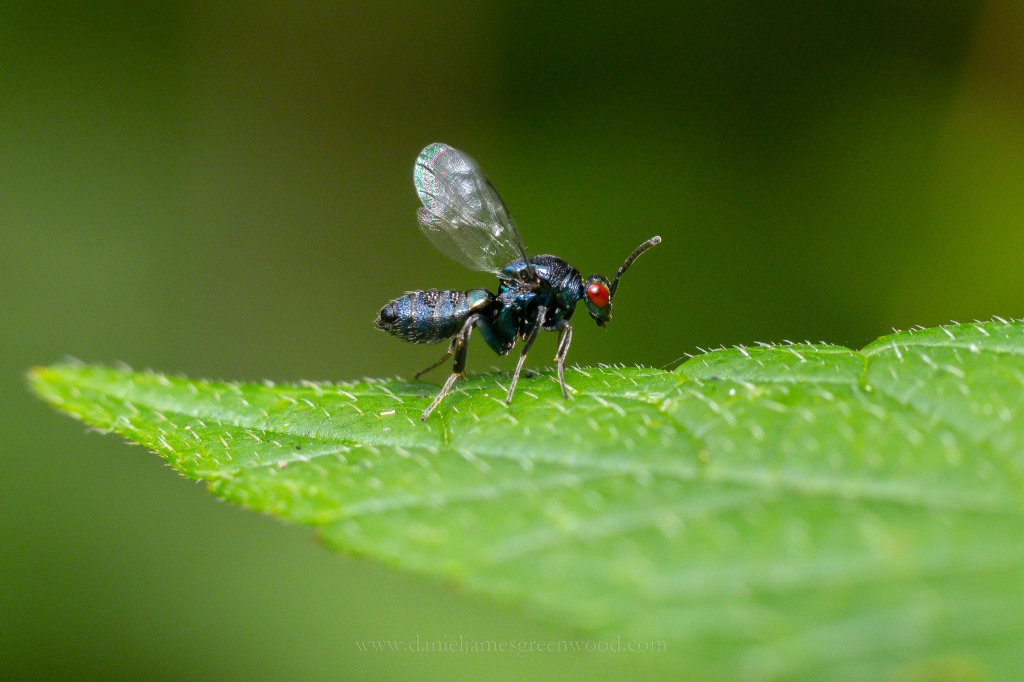
Yes, you guessed it, this is another post about wasps. This time, it’s some of the smallest wasps in the world. The group I encountered, and which are shown here, could amount to a total of 500,000 species, with about 470,000 of those species unknown to science. Do you need help picking your jaw off the floor?
Reminder: we are just the one species, Homo sapiens.
You have to think sometimes – imagine all the ecological networks and relationships between species which we actually have no idea about. In places of the highest biodiversity, they’re being made extinct by the loss of habitat, before we even know they exist. Jair Bolsonaro has more to answer for than we may yet realise.
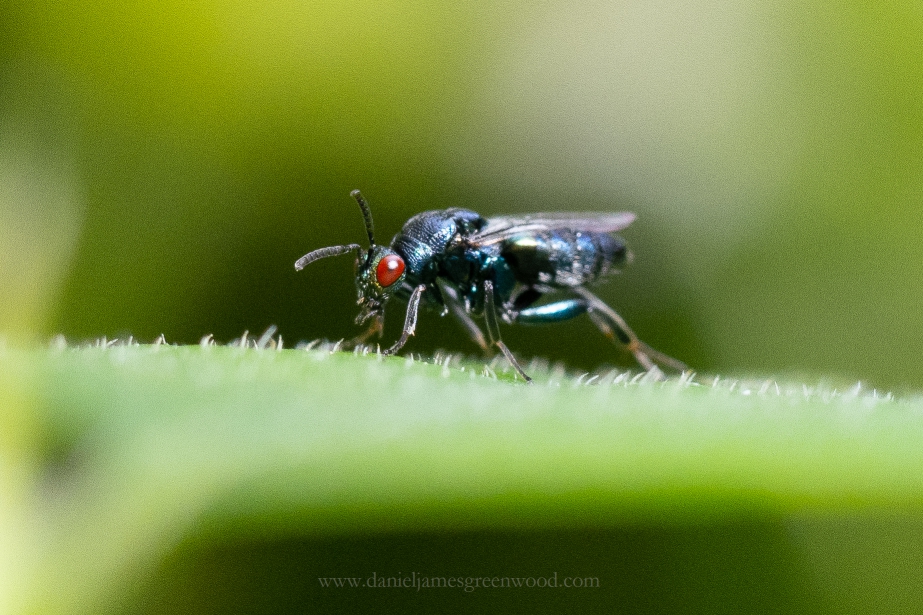
The wasp photographed here is now a species I know thanks to iNaturalist – a chalcid wasp in the genus Ormyrus. ‘Chalcid’ comes from the Greek word for ‘copper’ because they have a metallic appearance.
Back in August I visited a nature reserve local to me. The meadows had far more seed heads than flowers and I wasn’t intending to see a huge amount of invertebrate life. I give up on birds around July when they go on their holidays, usually low in a bush somewhere.
In actual fact I found a lot of species, many of them quite happy to be photographed, though of course not yet understanding of what a photograph is. I was drawn to a large area of dead nettle, a family so big there are many plants I just don’t know the names of yet.
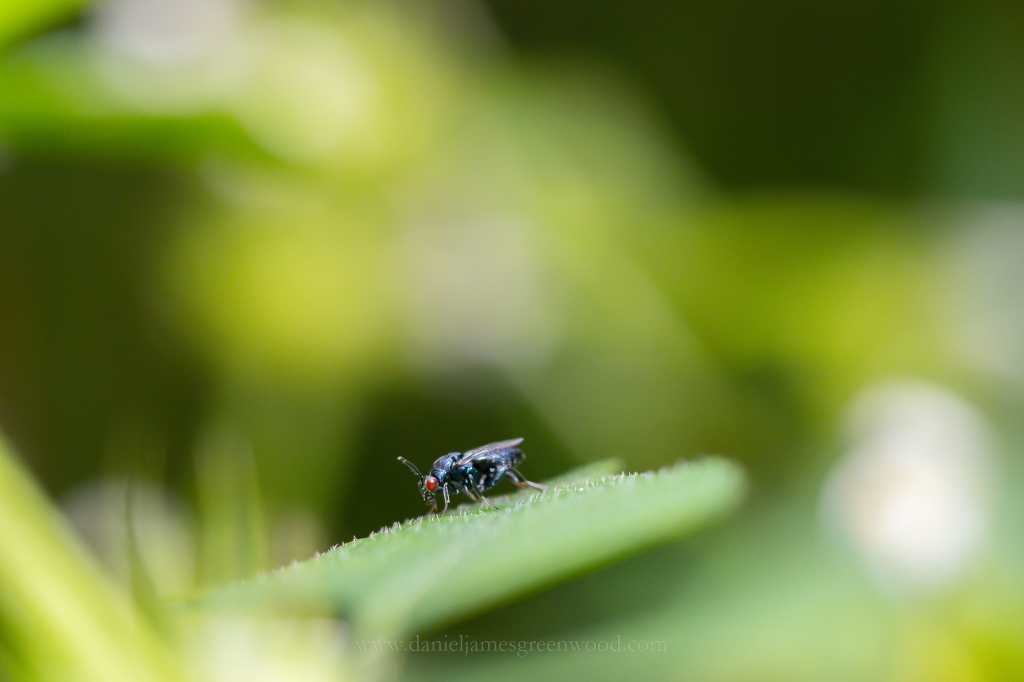
Looking at some of the leaves of the plant, I noticed something about 3-5mm in length, resting on the leaf. When I looked through the macro lens and additional extension tube, which magnifies the view further, I could see it was a type of wasp.
This wasp is obviously a great deal bigger than that. That said, I couldn’t see that it had red eyes without some magnification.
Chalcid wasps are parasitic species, as outlined by their Wikipedia entry:
Most of the species are parasitoids of other insects, attacking the egg or larval stage of their host, though many other life cycles are known. These hosts are to be found in at least 12 different insect orders including Lepidoptera (butterflies and moths), Diptera (true flies), Coleoptera (beetles), Hemiptera (true bugs), and other Hymenoptera, as well as two orders of Arachnida, and even one family of nematodes.
Now I don’t know much about the very small wasps, and one thing I really didn’t know was just how small they get. Some species of wasps are smaller than the width of a human hair, or even smaller than a single-celled organism!
Perhaps they’ll be the ones to get pilloried during 2022’s tabloid silly season. In truth, I doubt it.
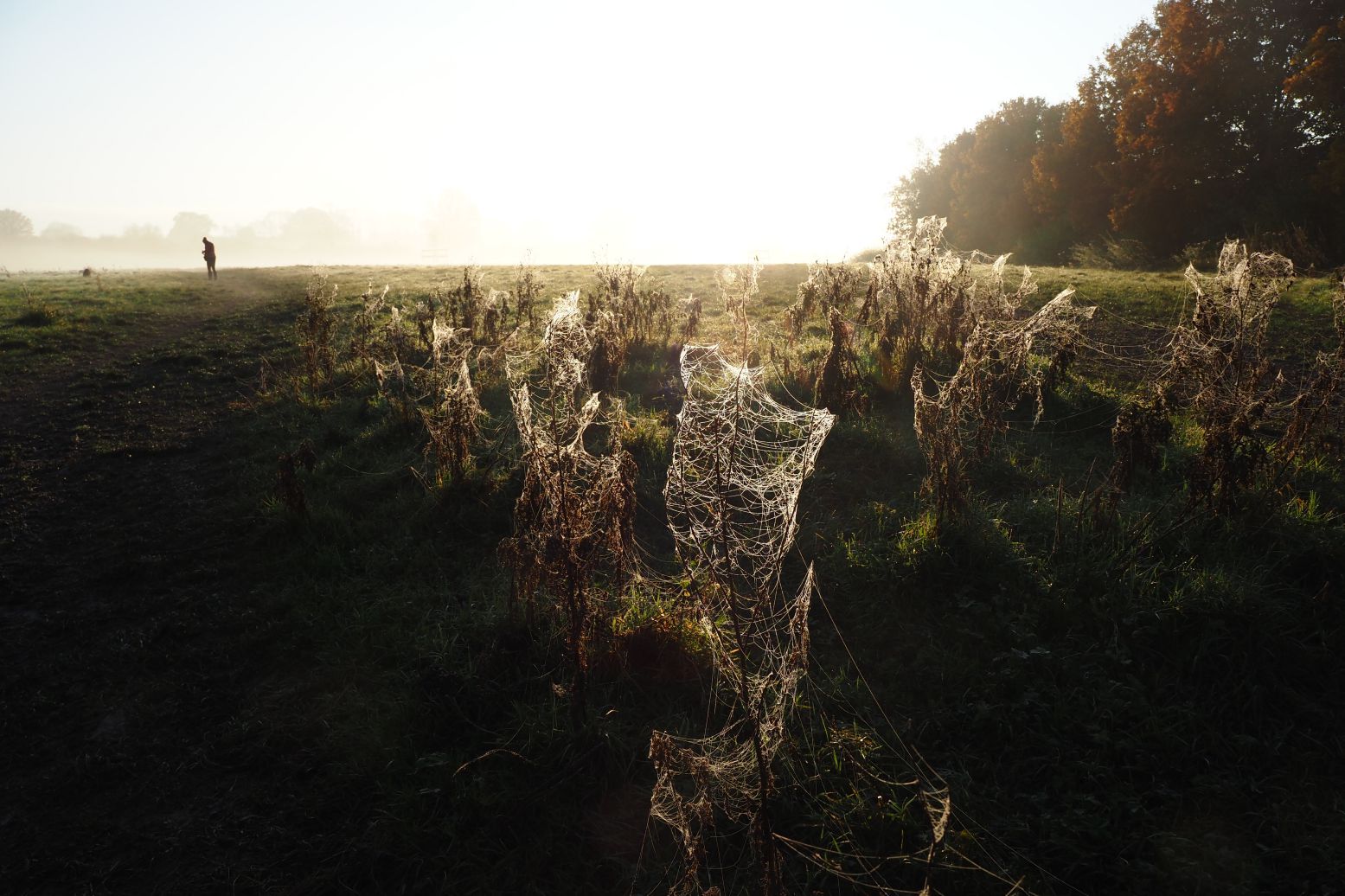
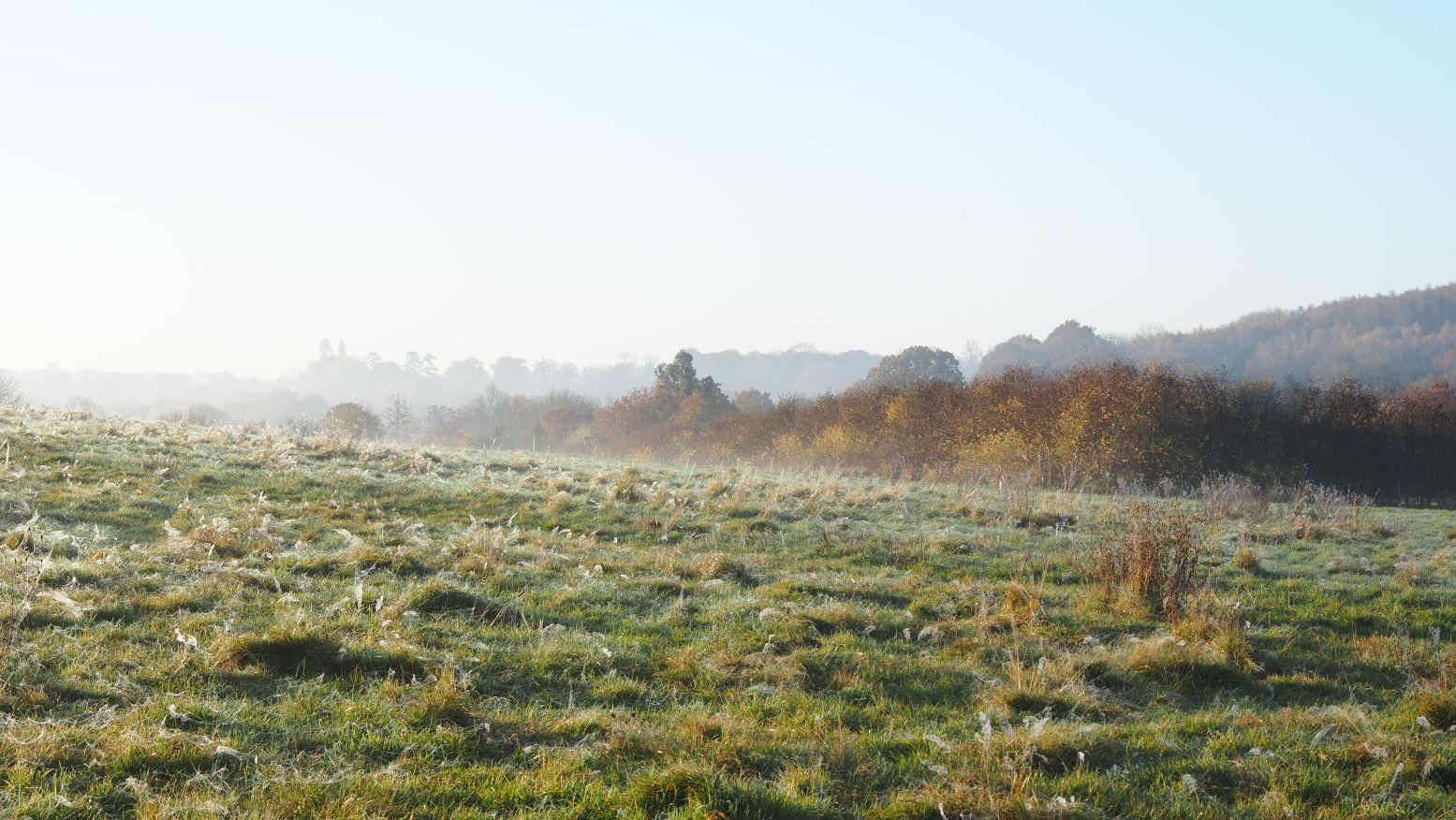
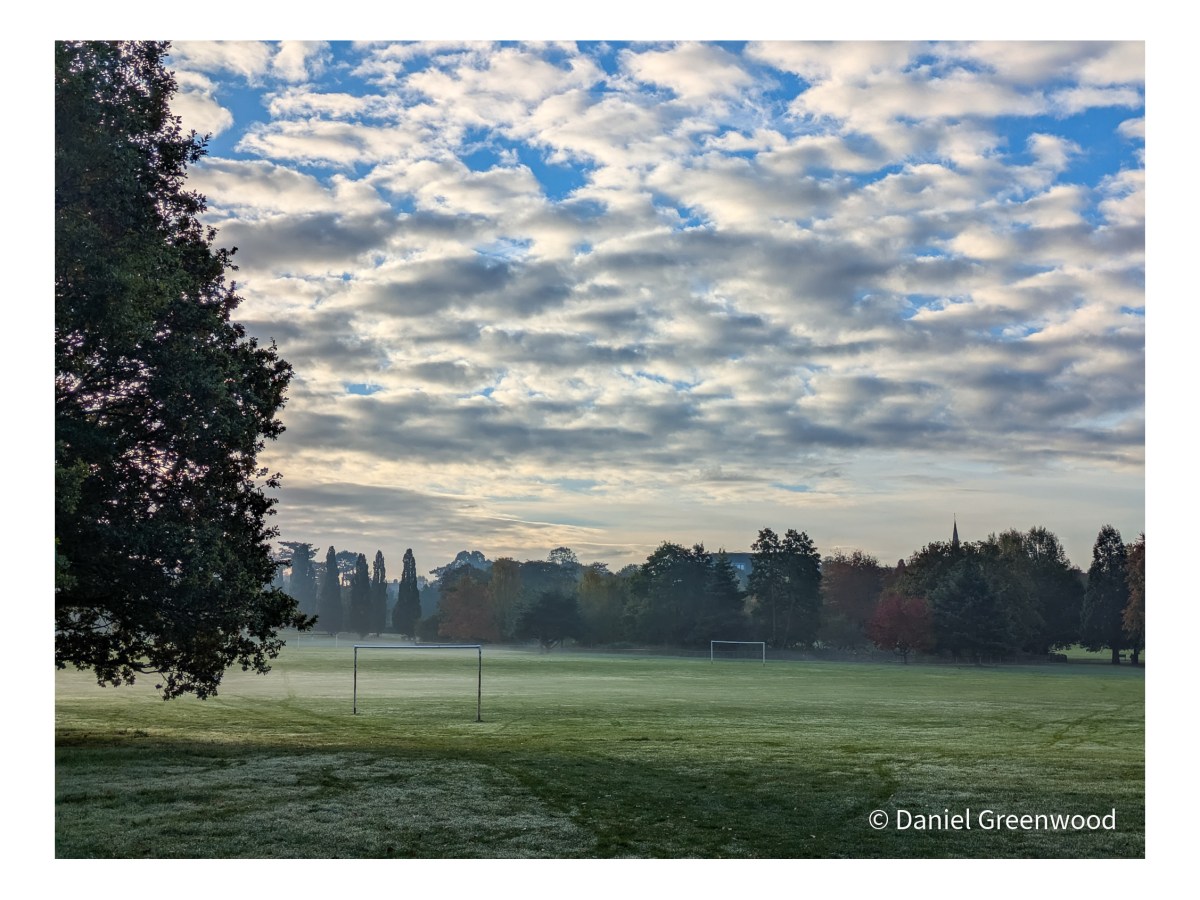
I first noticed the mist as I walked down the road where the landscape slopes gently towards the river. The hill in the distance was softened by a white veil of mist.
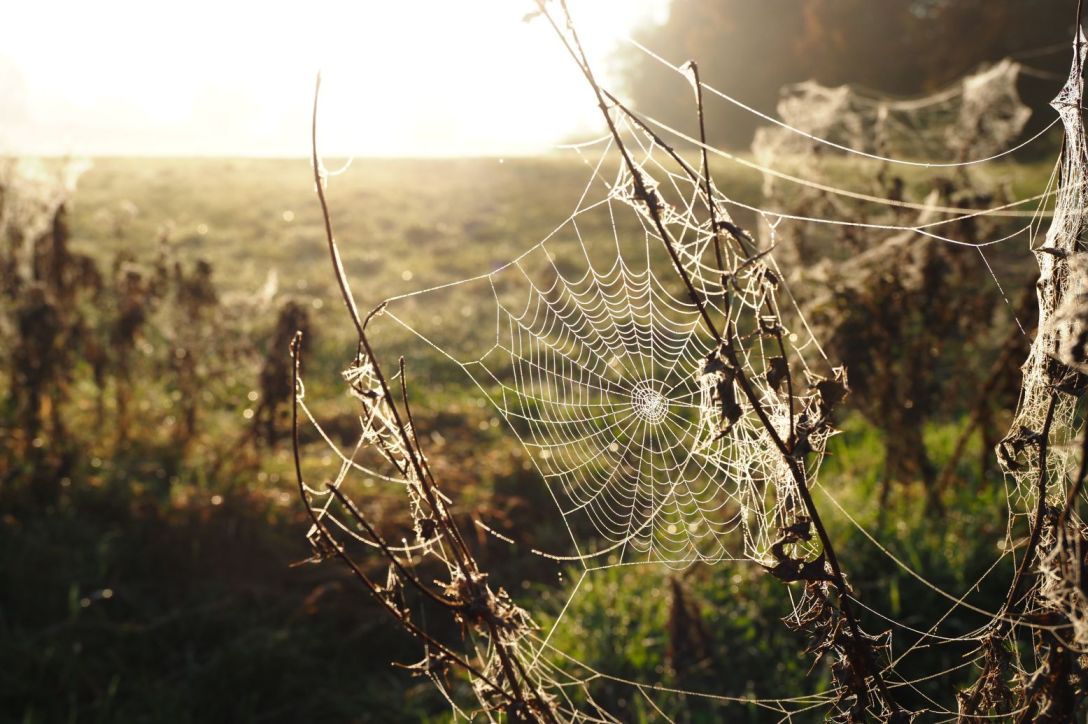
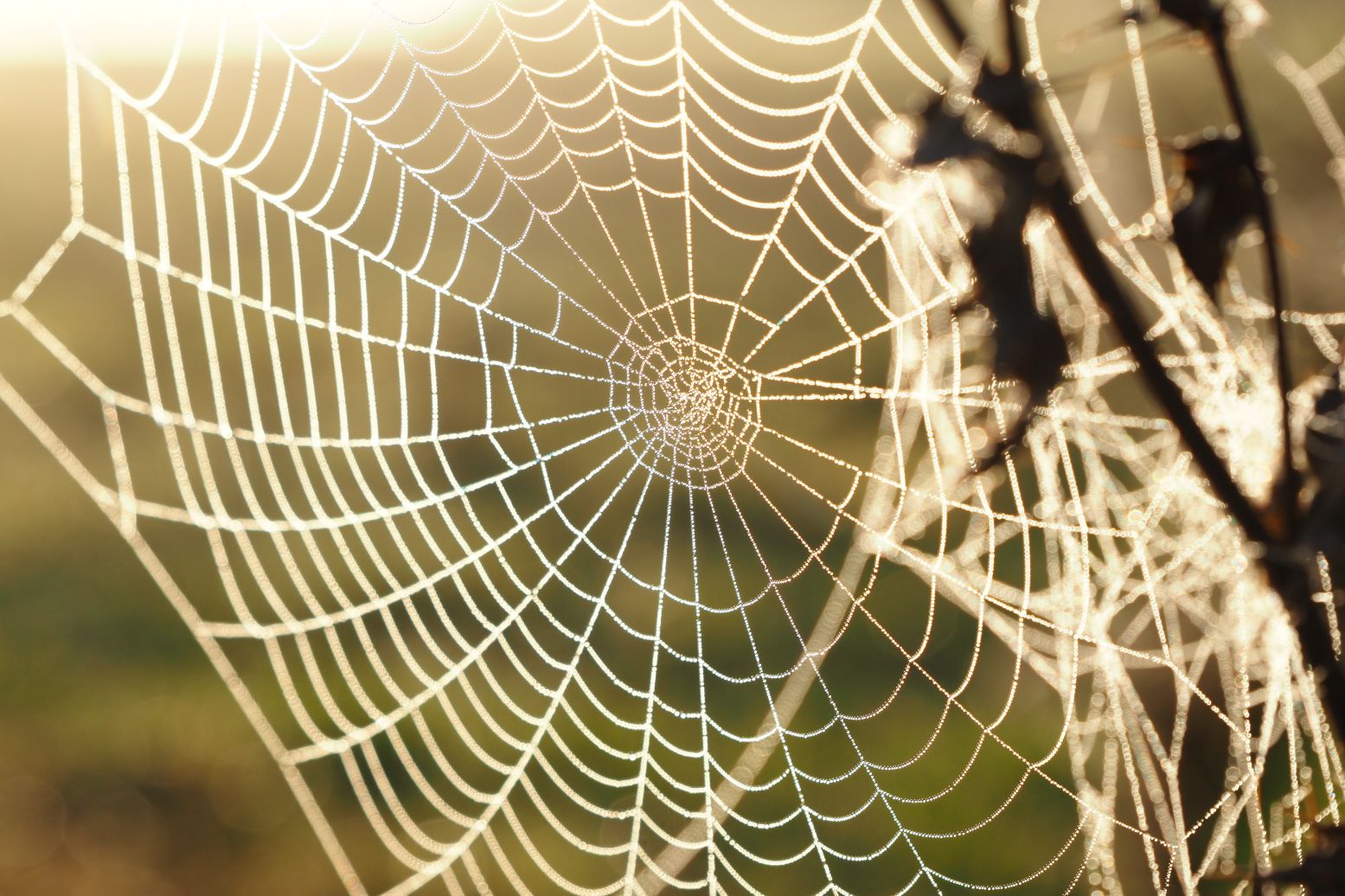
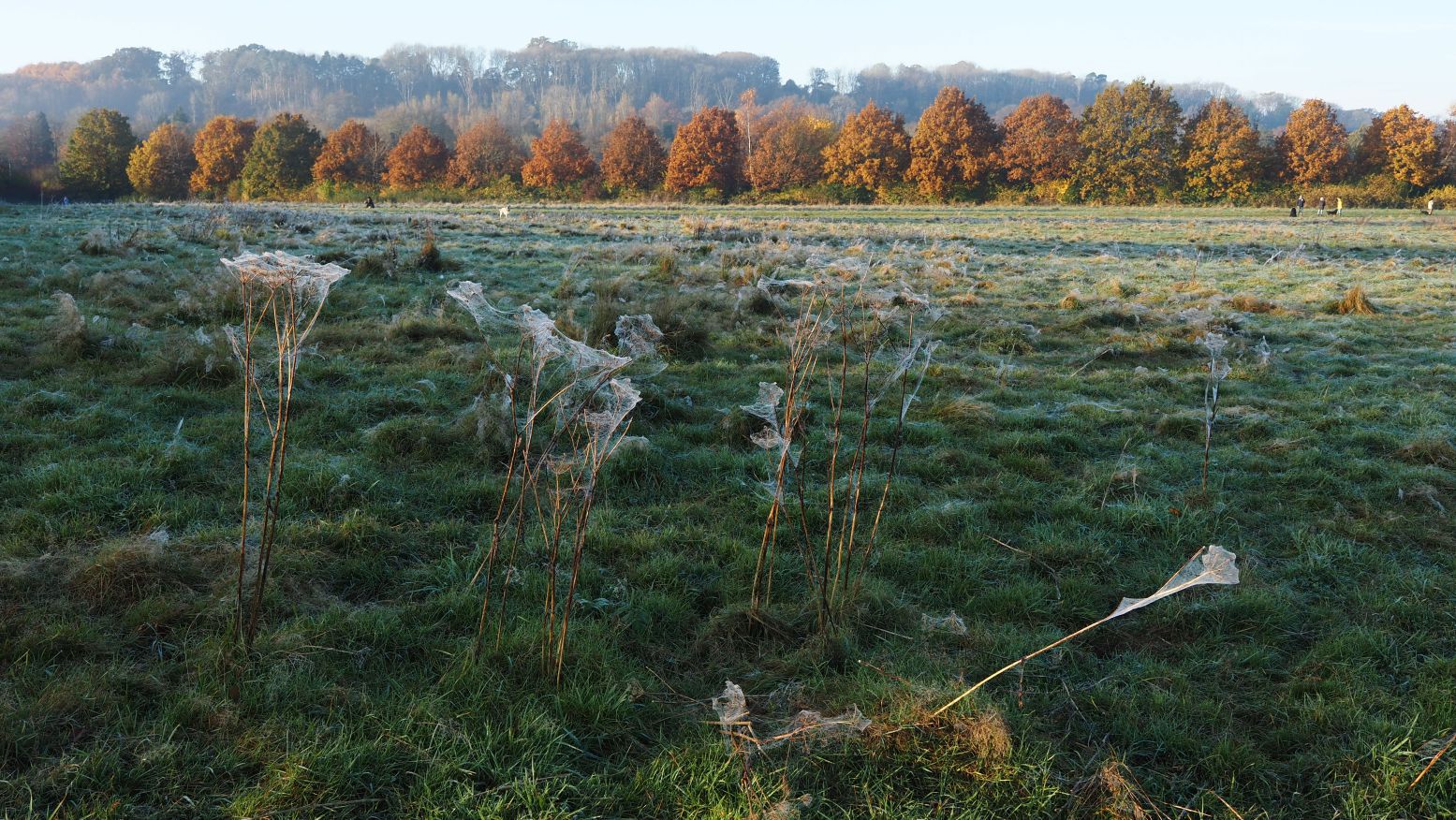
Turning off into the first field, the sight was astounding. The sun flooding through the grassland, illuminating the dewdrops in the desiccated seedheads and stems of last summer’s growth.
I hadn’t intended to walk through there but it was impossible not to. We forget this can still be a time of spiders.
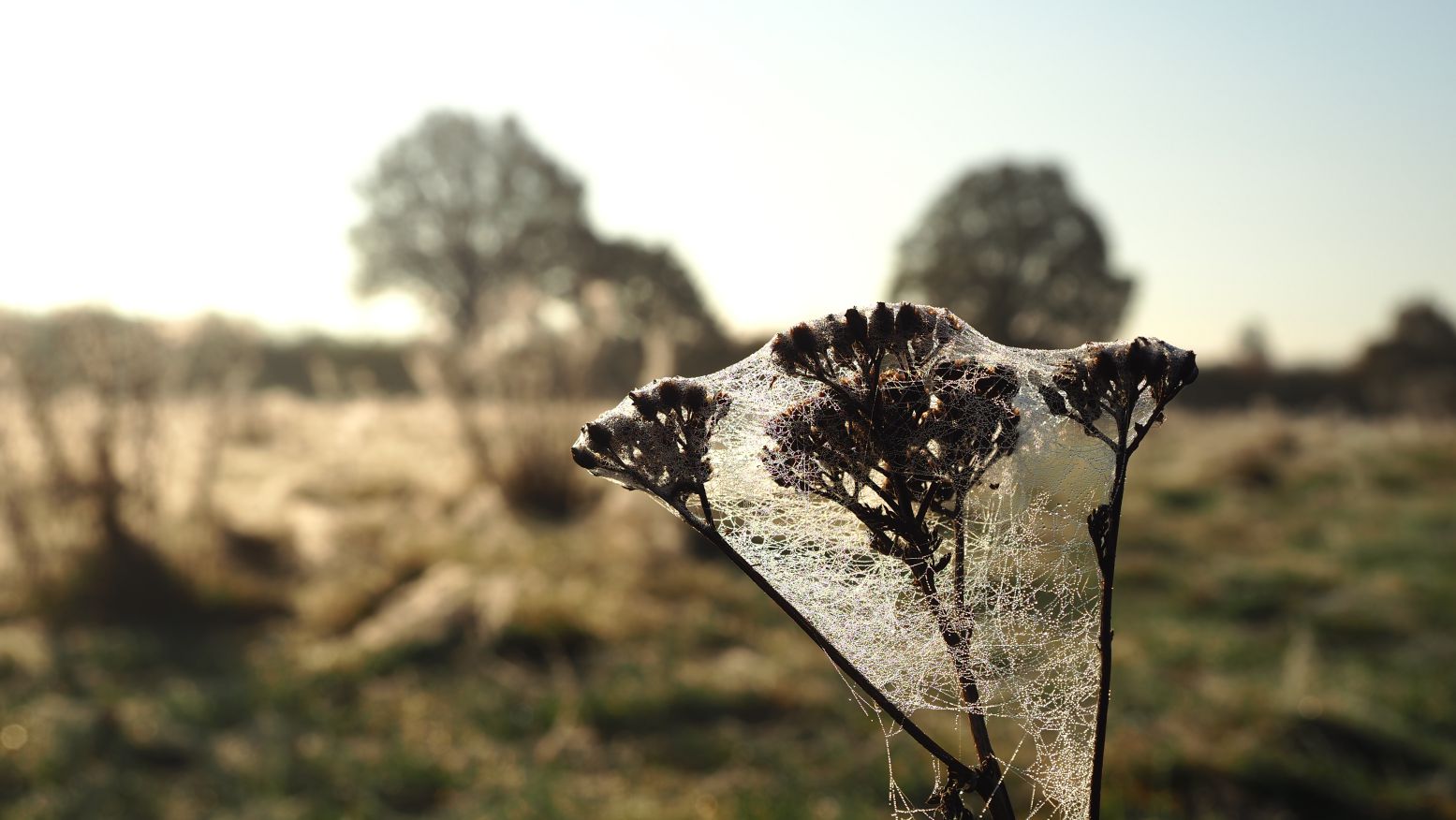
As the sun moved up in the sky the light shifted up the hill and so I followed it. Ragwort is bright yellow in summer but its dark winter stems had been silvered by the dewy spiders webs.
At this point a dog ran up to me while I knelt down to take photos of the webs.
“Daniel!” It was a man shouting in my direction. “Daniel!”
The dog turned away from me and ran towards the man.
“Is your dog called Daniel?” I asked.
“Oh, yes!” He said.
“Well, that’s my name, so that’s very confusing.”
Looking back away from the sun, the oak trees were aglow as they turned their final shade of the season: orange and brown.
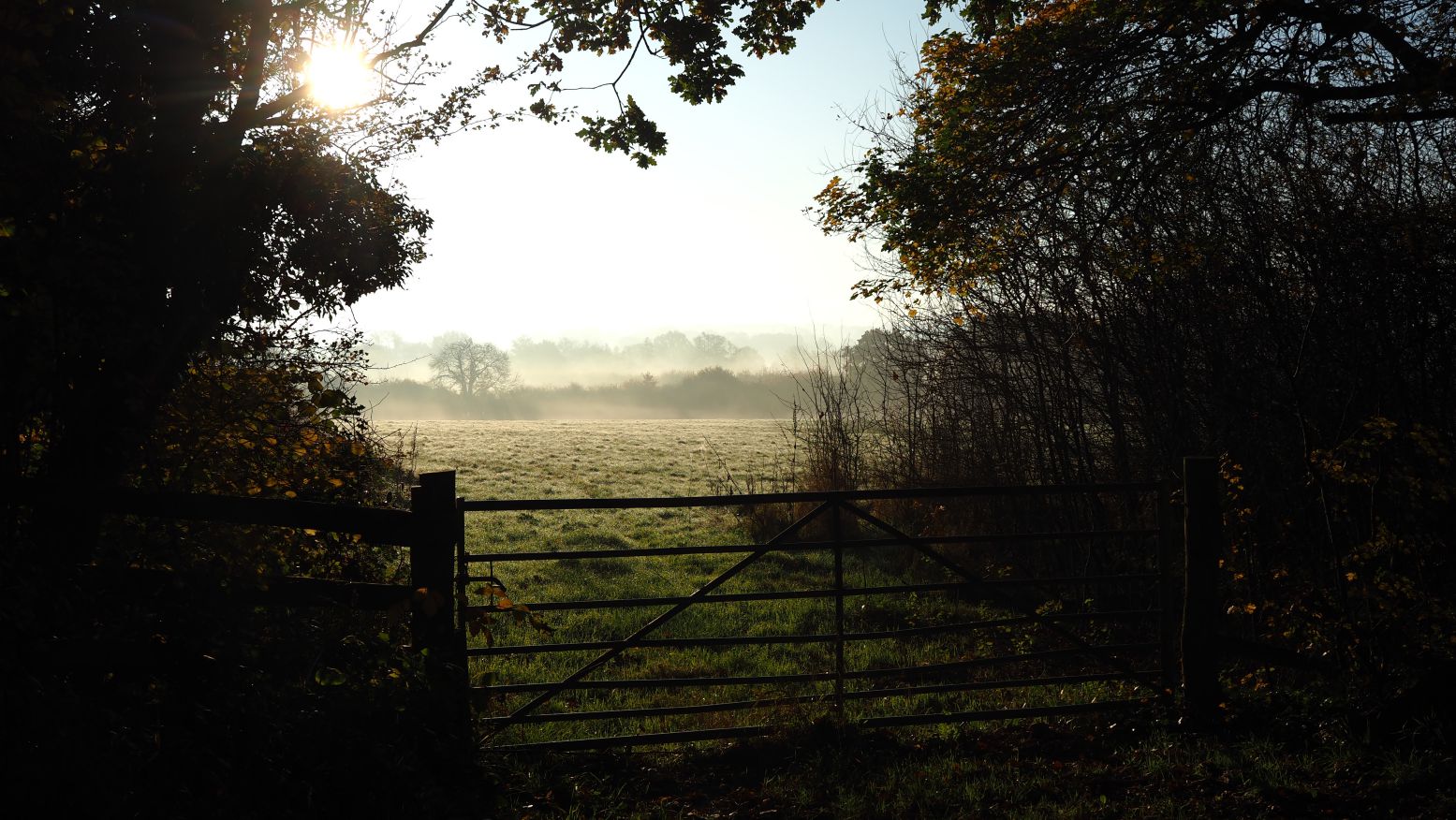
The mist was being chased uphill and into spaces behind the higher and larger hedges. I followed it.
The distant woods and tree-lined hedges were silhouetted as the mist burned away in the sun.
In one cold corner the vapour hung around like smoke against the scrub that had kept the land in shade.
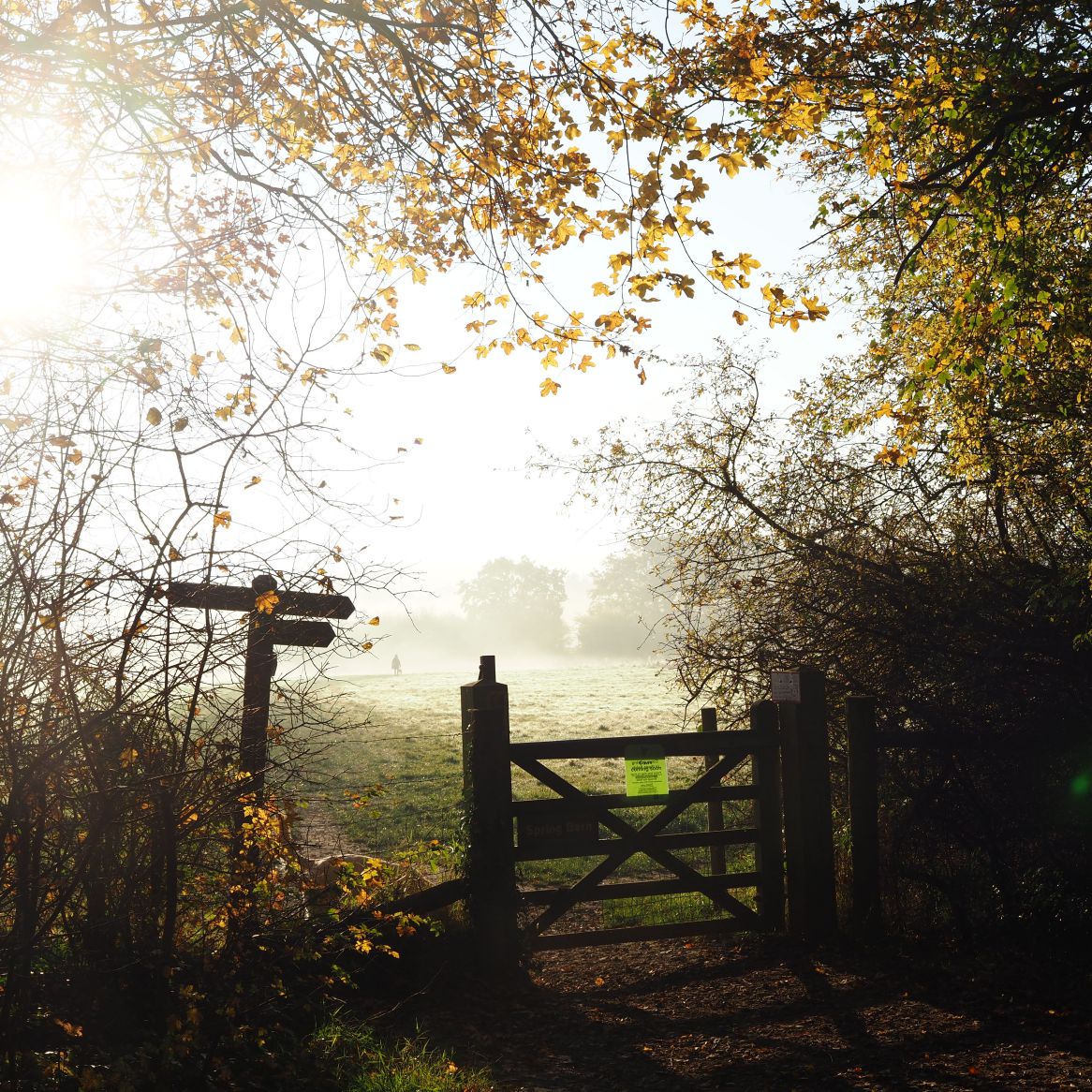
In one final field, edged by the yellow of field maple leaves, the mist remained. There was a dog that barked at me until called by its owner: “it’s because he’s afraid of you more than anything else,” she said.
Following on from part one of my recent trip to Dartmoor National Park in south-west England, it’s now time for part two. You can read part one here.
This was another day chock-full with mushrooms. It began well with a nice indicator of mushroom season when we found a gathering of clouded funnel on a roadside verge. This is a fairly common mushroom that can usually be identified by its size and the clouded tops. My boot is here for scale, obviously.
You can see how happy fungi are in the wet and wild landscape of Dartmoor by the presence of moisture loving organisms like these cladonia cup lichens. You can read some of my lichen posts here.
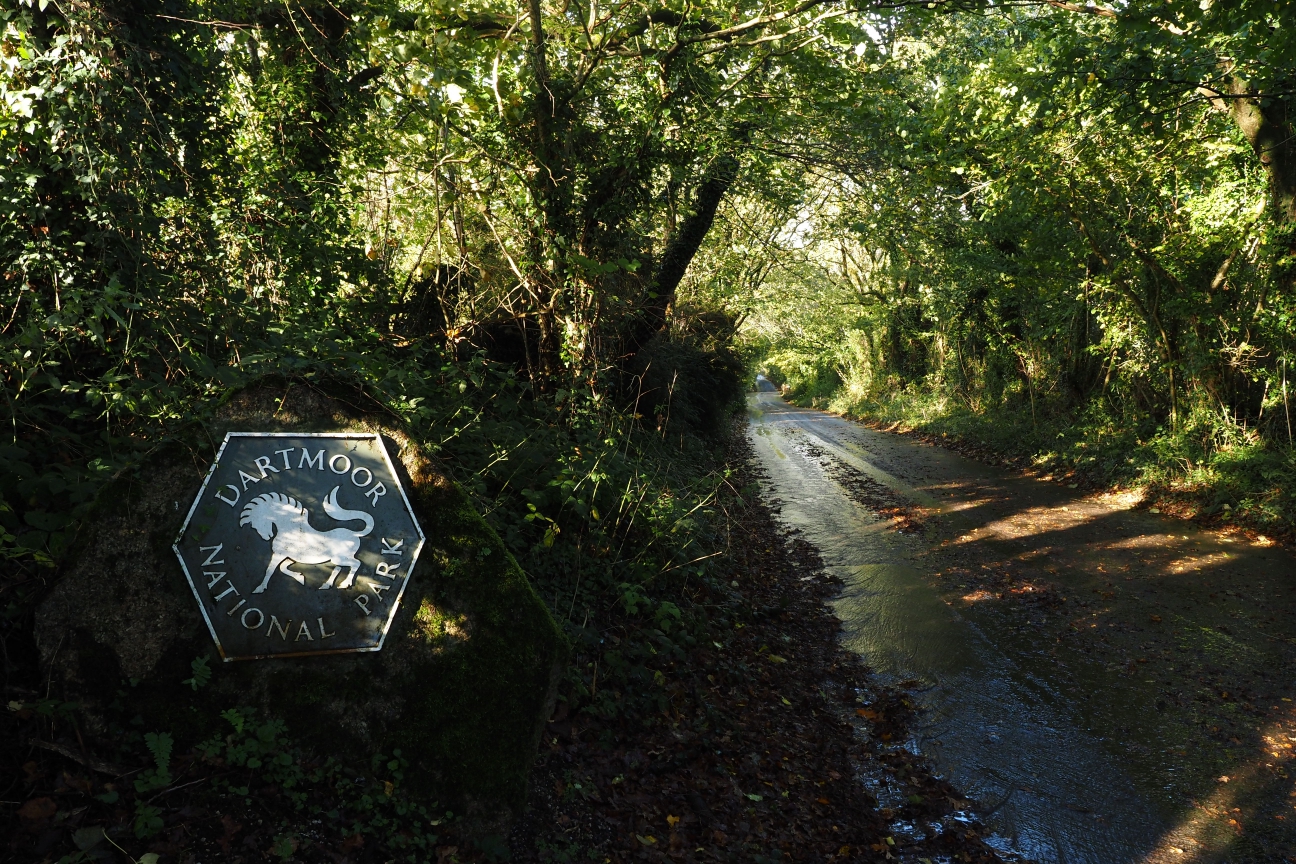
We were just on the edge of the National Park. Dartmoor’s logo is based on the famous Dartmoor pony, a semi-wild(?) species that has been running amok on the moor for thousands of years.
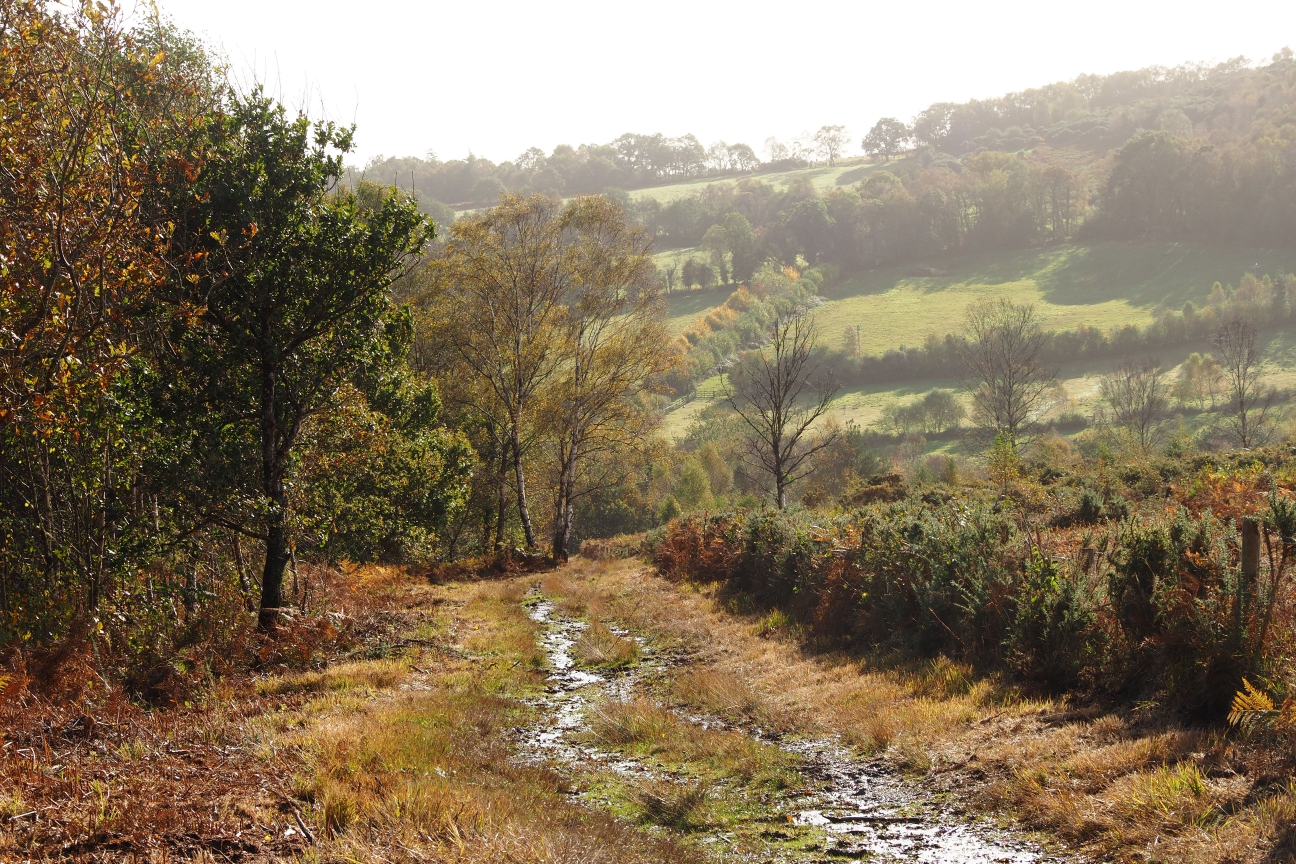
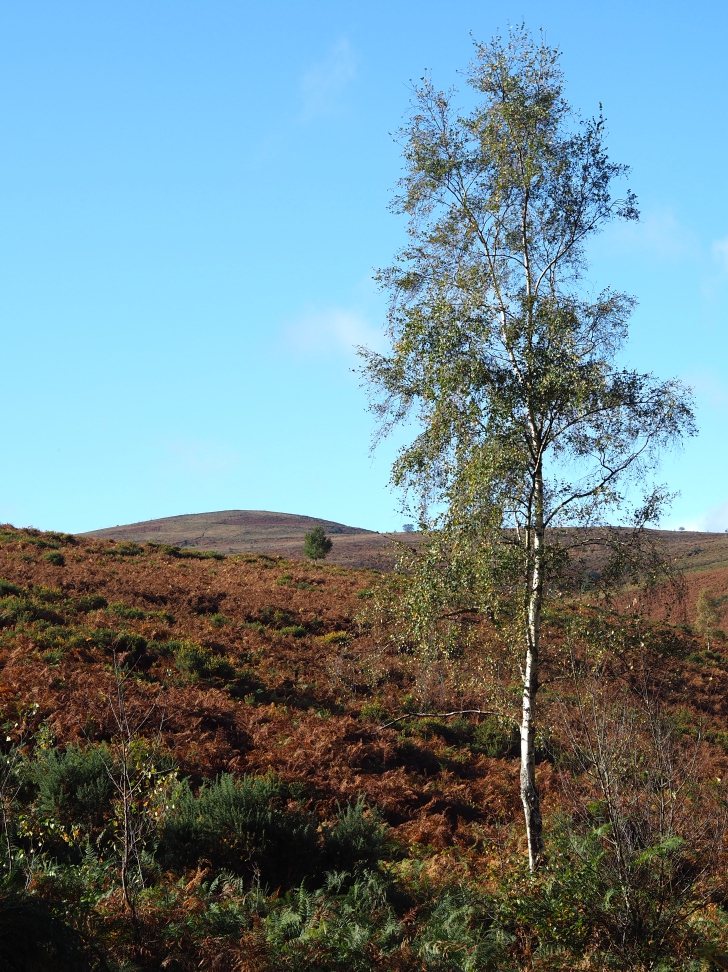
Dartmoor on an autumn morning. The silver birch with yellow leaves is one of the highlights of autumn, especially when the light catches the leaves.
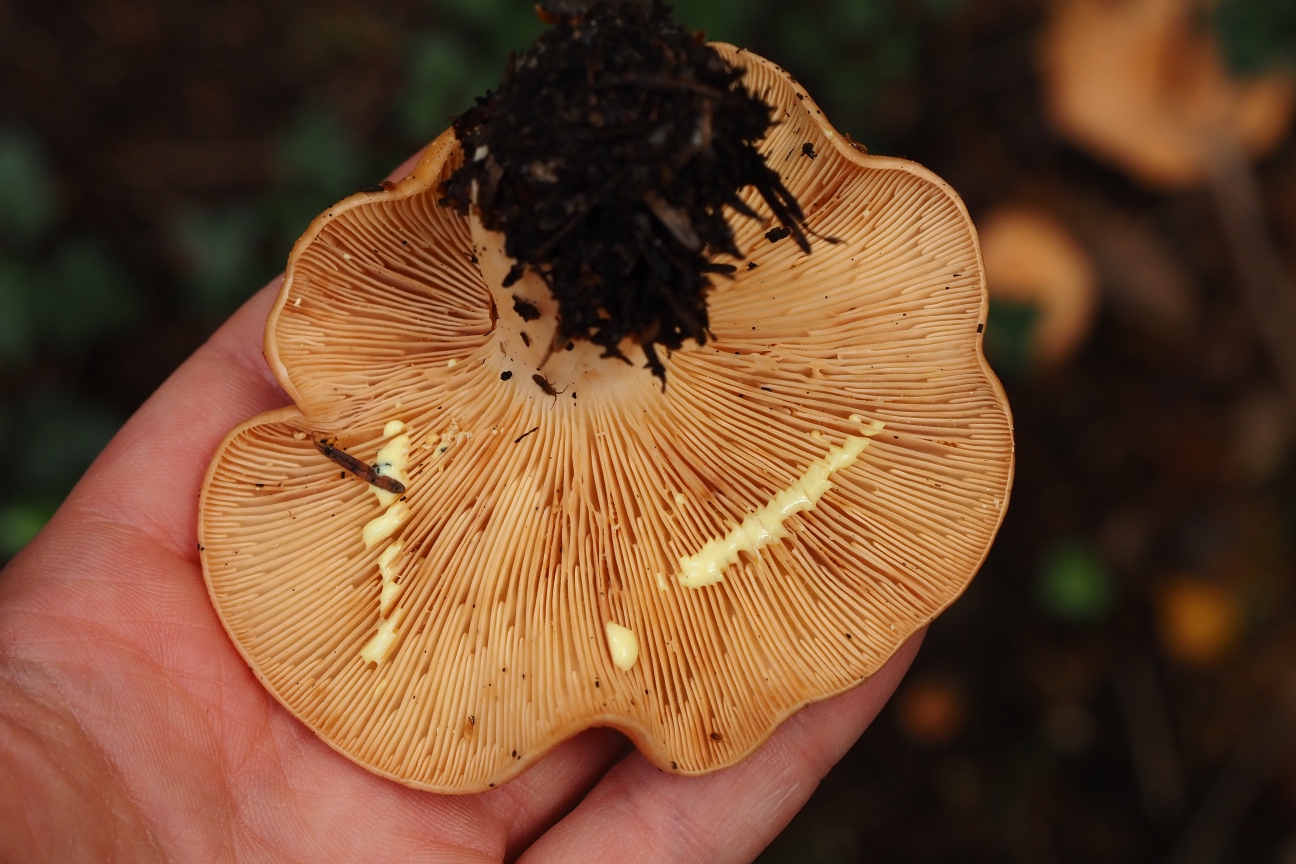
On top of a wood ant’s nest there were two mushrooms that looked interesting. I could tell that they were milkcaps from the unusual caps and the concentric circles. Turning one of them over I cut the gills with my fingernail and, sure enough, the gills produced milk. I don’t know what the species is.
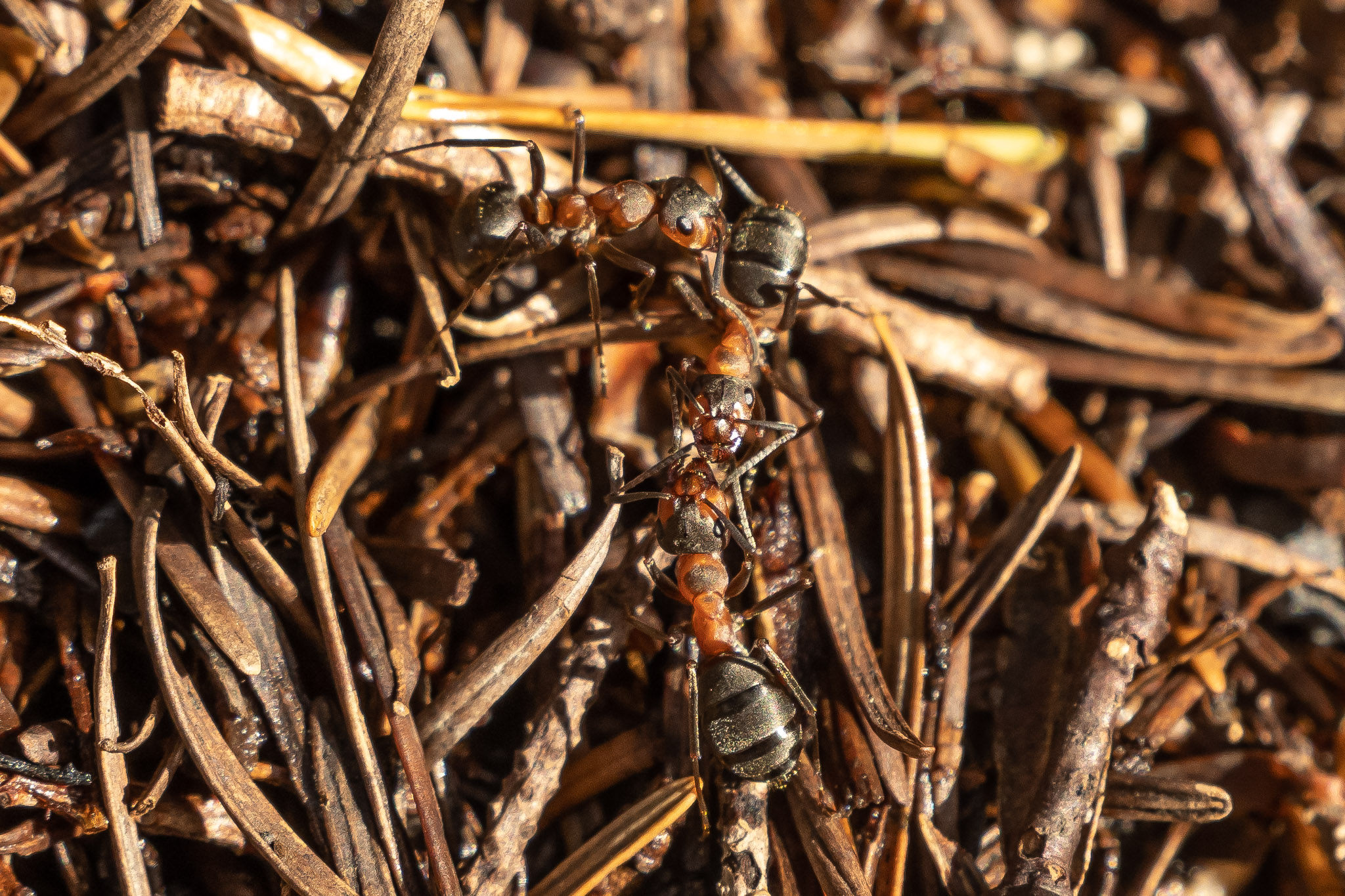
The ants were still active, with quite a lot of interaction going on. I wonder what role fungi play in the structure of certain ant hills. Ants have been found to cultivate fungi gardens inside their nests, and there must be other ways that ants mix with the fungal kingdom.
This walk was on the edge of the moorland, passing down into a wooded river valley known as the East Dartmoor Woods and Heaths.
The woodlands that made up some of the best parts of the walk are known as Atlantic Rainforest. Their main tree species are oak and hazel. I’m not sure if ash was more prominent before ash dieback came into effect. This type of woodland is very uncommon with a lot of it being lost down the centuries. It is a special habitat for its plants, lichens, fungi and other wildlife. It’s very mossy and ferny.
It did not disappoint. This blackening waxcap was growing in moss on a woodbank. It is a stunning fungus when in this condition and in this light. I always associate waxcaps with grassland so often forget they can also be found in the woods.
Close by were these white spindles (I think), another sign to me of an ecologically rich and diverse woodland.
The autumn rains had the river swelled and running fast. You can see the brown of the peat-inflected water.
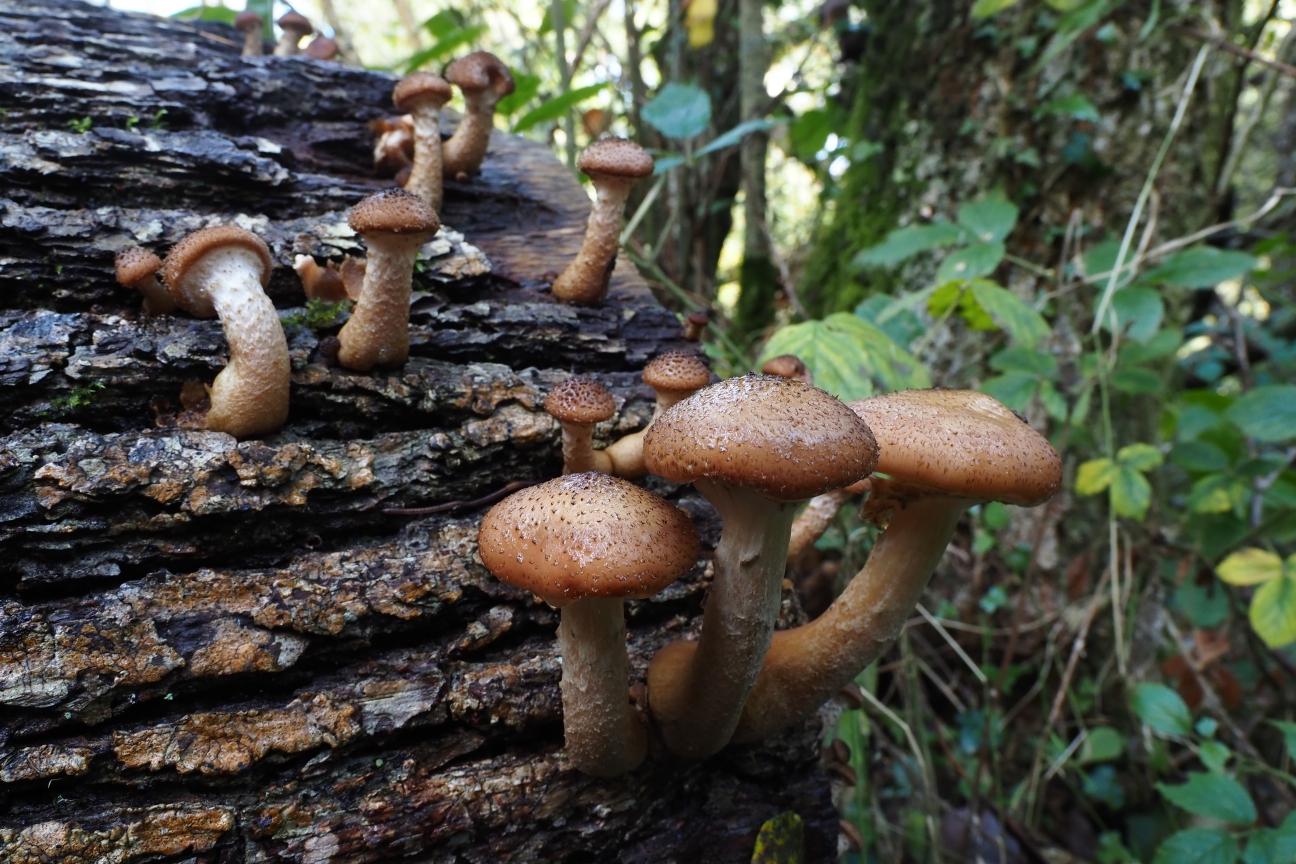
There is someone who has commented several times on this blog asking how or when to find honey fungus. If you’re reading this now, honey fungus is fruiting en masse at the moment. They are very photogenic indeed in the early stages, like the cartoony image of what a mushroom should be.
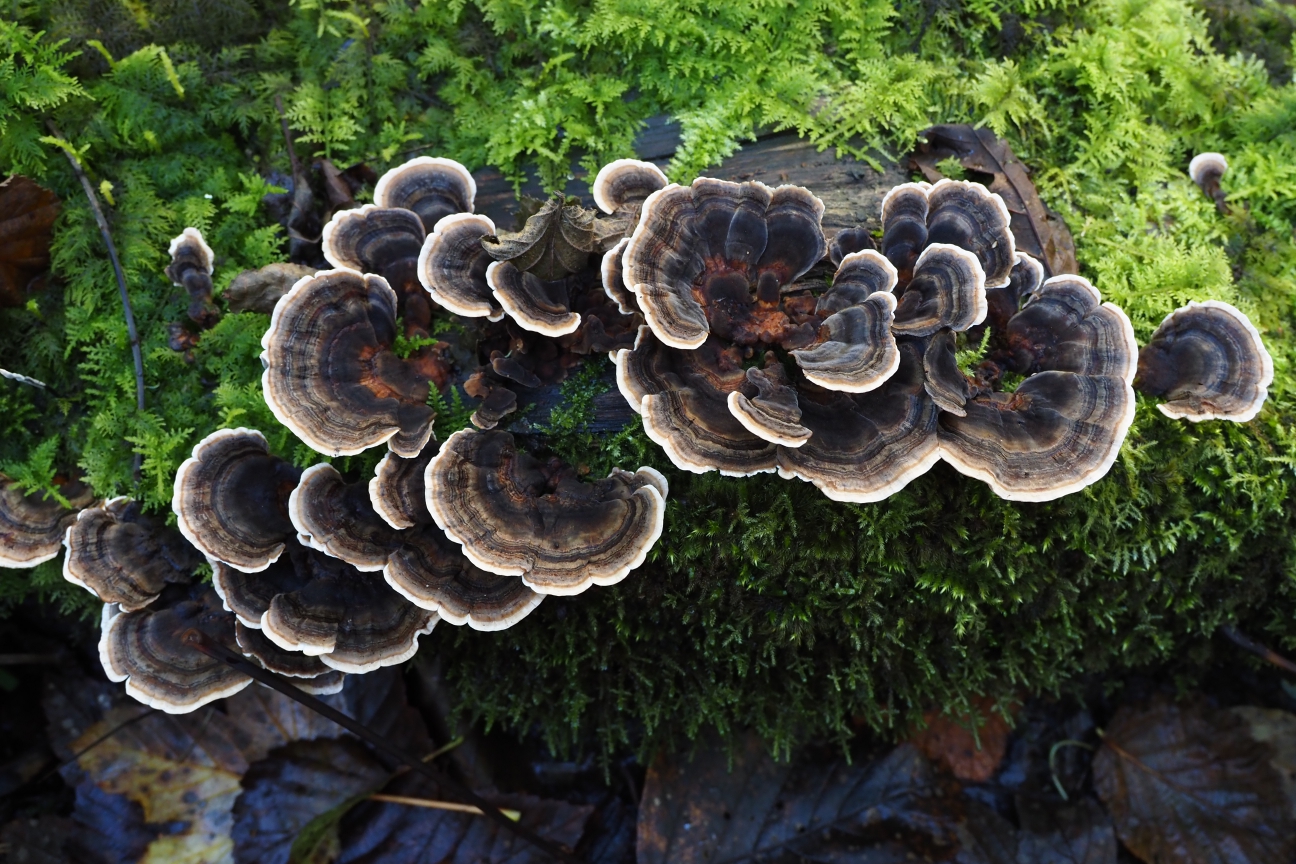
This fanned cluster of bracket fungi is probably turkeytail. These types of fungi can be found all year round but they look their best, like other mushrooms, in the October-November period.
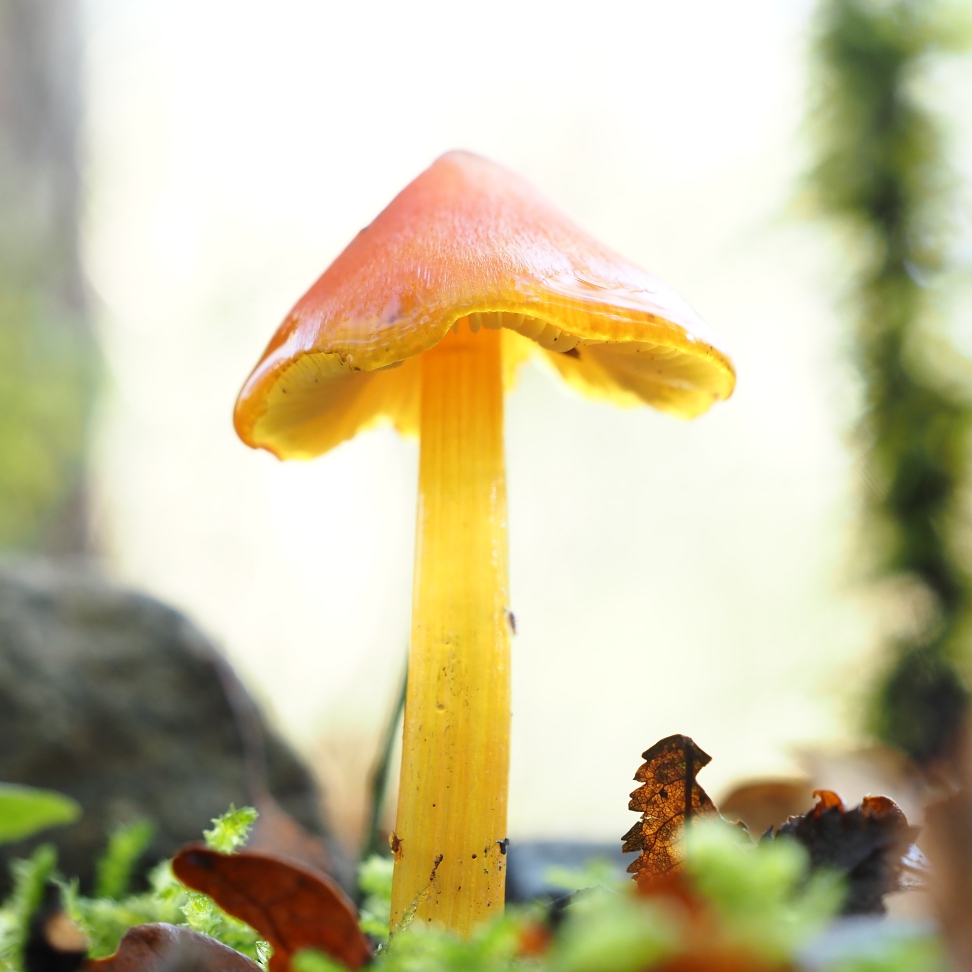
I can’t claim to have found these lovely bonnets growing from some moss on a tree. I’m not sure of the species.
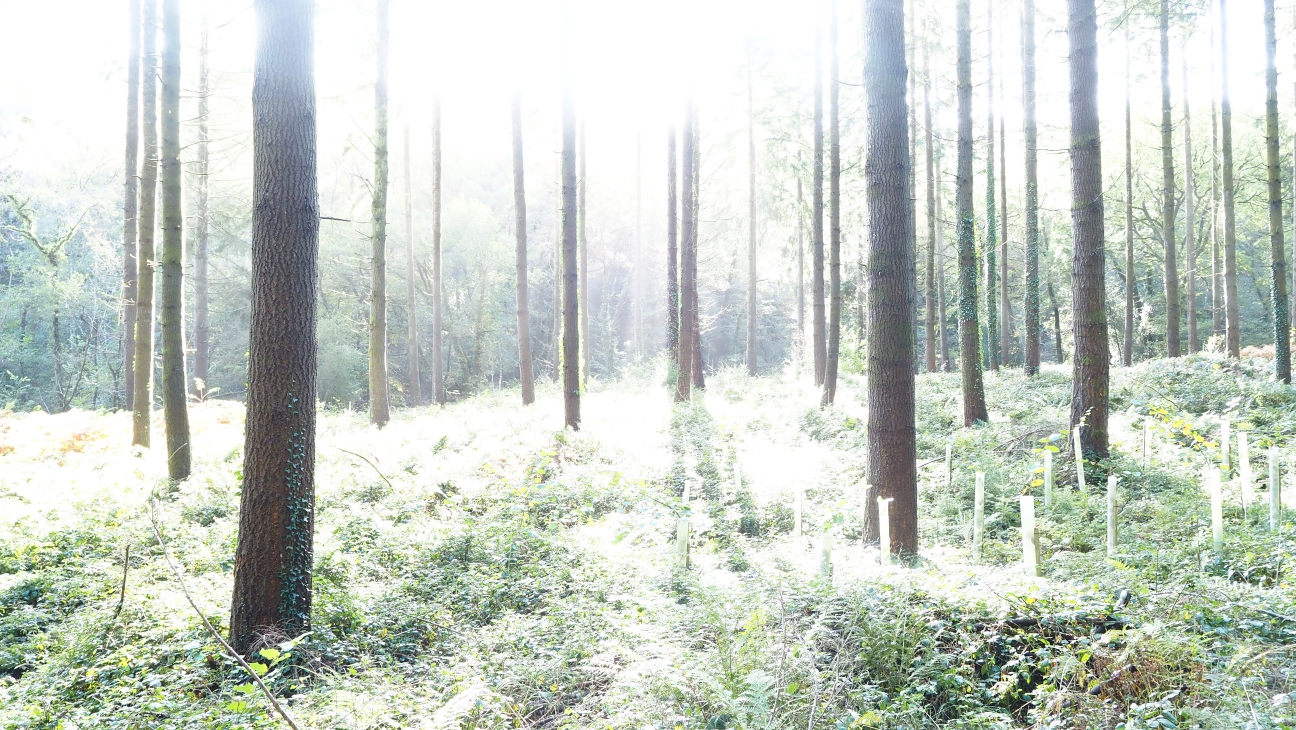
Here’s a snapshot of this beautiful woodland with an understory of bracken, and a tiny bit of hazel.
I’m not entirely sure but I think this is purple jellydisc. There is an organism on the birch leaf next to them which may be a fungus but could also be a slime mould.
On this walk we encountered one of the most beautiful mushrooms I’ve ever seen. This rainbow-coloured mushroom is a bitter beech bolete. It took the breath away. This was a phone pic as my camera wasn’t that happy about how dark it was. Well done Fairphone!
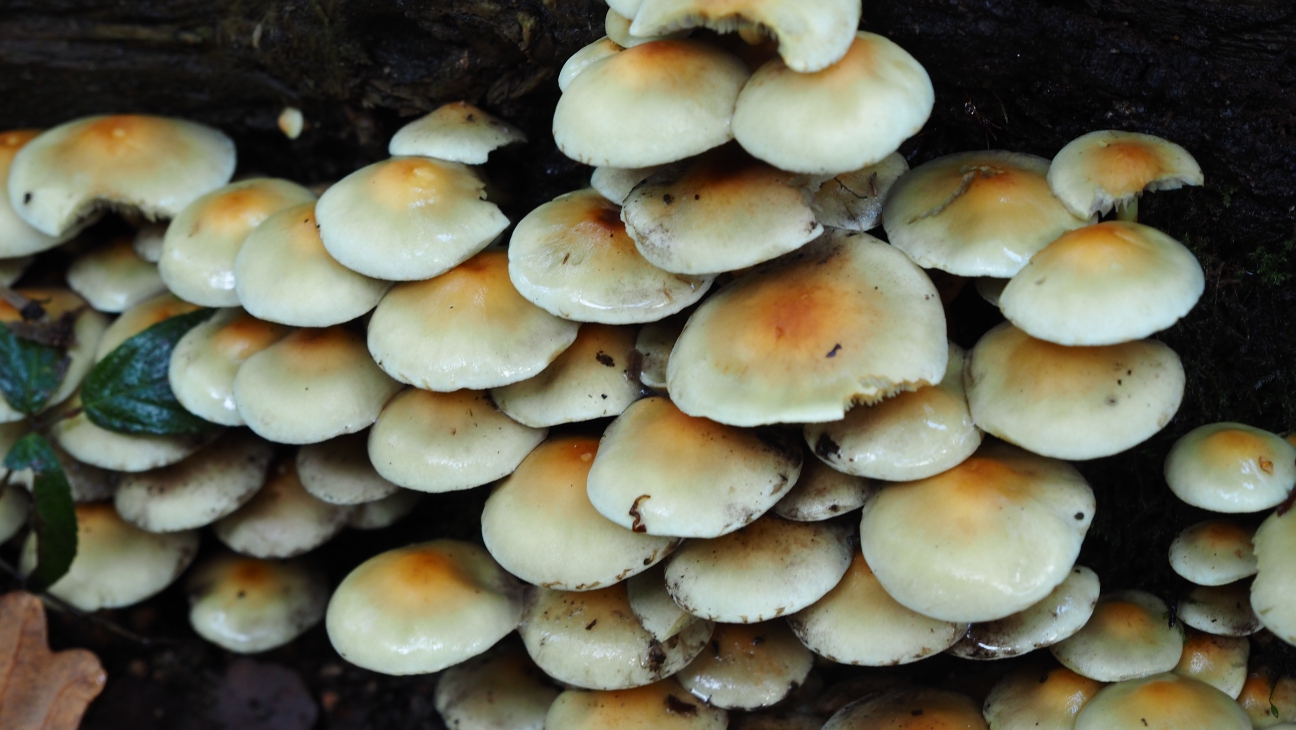
As mentioned in the first part of this blog trilogy, sulphur tuft is a very common mushroom. This was a nice spread. I haven’t spent any time looking to identify the other tufts, but I’m pretty sure this is sulphur.
The broadleaved rainforest was replaced on the other side of the river by coniferous plantation. The Woodland Trust owns this woodland and there was clear evidence of shifting it to its more species-rich habitat of broadleaved woodland. The walk followed part of the Dartmoor Way.
This bolete was helpful in leading us on the way along the track. Yet another bolete or relative growing from a mossy bank.
When I see a mushroom like this, I usually say to myself ‘macrolepiota‘, and leave it at that. It looks like a parasol relative of some kind.
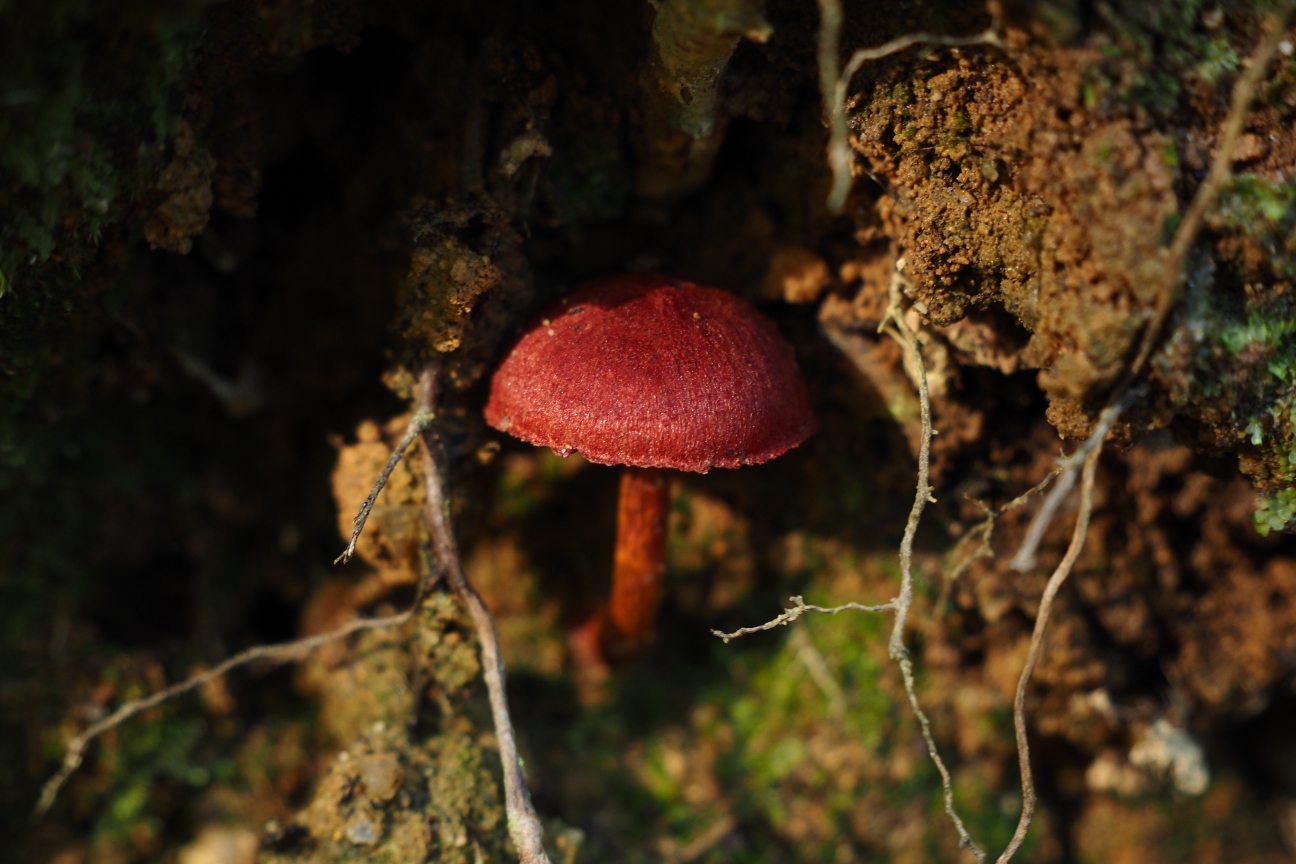
This gorgeous little red mushroom was growing from the exposed soil of the trackway. This isn’t a mushroom I can remember seeing before.
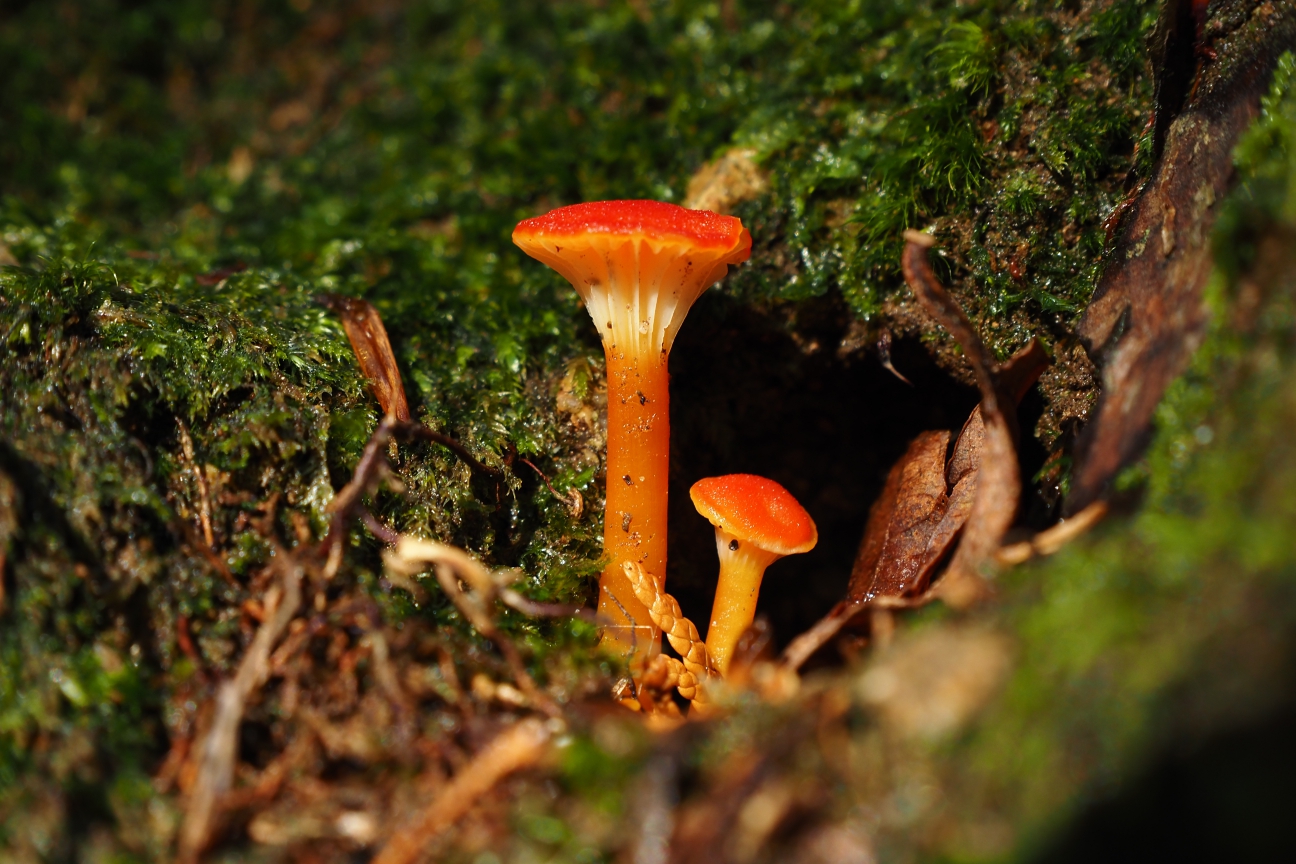
Now here is one I have managed to identify. These tiny red-orange mushrooms were growing from the same habitat as the unknown species before. These beauties are goblet waxcaps, looking like they’re standing on the threshhold.
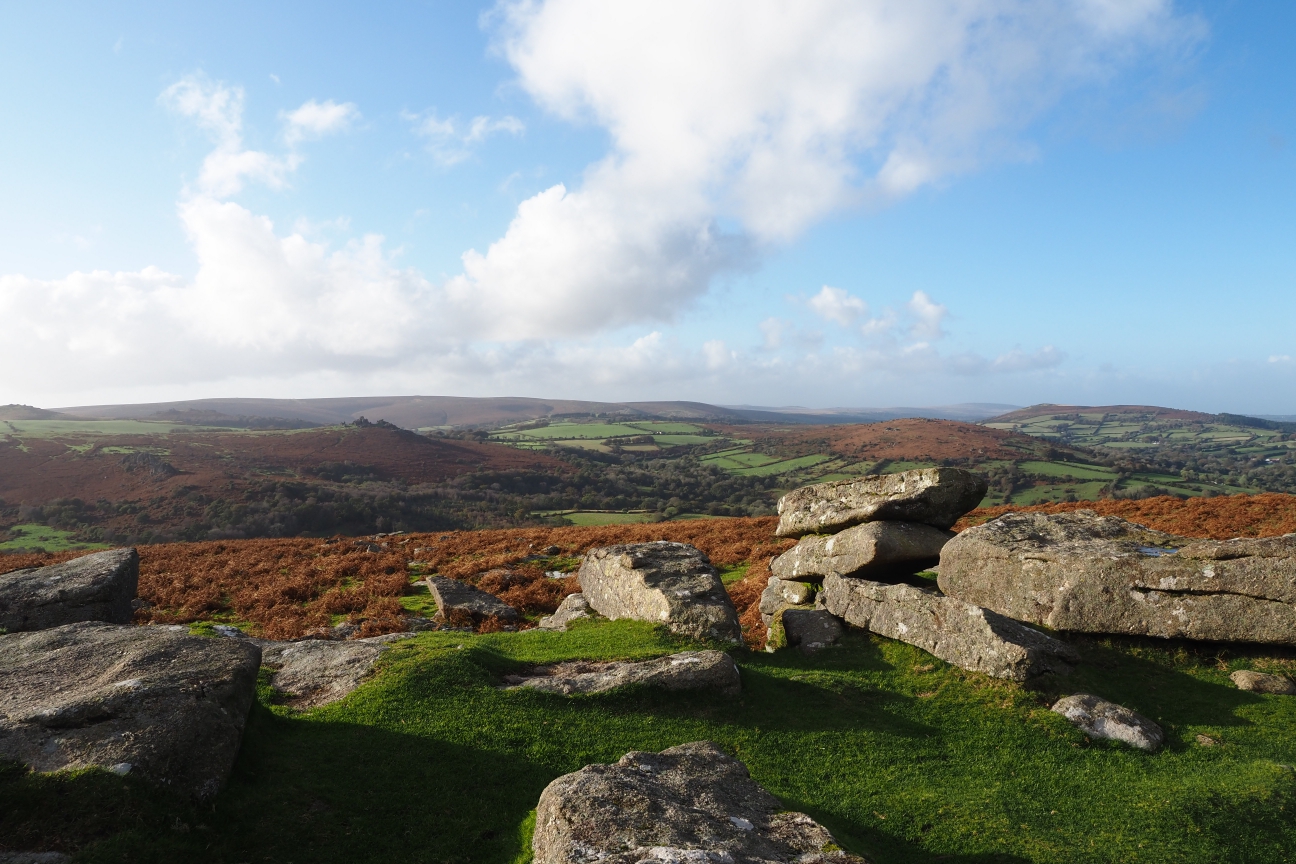
The walk left the woods behind and broke out onto Dartmoor proper with its famous granite tors and expansive views.
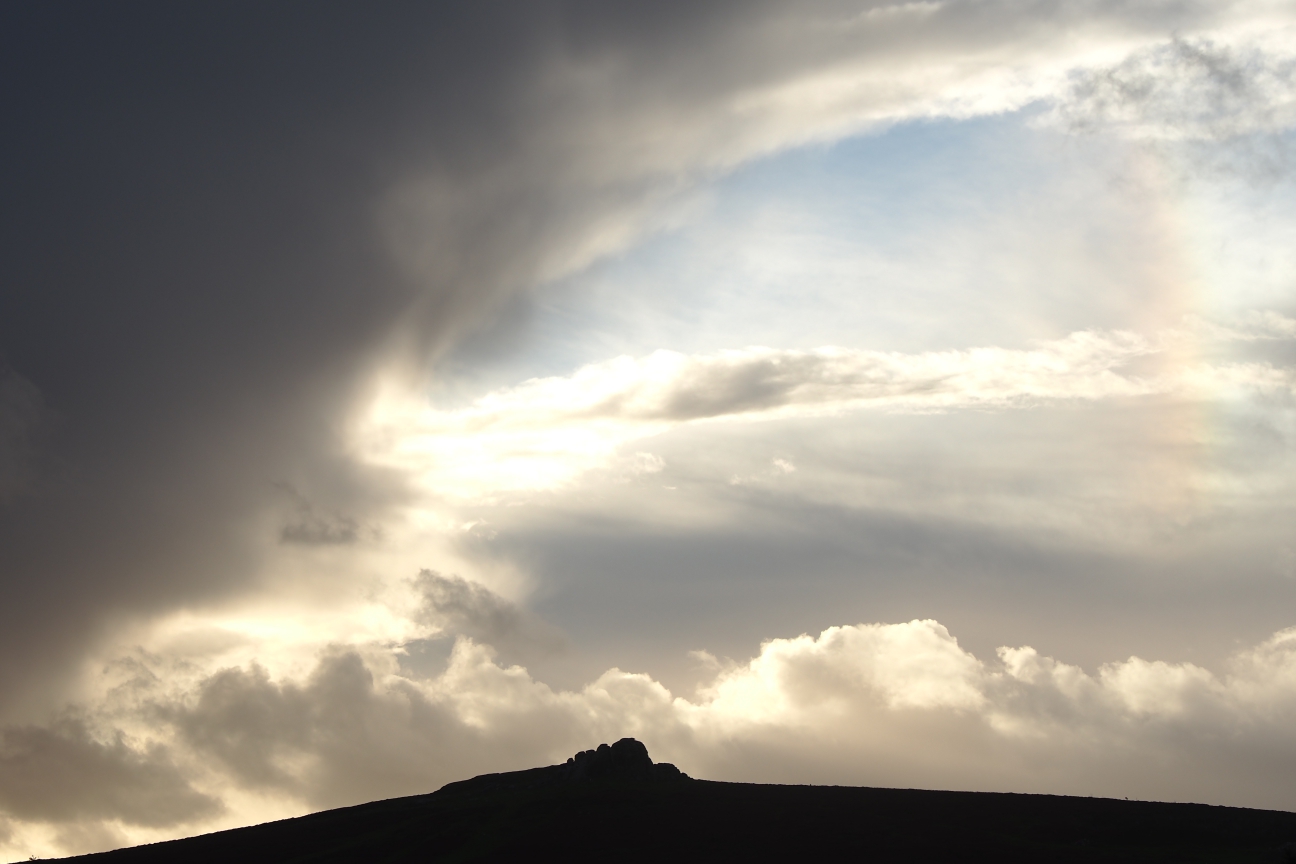
Haytor Rocks silhouetted against the wild skies often seen over Dartmoor.
Though the woods had been left behind, there was one final surprise as we descended through the farmland and hedgerows towards the National Park’s edge.
A tractor had been through to cut the hedges and road verges. In the process it had pulled up this stinkhorn mushroom. It wasn’t something you could miss. That was probably enough mushrooms for one day.
I thought it would be worth sharing an update on where things are with this blog. Last year was a hugely productive one for my blog due to spending so much time at home because of Covid-19 restrictions. At times I was posting three times a week with stuff I would see as good quality.
Now that things have changed I’ve lost that writing time. Things have gone back to where they were probably in 2019. That said, my blog has continued to grow in reach in 2021, especially it seems when people are interested in fungi in the autumn months. October’s views on here have been possibly the busiest month ever for visitors.
In January of this year I began recordings for my Unlocking Landscapes podcast. It was very easy to do because people had time to spend on Zoom due to the stay-at-home orders. Now that there is less of that, I don’t have the time to do them monthly, which has proven a big challenge. That said, I do have two more episodes to publish, hopefully this year, and some episodes agreed with some really cool people, including an author, shepherdess, eco-therapist and a nature writer.
I do hope to add more quality episodes over the years and it may just end up being seasonal, with the episodes maybe a bit longer. I don’t get any income for the podcast and the people appearing on it are doing so out of generosity and a desire to share ideas. Thank you to everyone who has been involved, I’ve loved it so far. The upcoming episodes are part two of the Hungary-Romania trip with Eddie Chapman, and a spring birdsong walk in the Sussex Weald that I recorded in May.
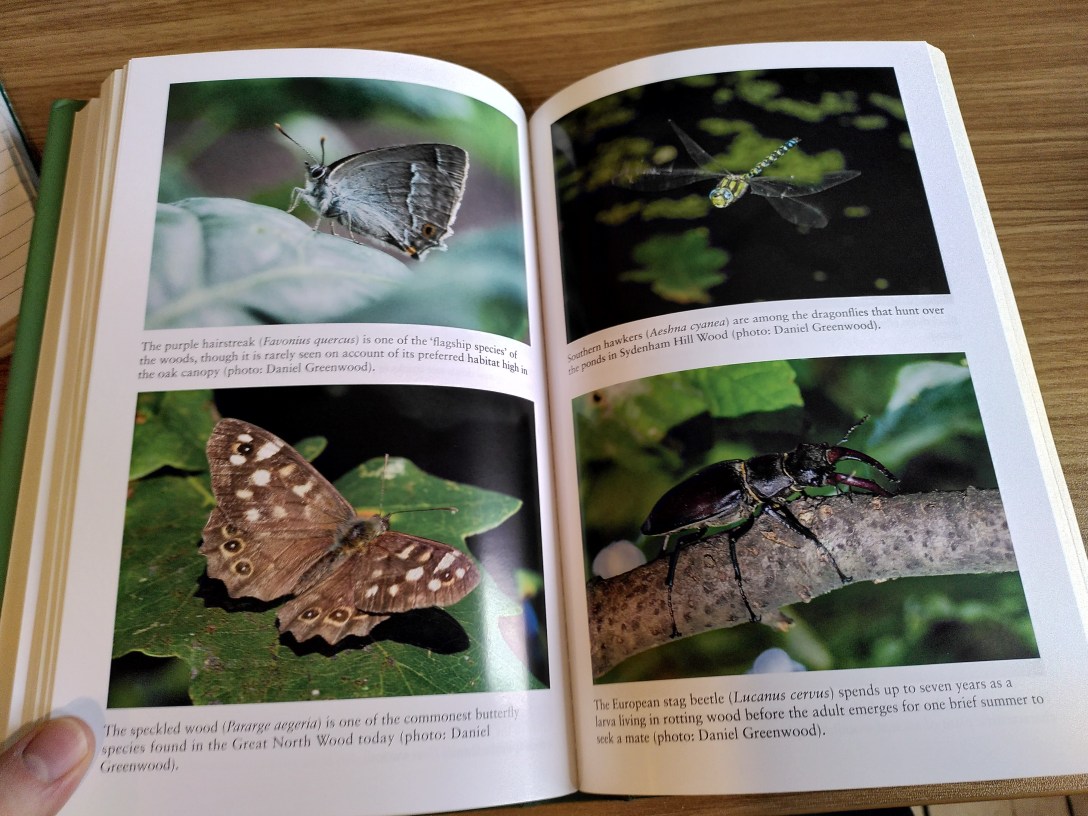
In book news, I have been providing content for other people’s books! Chris Schuler’s The Wood That Built London has just been published with some of my photos in the glossy inner-pages (see image above). It’s an absolute joy to be tied to this incredible book, which has levels of detail about south London’s ancient woodlands which have never before been amalgamated and shared. You can see more here. I’ve also (probably) had some photos published in Tiffany Francis-Baker’s book about Dark Night Skies.
In spring London Wildlife Trust will be publishing a book about nature in London which includes a chapter I wrote about woodlands, with more photographs included. This is another big personal thing for me and I am so honoured to have been asked to support the project. I will post more about it when the book arrives.
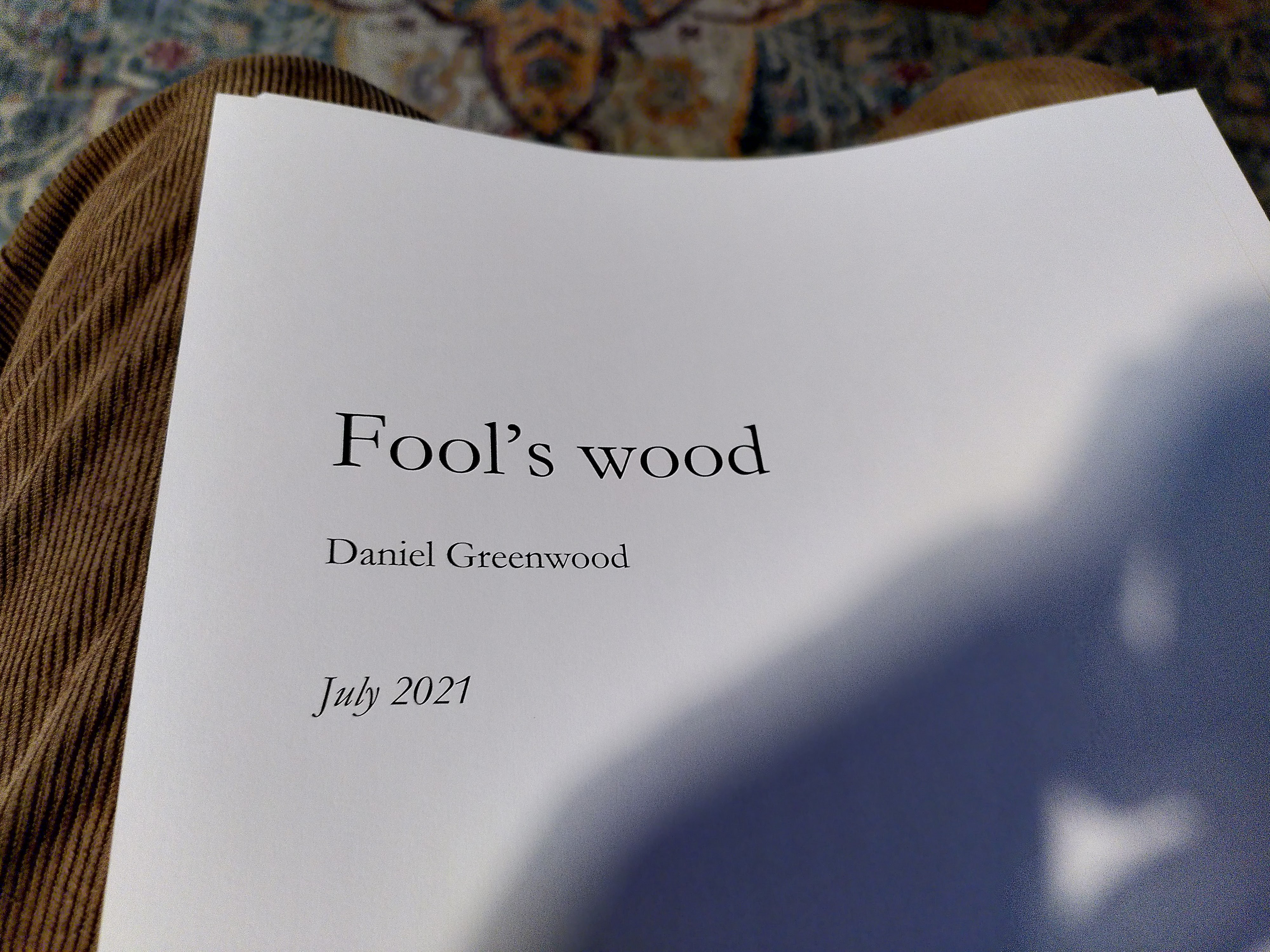
In my own personal self-publishing world I have plans to release a third poetry booklet in early 2022 called Fool’s Wood. I have also been trying to write a book for the past 10 years about my experiences of volunteering and what I learned about nature and our relationships to it. That is proving very difficult to get anywhere with, but I hope to make some progress over the winter months. I am not producing any of these with an aim of being published in the mainstream, more for my personal sanity, and as ebooks. If anyone has advice about producing and publishing ebooks, please help me!
The Town Clerk’s Office, Midhurst(c1500s)
As photography projects go I’ve been gathering images of timber-framed cottages and other buildings for an Instagram account @SussexTimbers. I’m still looking for the best format to share these images and to talk about their historical significance, which Instagram is not quite. I will probably build a section on this website next year to showcase them. Might even make some postcards!
What I’ve been reading: this year has been dominated by Vasily Grossman’s Stalingrad and Life and Fate. I have studied Russian cinema and am something of a Russophile, but there is only so much you can take of 20th century Russian history. Tread carefully. I’ve recently finished Wanderland by Jini Reddy, I Belong Here by Anita Sethi, some of the novels by Sarah Moss (Ghost Wall and Cold Earth), and at the moment I’m enjoying Finding the Mother Tree by Suzanne Simard. Reddy and Sethi’s books are a must read for people who are advocates (or not) of countryside access. Especially those who adamantly and aggressively announce that ‘the countryside is for everyone’ as a reposte to the lived-experience of Black people and people of colour. It’s not, and racism prohibits people from feeling welcome in certain places. Finding the Mother Tree is essential reading for those who want to understand more about how trees are interconnected and the role fungi play in healthy, happy woodlands. I still haven’t read the Merlin Sheldrake book.
What I’m listening to: the new album by The War on Drugs is one I have been waiting a long time for. Change is my favourite song so far (that piano…):
I want to give a shout out to my dad who regularly reads this blog and has, alongside my mum, been a massive support to me for many years (obviously). Dad has been under the weather recently and unable to get out as much as he would like to, so hopefully dad what you can continue to see here is a bit of a sense of the outdoors. We’ll get you back out there again soon.
Thanks to everyone who reads this blog, sending in comments on here as well as on Twitter. I love to receive your comments, which are almost 100% positive, though I don’t block criticism (as long as it’s not inappropriate).
Wishing you a pleasant winter ahead with friends, family, wildlife and pets.
At the end of October I spent three days in Dartmoor National Park (on Dartmoor). I saw so many mushrooms there that I have enough for a post to cover each day. It’s a relief to have some images and sightings to share after a barren period. The mushroom season has arrived very slowly but Devon never disappoints in the fungi department come autumn. I need to say thanks to my partner Rosie who found a lot of the things shown here, exercising her squirrel gene.
As is usual for me, the fungi search was part of walks rather than seeking out food for the pot. The photos were taken with an Olympus E-M5 MIII with a 12-45mm lens and no additional equipment.
For more info about each species just click through the hyperlink of the scientific name in brackets. As ever I’m happy to be corrected if I have a species ID wrong, hence why I use iNaturalist.
The first sign of peak mushroom season was a greenway with mossy hedgebanks and some smatterings of woodland. I’ve seen ceps (Boletus edulis) growing from mossy banks in Dartmoor before, also in Sussex, and it seems to be a favourable spot for them. I wonder if it’s part of their ectomycorhizal relationship with trees growing in those banks.
Close by in the leaf litter was a trio of pink mushrooms that I haven’t identified yet.
Here’s a nice collection that we found on the ground.
Dartmoor is a very birchy landscape in places which inevitably makes it a good place to find fly agaric (Amanita muscaria). I was listening to an episode of the Mushroom Hour podcast after this trip (as in, journey) which included quite a lot of discussion about fly agaric’s cultural place in mycophobic cultures such as Britain. Have a listen for yourself here.
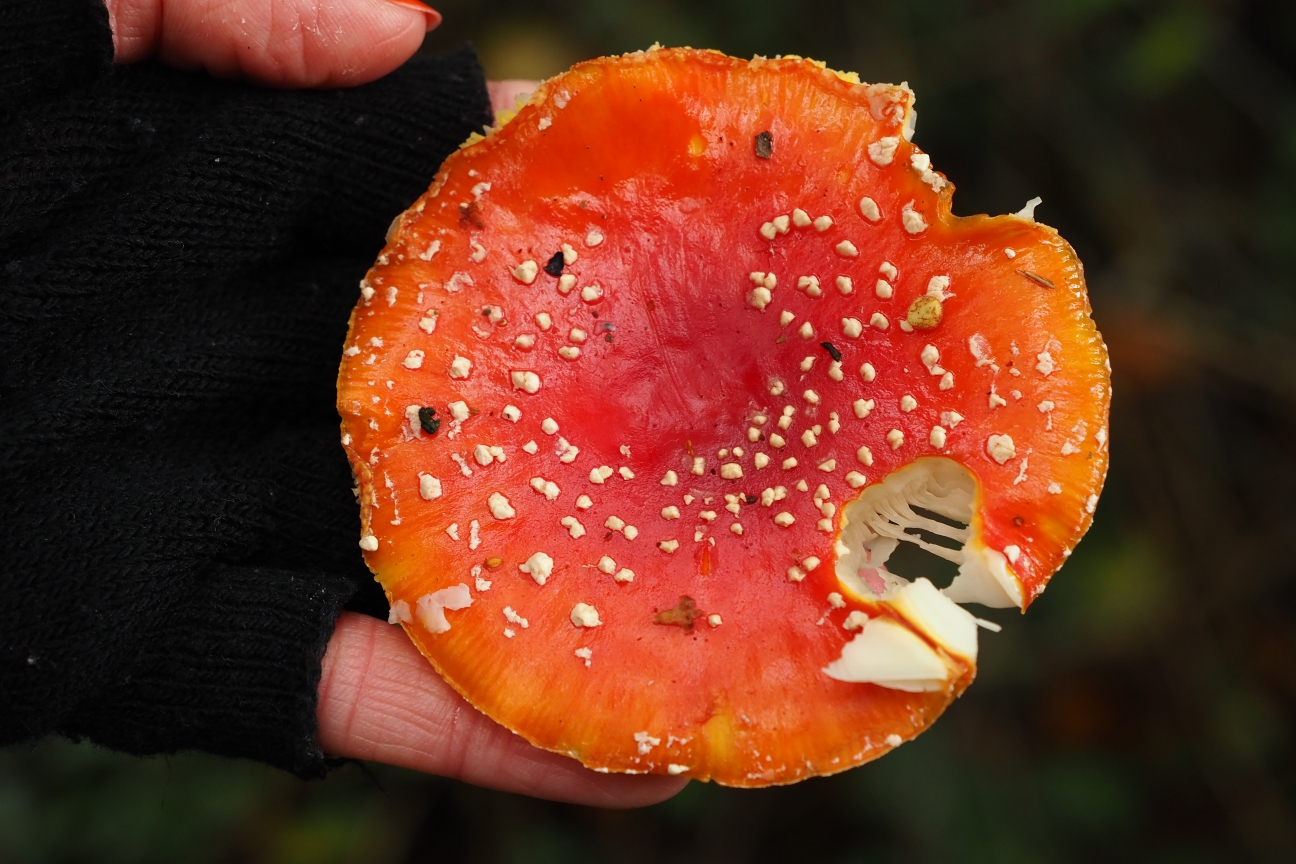
The fly agarics we discovered were all well beyond their best, which I think is really around September before the October rain and first leaf fall. They are clearly edible for some animals.
A scene from the wooded edge of Dartmoor’s eastern side. There are some fine woods around this part which will feature in the next post.
This was one of the nicer finds, what is probably golden scalycap (Pholiota arivella). It was a large spread at the base of a tree, where this group of mushrooms can often be found.
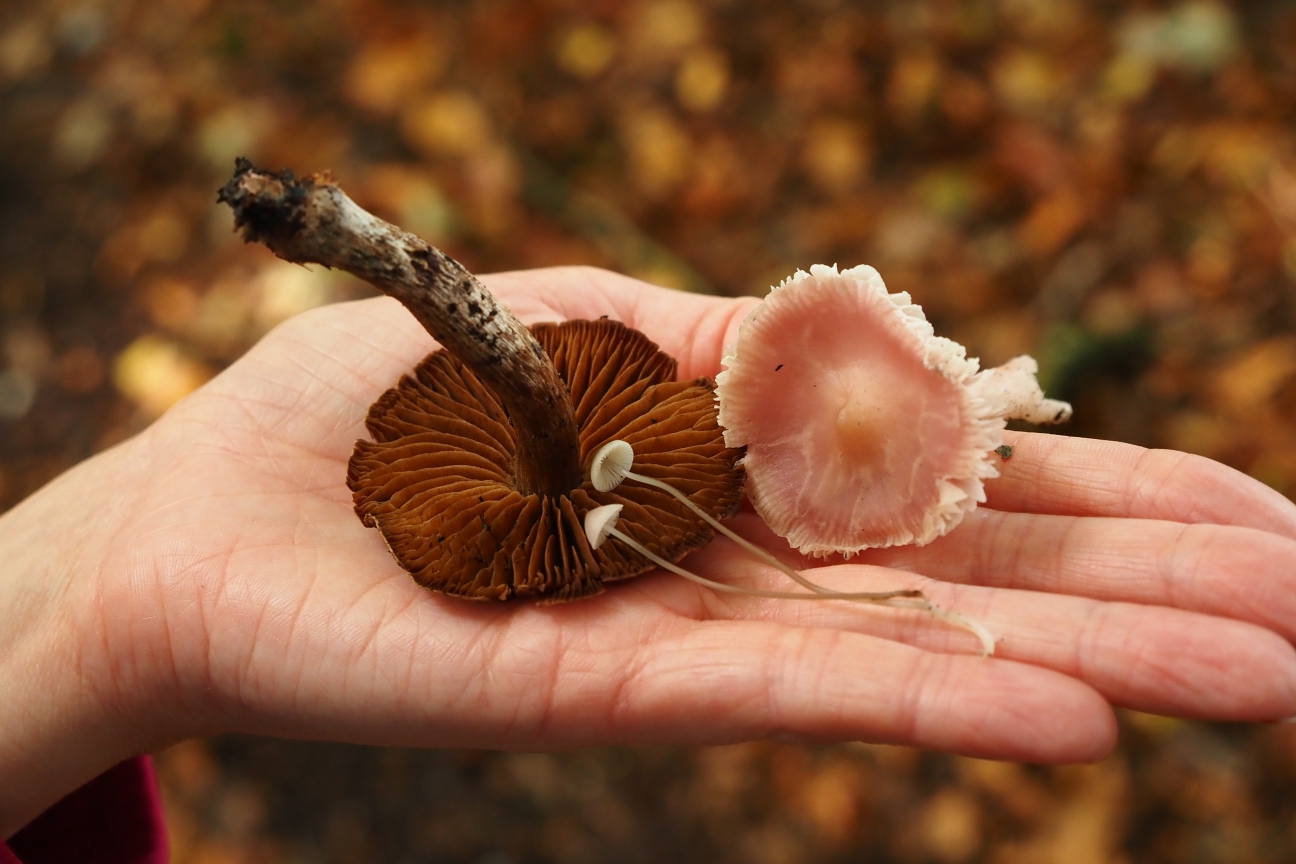
I’m not sure what species these leathery-brown mushrooms are but they were very attractive with that white trim to the cap.
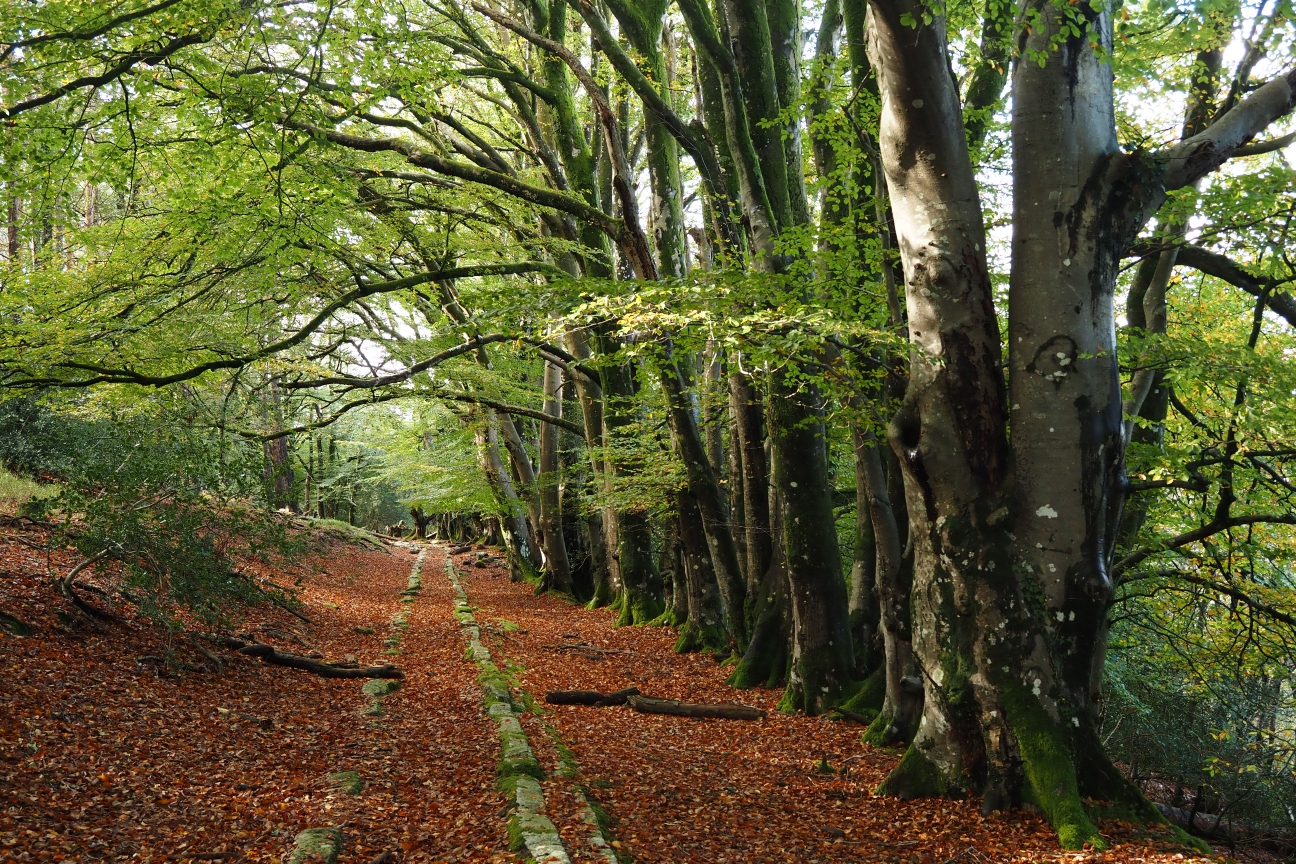
The walk encompassed part of the Templer Way, an old tramway used to transport granite quarried from nearby Haytor Rocks. You can read more about the Templer Way here. Stone from this area was used in the construction of a version of London Bridge and part of the British Museum. As seen above, beech is quite a common embankment planting on Dartmoor, presumably by the Victorians, and perhaps even at the same time that the Templer Way was being constructed.
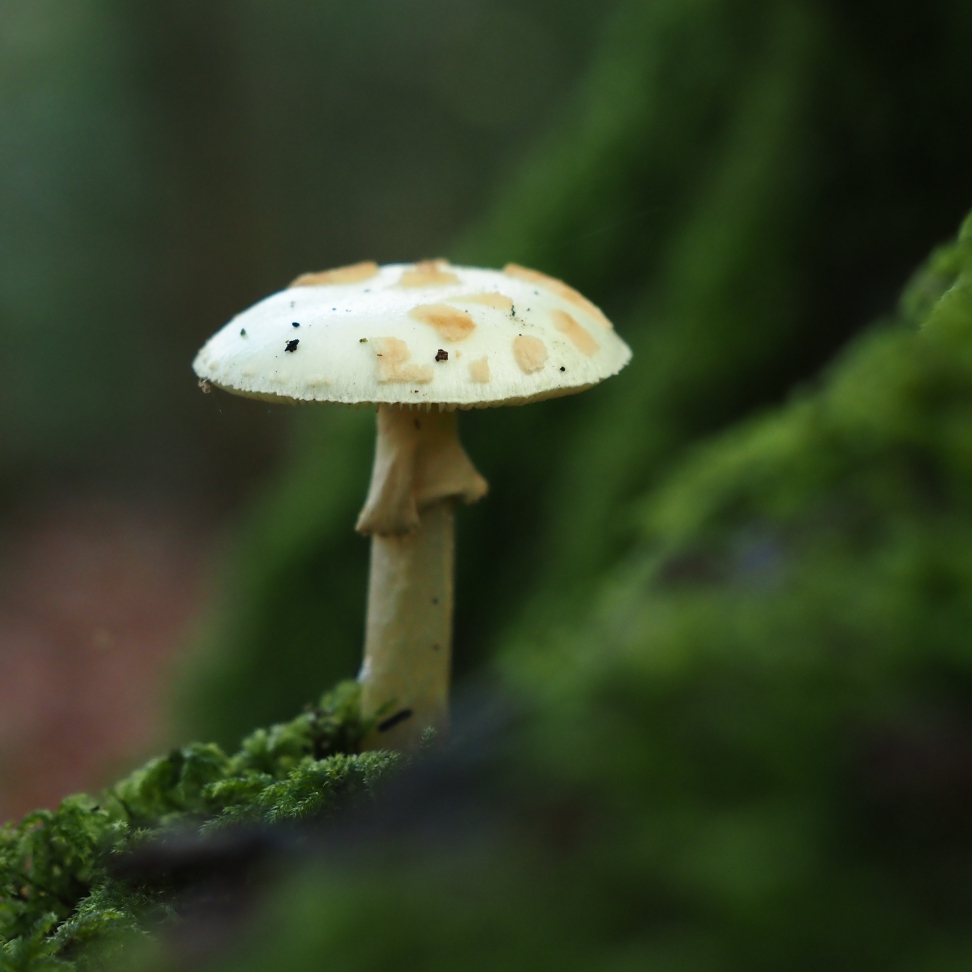
On the mossy bank (see a theme developing here) this false deathcap (Amanita citrina) had popped up. It can be distinguished from a deathcap by the remnants of the veil on the cap which make it look a little like a white fly agaric.
One species I haven’t seen much this year is porcelain fungus. There was one single fruiting body during this walk. This is a species almost always found on beech (Fagus sylvatica), even broken off bits of beech lying around can produce fruiting bodies.
On a large chunk of fallen beech wood this bracket fungus had grown. I’m not sure of the species. I’ve posted on iNaturalist to hopefully get an ID at some point.
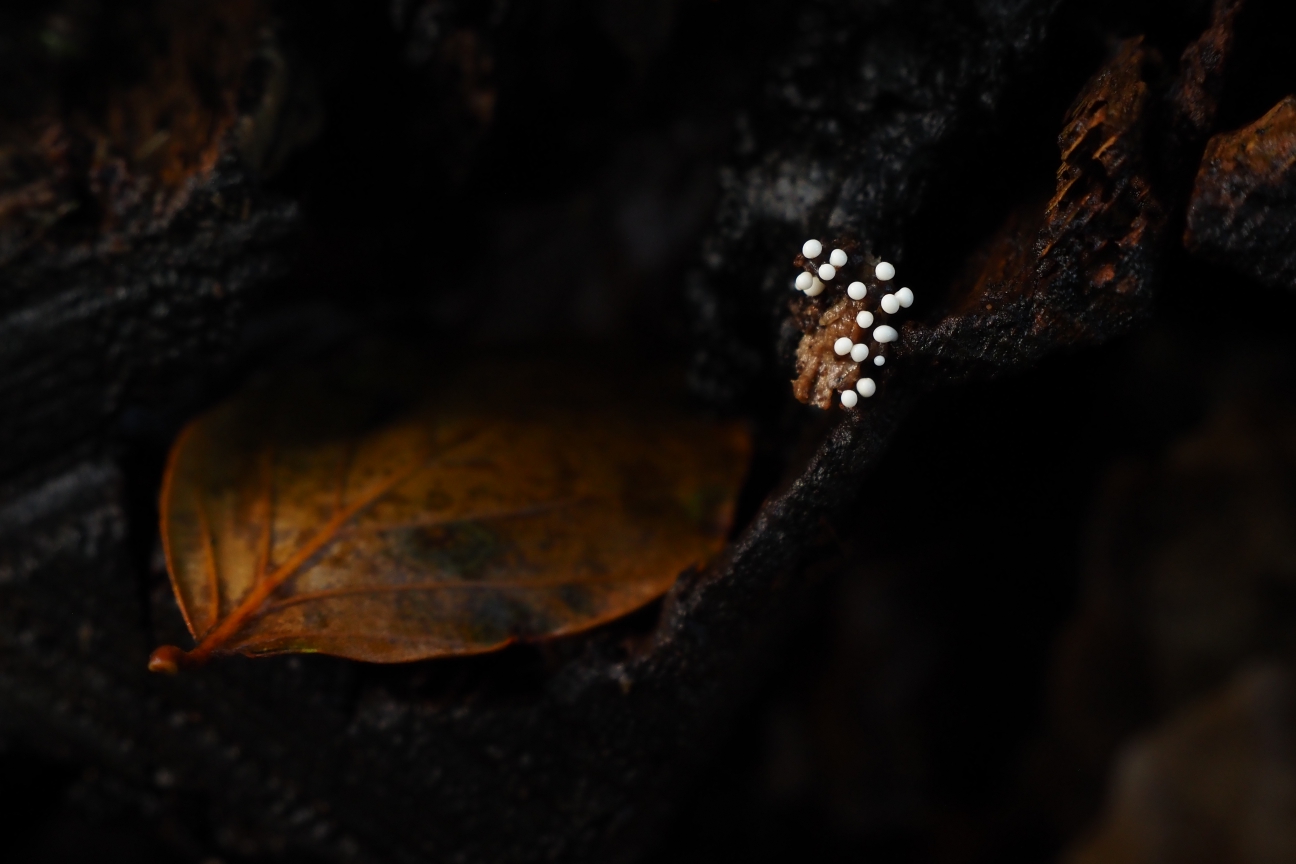
In the same beechy area there was some slime mould growing on some of the more wet fallen wood.
Here you can see the beech leaf for scale against the very small slime mould. I do like this composition and the colour of the leaf.
One funny thing was finding this stagshorn fungus (Calocera viscosa) growing from a gap in a bench. I was quite disturbed recently to find it’s scalled stagshorn rather than staghorn, as I had known it for such a long time.
I love how this fungus looks like a little animated fire burning.
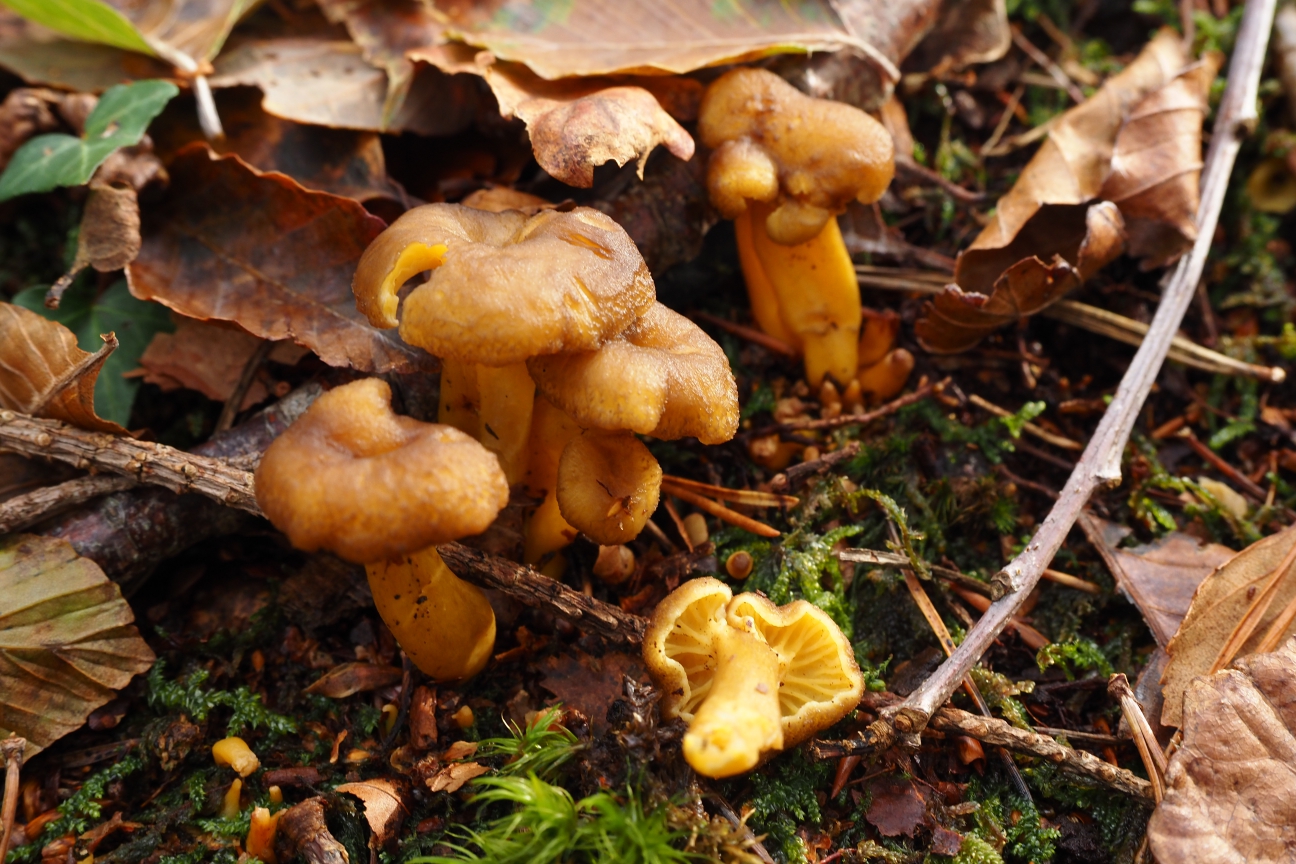
A distance away from the previous location I found the largest community of chantarelles I’ve stumbled upon. I’m not entirely sure if they’re two different species but some of them looked to me to be trumpet chantarelles (Craterellus tubeiformis). Again, nothing was picked and everything seen here had already been upturned.
I couldn’t resist a photo of these very photogenic glistening inkcaps (Coprinellus micaceus). The sheer dominance of moss on Dartmoor shows how wet the landscape is here.
Rosie managed to find a more complete fly agaric, but still with plenty of chewing done already.
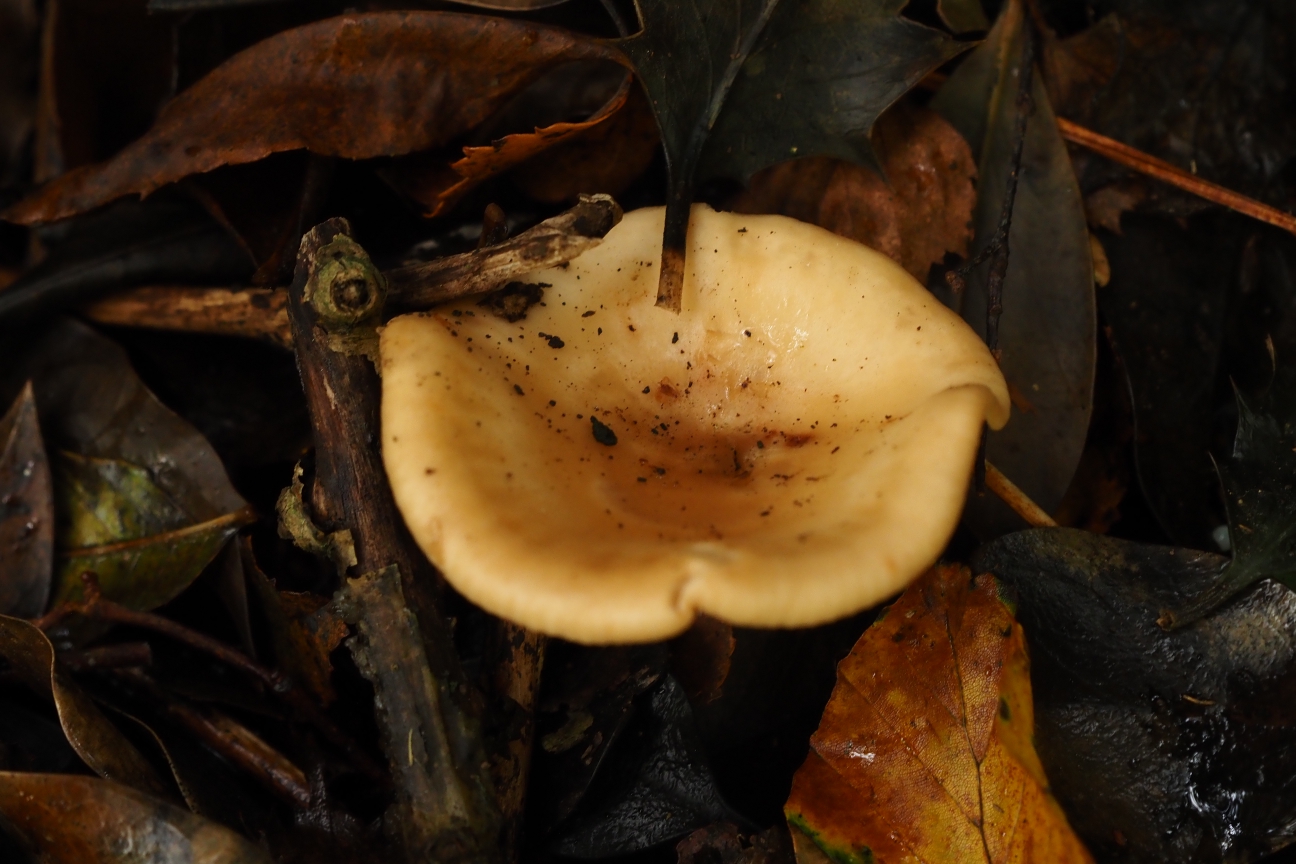
There are many, many mushrooms I see that I’m not able to name. This will go down in that category, possibly forever.
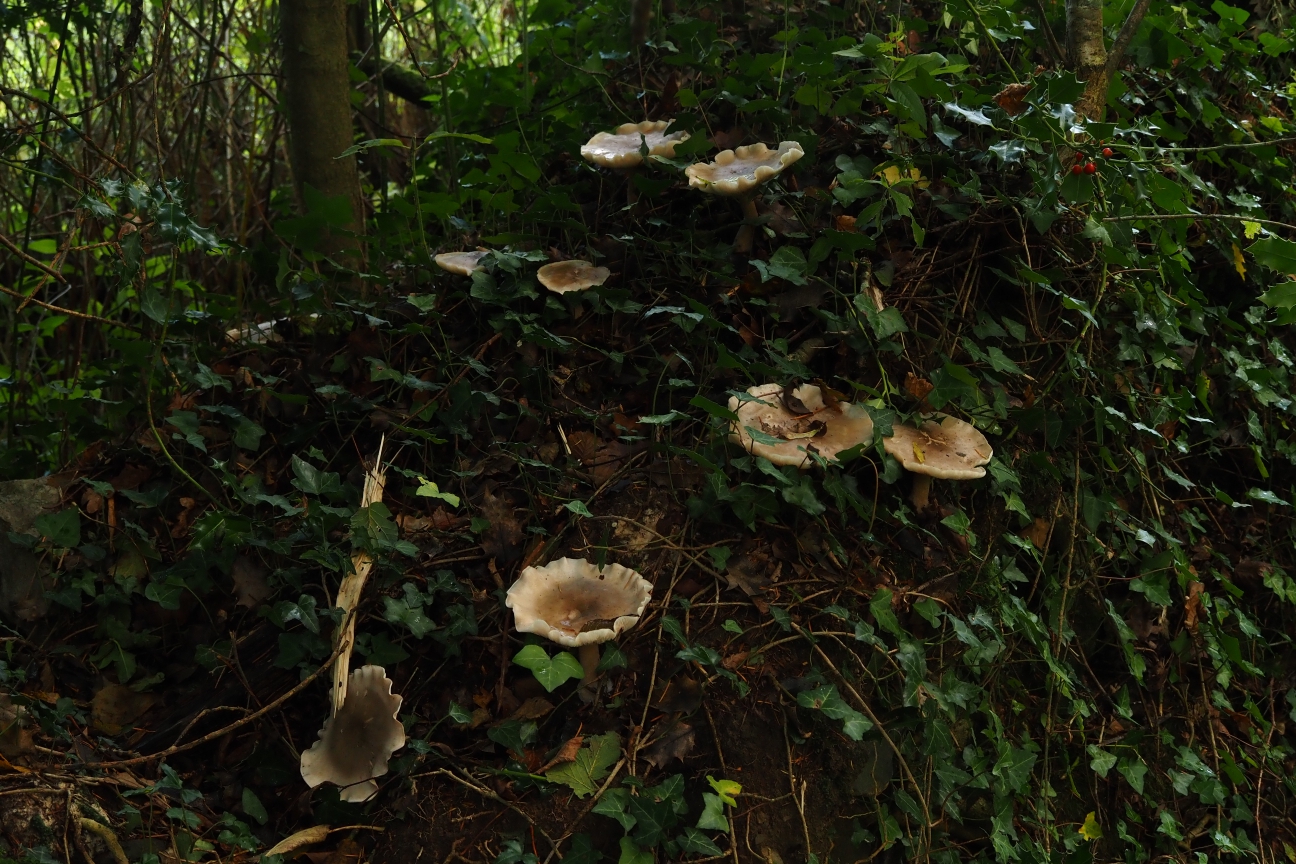
After hiding from an unexpected, torrential downpour we hid under some holly trees where these mushrooms were growing. I think they’re a species of funnel (Clitocybe) but I don’t know.
Sulphur tuft (Hypholoma fasciculare) was at almost every location where other mushrooms were fruiting. It is possibly the most common fungus I encounter, especially in woodland. This was a lovely scene and no surprise that this mushroom was making a home there.
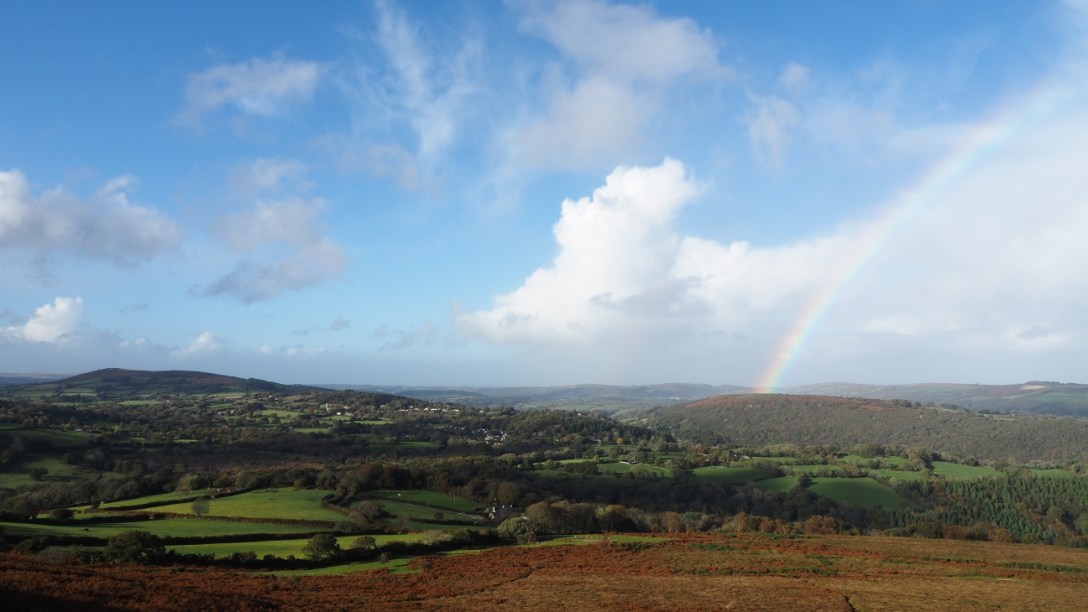
The weather really turned after this point when we reached the moor proper. You can see from the image above how unsettled the weather often is on Dartmoor. Haytor rocks can be seen to the right of the image.
The final mushrooms of the walk were found along the green lanes near the edge of the National Park boundary.
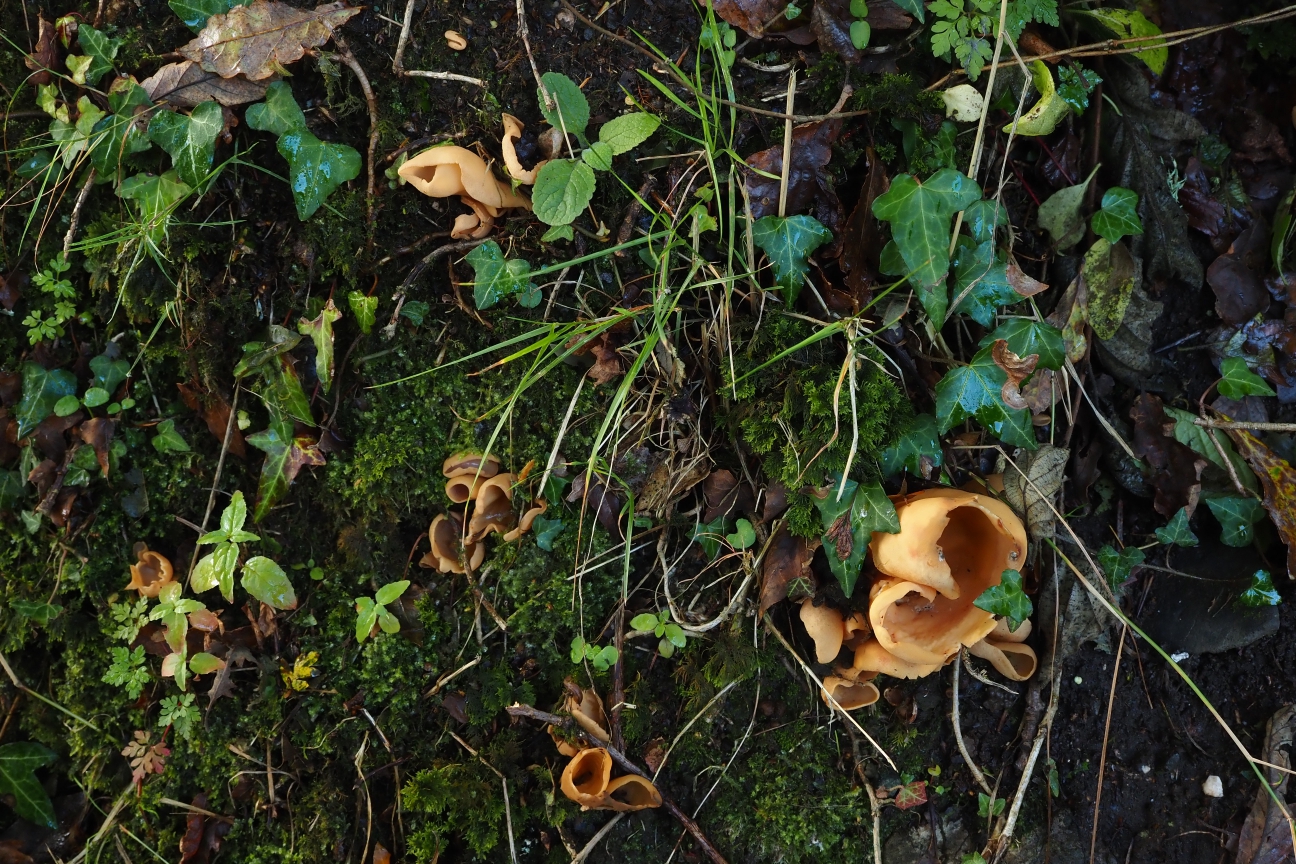
I’ve been meaning to write about the diversity of trees and plants in Dartmoor hedgebanks for years, but I hadn’t really considered their fungi. Above is an ascomycete fungus, a cup fungus. It’s probably hare’s ear (Otidea onotica).
This absolute bruiser of a mushroom is probably a pestle puffball (Lycoperdon excipuliforme). Usually it grows vertically from the soil but in this case was protruding at an exactly horizontal angle from the hedgebank.
As darkness fell, there was one final opportunity to see the mushrooms before night fell. This was the evening of the clocks going back one hour. The mushrooms above are clouded funnel, a common and fairly easy to identify fungus that grows in a group. It gets its common English name from the cloudy shading on their caps.
Thanks for reading. Stay tuned for episode two of ‘3 days on Dartmoor’.
I’ve had a burst of American visitors in recent days (to my blog, not my house). So thanks for visiting, y’all, and sorry about the year you’ve had. You may have noticed I’ve slipped to monthly posts on here. Between April and October I posted blogs every Monday without pause, which is a tricky task…
Here’s my seasonal update of stuff you don’t need to know about, but then welcome to the Internet. What I’m writing Soon I will be self-publishing my third poetry collection, Fool’s Wood. It’s seven years since my last one and this collection has taken longer because of LIFE. There will be a booklet and also…
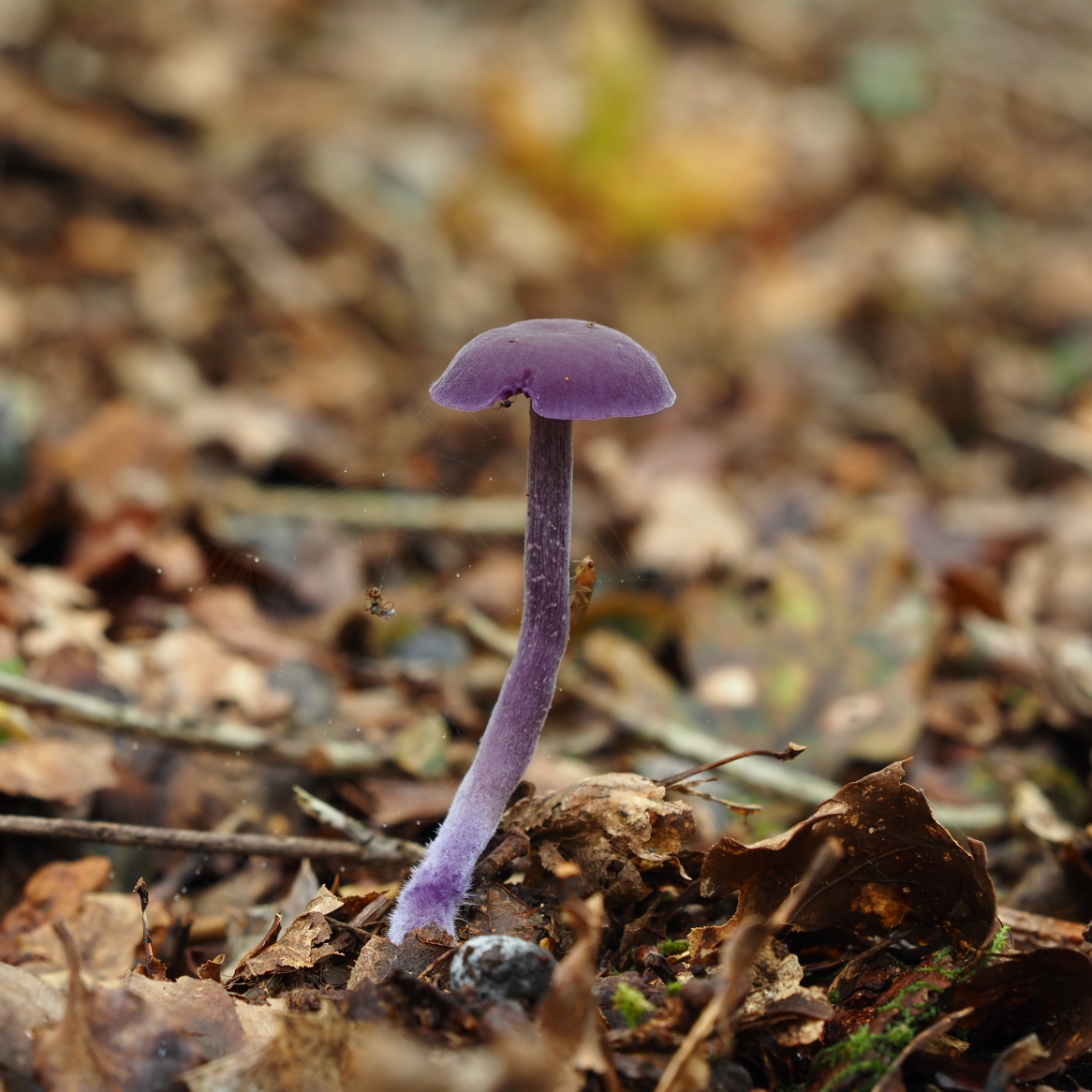
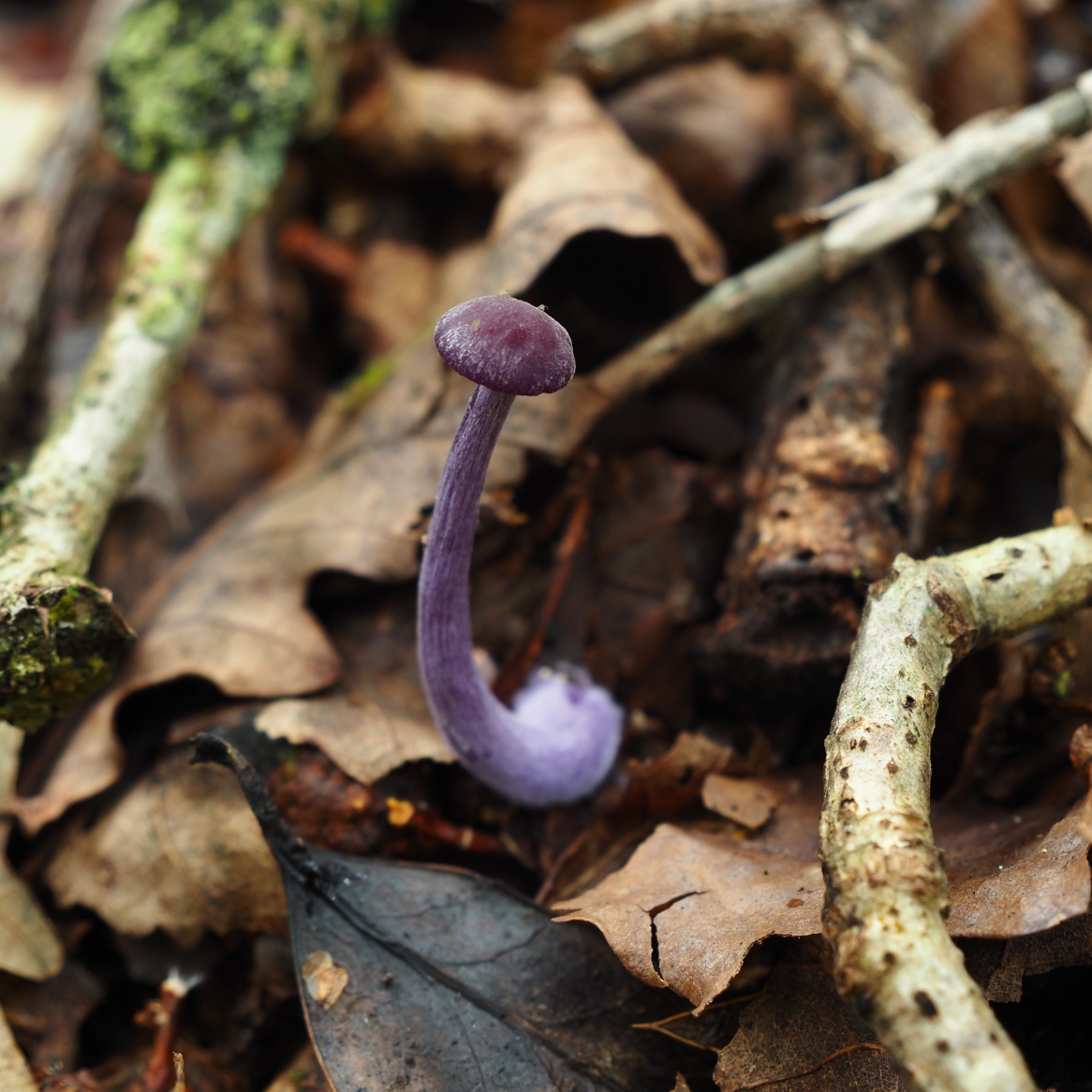
The day after last week’s post, I headed back out to another local woodland to check up on the fungal situation. Building on the violet webcap theme, I was this time lured down an amethyst deceiver rabbit-hole. Thankfully, I was able to return from it.
I saw a tweet recently from the editor of the Inkcap Journal about how she could never find these mushrooms. The question was whether they are as bright as people say, or if that was deceptive. They are, of course, deceptive by name but also in their appearance.
I was scanning the path edges along a usual mushroom route I take through this woodland when I spotted a very small, dark mushroom under the birch and holly. It was almost black in the shade but on closer inspection it was one of perhaps 100 amethyst deceivers in the local leaf litter.
As I slowed down upon finding the mushroom, I began to see more and more. They were everywhere. I was careful not to step or kneel on them. I took some photos of them in varying states.
Herein lies this family’s deception – they are often confusing because they can look so different in anything but colour. Perhaps their name also derives from the fact they are hard to see.
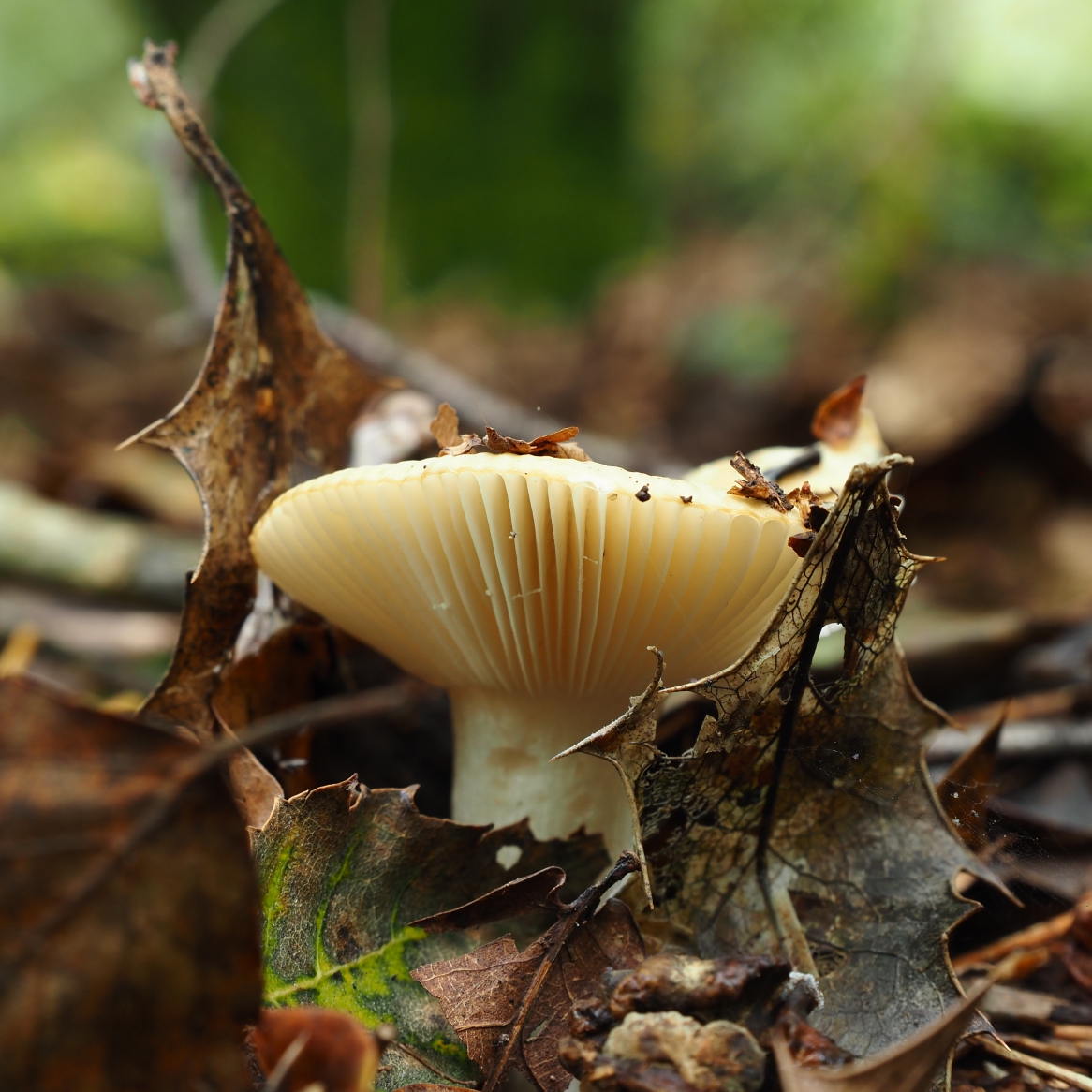
These blogposts can also be deceptive. Though I have found things to photograph, we are nowhere near a mushroom peak. Things are not in full flow. The Sussex Weald’s woods look dry still, with heavy rain not yet enough to provide the water for full-on fruiting across the board. In other words, the mushrooms remain small and sparse, but there if you look. This brittlegill was exploding onto the scene like the shark from Jaws.
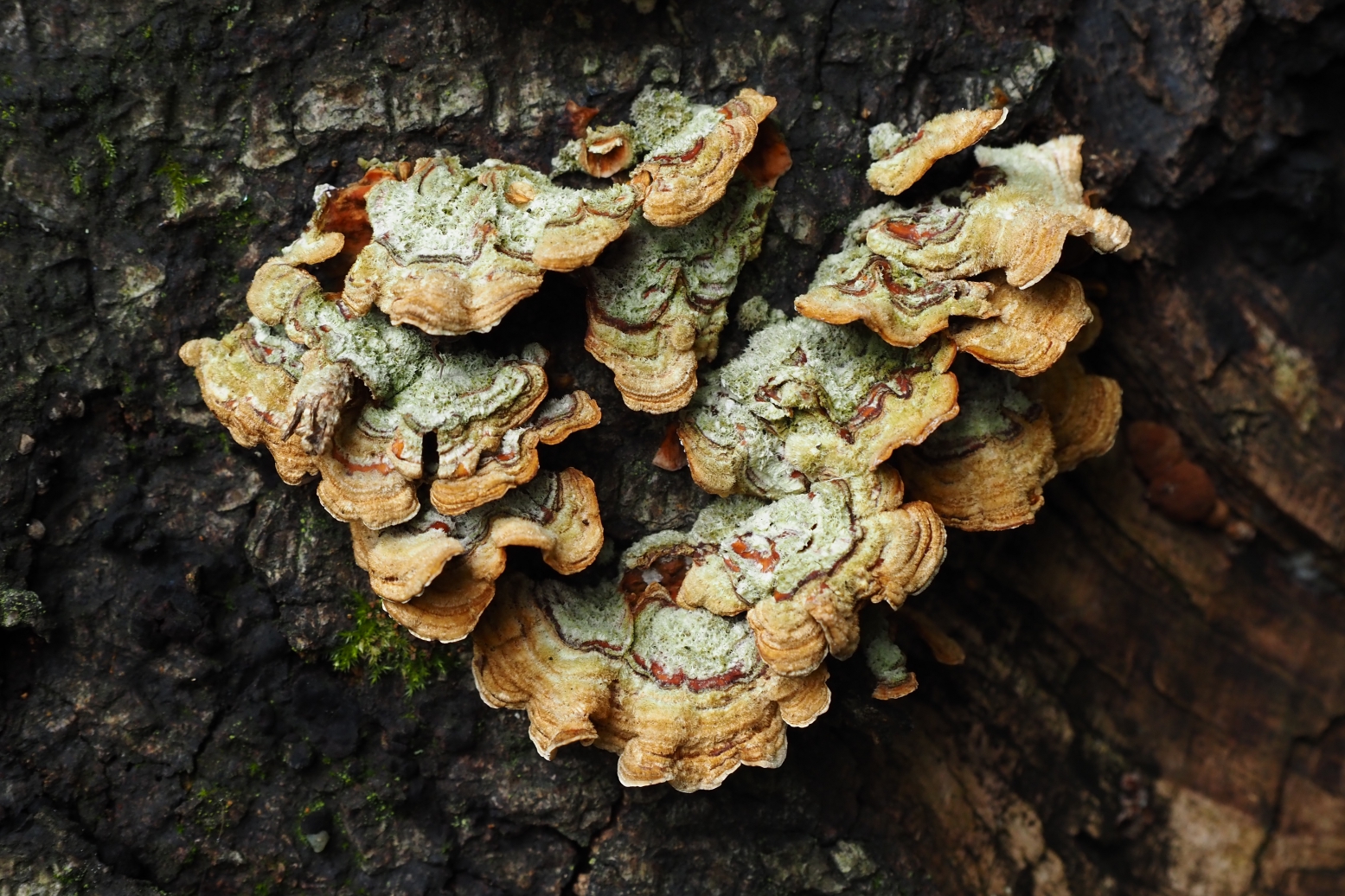
Something that can always be relied upon is a hard-wearing polypore. This fan of small brackets is the sort of thing you can find all year round.
There were more of the typical mushrooms, but mostly in the shaded areas under holly or lower vegetation. This crew of bonnets were growing in their hundreds.
On the woodland floor I spotted some very small mushrooms with conical hats. These tips look a bit like the famous magic Psilocybe mushrooms. After a bit of research I decided that they are in fact peaked webcap.
You can forgive me for seeing their similarity for liberty cap, the magic mushroom. In this photo you can see a small amount of the webbing which gives this huge family of mushrooms its general name.
Some of the more summery mushrooms were there to be found. This included the undisputed king of looking-like-they-just-burst-through-the-door, tawny grisette.
Another amanita to be found was this blusher, I think. It is quite difficult sometimes to tell the difference between a couple of relatives in this group, including the panther cap and grey-spotted amanitas.
The pinkish-hue and appearance of the stipe was enough to suggest to me that it’s a blusher, rather than a grey-spotted amanita.
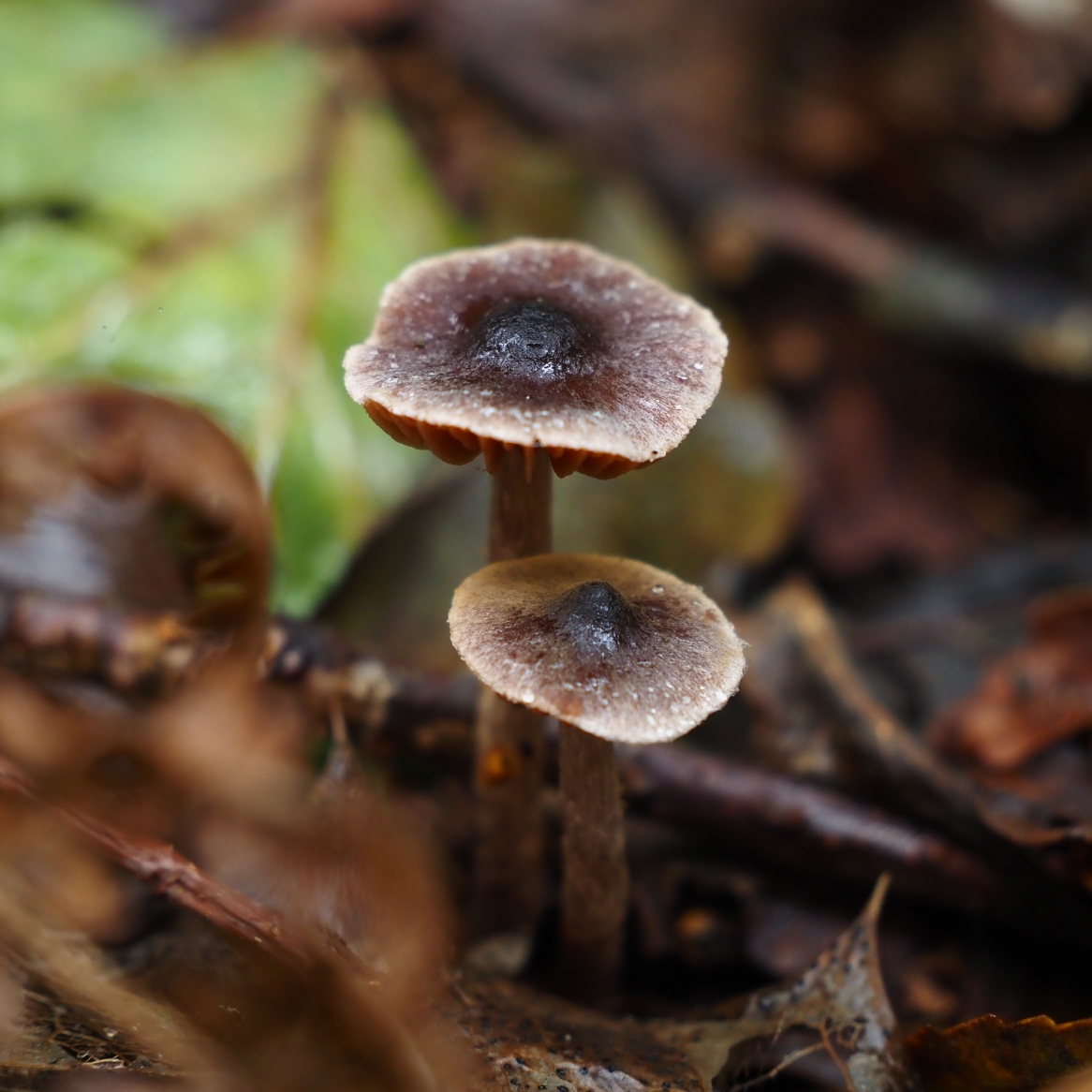
I like the felty-caps of these two friends down among the old holly leaves and sticks.
Before making my way back home I happened upon another gathering of bonnets, again under holly in very shady woodland. It’s where the moisture is and therefore where the magic happens.
If you can, make some time to get out there and find yourself some mushrooms. You won’t regret it.
At long last some time in the woods! Get ready for a mammoth mushroom post to celebrate the start of the season. I am so annoyed to have missed UK Fungus Day due to work commitments (no time or energy to do writing, visit woods or take photos) and also I have at least one other mushroom post that hasn’t made it to the surface yet.
In south-eastern England we have finally had some rain after a very dry summer. iNaturalist and social media have shown lots of autumn mushrooms popping up, including the first fly agarics. This week I had the chance to check things out for myself, and was not disappointed.
I am fortunate enough to live near a large expanse of ancient woodland/wooded heathland which is part of the High Weald Area of Outstanding Natural Beauty. This landscape is fungal heaven in places that have been wooded for more than 400 years. It’s dominated by birch, oak, beech and pine, trees that have strong associations with fungi.
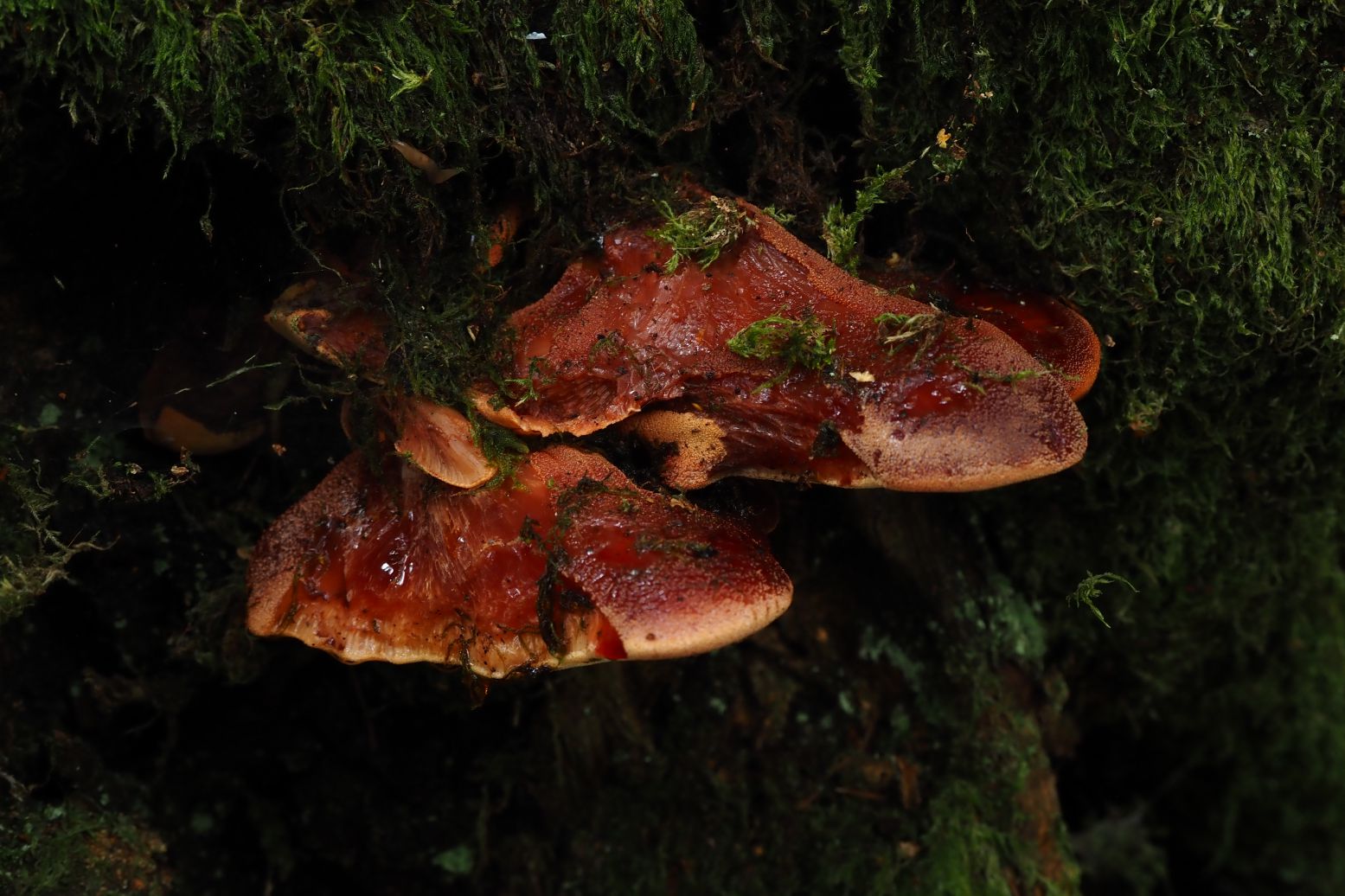
The early signs were good as I discovered a beefsteak fungus growing at the base of an oak tree. This is a species which can be mistaken for body parts, and though it’s parasitic, its impact is said to work more slowly than a tree’s ability to heal itself.
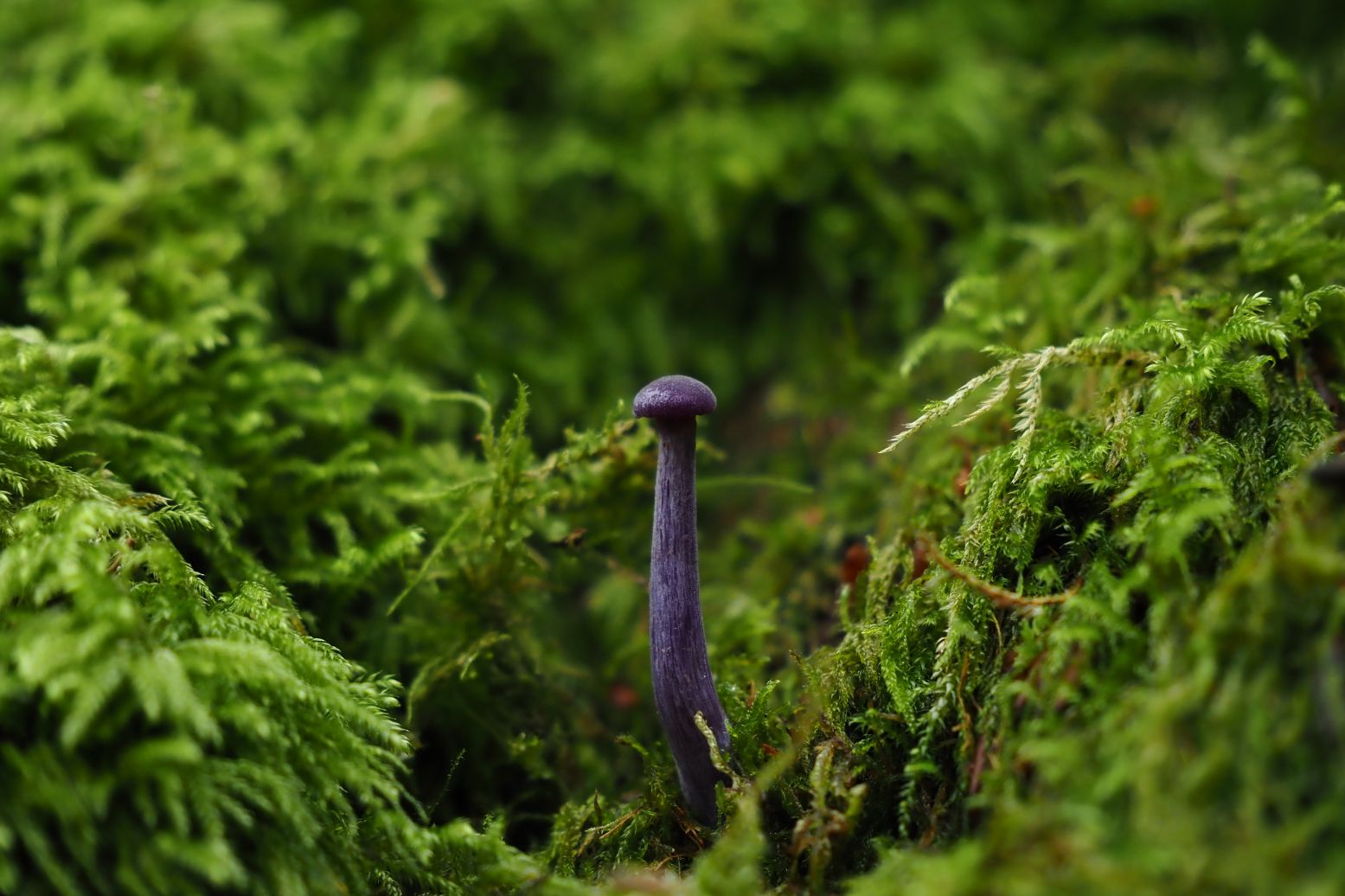
Amethyst deceivers are a common species at this time of year, often found growing in profusion. I spotted this tiny one growing in moss at the base of a tree.
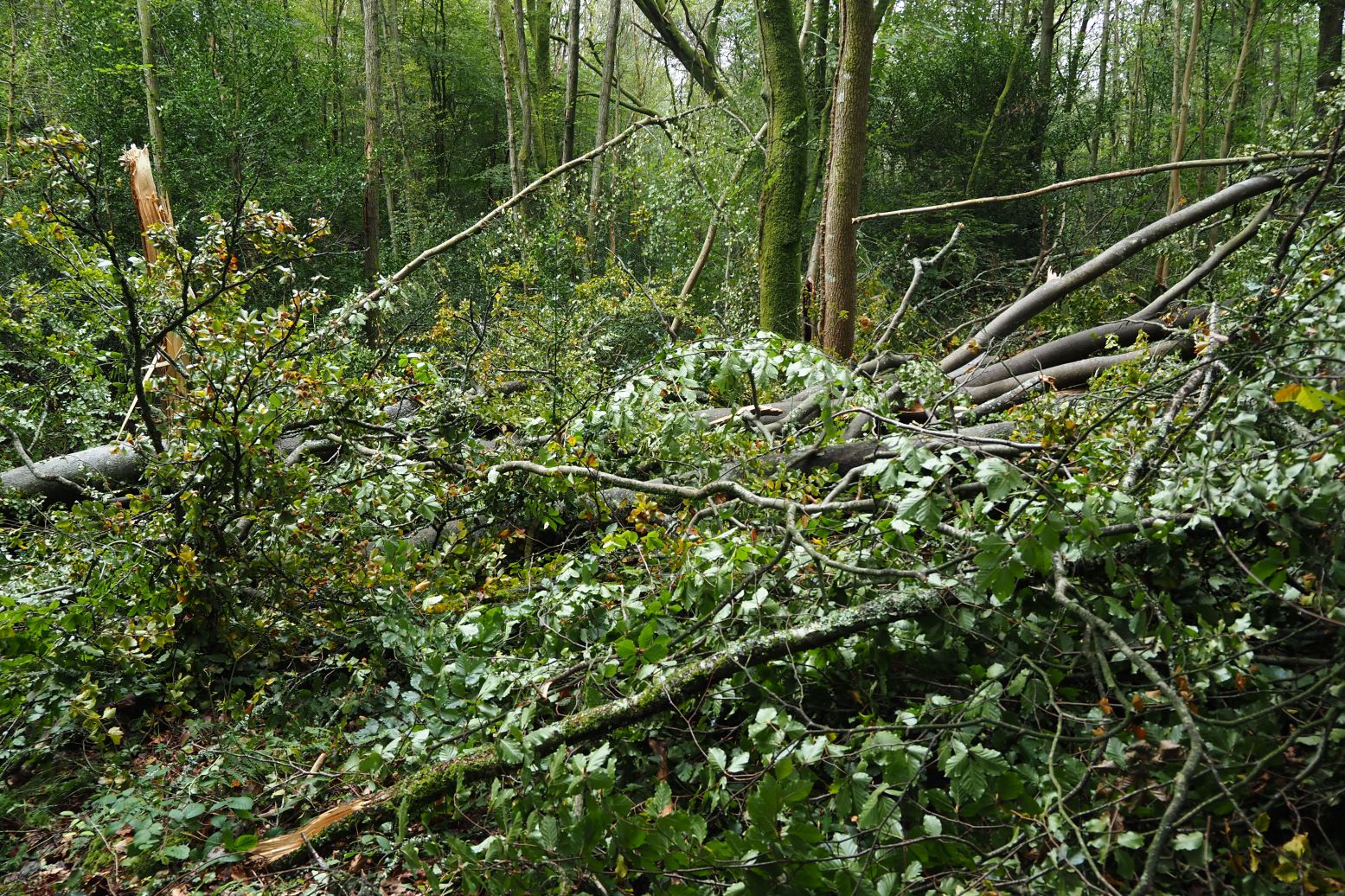
Recent storms had created a realignment of the woodland canopy. A beech tree had broken off in high winds, opening up the woodland to light. The concentrations of deer are high here, so it will be interesting to see how well the woodland manages to renew in this sudden clearing.
No, this is not an amphibian! I spotted this holly leaf covered in a species of wart-like fungus which I think might be in this family. Please add a comment if you know what it is.
Lurking behind a fallen log was what I think is a deer shield mushroom. I saw far more in the proximity of fallen wood, rather than in the open woodland floor. Perhaps the heavy rain recently has washed things away.
This mazegill-like crust fungus caught my eye.
This small polypore, which I have not looked to ID yet, was in fine fettle on a little birch stump. Not unlike a thought-cloud.
A reminder that it’s not just humans that enjoy fungi. Not that anyone is in any rush to chow down on this one.
This crust fungus interested me as it looked like a map of Scandinavian islands.
It’s always nice to find a bolete. This is probably a birch bolete as it was growing underneath birch trees. I moved the beech leaf but it fell into this position purely by accident. Lots of autumn happening here.
There were two moments during this two-hour walk that I let out some expression of joy upon finding mushrooms to photograph. I don’t know what family this, well, family of fungi, are in, but they are beautiful. I love to find fungi in this state, at this time of year, before the leaves have fallen.
Autumn appearing in beech, birch and bracken.
As a lone male visiting woodland, I am very aware of the impact my presence could have on women who are walking alone. I saw a woman walking and turned away to walk a different path to ensure she didn’t have to experience the fear of having some weird dude approach in a secluded area or pinchpoint of woodland. I also have my camera clearly on show. Sometimes I have considered getting a hi-vis vest with a mushroom emoji on the back. I would implore other men to consider how you are perceived in similar situations.
A pine tree had come unstuck and much of its bark had been pulled away. Looking more closely I could see some kind of root network. Now I’m not sure if these are aerial roots put on by the tree as it tried to consume its own decaying matter. Then again there was a lot of hyphae-like structure in among the roots, but the whole structure couldn’t have been all fungi. Here we have the foundation for much of life on earth, the partnership of fungi and plants.
It made me think of how Britain is faring at the moment. We cut our ties with our European neighbours in January 2021 (i.e. the wood-wide web), thinking we could grow taller and stronger alone. The truth is that everything is connected and we are diminishing in isolation because we need our nearest neighbours to thrive.
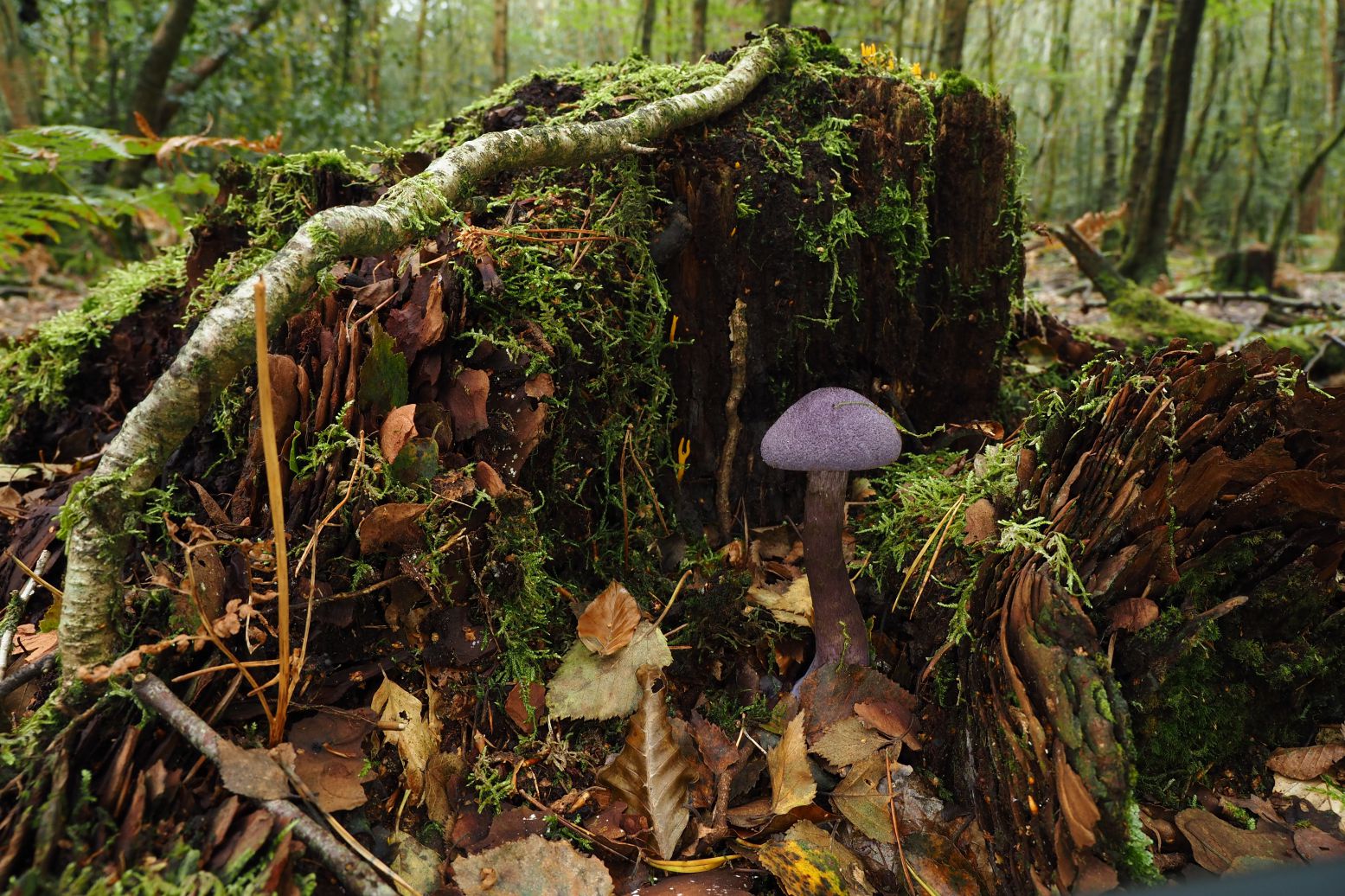
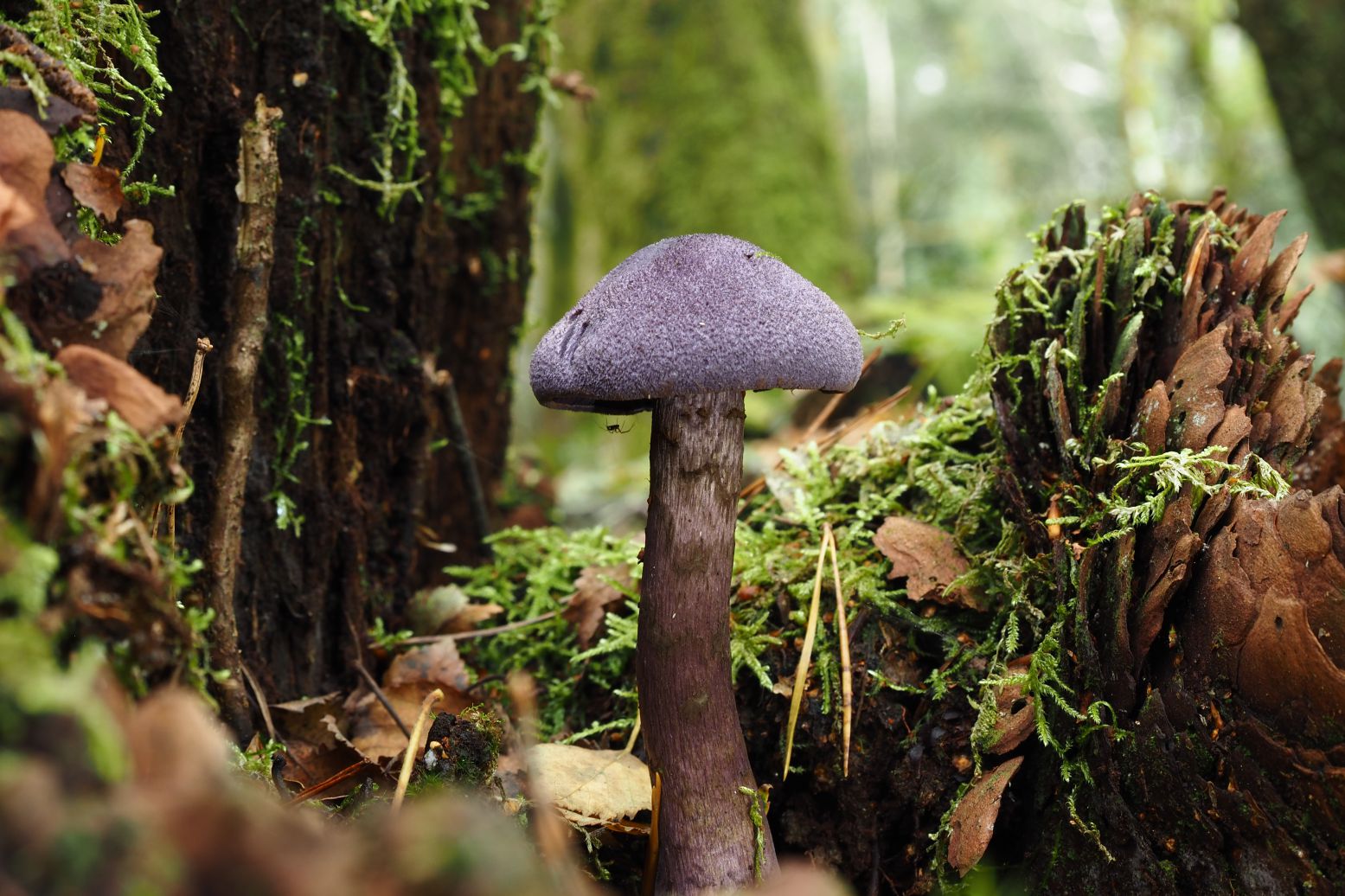
And then I found a mushroom I had never seen before – a webcap, probably violet webcap!
Seeing this mushroom sitting there took my breath away. It is a stunning fungus. The photographs just don’t do it justice.
Looking back at the photos I could see a spider using the underside of the cap as a place to find prey. It’s a smart move as many small insects and other arthropods are attracted to mushroom gills and caps.
One of the highlights of this walk, literally, were the spreads of yellow staghorn in the moss.
Their likeness to flames is really pleasing. I also love how they grow out of a tiny alcove in fallen wood as if from a little firepit.
Here is an example of how far and wide the little fires were burning.
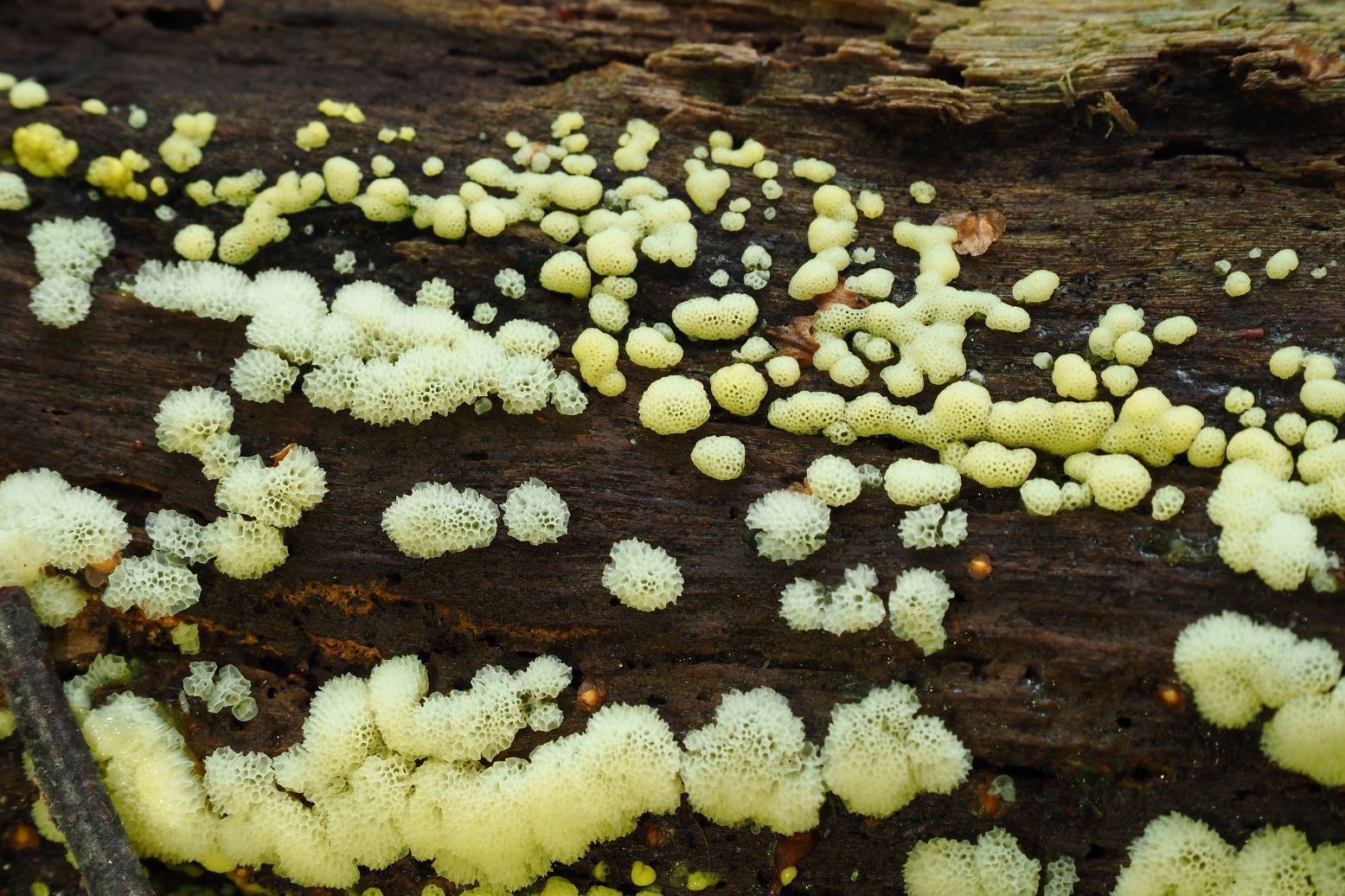
As my mind was turning to thoughts of heading home, I saw this neon glow around a fallen oak tree. I had to wait for some dog walkers and their most-definitely-not-under-control dogs to leave the area before setting up shop in front of the log. I think it may be a coral slime mould, but I’ve never seen it so bright before. It made me wonder if in fact it could be bioluminescent, with the subject on my mind after an excellent recent Welcome to the Mushroom Hour podcast episode.
Here’s a short video showing the full extent of the slime I encountered!
The light was growing dim as I made my way out, but these mushrooms were so bright I could see them from several metres away.
It was dark under the trees so I had to use a wide aperture setting (f4) to allow more light in, making the image quite dreamy. I think this is a species of dapperling.
Thanks for reading and make sure to get out there if you can. The mushroom days are coming!
Photos taken with Olympus E-M5 MIII camera and 12-45mm f4 lens. Photos are straight out of the camera, no edits or crops made.
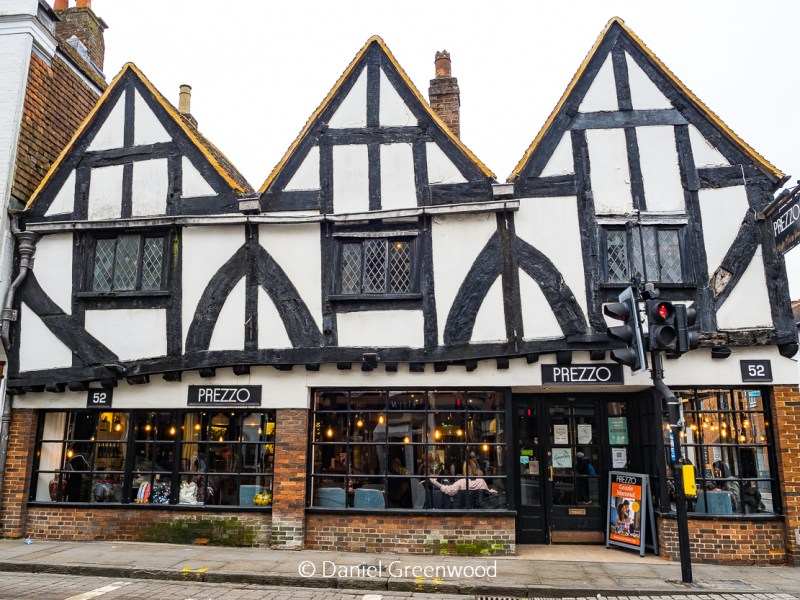
Here’s another entry in my slow-blogging Oak Timbers series. You can view my galleries and posts archive here. I visited Salisbury in Wiltshire (south-west England) for the first time in 2023 and was really charmed by the place. If you’re interested in this kind of thing, Salisbury is the place for you. Here’s a gallery…
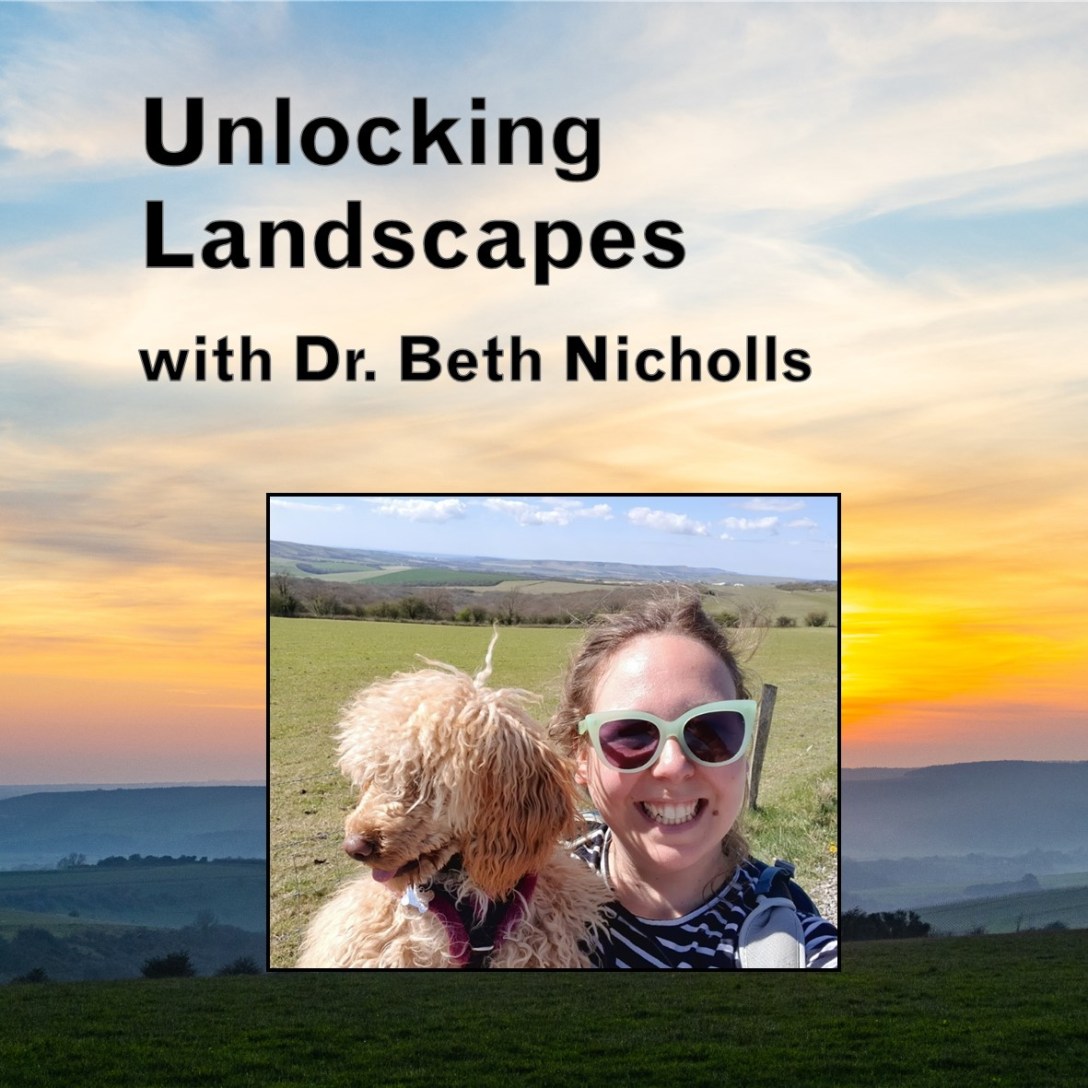
I’m getting into more of a routine of recording and editing audio, so here is the latest episode of Unlocking Landscapes. Listen on Podbean or via the usual platforms. Also via YouTube: https://youtu.be/y1K9Pqx68to?si=B-Fdhf3sdDH35Z8w Following on from July’s rather optimistic fungi walk, I popped back to the same area of ancient Wealden woodland to see if…
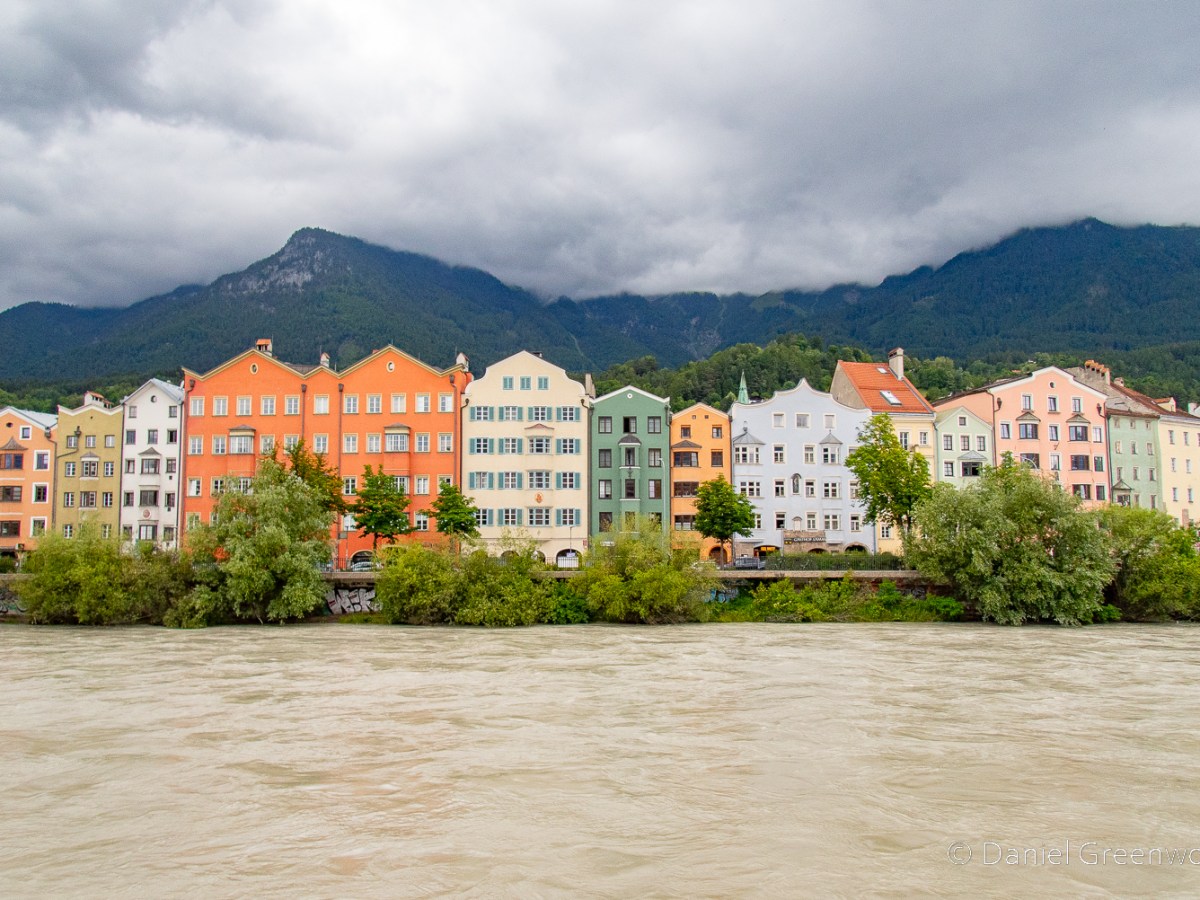
Innsbruck, Tyrol, Austria, June 2025 This is a longer post of the images I captured during a recent visit to Innsbruck in the Austrian Alps. We travelled to Innsbruck on a sleeper train from Amsterdam. It’s such a great experience and is significantly lower in carbon emissions compared with flying. If you consider the fact…
After a month off this summer, Unlocking Landscapes is back and this time it’s outside, with a guest!
In August I met up with Dr. Beth Nicholls at Bedelands Local Nature Reserve in West Sussex. Beth is a researcher on the subject of pollinating insects, with a key focus on bees. She works at the University of Sussex.
Listen here:
We talk about:
what inspired Beth to become a “bee doctor”
the hairiness of bees (but not wasps)
educating people about the importance of all pollinators
issues around honeybees (and Asian hornets) in the UK
why wasps are important, how bee-washing is employed by the corporate world
and the need to change how pesticides are used in the UK
Thanks for tuning in and I hope you enjoy the episode.
This week I stumbled across two of the more charismatic polypores you can find at this time of year. Polypores are bracket fungi that grow like shelves, usually from a tree trunk but sometimes also at the base or from a branch.
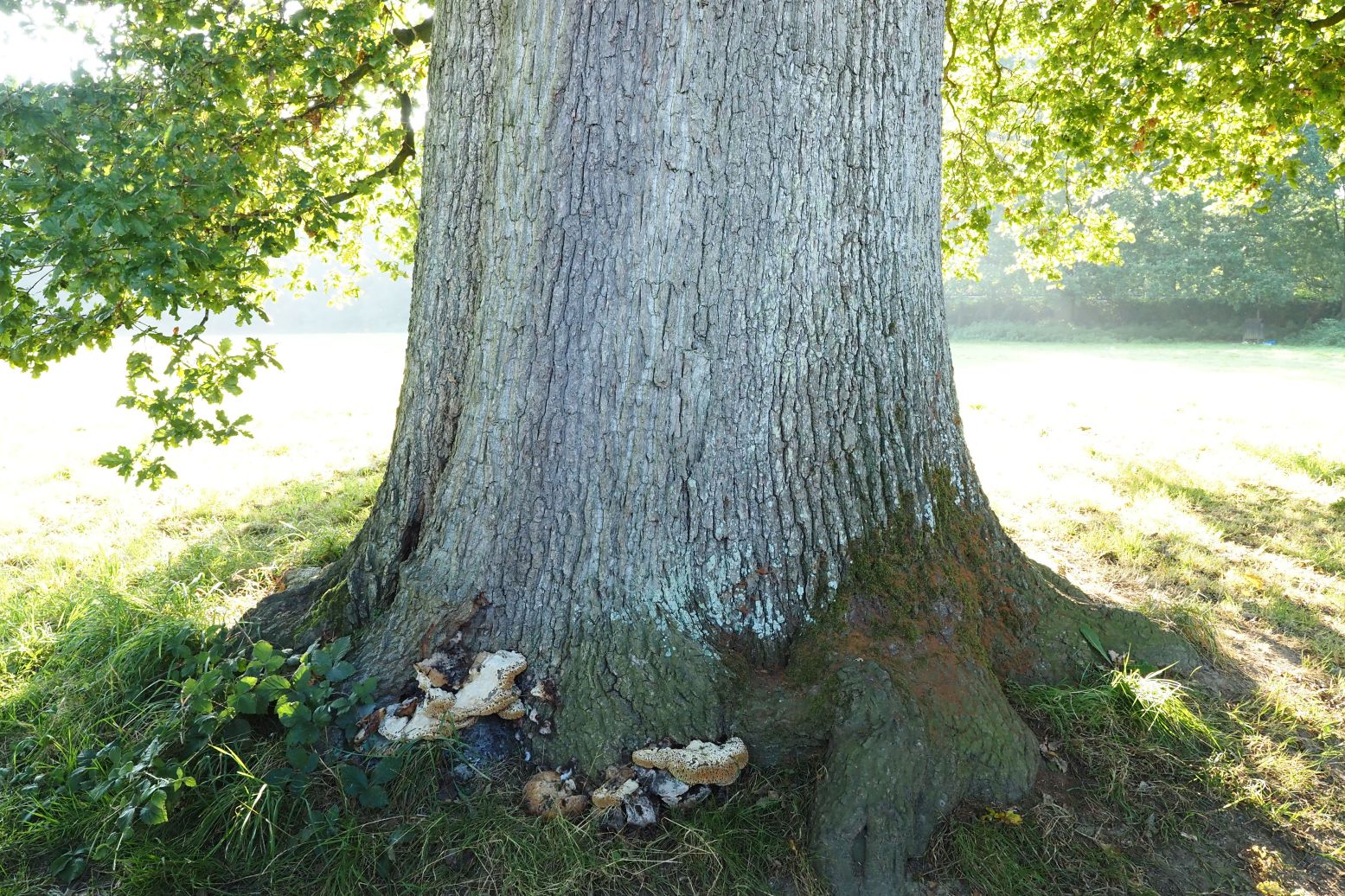
On a morning walk I went to check on the progress of a polypore I’d spotted several months ago (pictured above in late June 2021!), growing at the base of a large oak tree.
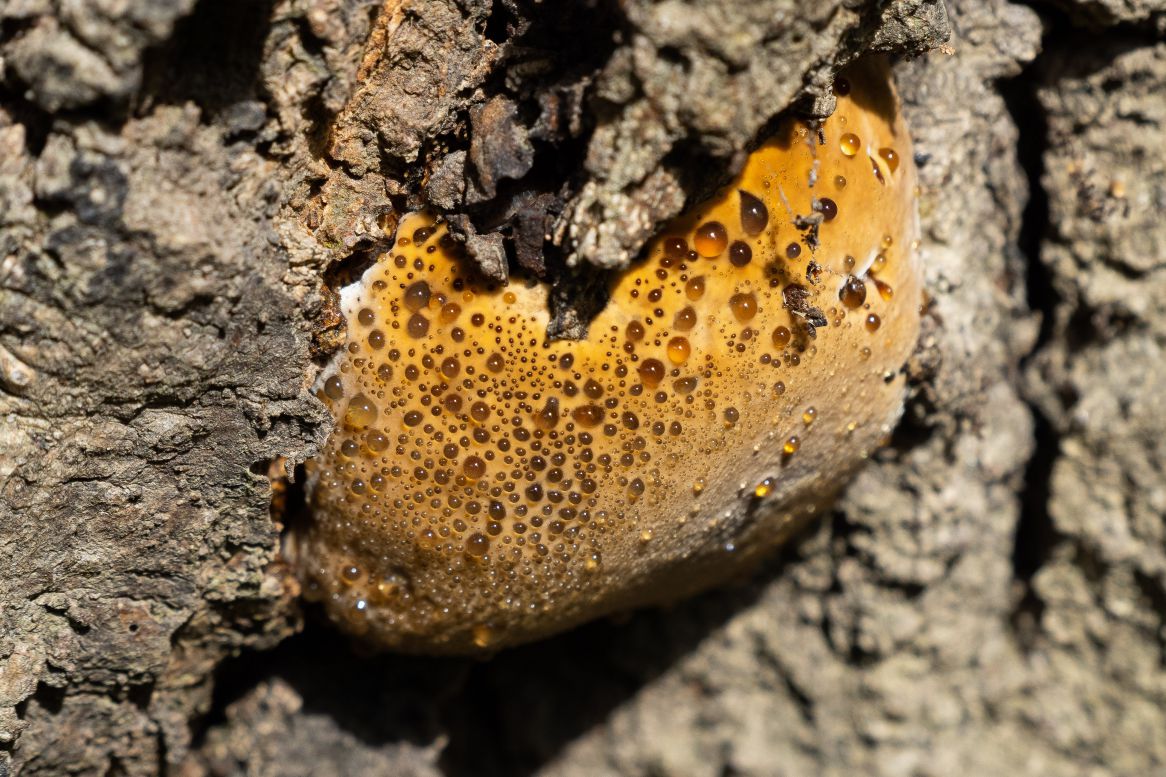
Oak bracket is one I posted about almost exactly a year ago during a visit to Suffolk. It also goes by the name of weeping conk, with a scientific name of Pseudoinonotus dryadeus. It’s a parasitic species, which means that this tree may be suffering some internal, ‘mechanical’ trouble. I hope not because it’s one of the largest in the area and is right next to a path. This makes it much higher up the chopping order if public health might be deemed to be at risk. I will never forget being taught that trees weren’t a hazard until we showed up.
This is a very attractive fungus, if you like a dough that drips caramel. It grows at a fairly critical part of the tree, where it meets the ground. It’s crucial because the tension of the roots holding the trunk upright.
Look into those hundreds of caramel eyes and tell me this is not one of the most beautiful fungi out there.
Later that evening I cycled out to the countryside on what was the end of a September heatwave. The landscape was very dry and smelly. I could smell the manure from my house two miles away in the daytime. That evening I became acquainted with the stench up close – muck spreading in the fields. It was absolutely rank, undoubtedly made far worse by the heat and lack of rain.
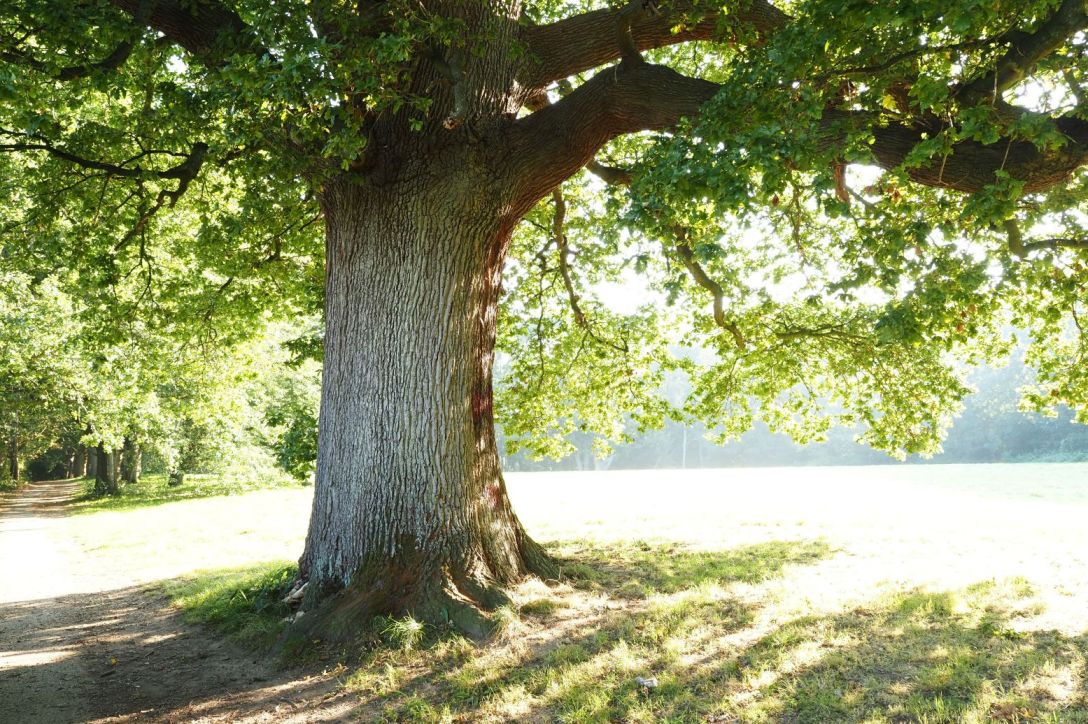
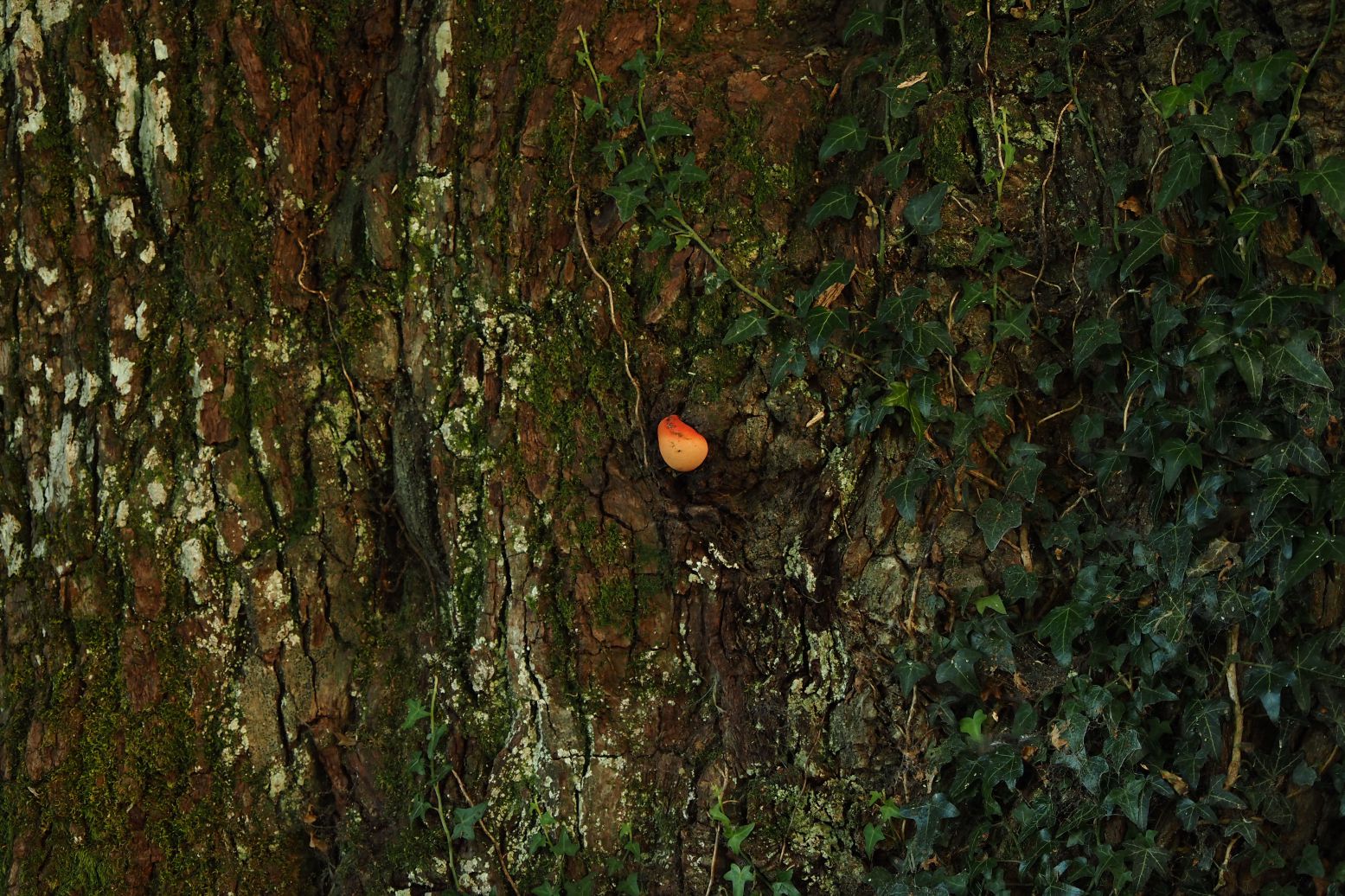
My route took me past the 800-year-old Sun Oak. Like the large oak I saw earlier that morning, this tree was also home to a charismatic polypore fungus.
This red button is a beefsteak fungus, Fistulina hepatica. It may also have been a red button – do not press the red button. Unless you want to continue watching this programme (BBC joke).
Oh go on then.
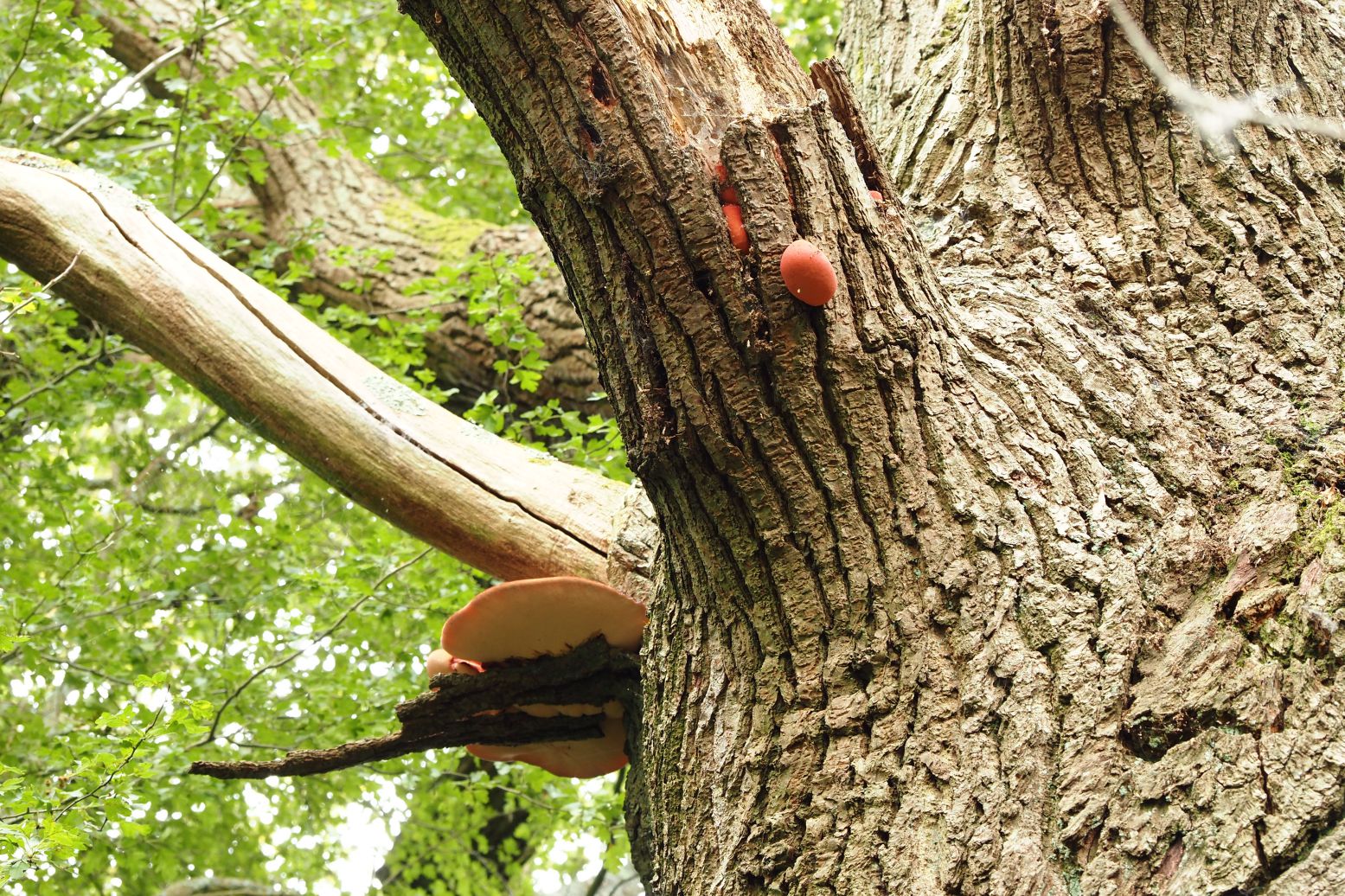
In reality this fungus will grow out to form something that looks like a human bodily organ (hepatica). It’s often on oak or sweet chestnut, especially more mature trees. It’s another parasitic species but it’s said to grow too slowly to ever cause the tree structural problems. We should remember that these fungi have been growing with their hosts for potentially millions of years. It’s the impact we have had on their habitats that have made the trouble. Check yourself before you wreck everything else.
Here’s a recent example that cost me several milligrams in blood as the mosquitos were hanging out under this tree waiting for me to arrive. Beefsteak indeed.
Mid-August: the woods sit between seasons. Leaves are not yet turning, the soil is dry and the leaf litter brittle. Even so, mushrooms are pushing through. I turn off the hard track to cross over the ghyll that cuts through the woodland, one of many dammed further down for the ancient iron industries that hammered this landscape several centuries ago.
Today no such industry exists but the streams still flow. In fact, from this area of the High Weald, some of Sussex’s great rivers rise and head off on their respective journeys: the Arun, the Adur and the Ouse.
Sitting on the bank, I notice fungi on fallen wood but also in the soil. They are terracotta hedgehogs, mushrooms with spikes where the gills or pores are found on other species. They’re a delicious edible mushroom.
When the iron industries were at full pelt here some 400-500 years ago, there was immigration of skilled workers from France. They brought knowledge unavailable to iron workers here in Sussex, with some tensions developing with the local workforce. On 21st January 1556, ‘Peter’ a French collier was ‘cruelly murdered’ (Weir-Wilson, 2021: p.45).
I wonder if those French men and women picked hedgehogs here, a species that’s treated as a delicacy in France. The Belgian father of a friend of mine messaged me on social media when I posted a photo of these mushrooms:
‘Pied de mouton,’ he said. ‘Clean then blanch them for 2min. Drain and keep. Fry 2 shallots and 1 garlic in butter (or oil). Butter tastes better.’
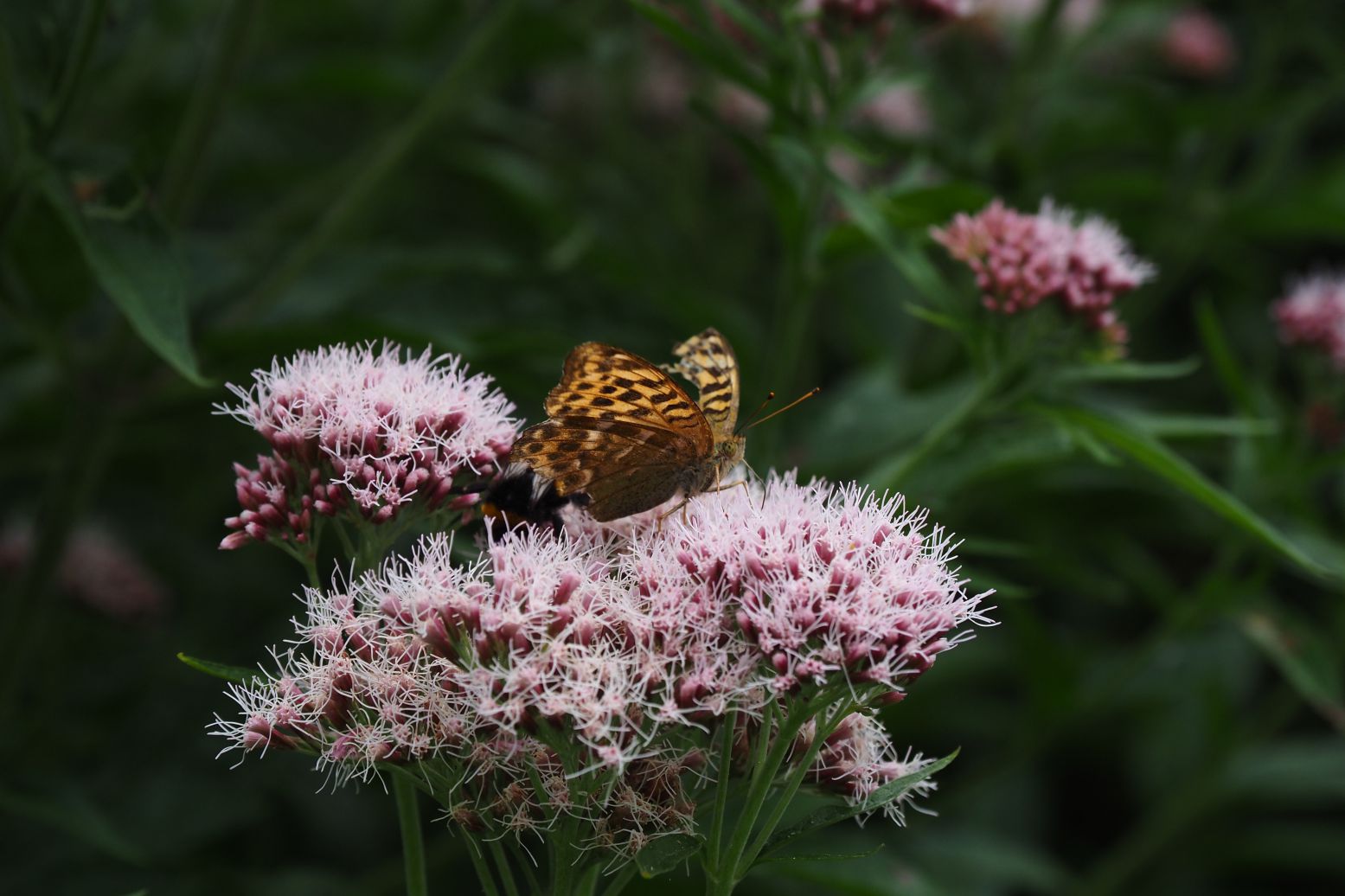
Deeper into the woodland there are the first signs of heather beginning to flower. The birdsong has dwindled but the edges of the rides burst with flowers that are covered in insects. A broken and battered fritillary butterfly nectars on hemp agrimony flowers as if for the first time. I watch to see if a butterfly with so many pecks taken from its wings can even fly, but it does, high into the overcast sky.
Further along the ride hogweed has built a great white canopy. The droneflies – a honeybee mimic – drink nectar in their tens, fizzing as they switch from one umbel to another. That’s when I notice the long, drooping antennae of a longhorn beetle, doing the very same thing. I can’t take my eyes from it, as it clambers over the small inflorescences.
After walking along the endless forestry road, I slip back into the woodland to an area of birchy bog and broken beeches. It’s quiet and still in here. Unlike the final bursts of summer flowers on the open forest rides, autumn can be found among the birch trees.
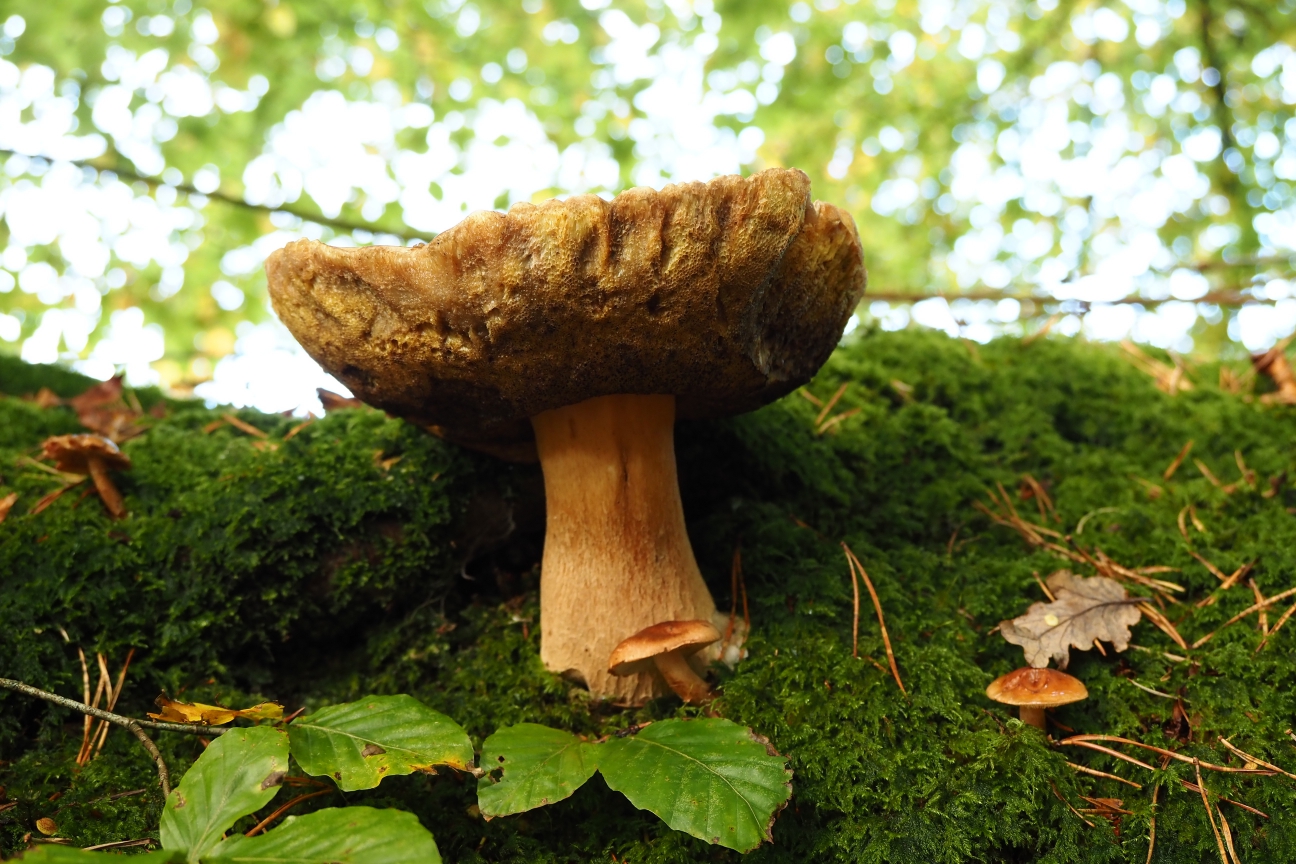
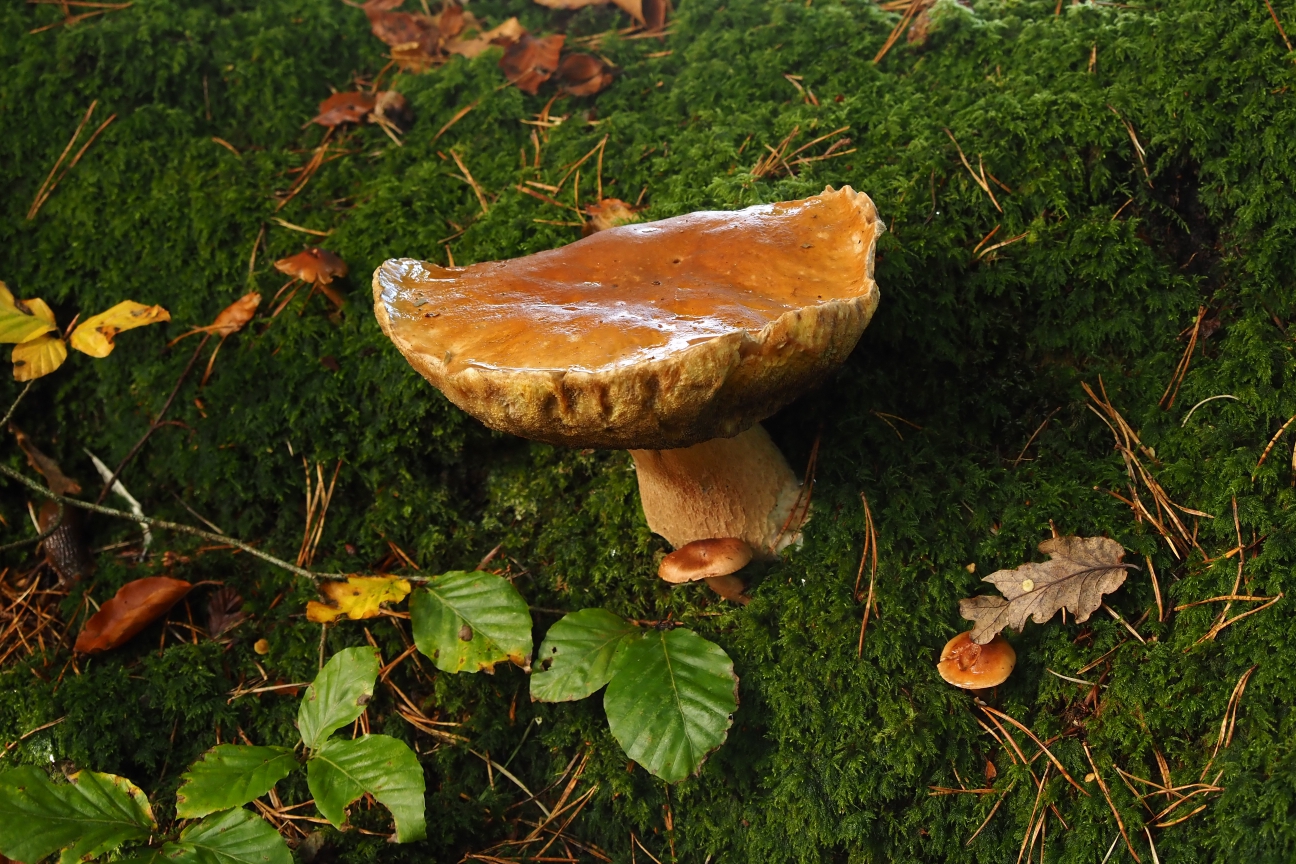
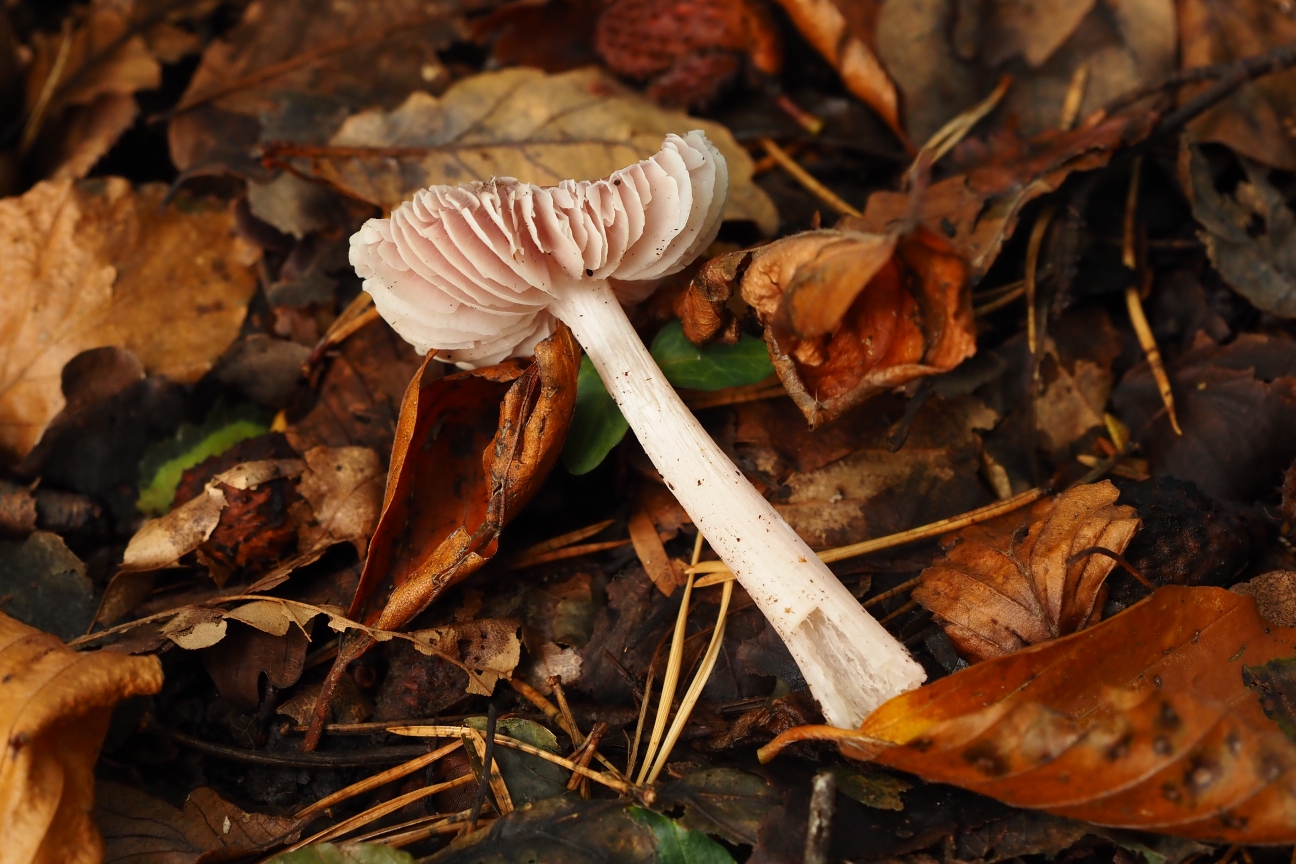
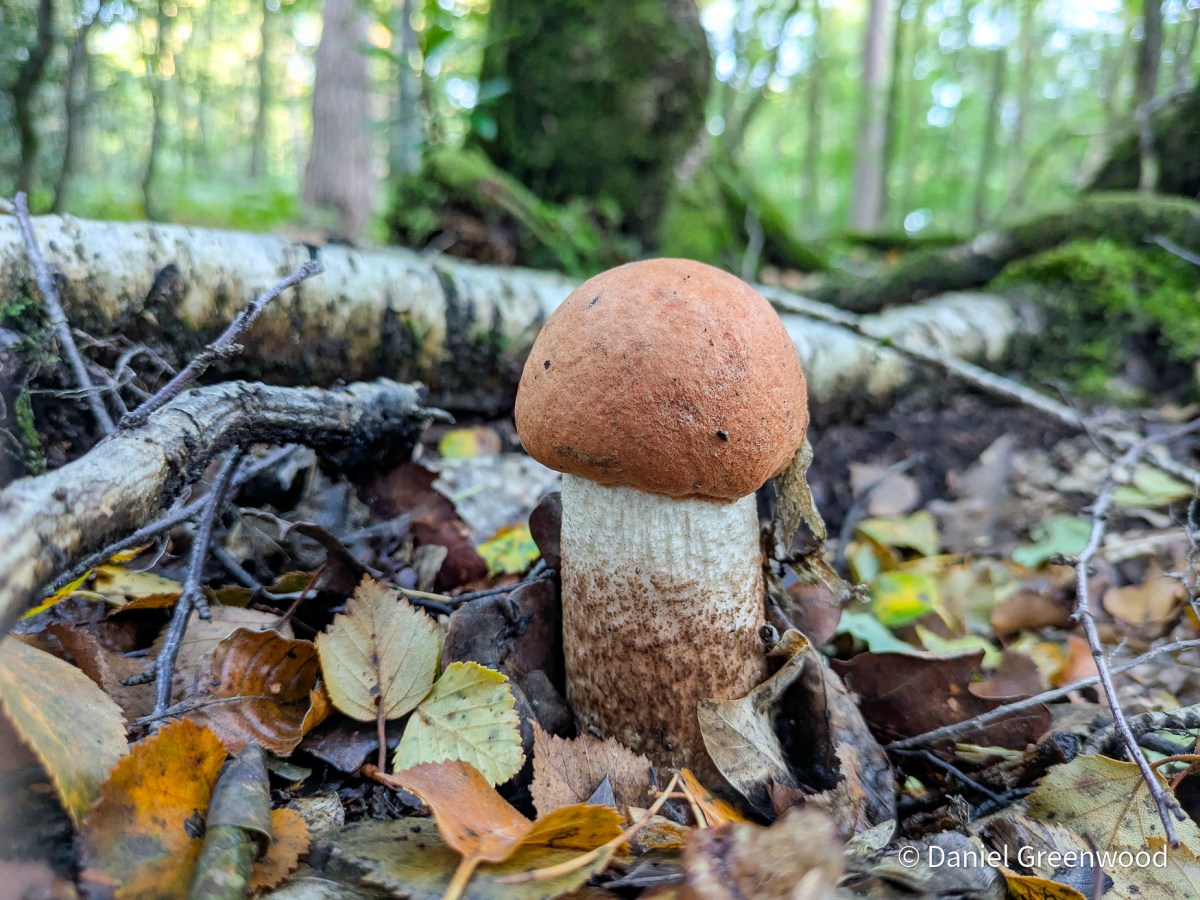
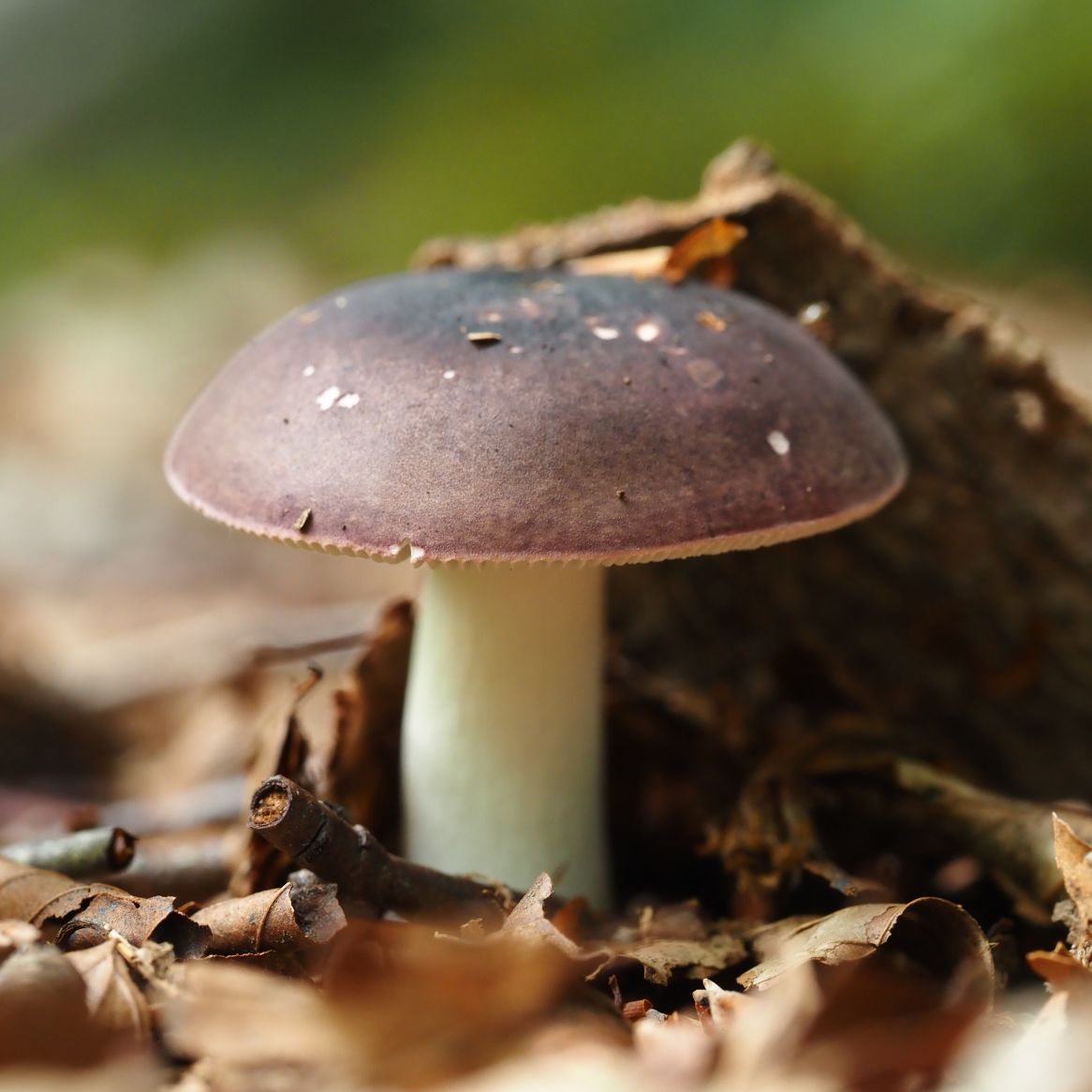
First there is a bolete with its pores and cap that has begun to turn upwards, growing from a stump. There’s a Leccinum or birch bolete of some sort standing tall (for its kind) in the soil. There are Russulas yellow, red, green and purple. These hard to identify fungi are a mental bridge between summer and autumn. They are also a welcome meal for squirrels and whatever can get there first.
It’s a reminder that the seasons are not concrete. There is give and take, building blocks can come tumbling down. Seasonal signs come with species appearing, some that pass like ships in the night.
























































 Unlocking Landscapes