The article was outlining how significant wasps are in our world, as controllers of other invertebrates that, in over abundance, would create a damaging imbalance in our farming- and eco-systems.
We should worry about the lack of wasps this summer, the article said. Helena Horton would probably enjoy this blog, to be honest!
As you may have noticed, there are very few images in this post. There’s a reason for that, which I’ll get to. After reading the article I went to put the washing on the line. With a cursory glance at the fennel in the flowerbed I noticed that one of my favourite wasps was visiting.
I skipped indoors, grabbed my camera with macro lens and began following the wasp around the fennel flowers. I didn’t get anything worth sharing, until the wasp was spooked and dropped down to cover in some grasses. As you can see above, it then began to clean pollen from its face and antennae. I fired off some pics and then checked them. They were super sharp and beautifully lit by the soft light from the clouds overhead.
There are only two pictures, almost identical but for their crop, because they represent the wasp in the best way I can. Clear, in focus, and sharp.
The insect season is drawing to a close and it’s been a poor one. Hopefully absence may make the heart grow fonder, and action taken at scale to ensure these pollinators, not just honeybees, can be protected.
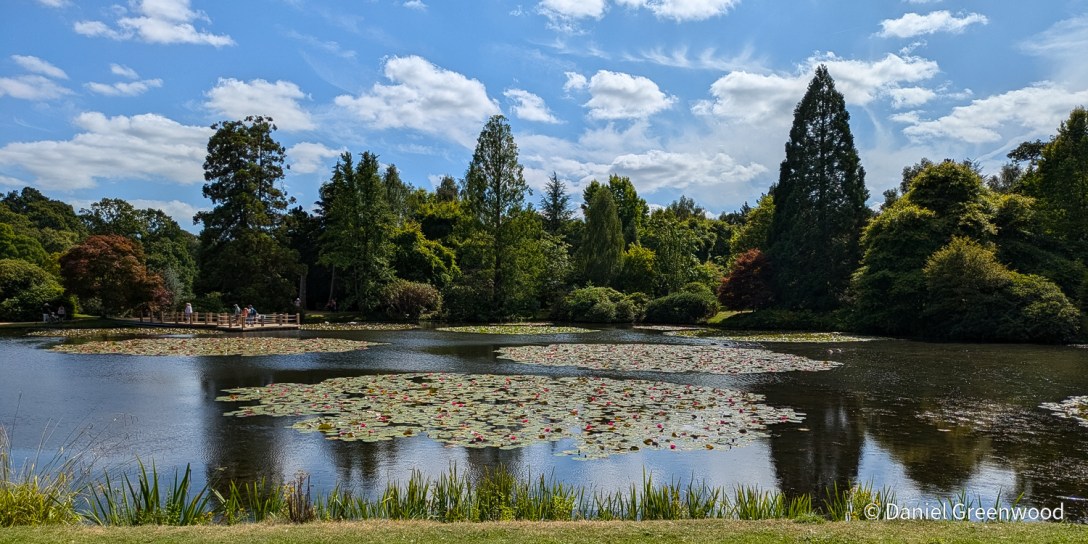
For my mum’s birthday in early August, we visited Sheffield Park in East Sussex, just over the border from West Sussex. It’s a National Trust estate so membership is needed to avoid the £17 entrance fee.
I didn’t have a camera with me other than my phone, but the Pixel 7a has an amazing camera, so I managed some nice pics of a few damselflies.
Obviously these are people not dragonflies, but the area was absolutely zinging with Odonata (the scientific name for dragons and damsels). This is looking back towards where the estate house is, though it’s not somewhere you can enter. People live there like in olden times.
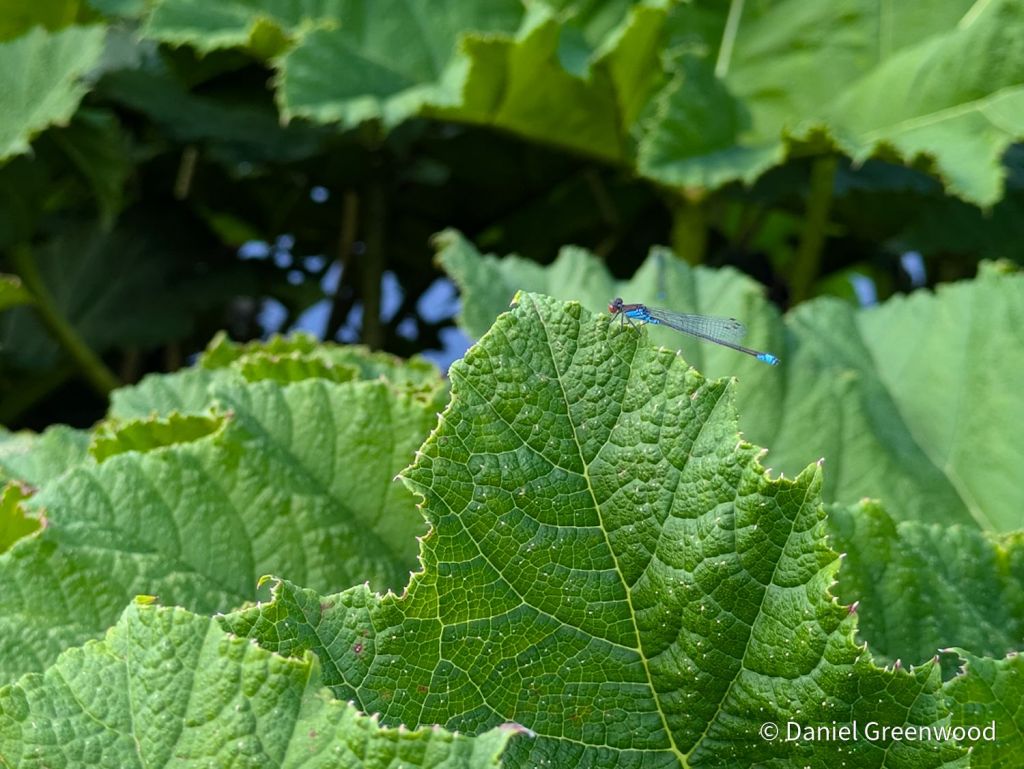
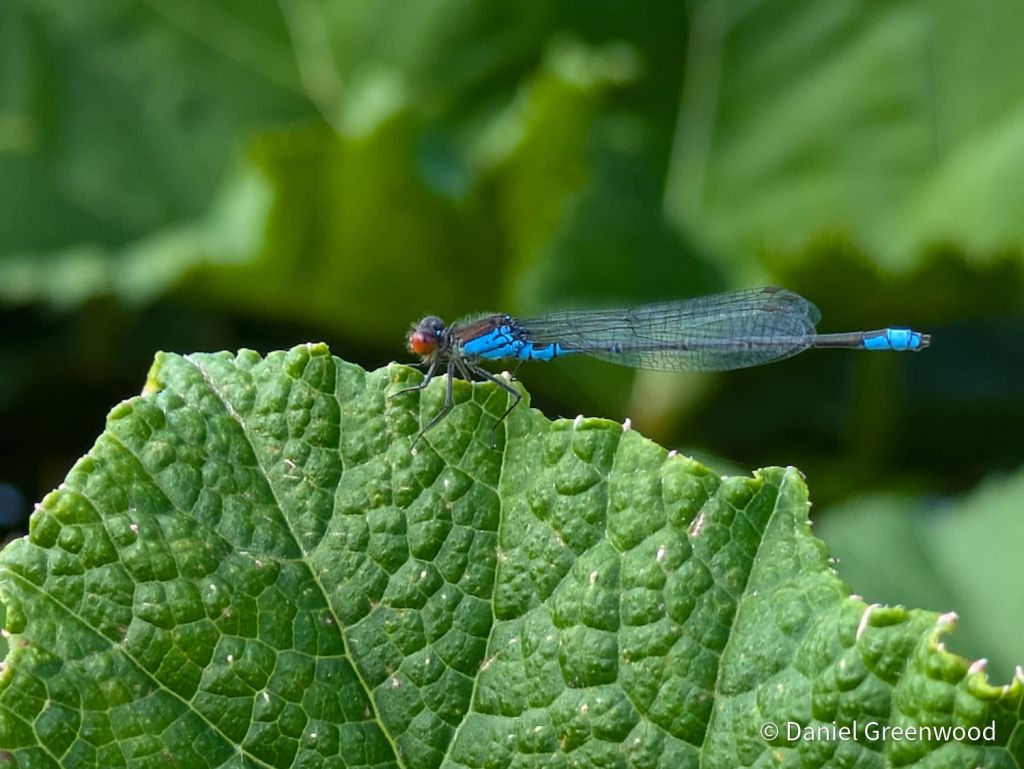
Perched on the edge of the giant rhubarb (Gunnera – a super invasive wetland plant installed in places like Sheffield Park long ago for their showy foliage) was a small red-eyed damselfly.
What a beauty. Damselflies generally rest with closed wings, while dragonflies have them open. That notion was quickly dispelled by my next sighting. Usually dragons are much bigger anyway, by the way.
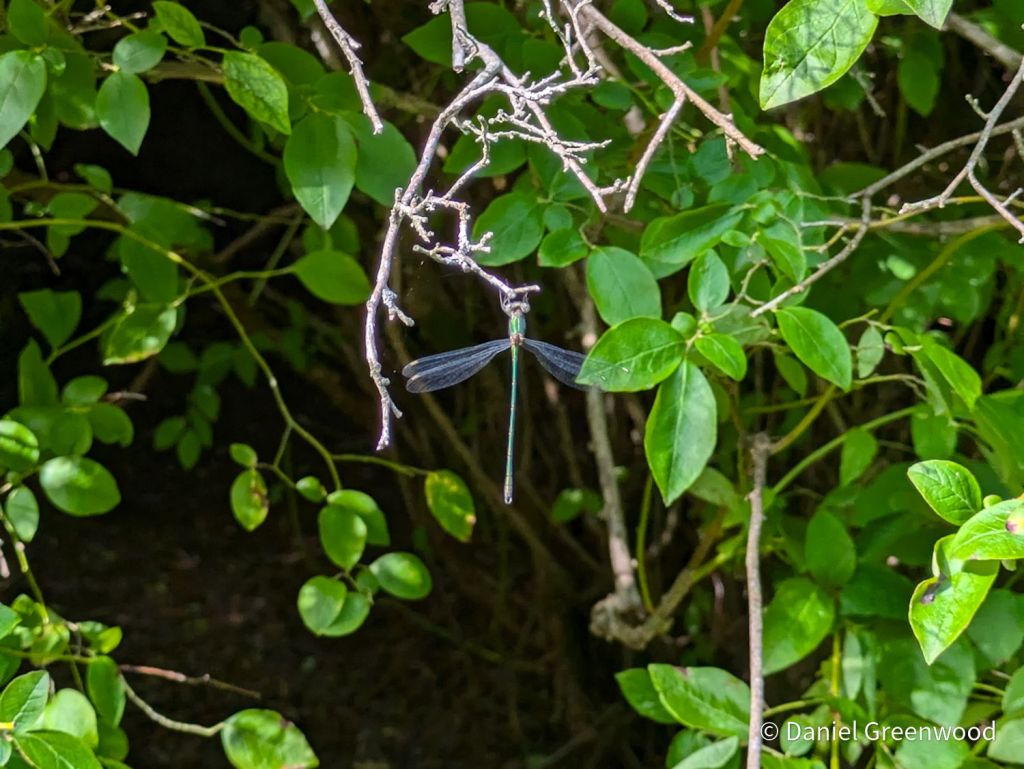
I was chatting to my sister when I noticed a damsel had taken a very pleasing perch in a shrub. A damselfly holding its wings out!
Now this is a willow emerald damsel, a species which ten years ago people were losing their minds over. It was a new arrival in the UK, and likely indicative of a warming climate. Now they are everywhere in southern England, and we’re experiencing temperature breakthroughs year on year.
I was just pleased to share a nice day in Sussex with my nearest and dearest. You can’t ask for much more than that, except for maybe some beautiful damselflies.
Warnham Local Nature Reserve, West Sussex, July 2024
I was making my first meaningful trip out to a wild space after being ill with Covid, to see if I could concentrate enough on taking some macro pics. Thankfully there were some very docile bugs pleading for their close up. Here you go, team.
I’ve missed a lot of the macro season this year, what has probably been one of the ‘worst’ summers in this part of England. Lots of rain, quite cool, clear lack of insects. I’m only just getting over brain fog so not able to compute how worrying the insect declines are right now. It seems that approving the use of bee-killing pesticides without appropriate risk assessment doesn’t help.
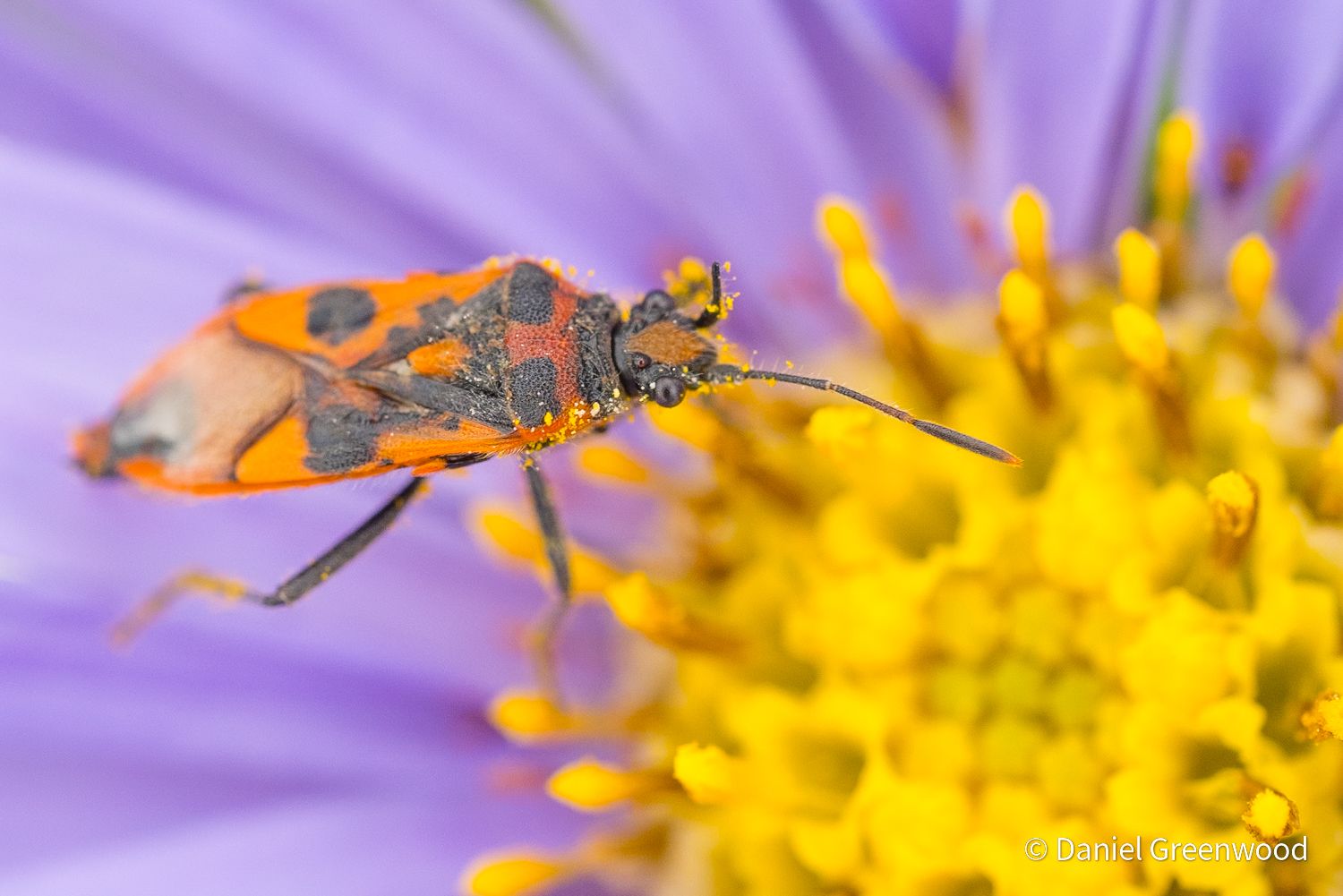
I was fortunate to spot this cinnamon bug nectaring in the flowerhead of a Michaelmas daisy within a few minutes of my visit to Warnham Local Nature Reserve. I love how this pollinating beetles get so covered by the pollen. It’s a bit like me after eating a choc ice.
Though flies are feared and reviled for their connections with unpleasant organic matter in this world, some of them are very interesting to look at. Many of them also tend to be pollinators. It’s not all about the bees. This fly is probably Nowickia ferox, which feeds on flowers. Moth fans – look away now. Their larvae develop in the dark arches moth.
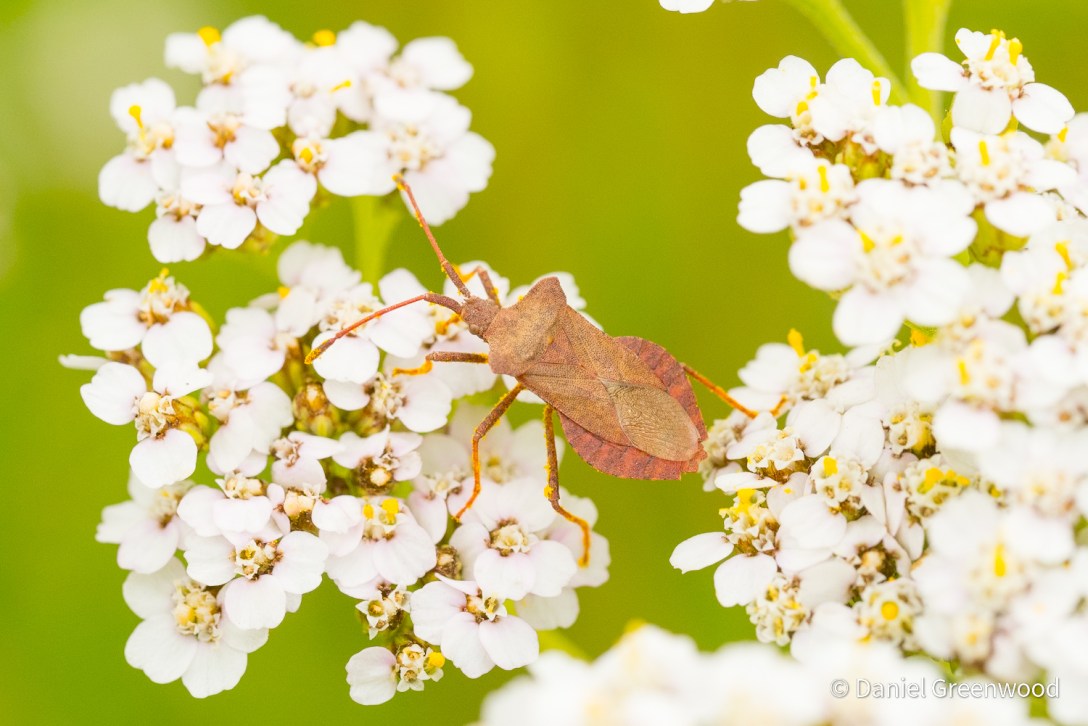
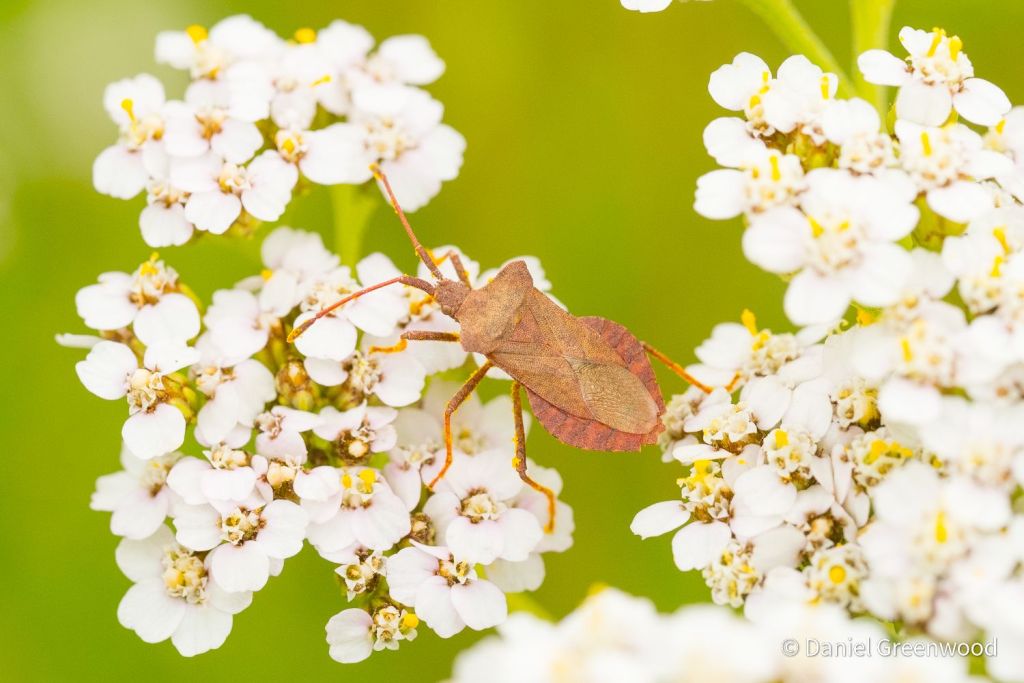
Dock bugs are a common sight in southern England, especially in flowery grasslands and meadows. They are very easy to photograph – they’re like the mushrooms of the insect world, slow moving, if at all. How trusting.
Elsewhere, this mid-summer period is one of hoverflies, many which looked very similar to the untrained eye (this one) but which can be nice subjects among the flowers of hogweed and other umbellifers.
I was pleased with this photo of a dancefly as it nectared on some ailing hogweed flowers. That is one heck of a proboscis. The light is very soft and the background is a serene green.
Over the years (I’ve been using a dedicated macro lens since 2014) I’ve learned about species behaviour, and how a little bit of knowledge can really help you to find wildlife. In terms of invertebrates, I remember a blog written about fenceposts and how they were a good place to find roosting insects. This is solid advice.
During this visit, in the forefront of my mind was a past, failed attempt to photograph a robberfly where it sat on a handrail. On that same handrail I didn’t find a robberfly, but instead my mother and father-in-law, which was also nice. But, that wasn’t the end of the story…
Turning to head home, realising how fatigued I was, and lacking in normal, basic levels of energy, I spotted something. A robberfly was sat on a different handrail! It’s so pleasing to have this sense of validation for my fencepost knowledge.
In the world of wasps, we are of course in the throes of the UK Media Silly Season (despite there being a General Election, potential dictatorship in the US, and far-right riots across the UK!) and wasps are in the news. Interestingly the mwin story is, where are they?
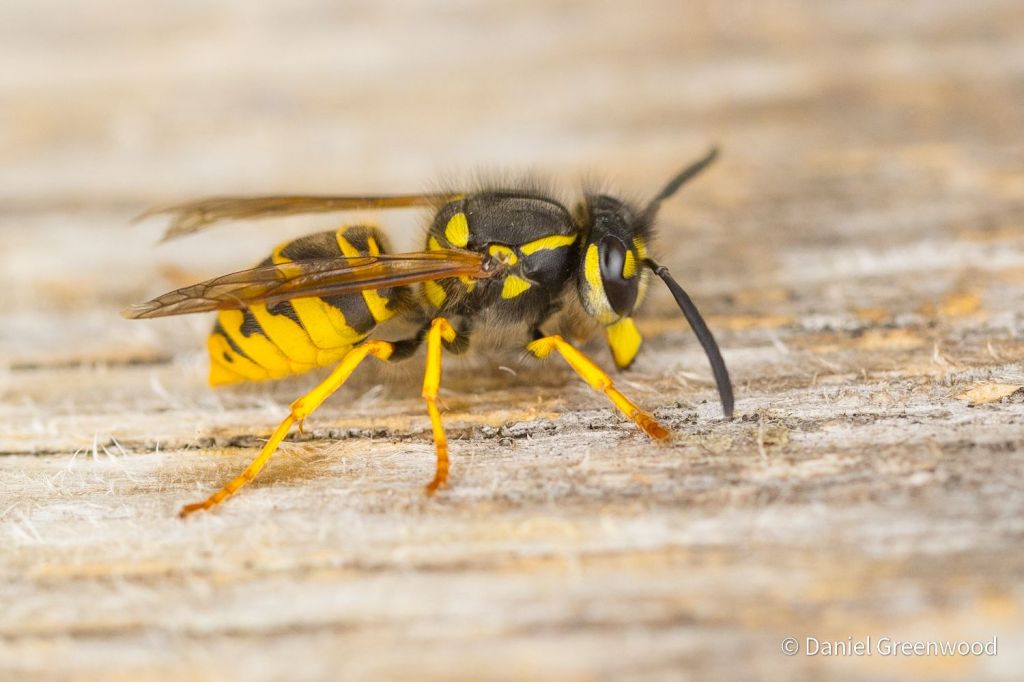
iNaturalist users think the wasp above is a German wasp. What you can see is the wasp gathering wood shavings for a nest. But that wasn’t the only wasp I saw.
July and August are good months to see the iconic ichneumon wasps. I absolutely love them, an interest which was deepened by reading The Snoring Bird (I recommend it). I wasn’t fast enough for this ichneumon to really get a strong pic, but this will do.
Even worse was this attempt to photograph one of the Gasteruption ichneumons. People, I am just too short for plants that want to grow this tall. I do enjoy the bokeh here though (circular light in the background). Take that, full-frame cameras!
So, all in all a decent showing for a fatigued individual.
Thanks for reading.
Photos taken with Olympus EM1 Mark III and 60mm f2.8 macro lens, edited in Lightroom.
In June, my wife called me out to the garden because she’d found something in the gooseberry. Pretty standard.
She has an amazing ability to find things and is especially good at foraging. In this instance she’d found caterpillars munching through the gooseberry leaves.
There was a sense of both amazement at what we were witnessing and fear for the health of the shrub. We don’t survive on gooseberries and the birds almost always get to them first, but you don’t really want your shrub to die. Then again it hasn’t exactly been a raging success, to be honest.
Personally, I always think English gardening culture fails to accept death and decay into the mix, and the important role that plays. Gardens should feed local wildlife, not just be a killing zone for visitors deemed unwelcome.
One summer does not a garden make!
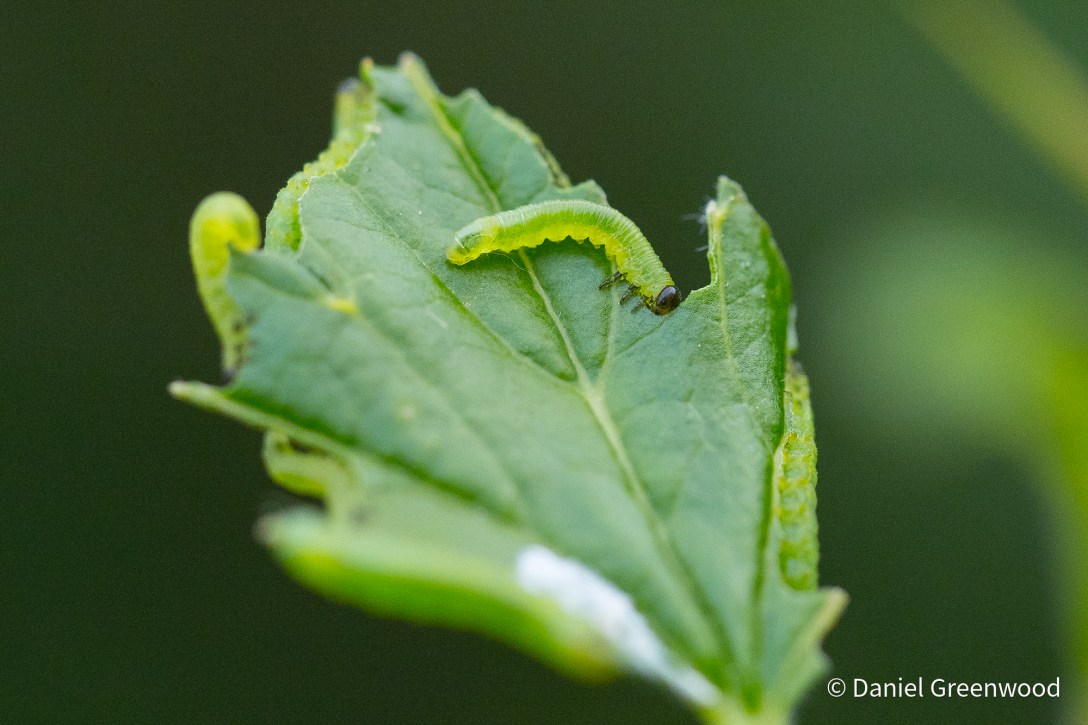
With the help of iNaturalist I understand these to be small gooseberry sawflies (Pristiphora appendiculata). Sawflies are relatives of bees and wasps that are common in gardens and elsewhere.
I do love this view of the sawfly caterpillar nibbling its way through the leaf. When we looked at them on the gooseberry new caterpillars would appear as your eyes adjusted.
In the days that followed I noticed house sparrows hanging from the surrounding raspberries and picking at the gooseberry. That’s a very good meal, especially for fledglings.
Some days later I spotted a new visitor to the gooseberry. I was confident this was a sawfly (not knowing anything about their lifecycle) but unsure if this was one of the caterpillars emerged as an adult insect. I’m not sure, but it’s likely to be an adult small gooseberry sawfly.
As for the gooseberry bush, it looks ‘touch and go’ as football physios say. It’s part of the game of life.
I’ve posted before about the so-called ‘zombie fungus‘, but that wasn’t in my own garden!
There are a few fungal concepts that have become mainstream in recent years, namely the wood-wide web and ‘zombie’ fungi. The latter has become popularised because of The Last of Us, a programme I haven’t watched and can’t say anymore about. The most famous parasitic fungus that can control its host is cordyceps.
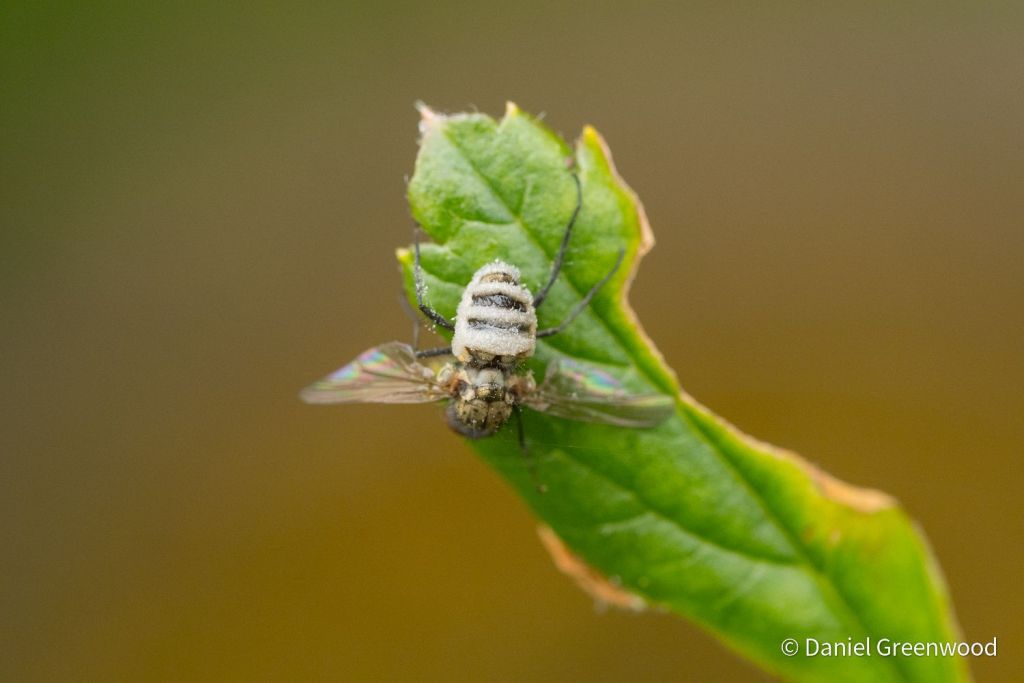
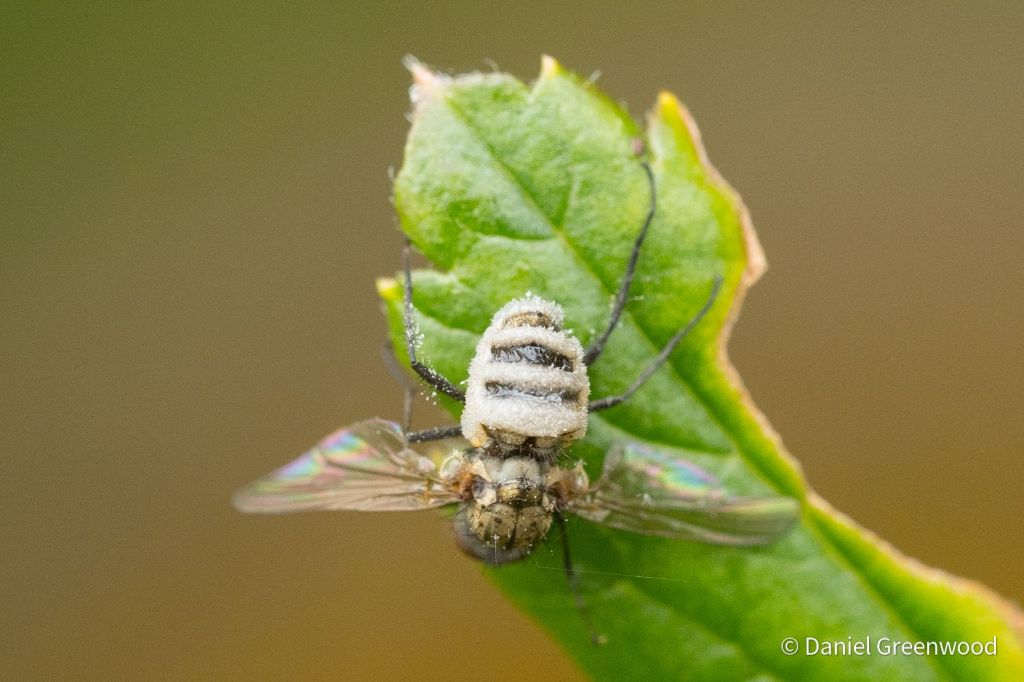
My wife actually found this (not cordyceps) when she was inspecting the gooseberry bush, which was steadily being eaten by sawfly larvae. I’ll post about them next.
What is this exactly? It’s a fly that has been parasitised by a fungus called Entomophthora. It basically is able to control the movement of the fly by making it move to a prominent position for its final moments, or at least I think that’s what’s happening.
The prominent position then allows the fungus to spread its spores on the wind or from a more beneficial height to reach its next host, however that occurs.
It’s not quite as gory as cordyceps, where a fungal fruiting body rises from the body of its host. It is altogether more macabre and sad-looking, though. Cordyceps can be very colourful.
In reality it is just an example of the immense biological diversity out there, the interactions between two kingdoms – animals and fungi.
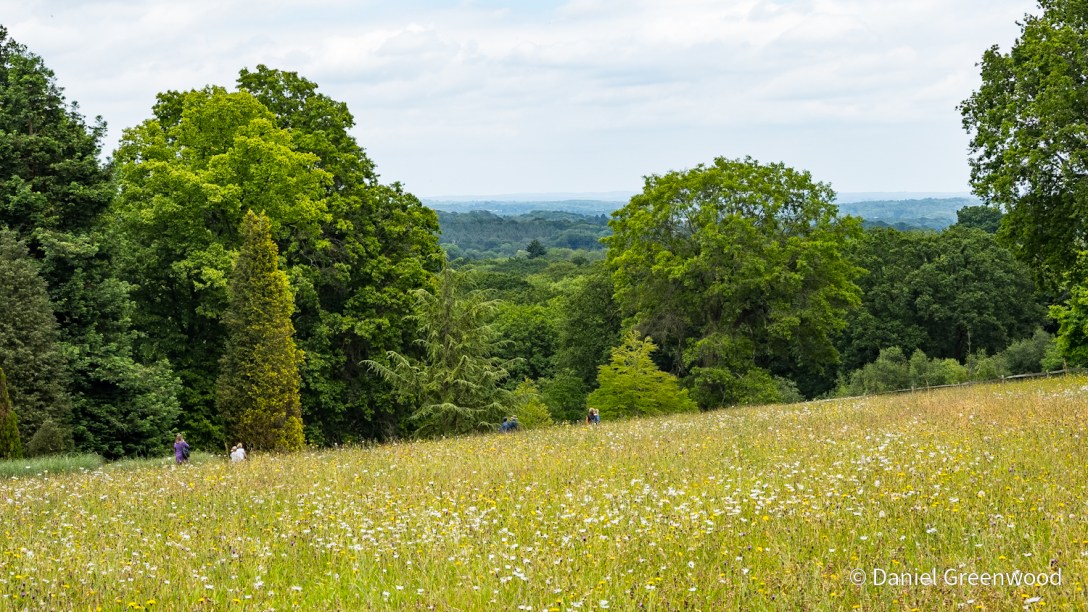
Nymans is a National Trust garden in the western edge of the High Weald. There are great views across Mid Sussex towards the South Downs. This visit was just for a general walk, but it quickly dawned on me that it could be a chance for some macro.
I had my Olympus 12-45mm lens with me which can work really well as a macro lens. Bingo!
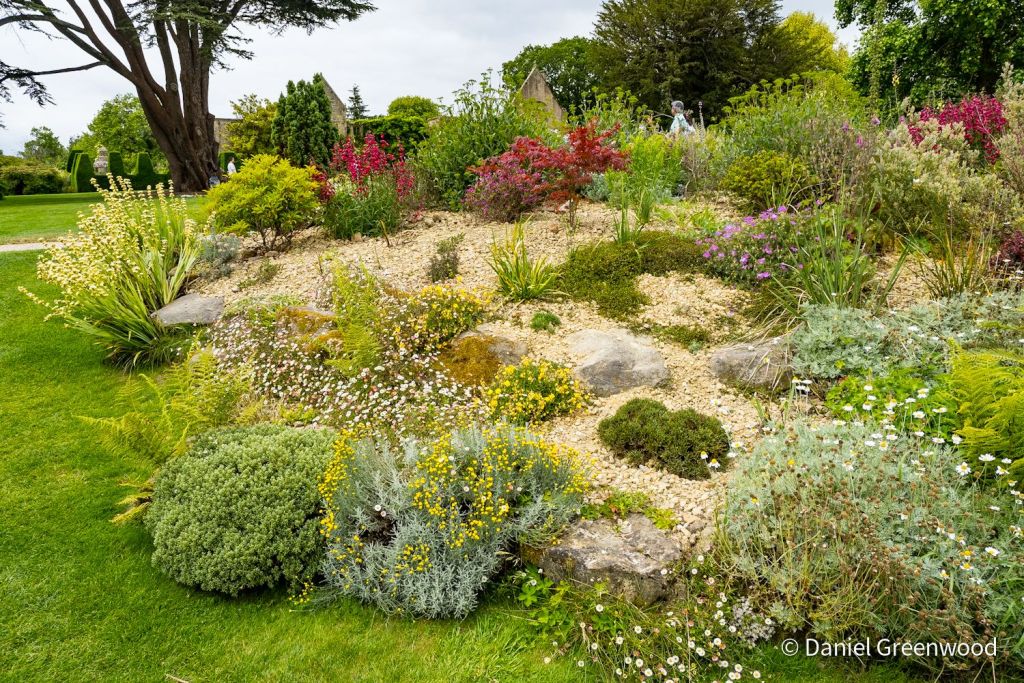
Nymans has a lovely array of rock gardens and extravagant flowering borders.
The common spotted orchids were peaking, as you can see, the flowers turning to seed.
I realised this visit could be interesting for macro when we spotted this caterpillar munching on a knapweed leaf. It’s the larva of a sawfly, rather than a moth or butterfly.
Elsewhere on the knapweed was this small robberfly. I love seeing this striking group of flies, they make great subjects. They also strike, in the predatory sense.
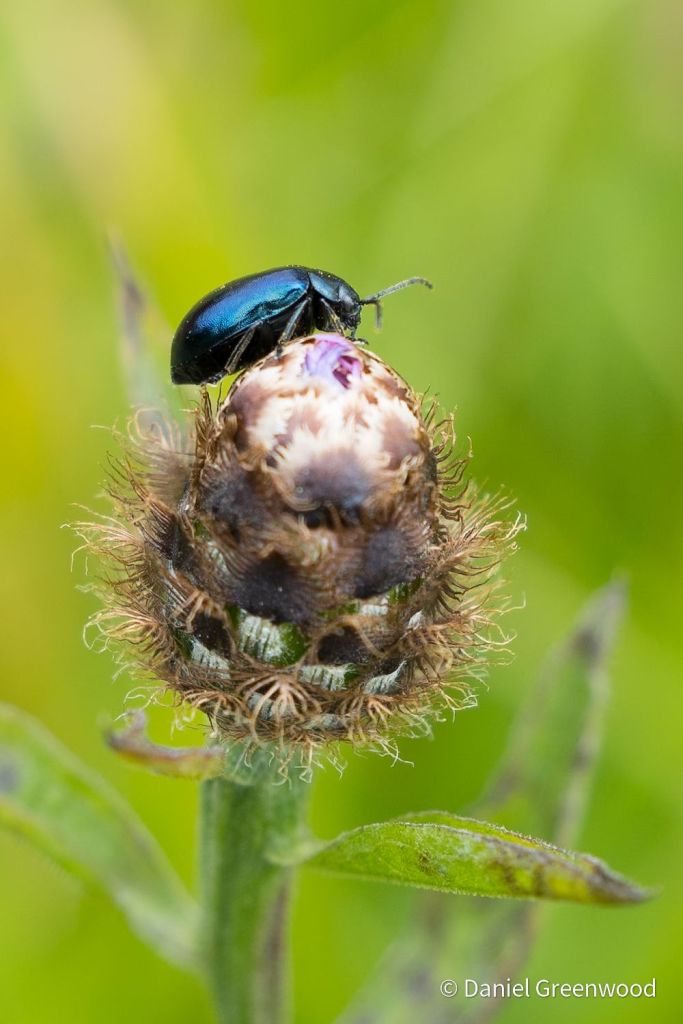
I’ve seen loads of alder leaf beetles since moving to Sussex but I usually see them in towns. It’s always nice to see one in a meadow.
There were a number of small bees around. I think this is one of the bronze furrow bees.
In the head of a meadow cranesbill was this rather dozy little solitary bee. I pulled the petal to the side, as you can see here, to see if it had been caught by a spider. It hadn’t, it was just still.
Nymans has rose gardens, where I found this solitary bee trying to make sense of the maze of petals. Life, eh?
I started drafting this blog while unknowingly coming down with COVID, and now can’t remember what I wanted to say…
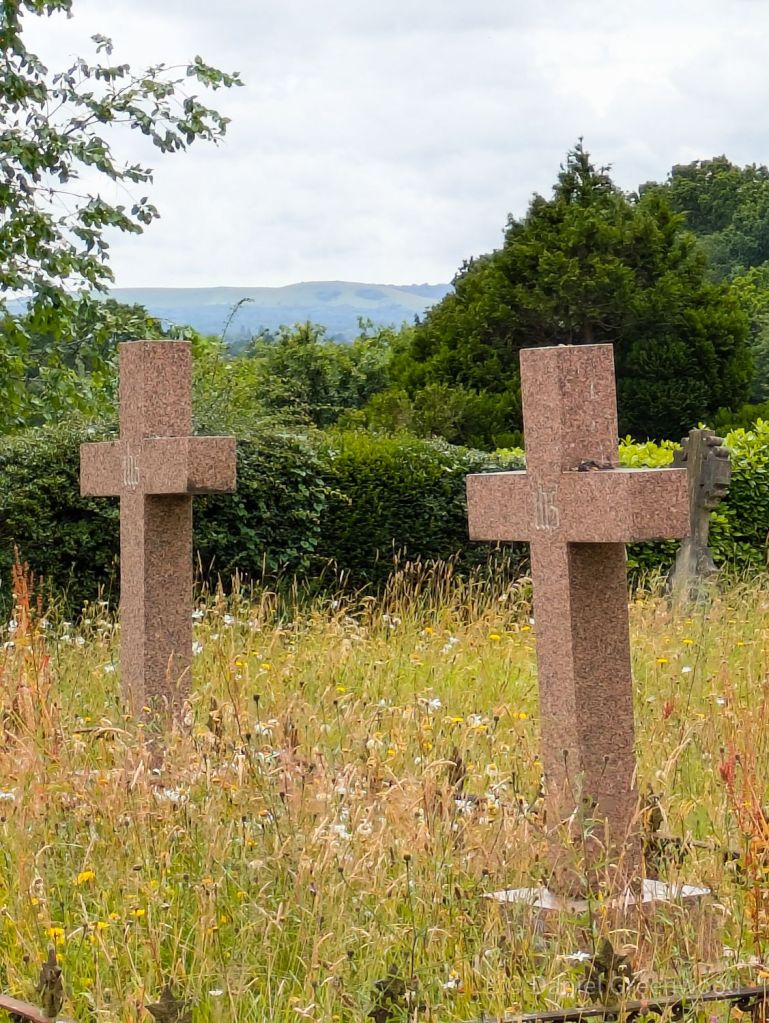
Nevertheless, the photos here are a few phone pics from a wonderful churchyard in Haywards Heath in West Sussex.
The churchyard has views of the South Downs, in this case towards Wolstonbury Hill. I was actually going to be walking there for the coming weekend but the virus has robbed me of that dream. I must spend less time hugging 5G phone masts.
Again, I am so impressed by the detail that the newer phone cameras can achieve. This is probably a furrow bee (I think sometimes referred to as sweat bees?) in a common knapweed flower head. Did you know that daisies are some of the most evolutionarily-recent flowers and they make use of multiple florets, as seen here. Bees are impressed.
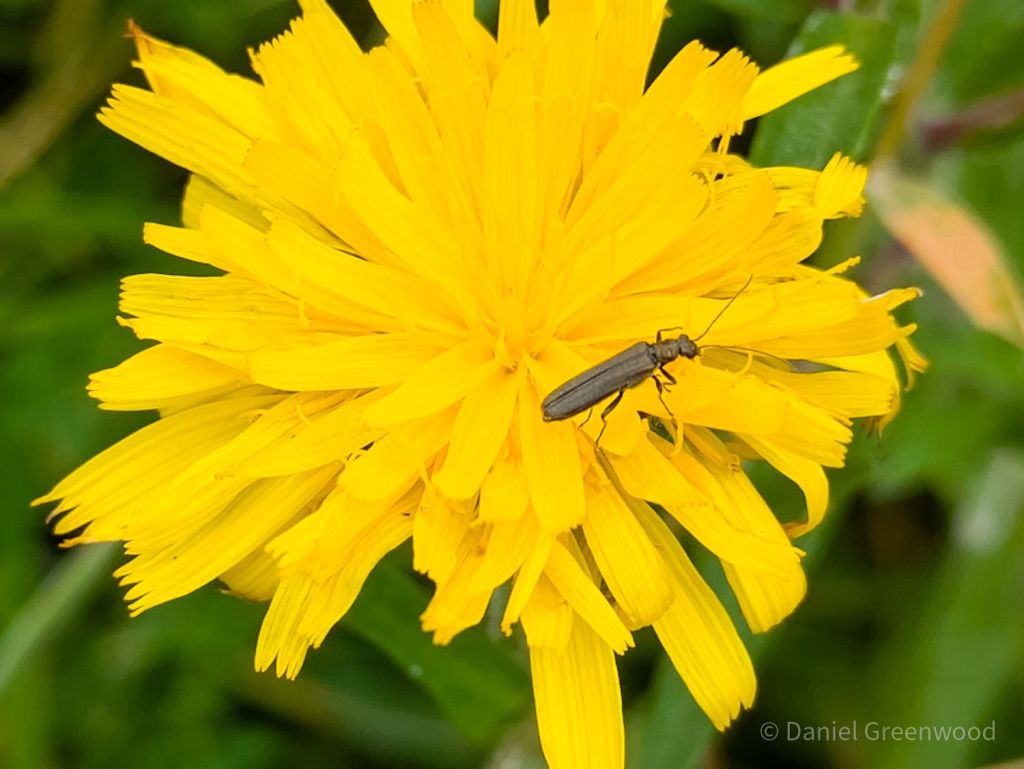
Hawksbeard or hawkbits (too ill to check) abound in these Sussex Weald grasslands. This is an Oedemera beetle, so a relative of the iconic swollen-thighed beetle. You may have seen him pumping iron in your local gym.
The nicest find was among the ragwort, a plant that inspires those on the margins of society, and upsets those who worry about their livestock being poisoned by it.
This is a cinnabar moth caterpillar, like the socks of some experimental Netherlands football kit. Their homestrip warns of their toxicity, so I had a sandwich for lunch on this occasion, just to be safe. Not that it made any difference! #Sick
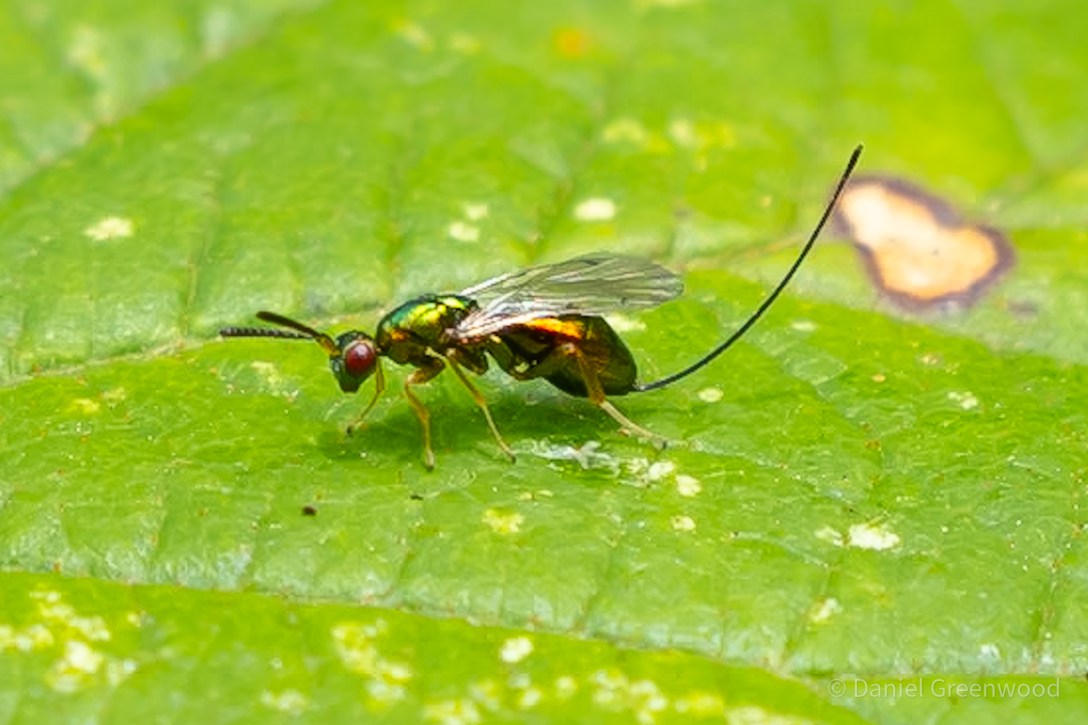
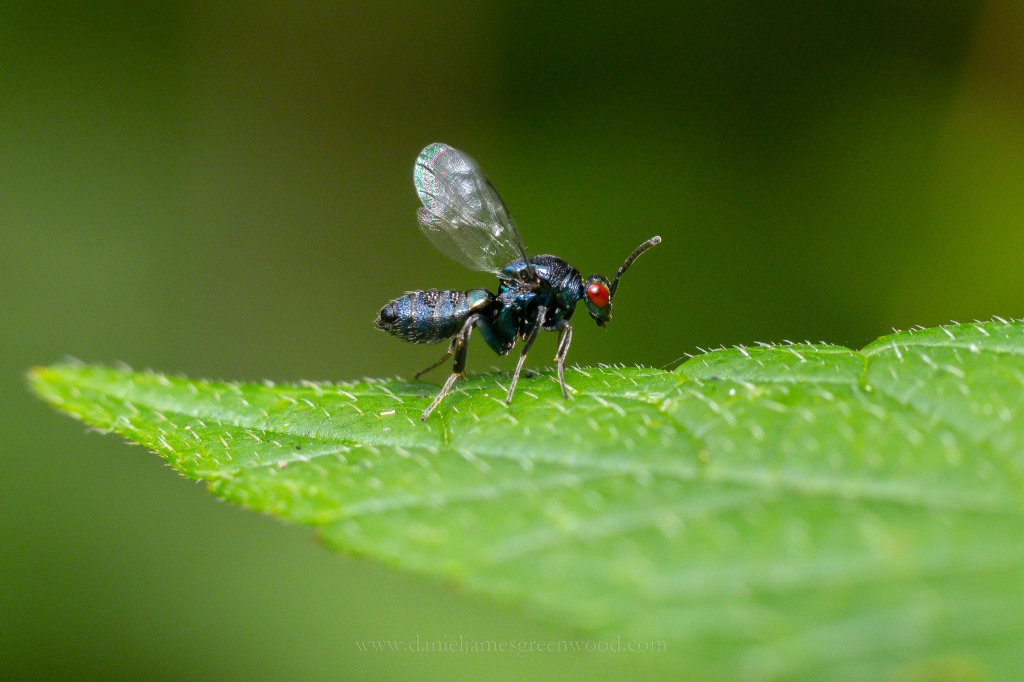
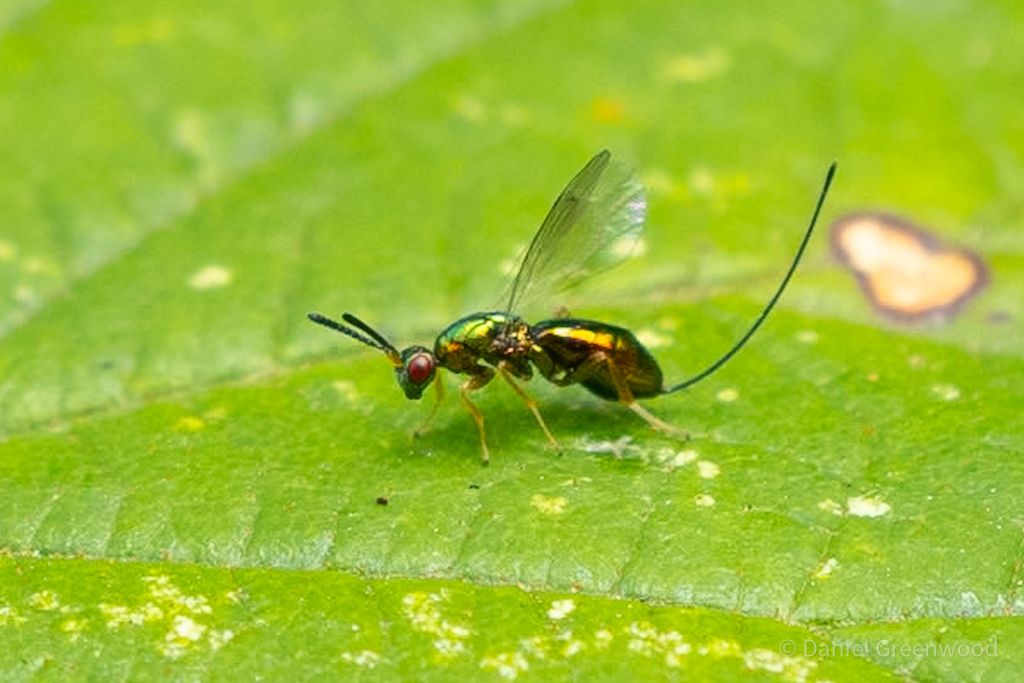
I was out for a walk the other day and found myself in among some brambles. I stopped to look at the leaves and noticed some miniscule insects flitting around. One was perched on a leaf, its long tail extending up in a crescent.
My first thought was that it was one of the Chalcid wasps which I posted about 3 years ago. This wasp has a weird significance for me. In 2021 I scheduled that post before my father (a great supporter of this blog over the years) was admitted to hospital.
A Chalcid wasp photographed in 2021
I was knocked out of that crisis zone for a couple of seconds by notifications about a blog I’d written, cued up and forgotten about. Those tiny wasps seemed so insignificant and irrelevant then, but here they still are, doing their thing as they have done for millions of years.
According to iNaturalist this is a species in the Torymidae family. Well, in an election week, that wasn’t what I was expecting. I now work in a politically restricted job, and wish to be as clear as Michael Gove that this is not a campaign ad for those true blue heroes of our great nation.
The wasps are parasites, so make of that what you will. I didn’t name them!
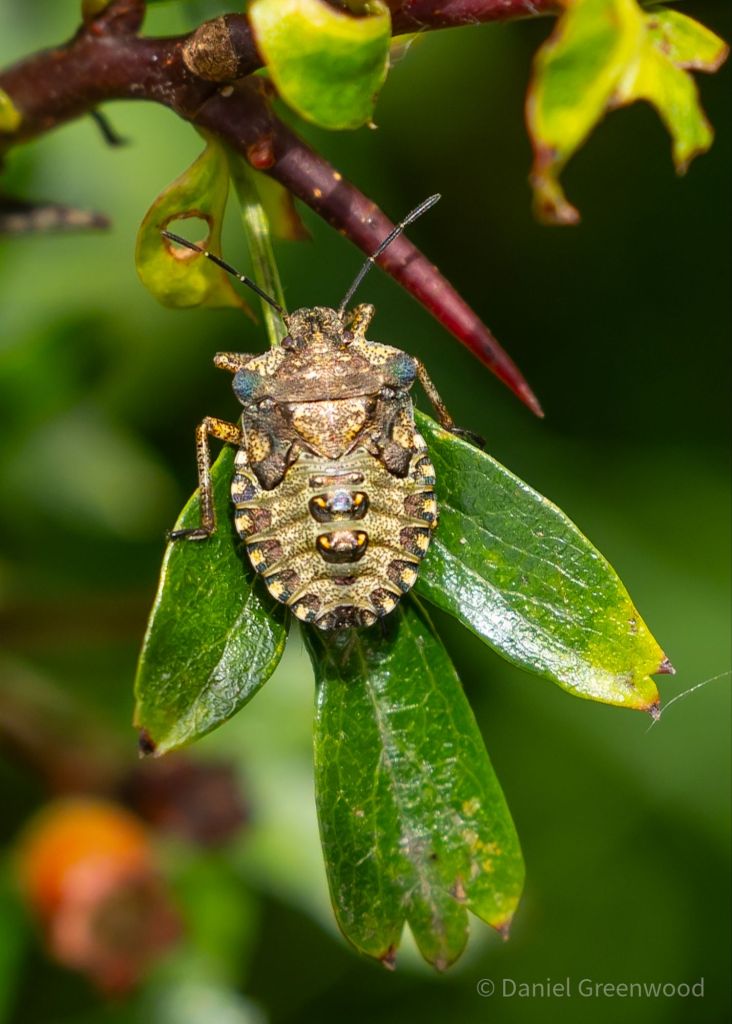
Elsewhere I found a few shield bugs sunbathing. These are forest bug nymphs.
And this longhorn beetle, a family of insects I love to see. They’re always quite busy in my experience, heading off in every direction.
I recently upgraded my phone from a Fairphone 3+ to a G**gle Pixel 7a. The Fairphone dream is dead for me. I bought the Fairphone 3+ looking for a sustainable option that would last a long time and be invested in. Instead two new models were soon released and the 3+ was effectively archived.
The Fairphone 4 and 5 are just too big and expensive, but the company have pushed sustainability and human rights up the agenda. Surely people shouldn’t be getting a new phone every year. I would argue it’s irresponsible due to the sensitive materials required and the shady employment practices across the production line.
I don’t think I would be interested in smartphones if they didn’t have cameras. Phones are thought to have killed off much of the entry-level camera market, especially when they are so good now and storage and sharing has become digital.
Back in 2002 I took Media Studies A-Level and we were taught about ‘convergence’, the coming together of all manner of tech into single devices. Photography has been a key part of that process. Radios, TVs, typewriters, even people’s jobs have disappeared into phones. This has been predicted for a long time.
So can anyone who considers themselves a photographer (always sounds very serious and self-important, doesn’t it) ignore phone photography? I don’t think so. Especially because Instagram has become the prime mechanism for professional photographers to promote their work.
Also, I’m writing this blog post on my phone!
Anyway, here are some of the first images I captured on the evil Pixel 7a. The camera is exceptional.
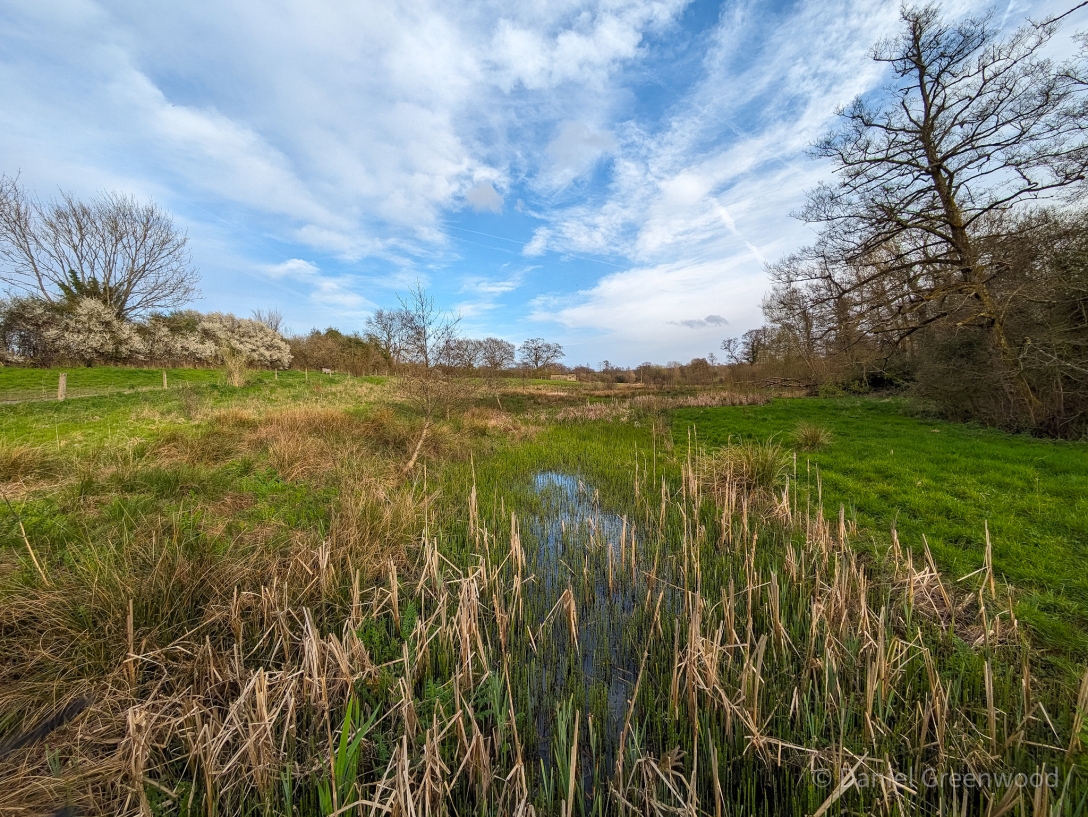
One thing that recent camera phones are doing so well is controlling glare. The sky here would be ‘blown out’ or over-exposed in normal images taken on a camera. AI is working here, I expect, to effectively take two images – one exposing for the foreground, a second for the sky. It can look quite over-edited, but for random snaps it’s really helpful.
Another interesting change with newer phone cameras is the inclusion of a wide angle lens. This lens type is probably one of the most controversial in the world of photography, because they’re rarely needed, heavy, expensive and often have extreme barrel distortion on either side of the image. Ever been at the far end of a photo taken with a wide angle lens? You probably looked quite warped!
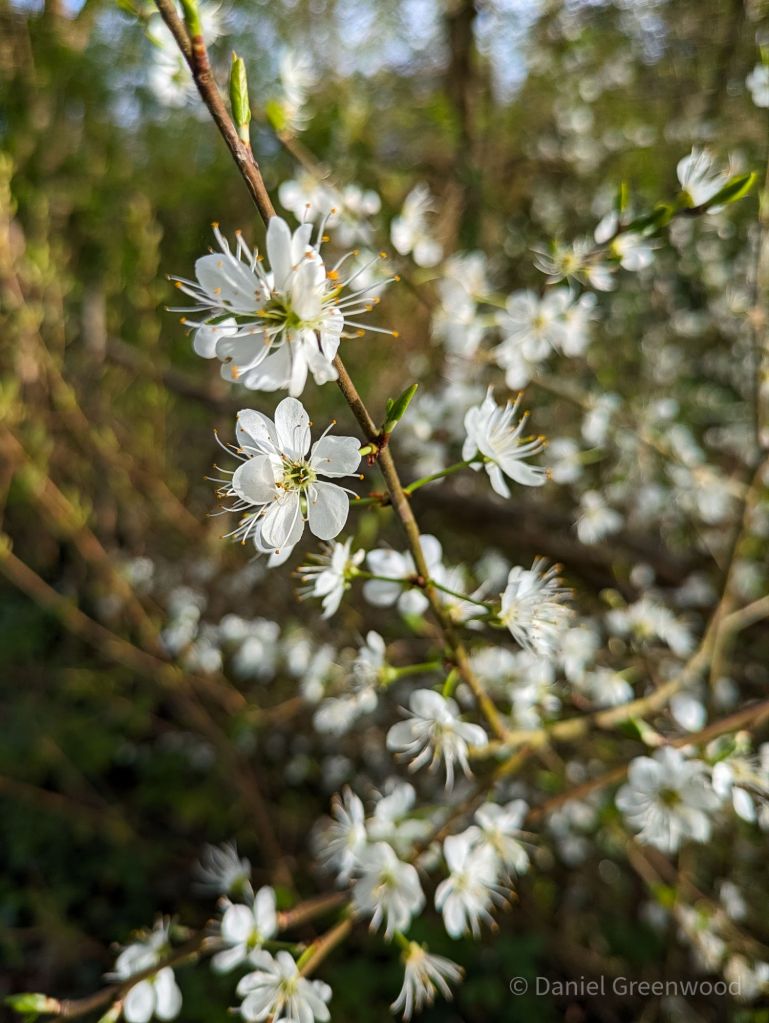
One thing that impresses with the Pixel 7a is the autofocus. These blackthorn flowers were blowing in the wind and yet the detail is so good.
Lichens are a great thing to photograph because they stand still and can be very attractive subjects. I was considering stretching my budget for a Pixel 8 Pro because it had a macro function. Reviews of the 7a said that it can focus closely, and that is true, to a degree. Also it sounded like the AI in that phone maybe does too much.
One potential block on macro potential is that the phone seems to do auto noise reduction. That can make these weirdly impressionist details were the AI is trying to hide graininess from a high ISO. I’ve noticed it a couple of times and it’s not ideal. The detail and focus is otherwise really good. This is not what the tech people call ‘flagship’ or top of the range.
All in all, I am amazed by what this camera can do. It is so much better than the Fairphone 3+, which shows how quickly cameras are developing in phones.
Would this phone make me sell my standalone camera? No way. Lenses and sensors of mirrorless, standalone cameras can’t be matched by phones currently. It just provides a great option for capturing nice images on the go. It’s going to be especially good for fungi.
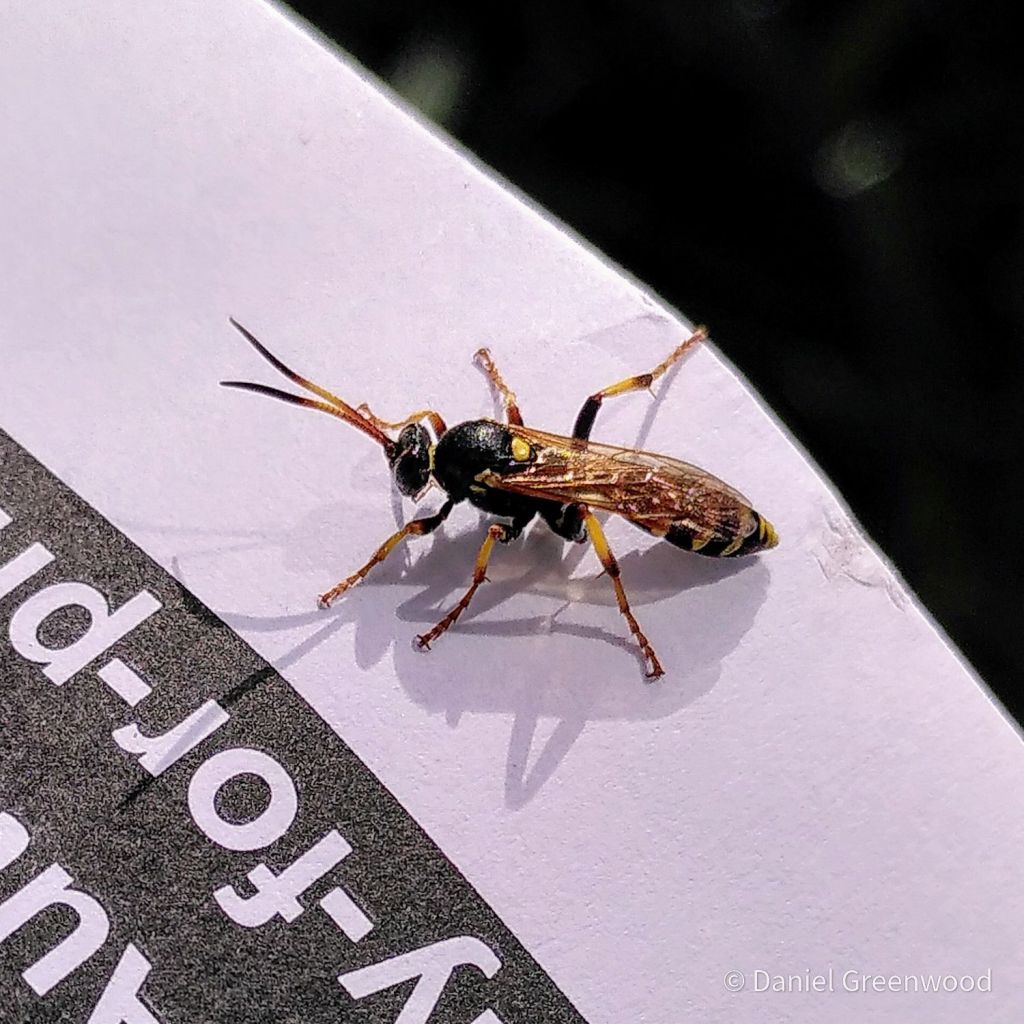
You know it’s spring when the bees and things start getting trapped indoors again. I visited my mum on Easter Sunday and her kitchen (which has lots of windows) turned into a veritable insect survey trap. Not just the ‘horrible flies’ she pointed out, but this lovely ichneumon wasp which I rescued with a glass and a local elections envelope.
You can probably tell that these are phone pics, I haven’t quite got into proper macro lens work yet this year, but soon! I love the orange-yellow-black fade of the antennae, which is probably where the name ‘xanthoria’ comes from in the scientific name.
Xanthoria is a genus of lichens which are commonly known as sunburst lichens. In Latin it means golden yellow, which is perfect.
And here’s the proof – Xanthoria parietina, a pollution-tolerant lichen that grows everywhere.