The sun sets over Dartford

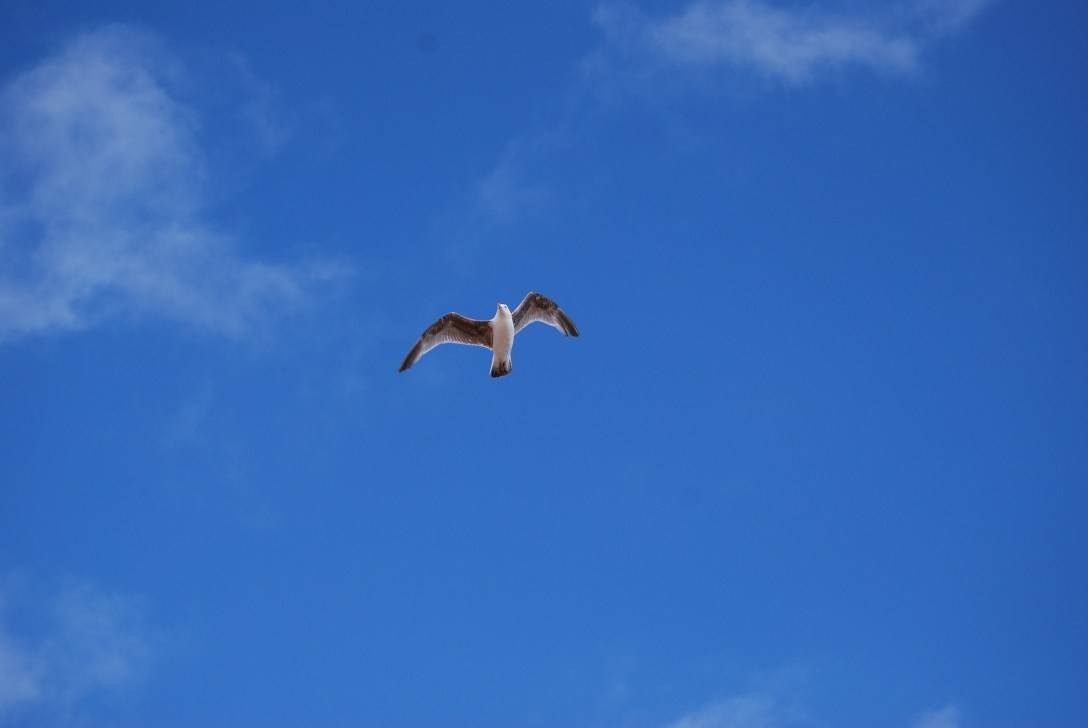
It’s late afternoon and the sun begins its descent toward Dartford. In the east the bridge is reflected in the shimmering Thames. Rainham Marshes is behind us, beyond the large concrete seawall and iron fencing, protecting the reserve from dogs, people and vehicles, protecting skylarks and lapwings, birds that breed on the ground. Gulls pass over from the marshes and across the Thames to the south. A deceit of lapwings exits, too, their flappy black wings belie their compact shape when grounded. They return to Rainham a few minutes later. Evidently this is not an exodus. Teal are swimming on the Thames, their colours draining as the sun retires behind them. We inspect the shoreline, its thin marshland and garbage. The ducks want to feed here, but what’s to be eaten? The tide bubbles audibly against concrete, an armchair rests at a tilt in the marsh, half against the slanting ground and half in the slurry. The chair is stained where it’s become soaked by liquids other than water over the years. If you were to sit in it, you’d fall backwards, skull first. The dry land is tropical with all kinds of plastic: caps freed from their bottles, thin tubes like the insides of biros, thousands of bits of broken plastic, and a syringe. There are pieces of driftwood lying around, one chunk has been bleached by sun, sea and salt. It breaks under the slightest pressure, the yellow shape of woodworm hibernating in a crevice created inside. I wonder how far this piece has travelled.

The sun is setting further, the river taking on the image of a lagoon, still the teal are drifting. We walk back along the path in the direction of Purfleet, a small flock of pied wagtails circling us back and forth to Rainham. They are wary and so they come and go, at last settling on a patch of rushes and straggly vegetation covered by yet more rubbish. Small islands of sand and mosses remain amidst plastic, industrial sponge, a road crossing bollard and bottles galore, the pooling water has the metallic sheen of petrol. The eye’s obsession with trash distracts from the living, in this instance the stone-washed water pipit holding onto a stalk amidst the rushes. The wagtails patrol the sand in their cheerful manner, taking pops at one another on occasion. The water pipit is still, in contrast to its cousins. A woman in red approaches and the passerines are flushed from the islands and back over the seawall, the pipit going with them. She has a green lager tin in her hand and white earphones. She sits to watch the sun from the wall, kicking her legs. The birds return to their patch. The pipit lands at the water’s edge, joined by what looks like a second pipit. The much duskier bird lacks a white eye stripe, or supercilium, and is itself a different bird, a rock pipit. Like its cousin, the rock pipit wags its tail as it looks for something to eat.

The trains back to London arrive on the hour so we sit by the water and watch the final movements of the evening. On the path a woman pushes her grandchild in a buggy, remarking to us that Thurrock once had a population of forty-four. This, of course, was centuries ago. The pipits would have been in a similar spot then, likely feeding in water free of oil and sponge, but no doubt touched by different sort of human waste. Up ahead, a man rides a mini motorbike with his daughter in his lap, his look is sincere. They disappear between a gap in a dumpy little bush. On the grass dwarf mallow leaves await flowers and a pair of mistle thrush regard us with caution as they disappear into near darkness. The sun is a ball, inflating and draining into the south, v-formations of gulls sweep to the east, down a river now black and gold. Ducks and debris float freely towards Greenhithe and Grays, a slurry of pollution passing by, highlighted in the twilight.

A fashion shoot is taking place against the railings, a young woman with cropped hair and a purple dress stretches herself against the bars in a mocking vogue. As if from the river itself, as its inhabitants flee eastward, a curlew calls over and over again.

Everyone knows a herring gull when they hear one

Everyone knows a herring gull when they hear one. Step off a train in Brighton on a summer’s day and you’ll hear their laughing call extend all the way to sea. It’s the sound used in TV and the movies to establish seaside towns. Two years ago I sat in Pavilion Gardens, green ash leaflets fanning against a blue sky, graduands strolling around with their grinning parents, when a bird poo bombshell exploded all over me. The velocity was shocking. I thought I had died and gone to graduation. The crap covered my hair, face, chest and arm. My companion was caught between the need to console and gloat. ‘You have to laugh, or else there’s nothing you can do,’ she said. ‘I’ll get a cloth.’

That day I learned some respect, seagull-style. My admiration for this bird is strange, a love unrequited on the animal’s side, a little masochistic on mine. I went to university in Liverpool and lived in a flat in the very heart of the city. My bedroom looked-out upon a row of fast food and booze outlets siphoning their stench out onto our balcony. At night we would peer over the ledge and watch the overblown shadows of rats moving between bins and under cars. Squalls came from that chasm after dark, and deep, booming voices often extinguished them. During my tenure, Saturday nights in Liverpool city centre were accentuated by the boozy rowing of couples, up against the walls of bars, stumbling across the pavement like seamen. But above it all something else was happening.

On a fine spring evening in my first year we lay on our backs on the grass verges beneath the Anglican cathedral.

‘Look!’ I had shouted, ‘a shooting star!’

‘No, you bloody idiot, it’s a seagull,’ was my acquaintance’s reply.

Smaller gulls, probably black-headed gulls, would catch the orange colour of streetlamps as they flew over. My inebriation did the rest. In the spring and summer months, when the gales which blow up and down Renshaw Street had died away, the angelic shapes of white gulls would waft down the road. Take the view from the corner of Rodney St., where Hardman St., meets Leece St., looking down onto the old Rapid Hardware store. When the sun set between the cormorant-esque liverbirds, the silhouettes of gulls moved like ashes from a fire, drifting on a light breeze to and from the Mersey.

From my old window, what I now know to be a newborn juvenile herring gull would call to its parent, waiting there for long periods of time, a bit like a package dipped in soot. Its bill is coal-black, a dusty grey hint to its body, ending in the white of its head. I have a polaroid picture of an adult herring gull perched on the rail looking into my room, a white-washed statue. The irony of the erroneous term ‘seagull’ is that now foodstocks have diminished in the bird’s natural coastal habitat, herring and black-headed gulls are coming inland to feed from the waste we leave in the street. They don’t merely follow the trawler anymore but the tractor. I recall a flock of feral pigeons, birds deriving from the cliff-dwelling rock dove, being dive-bombed by a herring gull over the scraps of chicken wings thrown into the road outside a fast food joint on Bold Street. It was like the moment the Tyrannosaurus Rex rears its head in Jurassic Park.

Whichever monstrous gull it was that crapped on me in Brighton, I forgive it. The presence of these birds on the margins of my youth have defined a remnant of my past with perhaps a little more tenderness than one might expect.

The cuckoo goes


We won’t know
when the cuckoo goes,
we’ll never know it’s gone,

we won’t know
when the cuckoo goes,
we’ve never heard its song.

We won’t know
when the cuckoo goes,
we’ll never know it’s gone,

we won’t know
when the cuckoo goes,
they say it won’t be long.

We won’t know
when the cuckoo goes,
we’ll say that nothing’s wrong,

until the day
that the cuckoo goes,
we’ll sing the cuckoo’s song.

And if the cuckoo goes,
then the cuckoo’s gone.


Set: Picos de Europa with EuCAN

I was fortunate enough to spend some time in Los Picos de Europa working with FCQ on behalf of EuCAN, a Dorset-based conservation action group. FCQ are a conservation group working to protect the Bearded vulture, otherwise known as Quebrantahuesos in Spanish, “Bone-breaker” for its diet of bones (and not specifically bone marrow, as is commonly stated in avian literature). The bird is referred to as the Lammergeier (a German phrase) or in Latin as Gypaetus barbartus. “Bearded vulture” is a misleading term because the bird is not all vulture, and its beard is more a moustache.

The Fundacion is an all-action group based in Benia, Asturius in Northern Spain. The organisation aims to promote and aid the work of shepherds in the Picos. By doing so, an ancient aspect of Asturian culture can be maintained, and food for the Quebrantahuesos can be provided, also. The bird will eat the remains of sheep and goats that have died in the region, often waiting alongside Griffon vultures (Gypus fulvus) to finish their banquet of flesh until just the bones are left – the meal of the Quebrantahuesos.

The work of FCQ taught me that conservation is not purely ecological or environmental, but intensely cultural. What is different about conservation in the Picos compared to conservation in London, for example, is that it is a system whereby humans are still a part of the cycle. Conservation need not be purely aesthetic, as in the preservation of nature’s beauty, which is a common conception. In the case of the farmers of the Picos, it’s about preserving a way of life. If, perhaps, conservation in urbanised England represents a longing to return to a lifestyle much closer and in keeping with nature, then the work in the Picos is an attempt for people to maintain a lifestyle close to and dependent on the natural world.

Please click any image to view more photos on my Flickr page, and please visit the websites linked at the top and bottom of the page.

Diego and Jose at FCQ headquarters

Rafa shearing his sheep. This is an annual event for a shepherd, and EuCAN mucked-in to help with the workload, some 300 or more animals

The Picos glimpsed on either side of a vehicle

EuCAN and FCQ building Quebrantahuesos release pens. This is where the young will be reared and liberated from, into the mountains overhead

Two farmers in Belbin, a summer village in the Picos. The farmers spend the summer here making goats cheese

A Nightjar (Caprimulgus europaeus), one of the many avian delights of the region

Woodland brown butterfly (Lopinga achine)

Nigel Burch moved to Spain thirty-years-ago. Trained in horticulture he runs a hotel and organic farm with his family in the Picos. Nigel has an apple orchard, livestock, vegetable gardens and resplendent wildflower meadows. He said his aim was to promote biodiversity and his land was living-proof of the benefits diversifying plant and animal-life can bring.

Cattle roam the Picos. The sound of cowbells jingling is commonly heard

Steve Bennett talks to an audience at the FCQ centre in Benia. Steve outlined the aims of EuCAN, the difficulties in securing funding for a not-for-profit organisation in a time of great financial strain for many European organisations and people alike

Diego & Chris take a breather during a 5-hour-long process of beam dragging. Low-carbon transportation is the law in the inhospitable terrain that much of the Picos poses. EuCAN joined forces with FCQ to build a bridge linking two valleys, the aim of which is to allow shepherds and their livestock access to another part of the Picos for further grazing. More livestock also means more food for the Quebrantahuesos


FCQ (Fundacion para la Conservacion del Quebrantahuesos)

EuCAN (European Conservation Action Network)

© All Rights Reserved, Daniel James Greenwood, 2011