Swiss Alps: Grindelwald’s magnificent meadows 🦗

In May 2024 my wife and I went on our interrail honeymoon to the Jungfrau region of the Swiss Alps. I am finally ready to post my photos from the trip, starting with some macro photos. I’ve popped in some short videos here to give a bit more texture and sound to bring things to life.

My cat whispering wife

It was an incredible trip, all done by rail there and back. The nostalgia is already with me.

In addition, I’m aiming to post about the spring alpine flowers and the amazing sycamore wood pasture. Hopefully one each week. I posted about the smattering of fungi back in May on Fungi Friday.

On the trip I took only one lens with me, one capable of pretty much any photography between 12-45mm (equivalent to 24-90mm in full frame cameras). That includes excellent close up capabilities. I also had a pocket compact camera and my phone.

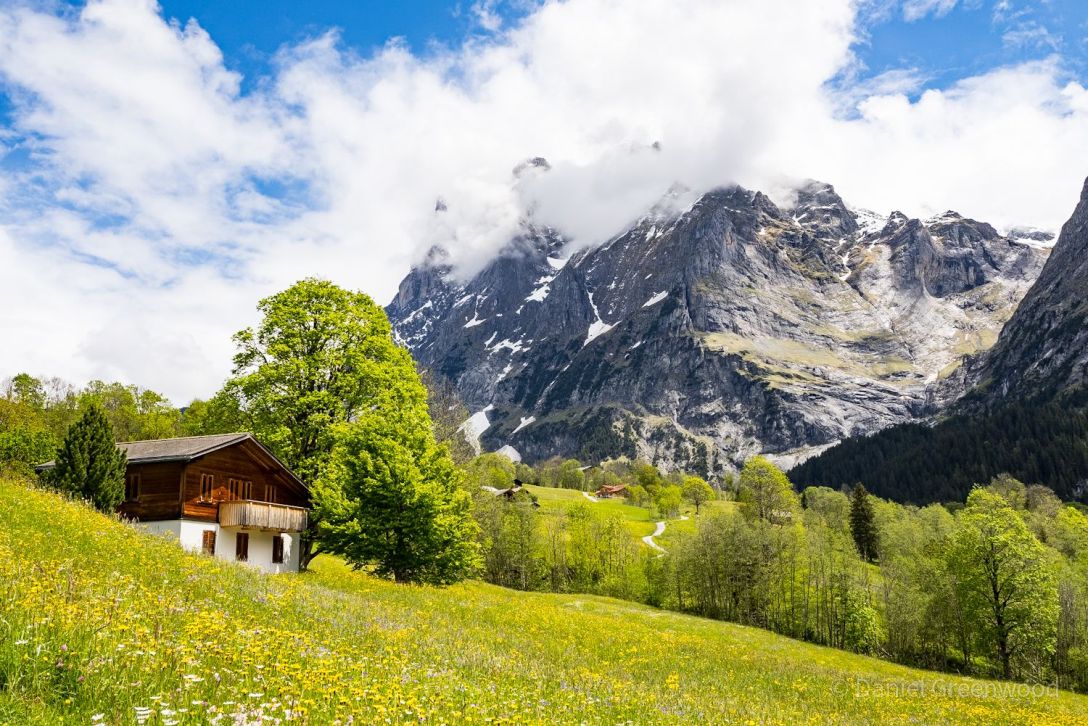
The meadows were in full bloom, days from being cut for hay to feed the alpine cattle through the winter months.

Breathtaking alpine meadows

Oxeye daisies with the Wetterhorn (I think) in the background. This pic is taken with my Olympus TG-6 compact.

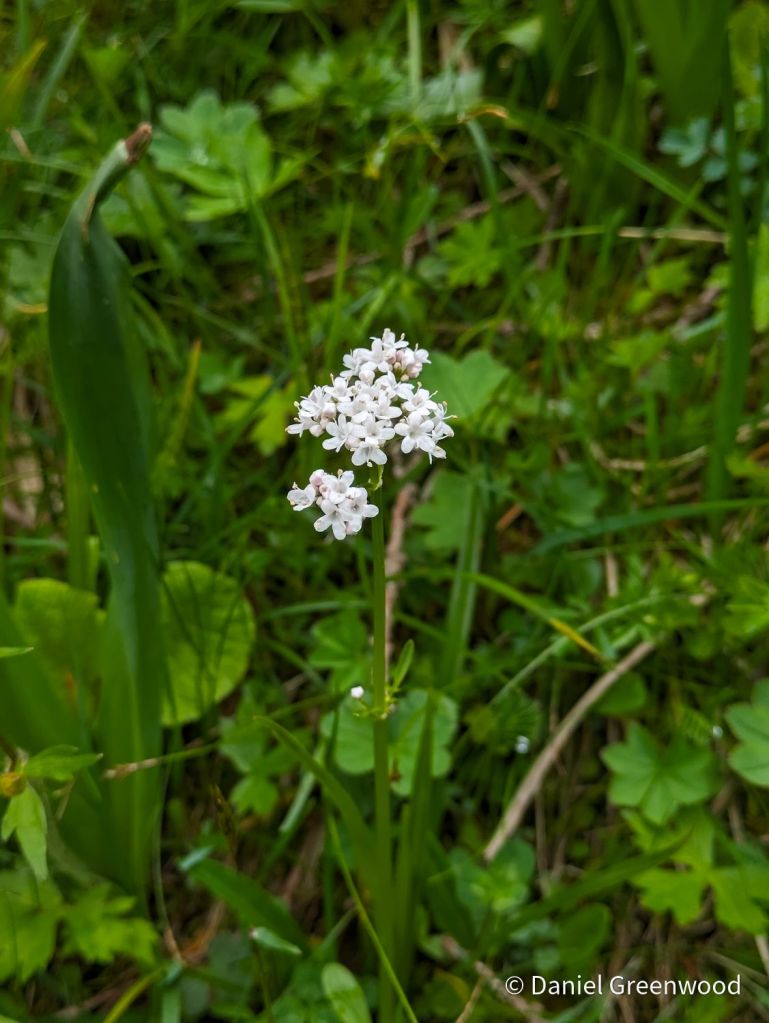
It was nice to see the variations in the grassland species in the different locations. At about 1200m up these meadows were packed with umbellifers. They make up the wash of white here. This meadow must have been impacted by the snowmelt as it nourishes the foothills in spring.

The typical mix around Grindelwald was one of red clover, scabious, oxeye daisy and hawkbits.

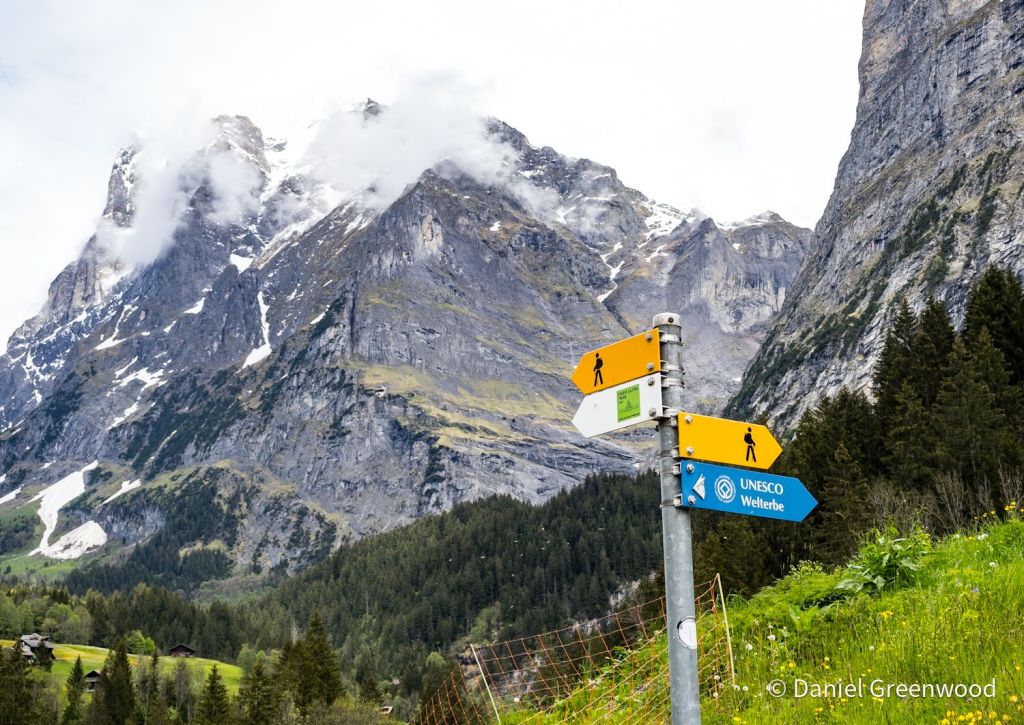
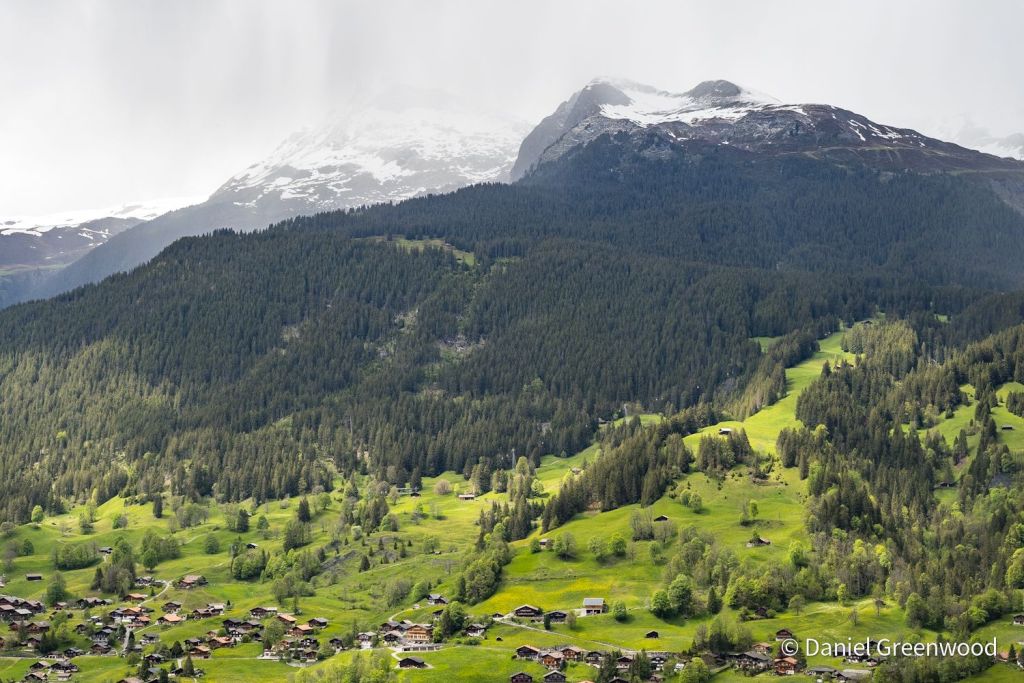
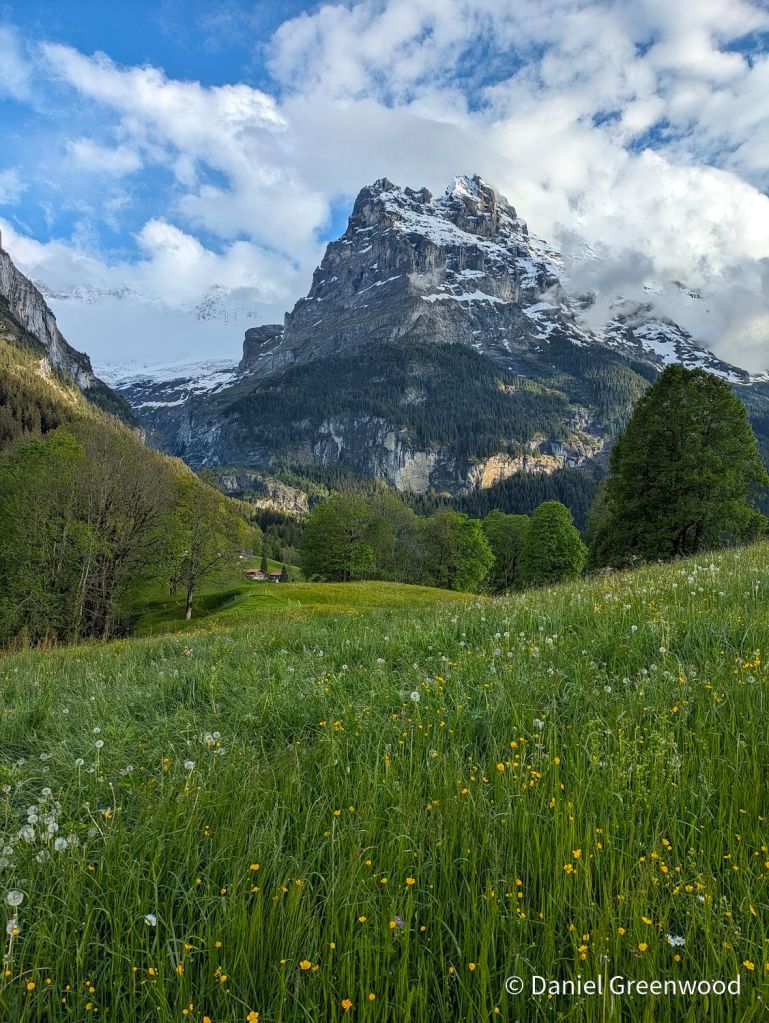
The Eiger looms over chalet homes and rich hay meadows. You can see the allure of Switzerland. High living standards and abundant nature.

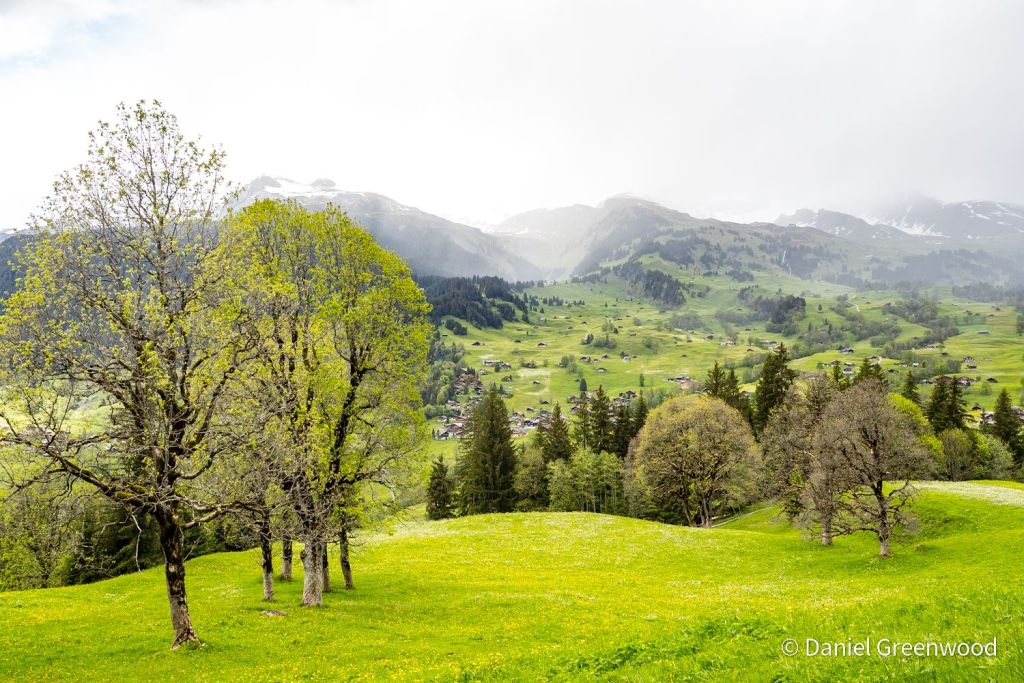
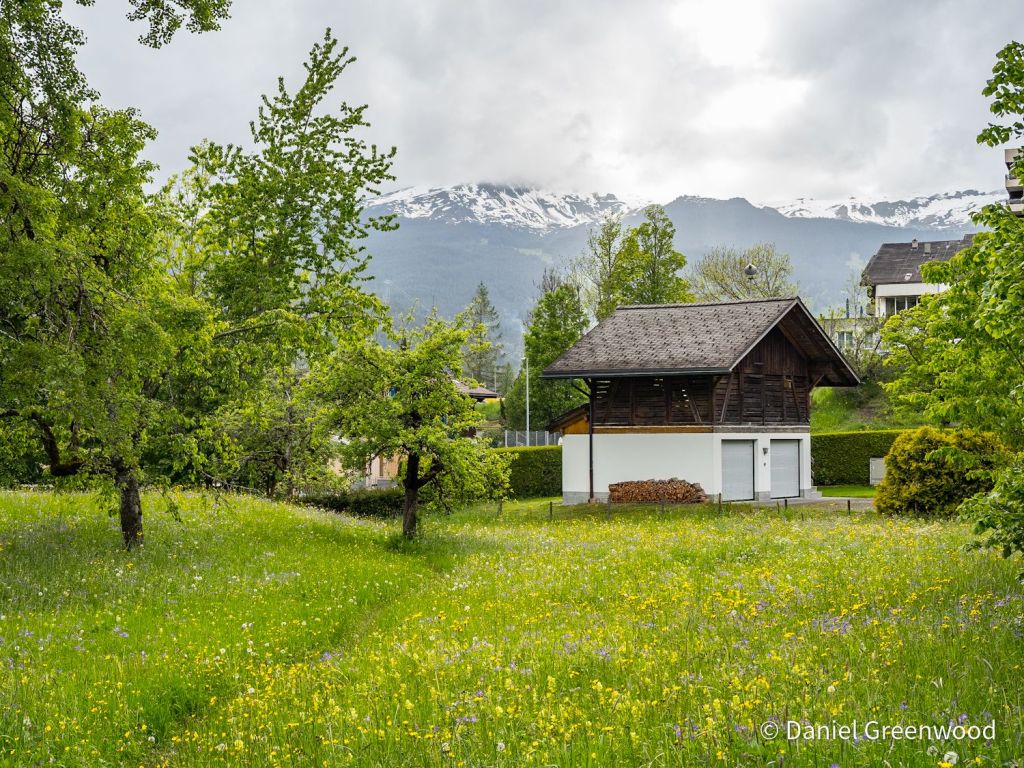
It is a breathtaking place, as this beautiful phone pic suggests (as in the phone’s capabilities!). This meadow was one that lacked the diversity of others, with the dandelions being evidence of nutrient enrichment, which encourages more vigorous plants at the expense of others. The most diverse meadows will have lower levels of nutrients in the soil.

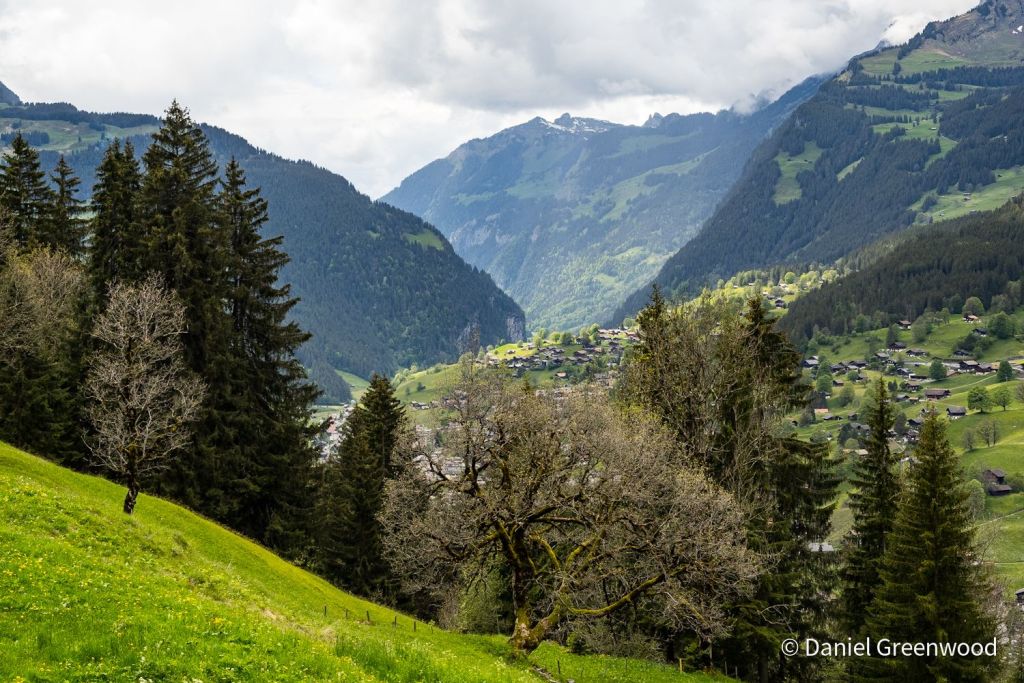
The Grindelwald meadows were at a height of around 1000m. They were peaking and very loud at times. Just listen to this:

It was a chorus of crickets, not something that we get in England much anymore. The management of these meadows follows a largely medieval practice of haymaking, though it is now mechanised:

This is probably a family cutting and collecting the hay. This photo was taken from a cable car heading up to Männlichen.

Now onto the invertebrates that lived in the meadows.

Bush crickets

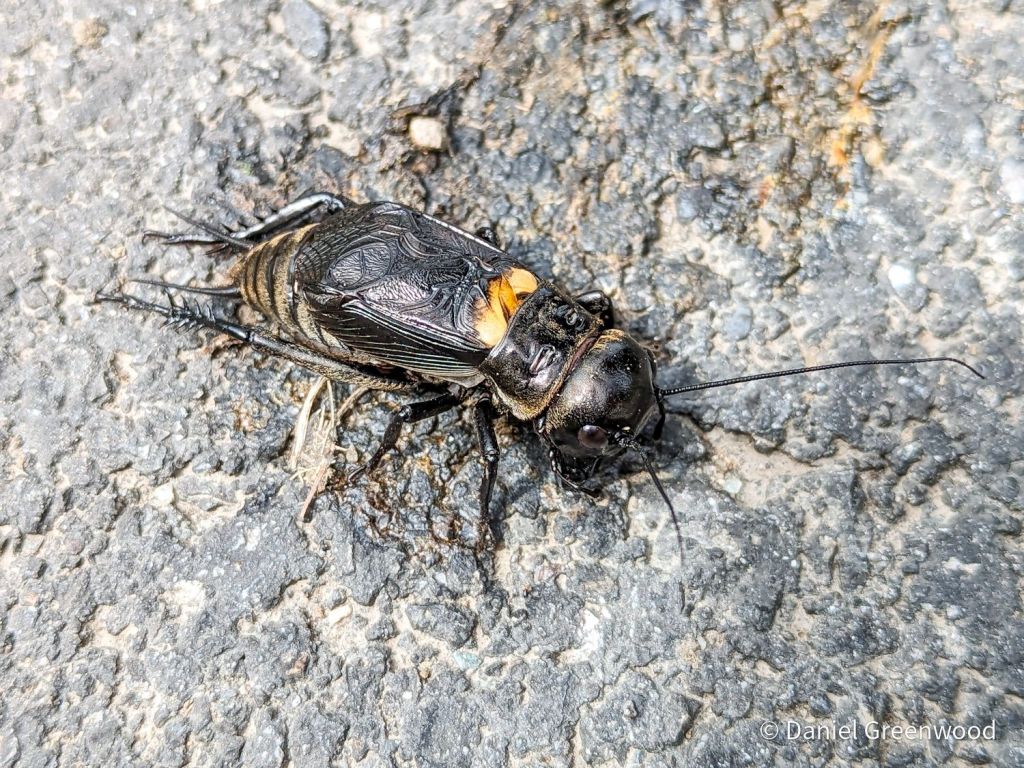
The sound in the meadows was made by the European field cricket, a species that has received support via conservation projects close to me in West Sussex. According to the iNaturalist page it’s flightless, so when it becomes locally extinct it struggles to repopulate lost ground. In the UK it has suffered from the decline in heathland, its favoured habitat. The cricket above was travelling across a lane to reach another meadow. There were a number of them squashed by vehicles. It’s unavoidable.

Moths and butterflies

During a walk in the valley woods at the foot of the mountain this green-veined white butterfly (I think) was on the wing. The main butterfly we saw was the swallowtail, but they were too fast, restless and far away for my lens to reach.

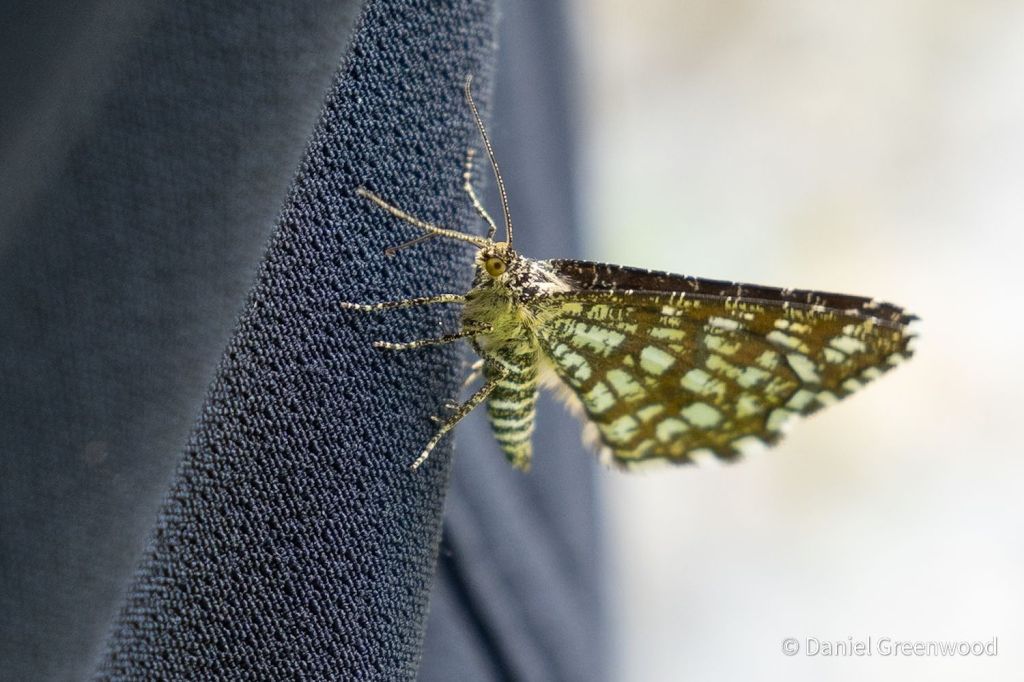
In stark contrast, this latticed heath moth alighted on my actual lens before being coaxed onto my trousers:

This is a species we also have in southern England.

Wasps and sawflies

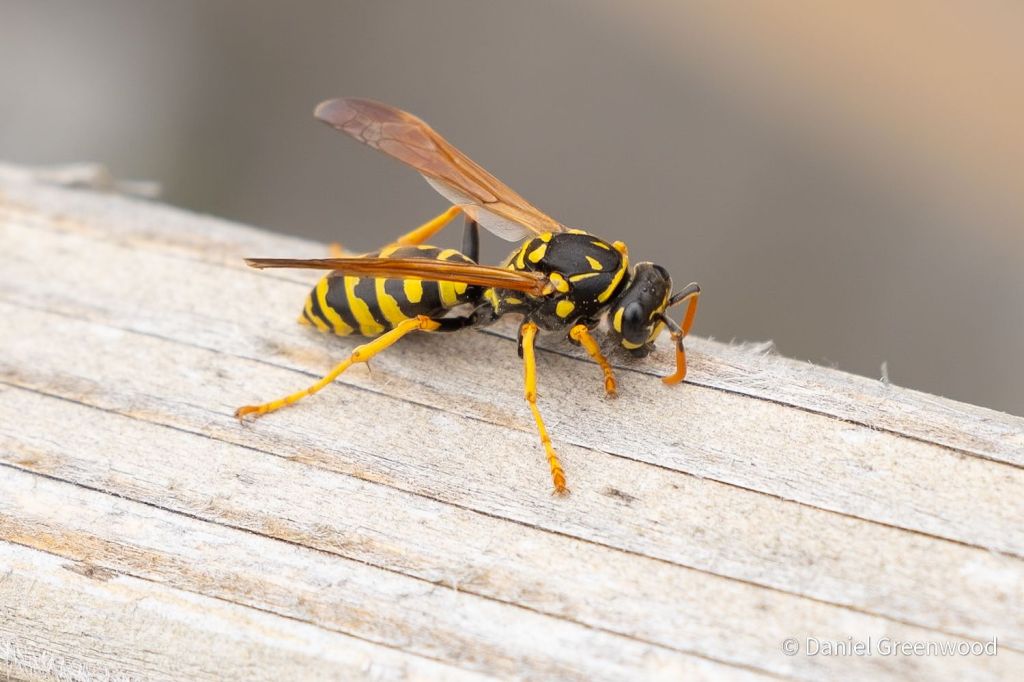
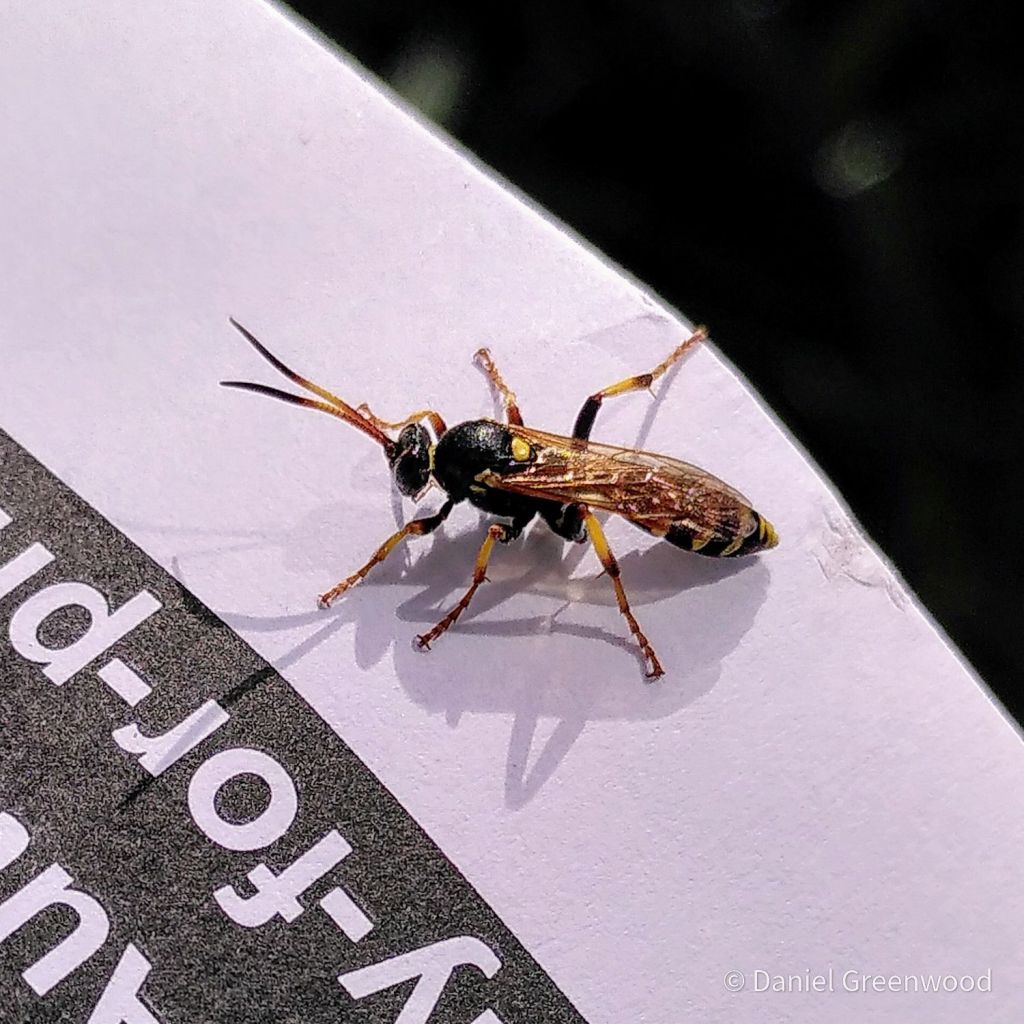
One insect you don’t see in the UK, as far as I know, is the European paper wasp.

They have a lovely orange hue to their antennae, feet and wings. I’ve seen them before in Czechia making nests in residential post boxes. Here you can see one gathering wood shavings for nest building.

Meadow cranesbill was another common flower in the – you guessed it – meadows. I noticed that one area we passed when returning to our accommodation had a number of cranesbills that held sawflies in their flowerheads. The iNaturalist sawfly oracles have decided this is Tenthredo koehleri.

Beetles

Beetles are not my strong point, unless they are from Liverpool. This is a species of click beetle from what I know, visiting an oxeye daisy flower.

Spiders

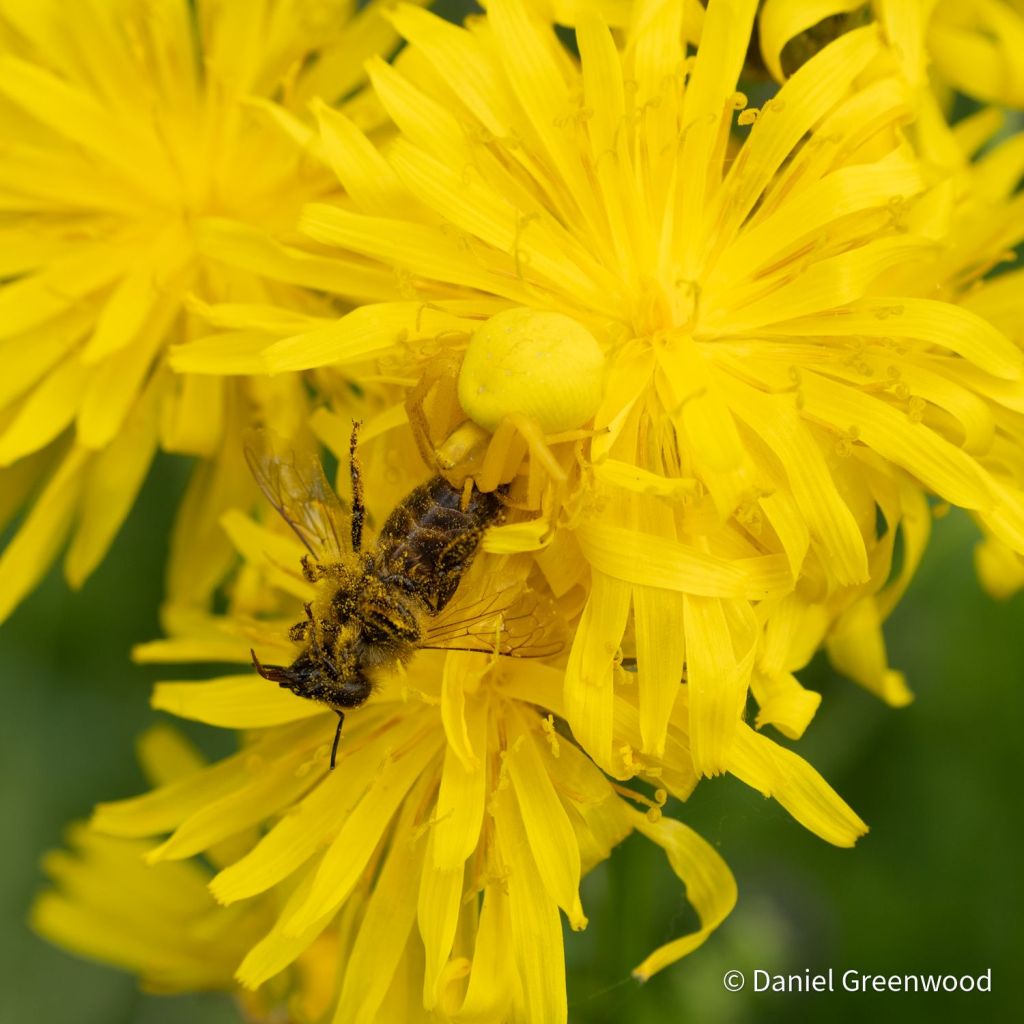
Now, I did mention those beardy daisies the hawkbits, earlier. I’m not up on my ID with these plants, but I did spot a crab spider which had joined in their colouring and caught a honeybee (I think) in one of the flowerheads. This was a statk example of how they can change their complexion to camouflage themselves in certain plants.

That’s all I really managed in the macro photos stakes. There’s much more to come from the Swiss Alps though.

Thanks for reading.

I write these blogs in my spare time because I want to raise awareness about the beauty and diversity of our landscapes. If you enjoy reading them you can support my blog here.
You can find my fungi blogs on Fungi Friday.

10 photos from a decade of macro

A break from my blitz of my usual summer macro posts for something a bit more, monumental.

I’ve been using a dedicated macro lens since 2014, so this year marks my 10 year anniversary.

Now, no one cares about this, and I only just remembered, but it gives me an excuse to share 10 of my favourite invertebrate macro images. I’m not including fungi in this, they are a different game entirely for me.

In no particular order:

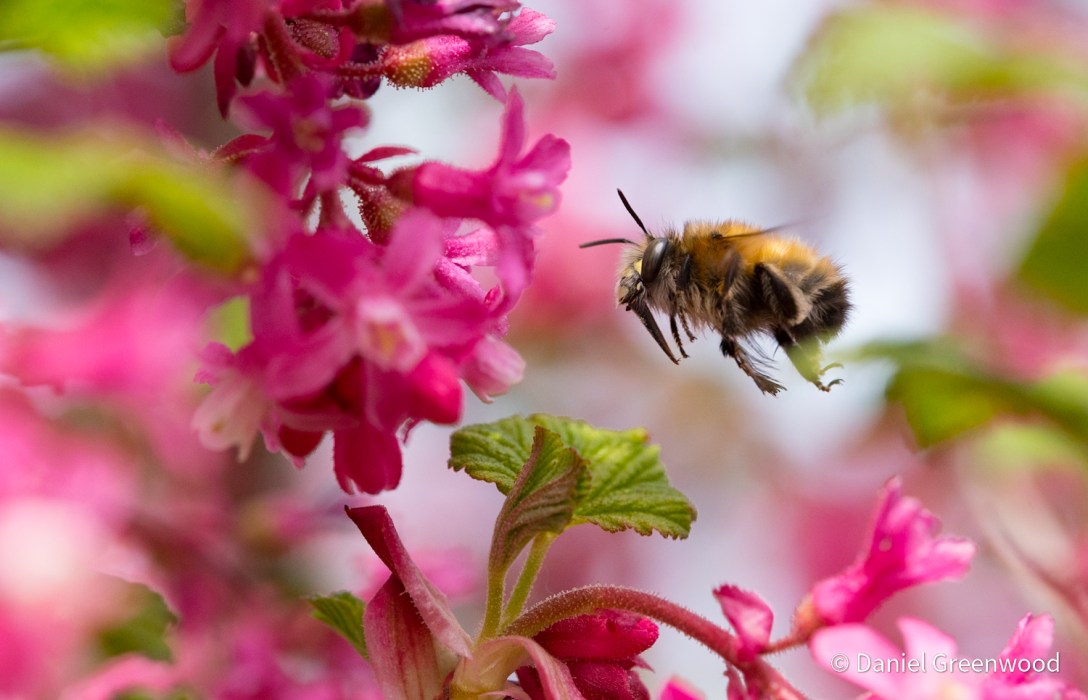
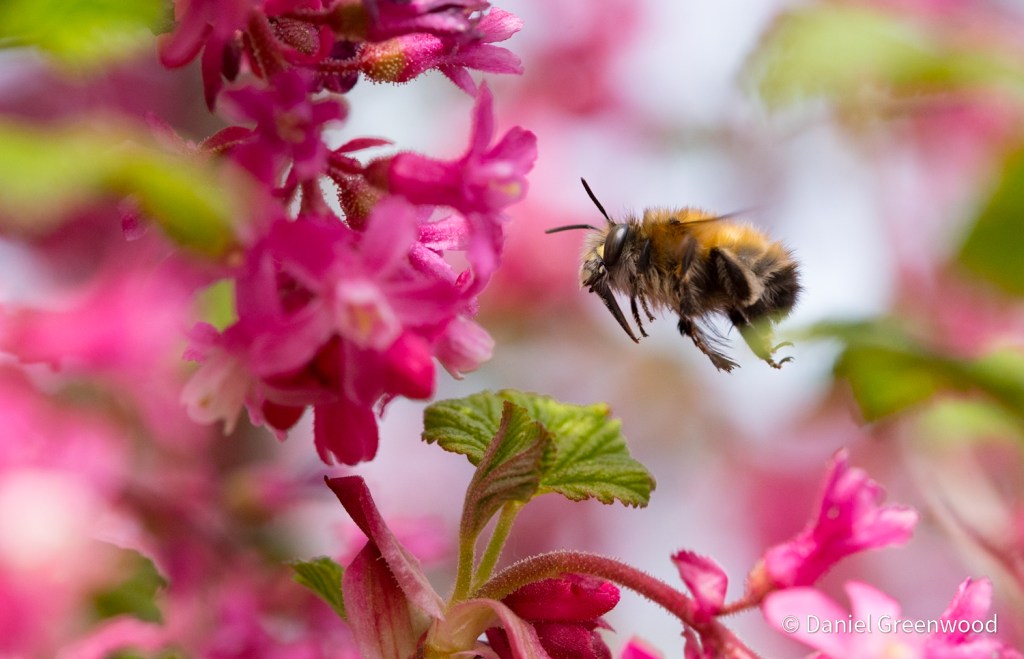
Hairy-footed flower bee in Peckham, London (April 2018)

Nikon D750 + Sigma 105mm macro lens

This picture was taken while I worked for London Wildlife Trust at the Centre for Wildlife Gardening in SE London. I knew that hairy-footed flower bees were keen on flowering currant. I got down at a good angle and managed to capture the bee just as it visited the flower. I love the pink of the flowers and the isolated shape of the bee.

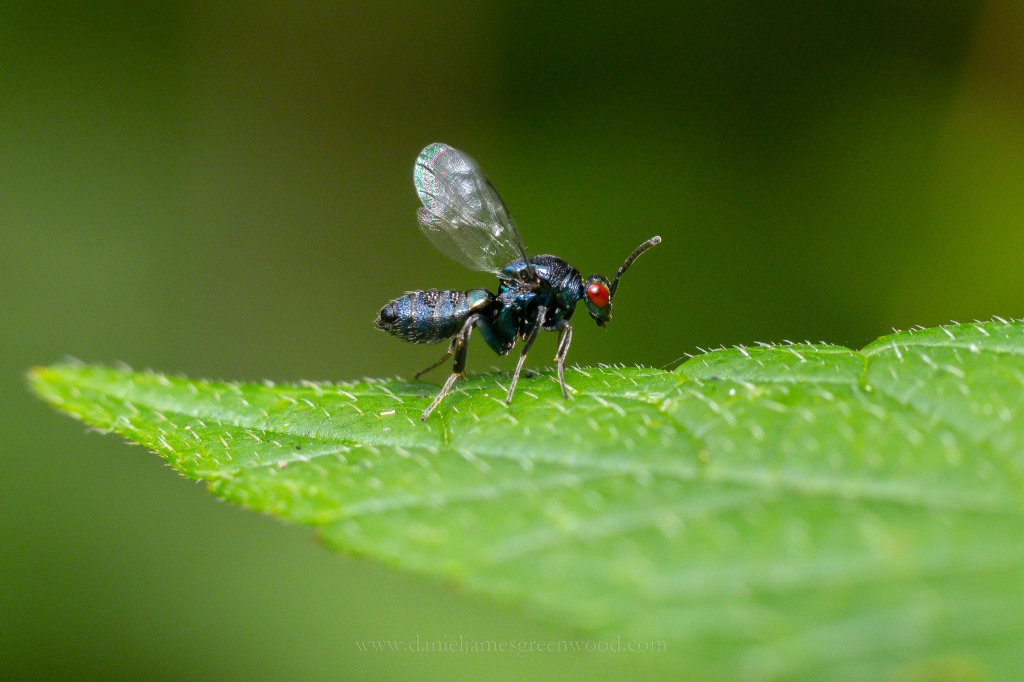
Chalcid wasp, West Sussex (August 2021)

Olympus EM-5 Mark III + 60mm macro lens

Wasps fascinate me, none more so than the parasitic species which are numbered in the thousands. This little wasp is a chalcid wasp which I saw one grey summer’s afternoon. You can read the post about it here.

Ant harvesting honeydew, my garden in West Sussex (June 2021)

Nikon D5600 + Sigma 105mm macro lens

Ants farm aphids for their honeydew and it’s something I’d always wanted to get a decent photo of. Right by my garden door this garden ant was gathering the honeydew from a group of aphids. I took a number of photos and cropped this one down. I like the glow of the globule and the warm background colours.

Fencepost jumping spider, my garden in West Sussex (June 2021)

Nikon D5600 + Sigma 105mm macro lens

Spiders are an unknown quantity for me but the lockdowns helped me to learn more about this in my house and garden. I was taking some photos after work one night when his large and rather pink jumping spider emerged from my fence. It was such a joy to have it wait so patiently for its close up. See blog here.

Silver-studded blue, South Moravia, Czechia (August 2016)

Nikon D750 + Sigma 105mm macro lens

I have to thank my friend Karel for inspiring me to take the plunge and buy a macro lens. So Czechia, where I first met him, forms a place in my macro story. When visiting there in 2016 my friend Pete and I were introduced to a meadow by Zuzka, our host. The meadow was alive with butterflies and wildflowers. We found hundreds of silver-studded blues, many of them roosting on cooler August days. This is a memory as much as a favourite macro photo. See the blog here.

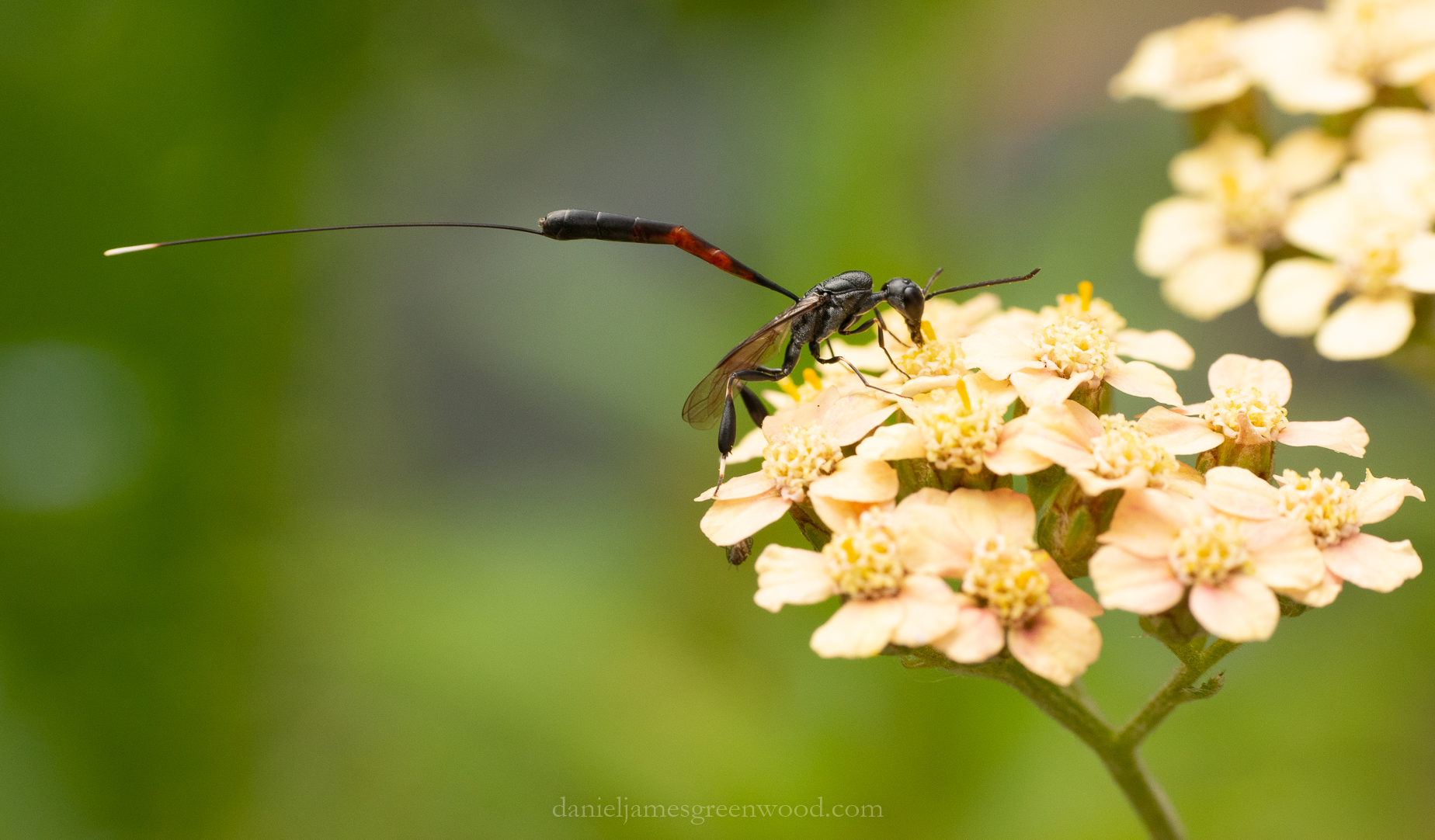
Javelin wasp, my garden in West Sussex (August 2020)

Nikon D5600 + Sigma 105mm macro lens

I will always remember this photo because my dad was with me, visiting from London for the day in those strict Covid times. Along with my mum (hello), my neighbours were also there to see this stunning ichneumon – the javelin wasp. It was a rare social moment, and one of the last times I managed to enjoy nature in the company of my dad before he passed away the following year. See the blog here.

Planthopper, my garden in West Sussex (June 2020)

Olympus EM10 MIII + 60mm macro lens

In June 2020 I was taking a macro photo every day. It was a rainy afternoon when I realised I needed to pull a macro pic out of the bag. I opened the garden door and found a grass head a few steps away. Inside it I found this planthopper roosting, so took a few pics and went straight back inside!

Tawny mining bee, my parents’ garden gate in London (April 2017)

Nikon D750 + Sigma 105mm macro lens

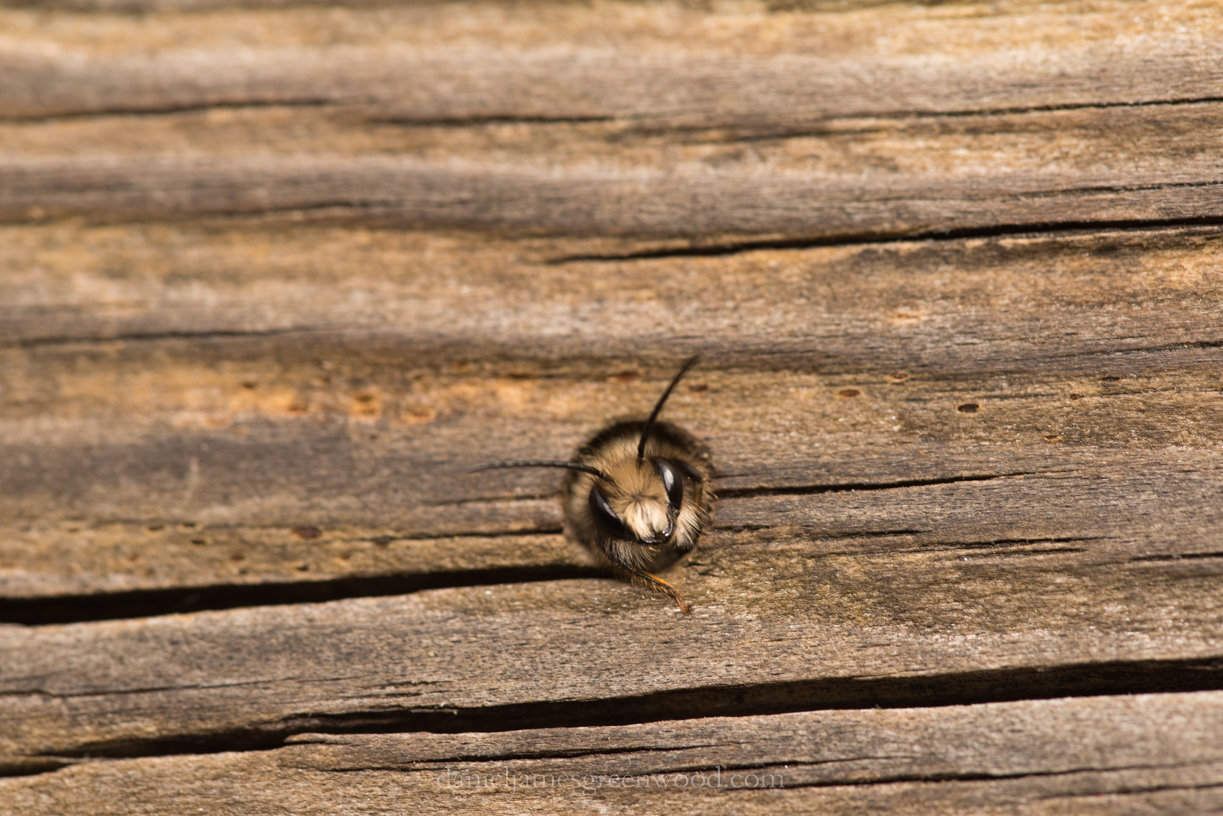
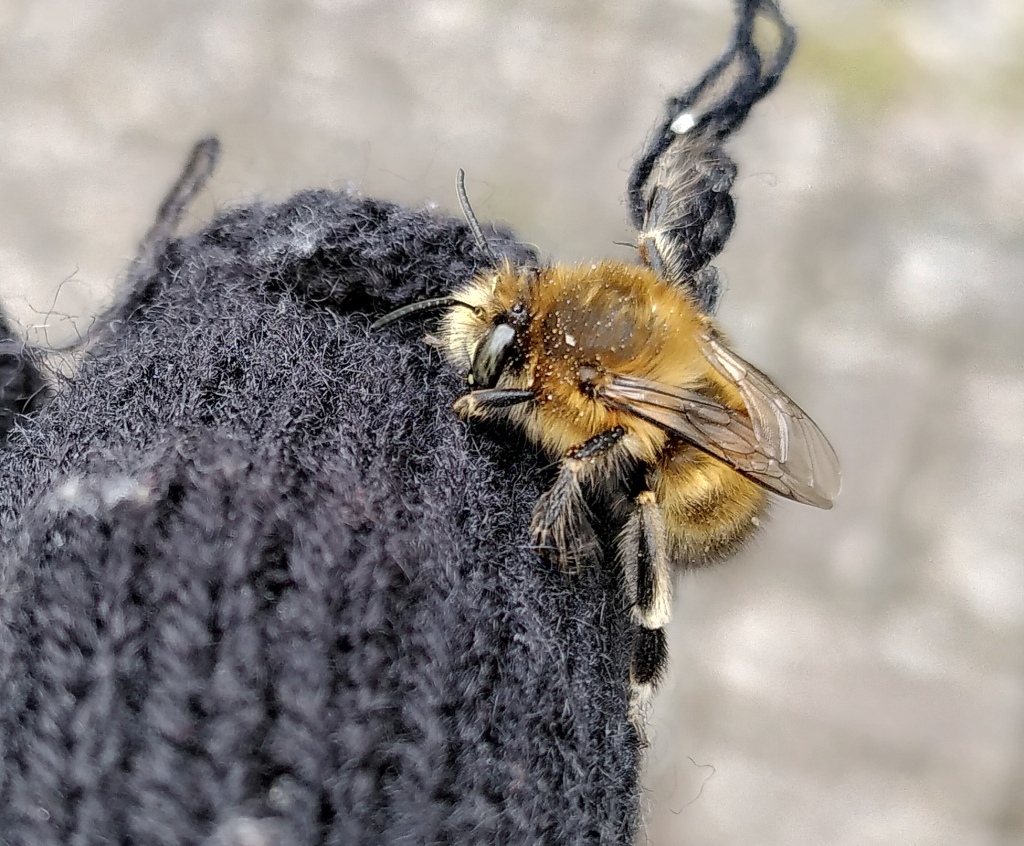
I was staying with my parents during the Easter weekend and keen to explore the macro world in their garden. I noticed some little holes drilled into the garden gate, which had been in place for maybe 50 years. I noticed a bee heading in and out and waited on the step for the bee to emerge. Bingo! This lovely male tawny mining bee popped his head out to say hello.

Plant bug, Coulsdon, Surrey (July 2017)

Nikon D750 + Sigma 105mm macro lens

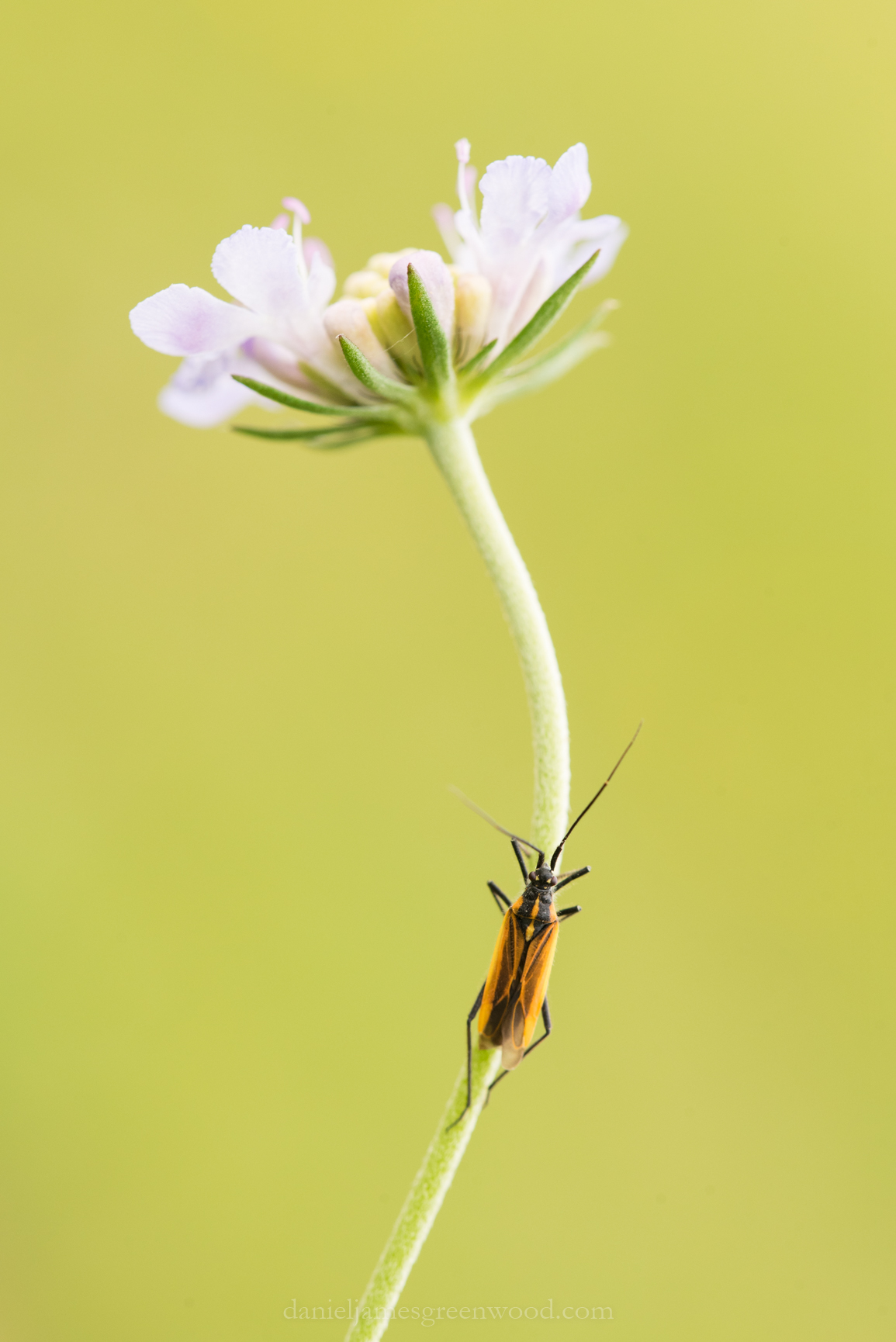
Farthing Downs on the Surrey/London border is where I would spend hours at a time honing my macro skills (basically the art of positioning and then finding subjects, nothing too technical). You could lie on the grass paths and not see anyone for hours. It was also the first place I took my new lens in 2014 (Sigma 105mm) to try it out. One summer’s day I found this plant bug climbing to the top of a scabious flower. It is one of my most accomplished pics and shows full-frame cameras at their most powerful, with beautiful colours and detail. See the blog here.

Paper wasp, South Moravia, Czechia (August 2016)

Nikon D750 + Sigma 105mm macro lens

Another one from my visit to Czechia in 2016. It was a great time for insects and with a more gentle heat than the months preceding. This was my first time seeing a paper wasp. I love these social wasps, which we don’t have in Britain, and I love the way it’s in a bed of wild carrot.

Here’s to another decade in macro.

Thanks for reading and for the support on here. I really appreciate it.

Macro

I write these blogs in my spare time because I want to raise awareness about the beauty and diversity of our landscapes. If you enjoy reading them you can support my blog here.

Camera juggling in the mud 🤳

I recently upgraded my phone from a Fairphone 3+ to a G**gle Pixel 7a. The Fairphone dream is dead for me. I bought the Fairphone 3+ looking for a sustainable option that would last a long time and be invested in. Instead two new models were soon released and the 3+ was effectively archived.

The Fairphone 4 and 5 are just too big and expensive, but the company have pushed sustainability and human rights up the agenda. Surely people shouldn’t be getting a new phone every year. I would argue it’s irresponsible due to the sensitive materials required and the shady employment practices across the production line.

I don’t think I would be interested in smartphones if they didn’t have cameras. Phones are thought to have killed off much of the entry-level camera market, especially when they are so good now and storage and sharing has become digital.

Back in 2002 I took Media Studies A-Level and we were taught about ‘convergence’, the coming together of all manner of tech into single devices. Photography has been a key part of that process. Radios, TVs, typewriters, even people’s jobs have disappeared into phones. This has been predicted for a long time.

So can anyone who considers themselves a photographer (always sounds very serious and self-important, doesn’t it) ignore phone photography? I don’t think so. Especially because Instagram has become the prime mechanism for professional photographers to promote their work.

Also, I’m writing this blog post on my phone!

Anyway, here are some of the first images I captured on the evil Pixel 7a. The camera is exceptional.

One thing that recent camera phones are doing so well is controlling glare. The sky here would be ‘blown out’ or over-exposed in normal images taken on a camera. AI is working here, I expect, to effectively take two images – one exposing for the foreground, a second for the sky. It can look quite over-edited, but for random snaps it’s really helpful.

Another interesting change with newer phone cameras is the inclusion of a wide angle lens. This lens type is probably one of the most controversial in the world of photography, because they’re rarely needed, heavy, expensive and often have extreme barrel distortion on either side of the image. Ever been at the far end of a photo taken with a wide angle lens? You probably looked quite warped!

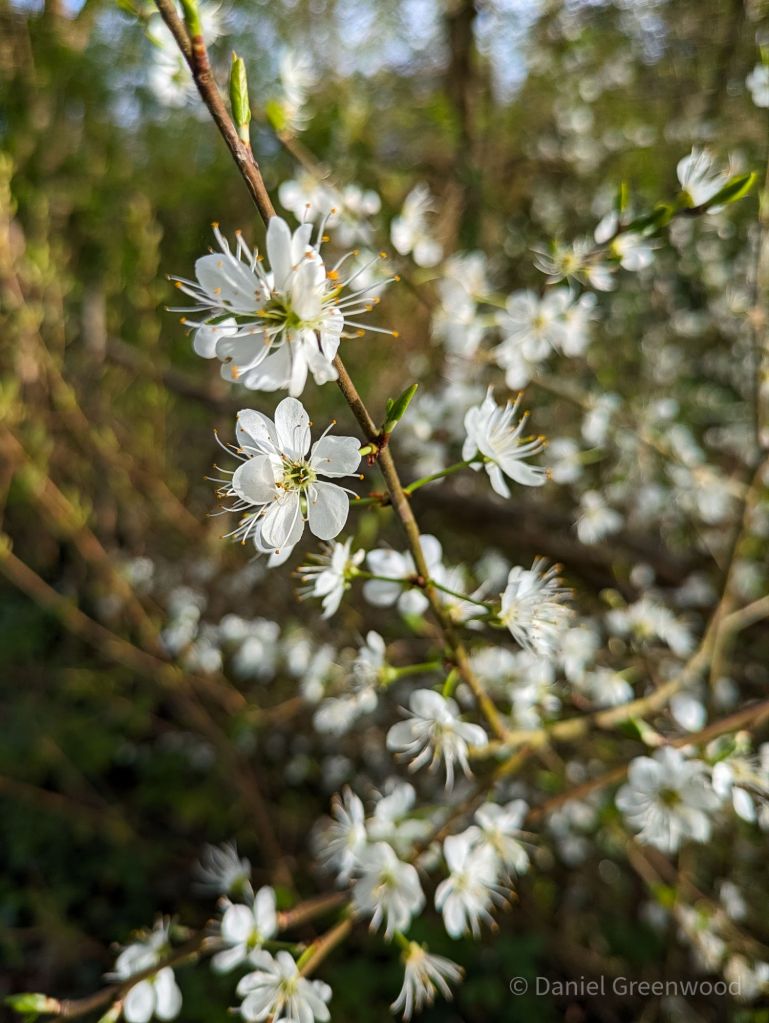
One thing that impresses with the Pixel 7a is the autofocus. These blackthorn flowers were blowing in the wind and yet the detail is so good.

Lichens are a great thing to photograph because they stand still and can be very attractive subjects. I was considering stretching my budget for a Pixel 8 Pro because it had a macro function. Reviews of the 7a said that it can focus closely, and that is true, to a degree. Also it sounded like the AI in that phone maybe does too much.

One potential block on macro potential is that the phone seems to do auto noise reduction. That can make these weirdly impressionist details were the AI is trying to hide graininess from a high ISO. I’ve noticed it a couple of times and it’s not ideal. The detail and focus is otherwise really good. This is not what the tech people call ‘flagship’ or top of the range.

All in all, I am amazed by what this camera can do. It is so much better than the Fairphone 3+, which shows how quickly cameras are developing in phones.

Would this phone make me sell my standalone camera? No way. Lenses and sensors of mirrorless, standalone cameras can’t be matched by phones currently. It just provides a great option for capturing nice images on the go. It’s going to be especially good for fungi.

Thanks for reading.

Oh, Fairphone.

First ichneumon wasp of 2024 🐝

You know it’s spring when the bees and things start getting trapped indoors again. I visited my mum on Easter Sunday and her kitchen (which has lots of windows) turned into a veritable insect survey trap. Not just the ‘horrible flies’ she pointed out, but this lovely ichneumon wasp which I rescued with a glass and a local elections envelope.

Looking at iNaturalist, this is probably a yellow-striped Darwin wasp (Ichneumon xanthorius).

You can probably tell that these are phone pics, I haven’t quite got into proper macro lens work yet this year, but soon! I love the orange-yellow-black fade of the antennae, which is probably where the name ‘xanthoria’ comes from in the scientific name.

Xanthoria is a genus of lichens which are commonly known as sunburst lichens. In Latin it means golden yellow, which is perfect.

And here’s the proof – Xanthoria parietina, a pollution-tolerant lichen that grows everywhere.

Thanks for reading.

February sunset in the Arun valley

Amberley, West Sussex, February 2024

Here’s the best image I captured while waiting for the sun to disappear over the Downs recently. To the right hand side of the image (north) you can see the Arun flooding the area known as Amberley Wildbrooks. It was surprisingly mild up there but as the sun slid away the cool air arrived with the moon. Red kites floated overhead and trains echoed through the valley on their way to Arundel. A beautiful evening in a special place.

Macro: As autumn beckons, ivy brings the bees 🐝

East Dulwich, London, September 2023

On the corner of the street, a mass of ivy was spilling over a wall. It was an explosion of leaves and flowers, sound and smell. The flowers were alive with insects: hoverflies, honeybees, bumblebees, and that ivy specialist, the ivy bee. 

I hadn’t seen many ivy bees before, and wasn’t aware they were now so far into the centre of London. They nectared in a frantic fashion, with at least two having been captured by a massive garden spider that scarpered when it realised how close I was to its web.

At this time of year very few plants are flowering, and none like the ivy can. Even so, ivy in London has an awful reputation. People hate it, calling it a parasite and tree killer.

Some years ago a man gave me his opinion by leaning in and whispering that he had seen it sucking the sap from a tree, like it was some dark truth kept hidden from the world.

In reality it’s not a tree killer and it’s not a parasite. But like so many things in society now, people will believe what they want, regardless of the facts.

In a wood near to this jungle of ivy, mature growths of it have been found hacked and severed by visitors acting on their instincts without reason (or permission).

I remember a local tree surgeon unloading on me one morning when I was in the woods about to start a working day, telling me how terrible ivy was at that location. I was taken aback by the man’s strength of feeling and let him say his piece. When he had finished I asked if I could go and start my day’s work.

“You didn’t like that, did you?” he said.

Is it any wonder tree surgeons don’t like ivy? I’m sure many appreciate its place in the ecosystem, a habitat for bats, birds, insects and autumnal nectar for pollinators. But to a tree surgeon it makes your work so much harder, what is already one of the most dangerous and brutal jobs available in the UK. I suppose I had just expected someone who works with trees all day to have a little more imagination and ecological flexibility.

I’ve made the faux-pas while leading guided walks of talking about the value of ivy nectar to honeybees and been informed that it’s not so good for them. One very polite beekeeper corrected me and said that the nectar can crystallise too quickly in the hive and leave the bees to starve. For wild pollinators there is no such problem, of course. The beekeeper said the issue was mostly where the only nectar source was ivy.

Should ivy be cut off trees in some cases? Of course. But is it often framed for crimes it didn’t commit? Yes, all the time.

I remember driving with my parents through Ireland back in 2008, when I knew very little about trees. Ivy was everywhere and I worried it was going to harm the trees. I later learned that the story is different.

Ivy often grows on trees that are in decline, meaning more light comes through the canopy, encouraging the growth upwards. Then when the tree does die, there stands the ivy, ‘throttling’, ‘suffocating’, ‘killing’, as some hyperbolise. In high winds ivy can act like a sail, and trees do come down.

In my experience it is often life-giving.

People come to nature looking for absolutes, but just end up finding more questions and often being humbled. The trick is to embrace the ambiguity, your own lack of knowledge and mastery of any given subject.

Personally, I was thankful for that final flush of insect buzz on an unseasonably warm September morning. Who do I thank for that? That’ll be the ivy.

Thanks for reading.

Why do people hate ivy?

Brighton, September 2023

Brighton, Sussex, September 2023

I’ve been visiting Brighton since I was a child on family holidays and it holds a special place in my photographic life as well. The sea at Brighton and Hove’s beaches are some of the places where I began to take landscape (seascape!) photos, using a Nikon F film camera.

Thanks for reading.

Also: Set: London to Brighton | Set: Hove beach

Spring 2023 blog update

Hello!

I wanted to do a blog update post as I have fallen behind with writing and photography, but am still in existence. Believe me it pains me not having the time or mental space to write anything, possibly more than it pains you to read this blog.

I’ve just finished working on a short-term project job and it’s been pretty full on. I’m hopeful that in April I’ll be able to post more, especially with the invertebrate world coming to life again. I’m also about to embark on a new project job, full-time, meaning I will have to be more organised about how I post on here. As ever I want to keep my blog as an outlet.

Hairy footed flower bee rescued from the road

Spring, it cometh

There have been a couple of signs of spring awakening in my garden, with a hairy-footed flower bee my most seasonal sighting. That said, I have only seen one, which is perhaps unusual for this time of year.

It’s late March now and the local green spaces have their chiffchaffs back.

In mid-March I led a spring walk in Dulwich for London Wildlife Trust. It was rather wet but there were still signs of the season changing.

Lesser celandines were the closest thing to a flowering plant I could find, but ramsons, bluebells and wood anemone were in leaf. That said, wood anemone appears to be a casualty of lockdown, in that the increased footfall has trampled this delicate ancient woodland plant out.

In terms of the more distant past, I spoke to the group about the Victorian impact on the woods, how invasive species like knotweed, laurel and rhododendron had been introduced by them. At the end of the walk one attendee spoke to me and told me something that astonished me.

“My family, back in the 1700s, were responsible for introducing rhododendrons to the country,” he said. “It’s in the bones.”

I was aware of the fact that my throwaway comment about Victorian introductions might have potentially been an insult. I explained that it was more in regard to their place in wilder landscapes which he agreed with, mentioning just how destructive they are in more rainy places like Scotland. 

I’ve said before on here that one of the great things about leading guided walks is that people feel comfortable sharing their knowledge with you. Guided walks are always a shared experience, not a lecture. They’re an invitation for people to look differently at a place and make others aware of things you didn’t know yourself.

I’ll have to be more careful in my (mild) criticism of the role Britons past have played in changing the flora, fauna and funga of the UK.

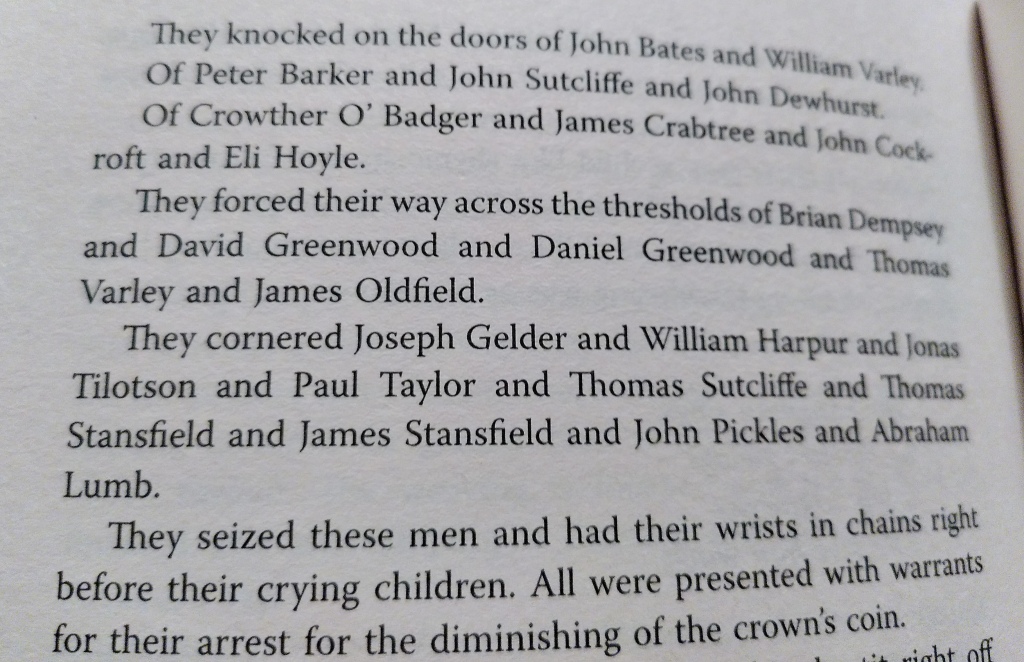
A worrying extract from The Gallows Pole

The Gallows Pole

I’ve been reading the novels of Benjamin Myers recently, an author of poetry, fiction and place writing based in Yorkshire. While on a weekend break I read The Offing and gobbled it up. It’s the story of a young man walking in the north of England one summer after the Second World War. He becomes friends with a very charismatic woman who takes him under her wing, in the way that people in their 30s upwards can often do for young people at the end of their teenage years. It’s a beautiful book and much recommended.

I’ve just finished the very brutal The Gallows Pole. The story is based in ‘the land of my forefathers’, the Calder Valley near Hebden Bridge in North Yorkshire. It’s a visceral, violent and disturbing novel but is one of the best I’ve read in years. It has that ‘unputdownable’ quality. More disturbing for me is the number of Greenwoods who crop up as part of the illegal coin clipping industry that blossomed in the rainy hills of Calderdale. Not least, a Daniel Greenwood! And it’s historical fiction! My family were hillfarmers there up until some point in the 1800s, living in the area around Haworth at the time of the Brontës, before moving to Liverpool where my father was born. Greenwood is a Yorkshire name with heavy concentrations around Lancashire, too, probably because they moved to work in the cotton industries at the advent of the Industrial Revolution. My Dad told me that Greenwood comes from a wooded place known as ‘Greenwode’. ‘Wode’ of course is the Anglo-Saxon name for woodland.

The Lost Rainforests of Britain

In the nature writing world, in February I read The Lost Rainforests of Britain by Guy Shrubshole. It’s great to see these woodlands getting some press, especially seeing as they have been decimated over the centuries, with very little of the the habitat left. Shrubshole shows the way for how much of the landscape in Western Britain can be home to more of this unique habitat. I hope it can progress but worry that in a warming climate it becomes less viable.

I felt the book might have benefitted more from a deeper focus on the landscape at its heart – Dartmoor, close to where Shrubshole lives. The random trips to tick off other woods felt a bit of a distraction from a more meaningful account, such is the style of this type of species or habitat-focused genre. In terms of personal taste, the name-dropping of other writers and musicians has become a tedious pastime of this genre and makes it seem like a clique. I don’t think that helps the movement, though again it’s probably about personal taste.

It’s definitely worth a read if you want to know more about things like Atlantic oak woodland and the habitats and landscape history of Dartmoor.

Thanks for reading.

The Sussex Weald: Autumn sunset at Cowdray Park

A new blog post series of single images, maybe, to counteract the decline of Twitter and the TikTok-isation of Instagram?

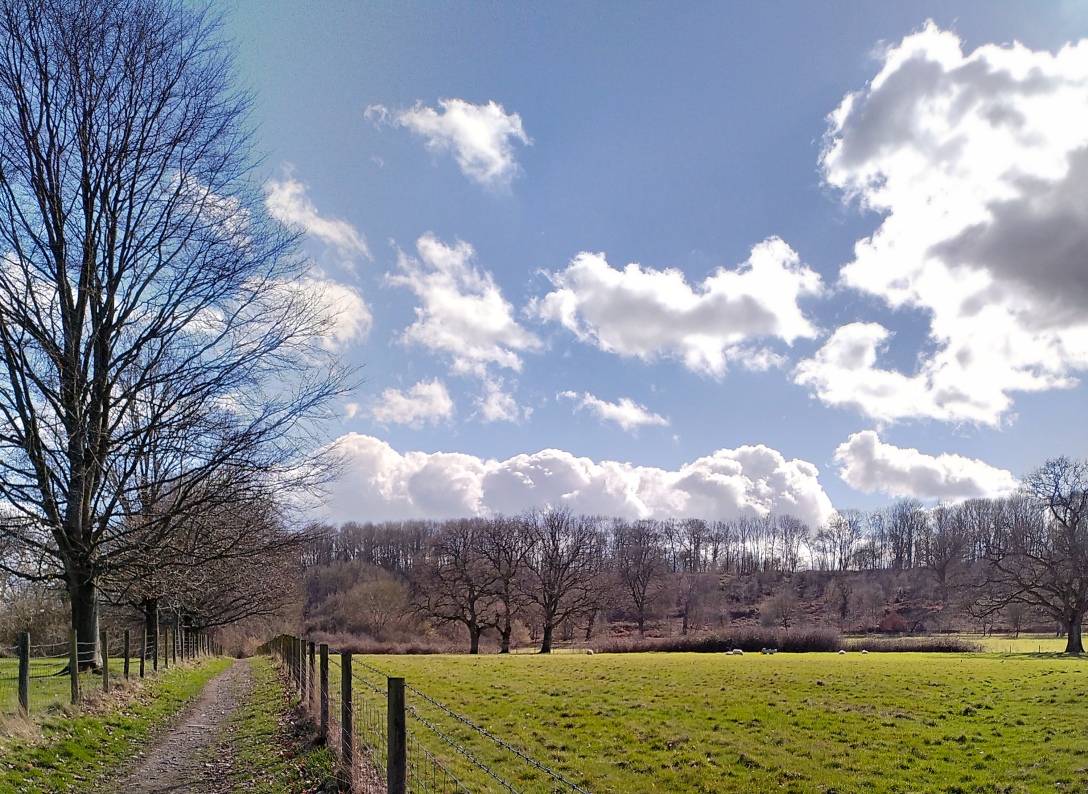
This image was taken at Cowdray Park near Midhurst on Monday 14th November. It was a stunning autumn evening, with trees in shades of gold, yellow and orange all the way to the sumptuous Downs.

Chanctonbury to Cissbury in the South Downs

On a warm and clear day in October I walked between two of Sussex’s most famous and well-loved hillforts: Chanctonbury Ring and Cissbury Ring. This is a walk that you can access by public transport, with buses to Washington and then from Findon off the A24.

I didn’t know much about Iron Age hillforts until I worked in the South Downs National Park and had the chance to learn from people working at the National Trust and other heritage experts. Still, my knowledge is not strong on this subject.

It is amazing to think that these hilltops might once have held the equivalent of small villages, using the hilltops to monitor the movement of people across land in the north, and at sea in the south.

The walk winds its way up through woodland to Washington chalk pits, an old chalk quarry that’s now habitat for butterflies and orchids. Here you get good views north to the Greensand Hills where Leith Hill, the highest point in SE England can be spotted (out of shot on the right hand side in the north).

It wouldn’t be a walk for me without the sighting of something fungal. The cow pats in a field approaching Cissbury Ring contained some inkcaps which may be the uncommon snowy inkcap. In the distance the ridge of the Downs bowls away west towards Amberley and the Arun Valley.

Immediately upon ascending the Downs, you can get good views south to Cissbury Ring, a hillfort much, much bigger than Chanctonbury Ring. In the distance are views of the south coast and, in this image, the Rampion windfarm. It’s named after ‘the pride of Sussex’, round-headed rampion, a flower more common in the South Downs.

You approach Chanctonbury Ring on the South Downs Way. I like this subtle stretch of the trail, with the beech trees that cover the ring giving a parkland feel.

In the distance beyond Chanctonbury Ring are the aerial towers of Truleigh Hill, home to the Youth Hostel and secret bunkers (apparently).

I first heard of Chanctonbury Ring when reading Robert Macfarlane’s The Old Ways. There are stories of the ring being ‘haunted’, not just by nature writers. It’s a welcome place to sit and rest, taking in the views under the fair shade of the beech trees. You can understand why this smaller hillfort would be such a good location to observe the comings and goings in the surrounding landscape.

Continuing east on the South Downs Way, views of Devil’s Dyke begin to open out. During the walk the site was visible through the glinting of the sun hitting car windows in the National Trust car park!

Devil’s Dyke (what is one of the most dramatic and awe-inspiring parts of the Downs) can be seen in the mid-left/centre of the image where the dark lump of woodland sits atop the ridge. Truleigh Hill is again visible with the masts.

Turning back to look over your shoulder gives a nice view of Chanctonbury Ring. I think the lump of hills in the right hand side of the image is Black Down, the highest point in the South Downs National Park, near Haslemere in Surrey.

Leaving the site of Chanctonbury Ring gives the impression of walking straight into the sea.

There’s a southern turning to take towards Cissbury Ring and off the South Downs Way. The track leads alongside arable fields and shooting cover. In this view the distant shape of the Isle of Wight is visible in the top right.

The resplendent South Downs set against a ribbon of blue sea and cloud-scattered sky.

Approaching views of Cissbury Ring.

Cissbury Ring is owned by the National Trust, thank god.

On Cissbury Ring there are better views of Brighton and the Seven Sisters cliffs reaching round to Eastbourne. This was a good way to observe the landing of invading armies but probably also to monitor trade.

Out at sea you can get closer views of the white turbines of the windfarm. The development required cables to be dug into the landscape, with a long strip having to be cut through the Downs to reach the electricity terminal. One person I know who lives in Hove said they were comforted by the red flashing lights on the horizon at night.

This sycamore tree got quite a lot of Instagram interest during lockdown, when a local person posted stunning phone pics of the sunsets up here. This is looking towards the Findon Valley.

Looking back where we’d travelled from, Chantoncbury Ring’s mini-hillfort can be seen as a beech clump on the hill, but much smaller now.

To the west, if you have binoculars, you can see the City of Portsmouth outlined on the horizon.

A last look across the Findon Valley, west into the Downs. The ramparts of the hillfort are in the image’s foreground.

Thanks for reading.

Further reading: The South Downs

Enjoyed what you saw here? If so, please support my work: https://ko-fi.com/djgwild

Latest from the Blog

November 2025: beware of pity

I’ve had a burst of American visitors in recent days (to my blog, not my house). So thanks for visiting, y’all, and sorry about the year you’ve had. You may have noticed I’ve slipped to monthly posts on here. Between April and October I posted blogs every Monday without pause, which is a tricky task…

Summer-autumn 2025: unveiling the sun

Here’s my seasonal update of stuff you don’t need to know about, but then welcome to the Internet. What I’m writing Soon I will be self-publishing my third poetry collection, Fool’s Wood. It’s seven years since my last one and this collection has taken longer because of LIFE. There will be a booklet and also…