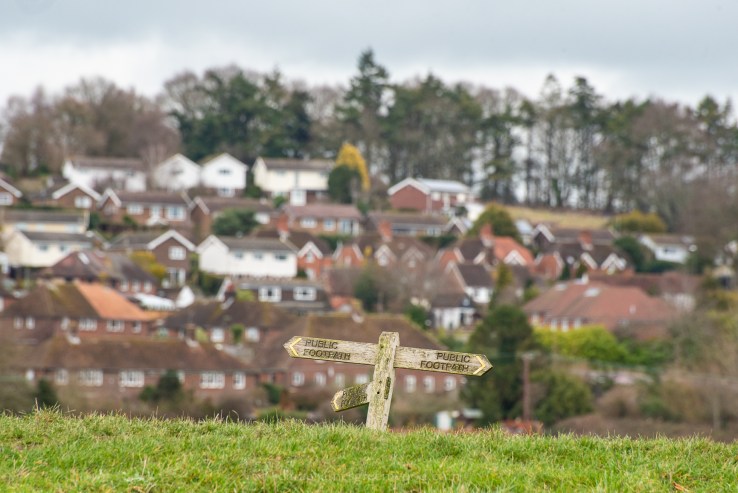
With some hours of Bank Holiday Monday to spare, we drove to Cuckfield in West Sussex. Pronounced ‘Cook-field’, it gets its name from the cuckoo.
The chuchyard in Cuckfield is vast. A country walk in Sussex is never complete without a visit to at least one church (which, if it’s old enough, usually has an ancient yew tree next to the building). Entering it from village streets dominated by a cedar of Lebanon, it spreads over the gentle crest of a hill, the South Downs rolling along in the distance. On that evening, they were so green and clear they seemed within arm’s length.
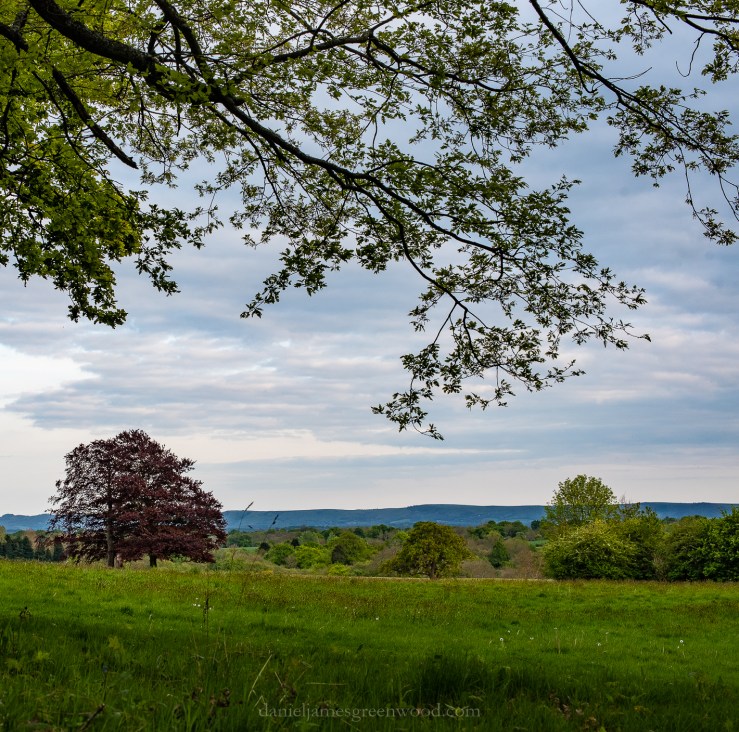
The South Downs beyond the spread of Wealden woodland, from Cuckfield Park
Entering into a church I am always struck by the smell, like an antique shop. There is cool and a sudden stillness. The small churches of English villages hold the scars of our history often with lists of names of people killed in the First World War, or sometimes with gruesome histories stitched into tapestries. Most of them are not actually English but Norman (1066). The yew trees in their grounds often date to pre-Saxon times (500AD), even before Christianity was dominant in Britain.
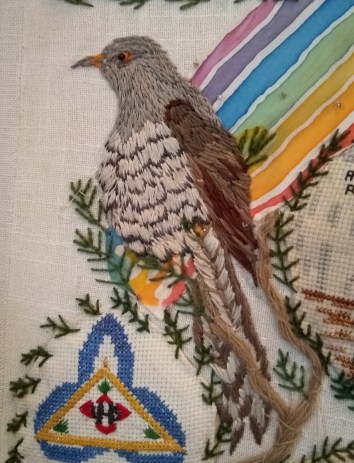
In the church a tapestry of a tree held symbols of the village. Perched on a branch was a cuckoo with its sharp bill and grey head.
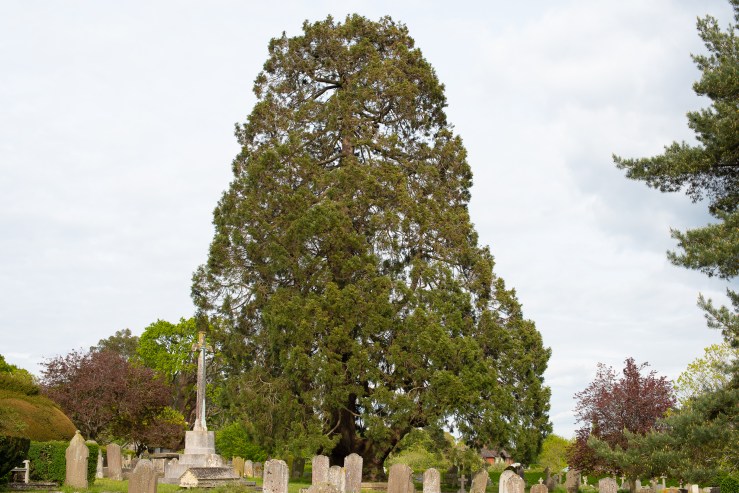
No cuckoos sang in the churchyard and no yew tree had lived long enough to recall Pagan Britain, but a castle of a giant sequoia grew amongst the graves.
We walked for four miles into the woods and fields that edged the village. Great veteran oaks sat on field margins, quintessential Wealden scenes of sprawling boughs and hefty trunks with woodland on one side and an open field on the other.
I spend a lot of time traveling by car between the Weald and the South Downs. From the corner of my eye I can tell when the Downs are done and the Weald has returned. It’s a case of oaks sitting in hedgerows of neatly set fields. Looking at a map of the Weald, these fields are glades carved out of the ancient woodland that once cloaked the entire area between the North and South Downs. No, it probably was not wall-to-wall woodland (as people say), but its openness was more rugged and less formal. Less civilised. It’s not all oaks in fields, however. Here a Scots pine stood in a private field, framed by the woodland footpath we were taking and the rounds of hay rolled up against the fenceline.
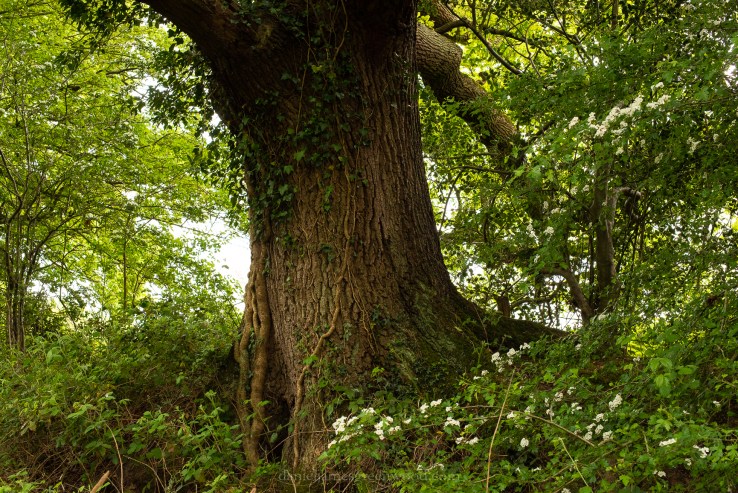
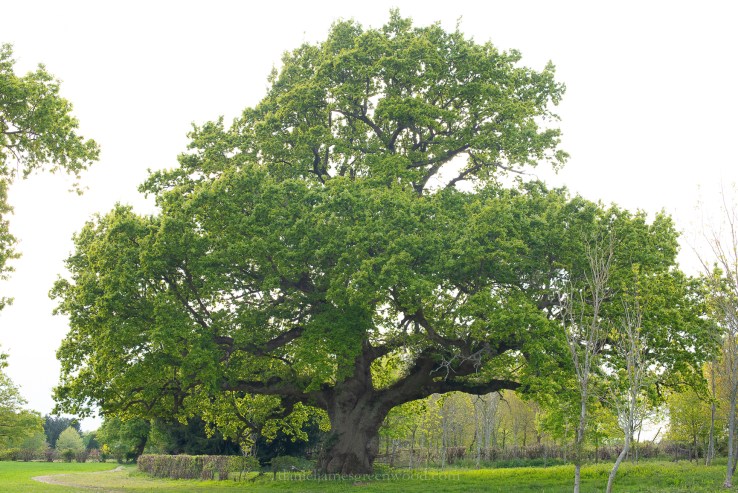
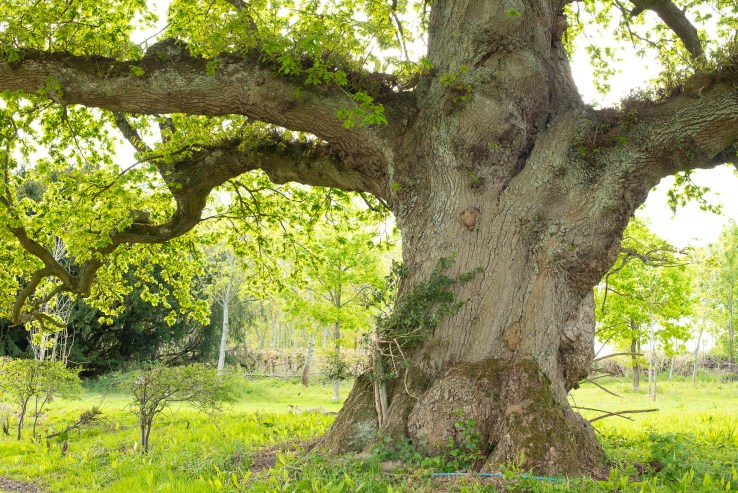
As is the way in the Weald, the most spectacular trees are the oaks like this one here. At the edge of a field this oak has lived without woodland close by for probably over 500 years.
As with so many oaks like this one, as they age they begin to tell a tale of all they have survived. The boles, knobbles and scars, the direction of the boughs and their sprawl.
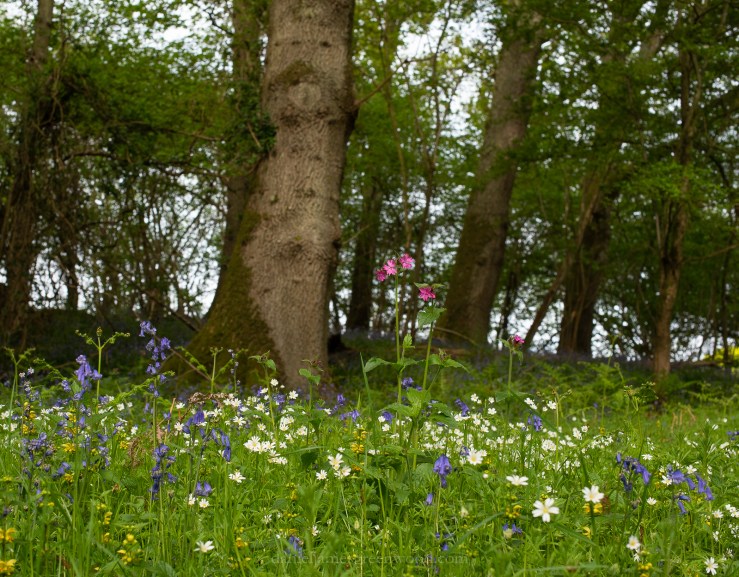
In the plentiful chunks of remnant ancient woodland, the oaks are smaller and white with algae. The latter is a measure of better air quality, of less chemical pollution from farming. They are smaller because they have to put up with competition from other trees. In May their toes are decorated with spreads of red campion, stitchwort and yellow archangel.
To see these flowers in this state is one of the moments of the year. It takes the breath away. It is a measure of what we have lost in Britain (mainly between 1960-1990) to our brutal, thoughtless treatment of the landscape.
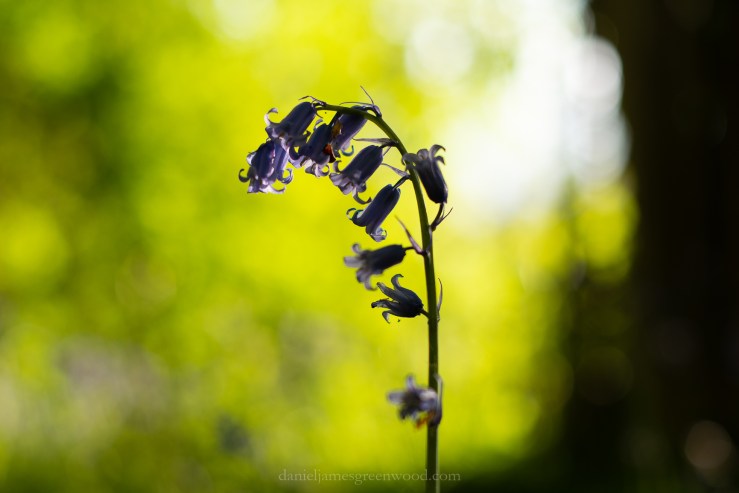
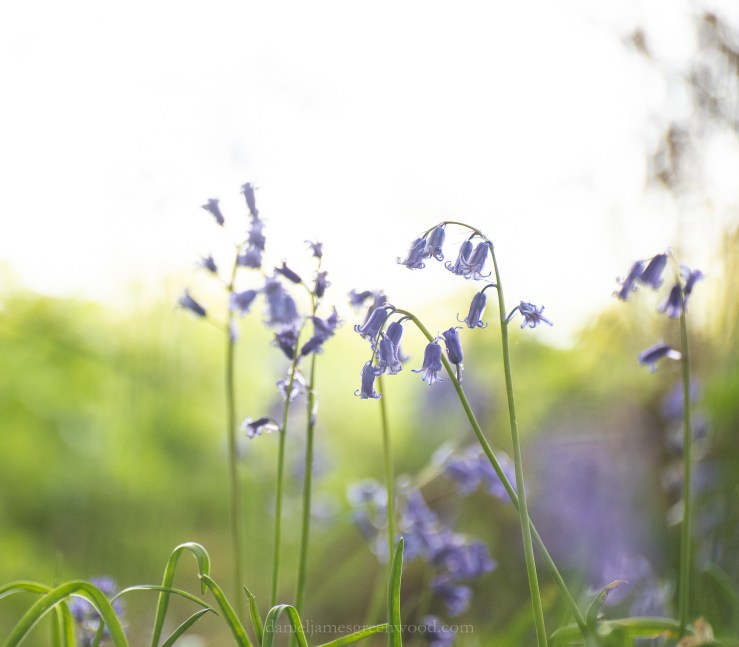
Bluebells were at their crispy peak. I love them in the evening, all that frames them: the light coming through the new green leaves of trees at the field’s edge, a silhouetted oak trunk and the faintest of light reaching those curling petals.
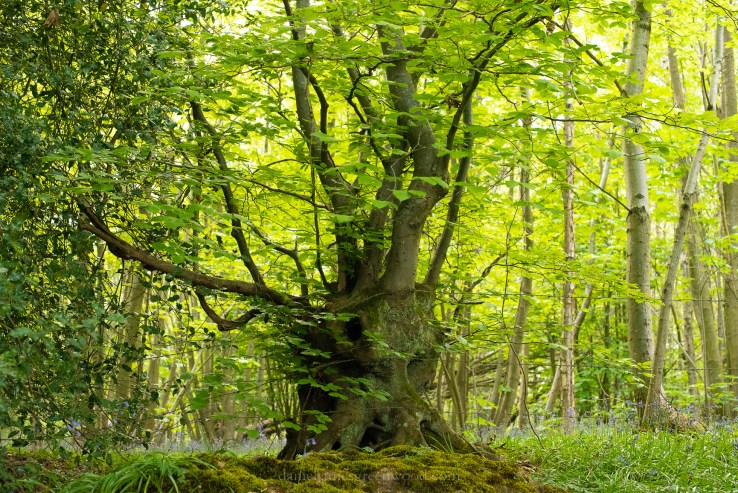
Not all of the trees in the woods make sense. Walking down a lane as we looped back to Cuckfield I noticed this ogre of a beech tree sat on a wood bank. Was it an old hedgerow tree? The trees around it were young, bluebells spread around its buttresses. Perhaps it was in a more open landscape that had now become closed. It showed signs of severe cutting, that is what had given it the look of an octopus.
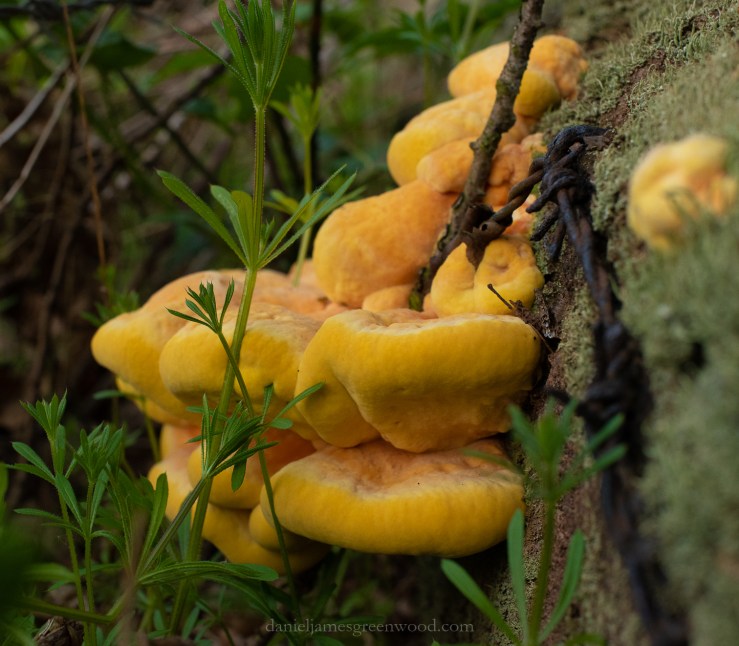
Passing through Cuckfield Park on the return to the village, the bright yellow and orange of chicken of the woods broke the lowering evening light. Growing from the felled trunk of an old oak at the edge of wood and field, it spread through barbed wire and even goosegrass, a sign of how quickly it was growing. This is a sign of spring turning towards summer and even, like the fox’s bark in January, the first sign of autumn. Seasons are not set things, their threads reach out far beyond the timescales in which we define them.
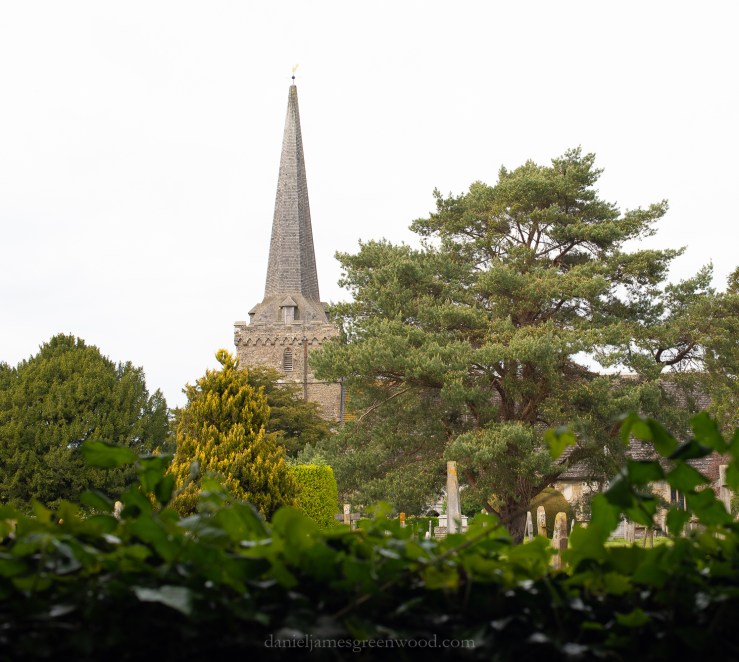
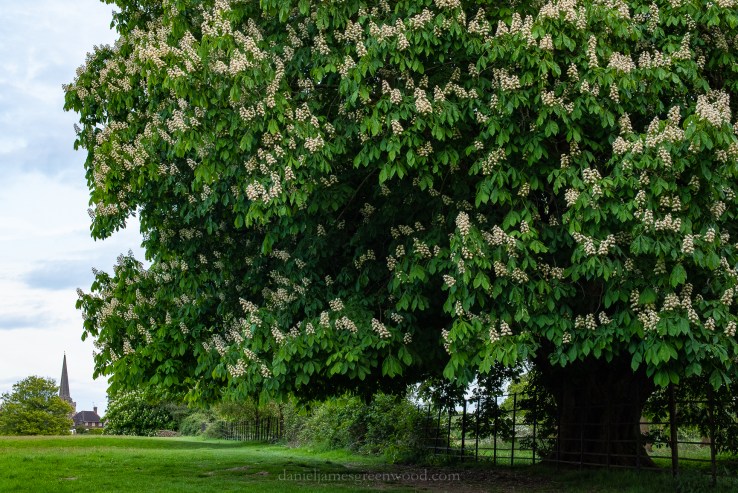
A quick up and over through gill woodland, so typical of the High Weald with its alders and snaking stream, we found the churchspire peeking out from a horse chestnut in flower. Here a queen bumblebee took the last of her nectar for the evening on flowers that appear almost as orchids up close.
I visited a small woodland in the Sussex Weald after work to make the most of a break in the showers. My aim was to catch the bluebells in the early evening light when I think they look best. The forecast was for cloud but it was windy enough for some sunlight to break through. This woodland is coppiced and was where I photographed the wood anemones last month. It is the bluest bluebell woodland I’ve ever seen. My friend always tells me, ‘no, it’s purple!’. He’s right.
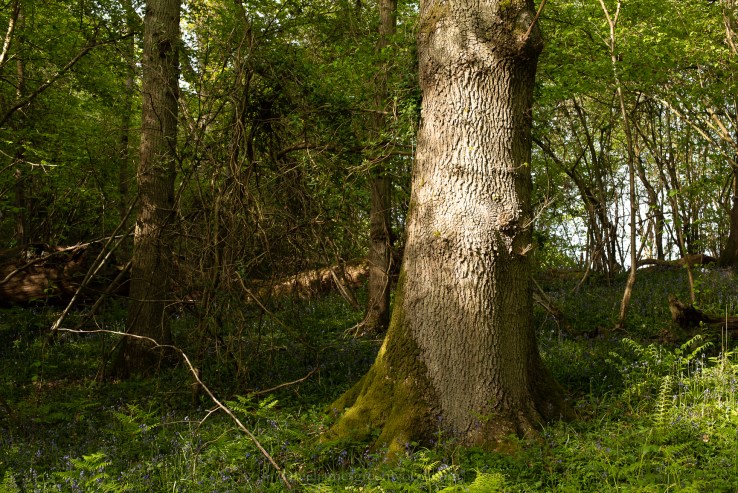
Bluebells are a huge draw for anyone who has a camera (so that’s everyone). It’s part of the traditional spring experience to go to a bluebell wood, in most places that still have them. That’s something that shouldn’t be taken for granted, ancient woodlands like those in the Sussex Weald are being lost, despite the fact that they are irreplaceable habitats. Their species diversity has evolved over thousands of years. At a coppiced wood like this, their ecosystems have coalesced with our management of them for wood products. The oak above might be a coppice, but it could also be three oak saplings fused together.
Something felt quite gentle and warming about this oak plugged in amongst bluebells. Perhaps it’s the slight lean, it’s almost an invitation to pass by. The mental and physical benefits of spending time in woodland are great.
I’ve noticed the flush of new green oak leaves and how quickly that freshness is lost to the stiff darker shade.
Take these two oaks in the High Weald from a week earlier. Their new green is incredibly fresh but will now have darkened. You have to enjoy every moment of spring before it goes.
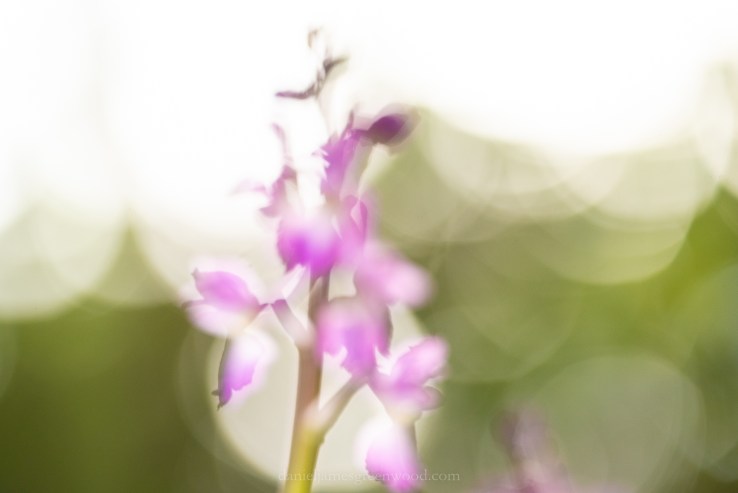
Back to the wildflowers. Before visiting the wood I spoke to a colleague whose job it is to survey woods. He said he’d seen very few early purple orchids this year, possibly due to the colder than average January and then sudden heatwave in February. I said I would report back on my findings. I discovered a patch of about 10 flowering on the wood’s edge with plenty of other spotted leaves yet to produce flowers. I had seen them in the same patch a couple of years ago so knew where to go.
I find orchids that grow in woods to be twice as exciting as those out in the open landscape. It’s a personal thing, because the diversity is far greater out there. There’s something about woodland versions of other species, birds or butterflies for example. There is something so interesting about the fact some species have made a niche for themselves in certain types of woodland only. Don’t get me started on firecrests. It’s even more interesting when these species, especially the wildflowers, escape out into the surrounding landscape.
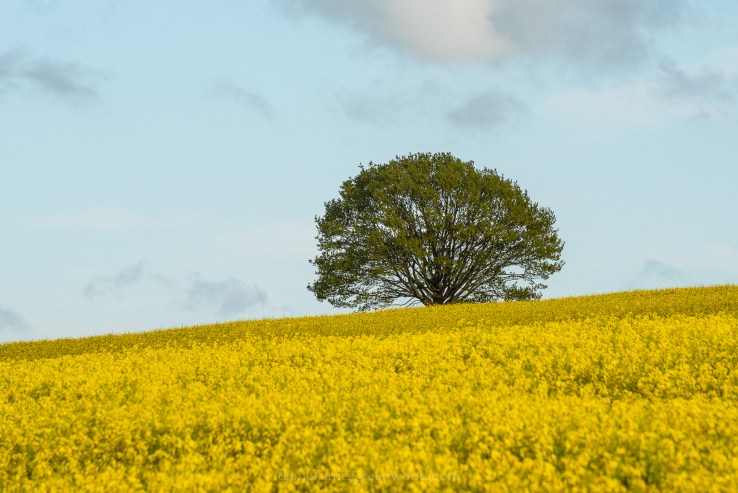
It’s not possible for the flowers to do much of that in this slither of the Sussex Weald because it’s surrounded by a monoculture of oilseed rape. On the contrary the farm is making its way into the woodland through the run off of fertiliser and water being piped in. You can see where the wildflowers are being pushed further into the woodland, away from the polluted areas. It’s something happening to almost every small woodland in England in one way or another.
Photographing the orchids was tricky because it was windy, dull and the plants were small. I used a telephoto lens and tried to maximise the bokeh around the flower. These flowers are beautiful even when out of focus.
The woodland flowers felt as if they were at their peak. Elsewhere yellow archangel spread amongst bluebells.
The details of a wood at this time of year are incredible. If you look closely it’s not just the bluebells that will attract you, the fronds of bracken unfurling are worth investigating. These primitive plants reproduce through spores and pre-date flowering plants like bluebells by millions of years. It’s a tough plant and can be a bit invasive. Oliver Rackham reckoned it was the most common plant across the whole of the UK.
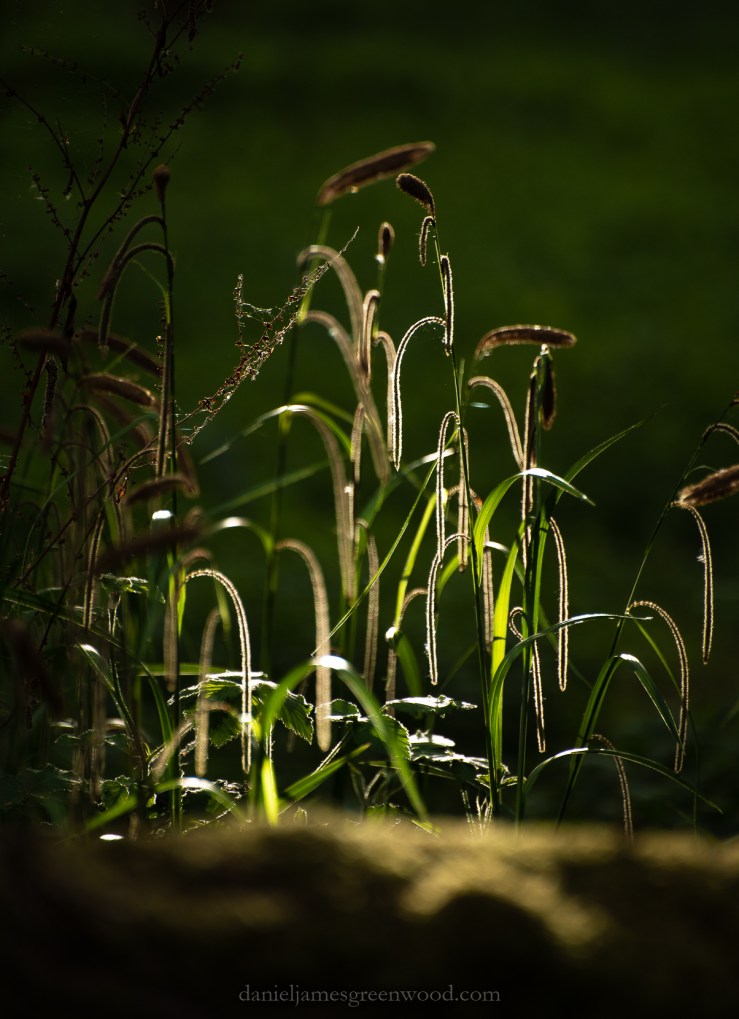
People often say they spend a lot of time trying to remove pendulous sedge from their gardens. It gets around. It’s actually a resident of ancient woodland and can be found in the wood. I passed this community of sedges on my way out as a few bands of sunlight broke through the clouds and lit their drooping seedheads.
That light broke free as I made my way out again, illuminating bluebells either side of tree trunks. It was a reward for gambling on a grey sky.
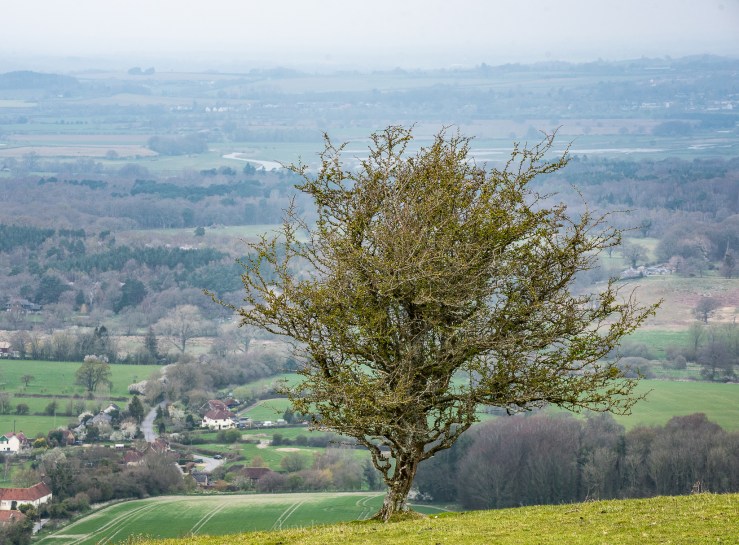
A recent walk along the the South Downs on a hazy day with hawthorns. They tough it out in some of the most intensively managed landscapes the UK has to offer.
A hawthorn stands alone, overlooking the folding Downs as they run deeper into West Sussex.
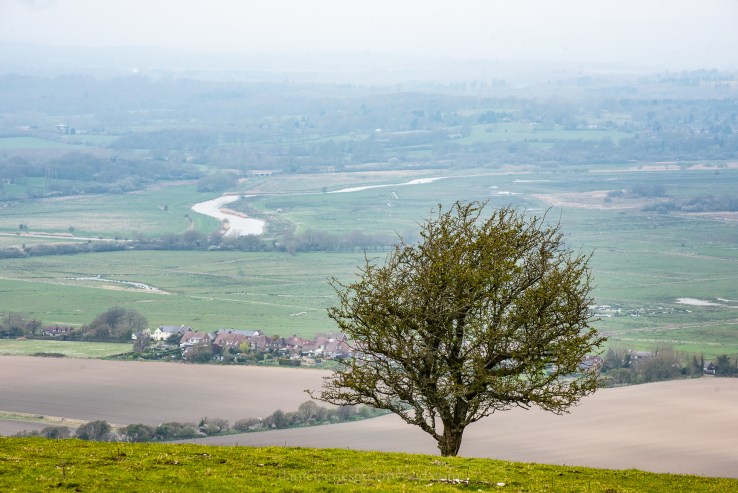
This hawthorn faces out over the Arun Valley towards Pulborough. The Low Weald is hidden by mist in the north.
Along the South Downs Way the trees show signs of pathway lopping, or an extreme politeness to the thousands of users of the National Trail.
A hawthorn obscuring a village built along spring-lines. The Arun snakes away in the background.
A tanker sits in an open field. I think that’s a hawthorn splodged against the South Downs Way towards Amberley.
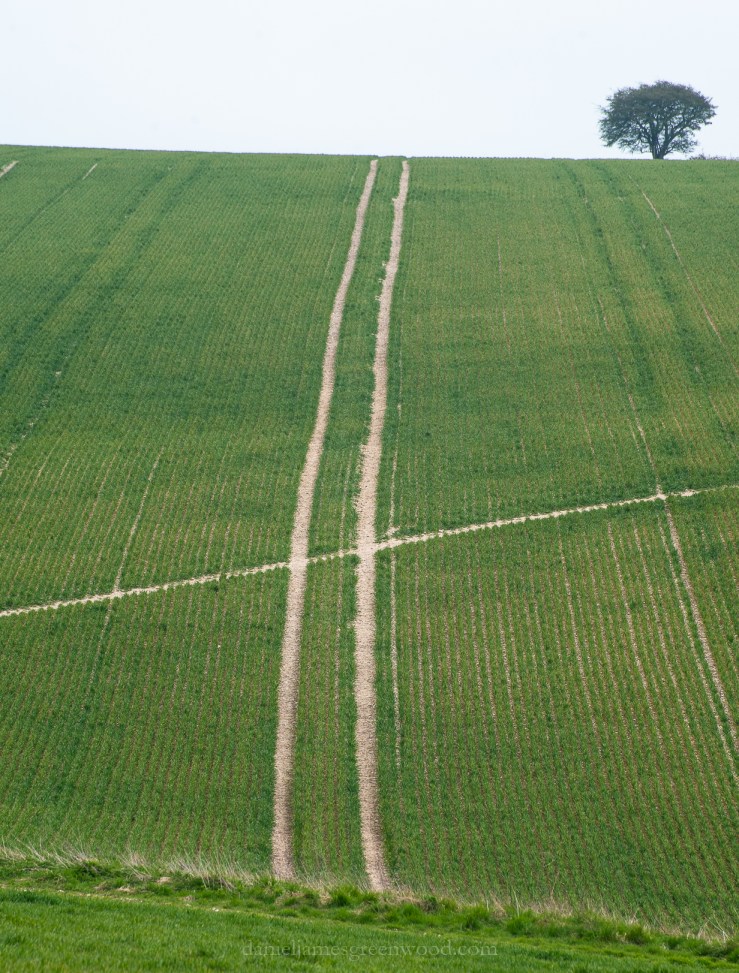
A monoculture of wheat (I think) with a single oak on the horizon. Wheat has been grown in the South Downs for thousands of years. It has only become mechanised and intensified in the past 100 years. We may idealise the days of horse and plough in the South Downs but it was a harsh and unforgiving existence. Few people could cope with it today. There were also fewer people to feed.
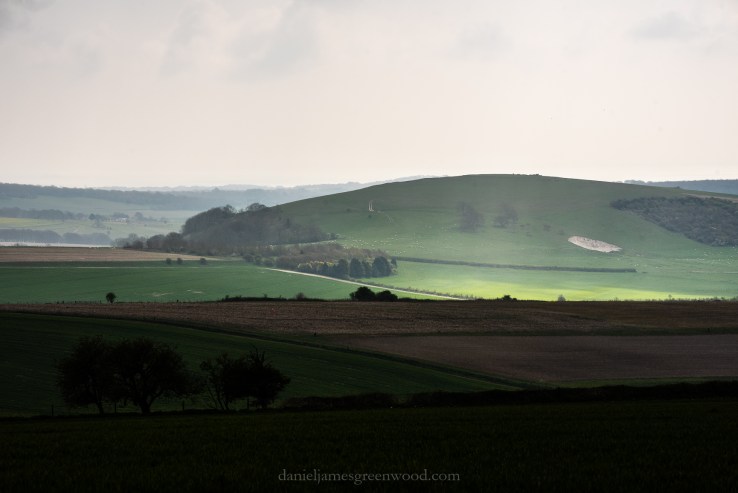
There was a single break of light over the Downs. The hazy nature of the day makes the photo look like a painting. My friend said it was good that the simple things matter to me, which apparently wasn’t an insult. I agree.
My time in the woods has thinned. Just like the seasoned photographers in magazines tell you, planning your time is key to getting the photos you most enjoy. It also becomes dependent on weather forecasts. A few years ago a friend of mine was leading me around his favourite sites in the Czech Republic and he made a point I haven’t forgotten. Nothing matters more with photography than light. You could have the most amazing scene in front of you, but light is everything. It adds contrast, shadow and colour. It makes you feel good.
Bearing that in mind, I had a few hours in the afternoon before the sun went down to visit an ancient coppice woodland in the Sussex Weald. The Weald is a chunk of southern England that runs from the Hampshire border of West Sussex all the way to Kent in the east. It was once an ‘impenetrable forest’ but now is a large mosaic of oak-dominant woodland with a Conservation Board to protect it. Coppicing is the practice of cutting trees low to the ground to harvest the materials for wood products. It’s effectively farming the woods. Our ancestors have been doing it for thousands of years. Even beavers do it.
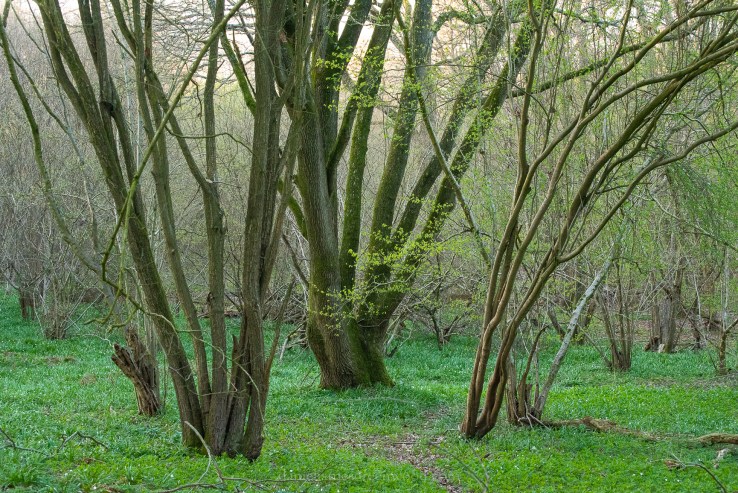
It produced the multi-stemmed trees see above and allows light to enter in, often resulting in a profusion of flowers indicative of a woodland that has remained there for over 400 years. March-May is the time when these flowers arrive, benefiting from the fact the canopy is still open. Wood anemones are the first of this swathe.
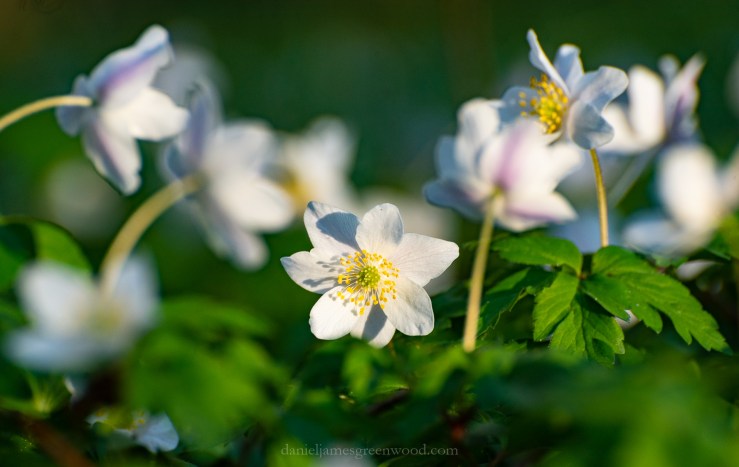
Like many people before (and after) me, I fell for this small white flower when I learned of its charming lifestyle. The petals close when the sun is gone and they are punished for this delicateness. It takes about 100 years to spread 2 metres across the ground. In the past it has been my job to try and protect wood anemones from trampling. I agonised over it.
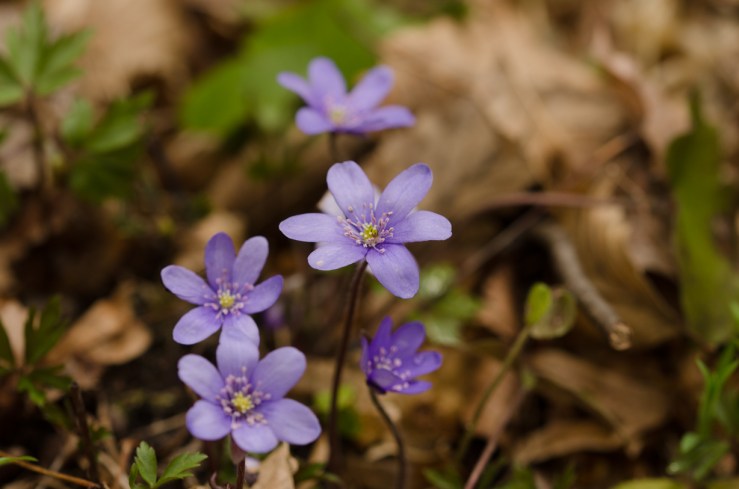
Wood anemone is a member of the buttercup family. The similarity to buttercups is in the number of petals, the leaves and the reproductive parts of the flowers (the stamens and anthers) that protrude from the centre. At this time of year in continental Europe purple anemones push through crusts of snow that we don’t really have in the UK. Our friends in Europe have wood anemones, also.
Bluebells and anemones can create beautiful spreads of flowers in woods. But they don’t always make the photos you want. Anemones look wonderful with a bit of early morning or evening light passing through their petals. I went with that thought in mind to see the Sussex anemones.
This is a special time – perhaps the best in the year? – when winter has been overcome and the promise of longer days, of warmth and green is on the cusp. It could also be a genetic memory we have from our ancestors who found winter to be more uniformly cruel than we experience today.
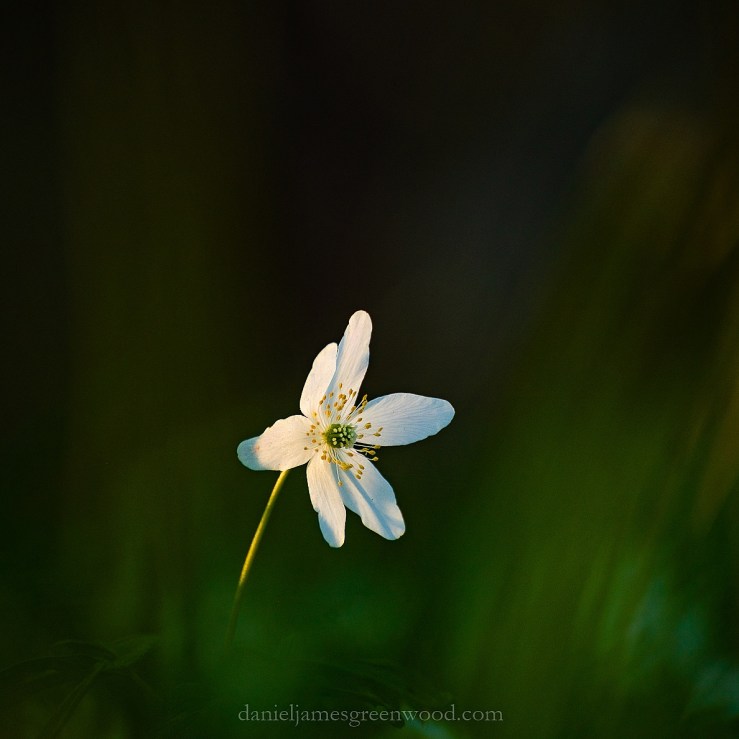
It’s really important for me that photographing any wildlife does not add to disturbance. With woodland flowers it means taking photos from the path or sparse areas. I’ve already said how long it takes them to travel. The photo above may reinforce that: a vulnerable, delicate flower isolated in a darkening wood.
You sometimes find a single flower left over from a trampled population, like a single cottage left from an abandoned village.
Everywhere in wild corners of the UK ther are signs of a micro-shift in a season. The wood anemones hold the floor today, but the first bluebells are unfurling. In this old coppiced wood the bluebells will run rampant and the wood anemones will be squeezed. It’s just the natural order of things.
For now the windflowers, as they were once known, break out from beds of dead bracken in still leafless woods.
On Saturday 23rd March 2019 I attended the People’s Vote march in central London. The march was attended by over 1,000,000 people, the biggest ever pro-European Union march in history.
The march came at a time of growing public disillusionment with the government’s handling of negotiations with the EU.
A petition calling for Article 50, the mechanism that counts down to Britain leaving the EU, to be revoked had been signed by 5,000,000 people at the time of the march. The theme of ‘revoke’ rippled across placards throughout the walk.
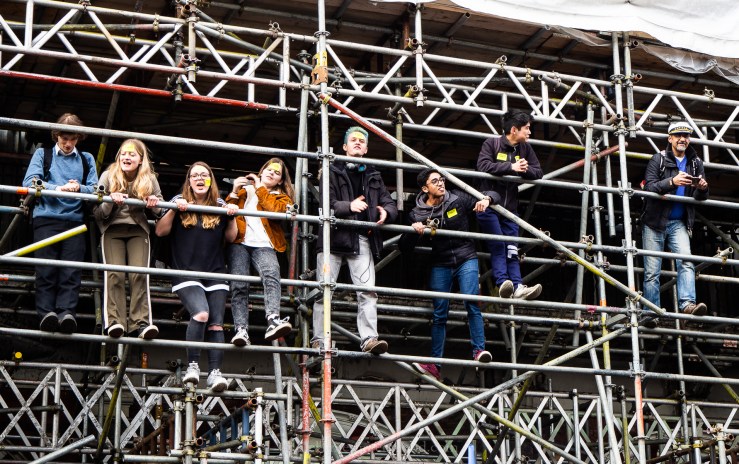
There were a lot of young people at the march, people of all ages were represented. The result of the referendum in 2016 has been a catalyst for people who were under-18 at the time to make their voices heard. The placard above gives the sense of how some young people feel about their lack of a say in the process.
The catastrophic process of Britain negotiating to leave the EU has galvanised a lot of people to campaign for change but they feel that government is not listening. Despite Theresa May’s references to issues other than the referendum in that fateful TV interview, toxic party politics and the usual haze of anti-European politicians has settled over the airwaves once more. Politicians are failing young people and it will come back to haunt them in the decades to come.
There is a strong sense of anger about the lies of the anti-European campaigns and also the shambolic failure of those leading the Remain campaign. People do not understand why more is not being said about illegal activity undertaken in the referendum campaign in 2016.
The convergence of political and cultural messages was seen in many of the signs, like the one above which references the musical Hamilton: ‘Immigrants – we get the job done’. Politicians have failed to highlight the fundamental role that immigration has in UK society. Britain is a nation of immigrants, from the Windrush generation to the Anglo-Saxons, Romans and the first people to set foot on our wild island before it became physically separate from Europe, 10,000 years ago. Recent political events, combined with inadequate social media policing and xenophobic newspaper reporting have allowed racist, far-right voices to be heard once more.
Alongside the anger was the ‘good old British wit’, with plenty of references to tea and mild disquiet: ‘I’m quite cross!’
There was colour and character to the march. It was a chance for people to express their love for the European Union creatively.
This man’s hat drew a lot of attention. It is a surreal union of Theresa May and Donald Trump, with bare plastic bums at the back.
This man on stilts was interacting with the crowd around him, much like many others who participated in costume.
In terms of creativity, few creations drew more attention and phone pics than this group.
What I felt most encouraged by was the sheer diversity and age range of people. This whole issue has affected everyone. What is encouraging is that young people, even children as small as those seen here, are aware of the issues and wanted to take part. The fact they could do so in comfort gives a sense of a movement that is open and good, the anger measured and directed in peaceable and often witty terms.
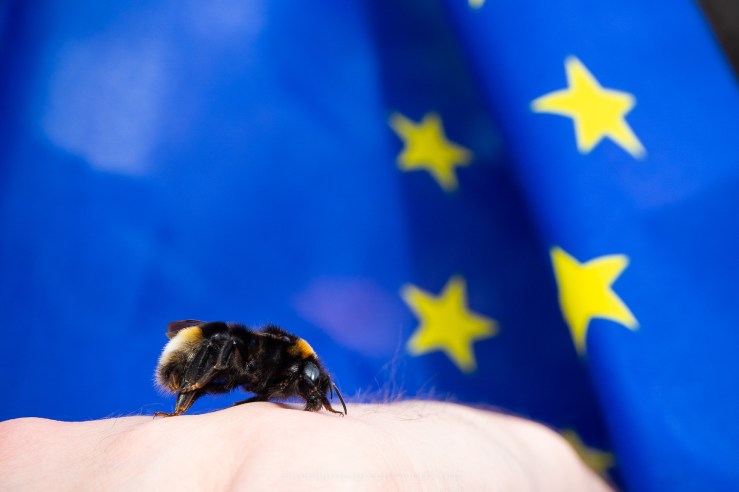
In 2016 my main motivation for our continued EU membership was the role it has played in protecting our wildlife, especially in banning bee-killing pesticides. This was done against the wishes of our own government initially, but who have now accepted the need to do so. During the march this bee rested on my friends hand to get some warmth. When the time was right, off she went out over the heads of the many thousands around us who had gathered to make their voices heard.
March is an odd month in British woods. There is the tantalising sense of spring arriving but winter’s dankness holds fast. Though we learn to see seasons a bit like buses coming and going, I see them as more incremental. There are pointers to change every single day. It’s something I picked up through wildlife surveys, seeing the return of migrant birds, the first bees and leafing oaks. In January it’s the barking fox as mating begins, in February (or sometimes earlier) bluebells and elders leafing, in March it feels like something has to give.
I go to the woods to take photos now more than to simply look for wildlife or listen, so there has to be some reason for taking out a heavy bag full of equipment. When I know there is a good amount of time to take photos I bring two cameras, almost always a macro and a wide angle lens, with a standard 50mm lens stowed away. If I’m feeling super strong I bring a telephoto lens (not a massive one) in case of some lucky encounter with a raptor perhaps.
On dull days the light feels glowering and like nothing is responding. I usually turn to trees at this time to slow my impatience. Here I went looking for mushrooms with the hope of some spring glut. It wasn’t there. Pathetically, the disappointment is real. The first queen bumblebees are symptomatic of the need to survive, winter is not over for them until they have found a spot to start their nest.
There is a lot to be said for taking the time to look at details. Turkey tail is a fungus that lingers all year and can be found in hypnotic shades and patterns on pieces of dead wood. It’s renowned for its medicinal benefits but I’ve never tried it. I’ll stick to camomile and honey.
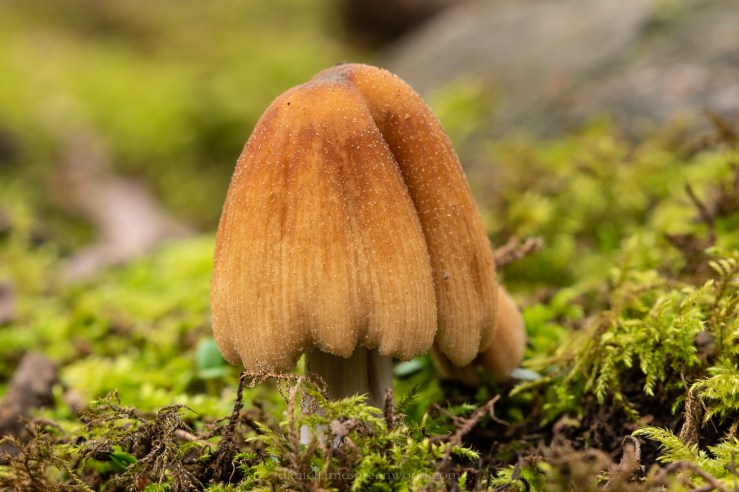
In the UK (and perhaps the Northern Hemisphere?) a mushroom called glistening inkcap bursts from the moss and soil after a change in the weather. It usually makes an appearance when a spell of rain has finished and the temperature is a little higher than it has been.
Moss is one of the few colours found in a winter wood and its ability to hold dampness can sometimes boost the growth of a mushroom, as seen in the inkcap photo. Up close these primitive plants are like miniature palm trees.
In the South Downs National Park, 10.5% of the landscape is covered by ancient woodland according to the Woodland Trust. That figure astonishes me. Much of this woodland is in the Low Weald, a stretch of ancient oak woodland that pitter patters between the South and North Downs. from near the Sussex-Hampshire border all the Way to Kent. Ebernoe Common is a National Nature Reserve managed by Sussex Wildlife Trust, home to almost every species of British bat and an amazing array of other species.
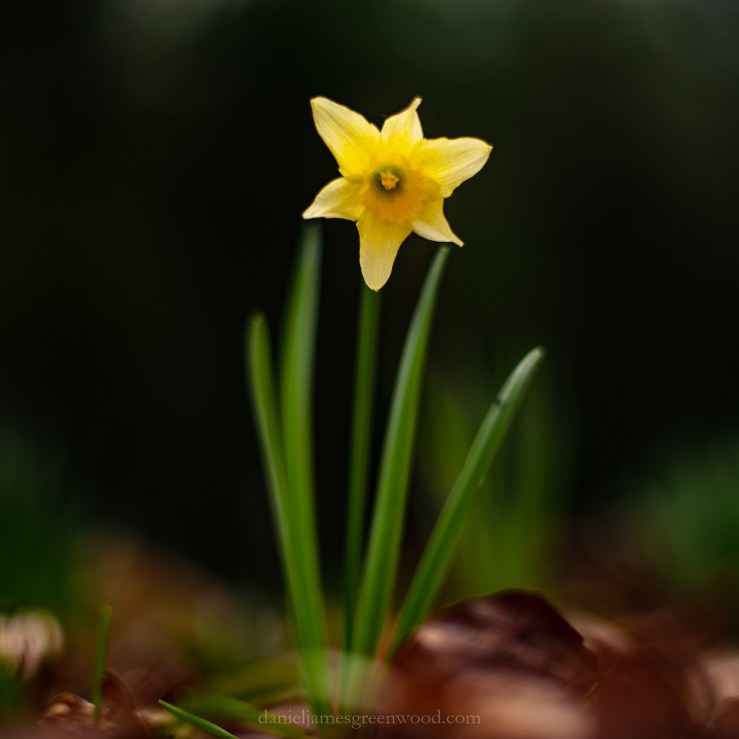
Ebernoe also hosts populations of wild daffodil, much smaller than the shop-bought beasts that burst from lawns and roadsides. This is a spring woodland flower that indicates ancientness. It is a privilege to see them in flower, especially considering that they have declined greatly in the past century. In the still wintry Weald, spring is trumpeting silent and yellow.
Unlike most annual reviews, this post shouldn’t include any reference to seismic political events which we are all likely sick and tired of. Instead, it’s a run through of some of the interesting mushrooms I’ve papped in the past 12 months. It also ends up being a seasonal review more than anything, because fungi is found mostly in the gentler bits of spring and the October-November phase before the cold weather snaps down. Expect references to camera equipment and a smattering of photography jargon that even I don’t understand.
You can read more about the ecology of mushrooms on my fungi page
There have been two things that have changed the nature of my fungi photos in the past year, one of them being the purchase of a compact camera. At the end of 2017 I bought a Canon Powershot G7X MII, a little camera that has allowed me to take photos of mushrooms in ways I couldn’t before.
This is because of the camera’s small size and the screen that flips round so I don’t need to lie down on the ground. Most of the time it’s actually impossible because some of the smaller mushrooms (usually the most interesting and unique) are down in amongst other debris and you need a small camera in there.
Another bonus is how light the thing is, though it has a bit of weight about it, it can be taken anywhere and charged off a USB. This means you can bring out a powerbank to charge it in the field or when trekking and you don’t need to spend £60 on batteries.
Above are some of the early pics I managed to get with the Powershot in and around Sydenham Hill Wood in south-east London. I took the photos in raw format and refined them (just colours, exposure, sharpness and a bit of cropping in Adobe Lightroom) to bring them closer to natural life.
Whatever you think of the photos, you’ve got to say they’re really sharp and as good as most Digital SLRs. I would say that if you don’t have a ‘decent’ camera and you want something light, portable and uncomplicated, it’s a great option.
However, one problem is the camera is so light it fell out of my pocket and I didn’t have it insured! I hope the person who found it is very happy with it. Anyway, back to the mushrooms.
July
Early summer months are a time of bracket fungi on trees and sudden eruptions of inkcaps after rain and milder temperatures. Hot dry weather is not good ‘shroom time.
It is, however, a time to appreciate the rock solid brackets that climb up the trunks of veteran trees.
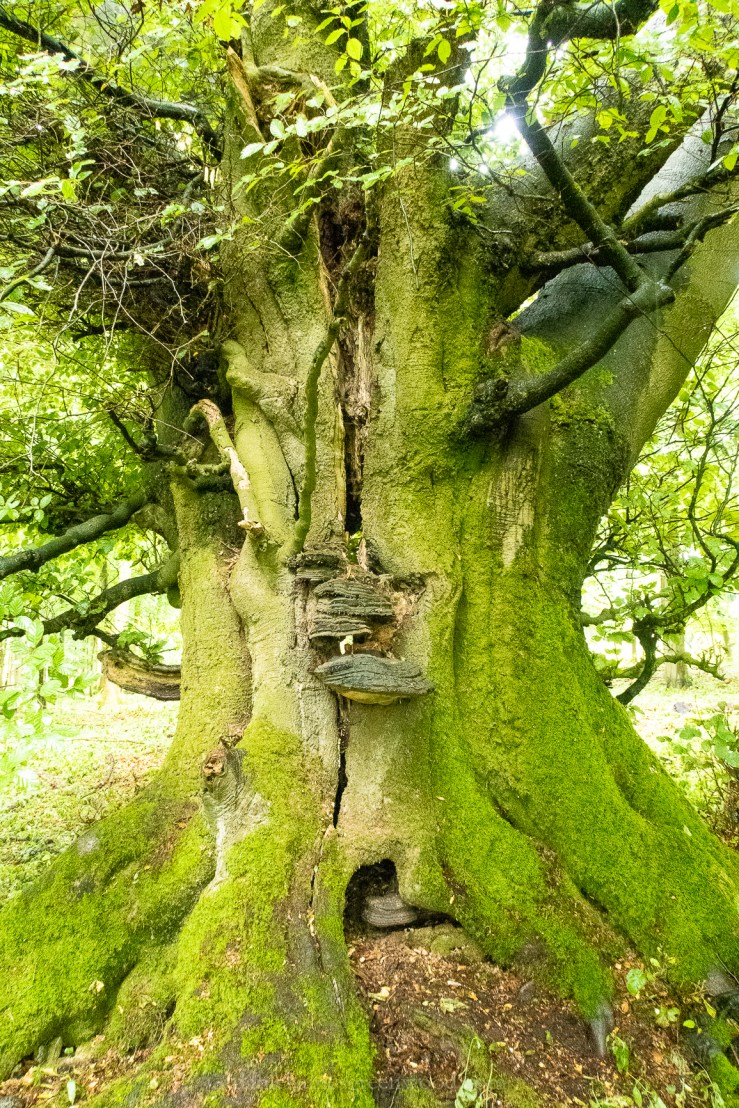
This hollow beech tree at Slindon on the South Downs is a fine example of a veteran tree, characterful and fungus-clad. I have to admit to not having a passion for bracket fungi of this kind, but I do know that these species enter through a wound in the tree and establish their mycelium (network of fungal fibres) and produce a fruiting body, in this case the bracket you can see above, and pump their spores into the air.
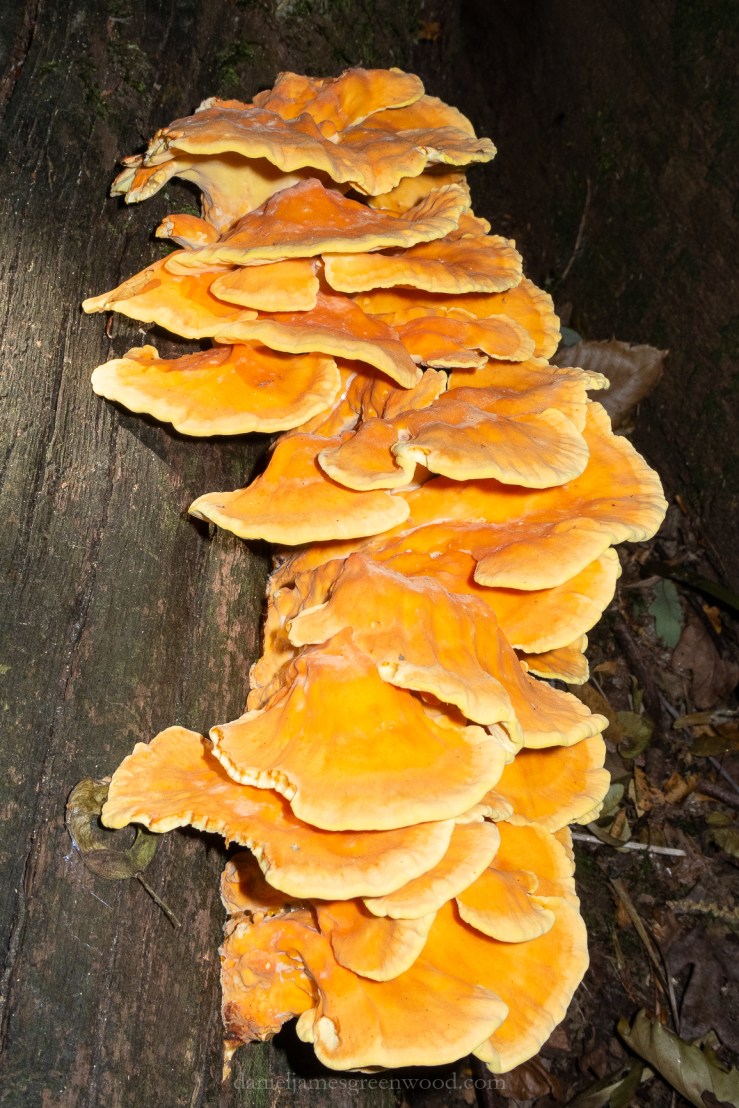
One of the true highlights for people who forage wild food is the summer glut of chicken of the woods. This fungus is hard to miss and simple to identify when in good condition. It is mostly found on oak, though I found my first specimens on yew in 2018. Chicken of the woods on yew should never be eaten because of the poisonous nature of the tree. I’ve never eaten this fungus but a friend said that she got too excited about finding it ate too much of it last summer. A case of being bloated rather than sick. May-June is the prime time for this beast.
August
August can be a very wet month in the UK. In 2017 it was rainy and cool and in the mushroom world autumn happened in August, with a much weaker season over the typical October-November period. I visited Epping Forest in August 2018 to see if there was any repeat of 2017, but there was a very modest fungal showing. This was due to the extreme heat between June and July with very little rainfall in southern England. It’s an example of how climate change will effect our ecosystems and the species within them.
This is not the moon landing, it’s a giant puffball! These monsters grow in grasslands and were once used as footballs. Though I don’t eat wild mushrooms I know it can be used to make puffball burgers. It’s one of those mushrooms that makes you think, what is the point of it? I suppose it has been kicked and thrown around for so many millions of years that its spores have spread widely and it’s become an evolutionary success.
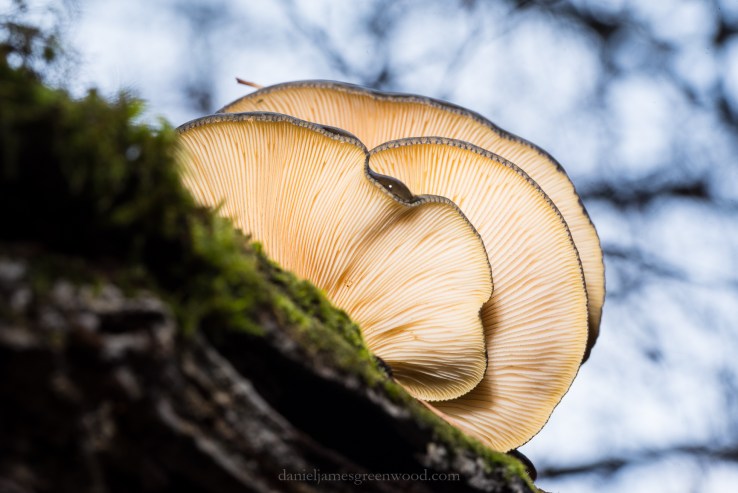
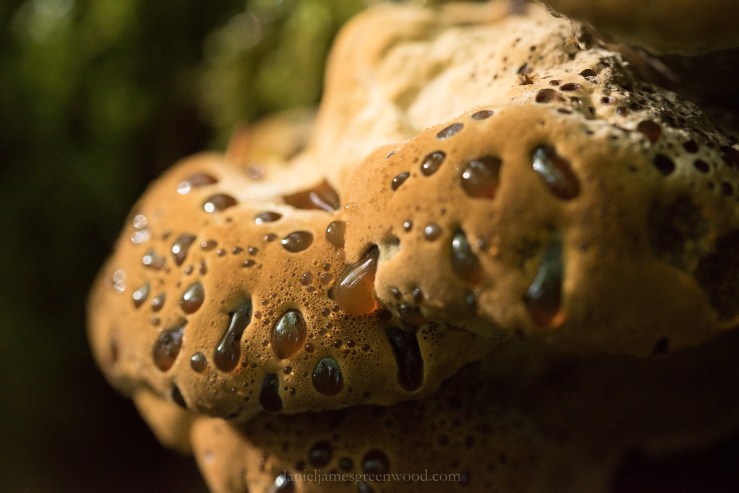
One fungus that does well in August and people struggle to cope with is oak bracket (though this specimen was on a veteran beech tree). This was an evening trip after passing it in the pouring rain on a group walk in late July. It’s one of the most photogenic shrooms and is full of macro possibilities! The above pic is taken with a wide angle lens.
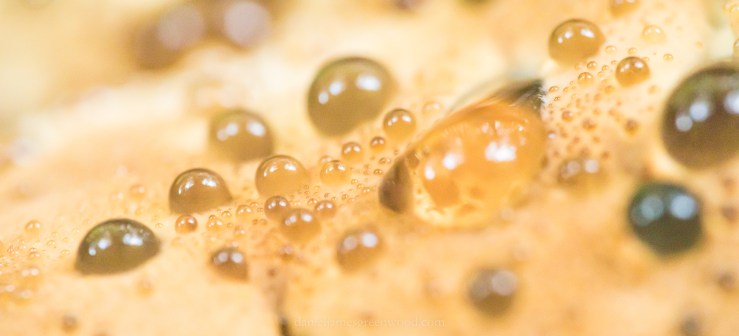
Using the macro here brings out the beads of water as the fungus exhudes the excess water from its pores. Can you see the figure reflected in the droplets? I’ll be back to visit the beech tree this fungus grows on next year.
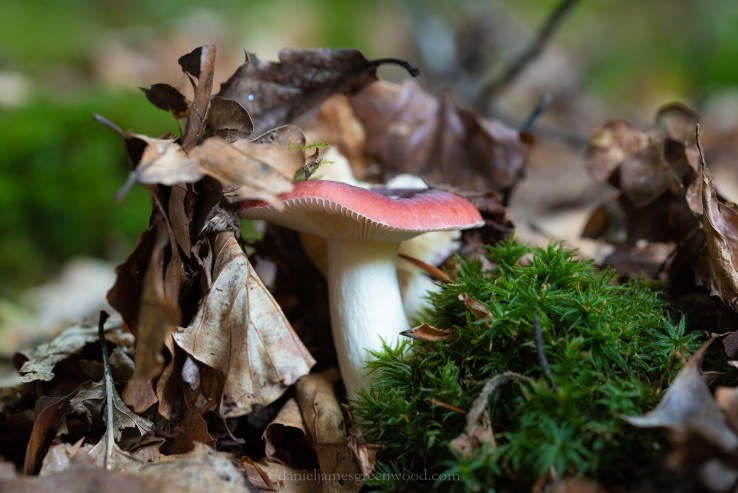
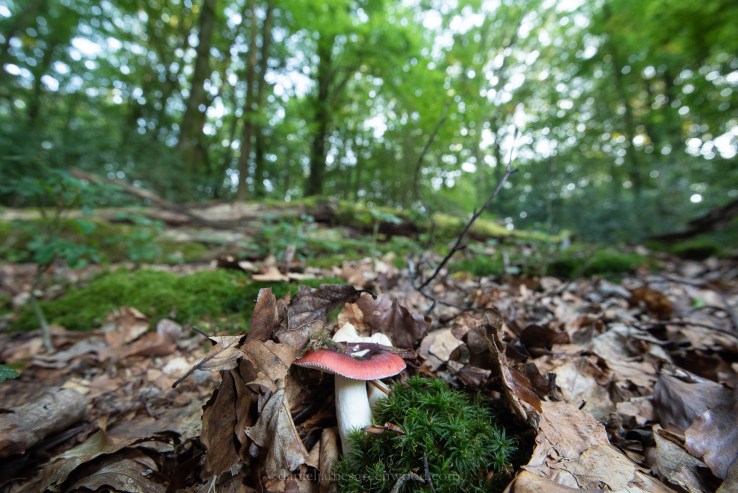
The closer the connection you develop with wildlife through observation, the more important the seasons become. Man-made climate change is messing with that but I still see the arrival of Russulas (brittlegills) as a key indicator of summer’s end and the first specks of autumn.
September
Walking 5 miles on the South Downs Way in early September I was delighted to find a patch of boletes growing under an old yew tree on chalk. I had my now deceased compact camera to hand and snatched this photo. This elfish mushroom is probably Scarletina bolete. It has orangey-red gills and absolutely stinks. One upturned specimen was beginning to smell like a decaying animal.
I managed to sneak in a visit to the New Forest in September, a place so good for fungi it’s illegal to forage it. I found this bracket mushroom growing on a pine tree on heathland. It looks like a certain political figure, but I mean that as no insult to this amazing natural phenomena (the fungus, not the human).
August and September is a good time for the members of the Boletus family, home to the much sought after and munched Boletus edulis (otherwise known as cep, penny bun, porcini). The boletes are a diverse group. I think the mushroom above is a suede bolete. It looks like a biscuit sitting atop a rhubarb stalk.
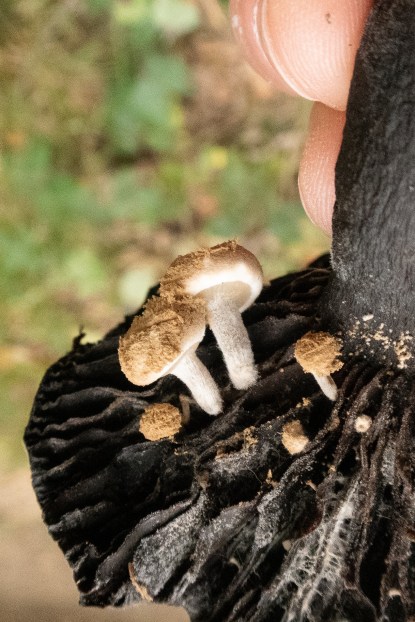
A strange find was this parasitic species called powdery piggyback fungus (brilliant name), growing on the gills of blackening brittlegill.
I thought these were horn of plenty at first, but they also just look like straight-up dog poo.
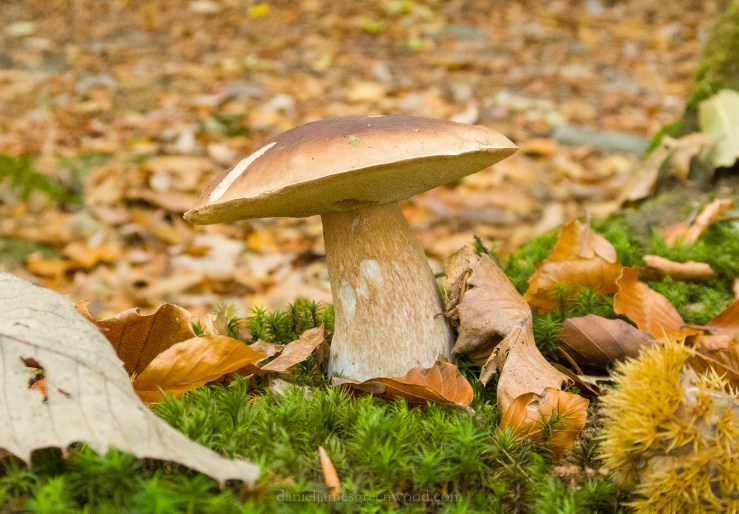
Towards the end of September I visited the Cairngorms and Perthshire in the Scottish Highlands. At Balmoral before a group hike I found what I think is Boletus edulis at the shore of Loch Muick. There are two sides to every shroom. The one with the sun, rain and loch behind is one of my fave pics of the year and was found, taken and left alone within the space of about 30 seconds. You can plan for all the amazing pics you want, but when it comes to mushroom portraiture (lol) you have to be ready at all times.
In some Perthshire woodland outside Pitlochry my friend and I found some jelly babies, a first for me.
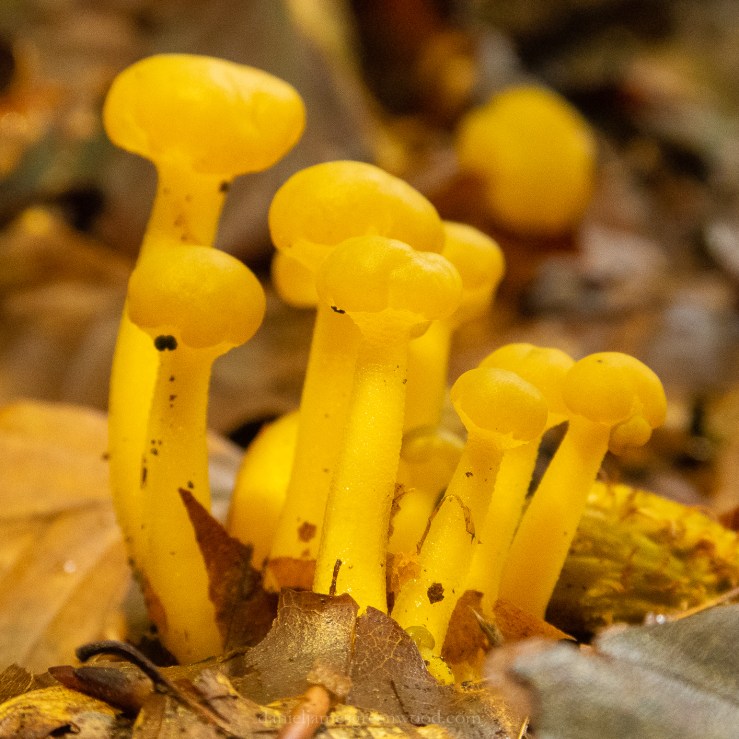
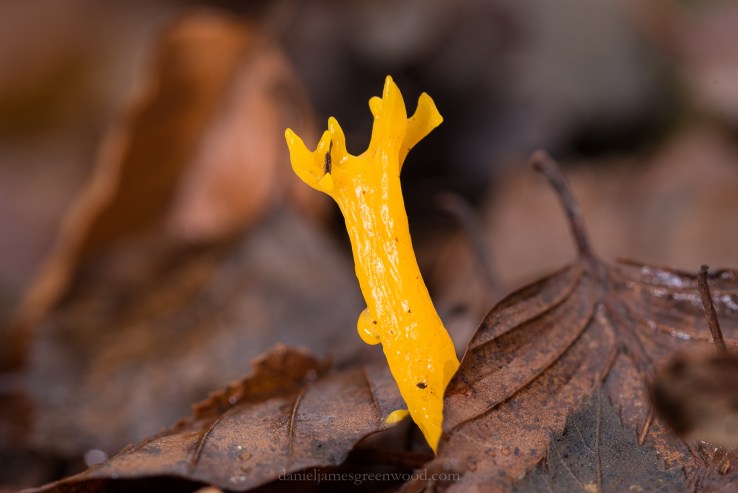
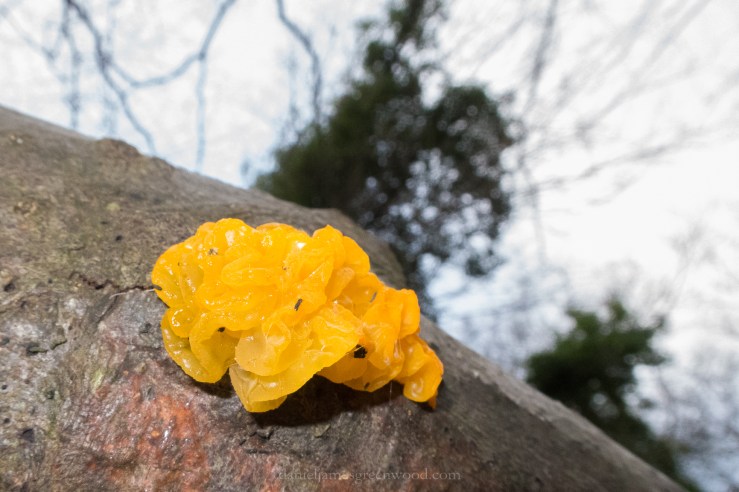
Yellow staghorn was cropping up fairly commonly in September. This bunch was on a stump which gave the opportunity for my friend Eddie to help with the composition. Another favourite from 2018!
October
One of my new playgrounds in 2018 was Ebernoe Common, a National Nature Reserve managed by Sussex Wildlife Trust. I had two full days over the autumn to explore Ebernoe (responsibly!) with my DSLR and macro lense. The mushroom above was found after about 5 minutes of searching one area that is quite open and heathy. The summer drought meant that mushrooms were not as abundant as perhaps they would have been after a wetter season and the ground here was very dry. This is taken with a macro lens and is lit with a small LED side light, alongside a lovely break of warm autumn sun.
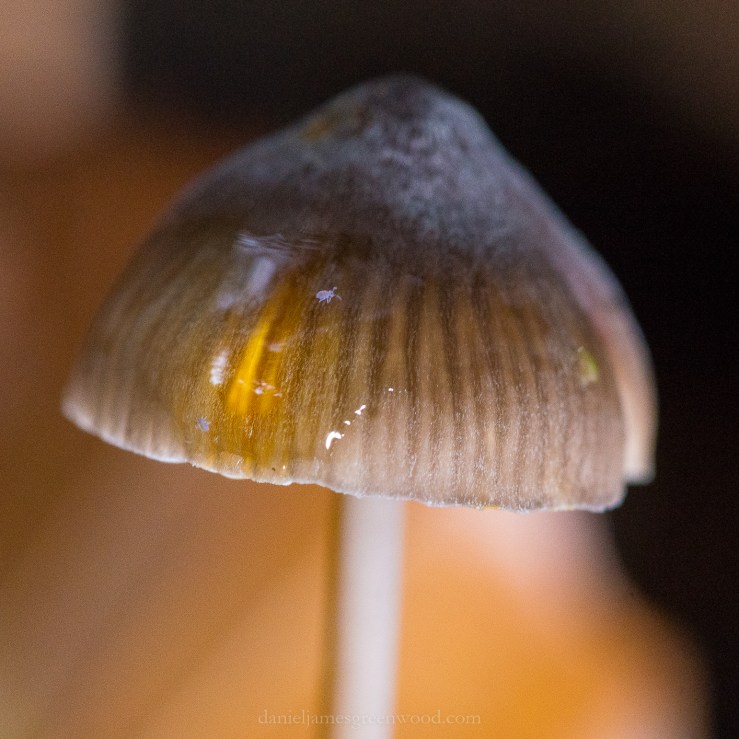
I find macro photography to be meditative. Looking at such a fine level of detail on what is usually a stationary object is very calming. One thing I have noticed is that when you look closely at a mushroom you often find other life. In the photo above I was trying to get a pic of what I think is bleeding bonnet and only when checking the photo on my camera spotted the springtail crossing its cap. Springtails are invertebrates that are found in soil and damp, shady parts of woodland. They are key to a woodland ecosystem as detritivores (they recycle stuff), and part of healthy woodland soil. By that I don’t mean soil good for ploughing or food growing but as part of the natural make-up of soil which includes fungi, bacteria and invertebrates.
Before the clocks went back in October I managed to visit The Mens in West Sussex (another special ancient woodland managed by Sussex Wildlife Trust) while the evening light was still there. For most woodland photography it’s vital to have a camera or lens that can deal with low light. The ISO needs to be able to go beyond 1600 without being too grainy I think. Luckily I have a camera that can do that. I also like to take photos at an aperture like f11 which gives more detail and a better depth of field than something like f2.8. Though wider apertures like f2.8 can give lovely isolated mushroom images. That’s photo jargon I know but it makes a huge difference when in woods.
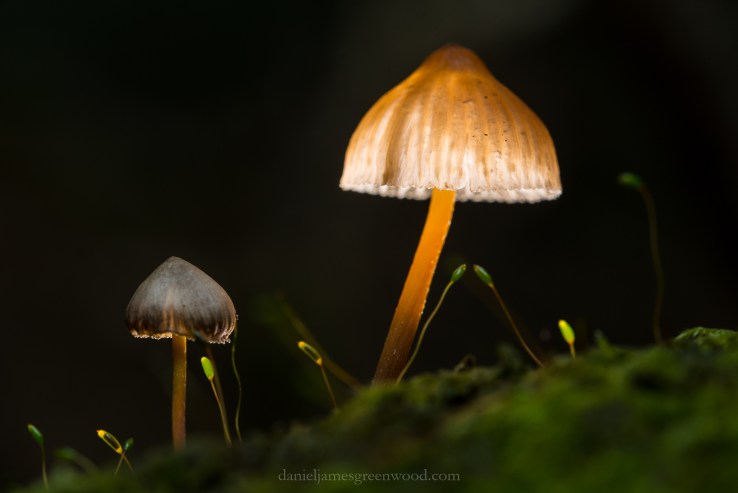
One way to get around this is to use artificial lighting. Sometimes a phone torch is good enough. The translucence of many mushrooms means that lighting can create all kinds of possibilities. The bonnet mushrooms above where photographed in very low light with cloud cover above the woodland canopy. I used a little LED light to bring them out against the dark woodland background.
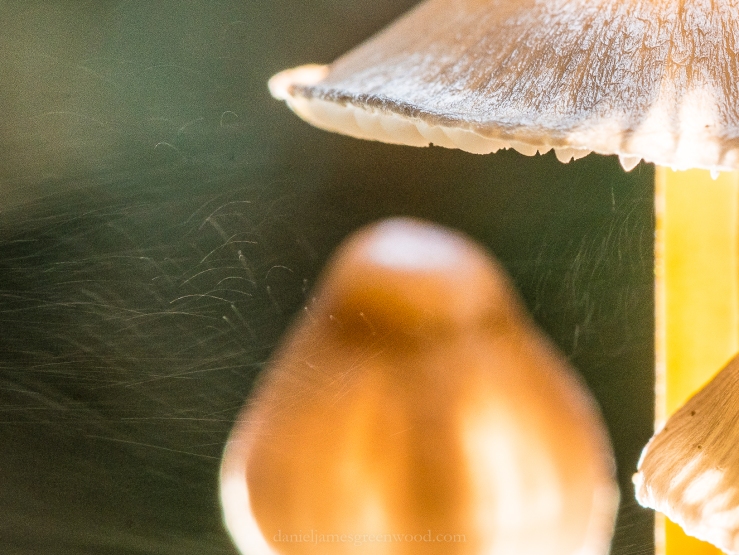
The detail my camera’s sensor combined with the macro lens can produce is amazing here – to the left of the frame you can see spores being released from the gills of the mushroom. Amazing! On the right-hand side you can see them dropping out of the gills, eventually carried away on the air flow.
I was really pleased with how this one came out, the moss ‘sporophytes’ add an extra element through their accidental lighting! You wonder where the idea for lampshades came from…
An October visit to Dartmoor gave the opportunity to explore the oak woods that make the south-west famous among those who care about Celtic rainforest. Dartmoor is known for its moorland but it also has extensive areas of ancient woodland. Some of this woodland is so boulder-strewn that there isn’t actually much in the way of substrate for fungi to spring from in the way it does in the Sussex Weald, for example.
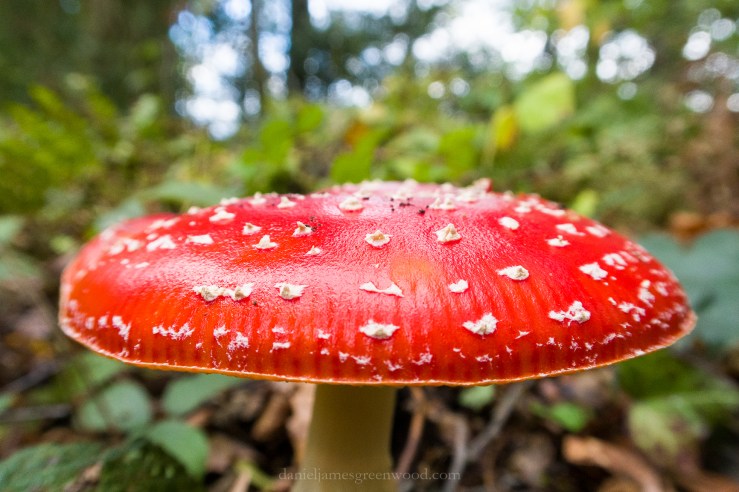
No mushroom season is complete without a fly agaric. We found some real beauties under some birch trees in a small slither of more typical beech woodland.
November
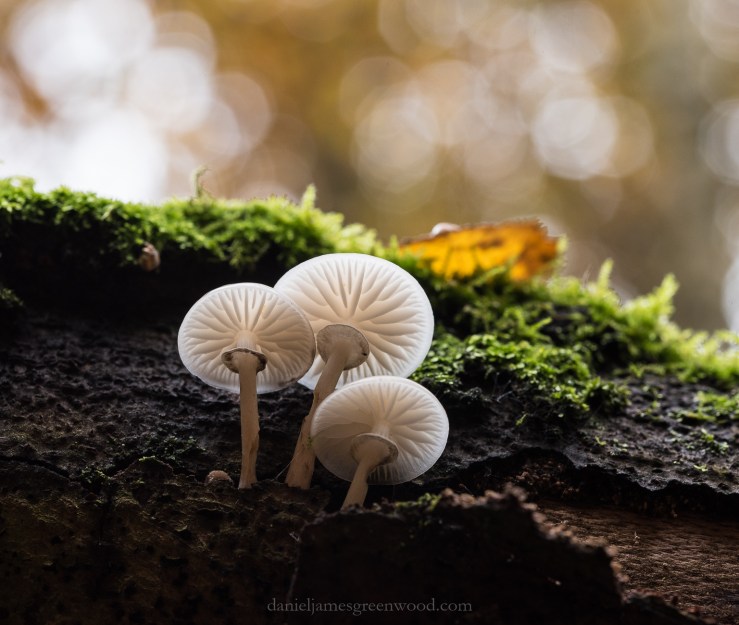
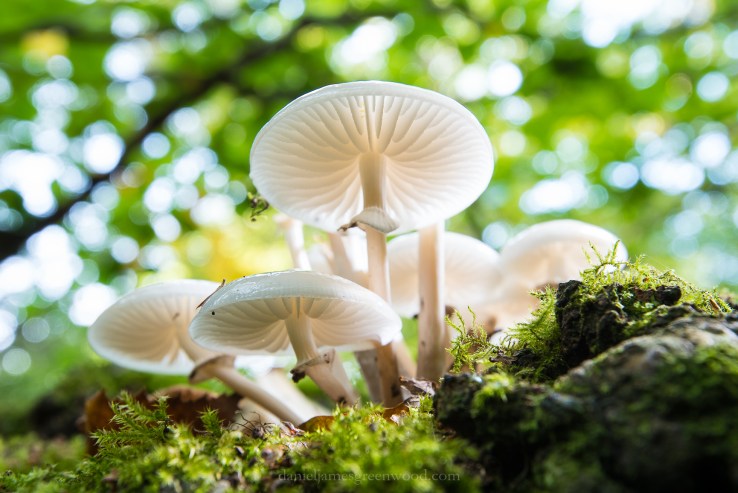
Porcelain fungus is one of the most photogenic species due to the translucence of the gills and the slimey cap that catches the light so sweetly. It also fruits at a time when leaves are still on the trees, helping to produce the bokeh (light circles that blur in the background) where the light does get through. The most beautiful mushroom images are often taken from below in my opinion.
Compare the above photo taken on the same tree early in October, compared with the more wintry version above that.
The tree host here is a fallen beech that is my go-to for photos. You can see some of the diversity in this video:
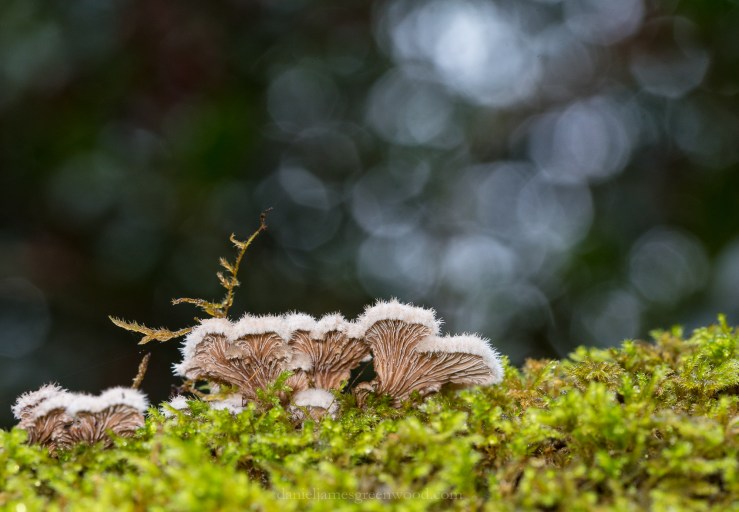
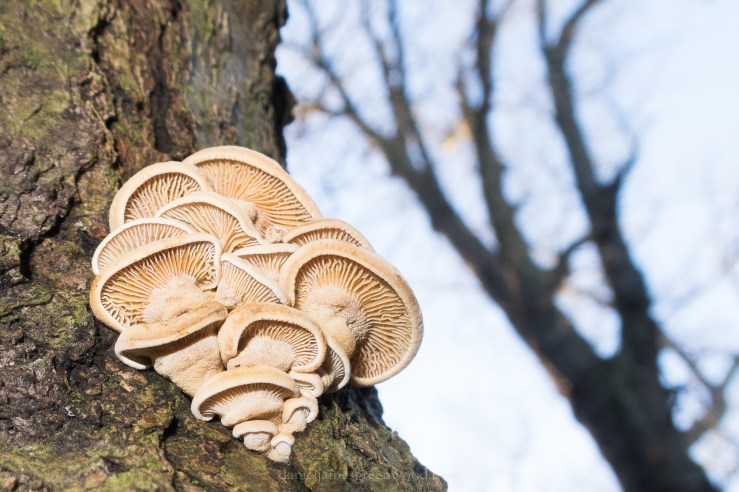
A species I was interested to find was split gill fungus. It has a quite hairy exterior and grows like a bracket or polypore on dead wood. This one wasn’t easy to photograph and I’m not over the moon about the pic, but the bokeh in the background is nice. It was on the tree in the video below, another fallen beech:
Another part of the Sussex Weald that I visited is St. Leonards Forest in the High Weald Area of Outstanding Natural Beauty. It’s a core part of the ancient wealden landscape in southern England. I walked about 8 miles in search of peak-season shrooms:
These oysters had a look of the sun rising over a green hill, much like the emoji! I think they’re olive oysterlings.
Yellow staghorn was going strong into the late-autumn. I used a side light to bring this one out in amongst the beech leaf litter.
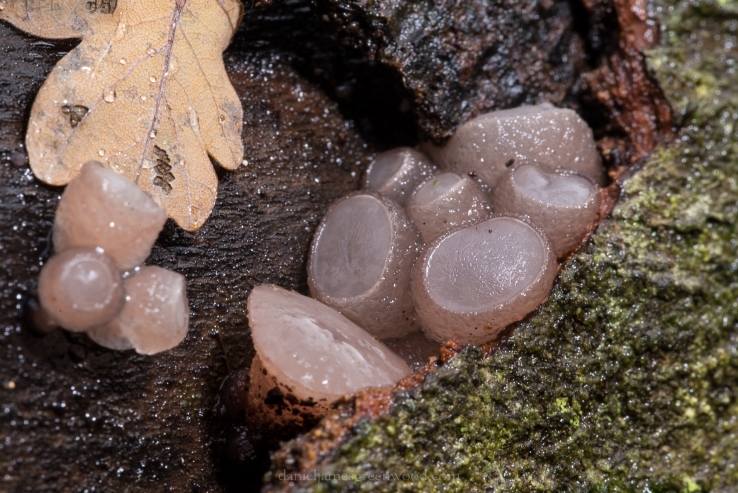
Fallen beech trees are becoming a theme here. This jelly fungus was common, as can be seen in the previous videos as well.
December
December is a month of snow-white mushrooms for me. If it’s a cold month and there’s too much frost, the mushrooms will perish. December kept on message with recent years and was fairly mild all the way up until Christmas which meant some shrooms could fruit.
Bramble stems often have oysterlings attached to them. At first they look like little white nothings but when you look at the gills, they’re beautiful.
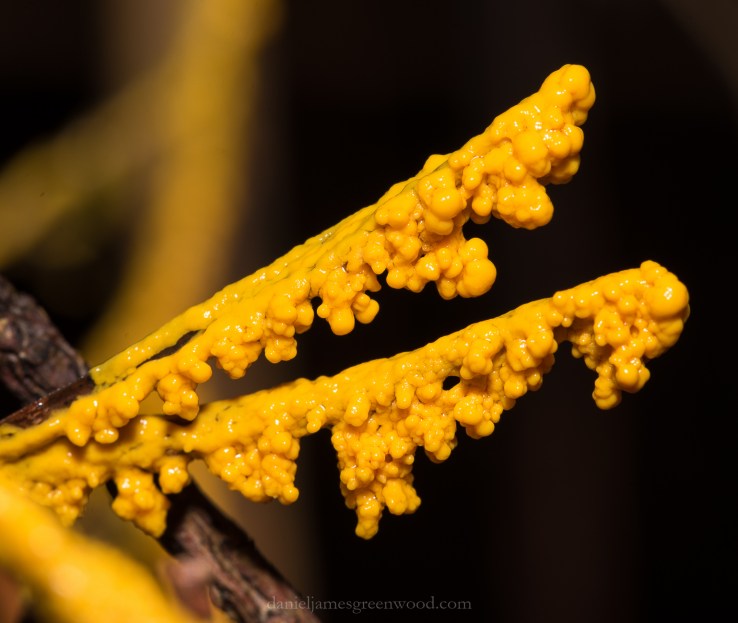
It’s also a good time to look for slime mould. Though not in the Kingdom of Fungi, slime mould is equal parts beautiful and disgusting. This is probably dog’s vomit fungus, Fuligo septica, famous for how it eats everything in its path:
I mentioned earlier those rogue springtails photobombing fungi pics.
During the Christmas holidays expectations for shrooms are low but I go for walks regardless obviously. Above is a fungus that is a bit of worry for gardeners, it’s silver-leaf fungus, a species that usually suggests a tree is dead or dying. It was harmless on this already dead tree. A much bulkier springtail was taking interest in it, perhaps.
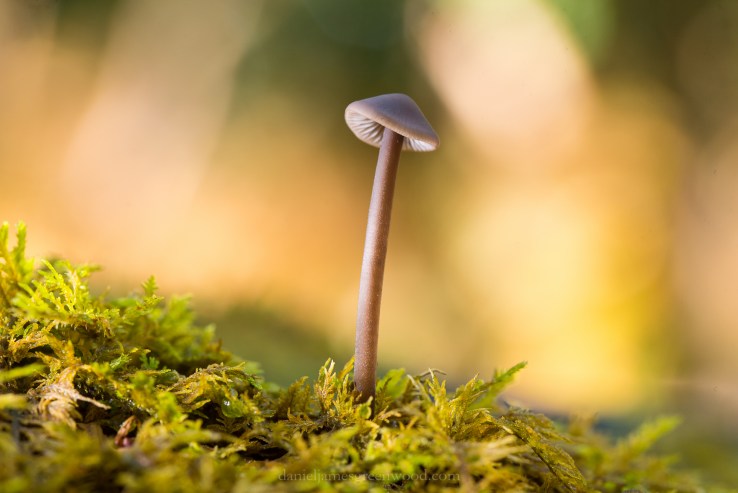
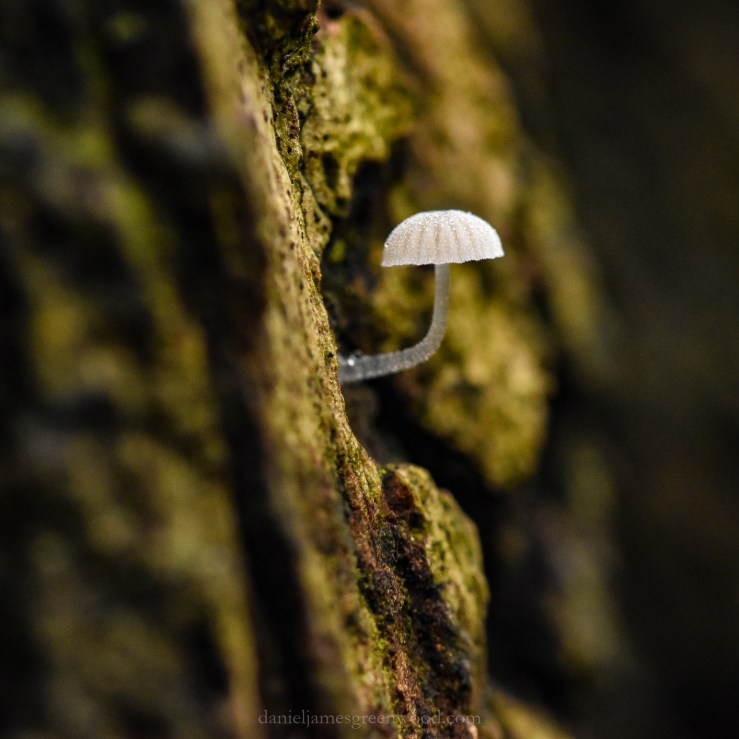
My final fungal pic of 2018 was this lovely little bonnet, umbrella-like as it peeped out from the bark of a veteran oak tree.
Thanks for reading, wishing you many mushrooms in 2019!
A winter walk around Pulborough in West Sussex, just inside the South Downs National Park. Despite last week’s record high winter temperatures, spring was still absent, bar the odd queen bumblebee and flowering primrose.
For someone who can’t afford a massive telephoto lens (both in terms of relative biceps and cash), March is the best month to photograph birds. There are no leaves to block them and birds are busy as spring builds. This robin barely moved. The photo has been cropped.
Let’s see him or her again… I tried to frame the robin against a silvery water body and the green moss of a tree behind. As in, I moved a bit to one side and crouched down a bit.
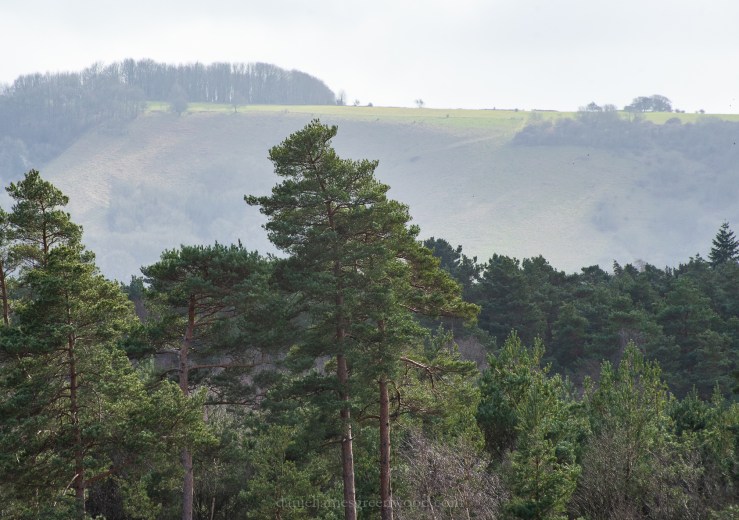
The South Downs ridge hangs over Pulborough and gives an extra layer of interest to photographs that might, in counties like Essex and Norfolk, be a little more flat.
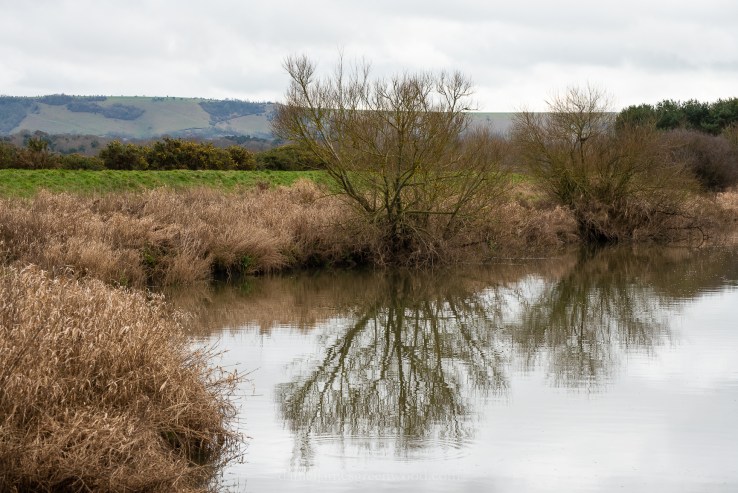
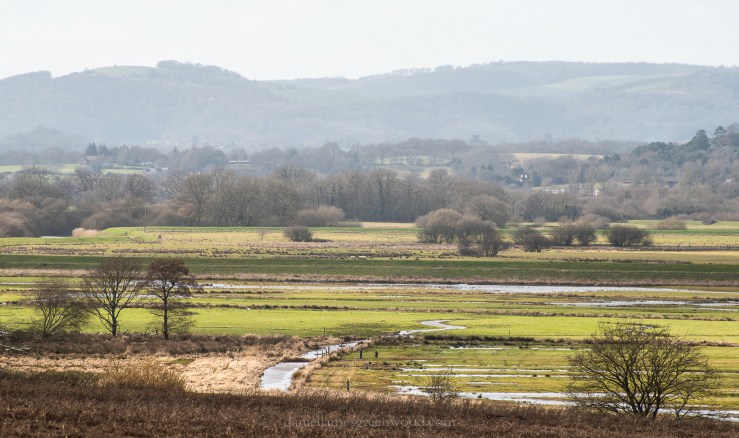
The river Arun runs through Pulborough, a key wetland area in southern England. The sun came out in the afternoon to lift the atmosphere. The South Downs add their irrepressible magic even in shade.
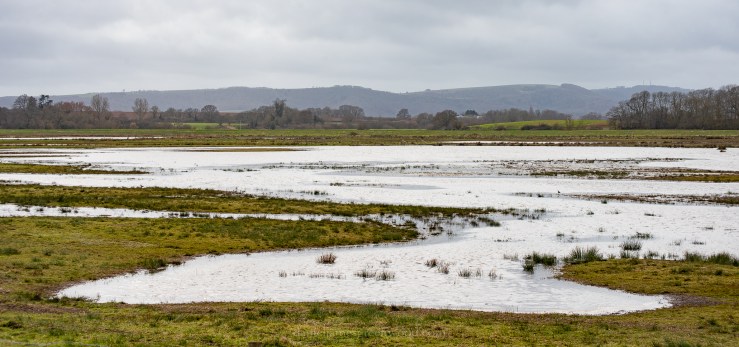
The silvery wetland areas of the Arun valley. This area was once marshland and has strong evidence of Roman activity and settlement, including a bath house.
Pulborough Brooks is managed by the RSPB and has a large area of heathland at Wiggonholt Common in addition to the wetlands. The South Downs veer into distance beyond the pines.
I love the soft palette of a winter heath.
Pulborough, South Downs National Park, West Sussex, March 2019
St. Leonards Forest, The High Weald, West Sussex, January 2019
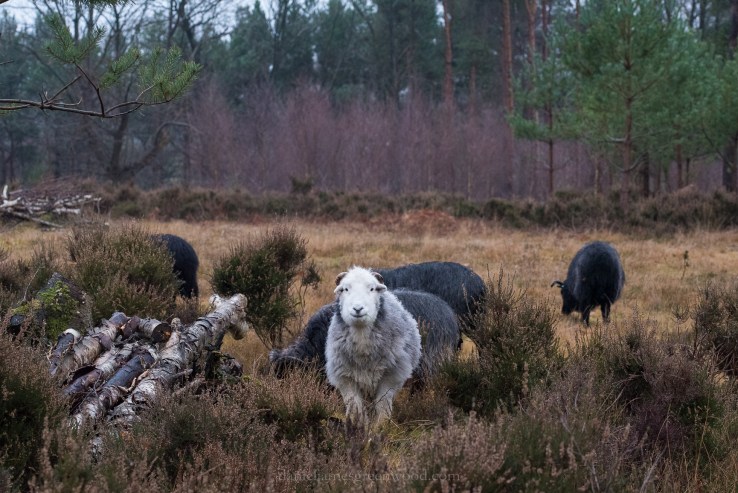
Gunshots echo from St. Leonards Forest, while up here on the dank January heath, woodpigeons fail to settle in pine branches. Within their paddock the sheep in deep black coats are startled by the scuff of my camera strap on my shoulder. They lift their heads from grazing, soon returning to their business. One with a white beard and human face gazes back at me, old man of the heath.
A powder-white and gold mushroom has been uprooted and left on a feathery bed of moss, an image of early autumn in this sodden midwinter. On the stumps of felled pine trees cup lichens grow like green, towering cities. I read that because they are a partnership of algae, fungi and cyanobacteria, they can’t truly be defined as a standalone species. Here they hold droplets of water like a precious stone in the top of a staff.
The birch bark is zebra-like in this land of deep purple, black and brown. The birches are routinely removed from heathland but to me they feel like a key part to it, a haven for many species of insect, a resource we seem no longer to know about. Every bit of this tree cut has a use for us: bark for firelighter, slippers, canoes and boxes; sap for sugary syrup; branches for brooms and spoons; wood for a fire. It follows us around and, unlike so many of our trees, is not facing an epidemic of imported disease.
Coming down off the heath, I walk up past a stream bed with alder trees climbing high to the canopy. They form dark clouds of branches and catkins at their tops. Alongside the track home holly woods stamp their permanent-feeling darkness. I turn to look left into a small break in that darkness. A silent sparrowhawk glides in touching distance of the ground, preying on blue tits that call in alarm. Those little things miss nothing until caught. It’s a reminder of how hard life is out here in January woods. It is eat, or starve trying.
I’ve recently moved somewhere new and with that comes an interaction with new landscapes. In the United Kingdom, a distance of 25 miles can open up entirely new experiences in the outdoors through the sudden change in soils, topography and local culture. I have moved further south into Sussex, in touching distance of a tangled web of counties (West Sussex, East Sussex, Surrey and Hampshire), communities and habitats. One landscape that feels closer than it ever did is lowland heathland, a landscape I’ve come to learn more about in recent months.
I now know that dry lowland heath has been drastically lost over the past 150 years and it is rarer than rainforest. It is a human-made habitat with intrinsic ties to a pre-industrial way of life where local people grazed their animals, cut and burned heather, extracted sand, cut trees, but were unable to grow crops due to the poor fertility of the soils. It is subject to epic conservation projects in some places, like the Heathlands Reunited project working across the South Downs, tipping into Hampshire and Surrey in places outside the South Downs National Park.
My family have roots in Ireland and I have spent time there learning about the way of life of people who lived in the wild and very wet western areas. To my ancestors heather was an incredibly diverse resource. It could be cut at the right age to produce all manner of items, most fascinating to my mind were lobster pots weaved from woody heather growth. The subsequent cutting of heather allowed new growth and light to reach the heathland, benefiting many different species – denser growth for ground nesting birds, increased flower abundance – and a mosaic of vegetation lengths which further the species diversity through the creation of micro-habitats.
This slideshow requires JavaScript.
With the popularity of the rewilding movement in the UK, heathlands are a point of contention because an argument for landscapes to be left to ‘adopt their natural state’. This is at odds with the desire to see heathlands humanised again, what is shown to produce the richest conditions for their wildlife. Heathlands which are ‘left’ or ‘rewilded’ become simply poor quality woodland in the sense of the lack of species diversity.
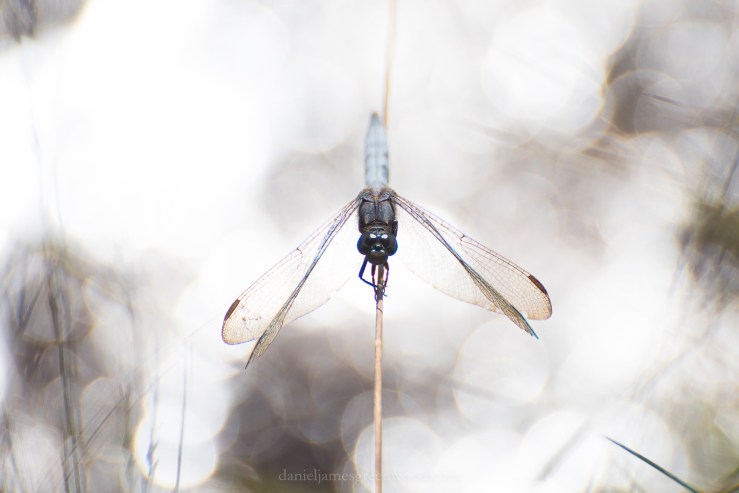
One site stuck in that tangled-web of counties is Thursley Common, a National Nature Reserve managed by Natural England in Surrey. I visited Thursley for the second time in June on a hot but mercifully breezy day. There were many thousands of dragonflies on the wing – so many I declined to ‘tick off’ the vagrant red-backed shrike which people were heading over to see but completely ignoring the riot of Odonata – and the sandy paths were brimming with rare insect life.
Having visited Thursley a year before with a tour from the site manager, I had an idea of where the good stuff was and some background on their ecology. Over the winter I had looked forward to returning to try and photograph the heath sand wasp and mottled bee-fly. Thankfully the weather was perfect for this.
This slideshow requires JavaScript.
Kneeling down on a sandy track it was possible to see the heath sand wasp, found only on lowland heath, mainly in the south of England. It was caching moth larvae that it had been hunting out in the heather. It’s hilarious how they use a small roll of sandy soil to close their doorway before heading off again to hunt on the heath.
They have every right to be cautious. Lying in wait on tiny scatterings of twigs were mottled bee-flies, a rare insect that parasitises the nest of the sand wasp. It wasn’t clear whether the sand wasp was wary of me or suspicious of the presence of the fly (do insects experience suspicion?) but at times the bee-fly deigned not to move, creating a kind of stand off between the two insects as the sand wasp waited to fly off to hunt and the bee-fly waited to hover and throw its eggs into the hole.
Sure enough, after the wasp had moved away, the bee-fly was hovering over the nest hole, chucking its eggs in like a footballer volleying the ball into an open goal.
These are two species which, without managed heathlands (interestingly much of the management they benefit from is the result of footfall exposing sand along the paths) would be lost. Woodland’s return would mean a loss of light, warmth and resultant heather growth where the sand wasp’s prey is found, meaning that the structure that binds these species would collapse.
Another unusual insect along the paths was the hornet robberfly. This is another type of fly that can be found in heathland and is classified as rare. It is possibly the largest fly in the UK but it looks like a hornet. Like many of our flies (bet you don’t consider them your own) it mimics the appearance of a predatory wasp to give a greater sense of protection. In terms of natural selection, it has survived probably because it looks like a species that has a world-shattering sting at the tip of its abdomen.
Robberflies do exactly what their name suggests, they steal insects and eat them, sucking them dry in about thirty minutes in the case of the hornet robberyfly. The best way to see them is through a macro lens and to hang out somewhere that you know has lots of other insects present. Some stunning photos are out there with robberflies holding on to their fly prey.
I spotted the hornet robberfly because it was sitting on a pile of manure, exactly where it likes to spend its time in life. It was using the manure as a perch to hunt where it can blend in with the hay stems that a horse or cow can’t quite digest. They also lay their eggs in the crevices of the dung.
It was a privilege to see these rare species, unseen to almost everyone (obviously), only present because of good management and an appreciation that human impacts can be positive for living things other than ourselves.









































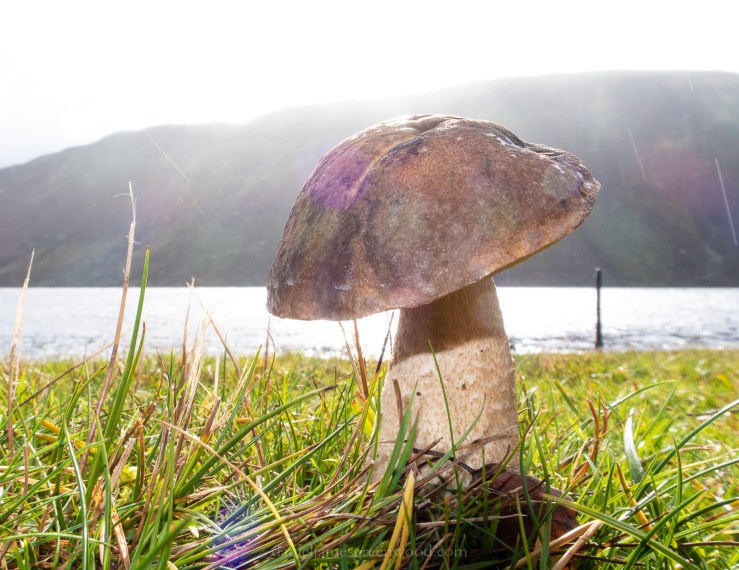
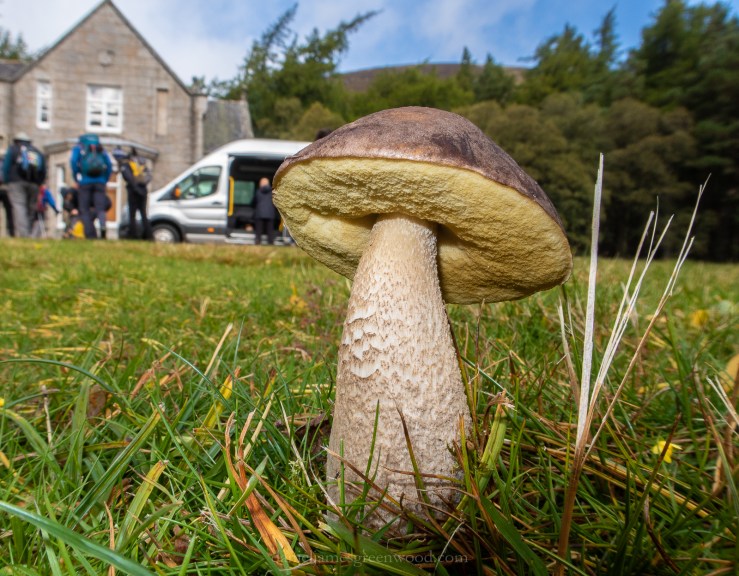 Towards the end of September I visited the Cairngorms and Perthshire in the Scottish Highlands. At Balmoral before a group hike I found what I think is Boletus edulis at the shore of Loch Muick. There are two sides to every shroom. The one with the sun, rain and loch behind is one of my fave pics of the year and was found, taken and left alone within the space of about 30 seconds. You can plan for all the amazing pics you want, but when it comes to mushroom portraiture (lol) you have to be ready at all times.