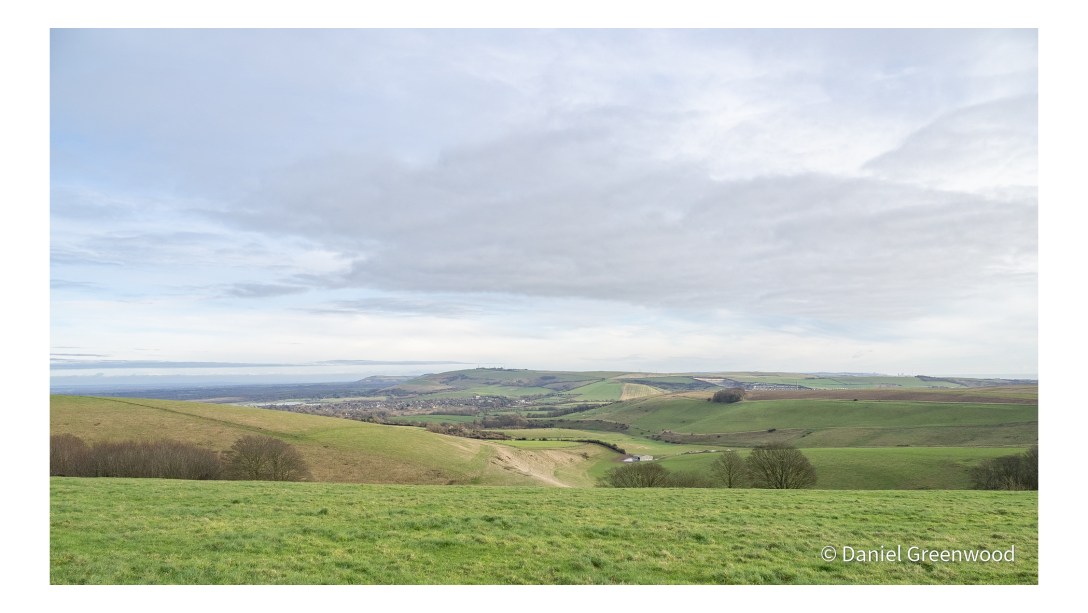
Along the South Downs from Washington to Bramber

South Downs Way between Washington & Bramber (10 miles), West Sussex, January 2024

This is a long post with a lot of South Downs history in it that dates back over 1000 years. I wanted to call it ‘Peaks and troughs on the South Downs Way’ but that wouldn’t have done it justice.

This walk is from the first days of 2024 and has been in my mind ever since. It’s actually two years to the day (I love that stuff). The walk left me feeling ecstatic in the quiet way that walking can.

I completed the walk using public transport, with a bus to Washington and then a bus from Bramber to Pulborough, and the train from Pulborough. Planet saved.
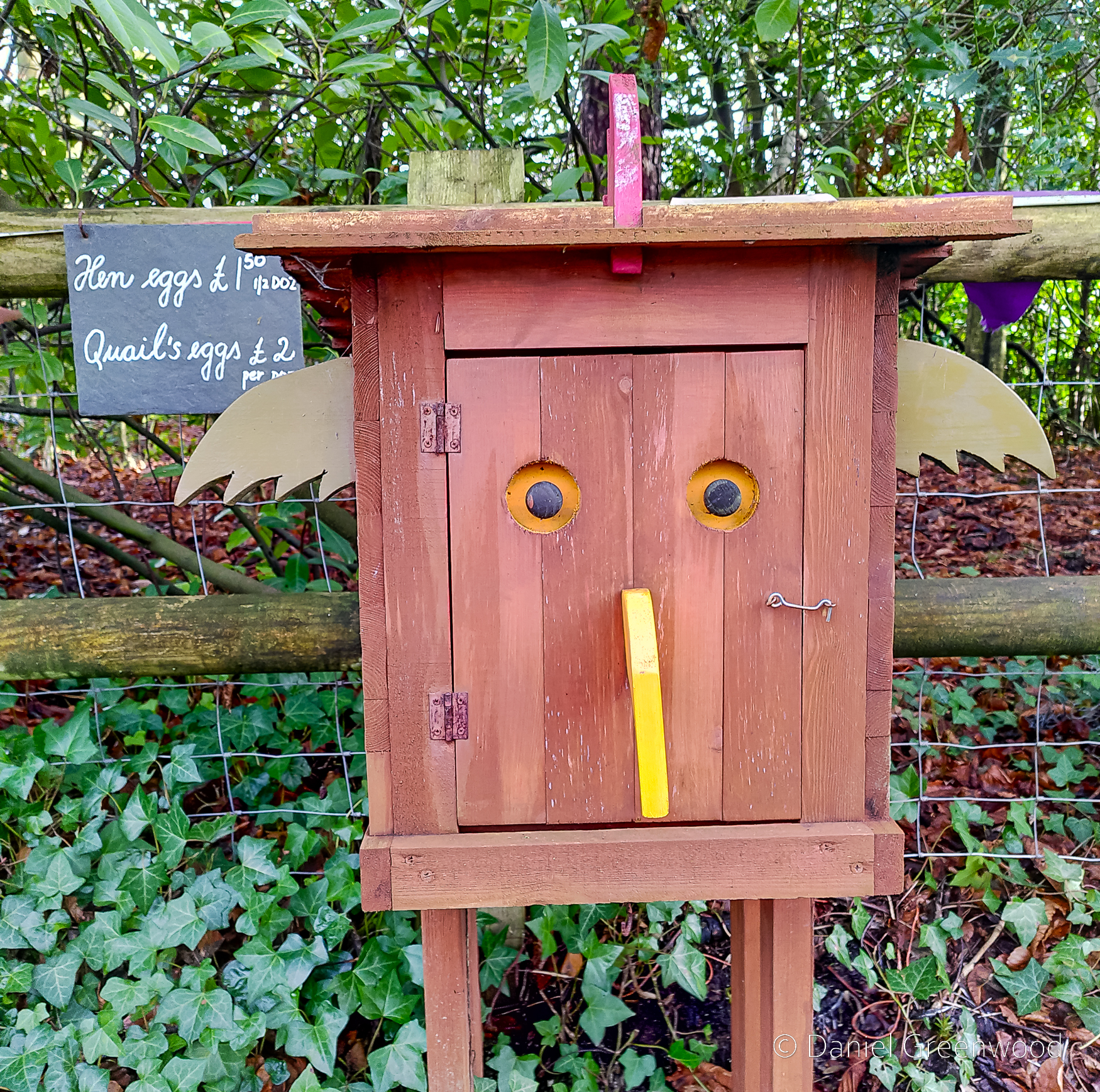
The walk began by passing this excellent egg box.
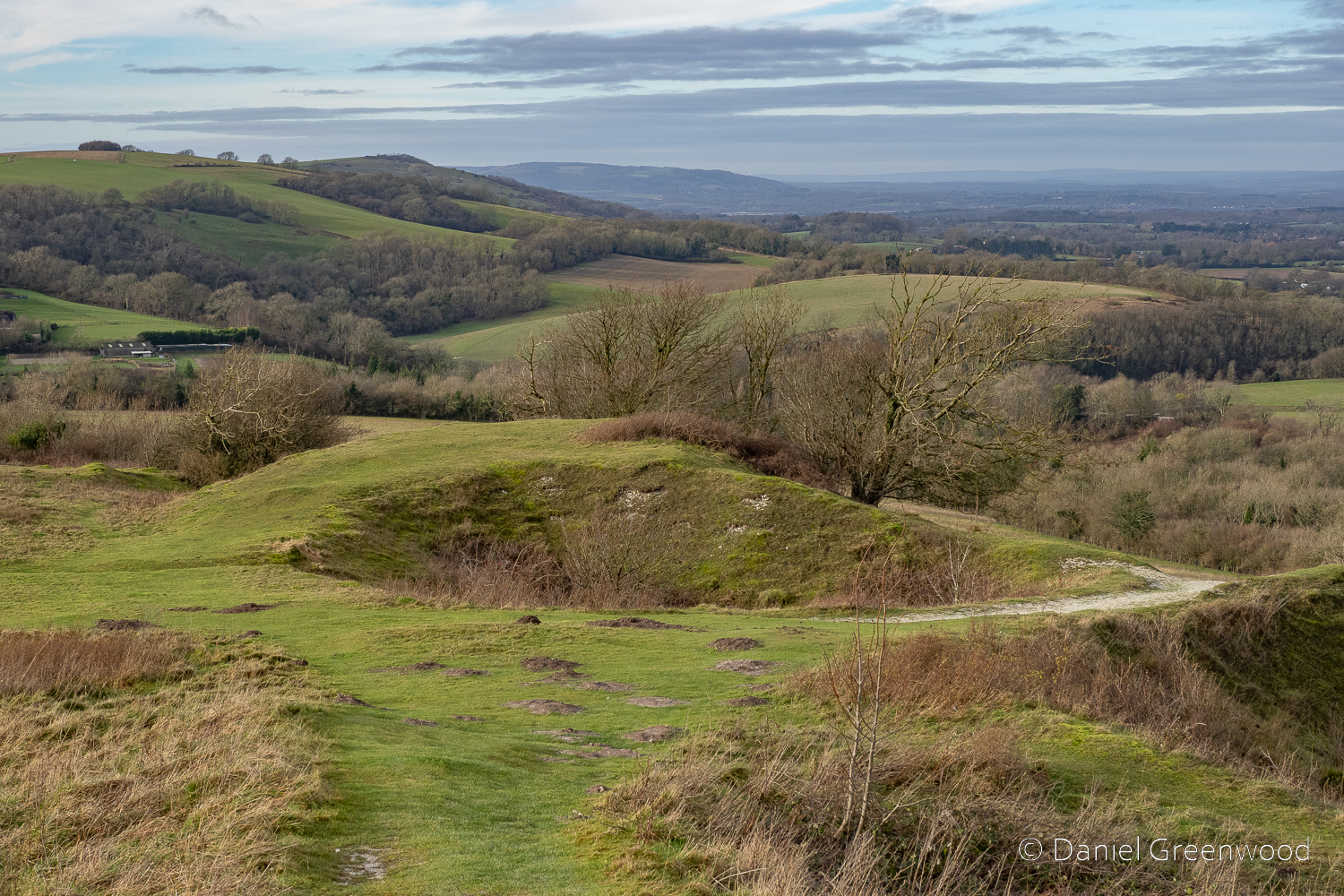
From Washington I walked up to the pocked and scarred hills of Washington Chalk Pits, ghosts of old industry – much more of that to follow. This place is excellent for butterflies so it’s worth visiting in the summer months. The photo here is looking west towards Storrington and Amberley. Here a buzzard flew low over the hill, looking for prey among the chalk pits.
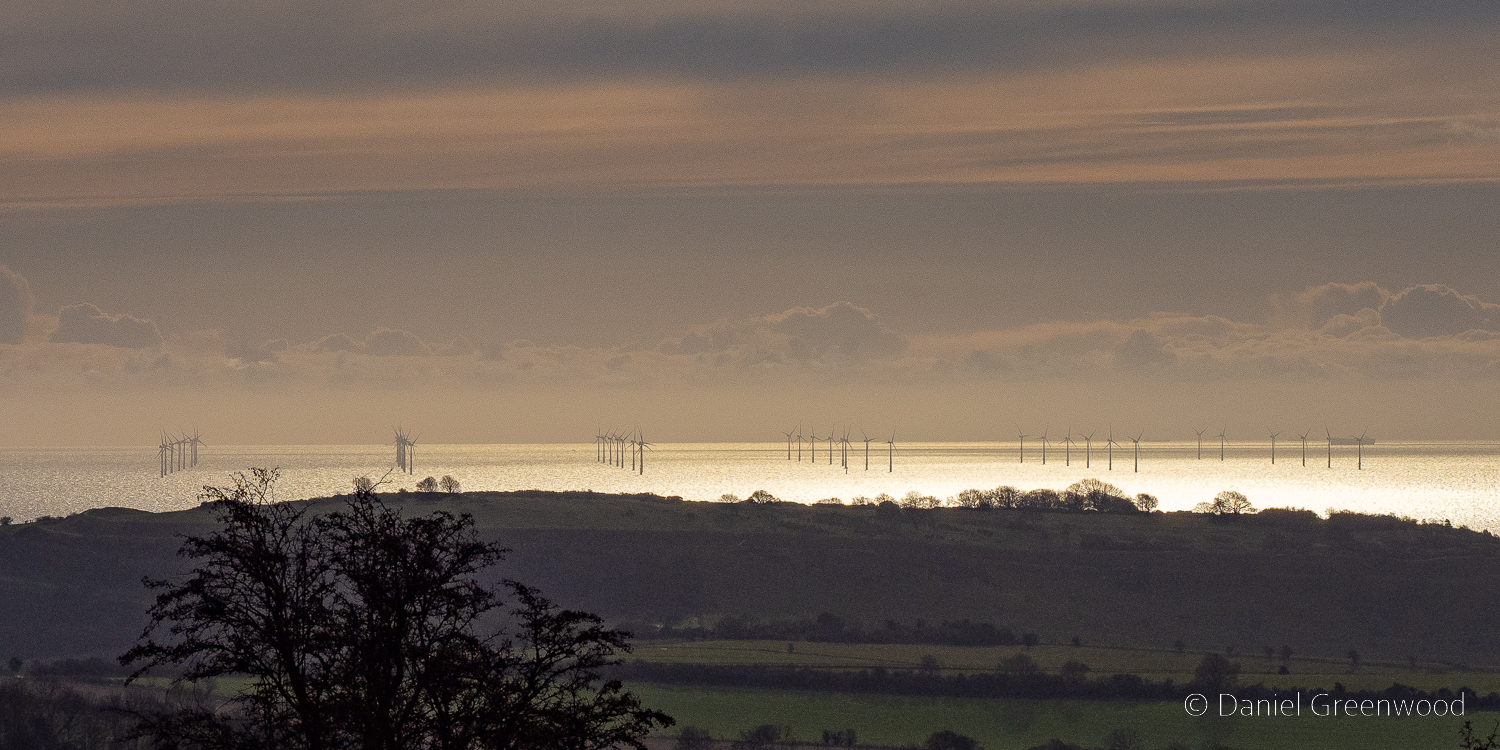
Far from being a place of wilderness, the South Downs have a deeply industrial feel to me. This is also because the views are so expansive you can see the stretch of human activity from miles away. This is the Rampion windfarm.

The Rampion windfarm cable trench, near Truleigh Hill, May 2018

The windfarm needed a trench to be cut through the Downs when the electricity cables were routed north to the substation at Twineham. This image is from 2018 near Truleigh Hill showing the fresh, exposed chalk. The windfarm will be seen again on this eastward journey.
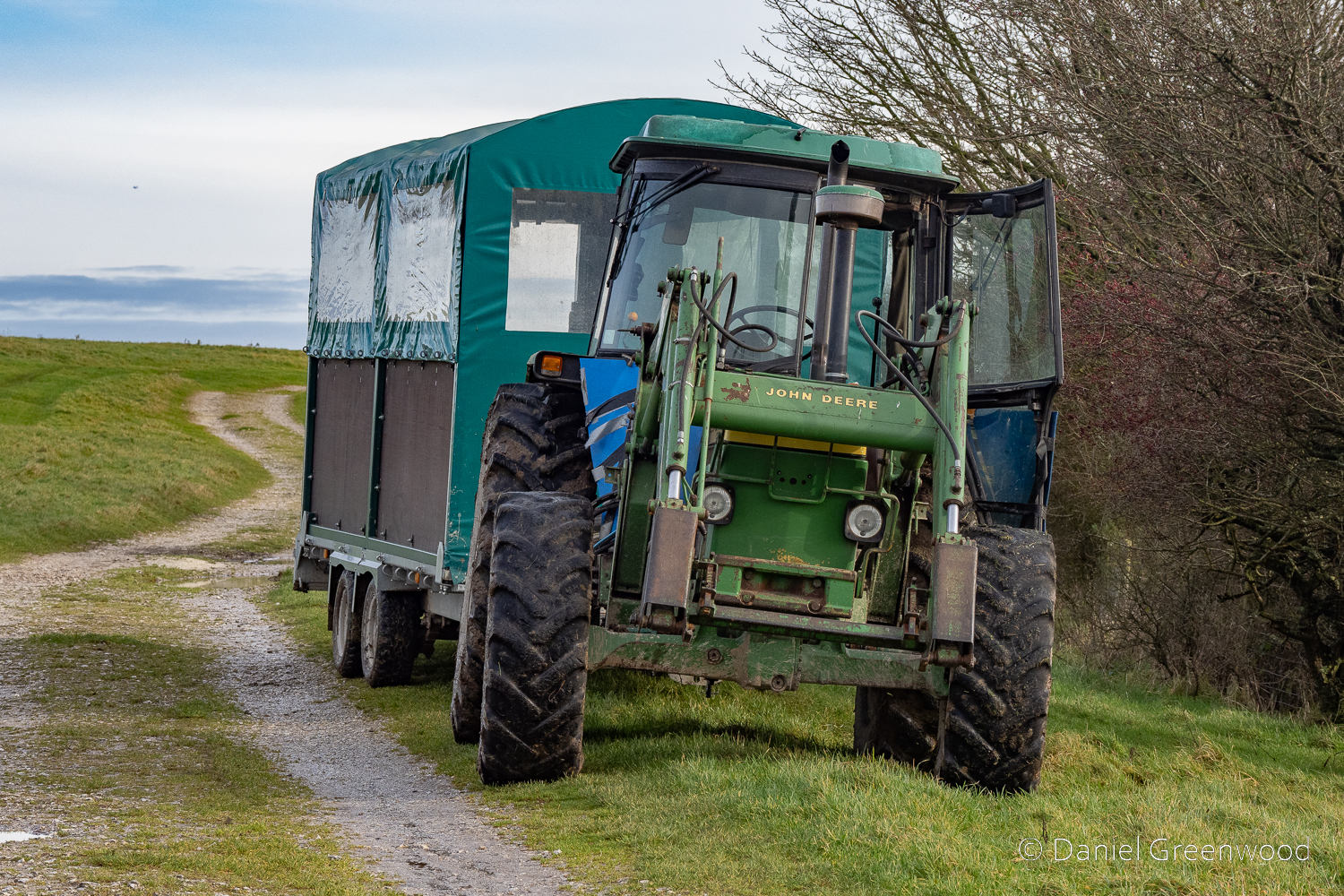
A man with a long beard had parked his tractor at the side of the South Downs Way where it approaches Chanctonbury Ring, and was breaking sticks from a fallen ash tree at the field boundary. Ash trees will pop up again along this journey.
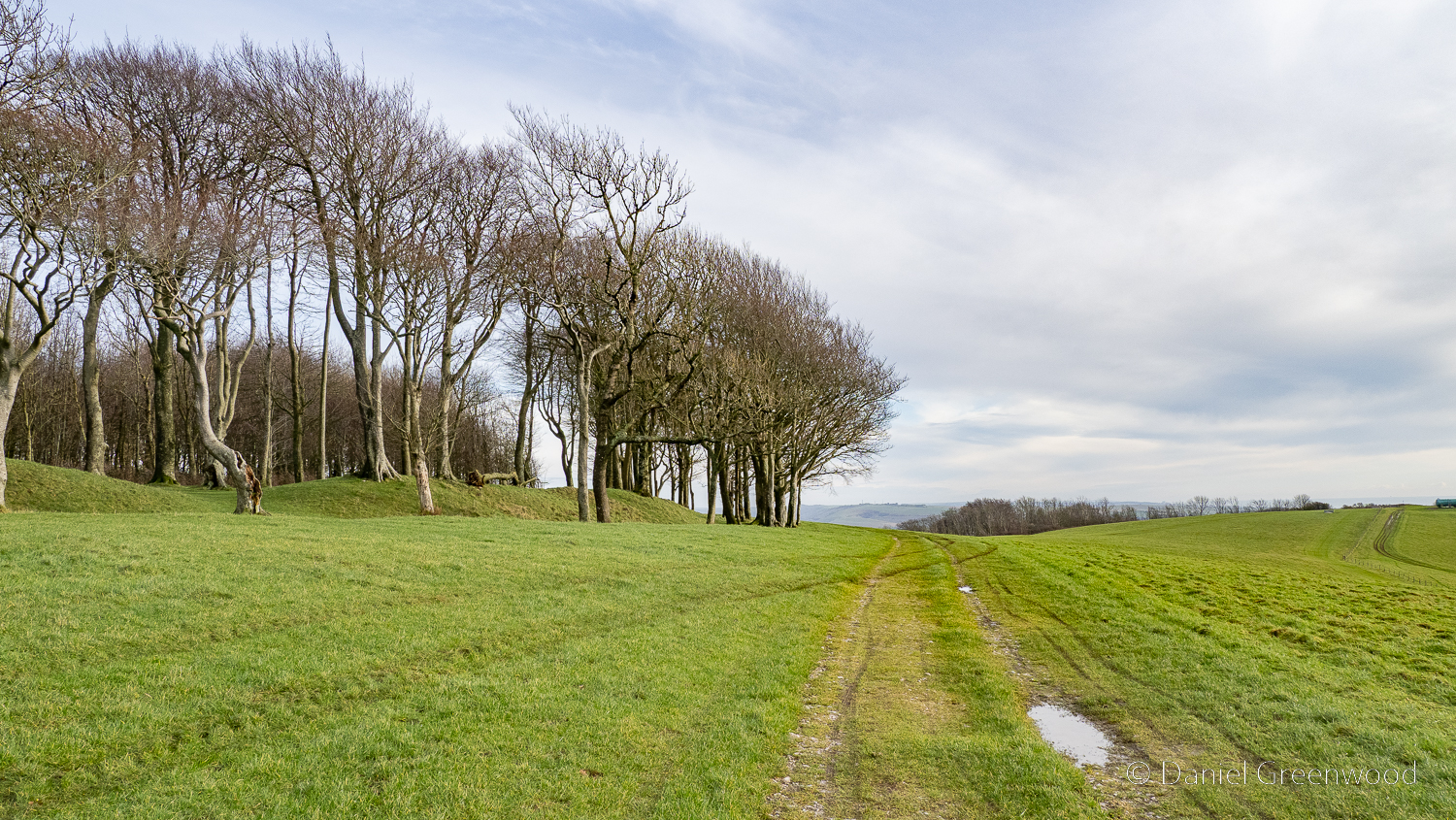
The grass is always snooker table smooth where the beech trees of the ring come into view. I’ve posted before about a walk that heads south from here to Cissbury Ring, the site of another Iron Age fort. As I approached the Ring a herd of deer ran across ahead of me, leaping over the path.
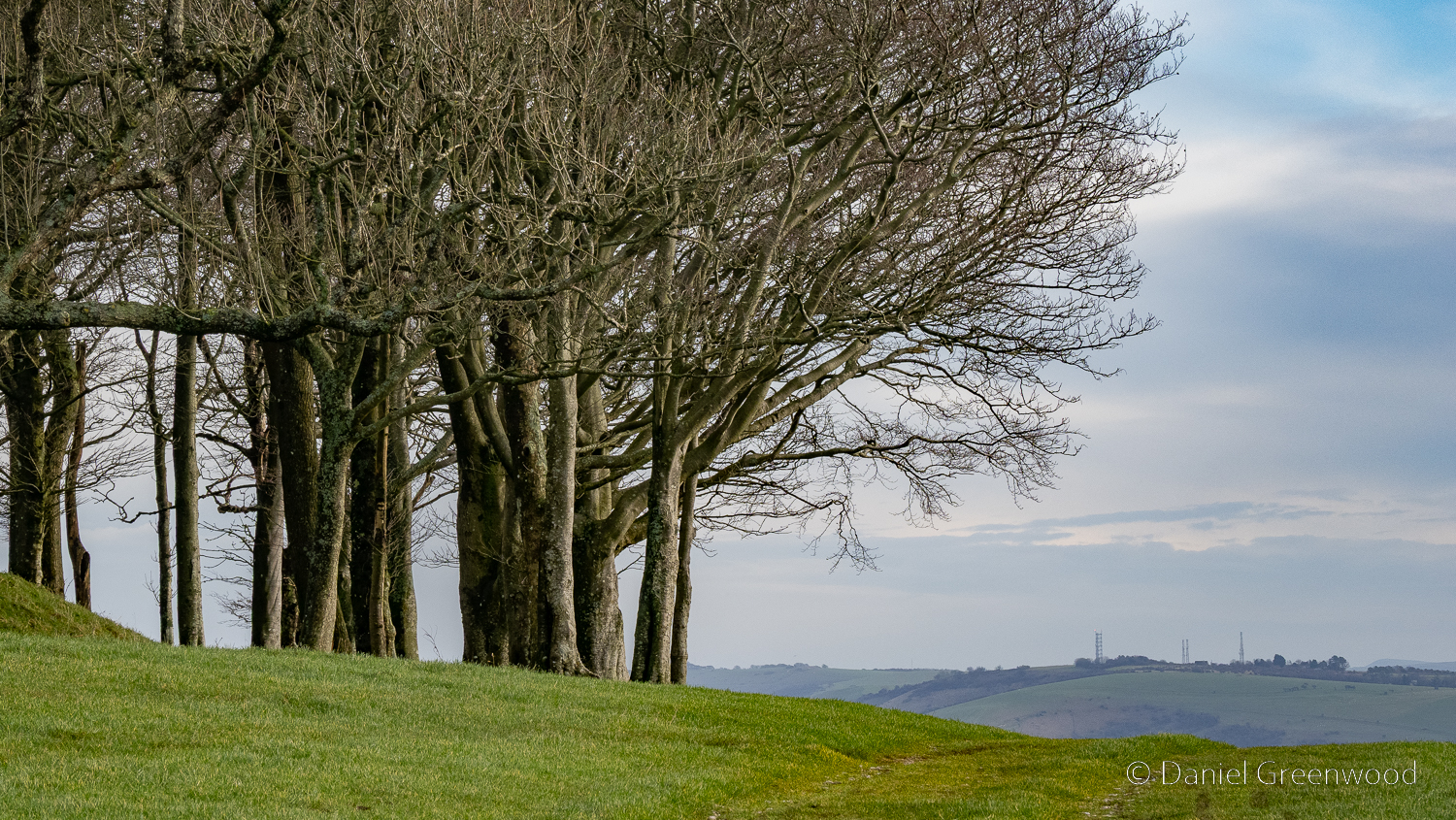
Beyond the trees the metal orchids (aerials) of Truleigh Hill mark the South Downs Way some 10-15 miles east.
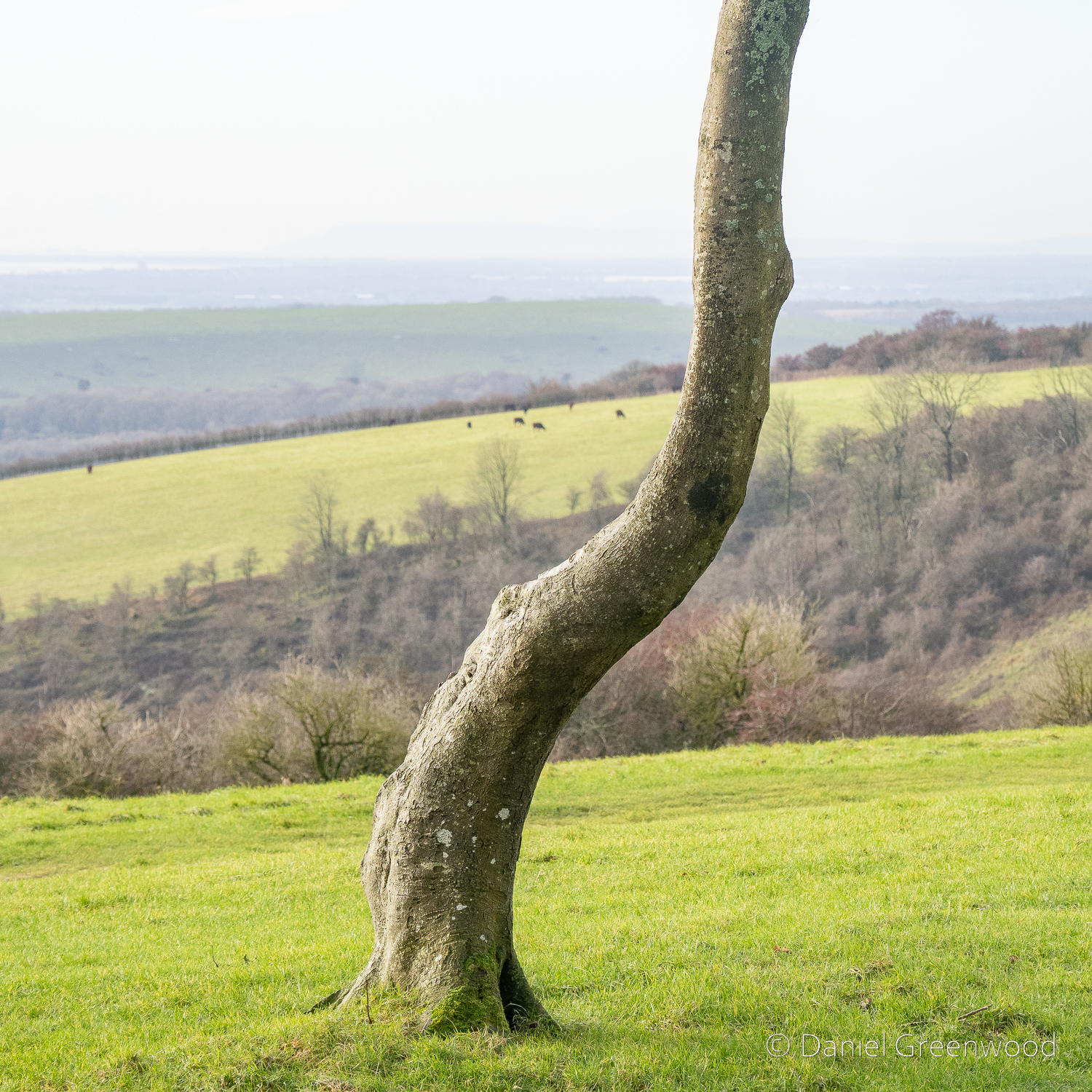
In isolation these windswept beech trees cross more gentle lines in the landscape.
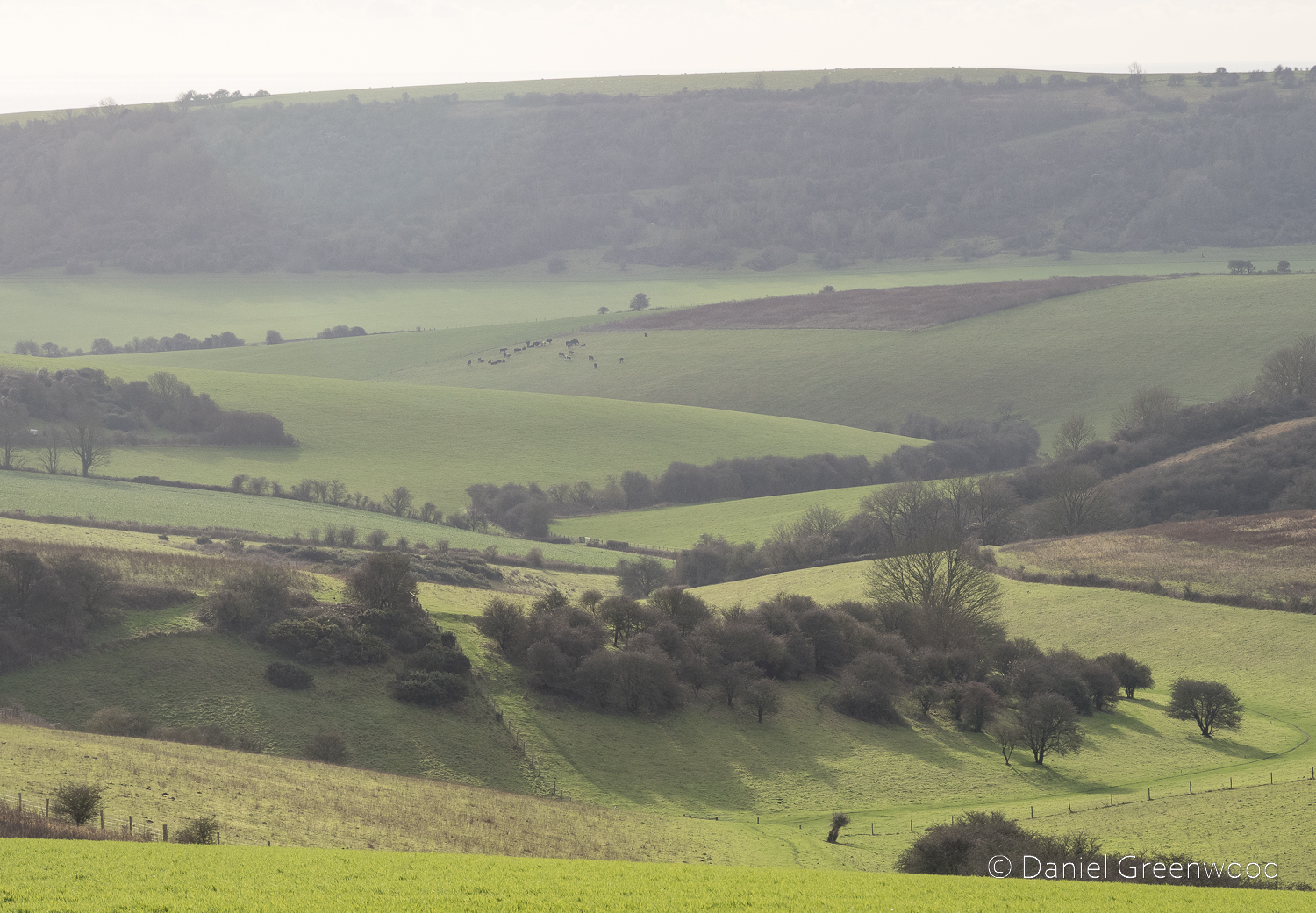
The archetypal folds of the Downs, stubbled by trees and scrub.
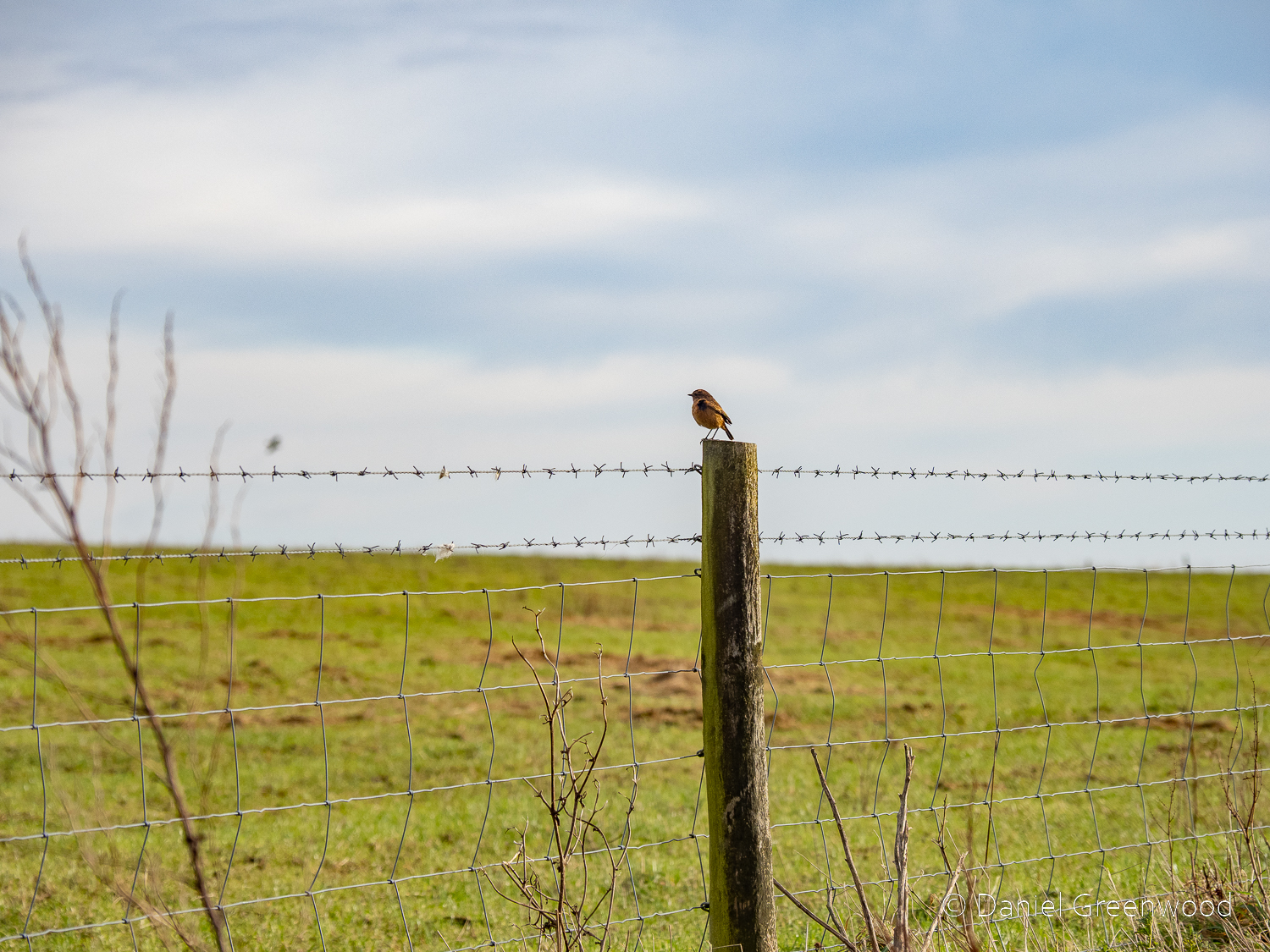
Away from Chanctonbury a stonechat perched on a fencepost. These chats are your friends in the winter downland.
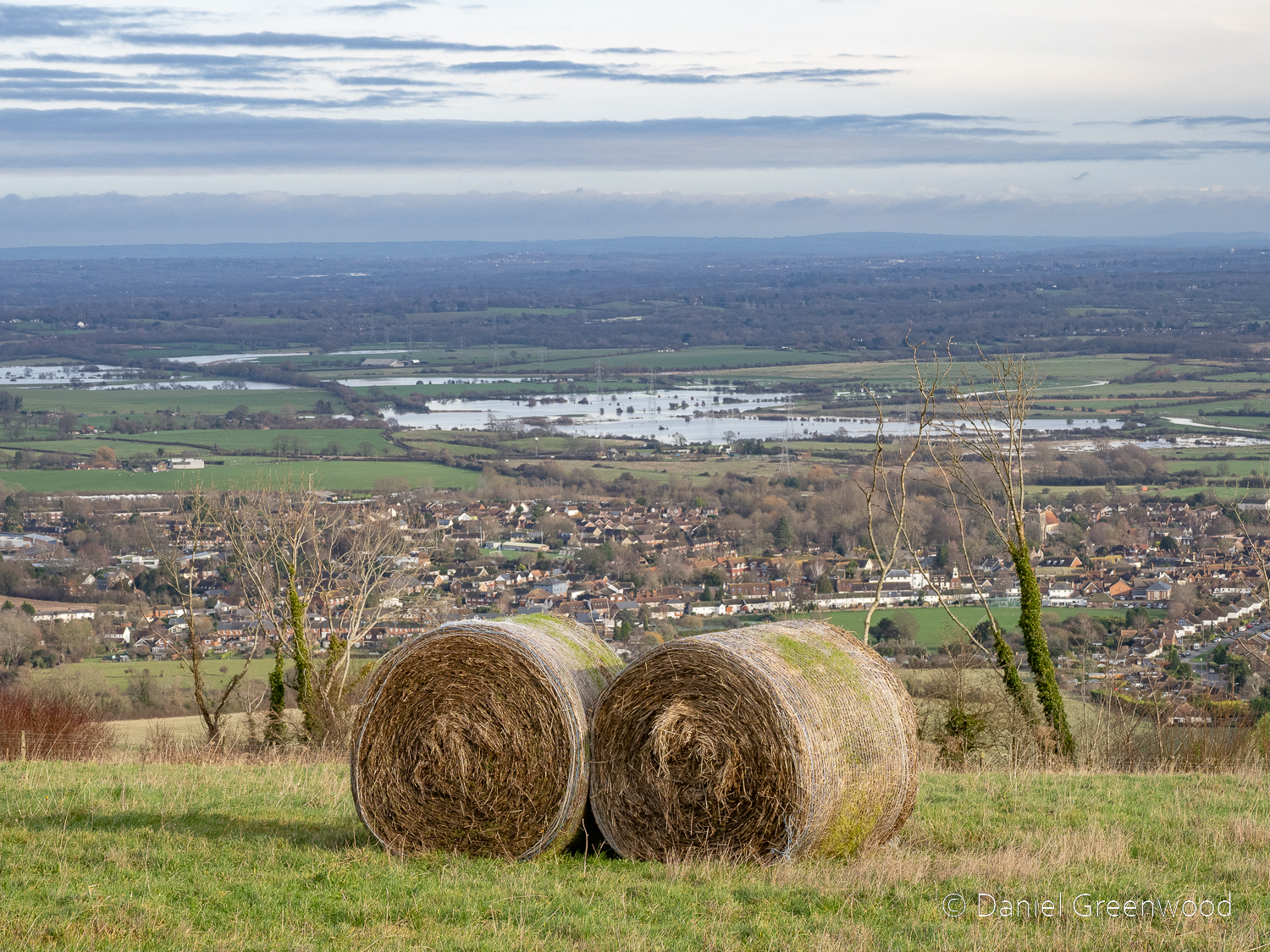
Looking down towards Steyning, the Adur had flooded. Why have these bales been left to grow mossy?

A tribute to one of the downland farmers, a sea of arable crop washing away to the horizon. The gleaming top right-hand corner of this photo is indeed the sea.
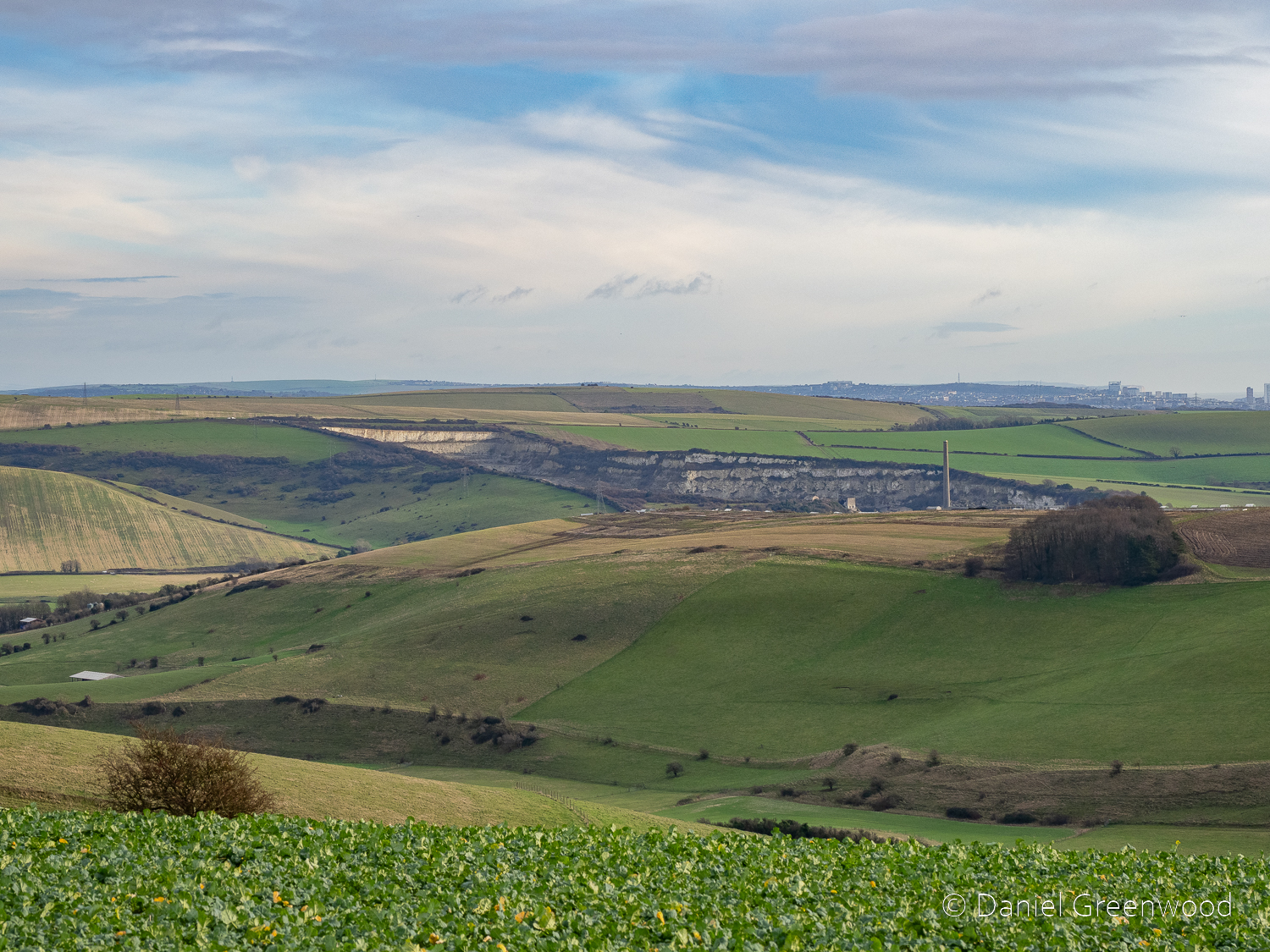
Beyond the crop a rupture in the chalk where the Shoreham cement works pipes up.
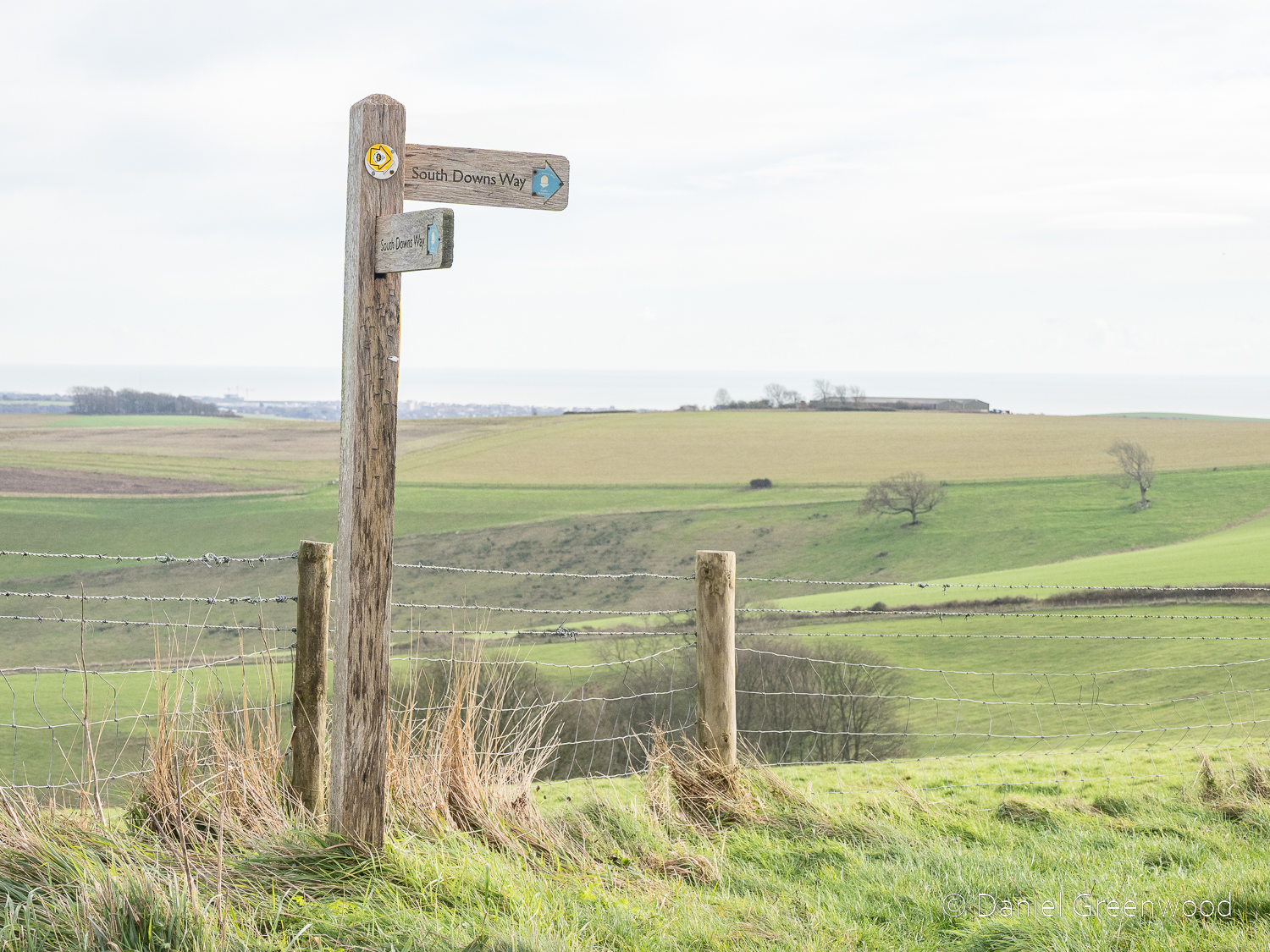
These wonderful fence posts are plopped into place by the rangers, the volunteers or the rights of way team from the National Park. The kindness of fingerposts.
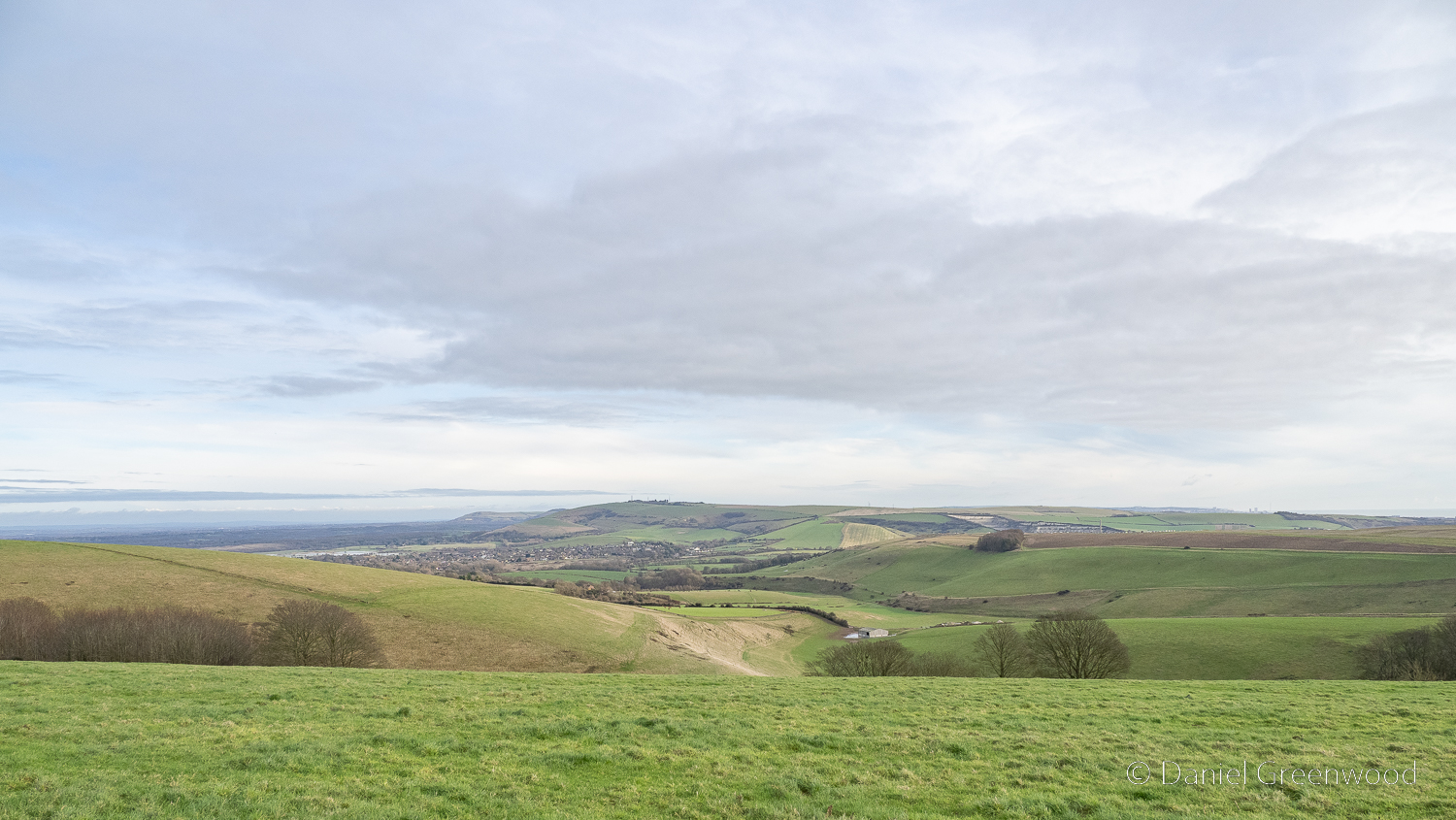
The sheer openness of the Downs and its skies. The memories of these wide open spaces can stay with you for years, the very essence of why people deserve the right to pass along these ways.
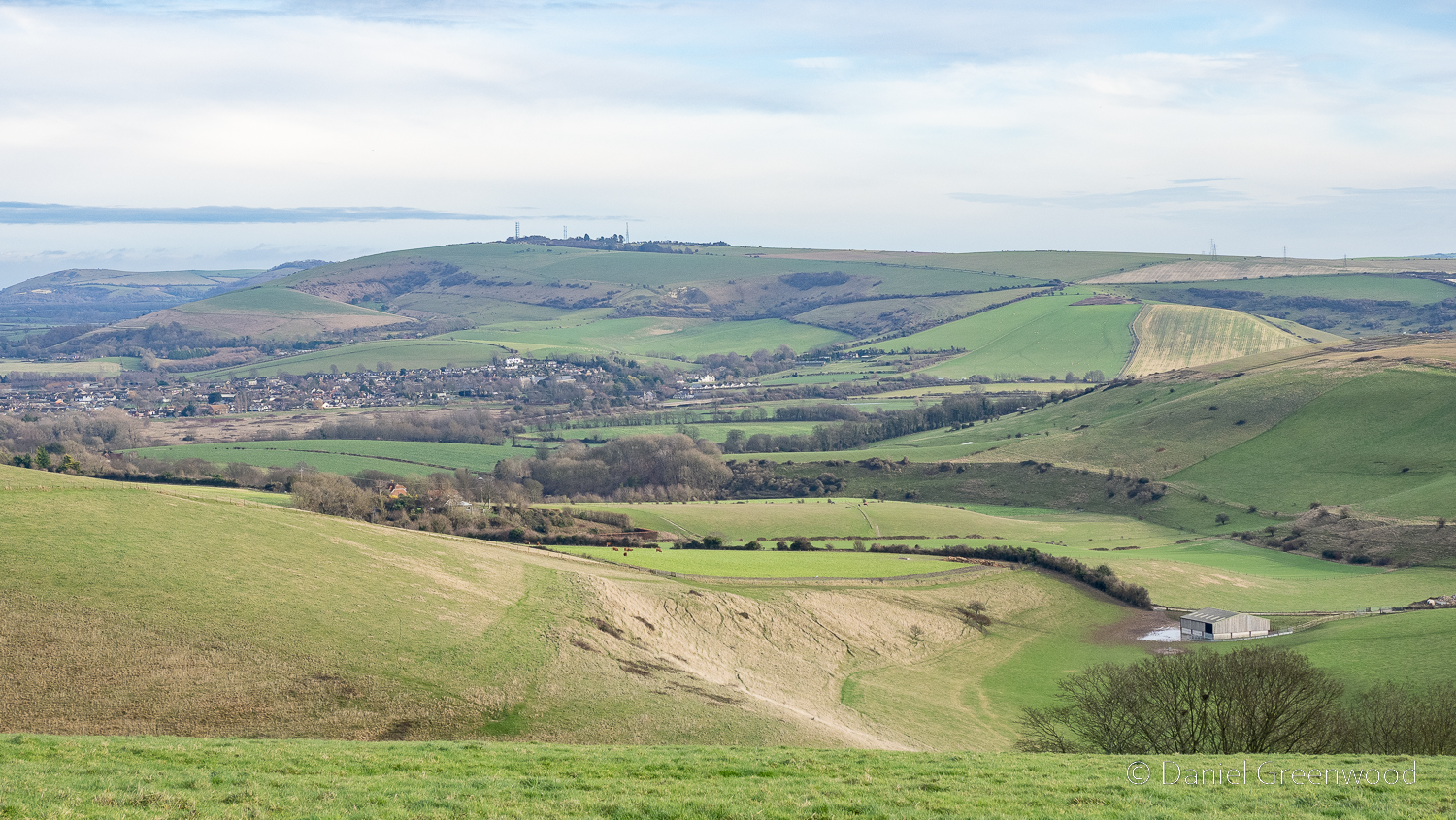
Zooming in on Truleigh Hill – what is cloud, hill or perhaps even the sea? The eye plays tricks.
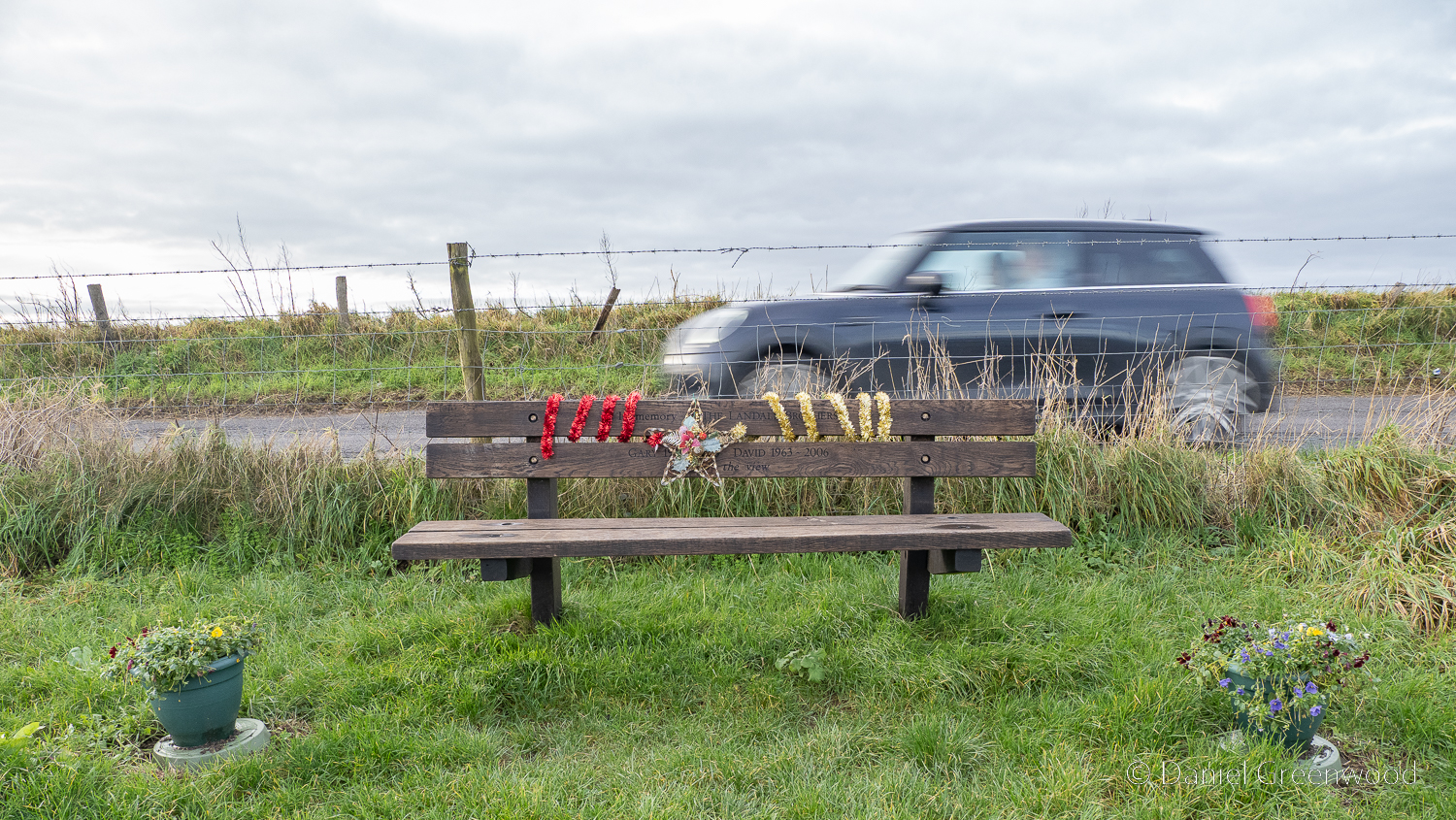
A memorial to two brothers who passed in their thirties and forties, replete with tinsel and flowers potted on either side. A Mini spinning by in the lane behind.
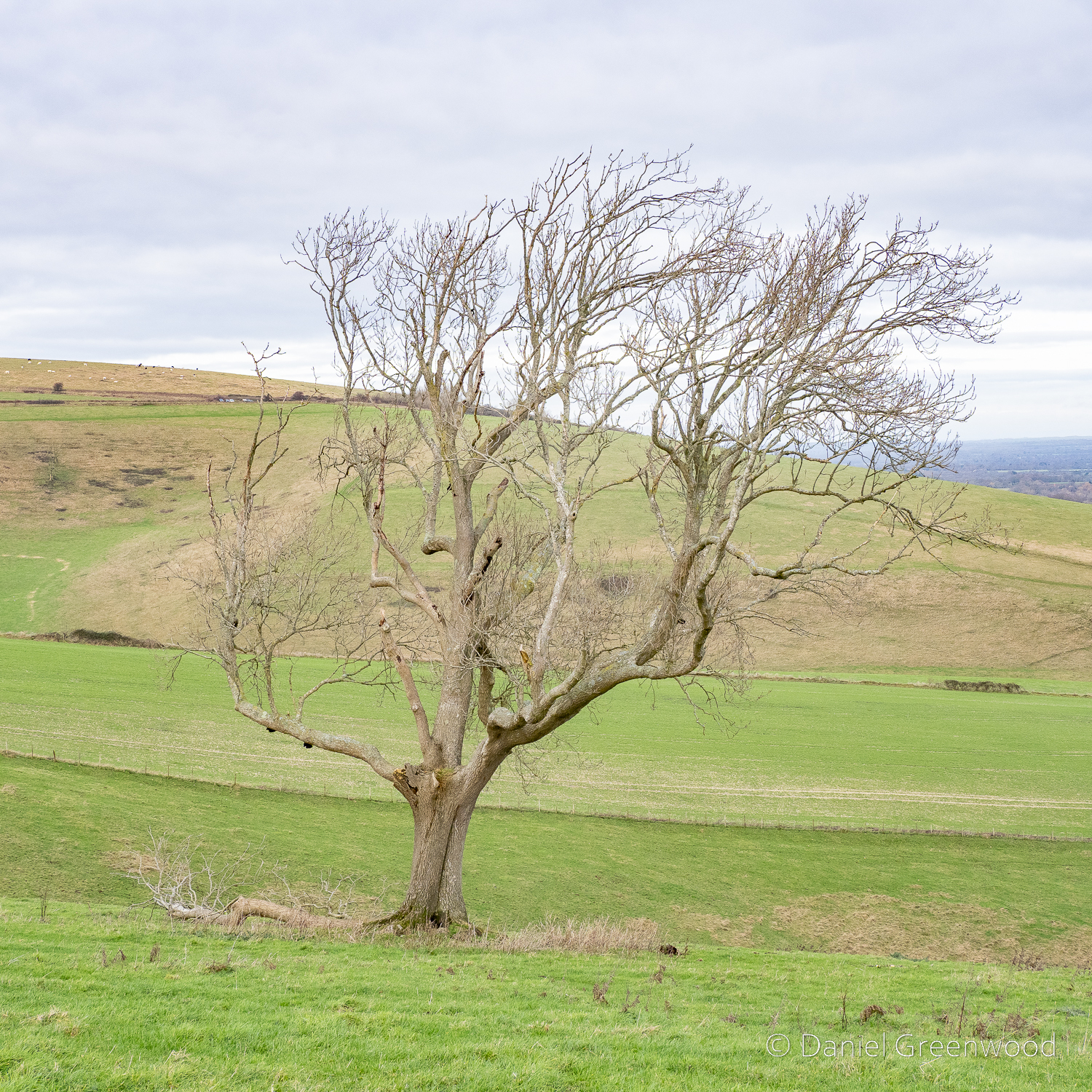
Another ghost of the Downs – an ash tree dying from the disease. One limb has fallen and more will follow in the winds. If you look closely you can see the remains of what are probably shaggy bracket fungi. Fear not, there is hope for ash trees in Britain.
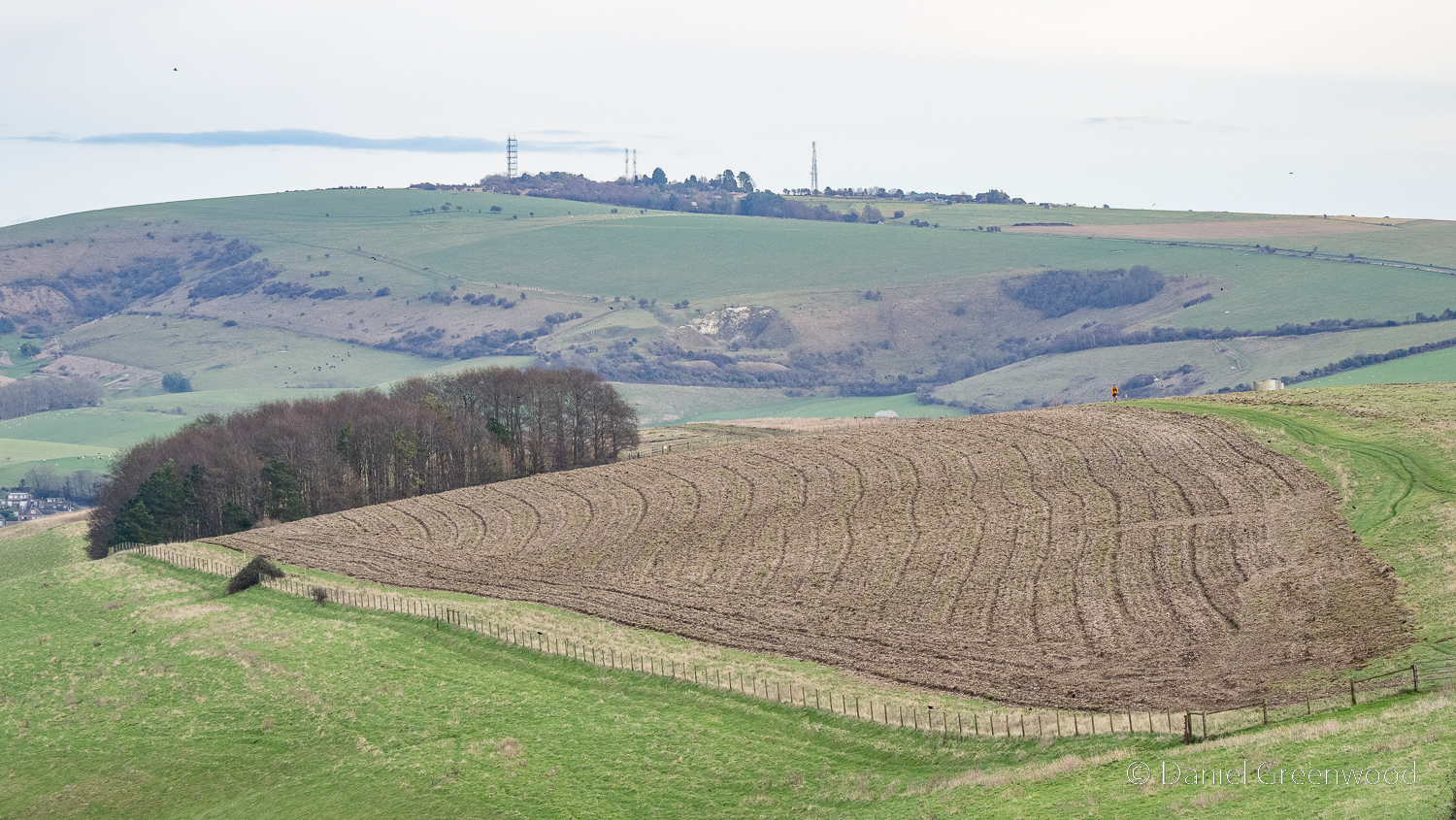
Tilled fields, with Truleigh Hill edging closer, though it’s not part of this walk. The copse of beech trees is likely to shelter pheasants bred for shooting, a common economic activity in the South Downs, and not without its problems. Unfortunately it appears that the persecution of birds of prey (often linked to shooting estates) is rearing its head in the South Downs National Park.

Chalk flints clawed to the surface at the edge of some of the ploughed field the South Downs Way passes.
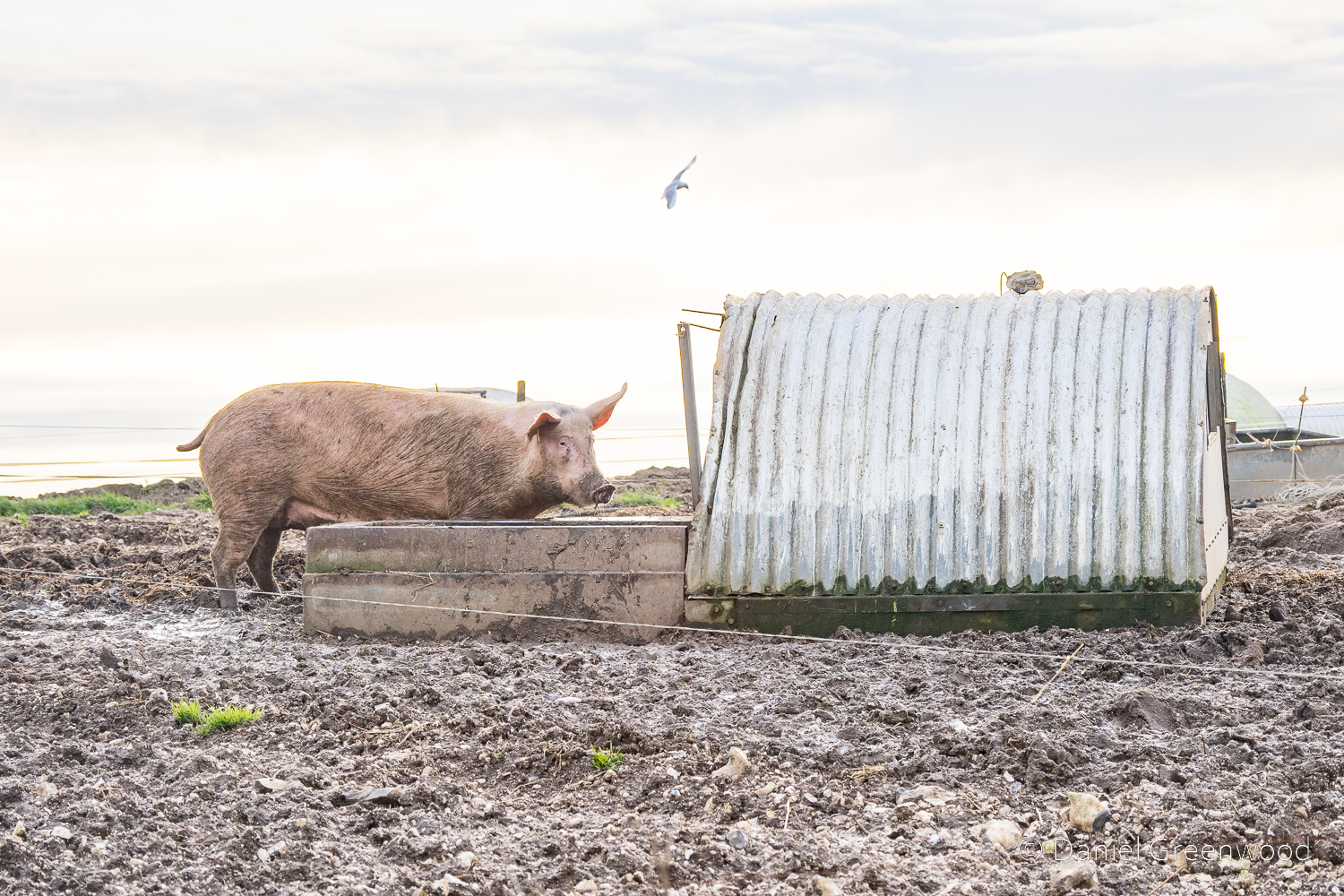
Peaks and troughs! One unmissable part of this walk (in many senses) is the pig farm right next to the South Downs Way. A man was piling up hay for the pigs and from a distance I heard him call one a ‘f***ing c**t’.
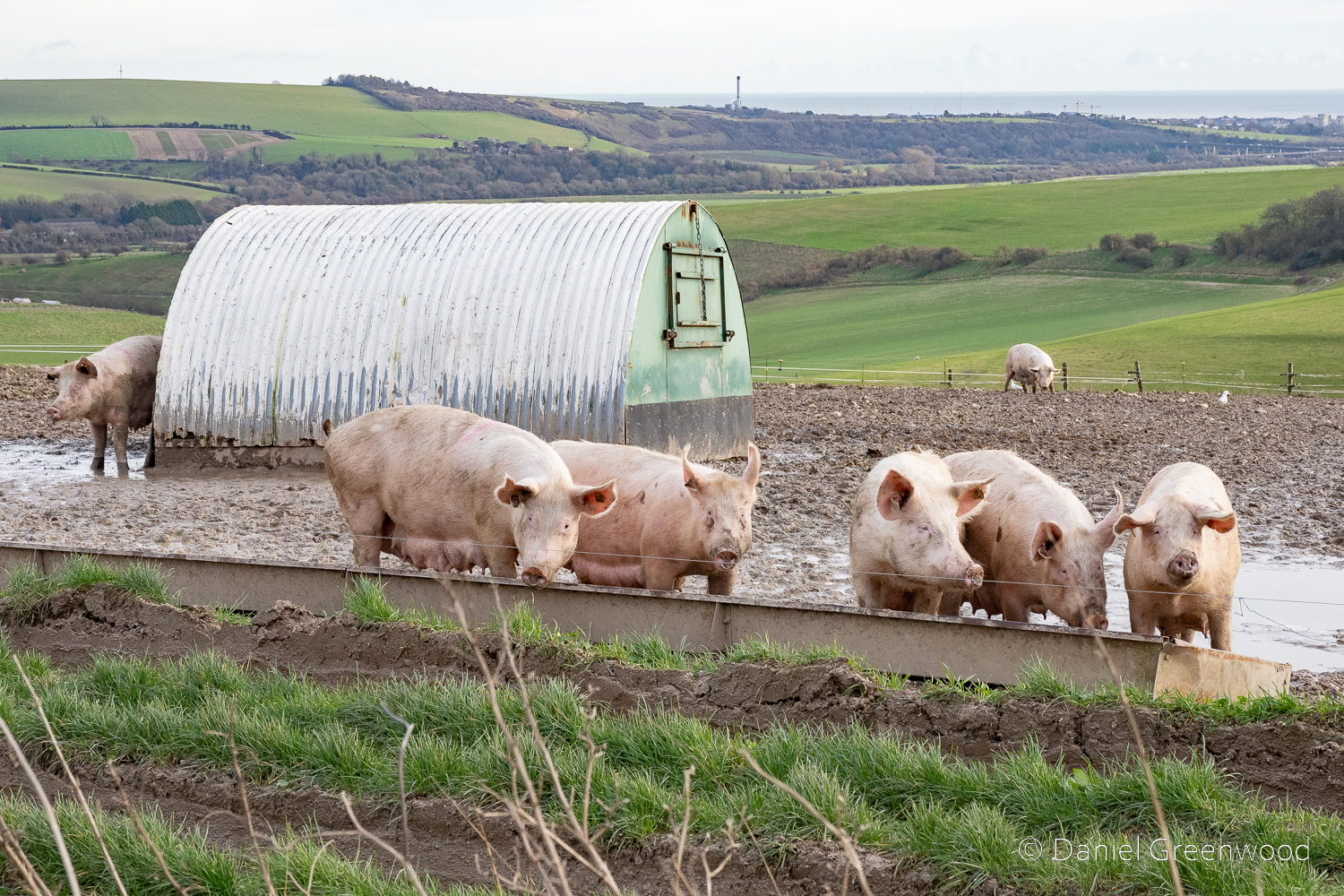
‘Really, us?’ they ask.

The windfarm once again comes into view with Lancing College, a boarding school, rising above the trees at the edge of the Downs. When I was a kid and misbehaving my parents would threaten to send me to boarding school. Now I realise they could never have afforded it! Bravo, mum.
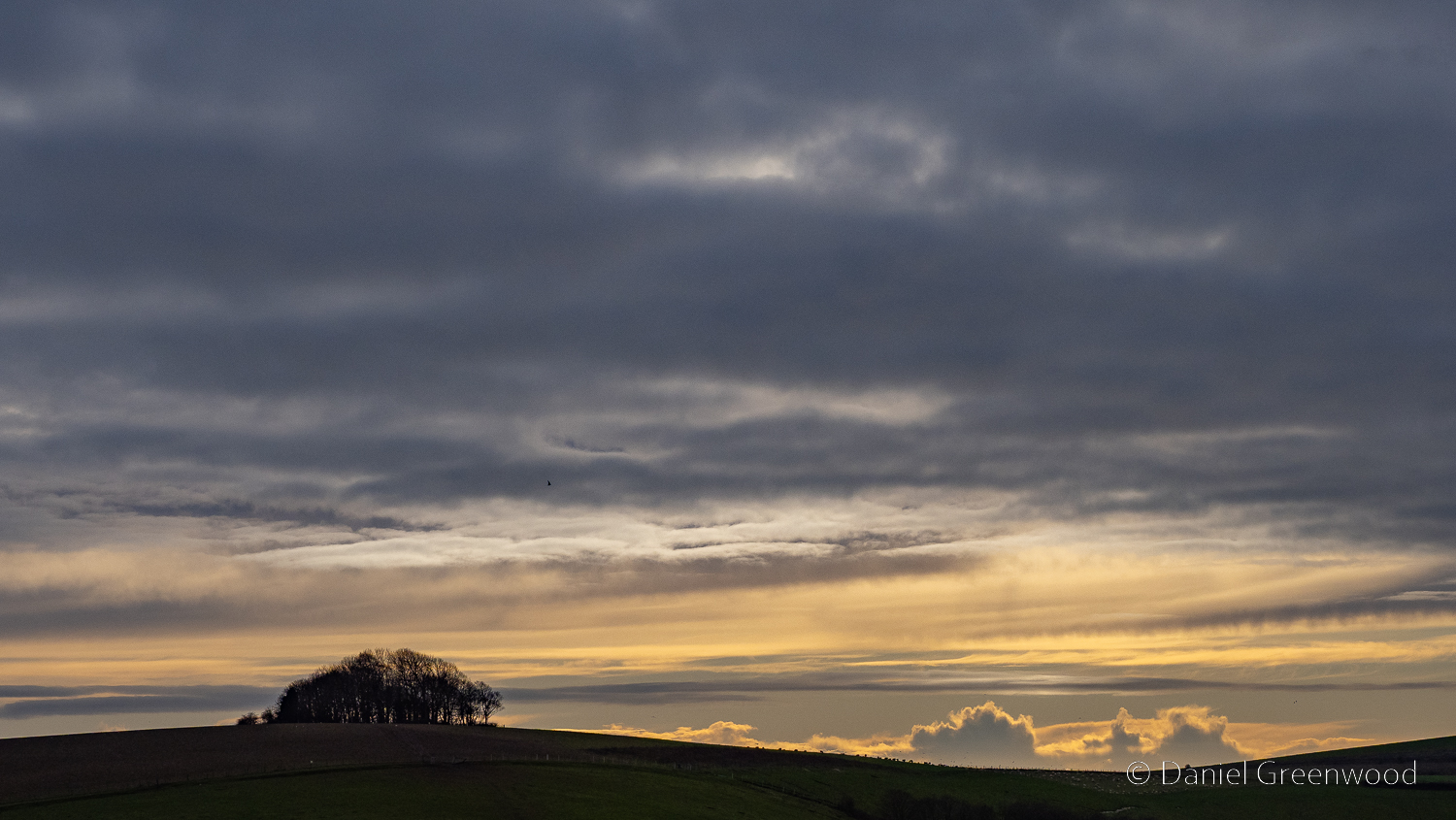
I’ve reduced the exposure on this photo to bring out the mood in the sky. Another pheasant copse on the hilltop?
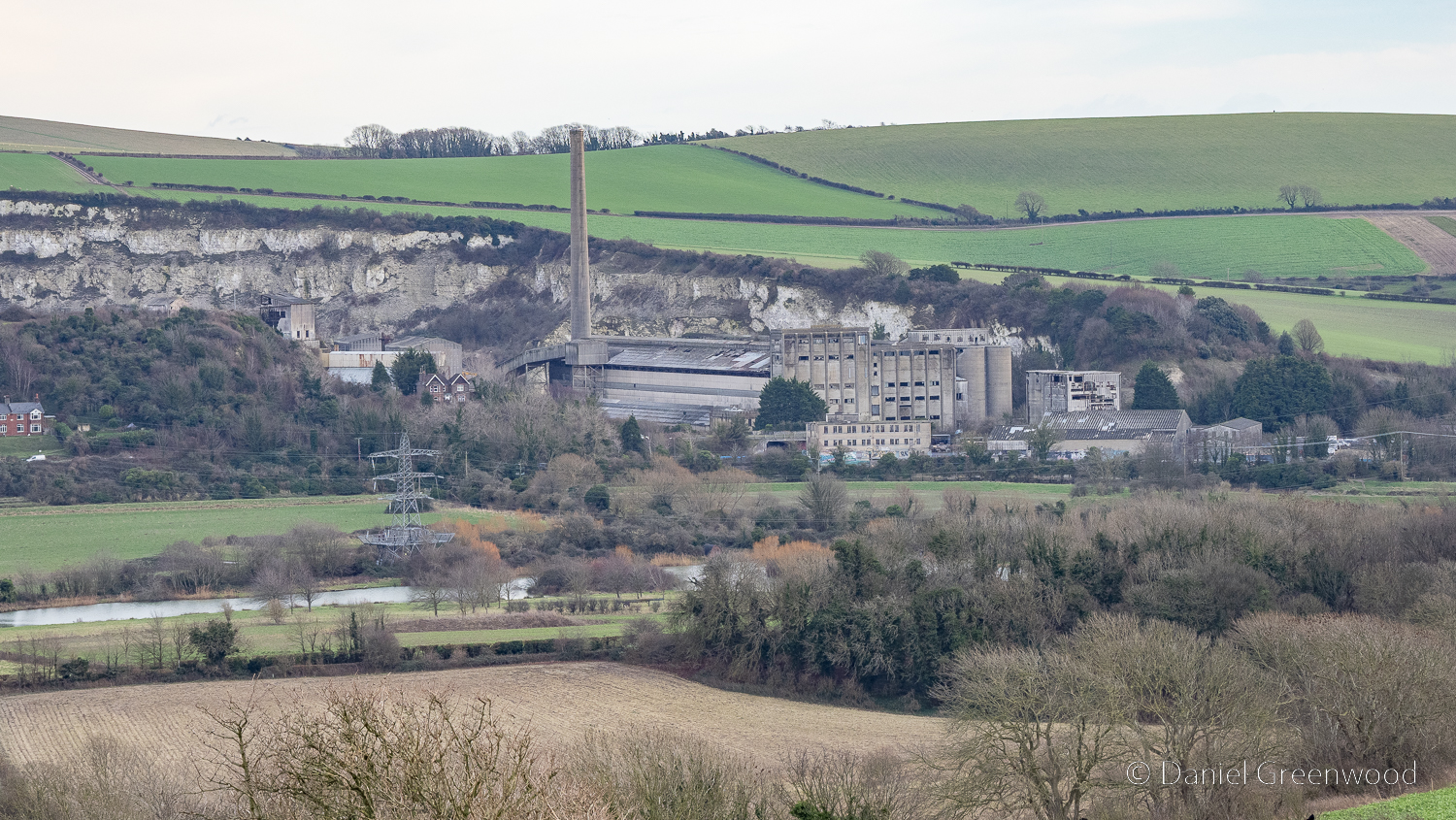
Shoreham cement works is built into the site of an old chalk quarry, which dates back to the 18th century. It’s on the market for housing as of October 2025.
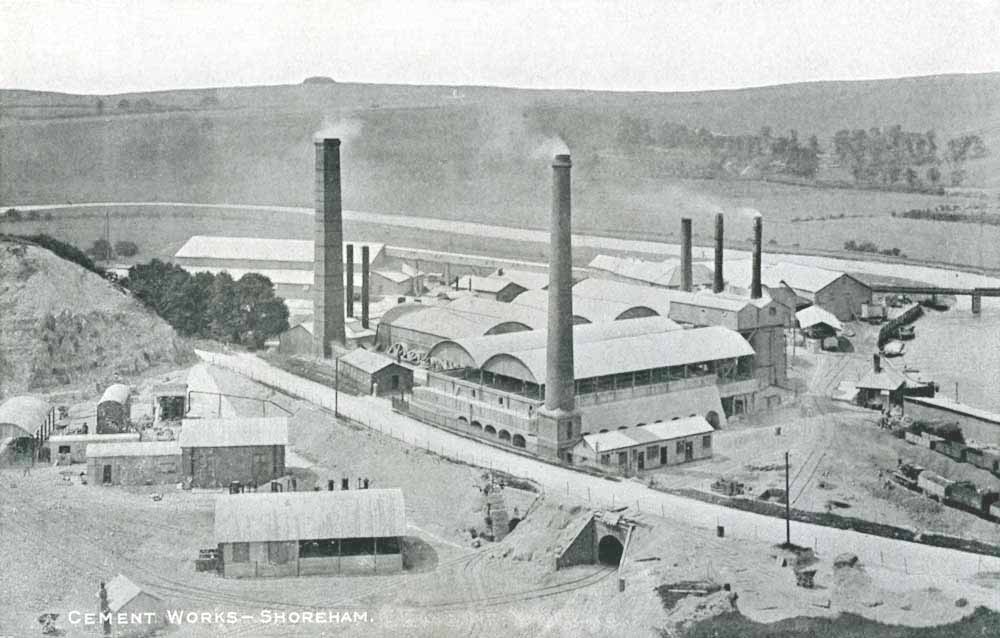
This pre-1950s photo wasn’t one I took, but it shows the cement works before they were rebuilt into the Soviet-esque version currently standing. This article has a lot of interesting information and old photos looking at the history of the place.

St. Botolph’s Church is one of the oldest in Sussex, dating back to pre-Norman England. St. Botolph is a Saxon Saint associated with river crossings. The Sussex Parish Churches website points out that the village connected to the church ‘was an important port on the lower Adur until the sea receded after about 1350’. I enjoy the lichens growing on this old metal sign.

Dating from around 950, St Botolph’s was built near one of the first industrial trade routes in Britain, a Roman road along which tin was carried from the Cornish mines to the East Sussex seaport of Pevensey. Two thousand years on, and industry still stamps its mark in this book of rural West Sussex, with the railway line and modern cement works visible just a few hundred metres away.

Gail Simmons, Between the Chalk and the Sea: p.157
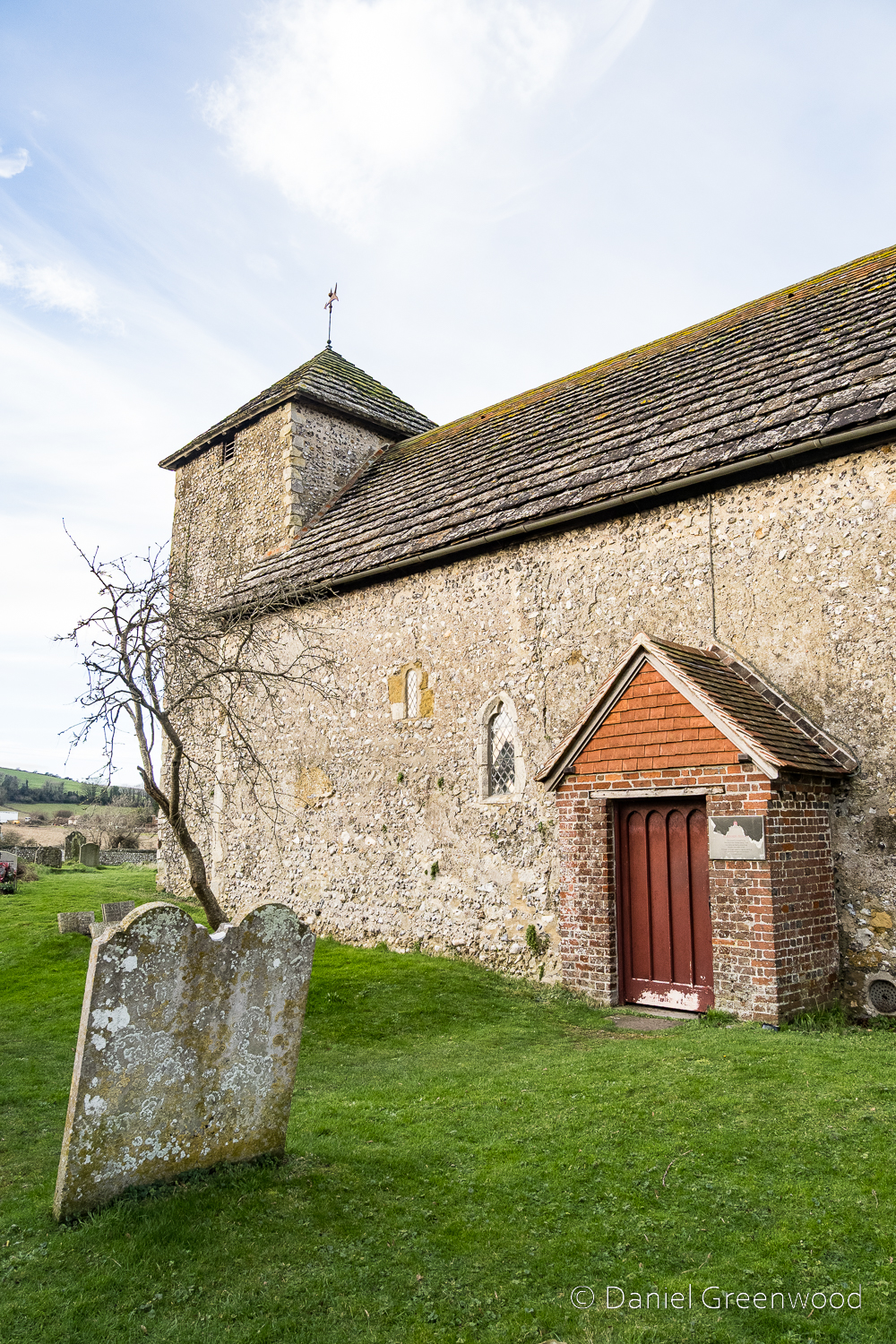
We’ll get to that railway line in a little bit, but after being out in the cold January air, it was nice to find a sheltered place to sit for a little while.
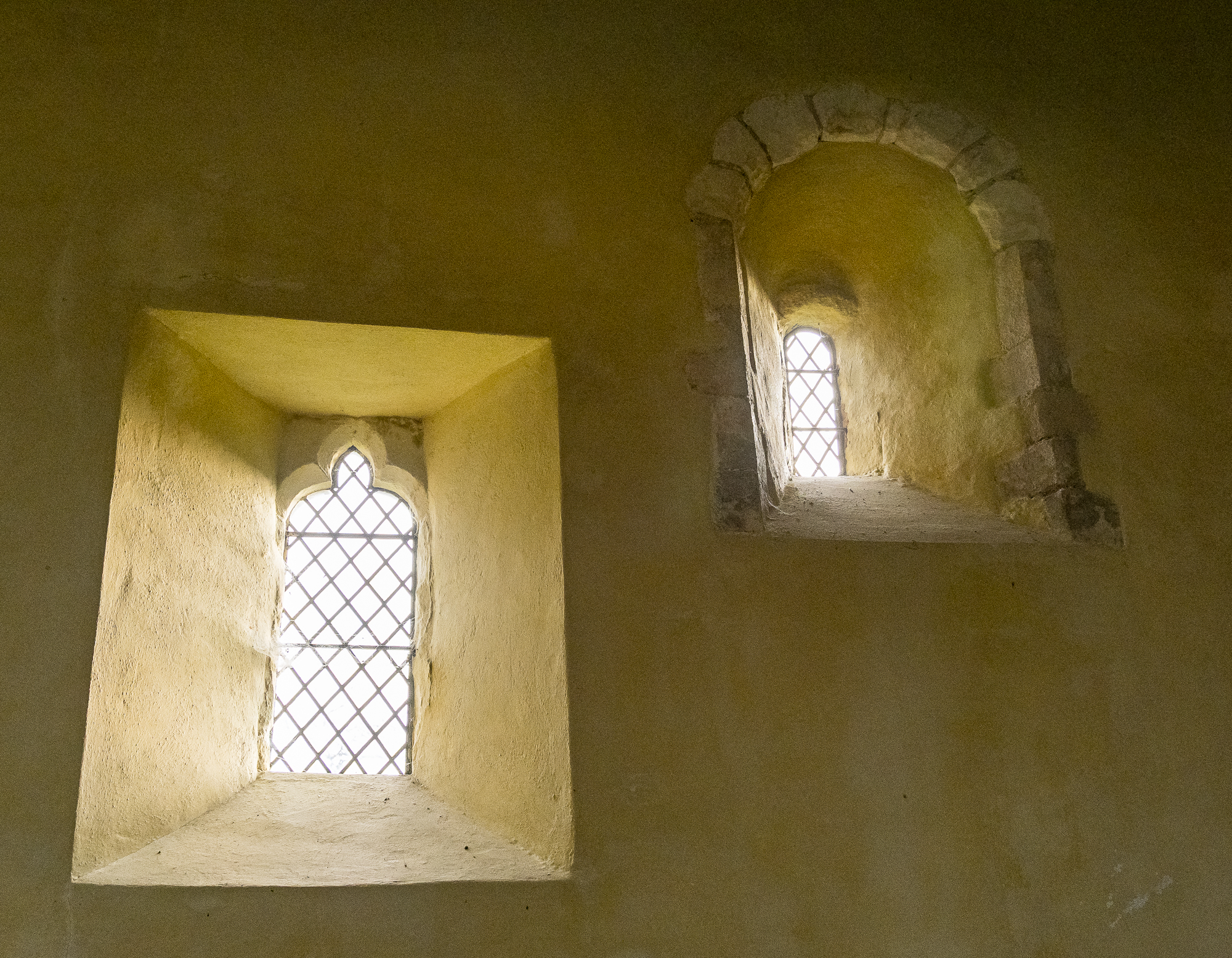
There’s a window that dates to the Saxon period at St. Botolph’s, which to me feels more mysterious than the much earlier Roman occupation (AD43-400). My guess would be the ’round-headed’ window in the top right here is the Saxon one, as per the official descriptions.
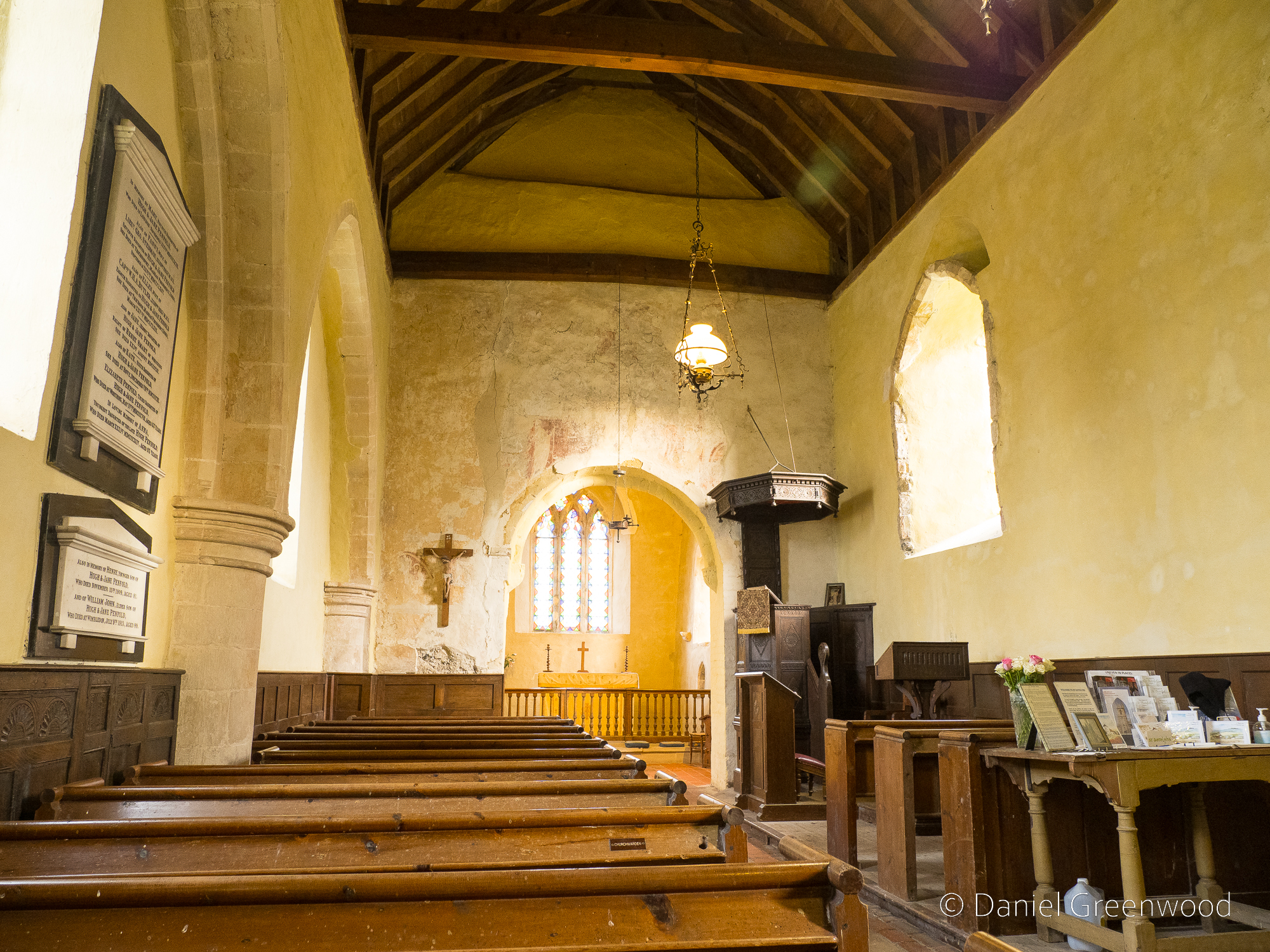
This should give a sense of the shape and colour of the interior. The nave and chancel also date to Saxon times.

The paintings at St. Botolph’s are subject to debate, and are hard to see. They could be part of an unproven ‘Lewes Group’ of wall paintings, with some potentially dating back to the 10th century (scroll down for more detail here).
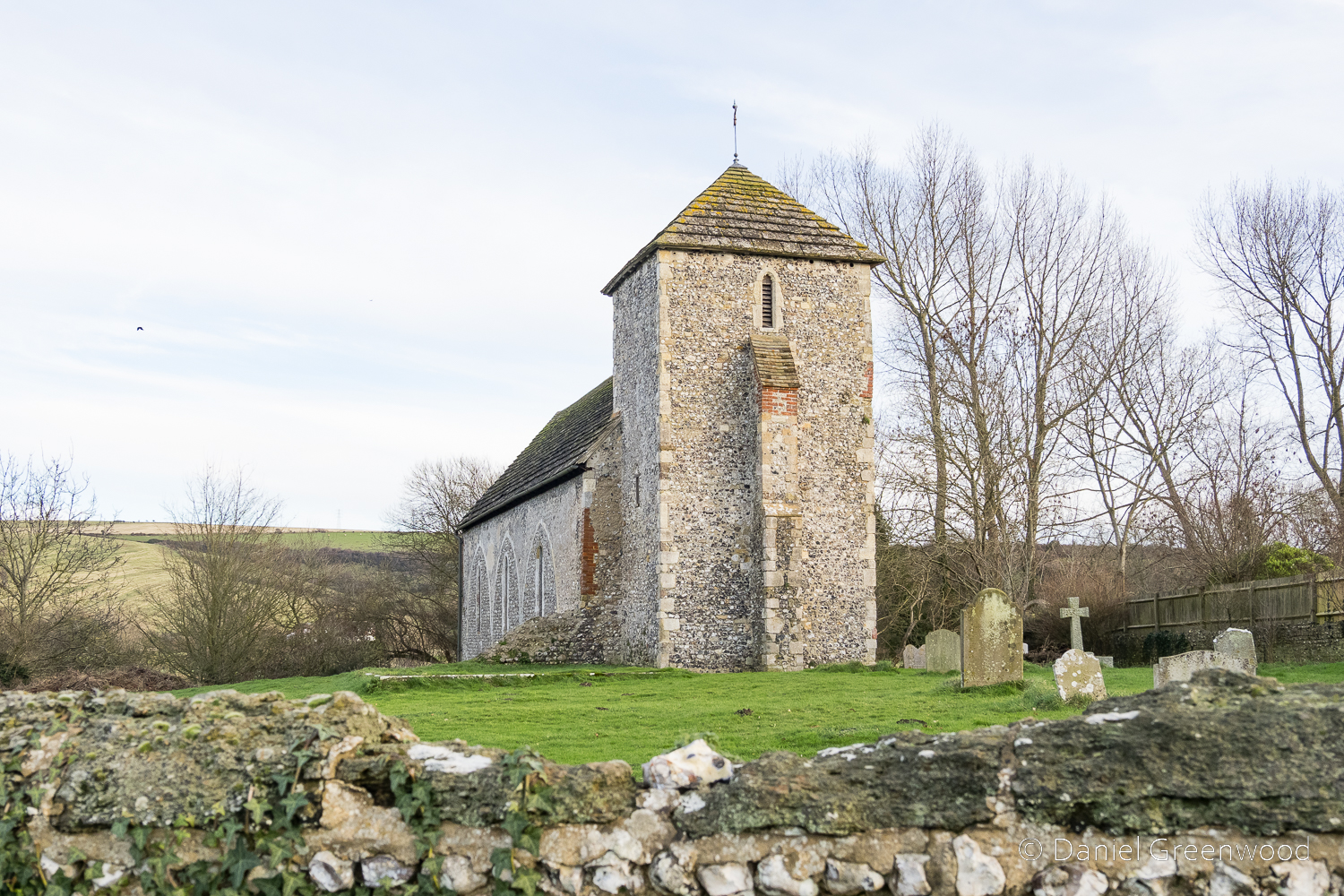
St. Botolph’s is a magnificent little church with thousands of years of history packed into its flinty walls. You can see my church galleries here.
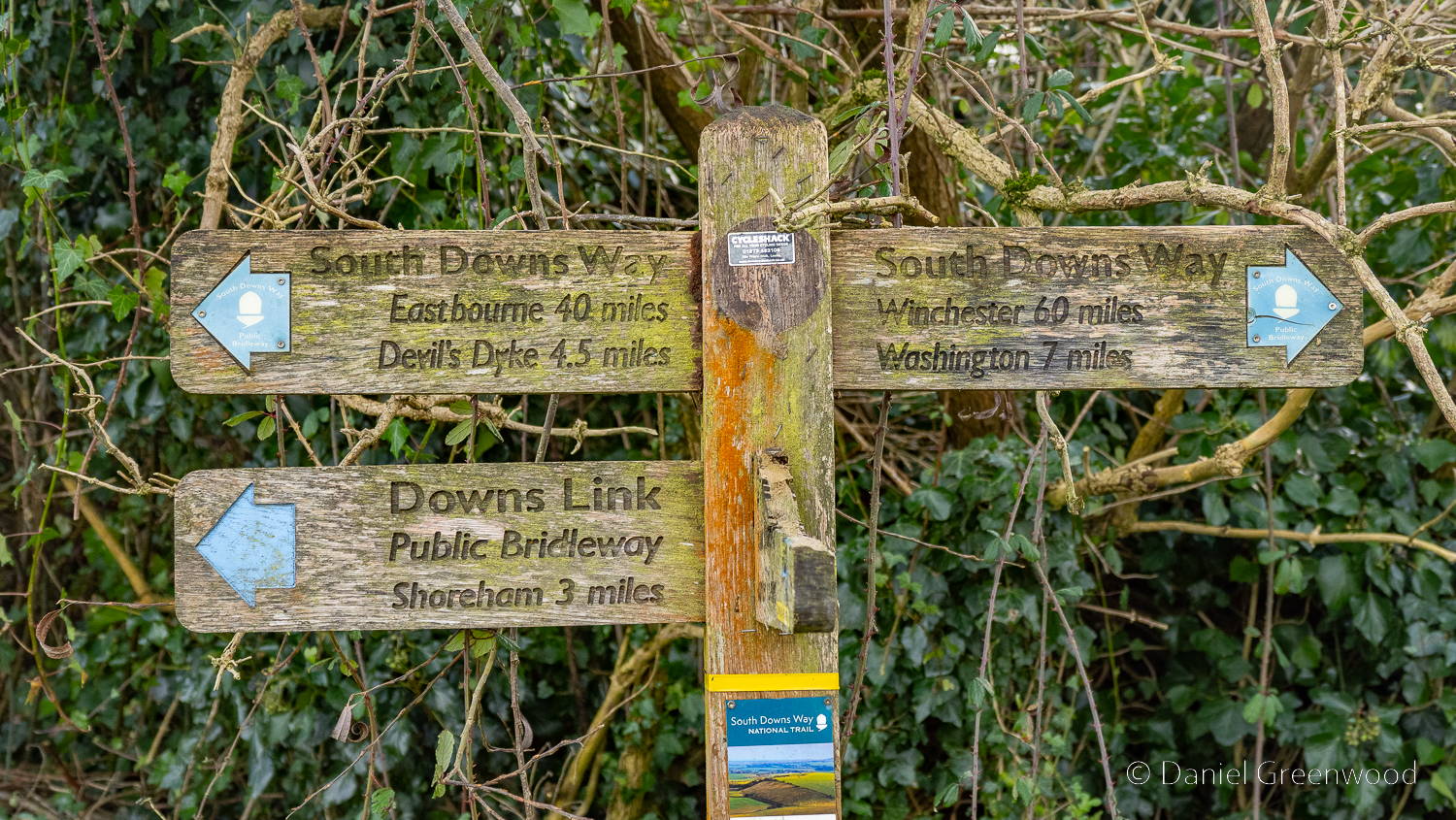
A helpful guide to what’s possible on the South Downs Way. I took the broken route to Bramber, having travelled the 7 miles from Washington.

Sheep-marked fields where the Downs rise again above the Adur, towards Truleigh Hill and then Devils Dyke.
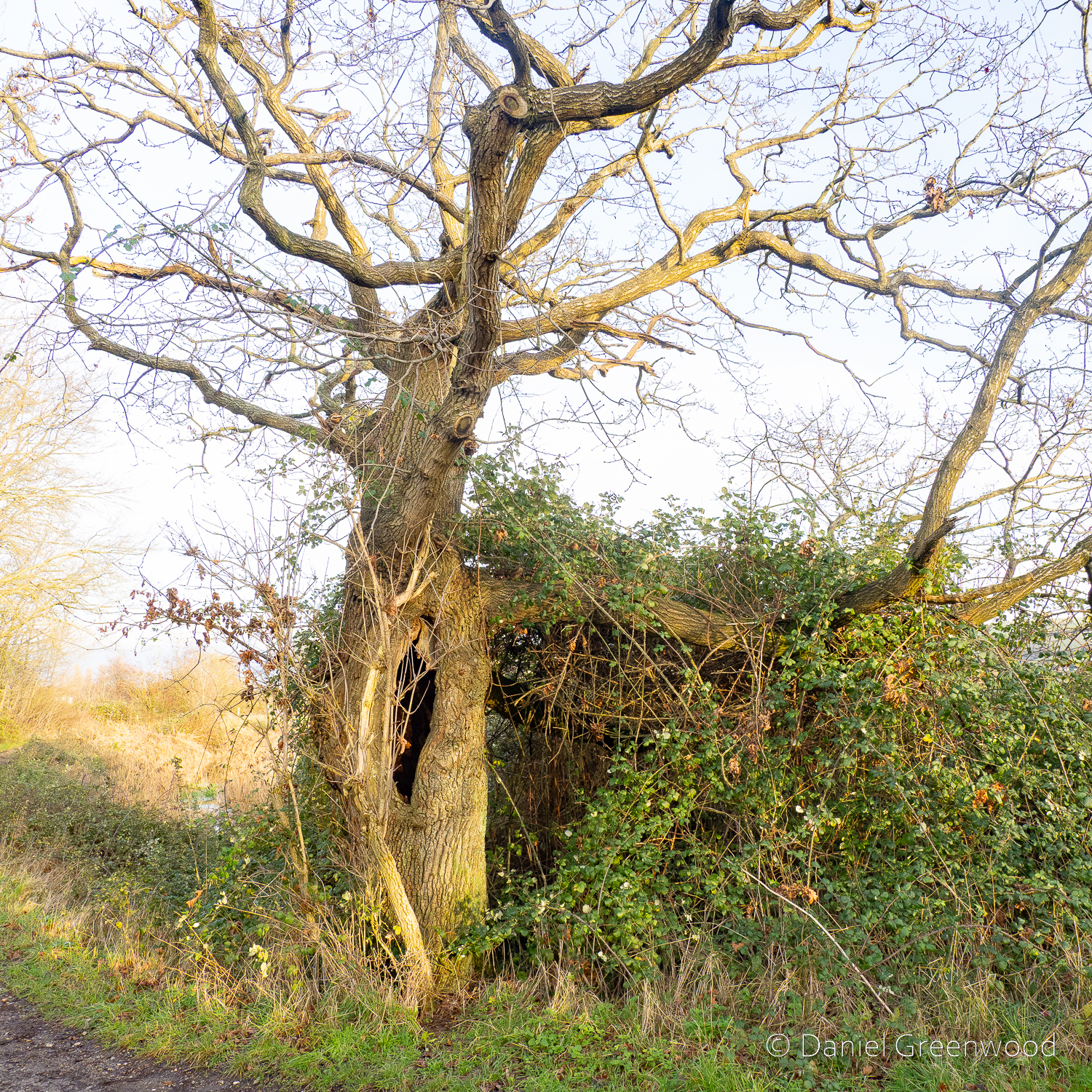
An indicator of what is to come when you descend from the Downs into the Low Wealdoak trees. This was the only one I saw on this rather treeless walk. There should really be an owl in that trunk.
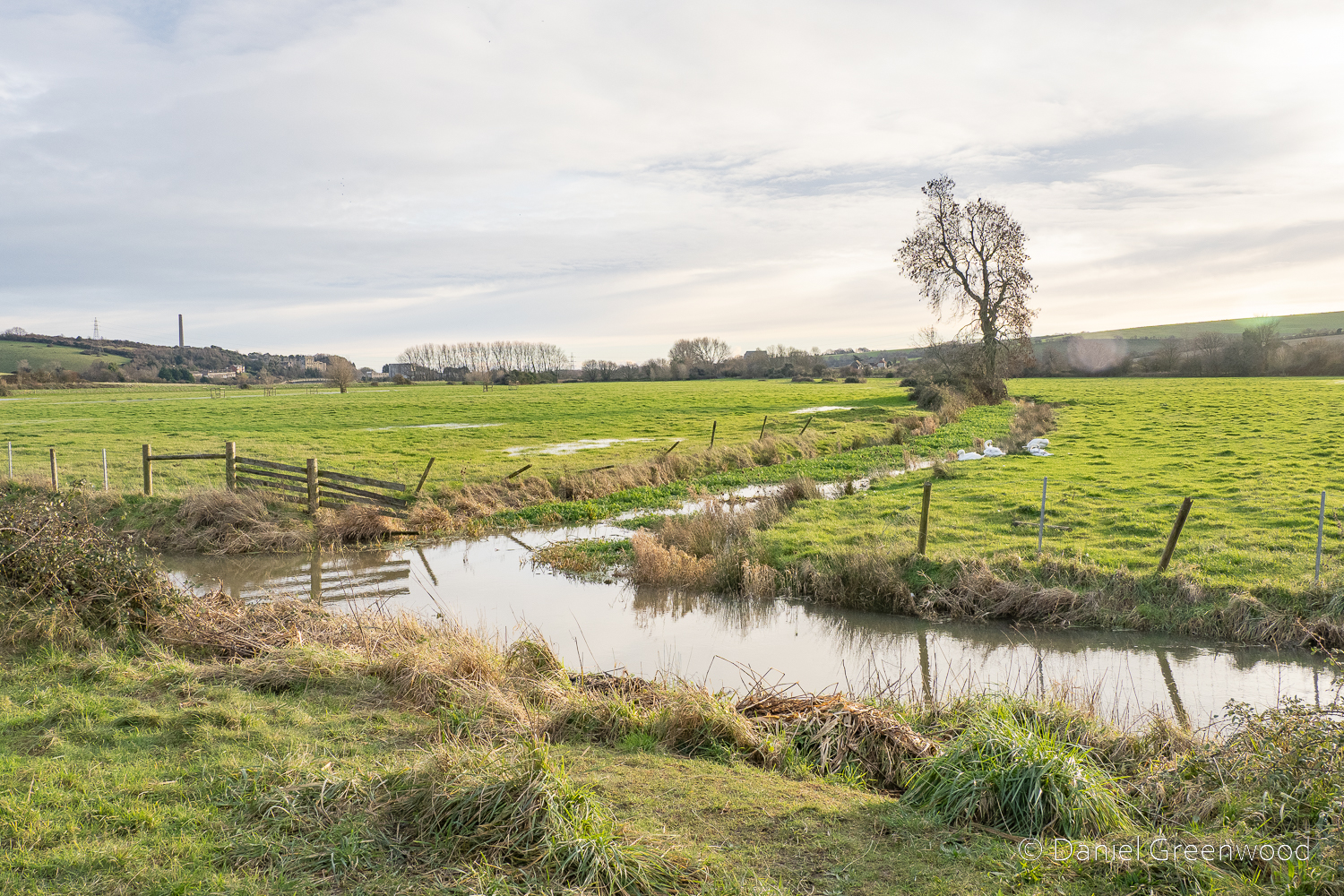
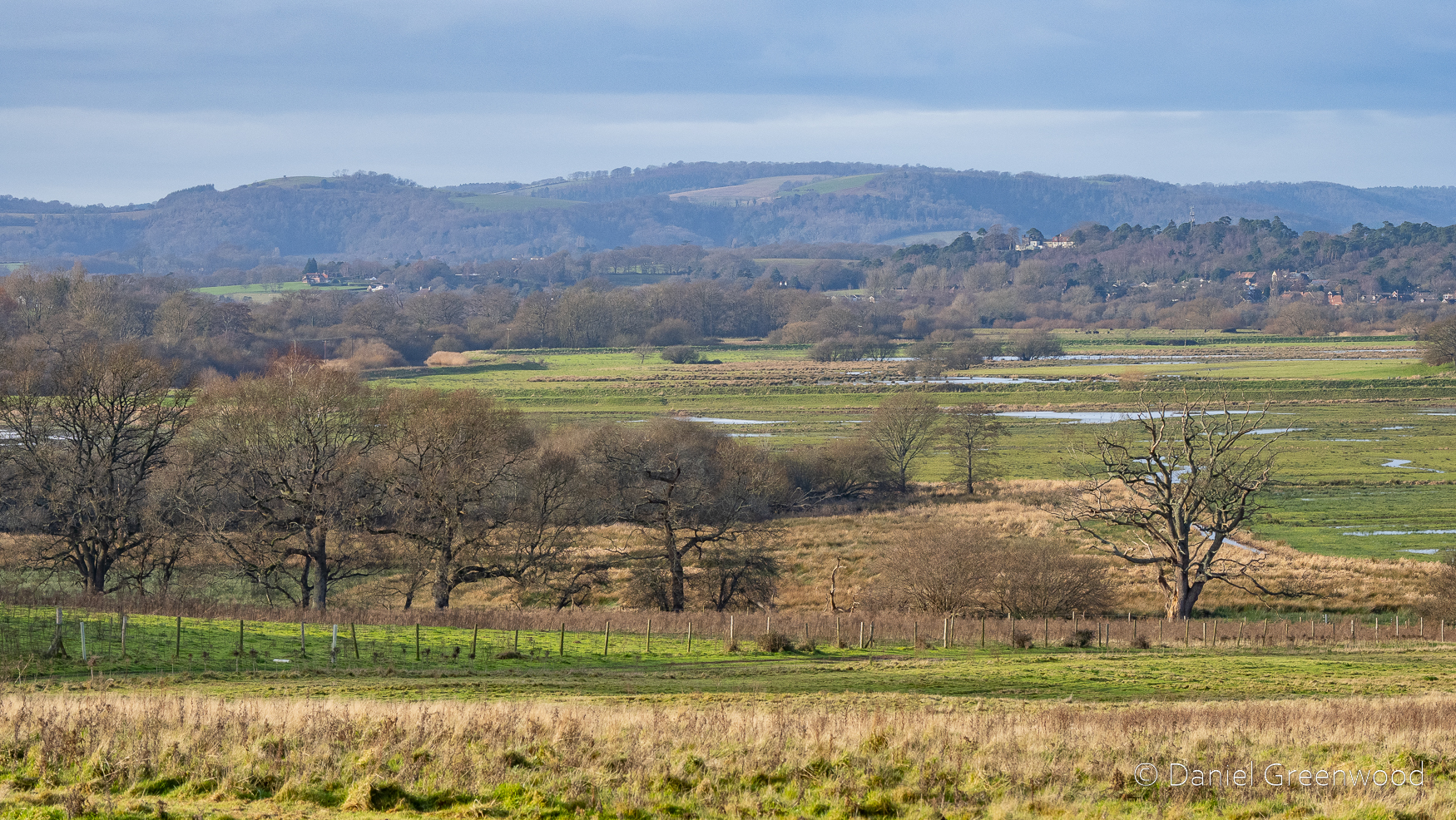
While the River Adur now wends its way through to Shoreham (the cement works chimney can be seen on the left-hand side) this is where the sea once swept. The river could be travelled by boat as far as Bramber, where my walk ended.
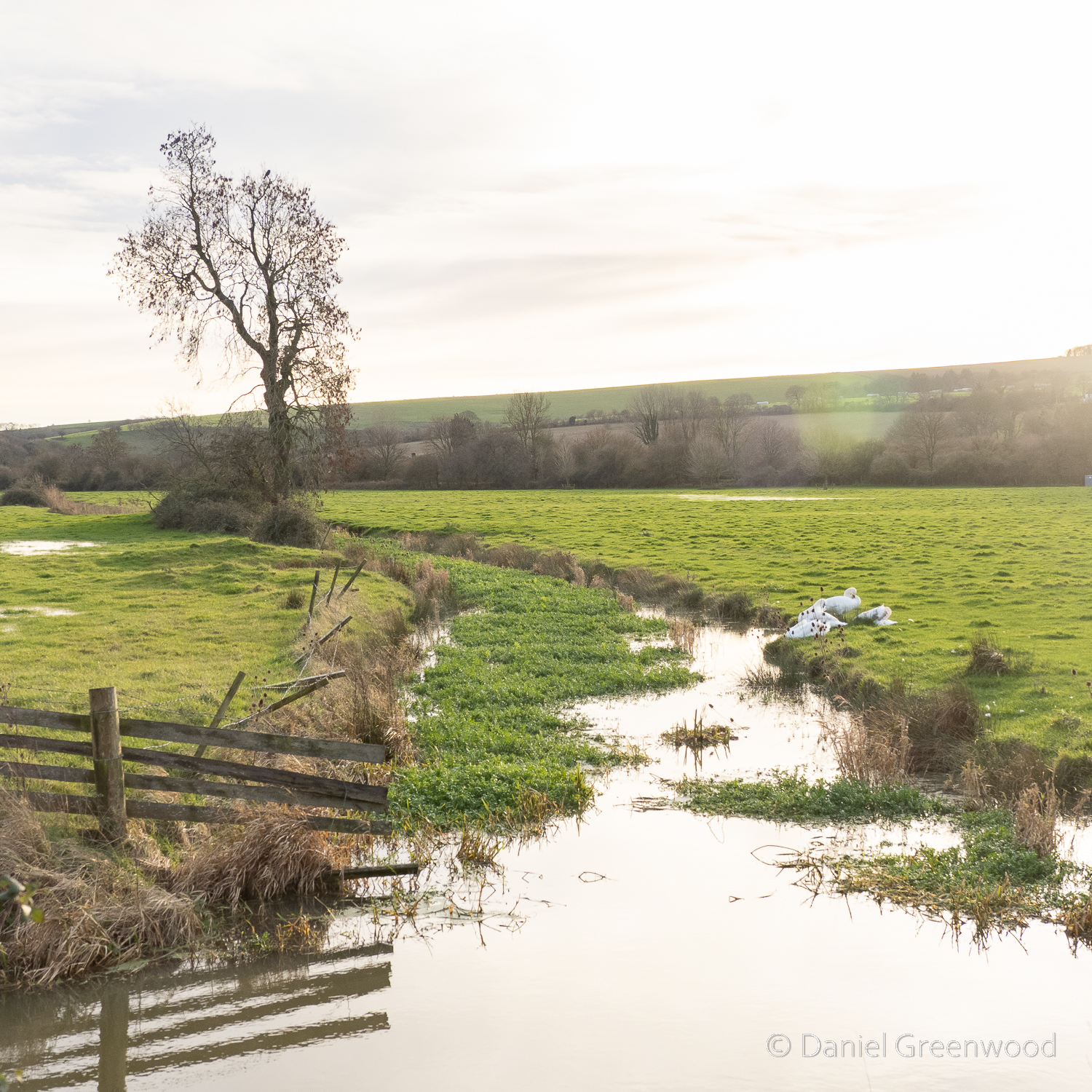
A small flock of swans roosting on the bank as the evening sun slips below the Downs. Another solitary ash tree survives here along the river. Over my shoulder the scene was far less tranquil:
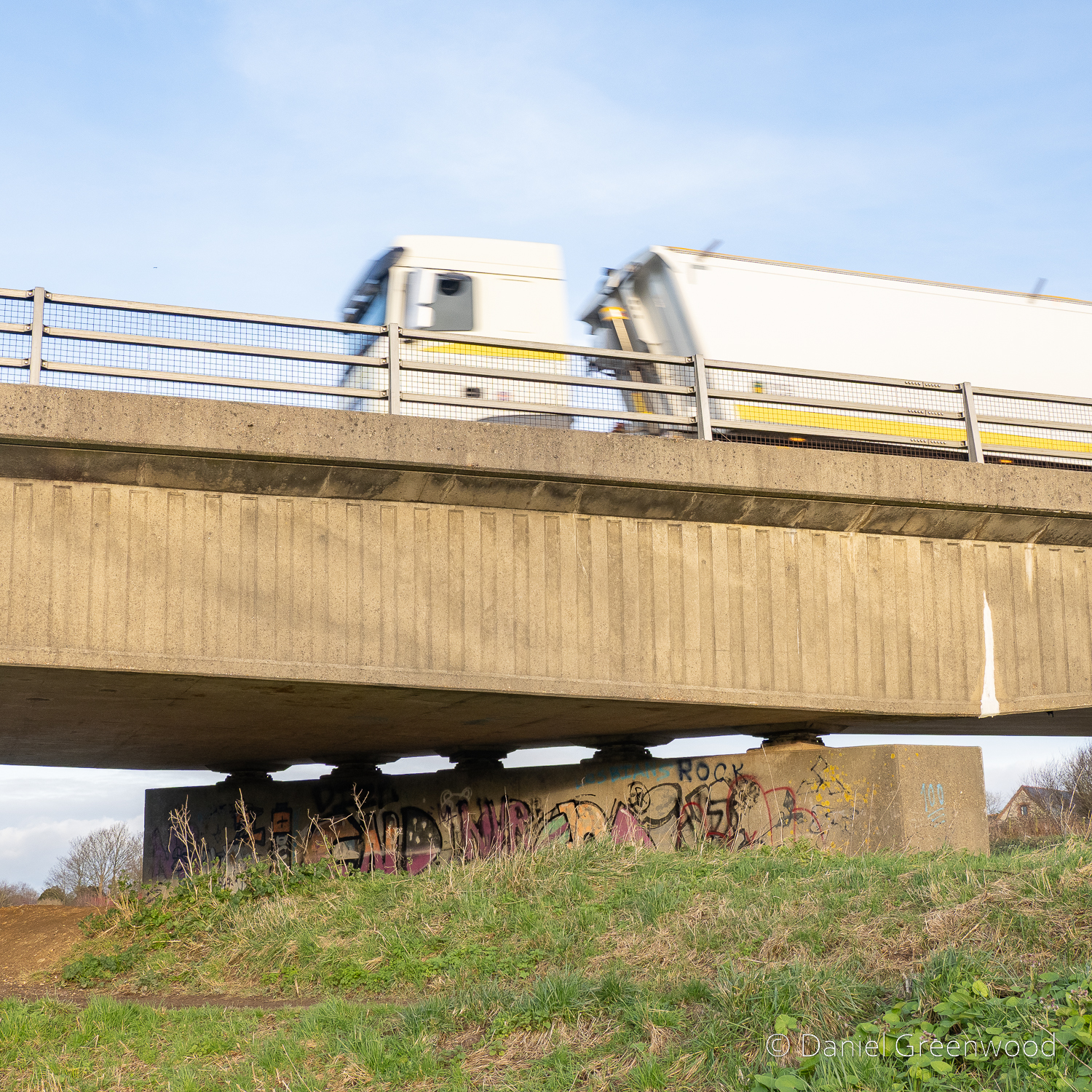
The A283 is a major connecting road between the A24 and Shoreham where it joins the A27, the road that roars at the feet of the Downs for many miles.
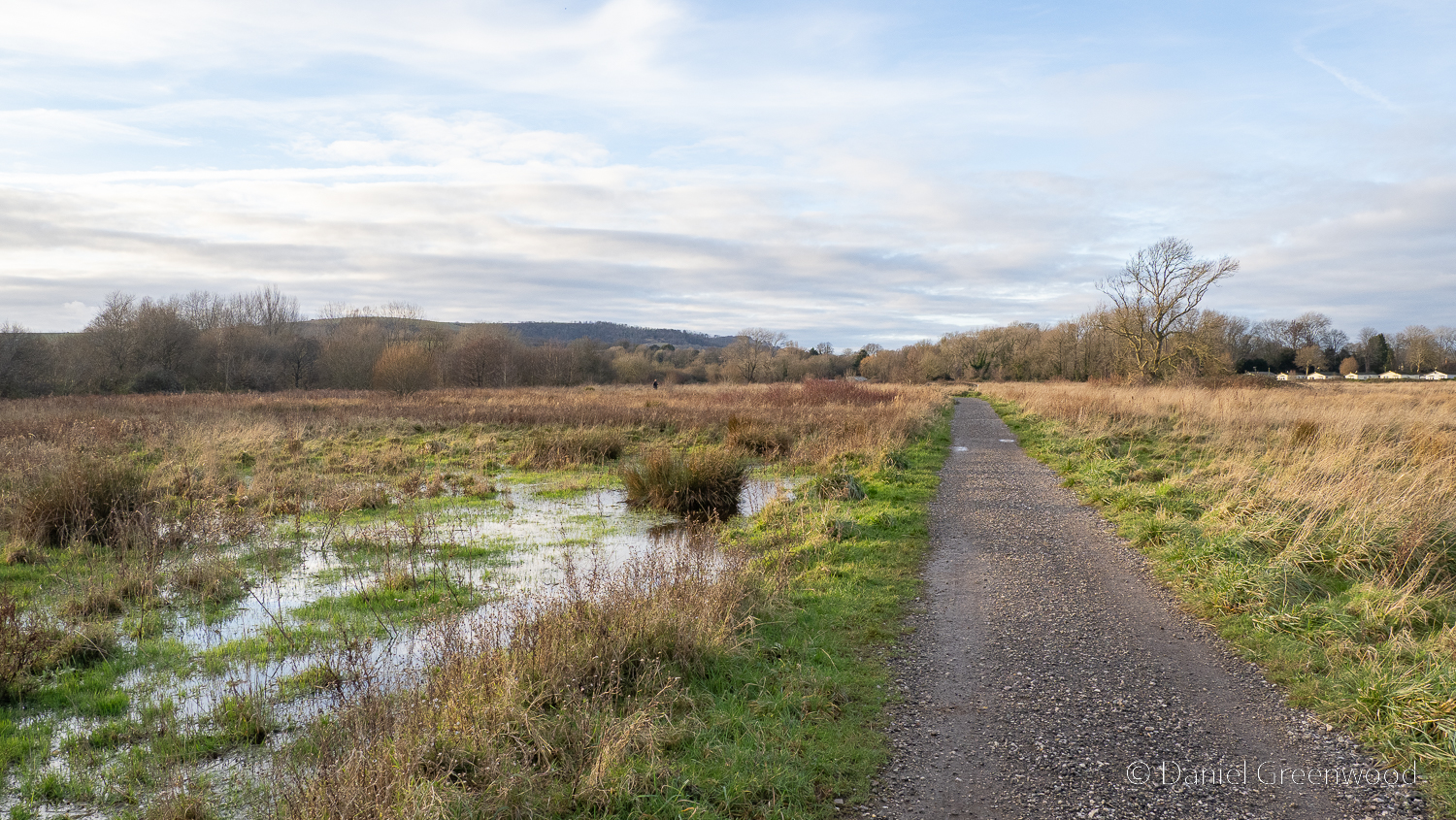
The path through the wet grassland to Bramber. It amazes me to think the sea once reached this far. But that’s not the only ghostly presence haunting these marshes.
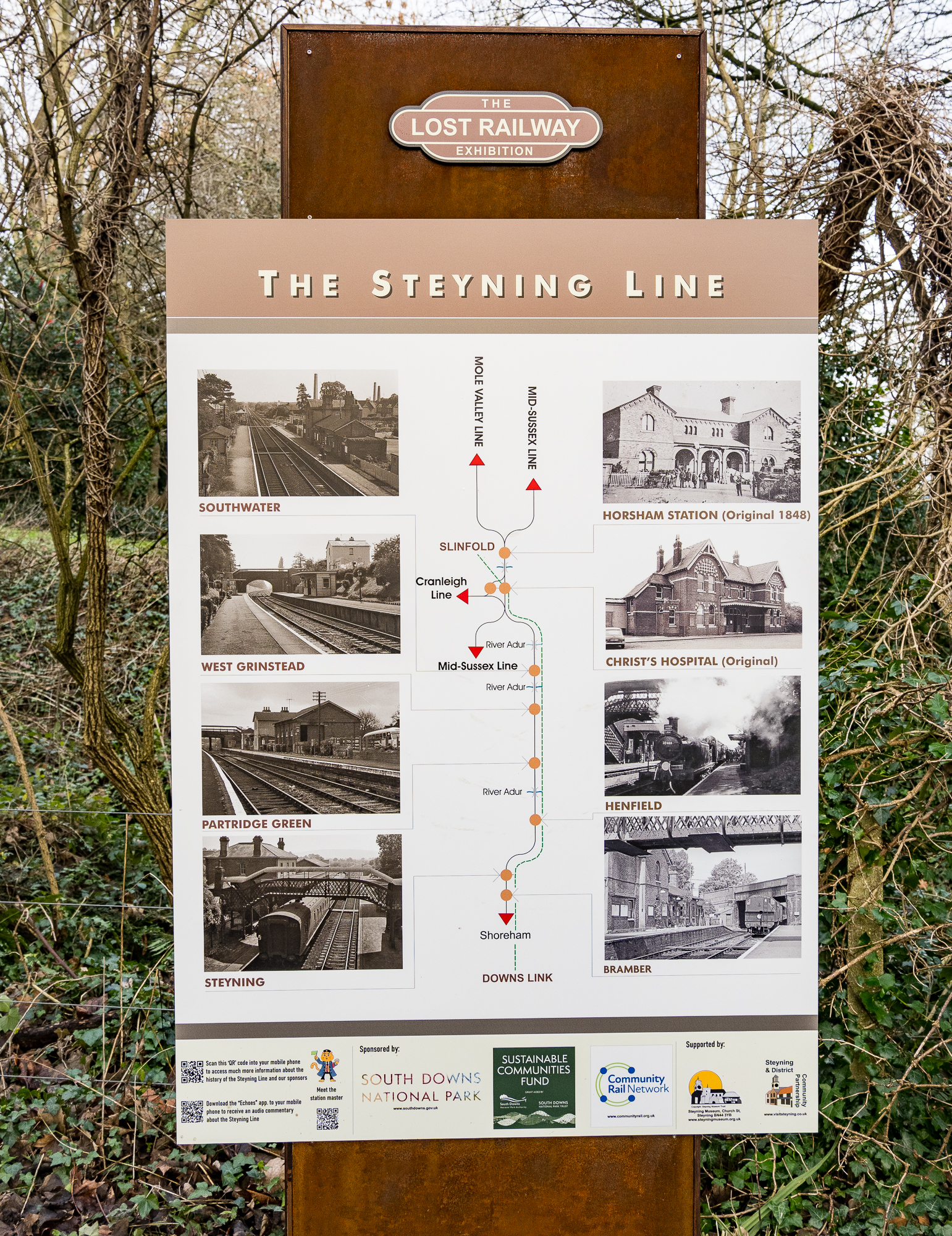
More recently this was the course of the Steyning Line, a railway now converted to an accessible walking and cycling path between Guildford and Shoreham. I was surprised to read that railway enthusiasts want to bring this line back. But for a photo caption, the article includes no mention of the fact this is now the Downslink path, one of the only truly safe long-distance walking and cycling routes in the area.
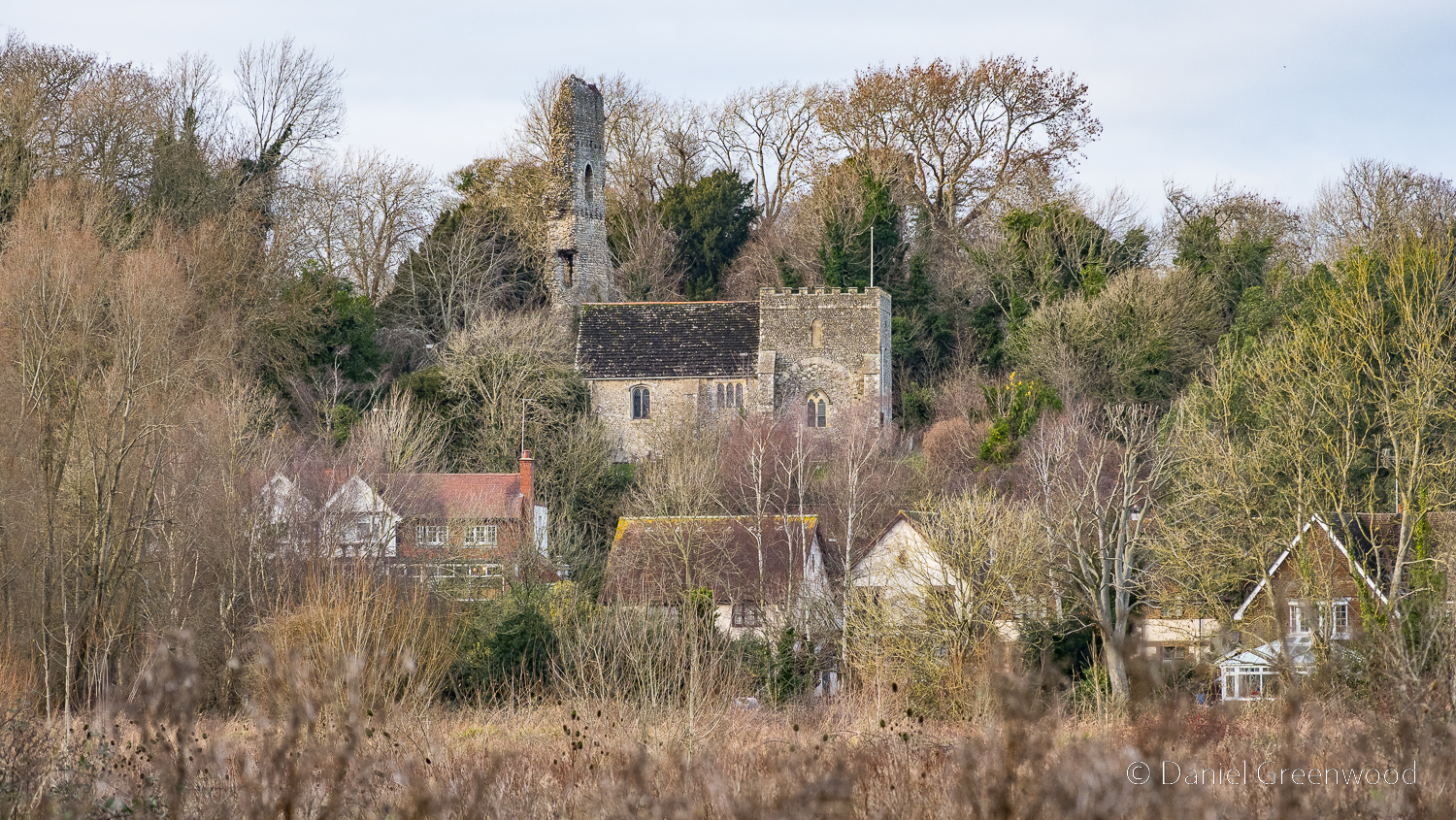
Bramber’s St. Nicholas Church as seen from the old railway path. The remnant wall above is one of the only remaining parts of Bramber Castle, with both the castle and church dating to the 11th century after the Norman Invasion of 1066. The castle has was a motte and bailey:

Bramber Castle was founded by William de Braose as a defensive and administrative centre for Bramber, one of the six administrative regions – each of which was controlled by a castle – into which Sussex was divided following the Norman Conquest. It was held almost continually by de Braose and his descendants from its foundation by 1073 until 1450.

Bramber Castle history webpage – English Heritage
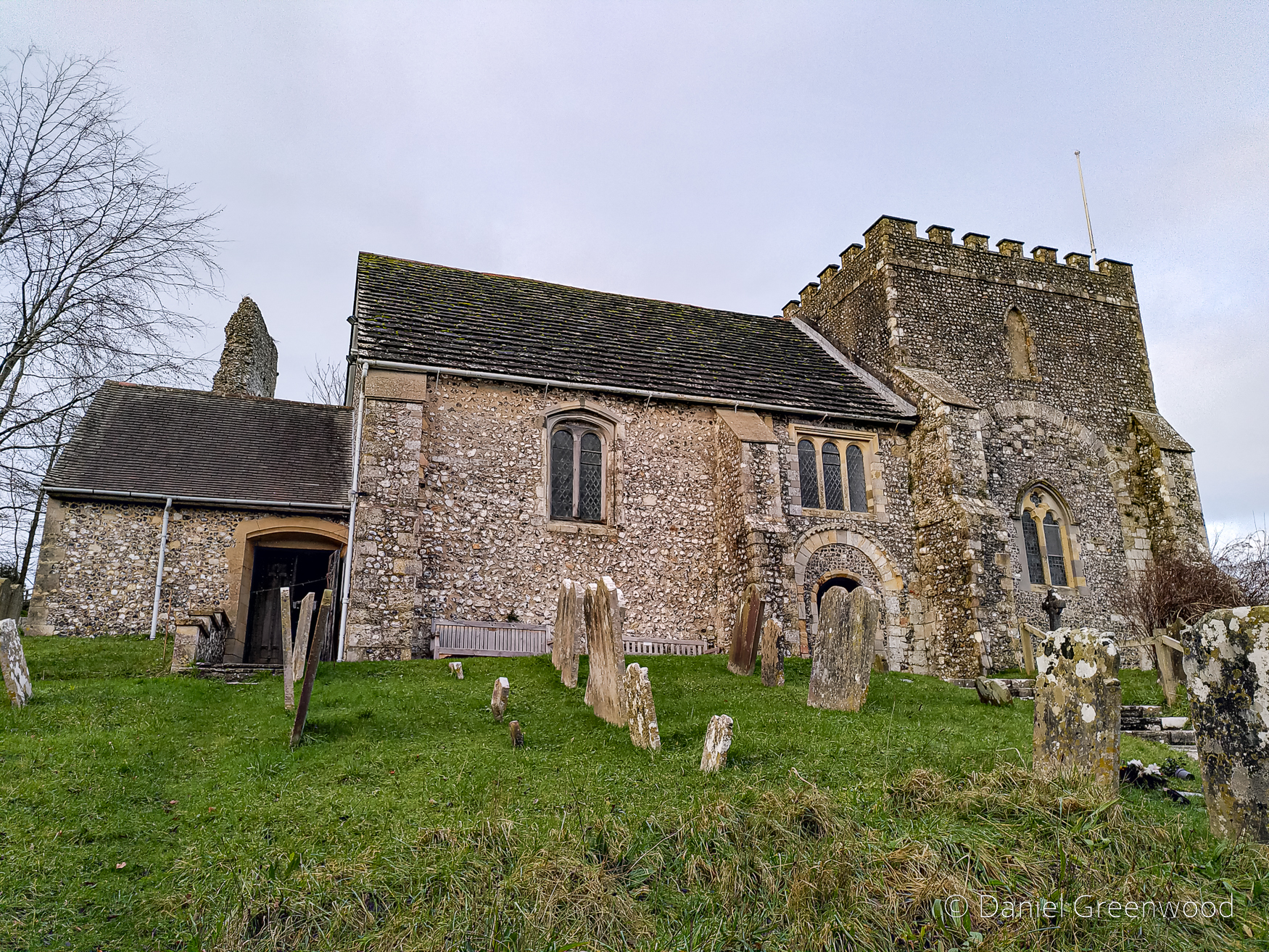
At this point my camera battery ran out of steam, so I took a few final photos of Bramber on my Fairphone.
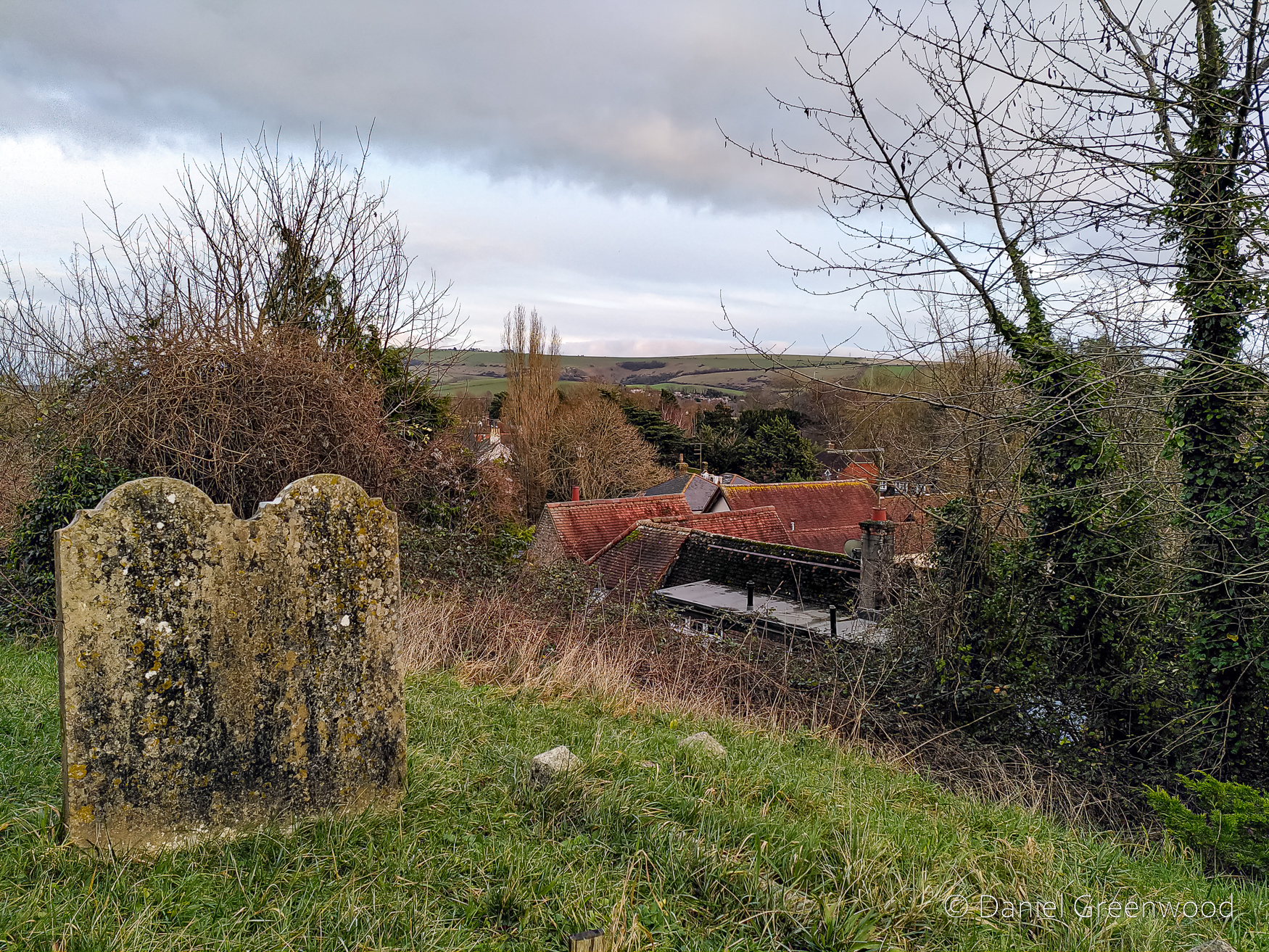
You can see how the raised position of the church and castle was chosen. The hills in the distance are the South Downs, to pass to the left (east) will take you to Truleigh Hill and eventually Devil’s Dyke. It’s believed Oliver Cromwell’s army set up guns on this hill during the English Civil War in 1642.
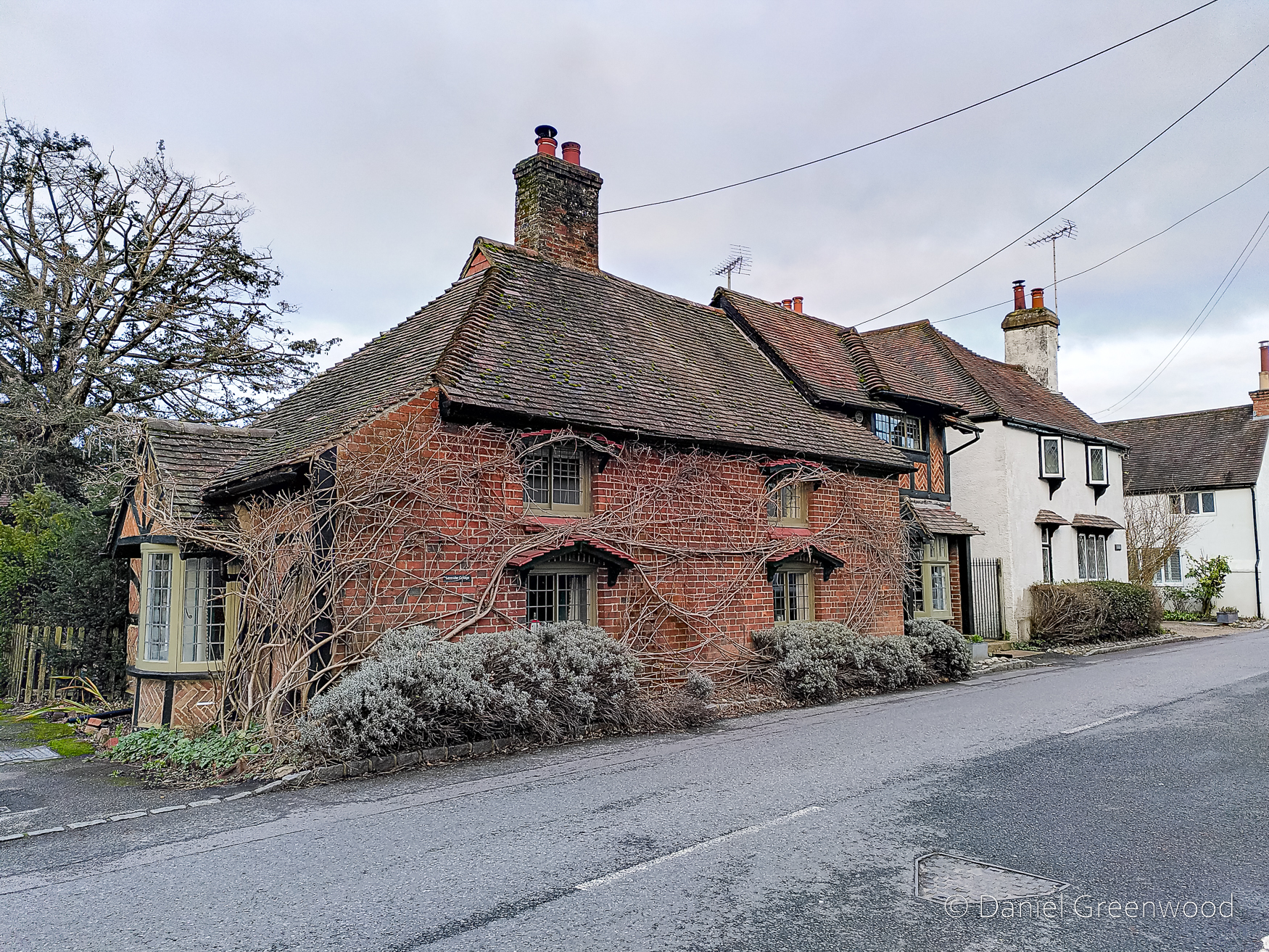
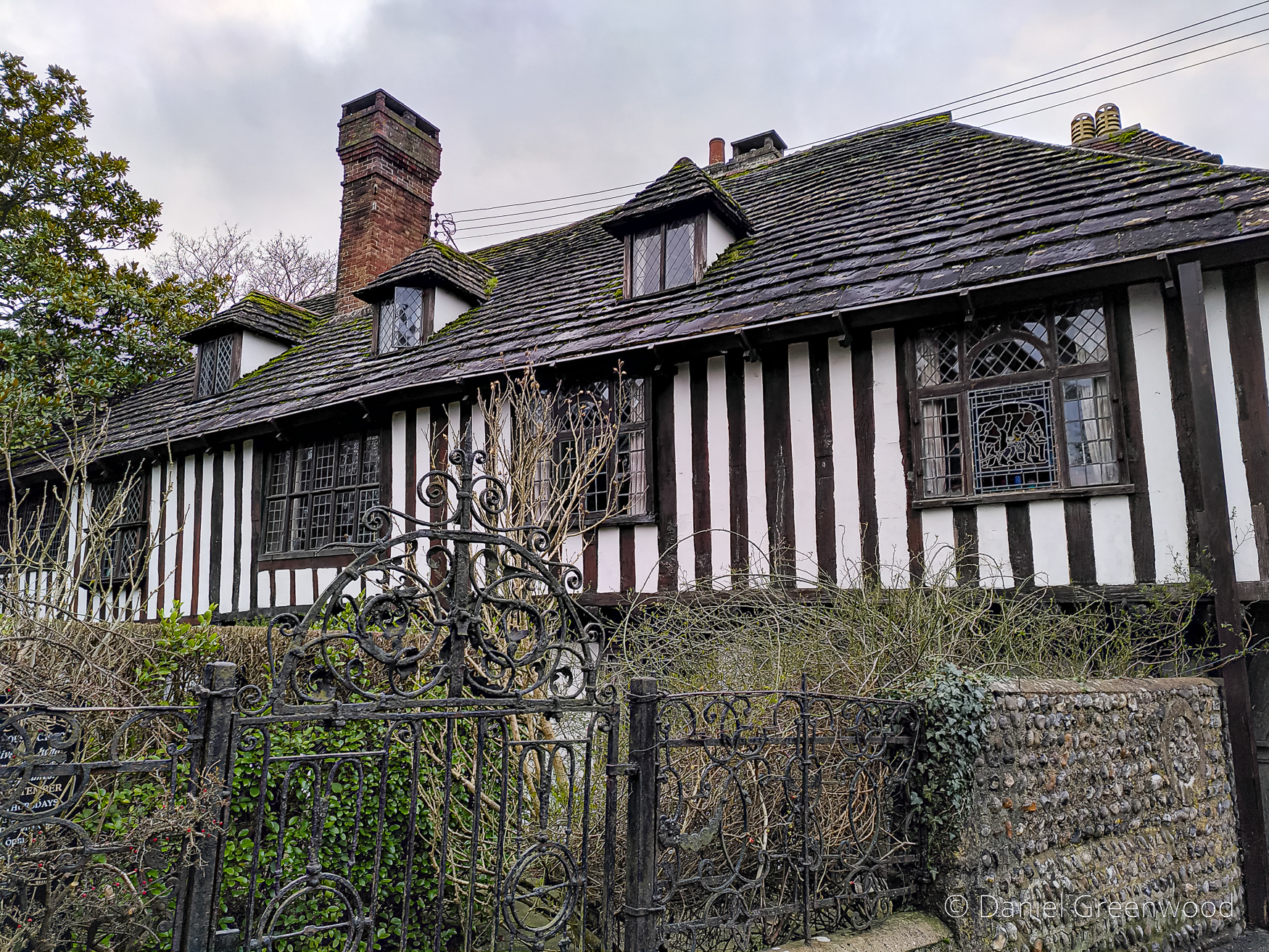
Bramber is a village of largely unspoilt brick and timber-framed buildings. I stopped off at the Bramber Hotel for a quick half before catching the bus, and encountered a wonderful oak timber-framed building.
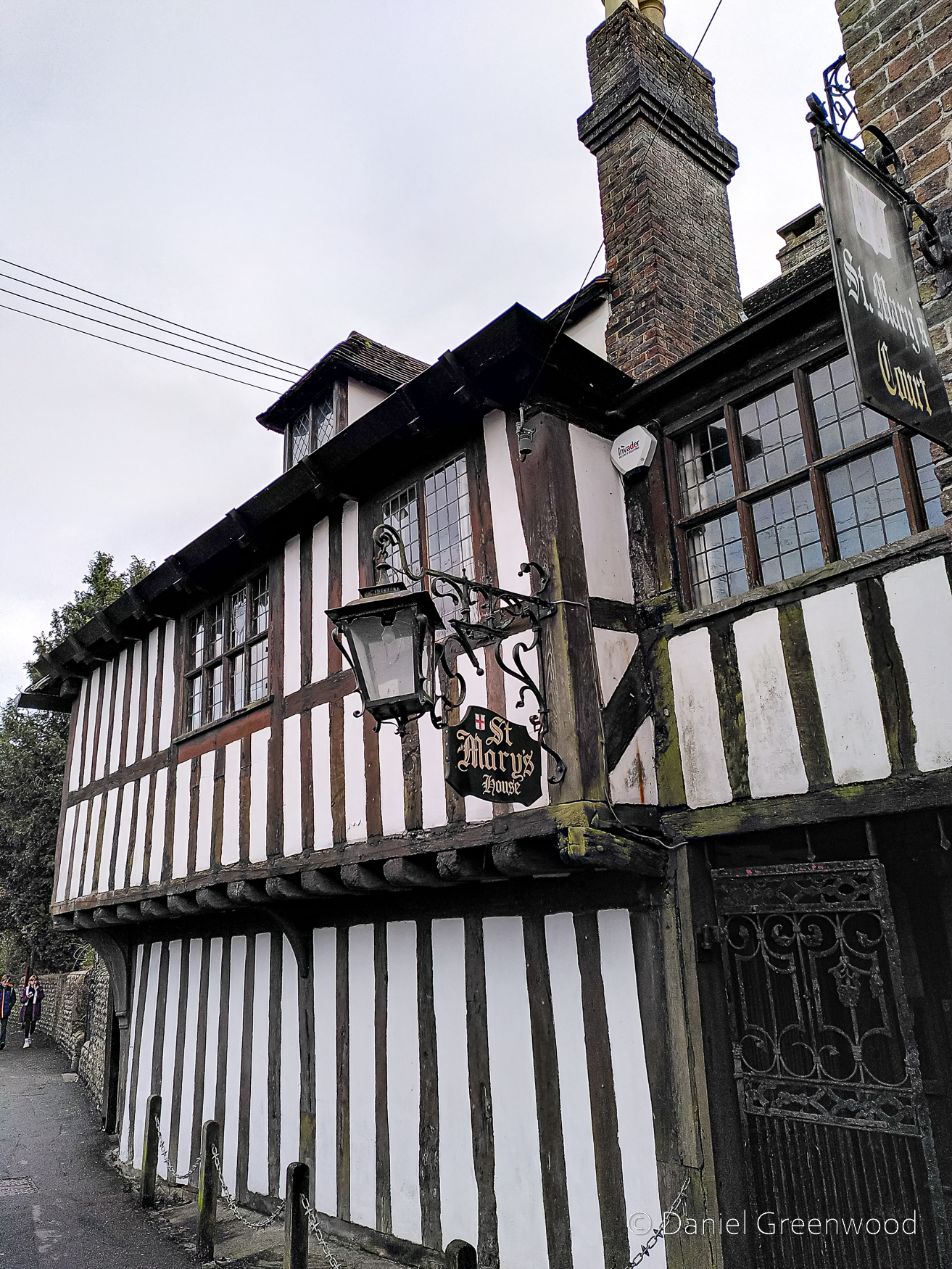
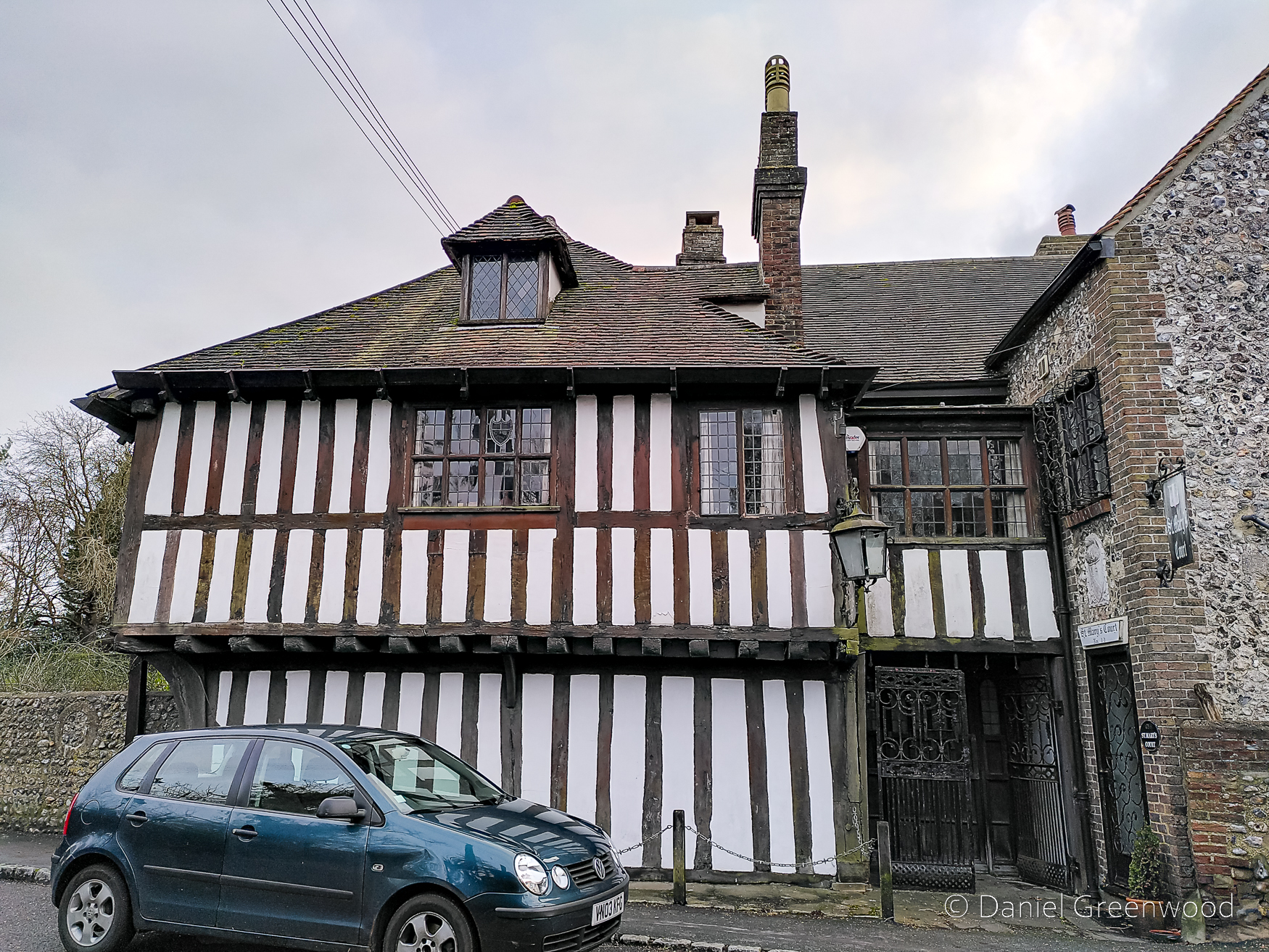
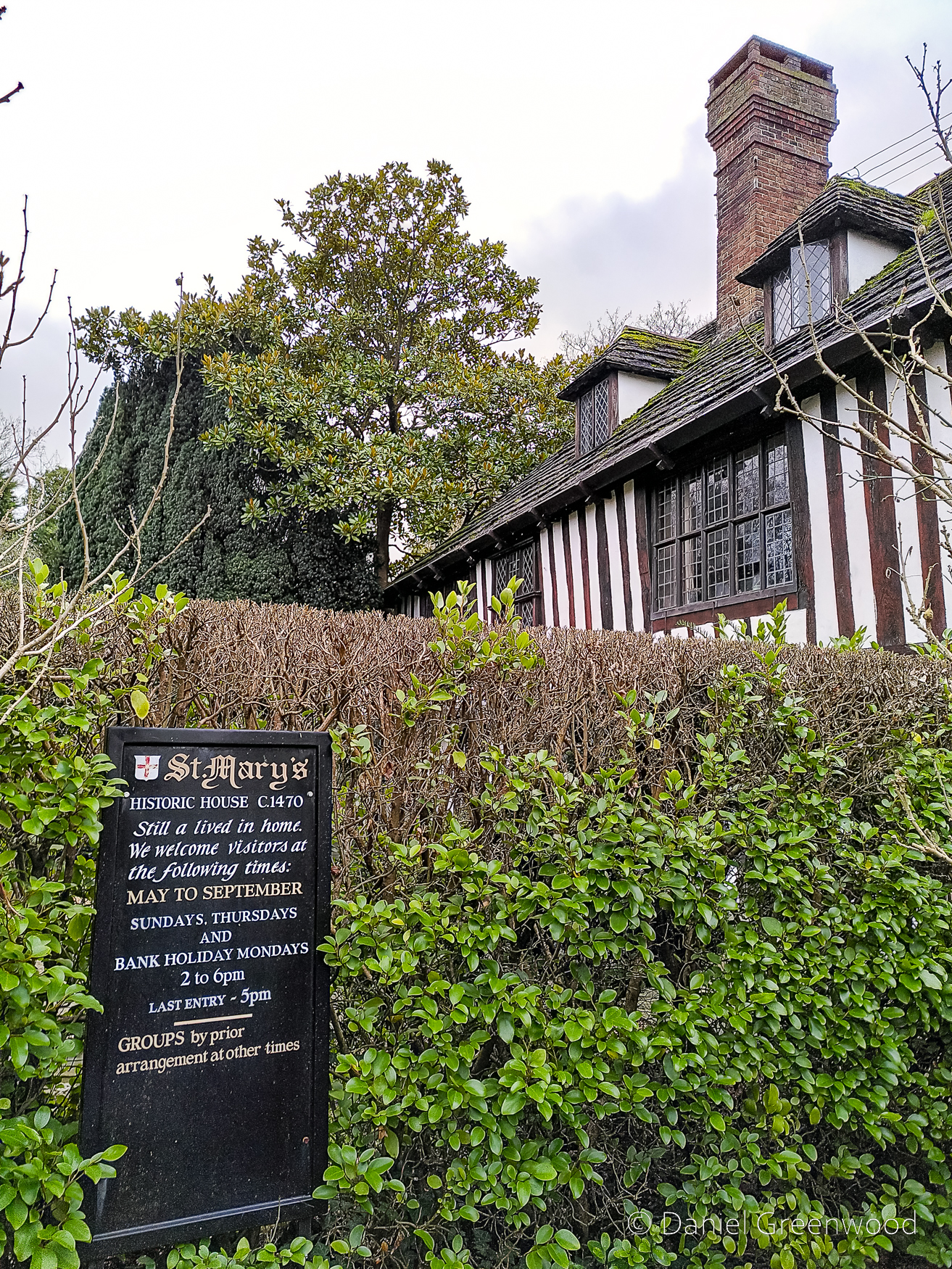
St. Mary’s House dates back to the 12th century and is open to visitors during set periods. There’s also a tea room. There’s a nice write up of the history of the building on the St. Mary’s website, including the recent investment to bring it back to life.

Thanks for reading, it’s been a long journey.

South Downs | Sussex Weald | Oak timbers | Churches

You can support my work here

Late summer timbers at the Weald & Downland Museum

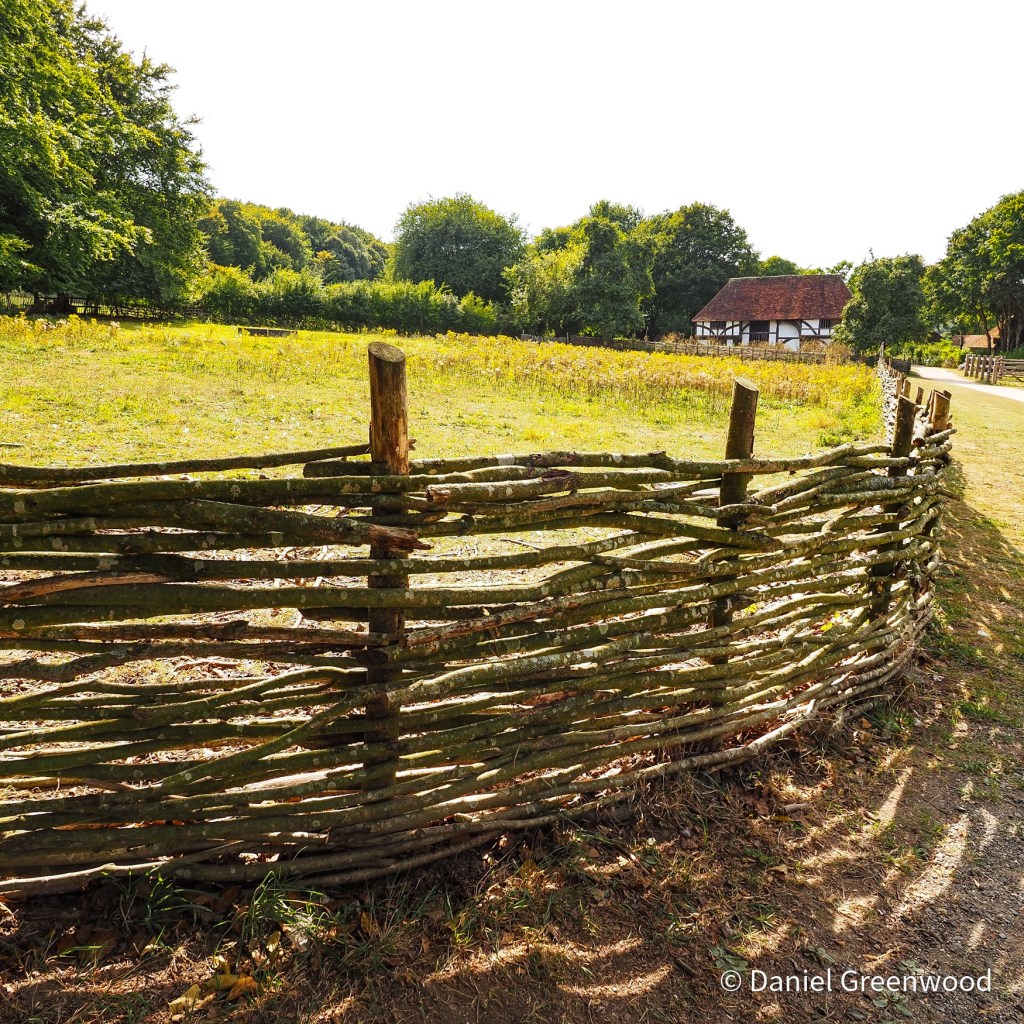
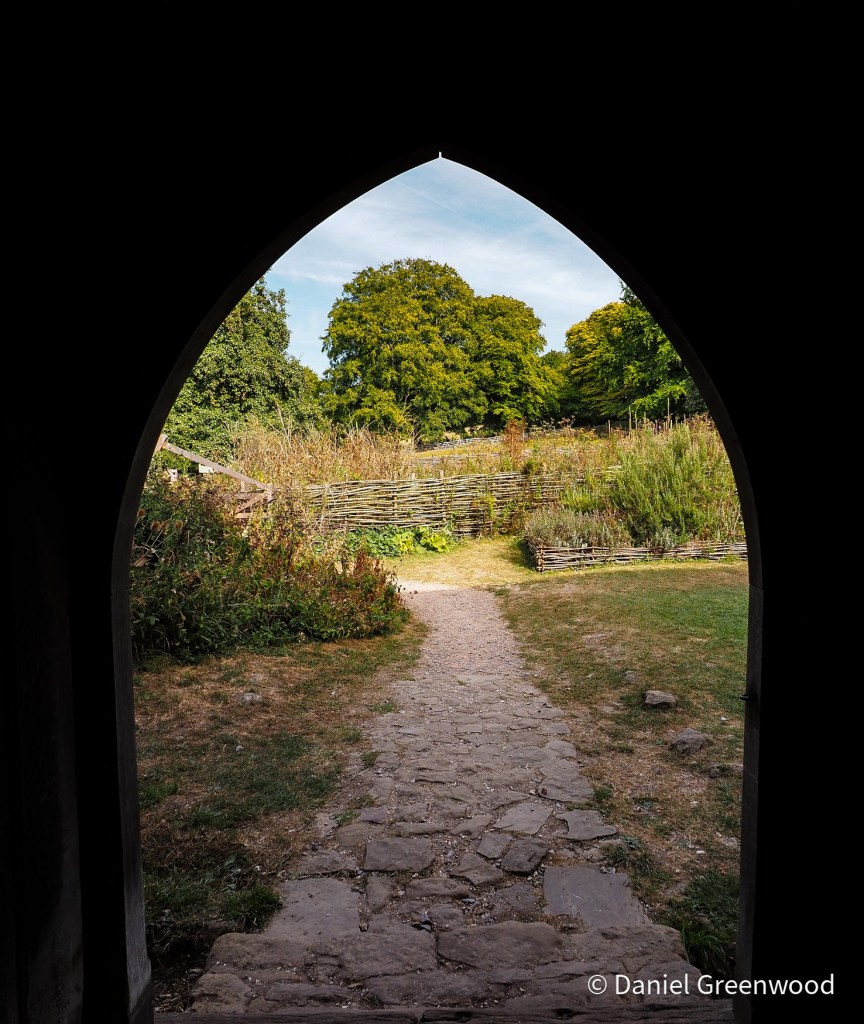
In August I made my annual visit to the Weald and Downland Living Museum in the South Downs.

You can see my timber-framed building photo gallery here.

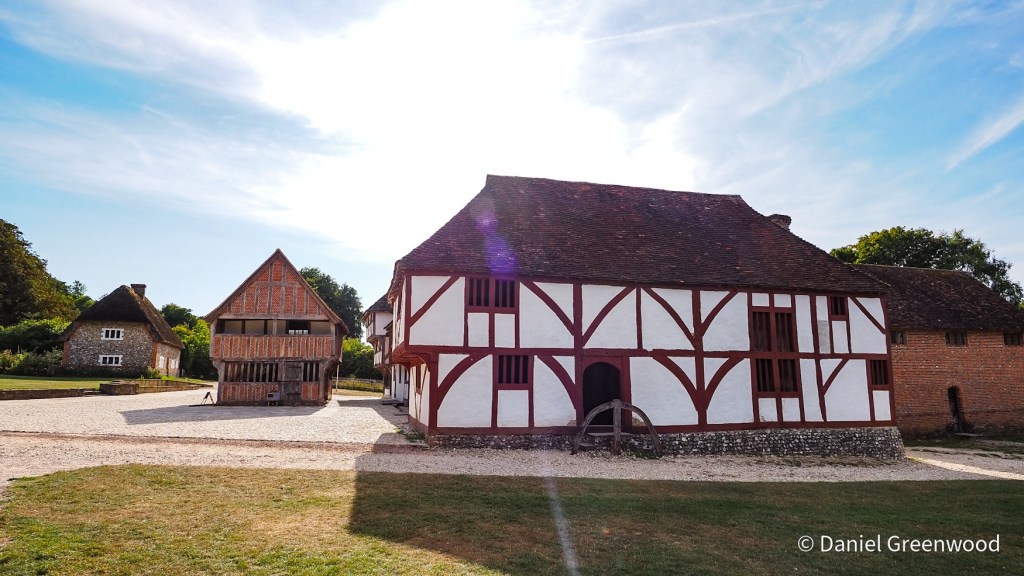
This is the first view you encounter inside the museum grounds after you pay your entry fee. Amazing to think the medieval hall house is from Cray in the London Borough of Bexley. It dates to the 1400s.

The Titchfield Market Hall has recently been restored. It’s looking very good indeed now. These halls were once more common in English market towns, but I can’t say I’ve ever seen one in situ. How times change.

The House from Walderton punctuates a quintessential Weald and Downland Museum scene.

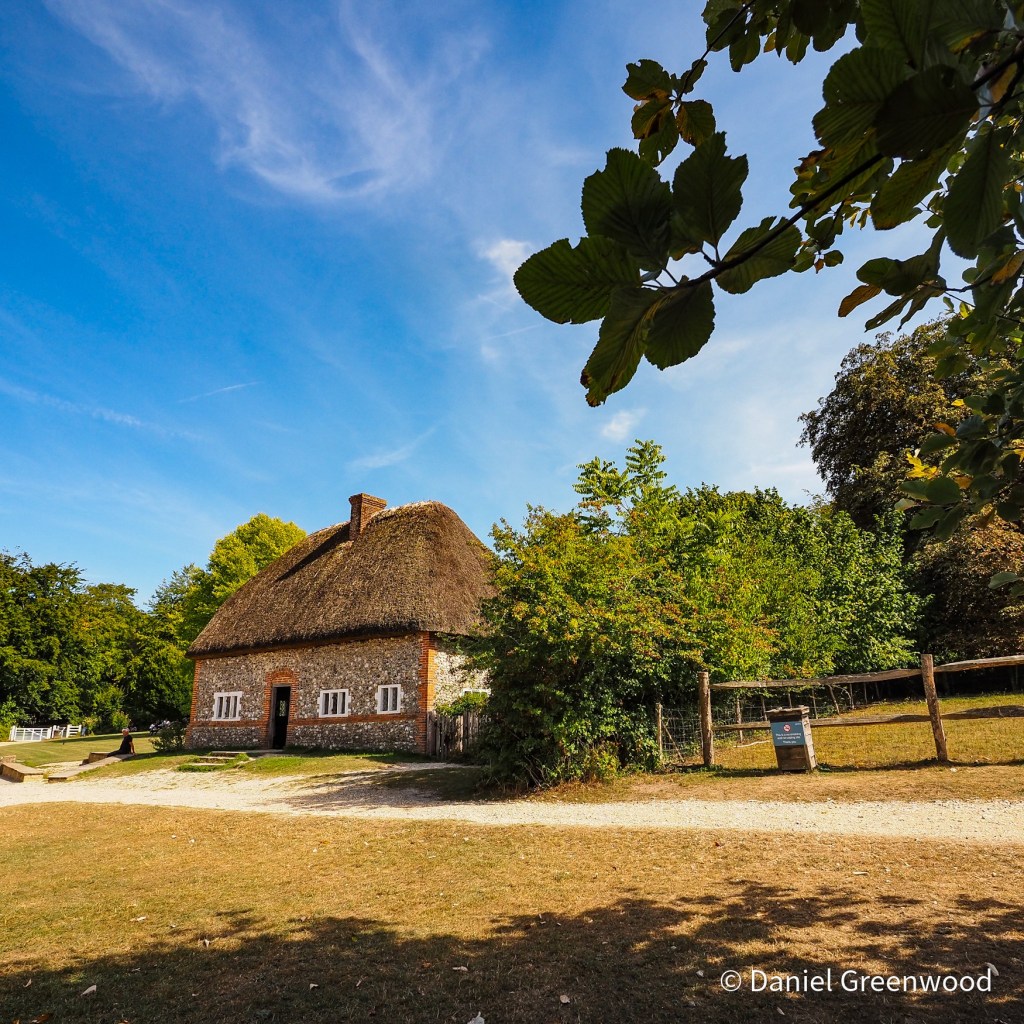
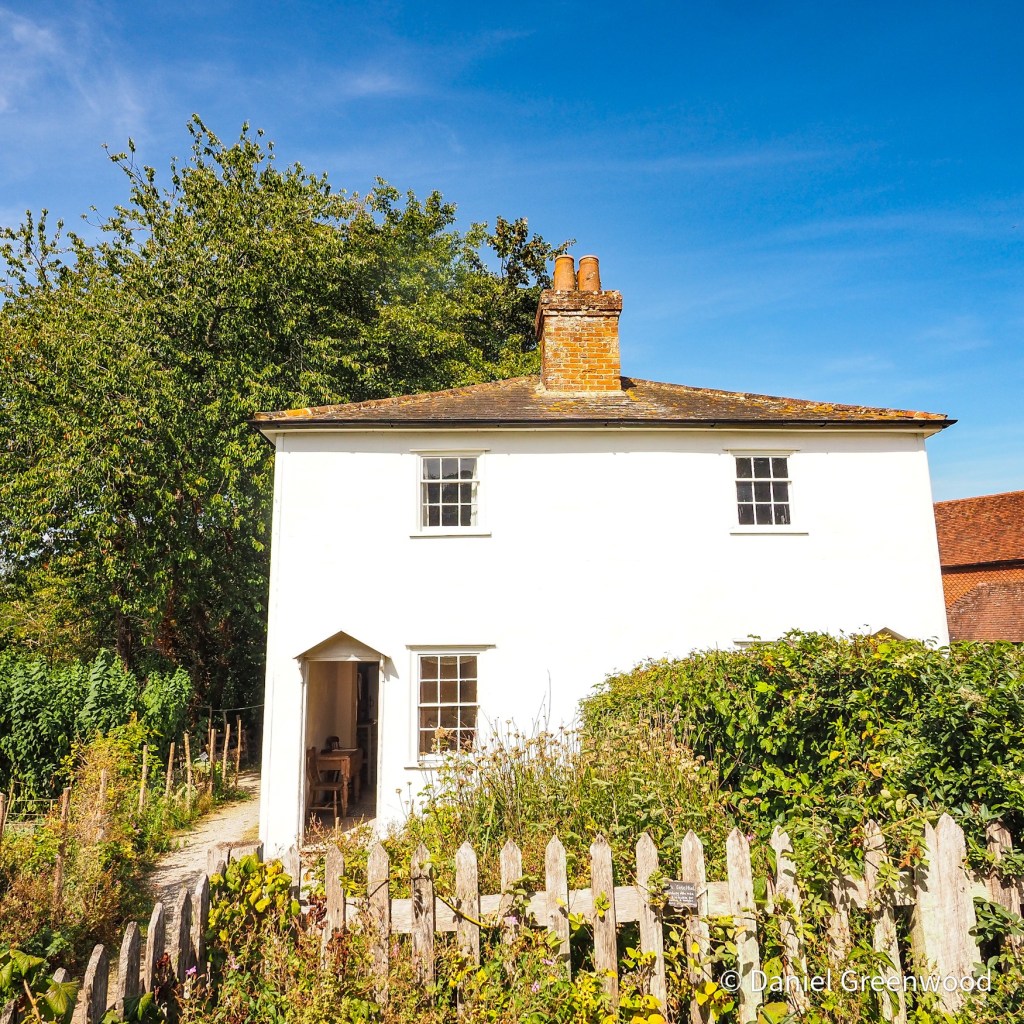
These charming railway cottages are a game of two halves. In one part (here on the right) you can see the internal structure of the building. On the left hand side you can see a furnished representation of the cottage.

Poplar Cottage is one of my favourites. I’ve posted about it before.

Bayleaf‘s grandeur isn’t fully accounted for in these three images. It’s a large Wealden Hall that has been dated to the early 1400s.

Pendean sits out of view on the top slopes of the museum grounds. Its timbers are dated to 1609 (the year they were felled – amazing, isn’t it).

Tindalls Cottage is more recent, being from the 1700s. It has a bit of an eerie vibe about it, not sure why.
Mediaeval Hall dates from the 1600s. It’s a beauty.

I’ve been visiting the museum since 2018 but only managed to see the cart and vehicle section for the first time during this visit. Some of the wheels on show were huge. It would have been amazing to see these carts wending their way around Sussex once upon a time.

Thanks for reading

Oak timbers

The ash tree’s survival

I noticed some good news about ash trees recently and wanted to share my experience of a difficult decade for the European ash (Fraxinus excelsior, referred to here as ‘ash’), as well as some of the photos I’ve taken of this iconic tree. Working through this post, I’ve realised just how many images I’ve compiled down the years. I’ve also realised just how much I care about this tree as a species, and how painful it is to see it effectively being erased from the landscape by disease.

Ash is one of the first tree species that I really began to notice and tried to understand ecologically and culturally. When I started to take notice of wild trees, I saw that ash was everywhere in south London, seeding in railway sidings, parks, gardens, and woods. I’ve cut them down (not particularly big ones), planted them, pollarded them, photographed them and breathed their oxygen (obviously most people in the UK have!).

What do ash trees mean to people?

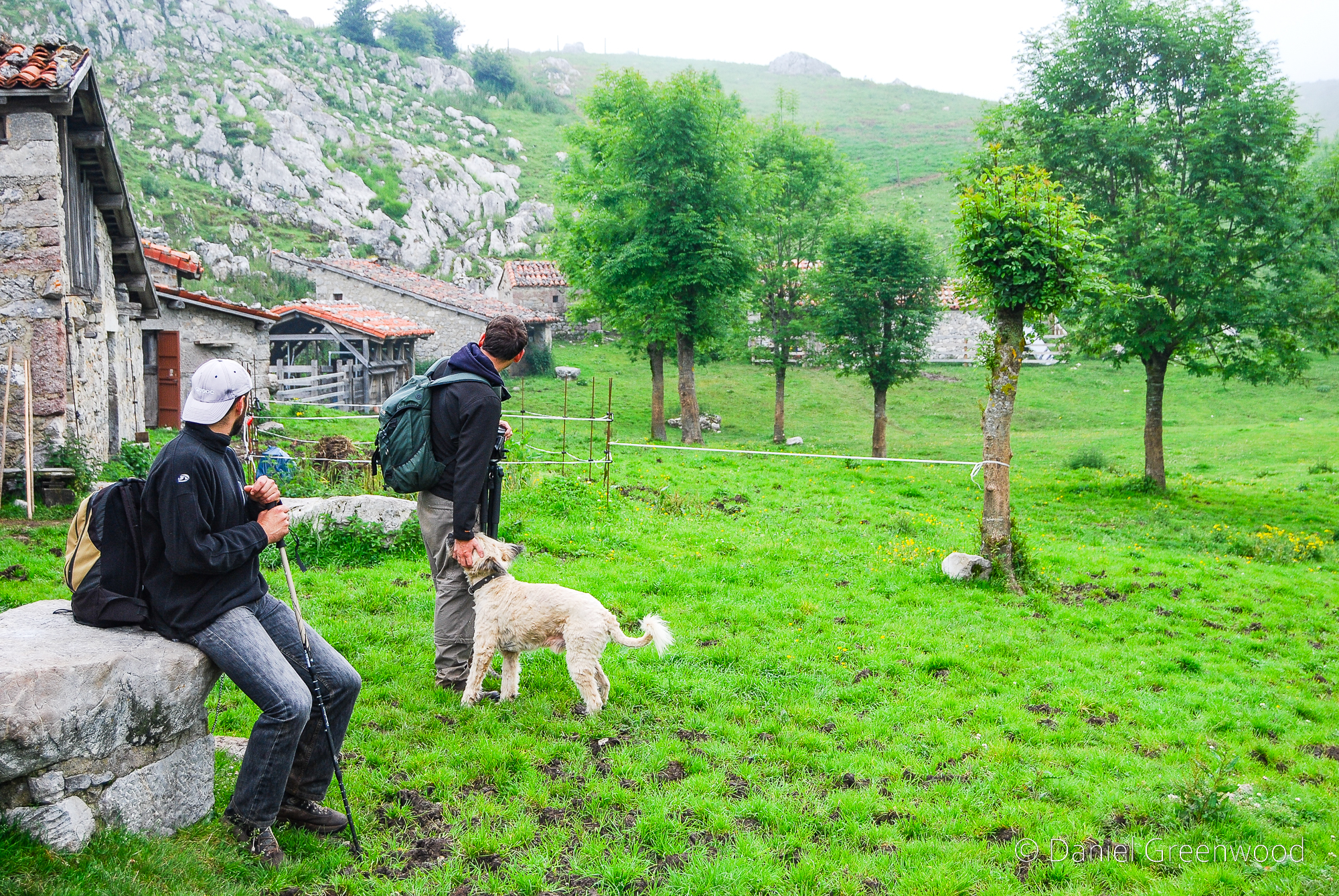
Pollarded (or shredded?) ash trees outside shepherd’s huts in Asturias, Spain in June 2011

I’d like to start overseas, as ash dieback is Europe-wide problem.

This week it was 14 years since I visited Los Picos de Europe (The Peaks of Europe National Park) in Asturias, Northern Spain as a volunteer.

The photo above came up in my ‘memories’ and it was only then that I remembered the ash trees. This was a remote village high in the mountains where people were making cheese (they didn’t want the name of the village to be shared online). The ash trees here are pollards, with the branches cut back to make a single stick of a trunk. It’s probably severe enough to be considered ‘shredding’, which Oliver Rackham wrote about.

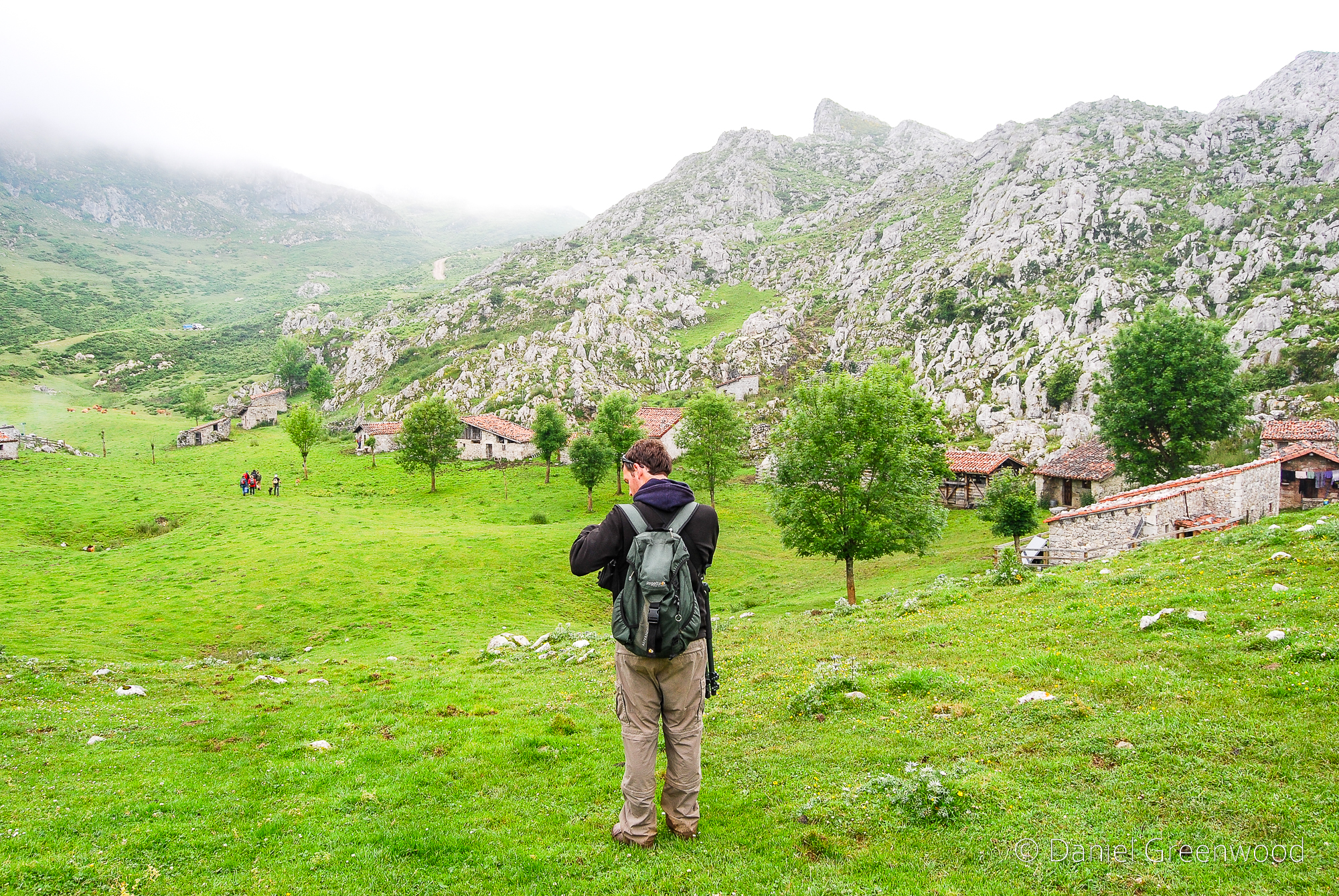
Lollipop ash trees growing close to the old shepherd’s huts in a remote part of the Picos de Europa, June 2011

The reason this is done is to provide food for sheep – the fresh green growth of new ash leaves, which they love.

A massive pollarded ash tree next to a restored hay barn in Wensleydale, Yorkshire in 2018

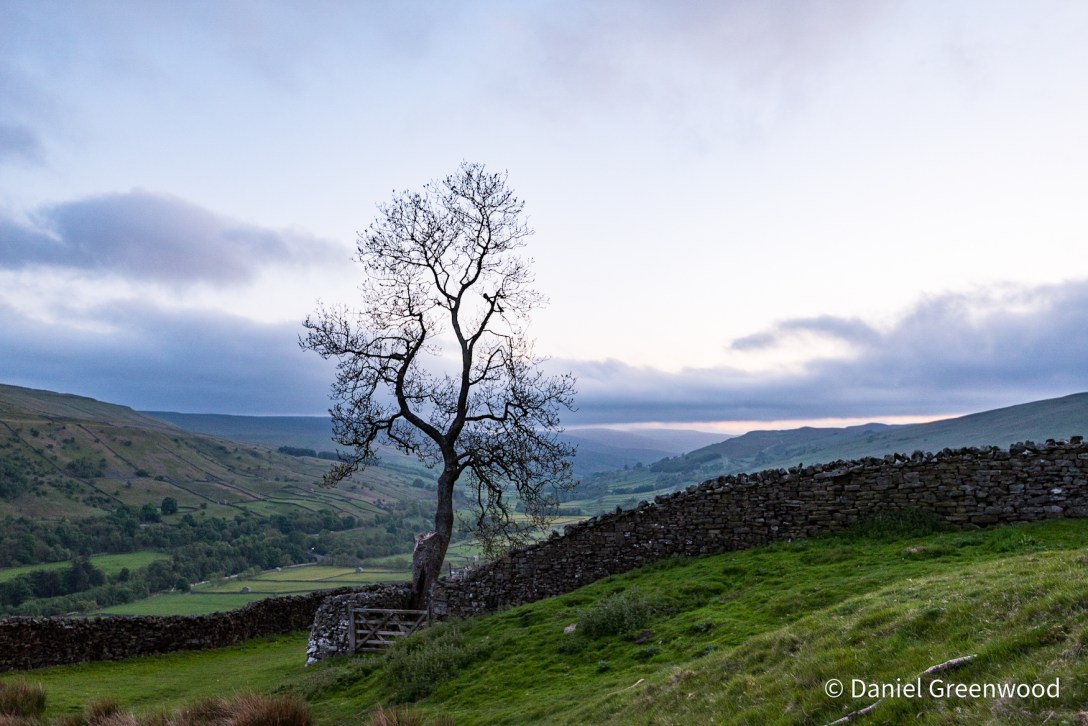
Interestingly, it’s similar in the Yorkshire Dales, where ash trees are abundant (see above and header image) and so are sheep. During one holiday in the Dales, I remember seeing a sheep climbing up a wall in order to nibble the leaves of an ash. What is also interesting to me, is that this is the same model of livestock grazing which spread from the Middle East, across Europe and into Britain thousands of years ago. It doesn’t sound dissimilar to the spread of ash dieback.

A typically large ash stool in a former hedgeline or boundary, coppiced or laid for many years (near Reeth in the Yorkshire Dales, 2019)

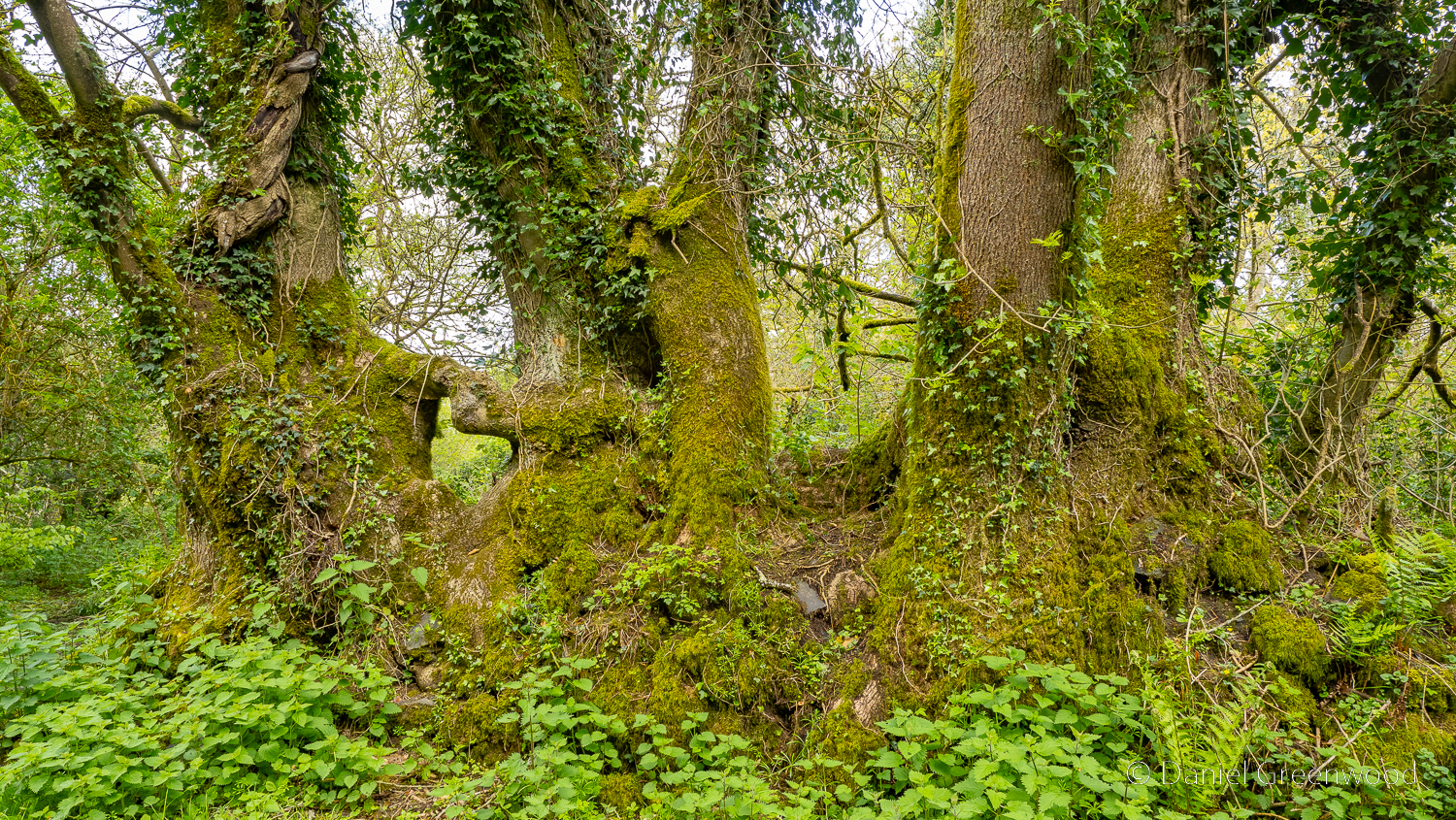
It’s not uncommon to see very large ash stools (old trees that have been regularly felled for timber) in boundary lines in places like Yorkshire, Sussex and Kent. I’m sure their coppicing was probably to provide ample feed to sheep, as in Northern Spain, above.

Dartmoor, Devon in 2023

This mammoth ash in Dartmoor National Park in Devon is possibly the biggest I’ve ever seen.

What do ash trees mean to wildlife?

A diseased ash tree with a large number of King Alfred’s Cakes fungi growing on the main trunk in Sussex in 2023

The fungus King Alfred’s Cakes has benefited in the short-term from an explosion in dead ash wood to colonise. The longer-term picture for fungi and lichen is not so good. Ash has a number of lichens that depend on it in places like the Lake District (my knowledge doesn’t extend very far here) which needs living trees.

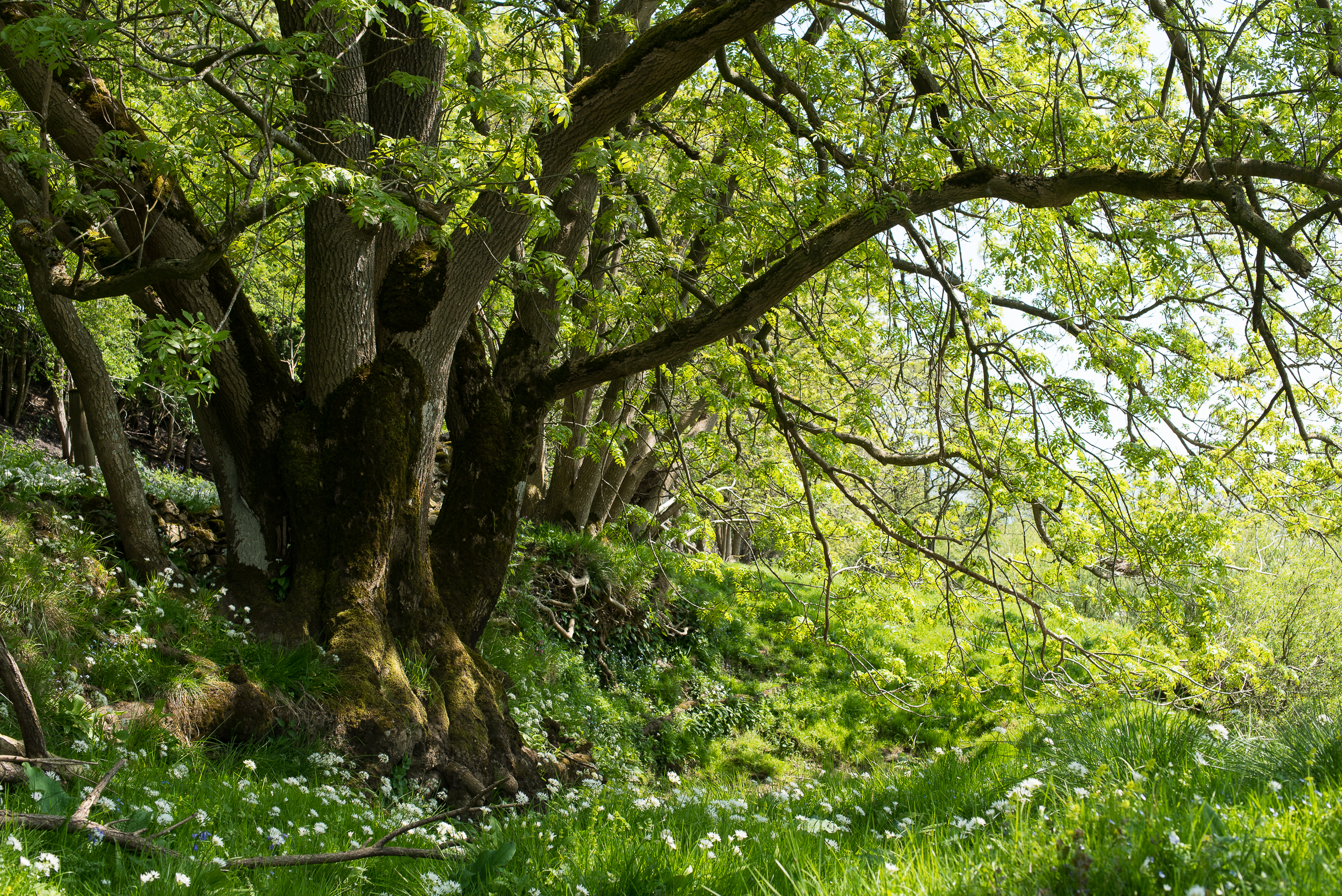
A mossy ash surrounded by wild garlic in Wensleydale, Yorkshire in May 2018

Ash benefits ancient woodland flowers that arrive early in spring because the leaves are compound (they have leaflets, not broad leaves) and allow light into the woodland floor. Species like wood anemone and wild garlic do particularly well in their dappled early spring light.

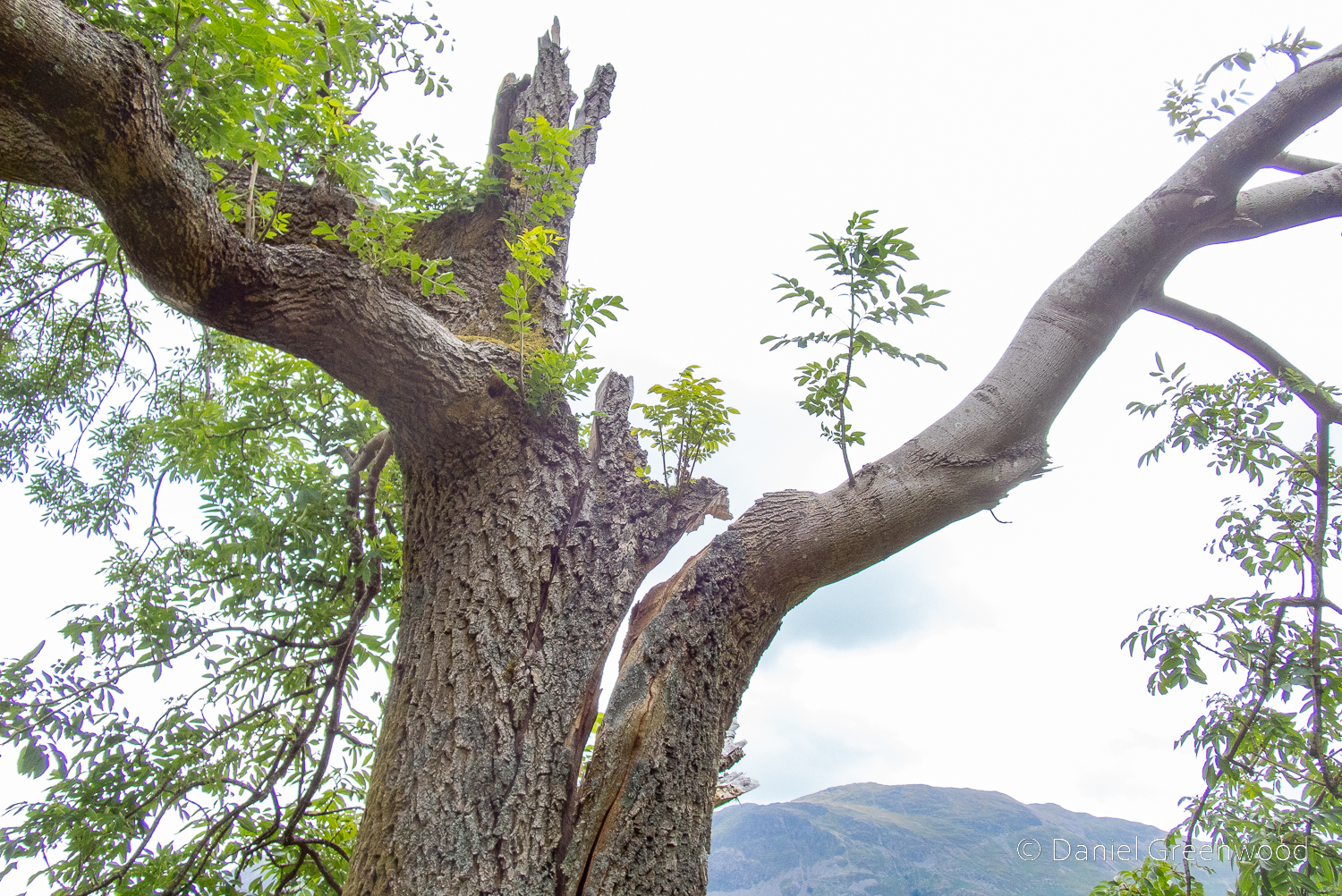
Magnificent veteran ash tree with Ullswater behind it in the Lake District. The top trunk of the tree has collapsed on some farm equipment in the background (2023)

I’ve encountered several ash down the years that have been for the chop on reasonable safety grounds in London, but then have been saved by the fact bats are living in them.

Bats can live under loose bark, in woodpecker holes (which are often found in older ash) and in large crevices. This magnificent ash was near Ullswater in the Lake District and had suffered what the tree officers would deem a catastrophic failure, but the woodland ecologists would be licking their lips at!

The Timeline

2012: when ash dieback arrived in Britain

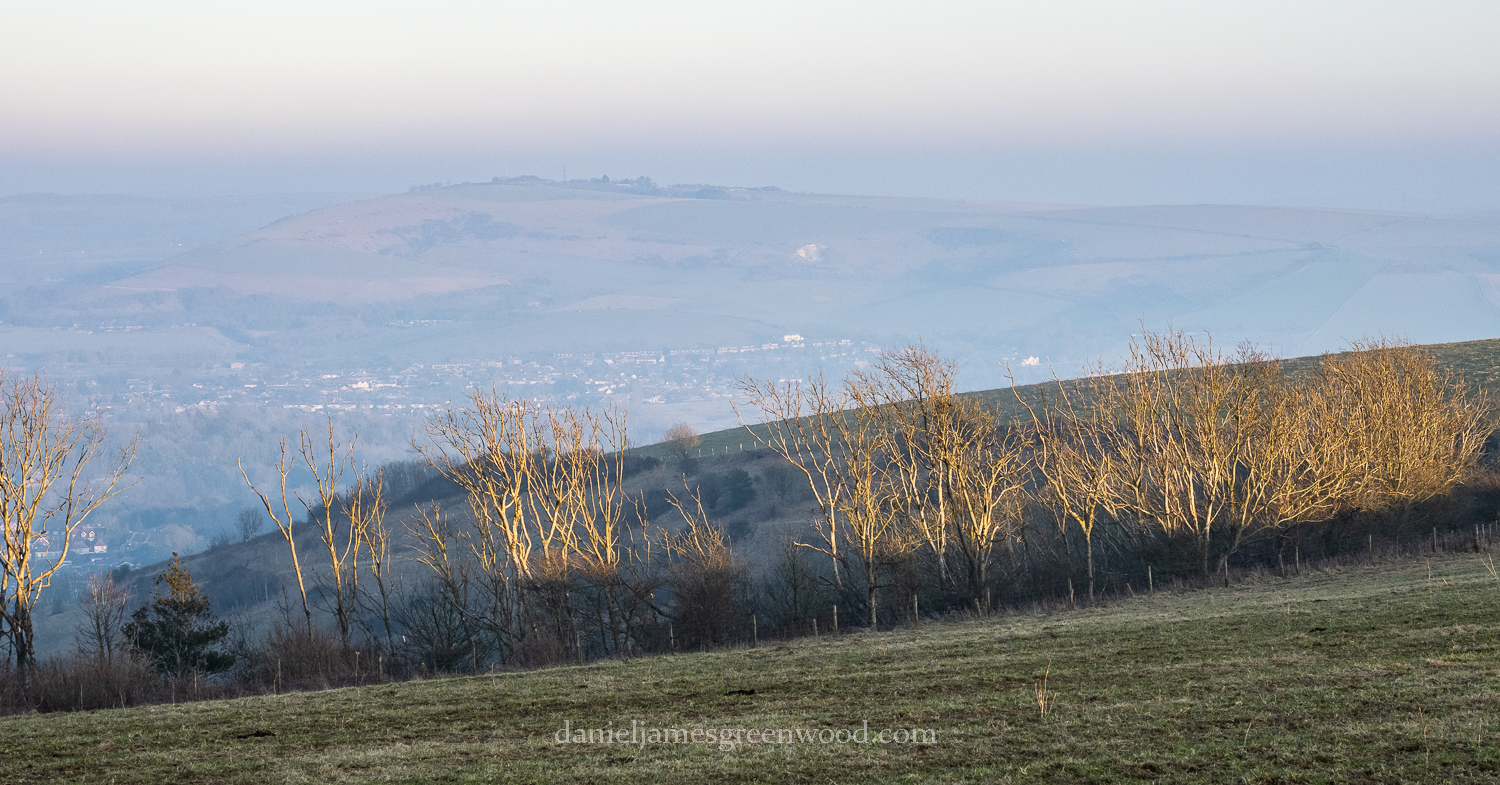
A range of leafless ash trees alongside the South Downs Way near Ditchling in November 2024

One afternoon in the autumn of 2012 I was finishing my working day in the woods when I noticed the dying-back of an ash sapling. The stem had lesions and the leaves were drooping. It was my first year as a community woodland officer and ash tree seedlings were so numerous we actually had to pull them up in certain places. They were the epitome of a sometimes invasive British plant.

It was the first time I had seen a European ash tree (Fraxinus excelsior) infected with ash dieback disease, known scientifically as Hymenoscyphus fraxineus.

The first time I saw and photographed ash dieback disease in Sydenham Hill Wood, autumn 2012

At the time we needed to report every new sighting to the Forestry Commission (as it was then), to help map the spread of this devastating disease. It spread so quickly that reporting became redundant, as were widespread protection measures. I remember someone remarking that asking people to clean their boots would be about as effective as asking the birds to clean their feet.

2017: ash dieback decimates the South Downs

Leafless diseased ash trees above Steyning, seen from the South Downs Way in February 2023

It was only really when I moved to Sussex to work in the South Downs National Park that the real impact dawned on me.

Eastbourne appearing beyond infected ash trees in June 2017

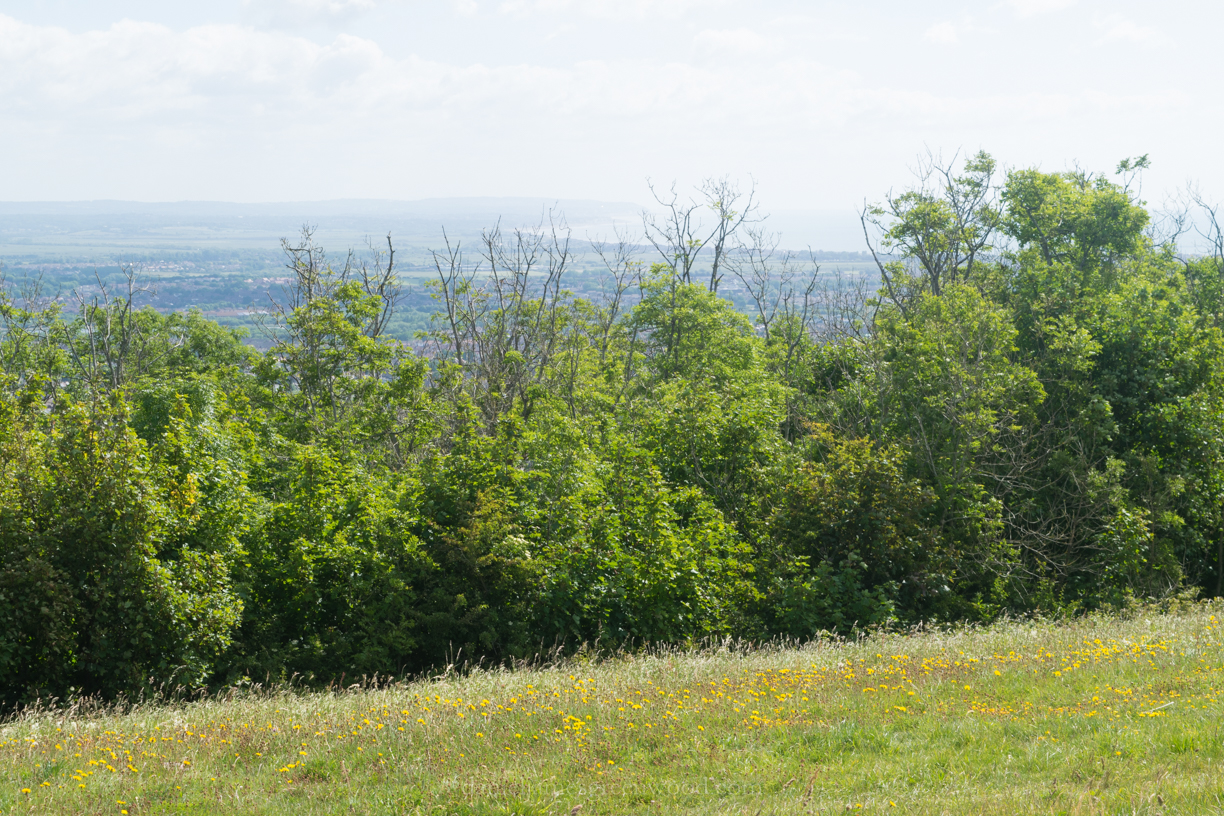
During a walk with the South Downs Eastern Area Ranger team, I was taken aback by the way declining ash trees were opening up views of the coastal town of Eastbourne. It has continued to progress since then.

A young ash tree experiencing ash dieback from the top-down on the South Downs, May 2019

Groves of once green ash woodlands and verdant hedgerow trees were dying en masse. In the past few years trees along highways have been felled due to the threat to public safety from these brittle, dead trees overhanging roads, paths and properties.

The main concern is how the decay enters the heartwood (as above) and causes structural failure even within living trees, meaning the ash are more likely to fall unexpectedly. I spoke to a council tree officer who said that there have been a number of fatalities of tree workers due to ash trees. It’s tragic.

A diseased ash tree that had fallen across a footpath in the South Downs, logged and cleared in February 2023

But how did ash dieback get to Britain? Fungi spread through spores, tiny particles that ‘seed’ in appropriate places and then grow into a living fungus that produces fruiting bodies. The fruiting bodies (mushrooms, to most people) then produce the spores. The ash dieback fungus is native to Asia, but there’s no way it could get to Europe alone. People helped it, accidentally, to arrive in Europe over 30 years ago. In Britain, it may have been helped by the process of growing UK saplings in Dutch hot houses, alongside infected ash saplings, and bringing them back to the UK.

2024: signs of resistance

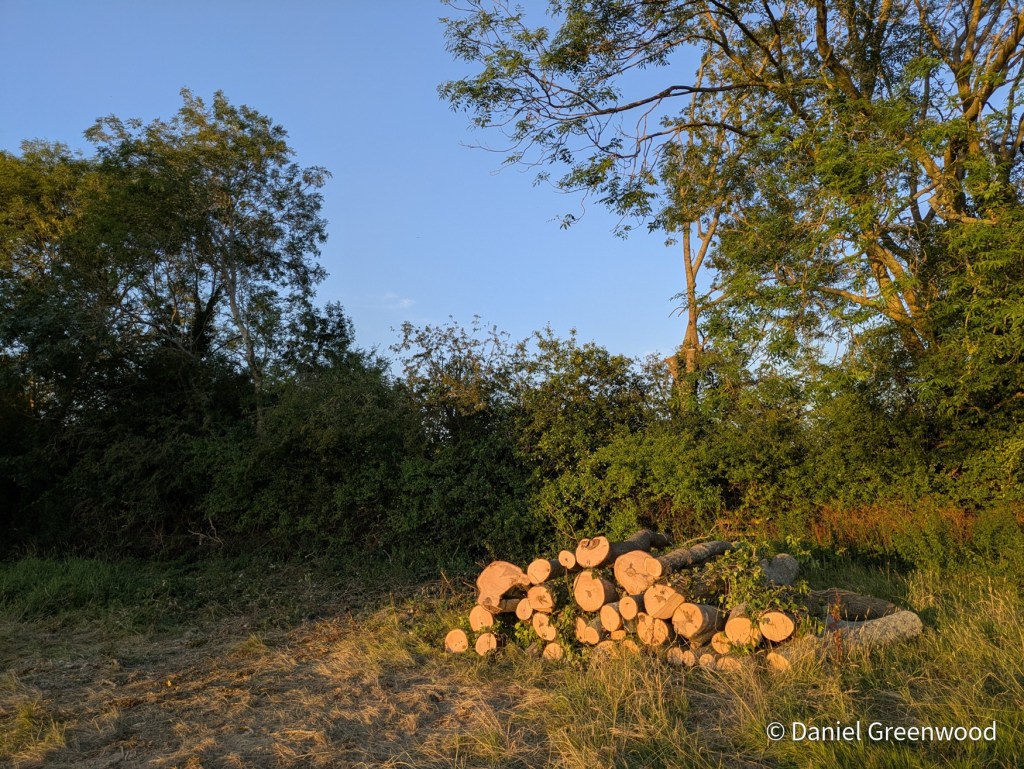
This phone pic was taken in July 2025 when my local green space had been subject to ash removal. The logs show the scars of the disease (see previous) but the scene is not one of disaster. There are healthy ash trees on either side that are surviving and, indeed, thriving considering what they are up against.

That is something The Living Ash Project have been logging(!) – trees showing mild symptoms and overcoming the dieback.

This rather optimistic article highlights more of the positive steps, and advanced scientific interventions being made to save ash trees.

Ash trees in isolated areas, away from ash woodlands, may be in a much better position (literally) to survive the disease epidemic because they are not overwhelmed by spores from ash leaf litter found in thick leaf litter.

A turning point for ash trees?

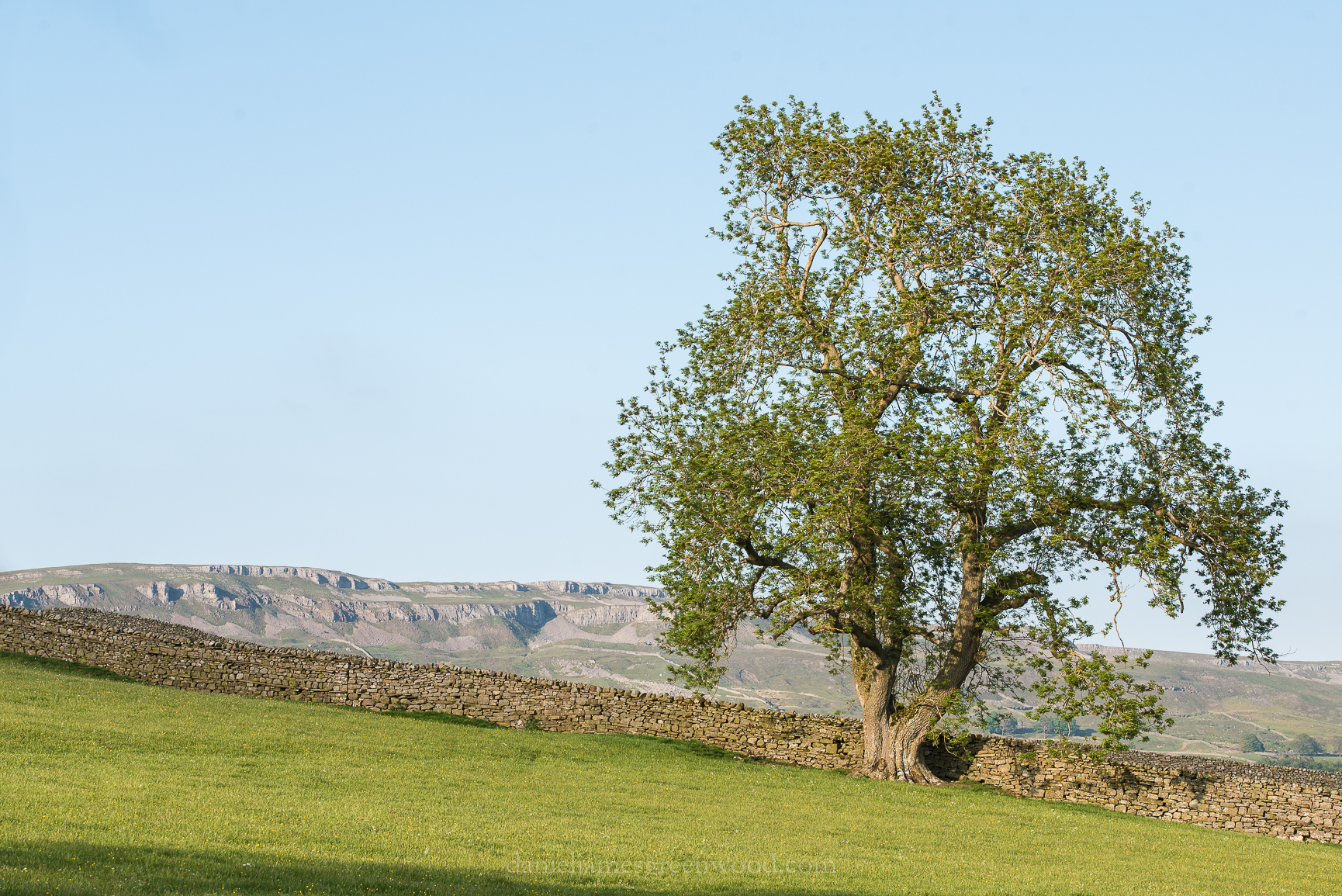
A mature ash tree in Wensleydale, Yorkshire in May 2018

The news for ash trees in 2025 is much more promising.

An article in The Guardian reports that ash trees in Britain are showing signs of evolving genetic strains of ash that will not succumb to the fungus. This means ash trees could return to the landscape in due course, though not in the same way.

In the south-east of England where I live the disease is said to have peaked.

Other research has shown that some isolated ash trees are surviving. I can vouch for this – there’s an ash tree in my mum’s garden (c.15 years old) in London that I’ve trimmed back once before. It is flourishing, so much so that the neighbours are asking for it to be cut down again. Welcome to London.

Large ash in the Howgill Fells, Yorkshire Dales (close to Cumbria) in 2019

There is also a plea on the back of the latest research for woodlands to be allowed to regenerate on their own. Many people will be keen to point out the role of ‘rewilding’ in helping this process. In many cases it’s just a matter of leaving woodlands in certain places to do their thing, probably behind some fencing.

Here’s hoping that ash trees can be saved across Europe and wild trees are given the space to do their thing. In the end they may outlive us.

Thanks for reading.

Ash trees | Fungi | Support my work

My 2024 in photography

Another year completed and lessons learned. Creatively I have found a balance with my equipment and the actual process of photography. I’m into my 6th year of working with Micro Four Thirds cameras and lenses, giving more space to enjoy the process of gathering photos – walking – because the equipment is light.

Cameras used include Olympus EM-5 Mark III, Oly EM-1 Mark III, Olympus TG-6 Tough compact camera, and Pixel 7a phone camera.

These photos should show the range of things I like to take pics of – not just mushrooms! 😂

With the privileges available to me – health, location, resources, freedom of expression – here are my photographic highlights of 2024:

January

I did a couple of long walks in Sussex at the beginning of the year, exploring some new locations around the South Downs. I visited St. Botolphs church for the first time, one of Sussex’s special ones among thousands of already significant churches. Last year I set up a gallery for my fledging church photographs project which can be viewed here.

February

This felt like the moment of the light returning after the dark winter months. The Downs at Amberley are my gateway to the South Downs, and walking here is always worth the gentle climb.

March

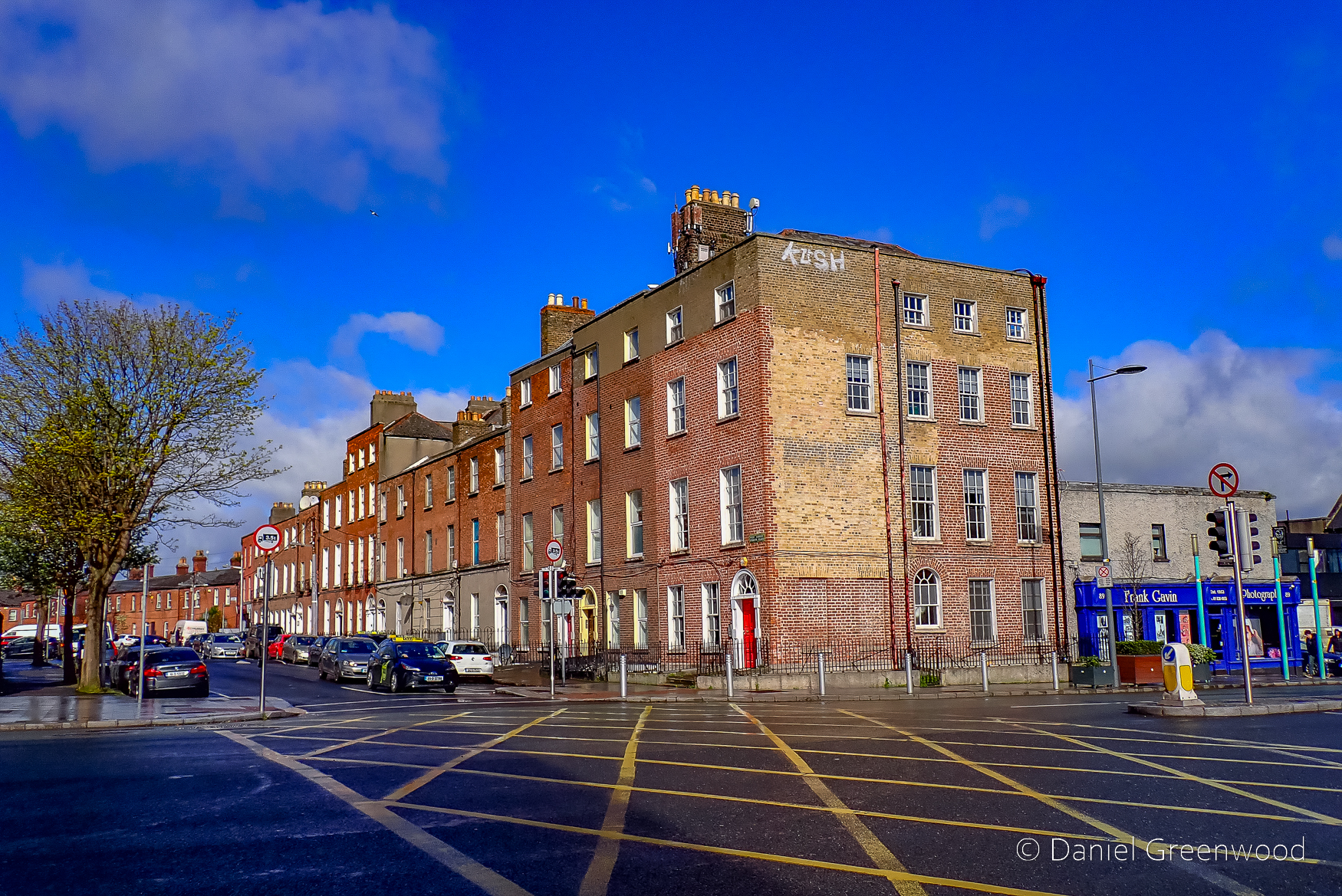
In March I visited Dublin for a weekend and took in the sights along the great river Liffey.

For a friend’s birthday we spent the weekend in York, which gave me a chance to take some compact camera pics of a few of the oak timber framed buildings. I’ve added a gallery for my ‘Oak Timbers’ project here.

April

I got married in April so there wasn’t time for much beyond the odd local walk. I was trying out my new Pixel 7a, bought because of its value and reported image quality. The camera is spectacular, I just wish it wasn’t a G**gle product. I blogged about it here.
May

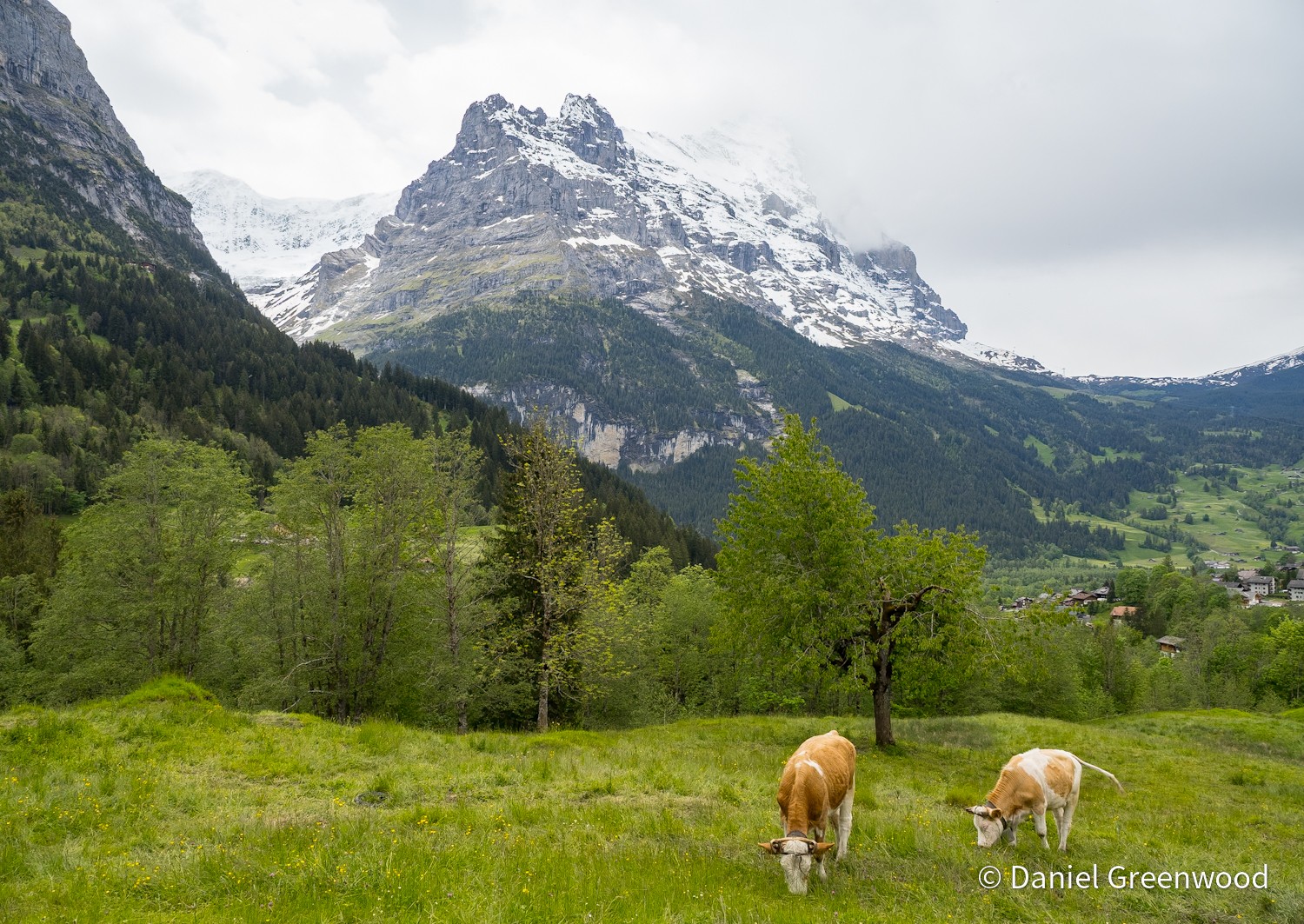
Ah, memories. In May we went on our honeymoon to Austria and Switzerland, all by train. You may be sick of reading about that! I am definitely not sick of blogging about it though!

This was one of those one-off photos experiences. Thankfully the weather held and we saw the mountains in much of their glory.

June

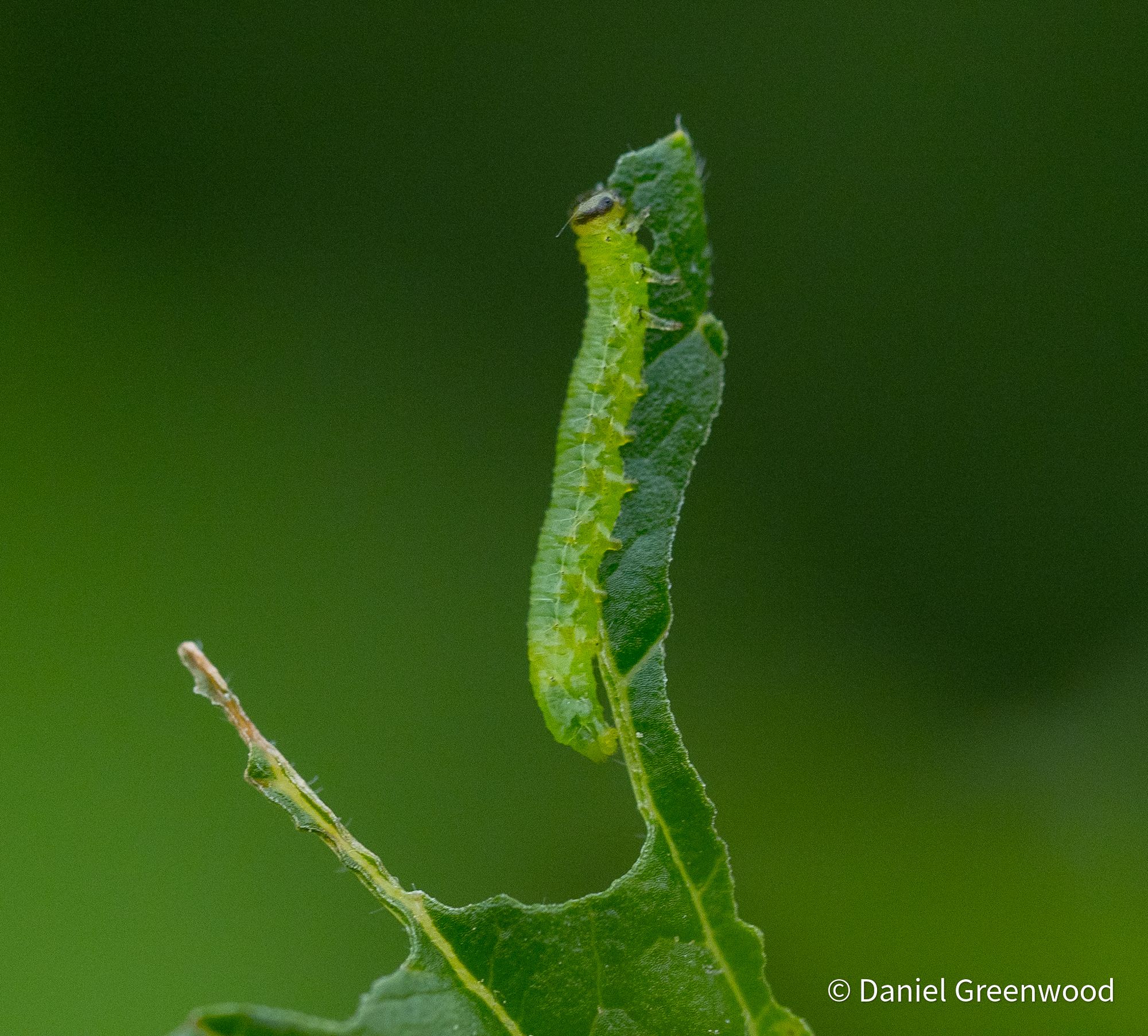
A bit of a lost month for photography because I started (yet another) new job and had to settle into a new routine. The highlight was probably these sawfly larvae which ate through some of the leaves on my gooseberry. Blog here.

July

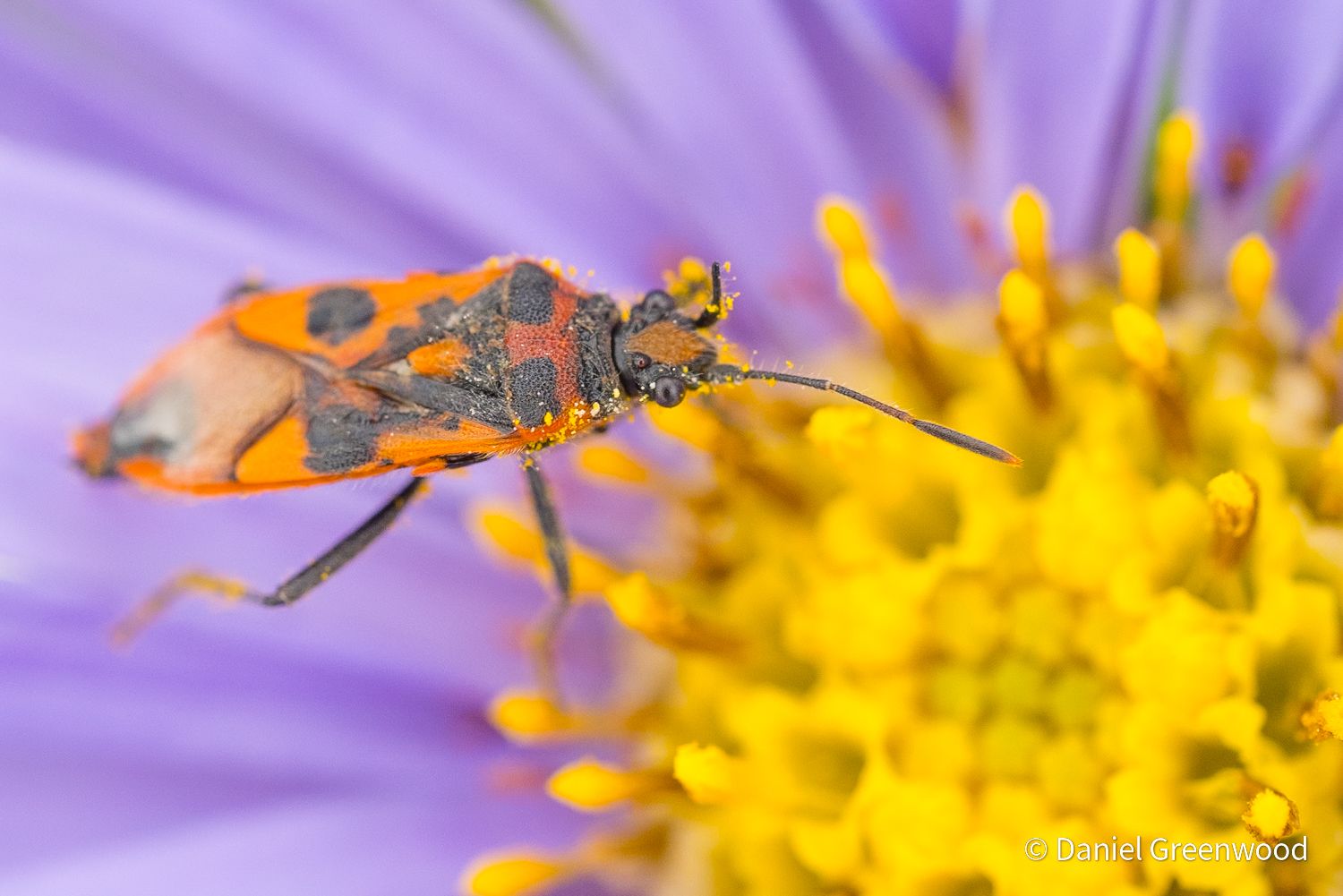
“July, July, it never seemed so strange”, as the Decemberists sang. I caught Covid and didn’t really get back to normal for 3 months afterwards (Vitamin D is very important, people). My macro work was reduced by the evil contagion but I did find some nice bugs near home to share.

August

I managed to pap some pretty fine inverts in August, with this beautiful ichneumon wasp seen in my garden. I’ve not got anywhere near enough out of my Olympus EM-1 Mark iii and 60mm macro, but this showed just how good Micro Four Thirds cameras are for macro.

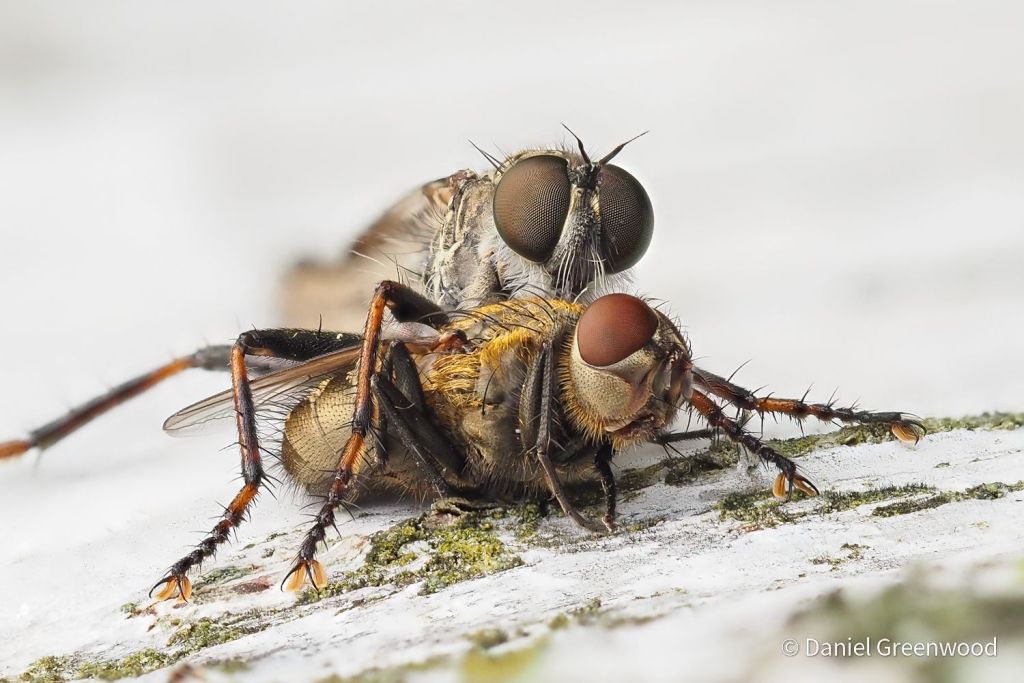
Another strongpoint for M43 cameras is that they can ‘stack’ images internally, something now copied by the big hitters. This is a composite of about 10 photos the camera has laced together to ensure the depth of field covers a deeper focus range. It means more of the, rather gruesome, subject can be seen in detail.

September

In September I made my first ever visit to the iconic sea stacks at Downpatrick Head on the North Mayo Coast in Ireland. Mayo has an international dark skies designation so I was able to mess around with the Milky Way. But for the astro photo I haven’t processed these images yet so here are a couple of phone photos.

October

As I have lamented on my Fungi Friday blog, 2024 was not the best mushroom season. But there are always things to find out there. I found this knocked over fly agaric, which was in perfect condition, ready for its portrait.

November

Autumn is a time for Dartmoor for me and my wife, and despite colds we managed some walks onto the moors in the National Park. We found an amazing array of waxcaps, like the crimsons above, which you can see in full on Fungi Friday.

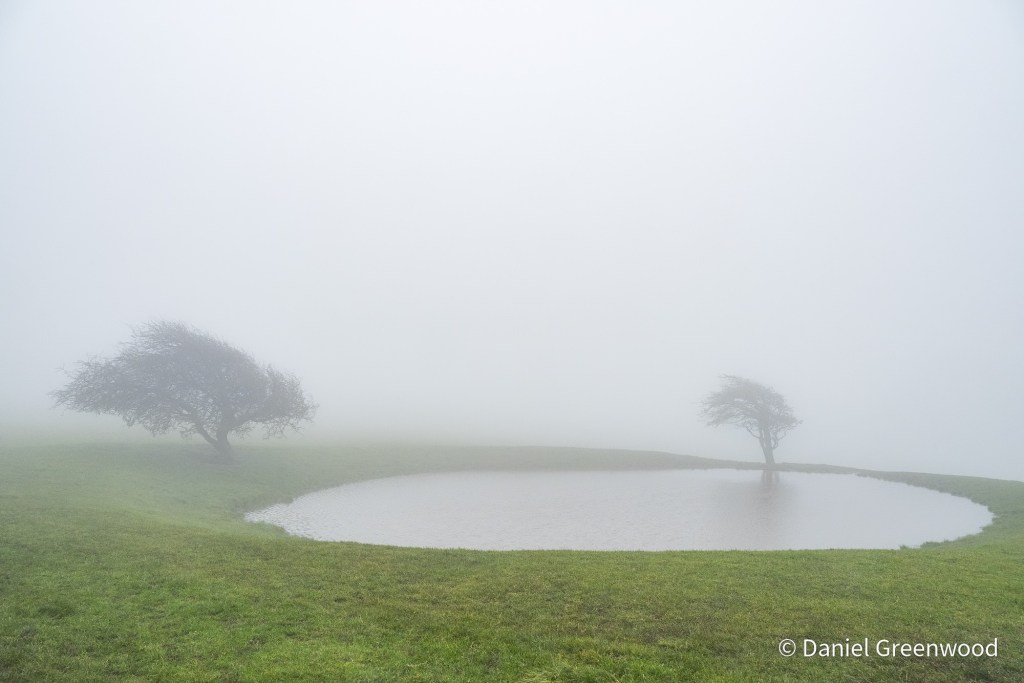
On the last day of November I hiked with my South Downs amigo from Ditchling into the mist. This is the much-photographed Ditchling dew pond, shrouded in mist.

December

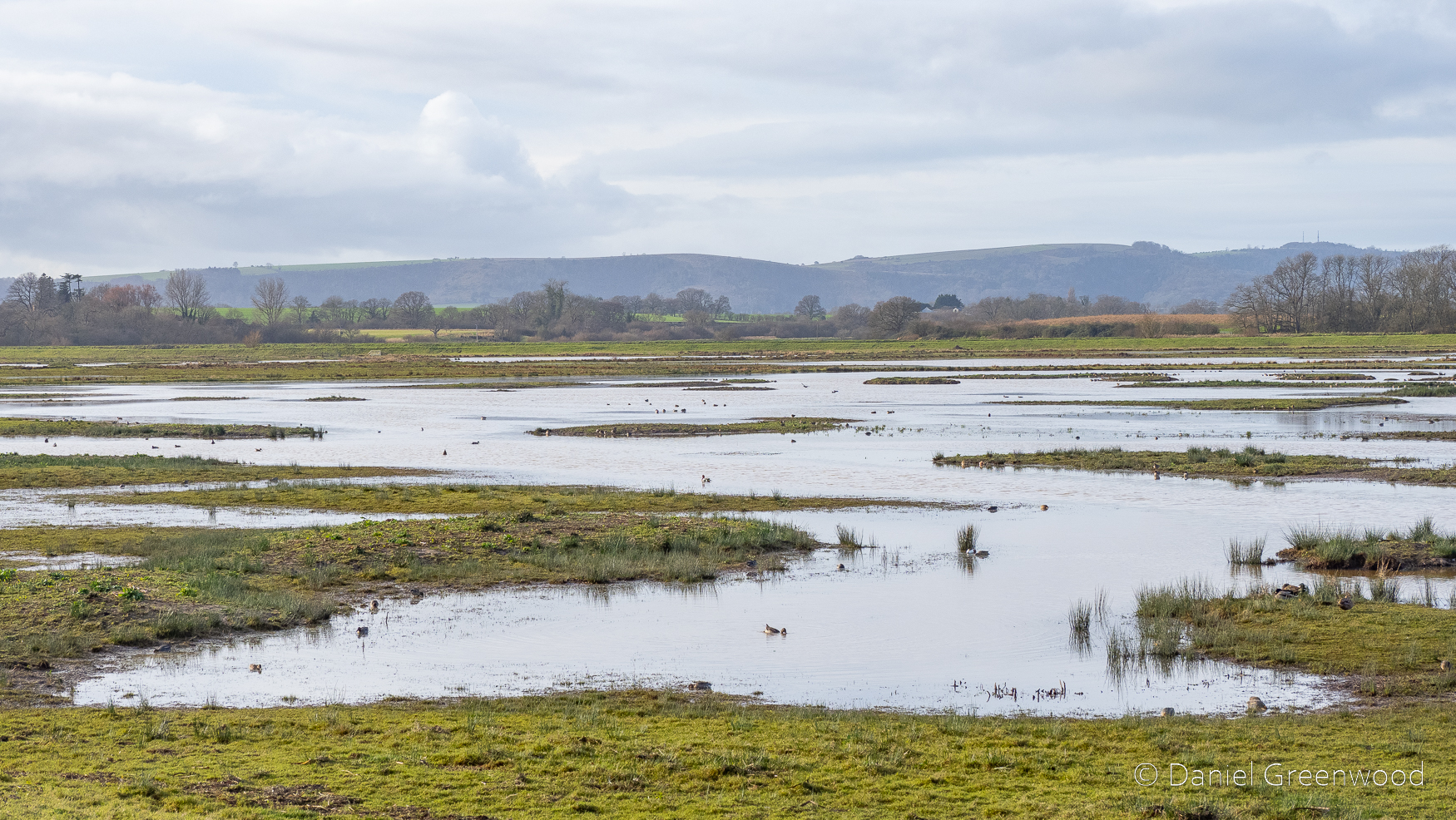
The weather in December was very grey and damp, and all the Christmas demands gave me only one meaningful walk – to Pulborough Brooks in West Sussex.

Thanks for all your support in 2024 and wishing you peace and happiness in 2025.

February sunset in the Arun valley

Amberley, West Sussex, February 2024

Here’s the best image I captured while waiting for the sun to disappear over the Downs recently. To the right hand side of the image (north) you can see the Arun flooding the area known as Amberley Wildbrooks. It was surprisingly mild up there but as the sun slid away the cool air arrived with the moon. Red kites floated overhead and trains echoed through the valley on their way to Arundel. A beautiful evening in a special place.

Fungi walk at Bramshott Common – 21st Oct 2023

I’m pleased to be leading a fungi walk with the Heathlands Reunited team in the South Downs National Park this October:

Date/time: Saturday 21st October 2023, 11am

Location: Bramshott Common, Hampshire (near Haslemere)

Bramshott is in Hampshire, close to the border with Surrey and not far from West Sussex.

You can book a ticket (£3 admin charge) via Eventbrite.

I posted about Bramshott Common last year:

Basketful of Boletes

Earpick fungus in Hampshire

This walk will be a good way to learn about the common species of fungi in woodlands, their ecology and cultural significance. Though we won’t be picking mushrooms to eat, there will be some guidance around edibility generally as a safety guide. This is a great site for fungi with a lot of the ‘big-hitters’ and other unusual species to be found.

Thanks for reading.

Fungi

Oak timbers: Poplar cottage

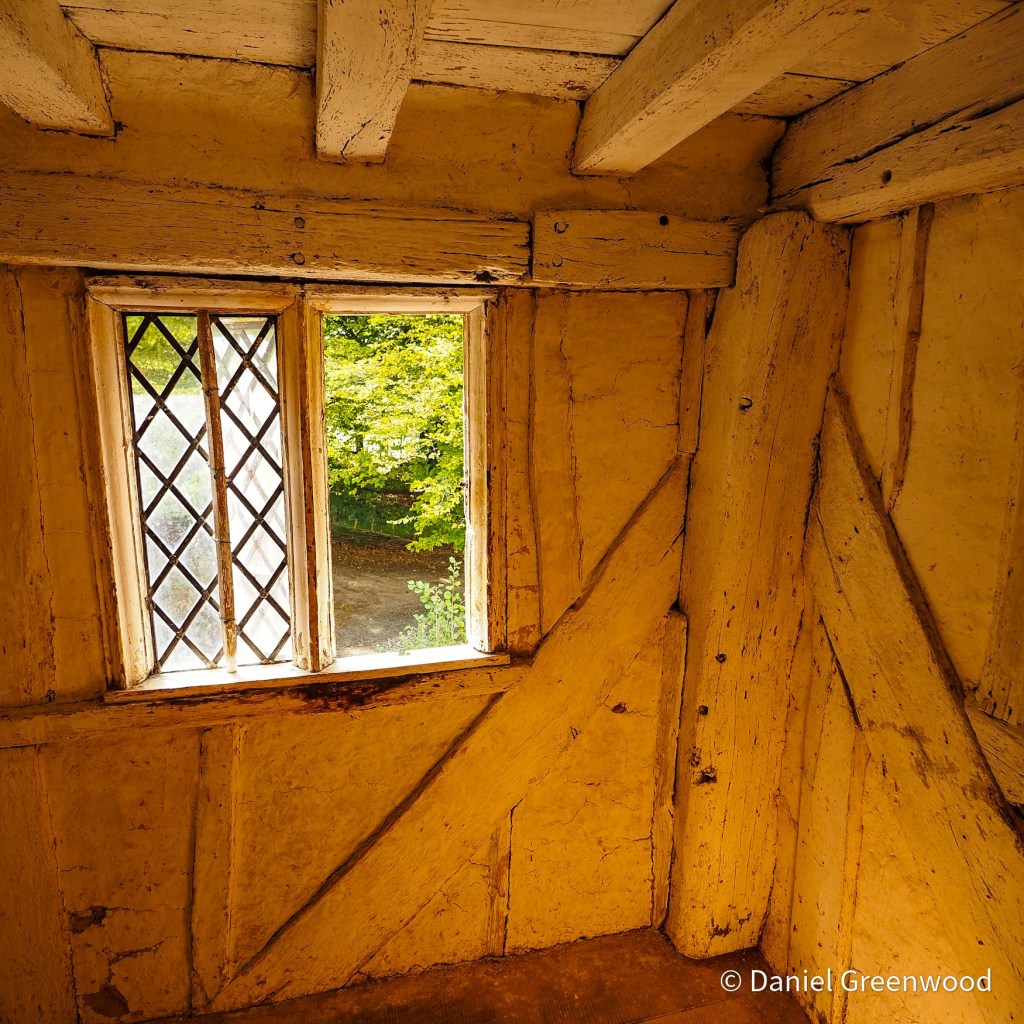
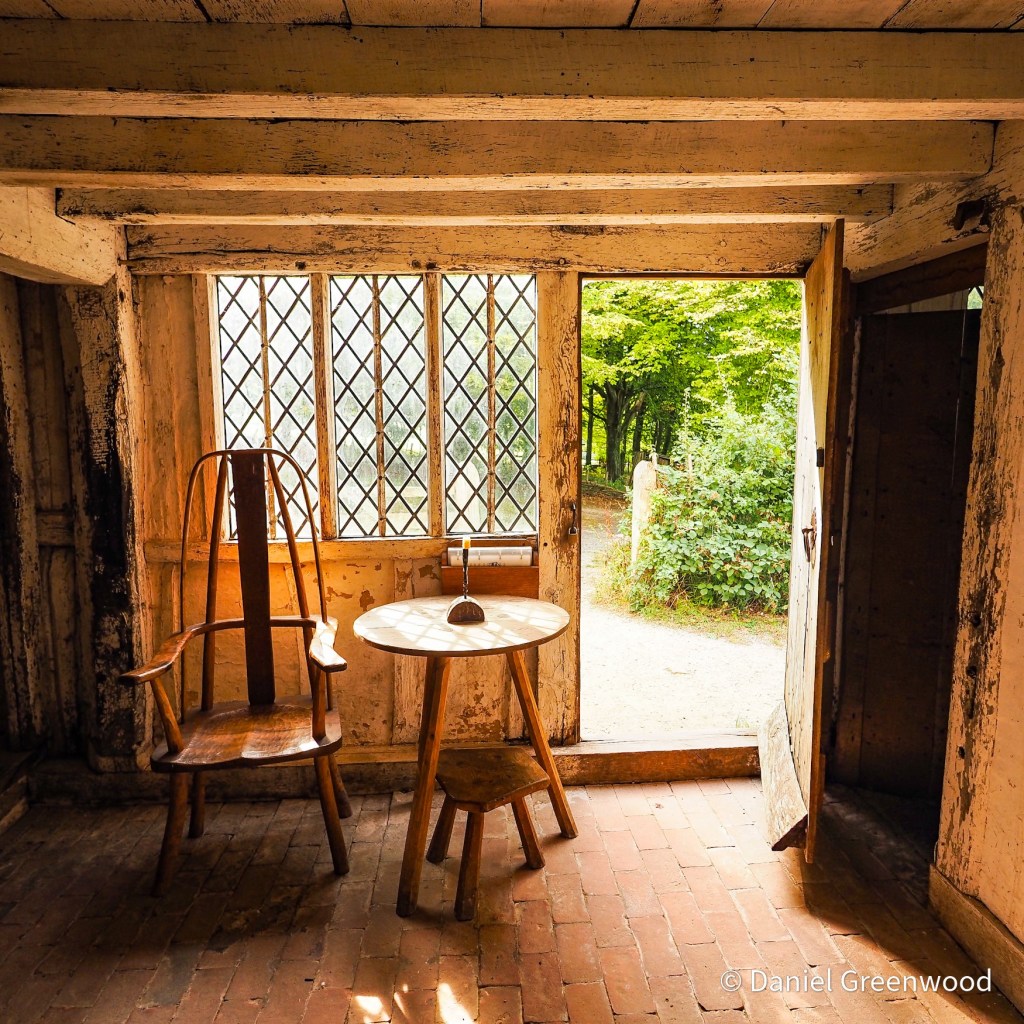
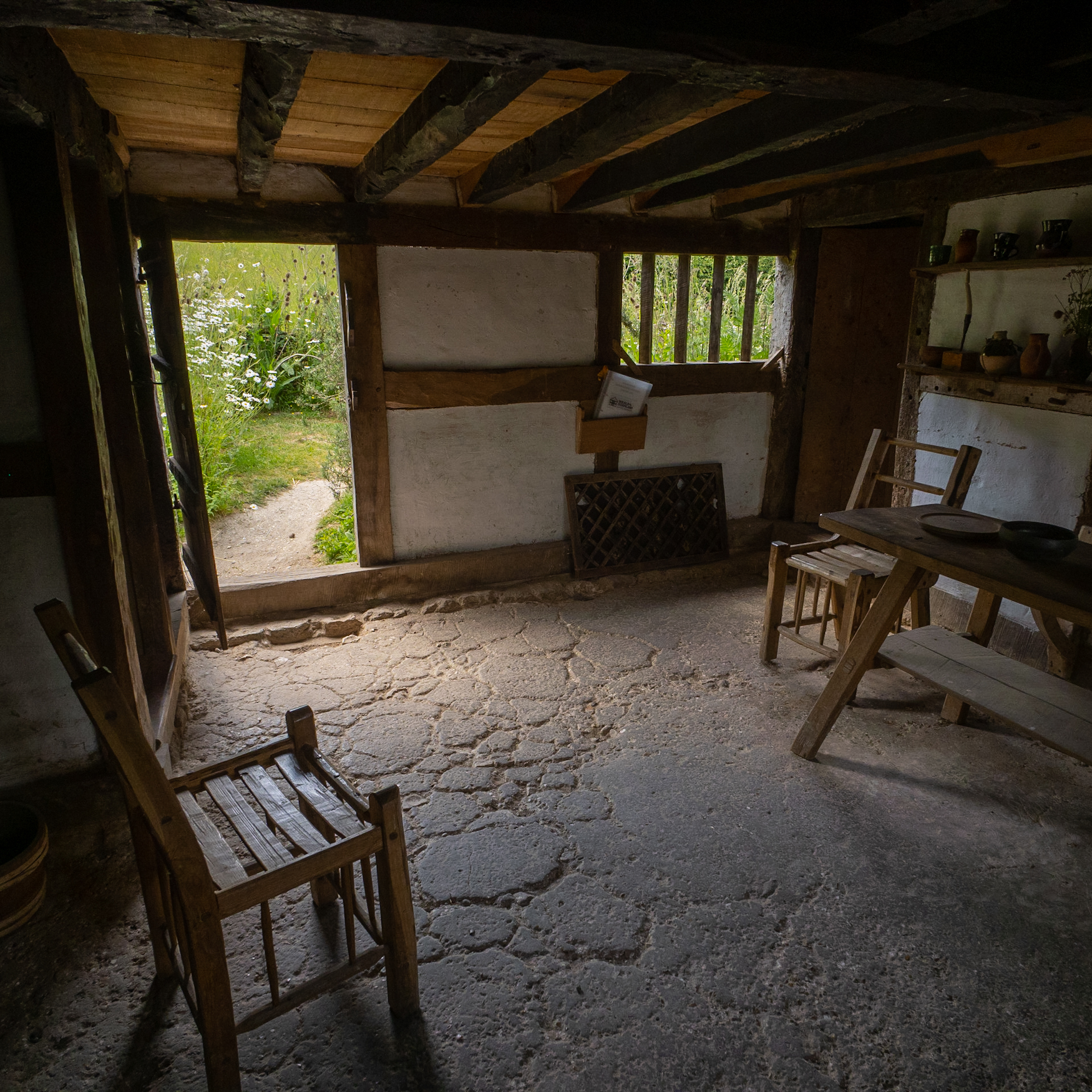
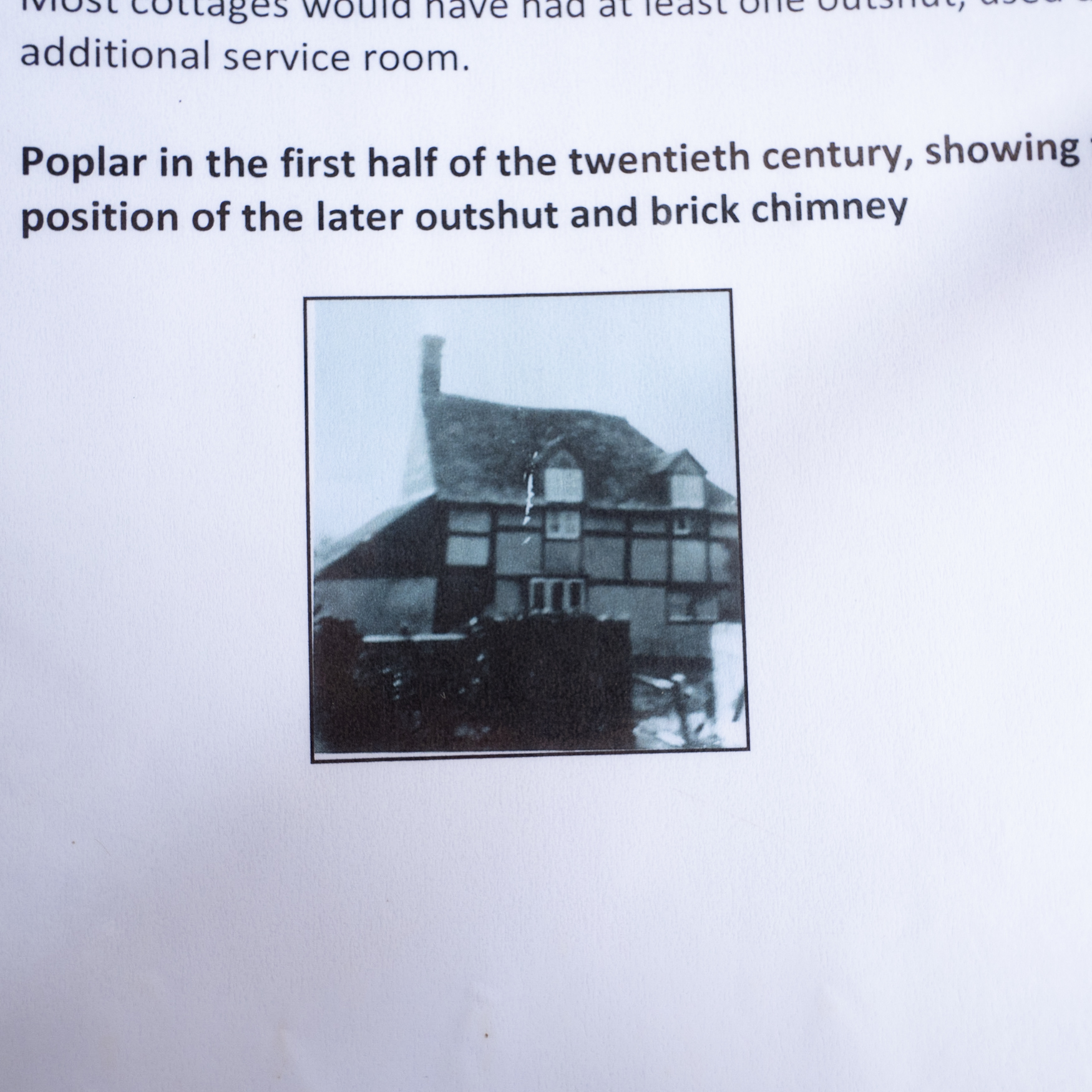
In June I spent some time at the Weald & Downland Living Museum in Singleton, West Sussex. I was trying out a new wide-angle lens and in the perfect place to do so. I focused on Poplar Cottage, one of the most attractive ‘installations’ at the museum. Below are some images and also the italicised text which is written in the cottage’s binder, and therefore copyright Weald & Downland Living Museum.

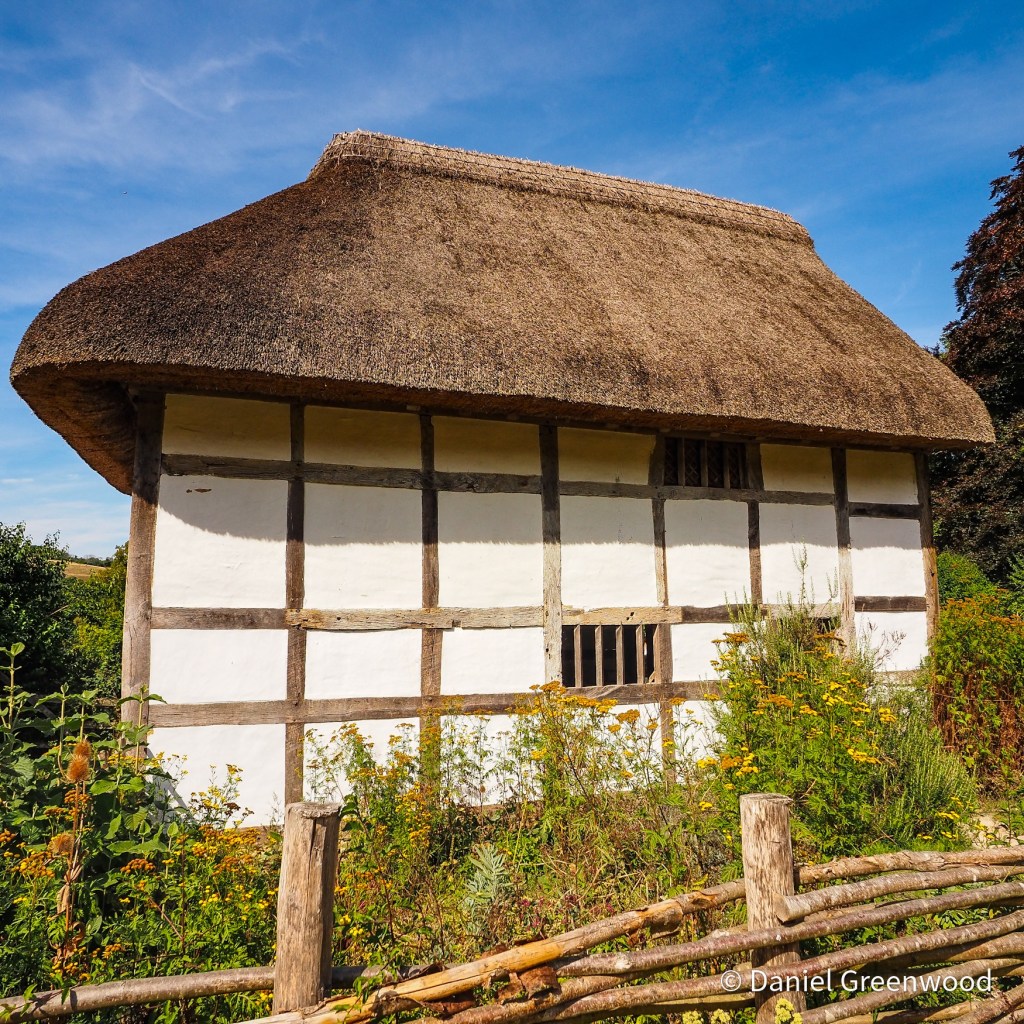
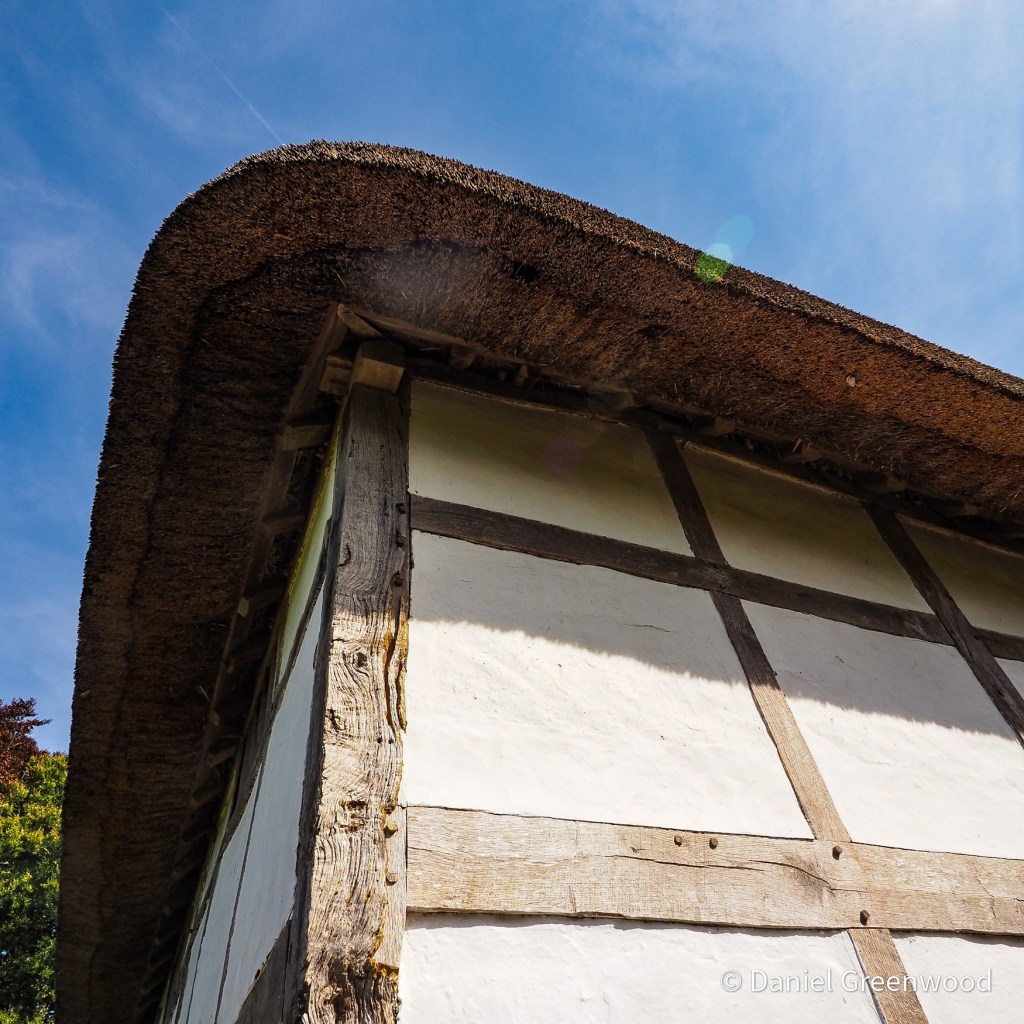
Poplar Cottage was originally built on a small plot of common land on the edge of Washington Common in West Sussex. It is a building of a distinctive type with a hipped roof at one end and a gabled roof at the other. The gabled end originally contained a smoke bay.

Washington is a village at the foot of the South Downs in West Sussex, near Chanctonbury Ring. Its name relates to “Wassa’s people” rather than a place renowned for cleaning.

© Weald & Downland Living Museum

This cottage type is associated with ‘wasteland’ or ‘wayside’ encroachment onto common land. The earliest occupants of the cottage are likely to have been husbandmen or rural craftsmen. Husbandmen were socially inferior to yeomen but superior to labourers.

Many cottagers engaged in small-scale craft activities, like making wooden hoops for barrels or spars for thatching, or indeed shoe-making. We have evidence to suggest that a shoe-maker may have lived here in the 17th century.

Thanks for reading.

Oak timbers

Praying for Everton’s survival among the wildflowers ⚽

Amberley, West Sussex, May 2023

I am aware that most of the people who read my posts are likely to have a natural aversion to football. But really I’m not sure this blog would be here without the football side of my life. I’m someone who is able to say I’ve had words printed in national newspapers having written (unpaid, of course!) short articles about Everton Football Club as a student for the Observer newspaper. As a child I learned to love the outdoors from playing football with my dad and then my friends in the park, and chasing the irregular bounce of a ball over uneven grazing land in Ireland on summer holidays.

As a masters student I dreampt up articles and essays about the psychological landscape of football pitches and the sheer absurdity of the rules of the game. I wanted to deconstruct football, to make it make sense. The ball crosses a line and people’s lives are changed, while billions of pounds change hands. It has become something so unpleasant in many ways nowadays, but its heritage is old and significant. My family have probably supported Everton since the late 1800s when the club was invented.

On Sunday 28th May I forced myself, though tired, to go for a walk in the Arun valley in the South Downs. The aim was to try and distract myself from Everton’s final day game against Bournemouth, where my team could be relegated from the top division of English football for the first time in 69 years.

Formed in 1878, Everton were relegated in 1951 but came back in 1954 and promptly won the league. My dad passed away just short of his 72nd birthday. As an Evertonian from the age of 5, he had never known his team to be anything other than in the top flight. I can say they have won the league in my lifetime, in 1987, in the year of my birth, 1985, as well as picking up the FA Cup against the odds in 1995. It’s not something Newcastle and Spurs fans my age or younger can say!

The stress of these final day relegation cliffhangers is extreme, but I couldn’t tell you why. In 1994 Everton were on the brink, 0-2 down to Wimbledon (RIP) on the final day, but managed to win 3-2 and stay up. In 1998 I put my face in the grass and pleaded with a god I didn’t really know, to save Everton from relegation again. They survived yet again.

Back on my present day distraction walk I passed through Amberley village and popped into the churchyard. It was a beautiful sight, with intelligent mowing having taken place to allow the chalk downland of the churchyard to grow into a rich and healthy sward. #NoMowMay indeed. One unlikely advocate of this excellent initiative is the former footballer and now pundit, Chris Sutton. Sutton regularly makes the case for bee conservation while barracking his co-host Robbie Savage on BBC Radio 5Live’s football phone-in. Well in, lad.

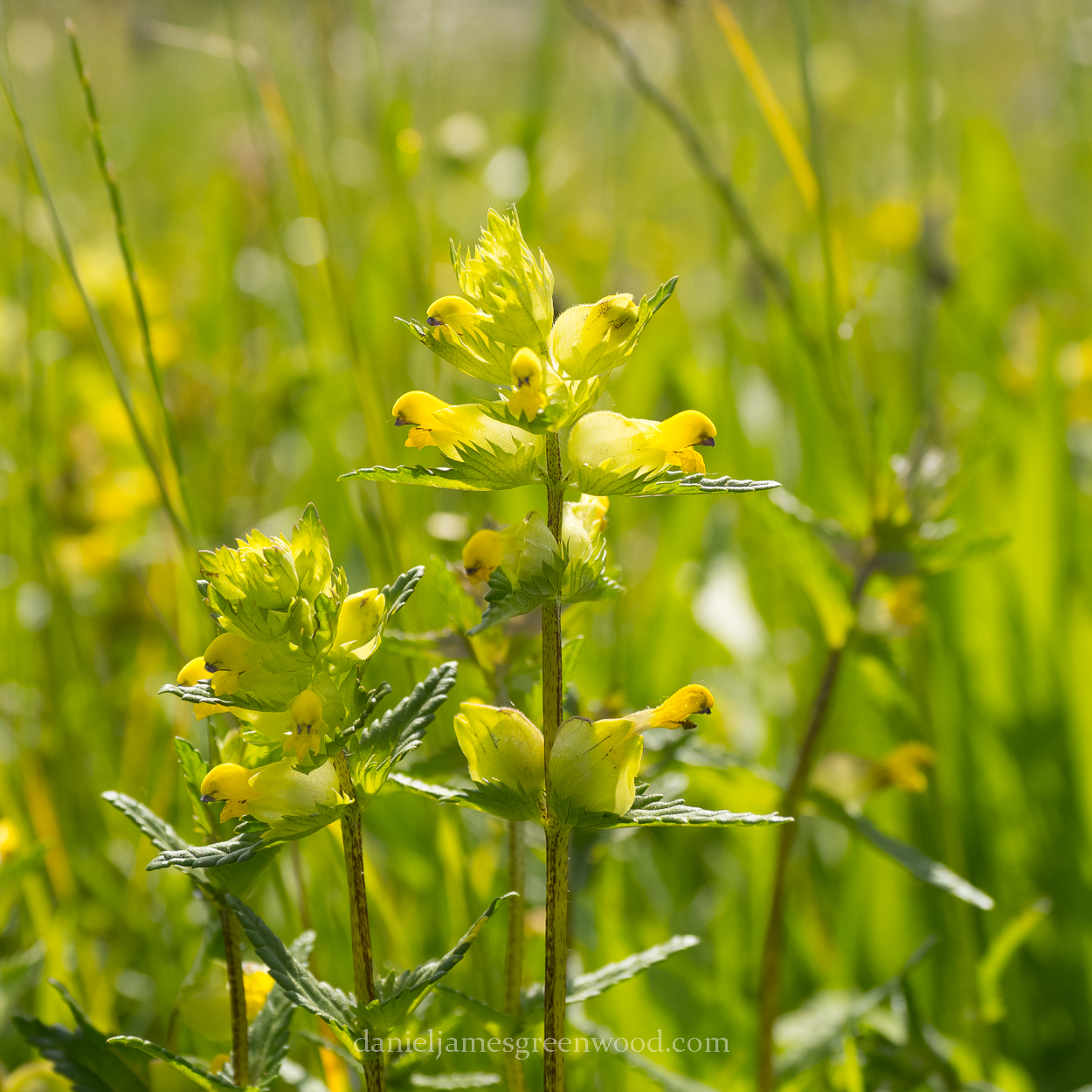
Back in the churchyard, the grasslands were full with oxeye daisies and that downland favourite, yellow rattle.

I entered into the church and took a break from the sun. I love the cool air and quiet of churches, of which the South Downs is spoilt in terms of the sheer number of them. Now, I am not a practicing religious person of any recognised faith, my cathedrals are usually either tree or hill-shaped, but I did ask for my pathetic football team to be spared while sitting on the pew (I also donated to support the church’s eye-watering running costs).

Some hours later, having hammered out 6 miles on the Downs and rushed back to catch the train to listen to the second half at home, Everton survived.

1994, 1998, 2023. Please, just not next year.

Thanks for reading.

The South Downs

Apaches over the Downs

Steyning, West Sussex, February 2023

A walk from Steyning, along the field edge with those lumpy Downs caught in a smoke-like haze. The sun beat over the hilltops, the trees naked, grey and brown without leaves. Hazel catkins were the only decorations.

We walked through an old farm replete with buildings that seemed to be crumbling. The ground underneath was churned up with that grey gloop where the downland chalk meets the Wealden mud, a Sussex special.

The woods were cold and quiet except when labourers felled a tree somewhere in the shade of the Downs. It crashed down and broke into pieces. No doubt an ash tree, dead or dying like so many of them across this once ashy landscape.

On the banks there were the first signs of woodland spring, with dogs mercury leafing and some flowering.

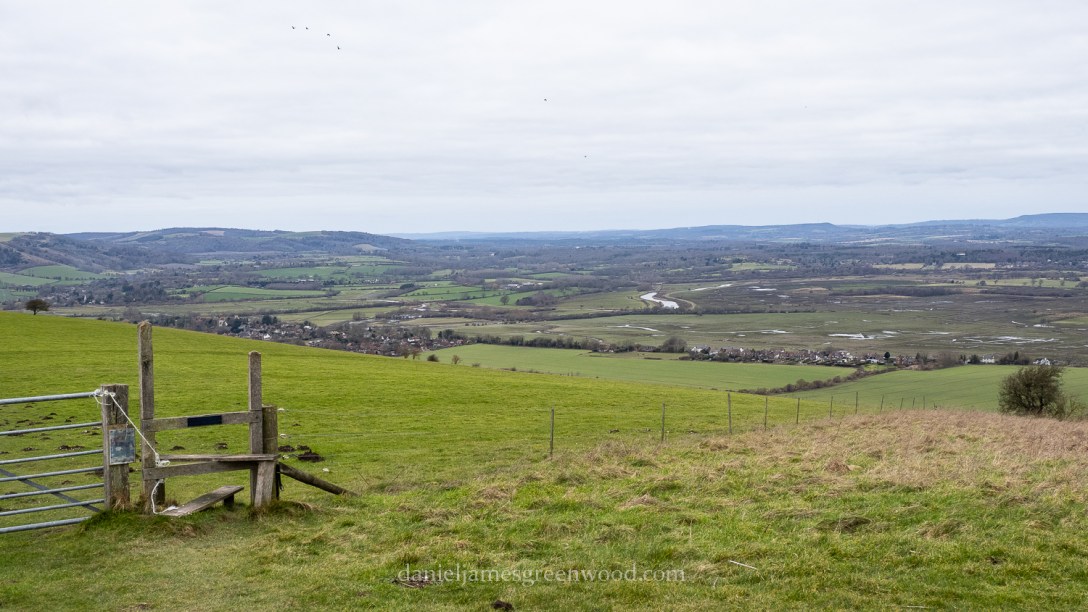
Rising up towards Chanctonbury Ring, the views north were dulled by a dense grey fog that looked like London’s winter pollution belt.

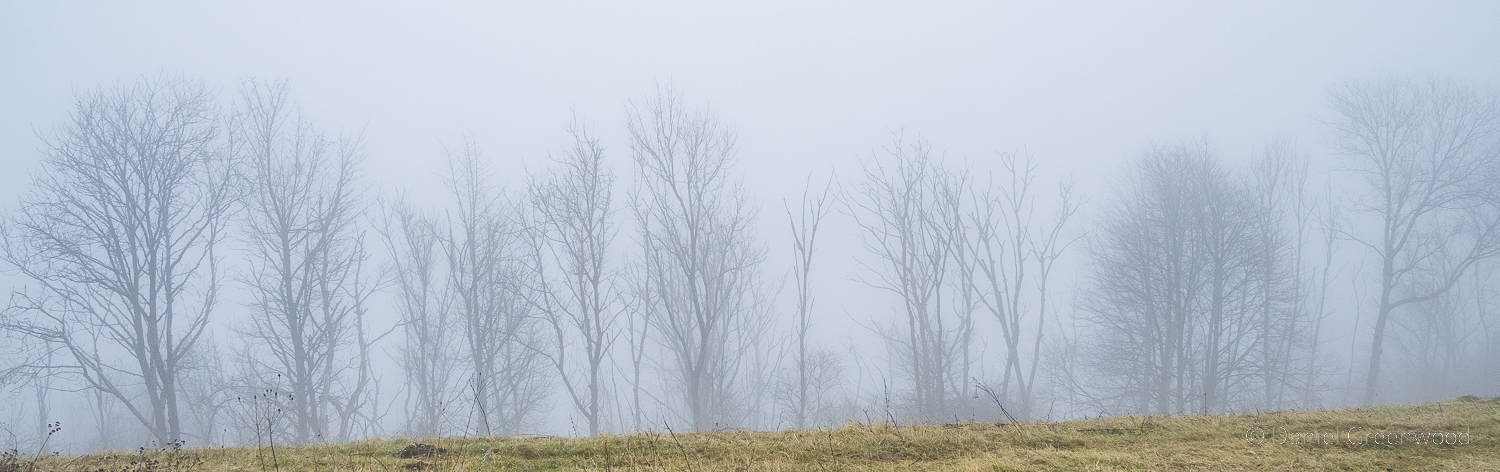
A stand of dead ash trees led to the top of the Downs, where a pair of marsh tit passed between the brittle branches, calling as they moved from tree to tree.

A new vista opened out with the views south, hills folding away into the haze. Black trees breaking the lines.

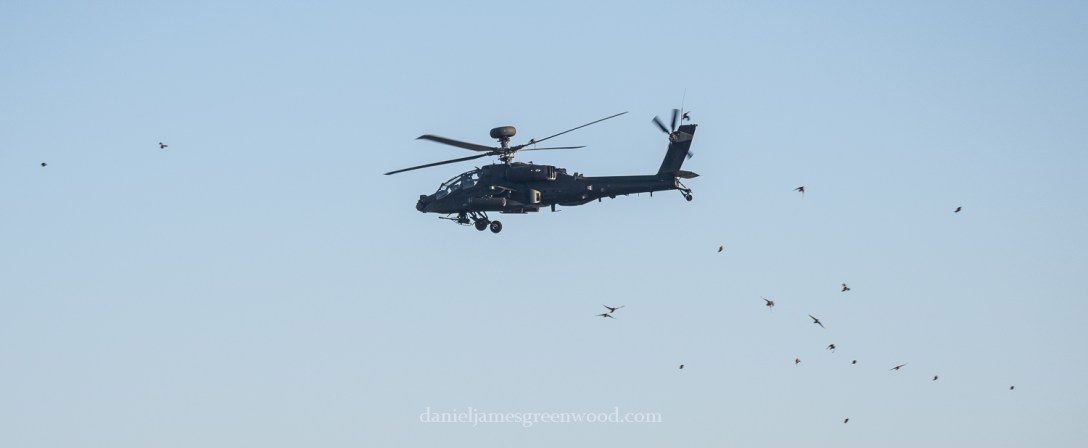
Further along the South Downs Way a great roaring emerged from the south and an Apache helicopter flew low overhead. It felt too low. A flock of what I thought were starlings were spooked and seemed to fly right at the helicopter.

A second helicopter appeared, banking north and turning 90 degrees as it slid over the edge of the Downs and dropped out of view into the Weald beyond.

A man came past on a bike and stopped to speak to us, registering our surprise: ‘Have you never been here when they do that? I just hope they’re training Ukrainian soldiers and that they’ll be sending them out there.’

We heard stories of accidents that had happened when the appearance of sudden, low-flying military aircraft had disrupted the flow of civil life in the wider landscape.

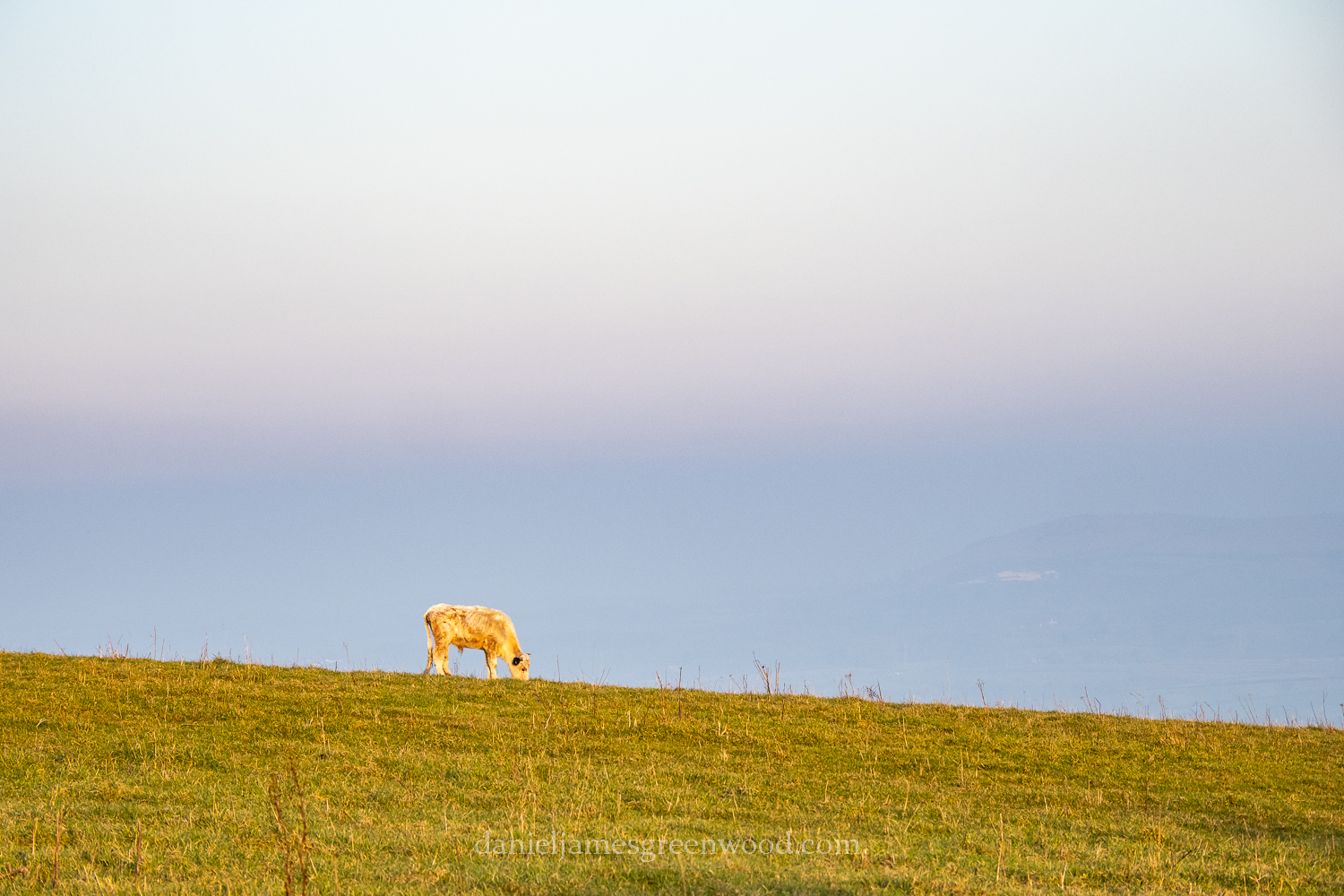
Up ahead beyond the enclosed South Downs Way, cattle grazed the green hill, unperturbed by the helicopters. In the valley to the south one of the few hedgerows to be seen jangled with the key-song of corn buntings.

Thanks for reading.

The South Downs

You can support my work here: https://ko-fi.com/djgwild

A tale of two hedges in the South Downs

Amberley, West Sussex, February 2023

The light was low over the Arun valley. To the south the Sussex coast was a band of grey concrete, the horizon between sky and sea broken only by the pale sticks of the offshore wind farms. The Isle of Wight rested out at sea to the west like a great sleeping sloth.

The Arun’s floodplain had traces of silver, the remains of January floods. The rain had gone quiet in recent weeks, and so the wetlands were receding back to the river.

The birds were quiet, too. Every now and then a small flock broke and reformed in leafless branches, possibly linnets, goldfinches, chaffinches, it was hard to tell. A red kite followed the crests of the Downs for much of the seven I walked along the South Downs Way that day.

When I first turned off the main road onto the trail, I saw a couple planting out the fresh green leaves of cherry laurel, no doubt to screen their farmland. I gasped but said nothing. They worked at speed, focused intently on their planting. 

Cherry laurel is one of the most invasive and ecologically destructive shop-bought species in the UK. I’ve spent much of my recent working life removing it from oak woods. I firmly believe it should be banned from sale. Holly and yew do just as good a job as screening hedges and are nowhere near as destructive. England’s most ecologically rich and diverse woodlands are usually oak, a tree that loses out every single time to cherry laurel. It can also become established in downlands, of which the South Downs are famous.

A couple of weeks ago I was working with a group of volunteers pulling cherry laurel saplings from an ancient oak woodland that holds a diversity of broad-leaved tree species, namely: oak, ash, wych elm, hazel, holly, yew, field maple, hawthorn, guelder rose, and more. Where cherry laurel has become established in this woodland, all of these species would disappear without intervention. So the task was very clear – remove the self-seeded laurel saplings before they become established and reduce the woodland to a monoculture of one species.

That is the fundamental issue with monocultures of invasive species: the diversity of plants, fungi and animals dies out. That is bad for everyone and everything, even laurel eventually.

This is a tree that originates in the Balkans and is available in most garden centres as a quick-growing, glossy evergreen to create a screen in a garden. It’s also toxic.

Of course there are many species which have toxic chemicals in them, and humans are experts at introducing them to the environment, but I’ve personally felt the impact of laurel’s toxicity. 

Some years ago I somehow got a very small laurel splinter into the vein in my wrist. The following day my wrist swelled-up and a line appeared down the middle-underside of my forearm from the site of the splinter. I went to the accident and emergency and was forwarded through to a care unit where they injected my hand with antibiotics and took several tests, including an ECG. They puzzled over the issue and sent me home with a prescription of more antibiotics. Laurel wasn’t even on their register of toxic plants on that December day in 2017. The infection dropped away after the NHS’s treatment and a few weeks later a miniscule, redundant piece of laurel splinter appeared from my wrist.

Cherry laurel contains cyanide in its leaves and is used by entomologists, or so I’ve heard, to create kill jars for trapping invertebrates. That said, yew is of course also toxic, and the cherry family (which laurel resides in) holds cyanide as a defence mechanism in many of its relatives. The laurel is just doing what’s in its nature, its our role in spreading it to places where it causes harm that is an issue.

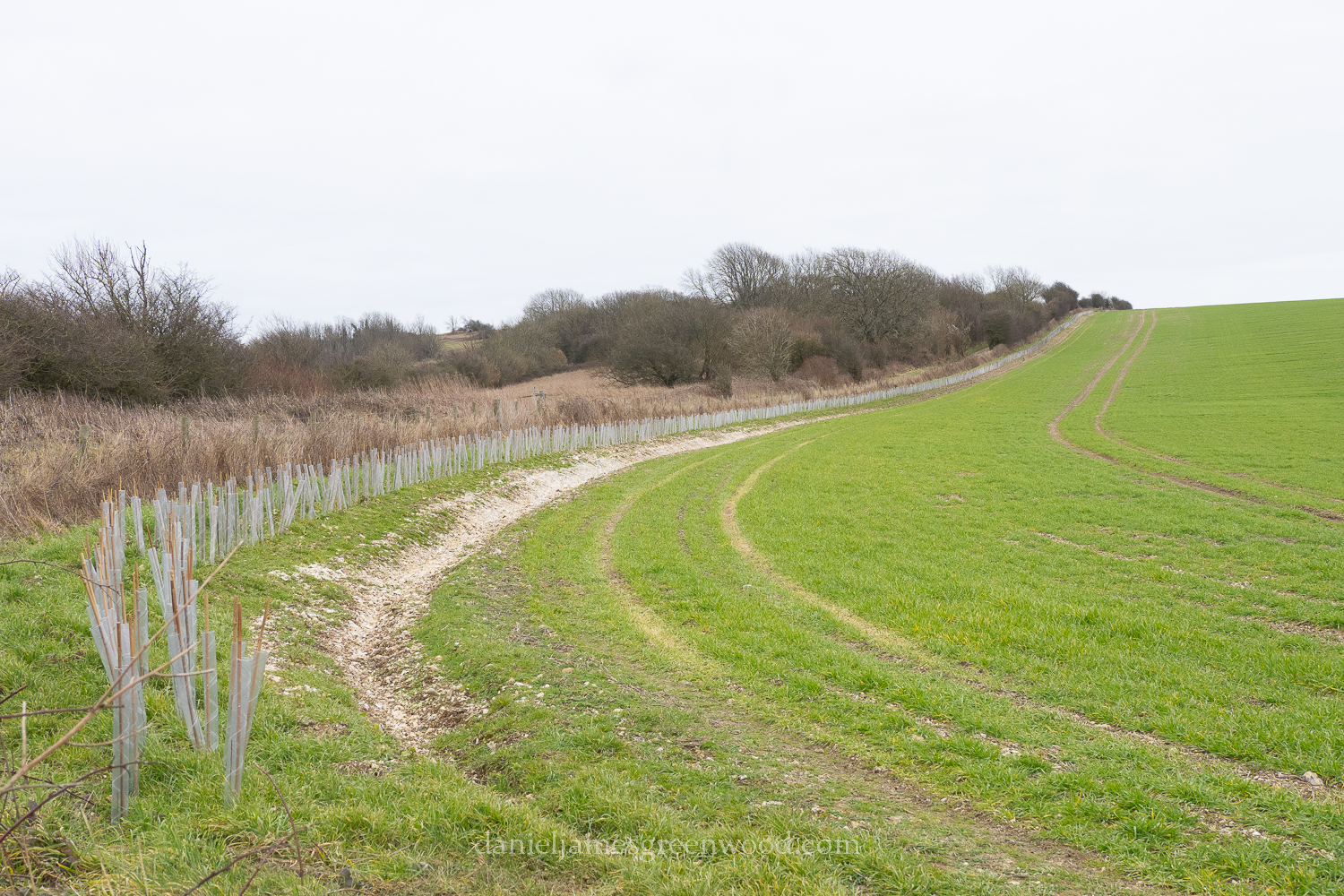
Along the South Downs Way, there was much better news. For miles I observed a trench dug into a farmer’s field and saplings of hawthorn and other native hedgerow species planted. This new hedgerow spread for several miles, an incredible contribution from the farmer, or perhaps volunteers who had been involved. Britain has lost 50% of its native mixed hedgerows since the Second World War and, in a landscape home to declining farmland birds like corn bunting and yellowhammer, this new habitat will make a huge difference.

In this case, the difference will be a positive one.

Thanks for reading.

The South Downs