
Tag: Landscape
Photography: The Bavarian Alps

For John Corr of Mayo, Eire

Essay: John Keats and how nature makes us feel so small
John Keats (1795-1821) died aged 25 thinking himself a failed poet. Today he is revered as a great. I mine his poems for evocations of nature, the nightingales, the bees ‘bustling down in the bluebells’, and his recurring musk rose. For these moments, from a wet and gloomy winter, I find great pleasure in peering back 200 years to Keats’s descriptions of a London that had not yet swallowed Hampstead entirely, or my borough, the 800-year-old parish of Lewisham. In Keats’ Ode to a Nightingale, he describes much of what makes birdsong a cure for human pains, the continuity of wildlife and nature gives us a place in the world, for we are not the first to hear a blackbird, song thrush or nightingale sing, nor will we be the last:
Thou was not born for death, immortal Bird!
No hungry generations tread thee down;
The voice I hear this passing night was heard
In ancient days by emperor and clown (p. 220[i])
Birds do not discriminate against any audience, their songs can be heard by any person who happens to be passing, be it the song of a robin singing at midnight in central London or a nightingale firing in the morning from a blackthorn hedge in a Dorset field. And perhaps real nature conservation has this at its heart, though often unsaid from a fear of sounding eccentric or elitist. Nature is vital to humanity in many ways, humanity is inseparable from nature, but in dealing with dissonance and social discord brought about by contemporary austerity and financial inequality, its inclusiveness is what makes it most relevant to us living in the 21st century. The song of the blackbird can be heard by anyone who might happen to hear it, more so if conservation is supported by communities and authorities.

On a recent visit to Dumfries and Galloway in south-western Scotland I brought Andrew Motion’s hefty biography of Keats with me. It appears more and more that it is not so much Keats’ poems I like the most, but the many aspects of his story, which poetry seems such a big part of. He lived a very short and full life, his published poems barracked by what we might today equate with critics or journalists of the propagandist right’s ilk. And many people thought that he had died from the heavy blows of his critics. Motion points to his wildly ambitious walking tour of Scotland and Ireland, arguing that it was the conditions a weary and exhausted Keats experienced on the Isle of Mull that began his descent into critical illness. Keats had embarked on a mission to collect experiences to influence his writing, and he was astounded by Scotland’s sublime mountains and wild landscapes. He ‘forgot himself’ and found that nature took away all resentment he might have for other people, or his critics, at that time:
The space, the magnitude of mountains and waterfalls are well imagined before one sees them; but this countenance or intellectual tone must surpass every imagination and defy any remembrance. I shall learn poetry here and shall henceforth write more than ever, for the abstract endeavour of being able to add a mite to that mass of beauty which is harvested from these grand materials, by the finest spirits, and put into ethereal existence for the relish of one’s own fellows. […] these scenes make man appear little. I never forgot my stature so completely – I live in the eye, and my imagination, surpassed, is at rest. (p. 269)
Keats has been knocked down by nature’s visual power and, eventually, by its impacts on his body. He cracks open the heart of the genre of nature writing. Surely the whole point of casting nature as the central theme in anything is so that ‘these scenes make man appear little.’ In the face of the sublime image of Scottish mountains, human problems are made to feel minute. It’s the same feeling people experience today in British woods, on those same Scottish mountains and by the sea. Surely if Keats were alive today his thoughts might have turned to conservation of larger landscape areas – in the same way that his biographer, Andrew Motion, once Poet Laureate, now works for the Campaign to Protect Rural England, defending National Parks from a development lobby which seems to hold sway with government. National Parks are an idea created by John Muir, the Scottish adventurer who helped to found Yosemite National Park with his grand and flawed ideas of wilderness. In Scotland, protected landscape areas such as the Trossachs National Park, Cairngorms National Park and Galloway Forest Park are key to preserving the impact of those places on the human mind, at the same time protecting their prehistoric ecosystems and wildlife. A National Park or protected landscape area is an admission or celebration of the fact that nature can show us how small we really are. For John Keats and visitors to mountains today, if underestimated or not treated with respect these landscapes and their conditions can kill.
[i] The Complete Poems of John Keats, Wordsworth Poetry Library, 2001
© Daniel James Greenwood 2014
Photography: The Kingdom of Moravia, Czech Republic

Photography: Ludwigsthal, Bavarian Forest, Germany

Click through to see the full album.
Cerne Valley

Essay: In south London, a place reclaimed by weeds

As featured in The Earthlines Review:
Crystal Palace, London, March 2013
It’s 6:30 am. We’re strolling along the Crystal Palace ridge, a chunk of wild land made up of all kinds of plants, a few notorious for their invasive, disruptive nature. Bramble and nettle are frost-encrusted, brightened as the ice turns to dew in the occasional spillage of sunlight that greets us from the south. When it does appear we bathe in it like a gift from the gods, droning as maybe druids would. The willow catkins are clean through now, many dew-laden, droplets elongating as gravity weighs. Last spring we listened to the call of a lesser whitethroat as it dinked in and out of these willows, its common cousin, the whitethroat, performed mating rituals in a bower of buddleia, diving into the cover of bramble at the farthest tip of the palace’s former standing, now marked by a solitary white bracket. Buddleia grows on the ridge in large sprigs, still harbouring last year’s brown cones of flowers that will be purple in a few months. Elder leaves escape their buds a little early in this still wintry weather, green sleeves unfurled but perhaps thinking the better of it. The mutilated stalks of Japanese knotweed are the only signs of intervention but for discarded beer cans and a few muddy desire lines. The scene is punctuated by crows sat idly in birch and sycamore trees that have grown in the cracks of the palace’s old stairways, immortalised in stone. These walkways, presided over by headless statues and sphinxes, are now engulfed by green and yellow lichens. As for the living, we aren’t the only people visiting: dog walkers, joggers, cyclists, commuters all make their passes before us. A dog with a stick in its mouth accosts us out of curiosity as we regard a song thrush singing in an ash tree, the dog turning its head and smacking fellow birdwatcher Lisa on the back of her leg. It seemed to hurt.
The view below is of open parkland where crows and black headed gulls saunter, pulling worms from the always waterlogged ground. Every so often the crows leave their perches in the palace’s trees, returning a few minutes later with large morsels of white bread in their bills. It’s almost impossible to see if a bird returns to its perch, such is their uniform blackness. This is the highest point in south London, higher still is the television mast that reaches upwards into the sky. Last year we watched a peregrine falcon using the mast’s very top as a perch, a pair of sparrowhawks coasted from even higher. The memory brings vertiginous feelings. The view is south to the North Downs, the Dartford Crossing to the east, visible in the orange morning sky. Chimneys and flues are blowing white smoke up into the air, beyond the Crystal Palace athletics stadium, a site that without the development of the Olympic Stadium in east London would be England’s national athletics arena. Unbeknownst to most, a long distance marathon has taken place here for millennia. Migrant birds have historically chosen the Crystal Palace ridge as a spot to drop in on, with swallow, redstart, willow warbler, chiffchaff, blackcap, whitethroat and wheatear having been recorded in recent years.

The Crystal Palace’s relocation to Penge from its original siting at Hyde Park was completed in 1854 and caused a global stir, attracting visitors from all over. The Crystal Palace High Level railway was built to serve the palace, a trainline which has now been reclaimed by nature in the form of Sydenham Hill Wood, Brenchley Gardens and the Horniman Nature Trail. The Crystal Palace burnt down in 1936 and the trainline was closed in 1954, leaving a footprint of paths interrupted by housing estates at the ghosts of Lordship Lane and Upper Sydenham stations. Train tunnels were built underneath roads and excavated through the ancient Dulwich and Penge woodlands, now home to bats like the brown long-eared. Go back a few hundred years and Crystal Palace would be entirely different, even further than its enclosure as Penge Place in the early 1800s, and its original incarnation as Penge Common. Penge translates from the Gaelic as ‘the end of the wood’, a wood that was known as The Great North Wood, a landscape of commons and coppices that stretched from Deptford to Selhurst. It was deemed ‘North’ because it was the great wood north of Croydon, a thriving market town. Locals from the surrounds would make trips here to Penge Common to listen to nightingales, a bird that has disappeared from the area, and is suffering similarly staggering declines nationally.
Perhaps there is some irony in the fact that Crystal Palace fills me with a sense of nostalgia, for the Arcadian past of Penge and the Great North Wood. It’s an emotion that the Victorians made their own as a visit to nearby Dulwich Upper Wood and Sydenham Hill Wood proves. The Victorian villas built along the Sydenham Hill ridge are now gone, their footprints straddled by regenerating hornbeam, oak and new woodlands of sycamore and ash sprouting from the basements, as well as the invasive laurel and rhododendron planted in their gardens. At Sydenham Hill Wood a small folly remains, a remnant of the Sydenham Hoo and a feature of its vast ornamental garden. There’s a picture on the Internet that shows this very garden, with a small shrubby evergreen which now stands as a mature cedar of Lebanon. I share Victorian nostalgia instead for a world that much of their development denuded. The Crystal Palace brought unprecedented change to the Great North Wood. But then there are records from the time of the Crystal Palace High Level railway suggesting that in the immediate aftermath of the development birdlife still thrived. Bullfinch, tree pipit, wryneck, spotted flycatcher and wood warbler were all known to nest in the area, and some locals will point to the fact that bullfinch and spotted flycatcher only stopped breeding in the area in the late twentieth century following a national trend. In the grounds of the palace tree pipit and hawfinch were breeding birds, the latter thought to have bred in Sydenham Hill and Dulwich Woods until the 1980s. What concerns me about the run off from the Crystal Palace’s legacy is how the ridge will be treated in the next 100 years.

There is a masterplan to redevelop Crystal Palace Park and bring the ridge into the same aesthetic bracket as the lake and waterfall features that remain from Joseph Paxton’s pleasure gardens down at the bottom end of the park. In previous decades there were proposals for a casino and other grandiose leisure complexes which have disappeared from the agenda due to public opposition and lack of funds. Some of the park, registered as Metropolitan Open Land, is being earmarked for the development of apartments, a decision upheld by the High Court in June 2012, to the grave disappointment of the Open Spaces Society, the Crystal Palace Community Association and London Wildlife Trust. What makes the Crystal Palace ridge unique is the lesson it can teach us about our design, about what truly lasts. The Crystal Palace was a grand and ambitious venture but like the villas painted across the Sydenham Hill ridge a mile away, it was too grand to last. Looking here at giant stone stairwells with pioneer woodland trees like birch and sycamore escaping from the cracks, headless statues reawakened by the figure of a perching crow, and the only remnant of the palace’s outer shell sitting alone on the wildflower-enveloped ridge, the feeling is not one of defeat. Over on the grass banks of Crystal Palace Parade where buses terminate and begin journeys to places like Elephant and Castle and Blackheath, a line of plane trees was planted to signify the footprint of the old palace. The masterplan includes proposals to plant a new tree palace along the ridge and to landscape it. If this is handled without due care and consideration, it could lead to the loss of good, wild habitat home to breeding song thrush, dunnock, blackcap, chiffchaff and whitethroat amongst all the other wild plants and creatures thriving in a space where wildlife has been allowed to thrive without much intervention. The palace has grown back in its own way, in the birch and sycamore palace escaping from the cracks in the steps, yet to reach the old palace’s heights. In truth, I wonder why we are so desperate to master the land, to make a statement of it. There is more pleasure in observing the movements of wild birds each spring, in listening to their songs, than in attempting to control them. I hope there comes a point where we can step back and allow the land to recover from our past mistakes. For us birdwatchers it will be a case of watching, listening and waiting.
Wild goats

Ox Mountains, Co. Mayo, Ireland
Horse on the moor
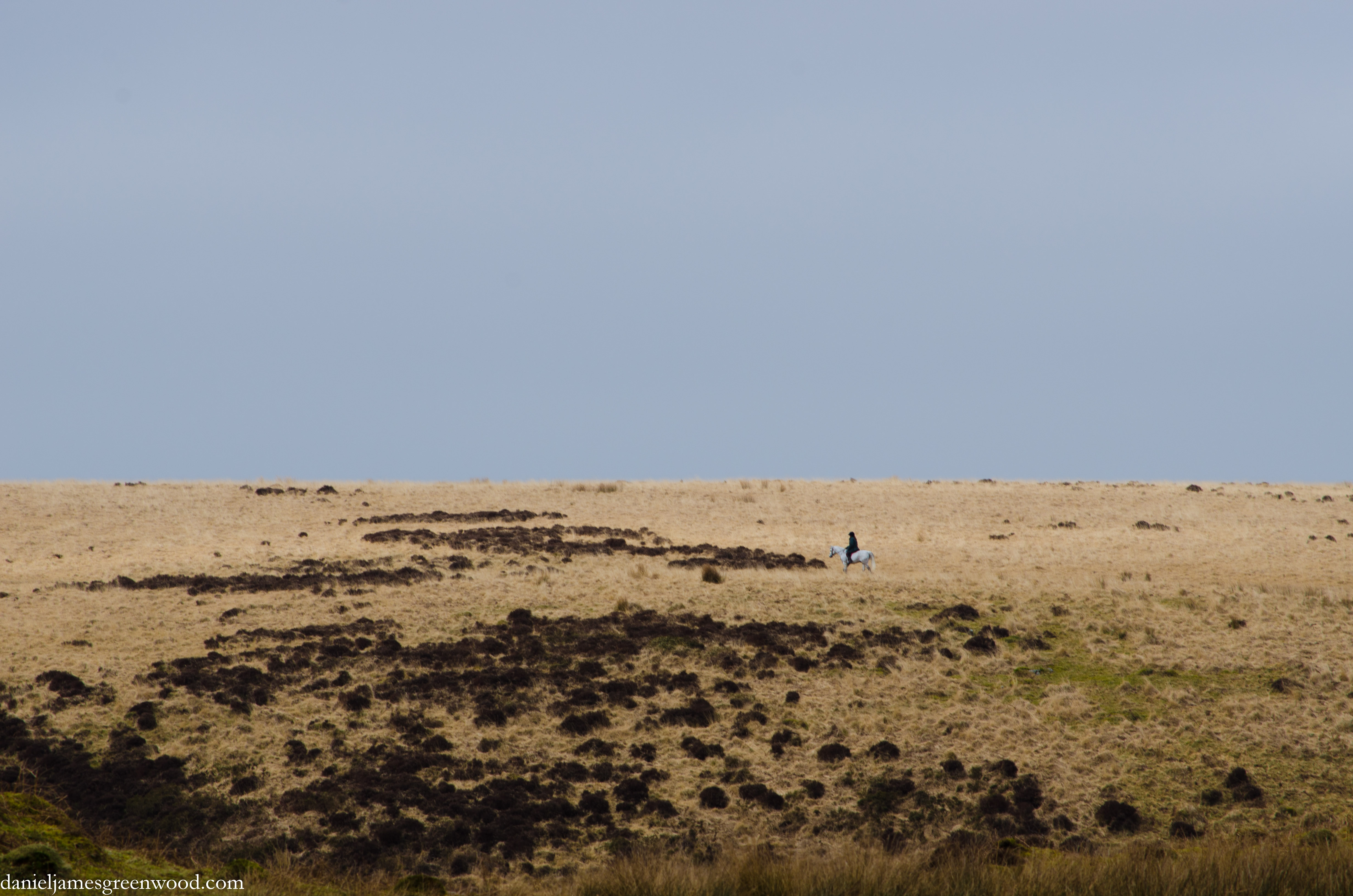
Exmoor National Park
© Daniel James Greenwood 2013
 Unlocking Landscapes