This is an expanded version of an article that was first published in London Wildlife Trust’s Wild London magazine
It’s a sound that stops many in their tracks, the rattling in the canopy of woods, parks and gardens. It’s a sound that brings in the new year, signs of spring breaking through as our own seasonal celebrations draw to an end. While we are still deep in recognising our need to rest in the midwinter, our wildlife is busy setting out its quest for new life. Britain has three species of woodpecker and in January we begin to hear the hammering, or drumming, of the great spotted, the sound of male birds marking new territories. It’s a bird that is becoming more and more familiar to us in London as its numbers increase.
Its favoured habitat is oak woodland with plenty of rotting branches, trunks and limbs in which to create a new hole each year, ample habitat for the biggest of our two Dendrocopos woodpeckers, the great spotted. Dendrocopos translates from Greek as ‘wood-striker’.
One thing I have noticed in suburban locations is the woodpecker drumming on TV aerials and receivers. One great spot I’ve seen has found the plastic box now employed to improve TV signals makes decent percussion. It’s a wonder that this hammering on hard surfaces doesn’t cause the birds injury, but evolution has equipped them with shock absorbers in the back of their skulls that cushion the blow. It’s not the same as banging your head against the wall.
There are four members of the woodpecker family deemed native to Britain, with one now classified as extinct as a breeding bird. That is the wryneck (Jynx torquilla), a bird that migrates from Africa each spring in small numbers still. In 1904 a wryneck nested on south-east London, what was thought by the observer to be one of the last nests in his time, in south-east London historically.
Another of our four species has declined at a rate that has baffled ornithologists. The lesser spotted woodpecker (Dendrocopos minor) was noted in south London’s woods up until 2008. The odd autumnal record does crop up as the lesser spots are migratory, with one seen in 2015 in Brockwell Park in Lambeth.
Lesser spotted woodpecker
One possible theory for the decline of lesser spotted woodpeckers (above) relates to the rise of the great spot and the disappearance of starlings from London’s woods as a breeding bird. When starling numbers were higher in woods they provided more competition for great spots.
This gave more space for the lesser spots, being much smaller, about the size of a sparrow or starling. As starlings and their ruckus have left the woods, the great spots have increased in number as they have experienced less competition and adapted to the boom in garden bird food. Lesser spots require a smaller hole in a tree to nest and if a great spot chooses the nest they can make the hole bigger and the lesser spots are pushed out.
Lesser spotted woodpeckers, however, are not extinct like the wryneck as a breeding bird and they still have strongholds in the UK. The most important place for them is the New Forest, one of the mythical heartlands of ancient English woods. There the management of the woods has remained the same for centuries, pointing to another reason for the species’ decline elsewhere. British wildlife is under increasing pressure from development and the loss of available food due to wider intensified management of the countryside.
So the two factors which are most harming lesser spots, and starlings, too, are a lack of habitat and food. The loss of food is a loss of invertebrate life being driven by agricultural intensification and a tidying up of green spaces, loss of gardens and general overuse of harmful, residual pesticides. Another key change is the loss of old orchards, another traditional habitat disappearing in Britain, one of the lesser spot’s favoured habitats.
The other member of the British quintet, if including wryneck, is the green woodpecker (Picus viridis). Green woodpeckers are different to the spotted woodpeckers because they don’t hammer to mark their territories but instead call, what was known for centuries as ‘yaffling’. An old name for a green woodpecker is ‘yaffler’. It’s a call that can be heard most clearly in woods and parks with mature trees, where green woodpeckers also nest.
Oak woodland is a key habitat for woodpeckers
The call has a prehistoric feel about it, echoing deep into woodland, as the reverberation recedes. Greens differ again from the spotted woodpeckers because of their feeding habits, spending their time searching for ant colonies in woods and lawns. Naturally grassy sports pitches with a surrounding area of mature trees are a good place to find the birds. They lie low, shooting their long tongues down into nests to find food. It’s something you are very unlikely ever to see a great spotted woodpecker do.
For those curious and unsatisfied by the array of woodpeckers in London, remember that you will have to travel to continental Europe to find a greater diversity. Arriving in France you could meet with the biggest of all the European woodpeckers, the black woodpecker and heading as far as the great ancient woods of the Czech Republic, Poland or Romania, you can find as many as seven species. In British terms, the health of London’s woodpeckers reflect the state of the nation’s.
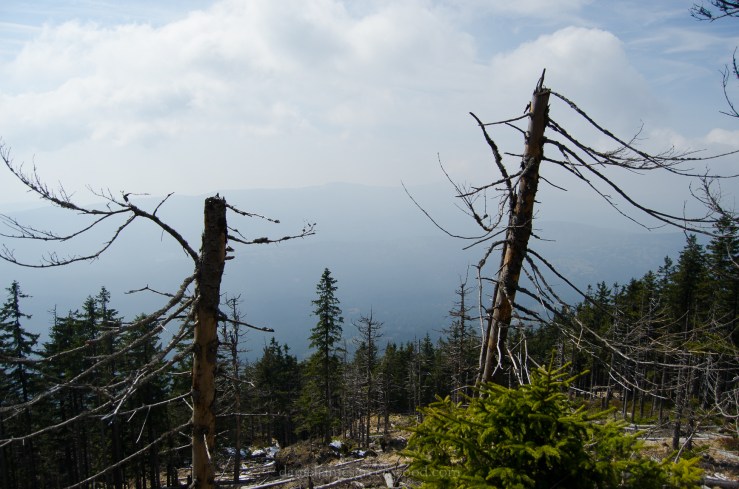
In April 2014 I visited the Bavarian Forest, a landscape which, combined with the neighbouring Bohemian Forest in Czechia is the largest area of protected woodland in Europe. The Bavarian Forest or Bayerischer Wald, contains populations of lynx. In recent decades an outbreak of the spruce bark-beetle has devastated areas of conifer woodland. It is a remnant of the once vast Hercynian Forest.
The Bavarian Forest, Germany, April 2014
They burst from the slabs of granite like stony pillars. They are beech trees and they mask the view on all sides. They are giants imprisoning me on the path to Groβer Falkenstein. They are elephant limbs, they are victims of metaphor. Beneath them is a sea of copper and golden brown. The wind moves through last year’s fallen leaves and I think for a moment that it may be the sound of footsteps. Chunks of shining granite and smatterings of plant life break the spell of the endless leaves. Wood anemones, even this high, have opened their petals to the sun breaking through these yet leafing beeches.
I’ve travelled here over land and left the anemones coming towards the end of their annual cycle in London’s oldest woods. We have that in common, then, both species attempting to move through the woods of western Europe. Back home, I do my best to help them. Amidst my minute understanding of German and the feeling of isolation that brings as a lone traveller, I do get a sense of home from these white buttercups. Wood anemone is not the only plant to have made it up here, wood sorrel, one of the most common wildflowers in the Bavarian Forest, sits with its flower heads drooping, its leaves like the club from a pack of cards, still to be revealed. I continue on, touched by vertiginous thoughts as the path slaloms through the beeches, the mountainside steepening.
A stream channels its music to my ear and the familiar spread of marsh marigold, a buttercup that I’ve planted in the marshy woods back home and dunked into my parents’ enamel sink-pond by the kitchen window. Yesterday I feared hypothermia in the snow around Zwiesel’s mountains but today I’m in a t-shirt and a large orange butterfly bursts across the stream. It drives around me in a circle, never taking a moment to rest, it must still be too cold for it to pause too long. Butterflies need a body temperature of about 32 degrees to fly and forage properly. They often hold their wings out to trap hot air and warm their hairy bodies. It’s not as simple a manner of basking as it may seem. I think it’s a silver-washed fritillary.
I have come to the continent with a sense of something missing from England’s wildlife. This butterfly is one that was more common in England but has declined. It is a butterfly of woodland rides, laying its eggs on dog violets, plants which grow in my front garden and in our local woods. Last August in London I visited the doomed Heygate Estate in the Elephant and Castle to shadow an invertebrate survey with local entomologist, Richard ‘Bugman’ Jones. Led through the fencing by private security guards with gigantic German shepherds caged in the boot, we stepped out onto the parkland under the shade of cherries and mature London plane trees. The flicker of a butterfly’s wing caught my eye and Richard threw his net into the air. Looking at the contents we discovered a silver-washed fritillary. I could not quite believe it.
There is a sudden drop in temperature as I turn up the path, a chill wind skis across. In the shadows beneath boulders sits the remnants of yesterday’s snow. The spruce trees return, the snow thickening, slush on stone a recipe for serious injury. This is primary spruce woodland, or natural forest, formed without the helping hand of humans. However, the dominance of spruce lower down is due to the intervention of foresters (förster) in the first half of the twentieth century, as in England, when timber was needed to fuel either side of the world wars. It is telling – one of war’s casualties are woods.
From the boulders comes the drip of melting snow. Through the trees I see a large house that marks Groβer Falkenstein’s height of 1315m. A whisper passes through the highest spruce trees. A number of trees have been felled, the stumps cut with chainsaws. The ‘step cut’ in the stumps is still there, the torn wooden ‘hinge’ which the forester leaves intact and that helps guide the tree in the right direction when falling, throws up splinters.
I hear voices, laughter and that peculiar zenith-community that exists atop well-attended mountains of this kind. Four happy Germans appear to be double dating. I sit on a picnic bench by a cleared space of spruce, the scene hazy at best, the cloud cloaking the valley below. I hear a dunnock singing, a shy garden bird that instead nests in dense upland spruce plantations in this part of Europe. I eat some nuts and chocolate and head past a lady walking a hund, to the other side of the peak. The snow is deep, I clamber over spruce trunks to get to a plateau. One path back down has been closed due to nesting peregrine falcons. In London, 2014 holds 27 pairs.
I take a seat down on some soft, dead grasses, all around me are the dead and rotting stands of spruce said to have been killed by a spruce bark beetle outbreak. Many of the trees have been allowed to rest for fungi and other smaller, subtler wildlife, one of any woodland ecosystem’s most important aspects – the recyclers. I take it all in – the hazy folds of mountains, the glistening rooftops of immaculate Bavarian churches and towns. I head off and down through the spruce woods, under the song of the ring ouzel and firecrest. This path will take me to the realm of the lynx.
In September 2017 I visited the White Carpathians on the Czech side of the Czech-Slovak border. The White Carpathians hold wood pasture meadows with the highest plant diversity on Earth per square metre. This is a landscape heavily impacted by people but may be fairly close to the pre-human ‘wildernesses’ of Europe. Here conservation efforts have yielded great success in preserving part of a once international wildlife corridor.
The White Carpathians, Czechia (a.k.a Czech Rep.), September 2017
The sun beats down on the village of Vápenky and in the trees high winds blow off from over the White Carpathians. The sky is a deep, summer blue but in the orchards the colours of autumn are appearing. The meadows are dry and grain-coloured, red apples and green pears drop into the cropped grass.
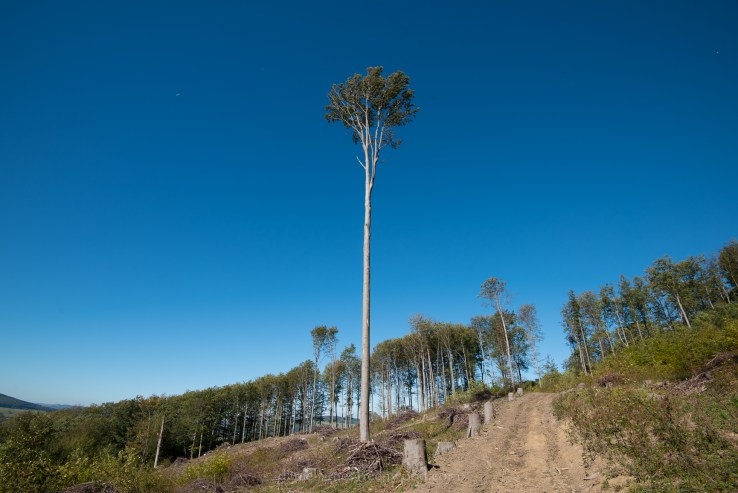
We follow the forestry road through tall beech woods that stand like the framework of a cathedral incomplete. The wind lashes them but some stillness rests in the opening low between the silver-grey trunks. The limestone quarry track bends up and over into a clearing where the forestry machines have deeply rutted the road. They have also cleared the trees but for one long, thin beech that stands alone, its bark bleached by the sun.
The landscape of a recently deforested area is shocking, wreckage. But this industry is one of the most important in the whole of Czechia. Many lives are sustained by it. Still, I wish we could find a way for horses to still remain an integral part – something I’ve seen in Romania – and that its culture was not so macho, chauvinist and driven by putting profit above good ecological stewardship.
The clearing of trees has opened up views of the valley, showing forested mountains and peach rooftops. For a country that is nowhere near as pious as neighbours Poland and Germany, each village or town has it church, climbing above all else.
We are looking for a nature reserve called Porážky but our map failed to show the road we were taking some time ago. We speak to a Czech woman heading down a track with freshly picked parasol mushrooms in her hand. She points us back up the trackway, fingernails cut and painted indigo, her hair dyed reddish-brown.
The end of forestry land is always marked by a boost in tree diversity. Here hornbeam, a tree of no forestry value, grows. So too hazel, oak and small-leaved lime – the Czech national tree. These are all species of the pre-industrial forestry age, wildwood species of great use to human hand and hearth, but not the modern machine.
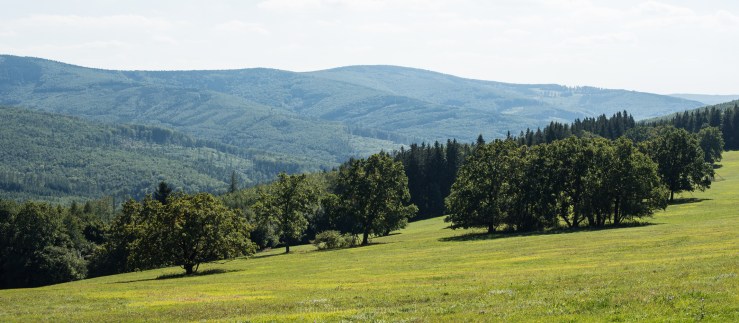
Light breaks through the edging of broadleaved wood to reveal grasslands and the sky atop the hill. Again the wind gusts. Reaching its top we enter Porážky, the protected area of wood pasture we had hoped to find. The landscape is cropped grass and single oaks. You would have not the slightest idea that these are the richest meadows on earth.
They are a man-made and exploited habitat, but they are the truest symbol of harmony between people and nature. In fact, they may even be closer to what the pre-human woodland landscape of Europe was like, due to the cropping of large, roaming groups of wild grazing animals we have now made extinct. ‘Rewilding’ in its purest or most puritanical form wants that world back.
The White Carpathians are the lowest lying, most westerly extent of the Carpathians massif, stretching east to Romania where they reach their zenith. It is a landscape that holds great mystery, wildness and fascinating human cultures. What a life it could be to travel back and forth across the range, witnessing its wildlife and spending time with the people making a living from its soils, woods and meadows.
Eddie, my hiking companion, and I, have been to their furthest point, and there, too, are found meadows of great diversity. In Romania ancient traditions are dying out as people move to cities – what contrarily is thought to be the driving force behind the return of wolf, bear and other megafauna – the rewilder’s dream. In the White Carpathians conservation initiatives have led to the protection of the meadows and their continued management.
Two days ago we visited the headquarters of the Bílé Karpaty protected landscape area or CHKO in Veselí nad Moravou where we learned that one of the great successes for the organisation has been the return of orchards to the landscape. Vast tracts of this landscape have been returned from arable farming to species-rich grassland, righting wrongs of the post-war Soviet era. Fruit trees have returned because they offer something in return to local people – fruit.
Here in Moravia the Czechs have achieved great things. Grasslands are the most threatened habitat in the world, due to intensive agriculture, afforestation and development, and they have succeeded in both conserving what remains and bringing it back in other areas.
I have recently taken an interest in the Twitter account of Tibor Hartel, an ecologist in Romania whose work includes the mapping of ancient wood pasture. Unlike Czechia, Romanian wood pasture is poorly protected and local groups and individuals must act independently to save these amazing places often, it would seem, without government help. Imagine that this landscape once ran across the Carpathians, from Moravia, through the Ukraine, to Transylvania in the eastern corner of Europe. Even Prince Charles has taken an interest.
Walking through Porážky it has the feel of an English parkland, the single oaks dotted amongst the green. I first visited here in 2014, hiking over the meadows with Libor Ambrozek, the former Czech Environment Minister and then head of the White Carpathians protected landscape area, or CHKO. I was blown away, the sheer abundance of orchids and the fact of its singular richness. In May 2014 a storm blew in and we were drenched in the open pasture. Today the wind overwhelms and the sun bears down, the glare intense.
Jays pass almost every few seconds, back and forth to stash acorns. They are in the process of ‘scatter-hoarding’, the act of burying acorns in places that may well one day grow into the new oak trees of this landscape. These are birds in an autumn-pique. Beyond them buzzards soar but the wind deters the smaller species. In the grasslands clouded yellow butterflies feed on knapweeds and dandelions, red admirals bolt from the dark plantations. We find a single aspen, its trunk crooked, whipped north by decades of strong winds. Half its canopy shows red in its leaves.
To many this kind of landscape is at odds with the contemporary ethic of rewilding, or ‘allowing land to return to its natural state’. If that were to happen here many species would become extinct. One plant clinging on, Pedicularis exaltata, a species of lousewort, is only found in this area away from other localities in Belarus, Ukraine and Romania. Its presence suggests a once-continuous wood pasture landscape across the Carpathians between the Czech-Slovak border and eastern Romania. It can’t be seen today as it flowers in spring and summer. Instead the ground is dotted with meadow saffron, a pink crocus.
The wood pasture as it looks today was created and ‘refined’ thousands of years ago by people clearing woodland – likely of oak, ash, hornbeam and hazel – to allow their domesticated cattle and goats and Mesopotamian sheep to graze. At least that is the common understanding, for could the presence of large, roaming groups of wild horses, bison, elk and other herbivores have meant a landscape more open than the idea of coast-to-coast closed canopy woodland? Compared with today’s measure, the deforestation work of our species was sustainable deforestation due to the population sparsity, moving a possibly more dense wildwood to something more open in places.
The current management and conservation of wood pasture relates to the belief that habitats which are species-rich are the ones which are most important and valuable. But they need to be maintained. If their management involves local people, provides sustenance and perhaps employment, it will work, especially in a place like Czechia. This may lack the perceived poetry of rewilding, but its practicality brings results: the continued existence of the world’s most important wildflower meadows and all the other chains of life which depend on them.
With thanks to my travel companion Eddie Chapman, friend and guardian Zuzana Veverkova, Ivana Jongepierova and everyone at the CHKO office.
I’ve created a map of my blog posts, stretching from the west of Ireland to the edge of Europe in Romania. Websites are tricky to navigate when they have as much content spread around as I do here so I thought this might help. I am also keen to promote Europe-wide conservation measures from this tiny corner of the internet so this encapsulates that nicely.
The North Downs diary feeds out of south Croydon through a link to all the posts rather than individual posts all the way across the Downs, something I may come to change. I’ve done the same for the New Forest. If you have any thoughts on this, please let me know. I will edit it over time as new pieces are added.
This is an expanded version of an article published in the winter 2017-18 edition of London Wildlife Trust‘s Wild London magazine
As autumn draws to a close, the bare branches of trees stark against wintry skies, we find ourselves on the tail-end of a mast year for London’s acorns. Mast is another name for nuts or seeds, with beech nuts often referred to as ‘beech-mast’. It means a time when the weather and temperatures in spring and summer have created the right conditions for a bumper crop.
Oaks are wind-pollinated, one of nature’s first reproductive mechanisms for plants that evolved very early on land with the arrival of spore-bearing mosses hundreds of millions of years ago. Trees like cherry and others in the rose family, are pollinated by bees, butterflies, moths and flies.
Though cherries are far tastier than acorns, the oak’s fruit is one of the most important to us for several reasons. When acorns fall many of them will simply fail in the leaf litter or decay away to feed the soil. Birds like jays will stash acorns and plant thousands of them to keep them alive over the winter. Grey squirrels do exactly the same.
If you think about it, and scientists have been, this is one of the most important vehicles for woodland creation on Earth. It’s also one of the reasons that oak woods were able to recolonise the Northern Hemisphere after the end of the last glacial period some 12-14,000 years ago.
If any of those jays died or forgot some of their acorns, they sprouted into trees and woods, many of which would eventually form great woody landscapes adapted and exploited to what we now know as the Great North Wood, Epping Forest, the Weald and the New Forest.
Oak mast
In North America there were entire cultures of Native Americans who built their lifestyles on a diet of acorns. Beneath their shells acorns are nuts that can be ground down for flour, coffee or even jelly.
In Britain the hazelnut is one of the single most important food sources for our species, especially before the advent of farming when hunter gatherers relied on foraging to survive. Archaeologists have found regular evidence of hazel nut shells at prehistoric settlement sites, sometimes in vast numbers. There is also evidence that our ancestors cooked hazel into a paste that could be taken on long journeys.
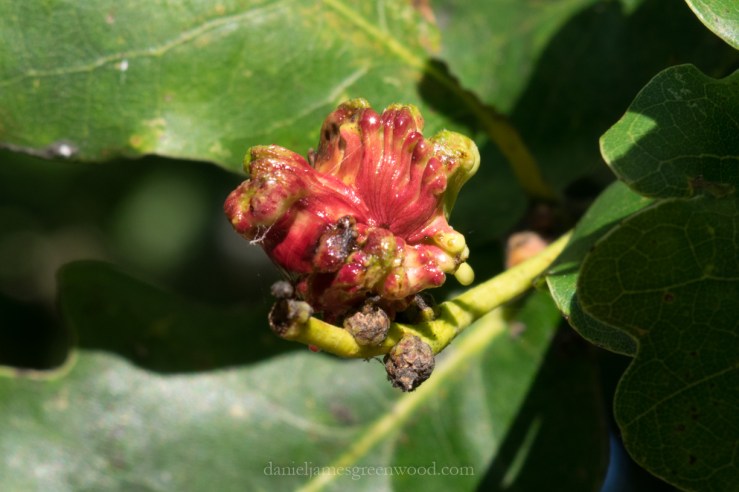
But perhaps the most fascinating cultural impact of the acorn is when it is missing, and in its place a parasite. In the spring tiny parasitic wasps appear from galls, a growth (sometimes referred to as a tumour) that has prospered in the place of an acorn, and lay their own eggs in an acorn bud. A chemical reaction takes place in the tissue of the plant and a gall is formed.
There are many species of gall, and many of them are not instigated by solitary wasps, but one of the most significant for human civilisation is that of the oak apple gall.
The oak apple gall was imported to Britain over a 1000 years ago for its prime use in the creation of ink. The galls can be ground down and mixed with chemicals to make a black ink. It was this ink that was used to write almost all of the major doctrines and political agreements in the western world.
The Magna Carta and the American Declaration of Independence are but two of them and, indeed, that sylvan scripture known as the Forest Charter of 1217 will also have been transcribed in oak ink. Amazingly, it was only in the 1970s that the German government stopped using oak gall ink for use in all official documentation.
Knopper galls in summer
London’s other notable seeds are those of horse chestnut, beech and sweet chestnut. Horse chestnuts, named after the horseshoe-shape at the base of the leaf stem or petiole when plucked from a branch, are not related to sweet chestnuts. Neither of these trees are deemed native to the United Kingdom, and sweet chestnut sits in with the oaks in the beech family.
If you roasted chestnuts on an open fire at Christmas it will be those of the sweet, not the horse chestnut. Sweet chestnuts are the fruit found inside painfully spikey shells, very similar to the horse chestnut.
For the more childish among us, the horse chestnut is really known as the conker tree. The sight of a glossy brown conker in roadside leaf piles in autumn is a thing of wonder. The maple family’s seeds may not be palatable, but the game of ‘helicopters’ was one of great pleasure for school children before the arrival of smartphones.
Though we often focus on the edibility of plants and their fruit and seeds, the crops of trees like rowan, oak and beech have an impact on the activity and behaviour of birds in autumn. In October there can be seen large movements of jays, with birds acting quickly to secure seeds and plant them in a suitable location.
A jay massaging its way high across an open field, heading to and from an oak or beech wood, is a common sight in the early autumn. Redwing, a winter arrival in the UK, rely on rowan’s bright red fruit. Changes in the Scandinavian crop can trigger the movements of this species south as winter draws in.
Where old, fruit-packed hedgerows still exist in the UK, heavy with rosehips, haws and holly berries, redwings can be found feasting. From places as far apart as rural moorland and urban London, their distinctive but subtle tseep calls can be heard overhead at night.
Those nocturnal calls can be a pleasant reminder of the changing season, of the fundamental need for fruit and seed for the wild and civilised alike.
This is an update on my Oaks of London photography series. The photos have been taken with DSLRs, compact cameras and my phone camera. Rather than trying to put together a glossy array of ancient oak photos, I want to draw attention to the unseen trees fighting it out with modern London, many of which are teetering on the margins. Lack of funding to protect and manage London’s oaks is biting, as is a lack of understanding and appreciation of their heritage and wildlife value. These trees have stories to tell.
Photographing the oaks of London is a fairly impossible but very slow and enjoyable project. South-east London is, quite literally, a walk in the park. Such is the extent of green space south of the river that there are many oaks to be found and some very closely concentrated, especially in Dulwich or Honor Oak, which I covered last year. But moving into new areas can be tricky, London’s oaks are on the margins now, they no longer form the central, spiritual role of Celtic or event recent times, when gospel oaks held prominence in settlements or when the Druids (the knowers of oak) made sacrifices before them, something I am not suggesting we bring back in 2017. One of the things I’ve learned this year, also after having read some of Aljos Farjon’s new book Ancient Oaks in the English Landscape, is that old parks and estates are key to the survival of oaks.
In March 2017 as part of a walk with London Wildlife Trust, we were led by Mathew Frith around Danson Park and Bexley Woods. Two oaks stood out in this walk, an area I would not have known about without the connections I have with the Trust and exposure to knowledge of people like Mathew. One oak, the Bexley Charter Oak, can be found in TimeOut’s The Great Trees of London, and it has a lovely fence around it protecting its root plate. The tree is some 200 years old and reflects the treatment that all these oaks deserve to have, if they stand in similar surroundings.
Another oak is not faring so well and is not treated with the same level of affection, or perhaps simply a different kind. Walking through Bexley Woods and following the river Shuttle east brings you to an oak quite unlike one I’ve seen.
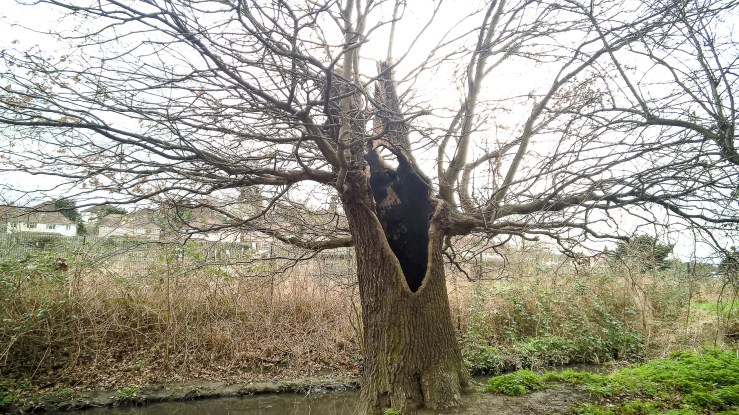
The oak is entirely hollowed out until about human waist-height, with charred sapwood that shows it has had fires lit inside. It is a stunning tree, wild and exposed on the edge of the river and a footpath. It is a symbol of London’s oaks on the edge: unprotected, vandalised but fighting on. The tree still lives. In many ways the actions here of what you can only expect to have been children or ‘wayward’ teens, is a process of veteranisation. The only difference is that rather than being undertaken by arboriculturalists, it’s the unintended work of the public.
Shifting south-west to the boundary of Lewisham and Bromley is Beckenham Place Park. This old country estate, fit with a mansion house very similar in style to that of Danson Park, has open parkland and many fine veteran trees. On the hill is a remnant of the Great North Wood, the typical oak-hornbeam and hazel mixture that can be found in chunks all the way up to Dulwich. Thanks to Lucy Mitchell for showing me round.
The oak featured here is a lapsed pollard, meaning that it was likely once cut back higher up but has, like many old oak and beech trees across London, been left to restructure itself. This oak is somewhere between the two Bexley oaks mentioned above. It needs the care of the Bexley Charter Oak as it is experiencing stress and strain from its exposure to footfall. Looking closely at the buttresses you could see that dogs had been digging holes, pooing on the roots, and that the collective trampling was exposing roots in some places. It’s a tree you just want to hug and climb, but its spot right there in front of the house leaves it open to quiet, unintended harm.
In Roydon Woods the sycamore leaves are falling. Though they won’t lie for anywhere near as long as beech leaves, they are something of a sheet across the ground, like papers dropped and never collected. One leaf is caught on the barbed wire of the neighbouring fenceline, and I never can tell whether it’s the work of the wind or someone trying to make a point.
Over the past few days rain has returned to southern England. But if you put a spade in the ground the dampness is only a few millimetres thick. It doesn’t bode well for a mushroom search.
Earthballs sit as their name suggests, as scaly mainstays. Clouded funnels, their caps like an Americano dusted with air pollution, have fruited and now teeter on crumbling stipes.
A low roar carries across the open wood, where deer have established a browsing-line removing the thicket layer. It’s not the sound of a machine but a rutting stag. It is their time. Content that its voice is distant I carry on along the path, drifting off on occasion to find softer layers of leaf litter.
The stag roars again.
In amongst stumps and mosses are miniscule bonnets, perhaps. They fruit so quickly and root only lightly. In another spot a patch of orange waxcap-like mushrooms bulge, beside them a row of coral fungi that are only seen after the long pause of wondering what the orange ones might be.
Crouched down with the coral a grey blur passes in the corner of my eye. I look up – nothing. The sound of galloping hoofs and a female deer is chased by a stag with a small set of antlers. Remaining still, not twenty-feet away I look back to the path, and join it again. The deer, with its white tush and black-edged buttocks, watches me with its head turned, I walk on so as not to become part of this conflict, the stags still roaring in the distance.
I stop for lunch and to write this under a favourite beech tree. There are lots of animals moving around where I sit. A flock of blue and great tits hop around the leaves of fallen branches, a frog leaps out from the remnants of a children’s weekend den. It gave me a fright, a wood sprite bursting into life.
The rule is simple: sit, wait, be still, be silent, and you will see things.
From the field at the edge of Roydon Woods the horses are startled and begin to gallop. I stand to look and along the adjacent path a stag trots, horse-like, too. He, again, is twenty-feet away. He sees me, stops and heads off into the dead bracken and birch trees that surround the beech tree I stand under.
I think it’s gone, but looking again I see a pair of antlers facing me in the bracken. Then I see its eyes, it watches me, head on. Then it runs away, crashing through thick, hard bracken and birch twigs.
Worried by its closeness and size, I get moving again back towards the path. What I think is a false deathcap mushroom sits under leaves at the edge of the bank.
A gun shot is fired, one more, and another.
It rings out, fading into the open woodland like a vapour. The stag – the shots came from the direction it had headed into. I recall its face, perhaps that first gallop, was it running for its life?
In September 2017 I visited the Pálava Hills in south-eastern Czechia, close to the border with Austria. Beginning at the Archeopark Museum in Pavlov, where an exhibition of some of the most important Paleolithic finds ever were on show, and finishing in the town of Mikulov, I try to capture the world of our hunter gatherer ancestors, the Gravettians.
I take the road up towards Děvin, a hill where Děvičky, a ruined 13th century castle faces out towards Austria. From the surrounding vineyards sounds the booming of gas cannisters designed to deter flocking starlings from eating the grapes fruiting at this time of year. A church stands in the heart of Pavlov, and a small murmuration of starlings swoops and morphs in search of a perch. The faux-shotgun fire is working. I pause at a bench overlooking Dolní Věstonice, and north of this a village now flooded after the damming of the river Dyje. Long before the flooding, some 30,000 years ago, a tribe of people known as the Gravettians kept watch from the hills with small encampments and fires. When herds of reindeer and roaming mammoths entered the valley they lit fires to signal that the time to hunt had arrived.
Down in the village of Pavlov the Archeo Park Museum protrudes from the grass bank like fragments of chalk, perhaps an attempt to reflect what’s kept inside – some of the most revealing human artefacts ever to be found. In this area of the Czech Republic, now known as Czechia, evidence has been found to show that hunter gatherers, the Gravettians, lived in these hills approximately 30,000 years ago, disappearing when a climactic cooling took place 8,000 years later.
The Venus of Moravia (copy)
The items on show in the exhibition include a copy of the Venus of Dolní Věstonice. This sculpture is of a woman with large, elongated breasts and wide hips. Its meaning is unknown but it suggests some ritualistic celebration of the female form and fertility. There are many such small sculptures to have been found but more often broken into pieces, possibly smashed as part of a ritual. The Venus was found almost complete. Yet more intriguing is the presence of a fingerprint said to be that of a child between the age of 7 and 15. Was this a gift in mourning from a father or family member to a child after the death of their mother?
Whatever the explanation is, a ceramics culture appears well ingrained in the world of the Gravettians, something unknown until the discoveries were made here in Moravia. The exhibition, lodged deep at the foot of the Pálava Hills, brings to life the human history of this Carpathian outcrop. Here I learned about the megafauna that both predated and sustained the human tribes in what will have been a cold and unforgiving landscape, one that has much changed from that of the Paleolithic hunter gatherers. In Dolní Věstonice, flooded after the damming of the Dyje, only the village church remains above water on a small island, along with the skeletal remains of trees that drowned with the intentional flood. Red-footed falcons, ospreys and other birds of prey are said to perch on those dead branches. To look out from this point is to see an industrialised landscape of crops and vineyards.
The Gravettian hunter gatherers used wood for specific purposes, and they had the ability to prepare flints and stones for weapons. The use of wood suggests an understanding of woodland management, at least how trees will grow and which species is most useful for a specific task. The permanent settlements of the Gravettians were constructed from timber. Ash and hazel were surely the preferred material for a spear, if they did indeed grow in the area at that time, as they produce straight and flexible poles unlikely to snap upon impact, therefore able to be picked up and chucked again. Both can be split by the flints and other sharp tools they had with ease, similar to their use in making early wooden hay rakes. As for stones or flints, the Pálava Hills are part of the Carpathian massif, formed in the Mesozoic, no more than 250 million-years-ago, from the residue of the oceans that once washed here. Limestone is simple to quarry, as a sedimentary rock it is younger and subtler that igneous or metamorphic rocks. But the colder conditions of the time would have made that difficult, therefore the animals they hunted would have been crucial in all the resources they provided.
Tools including primitive saws made from flints and shards of rockA necklace made from mammoth bones
The river Dyje runs south of Pálava, joining with the Morava at the border of Czechia, Slovakia and Austria. These two great European rivers are tributaries of perhaps the greatest, the Danube. It is thought that the first Homo sapiens to enter Europe 42,000-years-ago did so by following the Danube and its floodplain. It was rich in resources: water, wood from floodplain forests, fish and meat, rocks and stone, and pelts from animals present in its riparian margins. This behaviour has resulted in the creation of many European cities along major rivers, my home city of London and the Thames being a fine example. The Dyje’s braided channels and meanders are where the Gravettians based in the Pálava Hills found their flints and stones for tools, weapons and crafts. Here they found fish and beavers for pelts. Thankfully beavers are still in the area, despite the attempts of local Moravian fishpond owners to eradicate them.
Into the woods
The first break from the town is into Děvin’s woods, where a steep track worn by feet and running water swerves through multi-trunked trees: small-leaved lime, elm, hornbeam, ash. These are old coppice stools, trees once cut down, their wood harvested for firewood or some other need. Now they are overgrown. These woods hold plants that are not found in many other places, including rare bellflowers, and birds such as black woodpecker, hawfinch and golden oriole. The woods will not have been the same 30,000-years-ago when the Gravettians lived here, so much colder was the climate and closer the northern European glaciers. At this time Middle England remained under ice.
Worse still for the vulnerable hunter gatherers, wolves and lions would all have hunted from the cover of woods and the caves held within. But wolves were a key prey for hunter gatherers in Pálava, with their bones commonly found near former settlements. The Gravettians lived in tepee-like tents made from wolf and other animal skins and pelts, meaning that hunting was a crucial part of their lifestyle. Mammoths would have been the key prey in housing a tribe because of their size and the rich bounty of materials that could come from them. Other megafauna included arctic fox, woolly rhinoceros – a species which beggars belief – elk, reindeer, horse, deer, ibex, chamois and maybe bison. Now only the red fox, chamois, ibex, deer and wolf remain from this array of wonderful animals. Wolves inhabit Czechia, Slovakia, Poland and are moving into Germany, Belgium and even the Netherlands.
Reaching the light beyond the woods I take the choice of a lower route with more cover. This rain is the thin, fast-falling, soak-you-through kind. The path is pale with the calcium of the chalk. The slopes from the hilltop are dotted with scraggy scrub, some are charming little oaks, a species once more common in Czechia, before a move to German forestry ethics of pine and spruce took hold. Ironically these are the trees that will have sprouted from this rocky outcrop some 30,000-years-ago.
The grasslands the scraggy oaks stand in are muted and yellowed, but in season they are some of the richest around, with uncommon plants, many tied to these limestone hills, and a rich abundance of moths and butterflies. They are a rare habitat known as steppe grassland, a remnant of the open landscape that the Gravettians entered into. It’s likely that these meadows hold more species of butterfly than all the British species combined. The Gravettians of Pálava had problems with less colourful insects. They were known to use red dye to deter the mosquitos that plagued them here in the Dyje floodplain. Even today mosquitos are considered a major problem in the area, exacerbated by attempts to dam the river near the Austrian border.
These grasslands tell a further story of the Gravettians, one which says much about the world we live in today. Work by Italian archaeologists has led to the discovery of microscopic plant matter on rocks used in the form of a pestle and mortar. The Gravettians may have been grinding down grain or other plants to create pastes or other foodstuffs. This technique has a domestic hint to it, suggesting that the farming or Neolithic revolution of 4,000 BC was not the explosion it is sometimes said to be. Perhaps the Gravettians took with them from the Middle East and Africa an understanding of how to do more than forage, also to use certain plants to produce pastes and even soups.
Evidence suggests the role of the already present Neanderthals, Homo neanderthalensis, is not completely recognised in how our own species adapted to life in Europe. There is evidence of hazelnuts being ground down into a paste by ‘British’ hunter gatherers to use on the move, a source of energy that suited their lifestyles. Our Paleolithic ancestors were not dim cave people banging their heads against the wall; their lives were short, their strength and fitness great, their understanding of natural resources far keener than the average person today. Who out there could ever hunt a wolf with hand tools?
Walking on, the path dips in and out of more coppiced woods, the stools extending in length and thus in age. Chlorophyll has already begun to fade from the leaves, creating a faint glimmer of yellow in the woods. It’s a welcome shift from the grey, misty day. I pass down into more woods where flocks of marsh or willow, great, blue and long-tailed tits join with nuthatches to feed in a rain-drenched glade. The rain falls hard and I sit under a picnic watching it pour down, the birds still flocking, calling, feeding. It’s a time to regret not getting the bus and instead confining yourself to a march over open hills, with the mist stealing away views.
Mikulov castle with Austria on the horizon
Memories of sunnier times
In 2013 I woke up in a tent on an old farm and walked from Mikulov at dawn over the Pálava Hills, ending up at Dolní Věstonice. It was July and vital to begin at first light to avoid the highs of a Moravian summer. Hence the images used here don’t quite correlate to the reverse I experience now: rain and cold. In 2013 the hills were being tramped by families from Czechia, Poland, Austria and Slovakia enjoying summer holidays, today I am unlikely to see anyone at all before the villages and eventually the major town of Mikulov. Back then golden orioles sang from trees and colourful bee eaters lined up on telephone wires. Now these African migrant birds have returned south to avoid the European winter. There is a heavy sense of absence in this place.
On that sunny day in July 2013 the vista of Austria was clear, the end of Czechia marked by the reversion to thin strips of farmland and crops, white wind turbines spinning on the horizon. Mikulov castle stood clear against an Austrian tapestry of fields and small woods. The castle (‘zamek’ in Czech) itself has relevance to the Gravettian treasures found in Pálava. During the Nazi invasion of Czechia (1938-45) the fascists wanted to continue the work of the Czech archaeologists. Many of the artefacts were kept in Mikulov castle. During a battle to remove the Nazis from Pálava, the castle burned down and many important items were lost. Thankfully the Venus was being kept in Brno and survived the devastation. Never forget that war is about more than an atrocious loss of human life, it so an attempt to erase certain histories and cultures, even if it was not the desire of the Nazis on this occasion.
I pass over Stolová hora where horses graze against the desolate horizon. Mountains of cut scrub are piled alongside the path, cleared to allow the wildflowers and their co-dependent butterflies and other insects to remain. In July I saw crested-cow wheat and sparkling shows of stellarias in these meadows. Down from the hills once more, I walk alongside the road with sweeping views of endless monocultural crops, a throwback to Soviet collectivisation that has led to huge environmental difficulties: biodiversity loss, soil erosion and aquatic pollution from pesticide run-off. The average field in Czechia is 500hectares. Many come here to photograph the undulating fields and valleys of Moravia, known as ‘Moravian Tuscany’ in places.
At Klentnice a bus sweeps by: wet and muddy I trundle on. Cyclists ride in the opposite direction towards Pavlov, the leader speaking English in guiding tones to two Australian friends who listen closely. In 2013 I noted viper’s bugloss, poppies, thistles, knapweeds, scabiouses tended by red tailed bumblebees and painted ladies. ‘The colours of the living strike against the black, crumbling tarmac edge’, said the notes. Not today.
Before turning up onto Turold, the final hill of this three peak challenge, I stop to photograph a small-leaved lime tree lodged between houses and parked cars. It is a natural monument, even located on the Czech map service I’m using on my phone. These trees are commonly planted across eastern and central Europe. They are the linden tree, one of the first to colonise after the most recent glacial period 14,000-years-ago. The small-leaved lime is the Czech national tree. The Gravettians would have had a use for this tree, perhaps eating its leaves and making tea from its flowers.
The path curves around Turold, with a view of the hills I have just walked, stretching away in the rain beyond vineyards. Turold is a series of limestone outcrops heavily wooded and cut internally by networks of caves. The rock faces are where the eagle owl nests, Europe’s largest, a beast that preys on birds as big as buzzards and ravens. The caves contain colonies of lesser-horseshoe bats, one of Europe’s most threatened species. Of course, all this is only clear because of information boards, for which a visitor should be grateful. Perhaps the best information of all comes from the edge of Turold and the beginning of Mikulov. Here stands a wooden shelter selling refreshments, it’s a bat bar. Faded laminated photographs are stapled to the wooden panels showing images of inside the caves and bats roosting. Sadly, the bat bar is hibernating.
Of castles and campfires
Arriving back in Mikulov the question comes to mind: could those Paleolithic Gravettians ever have dreamed that a building as grand as Mikulov castle might stand here looking south towards the great river Danube? Living in tents of animal skin, carving small sculptures of rhinos, mammoths and images of deceased mothers and sisters, what futures did they dream of? The castle is grand, indeed, but it is not dissimilar to the hunter gatherers keeping watch from the hilltop – you only have to note the structure on each of these hills to realise that we share the same desire for protection from threats appearing on the horizon.
Distant the Gravettians may have been in time but in practice and creativity we are the same, but for the fact that their strength, stamina and practical skills are likely to have far outweighed our own today. We still carry their fears of insect bites, of megafauna that might hunt us, though we are without that very same megafauna, projecting those fears onto the closest thing we have, imagining that our countrysides are the domain of great unknown beasts.
The thing that I take from the knowledge of our ancient ancestors is a need to remember our origins, not in nationalities or ethnicity, but our place in nature. The Gravettians faced everyday difficulties which we do not, but there can be no doubt that we share the same need to create, to move freely, to use the resources we have wisely. The Gravettians are thought to have left Moravia because of climate change, exacerbated by the micro-climate of the Carpathians. They moved south for a time out of necessity but then came new generations who went on to establish our great European cities and institutions. These ancient people we patronise and know so little about, we are indebted to them.