Trees: Old field boundaries of Dulwich Park, Southwark, London, September 2016 Species: English oak, Quercus robur Age: Between 200-500 years? Status: Fair
This sizeable boundary oak lost a limb in a recent storm but it should be able to recover. It’s important to remember that many ancient trees lose their heartwood through storm damage, lightning strikes or by other means. It is also very pleasing to see that the fallen limb has been left to decay next to the tree. Southwark Council are generally good at doing this where conservation policies make it to grounds maintenance.
One of the more intriguing trees is this heavily belted pollard oak. I like to call it the toilet oak. It has put on a lot of bulgewood over the centuries as it’s had to reach out to the light. My images are slightly distorted by the 10-24mm wide angle lens I use, seen in the lean of the toilet block. It seems in fair condition despite the erosion around its base, likely from the soles of children’s shoes as they climb it.
In the fenced nature reserve area is a neat line of former field boundary oaks from the time of farmland smallholdings, likely dating further back to when this was Dulwich Common. These oaks also show a great deal of bulgewood from the interal shifting of the tree’s woody fibres as it has reached out towards the light. They once grew in full sunlight, undeterred.
The one nearest the gate has all the signs of recovering from lost limbs, epicormic growth and the need to put on bulgewood. Immediate trouble for this tree is coming from the yew growing on the right hand side.
It’s an impressive pollard, probably about 300 years old. It is reaching for the light outside the nature reserve.
The furthest oak has lost one of its limbs and has a large wound in the heart of the tree. I can’t underline enough how important this is as a habitat feature for the fungi and invertebrates. It is a major wound but it should be able to recover over time now that the excess weight has been lost.
The largest of the oaks is this fine one next to the boating lake. I remember this well from childhood (decades not centuries). It has fairly complete leaf cover, so few signs of stress despite its closeness to the path and amenities.
The trunk shows the bulge of a former limb, the buttresses at the base holding the tree steady. When I photographed the oak it had been marked by the business card of a commercial dog walker.
Tree: The Beulah Spa oak, Croydon, London, October 2016 Species: English oak, Quercus robur Age: Between 300-600 years Status: Good
Next up on my slow-motion journey through the oaks of London is another of the Great North Wood oaks. This was shown to me by Jo Wright and Sam Bentley-Toon.
This oak is a confusing one. At first sight it appears to be an ancient pollard, possibly 500-600 years of age. Closer examination shows that it may actually be a coppice or regrown fell, meaning it’s more like 300 years old at most. Oliver Rackham pointed out that coppiced oaks can look like pollards in the way other species would appear to be pollarded.
It’s situated in Spa Wood (or the Lawns) in South Norwood. It is certainly a remnant of the Beulah Spa, created in the 1840s before the opening of the Crystal Palace. Therefore it is another Great North Wood oak.
We arrive on Church Hill, the river Medway careering through Rochester under the fresh grey concrete of the bridge. The city looks a toy model from up here, high speed trains crisscrossing, back and forth to London and Dover. The carriages are coloured navy and pale blue, corporate and inoffensive. The howl of traffic comes from Cuxton at the bottom of the hill, possibly soon to be increased by a second major highway, the Lower Thames Crossing that has been proposed by Highways England. The plans have resulted in a campaign against the project, focusing on the impact it will have on the village of Shorne, nearby ancient woodland and Cuxton itself. I’m walking with my friend Pete Beckenham, he shows me on his old OS Map the Tilbury marshes where the Lower Thames Crossing will cut through, some of North Kent’s finest marshland. To our left and in the north suburban homes have crept into the downs, stopping short of the ancient coppice woods we have just escaped from. We have left behind a vast estate owned by Lafarge tarmac, polite signs succumbing to lichen asking walkers to stay on footpaths. In other places, fields and copses leased for grouse hunts, black and white signs warned us: KEEP OUT. Pheasants gathered in harems, their winter feeding stations deposited throughout the estate. The coppices of sweet chestnut appeared ready to fell, either for straining or simple fenceposts. Elsewhere old hornbeams coppiced and left for many decades reflect a trend across the North Downs: hornbeam has little to no value economically anymore, its heritage value to us a reminder of the ancient charcoal industries now long extinct.
On telephone wires spanning the hillside a kestrel perches, looking out across the grasslands. He’s soon joined by a pair of linnets, waiting closely, pressuring him, a reminder that the element of surprise is lost. We make our way down to Cuxton, the roar of traffic growing ever louder. We pass through the grounds of St. Michael’s Church, a plastic monarch butterfly fluttering at the grave of a four-year-old child. Across the intersection, horses graze and groom one another, framed by the concrete bridge. In the White Hart pub we order two pints of Kentish ale – Pete is a true Kentish man – and sit on leather sofas. In the corner men play pool after work, while two regulars sit apart in colourful shirt and tie, one man in breeches, scribbling away at an A4 notebook. Another regular hobbles in from the car park, a plastic support boot on his right foot.
‘I went for a scan and then it turned out I had a fracture,’ he says. ‘I don’t believe ‘em though.’
The barman, youthful but confident in his experience, pulls the injured man a pint of lager and places it in front of him on the bar. ‘Twenty-quid please,’ he says.
We can’t see the man’s expression, but his silence suggests a wry smile. He’s leafing through a Cuxton gazette.
‘What’s happening in Cuxton, then?’ the barman asks.
‘Parking, parking and more parking,’ the regular replies. ‘Everyone’s got three cars nowadays.’
We drink up and head to the train station, a horse with hair like Little Richard, tangled by months-old burdock burrs, chews vegetation on the edge of the lane. Up ahead, in perfect entanglement, shrink-wrapped cheese sandwiches dangle from a twig.
It’s dry and dull on the downs, wild carrot and ragwort desiccating, but house martins migrate overhead as they begin their return to Africa. In the damp and shady nooks of Devilsden Wood’s rotting logs the mushrooms sprout. The first I can find is a tiny bonnet rising out of beech leaves, one such leaf topped by an aphid. There is a spread of what I think are webcaps, orange-yellow in the wood dark. Now I remember the ache of kneeling for so long, gently turning the focus ring of the lens to catch the right part of the mushroom: the serrated gills, the skin of the cap. Overhead the soft calling of a tawny owl comes, at four o’clock in the afternoon. I’ve noticed this for the past month, with owls calling at two and three o’clock. The jays begin to rouse with their piercing shrieks, they are the principle mob leaders against the tawny. But no ruckus is forthcoming. I’ve read that tawny owls actually call more commonly in daylight rather than under darkness. Reading about them only this morning I learned that owls are better at hunting at dusk and some species are aided by an increase in moonlight. The jays are right to be worried, with birds taking up the largest chunk of a tawny’s diet. Under a decaying beech trunk dressed in moss the shape of a wood mouse trails into the cover of the leftover bark, another species fearful of the owl.
Away from the fungi I take a closer look at an old horse chestnut perhaps some 200-300 years in age, planted as a boundary marker on the edge of Happy Valley. It stands out beyond the still verdant hazel coppices with its floor of red crinkled leaves. It’s often the first to leaf and the first to leave. Out beyond the trees in Happy Valley the sun casts long shadows, the lines of hay the shadows of recent cutting, soon to be bailed, probably sold on to feed local grazing animals through the winter. I don’t quite know. Elsewhere on the North Downs these rows of hay are burnt, its value no longer universally high across the chalk. The sun sets over Devilsden Wood, the sheep grazing in the golden September light. All appears well in this remnant of downland past.
Having been continually wooded for hundreds, if not thousands of years the Blean is an area steeped in history which is unusually well documented. The continuity in woodland cover has also resulted in the creation an immensely rich habitat. Almost all of the 11 square miles of woodland comprising the Blean complex is classified as ancient woodland, which contains an enormous variety of biodiversity. Its value for wildlife is recognised at a national level with over half of the Blean being designated a Site of Special Scientific Interest; further to this, approximately one third is designated as a Special Area of Conservation, affording it protection at a European Level. – Blean Woods official website
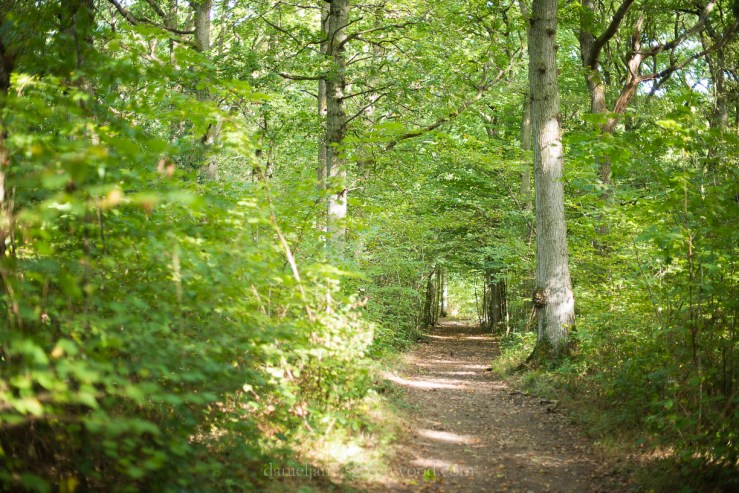
Along a pathway, sessile oaks pale with algae, a sign of clean air
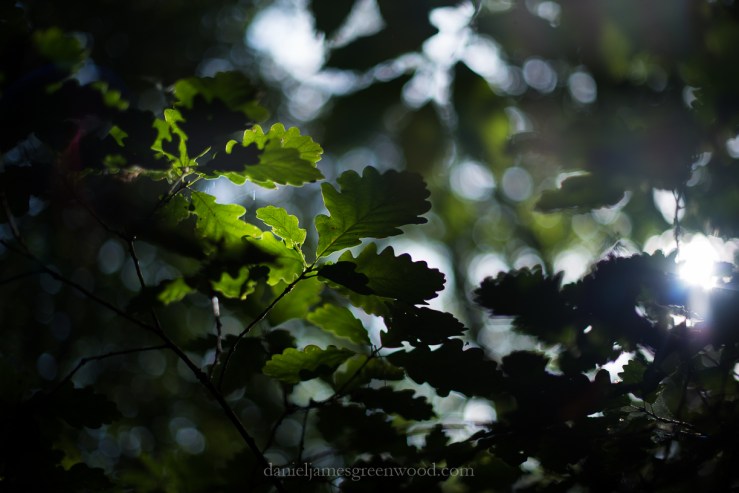
Sunlight through sessile oak leaves
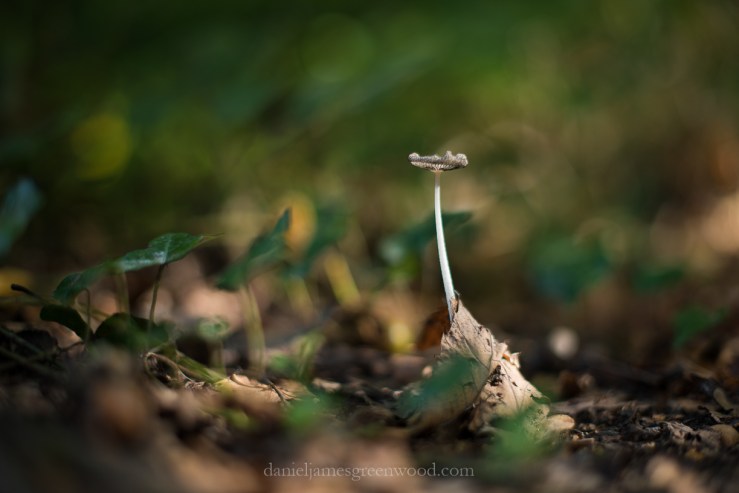
One of very few mushrooms, a species of Coprinus inkcap
Coppice with standards: the piles of timber are sweetchestnut cut (I think) last year, the spring-summer growth can be seen
September is a beautiful month, the light has a spring-like quality about it. This gorse caught my eye where it grows in the areas of heathland in Blean Woods
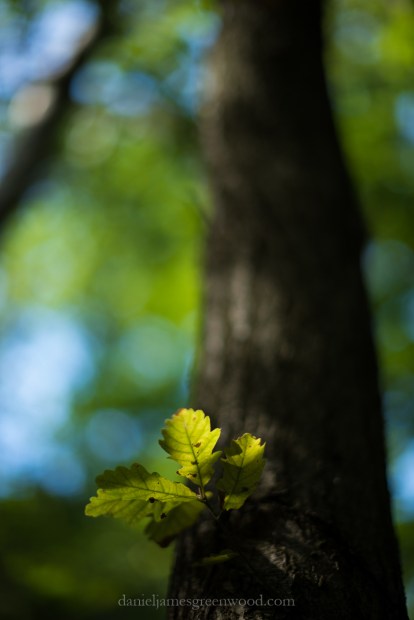
Some epicormic growth on a sessile oak. I shot this at f1.4 with my 50mm lens to try and highlight the woodland ‘bokeh’
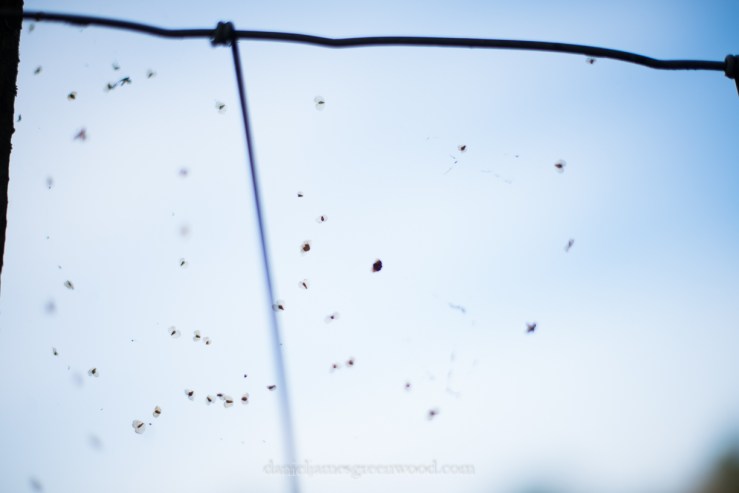
Blean has lots of birch, much of it coppiced. On the pathway between Canterbury and Blean the strongest signs of autumn were the seeds (of which I took many back home with me accidentally, and to me look like little flies in flight)…
…and the leaves tangled in spiders webs
The orchards, of which there are a fair chunk running between Blean and Canterbury, were heavy with apples, the ground littered with hundreds of decaying fruits.
I’ve recorded a lo-fi folk song about Blean Woods, which you can listen to here:
I have just published a four song EP entitled Blackbird sing:
Skylark
Picking at the limes
Blean
Blackbird sing
You can download this EP for £4. Please do download it even if you don’t like birds or trees or folk music. To many of us, £4 is less than a pint, most people have too many pints.
All of the money received will be donated to the European Conservation Action Network to support with international conservation projects in places like Romania, Poland, the Czech Republic, Hungary and Estonia.
The songs are home recordings produced between 2012 and 2015, all written, recorded and ‘mastered’ by me at home. Photo, too.
View my full gallery of New Forest photos on Flickr
I hadn’t managed to visit the New Forest since May, when redstarts sang in the woods and the stitchwort and bluebells flourished under the trees. A lot has changed since then, Britain having voted by 52%-48% to leave the European Union. I am pro-EU and on the morning after the vote took place I felt a degree of sadness that The New Forest voted to leave. Why sadness? The New Forest is one of the EU Habitats Directives Natura 2000 sites which is specially recognised for its importance across the whole of Europe. One of the main barbs of the Leave campaign was that somehow the EU was an attack on individual freedoms, especially of local, unique communities in Britain. I disagree with this. The Natura 2000 website recognises that the New Forest is designated as a Special Area for Conservation because of the role that local people play in managing its habitats:
The quality of the habitats of the New Forest, and the rich diversity of species which they support, is dependent upon the management activities of the various owners and occupiers. Of fundamental importance is the persistence of a pastoral economy based on the existence of Rights of Common. The commoners’ stock, mainly cattle and ponies, roam freely over extensive areas of the New Forest, playing a vital role in keeping open habitats free of scrub and controlling the more aggressive species such as bracken (Pteridium aquilinum) and purple-moor grass (Molinia caerulea), and maintaining the richness and variety of heathland and wood pasture habitats.
Then again, don’t ask me what I think about the antics of the Leave campaign, nor the failures of Jeremy Corbyn and David Cameron in alerting people to the importance that the EU holds/held for the environment. If you’re interested there is a petition asking for the EU environmental protections to be upheld if/when Britain leaves the EU. Yet again our politicians and political system have failed to protect the environment.
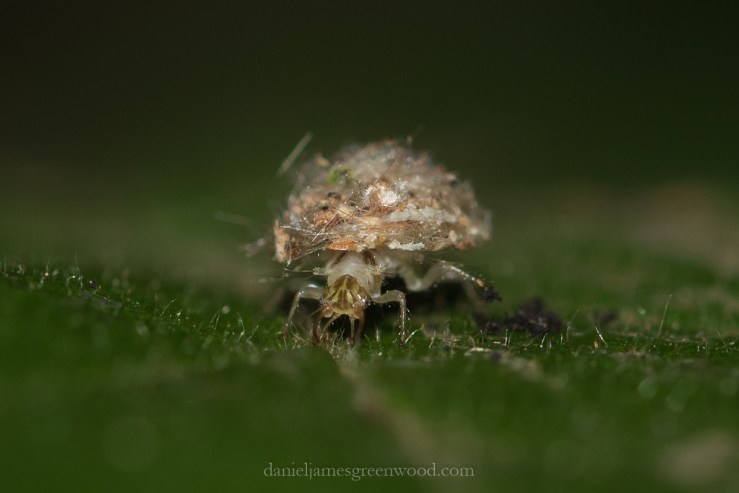
The Hampshire and Isle of Wight Wildlife Trust’s Roydon Woods is one of my favourite reserves to visit. It was silent but for a few flocks of blue tit and long-tailed tit, and one of only a few insects I found was this lacewing larvae (Neuroptera). It was carrying this backpack around, what I think is tied together by the downy hairs of leaves, possibly willow or hazel.
Autumn is a special time, though there has been little rain in recent weeks, there were several large bracket fungi to be found. This is a newly emerging chicken of the woods (Laetiporus sulphureus).
The solitude of the New Forest – most areas away from campsites, car parks and cycling routes are largely devoid of visitors during the week – means you can encounter some wonderful things. I looked up to find a roe deer (Capreolus capreolus) watching me, half way between a field and the woods. There is a clear browsing line in the New Forest and very little natural regeneration of trees because deer and other herbivores, generally New Forest ponies and other livestock, are eating the new growth. Chris Packham has recently said that the New Forest is dying because of over-grazing.
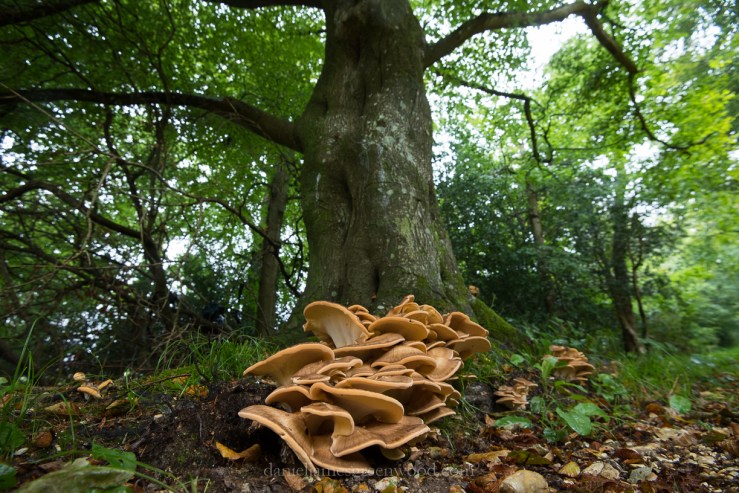
It’s not often that you come across a perfect specimen of a mushroom. Fruiting bodies are short-lived and very quickly deteriorate. To find this giant polypore (Meripilus giganteus) was a moment of sheer joy. As I’ve said in my fungi round-up for last year, I don’t pick them, just photograph them. I’m not precious about this nor hyper-critical of mushroom picking, I just prefer that other people and indeed animals can enjoy them. This mushroom was about 2ft in length and just beside the path. I hope others manage to see it before it decays.
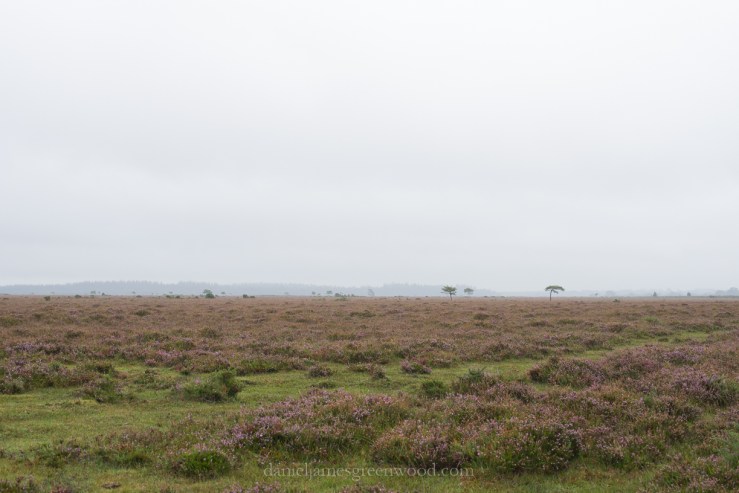
Out on Beaulieu Heath it was drizzling and grey. Stonechats were low in the leftovers of gorse, a flock of medium-sized birds flew overhead and down into the heather which I couldn’t identify. Horseflies dive bombed from the woody margins, the sound of their wings is unmistakable and unnerving. They only want one thing. Along a denser edge of trees and scrub a hare burst free, then came a stoat, turning on its heels at lightning speed to return to the cover of bramble. Spotted flycatcher was also a nice sight at the corner of Lodge Heath.
In the Frame Heath Inclosure forestry operations were underway with mature sessile oaks (Quercus patraea) being harvested. I’ve been reading about the Forestry Commission’s attempts to remove broadleaf species like this from the Forest in the 20th century. It took ministerial intervention and local opposition to stop a near complete shift to conifer plantation.
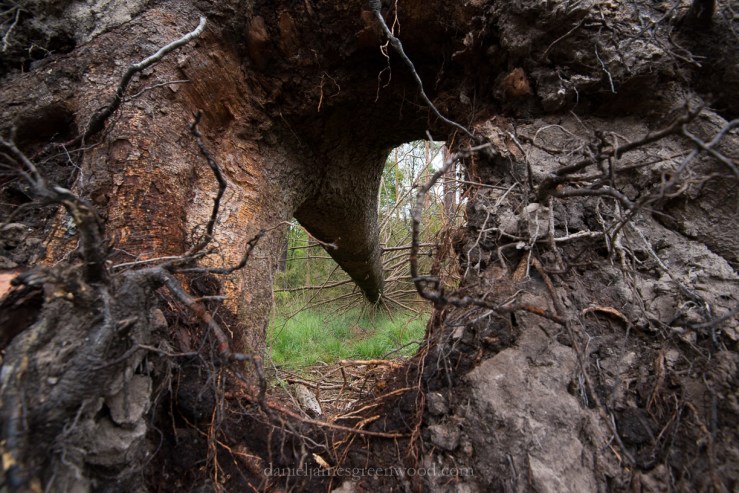
Sitka spruce (Picea sitkensis) is one of the preferred species for foresters. They are shallow rooted trees liable to windthrow in more open landscapes. This spruce had been taken down by just that, a large hole bored through its middle where the soil had fallen away.
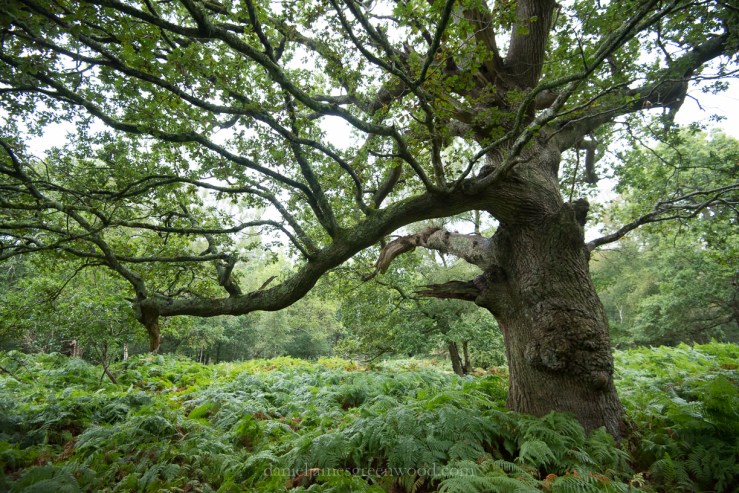
The gentle giants of English oak (Quercus robur) are far ‘happier’ standing alone in the landscape. The reason they are not surrounded by regenerating trees is because of the aforementioned grazing taking place around it. Give me these beautiful old trees any day over a spruce or pine monoculture. We should be thankful to all the people who have fought to fend off intrusive forestry practices in the Forest.
It is these ancient and veteran trees that makes the Forest so unique in Europe. The number of these old trees draws the breath, in areas which are not Inclosures where oak, pine or spruce are planted in regimental fashion for timber, there are just so many of them to be found.
Balmerlawn is close to Brockenhurst and hosts two spectacular old English oaks. This one has a trunk about 6ft and I would approximate it to be over 500 years old.
Next door to it is a younger oak with a massive ‘wolf branch’ as arborists call it, reaching out towards the road. Where it swoops closest to the ground there are two patches where the grass has been worn away by kids jumping up and down over the years. It’s a dream to climb.
For the past five years I have been searching hedge lines, woods, parks and boundaries for the undulating mass of an old oak. This search has not taken place in the English countryside, instead the border of the London boroughs of Southwark and Lewisham. The southern towns of Southwark were once the parish of Camberwell and its boundary with Lewisham still supports centuries-old oak trees that were the previous markers between old Camberwell and Lewisham. Along with the Dulwich Woods and One Tree Hill, these trees are the strongest ties to the much diminished Great North Wood.
One Tree Hill (centre left) when it was ancient woodland in 1799
The Great North Wood
The Great North Wood was a landscape of woods and commons that stretched from Selhurst to Deptford. It was worked over centuries for its timber and underwood (sessile oak, hornbeam and hazel, mainly) for ship building, tannin extraction and charcoal burning. Its origins are in the wildwoods that spread after the end of the last glacial period 10-12,000 years ago at the start of the Holocene. The oaks remain where other species have disappeared as they are tough, long-living (sometimes 800 years in open land) and are of great use to our species. The Forestry Commission approximates that London’s trees are worth £43billion in their environmental and amenity value. Oaks are some of the most important. Their carbon storage capabilities should be remembered by those controlling planting regimes in cities today.
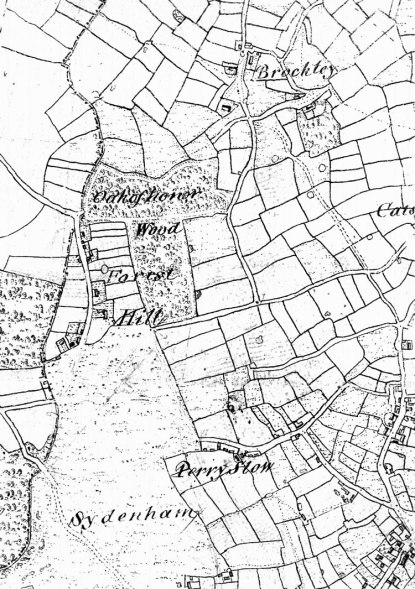
This old image (likely early 1900s) shows what One Tree Hill’s western slopes were like. The earlier map, dated 1799, shows that One Tree Hill was an isolated ancient woodland. It once connected with the Dulwich Woods which skirt the left hand side of that image, and spread even further before humans began managing the woods. That could have been thousands of years ago, however. The Dulwich Woods are very likely several thousand years old. There is no woodland at all but plenty of shrubs, likely including gorse and hawthorn. The landscape swelling into Lewisham shows much of south London’s old landscape was farmland. The boundaries of the farms were marked by old oaks.
Pollarding
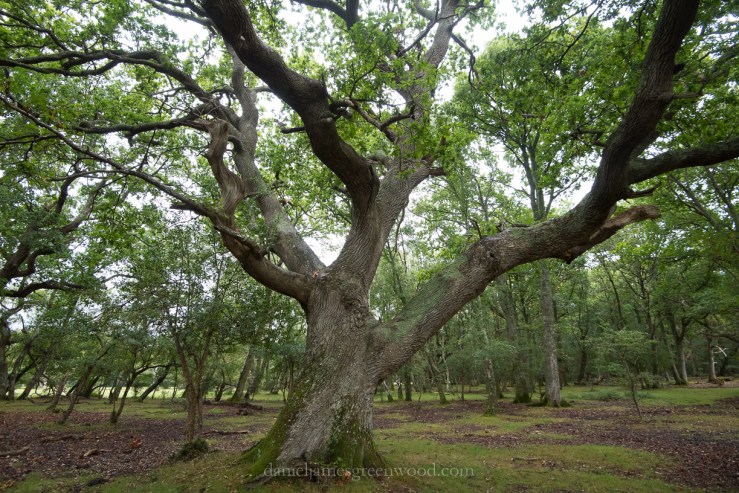
One of the first mistakes made by those (myself included, of course) looking for old trees in the landscape is to head for woodland first. The oldest trees are usually living in isolation in what has longest been open land. The great Oliver Rackham told us that ‘ancient woods are not the place to look for ancient trees’. The best trick is really to get an old map, compare it with a current one and see if there are any clear boundaries where trees may have been planted or perhaps wild trees maintained as standards. Sometimes the old maps show trees dotted along the edges. The image above is a pollarded English oak (Quercus robur) at the entrance to One Tree Hill on Honor Oak Park. The tree is actually in the grounds of the Honor Oak Allotments and a line of similarly old oaks can be found running up alongside it.
This oak, one down from the previous, has clearly been pollarded (c.1900s) and is now swamped by other trees. Logic says that pollarding it again and removing some of the surrounding growth would allow the trees to re-balance and go on living indefinitely, but experimental pollarding taking place in Epping Forest suggests otherwise. Lapsed beech pollards are known to die when pollarded again. These oaks may be so unused to management that pollarding them will kill them off. We may have to accept that these landmarks of the Great North Wood have a limited time left.
The Oak(s) of Honor
One Tree Hill is a good case study for remnant Great North Wood sites as it was open land until the mid-20th century but was woodland on the north-western slopes up until the 1840s. Today it is returning to woodland having been largely managed through non-intervention, bar access works and hedge planting, by the Friends of One Tree Hill and Southwark Council.
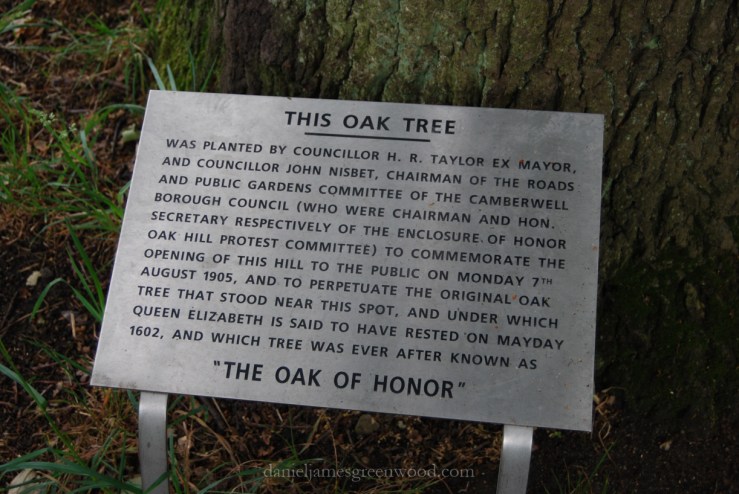
One Tree Hill gets its name from the single English oak (pictured) which was replanted in 1905 when the hill was reopened to the public after a battle to save it from becoming a golf course. 15,000 people conducted a mass trespass on 10th October 1897 to challenge the Honor Oak & Forest Hill golf club’s attempts to fence and enclose the hill.
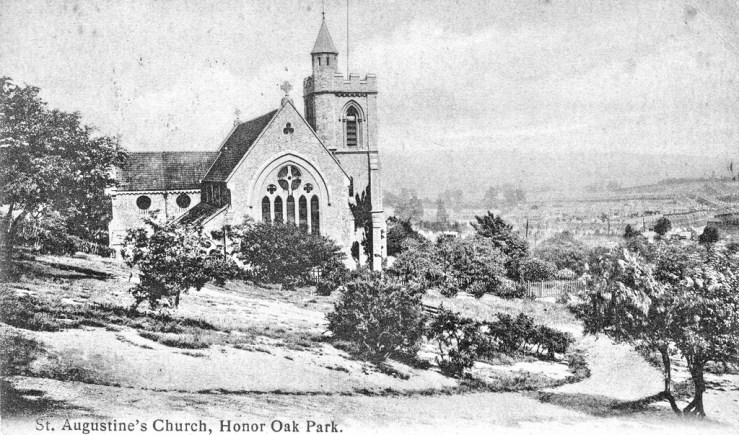
The previous Oak of Honor was thought to be much older and was a boundary tree for the old vice-counties of Kent and Surrey. It was also the edge of the Honour of Gloucester’s land. The idea is that in 1602 Queen Elizabeth sat under the tree and was thus honoured thereafter. Today the Oak of Honor is the most obvious tree to seek but by no means the oldest. I love that it has so influenced local place names. An old black and white photograph of the former oak (the church building can just be seen in the top right) gives the sense that the oak was not so old, perhaps only a few hundred years before it perished. This tree was destroyed by lightning in 1888.
To the right is the oak of Honor when it was only a decade old. The open landscape of early 20th century Honor Oak/Forest Hill is filling up with housing. The tree cover on the hill was largely hawthorn scrub, as can be seen behind the caged oak.
Wildlife
It’s worth remembering that though we are fixated by neat and tidy trees in urban areas, often for safety reasons, that oaks provide habitat for a great number of species. The Oak of Honor in September 2015 held many knopper galls, the protective case for a gall wasp (Andrus quercuscalicis), and oak apple galls.
The top of One Tree Hill is an excellent spot to find butterflies in spring and summer because it is open and sunny. This speckled wood (Parage aegaria), one of the contemporary Great North Wood’s most common butterflies, was enjoying some September sunshine on the great tree’s leaves.
The winter months provide ample opportunity to find nuthatch (Sitta europaea) which is often tied to oaks because of the invertebrates it forages from the bark and the old woodpecker holes it nests in. It makes a neat mud ring around woodpecker holes to make the entrance smaller and more protective for its young.
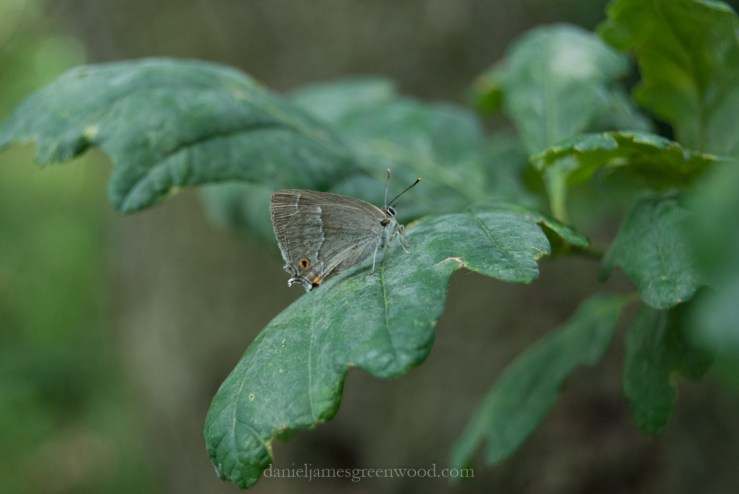
The purple hairstreak was the first ecological record at One Tree Hill when it was mentioned for the first time in the 1766 publication The Aurelian by Moses Harris. This overlooked butterfly was ‘commonly taken in plenty in Oak-of-Honour Wood, near Peckham, Surry.’ It’s one of the insects promoted by conservation groups in the Great North Wood, a good indicator of long-term woodland cover, especially at nearby Sydenham Hill and Dulwich Woods. The purple hairstreak is only usually seen by those straining to look up at the canopy or those lucky enough to stumble across one when it’s down and dazed on the path.
Secret oaks
The oldest of One Tree Hill’s oaks is likely to be this lapsed pollard (whereby a tree is cut higher up – coppice is cut at the base – to prevent grazing animals eating regrowth) growing on the path that runs adjacent to Brenchley Gardens. I’ve seen a photograph somewhere of the tree isolated in open land, with Peckham’s farms rolling down to what is now Peckham Common.
The tree, seen here on the right of the photograph (its lean exaggerated by the distortion of my 10-24mm wide angle lens) is competing with the seedlings that have likely fallen or been stashed by grey squirrels (Sciurus carolinensis) and members of the corvid family, especially jays (Garrulous glandarius). You could suggest that the new woods of One Tree Hill are products of its old boundary oaks, where the dominant species is oak. Recent research has uncovered how important crows are in establishing new oak woods across the northern hemisphere.
One of the lower limbs is rotting nicely and providing habitat for slime moulds and small mushrooms, whether this is a bonnet (Mycena) or a parachute (Marasmius), I couldn’t tell you. The life that old oaks can support adds to the tree’s immense amenity and ecological value. Oaks typify the anthropomorphic but no less accurate notion of trees being ‘accommodating’ to many species.
Next door to One Tree Hill and its allotments is Camberwell New Cemetery, a more authentic remnant of Honor Oak’s open landscape of the past 200 years. One boundary, otherwise planted with Lombardy poplar (Populus nigra ‘Italica’), has two old English oaks. One has been hollowed out, possibly after being struck by lightning or affected by human damage. It’s an example of trees as habitat, something which people are generally uncomfortable with at first, especially with fungi as they think the tree is dying. In August 2015 the hollowed oak had the fruiting body of what I think was chicken-of-the-woods (Laetiporus sulphurous). Oak supports many insects and also fungus. The oldest oaks you are likely to find will be dependent to some degree on mycorrhizal relationships with fungi. Fungi can also help the oaks by removing bits of deadwood that may otherwise add extra weight to the tree as it ages. Some species are necrophratic and will eventually kill a tree because they ‘take more than they give’.
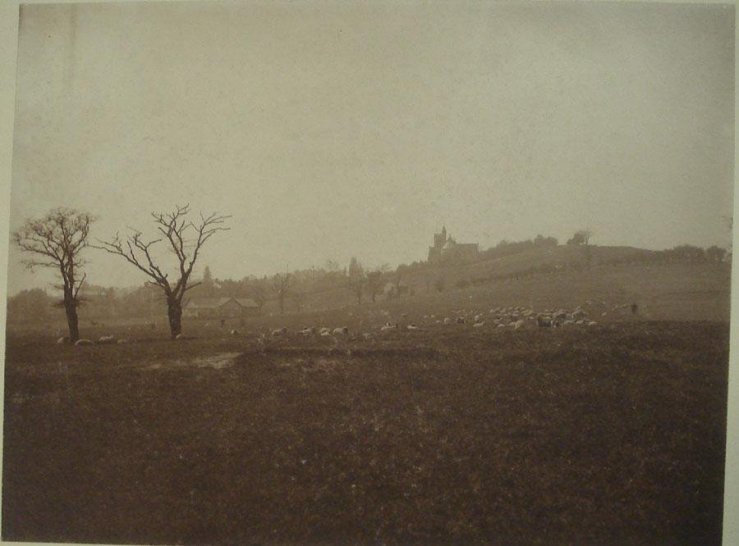
On first thought I was suspicious that the two oaks seen here might be the same two on the allotment-cemetery boundary. This is a photo from the 1920s that shows Camberwell New Cemetery and the Honor Oak Recreation Ground as open land being grazed by a flock of sheep. Evidently the sheep were used to keep the grass short for golf, or maybe also as a way to support a local farmer. The golf club house can be seen in the distance. The building on the hill in the distance is St. Augustine’s Church (1872-3). These two trees are too far away to be the same as those above, they are probably instead some of the black lines that can be seen in the distance. Note also the absence of any tree cover on One Tree Hill beneath and to the right of the church. Between the mid-1800s and this point, there ancient woodland had been well and truly grubbed out, possibly even some old boundary trees going as well. Today, this would be unacceptable.
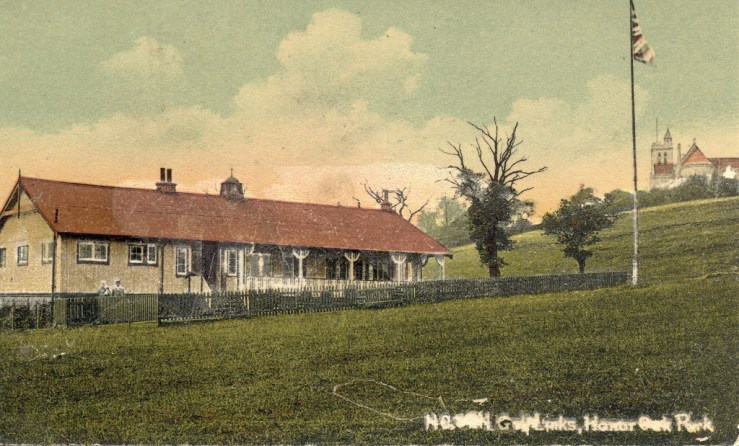
Instead, I think this image of the old golf club house exhibits the line of oaks. These oaks look to be dying back, possibly because of the impact of building the club house where the trees’ roots were. The distance between St. Augustine’s and the line of trees is one parcel closer than the previous image (Steve Grindlay).


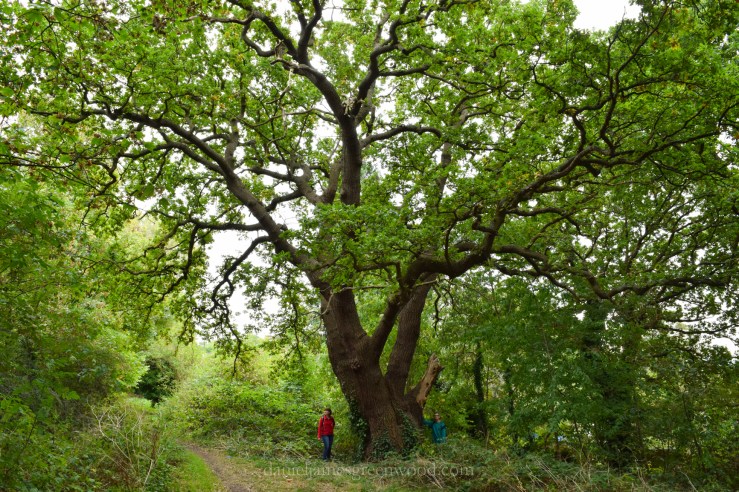
















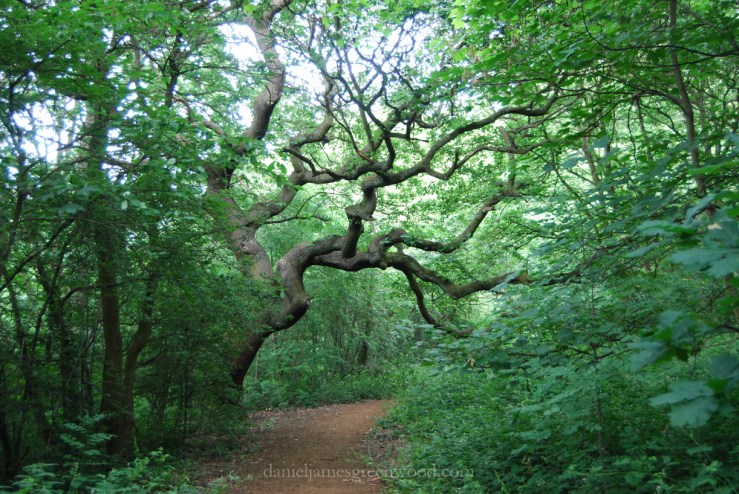
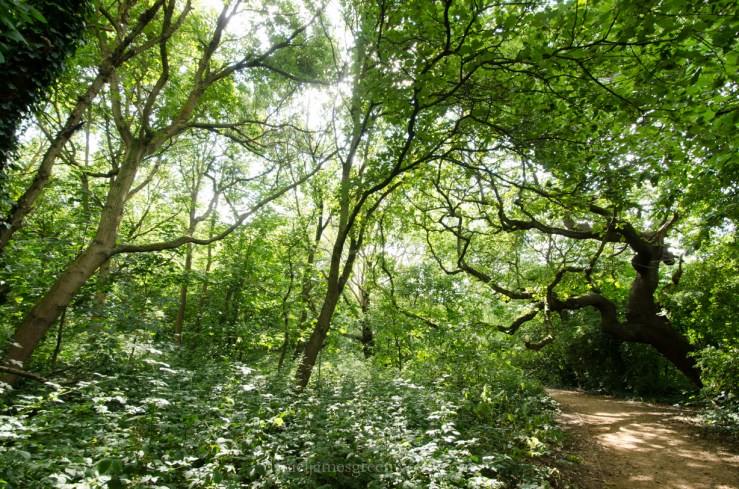 The tree, seen here on the right of the photograph (its lean exaggerated by the distortion of my 10-24mm wide angle lens) is competing with the seedlings that have likely fallen or been stashed by grey squirrels (Sciurus carolinensis) and members of the corvid family, especially jays (Garrulous glandarius). You could suggest that the new woods of One Tree Hill are products of its old boundary oaks, where the dominant species is oak. Recent research has uncovered how important crows are in establishing new oak woods across the northern hemisphere.