I spoke to BBC London on Tuesday for London Wildlife Trust in response to the latest data which shows that urban fox numbers are increasing. This despite the fact that foxes have declined by 43% since 1995.
Yours, Daniel Goodman
Writing, photography and more by Daniel Greenwood
I spoke to BBC London on Tuesday for London Wildlife Trust in response to the latest data which shows that urban fox numbers are increasing. This despite the fact that foxes have declined by 43% since 1995.
Yours, Daniel Goodman
North Downs diary, Mole Valley, Surrey, April 2017
I follow the Mole gap trail into Norbury Park, ash woodland glowing in the spring sunshine, dog’s mercury abounding on the soil between the pale trunks. The railway line cuts across the eastern edge of the woods, a brick bridge taking trains straight over one of the major footpaths. Under the bridge a lady walks her dog down the hill, her shape appearing beneath the brick. She pauses as I pass under the bridge and takes a photo.
‘All I could see was your legs,’ she says. ‘And then the rest of you appeared.’
We both have cameras and she asks what I’m here to photograph, about butterflies and how many I’ve seen today. Orange tip, brimstone, peacock and my first small tortoiseshell of the year. Along the banks of the Mole butterflies have flitted in good number.
‘Oh I haven’t seen many,’ she says. She tells me more about Norbury Park, its managers Surrey Wildlife Trust and how angry she feels about the fact all the Trust’s rangers will be made redundant. ‘It’s always the people who are out there doing the actual work that suffer. When there’s a fire or something goes wrong there won’t be anyone there for us to contact.’
The ranger programme was being funded with money from Surrey County Council, and Jenny has been making efforts to register her discontent with local councillors. ‘It’s all about priorities, they’ve just resurfaced the A24 and when there was nothing wrong with it.’
‘I devote myself to the countryside,’ she says. ‘Apart from 3 years in London for university I have always lived in Surrey. I spend hours walking with the dog and never get round to everything I need to do in life. When I get home I just head back out again.’
I ask her how things have changed over the years.
‘There are definitely less birds than there used to be,’ she says.
As we stand talking next to the railway bridge the sun shines down through the leafless trees. Peacocks sun themselves on the ride’s edge, bright yellow brimstones pass across the slopes above us. We say farewell, Jenny heading off into the Park while I continue south towards Box Hill.
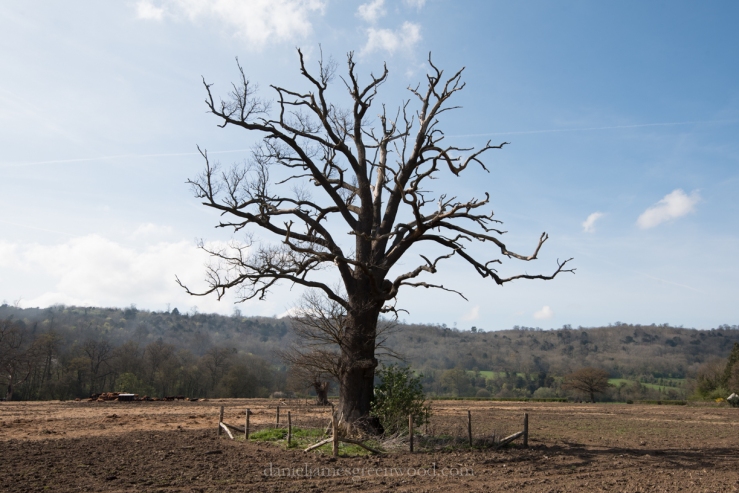
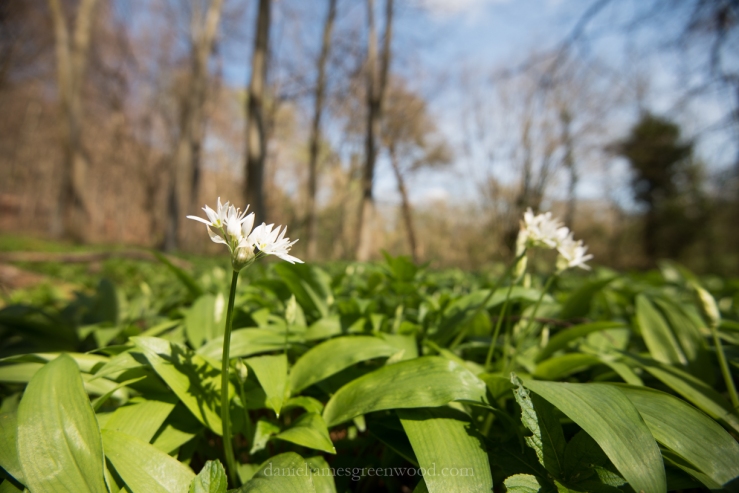
The Mole edges Norbury Park, where beech woods sprawl along the eastern slopes. On the other side of the river the smell and calling of livestock breaks through. In the woods the beeches gleam in the glory of the sun, ramsons begin to flower one by one. Leaving the Park, farmland opens out and the woodland is replaced by fields with single oaks, and a beanpole lime tree riddled with mistletoe. I learned recently that mistletoe grows only on smooth bark, its seed is sticky and is often left there by the mistle thrush, so named for this reason. The branches in the canopy of limes are always sleek and silver, perfect for the mistletoe to attach itself to. The oaks are grand specimens, one dying back from above. Many trees are leafing on the Downs but no oak or ash quite yet. Overhead buzzards soar and mew, and the rickety frame of a red kite tumbles towards Box Hill.
The green fields turn instead to brown where cattle graze. More oaks mark the old field boundaries, likely once connected by hedgerows now removed. The farmer has fenced them to protect their roots and bark from the jaws and hoofs of his or her livestock. The fields are protected by electric fencing audibly ticking, but several of these oaks are dying, possibly from the damage done by the cattle. Crossing the Mole again the train line returns, a neat arch allows the river to flower as it kinks round. The light shimmers and ripples on the underside of the brickwork built almost in a spiral. It’s dizzying to watch for too long. Across the old footbridge and into a field named Foxbury Shaw more veteran oaks stand ready to leaf again, a trio leaning into a dried up channel, perhaps a former braid in the river.
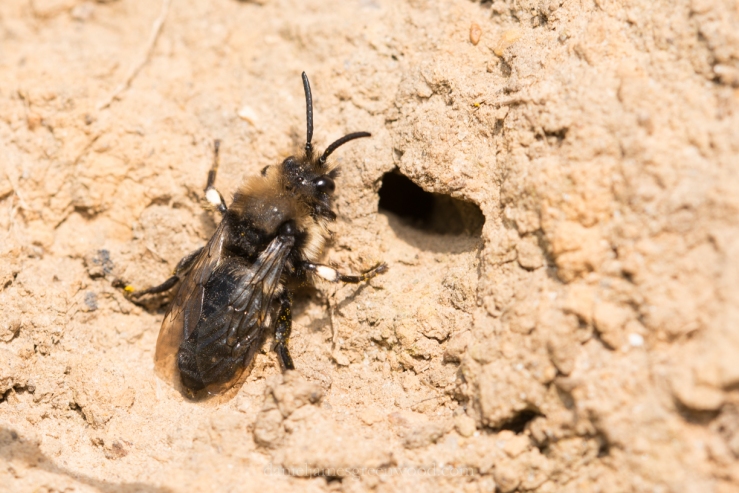
One oak has fallen and lies supine with that typical stag head of old roots. Passing close by I notice the swarming of insects at the root plate. It is surely too early for wasps and they appear too big. Edging closer, they are in fact hairy-footed flower bees whirring and zipping around the old roots. When the tree fell the roots lifted soil with them, now hardened like great chunks of biscuity dough. The sun has baked the soil and the wood of the fallen oak. Here is the very image of a life after death.
The oak is being mined by solitary bees, some, like the bronze furrow bee are minute. There are more animals besides them, with jumping spiders waiting for the chance to pinch their prey. One sits atop a root basking in the sun, camouflaged against the bleached timber. The soil has been drilled with holes, the habitat of the flower bees. A group of about five to eight males, blonde and super-fast in flight, zip around me as I photograph their homes. Truly it is the sound of racing cars or X-wings tearing around at several hundred miles an hour. Another species of bee basks on the upturned roots, it has long, black antennae and is disturbed when I look more closely. It’s a mourning bee, a parasite that lays its eggs in the nests of hairy footed flower bees. The eggs hatch, eat the young of the flower bee and then eat the food stash left for its prey. Despite our clichés, some bees are only in it for themselves.

This English oak is easily missed, to the point where I didn’t notice it was an oak until looking at the photo later. This early spring sunshine is the kind that brings people to sit underneath trees, like the man in the distance on Clapham Common. His bike is resting against the trunk behind him.

This English oak (Quercus robur) is alongside the Great Cambridge Road near Turkey Street station in Enfield, north London. It was photographed on my phone in January 2017. It stands in what evidently was once a more open, rural landscape. It’s a big, healthy-looking tree, likely between 200 and 300 years old. What I like about this one is the clash of the old and the new, rural and urban. If it can remain in peace it could live a good many centuries. This is dependent also on a gradual reduction in emissions from the nearby traffic as predicted move towards electric vehicles progresses and its ability to remain unimpeded by either self-seeded trees or new plantings. If this landscape was abandoned in future, the oak would create a new woodland of oaks around it.
North Downs diary, Banstead Woods, March 2017
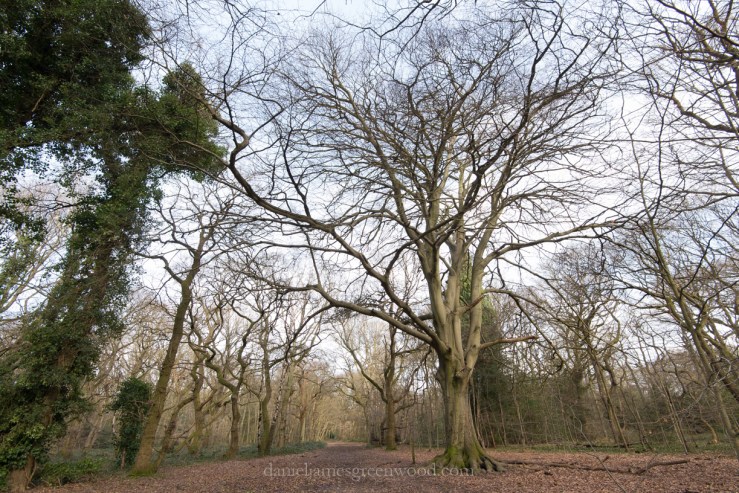
A bench has been built in a patch of recently churned clay, a rusty red. The bench matches the colour, dedicated to Jamie Eve who passed away in 2016 aged 26. His dedication tells passersby that he loved this place. A bouquet of tulips and ivy lies on the seat. Around Jamie’s bench bluebells peek, it is that special time. All across this wood the lilies push through. All around us life is returning, our side of this earth is coming closer to the sun, and wildlife is responding.
Edward Thomas, a poet made famous, really, by the success of Robert MacFarlane’s The Old Ways and sense of invigoration given to the subject of nature writing, wrote about the Banstead Downs. It is only because of reading Macfarlane’s books that I know of Thomas and for that reason that this time of year, when bluebell leaves threaten to reveal flowers, when the earliest pipings of blackbirds don’t quite progress to nightly songposts, reminds me of his poems. I have never truly got on well with his style, but Macfarlane’s success is the ability to bring you closer to the lesser known authors, walkers and naturalists. The line ‘Spring is being dreamed’ is one that is quoted across media formats at this time of year. It perfectly encapsulates that rough and wearied time when winter has bitten in and bitten long, but spring’s presence is unmistakable.
You can feel it in the movements and actions of birds, the great tit, chaffinch, blue tit, tree creeper all singing and moving across the wood. The consensus is growing. The hornbeam’s branches look different to the way they were two weeks ago, as the buds begin to break with their usual slowness. Small clusters of leaves spit from elder branches, hawthorns are never too ready to shift with the season. Throughout Banstead Woods large oaks stand in stoic silence. There is no hint of a leaf, their fistfuls of buds, many of which will never be needed, remain golden brown and closed. I remember last year seeing the tiny red leaves of oak coming out months in advance on the 25th January in south London, but this year there has not been the mildness to tempt the oaks out.

These oaks, along with beeches, hornbeam pollards and mighty sweet chestnuts, suggest this wood was once more open, lighter and more intensively managed. These trees bestow a grandeur not quite felt in other woods I know along the North Downs, even the mighty beeches of Devilsden Wood. Here the trees are all on the plateau of Banstead Downs, their scale is not reduced by the steep slopes of the many valleys that cut through this chalky landscape. Here storm Doris has broken limbs and split trees, several by gusts blown along a ride that cuts widely through. Sometimes you have to squirm through branches to carry on.
I pass a man with binoculars and ask him of hawfinch and lesser spotted woodpecker, two birds that are rumoured to be present here. He has black curls with a touch of grey and says he has never seen them but ‘surely they must pass through’. He exhibits a sense of contentment in what the land holds for him this afternoon. It marks the end of Banstead Woods, signalled by a family passing, booted and offering a greeting as they make their way inside. At the wood’s edge the landscape opens out, a few of the typical farmland oaks stand in the centre of the field and along a hedgerow boundary. I follow the path along the wood’s edge where crumbling oaks and beeches dominate, with laurels and rhododendrons creeping in at their toes.

At nearby Canons Farm a buzzard perches in branches, mobbed by crows, stirring starlings, sparrows and finches to leave their feeding until later. Above a lane enclosed by a close crop holly hedge birds explode across the grey sky, the buzzard following them in a blaze of alarm calls. Following the road round past a small clutter of houses where a man revs his van and reverses out, its emissions pungent, the buzzard perches in the branches of an oak. In the distance jackdaws roost and break in the tops of trees, closer at hand a crow swings low and short of the buzzard. It is unworried by the attention, taking its time, waiting for the right moment to move off over the fields again.
Tracing a path through leafing croplands that lead into the wealthy suburbia of Kingswood, the prospect of spring has been sidelined. It rings true – those who have no closeness to or desire to venture into woods or landscapes of the less manicured kind, can have little sense of the changing seasons. Treading the verge on route to the train station beside mansions with static laurel hedges, four cars and paved driveways, I can guess what Edward Thomas valued more.


Richmond Park is a National Nature Reserve managed by the Royal Parks. It’s home to an absurd array of veteran and ancient oaks. Some of the older trees show clear evidence of pollarding, but no sign of anything recent. It was a wet and windy day in south-west London, your camera equipment has to be as tough as oak to stick it out for long in these conditions. I’ve overexposed some of the images as it was so dark and dreary, and oak doesn’t burst with colour in winter. The park itself is a shock to find, a vast expanse somewhat pegged back by the constant chunter of traffic passing through.
Oaks of London archive


North Downs diary, Farthing Downs, January 2017
I pass through the gate onto the downs and a fox crosses the lane, that long, fluffed up tail and jinking stride. It seeks the safety of the woodland edge. Snow lingers on the downs, magpies feed in small groups. When they fly up it’s not unlike slices of snow lifting off the ground. Their strategy is simple: feed until a bigger beast passes, sit in the trees, then return. The sun breaks the dough-like cloud, a kestrel cutting through with ease. She finds the tip of a branch and balances, the twig bending under her weight. She looks out across the snow. Feeling herself perhaps too exposed, she shifts to the fox’s wooded margin. Restless, knowing she is now unwelcome in open land, she cuts west and disappears over the hill.
The hazel scrub carries beads of melted ice, hanging long out of the breeze. The shapes show black branches like little snow globes, a looking glass into some dark wood of elsewhere. On the ground the snow carries tokens of those living things that have since passed: dog, human, crow. In between them the stems of wild carrot persist. On the steepest slopes of the downs, sleds slip across the scene, their crew dressed in pink and orange, the colours of our mass production garment industries. On the eastern slopes of Happy Valley the snow rests without the patchiness of the highest point. Yet more magpies are driven from piercing their bills in search of soil. At the bottom of the hill birch trees reflect the snow’s whiteness, their reddish hue shows they are not whiter-than-white.
I heard a radio programme recently charting the decline of snowfall in Kent over the past fifty-years. It brought the presenter to the point: might snow become a thing of the past in southern England? Climate change’s predicted course means that the snowy downs here as I see them today may yet be something that can only be spoken of in the past tense. So does the act of photography now morph into a sentimental act of conservation? Our species’ recent photographic binge, due to the camera phone revolution, means that snow will never be forgotten in image, but its sensuality can’t be felt in a jpeg or print.
I forget these things so quickly when London’s short snowy affair departs, the glow of light from the white ground, the dripping trees, the soft press and crunch of boots, the sheer joy that children feel and express on their plastic sleds. Perhaps to us southerners who see so many different types of weather, the loss of snow’s short stint will barely be noticed. For climate change will bring profound challenges for species that depend on certain conditions, be they polar bears, butterflies, mushrooms or migrating songbirds. On the downs, like many thousands of others I’m sure, I seek change in itself. A different state of mind, of perspective, colours, textures and places to walk in. Nature reminds us always that change will come.

In December I did some recording with BBC Radio 4’s Open Country, presented by David Lindo and featuring The River Effra, the London National Park City and Queen’s Wood. It was great to be able to represent the Friends of One Tree Hill and London Wildlife Trust on the programme. Please listen here: http://www.bbc.co.uk/programmes/b088fx30
You can read my photo essay about One Tree Hill here: The Honor Oaks
There were many human things to feel sad, angry and upset about this year but still nature’s continuity and the simple movement of seasons brings encouragement and a reminder – change will come.
Politically it’s been a year to forget for nature conservation, with the UK government killing more than 10,000 badgers in its mindless badger cull, the likely loss of EU protections for nature in the UK, the ascent of climate change deniers in the United States and more evidence of species-declines brought about by human impacts on the landscape, be it intensive agriculture, pollution or man-made climate change. More than ever we need to take notice and maintain a connection with the natural world, to make the argument again and again for how crucial the biosphere is to our own civilisation.
But I’ve had some of the most memorable experiences of nature this year, and they are often enough to focus the mind on doing something positive
I for one will not be giving up on the UK-Europe conservation mission and will do what I can for British and European wildlife in 2017
Thank you to everyone who has helped artistically or logistically with these photos and taught me about the subject matter!
Wishing you a peaceful winter break and biodiverse new year!
Daniel


European bison, Bialowieza Forest, Poland
March 2016
I snapped this wild young bison through a hedge with a 70-300mm lens. Bison have been reintroduced to this part of eastern Poland after their near extinction in the 20th century due to the ravages of two world wars. I love the new growth of horn and the snot dripping from its nose!

Juniper haircap moss, The New Forest
April 2016
More and more I find myself on the woodland floor these days. That’s because it’s where all the action is. Be it wildflowers, mushrooms or the most primitive terrestrial plants, mosses. Mosses were the first plants to make it from the sea onto the land, one reason why they depend on lots of moisture, it’s a throwback to their days under the sea.

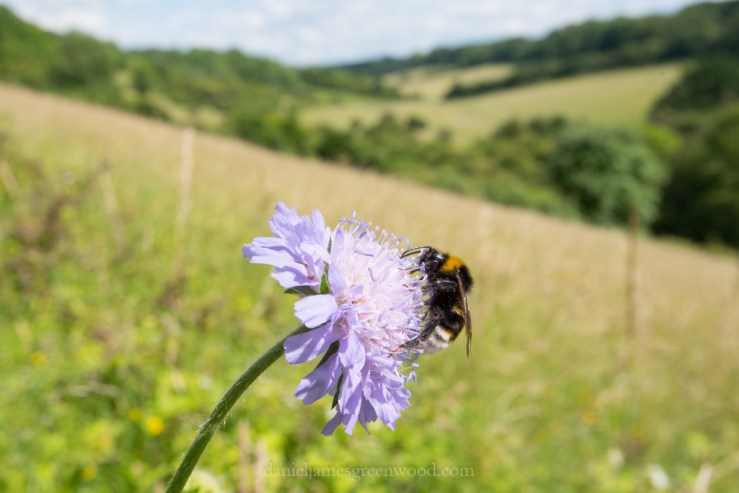
I’m not sure whether this is a bumblebee or cuckoo bee, having been told it was the former recently. If it is a cuckoo bee my ecosystem metaphor has fallen apart because cuckoo bees aren’t interested in pollination, mainly stealing from bumblebees!
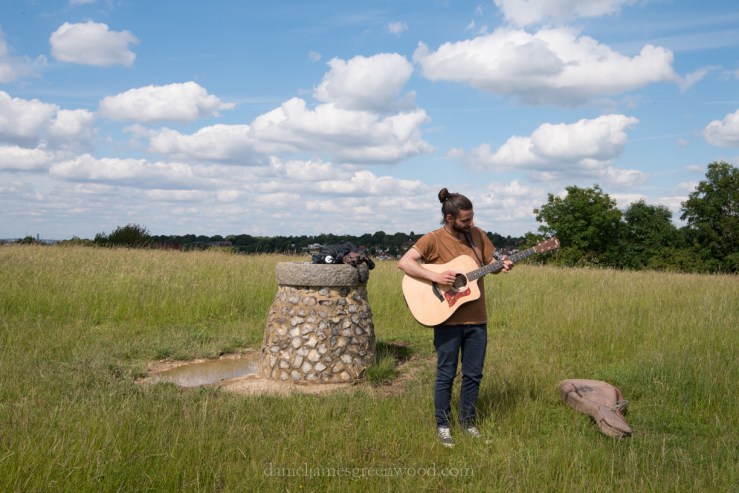
It’s in unsettling times when a simple walk in the landscape can remind you of the bigger picture. I was walking on Farthing Downs, full of angst for the post-referendum Britain, when I met Marco playing his guitar on the hill. He had only just moved to London from Italy:
‘I have been here one week and in Italy they did not even talk about it [the referendum]. Now I am here and wow. My friends think that I am in London surrounded by cars and buildings, but I am here. And I love it.’
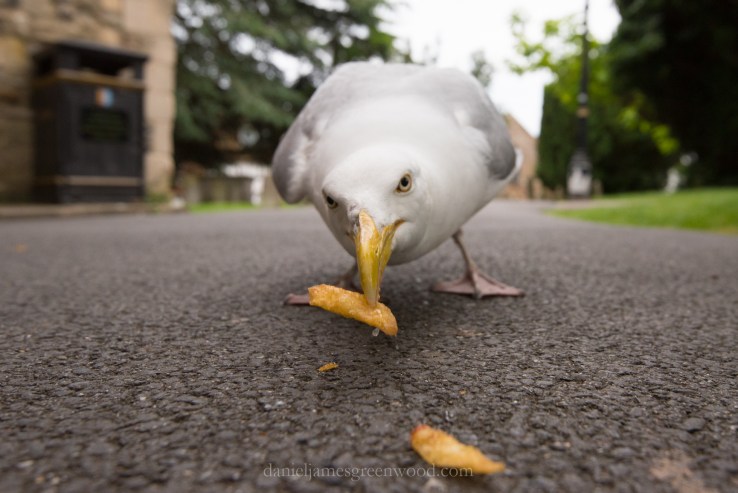
Herring gull, Rye
July 2016
Every time I go to Rye I get chips from a proper chippy and eat them up at the church on the hill. There is always a herring gull in attendance. I took the chance to create this photo, a technique frowned upon by wildlife photography purists.
I wanted the eye in focus but instead got the chip in the bird’s bill, saliva dribbling down.
.

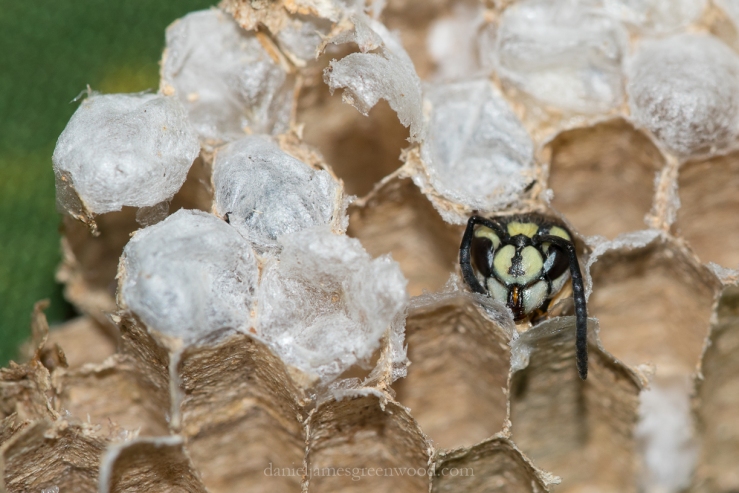
Honey fungus, The New Forest
October 2016
Let’s be clear, in London and the surrounds, it was a rubbish autumn for fungi. It was a dry season with the meadows of the North Downs largely devoid of waxcaps and other mushrooms. But a trip to the New Forest in October did provide an encounter with a gang of honey fungus, a mushroom that many gardens so dread because it kills trees OMG!
It was worth waiting for this chance to find mushrooms in their pomp, largely intact with some nice light and greenery still around.
Balmer Lawn, The New Forest
Halloween, October 2016
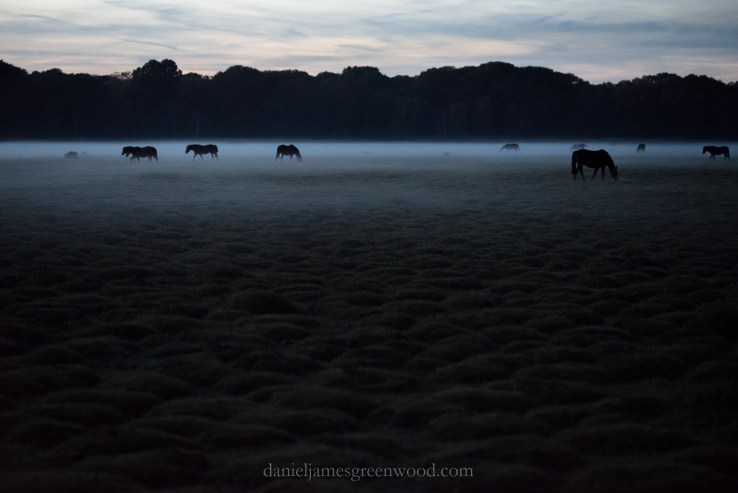
Whilst these New Forest ponies are not wild and they do belong to people as domesticated stock, I felt transported into some ancient scene from the Eurasion steppe. Mist rose with the twilight over Balmer Lawn near Brockenhurst, the ponies grazing the horizon.

North Downs diary, Farthing Downs, November 2016
Three o’clock and the sun sinks in the east, casting long rays of light through the papery sepals and stems of knapweed and agrimony, summer’s relics. Threads of spider silk drift between these old frameworks, a material stronger than steel by comparison. The experts will tell you that at this time of year birds depart the highest open reaches of the downs, and there are few birds around. This is the perfect camouflage for a crow, the sun so low and dazzling there could be hundreds of them chowing down on the edge of the hill. One lifts up, gliding on the wind, hovering kestrel-like, remembering its place.
I came here with thoughts of waxcaps bright and beautiful, but two hours out here and I only find one picked and overturned. The life is being scraped from the downs by the raking wind, the tumbling temperature and coming dark, the slide into winter. Yet every seasonal change is the same, like a shift in human history, it is not one event that brings about the enclosure of darkness but several over time. You can find its waymarkers, indicators of something different on the horizon. Each season, like each era of civilisation, is a product of the ones which came before.

The cows graze the grasslands, their coats lit red by the sun setting behind them. Their breaths puff out like smoke as they chomp. It is a reassuring sound, grass uprooted and chewed over. They offer few glances to those of us passing by this morning. Pied wagtails, a bird I don’t often see here, perch on their backs and pick at their pats. In the scrub slowly being cleared from the downs by the City of London, redwing break between hawthorn and rose, their wings lit as they break cover. I know why this work is being undertaken, I’ve helped with it elsewhere on the North Downs, but I am losing my old signposts in this open landscape. The area where willow warblers once nested, where redwing and whitethroats used to feed up, a hawthorn where chafers fed one evening: all of it grubbed out, the soil lightly ploughed. This scrub is being cleared to allow the return of chalk grassland, one of Europe’s rarest habitats, much of which is found in England and a surprising amount in London. Our response to the clearance of trees is almost always emotional, that’s okay, but it’s important to know why it’s happening but equally important to ask why.
A woman passes me with a broad smile, covering her eyes from the sun to look at me. She stops:
‘Isn’t it wonderful,’ she says, her companion a little surprised that she has stopped mid-conversation. ‘Cows, fields and sunshine.’
‘Yes,’ I say. ‘It’s like being in the countryside. Wait a minute, I think it is the countryside.’
‘I’m lucky, I live just next to it,’ she says, making her way.
I agree with her, she is lucky.
Up ahead a figure sits on a mobility scooter next to the millenium monument atop the hill. They are taking pictures of the sun disappearing behind the hill. Knowing I’m part of the photos I stop and ask, ‘would you like me to give a certain pose?’ She laughs and throws out her arms to suggest a stance.
‘What camera have you got there?’ she asks, my camera on its tripod resting over my shoulder like a bazooka. ‘I’ve got a Canon but haven’t used it in a while,’ she adds.
I don’t enter into the Nikon-Canon banter.
Her name is Tilly and she lives locally in Coulsdon. ‘Just down the road,’ she says. ‘Where are you from?’
I tell her that I’m not so local and I come here to get away from the SE postcode.
She asks what I’m here to photograph, ‘wildlife?’ She has it right, but there are a disappointing lack of mushrooms. ‘It’s probably the wrong time of year for that,’ she says.
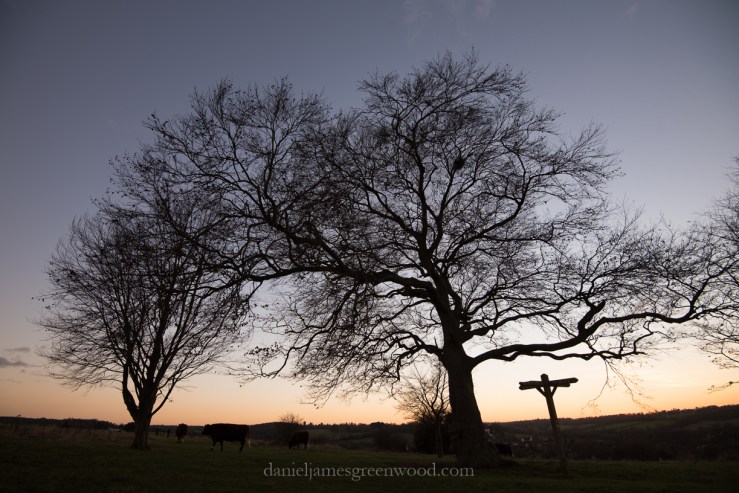
It’s been the right time before but an anxious thought creeps in – does someone know the movement of waxcaps here in some kind of hyper-intuitive detail? Probably not, it’s just been a rubbish autumn for them. She recounts tales of campervan holidays out in the New Forest’s old military sites where she could bolt her caravan into the old RAF concrete and fly agarics fruited on her portable doorstep. ‘I’ve not been there for a while though,’ she says. ‘I was ill last year, and I’ve been ill this year, too.’ She nods as if admitting something.
The sun has left us now, a few scraps of cloud coloured by the glow.
‘I love the red of those clouds,’ she says. ‘Apparently there’s a green flash when the sun goes down.’
‘It’s called the green ray, there’s a French film about it called Le Rayon Vert,’ I say.
‘Oh, I’ll have to look it up,’ she says. ‘Watch out for the cow pats.’
 Unlocking Landscapes