Introduction
In March 2016 I visited Białowieża National Park in Podlasia, north-east Poland. I must give thanks to Karolina Leszczynska-Gogol, Grzegorz Gogol and Izabela Sondej, without whom the trip would not have been possible. Białowieża is somewhere I have wanted to visit for several years after reading about it and hearing from friends (especially Poles) who had been there. It is described as Europe’s last remnant of primeval woodland (12-10,000 years old), a slight exaggeration recycled on social media and subsequently in news items. The Czech Republic has numerous stands of ‘virgin’ forest or woodland though not on the scale of Białowieża, which is probably the largest remaining tract of ancient European woodland due to the 5,000 hectare strict reserve which is said never to have been logged. But it is not the largest woodland in Europe, that accolade belongs to the Bavarian and Bohemian Forest complex on the border with the Czech Republic and Germany. We went to Białowieża at a time when the Polish government were rubber-stamping plans to increase forestry activity in the National Park and outlying woods, resulting in much opposition from environmentalists in the west and large demonstrations in Poland. The premise for increasing logging is to combat the spread of spruce bark beetle (Ips typographus) which is currently impacting on Norway spruce trees (Picea abies) in the National Park. Those opposed to the plans argue that this is a natural process and that the beetle is a key species, a ‘forest engineer’. I agree, having seen the same impact in the Bavarian Forest National Park where some intervention does take place. I would argue that the impact of 20th century forestry practice has led to a proliferation of Norway spruce where there should be a more ‘natural’ balance of other species. However, keen not to criticise without having visited, we went there with an open mind.

The history of Białowieża
Białowieża National Park has key designations to protect its natural heritage. It is a UNESCO World Heritage Site and Biosphere Reserve. The National Park was established in 1921 to offer protection to the herds of wild bison (Bison bisonus). Today Białowieża National Park is crucial because it has much of its original large fauna which can help ‘manage’ the landscape without any need for human intervention, i.e. logging. One theory of virgin woodland, established by Franz Vera in 1996, is that the dominant idea of endless trees covering northern Europe before humans arrived (we’ve been in Europe for over 40,000 years) is a myth. In fact wind blew holes in the wildwood and these glades were kept open by large grazing animals like elk, bison, deer and aurochs, meaning that the landscape was more like savannah or wood pasture – grassland dotted with trees. Vera argued that it was the human-enforced reduction and extinction of many of these large herbivores that led to the more dense woodland of the recent imagination. It also meant the larger clearings became towns and villages, settlements which were once established next to woodland (this is what ‘ley’ or ‘hurst’ means at the end of English place names). In Białowieża human intervention is evident in the landscape and has been for over 600 years.

Białowieża was ‘discovered’ by King Jagiełło before the Battle of Grunwald and established as his own hunting estate in 1410. He is said to have been awe-struck by Białowieża’s vast woodland and herds of bison. He later built a white tower to mark his hunting lodge. ‘White tower’ is what the area’s name translates to in English. The establishment of a proto-nature reserve in the early 15th century is a crack in the image of Białowieża as an untouched wilderness, however much the notion is recycled by us dewy-eyed environmentalists in the UK, distraught at the inexorable loss of our own ancient woods (‘at least we have countries like Poland’). Wilderness is also a misleading term, coined by John Muir at the advent of the American National Park system. That wilderness had been home to Native Americans for millennia, who also happen to be humans. Native Americans are responsible for the domestication of many crop species, including maize, which form large sectors of the global agricultural economy, the arch nemesis of wilderness.

Just outside Białowieża village at the site of Stara Białowieża, where King Jagiełło built his now lost white tower and established his hunting forest, is a trail of 200-500 year old pedunculate oaks (Quercus robur). Several of them are designated as protected monuments, fitted with red and white Polish emblems. These oaks reflect the reign of previous Polish Kings and the ancient boundary with the Kingdom of Lithuania. Many of these monarchs conducted hunts in Białowieża. In English, ‘forest’ means a place where forest law was enacted, largely related to the keeping and hunting of deer and the outlawing of poaching. In England today forests are areas of land managed for their timber almost exclusively. On the continent, ‘forest’ is used to describe almost all areas of woodland, also because, in places like Germany, France, Poland, the Czech Republic and Romania, woodland areas are often much larger than fragmented English woods. In Białowieża it feels natural to call it a forest, it is too big to be a ‘wood’. But what did people hunt?

In the 1400s King Jagiełło shared the forest with wolf (Canis lupis), lynx (Lynx lynx), European brown bear (Ursus arctos), aurochs (Bos primigenius), European elk, also called moose, (Elces elces), beaver (Castor fiber) and bison. Today only the auroch and bear are extinct in Białowieża, with the auroch’s final living animals dying out in Poland in 1627. The other species remain, several of them doing very well. Most of the brown bear populations in Europe are in mountainous areas that are not easily messed with by us, but the scale of Białowieża National Park (10,000 hectares) suggests a reintroduction could work. An attempt has been made in the past 100 years but the bears were hunted to extinction again. At least in other parts of Europe bears are now thought to be increasing as some countries urbanise and rural areas become depopulated. Romania is a case in point. They are also coming close to cities.

Bison once roamed much of Europe, they were even present in the woods of southern England. The bison found today in North America descend from the same roaming animals that crossed the Bering Strait between Russia and Alaska before it flooded some 8-10,000 years ago. Bison were hunted to extinction in the wild by the successive impacts of the First World War (1914-18) and the Second World War (1939-45). They were saved from total extinction by a Polish breeding programme in 1929 that led to the bison being released again into Białowieża in 1952. The bison are now numbered in their hundreds and we were lucky enough to encounter two very warm days which seemed to attract the bison out into the fields to graze. The bison pictured above is a wild animal, photographed with a telephoto lens. It is clear that bison are coming in close contact to people and are even being fed by them. Bison are dangerous animals and should not be disrespected or approached. Unfortunately one local man operating on a little too much wódka had to be pulled away because he got too close.

The human landscape
The melding of Polish and Russian Orthodox culture is clear in Białowieża. At the entrance to the village we were greeted by a simple crucifix alongside that of the Russian Orthodox church. During the Napleonic War, dramatised in Leo Tolstory’s War & Peace, Napoleon’s armies allied with the Poles to defeat the Russians, but defeat for the French in 1812 meant that Białowieża came under Russian control. The Polish Kingdom was created but there were rebellions from the Poles when Orthodox Christianity and the Russian language was enforced. In response to the uprisings Podlasia was annexed by the Russian Empire and the Polish Kingdom was dully dissolved. The Polish language was outlawed and Catholic churches were destroyed or taken over by the Orthodox church.

Like King Jagiełło, the Russian aristocracy also fell for the wild woods and bison. Another Royal hunting estate was established though the Russians did not merely protect the bison but breed them so there would be enough for everyone to kill when taking part in hunts. Białowieża was now a forest in the truest sense, a landscape where wild animals were corralled and bred to be hunted by the rich. A private railway was established a few miles outside of the village which today is a restaurant where you can sample dishes of bison, boar, deer or duck. In 1915 the German army took control of Białowieża. They began to build small gauge forest railways and managed the woods aggressively, such is the impact of war. In 1917 the Russian Revolution meant the end of Czarist Russia and yet more instability for the people and wildlife of Białowieża. During the Second World War the Nazis occupied Białowieża, losing it again to the Russians. In 1947 the forest was split between Soviet-controlled Poland and Belarus. Poland finally became independent in 1989.

Though Białowieża is famous for its trees, one of the highlights for wildlife has to be the village itself. The Narewka, a tributary of the much larger Narew, runs through an area of marshland and reedbed in the centre of the village. This was a wonderful place to spend a few hours after the darkness of the forest, especially the more heavily managed areas of Norway spruce.

I was visiting with my friend and mondo-birder Peter Beckenham. Many of Pete’s favourite places are in the North Kent Marshes so he felt at home here. In Białowieża he showed me great grey shrike (Lanius excubitor) and snipe (Gallinago gallinago). At first I thought the snipe’s ‘drumming’ song was Pete’s phone ringing. It was a magical sound. I like to think I showed him myriad woodpecker species, like a Czar with a vast woodpecker estate.

There were several snipe marking their aerial territories over the marshland, while one, as can be seen above, stopped to rest on the top of a telephone pole.

The village itself developed from the clearance of the naturally wooded landscape. It is known as the Białowieża glade, a clearing that in its pomp was 1367ha in size but between 1953 and 1989 decline by nearly half. Woodland is gradually retaking areas of arable land which are no longer farmed. The farms and fields were some of the most interesting places to visit, not least the open air folk museum (above) which was teeming with toads (Bufo bufo).

There were signs everywhere of abandoned cottages, though neighboured by new developments of what appeared to be second homes for the Polish nouveau-riche. Tourism is evidently changing Białowieża’s village, and from an ecological point of view it could be for the better, but it could also be for the worse. North-east Poland’s traditional, old fashioned agriculture is key to the richness of its wildlife and habitats. If these practices are completely lost in favour of more intense agriculture as promoted by the European Union’s agricultural board (though conversely not by EU-wide measures like Natura 2000’s Birds and Habitats Directives) then many species which are stable and increasing in this part of Europe will become threatened as the traditionally-maintained habitats decline. Coupled with the threat of increased logging in Białowieża a worrying trend is apparent. Also, if local people can’t work the land in a traditional way and only the wealthy can afford to live there this will also contribute to habitat loss.

Nature protection
The allure of Białowieża for many is the 5,000ha strict reserve and believe me it is strict. This area of unmanaged, ‘untouched’ woodland is presented as the only remnant of Europe’s wildwood. Wildwood is a mythical forest landscape that thrived after the last glacial period came to an end 10-12,000 year ago, at the same time that bison were walking from Russia into North America. Glaciers covered much of the northern hemisphere until the climate warmed and the conditions became favourable for a greater diversity of tree species. First birch and pine, then hazel, oak and ash covered the UK and northern Europe. There are many misconceptions about the finitude of this landscape – I agree that it was unlikely to be trees coast-to-coast, as Franz Vera argued. There is little to no known remnant of wildwood in Europe and many of its species lost. As Oliver Rackham argues in Woodlands, our sentimentality regarding trees and woods has warped our sense of what is natural for trees, or even what the word ‘natural’ means. Our impact on the climate through the burning of fossil fuels and the unprecedented release of nitrogen dioxide, carbon dioxide and other pollutants that alters the chemistry of the soil, poisons us and a wealth of other species, means that there is no corner or square of this earth that is ‘untouched’ by us.
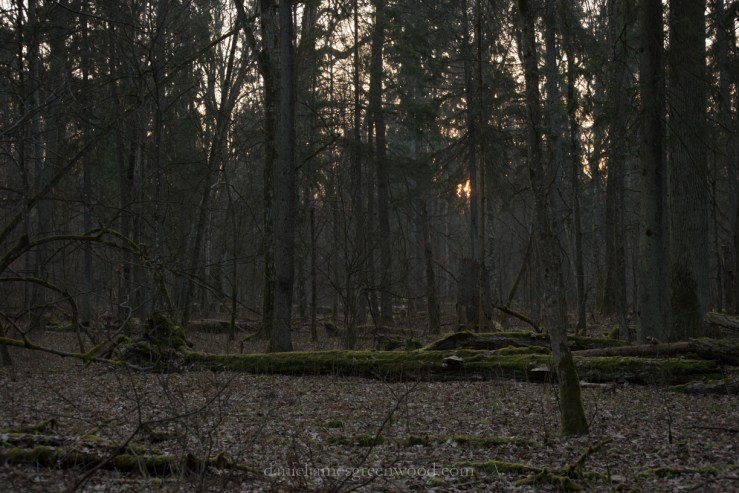
We visited the reserve at dawn. You can only enter with a guide having paid the entry fee or on scientific business, if you enter without one you can be fined. Wardens cycle around the main paths seeking to check permits at all times. This officiousness – our pass was checked three times – gave a sense of pressure to our visit but did not take anything away from the strict reserve’s grandeur.

The strict reserve manages itself ecologically – though there were plenty of signs of chainsaws cutting fallen trees across paths, so ‘truly wild nature’ had not escaped Health & Safety. Trees naturally succumb, fall and decay. Some remain standing to become habitat for fungi, plants and other invertebrates. One of the main attractions for Pete and I was the number of woodpeckers that could be encountered here. By the end of the trip we had seen 8 species.

One woodpecker that can be seen fairly commonly in east European spruce forest, if you give it the time and attention, is the three-toed woodpecker (Picoides tridactylus). It feeds on the larvae of the spruce bark beetle, the subject of much press attention in Europe currently. The three-toed woodpecker makes its way around the trunk of a dead spruce tree, pecking away at the bark to find its food. Evidently the deadwood created by the bark beetle is of great importance, rather than being the threat outlined by the Polish government. But is the threat economic or ecological?

Another woodpecker which I have rarely spent any time with is the lesser spotted woodpecker (Dendrocopos minor). In England this bird is undergoing a speedy decline, having disappeared from its historical range and now confined to strongholds, including the New Forest. Its decline in the UK is not completely understood. In Białowieża we had the opportunity to spend a good half an hour with this bird alongside the Narewka as it picked its way around the tree. Before reaching the river we had seen the Syrian woodpecker (Dendrocopos syriacus), identifiable from the great spotted woodpecker (Dendrocopos major) by a break in the black bar that connects its cheek from its nape!

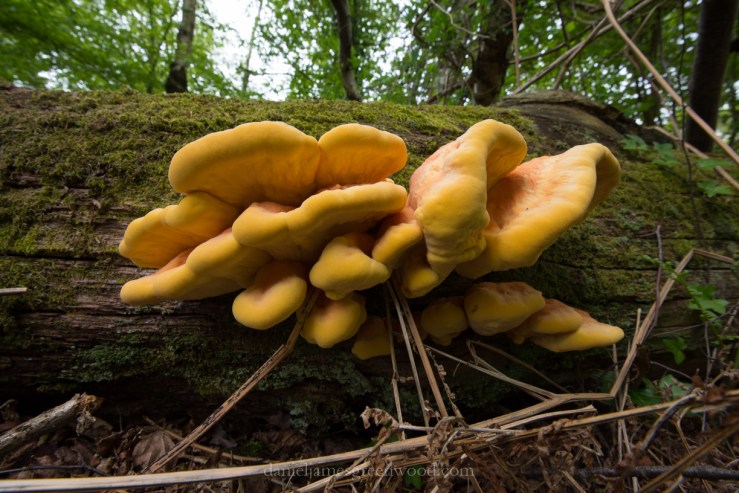
Fungi is a friend of the woodpeckers in that it softens up trees for excavation. Fungi performs a vital role in woods, in breaking down dead trees, controlling the number of certain species and in creating soil and stable nutrients for other life to prosper from. It also helps trees by weakening and quickening the removal of deadwood that otherwise adds weight to a tree, inhibiting its growth.

Outside the strict reserve this hoof fungus (Fomes fomentarius) evidenced the role fungi has in offering direct nourishment to wildlife. I pray that this was bitten into by an elk but it was most likely a horse.

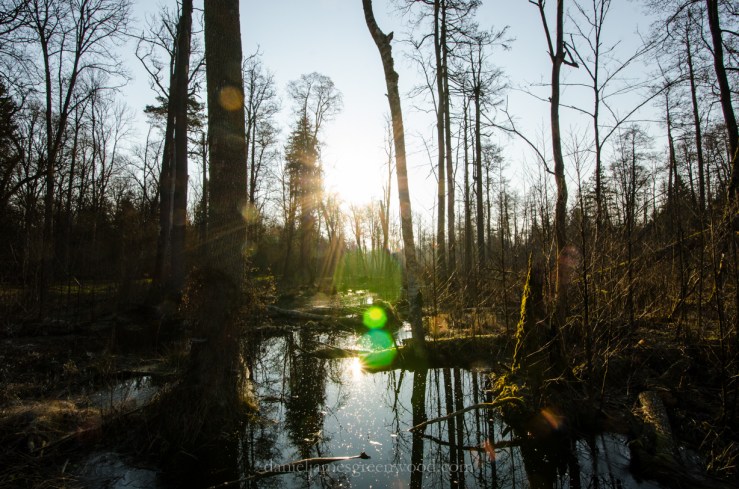
I’ve written before about beavers in Europe. In Białowieża’s strict reserve they are another ‘forest engineer’. You can even find them in Warsaw, a lesson for us in the UK as we get to grips with these returning beasties. The flooded woodland you can see here has been opened up and the river Orłówka broken out and slowed by beavers. This has a massive effect on the number of species found in wetland habitats. The smaller pools of water create breeding space for fish and many aquatic invertebrates, as well as for amphibians. The rerouting and channelling of European rivers – especially by communist or Stalinist agricultural schemes – was one of the most destructive environmental practices to have occurred in the continent’s history.

This is a multi-stemmed hazel tree which had been ‘felled’ by beavers. I love how similar this is to the hazel stools coppiced by volunteers in much smaller English woods. So it’s ok if beavers do it, but not us? I’m not so sure.
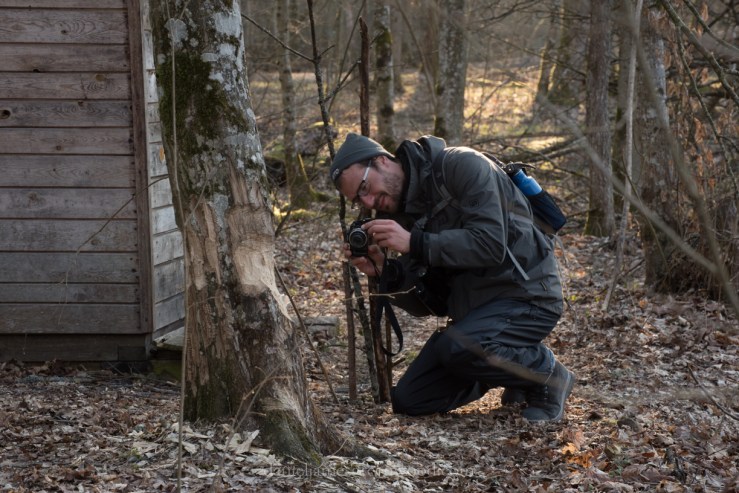
Pete was also impressed by the beaver’s work. They are able to sharpen their felling teeth with bottom front teeth that act as a kind of sharpening stone. They are evidence of the fact that sometimes cutting down trees can be a good thing.

The bark beetle battle
Tree felling is not always the right thing to do. Walking in Białowieża there were clear signs of spruce trees dying off from the impacts of the bark beetle. Trees with red dots or crosses with numbers marked in red spray paint indicated that they were to be felled.

The bark beetles do damage to trees when present in large infestations because they bore through the cambium of the tree. The bark is the protective layer for the cambium as well as the phloem and the xylum. Water travels through the xylum and sugars and other minerals pass through the phloem. These are the two most important cell membranes in a tree’s ability to feed and grow. There are many species of bark beetle, the above image is an ash tree and so I don’t profess to know if it’s the spruce bark beetle, it probably isn’t seeing as the spruce bark beetle family only feed on spruce or pine.

As mentioned earlier, deadwood is an intrinsic part of a woodland ecosystem. It provides habitat for thousands of species of invertebrate and fungus. Many managed forests completely lack any deadwood because it has been removed for sale or simply tidied up. Also the key plantation trees of spruce, pine and larch produce very view large branches, unlike oak or ash, and so there is little to even fall anyway. Recent research suggests that the removal of deadwood from woodland environments has contributed to climate change. This is because wood continues to hold carbon as deadwood. The tidying up of woods is one of the key ways to reduce its biodiversity, I hate to see it.

In the Bavarian Forest, on the border with the Czech Republic, the spruce bark beetle has also hit the woodlands hard. One of the possible reasons for this increase is the intensive forestry of the early 20th century, when Germany was at the forefront of two world wars. In wartime, woods suffer greatly. In the UK, the Forestry Commission was created in 1919 in response to the depleted supply of wood caused by the First World War. In Britain this meant a loss of ancient woodland, an irreplaceable habitat. In Germany war meant more spruce and pine, laying the groundwork for the outbreak of the bark beetle in recent decades. Before the Bavarian Forest’s intensive forestry work in the 1900s, the woods were made up of silver fir (Abies alba), beech (Fagus sylvatica), ash and a greater diversity of species. When the balance in stable ecosystems is disrupted some species can become invasive. Similarly, the outbreaks of Dutch elm disease in the early Holocene (12,000 years ago to present) were likely caused by our species opening up woods and allowing the elm bark beetle (Scolytus scolytus) greater range of travel to infect more elms with the fungal disease. Manmade climate change is also identified as a cause of the dying off of spruce due to drier soils, another reason why no landscape can be described as ‘untouched’ by us.

On our final day in Białowieża we came across the first signs of intervention from foresters. A nature reserve sitting between the road to Hajnówka and the bison show reserve had large areas of mature dead spruce that had been felled. Was this in response to the bark beetle, or was it a safety measure? We didn’t know for sure but it seemed beetle-related.

Earlier in the day, before being stopped by the very suspicious Polish border guards warning us not to try and escape to Belarus(!), we encountered a man gathering timber with his tractor. I snapped this picture of him, mainly because I am interested in how woods are managed in Europe and who they are managed by. He didn’t see me take that photo but when he saw me taking the photo below, having driven past us, he began shouting at us in Polish to go away. My general feedback has been that European foresters don’t like being photographed.

This is what he had been so worried about. We met a Polish birder around the corner and I asked why he had been so angry. ‘Perhaps he is stealing,’ he said. I wasn’t convinced of that. It could be that Greenpeace Poland’s visits to Białowieża to count the number of felled trees, along with their typically ambitious protests being undertaken in Warsaw, has caused anxiety and tension among forestry workers, many of whom will be doing only what they do normally. I sympathise with them.
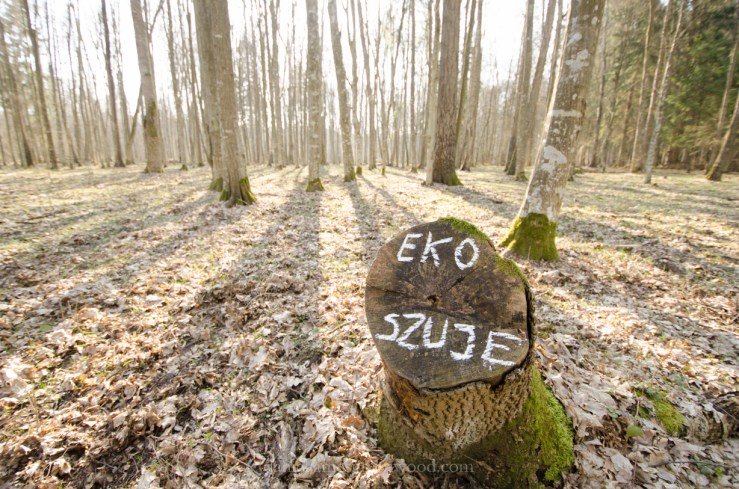
In another area we noticed that wherever there was a felled tree, the words ‘eko szuje’ or ‘eko kornik’ had been daubed on the stump. We were unsure what it meant, but ‘eko kornik’ probably means ‘reserve of the bark beetle’. I would welcome any translations from readers! This seemed like an urban protest. But why are the Polish government so keen to fell spruce? Why do they care so much about the tree? It’s not threatened in Europe, in the Bavarian and Bohemian Forest’s case its presence is too great and it inhibits species diversity and only small areas of infected trees are being managed to reduce the beetle. In my opinion, having seen how much use the tree is for construction and carpentry in Romania, the Czech Republic, Poland and Germany, the answer is surely commercial. Patrick Barkham has written a very informative account of the issue, he takes it further: ‘They [those opposed to the plans] say the beetle is a handy alibi for commerce. Before Szyszko [the environment minister] (a forestry teacher) was elected, he spoke of the wasted commercial potential of unlogged wood. Only 57% of the proposed harvest refers to disease-ridden spruce – its rotten wood is worthless. Loggers want to get their hands on valuable, large old trees. One forest district has already almost felled an allowance of trees which was supposed to last until 2021 and so the government will permit it to increase its annual take from 6,000 cubic metres to 53,000 cubic metres. Other districts are likely to follow suit.’

If the opposition view is right and the Polish government is attempting to log old growth forest (400-10,000 years old) the EU, as Barkham points out, should stop them: ‘As Britain heads towards the EU referendum, virtually every conservationist argues that we need to stay in Europe because of its environmental protections, including the habitats directive and its Natura 2000 sites, of which Białowieża is one. Białowieża is the big test for that argument. The EU must intervene, cajole and penalise the Polish government until its vandalism is stopped. If the EU can’t save Białowieża, its environmental protections aren’t worth the – sustainably sourced – paper they are written on.’
Doing the right thing for Białowieża
I’m uneasy about the ‘save our woods’ rhetoric that is so common now on English-speaking social media. The ‘crying wolf’ of many campaigners has led to scepticism for things that really are important. Evidently there are serious problems in Białowieża. The main crux of the argument to protect it is that it’s ‘pristine’, ‘untouched’ and a wilderness. I don’t agree that it is. Białowieża’s woods and trees have been exploited and its fauna messed with by people for over 600 years and likely further back. If Białowieża is to be saved from these ecologically illiterate measures of clear felling deadwood, the argument should not be based on mysticism. Campaigns to save woods and landscapes should be built on a clear case that people can understand, not on a fairy tale that will later be picked apart through the bureaucratic process. I don’t think Greenpeace Poland are doing this but those of us English-speakers trying to raise awareness about Białowieża should focus on reason rather than emotion first of all. There is a reasonable case not to increase logging in Białowieża, so why not focus on that? If you really do love the idea of Białowieża and want it to be protected the best thing you can do is visit, to spend your money there, invest in the eco-tourism infrastructure and show the Polish government that its value is far greater as a nature reserve than as one to be infringed upon by exploitative forestry. The battle for Białowieża will rumble on as it has for centuries.




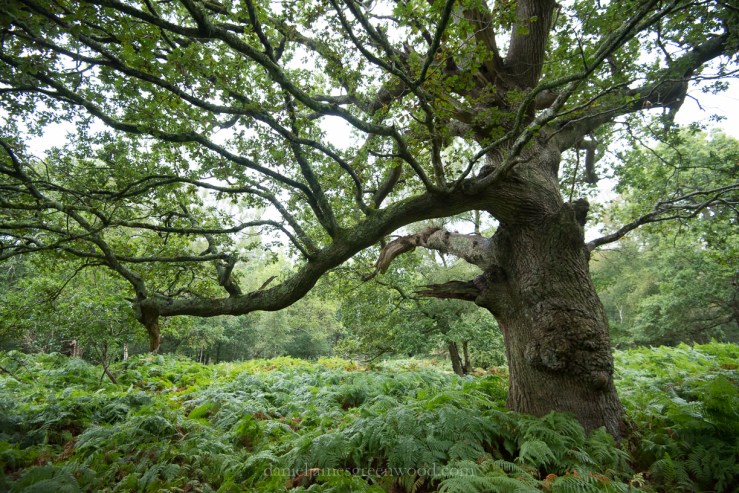
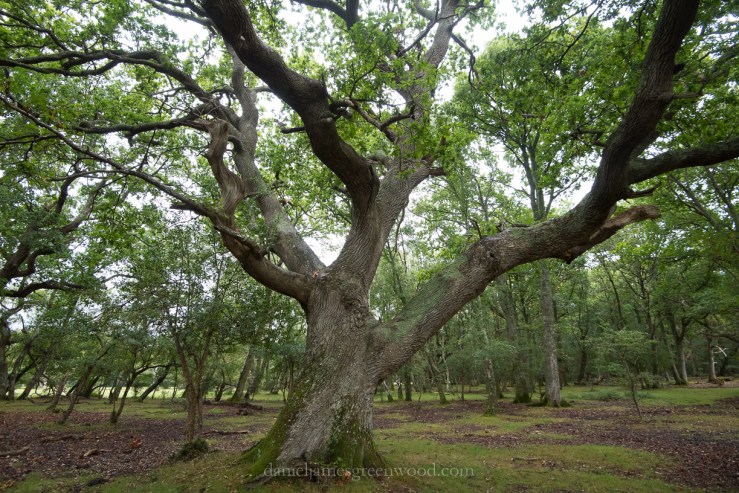


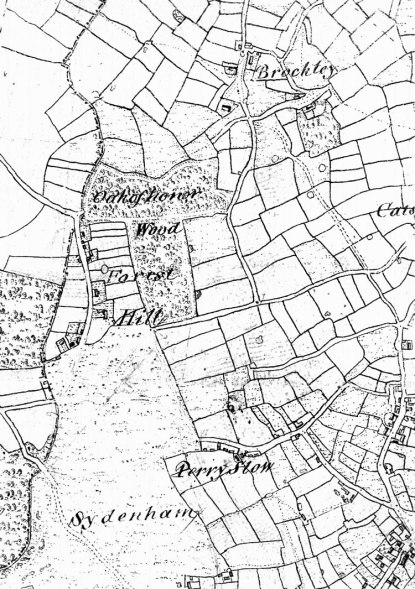
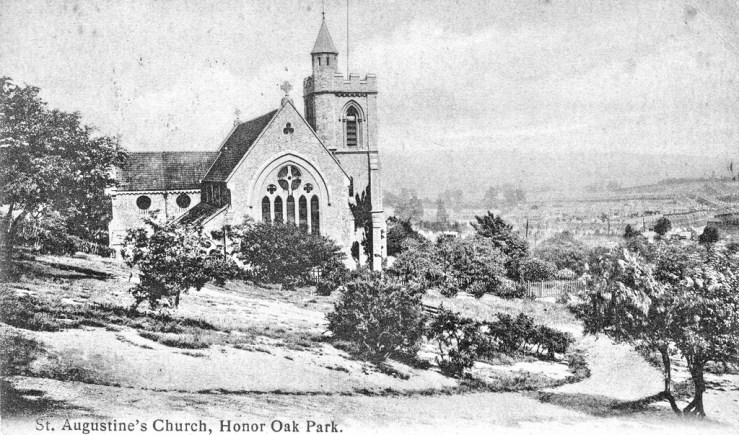


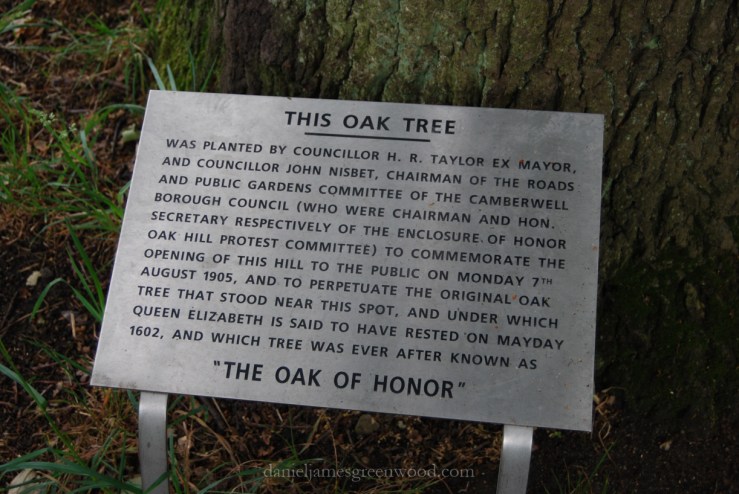


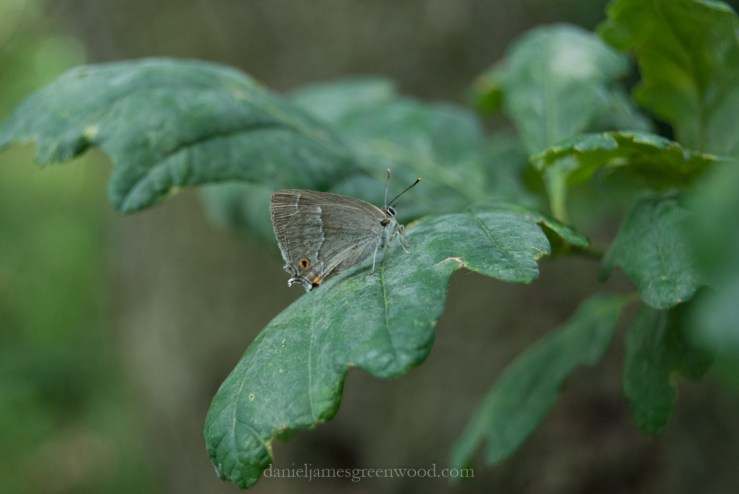
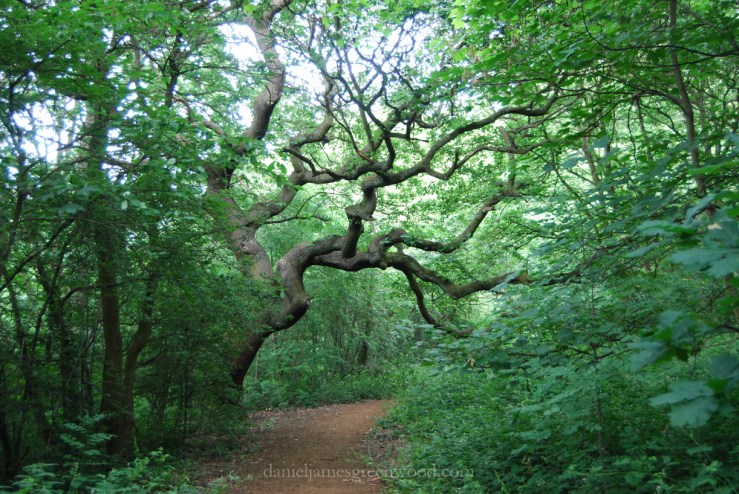
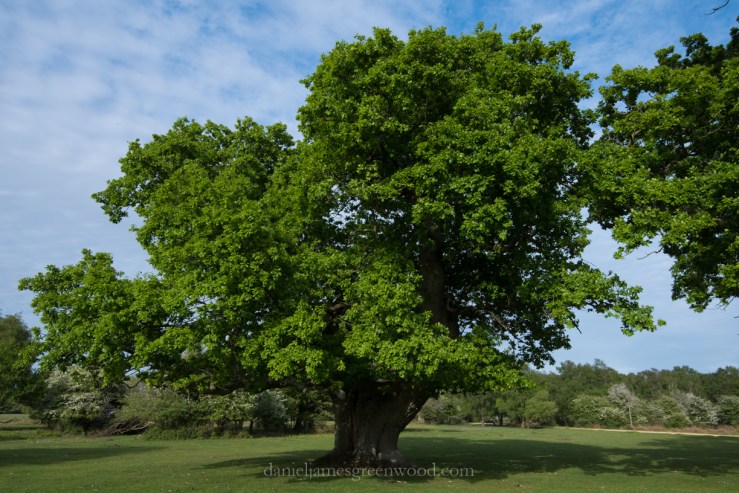
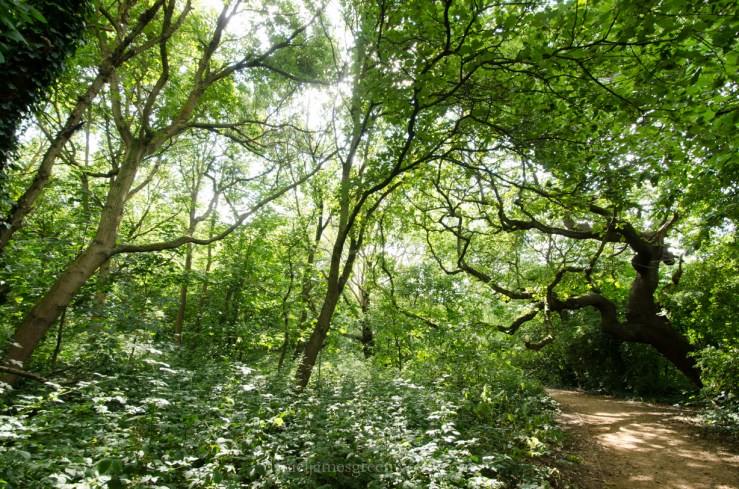 The tree, seen here on the right of the photograph (its lean exaggerated by the distortion of my 10-24mm wide angle lens) is competing with the seedlings that have likely fallen or been stashed by grey squirrels (Sciurus carolinensis) and members of the corvid family, especially jays (Garrulous glandarius). You could suggest that the new woods of One Tree Hill are products of its old boundary oaks, where the dominant species is oak. Recent research has uncovered how important crows are in establishing new oak woods across the northern hemisphere.