Blog

Woodland Diary: Litter picking in lost gardens

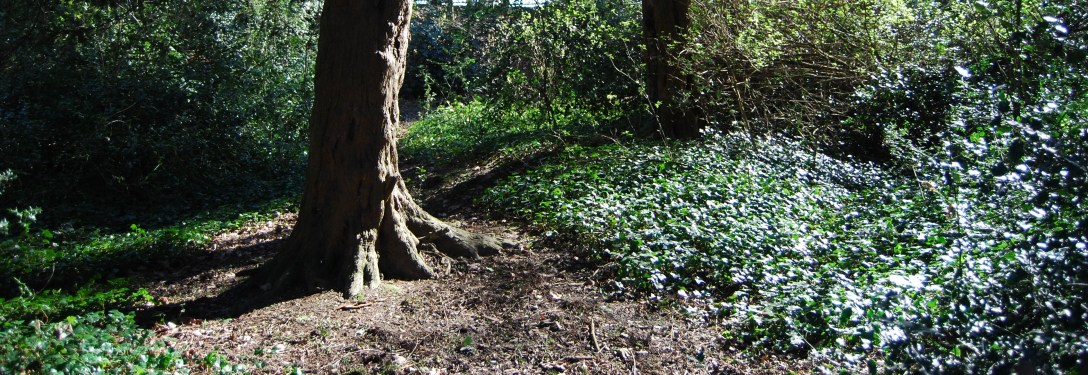
A slender pathway cuts through the ground layer of ivy, more likely to have been forged by a train of foxes. A large ash has been pulled down by the wind, the underside of the ivy leaves are a fresh colour, like the flesh of a lime. To the side a den has been made, with string tied to the rotting logs which rest against a tree in a tepee form. It can be the case that the people spend a night in the wood to qualify for a homeless shelter and so the sign of a tent or den surrounded by food packaging and drinks bottles is not unusual. There isn’t much litter to be found, other than things the ivy has subsumed, bottles or cans missed previously and taken in by the soil, or blown over from the road. Spiders make a home for themselves in empty bottles and the woodlouse is a common inhabitant of an old shoe.

We toe the path which leads around the ridge. It’s just ivy, above and below, masking the trees and the woodland floor. On the ground the leaves of premature bluebells peek through the earth and we take care not to trample. The coming of spring is a time of year to be cherished, the very thought leavens the darkness of long winter nights.

The ivy ends and a clearing opens up around a large yew tree, the soil cleared of life by the acidity and shading of the tree’s needles. The trunk is rippled and worn like an old doll’s limb, its circumference suggests it could be a few hundred years old. A line of tall yews appear as we move on, what must have been a hedge in a garden, turning into a right-angle. The ground dips to reveal the whitish bricks of a wall and a trail of broken glass. Behind us is a tall group of silver birch trees, quarantined amidst layers of ivy and the yew. These birch look like they’re waiting for something.

The other side of the wall shows a support structure for the terrace of an old Victorian villa, where people would have taken tea and listened for the hammering of woodpeckers in January, the repertoire of the song thrush in spring, and the call of the woodlark. A century ago they would have sat listening to the voices leading Britain to war. Now we look out from over the wall at wildness regenerated. Trees collapsed and left to rot down as fodder for bugs and beetles. The slow life of the woodland has been allowed to resume. A blackbird calls in the canopy and a great tit sings its winter song down in the woodland glade. The sun is setting low through the slope of trees. It’s time to go home.

Woodland Diary: Bramble, love or hate?

Bramble (Rubus frusticosus) is a point of contention. This is a common plant in gardens, alongside railway lines, in woodland and parks. Through the summer and into autumn ripe blackberries are a delicious and easy feed for humans and animals alike, the only price you pay is the odd nip from a thorn or a scratch to the tummy reaching for the highest bunch of all. The gobbling of blackberries by animals and their ultimate evacuation is one of the main ways the plant colonises new ground. In my family we have a dense lot of bramble at the back of the garden which, traditionally, my mother picks for fruit and freezes through the winter. Blackberries work wonderfully in pies, their bloody juices swamping the mixture of apples and sugar, colouring the innards a fantastic pink.

In the open and wild landscape of woodland bramble can be invasive, encroaching on grassland, rides and glades until wildflowers are shaded-out. A happy medium can be drawn by the technique of ‘scalloping’ along pathways and rides or in glades. This can be achieved with a grass hook or slasher, or else with the petrol power of a brushcutter. By cutting messy semi-circles into the shrub layer the bramble is pushed back, but not completely, and hopefully wild flowers will thrive with the new light which reaches the soil. The biodiversity is improved all round. In the autumn we brushcut the woodland ride of Cox’s Walk in Sydenham Hill Wood and the next day I accidentally flushed a green woodpecker (Picus viridis) which was feeding on insects in the newly cut scallop.

In the summer months bramble is a good place to spot butterflies. Comma (Polygonia c-album) and red admiral (Vanessa atalanta) can lay their eggs on bramble, and speckled wood (Parage aegaria) is commonly seen sunning its brown wings on a bramble leaf. Last year on Cox’s Walk we found a dying purple hairstreak (Quercusia quercus) amongst bramble, a butterfly which is tied to oaks (hence its Latin name) and should really have been ferrying between the canopy above. Bramble is not a good sign for wildflowers in woodland because it points to nitrogen-rich soil which promotes common nettle (Urtica dioica) more than anything.

However, the problem with labelling plants as wholly good or bad was emphasised to me recently when a group of teenage volunteers were working in One Tree Hill to push back the bramble from the acid grassland patch. They did an excellent job and opened up a patch which will hopefully be reclaimed by a diverse array of acid grassland flora in the growing season. But as we enjoyed a break, we glimpsed a small mammal, possibly a wood mouse, but small enough to be a harvest mouse, climbing through the last line of bramble. The red bramble leaves were frost-covered. This beautiful mixture of ice and vibrant colouring, and the tiny creature escaping to safety made me wince at the thought: bramble, good or bad?

Everyone knows a herring gull when they hear one

Everyone knows a herring gull when they hear one. Step off a train in Brighton on a summer’s day and you’ll hear their laughing call extend all the way to sea. It’s the sound used in TV and the movies to establish seaside towns. Two years ago I sat in Pavilion Gardens, green ash leaflets fanning against a blue sky, graduands strolling around with their grinning parents, when a bird poo bombshell exploded all over me. The velocity was shocking. I thought I had died and gone to graduation. The crap covered my hair, face, chest and arm. My companion was caught between the need to console and gloat. ‘You have to laugh, or else there’s nothing you can do,’ she said. ‘I’ll get a cloth.’

That day I learned some respect, seagull-style. My admiration for this bird is strange, a love unrequited on the animal’s side, a little masochistic on mine. I went to university in Liverpool and lived in a flat in the very heart of the city. My bedroom looked-out upon a row of fast food and booze outlets siphoning their stench out onto our balcony. At night we would peer over the ledge and watch the overblown shadows of rats moving between bins and under cars. Squalls came from that chasm after dark, and deep, booming voices often extinguished them. During my tenure, Saturday nights in Liverpool city centre were accentuated by the boozy rowing of couples, up against the walls of bars, stumbling across the pavement like seamen. But above it all something else was happening.

On a fine spring evening in my first year we lay on our backs on the grass verges beneath the Anglican cathedral.

‘Look!’ I had shouted, ‘a shooting star!’

‘No, you bloody idiot, it’s a seagull,’ was my acquaintance’s reply.

Smaller gulls, probably black-headed gulls, would catch the orange colour of streetlamps as they flew over. My inebriation did the rest. In the spring and summer months, when the gales which blow up and down Renshaw Street had died away, the angelic shapes of white gulls would waft down the road. Take the view from the corner of Rodney St., where Hardman St., meets Leece St., looking down onto the old Rapid Hardware store. When the sun set between the cormorant-esque liverbirds, the silhouettes of gulls moved like ashes from a fire, drifting on a light breeze to and from the Mersey.

From my old window, what I now know to be a newborn juvenile herring gull would call to its parent, waiting there for long periods of time, a bit like a package dipped in soot. Its bill is coal-black, a dusty grey hint to its body, ending in the white of its head. I have a polaroid picture of an adult herring gull perched on the rail looking into my room, a white-washed statue. The irony of the erroneous term ‘seagull’ is that now foodstocks have diminished in the bird’s natural coastal habitat, herring and black-headed gulls are coming inland to feed from the waste we leave in the street. They don’t merely follow the trawler anymore but the tractor. I recall a flock of feral pigeons, birds deriving from the cliff-dwelling rock dove, being dive-bombed by a herring gull over the scraps of chicken wings thrown into the road outside a fast food joint on Bold Street. It was like the moment the Tyrannosaurus Rex rears its head in Jurassic Park.

Whichever monstrous gull it was that crapped on me in Brighton, I forgive it. The presence of these birds on the margins of my youth have defined a remnant of my past with perhaps a little more tenderness than one might expect.

Woodland Diary: Sycamore coppicing

Holly blue

This was the first workday for the Friends of One Tree Hill (FrOTH). We coppiced 10 sycamore (Acer pseudoplatanus) trees and cut back the bramble (Rubus frusticosus) which is so dominant on the site.

In the case of sycamore we were felling trees of some thirty-feet or more in height that were competing with the sessile oak trees (Quercus patraea). These oaks are regenerating on the slope of the south-facing hill and are slow growers compared to the highly successful sycamore. We felled the trees also to allow light in and let the herb layer regenerate. This is a technique which helps insects and butterflies in particular.

PlantLife reports that by 2002 97% of British broadleaf woodland had become high forest. In 1951 that figure was at 51%. This means that most of our woodland is dark and overgrown generally because humans have stopped relying on woodland as a resource for firewood, furniture, grazing of livestock and so on. One of the great misconceptions about woodland is that felling a tree is somehow a bad thing when, on the contrary, wildlife flourishes when trees are cut down in moderation and sunlight can get in to bring life to the woodland floor.

One ancient tradition which has gone out of fashion is the art of coppicing. This is a process of cutting a tree down to its base, generally of hazel (Corylus avellana) or ash (Fraxinus excelsior), which means that the tree shoots new, straight growths. These poles were used for a variety of things, often as fencing.

Sycamore is not a typical coppice tree, but the stumps we cut down to in One Tree Hill will shoot similar growths in the spring and summer. In the meantime the wood we have cut will be used either to make log piles for beetles and other bugs to inhabit, otherwise the material will be used to make handrails or dead hedges in the wood.

The point of managing a wood in this way is to show that using the material, i.e. trees, is not a negative thing and can boost wildlife in the short term. The Pearl-bordered fritillary (Boloria euphrosyne) is one butterfly which saw a decline in numbers after the tradition of coppicing declined in the 20th century after we began to rely on gas to heat our homes and use wood imported from overseas. You can see that a tree has been coppiced if you spot thin shoots and the hairy green leaves of a hazel. 

This technique is renowned for its benefits for wildflowers such as wild primrose (Primula vulgaris) and bluebells (Hyacinthoides non-scripta) which can burst into life when the coppice is cut. These are plants indicative of ancient woodland and seeing as One Tree Hill is located in the area which was once part of London’s Great North Wood, we are hoping that some plants, in certain areas, could reappear one day, not to mention the wildlife which feeds from them. Sydenham Hill & Dulwich Woods and Dulwich Upper Wood are two fragments of the Great North Wood which have ancient woodland flora growing there, and have done for thousands of years. Perhaps one day One Tree Hill can be in a similar vein of health.

The cuckoo goes


We won’t know
when the cuckoo goes,
we’ll never know it’s gone,

we won’t know
when the cuckoo goes,
we’ve never heard its song.

We won’t know
when the cuckoo goes,
we’ll never know it’s gone,

we won’t know
when the cuckoo goes,
they say it won’t be long.

We won’t know
when the cuckoo goes,
we’ll say that nothing’s wrong,

until the day
that the cuckoo goes,
we’ll sing the cuckoo’s song.

And if the cuckoo goes,
then the cuckoo’s gone.


Gawping at the Chilterns

I am a countryside gawper. I like to watch the flow of valleys, hills and pasture seen from an English train window. As a student I remember travelling to and from Liverpool on the Euston line, experiencing a sense of nostalgia for the things whizzing by without the chance to grasp them. And this was before the trains had been improved to a mere two-hour journey between North and South. I recall the yellow of rapeseed and turnip flowers which bloomed in April fields, like a paintbrush passed across the glass. There were the peculiar farmhouses and barns, the horses drinking from streams which I deemed to be wild, and the black silhouettes of hawthorn and oak which had been moulded by the gusts and gales, all crooked and splayed. I remember the train slowing one evening in the gloaming, a brook taking on a glassy sheen in the near dark.

Now I stare out of the window in search of my post-London rations: skylarks, buzzards and such. These are not readily available in London, though they are in rural spots of Croydon and Bromley. This journey in particular was a trip to Birmingham for a flat-warming, promising (and delivering) a different kind of wildlife. The daytime train ride offered a snapshot of a new landscape to me, the Chilterns, designated an Area of Outstanding Natural Beauty and a part of the Green Belt. This is an area which has been earmarked for the High Speed Rail 2 which will see trains passing through the region every two minutes at speeds of 250-miles-an-hour. The service, some argue, will make use of the region but will offer it nothing in return. The closest stop will be Heathrow airport.

I was not thirty-minutes from leaving Marylebone when I glimpsed a trio of buzzards wafting in the grey ceiling. I saw jackdaws bothering the chimneys of small-town folk, and those magical inhabitants of plough tracks, the birds which had treated the silence between rounds at the disastrous battle of the Somme – skylarks. Their stiff, sharp wings rang the bell, as the train careered past on the raised track. The larks, three of them, descended upon a hedgerow in perfect accord.

I had recently read a book by Mark Cocker entitled Crow Country, where the author describes waking at 3am to watch rooks in Norfolk, amongst other revelatory birding experiences. The sections on Corvus corone, the carrion crow, had stayed with me. I could not help but observe these clever brutes patrolling green spaces in London. It should be pointed out that this is to the chagrin of some bird lovers who cite the cradle-snatching antics of the corvids as a reason to cull them, and to enhance supposedly falling fledge-rates of songbirds. Cocker’s writing on crows drew me to take greater notice of how they behaved. One thing I had witnessed a number of times in the autumn was crows bothered by kestrels, the big black creature barking, immensely uncomfortable in the presence of the cheeky falcon. Falcons like kestrels and hobbies sometimes go for old crow’s nests, so perhaps this was a question of ownership.

From my seat on the train I witnessed a trail of crows flying from over the roof of the carriage. The sound was killed by the glass but the conga-line of corvids pointed to something else. The line came to an abrupt end and a stretch of thin air opened up. And, some moments later, the giant wingspan of a red kite appeared in their wake. Its flight was smooth, a single beat of its wings expressing its power over the fleeing crows. The kite’s wingtips were like fingers. The forked tail was the motif that defined it, the whitish head and large white patches against the dark wings. This is not to mention the rufous shade which separates it from its continental cousin, the black kite. This is a bird which preys on crows, hence the sense of uniform panic amongst the fleeing black feathers.

Red kites were on the brink in the UK until a breeding programme in Cumbria re-established populations which have now spread eastwards into England. It is now said to be approaching students eating their lunch at Reading University, where a research programme is underway to discover how far the birds are spreading, with reports of the birds feeding in gardens. This is a monster which ate offal from the streets of London in the 1500s, when butchers threw them their scraps, but declined after centuries of persecution. For all of our dwindling species, there are some which are returning to dominate again. They’re screening in a train window near you.

— Photo by Ian Knight