#FungiFriday: how I first discovered mushrooms (not literally)

Picture 096

Fungi Friday 29th May 2020 via November 2011

This autumn it will be 9 years since I first began photographing fungi. I want to share how I found a passion for these incredible organisms and show the first photos I ever took of fungi.

I owe thanks to several people for tuning me into the world of mushrooms. David Warwick, who led fungi walks for volunteers and the public for London Wildlife Trust at Sydenham Hill Wood, shared his knowledge with his fellow volunteers and helped me to gain an interest. That was where I learned about fungi and, over 7 years, had the opportunity to watch them pop up and fade away across the nature reserve.
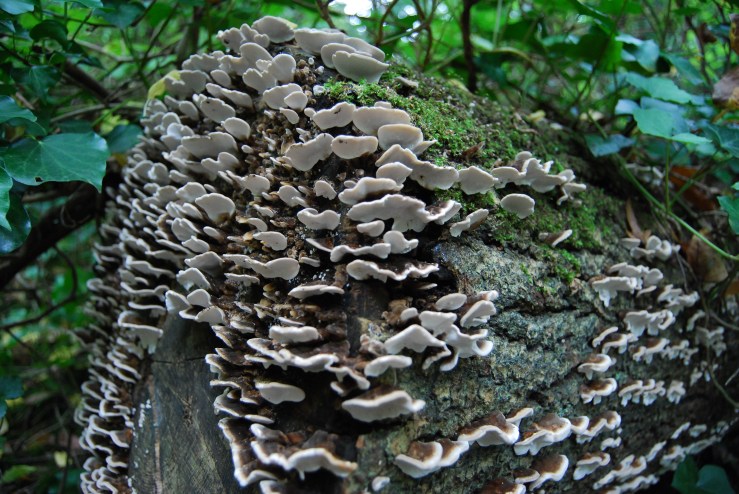
SHW September 2011 (52)
Turkeytail

The biggest thanks of all go to Ashley White who was the Project Officer who managed the Wood when I was a volunteer. For anyone who has ever volunteered, you will know that the person who leads you is as important as the thing you’re volunteering to do. Ashley inspired many of us to follow our interests in many areas of conservation and ecology.
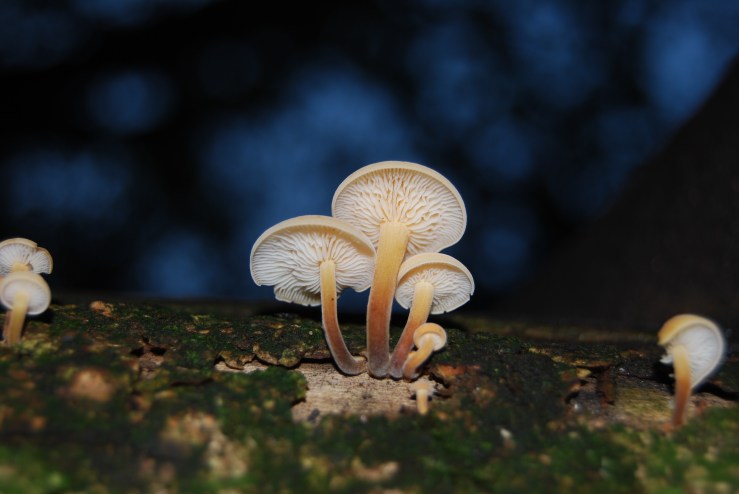
Picture 091
Velvet shank

My first real attempts to photograph fungi took place in November 2011 during a volunteer day. I used a Nikon D60, a 10 megapixel camera (the equivalent today is double that) that I was given as a birthday present in 2008. I had no editing software and the photos here are as they were taken in the camera, which you can probably appreciate.
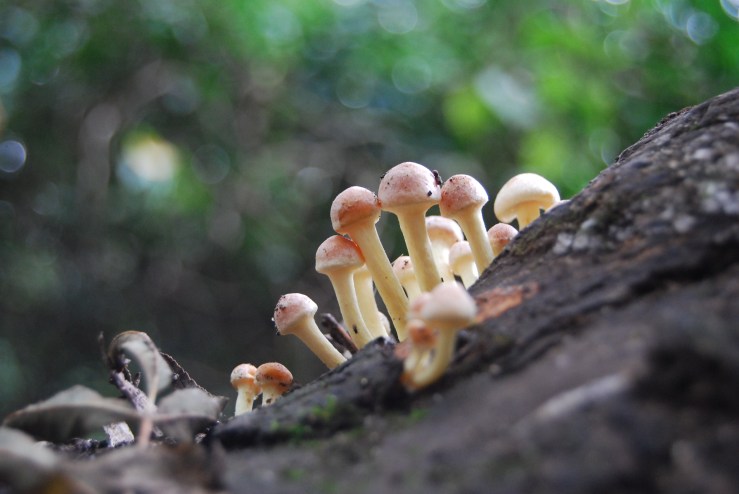
SHW September 2011 (49)
Sulphur tuft

One of the more memorable images that I contributed to London Wildlife Trust was this happy bunch of sulphur tuft. This species is probably one of the most common in the UK. It’s toxic but charming to look at. I respect its ability to show up in the street and in all manner of other locations.
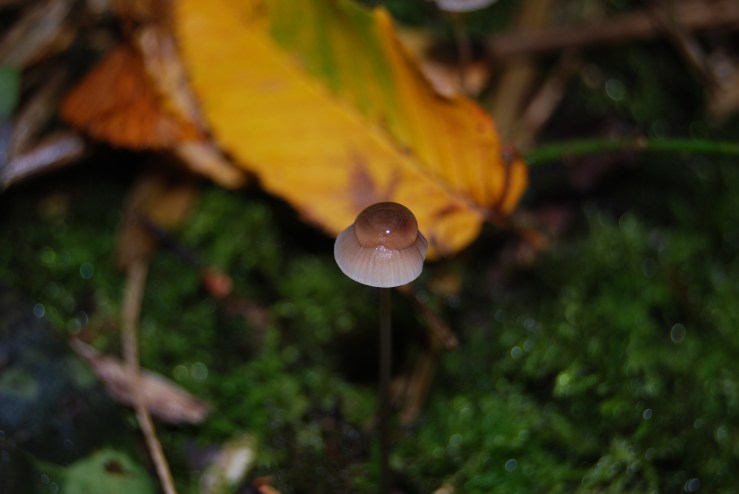
Picture 100
Bonnet with a droplet on top

Photography has always been a way for me to learn about much more than cameras. To identify the majority of species of fungi, you’ll need to undertake all manner of experiments that I am way too lazy/skilled enough for. I want to spend as much time outside in the company of the things I enjoy photographing. Too much time is already spent indoors. All these are excuses, I know.
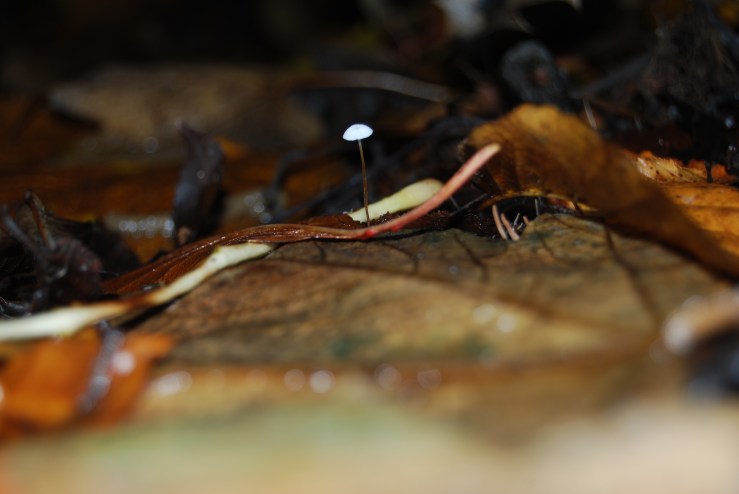
Picture 084
Parachute

I think one of the most interesting things about fungi are their diversity. This doesn’t just mean there are a lot of species (over 120,000 accounted for on Earth, probably more than 1,000,000 in reality). It also means they appear in all kinds of places: leaf litter, holes in trees, the ground, the pavement, sometimes even inside your house. That’s not really what you want.
Picture 071
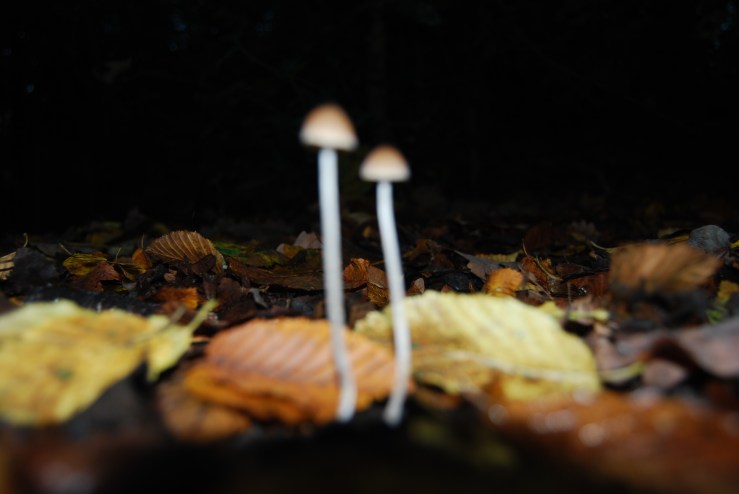
Brittlestems out of focus

After autumn volunteer days I would seek out fungi anywhere I could find them. I had begun to notice some growing down in the leaf litter. As you can see from the photo above, it’s difficult to take photos on the ground without a reticulating screen. Mine was fixed which led to classic images such as the above. These are brittlestems. Over the years at the Wood I would notice this family of mushrooms popping up in damp patches under leaf litter.
Picture 018
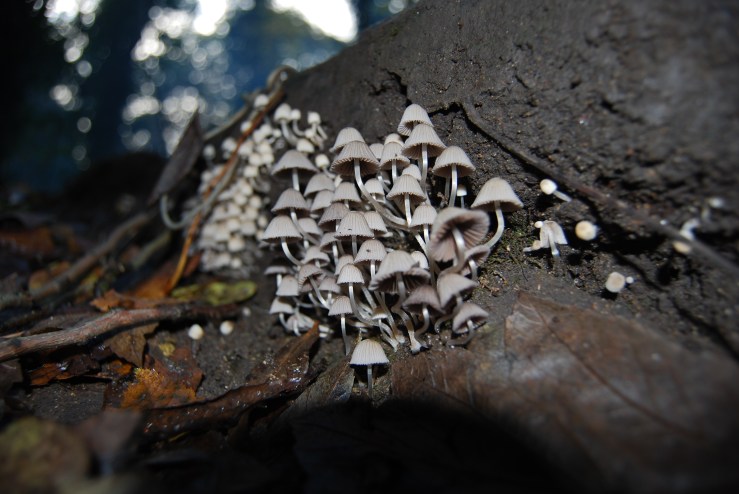
Fairy inkcap

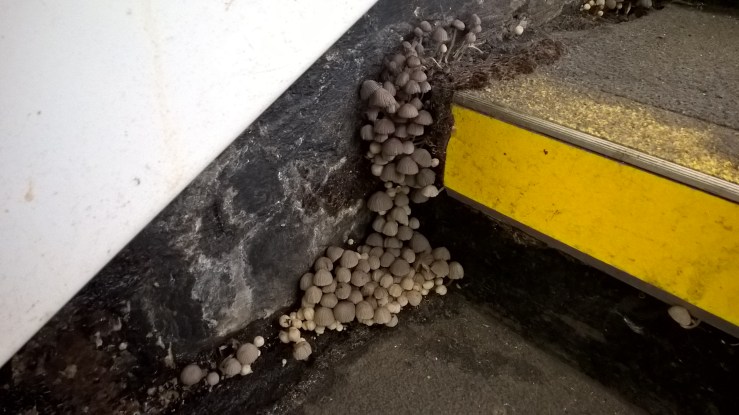
Many of the mushrooms in an urban woodland like Sydenham Hill Wood are common species that can pop up after a decent amount of rain. These fairy inkcaps are often found at the base of steps. The steps in the Wood were constructed by volunteers using wooden sleepers, planks for the edges and then filled with gravel. These mushrooms like steps so much I have even found them growing in Clapham Junction station on steps! For those who don’t know, this was once one of the busiest railway stations in the world. Thousands of people rush up and down these stairs every day.
WP_20150705_13_07_27_Pro
What’s not to love?

For all the negativity around nature conservation in Britain – and for me all contact with nature in the UK fosters a relationship with conservation – fungi gave me a sense of nature’s attitude of I will show up where I want, when I want. For anyone who has ever felt constricted by the physical environment we are forced to live in, nature is always looking to re-align it. As with fungi, it just takes time.

Picture 272
A miniscule fairy bonnet on a piece of mud

Fungi says to me (not literally) that life does not stand still. Fungi are a part of life processes which have no end. Fungi are always building and feeding a new world whether we like it or not. Perhaps that’s what seeing those fairy inkcaps on the steps of Clapham Junction station taught me. We may be extinguishing a beautiful diversity of life on Earth, first with large, charismatic animals. But nature is complex, unknowable in its entirety, and it will never stop.

Thanks for reading. Have faith.

More mushrooms


#FungiFriday: 5 reasons why fungi are good for us

SLF - 14-12-2019 blog-23

Fungi Friday 22nd May 2020

This week has been Mental Health Awareness Week. We all have mental health but in general many people lack an awareness of it.

In the UK this is not helped by hundreds of years of toxic interpretations of masculinity and the systematic oppression of women in society. There’s a grave stigma attached to even discussing mental health, due to centuries of extreme societal, political and, indeed, medical responses to psychological ailments.

In recent years, despite severe cuts to mental health services in the UK, the conversation has begun to change.

Nature, or at least our sense of it, has become a counsellor, allowing us to detach ourselves from societal roles and see ourselves as a single species in a vast web of biodiversity. Nature helps us to feel human. Fungi are a big part of that.

While this post is definitely not about hallucinogenic mushrooms or any such trips, dude, I thought I’d take the chance to share how fungi offers ideas that help me to cope with the stresses and anxieties of ‘normal’ life.

Fungi - 10-1-2019 djg-9

1. Fungi and the diversity of life

Knowledge is one of the most important ways to overcome mental illness. For many people a diagnosis is crucial to overcoming a condition. In trying to cope with life generally I have found that small, incremental improvements to my own knowledge, especially around the natural world, can help to build a foundation of resilience through understanding. In a time when we are faced with the potential for a Sixth Mass Extinction, it’s important to appreciate that there is an immense diversity of biological life on Earth worth fighting for.

A big part of that diversity is fungi, it has a Kingdom of its Own. British conservationists are renowned for pummelling themselves with the lack of biodiversity we have. Yes we have lost wolves, bears and lynx, but we have an immense diversity of fungal life in comparison to other groups such as mammals.

In the UK there are thousands of species of fungi, in the world there are known to be around 100,000. Scientists believe there are in fact over 1million species of fungi with a huge percentage of them yet to be identified.

RS2354_Daniel Greenwood Sydenham Hill Wood mushroom 26-11-2017

2. Looking for fungi is good for you

Above is a photo of a fungi walk I led in 2017 for London Wildlife Trust. These walks had to be capped each time and extra dates put on (rock’n’roll) because the interest was so high. We are attracted to fungi by its mysteriousness, its beauty, the fact it feeds us, underpins the biosphere, and also that they kill us on rare occasions.

While opinions around foraging fungi are fairly divided, the act of looking for fungi can have a huge impact on your wellbeing. One of the most rewarding elements about spending time ‘in nature’ is that you are distracted by the largely artificial worries that we face in modern life. By that I mean the deadline you have to meet at work, the email you didn’t reply to or the fact you haven’t hoovered your bedroom for a month.

An appreciation of fungi can also help to deal with seismic moments in life. A recent book has shown how learning about fungi and seeking them out can help to overcome bereavement.

WP_20151001_09_30_46_Pro

Take the example above. This is a patch of sulphur tuft, one of the most common speciess in the UK. I used to pass this garden on the way to work every day. It was very manicured but these mushrooms had burst on the scene. If I were to anthropomorphise, I would say it was a big ol’ middle finger to people trying to control every inch of their gardens. Sorry if that’s you!

The act of looking is an act of defiance, of rejecting the status quo and seeking out something new. For me, what nature brings in fungi is a newness that will never end. There are too many species, too much to learn, even in Little Britain.

DH-29-4-2020-lo-res-3

3. Fungi feeds humanity

While you won’t find recipes on this website for anything other than life-affirming hiking experiences, we should remember that fungi make up an important part of our food systems. While wild mushrooms don’t really make much of a dent in that, the discovery of a delicious wild mushroom is a thought that can keep you going when the woods are far away.

I have only ever eaten one wild mushroom. It was picked by a friend in Czechia in a very large area of woodland. She gasped when she saw it, took out her pen knife and cut the cap off. ‘Are you sure that’s edible?’ I asked. She was crouched down, stopped what she was doing and glared at me: ‘I have been picking this mushroom my entire life.’

Nuff said.

When we got back to her house she battered it in breadcrumbs and fried it. It was incredible.

Fungi does also provide important meat-alternatives to help us to focus on consuming meat from sustainable, local sources. Mycoproteins make wonderful sausages and burgers. Fungi is also needed for cheese, beer, bread and wine. Now many of you would struggle to live without those things!

New Forest - 23-10-17 -1 djg (4)

4. Fungi = time in the woods

Every autumn I make sure to have at least one full day in the woods. I bring lunch, snacks, water and all the camera equipment I can carry. It’s a chance to slow down and tune into the rhythm of the woods. It’s better than I’ve made it sound.

Spending time in woodland is shown to improve our health. The air is fresh, the sounds, colours and textures give us a great feeling of calm. There are also chemicals which trees and plants release which support our immune systems.

Spending time in woodland also teaches us respect. As a woodland warden in south London I witnessed many people making their first visit to the woods and nigh-on trashing the place. They sometimes did that themselves, sometimes with their pets, sometimes with their friends. I remember one volunteer who had become an impassioned defender of wildlife at the wood, even though he probably did things several decades ago as a teenager, that he wasn’t proud of. Even when people are causing harm in nature, not through the devastation wrought by things like HS2, at least they are there and they can develop an appreciation of it. We all must learn these things one way or another.

New Forest - 23-10-17 -1 djg (59)

5. Fungi will save the world – perhaps us, too

Plastic is a blight on our planet. Fungi could help us to manage it and rid its waste from the landscape. Fungi is being developed as a disposable material to replace non-degradable or recyclable plastics. Fungi also has a role in the mass production of a bacteria that scientists recently discovered at a landfill, quietly digesting non-degradable plastics.

While fungi has an important role to play in these issues, it’s good to remember that in many ways, fungi are the world. Fungi have played crucial support roles in the evolution of woodland ecosystems, trees, plants and many more species. We should celebrate and attempt to understand as much as we can about this amazing biological group.

Thanks for reading, wishing you well.

More mushrooms

#FungiFriday: Chicken of the woods

DH-29-4-2020-lo-res-3

Fungi Friday 15th May 2020

I mentioned a fungi photo project which I was working on, watching the development of a fungus on my daily exercise ration. Both of those things have now been foraged and are consigned to the past. We can go out for a walk more than once a day, and my subject has been sliced and munched by someone who knows what they’re doing.

I was watching the slow mushrooming of a chicken of the woods fruiting body on a circular walk from my house but its progress was interrupted last week. Now the post looks wafer thin. Here’s how it played out on Twitter:

COTW_1

I first saw this mushroom developing on 25th April on a fallen oak tree next to a footpath, lodged between farmland and a wooded estate.

COTW_2

Three days later I passed it again under twilight and the advancement was pretty clear.

mark-twain-medium

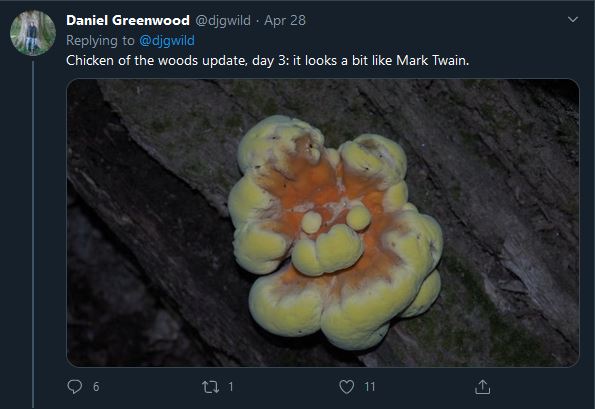
I also felt it looked quite a lot like Mark Twain, one of the great American writers. His characters sure ate plenty a chicken in the woods, sure did.

COTW_3

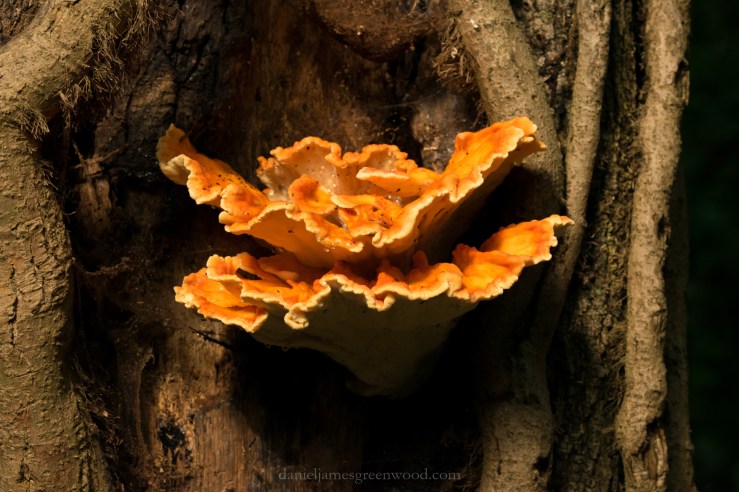
Chicken of the woods is a highly desirable edible fungus for people who desire that sort of thing. It’s one that’s easy to identify and is not known to have any serious side-effects. I have noted ecologists arguing that it should be left for the many species of invertebrate that find a home in it.

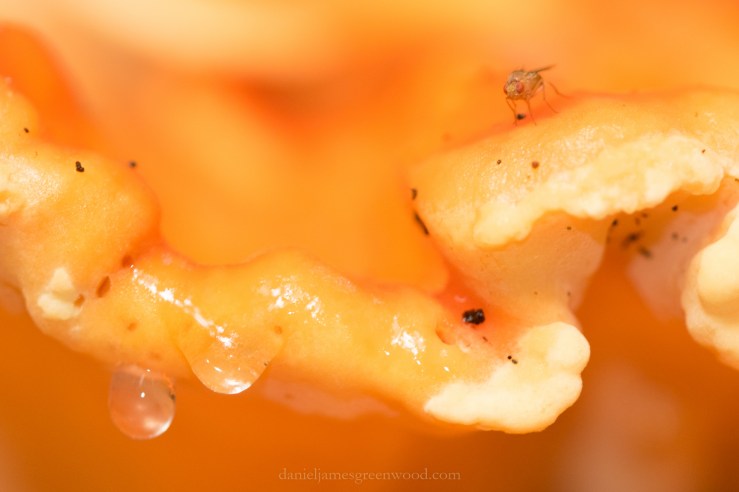
SHW 23-7-17 djg-10SHW 23-7-17 djg-14SHW 23-7-17 djg-17

The images above show a chicken of the woods fruiting body with some of the invertebrates hanging out on it. Believe me, there were so many more.

COTW_4

At this stage, on May Day, the chick was beginning to make its way in the world.

COTW_5

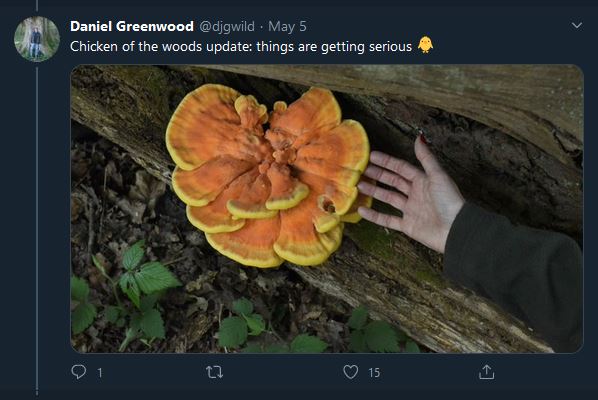
Four days later, it was positively enjoying life. Then, this happened:

COTW_6

The moral of this story is: we all get foraged in the end.

Ches-9-5-2020-lo-res-05

Here you can see the clean cuts of someone who knows what they’re doing. They’ve brought a knife with them on their walk and have made an attempt to not damage the mycelium which is attached to the dead wood itself, and not visible here.

Fungi - July 2018 djg-6

I’ve found some pretty epic chicks in the past, like this 1-2m long gathering on a fallen oak or sweet chestnut next to a river in West Sussex. It’s the biggest one I’ve ever seen. It does make me laugh how bites have been taken from the side, possibly the teeth of deer which are common in this area.

IMG_20180729_111426071IMG_20180729_110927744

This one is several months old and had begun the process of falling apart. This is in July and is probably a June fruiting body.

IMG_20180729_111303742

This is the same day, and here Richard’s coat was not dissimilar to the fungus itself. He is a bit of a chicken in the woods at times, too.

Thanks for reading.

More mushrooms


#FungiFriday: the biggest mushroom I’ve ever seen in the White Carpathians

Czechia 2017 lo-res djg-8

Fungi Friday 8th May 2020

Happy Bank Holiday Friday! I hope you’re having and are permitted a nice extended weekend off.

I am working on a fungi photography project just now through my daily exercise walk but it’s too early to share just now. So it’s another ramble down mushroom memory lane. In the week that the UK became the country worst hit in Europe by the Covid-19 pandemic, I bring you one of the countries that has dealt with the situation far better: Czechia.

In September 2017 my friend and I visited the White Carpathians, an area of mountains that stretch across the border with neighbouring Slovakia. I wrote this post about the landscape of the White Carpathians. Here I am sharing never-before-seen photos of some of the fungi we encountered on one hike in the White Carpathians.

Czechia 2017 lo-res djg-109

The Carpathians are a mountain range that stretch across central and eastern Europe crossing Austria, Czechia, Poland, Slovakia, Hungary, Romania, Serbia and the Ukraine. The White Carpathians are so called because of their white limestone (which I think is chalk!). In Czech they are called Bรญlรฉ Karpaty. I am indebted to my friend Zuzka Veverkova for introducing me to this landscape.

Czechia 2017 lo-res djg-17

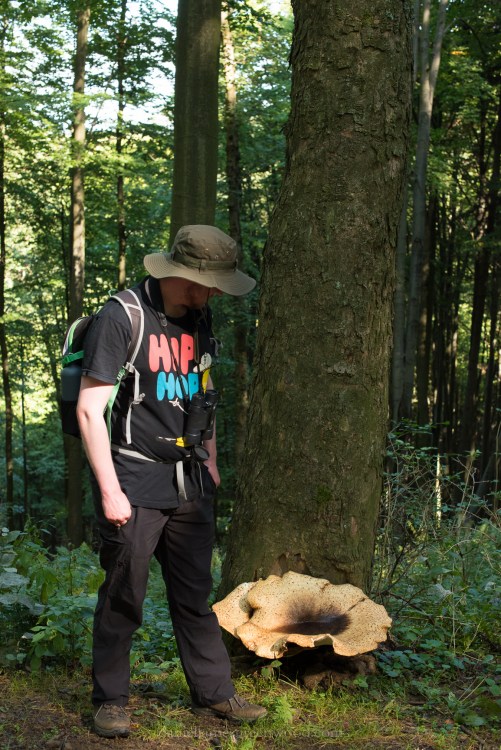
Eddie and I were hiking to the Czech-Slovak border from a hostel we were staying in a tiny village called Vรกpenky. We hiked up through beech woodlands which were actively managed as plantations to reach some ancient woodland close to the accessible peak of Velka Javorina. The walk began well with this absolutely massive dryad’s saddle. It was so big it had become like a giant petunia and held rainwater in its cap!

Czechia 2017 lo-res djg-18

Here is Eddie, who is over 6ft, giving a sense of scale. This is a species which is fruiting now in May. It’s the biggest seasonal fruiting body of a fungus I’ve ever seen. Ones that are present all year round as brackets don’t quite count!

Czechia 2017 lo-res djg-62

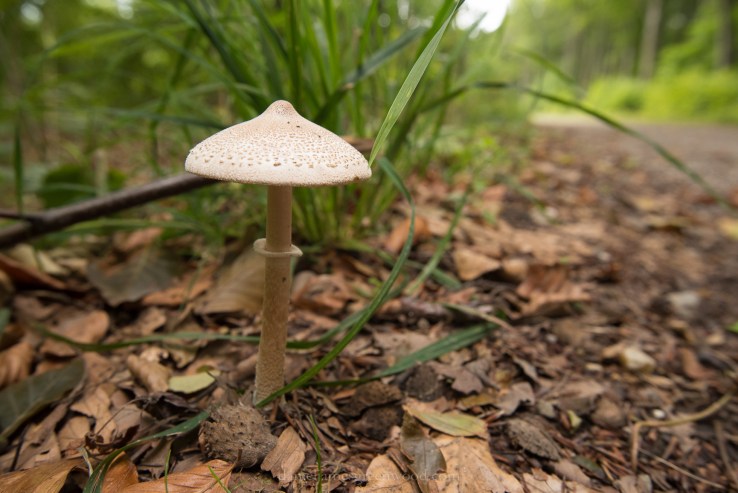
In the beech plantations (beech is remnant of the climax vegetation in the Carpathians – basically the naturally occurring dominant tree species) parasol mushrooms were pushing up from the leaf litter. We also encountered a woman returning from the mountain with a small number of these mushrooms collected for cooking. She had picked them when they were young and just appearing from the soil. It was evidence of local knowledge that is diminishing in many parts of the world as urbanisation increases.

Czechia 2017 lo-res djg-64

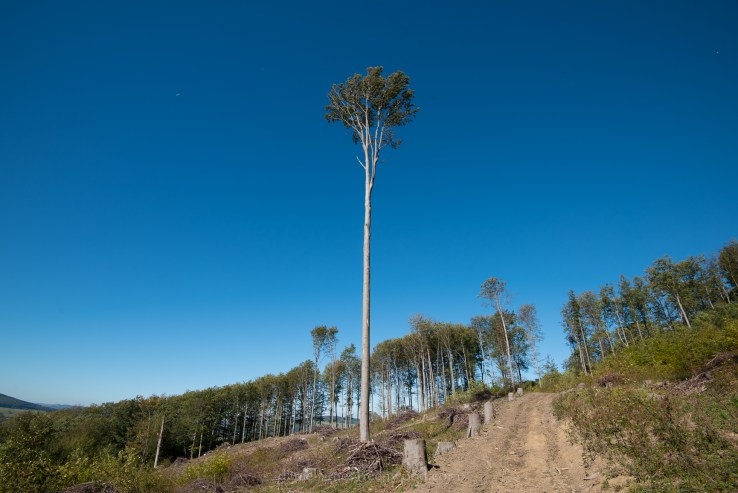
The forestry practices in the area bordered on the surreal.

Czechia 2017 lo-res djg-133

We saw much larger parasols on the steeply wooded slopes.

Czechia 2017 lo-res djg-43

At the sides of the forestry roads they were also common.

Czechia 2017 lo-res djg-75

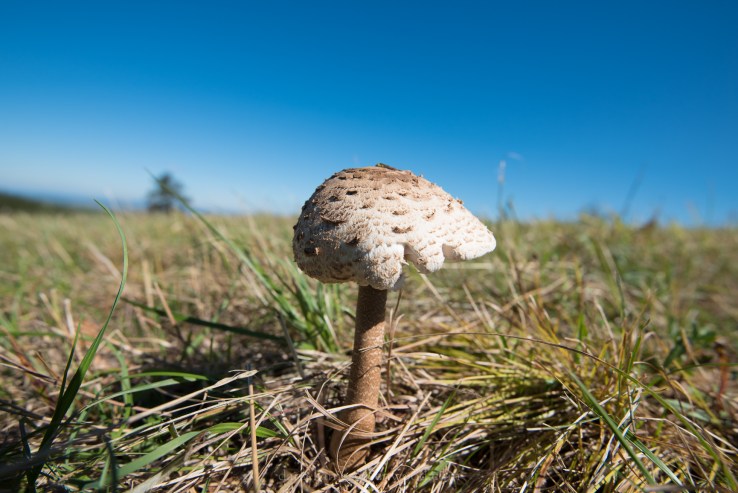
I find this family of mushrooms quite confusing and need to spend some time getting to know them better. The Lepiota/Macrolepiota group can appear very similar and I am not quite dedicated enough to find out what each one is.

IMG_20170914_112829124

I will lie down for a photo though, to take one that is (thanks Ed). You may not realise but these are some of the richest grasslands in the world. September is not a good time to see them however, April-July is best.

For reference, above is a collection of images of the plants found in these grasslands in May 2014 when I first visited. The Steppe grasslands of the White Carpathians are the richest in the world, according to the Landscape Protection Agency. The orchids seen here are elder-flowered orchid. The woods were frothing with wild garlic.

Czechia 2017 lo-res djg-53

On trees and stumps, a fungus that was common was red-belted bracket. This was nice to see as it is not so common in the UK, if present at all.

Czechia 2017 lo-res djg-41

This very colourful bracket was growing on the stump of a felled tree close to the top of the mountain.

Czechia 2017 lo-res djg-34

For most of my hiking comrades this is the feeling of, ‘oh for God’s sake not another mushroom photo’. Soz Ed.

Czechia 2017 lo-res djg-33

On the way back down from the summit we found this shroom which I think is rooting shank. It’s a dream vantage point for a photo, especially with some blissful bokeh blur in the background.

Czechia 2017 lo-res djg-28

This is a species I associate with late summer or early autumn when the wetter weather hasn’t quite arrived and the soil is still a bit dry. They’re often close to the trunks of trees.

Czechia 2017 lo-res djg-20

This has the look of a shield of some kind, but I didn’t spend much time looking at it. This was in one of the protected areas of woodland where forestry was not permitted. It happened also to be the place where biting flies where most interested in us so we didn’t stand still for long.

Czechia 2017 lo-res djg-118

The White Carpathians are a fantastic place for nature and I would love to visit in the prime mushroom season to see what shows up.

Thanks for reading.

More mushrooms

#FungiFriday: September shrooms in Scotland, part three โ€“ Lochnagar

Cairngorms - September 2018 djg-34

Fungi Friday 1st May 2020

For another week the Covid-19 pandemic is keeping me away from the woods and therefore the shrooms. This fungal breaking news desk has run out of scoops, so itโ€™s more like a sports channel airing classic re-runs.

I had been intending to post about some fantastic fungal hiking experiences (sounds weird) from a 2018 visit to Scotland but work and life stopped me. I do hope anyone reading this is doing well and that youโ€™re following the guidance.

Cairngorms - September 2018 djg-4

These posts remind me of my uncle Joe Reilly who passed away in November. Joe was a Glaswegian by birth who, along with my aunt Marg, introduced me to some of the most beautiful places the UK has to offer in Perthshire, among so many other gifts. I would visit Marg and Joe in Perthshire as often as I could, often in autumn when going to meet my hiking companion Eddie (seen here) for a jaunt in the Cairngorms.

Joe fell for fungi like I did in recent years and I will always miss his WhatsApp messages with mushrooms he had found on Perthshire walks. We miss his thirst for life terribly but carry it on just as he did.

Last week I was sharing fungi found on a hike to the top of Ben Vrackie in Perthshire.

This week my final Scotland post makes me feel like a bit of a cheat. The post is built around an incredible hike led by the rangers of the Balmoral Estate in the Cairngorms National Park with only one serious mushroom to be found. But it was one special shroom, and probably one you want to eat if you haven’t already. I will soften that blow with some dodgy phone pic shrooms.

IMG_20180920_082927299

I was visiting the Cairngorms for a Europarc Conference and there was very little time to get out on foot in the mountains and hills. Most of my photos looked like this one above, a phone pic taken while being ferried around in a minibus.

IMG_20180918_120728899_HDR

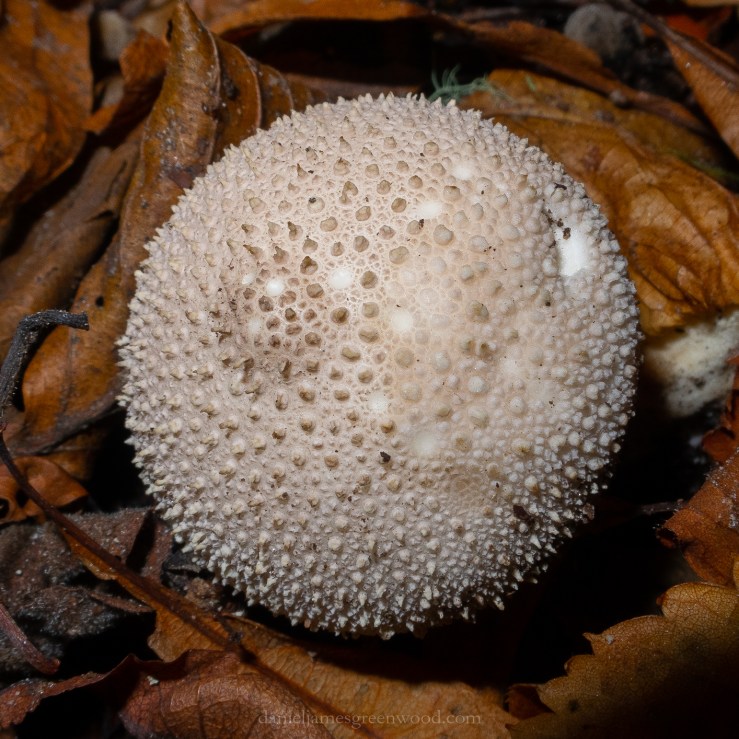
I was staying in Aviemore and there were a pleasing selection of shrooms found right next to the pavement in the verges. This is a giant puffball in its early stages, part brain part, well, bottom.

IMG_20180918_121133071_HDR

I’m not entirely sure what this species is, I thought it might be in the Macrolepiota/Lepiota family (where parasols are found) but can’t find a candidate just now.

IMG_20180919_180948746_HDR

This is almost certainly brown rollrim, a deadly poisonous fungus. It’s growing out of ballast, which is no surprise as I’ve seen it growing next to pavements in south London.

IMG_20180918_121355902

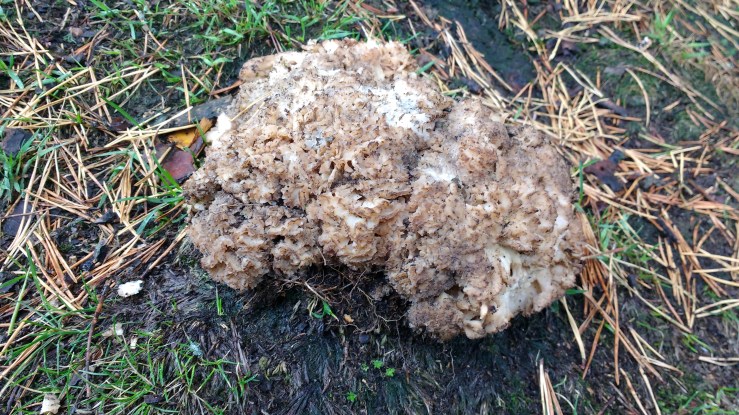
And behold, a very well trampled cauliflower fungus.

IMG_20180918_190309993

Winner of the truly worst phone pic was this fly agaric which was absolutely belting it out from underneath a hedge in a residential area.

Cairngorms - September 2018 djg-17

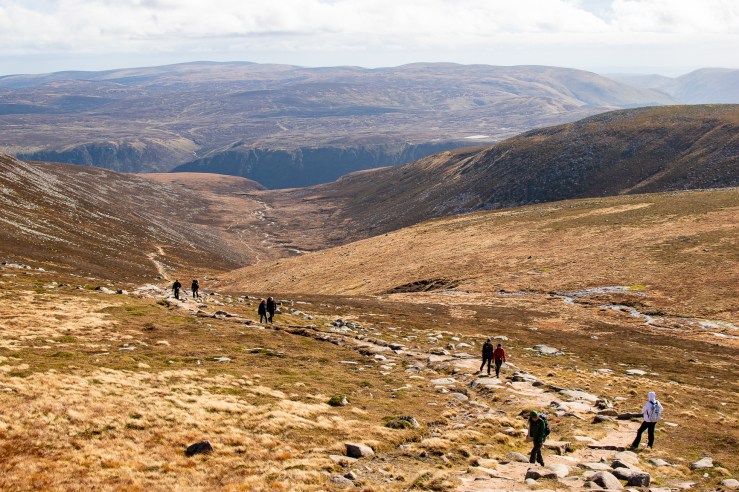
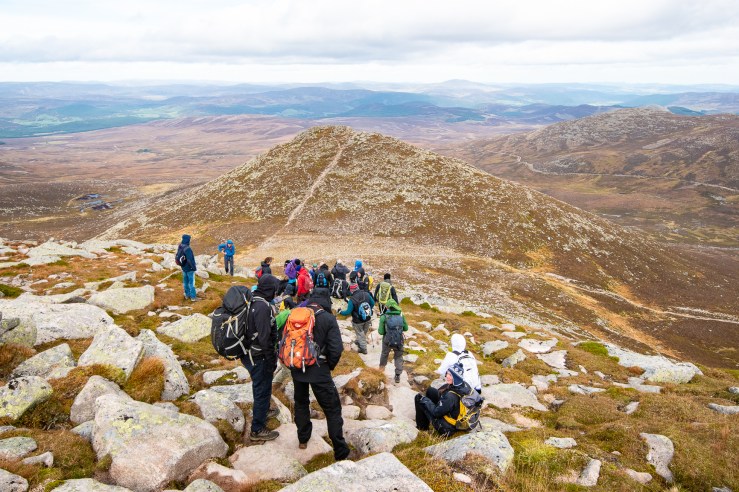
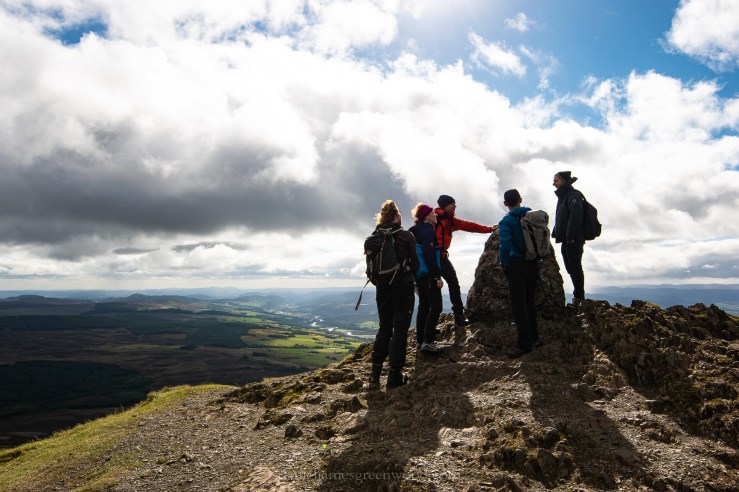
As mentioned at the start of this blog, I was lucky enough to go on a hike to Lochnagar on the Balmoral Estate, led by a very nice ranger and a professional guide, who was also very nice. There were National Park staff from all across Europe. I spoke to one ranger from Iceland who would be spending her winter driving around the vast areas of her Park undertaking works to signage and all manner of other things. She was the real deal. Our National Parks are tiny in comparison to many in Europe, though the Cairngorms is the closest we probably get to some of Europe’s most rugged wildness. The Balmoral Estate is not a good example of that because of the intensive management to support grouse shooting. Apparently the Queen still drives around the Estate in her Land Rover.

Cairngorms - September 2018 djg-18

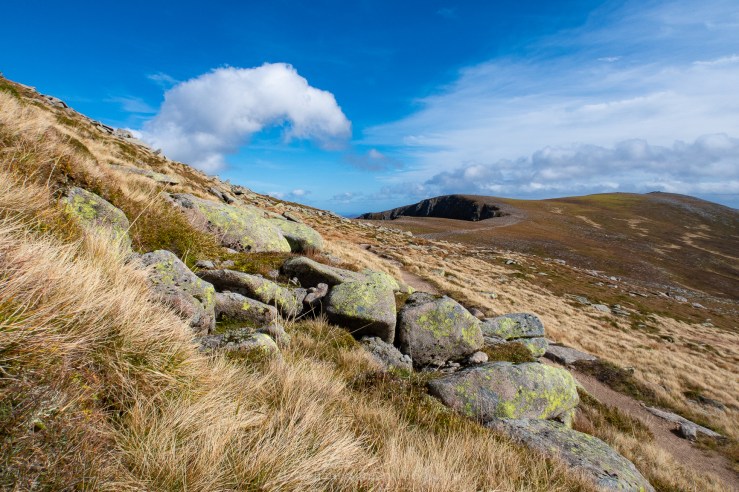
There were extreme winds at the time of the walk and we didn’t make it to the peak of Lochnagar. It was too dangerous. Though you’re unlikely to find much fungal diversity at these altitudes (1000m+) there was a familiar neon lichen on the boulders. This is Rhizocarpon geographicum.

Cairngorms - September 2018 djg-26

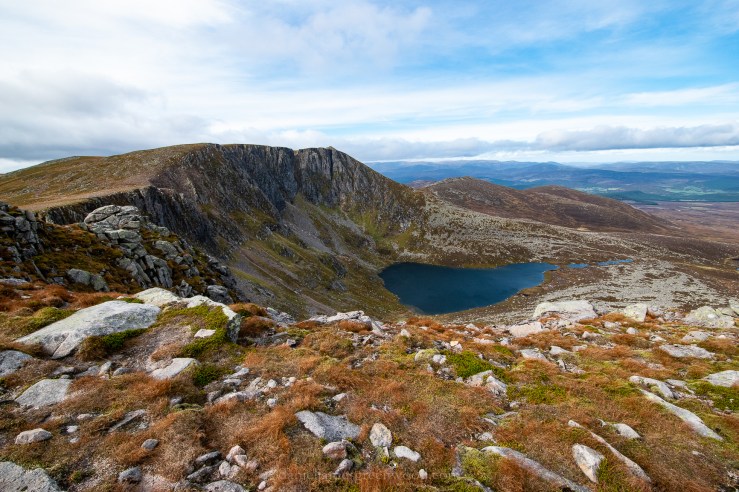
It took a real effort to actually hold my camera in place and take this photo. It was incredibly windy. This is Lochnagar. The peak can be seen in about the middle distance where a small cairn stands.

Cairngorms - September 2018 djg-32

At this point we were all told to put our cameras away because the winds were going to hit hard. They did, it was incredible.

Cairngorms - September 2018 djg-1

You’re probably wondering – where are the shrooms? But let it be a lesson to you, finding fungi can be really hard. Sometimes it’s all there at the side of the pavement, but at other times you will see nothing.

Cairngorms - September 2018 djg-3

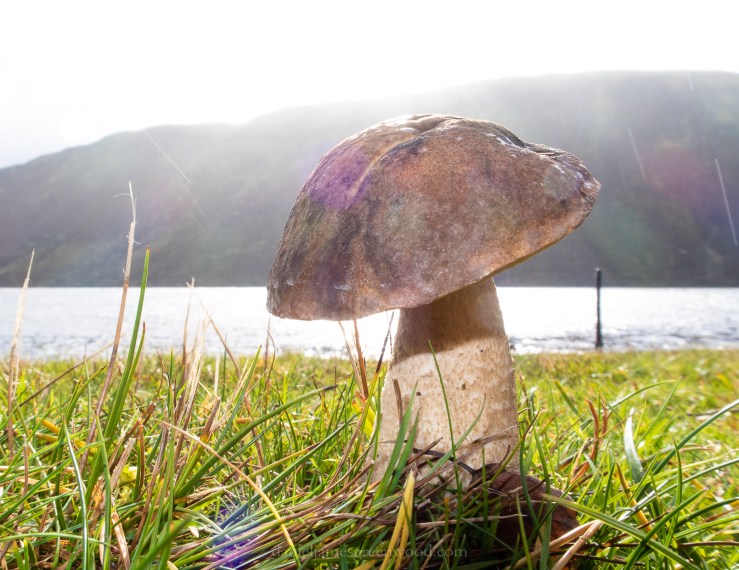
At the point where our minibus was parked I could not believe what I saw. This is a cep, otherwise known as porcini or pennybun. Its Latin name is Boletus edulis. It is the most prized edible mushroom. This was the most perfect specimen I have ever come across. In the background is Loch Muick, with the classic Scottish rain, sun and wind falling in the background. I can still get a tingle of the joy of finding this mushroom, against that background, in such a stunning location.

Thanks for reading.

More mushrooms


#FungiFriday: September shrooms in Scotland, part two – Ben Vrackie

Perthshire - September 2018 djg-47

#FungiFriday 25th April 2020

For another week the Covid-19 pandemic is keeping me away from the woods and therefore the shrooms. This fungal breaking news desk has run out of scoops, so it’s more like a sports channel airing classic re-runs.

I had been intending to post about some fantastic fungal hiking experiences (sounds weird) from a 2018 visit to Scotland but work and life stopped me. I have three hikes to share with you which should get you through the next three weeks of lockdown. I do hope anyone reading this is doing well and that youโ€™re following the guidance.

Perthshire - September 2018 djg-38

These posts remind me of my uncle Joe Reilly who passed away in November. Joe was a Glaswegian by birth who, along with my aunt Marg, introduced me to some of the most beautiful places the UK has to offer in Perthshire, among so many other gifts. I would visit Marg and Joe in Perthshire as often as I could, often in autumn when going to meet my hiking companion Eddie (seen here) for a jaunt in the Cairngorms.

Joe fell for fungi like I did in recent years and I will always miss his WhatsApp messages with mushrooms he had found on Perthshire walks. We miss his thirst for life terribly but carry it on just as he did.

Last week I was sharing fungi found on a walk around Clunie Wood in Pitlochry.

This week Iโ€™m reminiscing about a hike from Pitlochry up to the summit of Ben Vrackie accompanied by my friend Eddie. Below the tree line, a pleasing range of fungi were found.

Perthshire - September 2018 djg-26

The walk leaves the town of Pitlochry and heads up through suburbs. This manicured field had a rowan so heavy with berries it looked like it was falling over. I have never seen so many on one tree.

BenVrackie_Sept2018-1

The day was warm and while I waited for Eddie to change out of his underlayers behind a tree I scoped out some shrooms in the first piece of woodland we encountered. I’m not sure what this species is. I found them pre-plucked at the side of the path.
BenVrackie_Sept2018-2

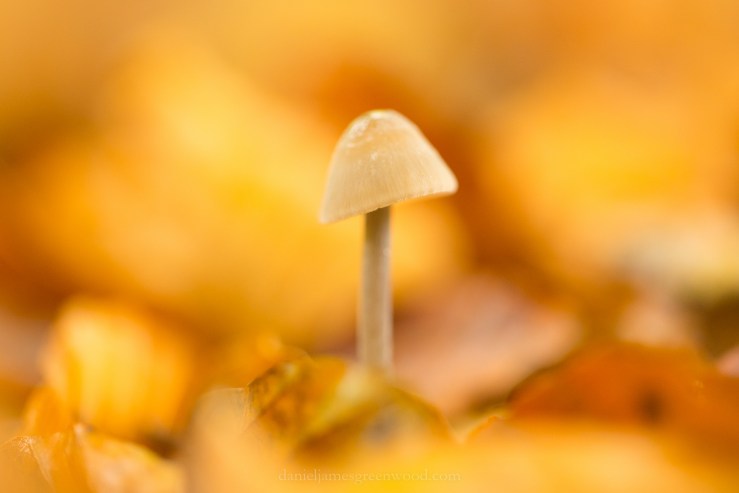
Further up through the woodland this common puffball was sitting among the leaf litter. This has to be one of the most common woodland mushrooms to find in the UK. This is always a good sign of what is to come on a longer walk. Puffballs can be an indicator of a good amount of fungi on the ground.

Perthshire - September 2018 djg-28

The woodland broke into something more open as the moorland and hills approached, with large birch trees growing along the edge of the path. A tree stump held this gathering of yellow staghorn. I asked Eddie if he would help to add something to this pic! Probably one of my fave fungi photos.
Perthshire - September 2018 djg-33

As we ascended towards the winding set of steps that take you to the top of Ben Vrackie, we saw two golden eagles floating above another hill nearby. This was only the second time I’d seen golden eagles in the UK. They are massive!

Perthshire - September 2018 djg-34

The fungi in these areas thins out to small species connected to the habitat and the odd common species which is particularly good at spreading its spores and growing in a range of habitats (stuff like sulphur tuft on dead wood). For those who don’t know, this is heather moorland. Short on trees so not the richest place for fungi. Then again I haven’t spent enough time looking.

Perthshire - September 2018 djg-52

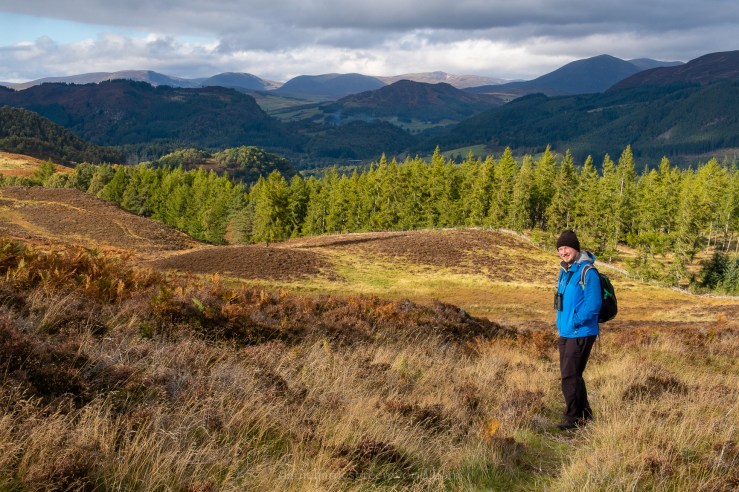
This is a popular walk from Pitlochry. Lots of people were coming and going from the 841m summit of Ben Vrackie. Here is Eddie trying to get some soul signal from the gods. He failed.

BenVrackie_Sept2018-3

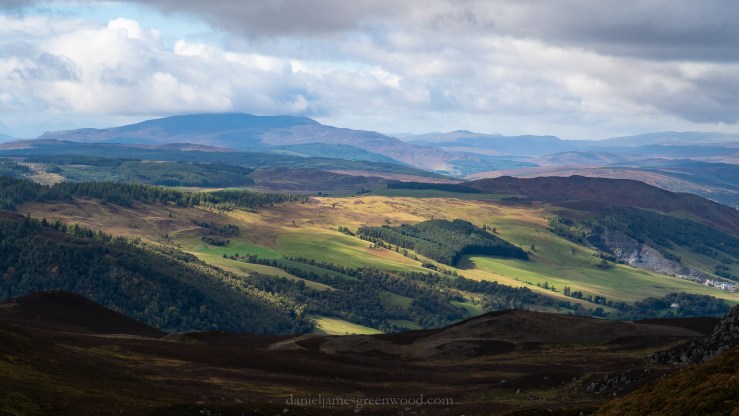
The views north into the Cairngorms were beguiling. Landscape photographers would have appreciated the range of weather available and the clouds which gave extra character to the views. While we sat up here eating lunch, a man and his two sons reached the top. He told them a story of when he had climbed a hill with ยฃ200 cash in his pocket. He knew it was a bad idea and half way up the money slipped out of his pocket and away into the landscape. He salvaged ยฃ20. His boys told him it had indeed been a bad idea.

BenVrackie_Sept2018-5

Rain following the River Garry through the valley from Blair Atholl. This photo has been enhanced to bring out the distant peaks and rainfall.

BenVrackie_Sept2018-6

Rain arriving in the hills.

BenVrackie_Sept2018-9

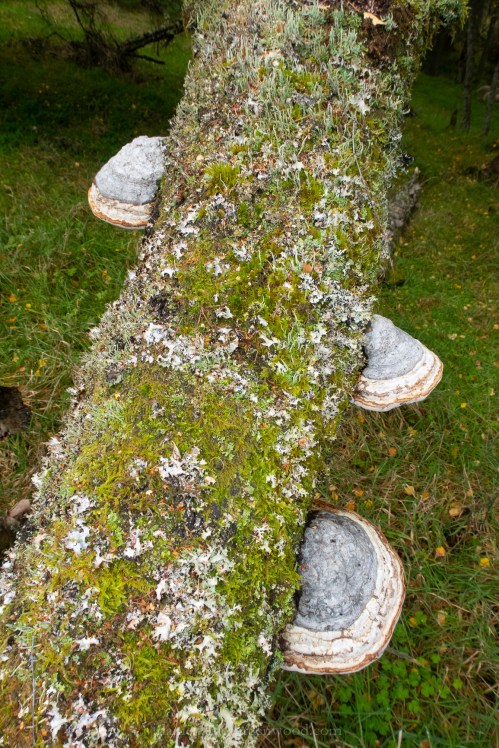
Descending back down through the tree line, we took the same path back. It’s interesting how you see things so differently when you walk a single route in another direction. Here was a very large birch polypore, also known as razorstrop fungus. It is a natural controller of birch trees and is possibly one of the easiest species to find.

Perthshire - September 2018 djg-96

On the way back we found what I think is a birch bolete. It was reaching out from the path edge and had already been nibbled on by slugs. A real treat to find something like this.

BenVrackie_Sept2018-10

It was a pleasant surprise was to find a chantarelle, one of the most sought-after edible fungi. This one had already been plucked (I think).

BenVrackie_Sept2018-11

I’m really not sure what species these shrooms are, but they were a nice find.

BenVrackie_Sept2018-12

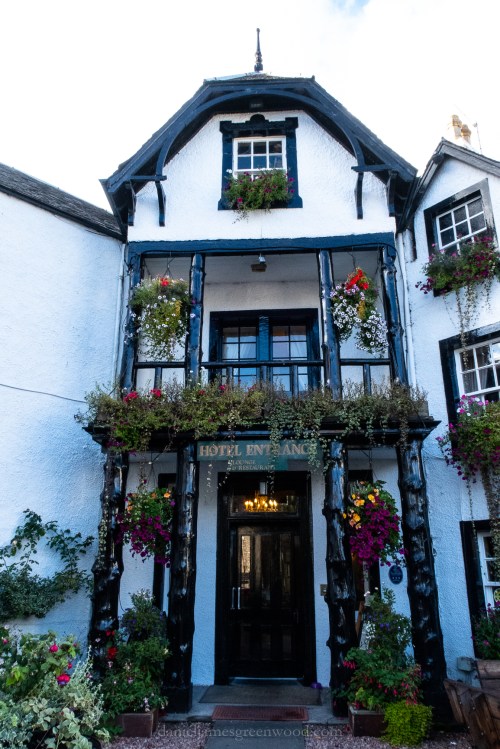
On the way back we visited this beautiful pub, the Moulin Hotel, with conifer beams holding up a balcony. It dates from the 17th century.

BenVrackie_Sept2018-13

The rain was coming and going throughout the afternoon. It reminded me why Scotland is so good for fungi. There is a high level of rainfall, large areas of woodland and acidic soils which seem so good for mushrooms.

Next week it’s fungal royalty in the Cairngorms.

Thanks for reading.

More mushrooms


#FungiFriday: September shrooms in Scotland, part one: Pitlochry

Perthshire - September 2018 djg-25
Ben Vrackie as seen from Clunie Wood

Fungi Friday 17th April 2020 via September 2018

For another week the Covid-19 pandemic is keeping me away from the woods and therefore the shrooms. To be honest though, my town is so deserted at the moment that I am kind of hoping some shrooms start popping up soon in the paving. Especially considering there is rain coming today.

I had been intending to post about some fantastic fungal hiking experiences (sounds weird) from a 2018 visit to Scotland but work and life stopped me. I have three hikes to share with you which should get you through the next three weeks of lockdown. I do hope anyone reading this is doing well and that you’re following the guidance.

These posts remind me of my uncle Joe Reilly who passed away in November. Joe was a Glaswegian by birth who, along with my aunt Marg, introduced me to some of the most beautiful places the UK has to offer in Perthshire, among so many other gifts. I would visit Marg and Joe in Perthshire as often as I could, often in autumn when going to meet my hiking companion Eddie (seen here) for a jaunt in the Cairngorms. Joe fell for fungi like I did in recent years and I will always miss his WhatsApp messages with mushrooms he had found on Perthshire walks. We miss his thirst for life terribly but carry it on just as he did.

This week I’m reminiscing about a great walk in the wooded hills of Pitlochry.

Perthshire - September 2018 djg-14

The walk was on a Friday afternoon from the door of our guesthouse in Pitlochry but can also be done from Pitlochry railway station. It’s a stunning place, close to the southern border of the Cairngorms National Park. My friend Eddie lives in Glasgow and his journey was a wee bit quicker than mine from Sussex. Above you can see Eddie not at all incongruous in the landscape All these pics are taken with the amazing Canon Powershot G7X MII in RAW format and processed in Adobe Lightroom.

Perthshire - September 2018 djg-1

Scotland has deliciously wet and humid woodlands which in some parts constitute what is affectionately known as ‘Celtic Rainforest’. This is my habitat, the milder temperatures and shadier conditions far better suit my Celtic biology (which is not actually something that exists in Science).

Perthshire_Sept2018-1

Perthshire_Sept2018-2

These birch trees were host to large hoof fungus brackets and many foliose lichens. These are commonly found on the acidic soils of heather moorland that covers so much of the Scottish Highlands.

These dead standing trees are a vital source of biodiversity in woodlands. They are the thing we have lost but are slowly, very slowly, returning to the landscape thanks to sensitive management.

Perthshire - September 2018 djg-4

In Clunie Wood I found my first ever jelly babies. These are a bizarre species that do look like the sweets. They were growing in large numbers under shade in a wet area alongside the path.

Perthshire - September 2018 djg-21

At the edge of a plantation we found a huge fly agaric.

Here is Eddie getting a pic which gives a sense of scale. September seems a good month for fly agaric in the Highlands of Scotland.

Perthshire - September 2018 djg-24

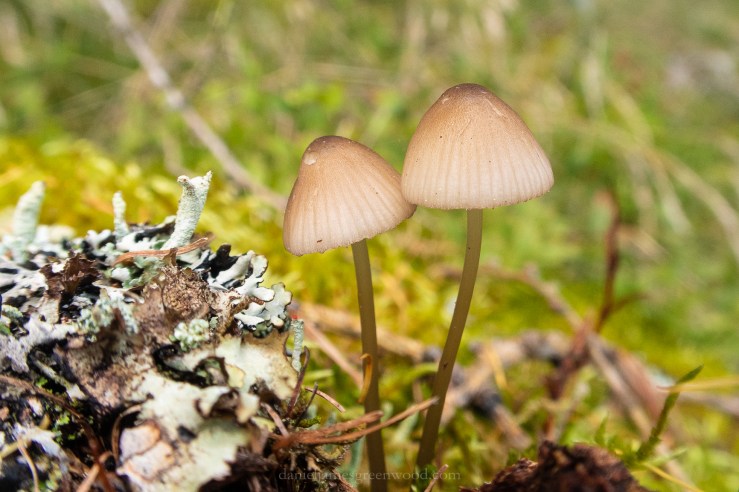
The conditions were perfect for fungi and these beautiful bonnet mushrooms were alongside lichens on a tree stump.

Perthshire - September 2018 djg-5

This quite hilarious clump of mushrooms (they were growing from one small stump… had to be there) are probably a type of honey fungus described in Latin as Oystoyae.

Perthshire - September 2018 djg-2

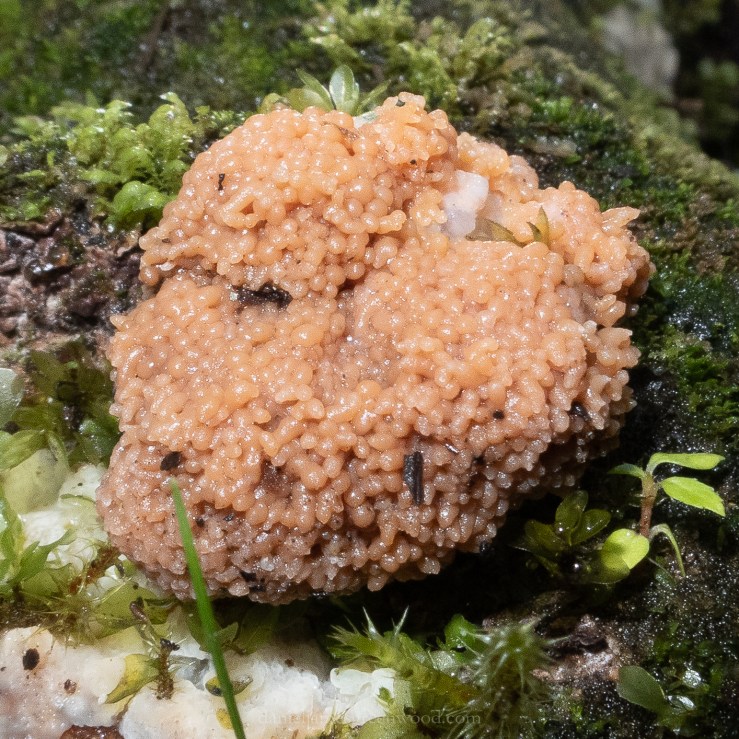
This cheeky slime mould was another sign of the exceptional conditions with the mixture of broadleaf woodland and conifer plantation providing lots of moisture.

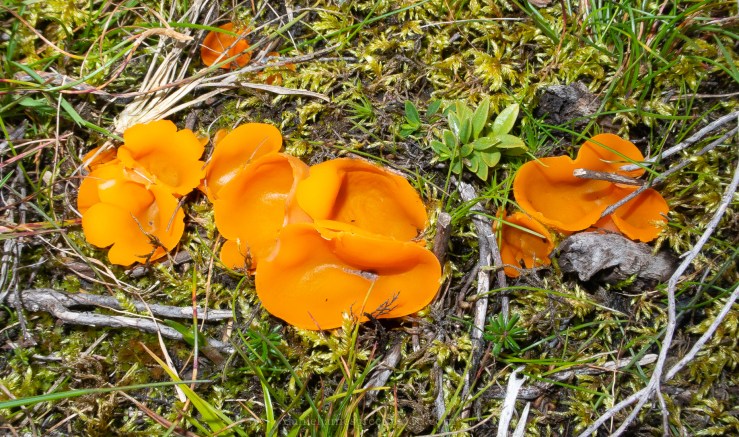
I always think orange peel fungus is some kind of plastic pollution. Having worked in urban nature conservation it reminds me of litter picks pulling old bits of traffic cone out of the soil!

At the edge of the woodland the beautiful heather moorland appears and views expand into the Grampian Mountains of the Cairngorms National Park.

Thanks for reading and keep dreaming!

More mushrooms

#FungiFriday: a special day in the New Forest

New Forest - 23-10-17 -1 djg (59)

#FungiFriday 10th April 2020 (via October 2017)

With another week of social distancing and time spent indoors, I am once again recalling a classic mushroom experience. Sorry to disappoint both of my readers, but this does not involve the ingestion of hallucingenic fungi. If I said that on Instagram I would lose probably all my followers. Don’t tar me with the liberty cap brush!

This week I am recalling one of the great days out I’ve had in search of mushrooms to photograph, hot on the heels of last week’s look back at 2019’s highlight. This time I invite you to the New Forest, virtually, and the moment I snapped what I think is the most perfect mushroom scene I have witnessed.

New Forest - 23-10-17 -1 djg (4)

It was October 2017 and I’d travelled from London by train to Brockenhurst to do a long circular walk from the station, taking in some beautiful ancient woodland, plantation and bits of heath. The New Forest is a National Park in Hampshire, southern England. It is home some of the most intact stretches of semi-natural woodland in Europe. Semi-natural woodland equals mushrooms.

New Forest - 23-10-17 -1 djg (10)

On arrival the signs were good because the dead wood held smaller shrooms in nice condition, such as this probable bonnet. That’s a mushroom name I wish existed.

New Forest - 23-10-17 -1 djg (17)

The richer areas of woodland were under beech. You can see that the leaves had already fallen, what can be a bit of a pain for photographing shrooms because they’re all hidden, basically.

New Forest - 23-10-17 -1 djg (18)

This mushroom seems to dissolve into the background glow of the newly fallen beech leaves.

New Forest - 23-10-17 -1 djg (23)

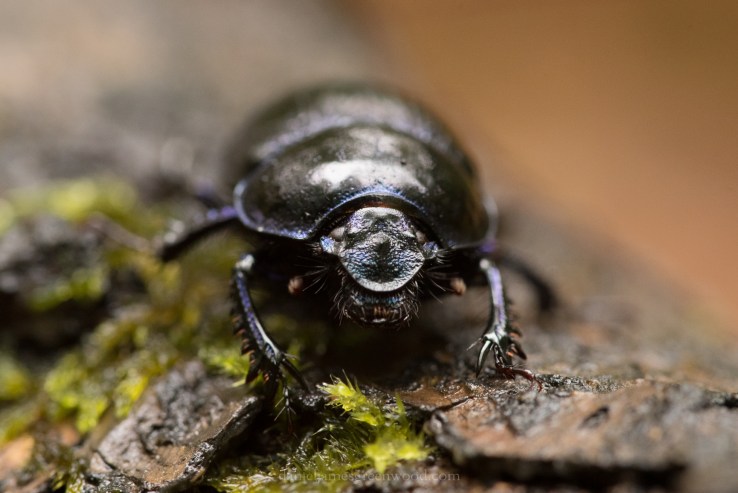
Looking for fungi, it’s difficult to ignore the mushroom of the insect world otherwise known as a dor beetle.

New Forest - 23-10-17 -1 djg (38)

One of the pains of photographing fungi is how much time you have to spend down in the dirt. Upon leaving the first area of woodland on this circular walk, a gang of bonnet mushrooms were poking their heads out from a fence post at head height. This is the kind of thing you see in peak mushroom season.

New Forest - 23-10-17 -1 djg (43)

The walk left entered more grassy and open woodland at the edge of the heath. This is a good place to find fungi. This Leccinum or birch bolete was pushing the boat out. Half the shroom had already been eaten on the other side by slugs!

New Forest - 23-10-17 -1 djg (52)

The walk followed on to the edge of Beaulieu Heath. The richest parts of the New Forest are those which don’t suffer from over-grazing. This tawny grisette was in a grassy area of heathland interspersed with oak and birch trees. It should have been an indicator of peak mushroom. It was.

New Forest - 23-10-17 -1 djg (57)

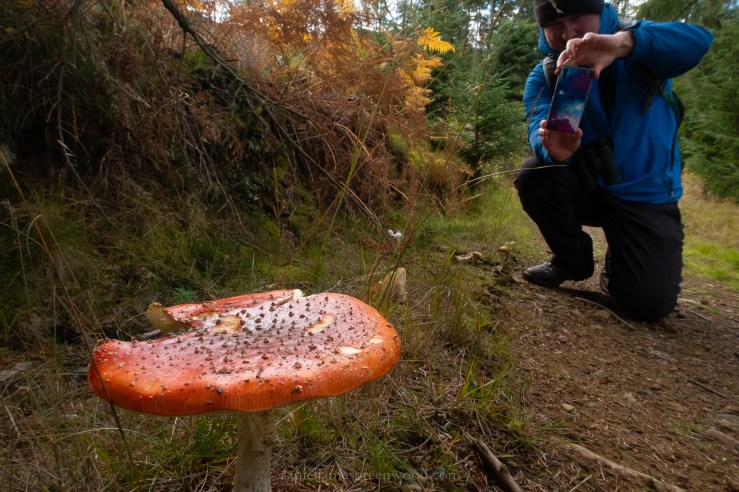
A metre or so away from the footpath this fly agaric was unmissable. I crouched down in front of it to find the best way to get a photo. A family came out of a cottage across the way and stopped to see what I was doing. ‘Oooh, a magic mushroom!’ they said. I didn’t get into discussing how in fact it is a mushroom that has hallucinogenic tendencies and is consumed for tribal purposes in northern Scandinavia. It should also be considered poisonous as standard.

IMG_20171024_092411_982

Here is the VIP behind the scenes view. A perfect end to a classic mushroom photography experience. Here’s to more special mushroom days in autumn 2020. The way things are going it will probably be another mushroom reminiscence therapy next week.

Thanks for reading. Stay away from each other. Both of you.

More mushrooms


#FungiFriday: looking back on a mushroom classic

Ebernoe - 8-11-2019 blog-75

Fungi Friday 3rd April 2020 (or Friday 9th November 2019)

I can’t get out to anywhere that has mushrooms to photograph and we’re also experiencing something of a dry spell in Sussex. That means that this week I’m posting about my fungal highlight of autumn 2019, which took place on Friday 9th November. Consider this a bit of a sporting or cinematic classics TV show, until we’re allowed to venture further and any spring rain arrives. The inconsistent nature of mushroom fruiting bodies means I may have to wheel this out again to keep it going every week.

Ebernoe - 8-11-2019 blog-91

It was mid-November with autumn at its peak. The colours of the beech trees were at their most explosive. In the woodlands of the Sussex Weald, there were millions of mushrooms. They seemed to be under every footstep and fruiting from every fallen tree.

Ebernoe - 8-11-2019 blog-10

It was clear it was peak mushroom time. The bonnets were out en masse and many leaves were still on the trees. I have come to think that fungi hunting is so much easier before the leaves fall. The leaf litter created by oak and beech is very hefty.

Ebernoe - 8-11-2019 blog-88

I would also consider using hazel as an indicator. When those leaves start to yellow and fall, you know it’s going to be more difficult. Winter is on its way.

Ebernoe - 8-11-2019 blog-39

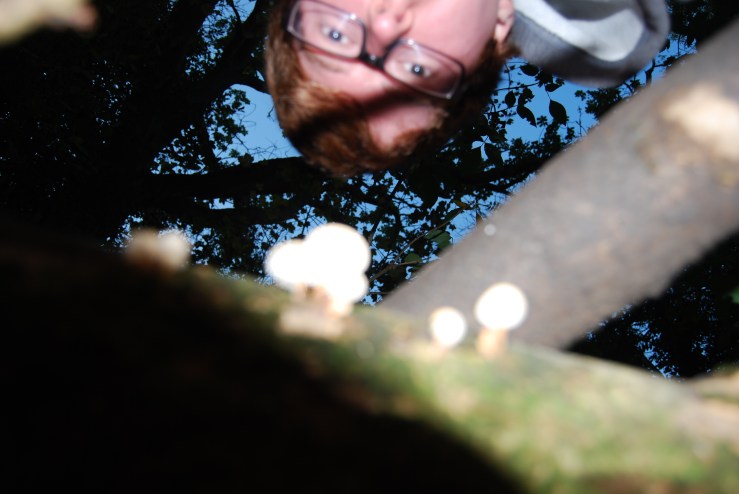
Bonnets are some of the best fungi to photograph because they’re often elevated on the limbs of fallen trees, meaning you don’t have to scrabble around on the ground. It’s also a very nice height for a tripod. A tripod gives you the steadiness to use slow shutter speeds which makes it so much easier to take pics in a dark woodland in autumn. Also, mushrooms don’t move!

Ebernoe - 8-11-2019 blog-14

What I am looking for in general is a mushroom that can be isolated. A macro lens gives a very shallow depth of field, which means that the focus is thin and the background easily blurs. This kind of thing is perfect. I don’t focus stack images (a complex process of threading images together which have different stages of focus) but this would look really good with every aspect in focus.

Ebernoe - 8-11-2019 blog-48

This is also what’s so nice about elevated fungi. You can play around and get some nice bokeh (the circles in the background). This is created by daylight flooding through the leaves – can you see the wash of green? I used a small LED light to light the gills of the bonnets. They look almost like paper or plastic to me. The idea also occurred to me that the white bokeh circles look like the mushrooms, too.

Ebernoe - 8-11-2019 blog-27

These are probably more bonnets. Again, taking a photo of the gills underneath can create a really beautiful effect. I could have pulled the bit of dead wood off to reveal the other mushroom but I fundamentally disagree with damaging habitats for the sake of a photo.

Ebernoe - 8-11-2019 blog-18

A species I learned last year was buttercap (or at least I think I have). This is said to be a common species. I like the fairytale shape of the stipe as it bulges at the base.

Ebernoe - 8-11-2019 blog-1

The woodland was entering peak autumn colour. These beech leaves still held traces of their chlorophyll.

Ebernoe - 8-11-2019 blog-62

It was a beautiful day to be in the woods. I can’t tell you how much a woodland stream adds to the overall experience!

Ebernoe - 8-11-2019 blog-79

With what is approaching a lake, you’re spoiled rotten.

Ebernoe - 8-11-2019 blog-21

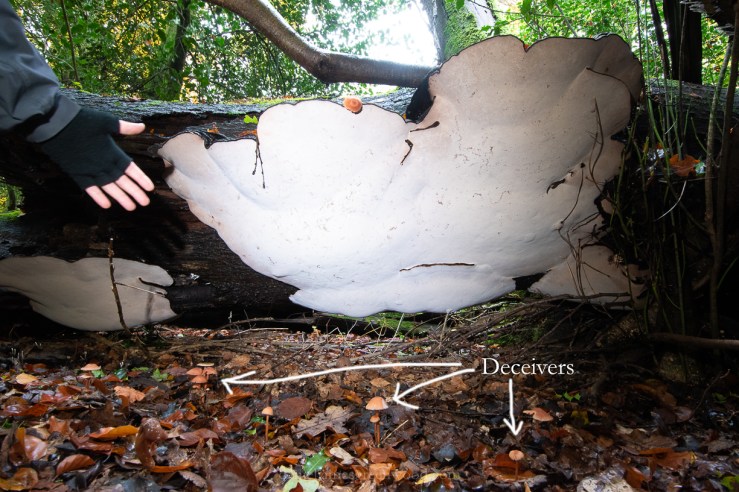
Back to the shrooms. I found probably the biggest fungus I have ever seen, though you could argue it is several fruiting bodies fused together. I even added some in-photo text to help explain the situation to you. Very advanced. This is a bracket fungus that looks more like a ray. It’s probably artist’s bracket, a Ganoderma species. Below it you can see some smaller mushrooms, these are all deceivers. They were just about covering the entire area here. It was almost impossible not to step on one. By the way don’t worry that’s my hand not a mushroom burglar’s.

Ebernoe - 8-11-2019 blog-77

All in all this was my peak mushroom experience in autumn 2019.

Thanks for reading.

More mushrooms


#FungiFriday: it’s a mushroom lockdown

Warnham - 20-10-2019 lo-res-30

Fungi Friday 27th March 2020

It’s estimated that 25% of people on Earth are now under some social restriction due to the Covid-19 pandemic. While the non-human organisms are probably enjoying this hiatus, it’s certainly harder to continually produce these finger-on-the-pulse-docu-drama Fungi Friday posts. This week I confess I have no fungi photos worth sharing. I even sat in the garden just now for half an hour trying to get extreme macro images of a mouldy orange. No word of a lie. Look:

Orange_mould_27-3-2020_lo-res-5

So the only sensible thing to do is admit defeat – I have no mushroom images to show you from this incredibly sunny and dry week in Sussex. But this blog has only been running since Christmas and so this is a chance for me to spend some of those Fungi Fridays I’d been storing in the mushroom bank.

Warnham - 20-10-2019 lo-res-31

In early November I took a walk one Sunday around a nature reserve close to where I live. It’s a mixture of wetland, wet woodland and plantation. I featured some pics from it last week before the powers that be sent us packing. I found a very unusual looking mushroom growing along the path edges in patches of woodchip. This was a new species for me and apparently too for our great nation.

I struggled with some serious mushroom envy at times last year due to lots of images of a blue mushroom that every mycologist and her dog had found. I felt a bit better about it after meeting its cousin, the redlead roundhead, for the first time. This beautiful red shroom is a naturalised species which originates in New Zealand. As the Covid-19 pandemic shows us, things can spread easily around the world if their manner of reproduction is microscopic, airborne and supported by intercontinental human travel. Tree diseases, I’m talkin’ to you!

Warnham - 20-10-2019 lo-res-36

I was trying out a new zoom lens on my little mirrorless camera and these funeral bell mushrooms enjoyed their opportunity to show off their poisonousness. Their name should tell you what eating them does. They are very similar to sheathed woodtuft and anyone looking to eat fungi should be very careful when trying to decipher between these two species. I’m just going to flat out discourage that!

Warnham - 20-10-2019 lo-res-28

The path edge was also rich in puffballs. The birch log at the side of the photo is path edging, what is sometimes known as a fungi super-highway. These puffballs are quite weird looking but they’re in their prime. I think they probably common puffballs but they could also be pestle puffball, which I believe is a bit larger than this really. 10 points if you can identify which small mammal has nibbled into the hazelnut in the bottom right.

Warnham - 20-10-2019 lo-res-23

In another coniferous patch I found this expanse of common funnel mushrooms. I spent several years working in a woodland that housed trooping and clouded funnels in the same areas pretty much every year. But the above was a species I’d only seen once before. Also using a zoom lens made it a lot easier to express the scale of their spread, compared with the narrow depth of field a macro lens provides.

Warnham - 20-10-2019 lo-res-22

Next week I’m planning to recap my peak autumn 2019 mushroom experience which I never got round to posting last year. I promise no more mouldy fruit unless it’s aesthetically worth it.

Wishing you well, thanks for reading.

More mushrooms