North Downs diary: The bees are racing on the Mole

Mole gap trail - 3-4-17 blog-5

North Downs diary, Mole Valley, Surrey, April 2017

I follow the Mole gap trail into Norbury Park, ash woodland glowing in the spring sunshine, dog’s mercury abounding on the soil between the pale trunks. The railway line cuts across the eastern edge of the woods, a brick bridge taking trains straight over one of the major footpaths. Under the bridge a lady walks her dog down the hill, her shape appearing beneath the brick. She pauses as I pass under the bridge and takes a photo.

‘All I could see was your legs,’ she says. ‘And then the rest of you appeared.’

We both have cameras and she asks what I’m here to photograph, about butterflies and how many I’ve seen today. Orange tip, brimstone, peacock and my first small tortoiseshell of the year. Along the banks of the Mole butterflies have flitted in good number.

‘Oh I haven’t seen many,’ she says. She tells me more about Norbury Park, its managers Surrey Wildlife Trust and how angry she feels about the fact all the Trust’s rangers will be made redundant. ‘It’s always the people who are out there doing the actual work that suffer. When there’s a fire or something goes wrong there won’t be anyone there for us to contact.’

The ranger programme was being funded with money from Surrey County Council, and Jenny has been making efforts to register her discontent with local councillors. ‘It’s all about priorities, they’ve just resurfaced the A24 and when there was nothing wrong with it.’

‘I devote myself to the countryside,’ she says. ‘Apart from 3 years in London for university I have always lived in Surrey. I spend hours walking with the dog and never get round to everything I need to do in life. When I get home I just head back out again.’

I ask her how things have changed over the years.

‘There are definitely less birds than there used to be,’ she says.

As we stand talking next to the railway bridge the sun shines down through the leafless trees. Peacocks sun themselves on the ride’s edge, bright yellow brimstones pass across the slopes above us. We say farewell, Jenny heading off into the Park while I continue south towards Box Hill.
Mole gap trail - 3-4-17 blog-8

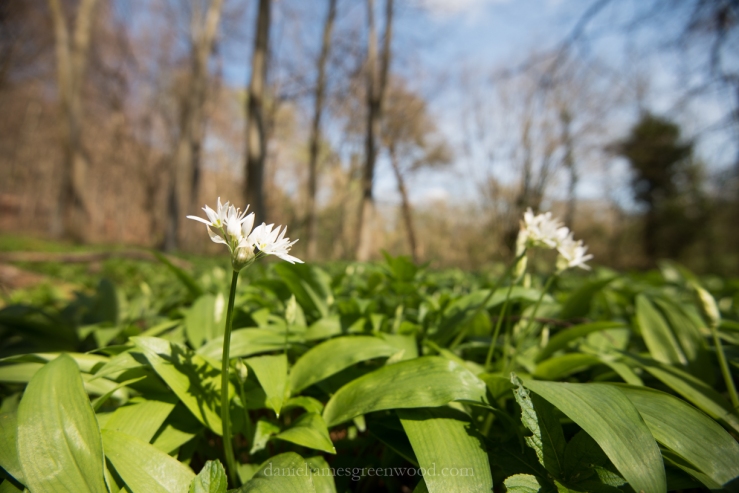
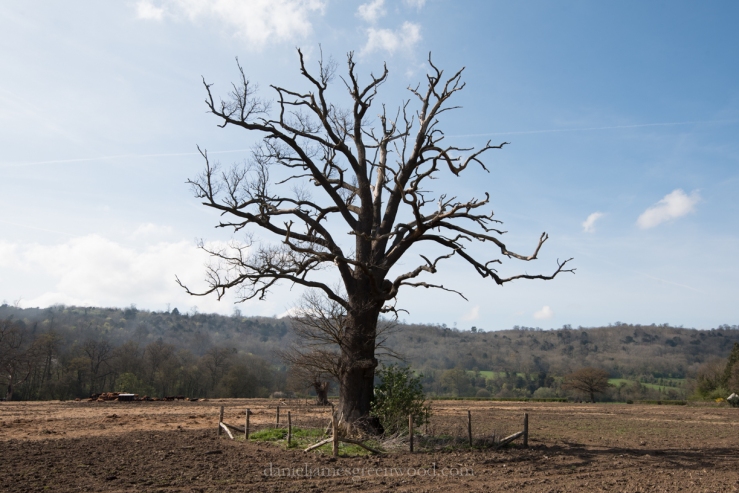
The Mole edges Norbury Park, where beech woods sprawl along the eastern slopes. On the other side of the river the smell and calling of livestock breaks through. In the woods the beeches gleam in the glory of the sun, ramsons begin to flower one by one. Leaving the Park, farmland opens out and the woodland is replaced by fields with single oaks, and a beanpole lime tree riddled with mistletoe. I learned recently that mistletoe grows only on smooth bark, its seed is sticky and is often left there by the mistle thrush, so named for this reason. The branches in the canopy of limes are always sleek and silver, perfect for the mistletoe to attach itself to. The oaks are grand specimens, one dying back from above. Many trees are leafing on the Downs but no oak or ash quite yet. Overhead buzzards soar and mew, and the rickety frame of a red kite tumbles towards Box Hill.

The green fields turn instead to brown where cattle graze. More oaks mark the old field boundaries, likely once connected by hedgerows now removed. The farmer has fenced them to protect their roots and bark from the jaws and hoofs of his or her livestock. The fields are protected by electric fencing audibly ticking, but several of these oaks are dying, possibly from the damage done by the cattle. Crossing the Mole again the train line returns, a neat arch allows the river to flower as it kinks round. The light shimmers and ripples on the underside of the brickwork built almost in a spiral. It’s dizzying to watch for too long. Across the old footbridge and into a field named Foxbury Shaw more veteran oaks stand ready to leaf again, a trio leaning into a dried up channel, perhaps a former braid in the river.
Mole gap trail - 3-4-17 blog-13

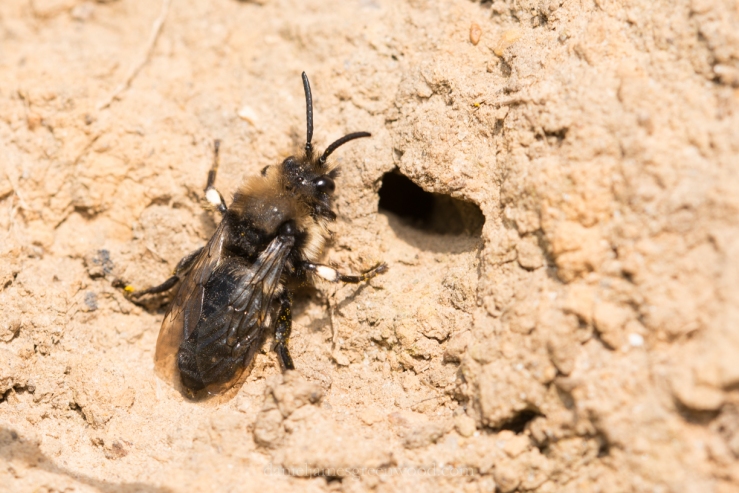
One oak has fallen and lies supine with that typical stag head of old roots. Passing close by I notice the swarming of insects at the root plate. It is surely too early for wasps and they appear too big. Edging closer, they are in fact hairy-footed flower bees whirring and zipping around the old roots. When the tree fell the roots lifted soil with them, now hardened like great chunks of biscuity dough. The sun has baked the soil and the wood of the fallen oak. Here is the very image of a life after death.

The oak is being mined by solitary bees, some, like the bronze furrow bee are minute. There are more animals besides them, with jumping spiders waiting for the chance to pinch their prey. One sits atop a root basking in the sun, camouflaged against the  bleached timber. The soil has been drilled with holes, the habitat of the flower bees. A group of about five to eight males, blonde and super-fast in flight, zip around me as I photograph their homes. Truly it is the sound of racing cars or X-wings tearing around at several hundred miles an hour. Another species of bee basks on the upturned roots, it has long, black antennae and is disturbed when I look more closely. It’s a mourning bee, a parasite that lays its eggs in the nests of hairy footed flower bees. The eggs hatch, eat the young of the flower bee and then eat the food stash left for its prey. Despite our clichés, some bees are only in it for themselves.

Explore my North Downs diary

Oaks of London: Clapham Common oak

Clapham Common - 27-3-17 blog-3

This English oak is easily missed, to the point where I didn’t notice it was an oak until looking at the photo later. This early spring sunshine is the kind that brings people to sit underneath trees, like the man in the distance on Clapham Common. His bike is resting against the trunk behind him.

Oaks of London

Oaks of London: Sketch for Enfield oak

Enfield oak

This English oak (Quercus robur) is alongside the Great Cambridge Road near Turkey Street station in Enfield, north London. It was photographed on my phone in January 2017. It stands in what evidently was once a more open, rural landscape. It’s a big, healthy-looking tree, likely between 200 and 300 years old. What I like about this one is the clash of the old and the new, rural and urban. If it can remain in peace it could live a good many centuries. This is dependent also on a gradual reduction in emissions from the nearby traffic as predicted move towards electric vehicles progresses and its ability to remain unimpeded by either self-seeded trees or new plantings. If this landscape was abandoned in future, the oak would create a new woodland of oaks around it.

Oaks of London


Oaks of London: February in Richmond Park

Richmond Park is a National Nature Reserve managed by the Royal Parks. It’s home to an absurd array of veteran and ancient oaks. Some of the older trees show clear evidence of pollarding, but no sign of anything recent. It was a wet and windy day in south-west London, your camera equipment has to be as tough as oak to stick it out for long in these conditions. I’ve overexposed some of the images as it was so dark and dreary, and oak doesn’t burst with colour in winter. The park itself is a shock to find, a vast expanse somewhat pegged back by the constant chunter of traffic passing through.

Oaks of London archive

North Downs diary: Snow’s short stint

North Downs diary, Farthing Downs, January 2017

I pass through the gate onto the downs and a fox crosses the lane, that long, fluffed up tail and jinking stride. It seeks the safety of the woodland edge. Snow lingers on the downs, magpies feed in small groups. When they fly up it’s not unlike slices of snow lifting off the ground. Their strategy is simple: feed until a bigger beast passes, sit in the trees, then return. The sun breaks the dough-like cloud, a kestrel cutting through with ease. She finds the tip of a branch and balances, the twig bending under her weight. She looks out across the snow. Feeling herself perhaps too exposed, she shifts to the fox’s wooded margin. Restless, knowing she is now unwelcome in open land, she cuts west and disappears over the hill.

The hazel scrub carries beads of melted ice, hanging long out of the breeze. The shapes show black branches like little snow globes, a looking glass into some dark wood of elsewhere. On the ground the snow carries tokens of those living things that have since passed: dog, human, crow. In between them the stems of wild carrot persist. On the steepest slopes of the downs, sleds slip across the scene, their crew dressed in pink and orange, the colours of our mass production garment industries. On the eastern slopes of Happy Valley the snow rests without the patchiness of the highest point. Yet more magpies are driven from piercing their bills in search of soil. At the bottom of the hill birch trees reflect the snow’s whiteness, their reddish hue shows they are not whiter-than-white.

I heard a radio programme recently charting the decline of snowfall in Kent over the past fifty-years. It brought the presenter to the point: might snow become a thing of the past in southern England? Climate change’s predicted course means that the snowy downs here as I see them today may yet be something that can only be spoken of in the past tense. So does the act of photography now morph into a sentimental act of conservation? Our species’ recent photographic binge, due to the camera phone revolution, means that snow will never be forgotten in image, but its sensuality can’t be felt in a jpeg or print.

I forget these things so quickly when London’s short snowy affair departs, the glow of light from the white ground, the dripping trees, the soft press and crunch of boots, the sheer joy that children feel and express on their plastic sleds. Perhaps to us southerners who see so many different types of weather, the loss of snow’s short stint will barely be noticed. For climate change will bring profound challenges for species that depend on certain conditions, be they polar bears, butterflies, mushrooms or migrating songbirds. On the downs, like many thousands of others I’m sure, I seek change in itself. A different state of mind, of perspective, colours, textures and places to walk in. Nature reminds us always that change will come.

Explore my North Downs diary

Photography: 10 photos for 2016

There were many human things to feel sad, angry and upset about this year but still nature’s continuity and the simple movement of seasons brings encouragement and a reminder – change will come.

Politically it’s been a year to forget for nature conservation, with the UK government killing more than 10,000 badgers in its mindless badger cull, the likely loss of EU protections for nature in the UK, the ascent of climate change deniers in the United States and more evidence of species-declines brought about by human impacts on the landscape, be it intensive agriculture, pollution or man-made climate change. More than ever we need to take notice and maintain a connection with the natural world, to make the argument again and again for how crucial the biosphere is to our own civilisation.

But I’ve had some of the most memorable experiences of nature this year, and they are often enough to focus the mind on doing something positive

I for one will not be giving up on the UK-Europe conservation mission and will do what I can for British and European wildlife in 2017

Thank you to everyone who has helped artistically or logistically with these photos and taught me about the subject matter!

Wishing you a peaceful winter break and biodiverse new year!

Daniel

marsden-road-newt-djg-1

Newt, Peckham, London
March 2016I’m lucky enough to spend a few days a week at a wildlife garden managed by London Wildlife Trust. In the late winter and early spring, when darkness falls, things begin to happen. The night before this a huge number of toads had been on the move and I brought my camera equipment along the next day hoping to find them again in action. They had completely disappeared. However, there was one newt on the move and it paused in this position for some time as I photographed it.

bialowieza-bison-djg-1

European bison, Bialowieza Forest, Poland
March 2016

I snapped this wild young bison through a hedge with a 70-300mm lens. Bison have been reintroduced to this part of eastern Poland after their near extinction in the 20th century due to the ravages of two world wars. I love the new growth of horn and the snot dripping from its nose!

new-forest-april-2016-djg-com-14

Juniper haircap moss, The New Forest
April 2016

More and more I find myself on the woodland floor these days. That’s because it’s where all the action is. Be it wildflowers, mushrooms or the most primitive terrestrial plants, mosses. Mosses were the first plants to make it from the sea onto the land, one reason why they depend on lots of moisture, it’s a throwback to their days under the sea.

new-forest-20-5-2016-blog-9

Cuckoo, The New Forest
May 2016I have been fascinated by cuckoos for years. They migrate to Britain and Europe from as far away as Cameroon, spending about 7 weeks here in the spring to mate. This bird burst out of a plantation and I was lucky enough to have the right lens on and the right setting on the camera to snap him. Cuckoos are in sharp decline in Britain and it’s up to us to find out why and try to do something about it.

North Downs diary June 2016-8301

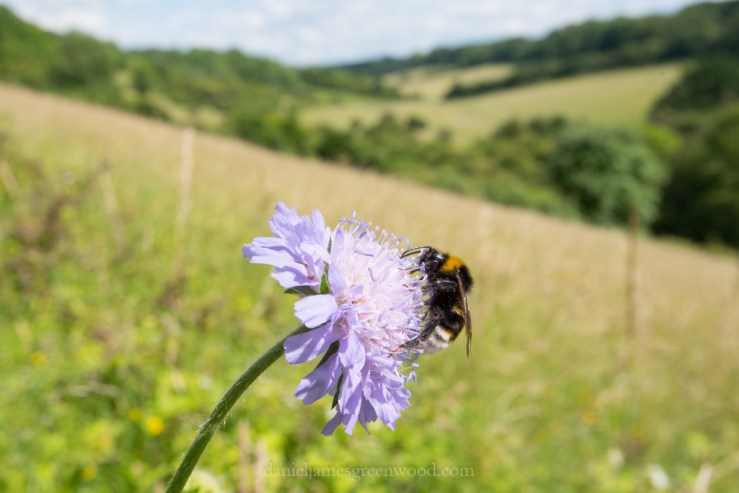
Bee on scabious, The North Downs
June 2016This bee was feeding up on the other side of a stock fence in June and with my wide angle lens I managed to get this picture. I think it encapsulates the ecology of meadows, the bee and the flower a symbol of the wildflower-rich North Downs scrolling off into the distance.

Bees pollinate 80% of wildflowers in Europe and contribute £560million each year to the UK economy through crop pollination, and yet we still use neonicotinoid pesticides which are the strongest force driving 32% of bee species towards extinction in the UK.

I’m not sure whether this is a bumblebee or cuckoo bee, having been told it was the former recently. If it is a cuckoo bee my ecosystem metaphor has fallen apart because cuckoo bees aren’t interested in pollination, mainly stealing from bumblebees!

North Downs diary June 2016-8340

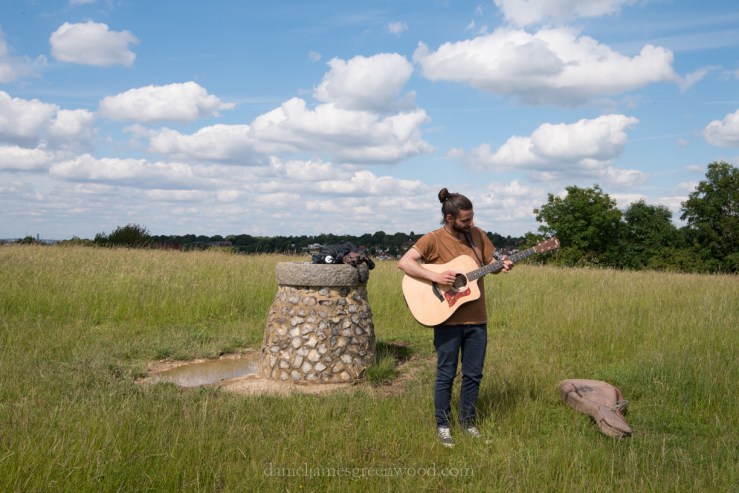
Marco plays the guitar, The North Downs
June 2016Like 48% of British people who actually did or could vote, I was greatly aggrieved and disappointed by the result of the EU referendum. The week following it was scary. A sharp spike in hate crime, the nastiest characters in our society buoyed by xenophobes who’d pushed for a leave vote based on fear-mongering about immigration and lies about how much it cost Britain to be in the EU each year.

It’s in unsettling times when a simple walk in the landscape can remind you of the bigger picture. I was walking on Farthing Downs, full of angst for the post-referendum Britain, when I met Marco playing his guitar on the hill. He had only just moved to London from Italy:

‘I have been here one week and in Italy they did not even talk about it [the referendum]. Now I am here and wow. My friends think that I am in London surrounded by cars and buildings, but I am here. And I love it.’

rye-djg-4

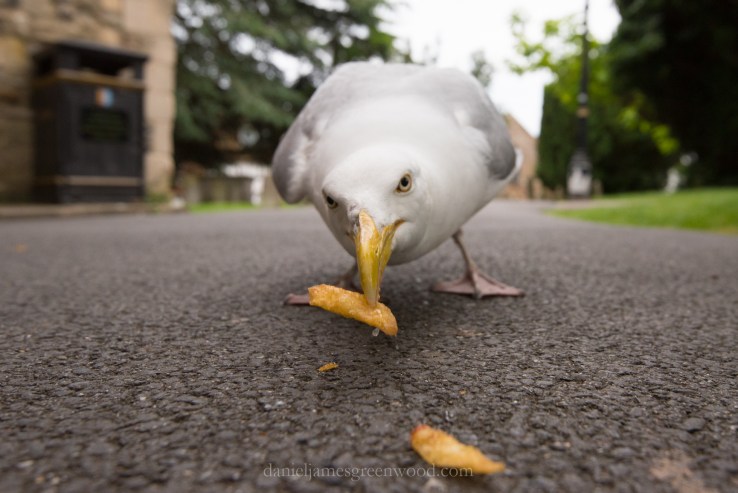
Herring gull, Rye
July 2016

Every time I go to Rye I get chips from a proper chippy and eat them up at the church on the hill. There is always a herring gull in attendance. I took the chance to create this photo, a technique frowned upon by wildlife photography purists.

I wanted the eye in focus but instead got the chip in the bird’s bill, saliva dribbling down.

czech-rep-2016-blog-29

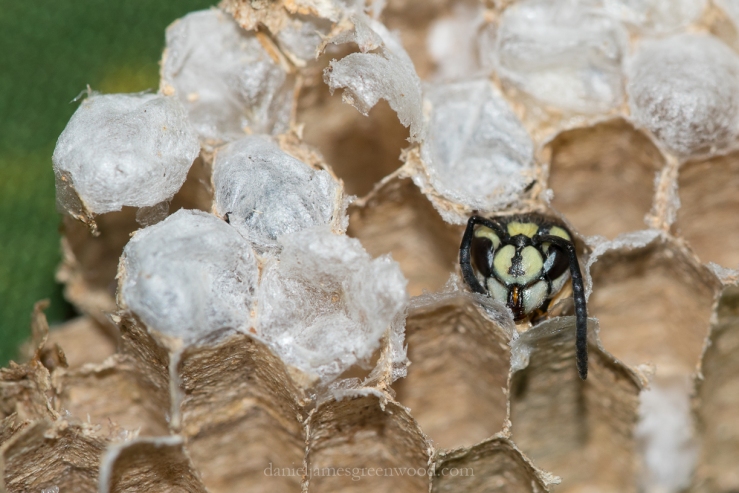
Wasp in the cell, Czech Republic
August 2016We were walking along a quiet forest road when my friend Zuzka picked up a piece of something on the ground. Looking more closely it was a chunk of wasp nest that had been torn off and dropped.


Inside the cells were wasp grubs encased in a papery sheeting, with one ready to emerge. It had likely been dropped by a honey buzzard, a bird of prey that eats wasp grubs and will situate its nest with the number of wasps’ nests nearby being the key. Kind of like good restaurants for us.
It was a privilege to be able to see into this world without being stung by wasps guarding an actual nest

.

new-forest-october-2016-lo-res-157

Honey fungus, The New Forest
October 2016

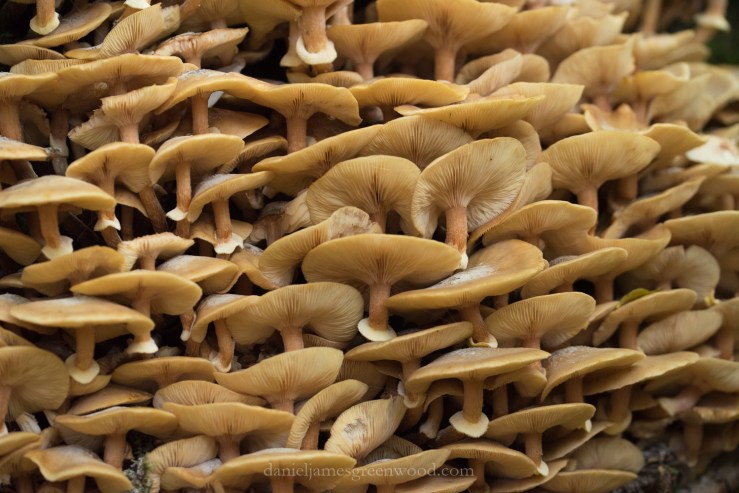
Let’s be clear, in London and the surrounds, it was a rubbish autumn for fungi. It was a dry season with the meadows of the North Downs largely devoid of waxcaps and other mushrooms. But a trip to the New Forest in October did provide an encounter with a gang of honey fungus, a mushroom that many gardens so dread because it kills trees OMG!

It was worth waiting for this chance to find mushrooms in their pomp, largely intact with some nice light and greenery still around.

new-forest-ponies-djg-1

Balmer Lawn, The New Forest
Halloween, October 2016

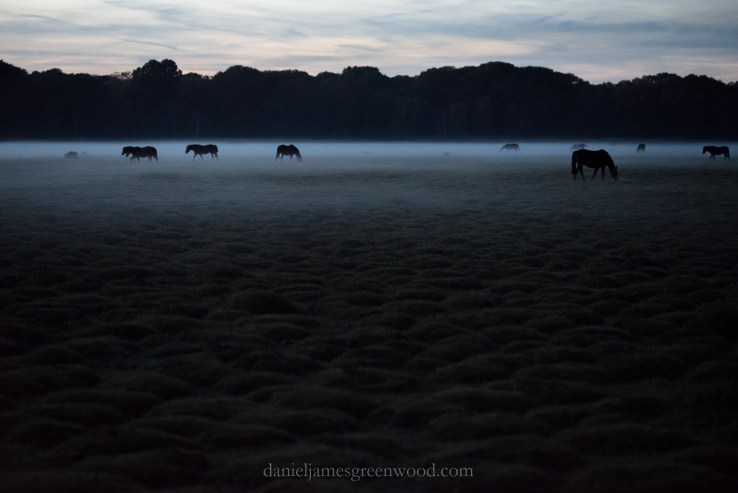
Whilst these New Forest ponies are not wild and they do belong to people as domesticated stock, I felt transported into some ancient scene from the Eurasion steppe. Mist rose with the twilight over Balmer Lawn near Brockenhurst, the ponies grazing the horizon.


North Downs diary: Cows, fields and sunshine

Sunset oak - North Downs diary - November 2016 - D. Greenwood

North Downs diary, Farthing Downs, November 2016

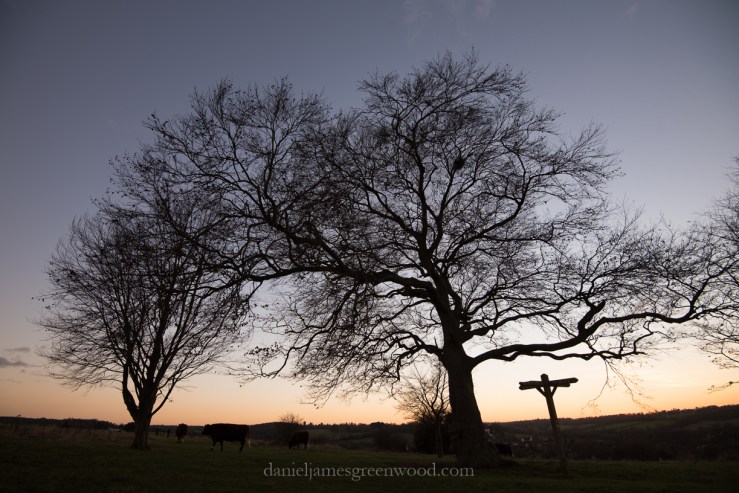
Three o’clock and the sun sinks in the east, casting long rays of light through the papery sepals and stems of knapweed and agrimony, summer’s relics. Threads of spider silk drift between these old frameworks, a material stronger than steel by comparison. The experts will tell you that at this time of year birds depart the highest open reaches of the downs, and there are few birds around. This is the perfect camouflage for a crow, the sun so low and dazzling there could be hundreds of them chowing down on the edge of the hill. One lifts up, gliding on the wind, hovering kestrel-like, remembering its place.

I came here with thoughts of waxcaps bright and beautiful, but two hours out here and I only find one picked and overturned. The life is being scraped from the downs by the raking wind, the tumbling temperature and coming dark, the slide into winter. Yet every seasonal change is the same, like a shift in human history, it is not one event that brings about the enclosure of darkness but several over time. You can find its waymarkers, indicators of something different on the horizon. Each season, like each era of civilisation, is a product of the ones which came before.

Cows grazing - North Downs diary - November 2016 - D. Greenwood

The cows graze the grasslands, their coats lit red by the sun setting behind them. Their breaths puff out like smoke as they chomp. It is a reassuring sound, grass uprooted and chewed over. They offer few glances to those of us passing by this morning. Pied wagtails, a bird I don’t often see here, perch on their backs and pick at their pats. In the scrub slowly being cleared from the downs by the City of London, redwing break between hawthorn and rose, their wings lit as they break cover. I know why this work is being undertaken, I’ve helped with it elsewhere on the North Downs, but I am losing my old signposts in this open landscape. The area where willow warblers once nested, where redwing and whitethroats used to feed up, a hawthorn where chafers fed one evening: all of it grubbed out, the soil lightly ploughed. This scrub is being cleared to allow the return of chalk grassland, one of Europe’s rarest habitats, much of which is found in England and a surprising amount in London. Our response to the clearance of trees is almost always emotional, that’s okay, but it’s important to know why it’s happening but equally important to ask why.

A woman passes me with a broad smile, covering her eyes from the sun to look at me. She stops:

‘Isn’t it wonderful,’ she says, her companion a little surprised that she has stopped mid-conversation. ‘Cows, fields and sunshine.’

‘Yes,’ I say. ‘It’s like being in the countryside. Wait a minute, I think it is the countryside.’

‘I’m lucky, I live just next to it,’ she says, making her way.

I agree with her, she is lucky.

Up ahead a figure sits on a mobility scooter next to the millenium monument atop the hill. They are taking pictures of the sun disappearing behind the hill. Knowing I’m part of the photos I stop and ask, ‘would you like me to give a certain pose?’ She laughs and throws out her arms to suggest a stance.

‘What camera have you got there?’ she asks, my camera on its tripod resting over my shoulder like a bazooka. ‘I’ve got a Canon but haven’t used it in a while,’ she adds.

I don’t enter into the Nikon-Canon banter.

Her name is Tilly and she lives locally in Coulsdon. ‘Just down the road,’ she says. ‘Where are you from?’

I tell her that I’m not so local and I come here to get away from the SE postcode.

She asks what I’m here to photograph, ‘wildlife?’ She has it right, but there are a disappointing lack of mushrooms. ‘It’s probably the wrong time of year for that,’ she says.

Dusk on the downs - North Downs diary - November 2016 - D. Greenwood

It’s been the right time before but an anxious thought creeps in – does someone know the movement of waxcaps here in some kind of hyper-intuitive detail? Probably not, it’s just been a rubbish autumn for them. She recounts tales of campervan holidays out in the New Forest’s old military sites where she could bolt her caravan into the old RAF concrete and fly agarics fruited on her portable doorstep. ‘I’ve not been there for a while though,’ she says. ‘I was ill last year, and I’ve been ill this year, too.’ She nods as if admitting something.

The sun has left us now, a few scraps of cloud coloured by the glow.

‘I love the red of those clouds,’ she says. ‘Apparently there’s a green flash when the sun goes down.’

‘It’s called the green ray, there’s a French film about it called Le Rayon Vert,’ I say.

‘Oh, I’ll have to look it up,’ she says. ‘Watch out for the cow pats.’


Explore my North Downs diary

Photography: Halloween in the New Forest, October 2016

new-forest-october-2016-lo-res-17

This post is part of my Woodlands project

View my full gallery of New Forest photos on Flickr

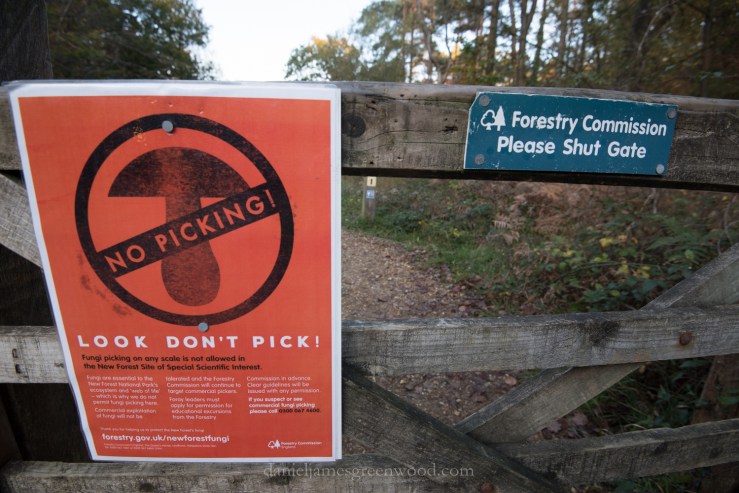
One of the great rewards of cultivating an interest in wildlife is the freshness and newness, the constant change. In spring it’s the woodland flowers breaking through the soil, in summer the bees, wasps and butterflies, and in autumn I seek out mushrooms on the woodland floor. This autumn, however, has not given the third kingdom of biological life, the fungi, what it needs. It has been very dry in the south of England. In October 2015 clouded and trooping funnels were romping across the woodland floor but this year there is very little soil-based fungi. Thanks to the astute minds of woodland conservationists who leave deadwood ‘in situ’ there are still mushrooms to be found and photographed for those of us who seek it. As I’ve said before, I’m not a forager for no good reason other than that I just enjoy photographing mushrooms. The New Forest has received publicity recently for its mushrooms and the Forestry Commission’s ban on all picking.

new-forest-october-2016-lo-res-162

Sure enough the signs were up when entering Forestry Commission land. I put similar signs up in my professional life and wish more people would respect the landowner’s wishes. But I sympathise with both sides in this case. Peter Marren argues that the Forestry Commission do more damage than a forager ever could with the use of heavy duty forestry machinery. Mushrooms are just the fruiting body of the fungus itself and the most important thing for any soil-based fungus is the mycelium in the soil. When heavy machinery is used in a forestry setting the soil is churned up and the mycelium destroyed. Even when the biggest band of foragers comes to raid the nest, they will only really be doing what the organism wants – spreading the spores released by the mushroom and leaving the mycelium intact. I sympathise with both arguments and feel that Marren may have the edge scientifically.

new-forest-october-2016-lo-res-30

Conservation debates aside, there were lots of mushrooms to be seen. It has only been in the final weeks of October that honey fungus (Armillaria) has begun to appear and I came across large spreads of this most attractive and demonised mushroom. It is necrotrophic and often takes more from a tree than it gives in return in the symbiotic sense, meaning that the tree can often fail. It’s a native species often indicative of ancient woodland, so it’s been killing and breaking down trees for millions of years in Europe. But when it costs people money, people get angry.

new-forest-october-2016-lo-res-157

Honey fungus is the common name for a number of different types which are more difficult to identify straight away. I came across this charming clutch at the base of a beech tree. To think that fungi is in the fossil record as far back as 700 million years ago, while the Homo genus we have evolved from broke from other primates 3 million years ago. I feel we owe these unthinkably ancient organisms respect, which means not taking more than we should and protecting their habitats and allowing them to be, well, mushrooms. I think this species is Armillaria mellea owing to the ring and the colouring in the centre of the cap.

new-forest-october-2016-lo-res-78

Though I have complained about the lack of fungi this autumn on the soil sulphur tuft (Hypholoma fasciculare) has had a great year. It took it a while to come out last autumn but it has been first past the post this time. It is one of our most common species, found on the surface of logs and fallen trees.

new-forest-october-2016-lo-res-68

Looking back at this macro image of a bonnet mushroom (Mycena) I noticed the small shower of spores leaving the gills and flowing off towards the left. I’ve never seen a mushroom with a cap do this and certainly did not notice until I looked more closely later. To think one of those spores could end up producing a beautiful mushroom like this somewhere nearby.

new-forest-october-2016-lo-res-103

Spore dropping mushrooms are known as basidiomycetes, pointing to the basidium which, in mushrooms with gills, is where the spores are produced. Alternatively ascomycetes are spore shooters and myxomycetes are slime moulds, which aren’t fungus at all. Still there? On Halloween you could be forgiven for thinking these were the fangs of a vampire mushroom. But vampires don’t exist, and it’s a mushroom. This is a species from the genus Amanita.

new-forest-october-2016-lo-res-105

Though it can be disappointing if you’ve travelled a long way to see a big show of mushrooms in the woods and find nothing much, there is pleasure in finding  a little mushroom down in the leaf litter. This little bonnet was sticking its head above a parapet made of beech leaf litter, hence the brown and faintly orange blur throughout the image.

new-forest-october-2016-lo-res-86

Somewhat more incongruous and rock like was this earth ball in the genus Schleroderma.

new-forest-october-2016-lo-res-55

No, I am not saying this is a mushroom. It’s the reproductive parts of a moss seeking to spread its spores across the woodland.

new-forest-october-2016-lo-res-41

In the plant kingdom the bracken, such an important resource for people and their animals in the New Forest, was rainbow-like. The greens were so dark they almost appeared blue.

new-forest-october-2016-lo-res-122

The New Forest is an ancient landscape that supports species of conservation importance across Europe. In England the wild service tree (Sorbus torminalis) is far less common than it once was but Roydon Woods NNR is a good place to find the odd individual tree. I had never seen its autumn colour until this year.

new-forest-october-2016-lo-res-147

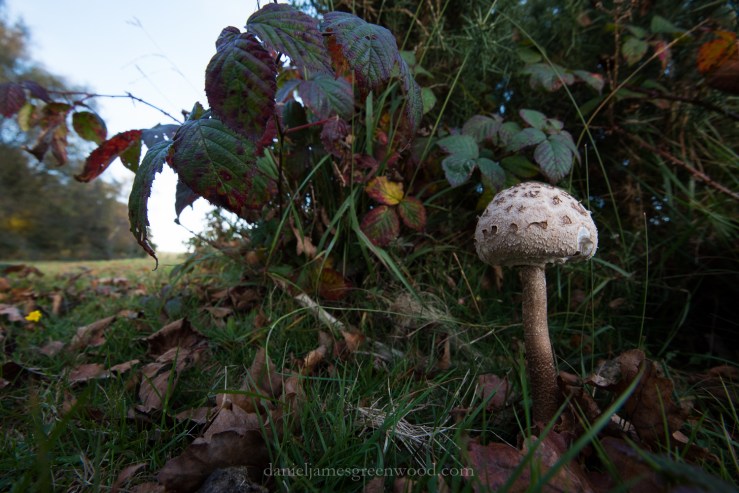
Out of the woods I found this parasol mushroom hiding in the shelter of bramble. If this was a tabloid article there would be a band of European foragers coming round the corner there with sacks full of mushrooms. There was only a lady walking her dog.

new-forest-october-2016-lo-res-168

One of the things to remember at this time of year is how quickly the light fades. On Halloween bats were hunting at 4 o’clock, ready for their upcoming hibernation. Is this why they are such a key part of Halloween’s iconography, because they hunt so close to dusk in autumn we come into contact with them, their shapes imprinted in our minds. I left with the shapes of New Forest ponies grazing the misty horizon of Balmers Lawn, imprinted upon my camera’s memory card.

See more in my New Forest archive


Oaks of London: Rural remnants of Dulwich Park

dulwich-park-oaks-22-8-16-lo-res-26

Trees: Old field boundaries of Dulwich Park, Southwark, London, September 2016
Species: English oak, Quercus robur
Age: Between 200-500 years?
Status: Fair

dulwich-park-oaks-22-8-16-lo-res-55

This sizeable boundary oak lost a limb in a recent storm but it should be able to recover. It’s important to remember that many ancient trees lose their heartwood through storm damage, lightning strikes or by other means. It is also very pleasing to see that the fallen limb has been left to decay next to the tree. Southwark Council are generally good at doing this where conservation policies make it to grounds maintenance.

dulwich-park-oaks-22-8-16-lo-res-43

One of the more intriguing trees is this heavily belted pollard oak. I like to call it the toilet oak. It has put on a lot of bulgewood over the centuries as it’s had to reach out to the light. My images are slightly distorted by the 10-24mm wide angle lens I use, seen in the lean of the toilet block. It seems in fair condition despite the erosion around its base, likely from the soles of children’s shoes as they climb it.

dulwich-park-oaks-22-8-16-lo-res-42

In the fenced nature reserve area is a neat line of former field boundary oaks from the time of farmland smallholdings, likely dating further back to when this was Dulwich Common. These oaks also show a great deal of bulgewood from the interal shifting of the tree’s woody fibres as it has reached out towards the light. They once grew in full sunlight, undeterred.

dulwich-park-oaks-22-8-16-lo-res-37

The one nearest the gate has all the signs of recovering from lost limbs, epicormic growth and the need to put on bulgewood. Immediate trouble for this tree is coming from the yew growing on the right hand side.

dulwich-park-oaks-22-8-16-lo-res-41

It’s an impressive pollard, probably about 300 years old. It is reaching for the light outside the nature reserve.

dulwich-park-oaks-22-8-16-lo-res-33

The furthest oak has lost one of its limbs and has a large wound in the heart of the tree. I can’t underline enough how important this is as a habitat feature for the fungi and invertebrates. It is a major wound but it should be able to recover over time now that the excess weight has been lost.

dulwich-park-oaks-22-8-16-lo-res-26

The largest of the oaks is this fine one next to the boating lake. I remember this well from childhood (decades not centuries). It has fairly complete leaf cover, so few signs of stress despite its closeness to the path and amenities.

dulwich-park-oaks-22-8-16-lo-res-19

The trunk shows the bulge of a former limb, the buttresses at the base holding the tree steady. When I photographed the oak it had been marked by the business card of a commercial dog walker.

Oaks of London archive
I’m leading a tree walk at Dulwich Park on Saturday 29th October 2016 
Dulwich Society
Dulwich Park Friends
My oaks of London gallery on Flickr

North Downs diary: The owl is calling autumn

North Downs diary, Coulsdon, September 2016

It’s dry and dull on the downs, wild carrot and ragwort desiccating, but house martins migrate overhead as they begin their return to Africa. In the damp and shady nooks of Devilsden Wood’s rotting logs the mushrooms sprout. The first I can find is a tiny bonnet rising out of beech leaves, one such leaf topped by an aphid. There is a spread of what I think are webcaps, orange-yellow in the wood dark. Now I remember the ache of kneeling for so long, gently turning the focus ring of the lens to catch the right part of the mushroom: the serrated gills, the skin of the cap. Overhead the soft calling of a tawny owl comes, at four o’clock in the afternoon. I’ve noticed this for the past month, with owls calling at two and three o’clock. The jays begin to rouse with their piercing shrieks, they are the principle mob leaders against the tawny. But no ruckus is forthcoming. I’ve read that tawny owls actually call more commonly in daylight rather than under darkness. Reading about them only this morning I learned that owls are better at hunting at dusk and some species are aided by an increase in moonlight. The jays are right to be worried, with birds taking up the largest chunk of a tawny’s diet. Under a decaying beech trunk dressed in moss the shape of a wood mouse trails into the cover of the leftover bark, another species fearful of the owl.

Away from the fungi I take a closer look at an old horse chestnut perhaps some 200-300 years in age, planted as a boundary marker on the edge of Happy Valley. It stands out beyond the still verdant hazel coppices with its floor of red crinkled leaves. It’s often the first to leaf and the first to leave. Out beyond the trees in Happy Valley the sun casts long shadows, the lines of hay the shadows of recent cutting, soon to be bailed, probably sold on to feed local grazing animals through the winter. I don’t quite know. Elsewhere on the North Downs these rows of hay are burnt, its value no longer universally high across the chalk. The sun sets over Devilsden Wood, the sheep grazing in the golden September light. All appears well in this remnant of downland past.

More from my North Downs diary