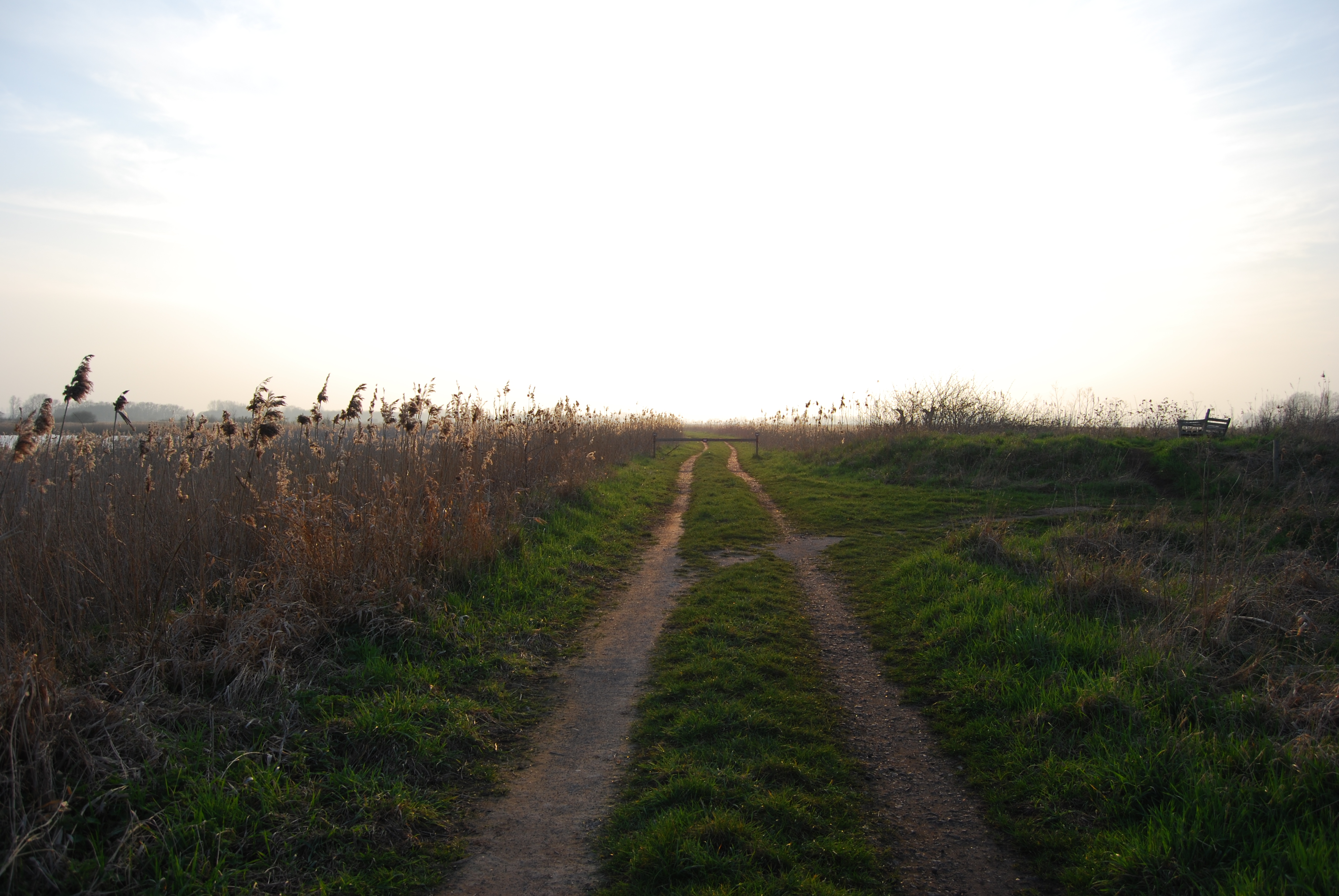
The cranes aren’t flying

March 2012 631

– Lakenheath Fen, Suffolk, March 2012

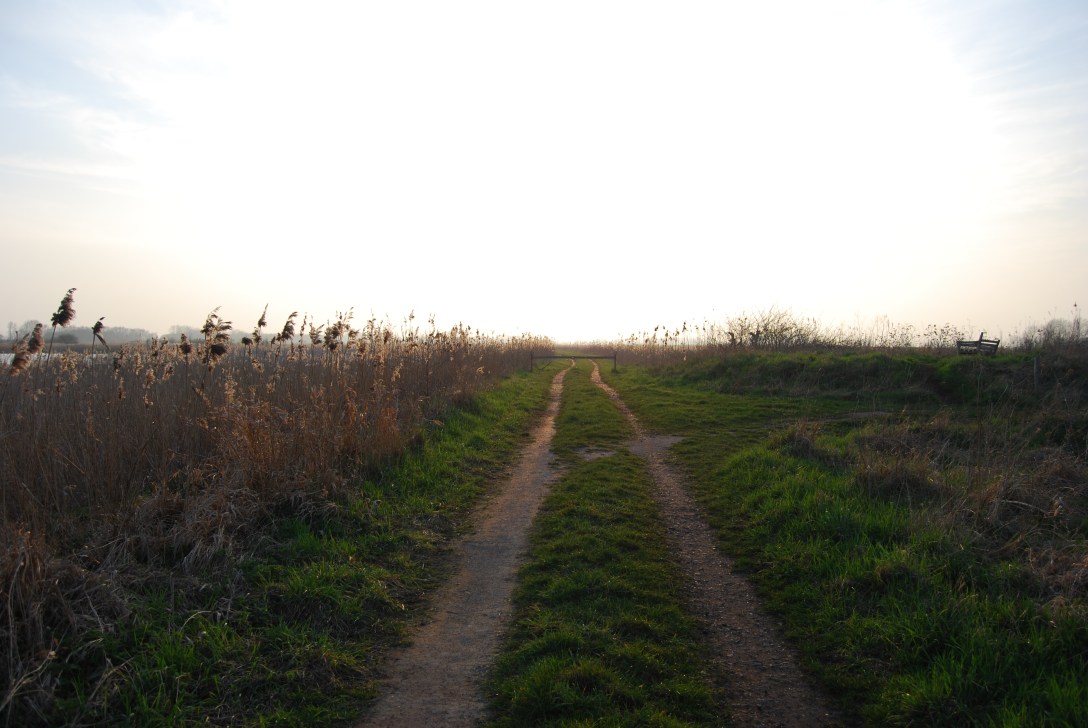
We’re standing on the raised bank overlooking Lakenheath’s reedbeds. It’s a warm, clear day but cooling gusts of wind disturb the peace, ushering us away from the viewpoint. On calmer days bearded tits move across the tops of the reeds, today they’ll be down in the cover. We pass a rigid poplar plantation famed for its golden orioles which breed here in spring, what is perhaps the only nesting site in the United Kingdom. The trees grow out of swamp and some of them have collapsed, the soil clinging to the upturned roots making the poplars look like toy soldiers left supine by a child’s swooping palm. The trees have sent suckers out along the horizontal trunk meaning a new layer of woodland is growing from the body of one of the fallen, a new understory naturally occurring from a man-made habitat.

The cover of the plantation lessens the wind somewhat, a green woodpecker yaffles from the cover of the trees. Along the bank are anthills home to yellow meadow ant. I’m with David Norfolk, a friend and expert ornithologist, and he tells me these are rare. The hills could be hundreds of years old. ‘They wouldn’t exist in today’s farmland,’ he says. ‘A tractor will destroy them’. He takes a small chunk of the mound and golden-coloured ants move busily across the grey soil held in his fingertips. On the other side of the bank a blue river runs away to where the sun is going, a flock of oystercatchers pass, chattering as they fly against the flow. On the riverbank near to us pristine white feathers are strewn like discarded quills around the skeleton of a mute swan. David has seen it before: ‘That’ll be a fox kill.’

We’re alerted to a faint, hoarse bird call wafting from beyond the poplars where a swathe of reeds stand for perhaps 200m all the way around. We stand to face the reeds and the wood beyond where trees have collapsed, fieldfares pass through on migration north on their return to Scandinavia. We hear it again, the muffled, bugling call of a crane. I have longed to see or hear these birds, Russian symbols of peace in the aftermath of Hitler and Stalin’s tyranny. The poet Anna Akhmatova described hearing cranes as she lay in her sickbed, the birds fleeing the dry autumnal fields after the harvest. Our cranes are not forthcoming but David is convinced they’re here. I’m prepared to wait until dark.

A group of men in their sixties arrive and we point out the vague sound of the crane, but they look in the opposite direction, instead to the sun setting over the lake. I suggest to another man that the cranes can be heard, he complains that he needs to sit down. ‘That’s a dog barking,’ he retorts. Bearded tits are pinging in the reeds, a water rail is squealing like a pig. We follow the path back to the start. The bugling goes on, it has to be cranes. But the beardies are closer and closer and even louder now. ‘Watch for their flight between the reeds,’ David says.And here they go, the pale brown flash and long tail, something I’ve never seen before. From behind us a crane calls clearly into the lilac sky.

F16s tear up the sunset with their apocalyptic thunder, a train careers along the bank next to us, the two carriages a little pathetic-looking and exposed in this vast open space. The lights shine inside, juxtaposed against the light dying down around us. The sun is stuck behind a strip of cloud and its colour cannot be revealed, jackdaws are roosting noisily in the poplar plantation, the green woodpecker continues its laughing fit, escaping its perch in an undulating flight overhead. The water rail is squealing still, a kingfisher bolts around a swoop of reeds. Two giant birds appear from the path we’ve just taken, grey and white. It has to be! Two cranes, flying together, approaching us on the bank, moving across. They are within a stone’s throw… but the joy evaporates. They’re swans and it’s a trick of the light.

The sparrows fall to pieces

— Eastmoor, Norfolk, March 2012

It’s evening, the light is fading to a greyish hue, the robin slips out its fragile song in the dead bay tree by the window. My cabin backs out onto a field of couch grass and sprouts which I face away from when I sit at the desk in the evening, all that goes on in the field and woodland behind me feels as if it were in the back of my mind. I know there is killing and fornicating going on out there. In the wood beyond the field a male tawny owl calls once, following up with its second, longer ‘twoo-ooh-ooh’. The ghostly call has the appeal of a siren, but this is a male marking his territory. The blackbird signals the shift to night with its ritualistic roll of ‘tchacking’ alarm calls and the day is most certainly at an end. That is by no means it for the noise. The ceiling is home to a colony of house sparrows roosting in the rafters. We are separated by slabs of insulation material which is of such texture that the slightest movement from one of the birds is clear to me.

They take hours to settle, tucked-in long before the blackbird or robin has gone to its roost, they tremble and bicker over space well into darkness. At around midnight I hear them scratching about, their feathers purring against the insulation. My host apologised to me about them: ‘they’re supposed to be endangered,’ she said, with a grimace. The house is a new-build and was immediately taken-to by house martins arriving in the spring but the house sparrows didn’t like that and have waited up there for them every year since. The family favours the martins but the sparrows outnumber them greatly. There is still the contempt for animals brought about by familiarity. This is how it has been for centuries, and in the main, is a harmless effect of living in a place where wildlife thrives.

It’s late now, the goose has gone to bed and ended its insufferable honking shriek. From the road beyond the house the deep bass of a motor comes, getting closer and closer. It’s a quad bike, the engine purring past the side of the house and into the field directly behind the cabin. I can hear the faint sound of the ducks quacking in their huts in anticipation, the sparrows are nervous, moving around above, perhaps huddling for protection. But from what? The lights of the bike are in the window, shifting, becoming longer and brighter as it approaches, the speed and resonance increasing. The sparrows fidget more and more, growing in anxiety. And then it comes: a spine crunching gunshot. I feel it in my back and shoulders, the sparrows fall to pieces in the rafters. The engine dissolves, and now is gone.

Silence.

Hit the road, muntjac

Foulden Common, Norfolk, March 2012

I walk the road from Oxborough, scanning the verges for unusual flowers. At times I am rewarded by small blasts of sweet violet, little white flowers which have been used down the centuries for their perfume and act as indicators of ancient woodland, particularly here in eastern England. But there’s no woodland anymore, just these elliptical patches of tiny flowers showing what might once have been here. The sudden end of the farmland is marked by a Scot’s pine, its bark fissured by wire that’s now part of the tree’s anatomy. Foulden Common opens up, a field of dry grass and mole hills, a wintry wood of birch and oak. A hare scarpers.

I sit beneath an oak tree riddled with dead branches and living lichens, a reedbed and crack willow behind me. Immediately I’m alerted to a large animal amongst the reeds, its fur dark brown, it turns its head towards me and disappears. I’m looking out at the fields, divided from the common by a fence and wire. Pheasants are calling back and forth from the wood behind me, its metallic call reverberating, to the field ahead. Gunshots boom, deep and bassy with a final, rippling crack, the pheasant screaming in the wake of the artillery. Overhead, military jets run drills from a nearby airbase and I am reminded of accounts of the Iraq war by civilians, the terrifying sound which hinted at what was to come. It takes over everything: the rooks and woodpigeons fly off in the distance, the robin singing in the scrub is silenced, a red breast moving, beak opening and closing as it sings into the machine’s roar. But it doesn’t last and the occasional gunshots resume, the soothing song of a yellowhammer coming over and over underneath. The release from the barrage makes me want to sleep, like being released from a grip, the yellow bunting luring me further with its repeated phrase, and so I give in.

I wake and the boredom has lessened, the endless trudge of hedgerow and arable land is distant, the lack of people is not so peculiar now. I feel the quiet throb of lichens, the bark against my back and the sun touching my face, the black eyes of an animal which thinks I’m still sleeping, a small, dog-like mammal with a head like a wood mouse. We hold eye-contact and it dithers, moving behind the collapsed willow and into the reeds. And then it begins. A volley of harsh, bark-like shouts fired from the cover – is it going to attack? The voice is intense, hostile. It’s unnerving. ‘Alright,’ I shout. ‘Alright!’ I put my camera and map away and head back to the road, the monotony of walking returns. The muntjac has shifted me from the Common.

The sun sets over Dartford

It’s late afternoon and the sun begins its descent toward Dartford. In the east the bridge is reflected in the shimmering Thames. Rainham Marshes is behind us, beyond the large concrete seawall and iron fencing, protecting the reserve from dogs, people and vehicles, protecting skylarks and lapwings, birds that breed on the ground. Gulls pass over from the marshes and across the Thames to the south. A deceit of lapwings exits, too, their flappy black wings belie their compact shape when grounded. They return to Rainham a few minutes later. Evidently this is not an exodus. Teal are swimming on the Thames, their colours draining as the sun retires behind them. We inspect the shoreline, its thin marshland and garbage. The ducks want to feed here, but what’s to be eaten? The tide bubbles audibly against concrete, an armchair rests at a tilt in the marsh, half against the slanting ground and half in the slurry. The chair is stained where it’s become soaked by liquids other than water over the years. If you were to sit in it, you’d fall backwards, skull first. The dry land is tropical with all kinds of plastic: caps freed from their bottles, thin tubes like the insides of biros, thousands of bits of broken plastic, and a syringe. There are pieces of driftwood lying around, one chunk has been bleached by sun, sea and salt. It breaks under the slightest pressure, the yellow shape of woodworm hibernating in a crevice created inside. I wonder how far this piece has travelled.

The sun is setting further, the river taking on the image of a lagoon, still the teal are drifting. We walk back along the path in the direction of Purfleet, a small flock of pied wagtails circling us back and forth to Rainham. They are wary and so they come and go, at last settling on a patch of rushes and straggly vegetation covered by yet more rubbish. Small islands of sand and mosses remain amidst plastic, industrial sponge, a road crossing bollard and bottles galore, the pooling water has the metallic sheen of petrol. The eye’s obsession with trash distracts from the living, in this instance the stone-washed water pipit holding onto a stalk amidst the rushes. The wagtails patrol the sand in their cheerful manner, taking pops at one another on occasion. The water pipit is still, in contrast to its cousins. A woman in red approaches and the passerines are flushed from the islands and back over the seawall, the pipit going with them. She has a green lager tin in her hand and white earphones. She sits to watch the sun from the wall, kicking her legs. The birds return to their patch. The pipit lands at the water’s edge, joined by what looks like a second pipit. The much duskier bird lacks a white eye stripe, or supercilium, and is itself a different bird, a rock pipit. Like its cousin, the rock pipit wags its tail as it looks for something to eat.

The trains back to London arrive on the hour so we sit by the water and watch the final movements of the evening. On the path a woman pushes her grandchild in a buggy, remarking to us that Thurrock once had a population of forty-four. This, of course, was centuries ago. The pipits would have been in a similar spot then, likely feeding in water free of oil and sponge, but no doubt touched by different sort of human waste. Up ahead, a man rides a mini motorbike with his daughter in his lap, his look is sincere. They disappear between a gap in a dumpy little bush. On the grass dwarf mallow leaves await flowers and a pair of mistle thrush regard us with caution as they disappear into near darkness. The sun is a ball, inflating and draining into the south, v-formations of gulls sweep to the east, down a river now black and gold. Ducks and debris float freely towards Greenhithe and Grays, a slurry of pollution passing by, highlighted in the twilight.

A fashion shoot is taking place against the railings, a young woman with cropped hair and a purple dress stretches herself against the bars in a mocking vogue. As if from the river itself, as its inhabitants flee eastward, a curlew calls over and over again.

Panic in the ancient woodland

Dorset, April 2011

The track was churned up by tractor wheels, giving the appearance of an industrial thoroughfare. The trees were mostly beech, with the odd oak or ash in places. They were not yet in leaf, but on the cusp. On the verges wild primrose had bloomed and swathes of wood anemone grew where light fed the woodland floor. Beyond the ride, greyish flowers were appearing from the thin green sleeves of bluebell leaves. In patches common dog-violets showed their petals and heart-shaped leaves. The wood anemones, bluebells, wild primrose and violets all indicated that the woodland had been here, in part, for over 400 years. In Dorset, only wood anemone is indicative of ancient woodland. Though wild primrose, common dog-violet and bluebells would qualify the wood as ancient in the South-East of England, here in the South-West it was not necessarily proof. But wood anemone signifies ancientness. Beech is the final stage of woodland, and so the wood appeared to me to be especially old. Wood anemone is a slow grower, it increases its range by no more than six-feet a century. The tractor’s movement through the wood may have benefitted the primroses, its wheels carrying their seeds to hedgerows in distant fields.

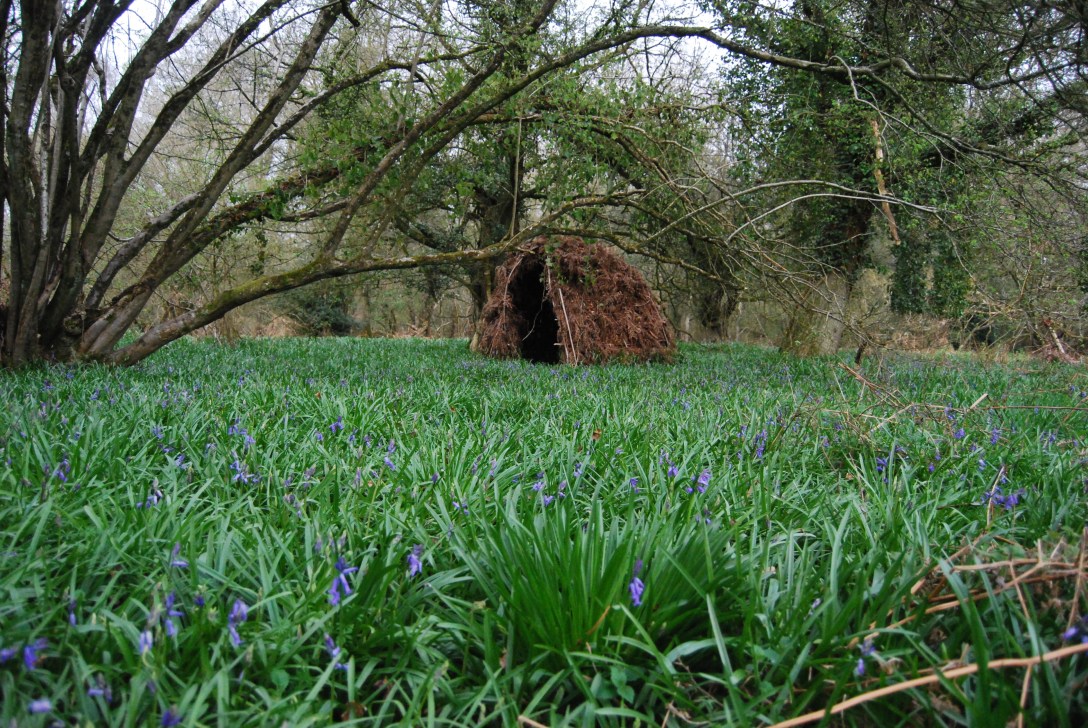
The track reached a plateau, swooping down and around a dense plantation of larch and other coniferous trees. No light reached the woodland floor, nothing could be seen beyond or between the trunks, merely needles and intense shade. No anemones, no violets. But this was a blip in the wood, the musty conifers likely planted for timber in a clearing came to an end. The spread of bluebells and beech returned. It was here that a big, moving, breathing blotch entered my peripheral vision. It was an animal, too tall to be a dog but that was my instinctive response. This flickering feeling is known as ‘fight-of-flight’, an adrenaline surge caused by the brain sensing that you are in danger. The brain then sends a command for adrenaline to be released into the bloodstream. Your senses are tunnelled. Leap the nearest fence or suffer the consequences. This natural pinch of adrenaline didn’t last. The fluffy white ‘tush’ of the animal engaged my senses. It was a roe deer. This doe got one whiff of a fragrant human and darted out of sight. The encounter was over within seconds. She had looked at me as she would once have witnessed her original predator, the wolf, a species long absent from Britain. In one of the trees a badger-viewing platform had been constructed. I climbed up and looked out across the dulled wood. The bluebells remained in their nearly state, spindly lichens hung from the bare branches of oaks like small, bluish wigs caught as their minor bearers escaped. In the gap of the sky untouched by twigs, the broad wingspan of a buzzard passed across. I clambered down and happened upon a neat den made from hazel poles and covered with brown ferns. To the side was an overgrown hazel coppice in need of cutting, with arms stretching out from the wide base. The ground underneath was coated with bluebells gradually lifting their heads to flower. Inside the den the leaves of the plant were flattened and brown hairs were scattered. A resting deer had stopped here.

There was a left-turning out of the wood marked by a rusted oil drum. The trees came to a sudden end and a field of grass exploded into a vista of deep, silent green. The roe deer stood in the tramlines leading over and down to an undulating expanse of the same. It watched me and continued sniffing around without much concern for a time, before galloping away as I took a few steps in its direction. I turned from the green field and gazed upon the woodland’s sudden end: a border of trees, a ditch and then the dirt of the farmland. A rabbit flinched in the low scrub by the ditch. The monoculture of the crop covered the scene for perhaps a mile over the hill and far away. In the wood, wildflowers of great variety grew, badgers slept through the day in their sett, birds of prey surveyed the glades and clearings while deer ambled along, sometimes stopping to rest in a man-made den. I turned my back to the farmland and sky and entered the wood once more.

Woodland Diary: Litter picking in lost gardens

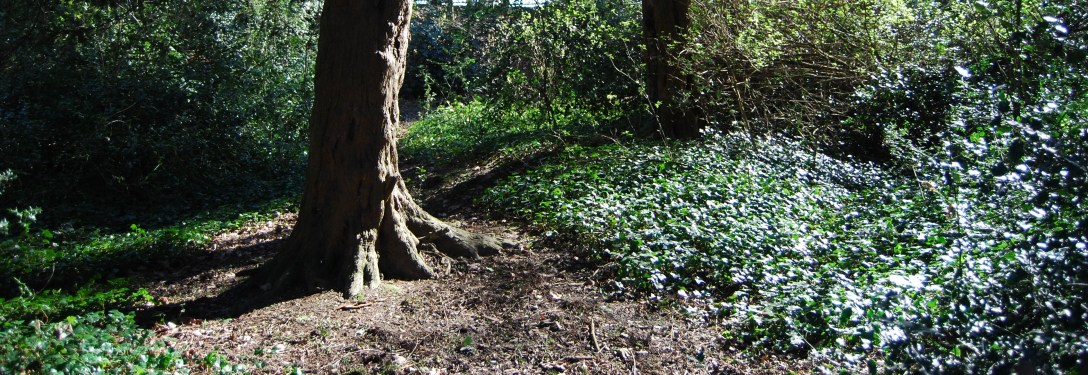
A slender pathway cuts through the ground layer of ivy, more likely to have been forged by a train of foxes. A large ash has been pulled down by the wind, the underside of the ivy leaves are a fresh colour, like the flesh of a lime. To the side a den has been made, with string tied to the rotting logs which rest against a tree in a tepee form. It can be the case that the people spend a night in the wood to qualify for a homeless shelter and so the sign of a tent or den surrounded by food packaging and drinks bottles is not unusual. There isn’t much litter to be found, other than things the ivy has subsumed, bottles or cans missed previously and taken in by the soil, or blown over from the road. Spiders make a home for themselves in empty bottles and the woodlouse is a common inhabitant of an old shoe.

We toe the path which leads around the ridge. It’s just ivy, above and below, masking the trees and the woodland floor. On the ground the leaves of premature bluebells peek through the earth and we take care not to trample. The coming of spring is a time of year to be cherished, the very thought leavens the darkness of long winter nights.

The ivy ends and a clearing opens up around a large yew tree, the soil cleared of life by the acidity and shading of the tree’s needles. The trunk is rippled and worn like an old doll’s limb, its circumference suggests it could be a few hundred years old. A line of tall yews appear as we move on, what must have been a hedge in a garden, turning into a right-angle. The ground dips to reveal the whitish bricks of a wall and a trail of broken glass. Behind us is a tall group of silver birch trees, quarantined amidst layers of ivy and the yew. These birch look like they’re waiting for something.

The other side of the wall shows a support structure for the terrace of an old Victorian villa, where people would have taken tea and listened for the hammering of woodpeckers in January, the repertoire of the song thrush in spring, and the call of the woodlark. A century ago they would have sat listening to the voices leading Britain to war. Now we look out from over the wall at wildness regenerated. Trees collapsed and left to rot down as fodder for bugs and beetles. The slow life of the woodland has been allowed to resume. A blackbird calls in the canopy and a great tit sings its winter song down in the woodland glade. The sun is setting low through the slope of trees. It’s time to go home.

Everyone knows a herring gull when they hear one

Everyone knows a herring gull when they hear one. Step off a train in Brighton on a summer’s day and you’ll hear their laughing call extend all the way to sea. It’s the sound used in TV and the movies to establish seaside towns. Two years ago I sat in Pavilion Gardens, green ash leaflets fanning against a blue sky, graduands strolling around with their grinning parents, when a bird poo bombshell exploded all over me. The velocity was shocking. I thought I had died and gone to graduation. The crap covered my hair, face, chest and arm. My companion was caught between the need to console and gloat. ‘You have to laugh, or else there’s nothing you can do,’ she said. ‘I’ll get a cloth.’

That day I learned some respect, seagull-style. My admiration for this bird is strange, a love unrequited on the animal’s side, a little masochistic on mine. I went to university in Liverpool and lived in a flat in the very heart of the city. My bedroom looked-out upon a row of fast food and booze outlets siphoning their stench out onto our balcony. At night we would peer over the ledge and watch the overblown shadows of rats moving between bins and under cars. Squalls came from that chasm after dark, and deep, booming voices often extinguished them. During my tenure, Saturday nights in Liverpool city centre were accentuated by the boozy rowing of couples, up against the walls of bars, stumbling across the pavement like seamen. But above it all something else was happening.

On a fine spring evening in my first year we lay on our backs on the grass verges beneath the Anglican cathedral.

‘Look!’ I had shouted, ‘a shooting star!’

‘No, you bloody idiot, it’s a seagull,’ was my acquaintance’s reply.

Smaller gulls, probably black-headed gulls, would catch the orange colour of streetlamps as they flew over. My inebriation did the rest. In the spring and summer months, when the gales which blow up and down Renshaw Street had died away, the angelic shapes of white gulls would waft down the road. Take the view from the corner of Rodney St., where Hardman St., meets Leece St., looking down onto the old Rapid Hardware store. When the sun set between the cormorant-esque liverbirds, the silhouettes of gulls moved like ashes from a fire, drifting on a light breeze to and from the Mersey.

From my old window, what I now know to be a newborn juvenile herring gull would call to its parent, waiting there for long periods of time, a bit like a package dipped in soot. Its bill is coal-black, a dusty grey hint to its body, ending in the white of its head. I have a polaroid picture of an adult herring gull perched on the rail looking into my room, a white-washed statue. The irony of the erroneous term ‘seagull’ is that now foodstocks have diminished in the bird’s natural coastal habitat, herring and black-headed gulls are coming inland to feed from the waste we leave in the street. They don’t merely follow the trawler anymore but the tractor. I recall a flock of feral pigeons, birds deriving from the cliff-dwelling rock dove, being dive-bombed by a herring gull over the scraps of chicken wings thrown into the road outside a fast food joint on Bold Street. It was like the moment the Tyrannosaurus Rex rears its head in Jurassic Park.

Whichever monstrous gull it was that crapped on me in Brighton, I forgive it. The presence of these birds on the margins of my youth have defined a remnant of my past with perhaps a little more tenderness than one might expect.

Woodland Diary: Sycamore coppicing

Holly blue

This was the first workday for the Friends of One Tree Hill (FrOTH). We coppiced 10 sycamore (Acer pseudoplatanus) trees and cut back the bramble (Rubus frusticosus) which is so dominant on the site.

In the case of sycamore we were felling trees of some thirty-feet or more in height that were competing with the sessile oak trees (Quercus patraea). These oaks are regenerating on the slope of the south-facing hill and are slow growers compared to the highly successful sycamore. We felled the trees also to allow light in and let the herb layer regenerate. This is a technique which helps insects and butterflies in particular.

PlantLife reports that by 2002 97% of British broadleaf woodland had become high forest. In 1951 that figure was at 51%. This means that most of our woodland is dark and overgrown generally because humans have stopped relying on woodland as a resource for firewood, furniture, grazing of livestock and so on. One of the great misconceptions about woodland is that felling a tree is somehow a bad thing when, on the contrary, wildlife flourishes when trees are cut down in moderation and sunlight can get in to bring life to the woodland floor.

One ancient tradition which has gone out of fashion is the art of coppicing. This is a process of cutting a tree down to its base, generally of hazel (Corylus avellana) or ash (Fraxinus excelsior), which means that the tree shoots new, straight growths. These poles were used for a variety of things, often as fencing.

Sycamore is not a typical coppice tree, but the stumps we cut down to in One Tree Hill will shoot similar growths in the spring and summer. In the meantime the wood we have cut will be used either to make log piles for beetles and other bugs to inhabit, otherwise the material will be used to make handrails or dead hedges in the wood.

The point of managing a wood in this way is to show that using the material, i.e. trees, is not a negative thing and can boost wildlife in the short term. The Pearl-bordered fritillary (Boloria euphrosyne) is one butterfly which saw a decline in numbers after the tradition of coppicing declined in the 20th century after we began to rely on gas to heat our homes and use wood imported from overseas. You can see that a tree has been coppiced if you spot thin shoots and the hairy green leaves of a hazel. 

This technique is renowned for its benefits for wildflowers such as wild primrose (Primula vulgaris) and bluebells (Hyacinthoides non-scripta) which can burst into life when the coppice is cut. These are plants indicative of ancient woodland and seeing as One Tree Hill is located in the area which was once part of London’s Great North Wood, we are hoping that some plants, in certain areas, could reappear one day, not to mention the wildlife which feeds from them. Sydenham Hill & Dulwich Woods and Dulwich Upper Wood are two fragments of the Great North Wood which have ancient woodland flora growing there, and have done for thousands of years. Perhaps one day One Tree Hill can be in a similar vein of health.

Gawping at the Chilterns

I am a countryside gawper. I like to watch the flow of valleys, hills and pasture seen from an English train window. As a student I remember travelling to and from Liverpool on the Euston line, experiencing a sense of nostalgia for the things whizzing by without the chance to grasp them. And this was before the trains had been improved to a mere two-hour journey between North and South. I recall the yellow of rapeseed and turnip flowers which bloomed in April fields, like a paintbrush passed across the glass. There were the peculiar farmhouses and barns, the horses drinking from streams which I deemed to be wild, and the black silhouettes of hawthorn and oak which had been moulded by the gusts and gales, all crooked and splayed. I remember the train slowing one evening in the gloaming, a brook taking on a glassy sheen in the near dark.

Now I stare out of the window in search of my post-London rations: skylarks, buzzards and such. These are not readily available in London, though they are in rural spots of Croydon and Bromley. This journey in particular was a trip to Birmingham for a flat-warming, promising (and delivering) a different kind of wildlife. The daytime train ride offered a snapshot of a new landscape to me, the Chilterns, designated an Area of Outstanding Natural Beauty and a part of the Green Belt. This is an area which has been earmarked for the High Speed Rail 2 which will see trains passing through the region every two minutes at speeds of 250-miles-an-hour. The service, some argue, will make use of the region but will offer it nothing in return. The closest stop will be Heathrow airport.

I was not thirty-minutes from leaving Marylebone when I glimpsed a trio of buzzards wafting in the grey ceiling. I saw jackdaws bothering the chimneys of small-town folk, and those magical inhabitants of plough tracks, the birds which had treated the silence between rounds at the disastrous battle of the Somme – skylarks. Their stiff, sharp wings rang the bell, as the train careered past on the raised track. The larks, three of them, descended upon a hedgerow in perfect accord.

I had recently read a book by Mark Cocker entitled Crow Country, where the author describes waking at 3am to watch rooks in Norfolk, amongst other revelatory birding experiences. The sections on Corvus corone, the carrion crow, had stayed with me. I could not help but observe these clever brutes patrolling green spaces in London. It should be pointed out that this is to the chagrin of some bird lovers who cite the cradle-snatching antics of the corvids as a reason to cull them, and to enhance supposedly falling fledge-rates of songbirds. Cocker’s writing on crows drew me to take greater notice of how they behaved. One thing I had witnessed a number of times in the autumn was crows bothered by kestrels, the big black creature barking, immensely uncomfortable in the presence of the cheeky falcon. Falcons like kestrels and hobbies sometimes go for old crow’s nests, so perhaps this was a question of ownership.

From my seat on the train I witnessed a trail of crows flying from over the roof of the carriage. The sound was killed by the glass but the conga-line of corvids pointed to something else. The line came to an abrupt end and a stretch of thin air opened up. And, some moments later, the giant wingspan of a red kite appeared in their wake. Its flight was smooth, a single beat of its wings expressing its power over the fleeing crows. The kite’s wingtips were like fingers. The forked tail was the motif that defined it, the whitish head and large white patches against the dark wings. This is not to mention the rufous shade which separates it from its continental cousin, the black kite. This is a bird which preys on crows, hence the sense of uniform panic amongst the fleeing black feathers.

Red kites were on the brink in the UK until a breeding programme in Cumbria re-established populations which have now spread eastwards into England. It is now said to be approaching students eating their lunch at Reading University, where a research programme is underway to discover how far the birds are spreading, with reports of the birds feeding in gardens. This is a monster which ate offal from the streets of London in the 1500s, when butchers threw them their scraps, but declined after centuries of persecution. For all of our dwindling species, there are some which are returning to dominate again. They’re screening in a train window near you.

— Photo by Ian Knight

Crows and Butterflies in Poland

Kraków, Poland, October 2011

By the Wisła the sun shone into my eyes, the great white bulb had me remove my winter coat. Wawel castle rested on the hill, overlooking the swoop of the river. I had been here in the thirty-degree heat of a Polish summer, Krakówians hiding in the shade of a tree on the riverbank. Now no one sat on the bank and my companion grimaced at the suggestion. The sound of footfall ricocheted from the medieval wall surrounding the castle as people walked briskly in the chill afternoon. The river gleamed beyond the slope of grass and winding paths filed by intermittent cyclists, their chains clicking.

From over the bank the silhouette of a large butterfly appeared in the ball of the sun, beating its wings against the cold. The insect flew over my head, its red and white bars flashing translucent from the glare. A red admiral. Mired in a deep, uncomfortable silence, the butterfly brought me back to life. Vanessa atalanta is common, and I’m glad to experience its dynamic coverage, to meet it there and then, when the thought of wildlife was far from my mind. This is a butterfly that tends to cross the channel to reach Britain from the Mediterranean and over vast tracts of land to appear in Poland. It hibernates in the south of England sometimes, with surviving individuals reappearing in March or April. Some red admirals linger until as late as December in milder winters.

A few hours later I stood on Karmelicka waiting for a taxi, the sun already set behind the buildings crouching around Kraków’s market square, the largest in the world. The red brakelight of a tram blurred in the new darkness. Krakówians were moving across the roads and broadly paved streets. The loop of ash, oak and lime which buffers the city’s heart had grown deeper and dark. Above the movement of electric lights the gloaming was purplish, accentuated by a channel of calling corvids. The jak-jaking of jackdaws cracked the noise of engines and voices. The birds were flocking in vast numbers, perhaps hundreds of thousands, en route to their nightly roost in a nearby park. A few pairs splintered from the gushing movement and disappeared onto the rooftops. The number of birds was so large and so constant, it was as if they were being drawn into a vortex from which they would not be returning from tomorrow.

Earlier I had watched with surprise at how these birds pulled worms from the sloping banks near the busy underpass leading to the train station, Kraków Główny. A pair had remained perfectly content with the humans but five-feet from them without a hint of anxiety. I thought back to the same birds I had lived alongside in Dorset. They would drag themselves to the wing with little encouragement, a glance from a watery blue eye. In Kraków, as we prepared to leave the grand old city, I felt the heavy blow of the flocking birds.