The cranes aren’t flying

March 2012 631

– Lakenheath Fen, Suffolk, March 2012

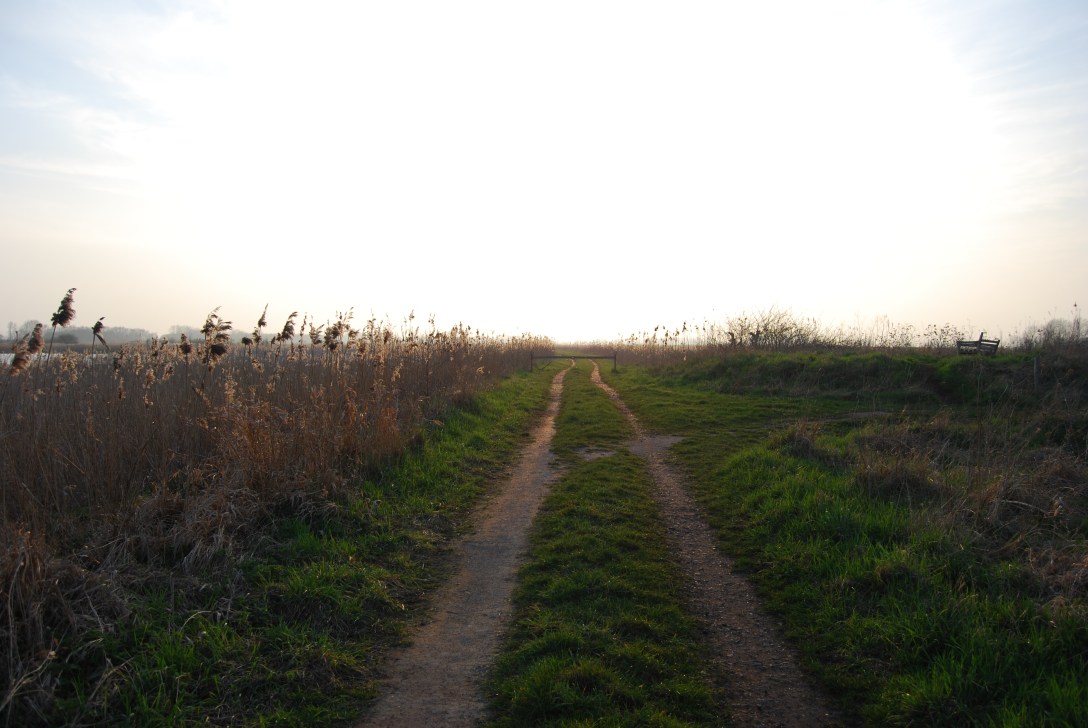
We’re standing on the raised bank overlooking Lakenheath’s reedbeds. It’s a warm, clear day but cooling gusts of wind disturb the peace, ushering us away from the viewpoint. On calmer days bearded tits move across the tops of the reeds, today they’ll be down in the cover. We pass a rigid poplar plantation famed for its golden orioles which breed here in spring, what is perhaps the only nesting site in the United Kingdom. The trees grow out of swamp and some of them have collapsed, the soil clinging to the upturned roots making the poplars look like toy soldiers left supine by a child’s swooping palm. The trees have sent suckers out along the horizontal trunk meaning a new layer of woodland is growing from the body of one of the fallen, a new understory naturally occurring from a man-made habitat.

The cover of the plantation lessens the wind somewhat, a green woodpecker yaffles from the cover of the trees. Along the bank are anthills home to yellow meadow ant. I’m with David Norfolk, a friend and expert ornithologist, and he tells me these are rare. The hills could be hundreds of years old. ‘They wouldn’t exist in today’s farmland,’ he says. ‘A tractor will destroy them’. He takes a small chunk of the mound and golden-coloured ants move busily across the grey soil held in his fingertips. On the other side of the bank a blue river runs away to where the sun is going, a flock of oystercatchers pass, chattering as they fly against the flow. On the riverbank near to us pristine white feathers are strewn like discarded quills around the skeleton of a mute swan. David has seen it before: ‘That’ll be a fox kill.’

We’re alerted to a faint, hoarse bird call wafting from beyond the poplars where a swathe of reeds stand for perhaps 200m all the way around. We stand to face the reeds and the wood beyond where trees have collapsed, fieldfares pass through on migration north on their return to Scandinavia. We hear it again, the muffled, bugling call of a crane. I have longed to see or hear these birds, Russian symbols of peace in the aftermath of Hitler and Stalin’s tyranny. The poet Anna Akhmatova described hearing cranes as she lay in her sickbed, the birds fleeing the dry autumnal fields after the harvest. Our cranes are not forthcoming but David is convinced they’re here. I’m prepared to wait until dark.

A group of men in their sixties arrive and we point out the vague sound of the crane, but they look in the opposite direction, instead to the sun setting over the lake. I suggest to another man that the cranes can be heard, he complains that he needs to sit down. ‘That’s a dog barking,’ he retorts. Bearded tits are pinging in the reeds, a water rail is squealing like a pig. We follow the path back to the start. The bugling goes on, it has to be cranes. But the beardies are closer and closer and even louder now. ‘Watch for their flight between the reeds,’ David says.And here they go, the pale brown flash and long tail, something I’ve never seen before. From behind us a crane calls clearly into the lilac sky.

F16s tear up the sunset with their apocalyptic thunder, a train careers along the bank next to us, the two carriages a little pathetic-looking and exposed in this vast open space. The lights shine inside, juxtaposed against the light dying down around us. The sun is stuck behind a strip of cloud and its colour cannot be revealed, jackdaws are roosting noisily in the poplar plantation, the green woodpecker continues its laughing fit, escaping its perch in an undulating flight overhead. The water rail is squealing still, a kingfisher bolts around a swoop of reeds. Two giant birds appear from the path we’ve just taken, grey and white. It has to be! Two cranes, flying together, approaching us on the bank, moving across. They are within a stone’s throw… but the joy evaporates. They’re swans and it’s a trick of the light.

The sun sets over Dartford

It’s late afternoon and the sun begins its descent toward Dartford. In the east the bridge is reflected in the shimmering Thames. Rainham Marshes is behind us, beyond the large concrete seawall and iron fencing, protecting the reserve from dogs, people and vehicles, protecting skylarks and lapwings, birds that breed on the ground. Gulls pass over from the marshes and across the Thames to the south. A deceit of lapwings exits, too, their flappy black wings belie their compact shape when grounded. They return to Rainham a few minutes later. Evidently this is not an exodus. Teal are swimming on the Thames, their colours draining as the sun retires behind them. We inspect the shoreline, its thin marshland and garbage. The ducks want to feed here, but what’s to be eaten? The tide bubbles audibly against concrete, an armchair rests at a tilt in the marsh, half against the slanting ground and half in the slurry. The chair is stained where it’s become soaked by liquids other than water over the years. If you were to sit in it, you’d fall backwards, skull first. The dry land is tropical with all kinds of plastic: caps freed from their bottles, thin tubes like the insides of biros, thousands of bits of broken plastic, and a syringe. There are pieces of driftwood lying around, one chunk has been bleached by sun, sea and salt. It breaks under the slightest pressure, the yellow shape of woodworm hibernating in a crevice created inside. I wonder how far this piece has travelled.

The sun is setting further, the river taking on the image of a lagoon, still the teal are drifting. We walk back along the path in the direction of Purfleet, a small flock of pied wagtails circling us back and forth to Rainham. They are wary and so they come and go, at last settling on a patch of rushes and straggly vegetation covered by yet more rubbish. Small islands of sand and mosses remain amidst plastic, industrial sponge, a road crossing bollard and bottles galore, the pooling water has the metallic sheen of petrol. The eye’s obsession with trash distracts from the living, in this instance the stone-washed water pipit holding onto a stalk amidst the rushes. The wagtails patrol the sand in their cheerful manner, taking pops at one another on occasion. The water pipit is still, in contrast to its cousins. A woman in red approaches and the passerines are flushed from the islands and back over the seawall, the pipit going with them. She has a green lager tin in her hand and white earphones. She sits to watch the sun from the wall, kicking her legs. The birds return to their patch. The pipit lands at the water’s edge, joined by what looks like a second pipit. The much duskier bird lacks a white eye stripe, or supercilium, and is itself a different bird, a rock pipit. Like its cousin, the rock pipit wags its tail as it looks for something to eat.

The trains back to London arrive on the hour so we sit by the water and watch the final movements of the evening. On the path a woman pushes her grandchild in a buggy, remarking to us that Thurrock once had a population of forty-four. This, of course, was centuries ago. The pipits would have been in a similar spot then, likely feeding in water free of oil and sponge, but no doubt touched by different sort of human waste. Up ahead, a man rides a mini motorbike with his daughter in his lap, his look is sincere. They disappear between a gap in a dumpy little bush. On the grass dwarf mallow leaves await flowers and a pair of mistle thrush regard us with caution as they disappear into near darkness. The sun is a ball, inflating and draining into the south, v-formations of gulls sweep to the east, down a river now black and gold. Ducks and debris float freely towards Greenhithe and Grays, a slurry of pollution passing by, highlighted in the twilight.

A fashion shoot is taking place against the railings, a young woman with cropped hair and a purple dress stretches herself against the bars in a mocking vogue. As if from the river itself, as its inhabitants flee eastward, a curlew calls over and over again.

Everyone knows a herring gull when they hear one

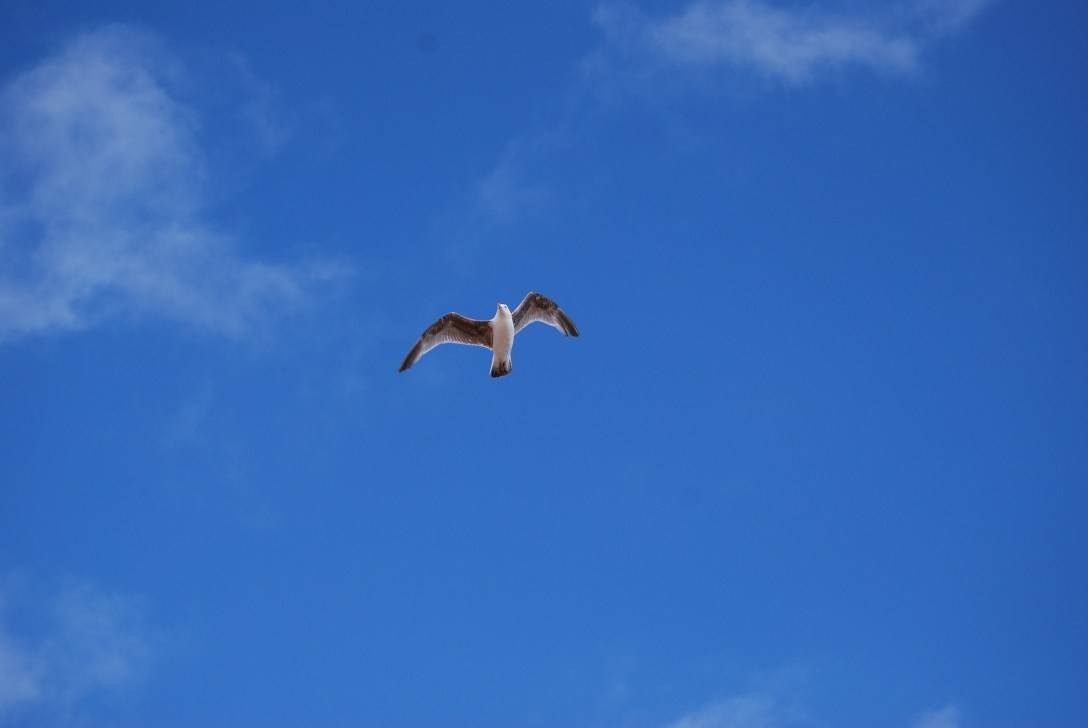
Everyone knows a herring gull when they hear one. Step off a train in Brighton on a summer’s day and you’ll hear their laughing call extend all the way to sea. It’s the sound used in TV and the movies to establish seaside towns. Two years ago I sat in Pavilion Gardens, green ash leaflets fanning against a blue sky, graduands strolling around with their grinning parents, when a bird poo bombshell exploded all over me. The velocity was shocking. I thought I had died and gone to graduation. The crap covered my hair, face, chest and arm. My companion was caught between the need to console and gloat. ‘You have to laugh, or else there’s nothing you can do,’ she said. ‘I’ll get a cloth.’

That day I learned some respect, seagull-style. My admiration for this bird is strange, a love unrequited on the animal’s side, a little masochistic on mine. I went to university in Liverpool and lived in a flat in the very heart of the city. My bedroom looked-out upon a row of fast food and booze outlets siphoning their stench out onto our balcony. At night we would peer over the ledge and watch the overblown shadows of rats moving between bins and under cars. Squalls came from that chasm after dark, and deep, booming voices often extinguished them. During my tenure, Saturday nights in Liverpool city centre were accentuated by the boozy rowing of couples, up against the walls of bars, stumbling across the pavement like seamen. But above it all something else was happening.

On a fine spring evening in my first year we lay on our backs on the grass verges beneath the Anglican cathedral.

‘Look!’ I had shouted, ‘a shooting star!’

‘No, you bloody idiot, it’s a seagull,’ was my acquaintance’s reply.

Smaller gulls, probably black-headed gulls, would catch the orange colour of streetlamps as they flew over. My inebriation did the rest. In the spring and summer months, when the gales which blow up and down Renshaw Street had died away, the angelic shapes of white gulls would waft down the road. Take the view from the corner of Rodney St., where Hardman St., meets Leece St., looking down onto the old Rapid Hardware store. When the sun set between the cormorant-esque liverbirds, the silhouettes of gulls moved like ashes from a fire, drifting on a light breeze to and from the Mersey.

From my old window, what I now know to be a newborn juvenile herring gull would call to its parent, waiting there for long periods of time, a bit like a package dipped in soot. Its bill is coal-black, a dusty grey hint to its body, ending in the white of its head. I have a polaroid picture of an adult herring gull perched on the rail looking into my room, a white-washed statue. The irony of the erroneous term ‘seagull’ is that now foodstocks have diminished in the bird’s natural coastal habitat, herring and black-headed gulls are coming inland to feed from the waste we leave in the street. They don’t merely follow the trawler anymore but the tractor. I recall a flock of feral pigeons, birds deriving from the cliff-dwelling rock dove, being dive-bombed by a herring gull over the scraps of chicken wings thrown into the road outside a fast food joint on Bold Street. It was like the moment the Tyrannosaurus Rex rears its head in Jurassic Park.

Whichever monstrous gull it was that crapped on me in Brighton, I forgive it. The presence of these birds on the margins of my youth have defined a remnant of my past with perhaps a little more tenderness than one might expect.

The cuckoo goes


We won’t know
when the cuckoo goes,
we’ll never know it’s gone,

we won’t know
when the cuckoo goes,
we’ve never heard its song.

We won’t know
when the cuckoo goes,
we’ll never know it’s gone,

we won’t know
when the cuckoo goes,
they say it won’t be long.

We won’t know
when the cuckoo goes,
we’ll say that nothing’s wrong,

until the day
that the cuckoo goes,
we’ll sing the cuckoo’s song.

And if the cuckoo goes,
then the cuckoo’s gone.


Gawping at the Chilterns

I am a countryside gawper. I like to watch the flow of valleys, hills and pasture seen from an English train window. As a student I remember travelling to and from Liverpool on the Euston line, experiencing a sense of nostalgia for the things whizzing by without the chance to grasp them. And this was before the trains had been improved to a mere two-hour journey between North and South. I recall the yellow of rapeseed and turnip flowers which bloomed in April fields, like a paintbrush passed across the glass. There were the peculiar farmhouses and barns, the horses drinking from streams which I deemed to be wild, and the black silhouettes of hawthorn and oak which had been moulded by the gusts and gales, all crooked and splayed. I remember the train slowing one evening in the gloaming, a brook taking on a glassy sheen in the near dark.

Now I stare out of the window in search of my post-London rations: skylarks, buzzards and such. These are not readily available in London, though they are in rural spots of Croydon and Bromley. This journey in particular was a trip to Birmingham for a flat-warming, promising (and delivering) a different kind of wildlife. The daytime train ride offered a snapshot of a new landscape to me, the Chilterns, designated an Area of Outstanding Natural Beauty and a part of the Green Belt. This is an area which has been earmarked for the High Speed Rail 2 which will see trains passing through the region every two minutes at speeds of 250-miles-an-hour. The service, some argue, will make use of the region but will offer it nothing in return. The closest stop will be Heathrow airport.

I was not thirty-minutes from leaving Marylebone when I glimpsed a trio of buzzards wafting in the grey ceiling. I saw jackdaws bothering the chimneys of small-town folk, and those magical inhabitants of plough tracks, the birds which had treated the silence between rounds at the disastrous battle of the Somme – skylarks. Their stiff, sharp wings rang the bell, as the train careered past on the raised track. The larks, three of them, descended upon a hedgerow in perfect accord.

I had recently read a book by Mark Cocker entitled Crow Country, where the author describes waking at 3am to watch rooks in Norfolk, amongst other revelatory birding experiences. The sections on Corvus corone, the carrion crow, had stayed with me. I could not help but observe these clever brutes patrolling green spaces in London. It should be pointed out that this is to the chagrin of some bird lovers who cite the cradle-snatching antics of the corvids as a reason to cull them, and to enhance supposedly falling fledge-rates of songbirds. Cocker’s writing on crows drew me to take greater notice of how they behaved. One thing I had witnessed a number of times in the autumn was crows bothered by kestrels, the big black creature barking, immensely uncomfortable in the presence of the cheeky falcon. Falcons like kestrels and hobbies sometimes go for old crow’s nests, so perhaps this was a question of ownership.

From my seat on the train I witnessed a trail of crows flying from over the roof of the carriage. The sound was killed by the glass but the conga-line of corvids pointed to something else. The line came to an abrupt end and a stretch of thin air opened up. And, some moments later, the giant wingspan of a red kite appeared in their wake. Its flight was smooth, a single beat of its wings expressing its power over the fleeing crows. The kite’s wingtips were like fingers. The forked tail was the motif that defined it, the whitish head and large white patches against the dark wings. This is not to mention the rufous shade which separates it from its continental cousin, the black kite. This is a bird which preys on crows, hence the sense of uniform panic amongst the fleeing black feathers.

Red kites were on the brink in the UK until a breeding programme in Cumbria re-established populations which have now spread eastwards into England. It is now said to be approaching students eating their lunch at Reading University, where a research programme is underway to discover how far the birds are spreading, with reports of the birds feeding in gardens. This is a monster which ate offal from the streets of London in the 1500s, when butchers threw them their scraps, but declined after centuries of persecution. For all of our dwindling species, there are some which are returning to dominate again. They’re screening in a train window near you.

— Photo by Ian Knight

Like Starlings

I am like a starling,
I mimic people passing,
and craning from the roof,
I whistle a little tune.

We are just like starlings,
with iridescent markings,
we gather on the roof,
we play our little flutes.

I am but a starling,
I call to people passing,
and perched up on the weathervane,
I play my little flute.

We are all like starlings,
we sing to people passing,
our bodies made for dancing,
we sing our little tunes.

© Daniel James Greenwood 2011