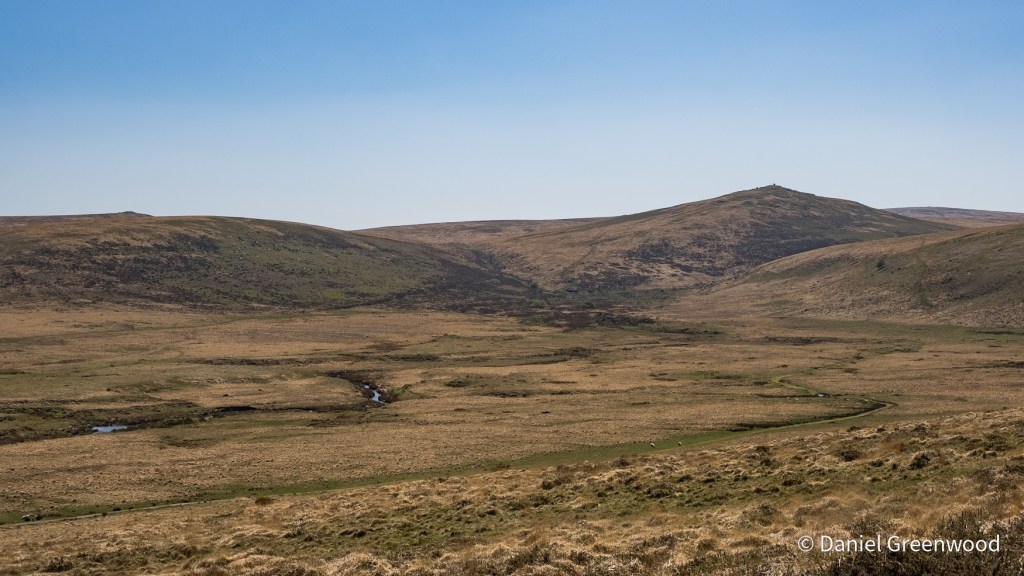
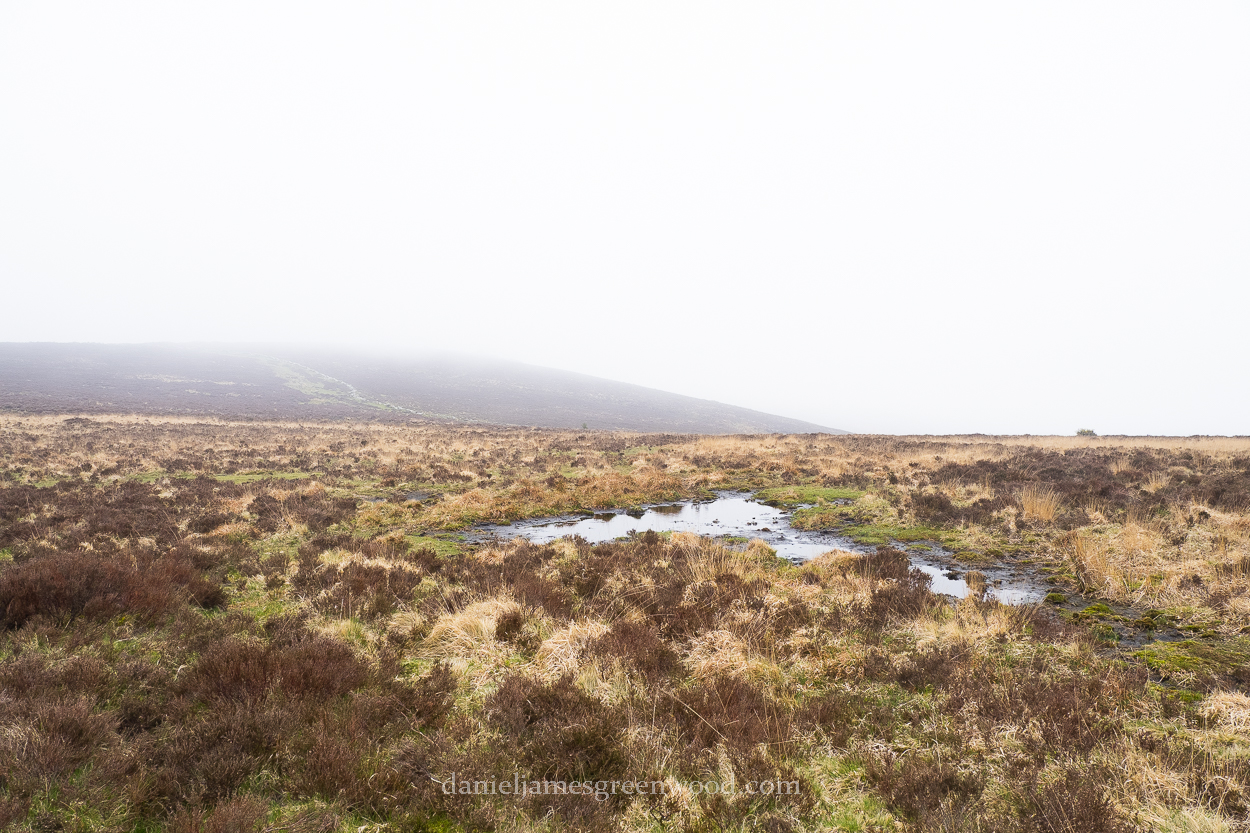
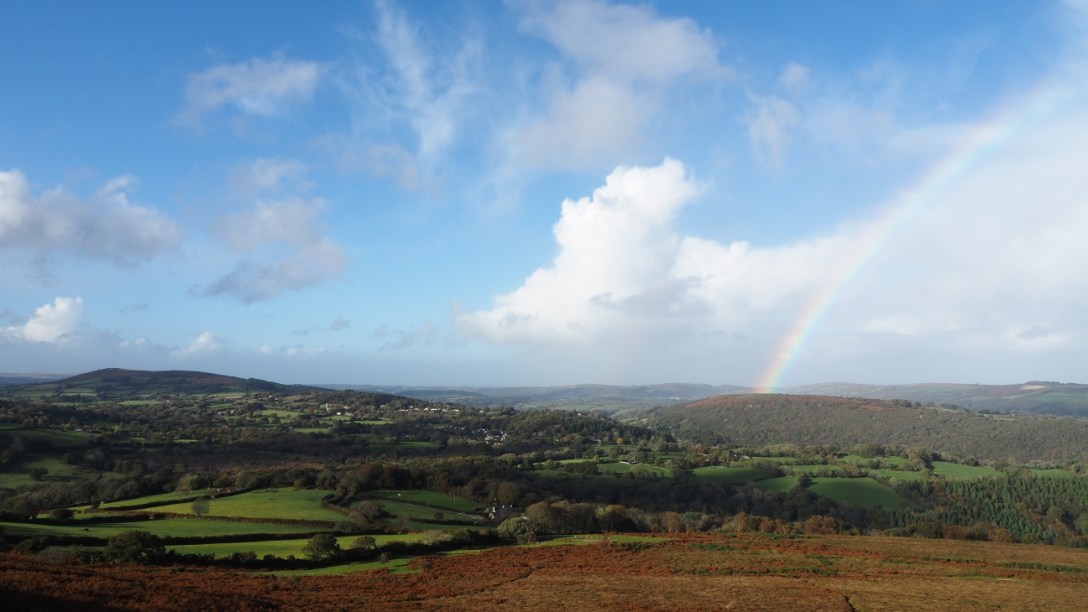
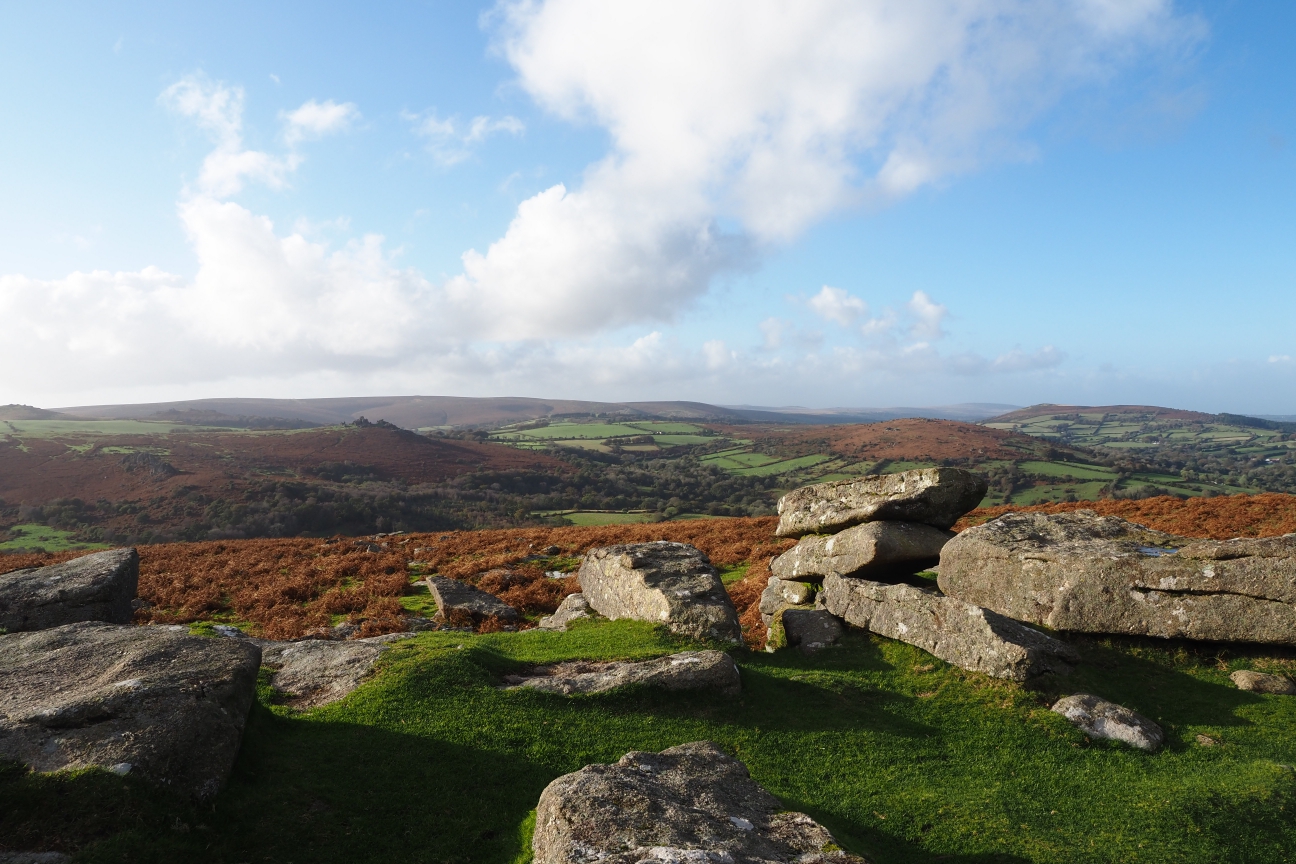
I spent the end of April in Dartmoor National Park, but not quite staying on Dartmoor as the initiated would say. It was unseasonably dry and warm, resulting in a large moor-fire days after we left. Looking at the state of the moor (below) it was hardly surprising. Underfoot it was tinder dry.
I had some time to take a few purist macro images, some with a does-it-all lens and some with my phone. Here are the results.
The first stop was Devon Wildlife Trust’s Dart Valley Nature Reserve. We often sit here and take in the scenery and birdsong. It’s special.
Gorse was flowering widely across Dartmoor. It’s also know as ‘chag’ historically on Dartmoor, giving the name to the village of Chagford.
Hawthorn was leafing across the landscape, an iconic moorland tree in Devon. The leaves are edible when young and have been known in the past as ‘bread and butter’.
Ferns were uncoiling in the more shaded areas. I think this is hard fern.
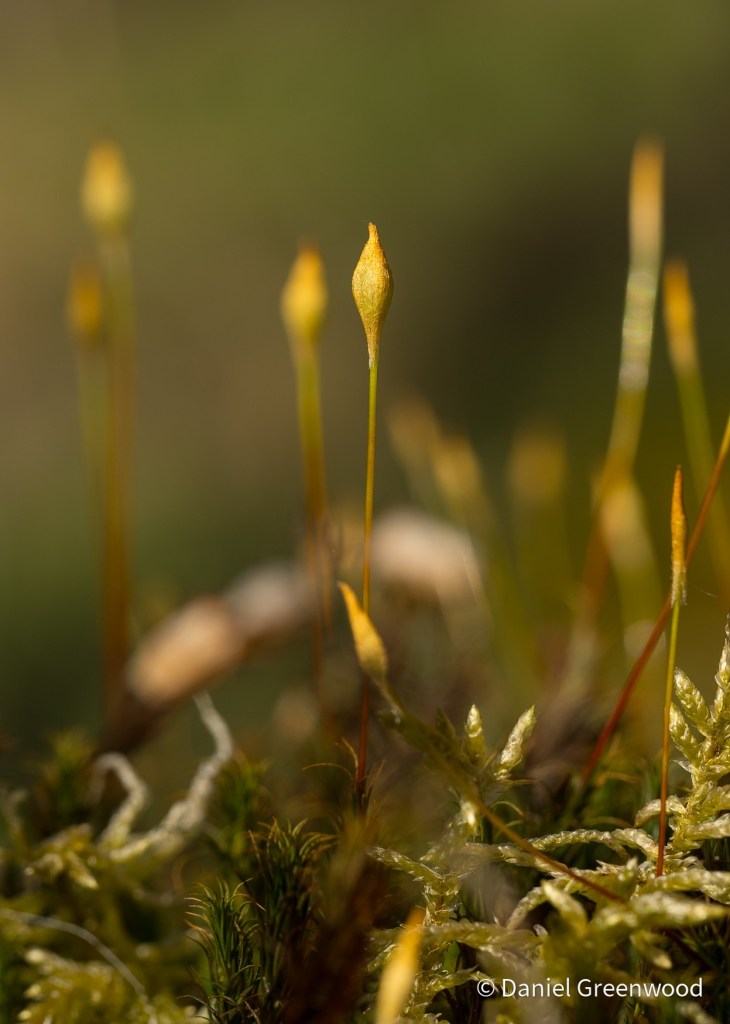
Juniper haircap moss is one that produces its ‘sporophyte’ in April. The very dry mosses were still able to do their thing.
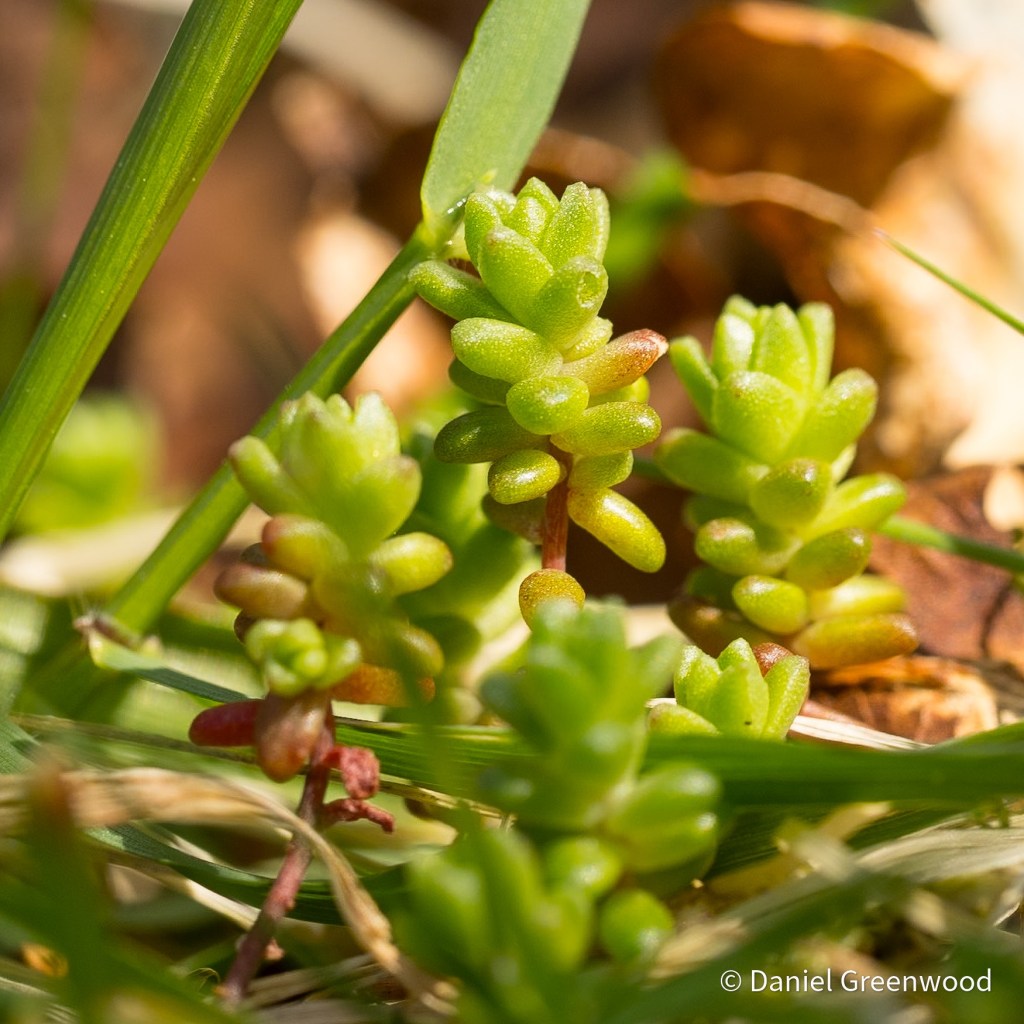
Stonecrops I’m not expert on, but you can see their succulent-ness up close.
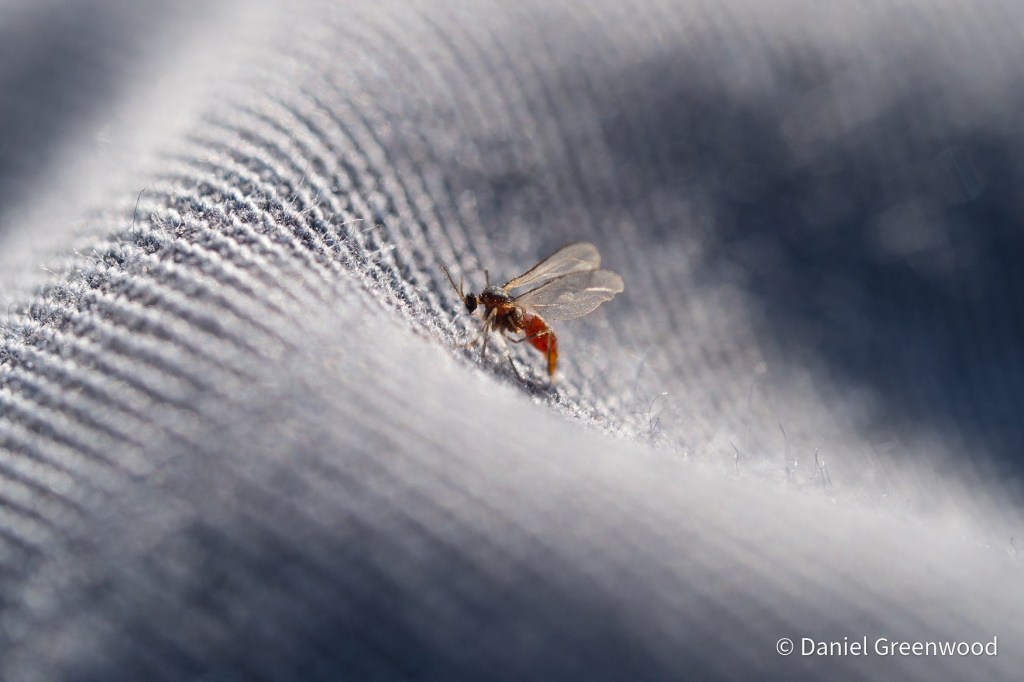
This solitary wasp of some kind was on my trousers. It was really small, as you can see from the threading of the fabric.
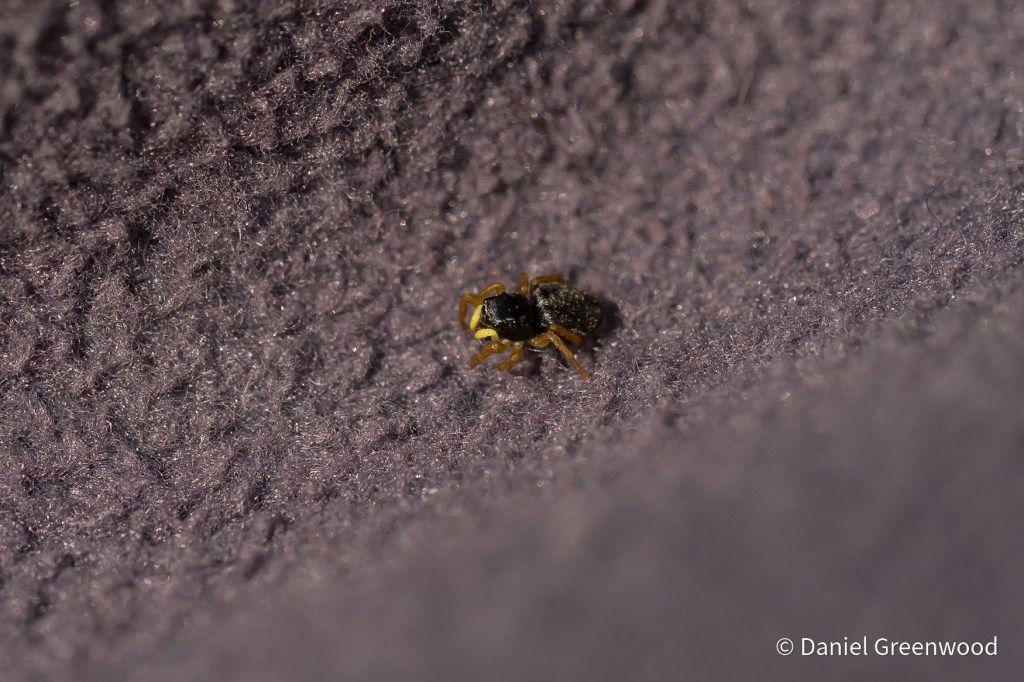
They’re not great images but this jumping spider arrived on my fleece. I would need extension tubes for better close-ups. It’s one of the heliophanus species.
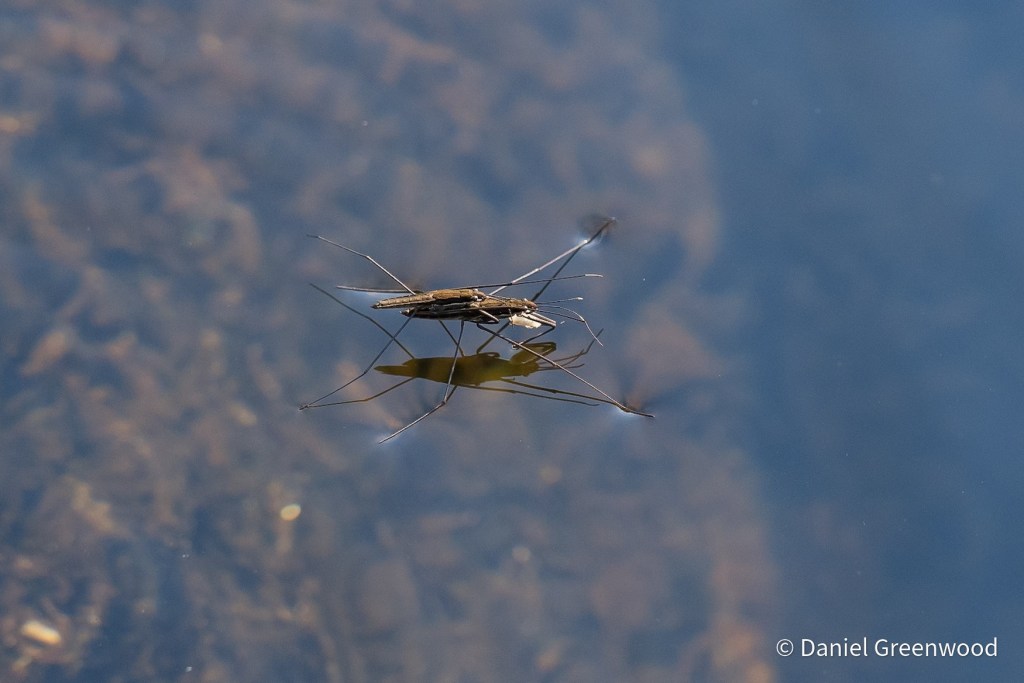
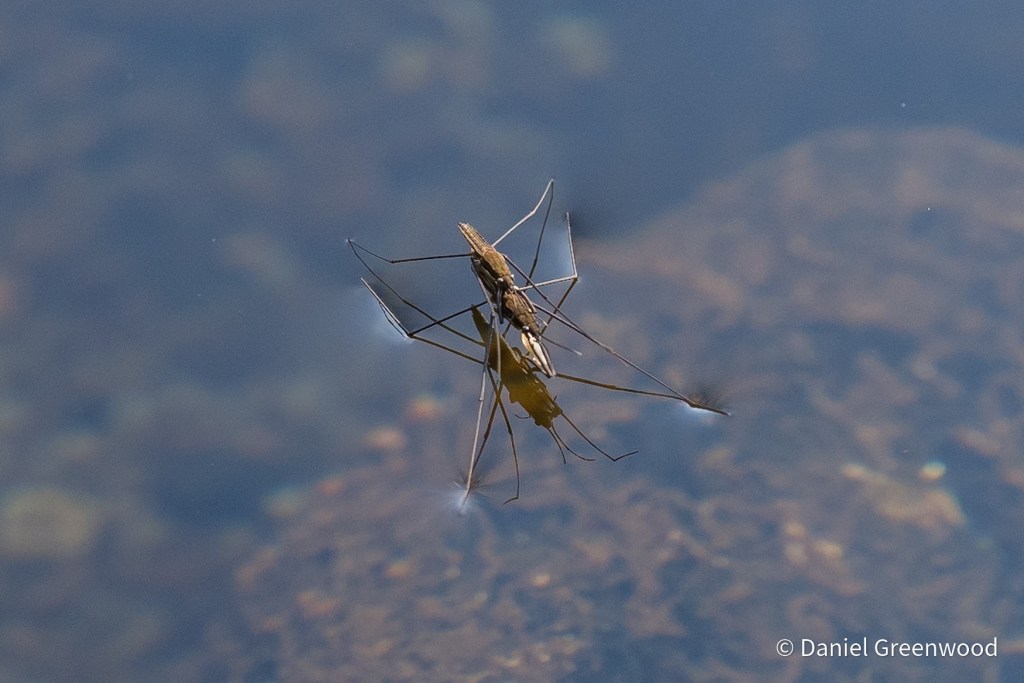
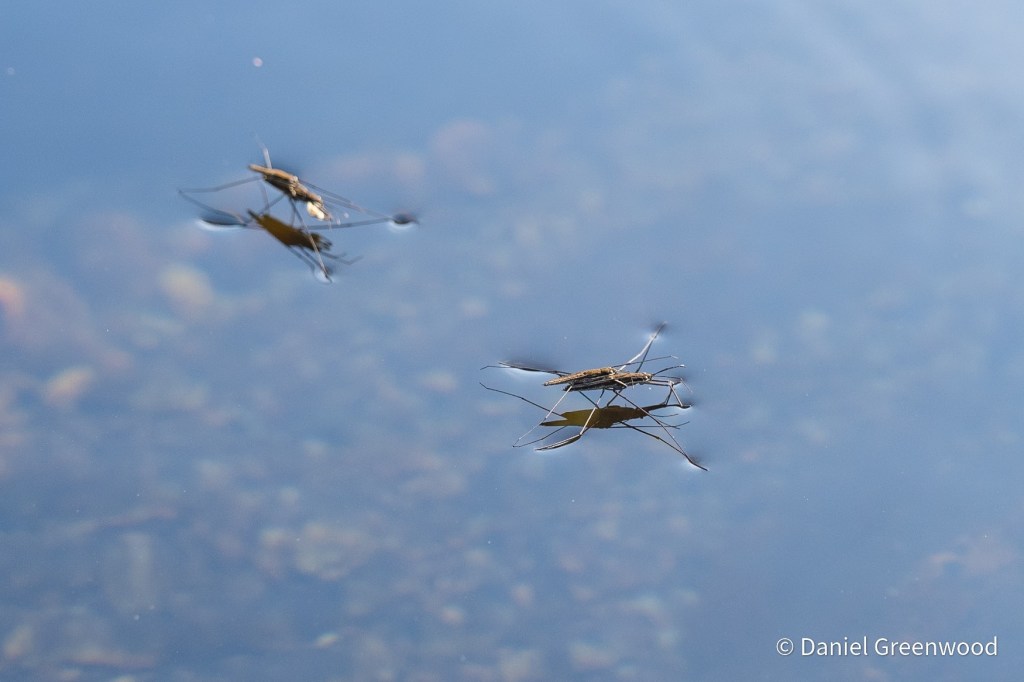
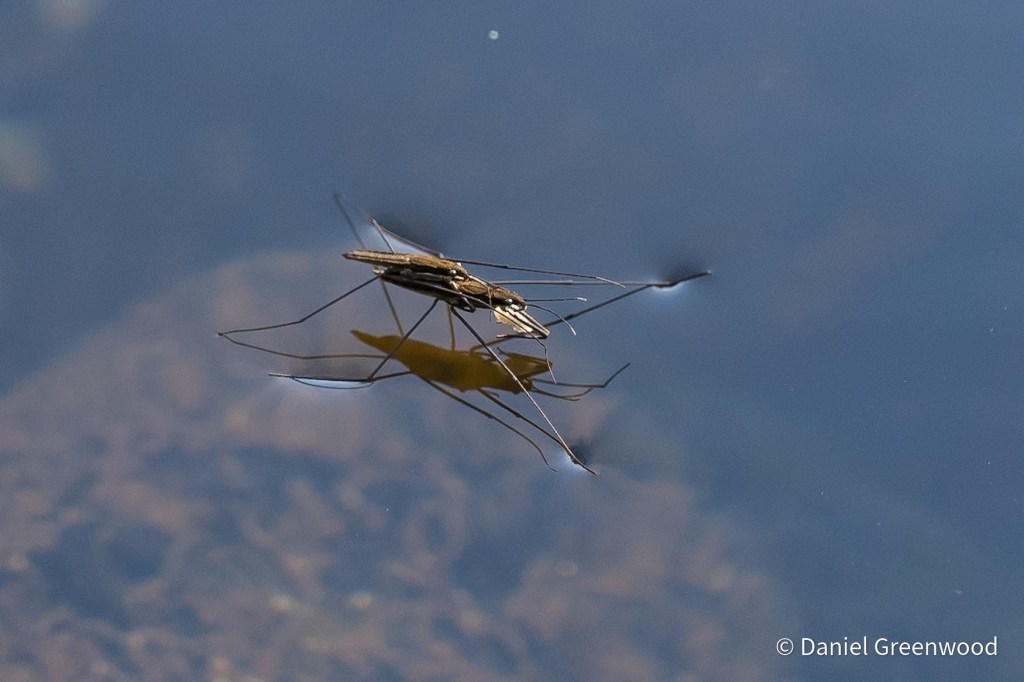
I was really drawn to the pond skaters making merry in the side pools by the river bank. It was only when I took some photos that I saw that they were actually mating. The final image focuses on their legs as they bend the surface of the water to stay afloat.
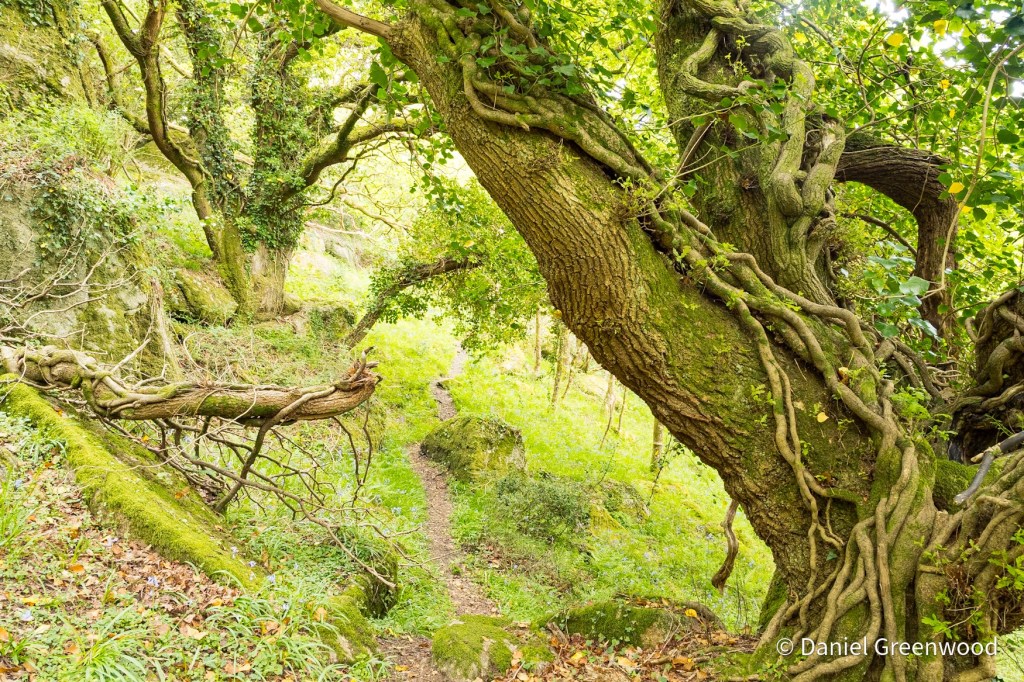
Later in the week we did a long walk around Lustleigh, through the picturesque bluebell rainforests above the River Bovey. These woods are spectacular and very rich in wildlife.
Wild garlic was in flower, mainly found along the lanes rather than deep in the woodland.
Dartmoor is a good place for cool beetles. This violet oil beetle was nibbling on some lesser celandine leaves. This is a phone pic, cropped, so not perfect focus or detail.
My hiking companion miraculously found this long-horn beetle on one of the many mossy oaks we passed. It’s a greater thorn-tipped longhorn beetle.
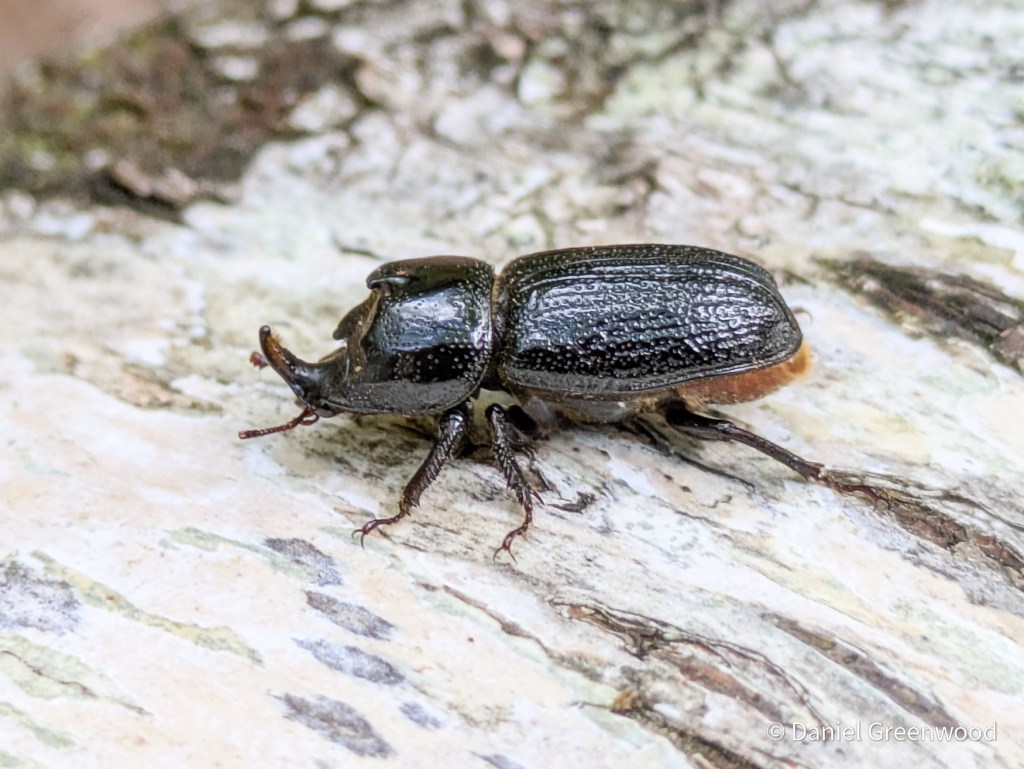
There was a large birch tree that had fallen across a path, and just as I was about to slide over it I saw my first ever rhinoceros beetle on UK soil. Again I only really could get a phone pic, but it still did a reasonable job.
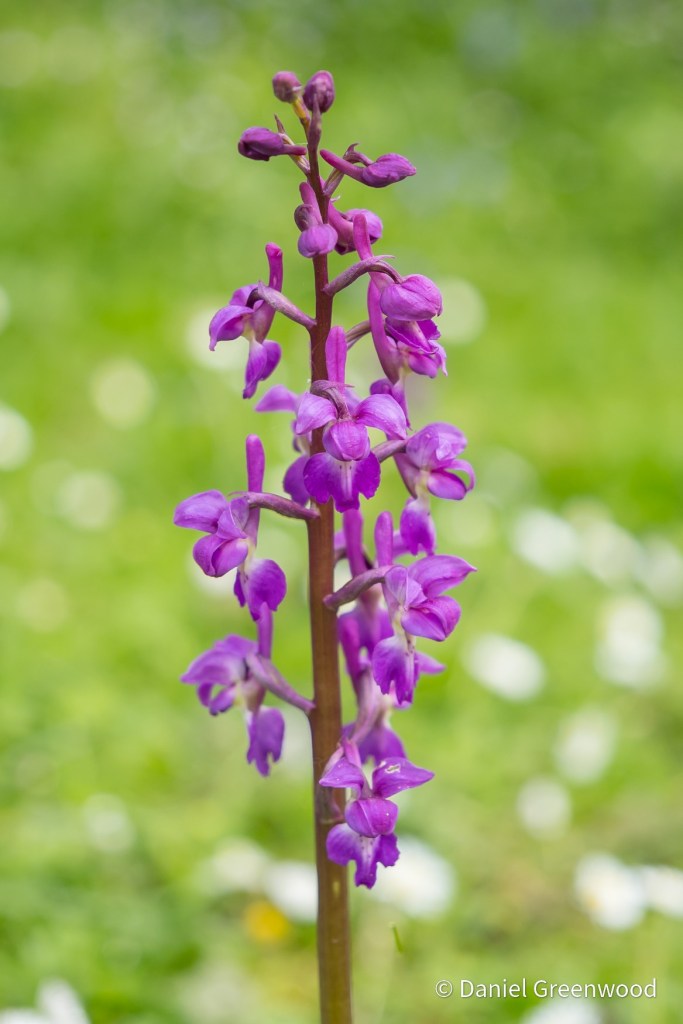
Elsewhere the early purple orchids were flowering. They are such beautiful plants.
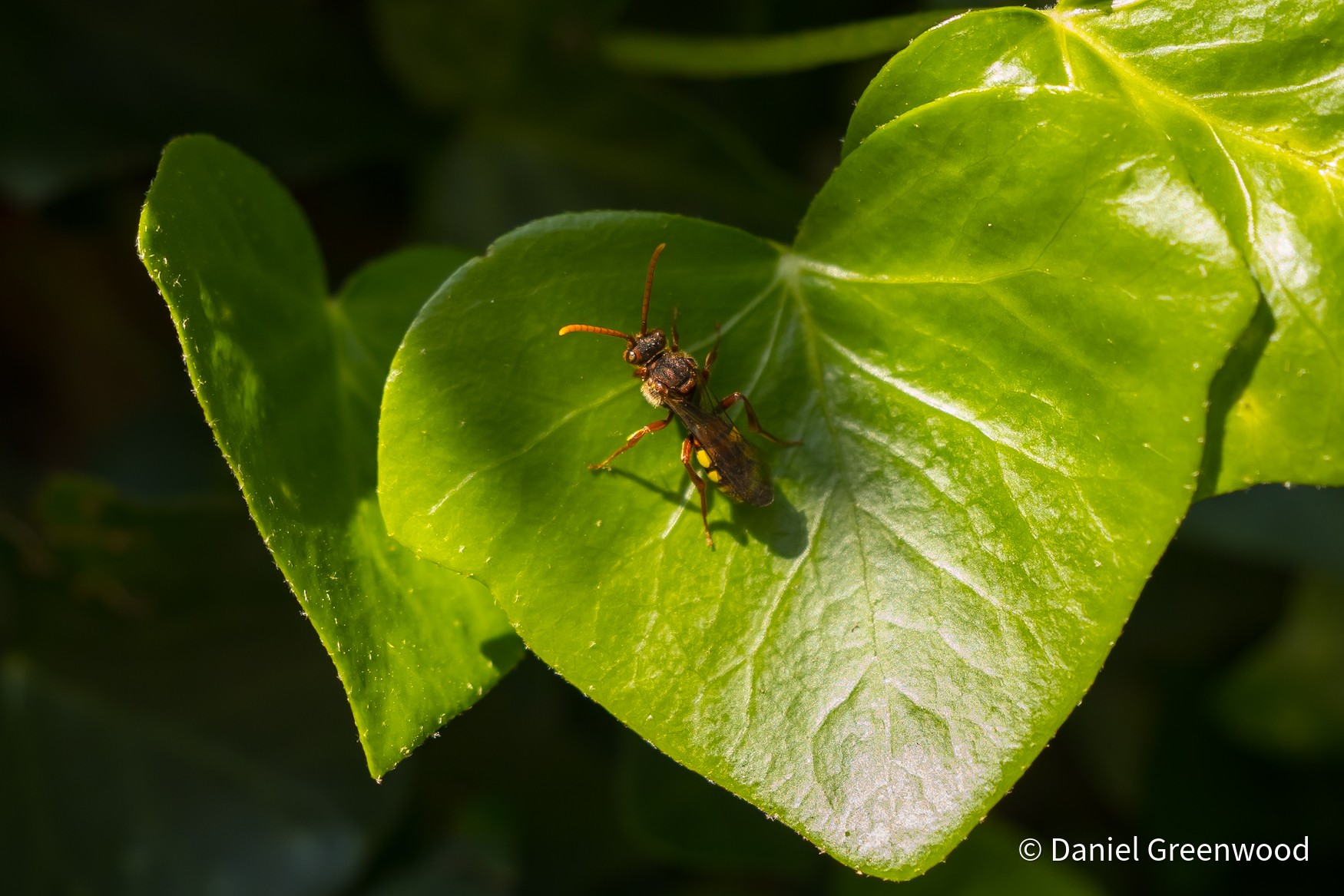
And finally, on another walk near South Zeal I managed to get a few decent images of a species from one of my favourite bee families – the nomad bees. This could be a flavous nomad bee, but I’m not sure. They are beautiful and quite hard to catch in time for a photo.
This is a showcase of the posh mushroom pics I gathered with my proper camera during a visit to the wonderful Dartmoor National Park in November 2024. Mad props to my wife who is chief squirrel during these Devonian photo forages.
The photos were taken on Sunday 10th November 2024.
I write these blogs in my spare time because I want to raise awareness about the beauty and diversity of fungi. If you enjoy reading them you can support my blog here.
A reminder that I am not encouraging people to pick or remove mushrooms in these areas. You could very easily clear all the mushrooms we saw within minutes. I think that would be sad because it would mean other people wouldn’t get to see them and learn or be inspired by them. I think with rare species like waxcaps that are featured here, we should be taking photos and submitting them to apps like iNaturalist or Plantlife’s waxcap campaign. In some areas that would be illegal anyway, due to site protections.
While I don’t believe 2024 will go down as a vintage mushroom season, there were a lot of lovely waxcaps to be found on the moor in a place we’ve been visiting since 2016. Moorlands seem to be quite good for waxcaps, not that I know why, and also for lichens because they are rocky, wet and the air is fresh.
I’ll post the images in chronological order for my own sanity.
This is the landscape where the fungi lived – moorland with a view towards the Teign estuary.
The first fungal find were these eyelash cups (Scutellinia) growing on animal dung! Plenty more dungi to come.
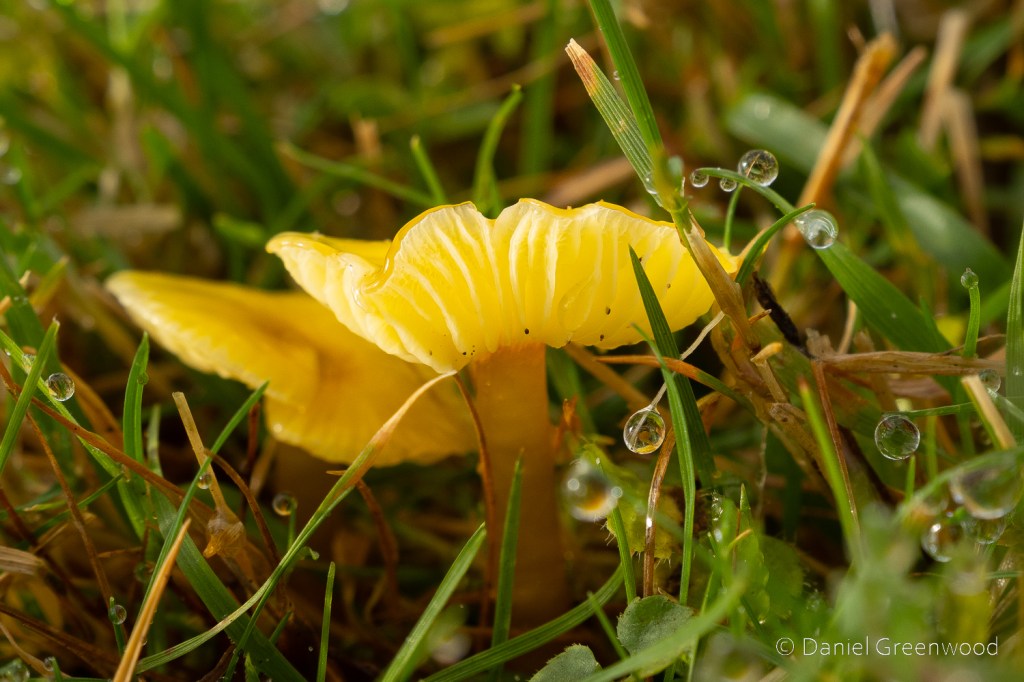
Waxcaps make up the crux of the mushrooms we found. These beauties are butter waxcaps (Hygrocybe ceracea).
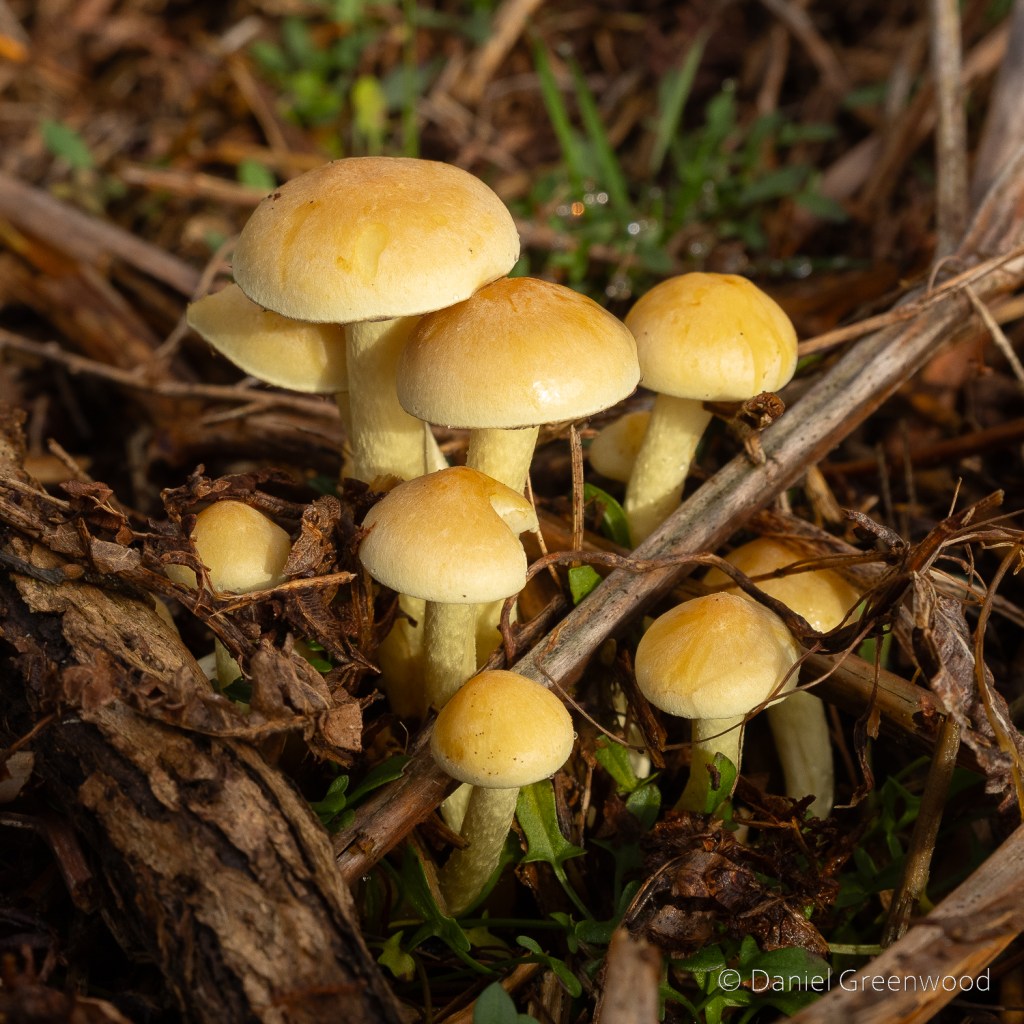
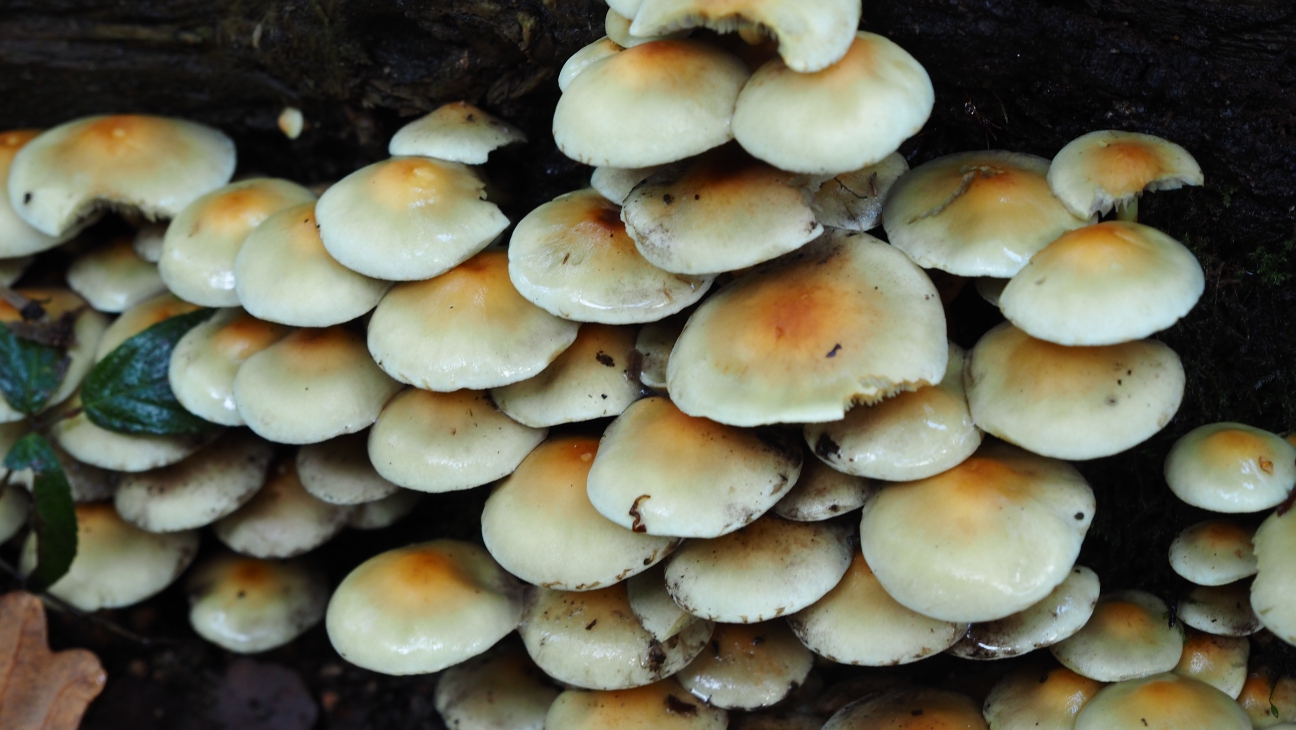
Not to be outdone, some very photogenic sulphur tuft (Hypholoma fasciculare) were found as we climbed the moor.
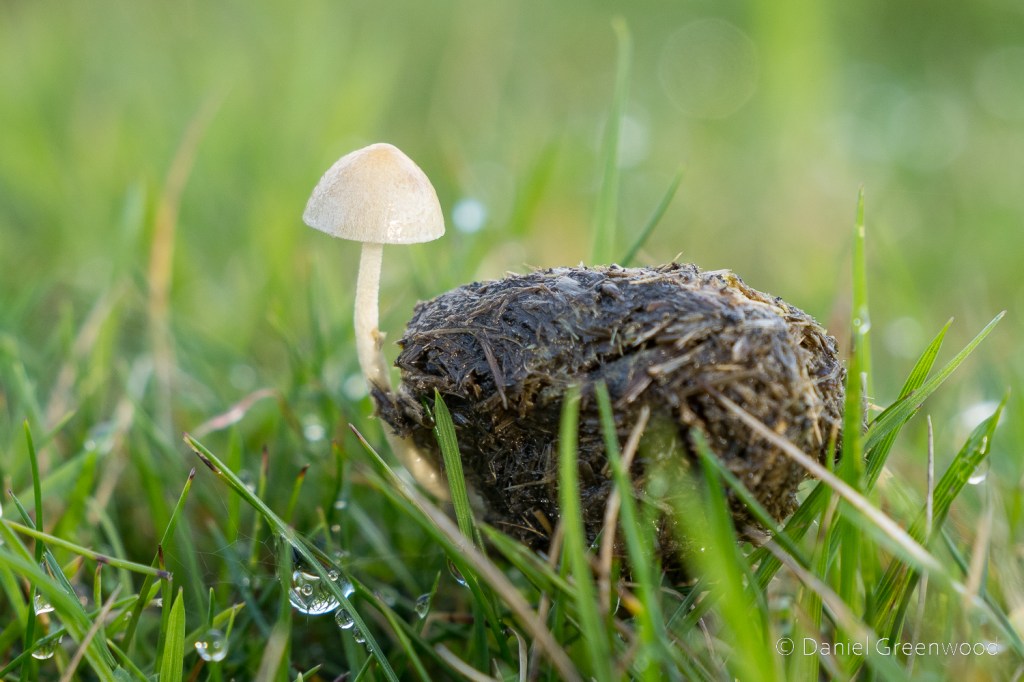
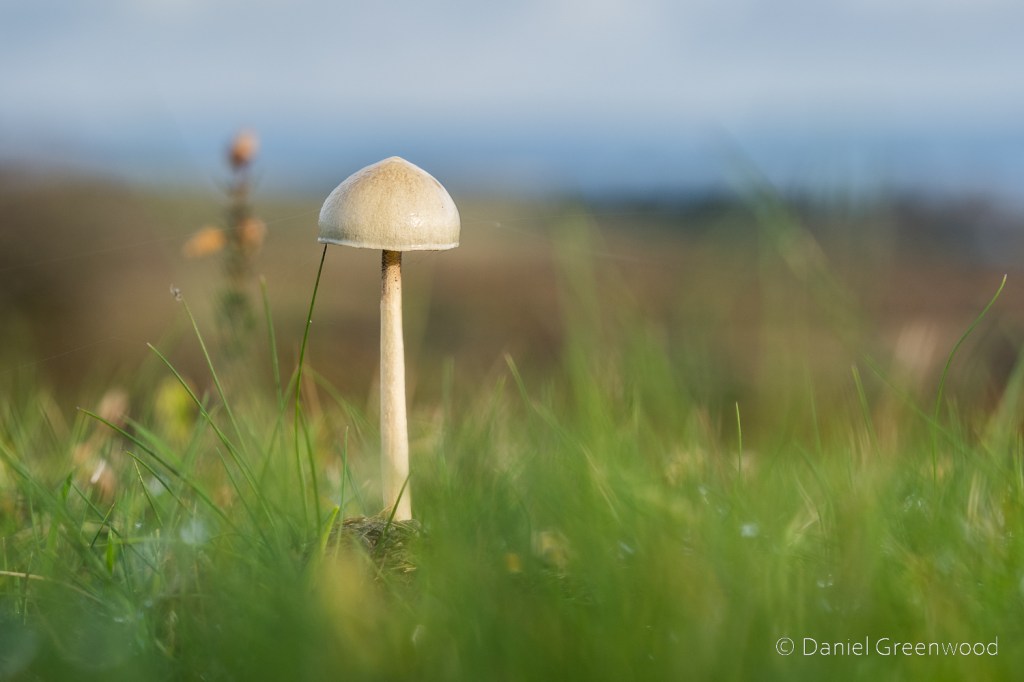
These mottlegills (Panaeolus) are quite common in places with grazing livestock like Dartmoor ponies.
My best guess is that this was one of the moss bells (Galerina).
These lichens are beautiful. I don’t see them very often because I have to travel west see moorland. They’re probably gritty British soldier lichens (Cladonia floerkeana).
I’m unsure what this species is, but it’s a beauty.
As we approached the more remote moorland (in terms of people living out there) the waxcaps began to appear in the cropped turf. This is another example of how important grazing to some degree is, and how it mimics very ancient processes. These mushrooms would not grow in closed-canopy woodlands.
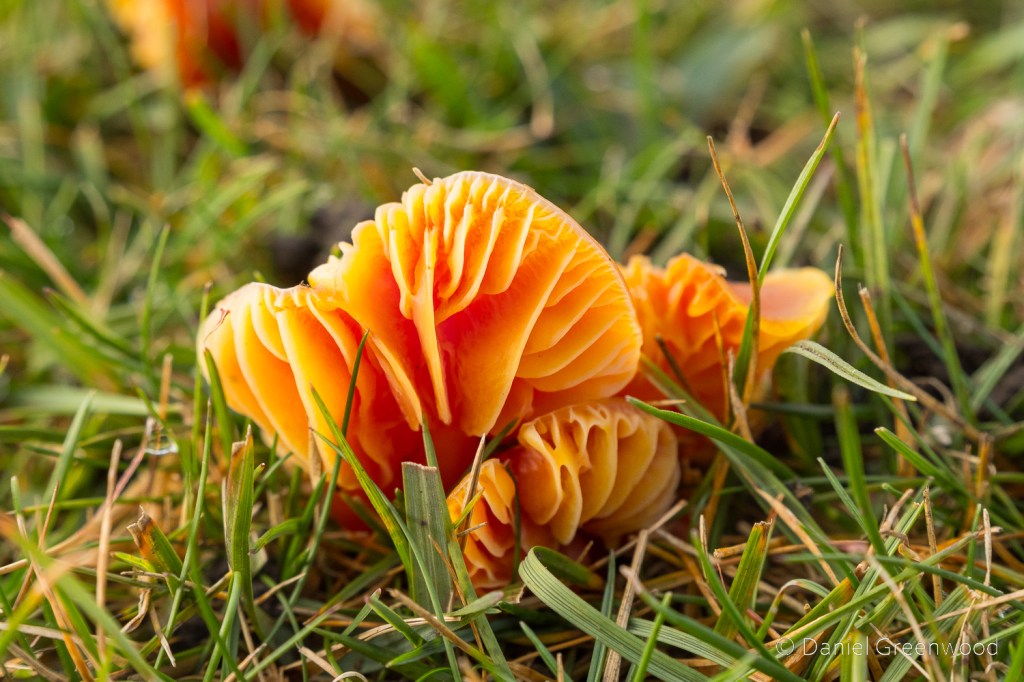
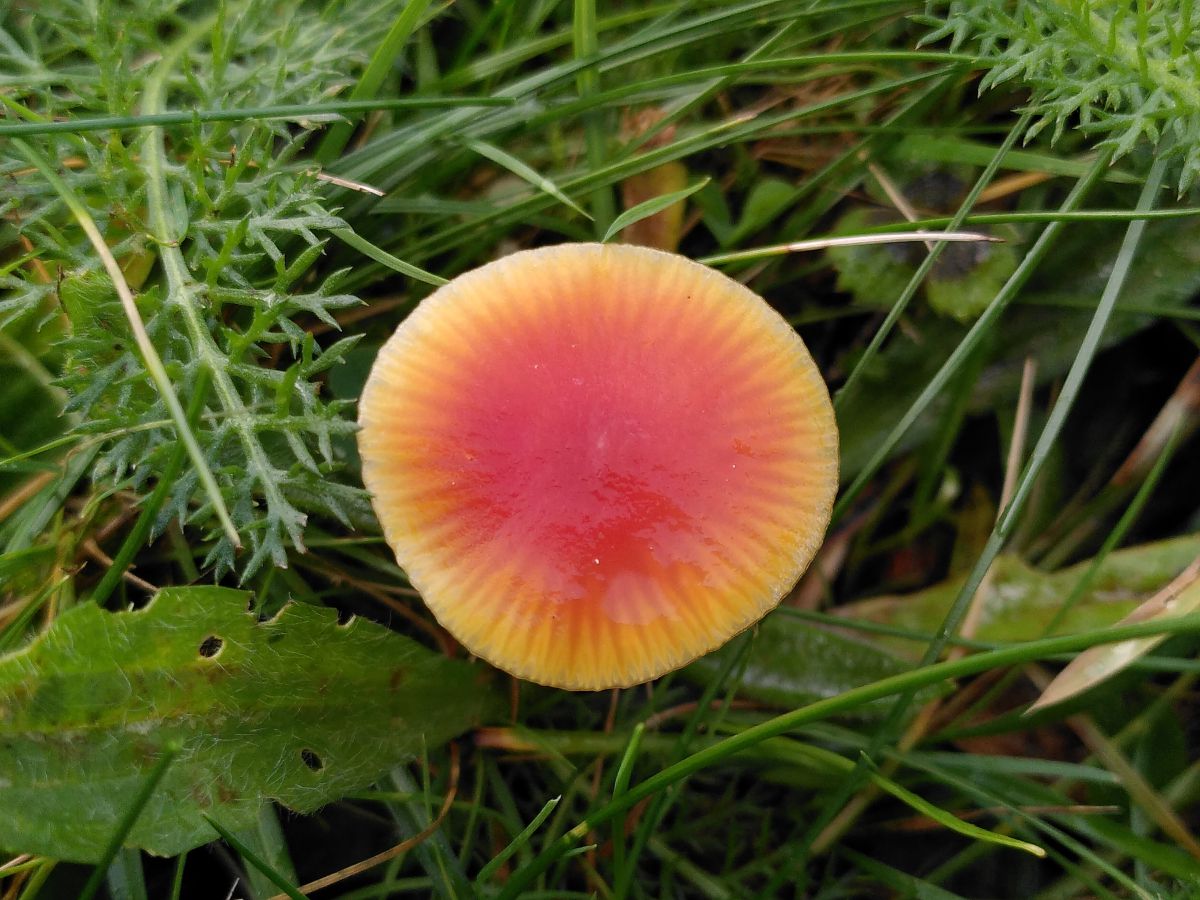
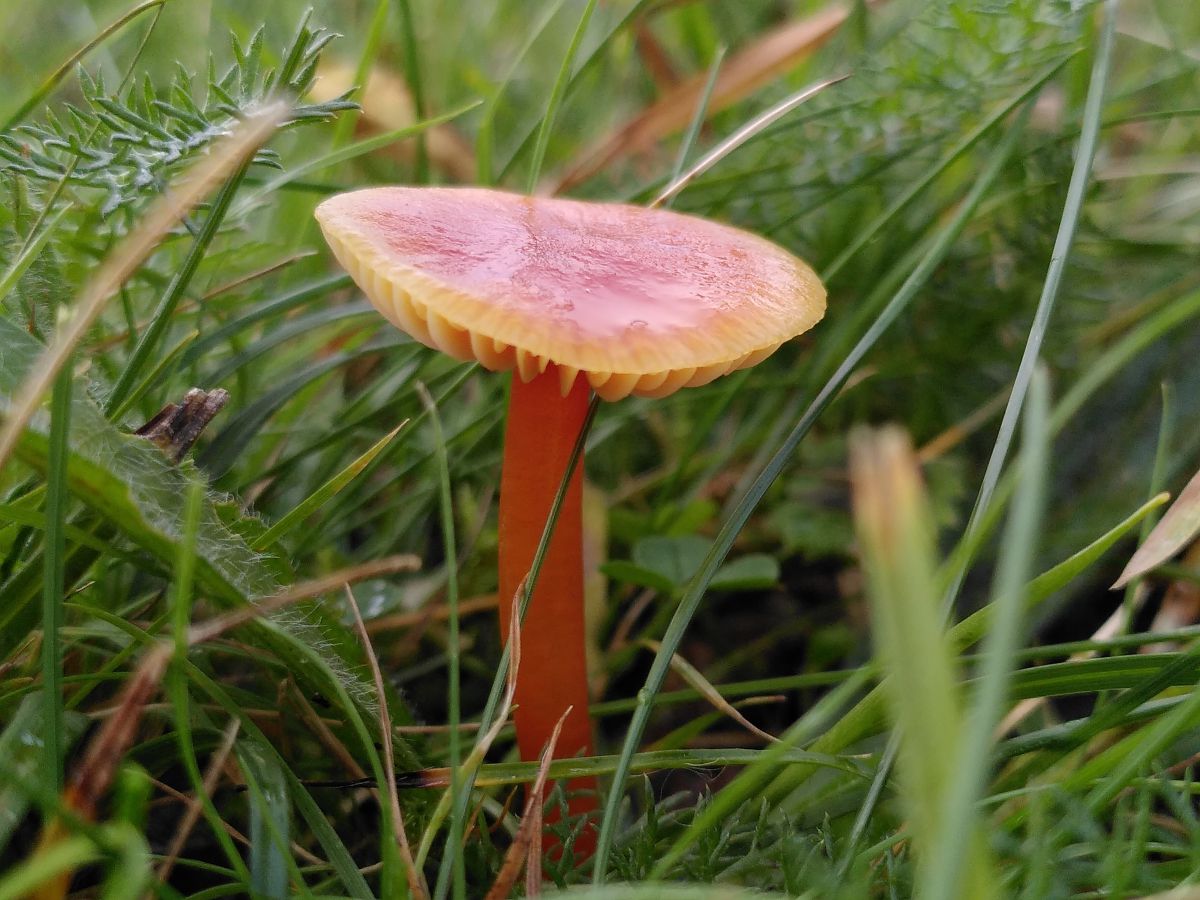
This is one of the red waxcaps, but I’m unsure if it’s honey waxcap or not. It looks too orange for scarlet waxcap.
This is one of several species under the umbrella of blackening waxcap or witches’ bonnet (Hygrocybe conica complex).
This is a species I only really see in the west of England or Ireland. It’s one of the dog lichens (Peltigera).
These are crimson waxcaps (Hygrocybe punicea), stunning mushrooms indeed. There were some young men passing by who stopped to admire the colours of these impressive shrooms.
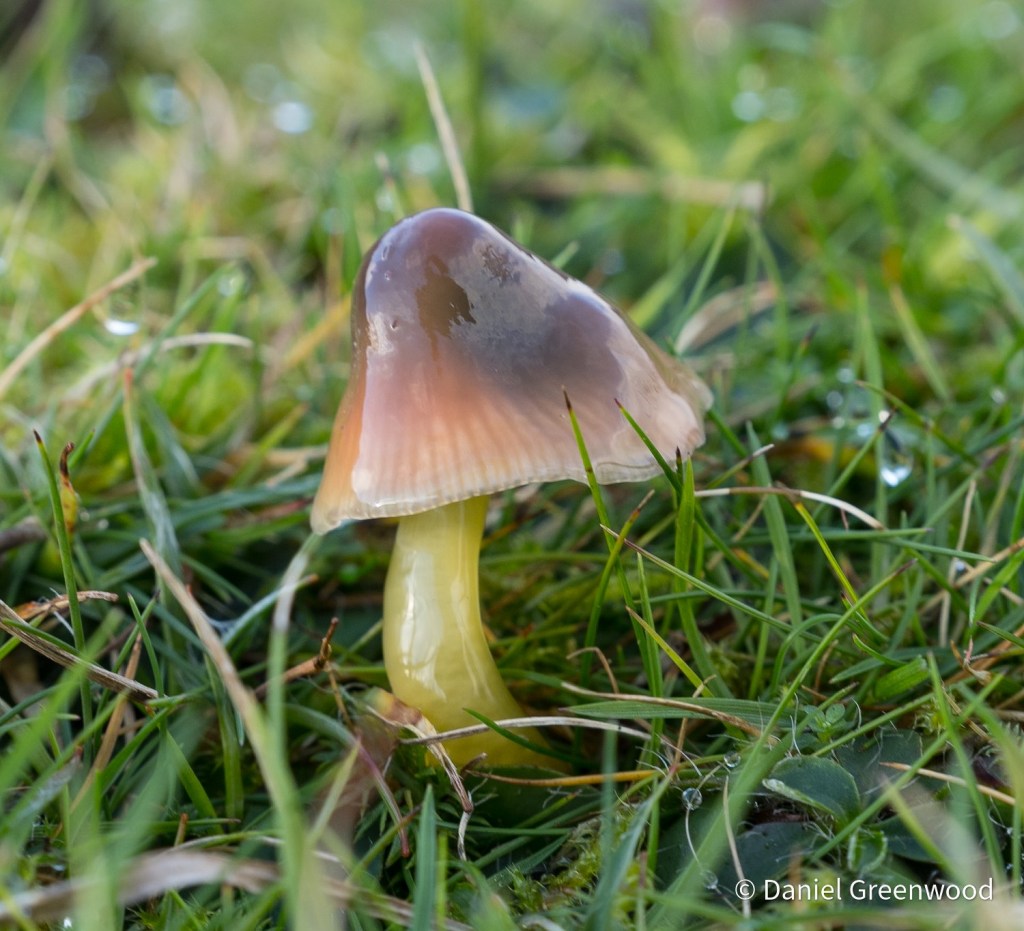
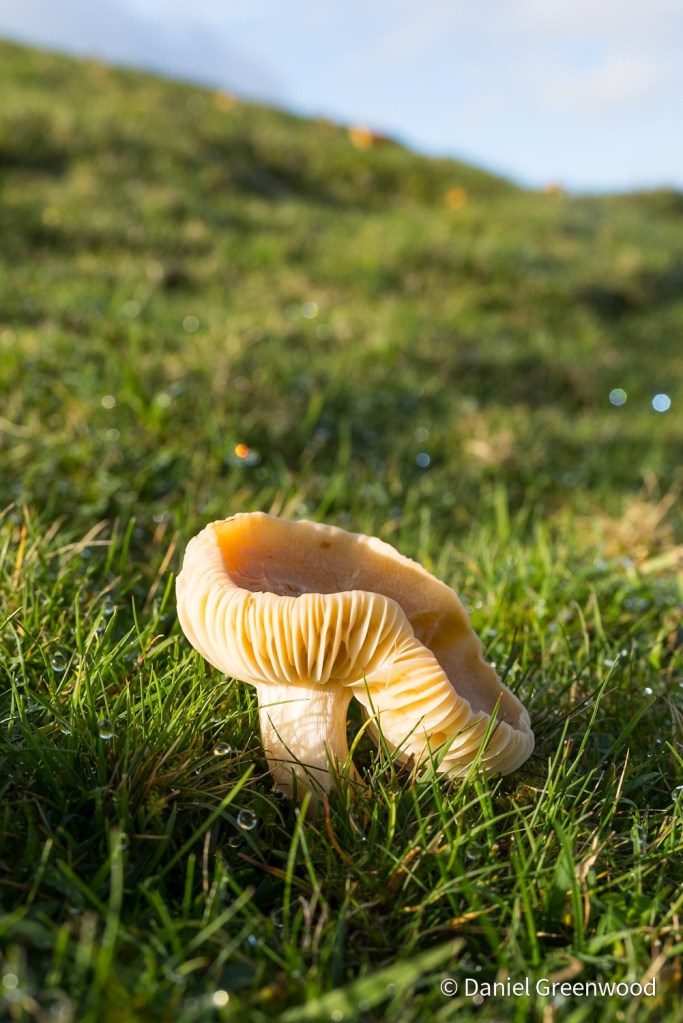
I don’t have an identification yet for this gorgeous waxcap and the closest I can guess is a colour variation of parrot waxcap (Gliophorus psittacinus).
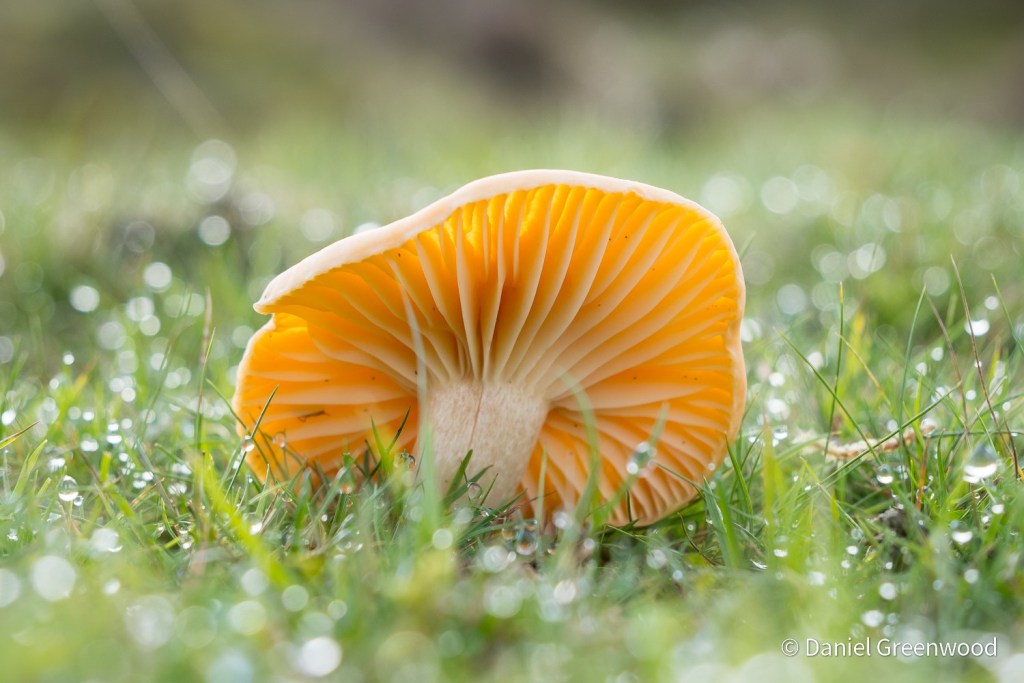
This is meadow waxcap (Hygrocybe pratensis), often fan-like, always best photographed from ground level.
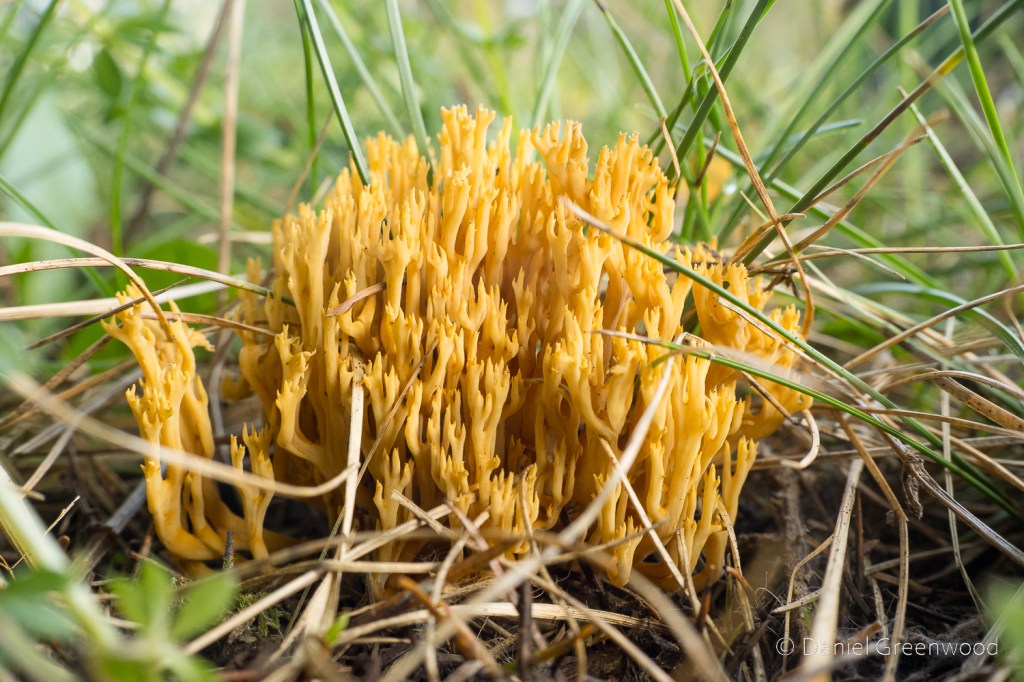
I’m not up on my corals and suchlike, but these are probably in this family.
The walk ended in a little graveyard, great places for waxcaps, by the way. That was evidenced again by this clutch of what I would say were scarlet waxcaps (Hygrocybe coccinea).
Phew!
Thanks for reading.
I write these blogs in my spare time because I want to raise awareness about the beauty and diversity of fungi. If you enjoy reading themyou can support my blog here.
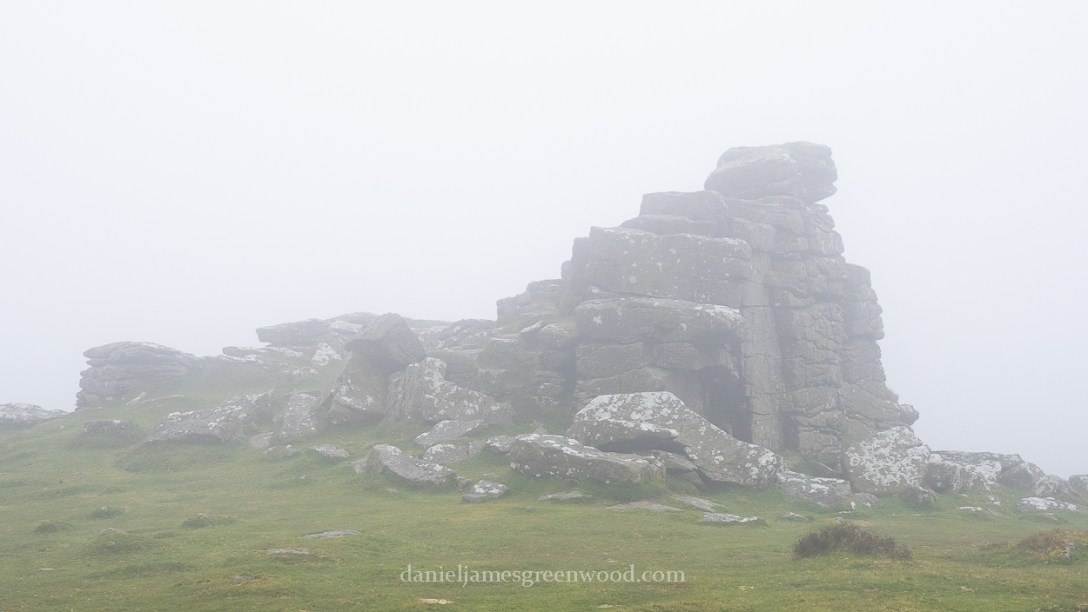
It was a misty morning high on Dartmoor. We began walking from Bennett’s Cross, passing Birch Tor and heading through wintry heather moorland. The white tails of wheatears burst across the paths as we disturbed them. Their journeys here are some of the longest undertaken by any migratory animal on the planet.
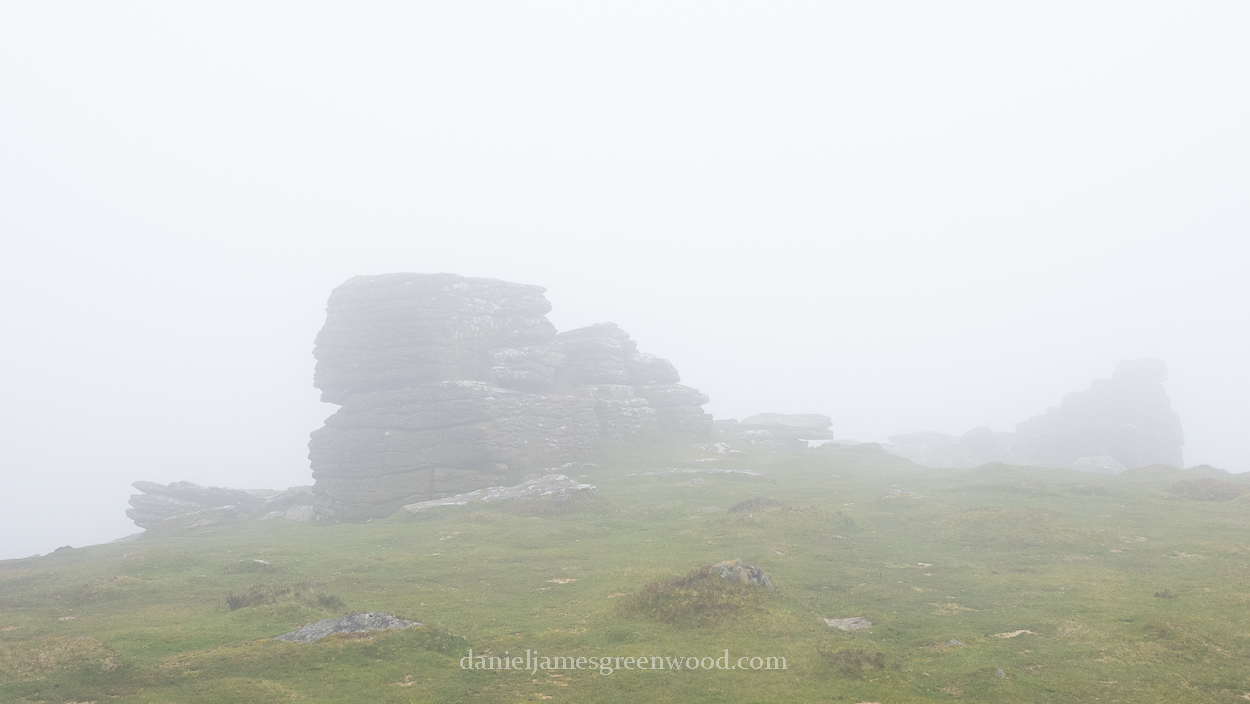
After a short plateau in the moor we crossed a quiet road and ascended Hookney Tor. Here the mist came in from the north, sucking up the wider moor, and the long stone wall that framed views in that direction. We switched east to pick up the unsigned Two Moors Way and walked between the rocky eruptions of Hookney Tor.
As we continued down on the Two Moors Way, a grey bird cut across the edge of the visible moor, some 25ft ahead, before the land was hidden by the mist. It was a male cuckoo, another African bird looking for a mate to breed in this harsh terrain.
The cuckoo slid away into the mist and we headed south for our prize – the 3000 year old settlement of Grimspound.
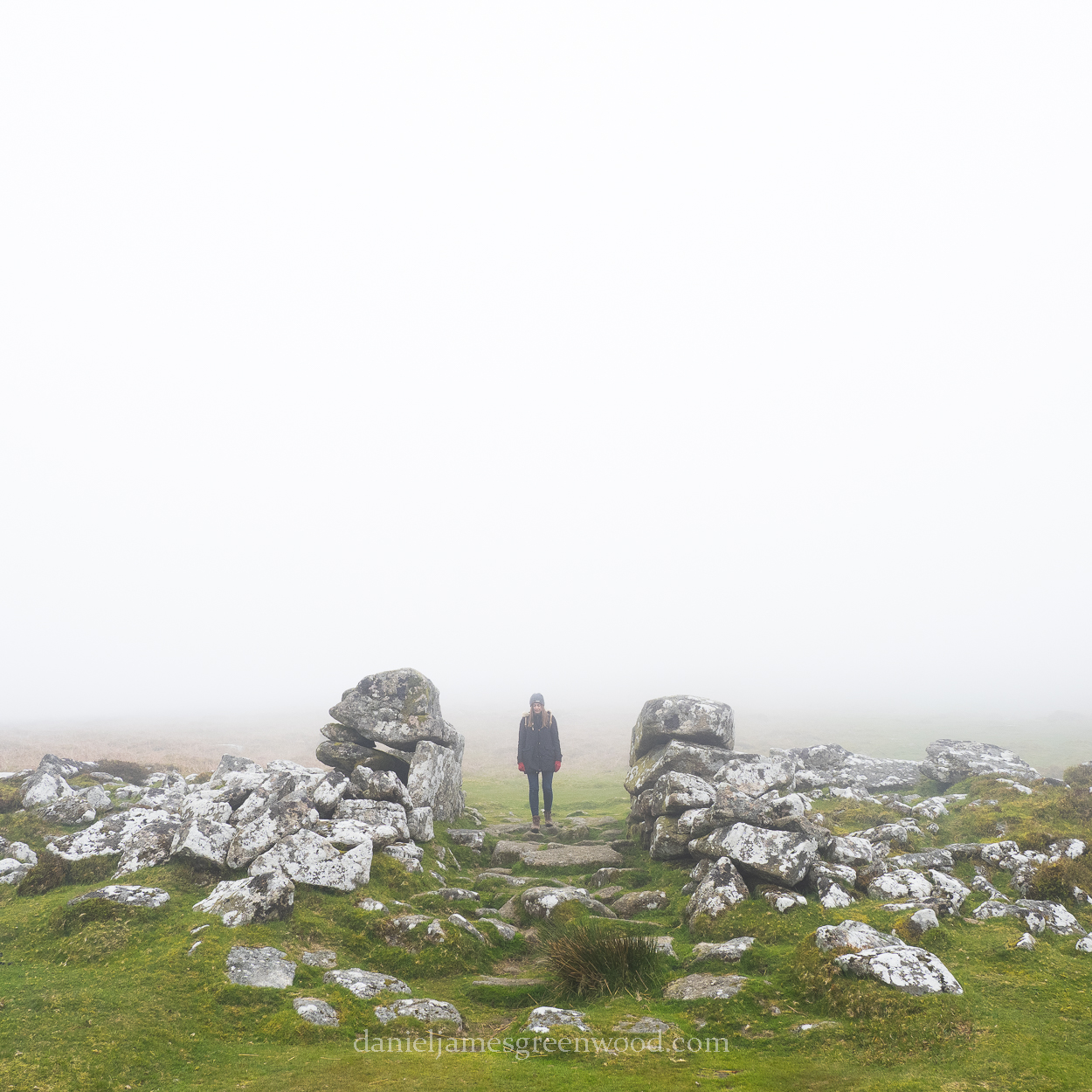
Approaching, only the collapsed stones of the outer enclosure were visible, painted white by the crust lichens that thrive on Dartmoor stone. In the distance we could hear the voices of other visitors to this ancient place. A family were visiting, posing for photos inside one of the small enclosures that had been rebuilt.
Entering into the ring of fallen stones, the smaller huts came into view. This wall will have been intended to protect the inhabitants and their livestock from wild animals like wolves (now long extinct) and any attacks from other people.
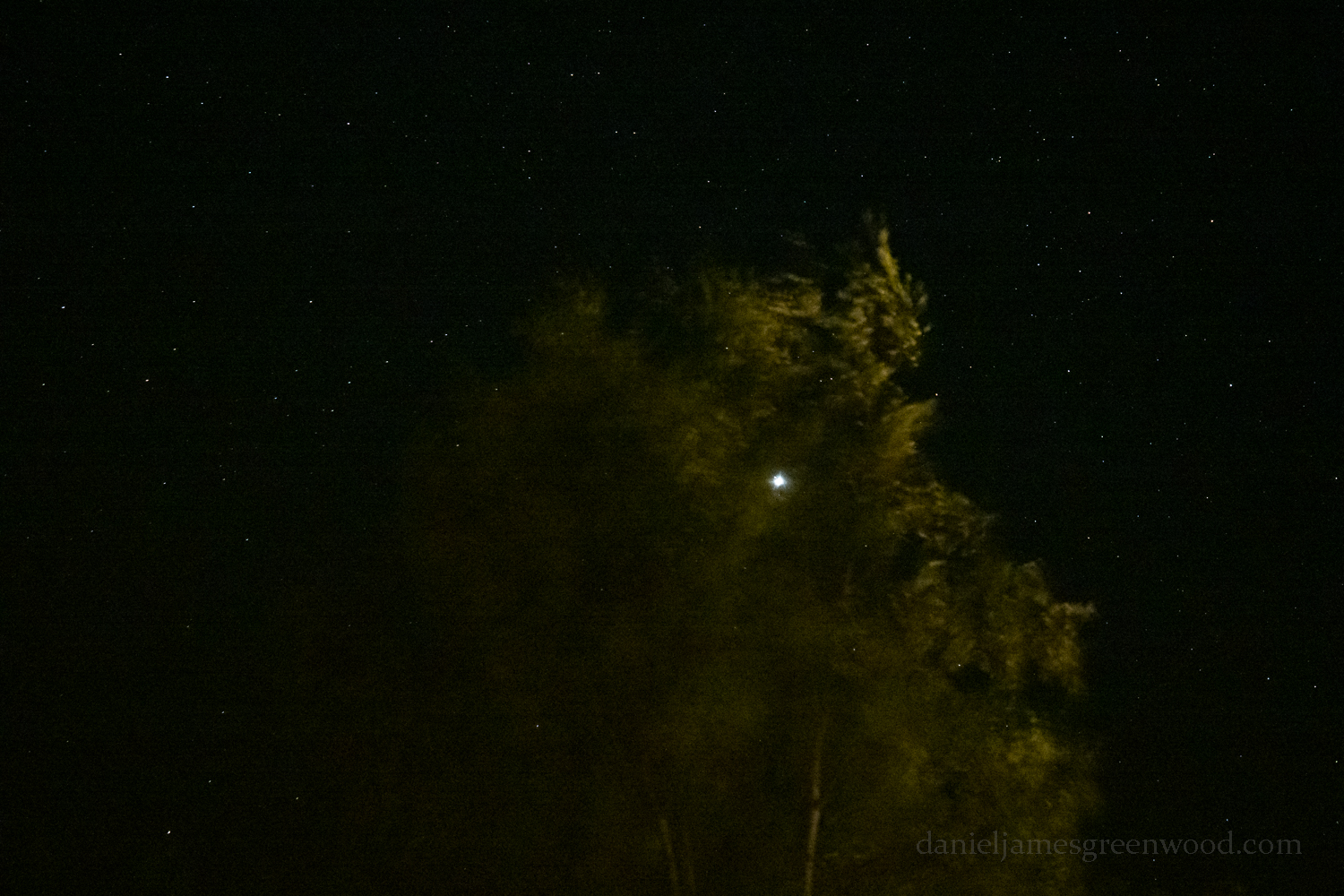
On Sunday 30th October I was admiring Jupiter in Dartmoor’s pitch black skies when what looked like a satellite skimmed above the tower of the illuminated church (header photo only viewable in browser).
At first thought it was a satellite due to its steady glide, but then satellites don’t usually burn up in the atmosphere, which is what this object did.
It later turned out that the trail of light was part of the Orionid meteor shower. Above is a photo kindly donated to Wikimedia Commons to illustrate it.
This Orionid was seen outside the peak for this shower. It was even more lucky because the weather surrounding those nights had been pretty much torrential rain and the night sky had been tucked away behind cloud.
The Orionids aren’t anything to do with the constellation of Orion directly, but are so named because they appear nearby and their naming helps people (like me) to locate them. These meteors are actually fragments of Hally’s Comet, which you may have heard of.
Jupiter seen through the leaves of a silver birch tree (Dartmoor, November 2022)
This is a great time to observe the night sky and take in all the night has to offer. Redwings are arriving in their thousands and can be heard even over the most built-up and light-polluted parts of the UK. While the Orionid meteor flashed across the sky, redwings were covering the night sky in their own, invisible but audible way.
A few nights later the skies cleared after days of heavy rain and high winds. This gave a good chance to look at Orion, which was fixed perfectly from the back of where I was staying at the time of viewing:
The constellation of Orion: Dartmoor November 2022
Cropping a bit closer you can see the fierce glow of the Orion Nebula in the bottom right-hand part of the image:
Also prominent and not too far from Orion was the Pleiades:
The Pleiades: Dartmoor, November 2022
I’m using a new camera (Olympus EM-1 MIII) at the moment which has the ability to autofocus stars with a special feature. It didn’t actually work that well for me, though I was taking these photos handheld and may have had the settings wrong. It was a spur of the moment kind of thing, as much as my astrophotography attempts are to be honest!
I was really drawn to this large bright star to the left-hand side(!) of Orion. I need to be better at noting the locations of stars in relation to other constellations. Looking at Stellarium I think it’s either Mars or Betelgeuse.
Your Christmas gift from me is the final part of my 2021 Dartmoor mushroom trilogy, following on from parts one and two.
I hope you can have a nice Christmas and holiday. Solidarity with anyone alone or grieving at this time. Here’s to happier times.
This post is all phone pics so there is a bit of a drop in resolution and quality, but that’s not all that matters in photography. The finds here were based on a walk from the edge of Dartmoor National Park into one of the nearby towns, outside the boundary. I found some lovely species, some of which I hadn’t seen for some time.
The walk began from our hotel, passing through a slither of ancient woodland that had been planted up with sweet chestnut perhaps over a century ago. I was delighted to find one of the first hen of the woods (Grifola frondosa) that I’d seen for several years. Also – how chivalrous am I!
I used to see this regularly on oak in London, but this time the species was growing on sweet chestnut. Sweet chestnut is in the same family as oak (Fagaceae), so this must happen fairly commonly in continental Europe where sweet chestnut is a native woodland species (post-Ice Age).
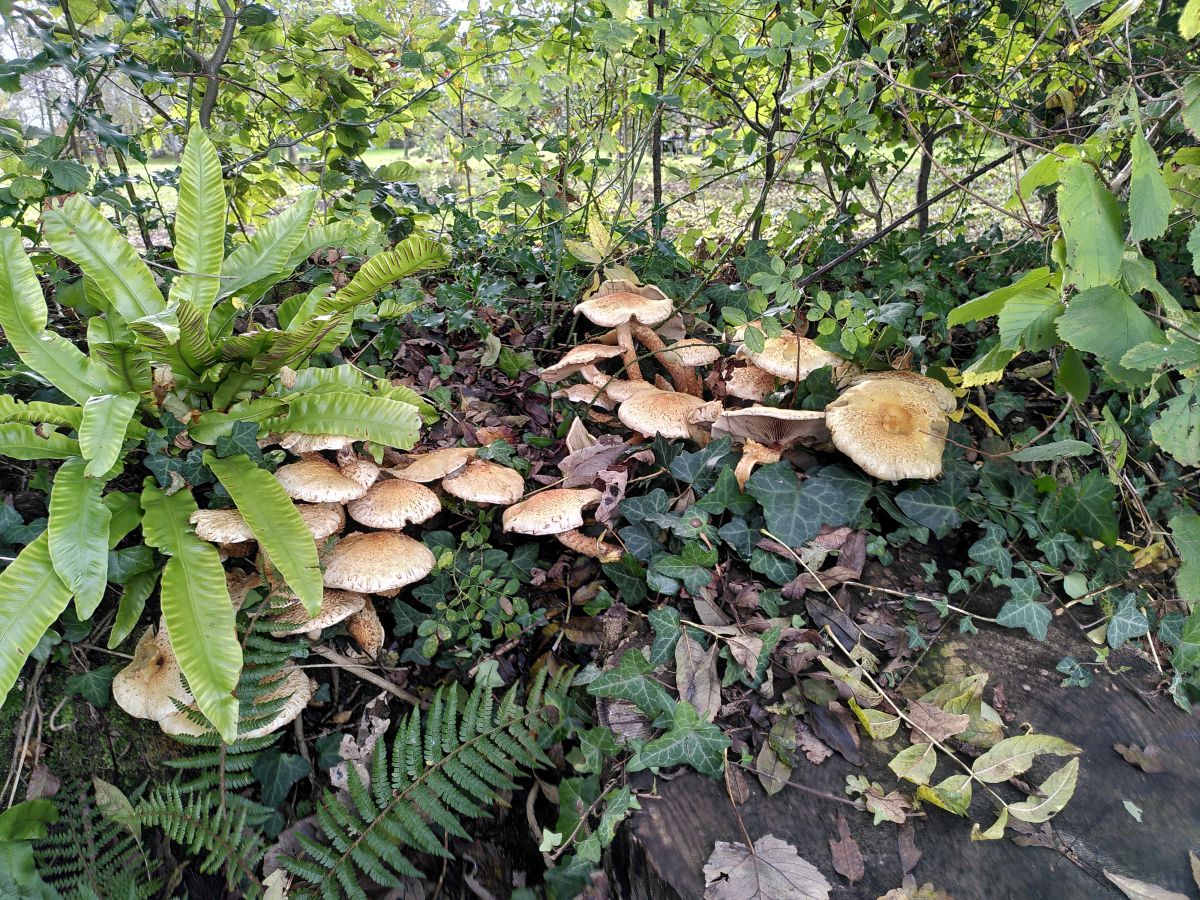
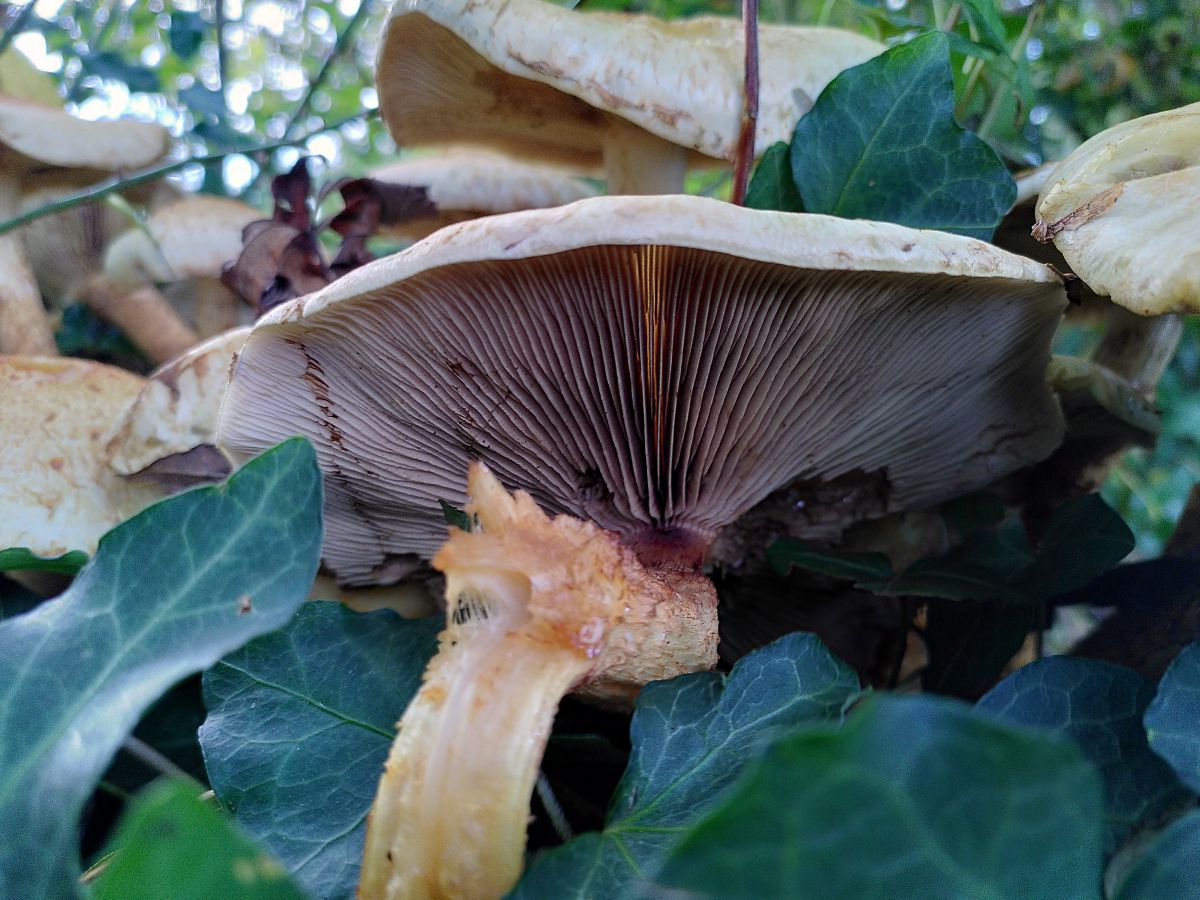
A nice large spread of mushrooms on an old stump in a hedgeline were this group of scalycaps. I expect these are probably golden scalycap (Pholiota aurivella).
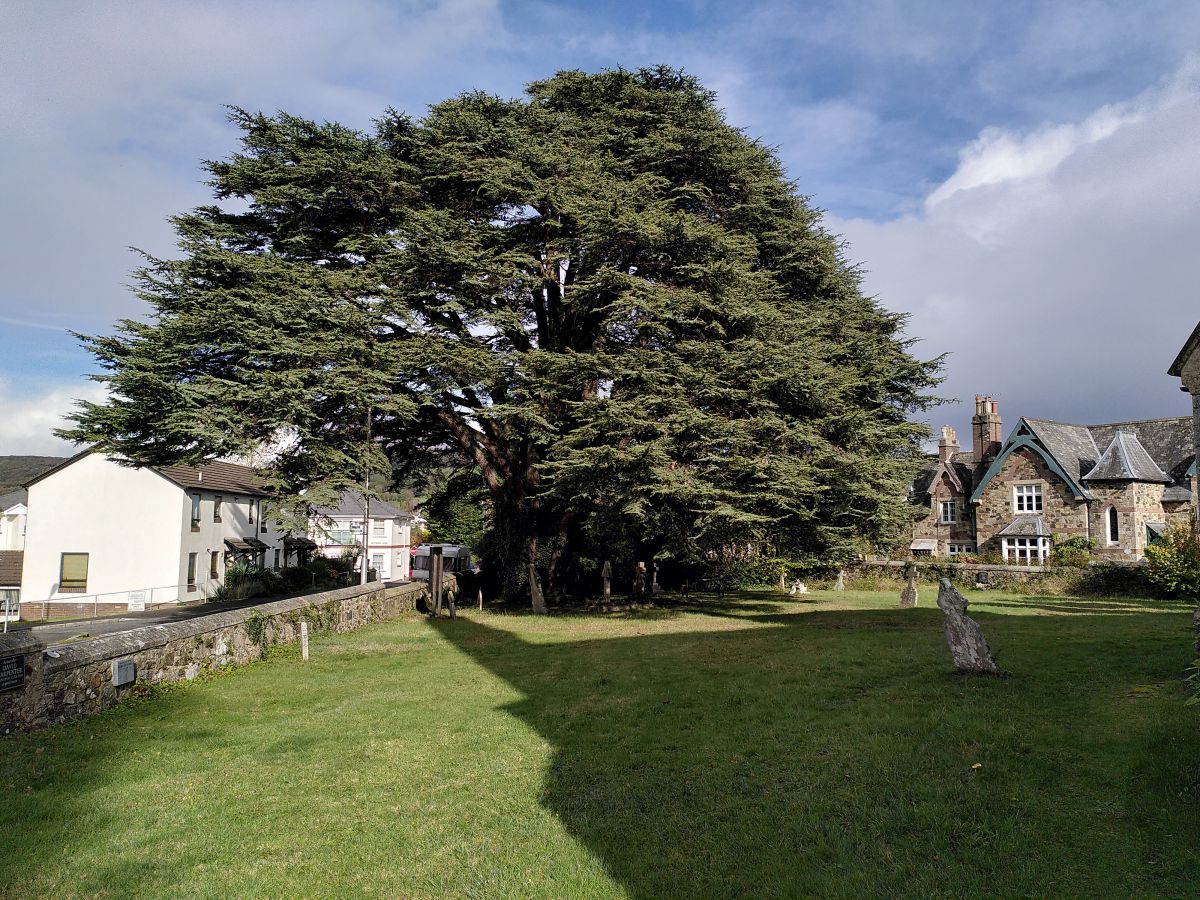
Cemeteries are excellent places for wildlife, sometimes for rare species of plants, invertebrates and fungi. This small churchyard is no exception to that. The main reason for this is that the grasslands are cut regularly and kept open, being in a state of grassland for hundreds of years or more.
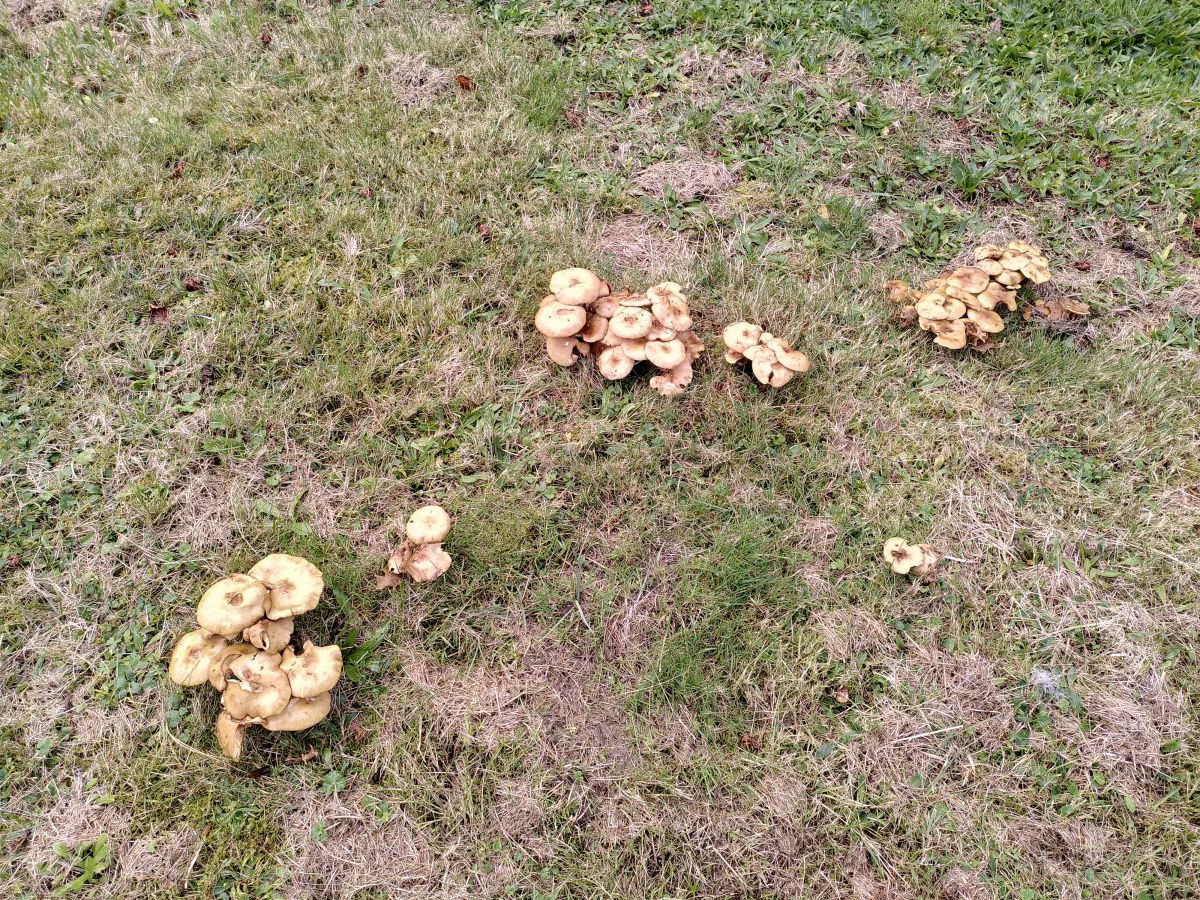
Honey fungus (Armillaria) has had quite a late start to the year in southern England. I have found it in this particular churchyard before. I think this cluster were growing where the roots of a tree once were.
Churchyards are good places to find waxcaps, a family of mushrooms that are mainly found in ancient, unimproved grasslands. This means the grasslands haven’t been ploughed up or fertilised, hence why sacred sites like churchyards are good for them. I found a gathering of small yellow waxcaps which have been identified on iNaturalist as butter waxcap (Hygrocybe ceracea). I love the gills of waxcaps, and the phone camera does do them some justice.
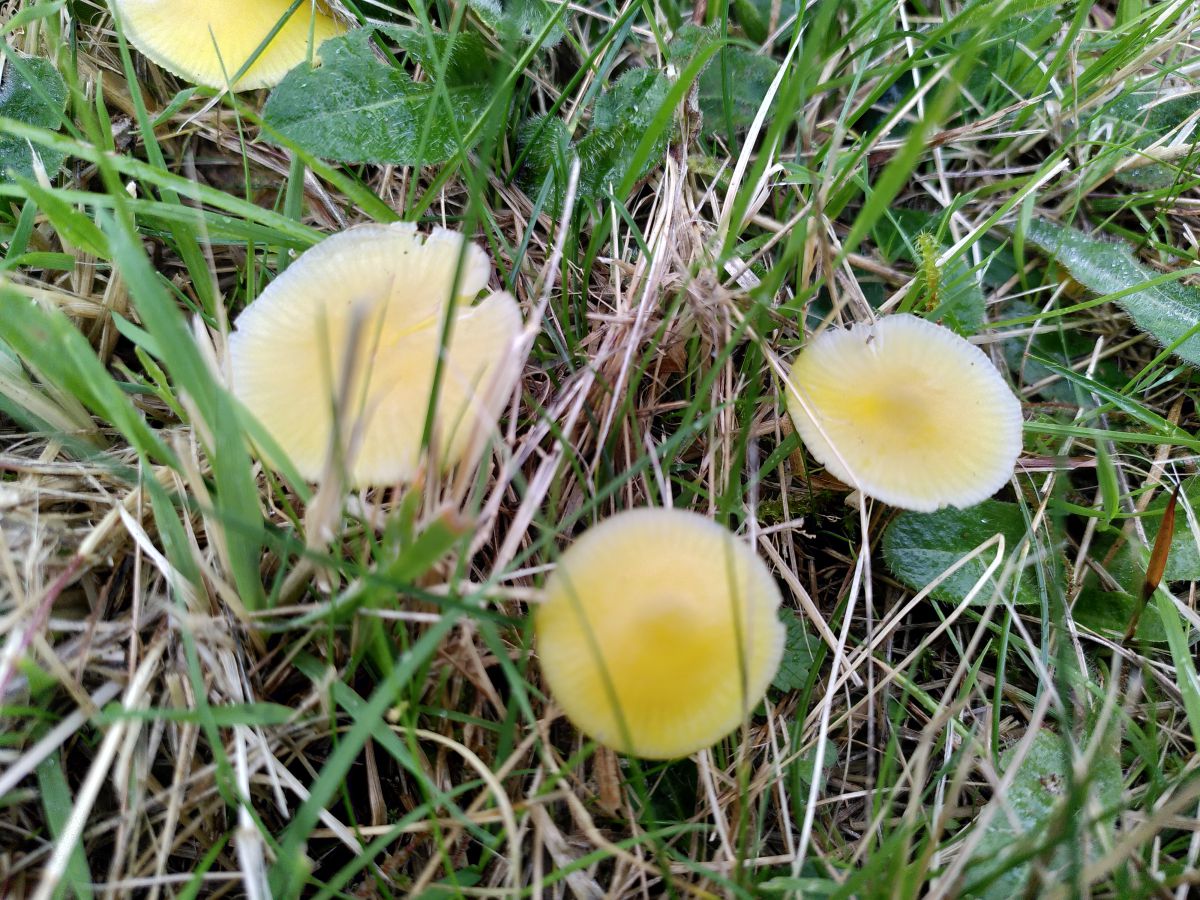
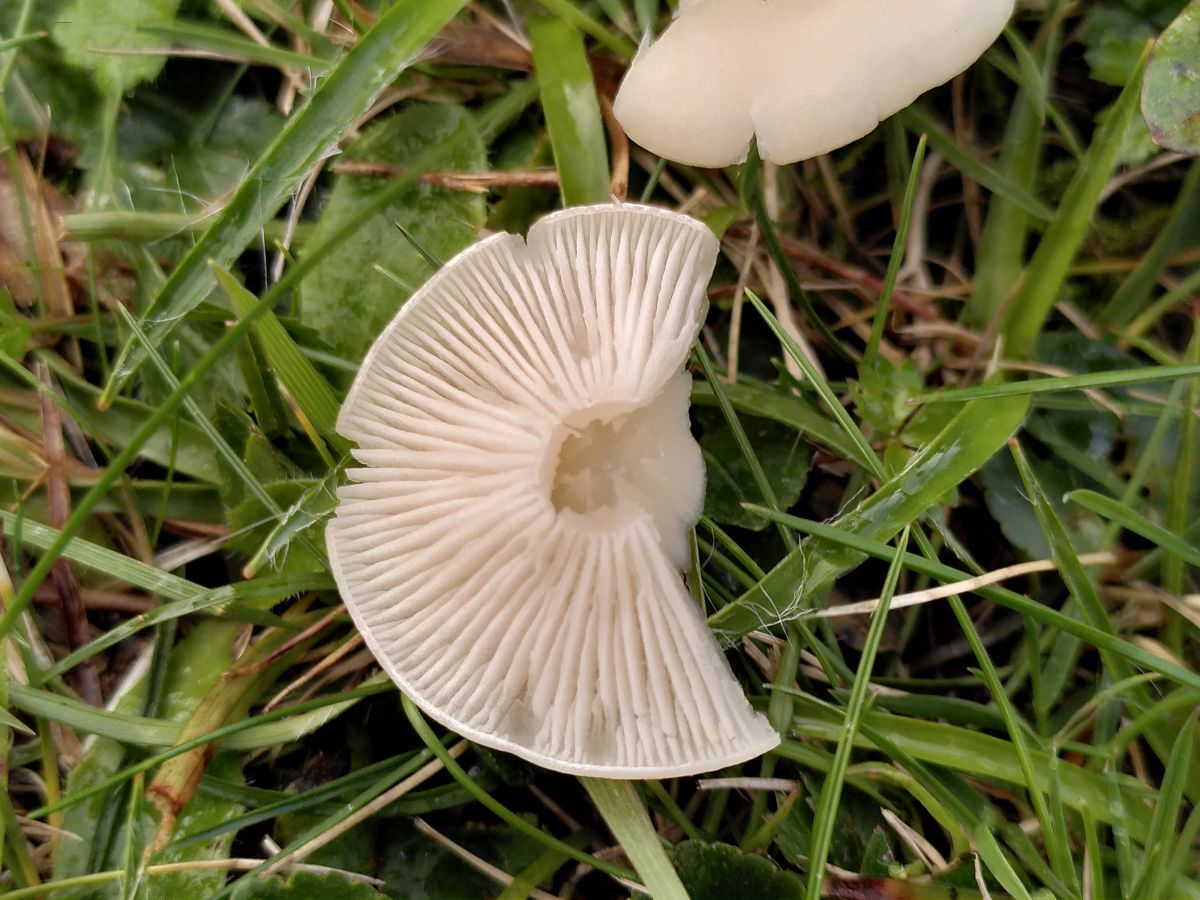
At first thought this very small mushroom was a waxcap but it probably isn’t. One suggestion is that it may be a type of funnel.
As witnessed elsewhere on Dartmoor the day before, I found a couple of blackening waxcaps (Hygrocybe conica). This nicely illustrates the shift from a Wine Gum yellow to the blackening stipe.
Closer to the large cedar seen in the wider image of the churchyard, there were several blushers (Amanita rubescens) dotted around the grasslands.
Perhaps the most beautiful find, and one I’ve never knowingly discovered before was bitter waxcap (Hygrocybe mucronella). If the gills of the butter waxcap were beautiful, the combination of pale yellow and orange backdrop are something else. The gills radiating towards the stipe from the edge of the cap also look to me like flames.
Thanks for reading. Extra points if you read all three posts!
Following on from part one of my recent trip to Dartmoor National Park in south-west England, it’s now time for part two. You can read part one here.
This was another day chock-full with mushrooms. It began well with a nice indicator of mushroom season when we found a gathering of clouded funnel on a roadside verge. This is a fairly common mushroom that can usually be identified by its size and the clouded tops. My boot is here for scale, obviously.
You can see how happy fungi are in the wet and wild landscape of Dartmoor by the presence of moisture loving organisms like these cladonia cup lichens. You can read some of my lichen posts here.
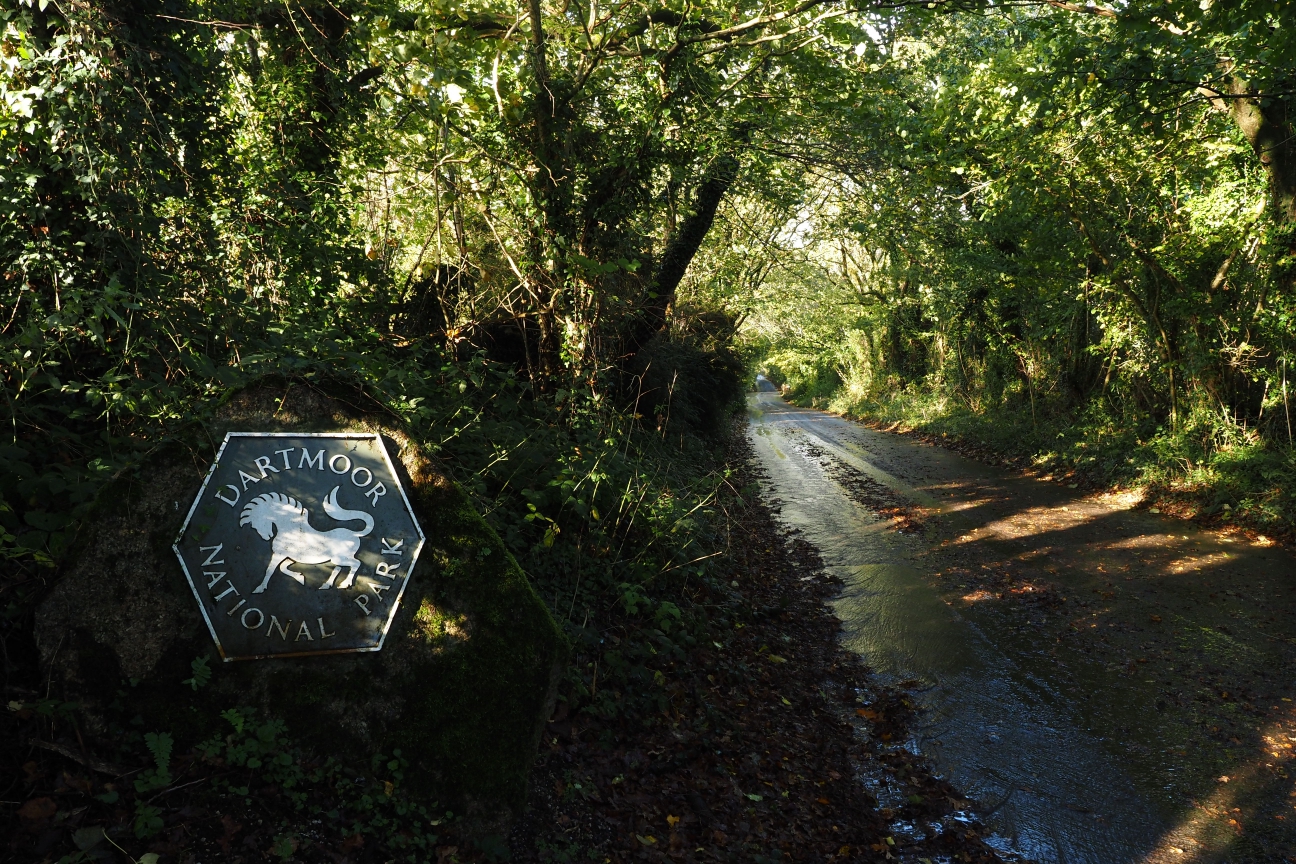
We were just on the edge of the National Park. Dartmoor’s logo is based on the famous Dartmoor pony, a semi-wild(?) species that has been running amok on the moor for thousands of years.
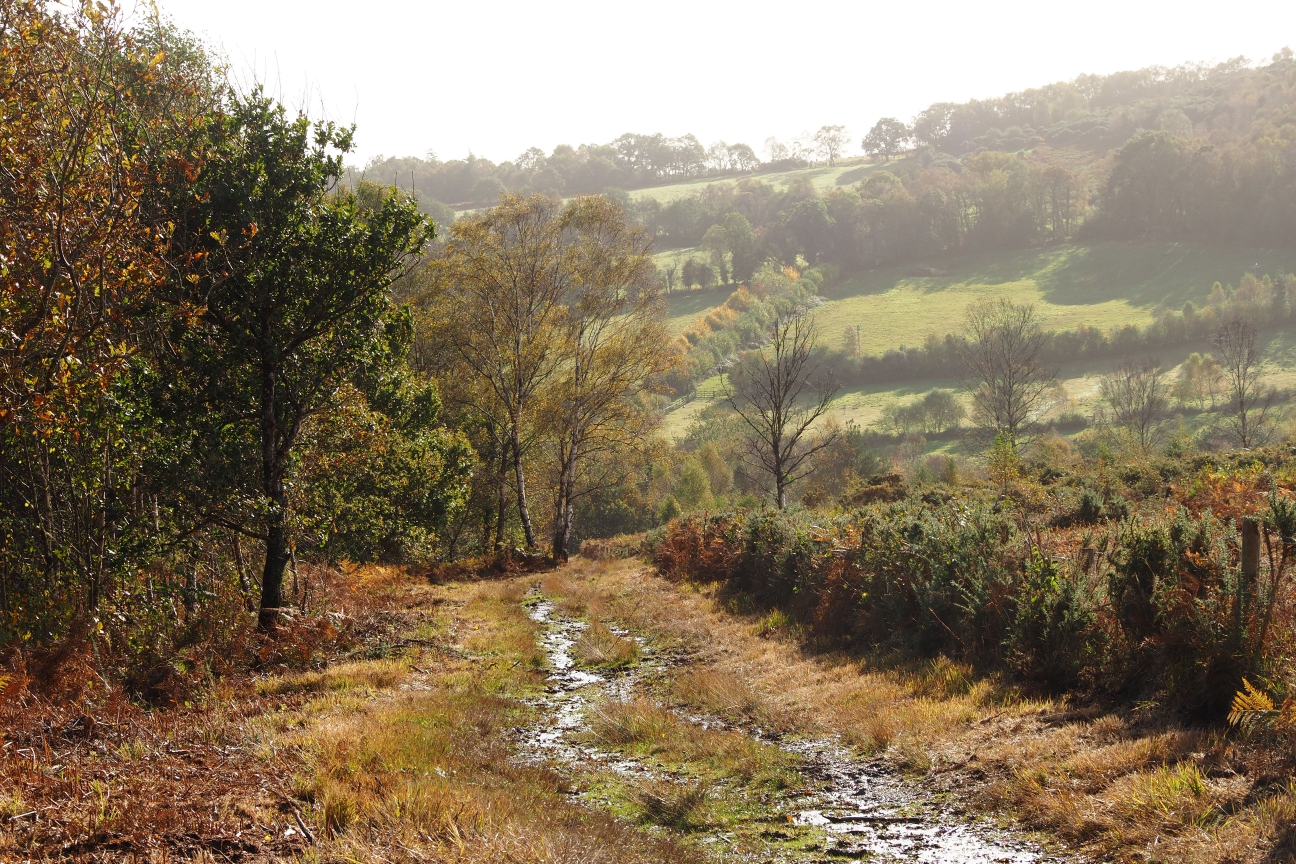
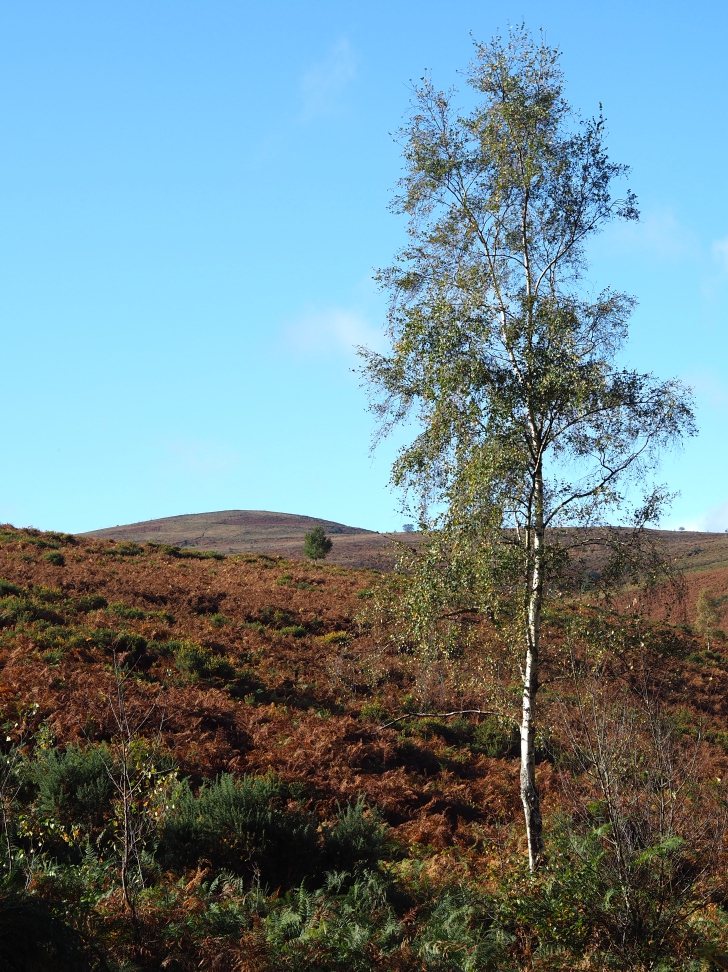
Dartmoor on an autumn morning. The silver birch with yellow leaves is one of the highlights of autumn, especially when the light catches the leaves.
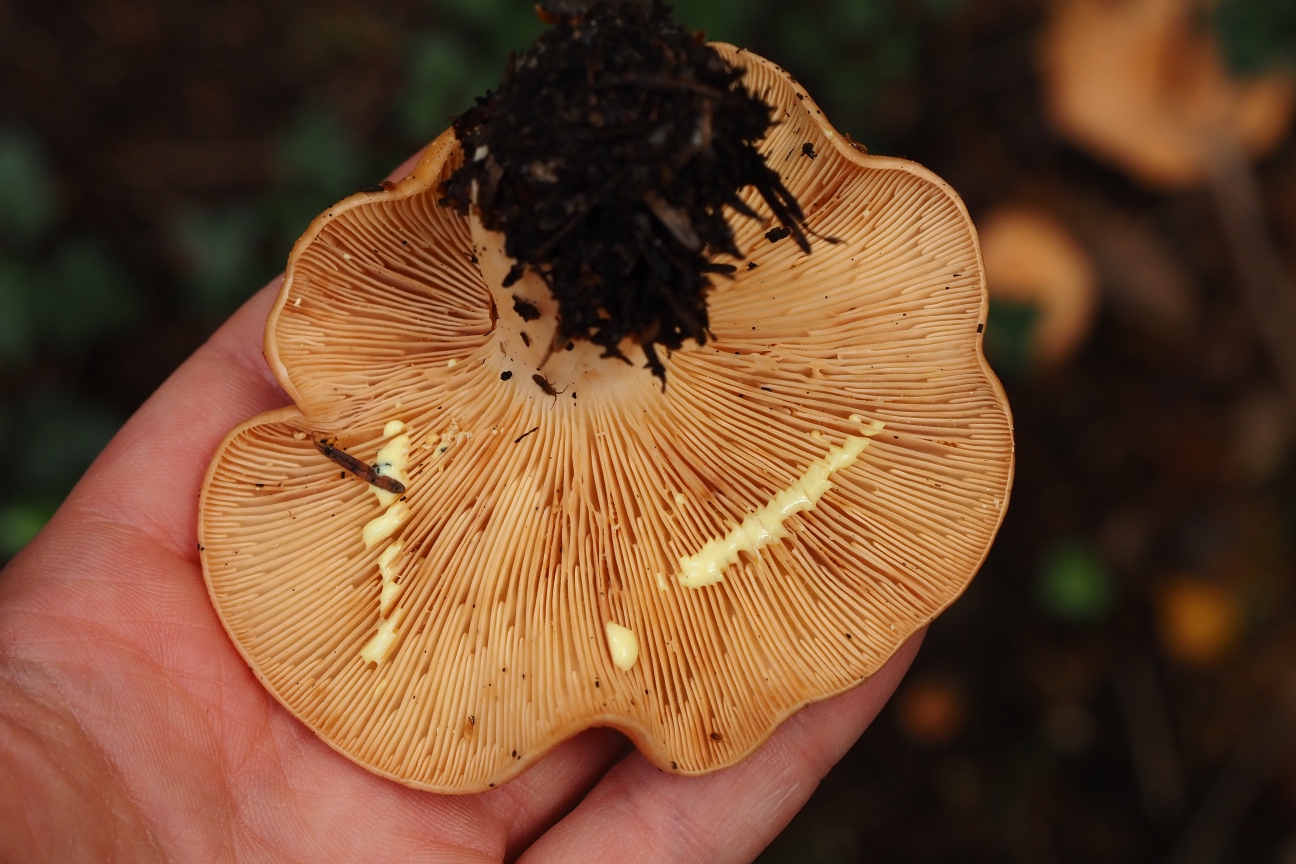
On top of a wood ant’s nest there were two mushrooms that looked interesting. I could tell that they were milkcaps from the unusual caps and the concentric circles. Turning one of them over I cut the gills with my fingernail and, sure enough, the gills produced milk. I don’t know what the species is.
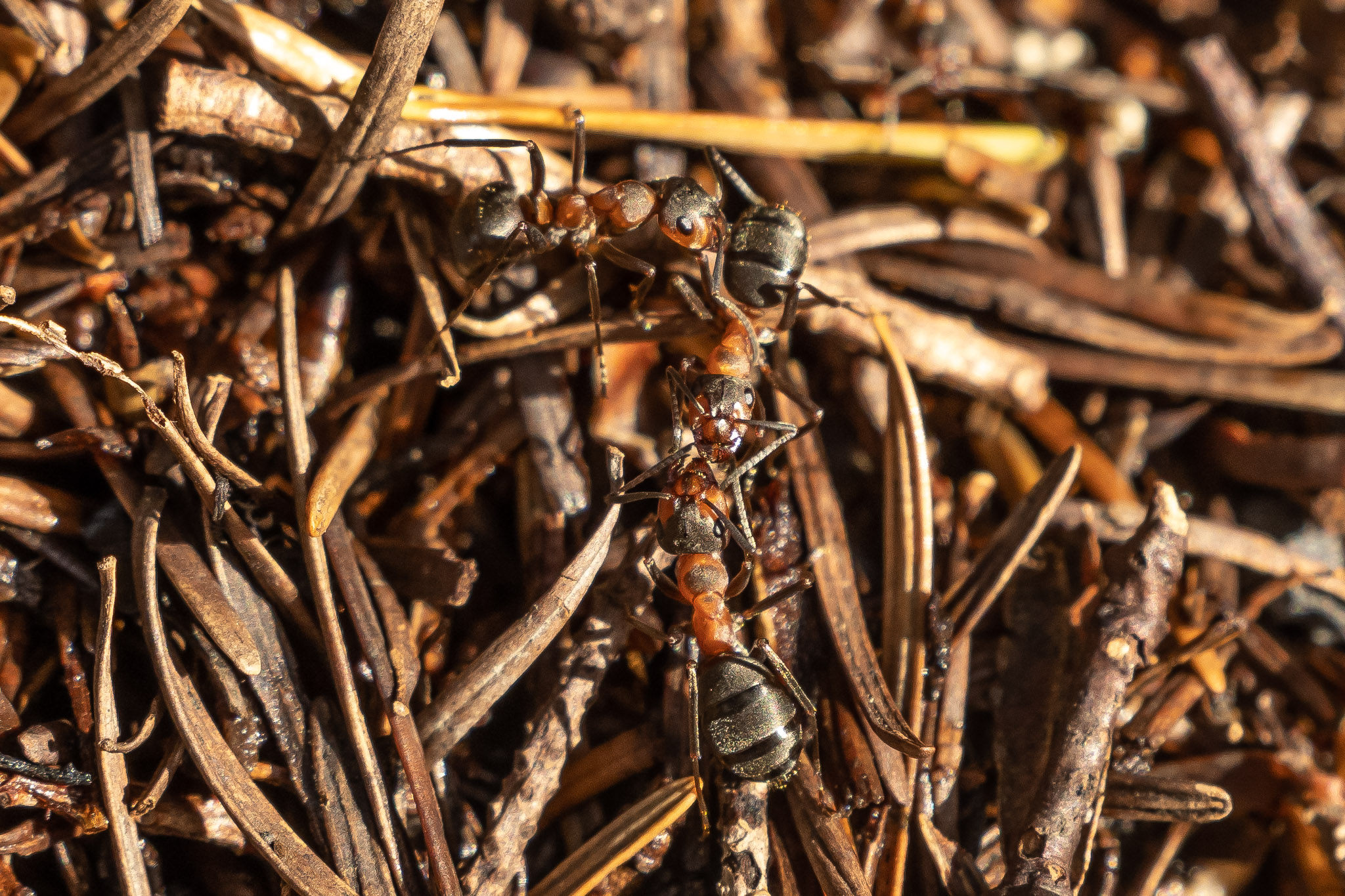
The ants were still active, with quite a lot of interaction going on. I wonder what role fungi play in the structure of certain ant hills. Ants have been found to cultivate fungi gardens inside their nests, and there must be other ways that ants mix with the fungal kingdom.
This walk was on the edge of the moorland, passing down into a wooded river valley known as the East Dartmoor Woods and Heaths.
The woodlands that made up some of the best parts of the walk are known as Atlantic Rainforest. Their main tree species are oak and hazel. I’m not sure if ash was more prominent before ash dieback came into effect. This type of woodland is very uncommon with a lot of it being lost down the centuries. It is a special habitat for its plants, lichens, fungi and other wildlife. It’s very mossy and ferny.
It did not disappoint. This blackening waxcap was growing in moss on a woodbank. It is a stunning fungus when in this condition and in this light. I always associate waxcaps with grassland so often forget they can also be found in the woods.
Close by were these white spindles (I think), another sign to me of an ecologically rich and diverse woodland.
The autumn rains had the river swelled and running fast. You can see the brown of the peat-inflected water.
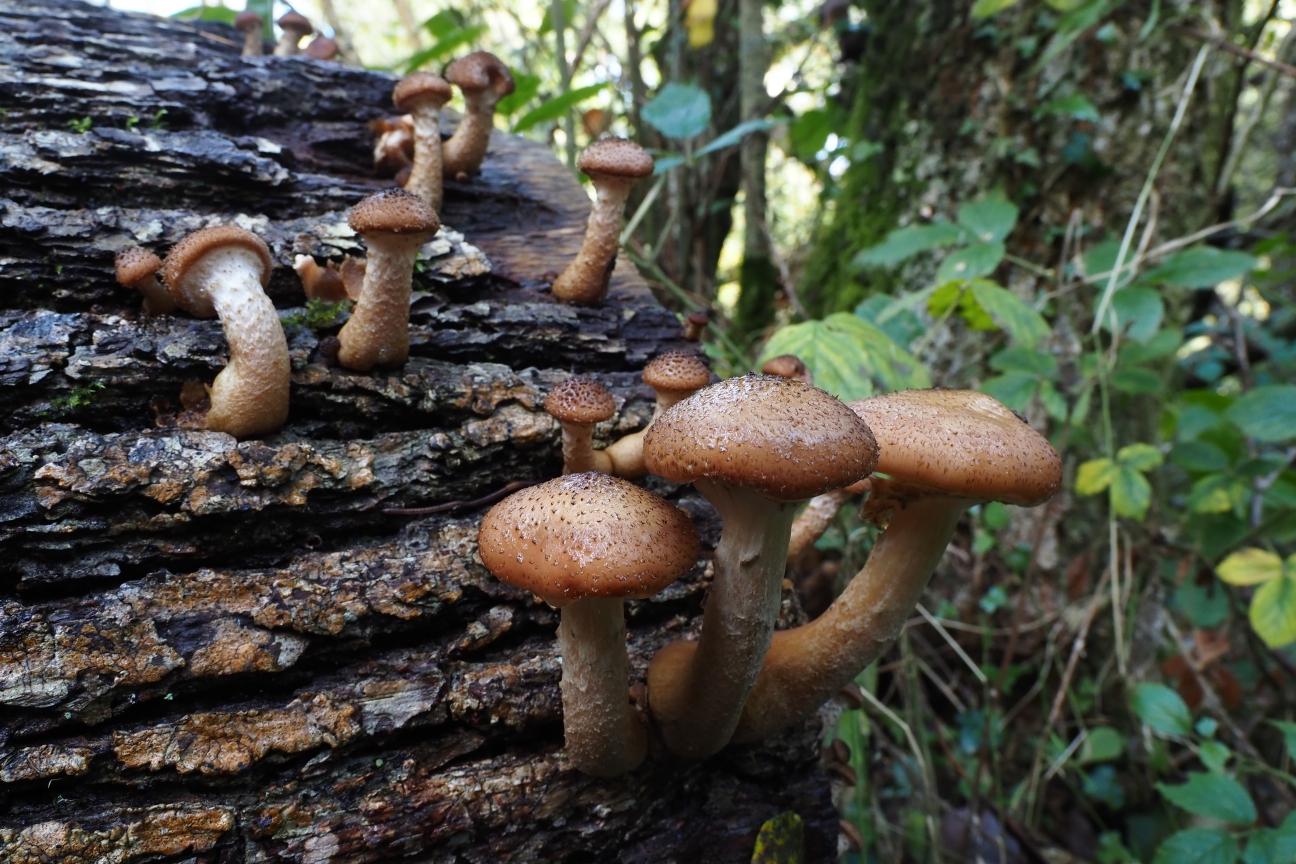
There is someone who has commented several times on this blog asking how or when to find honey fungus. If you’re reading this now, honey fungus is fruiting en masse at the moment. They are very photogenic indeed in the early stages, like the cartoony image of what a mushroom should be.
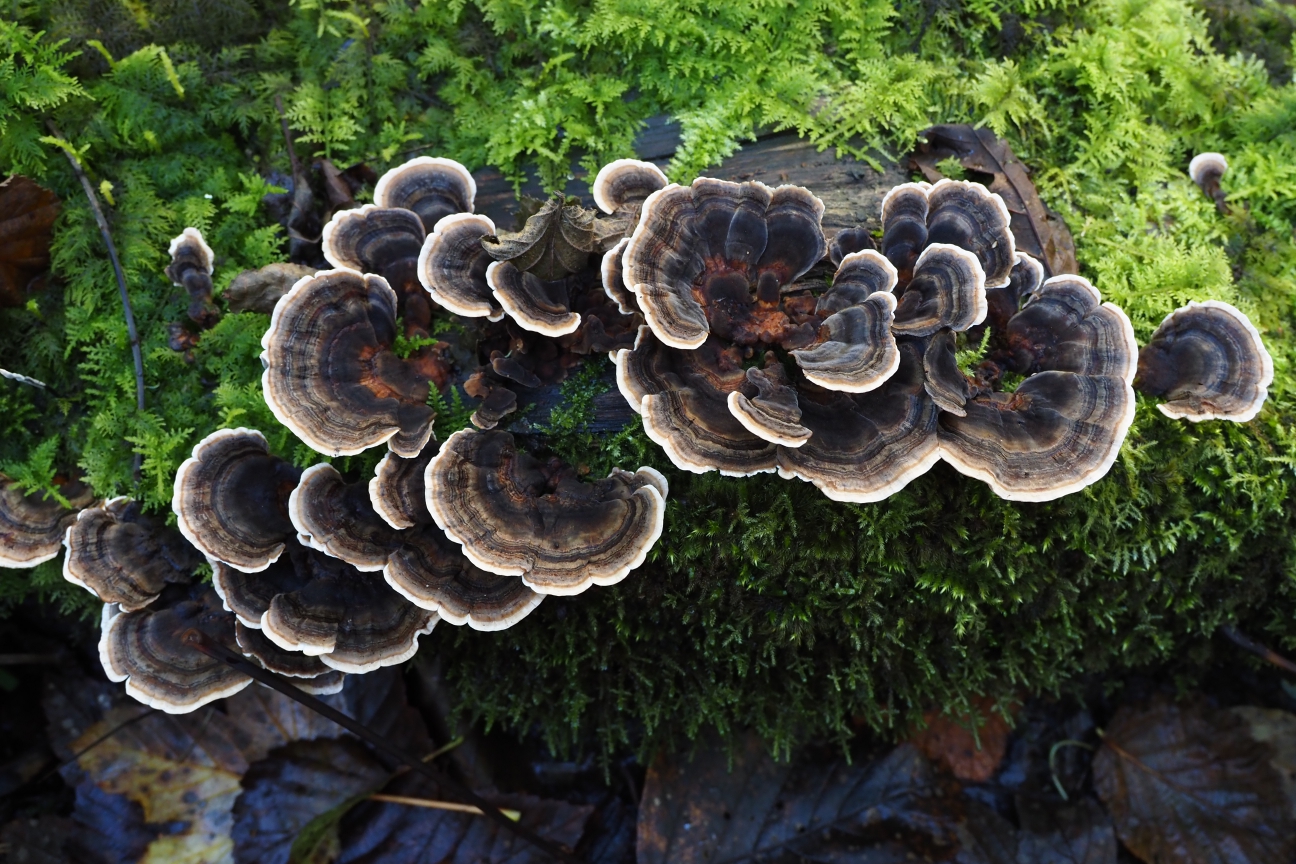
This fanned cluster of bracket fungi is probably turkeytail. These types of fungi can be found all year round but they look their best, like other mushrooms, in the October-November period.
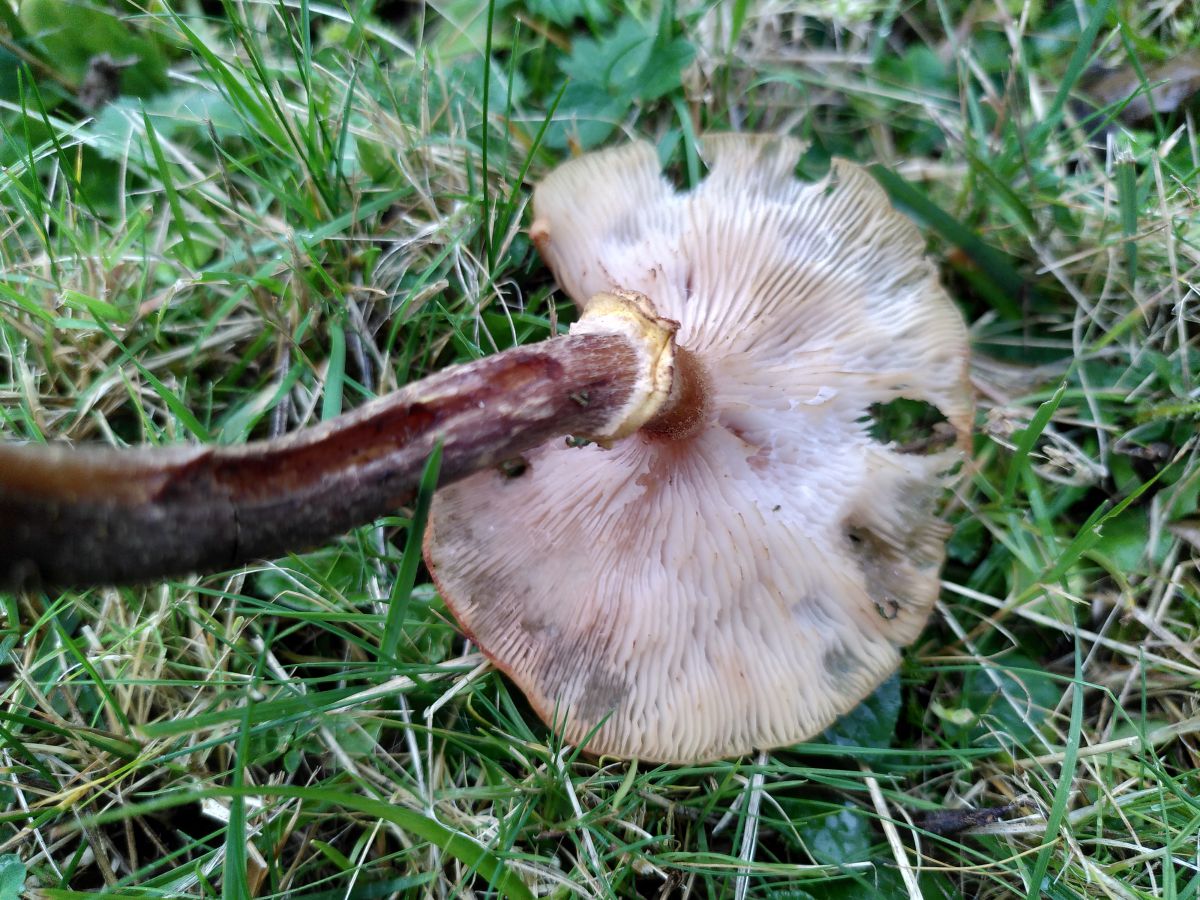
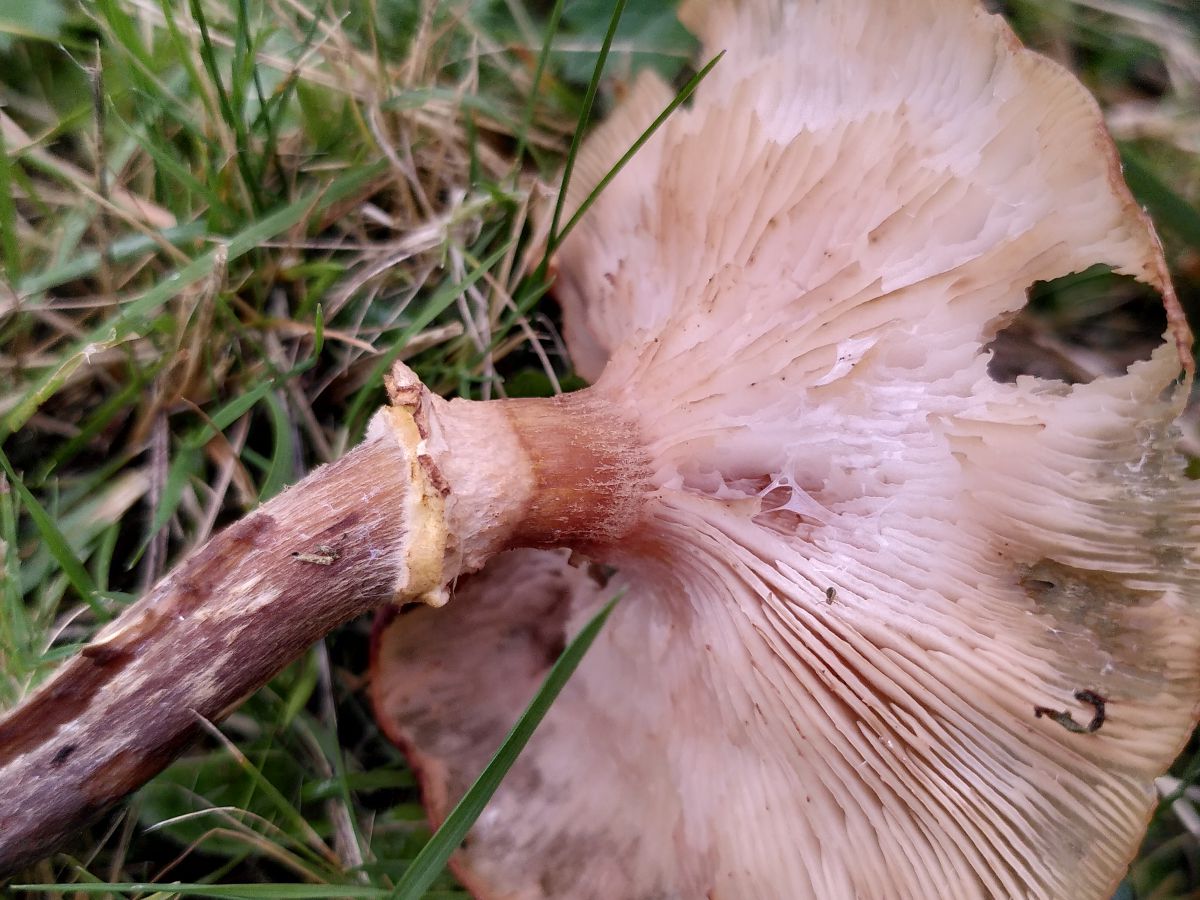
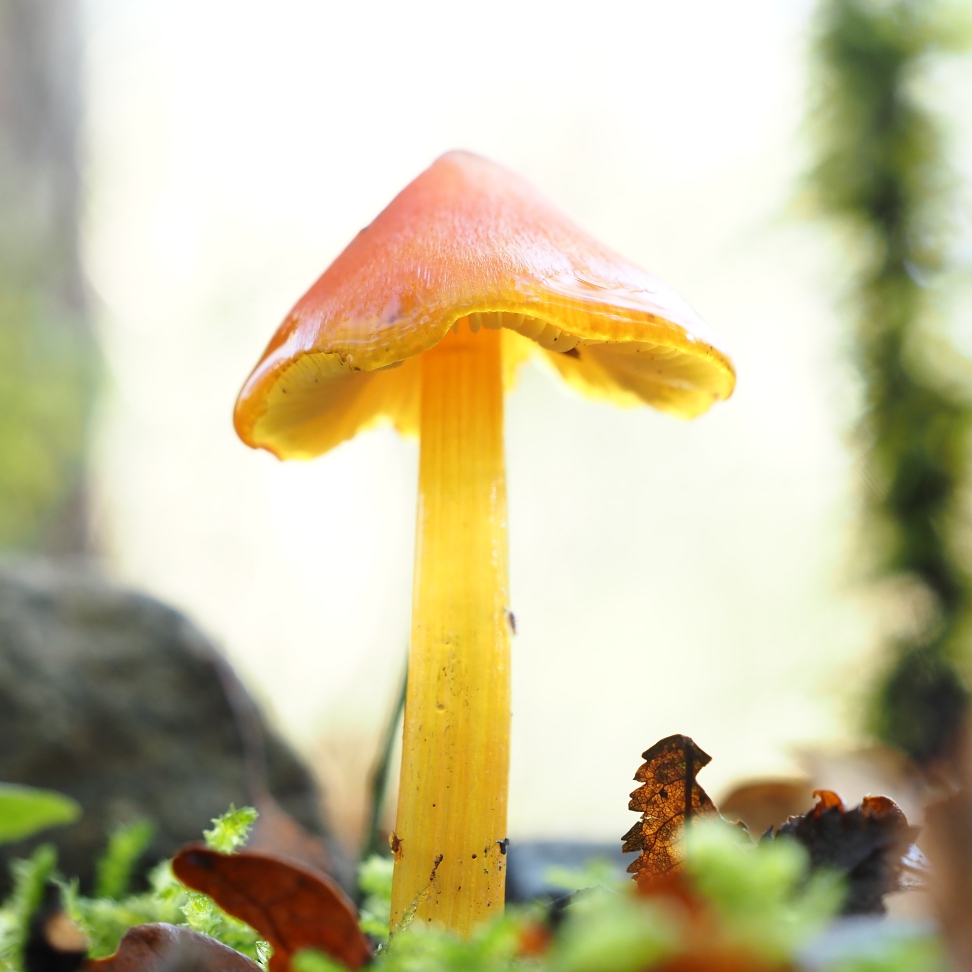
I can’t claim to have found these lovely bonnets growing from some moss on a tree. I’m not sure of the species.
Here’s a snapshot of this beautiful woodland with an understory of bracken, and a tiny bit of hazel.
I’m not entirely sure but I think this is purple jellydisc. There is an organism on the birch leaf next to them which may be a fungus but could also be a slime mould.
On this walk we encountered one of the most beautiful mushrooms I’ve ever seen. This rainbow-coloured mushroom is a bitter beech bolete. It took the breath away. This was a phone pic as my camera wasn’t that happy about how dark it was. Well done Fairphone!
As mentioned in the first part of this blog trilogy, sulphur tuft is a very common mushroom. This was a nice spread. I haven’t spent any time looking to identify the other tufts, but I’m pretty sure this is sulphur.
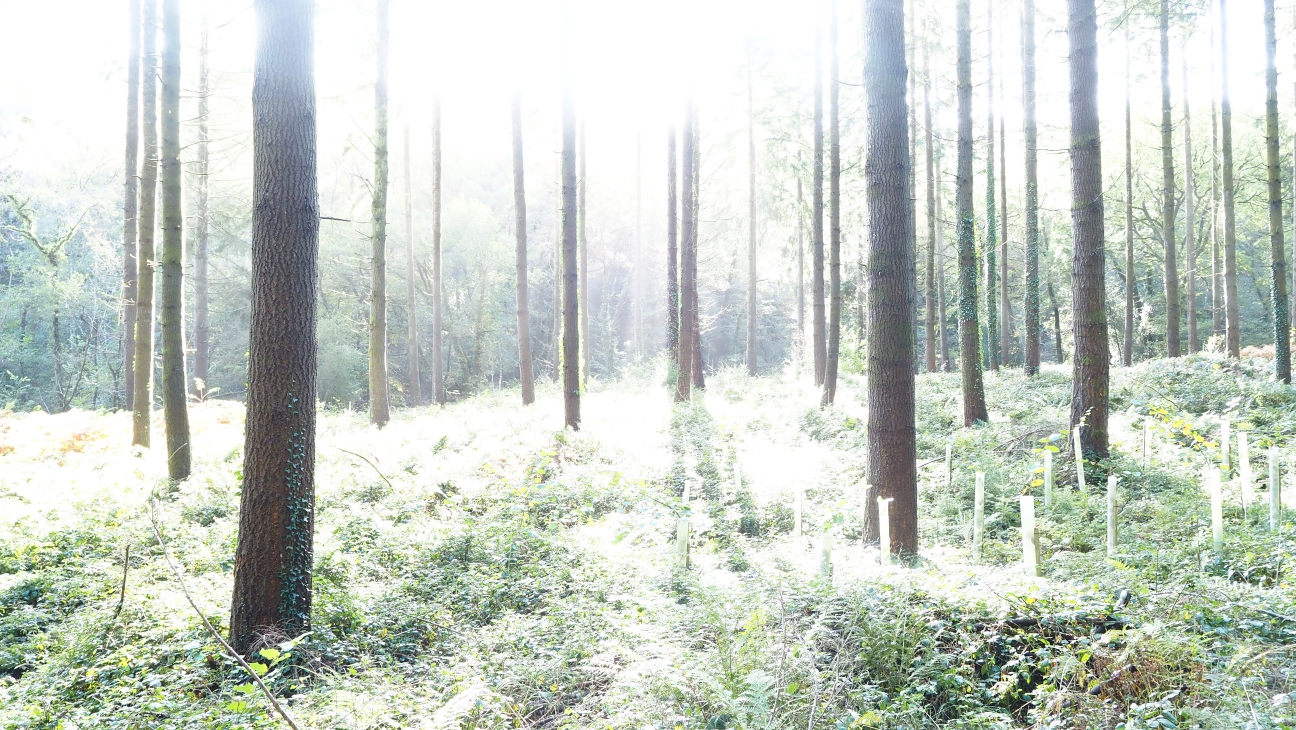
The broadleaved rainforest was replaced on the other side of the river by coniferous plantation. The Woodland Trust owns this woodland and there was clear evidence of shifting it to its more species-rich habitat of broadleaved woodland. The walk followed part of the Dartmoor Way.
This bolete was helpful in leading us on the way along the track. Yet another bolete or relative growing from a mossy bank.
When I see a mushroom like this, I usually say to myself ‘macrolepiota‘, and leave it at that. It looks like a parasol relative of some kind.
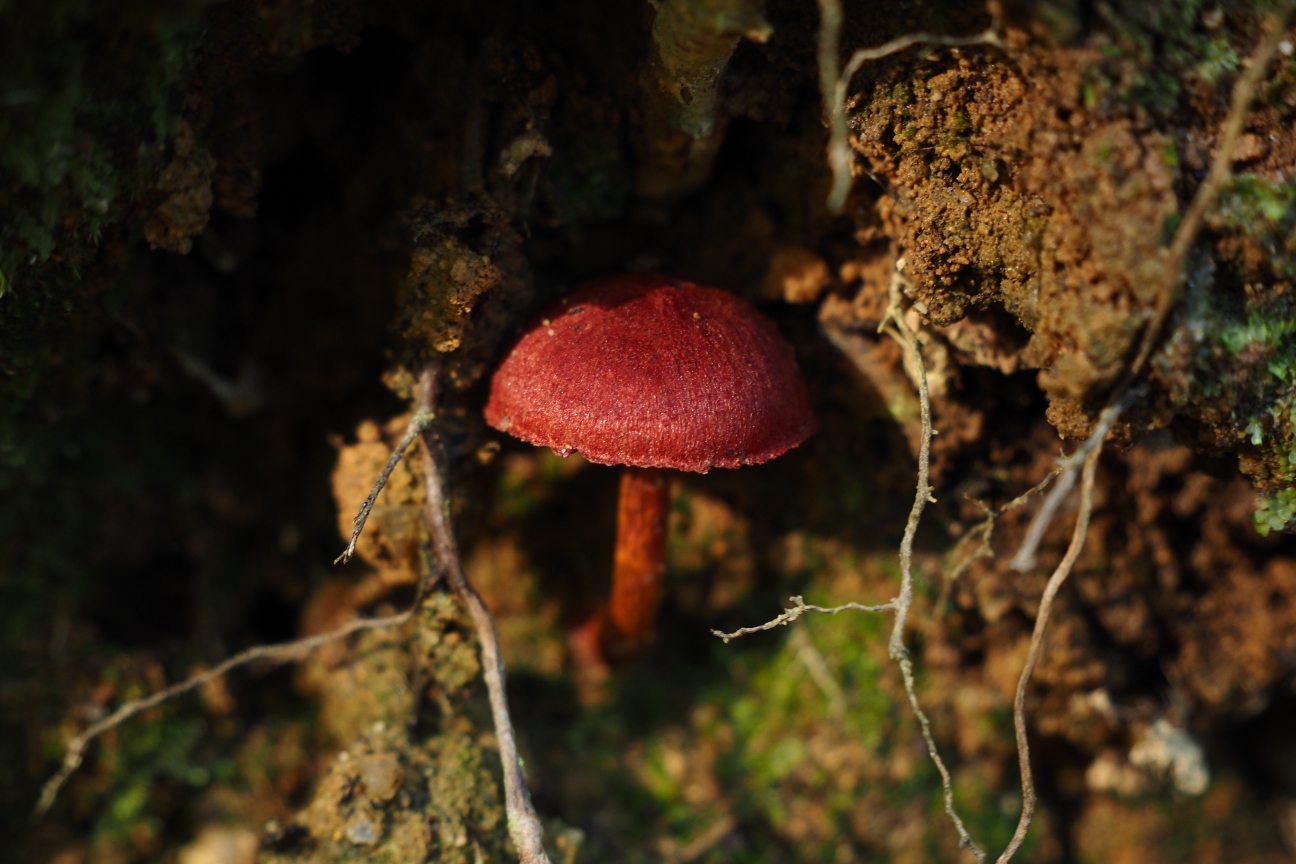
This gorgeous little red mushroom was growing from the exposed soil of the trackway. This isn’t a mushroom I can remember seeing before.
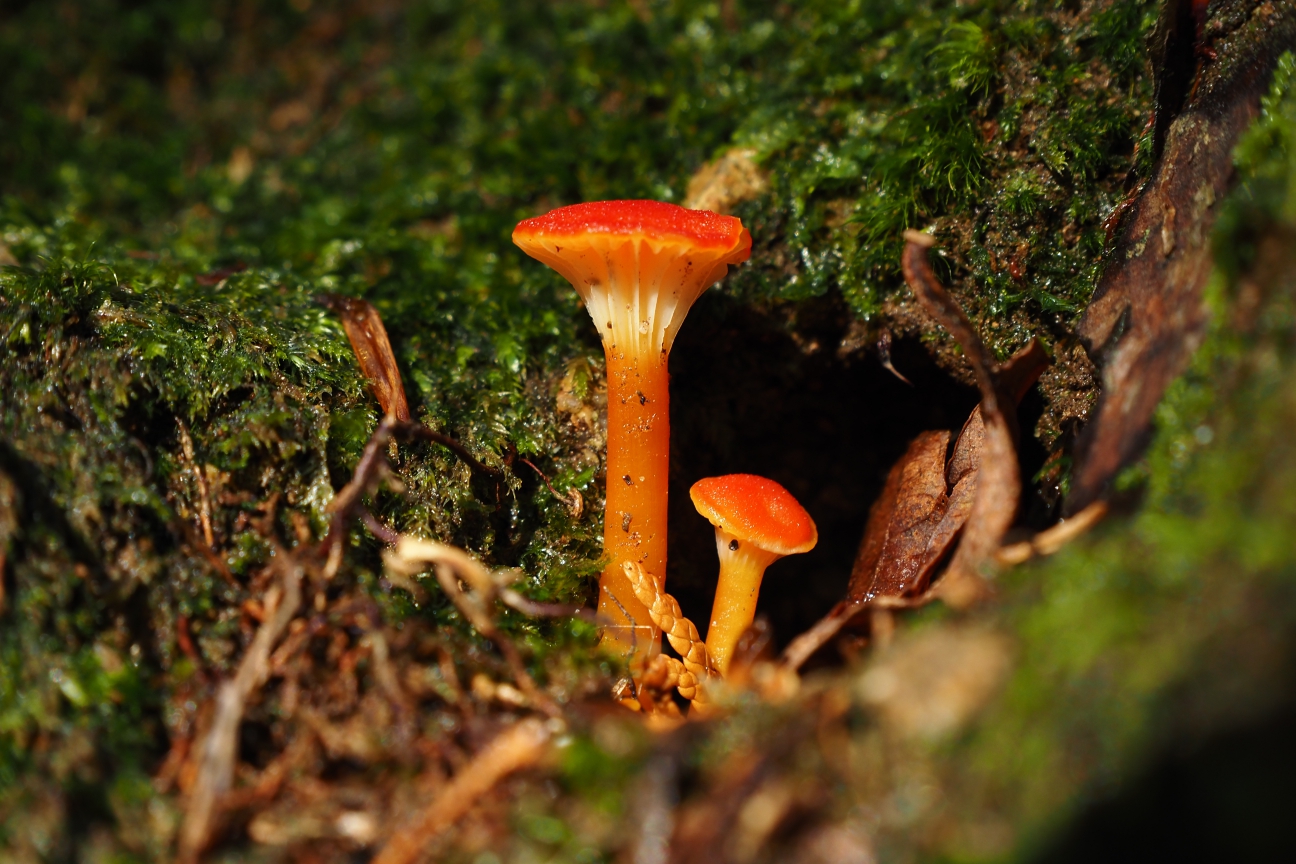
Now here is one I have managed to identify. These tiny red-orange mushrooms were growing from the same habitat as the unknown species before. These beauties are goblet waxcaps, looking like they’re standing on the threshhold.
The walk left the woods behind and broke out onto Dartmoor proper with its famous granite tors and expansive views.
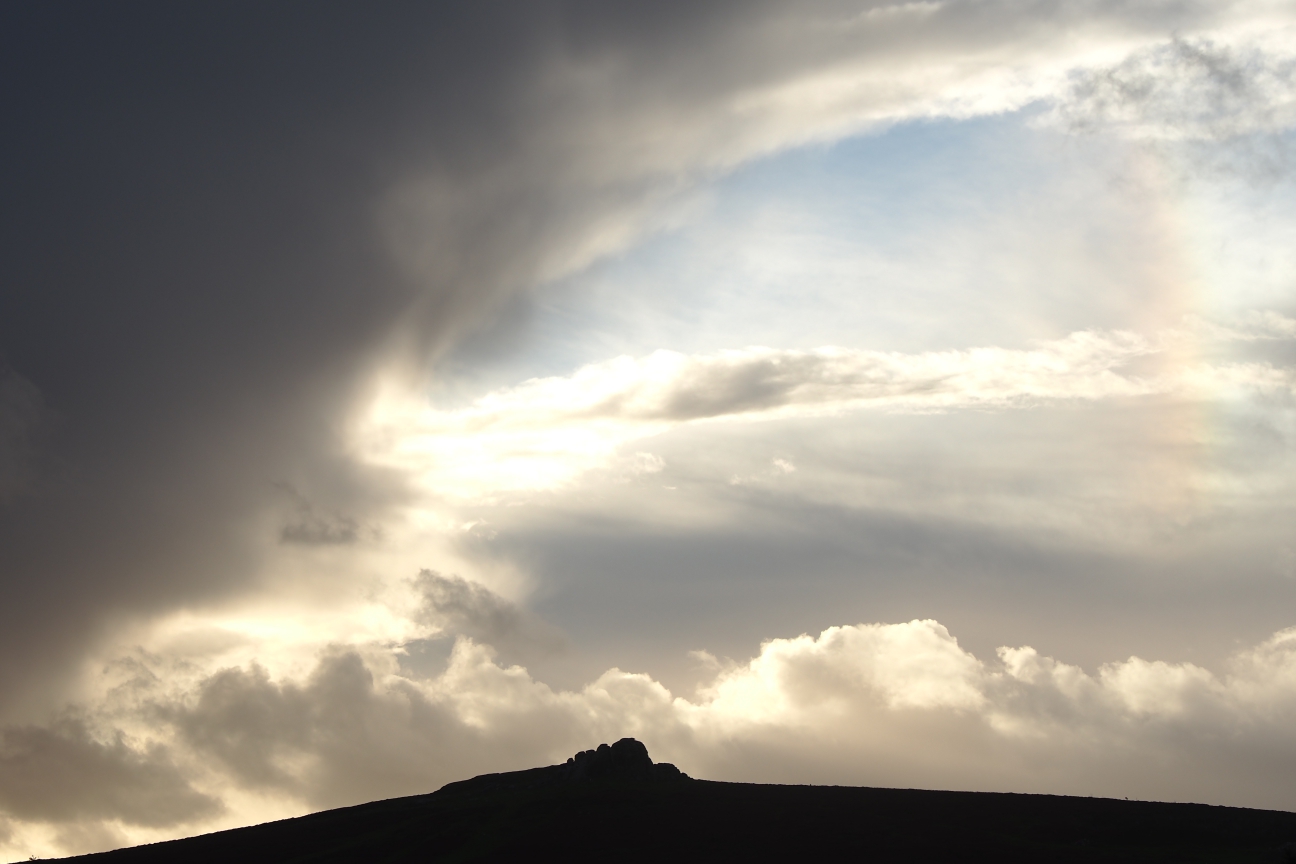
Haytor Rocks silhouetted against the wild skies often seen over Dartmoor.
Though the woods had been left behind, there was one final surprise as we descended through the farmland and hedgerows towards the National Park’s edge.
A tractor had been through to cut the hedges and road verges. In the process it had pulled up this stinkhorn mushroom. It wasn’t something you could miss. That was probably enough mushrooms for one day.
I’ve had a burst of American visitors in recent days (to my blog, not my house). So thanks for visiting, y’all, and sorry about the year you’ve had. You may have noticed I’ve slipped to monthly posts on here. Between April and October I posted blogs every Monday without pause, which is a tricky task…
At the end of October I spent three days in Dartmoor National Park (on Dartmoor). I saw so many mushrooms there that I have enough for a post to cover each day. It’s a relief to have some images and sightings to share after a barren period. The mushroom season has arrived very slowly but Devon never disappoints in the fungi department come autumn. I need to say thanks to my partner Rosie who found a lot of the things shown here, exercising her squirrel gene.
As is usual for me, the fungi search was part of walks rather than seeking out food for the pot. The photos were taken with an Olympus E-M5 MIII with a 12-45mm lens and no additional equipment.
For more info about each species just click through the hyperlink of the scientific name in brackets. As ever I’m happy to be corrected if I have a species ID wrong, hence why I use iNaturalist.
The first sign of peak mushroom season was a greenway with mossy hedgebanks and some smatterings of woodland. I’ve seen ceps (Boletus edulis) growing from mossy banks in Dartmoor before, also in Sussex, and it seems to be a favourable spot for them. I wonder if it’s part of their ectomycorhizal relationship with trees growing in those banks.
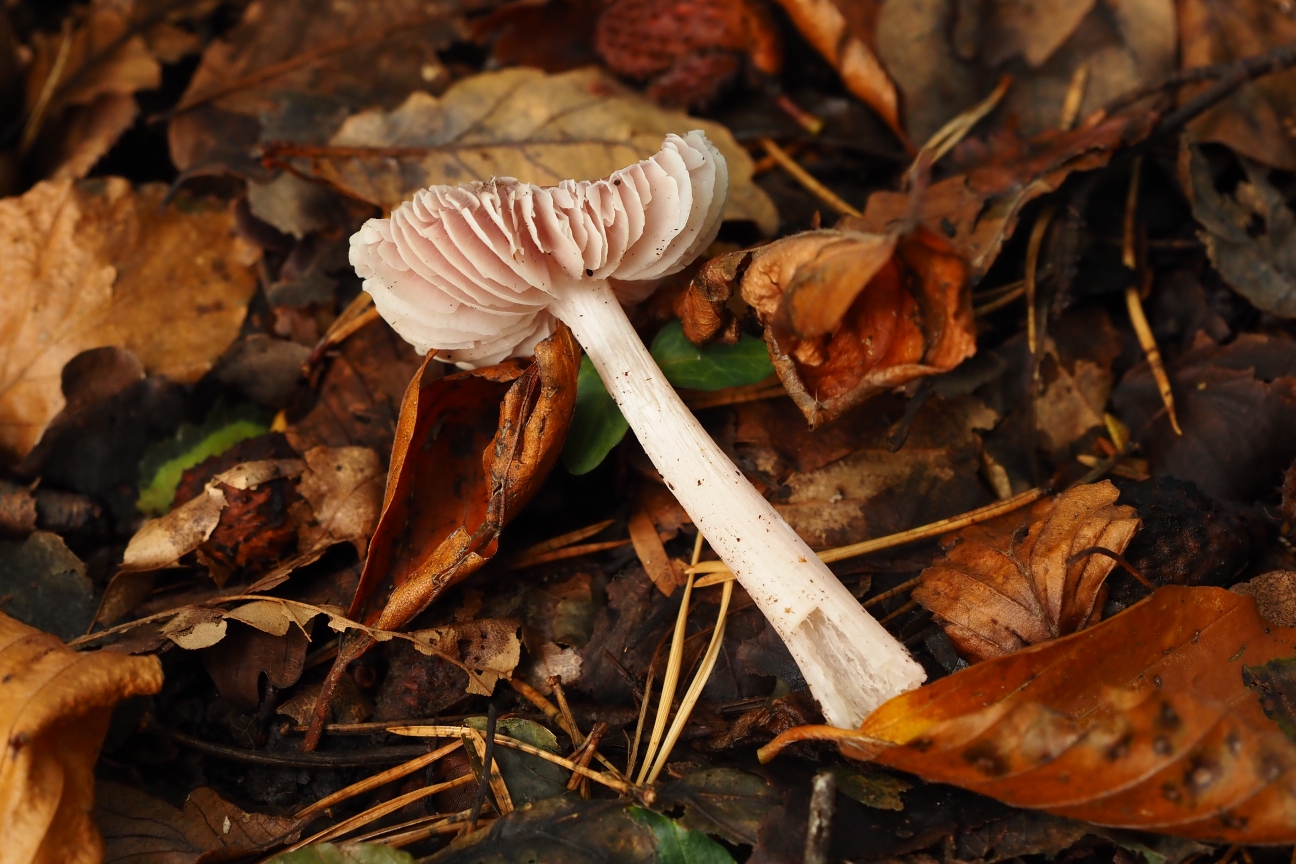
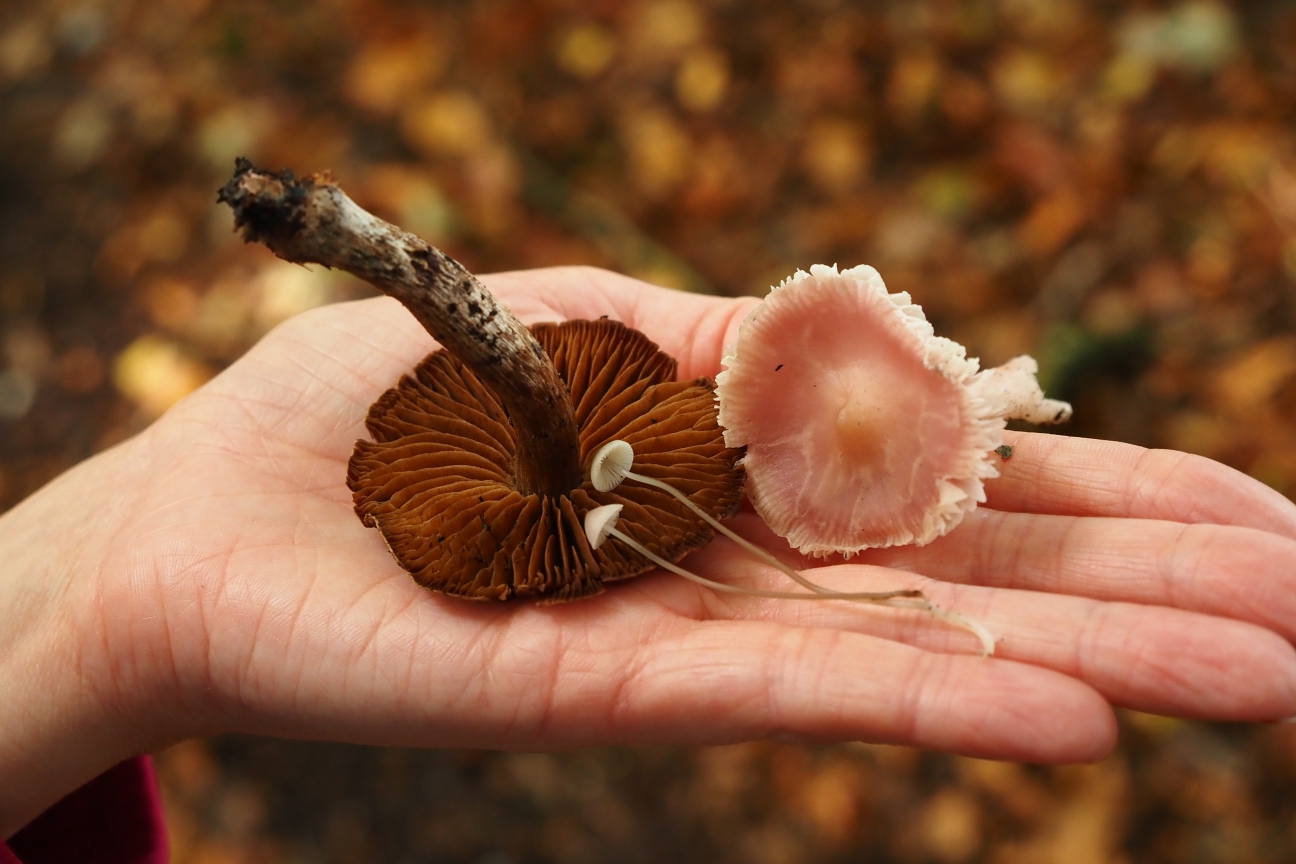
Close by in the leaf litter was a trio of pink mushrooms that I haven’t identified yet.
Here’s a nice collection that we found on the ground.
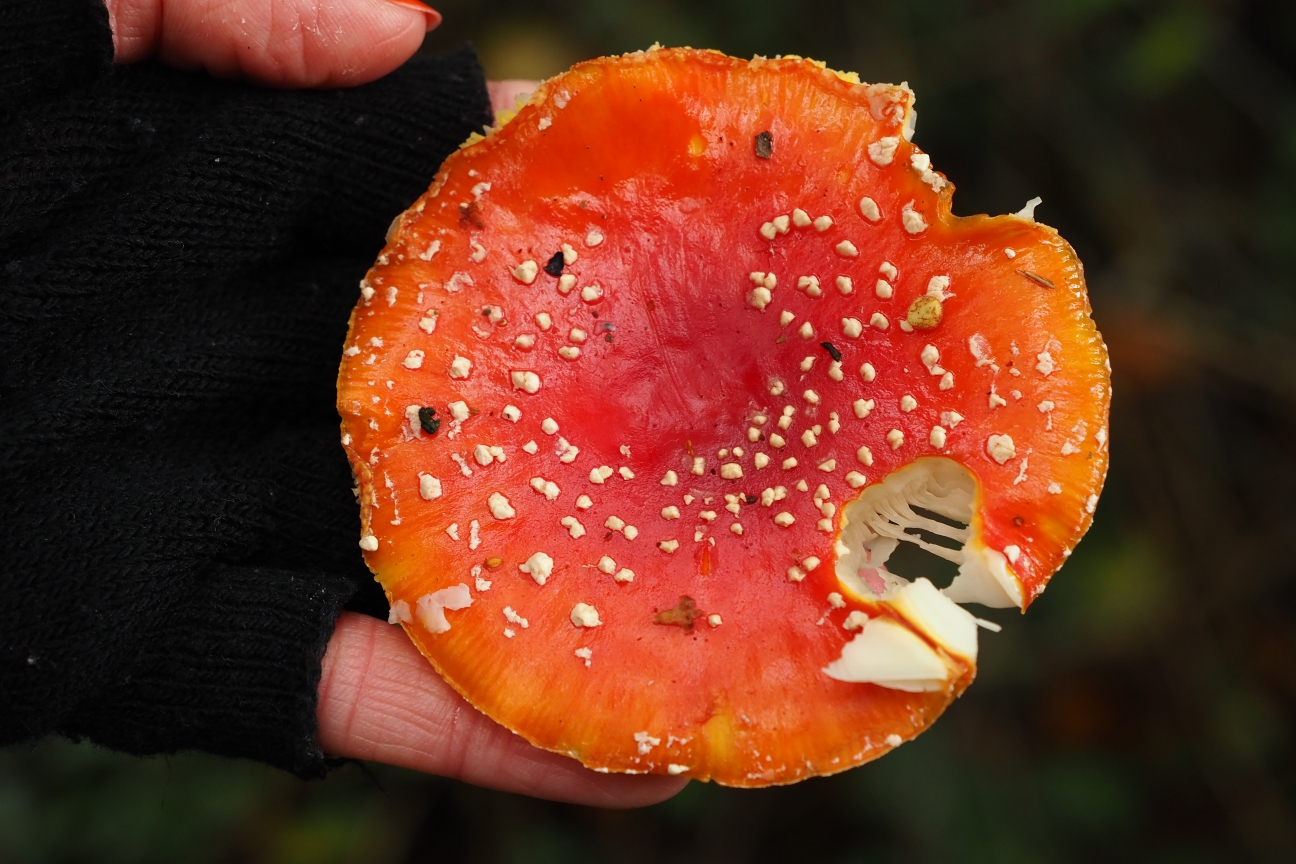
Dartmoor is a very birchy landscape in places which inevitably makes it a good place to find fly agaric (Amanita muscaria). I was listening to an episode of the Mushroom Hour podcast after this trip (as in, journey) which included quite a lot of discussion about fly agaric’s cultural place in mycophobic cultures such as Britain. Have a listen for yourself here.
The fly agarics we discovered were all well beyond their best, which I think is really around September before the October rain and first leaf fall. They are clearly edible for some animals.
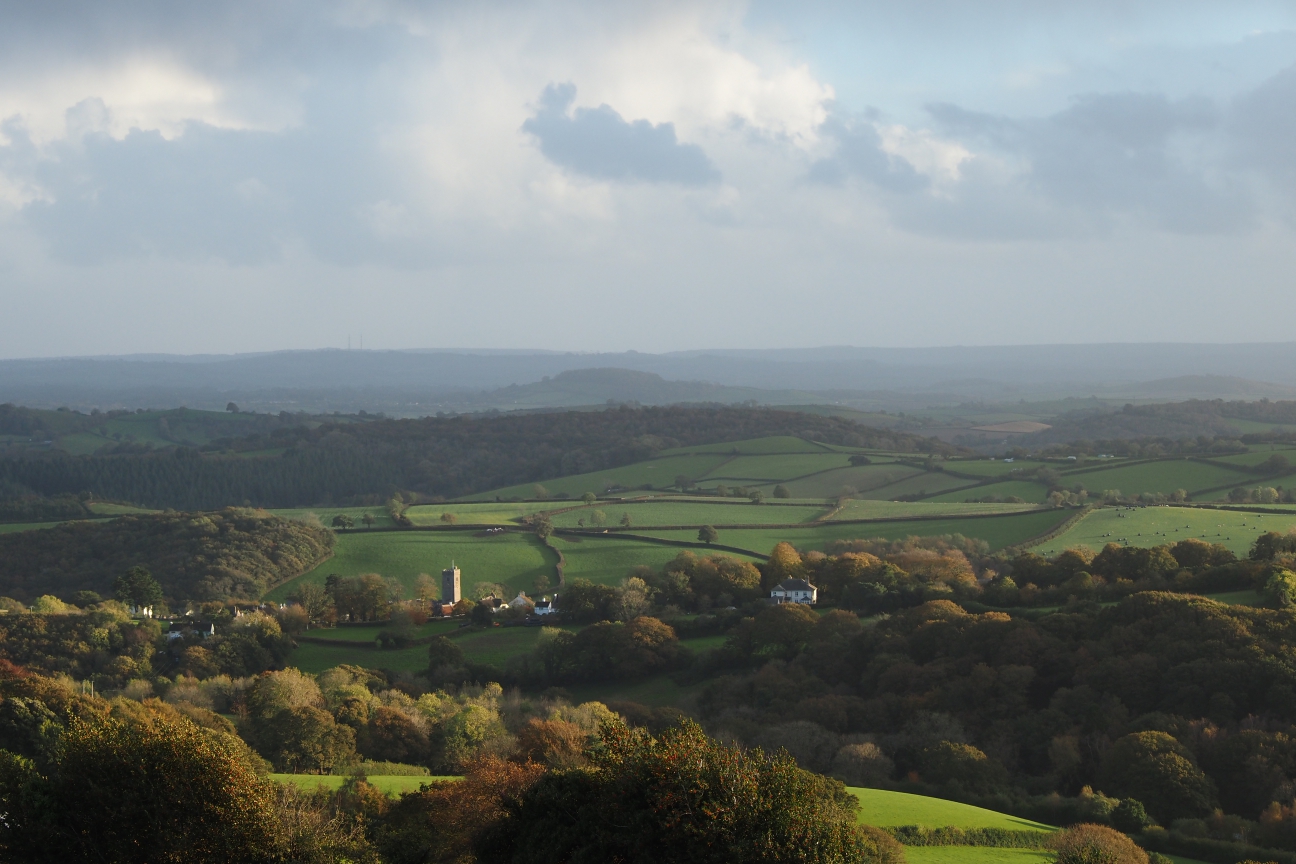
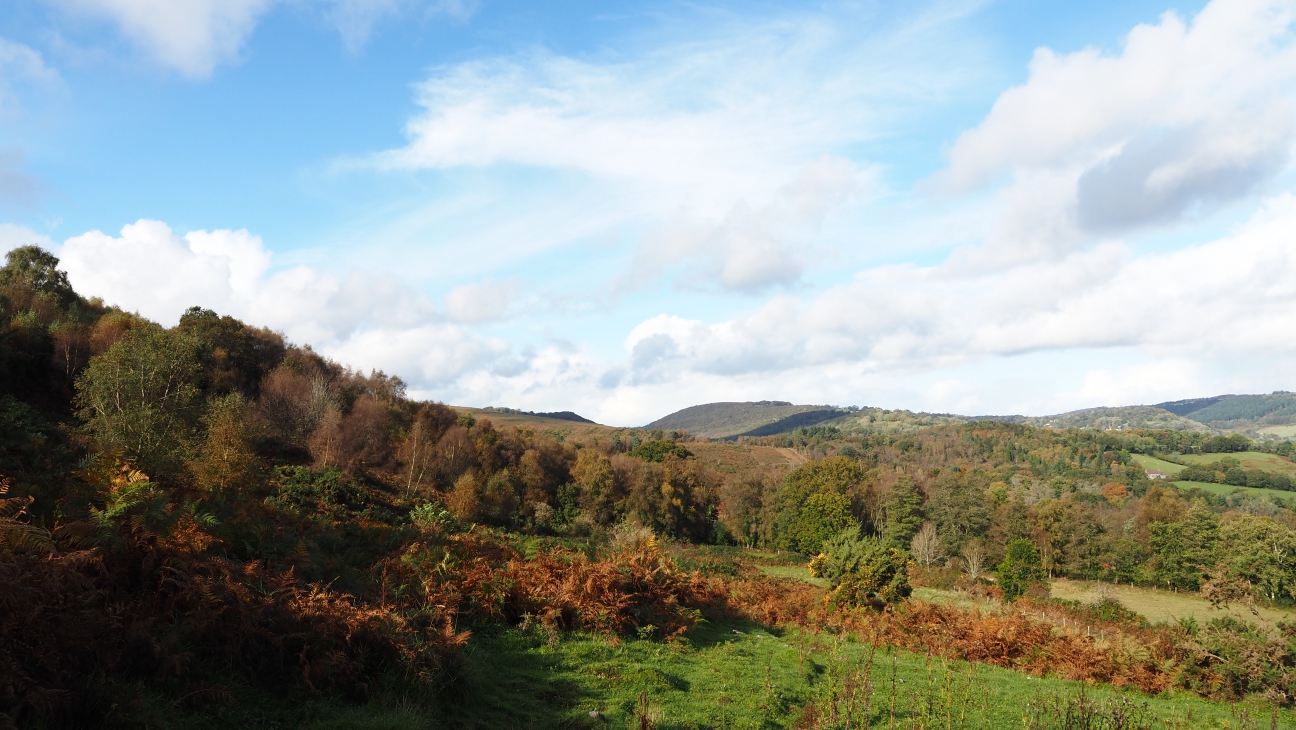
A scene from the wooded edge of Dartmoor’s eastern side. There are some fine woods around this part which will feature in the next post.
This was one of the nicer finds, what is probably golden scalycap (Pholiota arivella). It was a large spread at the base of a tree, where this group of mushrooms can often be found.
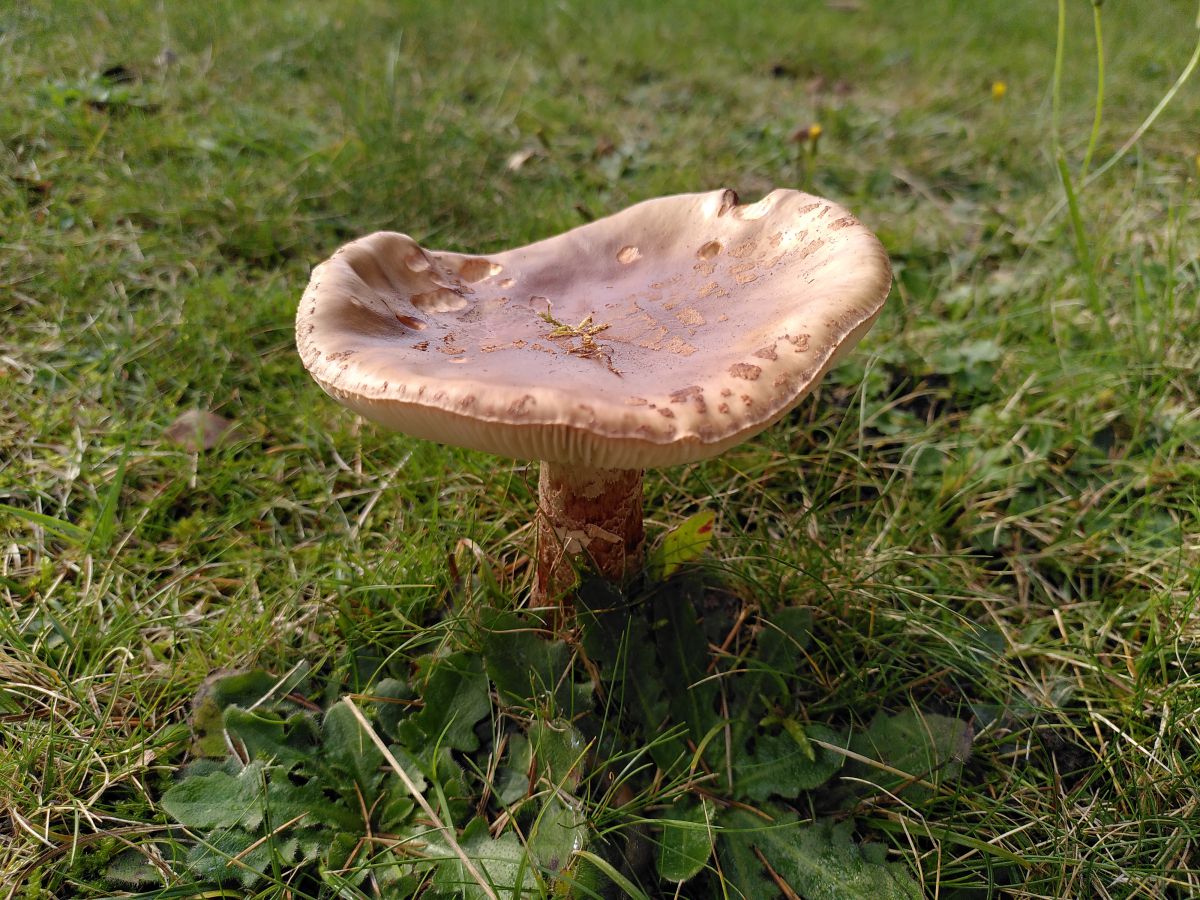
I’m not sure what species these leathery-brown mushrooms are but they were very attractive with that white trim to the cap.
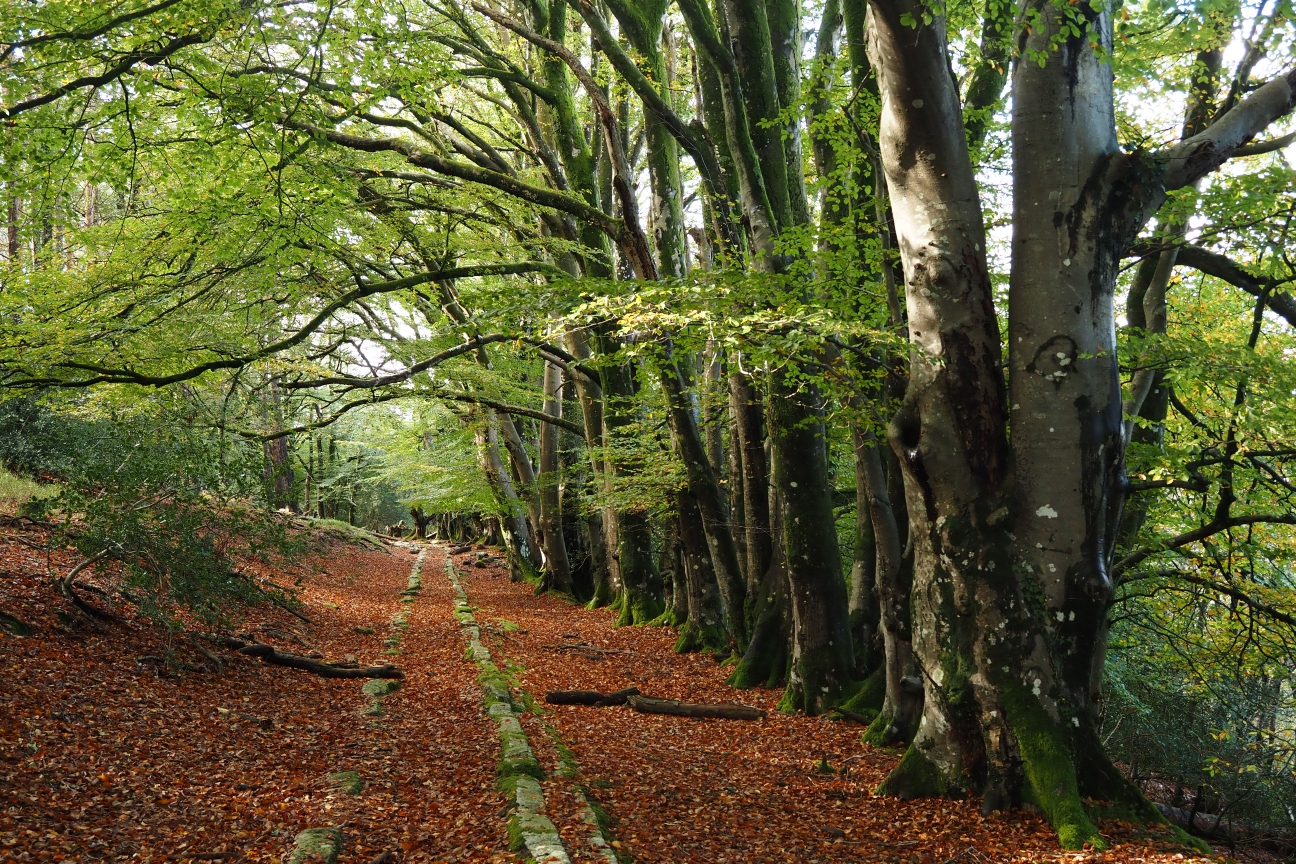
The walk encompassed part of the Templer Way, an old tramway used to transport granite quarried from nearby Haytor Rocks. You can read more about the Templer Way here. Stone from this area was used in the construction of a version of London Bridge and part of the British Museum. As seen above, beech is quite a common embankment planting on Dartmoor, presumably by the Victorians, and perhaps even at the same time that the Templer Way was being constructed.
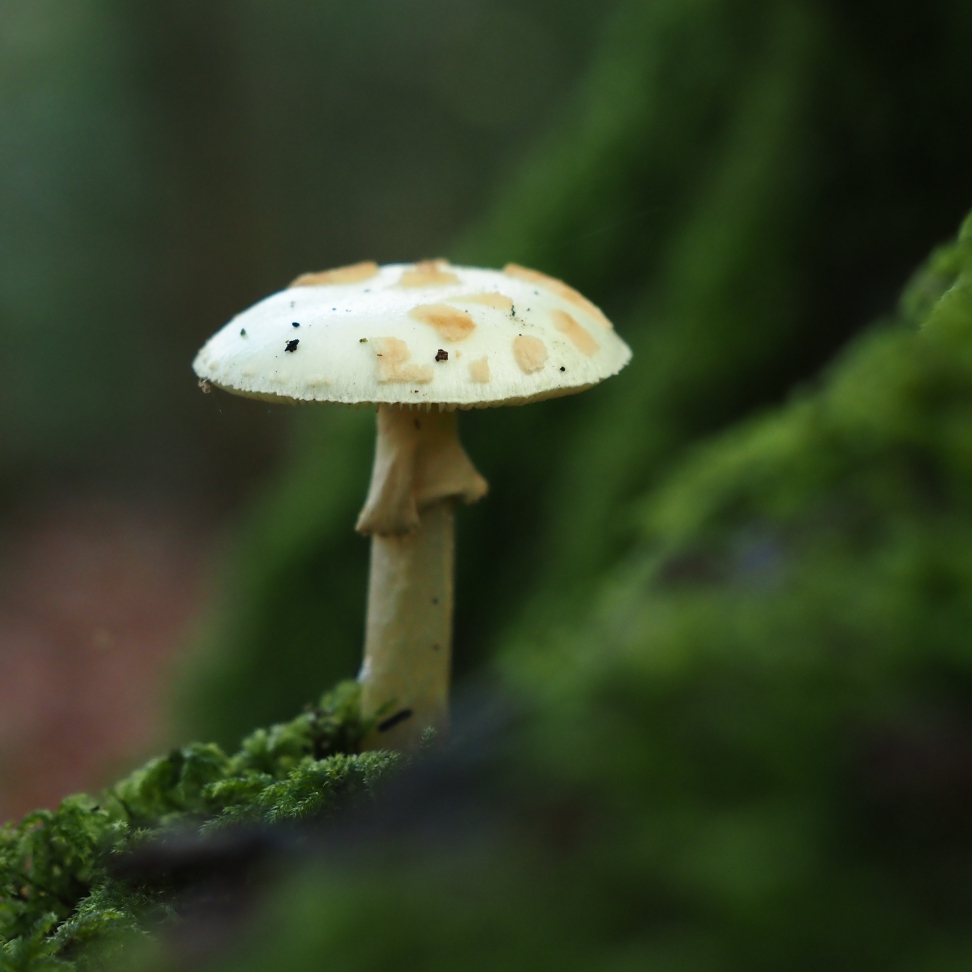
On the mossy bank (see a theme developing here) this false deathcap (Amanita citrina) had popped up. It can be distinguished from a deathcap by the remnants of the veil on the cap which make it look a little like a white fly agaric.
One species I haven’t seen much this year is porcelain fungus. There was one single fruiting body during this walk. This is a species almost always found on beech (Fagus sylvatica), even broken off bits of beech lying around can produce fruiting bodies.
On a large chunk of fallen beech wood this bracket fungus had grown. I’m not sure of the species. I’ve posted on iNaturalist to hopefully get an ID at some point.
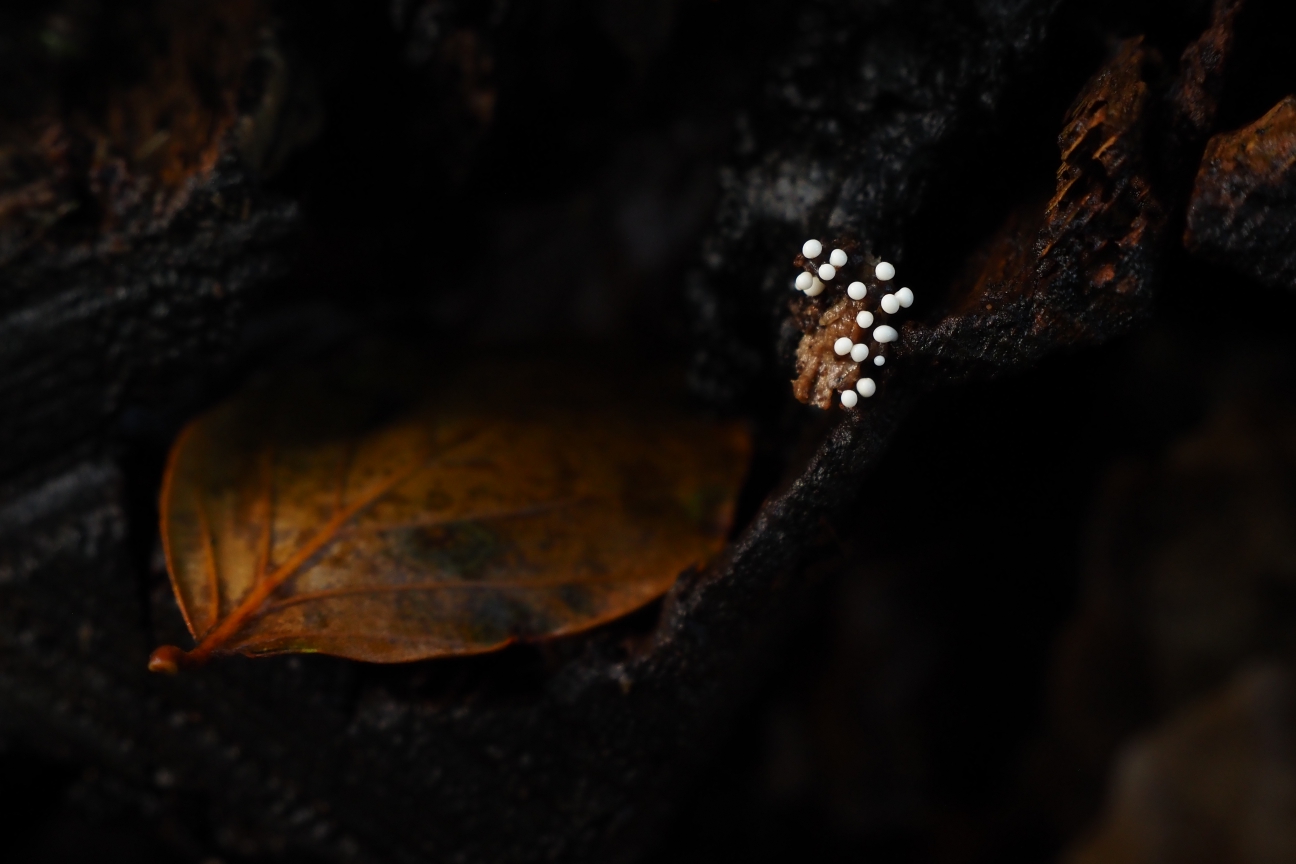
In the same beechy area there was some slime mould growing on some of the more wet fallen wood.
Here you can see the beech leaf for scale against the very small slime mould. I do like this composition and the colour of the leaf.
One funny thing was finding this stagshorn fungus (Calocera viscosa) growing from a gap in a bench. I was quite disturbed recently to find it’s scalled stagshorn rather than staghorn, as I had known it for such a long time.
I love how this fungus looks like a little animated fire burning.
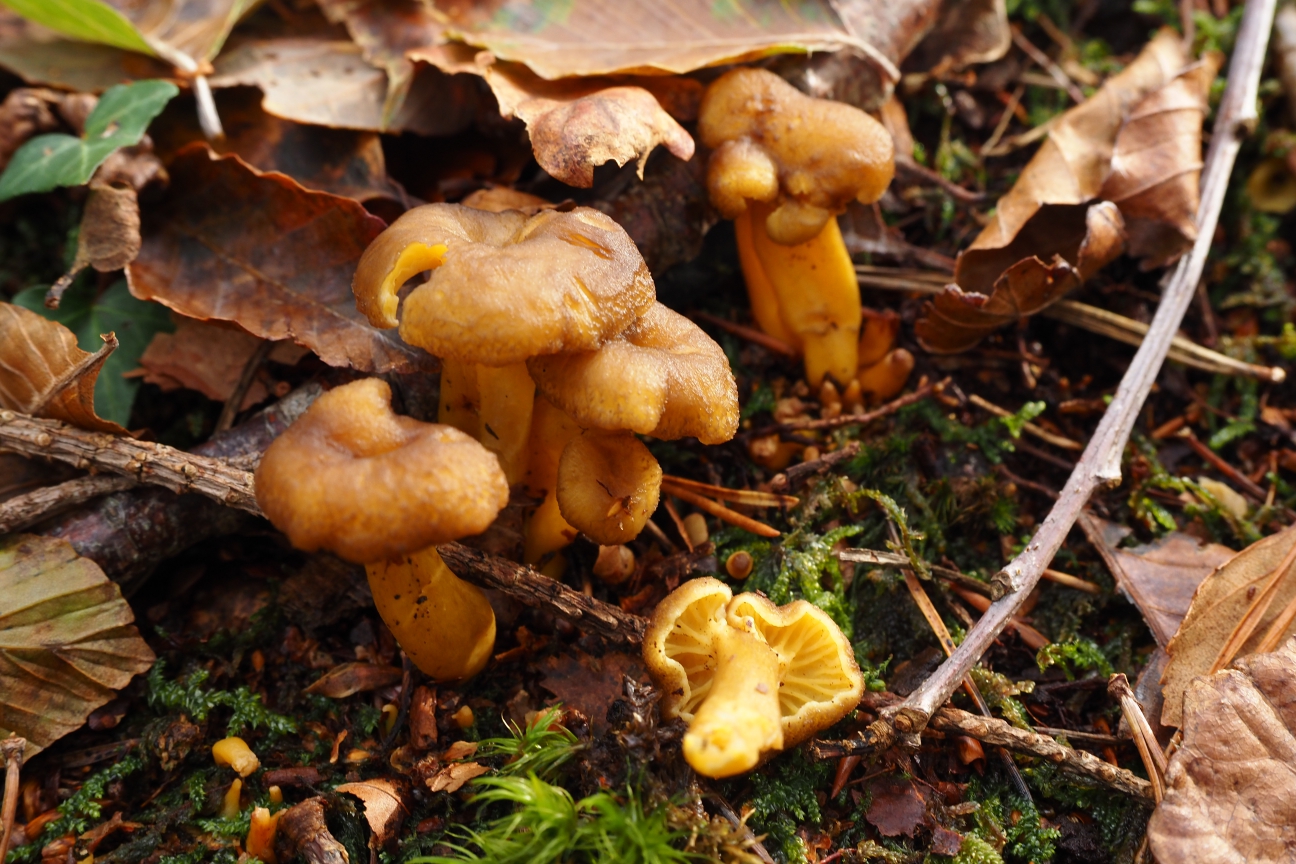
A distance away from the previous location I found the largest community of chantarelles I’ve stumbled upon. I’m not entirely sure if they’re two different species but some of them looked to me to be trumpet chantarelles (Craterellus tubeiformis). Again, nothing was picked and everything seen here had already been upturned.
I couldn’t resist a photo of these very photogenic glistening inkcaps (Coprinellus micaceus). The sheer dominance of moss on Dartmoor shows how wet the landscape is here.
Rosie managed to find a more complete fly agaric, but still with plenty of chewing done already.
There are many, many mushrooms I see that I’m not able to name. This will go down in that category, possibly forever.
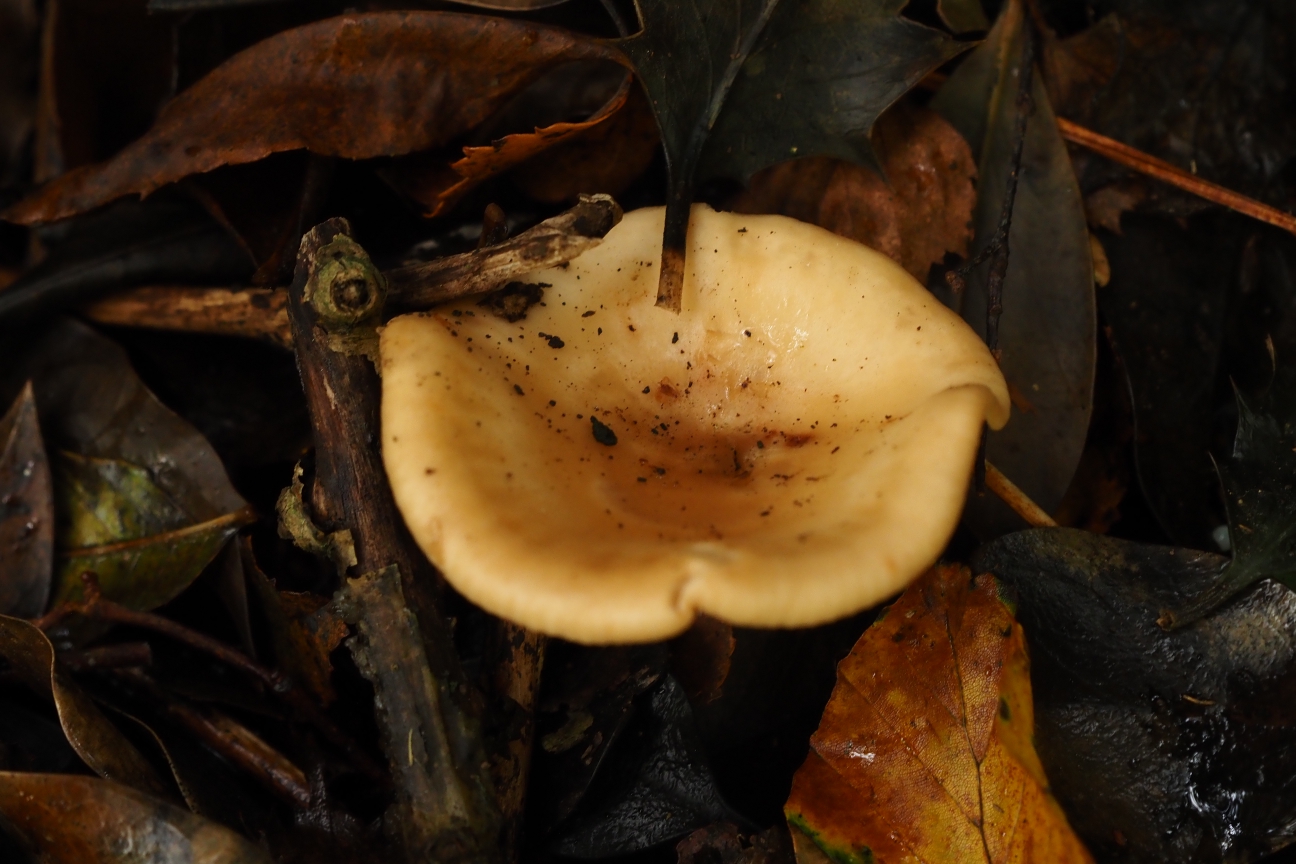
After hiding from an unexpected, torrential downpour we hid under some holly trees where these mushrooms were growing. I think they’re a species of funnel (Clitocybe) but I don’t know.
Sulphur tuft (Hypholoma fasciculare) was at almost every location where other mushrooms were fruiting. It is possibly the most common fungus I encounter, especially in woodland. This was a lovely scene and no surprise that this mushroom was making a home there.
The weather really turned after this point when we reached the moor proper. You can see from the image above how unsettled the weather often is on Dartmoor. Haytor rocks can be seen to the right of the image.
The final mushrooms of the walk were found along the green lanes near the edge of the National Park boundary.
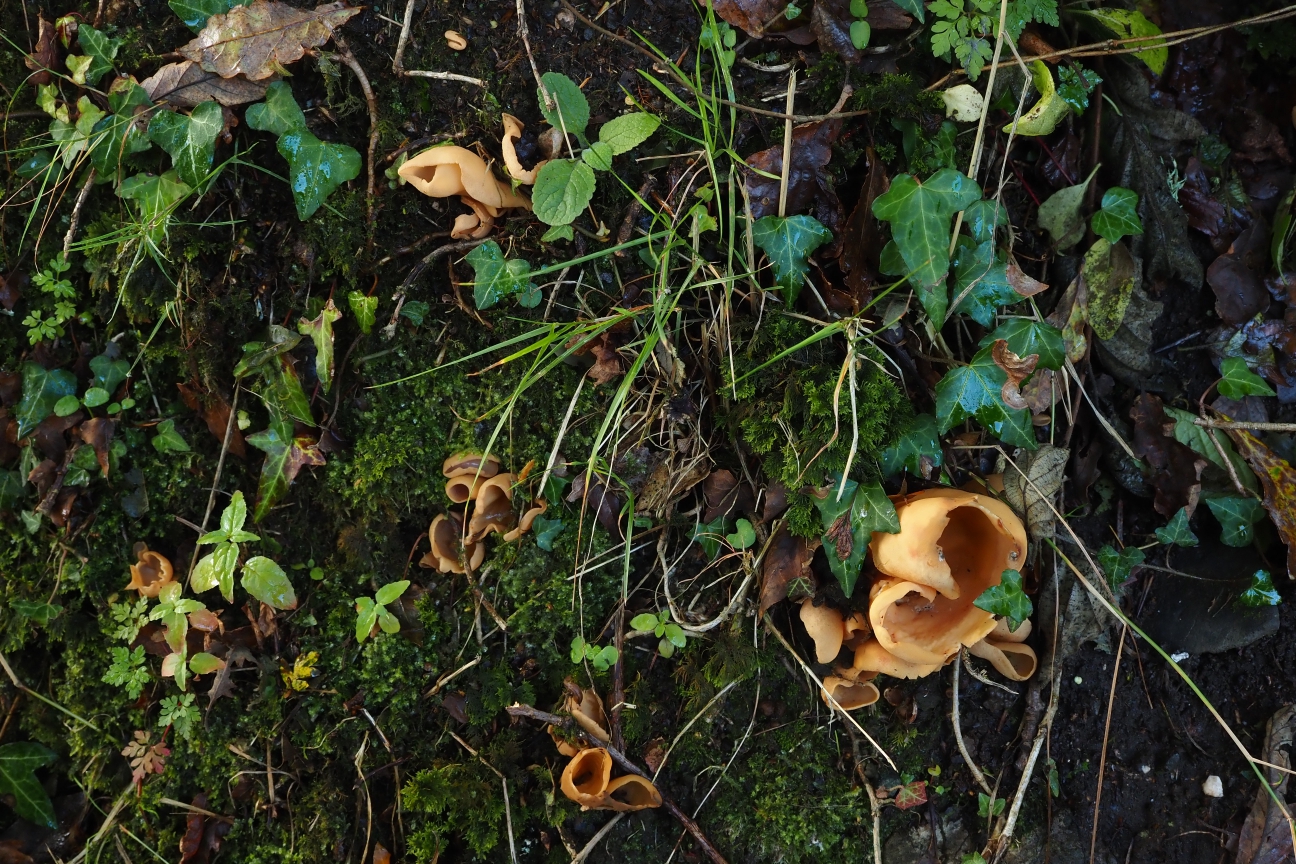
I’ve been meaning to write about the diversity of trees and plants in Dartmoor hedgebanks for years, but I hadn’t really considered their fungi. Above is an ascomycete fungus, a cup fungus. It’s probably hare’s ear (Otidea onotica).
This absolute bruiser of a mushroom is probably a pestle puffball (Lycoperdon excipuliforme). Usually it grows vertically from the soil but in this case was protruding at an exactly horizontal angle from the hedgebank.
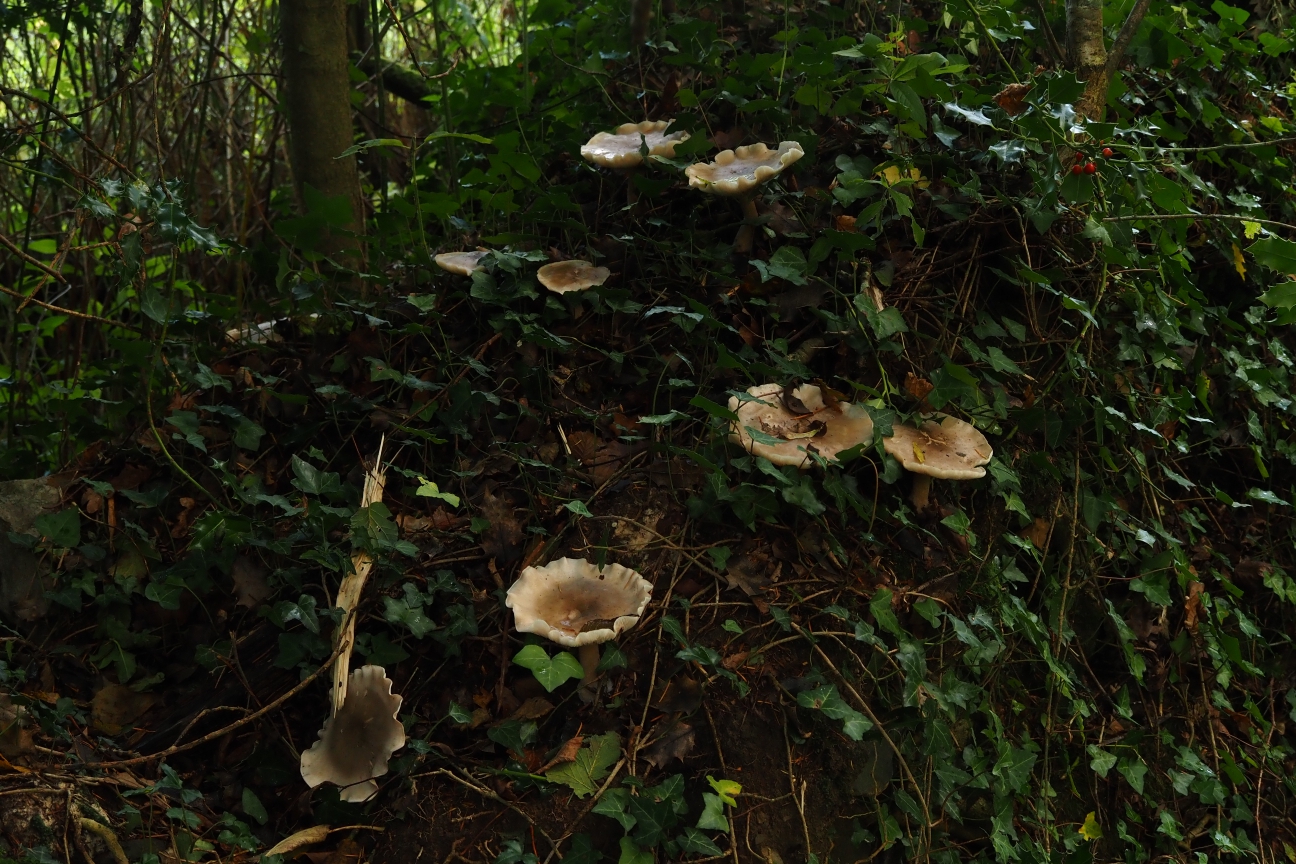
As darkness fell, there was one final opportunity to see the mushrooms before night fell. This was the evening of the clocks going back one hour. The mushrooms above are clouded funnel, a common and fairly easy to identify fungus that grows in a group. It gets its common English name from the cloudy shading on their caps.
Thanks for reading. Stay tuned for episode two of ‘3 days on Dartmoor’.
Here’s my seasonal update of stuff you don’t need to know about, but then welcome to the Internet. What I’m writing Soon I will be self-publishing my third poetry collection, Fool’s Wood. It’s seven years since my last one and this collection has taken longer because of LIFE. There will be a booklet and also…
Here’s another entry in my slow-blogging Oak Timbers series. You can view my galleries and posts archive here. I visited Salisbury in Wiltshire (south-west England) for the first time in 2023 and was really charmed by the place. If you’re interested in this kind of thing, Salisbury is the place for you. Here’s a gallery…
I’m getting into more of a routine of recording and editing audio, so here is the latest episode of Unlocking Landscapes. Listen on Podbean or via the usual platforms. Also via YouTube: https://youtu.be/y1K9Pqx68to?si=B-Fdhf3sdDH35Z8w Following on from July’s rather optimistic fungi walk, I popped back to the same area of ancient Wealden woodland to see if…
Dartmoor is renowned for its moorland and rocky hillscape in Devon, south-west England. It’s famous for its graphite outcrops or ‘tors’ which dot the landscape. It’s a very wet place, another reason why it’s so boggy. All in all a tremendous place for lichens and other moisture-loving organisms like mosses.
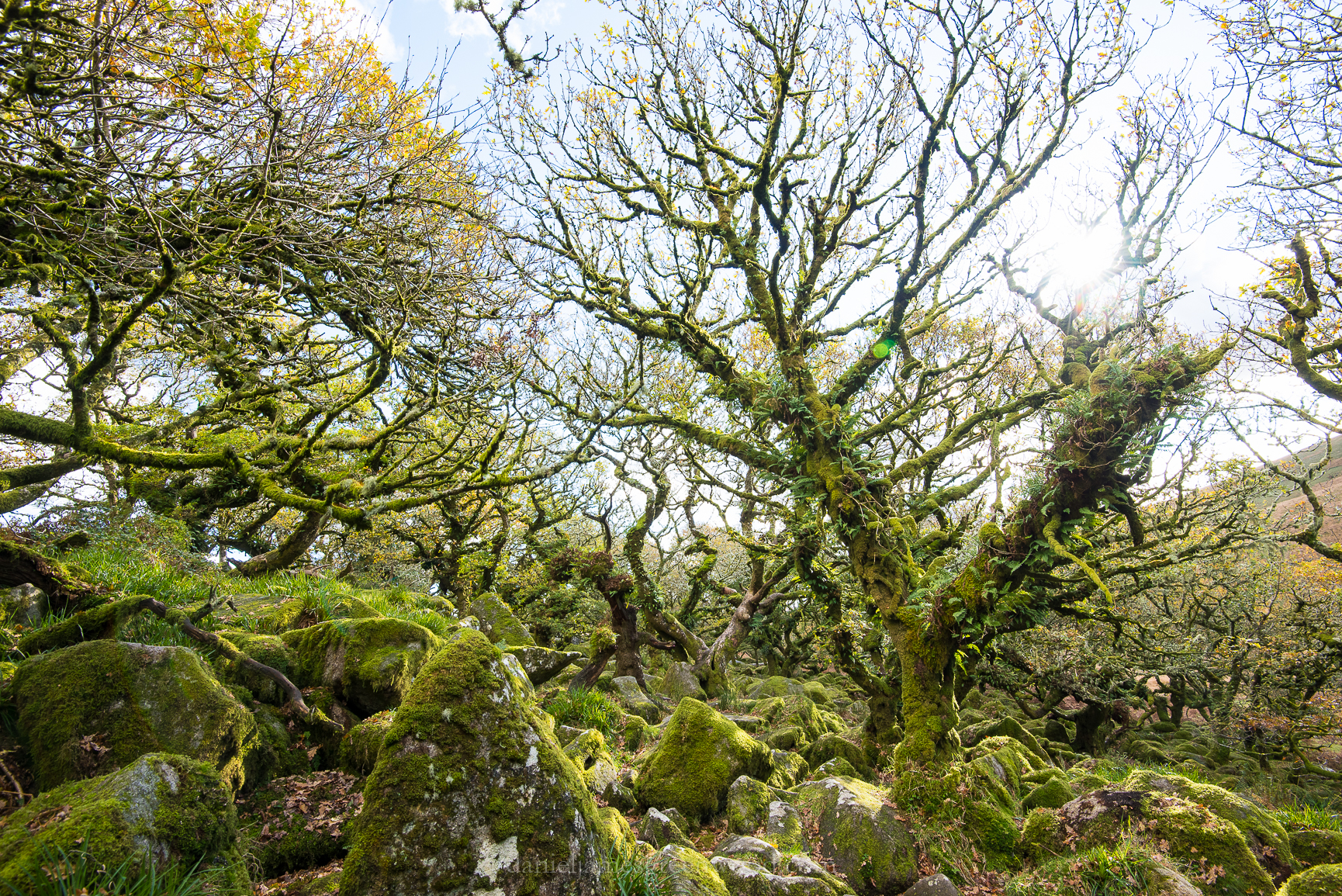
One of the most famous places in Dartmoor is a small area of woodland called Wistman’s Wood, a National Nature Reserve near Postbridge. This well-loved wood is home to scraggly oaks dripping in moss and lichen. These are also exceptional places for lichens. The wood itself is known for its misty scenes, with the trees clinging on to the moisture in the air. That is only a good thing for lichens and mosses.
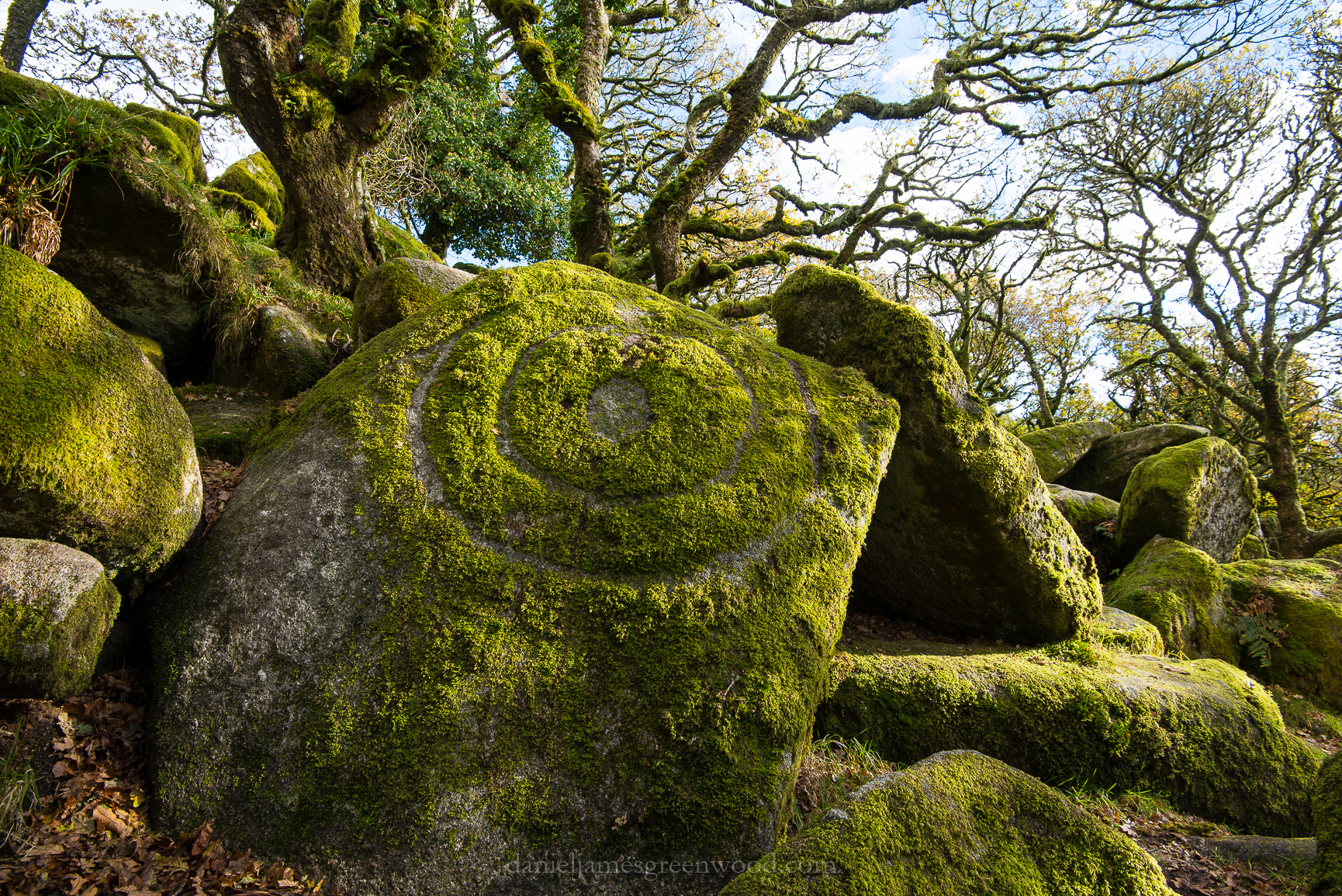
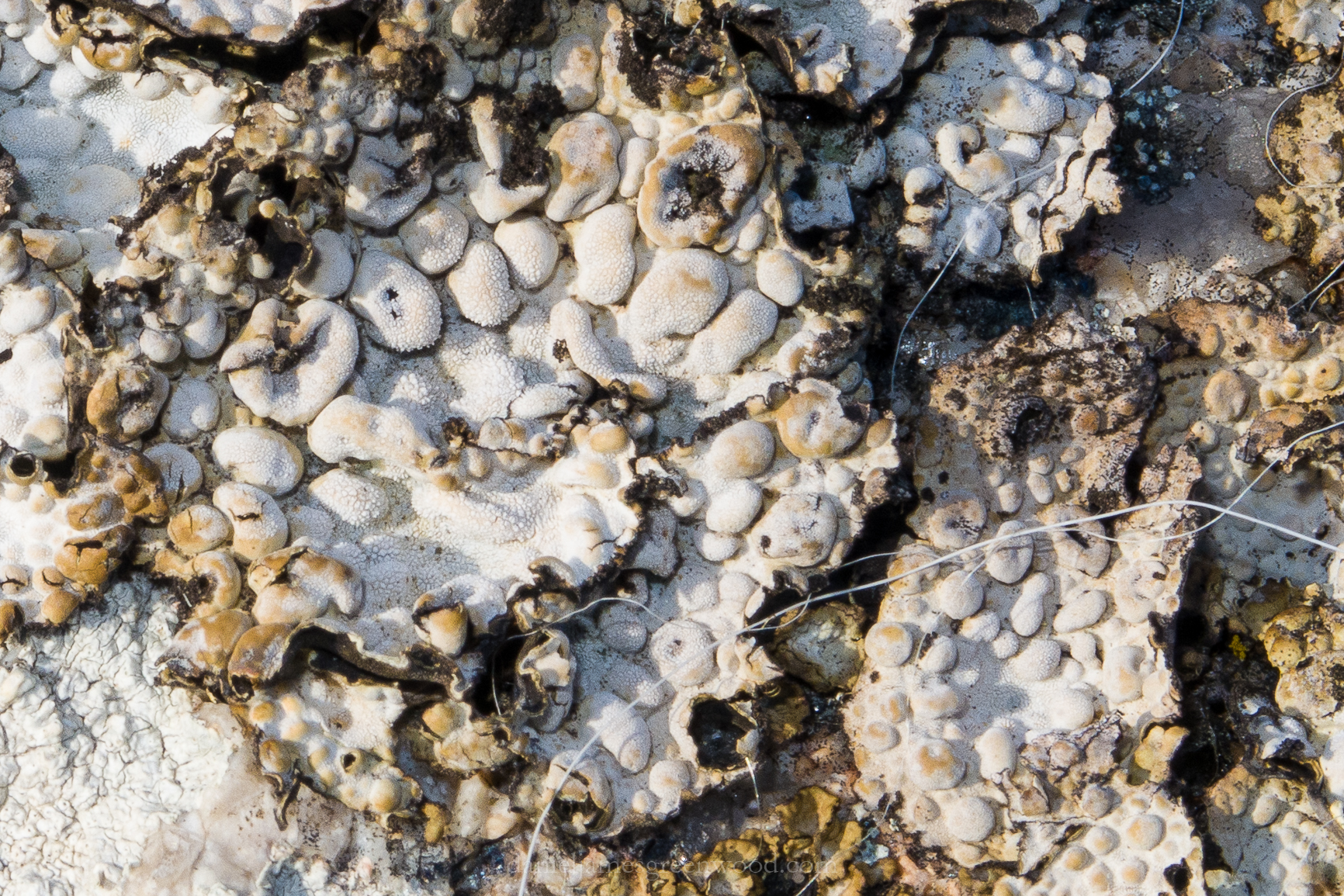
This bubbly-looking boulder lichen was growing on the approach to Wistman’s Wood. The threads in the lower right-hand part of the image are hairs from sheep or cattle which have squeezed past the rock.
Another boulder held a spidery community of foliose (leafy) lichens.
Mandarin duck with ducklings
Here is a rather nice example of a lichen-covered boulder in the river Dart. This is a female mandarin with her ducklings. This was in June and while rain isn’t unusual in Dartmoor in summer, you can see it has been warmer around the time of the photo because the mosses are blackened and dessicated.
Wistman’s Wood
The lichens in woodland like Wistman’s are found on rocky substrates and the branches of the trees. It’s interesting that these boulders are at great density in this woodland but not the same in the wider landscape. That is probably because the wider landscape has been cleared of woodland and then the boulders left behind, for livestock grazing. Woodland was cleared from Dartmoor long ago, mainly during the Bronze Age, from what I know.
This photo won’t display in portrait, but it’s an oak trunk covered in epiphytes – lichens, mosses and ferns coating the bark. This is the British and Irish equivalent of rainforest, or Atlantic oak woodland.
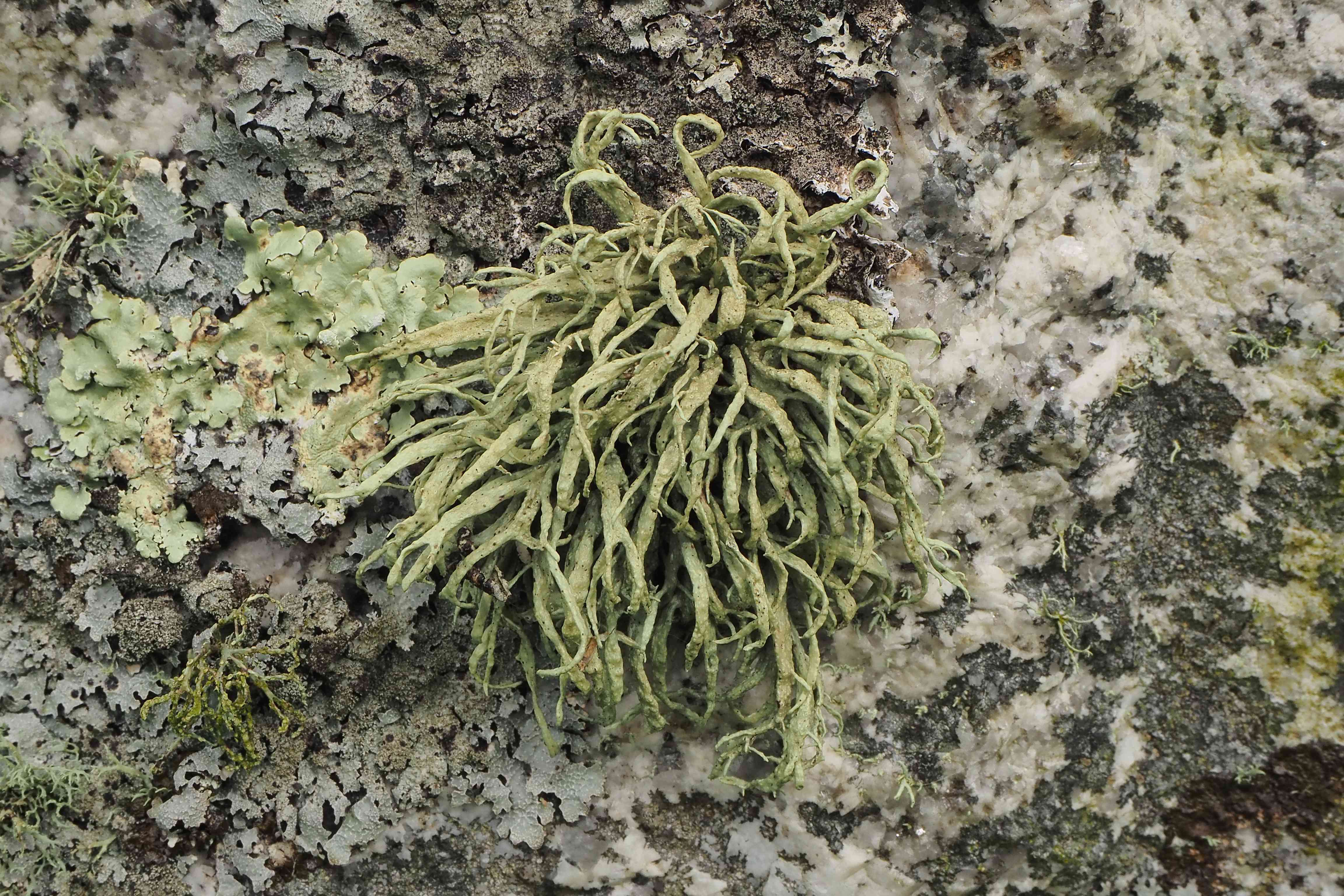
Dartmoor’s oak branches are rich in beard lichens, I think this is a species of usnea.
Some of the less flamboyant lichens, but probably more common, are these pore lichens. I think pore lichen is an American name, which isn’t used in Britain. I don’t really care and am always frustrated with the rigidity by which species recorders approach these issues. We need common names to encourage more interest in nature. I know Tyrannosaurus rex is a popular name, but Latin names do not capture the imagination in the way that common names do. Stinkhorn, anyone?
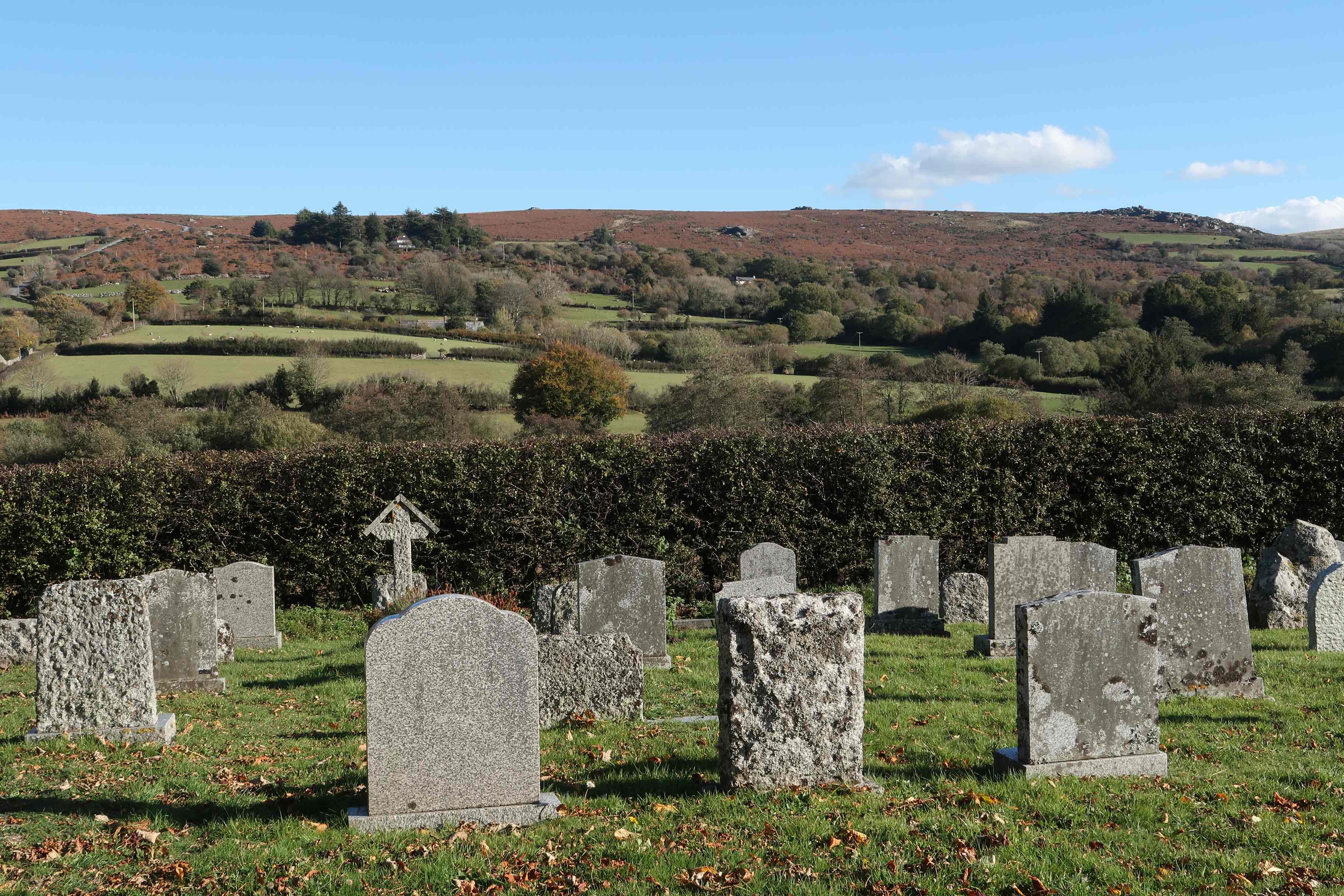
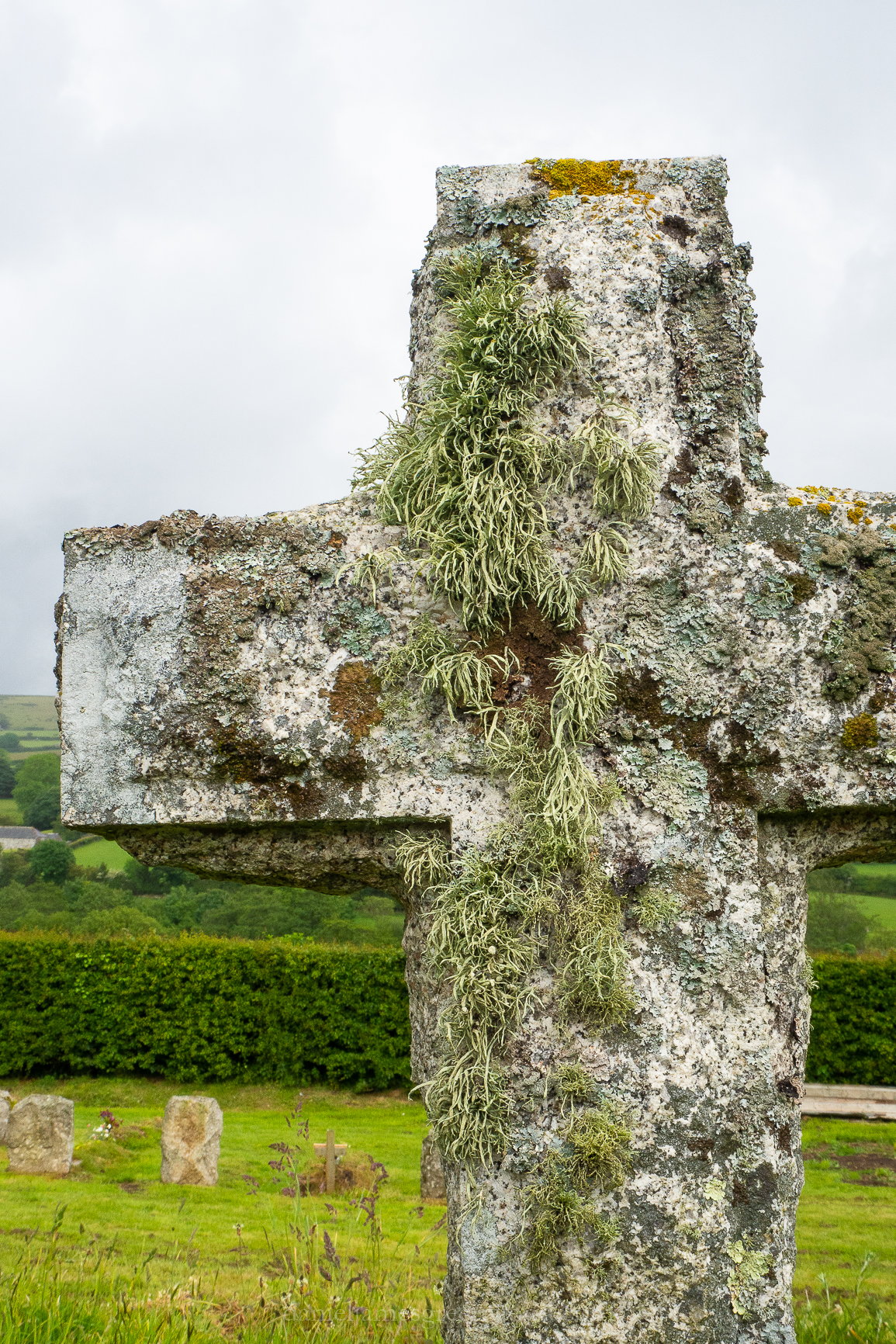
As someone who grew up in a city, cemeteries were some of the first places I began to notice wildlife. I think they are special places also because their atmosphere is so different to the rest of the built-upon or managed landscape. At Widecombe-in-the-Moor, there is one of the best lichen cemeteries I know. Not that they’re dead, they’re well and truly alive and kicking.
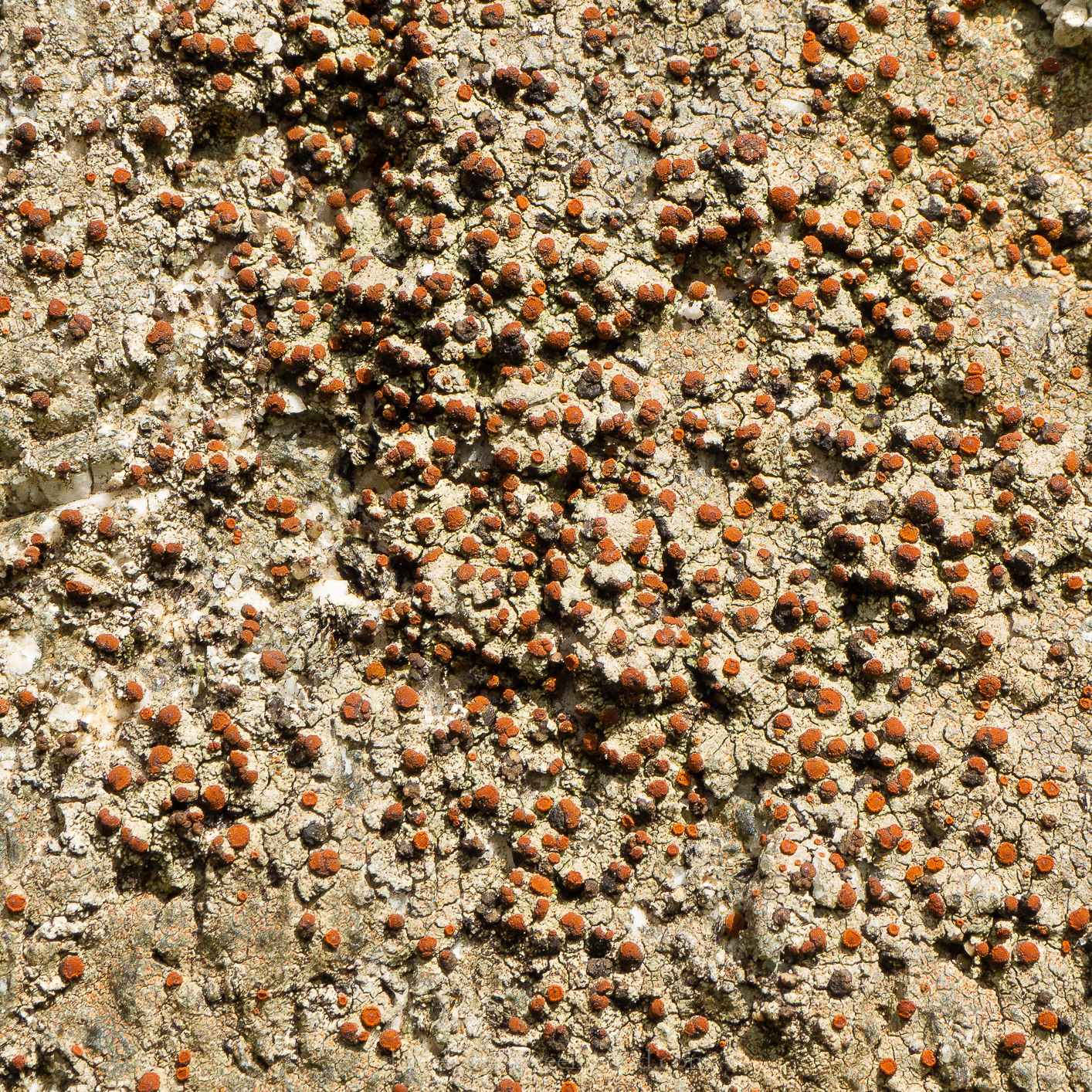
This cross is a dream. There are foliose and crustose lichens, and it hasn’t been tidied up by the cemetery managers (I don’t. The air quality is also excellent in this area, allowing for more species to find a place to live. Below is a selection of the species I found growing on gravestones in this cemetery:
I couldn’t let this woodlouse get away without being included along with these frosty fruiting cups.
Above is a really cool insect, a downlooker snipefly! I’ve also found this species on lichen-encrusted boulders in Western Ireland, a similar climate and landscape type.
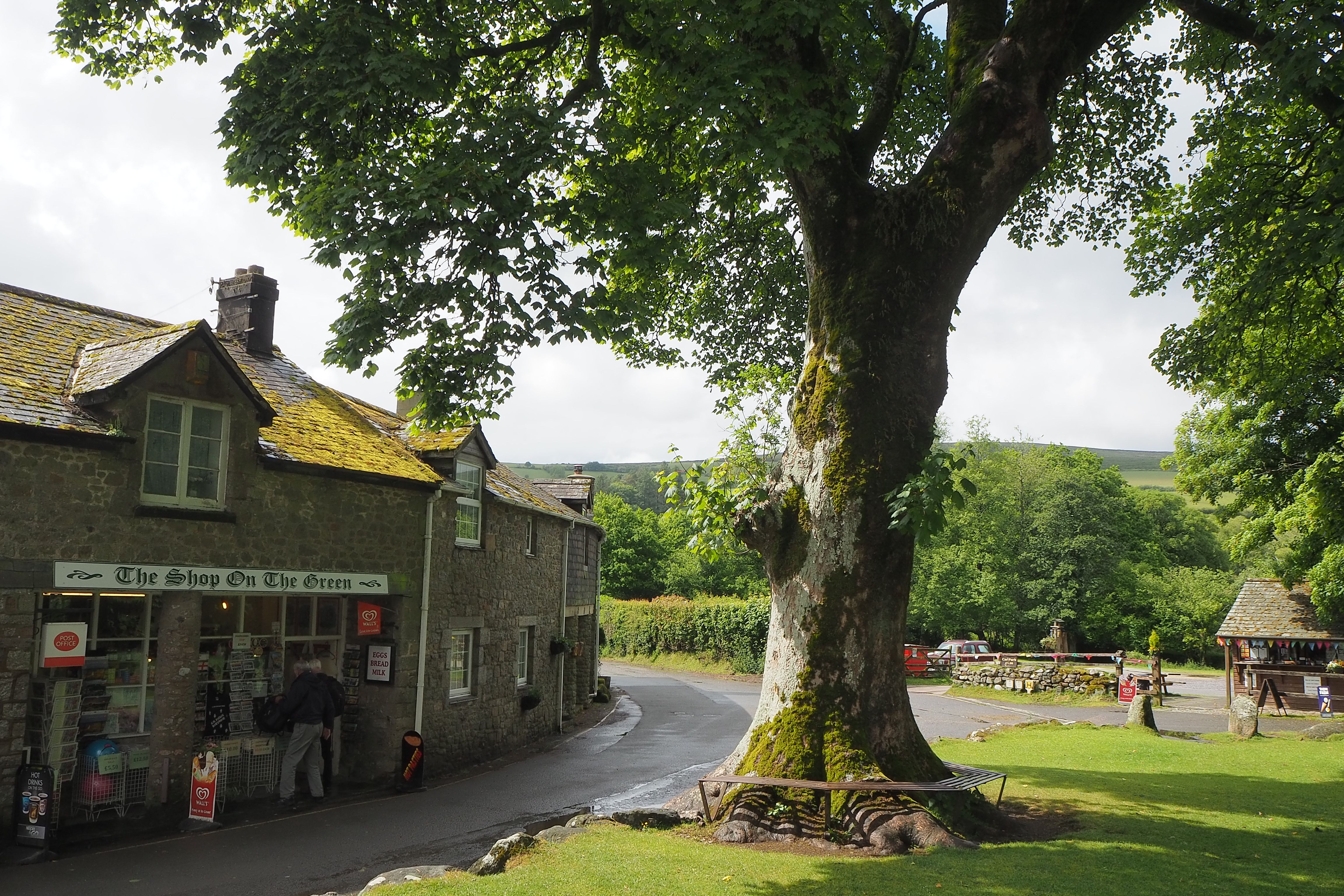
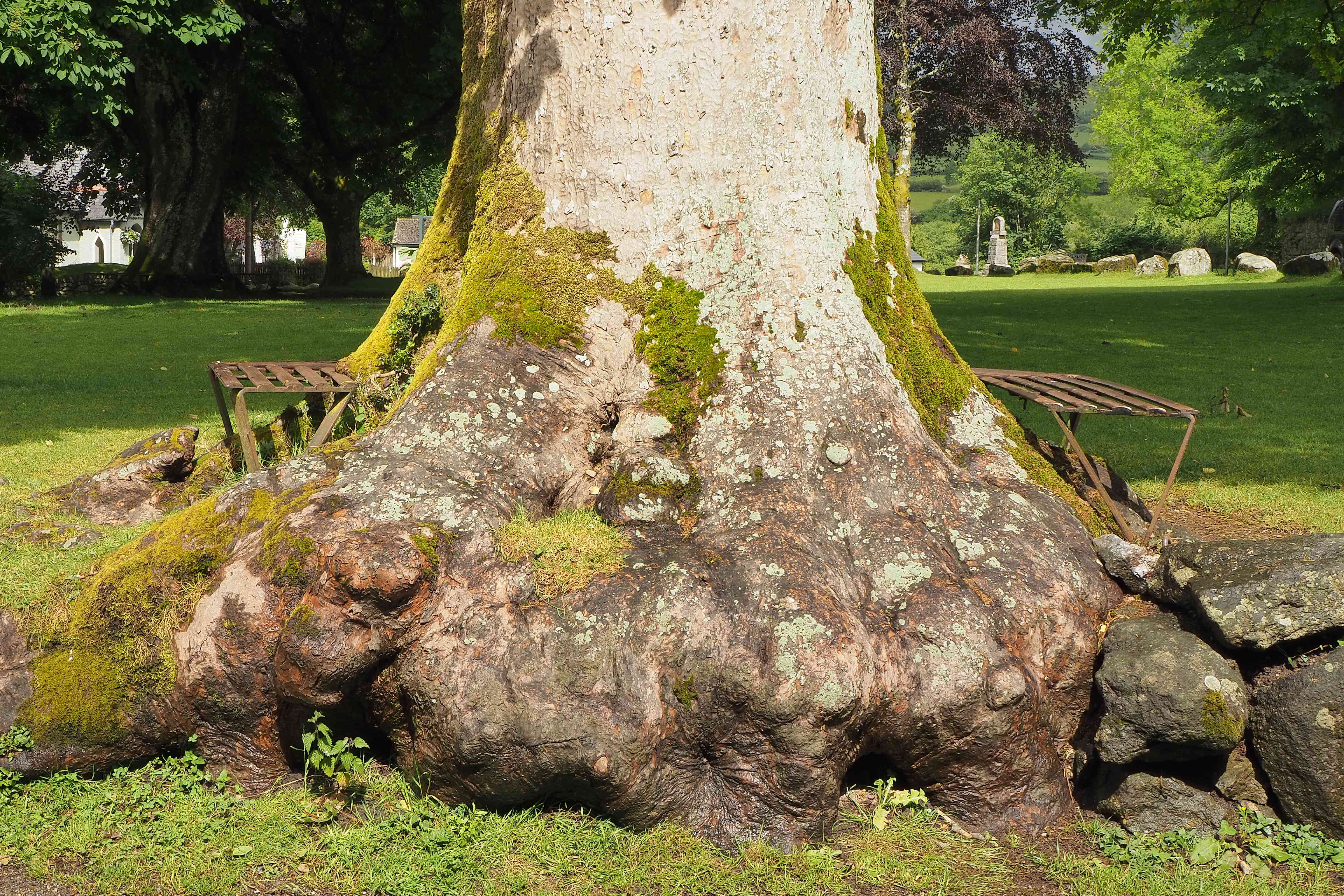
The village of Widecombe has a large sycamore growing on the edge of the green. This tree shows why scyamore (Acer pseudoplatanus) is a good wildlife tree, because it can provide habitat for lichens.
It looks like a perfect place to sit and cotemplate the amazing lichens you can find in Dartmoor.




















































































 Unlocking Landscapes